

IEC 61757-1-1:2020
(Main)Fibre optic sensors - Part 1-1: Strain measurement - Strain sensors based on fibre Bragg gratings
General Information
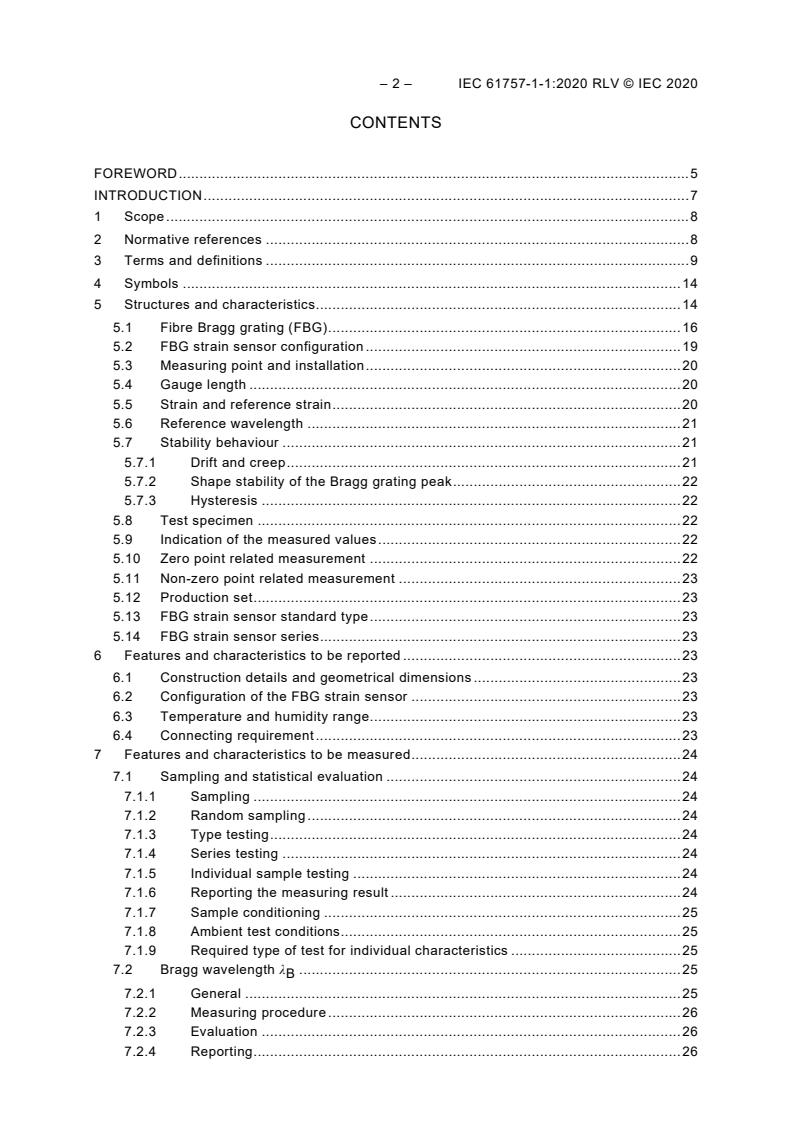
- Abstract
IEC 61757-1-1:2020 defines detail specifications for fibre optic sensors using one or more fibre Bragg gratings (FBG) as the sensitive element for strain measurements. Generic specifications for fibre optic sensors are defined in IEC 61757. This document specifies the most important features and characteristics of a fibre optic sensor for strain measurements, based on use of an FBG as the sensitive element, and defines the procedures for their determination. Furthermore, it specifies basic performance parameters and characteristics of the corresponding measuring instrument to read out the optical signal from the FBG. This document refers to the measurement of static and dynamic strain values in a range of frequencies. A blank detail specification is provided in Annex B. This second edition cancels and replaces the first edition published in 2016. This edition constitutes a technical revision. This edition includes the following technical changes with respect to the previous edition:
- update of cited standards;
- clarification of definitions and test specifications.
- Status
- Published
- Publication Date
- 26-Mar-2020
- Technical Committee
- SC 86C - Fibre optic systems, sensing and active devices
- Drafting Committee
- WG 2 - TC 86/SC 86C/WG 2
- Current Stage
- PPUB - Publication issued
- Start Date
- 27-Mar-2020
- Completion Date
- 10-Apr-2020
Buy Documents
IEC 61757-1-1:2020 RLV - Fibre optic sensors - Part 1-1: Strain measurement - Strain sensors based on fibre Bragg gratings Released:3/27/2020
IEC 61757-1-1:2020 - Fibre optic sensors - Part 1-1: Strain measurement - Strain sensors based on fibre Bragg gratings Released:3/27/2020
Overview
IEC 61757-1-1:2020 - "Fibre optic sensors – Part 1-1: Strain measurement – Strain sensors based on fibre Bragg gratings" is an international standard from the IEC that defines detailed specifications and test procedures for FBG (fibre Bragg grating) based strain sensors. It is the second edition (2020), replacing the 2016 edition, and provides the key performance parameters and measurement methods for both the sensor element and the corresponding FBG measuring instrument used to read out optical signals. The standard covers static and dynamic strain measurement across a range of frequencies and includes a blank detail specification (Annex B) for manufacturer or purchaser use.
Key topics and requirements
- Scope & intent: Defines features, characteristics and test methods specific to FBG strain sensors, building on the generic fibre optic sensor rules in IEC 61757.
- FBG characteristics: Requirements for Bragg wavelength, spectral width, reflectivity and spectral shape (including side-lobes).
- Strain sensitivity & gauge factor: Procedures to determine sensitivity, gauge factor and conversion of wavelength shift to strain.
- Mechanical and installation parameters: Gauge length, measuring point, attachment and minimum operating radius of curvature.
- Performance & environmental limits: Temperature and humidity ranges, temperature‑induced strain response, stability (drift, creep, hysteresis), fatigue behavior, maximum strain range and proof-test/lifetime considerations.
- Measurement and evaluation procedures: Sampling plans (type, series and individual testing), statistical reporting, test set-ups (tensile, bending, fatigue), and requirements for the measuring instrument used to interrogate FBGs.
- Documentation: Annexes include a blank detail specification (Annex B), extended properties (Annex A), polarization effects (Annex C) and applied sensor guidance (Annex D).
Applications and who uses the standard
IEC 61757-1-1:2020 is essential for:
- FBG sensor manufacturers specifying product performance and producing data sheets.
- Calibration and test laboratories conducting type and conformance testing.
- System integrators and end-users in structural health monitoring (bridges, buildings, tunnels), aerospace, automotive, energy (wind, oil & gas), civil engineering and research organizations needing validated strain measurement solutions.
- Procurement teams using the blank detail specification to define contractual sensor requirements.
Practical benefits include consistent, repeatable evaluation of FBG strain sensors, clearer instrument requirements for optical interrogation, and guidance to ensure reliable static and dynamic strain monitoring with traceable test methods.
Related standards
- IEC 61757 (generic specifications for fibre optic sensors) - referenced as the overarching document for fibre optic sensor families.
Relations
- Effective Date
- 05-Sep-2023
Buy Documents
IEC 61757-1-1:2020 RLV - Fibre optic sensors - Part 1-1: Strain measurement - Strain sensors based on fibre Bragg gratings Released:3/27/2020
IEC 61757-1-1:2020 - Fibre optic sensors - Part 1-1: Strain measurement - Strain sensors based on fibre Bragg gratings Released:3/27/2020
Get Certified
Connect with accredited certification bodies for this standard

ANCE
Mexican certification and testing association.

Intertek Slovenia
Intertek testing, inspection, and certification services in Slovenia.

LNE (Laboratoire National de Métrologie et d'Essais)
French national laboratory for metrology and testing.
Sponsored listings
Frequently Asked Questions
IEC 61757-1-1:2020 is a standard published by the International Electrotechnical Commission (IEC). Its full title is "Fibre optic sensors - Part 1-1: Strain measurement - Strain sensors based on fibre Bragg gratings". This standard covers: IEC 61757-1-1:2020 defines detail specifications for fibre optic sensors using one or more fibre Bragg gratings (FBG) as the sensitive element for strain measurements. Generic specifications for fibre optic sensors are defined in IEC 61757. This document specifies the most important features and characteristics of a fibre optic sensor for strain measurements, based on use of an FBG as the sensitive element, and defines the procedures for their determination. Furthermore, it specifies basic performance parameters and characteristics of the corresponding measuring instrument to read out the optical signal from the FBG. This document refers to the measurement of static and dynamic strain values in a range of frequencies. A blank detail specification is provided in Annex B. This second edition cancels and replaces the first edition published in 2016. This edition constitutes a technical revision. This edition includes the following technical changes with respect to the previous edition: - update of cited standards; - clarification of definitions and test specifications.
IEC 61757-1-1:2020 defines detail specifications for fibre optic sensors using one or more fibre Bragg gratings (FBG) as the sensitive element for strain measurements. Generic specifications for fibre optic sensors are defined in IEC 61757. This document specifies the most important features and characteristics of a fibre optic sensor for strain measurements, based on use of an FBG as the sensitive element, and defines the procedures for their determination. Furthermore, it specifies basic performance parameters and characteristics of the corresponding measuring instrument to read out the optical signal from the FBG. This document refers to the measurement of static and dynamic strain values in a range of frequencies. A blank detail specification is provided in Annex B. This second edition cancels and replaces the first edition published in 2016. This edition constitutes a technical revision. This edition includes the following technical changes with respect to the previous edition: - update of cited standards; - clarification of definitions and test specifications.
IEC 61757-1-1:2020 is classified under the following ICS (International Classification for Standards) categories: 33.180.99 - Other fibre optic equipment. The ICS classification helps identify the subject area and facilitates finding related standards.
IEC 61757-1-1:2020 has the following relationships with other standards: It is inter standard links to IEC 61757-1-1:2016. Understanding these relationships helps ensure you are using the most current and applicable version of the standard.
IEC 61757-1-1:2020 is available in PDF format for immediate download after purchase. The document can be added to your cart and obtained through the secure checkout process. Digital delivery ensures instant access to the complete standard document.
Standards Content (Sample)
IEC 61757-1-1 ®
Edition 2.0 2020-03
REDLINE VERSION
INTERNATIONAL
STANDARD
colour
inside
Fibre optic sensors –
Part 1-1: Strain measurement – Strain sensors based on fibre Bragg gratings
All rights reserved. Unless otherwise specified, no part of this publication may be reproduced or utilized in any form
or by any means, electronic or mechanical, including photocopying and microfilm, without permission in writing from
either IEC or IEC's member National Committee in the country of the requester. If you have any questions about IEC
copyright or have an enquiry about obtaining additional rights to this publication, please contact the address below or
your local IEC member National Committee for further information.
IEC Central Office Tel.: +41 22 919 02 11
3, rue de Varembé info@iec.ch
CH-1211 Geneva 20 www.iec.ch
Switzerland
About the IEC
The International Electrotechnical Commission (IEC) is the leading global organization that prepares and publishes
International Standards for all electrical, electronic and related technologies.
About IEC publications
The technical content of IEC publications is kept under constant review by the IEC. Please make sure that you have the
latest edition, a corrigendum or an amendment might have been published.
IEC publications search - webstore.iec.ch/advsearchform Electropedia - www.electropedia.org
The advanced search enables to find IEC publications by a The world's leading online dictionary on electrotechnology,
variety of criteria (reference number, text, technical containing more than 22 000 terminological entries in English
committee,…). It also gives information on projects, replaced and French, with equivalent terms in 16 additional languages.
and withdrawn publications. Also known as the International Electrotechnical Vocabulary
(IEV) online.
IEC Just Published - webstore.iec.ch/justpublished
Stay up to date on all new IEC publications. Just Published IEC Glossary - std.iec.ch/glossary
details all new publications released. Available online and 67 000 electrotechnical terminology entries in English and
once a month by email. French extracted from the Terms and Definitions clause of
IEC publications issued since 2002. Some entries have been
IEC Customer Service Centre - webstore.iec.ch/csc collected from earlier publications of IEC TC 37, 77, 86 and
If you wish to give us your feedback on this publication or CISPR.
need further assistance, please contact the Customer Service
Centre: sales@iec.ch.
IEC 61757-1-1 ®
Edition 2.0 2020-03
REDLINE VERSION
INTERNATIONAL
STANDARD
colour
inside
Fibre optic sensors –
Part 1-1: Strain measurement – Strain sensors based on fibre Bragg gratings
INTERNATIONAL
ELECTROTECHNICAL
COMMISSION
ICS 33.180.99 ISBN 978-2-8322-8092-8
– 2 – IEC 61757-1-1:2020 RLV © IEC 2020
CONTENTS
FOREWORD . 5
INTRODUCTION . 7
1 Scope . 8
2 Normative references . 8
3 Terms and definitions . 9
4 Symbols . 14
5 Structures and characteristics. 14
5.1 Fibre Bragg grating (FBG) . 16
5.2 FBG strain sensor configuration . 19
5.3 Measuring point and installation . 20
5.4 Gauge length . 20
5.5 Strain and reference strain . 20
5.6 Reference wavelength . 21
5.7 Stability behaviour . 21
5.7.1 Drift and creep . 21
5.7.2 Shape stability of the Bragg grating peak . 22
5.7.3 Hysteresis . 22
5.8 Test specimen . 22
5.9 Indication of the measured values . 22
5.10 Zero point related measurement . 22
5.11 Non-zero point related measurement . 23
5.12 Production set . 23
5.13 FBG strain sensor standard type . 23
5.14 FBG strain sensor series . 23
6 Features and characteristics to be reported . 23
6.1 Construction details and geometrical dimensions . 23
6.2 Configuration of the FBG strain sensor . 23
6.3 Temperature and humidity range . 23
6.4 Connecting requirement . 23
7 Features and characteristics to be measured . 24
7.1 Sampling and statistical evaluation . 24
7.1.1 Sampling . 24
7.1.2 Random sampling . 24
7.1.3 Type testing . 24
7.1.4 Series testing . 24
7.1.5 Individual sample testing . 24
7.1.6 Reporting the measuring result . 24
7.1.7 Sample conditioning . 25
7.1.8 Ambient test conditions . 25
7.1.9 Required type of test for individual characteristics . 25
7.2 Bragg wavelength λ . 25
B
7.2.1 General . 25
7.2.2 Measuring procedure . 26
7.2.3 Evaluation . 26
7.2.4 Reporting . 26
7.3 FBG spectral width. 26
7.3.1 Measuring procedure . 26
7.3.2 Evaluation . 27
7.3.3 Reporting . 27
7.4 FBG reflectivity . 27
7.4.1 Measuring procedure . 27
7.4.2 Evaluation . 27
7.4.3 Reporting . 28
7.5 FBG strain sensitivity . 28
7.5.1 General . 28
7.5.2 Tensile test set-up . 29
7.5.3 Measuring procedure tensile test . 29
7.5.4 Evaluation . 30
7.5.5 Reporting . 30
7.6 Gauge factor k . 30
7.6.1 General . 30
7.6.2 Bending test set-up . 30
7.6.3 Measurement procedure . 33
7.6.4 Evaluation . 34
7.6.5 Reporting . 34
7.7 Maximum strain range at room temperature . 34
7.7.1 General . 34
7.7.2 Test set-up . 35
7.7.3 Measuring procedure . 35
7.7.4 Evaluation . 35
7.7.5 Reporting . 36
7.8 Fatigue behaviour . 36
7.8.1 Test set-up . 36
7.8.2 Measuring procedure . 36
7.8.3 Evaluation . 37
7.8.4 Reporting . 37
7.9 Minimum operating radius of curvature . 37
7.9.1 Measuring procedure . 37
7.9.2 Evaluation . 37
7.9.3 Reporting . 37
7.10 Temperature and humidity ranges . 37
7.10.1 General . 37
7.10.2 Measuring procedure . 38
7.10.3 Evaluation . 38
7.10.4 Reporting . 38
7.11 Other environmental influences . 38
7.12 Temperature-induced strain response . 39
7.12.1 General . 39
7.12.2 Test set-up . 39
7.12.3 Measuring procedure . 40
7.12.4 Evaluation . 40
7.12.5 Reporting . 40
7.13 Proof test and lifetime considerations . 40
7.13.1 General . 40
– 4 – IEC 61757-1-1:2020 RLV © IEC 2020
7.13.2 Measuring procedure . 41
7.13.3 Evaluation . 41
7.13.4 Reporting . 42
8 Recommendations for use of FBG measuring instruments . 42
Annex A (normative) Further properties of FBG strain sensors . 43
A.1 General . 43
A.2 Extended explanation of FBG side-lobes for different conditions of use. 43
Annex B (informative) Blank detail specification . 48
B.1 General . 48
B.2 Mechanical setup of the FBG strain sensor . 48
B.3 Operational characteristics of the FBG strain sensor . 48
B.4 Limiting parameters of the FBG strain sensor. 49
B.5 Temperature data of the FBG strain sensor . 49
B.6 Further information of the FBG strain sensor given upon request . 49
B.7 Key performance data of the FBG measuring instrument . 49
Annex C (informative) Polarization effects . 51
Annex D (informative) Applied FBG strain sensors . 52
D.1 General . 52
D.2 Recommended bonding process . 52
Bibliography . 53
Figure 1 – Characteristics of the Bragg grating reflectance spectrum . 11
Figure 2 – Operation principle of a fibre Bragg grating in an optical waveguide . 17
Figure 3 – Example of a reflection spectrum of a fibre Bragg grating array . 18
Figure 4 – Gauge length between two attachment points . 20
Figure 5 – Reflection spectrum of a FBG (calculated (left) and measured spectrum
(right)) . 26
Figure 6 – Determination of R from the FBG reflection spectrum (left, Equation (9))
FBG
and transmission spectrum (right, Equation (10)) . 28
Figure 7 – Example set-up of a tensile test facility . 29
Figure 8 – Test layout for the 4-point bending test with scheme of lateral force and
bending moment curves . 31
Figure 9 – Determination of the strain via displacement measurement . 32
Figure 10 – Whole-surface applied sensor on a bended flexural beam . 33
Figure 11 – Test specimen with applied FBG strain sensor . 36
Figure A.1 – Side-lobes in the case of a single FBG strain sensor . 44
Figure A.2 – Fundamental peaks and detected side-lobe peaks in the case of serially
multiplexed FBGs . 45
Figure A.3 – Spectral peaks in the case of serially multiplexed FBGs . 45
Figure A.4 – Parameters to identify fundamental peaks and side-lobes . 46
Figure A.5 – Identification of fundamental peaks and side-lobes . 47
Table 1 – Required type of test for individual characteristics . 25
INTERNATIONAL ELECTROTECHNICAL COMMISSION
____________
FIBRE OPTIC SENSORS –
Part 1-1: Strain measurement –
Strain sensors based on fibre Bragg gratings
FOREWORD
1) The International Electrotechnical Commission (IEC) is a worldwide organization for standardization comprising
all national electrotechnical committees (IEC National Committees). The object of IEC is to promote international
co-operation on all questions concerning standardization in the electrical and electronic fields. To this end and
in addition to other activities, IEC publishes International Standards, Technical Specifications, Technical Reports,
Publicly Available Specifications (PAS) and Guides (hereafter referred to as “IEC Publication(s)”). Their
preparation is entrusted to technical committees; any IEC National Committee interested in the subject dealt with
may participate in this preparatory work. International, governmental and non-governmental organizations liaising
with the IEC also participate in this preparation. IEC collaborates closely with the International Organization for
Standardization (ISO) in accordance with conditions determined by agreement between the two organizations.
2) The formal decisions or agreements of IEC on technical matters express, as nearly as possible, an international
consensus of opinion on the relevant subjects since each technical committee has representation from all
interested IEC National Committees.
3) IEC Publications have the form of recommendations for international use and are accepted by IEC National
Committees in that sense. While all reasonable efforts are made to ensure that the technical content of IEC
Publications is accurate, IEC cannot be held responsible for the way in which they are used or for any
misinterpretation by any end user.
4) In order to promote international uniformity, IEC National Committees undertake to apply IEC Publications
transparently to the maximum extent possible in their national and regional publications. Any divergence between
any IEC Publication and the corresponding national or regional publication shall be clearly indicated in the latter.
5) IEC itself does not provide any attestation of conformity. Independent certification bodies provide conformity
assessment services and, in some areas, access to IEC marks of conformity. IEC is not responsible for any
services carried out by independent certification bodies.
6) All users should ensure that they have the latest edition of this publication.
7) No liability shall attach to IEC or its directors, employees, servants or agents including individual experts and
members of its technical committees and IEC National Committees for any personal injury, property damage or
other damage of any nature whatsoever, whether direct or indirect, or for costs (including legal fees) and
expenses arising out of the publication, use of, or reliance upon, this IEC Publication or any other IEC
Publications.
8) Attention is drawn to the Normative references cited in this publication. Use of the referenced publications is
indispensable for the correct application of this publication.
9) Attention is drawn to the possibility that some of the elements of this IEC Publication may be the subject of patent
rights. IEC shall not be held responsible for identifying any or all such patent rights.
This redline version of the official IEC Standard allows the user to identify the changes
made to the previous edition. A vertical bar appears in the margin wherever a change has
been made. Additions are in green text, deletions are in strikethrough red text.
– 6 – IEC 61757-1-1:2020 RLV © IEC 2020
International Standard IEC 61757-1-1 has been prepared by subcommittee SC 86C: Fibre optic
systems and active devices, of IEC technical committee 86: Fibre optics.
This second edition cancels and replaces the first edition published in 2016. This edition
constitutes a technical revision.
This edition includes the following technical changes with respect to the previous edition:
a) update of cited standards;
b) clarification of definitions and test specifications.
The text of this International Standard is based on the following documents:
FDIS Report on voting
86C/1642/FDIS 86C/1650/RVD
Full information on the voting for the approval of this International Standard can be found in the
report on voting indicated in the above table.
This document has been drafted in accordance with the ISO/IEC Directives, Part 2.
A list of all parts in the IEC 61757 series, published under the general title Fibre optic sensors,
can be found on the IEC website.
The committee has decided that the contents of this document will remain unchanged until the
stability date indicated on the IEC website under "http://webstore.iec.ch" in the data related to
the specific document. At this date, the document will be
• reconfirmed,
• withdrawn,
• replaced by a revised edition, or
• amended.
IMPORTANT – The 'colour inside' logo on the cover page of this publication indicates
that it contains colours which are considered to be useful for the correct understanding
of its contents. Users should therefore print this document using a colour printer.
INTRODUCTION
It has been decided to restructure the IEC 61757 series, with the following logic. From now on,
the sub-parts will be renumbered as IEC 61757-M-T, where M denotes the measure and T, the
technology.
The existing part IEC 61757-1:2012 will be renumbered as IEC 61757 when it will be revised
as edition 2.0 and will serve as an umbrella document over the entire series.
The IEC 61757 series is published with the following logic: the sub-parts are numbered as
IEC 61757-M-T, where M denotes the measure and T, the technology.
– 8 – IEC 61757-1-1:2020 RLV © IEC 2020
FIBRE OPTIC SENSORS –
Part 1-1: Strain measurement –
Strain sensors based on fibre Bragg gratings
1 Scope
This part of IEC 61757 defines detail specifications for fibre optic sensors using one or more
fibre Bragg gratings (FBG) as the sensitive element for strain measurements. Generic
specifications for fibre optic sensors are defined in IEC 61757-1:2012.
This document specifies the most important features and characteristics of a fibre optic sensor
for strain measurements, based on use of an FBG as the sensitive element, and defines the
procedures for their determination. Furthermore, it specifies basic performance parameters and
characteristics of the corresponding measuring instrument to read out the optical signal from
the FBG. This document refers to the measurement of static and dynamic strain values in a
range of frequencies.
A blank detail specification is provided in Annex B.
2 Normative references
The following documents are referred to in the text in such a way that some or all of their content
constitutes requirements of this document. For dated references, only the edition cited applies.
For undated references, the latest edition of the referenced document (including any
amendments) applies.
IEC 60050 (all parts), International Electrotechnical Vocabulary (available at
www.electropedia.org)
IEC 60068-2 (all parts), Environmental testing – Part 2: Tests
IEC 60793-2, Optical fibres – Part 2: Product specifications – General
IEC 60793-2-50, Optical fibres – Part 2-50: Product specifications – Sectional specification for
class B single-mode fibres
IEC 60874-1, Fibre optic interconnecting devices and passive components – Connectors for
optical fibres and cables – Part 1: Generic specification
IEC 61300-2 (all parts), Fibre optic interconnecting devices and passive components – Basic
test and measurement procedures – Part 2: Tests
IEC 61754 (all parts), Fibre optic interconnecting devices and passive components – Fibre optic
connector interfaces
IEC 61757-1:2012, Fibre optic sensors – Part 1: Generic specification
IEC 61757, Fibre optic sensors – Generic specification
IEC TR 61931, Fibre optic – Terminology
IEC 62129-1, Calibration of wavelength/optical frequency measurement instruments – Part 1:
Optical spectrum analyzers
IEC 62129-2, Calibration of wavelength/optical frequency measurement instruments – Part 2:
Michelson interferometer single wavelength meters
IEC TS 62129-3, Calibration of wavelength/optical frequency measurement instruments – Part 3:
Optical frequency meters using optical frequency combs internally referenced to a frequency
comb
ISO/IEC Guide 99, International vocabulary of metrology – Basic and general concepts and
associated terms (VIM)
3 Terms and definitions
For the purposes of this document, the terms and definitions given in IEC 61757-1:2012,
IEC 61757, IEC 60050 (all parts), IEC TR 61931, ISO/IEC Guide 99 (VIM), and the following
apply.
ISO and IEC maintain terminological databases for use in standardization at the following
addresses:
• ISO Online browsing platform: available at https://www.iso.org/obp
• IEC Electropedia: available at http://www.electropedia.org/
NOTE Long period gratings, non-uniform gratings, angled gratings, and FBG in polarization maintaining fibre are
not considered.
3.1
fibre Bragg grating
FBG
phase diffraction grating integrated in optical single-mode silica-based fibres, according to
category B of IEC 60793-2-50, to selectively reflect a very narrow range of wavelengths while
transmitting others
Note 1 to entry: To achieve this characteristic, periodically spaced zones in the fibre core are altered to have
different refractive indexes slightly higher than the core.
Note 2 to entry: This note applies to the French language only.
3.2
FBG strain sensor
device that uses one or more fibre Bragg gratings (3.1) as a sensitive element for strain
measurements
Note 1 to entry: Different configurations are possible (see 5.2).
3.3
Bragg wavelength
λ λ
B Bref
wavelength of the FBG (3.1), generally corresponding to the Bragg reflection peak or
transmission minimum, without applied strain under reference ambient conditions
Note 1 to entry: If referred to as an FBG strain sensor (see 3.2), it refers to the configuration prior to its installation.
Note 2 to entry: λ is the wavelength of the FBG strain sensor indicated by the manufacturer without any further
B
mechanical and ambient specification.
– 10 – IEC 61757-1-1:2020 RLV © IEC 2020
3.4
reference wavelength
λ
wavelength response of an FBG after installation or at the beginning of measurement to the
affecting loading and ambient conditions
3.5
FBG reflectivity
R
FBG
ratio of the incident optical power P to the reflected optical power P at Bragg wavelength λ
0 λB B
in a defined spectral window
Note 1 to entry: The power transmitted to the FBG strain sensor is less than the incident (input) optical power due
to losses in the fibre at the connector and even in the grating. The definition of the FBG reflectivity should therefore
use the incident optical power P (see the equations in 7.4.2) that represents the measurable part at the connector
of a fibre optic sensor.
Note 2 to entry: P depends on the measurement device and has no absolute characteristic value. From the user’s
point of view, the reflectivity is important if operational or installation conditions exist that influence the reflective
characteristic.
3.6
transmission loss of an FBG sensor
loss of power of the transmitted optical signal passing along the optical fibre, the fibre Bragg
grating and the components to connect an FBG strain sensor outside the FBG spectrum
Note 1 to entry: When considering transmission loss in an FBG sensor configuration, all parts that contribute to the
reduction of power, for example transmission losses due to joining and connecting techniques, have to be considered.
The transmission spectra of the grating can show a reduction of the grating transmissivity due to influences on grating
performance. Such propagation losses in the grating should be considered separately. The entry only applies to
wavelength multiplexed FBG strain sensors double-ended for in-series connection.
3.7
FBG spectral width
full width at half maximum (FWHM) of the reflection peak or transmission minimum at Bragg
wavelength
Note 1 to entry: The FWHM of an FBG spectrum is the wavelength range of the spectrum over which the amplitude
is greater than 50 % (3 dB) of its reflectance maximum value at λ (see Figure 1).
B
Note 2 to entry: This note applies to the French language only.
Key
(1) difference in intensity between Bragg peak and largest side-lobe (called "relative side-lobe level")
(2) recorded spectral distance (see 3.12) from the maximum value of one or both sides of the Bragg wavelength
(3) FBG signal-to-noise ratio SNR for (2)
FBG
Figure 1 – Characteristics of the Bragg grating reflectance spectrum
3.8
side-lobes
reflection peaks aside on each side of the Bragg wavelength peak λ of an FBG spectrum
B
Note 1 to entry: Side-lobes are also called "side modes".
Note 2 to entry: Side-lobes shall be considered according to conditions of use (see Figure 1 and Clause A.2).
Note 3 to entry: To describe the transmission characteristics, the following features should be reported:
– maximum attenuation of the transmission spectrum due to parasitic optic effects (in dB);
– maximum attenuation of the transmission spectrum within the wavelength range λ ± 1 nm.
B
Note 4 to entry: The quality of the wanted signal is expressed by the signal-to-noise ratio (SNR). The wavelength
range reported can deviate from those usually related to the SNR. In this case, it shall be explicitly reported.
3.9
relative side-lobe level
ratio of the maximum value of the amplitude of the specified field component in a side-lobe to
the maximum value in a reference lobe
Note 1 to entry: The reference lobe of an FBG is the peak power at the Bragg wavelength λ ; peak power of the
B
largest side-lobe in the FBG spectrum is the related field component (see Figure 1).
Note 2 to entry: Relative side-lobe level is usually expressed in decibels.
Note 3 to entry: Some manufacturers indicate this term as side-lobe suppression ratio (SLSR).
– 12 – IEC 61757-1-1:2020 RLV © IEC 2020
3.10
width level
relative amplitude difference between a local maximum and a specified amplitude, at which a
spectral feature is evaluated for a two-sided threshold crossing for purposes of defining that
local maximum as either a fundamental peak or as a side-lobe
Note 1 to entry: The width level is applied as an evaluative relative threshold to a local maximum.
Note 2 to entry: Width level is expressed in decibels.
3.11
peak width
width over which a local maximum exhibits a two-sided spectrum crossing over a threshold
defined by the width level parameter
Note 1 to entry: The quantity FBG spectral width is defined as the spectral width of the FBG fundamental mode and
will be equal to or greater than the peak detection algorithm’s peak width requirement when the width level is defined
as 3 dB.
Note 2 to entry: The peak width requirement is applied in conjunction with the width level parameter to distinguish
fundamental peaks from side-lobes in an array spectrum where side-modes may be at an absolute amplitude higher
than adjacent fundamental peaks.
Note 3 to entry: When several sensors are used in a Bragg grating array, special attention shall be paid to the
transmission characteristic. If wavelength multiplexing is used, unintentional signal-crosstalk of the Bragg grating
pulses is possible. The Bragg grating wavelengths shall be designed with a sufficient distance of the Bragg peaks in
the available spectrum to avoid overlapping of the Bragg wavelength. Parasitic reflexions, if relevant, shall be
suppressed.
Note 4 to entry: Peak width is expressed in nanometres.
3.12
FBG signal-to-noise ratio
SNR
FBG
ratio of the maximum amplitude of the Bragg wavelength peak to that of the coexistent side-
lobe amplitude at a wavelength distance of 1 nm under unloaded conditions
Note 1 to entry: SNR shall not be confused with the side-lobes of an FBG caused by the inscription process and
FBG
depending on the grid grating number, grid grating distance Λ and the change in the refractive index of the FBG.
Noise is generated by the measurement device; side-lobes are generated during inscription of the grating and have
great importance for the use of an FBG as strain sensor (see Figure 1 and 3.7).
Note 2 to entry: The value "1 nm" is still valid even if the central wavelength of an FBG is extended to the visible
range.
Note 3 to entry: FBG signal-to-noise ratio is expressed in decibels.
Note 4 to entry: This note applies to the French language only.
3.13
FBG strain sensitivity
ratio of the relative change in wavelength Δλ/λ for a given strain change Δε defined by the
equation
Δλ
1− p Δε
( )
λ
Note 1 to entry: FBG strain sensitivity describes the response of an FBG to uniaxial strain deformation Δε of the
grating area. The strain response is represented by the photo-elastic coefficient p. For practical use, the gauge factor
k is introduced as a linear approximate for (1 − p). In this case, the sensitivity can be considered as a linear function
for a uniformly non-integrated stretched grating area (see 7.6), i.e. only the optical fibre and coating are deformed.
Note 2 to entry: Frequently, this term is defined, for practical reasons, as the peak shift (Δλ in nm) over the
introduced strain change (Δε in μm/m) related to a specified reference wavelength λ .
=
Note 3 to entry: Strain sensitivity can be superimposed by temperature-induced deformation of the optical fibre.
Note 4 to entry: If the strain sensitivity gets a non-linear characteristic because of the set-up of for example a strain
transducer, higher order terms may be used. The calibration function and the parameters have to be defined.
3.14
gauge factor
k
ratio of the relative change in wavelength Δλ/λ to a mechanical strain Δε introduced to an FBG
strain sensor and expressed by the dimensionless gauge factor k measured by the manufacturer
Δλ
λ
k =
ε
Δ
Note 1 to entry: The gauge factor k is used by manufacturers to express the strain response of their products.
Note 2 to entry: The gauge factor k considers all influences of the FBG strain sensor on the strain sensitivity. It can
vary with the selected structural form of the strain sensor (e.g. Bragg grating fibre with special protecting layer or
FBG strain gauge) and therefore has to be distinguished from the strain sensitivity of the Bragg grating in the optical
fibre (see 3.13).
Note 3 to entry: The gauge factor k for an FBG strain sensor assumes a linear characteristic. Considering the whole
measurement system (sensor, device, cabling), it can be separately defined for the components of the measurement
system. It is only valid for defined conditions. In the case of a non-linear characteristic (e.g. by creeping effect in the
strain transfer), the gauge factor k is considered as linear within a defined permissible error.
3.15
gauge length
length within which a strain will cause a change in the measured value of the FBG strain sensor
Note 1 to entry: The gauge length depends on the FBG strain sensor configuration (see 5.2).
3.16
minimum operating radius of curvature
minimum radius that an FBG may be bent without change of the specified performance
parameters
3.17
strain range
maximum strain range that the FBG can measure being when excited according
to the stated mechanical conditions without change of the specified performance parameters
Note 1 to entry: This could include axial tensile strain and compression.
Note 2 to entry: Outside the strain range, the FBG strain sensor may not be physically damaged, but the specified
measurement performance may be affected.
3.18
FBG period
Λ
distance between the periodically varying refractive index zones (grating planes) in the fibre
and expressed by Λ
Note 1 to entry: The FBG period defines the Bragg wavelength (see 3.3) by the equation
k ×λ
BB
Λ =
2× n
eff
where
k = 1, 2, 3
B
– 14 – IEC 61757-1-1:2020 RLV © IEC 2020
3.19
fatigue behaviour
change in sensor properties as a result of sinusoidal load alternation permanent (long-lasting)
alternating stress or permanent stress under reference ambient conditions
Note 1 to entry: The relevant sensor properties specifying fatigue behaviour are the zero point displacement
(see 3.20) and the change in the reflection spectrum of the FBG strain sensor as a function of the number of load
cycles.
3.20
zero point
initial value of a measurement cycle to which all following measurement values are referred
Note 1 to entry: The zero point is also called null set.
Note 2 to entry: The zero point shall be recorded for all types of measurements (static, dynamic). In case of off-line
measurements, where recording devices are switched-off or disconnected, continued measurement shall be referable
to the zero point.
3.21
temperature influence to on an FBG strain sensor
change in Bragg wavelength (3.3) of an FBG strain sensor subject to thermal excitation only
Note 1 to entry: The temperature-induced strain is observed as an apparent strain.
Note 2 to entry: The term "temperature sensitivity" is not used because it refers to temperature measurement,
whereas the characteristic considered here is related to the "temperature compensation" of the signal.
3.22
birefringence
optical property of an optically anisotropic material having orientation-dependent refractive
indices that leads to different propagation velocities of light in different propagation directions
Note 1 to entry: Birefringence is a property of optical materials.
Note 2 to entry: For fibre optic sensors, the term "birefringence" is correctly used when optical fibres with
birefringent property are used, for example PANDA or and bow-tie fibres.
3.23
polarization dependence
dependence of the Bragg wavelength which occurs when transverse loading causes a fibre's
nominally circular cross section to become elliptical with the result of splitting the back-reflected
Bragg spectra into two unequally reflected or transmitted waves which produces a double peak
in the spectra
Note 1 to entry: Polarization dependence of the Bragg wavelength can also occur during the writing of the fibre
Bragg grating if the writing laser is not correctly focused in the centre of the core but is instead focused on one side
in the cladding. In this case, asymmetry in the refractive index of the glass due to asymmetry of the expose is created.
Note 2 to entry: Polarization dependence of Bragg wavelength can also lead to measurement uncertainty of Bragg
wavelength, spectral width and FBG reflectivity.
3.24
signal-crosstalk
wavelength influence when using spectrally adjacent sensors in the wavelength-multiplex
operation
4 Symbols
For the purposes of this document, the following symbols apply.
h thickness of the deformed object of measurement
I optical power intensity of the reference fibre
ref
k gauge factor k
l, L length
L original length of the object of measurement
o
L length of the object of measurement after deformation
L length of the free fibre inside a strain transducer
F
L length between the anchoring points of the FBG strain sensor to the object of
G
measurement (gauge length)
n refractive index of the waveguide
n effective refractive index of the Bragg grating (see 5.1)
eff
p effective photo-elastic constant
ε
p photo-elastic constant
P incident optical power
P optical power of the FBG
λB
R reflectivity of the FBG
FBG
R reflectivity of the FBG reference fibre
ref
s distance of the fibre sensor from the surface of the object of measurement
SNR signal-to-noise ratio of the FBG
FBG
T temperature
mean value
x
th
x
i measured value
i
X physical parameter (e.g. temperature, strain or pressure)
α thermal expansion coefficient of the fibre material
α thermal expansion coefficient of the load-carrying material of the strain gauge
gm
α thermal expansion coefficient of the test sample
sp
Δλ Δλ = λ- λ , FBG peak wavelength shift under the given strain Δε
ε strain (here always observed in the direction of the fibre axis)
ε strain applied to the test sample
a
temperature-induc
...
IEC 61757-1-1 ®
Edition 2.0 2020-03
INTERNATIONAL
STANDARD
NORME
INTERNATIONALE
colour
inside
Fibre optic sensors –
Part 1-1: Strain measurement – Strain sensors based on fibre Bragg gratings
Capteurs fibroniques –
Partie 1-1: Mesure de déformation – Capteurs de déformation basés
sur des réseaux de Bragg à fibres
All rights reserved. Unless otherwise specified, no part of this publication may be reproduced or utilized in any form
or by any means, electronic or mechanical, including photocopying and microfilm, without permission in writing from
either IEC or IEC's member National Committee in the country of the requester. If you have any questions about IEC
copyright or have an enquiry about obtaining additional rights to this publication, please contact the address below or
your local IEC member National Committee for further information.
Droits de reproduction réservés. Sauf indication contraire, aucune partie de cette publication ne peut être reproduite ni
utilisée sous quelque forme que ce soit et par aucun procédé, électronique ou mécanique, y compris la photocopie et
les microfilms, sans l'accord écrit de l'IEC ou du Comité national de l'IEC du pays du demandeur. Si vous avez des
questions sur le copyright de l'IEC ou si vous désirez obtenir des droits supplémentaires sur cette publication, utilisez
les coordonnées ci-après ou contactez le Comité national de l'IEC de votre pays de résidence.
IEC Central Office Tel.: +41 22 919 02 11
3, rue de Varembé info@iec.ch
CH-1211 Geneva 20 www.iec.ch
Switzerland
About the IEC
The International Electrotechnical Commission (IEC) is the leading global organization that prepares and publishes
International Standards for all electrical, electronic and related technologies.
About IEC publications
The technical content of IEC publications is kept under constant review by the IEC. Please make sure that you have the
latest edition, a corrigendum or an amendment might have been published.
IEC publications search - webstore.iec.ch/advsearchform Electropedia - www.electropedia.org
The advanced search enables to find IEC publications by a The world's leading online dictionary on electrotechnology,
variety of criteria (reference number, text, technical containing more than 22 000 terminological entries in English
committee,…). It also gives information on projects, replaced and French, with equivalent terms in 16 additional languages.
and withdrawn publications. Also known as the International Electrotechnical Vocabulary
(IEV) online.
IEC Just Published - webstore.iec.ch/justpublished
Stay up to date on all new IEC publications. Just Published IEC Glossary - std.iec.ch/glossary
details all new publications released. Available online and once 67 000 electrotechnical terminology entries in English and
a month by email. French extracted from the Terms and Definitions clause of IEC
publications issued since 2002. Some entries have been
IEC Customer Service Centre - webstore.iec.ch/csc collected from earlier publications of IEC TC 37, 77, 86 and
If you wish to give us your feedback on this publication or need CISPR.
further assistance, please contact the Customer Service
Centre: sales@iec.ch.
A propos de l'IEC
La Commission Electrotechnique Internationale (IEC) est la première organisation mondiale qui élabore et publie des
Normes internationales pour tout ce qui a trait à l'électricité, à l'électronique et aux technologies apparentées.
A propos des publications IEC
Le contenu technique des publications IEC est constamment revu. Veuillez vous assurer que vous possédez l’édition la
plus récente, un corrigendum ou amendement peut avoir été publié.
Recherche de publications IEC - Le premier dictionnaire d'électrotechnologie en ligne au monde,
webstore.iec.ch/advsearchform avec plus de 22 000 articles terminologiques en anglais et en
La recherche avancée permet de trouver des publications IEC français, ainsi que les termes équivalents dans 16 langues
en utilisant différents critères (numéro de référence, texte, additionnelles. Egalement appelé Vocabulaire
comité d’études,…). Elle donne aussi des informations sur les Electrotechnique International (IEV) en ligne.
projets et les publications remplacées ou retirées.
Glossaire IEC - std.iec.ch/glossary
IEC Just Published - webstore.iec.ch/justpublished 67 000 entrées terminologiques électrotechniques, en anglais
Restez informé sur les nouvelles publications IEC. Just et en français, extraites des articles Termes et Définitions des
Published détaille les nouvelles publications parues. publications IEC parues depuis 2002. Plus certaines entrées
Disponible en ligne et une fois par mois par email. antérieures extraites des publications des CE 37, 77, 86 et
CISPR de l'IEC.
Service Clients - webstore.iec.ch/csc
Si vous désirez nous donner des commentaires sur cette
publication ou si vous avez des questions contactez-nous:
sales@iec.ch.
Electropedia - www.electropedia.org
IEC 61757-1-1 ®
Edition 2.0 2020-03
INTERNATIONAL
STANDARD
NORME
INTERNATIONALE
colour
inside
Fibre optic sensors –
Part 1-1: Strain measurement – Strain sensors based on fibre Bragg gratings
Capteurs fibroniques –
Partie 1-1: Mesure de déformation – Capteurs de déformation basés
sur des réseaux de Bragg à fibres
INTERNATIONAL
ELECTROTECHNICAL
COMMISSION
COMMISSION
ELECTROTECHNIQUE
INTERNATIONALE
ICS 33.180.99 ISBN 978-2-8322-8019-5
– 2 – IEC 61757-1-1:2020 © IEC 2020
CONTENTS
FOREWORD . 5
INTRODUCTION . 7
1 Scope . 8
2 Normative references . 8
3 Terms and definitions . 9
4 Symbols . 14
5 Structures and characteristics. 16
5.1 Fibre Bragg grating (FBG) . 16
5.2 FBG strain sensor configuration . 19
5.3 Measuring point and installation . 19
5.4 Gauge length . 20
5.5 Strain and reference strain . 20
5.6 Reference wavelength . 20
5.7 Stability behaviour . 21
5.7.1 Drift and creep . 21
5.7.2 Shape stability of the Bragg grating peak . 21
5.7.3 Hysteresis . 21
5.8 Test specimen . 22
5.9 Indication of the measured values . 22
5.10 Zero point related measurement . 22
5.11 Non-zero point related measurement . 22
5.12 Production set . 22
5.13 FBG strain sensor standard type . 22
5.14 FBG strain sensor series . 22
6 Features and characteristics to be reported . 23
6.1 Construction details and geometrical dimensions . 23
6.2 Configuration of the FBG strain sensor . 23
6.3 Temperature and humidity range . 23
6.4 Connecting requirement . 23
7 Features and characteristics to be measured . 23
7.1 Sampling and statistical evaluation . 23
7.1.1 Sampling . 23
7.1.2 Random sampling . 23
7.1.3 Type testing . 24
7.1.4 Series testing . 24
7.1.5 Individual sample testing . 24
7.1.6 Reporting the measuring result . 24
7.1.7 Sample conditioning . 24
7.1.8 Ambient test conditions . 24
7.1.9 Required type of test for individual characteristics . 24
7.2 Bragg wavelength λ . 25
B
7.2.1 General . 25
7.2.2 Measuring procedure . 26
7.2.3 Evaluation . 26
7.2.4 Reporting . 26
7.3 FBG spectral width. 26
7.3.1 Measuring procedure . 26
7.3.2 Evaluation . 27
7.3.3 Reporting . 27
7.4 FBG reflectivity . 27
7.4.1 Measuring procedure . 27
7.4.2 Evaluation . 27
7.4.3 Reporting . 27
7.5 FBG strain sensitivity . 28
7.5.1 General . 28
7.5.2 Tensile test set-up . 28
7.5.3 Measuring procedure tensile test . 29
7.5.4 Evaluation . 29
7.5.5 Reporting . 30
7.6 Gauge factor k . 30
7.6.1 General . 30
7.6.2 Bending test set-up . 30
7.6.3 Measurement procedure . 32
7.6.4 Evaluation . 33
7.6.5 Reporting . 34
7.7 Maximum strain range at room temperature . 34
7.7.1 General . 34
7.7.2 Test set-up . 34
7.7.3 Measuring procedure . 34
7.7.4 Evaluation . 34
7.7.5 Reporting . 35
7.8 Fatigue behaviour . 35
7.8.1 Test set-up . 35
7.8.2 Measuring procedure . 35
7.8.3 Evaluation . 36
7.8.4 Reporting . 36
7.9 Minimum operating radius of curvature . 36
7.9.1 Measuring procedure . 36
7.9.2 Evaluation . 36
7.9.3 Reporting . 36
7.10 Temperature and humidity ranges . 37
7.10.1 General . 37
7.10.2 Measuring procedure . 37
7.10.3 Evaluation . 37
7.10.4 Reporting . 38
7.11 Other environmental influences . 38
7.12 Temperature-induced strain response . 38
7.12.1 General . 38
7.12.2 Test set-up . 39
7.12.3 Measuring procedure . 39
7.12.4 Evaluation . 39
7.12.5 Reporting . 39
7.13 Proof test and lifetime considerations . 40
7.13.1 General . 40
– 4 – IEC 61757-1-1:2020 © IEC 2020
7.13.2 Measuring procedure . 40
7.13.3 Evaluation . 41
7.13.4 Reporting . 41
8 Recommendations for use of FBG measuring instruments . 41
Annex A (normative) Further properties of FBG strain sensors . 43
A.1 General . 43
A.2 Extended explanation of FBG side-lobes for different conditions of use. 43
Annex B (informative) Blank detail specification . 48
B.1 General . 48
B.2 Mechanical setup of the FBG strain sensor . 48
B.3 Operational characteristics of the FBG strain sensor . 48
B.4 Limiting parameters of the FBG strain sensor. 49
B.5 Temperature data of the FBG strain sensor . 49
B.6 Further information of the FBG strain sensor given upon request . 49
B.7 Key performance data of the FBG measuring instrument . 49
Annex C (informative) Polarization effects . 51
Annex D (informative) Applied FBG strain sensors . 52
D.1 General . 52
D.2 Recommended bonding process . 52
Bibliography . 53
Figure 1 – Characteristics of the Bragg grating reflectance spectrum . 11
Figure 2 – Operation principle of a fibre Bragg grating in an optical waveguide . 17
Figure 3 – Example of a reflection spectrum of a fibre Bragg grating array . 18
Figure 4 – Gauge length between two attachment points . 19
Figure 5 – Reflection spectrum of a FBG (calculated (left) and measured spectrum
(right)) . 25
Figure 6 – Determination of R from the FBG reflection spectrum (left, Equation (9))
FBG
and transmission spectrum (right, Equation (10)) . 27
Figure 7 – Example set-up of a tensile test facility . 29
Figure 8 – Test layout for the 4-point bending test with scheme of lateral force and
bending moment curves . 31
Figure 9 – Determination of the strain via displacement measurement . 31
Figure 10 – Whole-surface applied sensor on a bended flexural beam . 32
Figure 11 – Test specimen with applied FBG strain sensor . 36
Figure A.1 – Side-lobes in the case of a single FBG strain sensor . 44
Figure A.2 – Fundamental peaks and detected side-lobe peaks in the case of serially
multiplexed FBGs . 45
Figure A.3 – Spectral peaks in the case of serially multiplexed FBGs . 45
Figure A.4 – Parameters to identify fundamental peaks and side-lobes . 46
Figure A.5 – Identification of fundamental peaks and side-lobes . 47
Table 1 – Required type of test for individual characteristics . 25
INTERNATIONAL ELECTROTECHNICAL COMMISSION
____________
FIBRE OPTIC SENSORS –
Part 1-1: Strain measurement –
Strain sensors based on fibre Bragg gratings
FOREWORD
1) The International Electrotechnical Commission (IEC) is a worldwide organization for standardization comprising
all national electrotechnical committees (IEC National Committees). The object of IEC is to promote international
co-operation on all questions concerning standardization in the electrical and electronic fields. To this end and
in addition to other activities, IEC publishes International Standards, Technical Specifications, Technical Reports,
Publicly Available Specifications (PAS) and Guides (hereafter referred to as “IEC Publication(s)”). Their
preparation is entrusted to technical committees; any IEC National Committee interested in the subject dealt with
may participate in this preparatory work. International, governmental and non-governmental organizations liaising
with the IEC also participate in this preparation. IEC collaborates closely with the International Organization for
Standardization (ISO) in accordance with conditions determined by agreement between the two organizations.
2) The formal decisions or agreements of IEC on technical matters express, as nearly as possible, an international
consensus of opinion on the relevant subjects since each technical committee has representation from all
interested IEC National Committees.
3) IEC Publications have the form of recommendations for international use and are accepted by IEC National
Committees in that sense. While all reasonable efforts are made to ensure that the technical content of IEC
Publications is accurate, IEC cannot be held responsible for the way in which they are used or for any
misinterpretation by any end user.
4) In order to promote international uniformity, IEC National Committees undertake to apply IEC Publications
transparently to the maximum extent possible in their national and regional publications. Any divergence between
any IEC Publication and the corresponding national or regional publication shall be clearly indicated in the latter.
5) IEC itself does not provide any attestation of conformity. Independent certification bodies provide conformity
assessment services and, in some areas, access to IEC marks of conformity. IEC is not responsible for any
services carried out by independent certification bodies.
6) All users should ensure that they have the latest edition of this publication.
7) No liability shall attach to IEC or its directors, employees, servants or agents including individual experts and
members of its technical committees and IEC National Committees for any personal injury, property damage or
other damage of any nature whatsoever, whether direct or indirect, or for costs (including legal fees) and
expenses arising out of the publication, use of, or reliance upon, this IEC Publication or any other IEC
Publications.
8) Attention is drawn to the Normative references cited in this publication. Use of the referenced publications is
indispensable for the correct application of this publication.
9) Attention is drawn to the possibility that some of the elements of this IEC Publication may be the subject of patent
rights. IEC shall not be held responsible for identifying any or all such patent rights.
International Standard IEC 61757-1-1 has been prepared by subcommittee SC 86C: Fibre optic
systems and active devices, of IEC technical committee 86: Fibre optics.
This second edition cancels and replaces the first edition published in 2016. This edition
constitutes a technical revision.
This edition includes the following technical changes with respect to the previous edition:
a) update of cited standards;
b) clarification of definitions and test specifications.
– 6 – IEC 61757-1-1:2020 © IEC 2020
The text of this International Standard is based on the following documents:
FDIS Report on voting
86C/1642/FDIS 86C/1650/RVD
Full information on the voting for the approval of this International Standard can be found in the
report on voting indicated in the above table.
This document has been drafted in accordance with the ISO/IEC Directives, Part 2.
A list of all parts in the IEC 61757 series, published under the general title Fibre optic sensors,
can be found on the IEC website.
The committee has decided that the contents of this document will remain unchanged until the
stability date indicated on the IEC website under "http://webstore.iec.ch" in the data related to
the specific document. At this date, the document will be
• reconfirmed,
• withdrawn,
• replaced by a revised edition, or
• amended.
IMPORTANT – The 'colour inside' logo on the cover page of this publication indicates
that it contains colours which are considered to be useful for the correct understanding
of its contents. Users should therefore print this document using a colour printer.
INTRODUCTION
The IEC 61757 series is published with the following logic: the sub-parts are numbered as
IEC 61757-M-T, where M denotes the measure and T, the technology.
– 8 – IEC 61757-1-1:2020 © IEC 2020
FIBRE OPTIC SENSORS –
Part 1-1: Strain measurement –
Strain sensors based on fibre Bragg gratings
1 Scope
This part of IEC 61757 defines detail specifications for fibre optic sensors using one or more
fibre Bragg gratings (FBG) as the sensitive element for strain measurements. Generic
specifications for fibre optic sensors are defined in IEC 61757.
This document specifies the most important features and characteristics of a fibre optic sensor
for strain measurements, based on use of an FBG as the sensitive element, and defines the
procedures for their determination. Furthermore, it specifies basic performance parameters and
characteristics of the corresponding measuring instrument to read out the optical signal from
the FBG. This document refers to the measurement of static and dynamic strain values in a
range of frequencies.
A blank detail specification is provided in Annex B.
2 Normative references
The following documents are referred to in the text in such a way that some or all of their content
constitutes requirements of this document. For dated references, only the edition cited applies.
For undated references, the latest edition of the referenced document (including any
amendments) applies.
IEC 60050 (all parts), International Electrotechnical Vocabulary (available at
www.electropedia.org)
IEC 60068-2 (all parts), Environmental testing – Part 2: Tests
IEC 60793-2, Optical fibres – Part 2: Product specifications – General
IEC 60793-2-50, Optical fibres – Part 2-50: Product specifications – Sectional specification for
class B single-mode fibres
IEC 61300-2 (all parts), Fibre optic interconnecting devices and passive components – Basic
test and measurement procedures – Part 2: Tests
IEC 61754 (all parts), Fibre optic interconnecting devices and passive components – Fibre optic
connector interfaces
IEC 61757, Fibre optic sensors – Generic specification
IEC TR 61931, Fibre optic – Terminology
IEC 62129-1, Calibration of wavelength/optical frequency measurement instruments – Part 1:
Optical spectrum analyzers
IEC 62129-2, Calibration of wavelength/optical frequency measurement instruments – Part 2:
Michelson interferometer single wavelength meters
IEC 62129-3, Calibration of wavelength/optical frequency measurement instruments – Part 3:
Optical frequency meters internally referenced to a frequency comb
ISO/IEC Guide 99, International vocabulary of metrology – Basic and general concepts and
associated terms (VIM)
3 Terms and definitions
For the purposes of this document, the terms and definitions given in IEC 61757, IEC 60050 (all
parts), IEC TR 61931, ISO/IEC Guide 99 (VIM), and the following apply.
ISO and IEC maintain terminological databases for use in standardization at the following
addresses:
• ISO Online browsing platform: available at https://www.iso.org/obp
• IEC Electropedia: available at http://www.electropedia.org/
NOTE Long period gratings, non-uniform gratings, angled gratings, and FBG in polarization maintaining fibre are
not considered.
3.1
fibre Bragg grating
FBG
phase diffraction grating integrated in optical single-mode silica-based fibres, according to
category B of IEC 60793-2-50, to selectively reflect a very narrow range of wavelengths while
transmitting others
Note 1 to entry: To achieve this characteristic, periodically spaced zones in the fibre core are altered to have
different refractive indexes slightly higher than the core.
Note 2 to entry: This note applies to the French language only.
3.2
FBG strain sensor
device that uses one or more fibre Bragg gratings (3.1) as a sensitive element for strain
measurements
Note 1 to entry: Different configurations are possible (see 5.2).
3.3
Bragg wavelength
λ
Bref
wavelength of the FBG (3.1), generally corresponding to the Bragg reflection peak or
transmission minimum, without applied strain under reference ambient conditions
Note 1 to entry: If referred to as an FBG strain sensor (see 3.2), it refers to the configuration prior to its installation.
Note 2 to entry: λ is the wavelength of the FBG strain sensor indicated by the manufacturer without any further
B
mechanical and ambient specification.
3.4
reference wavelength
λ
wavelength response of an FBG after installation or at the beginning of measurement to the
affecting loading and ambient conditions
– 10 – IEC 61757-1-1:2020 © IEC 2020
3.5
FBG reflectivity
R
FBG
ratio of the incident optical power P to the reflected optical power P at Bragg wavelength λ
0 λB B
in a defined spectral window
Note 1 to entry: The power transmitted to the FBG strain sensor is less than the incident (input) optical power due
to losses in the fibre at the connector and even in the grating. The definition of the FBG reflectivity should therefore
use the incident optical power P (see the equations in 7.4.2) that represents the measurable part at the connector
of a fibre optic sensor.
Note 2 to entry: P depends on the measurement device and has no absolute characteristic value. From the user’s
point of view, the reflectivity is important if operational or installation conditions exist that influence the reflective
characteristic.
3.6
transmission loss of an FBG sensor
loss of power of the transmitted optical signal passing along the optical fibre, the fibre Bragg
grating and the components to connect an FBG strain sensor outside the FBG spectrum
Note 1 to entry: When considering transmission loss in an FBG sensor configuration, all parts that contribute to the
reduction of power, for example transmission losses due to joining and connecting techniques, have to be considered.
The transmission spectra of the grating can show a reduction of the grating transmissivity due to influences on grating
performance. Such propagation losses in the grating should be considered separately. The entry only applies to
wavelength multiplexed FBG strain sensors double-ended for in-series connection.
3.7
FBG spectral width
full width at half maximum (FWHM) of the reflection peak or transmission minimum at Bragg
wavelength
Note 1 to entry: The FWHM of an FBG spectrum is the wavelength range of the spectrum over which the amplitude
is greater than 50 % (3 dB) of its reflectance maximum value at λ (see Figure 1).
B
Note 2 to entry: This note applies to the French language only.
Key
(1) difference in intensity between Bragg peak and largest side-lobe (called "relative side-lobe level")
(2) recorded spectral distance (see 3.12) from the maximum value of one or both sides of the Bragg wavelength
(3) FBG signal-to-noise ratio SNR for (2)
FBG
Figure 1 – Characteristics of the Bragg grating reflectance spectrum
3.8
side-lobes
reflection peaks on each side of the Bragg wavelength peak λ
B
Note 1 to entry: Side-lobes are also called "side modes".
Note 2 to entry: Side-lobes shall be considered according to conditions of use (see Figure 1 and Clause A.2).
Note 3 to entry: To describe the transmission characteristics, the following features should be reported:
– maximum attenuation of the transmission spectrum due to parasitic optic effects (in dB);
– maximum attenuation of the transmission spectrum within the wavelength range λ ± 1 nm.
B
Note 4 to entry: The quality of the wanted signal is expressed by the signal-to-noise ratio (SNR). The wavelength
range reported can deviate from those usually related to the SNR. In this case, it shall be explicitly reported.
3.9
relative side-lobe level
ratio of the maximum value of the amplitude of the specified field component in a side-lobe to
the maximum value in a reference lobe
Note 1 to entry: The reference lobe of an FBG is the peak power at the Bragg wavelength λ ; peak power of the
B
largest side-lobe in the FBG spectrum is the related field component (see Figure 1).
Note 2 to entry: Relative side-lobe level is usually expressed in decibels.
Note 3 to entry: Some manufacturers indicate this term as side-lobe suppression ratio (SLSR).
– 12 – IEC 61757-1-1:2020 © IEC 2020
3.10
width level
relative amplitude difference between a local maximum and a specified amplitude, at which a
spectral feature is evaluated for a two-sided threshold crossing for purposes of defining that
local maximum as either a fundamental peak or as a side-lobe
Note 1 to entry: The width level is applied as an evaluative relative threshold to a local maximum.
Note 2 to entry: Width level is expressed in decibels.
3.11
peak width
width over which a local maximum exhibits a two-sided spectrum crossing over a threshold
defined by the width level parameter
Note 1 to entry: The quantity FBG spectral width is defined as the spectral width of the FBG fundamental mode and
will be equal to or greater than the peak detection algorithm’s peak width requirement when the width level is defined
as 3 dB.
Note 2 to entry: The peak width requirement is applied in conjunction with the width level parameter to distinguish
fundamental peaks from side-lobes in an array spectrum where side-modes may be at an absolute amplitude higher
than adjacent fundamental peaks.
Note 3 to entry: When several sensors are used in a Bragg grating array, special attention shall be paid to the
transmission characteristic. If wavelength multiplexing is used, unintentional signal-crosstalk of the Bragg grating
pulses is possible. The Bragg grating wavelengths shall be designed with a sufficient distance of the Bragg peaks in
the available spectrum to avoid overlapping of the Bragg wavelength. Parasitic reflexions, if relevant, shall be
suppressed.
Note 4 to entry: Peak width is expressed in nanometres.
3.12
FBG signal-to-noise ratio
SNR
FBG
ratio of the maximum amplitude of the Bragg wavelength peak to that of the coexistent side-
lobe amplitude at a wavelength distance of 1 nm under unloaded conditions
Note 1 to entry: SNR shall not be confused with the side-lobes of an FBG caused by the inscription process and
FBG
depending on the grating number, grating distance Λ and the change in the refractive index of the FBG. Noise is
generated by the measurement device; side-lobes are generated during inscription of the grating and have great
importance for the use of an FBG as strain sensor (see Figure 1 and 3.7).
Note 2 to entry: The value "1 nm" is still valid even if the central wavelength of an FBG is extended to the visible
range.
Note 3 to entry: FBG signal-to-noise ratio is expressed in decibels.
Note 4 to entry: This note applies to the French language only.
3.13
FBG strain sensitivity
ratio of the relative change in wavelength Δλ/λ for a given strain change Δε defined by the
equation
Δλ
1− p Δε
( )
λ
Note 1 to entry: FBG strain sensitivity describes the response of an FBG to uniaxial strain deformation Δε of the
grating area. The strain response is represented by the photo-elastic coefficient p. For practical use, the gauge factor
k is introduced as a linear approximate for (1 − p). In this case, the sensitivity can be considered as a linear function
for a uniformly non-integrated stretched grating area (see 7.6), i.e. only the optical fibre and coating are deformed.
Note 2 to entry: Frequently, this term is defined, for practical reasons, as the peak shift (Δλ in nm) over the
introduced strain change (Δε in μm/m) related to a specified reference wavelength λ .
=
Note 3 to entry: Strain sensitivity can be superimposed by temperature-induced deformation of the optical fibre.
Note 4 to entry: If the strain sensitivity gets a non-linear characteristic because of the set-up of for example a strain
transducer, higher order terms may be used. The calibration function and the parameters have to be defined.
3.14
gauge factor
k
ratio of the relative change in wavelength Δλ/λ to a mechanical strain Δε introduced to an FBG
strain sensor and expressed by the dimensionless gauge factor k measured by the manufacturer
Δλ
λ
k=
Δε
Note 1 to entry: The gauge factor k is used by manufacturers to express the strain response of their products.
Note 2 to entry: The gauge factor k considers all influences of the FBG strain sensor on the strain sensitivity. It can
vary with the selected structural form of the strain sensor (e.g. Bragg grating fibre with special protecting layer or
FBG strain gauge) and therefore has to be distinguished from the strain sensitivity of the Bragg grating in the optical
fibre (see 3.13).
Note 3 to entry: The gauge factor k for an FBG strain sensor assumes a linear characteristic. Considering the whole
measurement system (sensor, device, cabling), it can be separately defined for the components of the measurement
system. It is only valid for defined conditions. In the case of a non-linear characteristic (e.g. by creeping effect in the
strain transfer), the gauge factor k is considered as linear within a defined permissible error.
3.15
gauge length
length within which a strain will cause a change in the measured value of the FBG strain sensor
Note 1 to entry: The gauge length depends on the FBG strain sensor configuration (see 5.2).
3.16
minimum operating radius of curvature
minimum radius that an FBG may be bent without change of the specified performance
parameters
3.17
strain range
maximum strain range that the FBG can measure when excited according to the
stated mechanical conditions without change of the specified performance parameters
Note 1 to entry: This could include axial tensile strain and compression.
Note 2 to entry: Outside the strain range, the FBG strain sensor may not be physically damaged, but the specified
measurement performance may be affected.
3.18
FBG period
Λ
distance between the periodically varying refractive index zones (grating planes) in the fibre
and expressed by Λ
Note 1 to entry: The FBG period defines the Bragg wavelength (see 3.3) by the equation
k ×λ
BB
Λ=
2× n
eff
where
k = 1, 2, 3
B
– 14 – IEC 61757-1-1:2020 © IEC 2020
3.19
fatigue behaviour
change in sensor properties as a result of permanent (long-lasting) alternating stress or
permanent stress under reference ambient conditions
Note 1 to entry: The relevant sensor properties specifying fatigue behaviour are the zero point displacement
(see 3.20) and the change in the reflection spectrum of the FBG strain sensor as a function of the number of load
cycles.
3.20
zero point
initial value of a measurement cycle to which all following measurement values are referred
Note 1 to entry: The zero point is also called null set.
Note 2 to entry: The zero point shall be recorded for all types of measurements (static, dynamic). In case of off-line
measurements, where recording devices are switched-off or disconnected, continued measurement shall be referable
to the zero point.
3.21
temperature influence on an FBG strain sensor
change in Bragg wavelength (3.3) of an FBG strain sensor subject to thermal excitation only
Note 1 to entry: The temperature-induced strain is observed as an apparent strain.
Note 2 to entry: The term "temperature sensitivity" is not used because it refers to temperature measurement,
whereas the characteristic considered here is related to the "temperature compensation" of the signal.
3.22
birefringence
optical property of an optically anisotropic material having orientation-dependent refractive
indices that leads to different propagation velocities of light in different propagation directions
Note 1 to entry: Birefringence is a property of optical materials.
Note 2 to entry: For fibre optic sensors, the term "birefringence" is correctly used when optical fibres with
birefringent property are used, for example PANDA and bow-tie fibres.
3.23
polarization dependence
dependence of the Bragg wavelength which occurs when transverse loading causes a fibre's
nominally circular cross section to become elliptical with the result of splitting the back-reflected
Bragg spectra into two unequally reflected or transmitted waves which produces a double peak
in the spectra
Note 1 to entry: Polarization dependence of the Bragg wavelength can also occur during the writing of the fibre
Bragg grating if the writing laser is not correctly focused in the centre of the core but is instead focused on one side
in the cladding. In this case, asymmetry in the refractive index of the glass due to asymmetry of the expose is created.
Note 2 to entry: Polarization depend
...