


IEC TS 61400-13:2001
(Main)Wind turbine generator systems - Part 13: Measurement of mechanical loads
General Information
- Abstract
Acts as a guide for carrying out measurements used for verification of codes and for direct determination of the structural loading. Focuses mainly on large electricity generating horizontal axis wind turbines.
This publication is of high relevance for Smart Grid.
- Status
- Replaced
- Publication Date
- 27-Jun-2001
- Technical Committee
- TC 88 - Wind energy generation systems
- Current Stage
- DELPUB - Deleted Publication
- Start Date
- 21-Dec-2015
- Completion Date
- 28-Aug-2026

Relations
- Replaced By
IEC 61400-13:2015/AMD1:2021 - Amendment 1 - Wind turbines - Part 13: Measurement of mechanical loads - Effective Date
- 31-May-2024
- Effective Date
- 31-May-2024
Get Certified
Connect with accredited certification bodies for this standard

DNV
DNV is an independent assurance and risk management provider.

Lloyd's Register
Lloyd's Register is a global professional services organisation specialising in engineering and technology.
DNV Energy Systems
Energy and renewable energy certification.
Sponsored listings
Frequently Asked Questions
IEC TS 61400-13:2001 is a technical specification published by the International Electrotechnical Commission (IEC). Its full title is "Wind turbine generator systems - Part 13: Measurement of mechanical loads". This standard covers: Acts as a guide for carrying out measurements used for verification of codes and for direct determination of the structural loading. Focuses mainly on large electricity generating horizontal axis wind turbines. This publication is of high relevance for Smart Grid.
Acts as a guide for carrying out measurements used for verification of codes and for direct determination of the structural loading. Focuses mainly on large electricity generating horizontal axis wind turbines. This publication is of high relevance for Smart Grid.
IEC TS 61400-13:2001 is classified under the following ICS (International Classification for Standards) categories: 27.180 - Wind turbine energy systems. The ICS classification helps identify the subject area and facilitates finding related standards.
IEC TS 61400-13:2001 has the following relationships with other standards: It is inter standard links to IEC 61400-13:2015/AMD1:2021, IEC 61400-13:2015. Understanding these relationships helps ensure you are using the most current and applicable version of the standard.
IEC TS 61400-13:2001 is available in PDF format for immediate download after purchase. The document can be added to your cart and obtained through the secure checkout process. Digital delivery ensures instant access to the complete standard document.
Standards Content (Sample)
TECHNICAL IEC
SPECIFICATION
TS 61400-13
First edition
2001-06
Wind turbine generator systems –
Part 13:
Measurement of mechanical loads
Aérogénérateurs –
Partie 13: Mesure des charges mécaniques
Reference number
IEC/TS 61400-13:2001(E)
Publication numbering
As from 1 January 1997 all IEC publications are issued with a designation in the
60000 series. For example, IEC 34-1 is now referred to as IEC 60034-1.
Consolidated editions
The IEC is now publishing consolidated versions of its publications. For example,
edition numbers 1.0, 1.1 and 1.2 refer, respectively, to the base publication, the
base publication incorporating amendment 1 and the base publication incorporating
amendments 1 and 2.
Further information on IEC publications
The technical content of IEC publications is kept under constant review by the IEC,
thus ensuring that the content reflects current technology. Information relating to
this publication, including its validity, is available in the IEC Catalogue of
publications (see below) in addition to new editions, amendments and corrigenda.
Information on the subjects under consideration and work in progress undertaken
by the technical committee which has prepared this publication, as well as the list
of publications issued, is also available from the following:
• IEC Web Site (www.iec.ch)
• Catalogue of IEC publications
The on-line catalogue on the IEC web site (www.iec.ch/catlg-e.htm) enables
you to search by a variety of criteria including text searches, technical
committees and date of publication. On-line information is also available on
recently issued publications, withdrawn and replaced publications, as well as
corrigenda.
• IEC Just Published
This summary of recently issued publications (www.iec.ch/JP.htm) is also
available by email. Please contact the Customer Service Centre (see below) for
further information.
• Customer Service Centre
If you have any questions regarding this publication or need further assistance,
please contact the Customer Service Centre:
Email: custserv@iec.ch
Tel: +41 22 919 02 11
Fax: +41 22 919 03 00
TECHNICAL IEC
SPECIFICATION
TS 61400-13
First edition
2001-06
Wind turbine generator systems –
Part 13:
Measurement of mechanical loads
Aérogénérateurs –
Partie 13: Mesure des charges mécaniques
IEC 2001 Copyright - all rights reserved
No part of this publication may be reproduced or utilized in any form or by any means, electronic or
mechanical, including photocopying and microfilm, without permission in writing from the publisher.
International Electrotechnical Commission 3, rue de Varembé Geneva, Switzerland
Telefax: +41 22 919 0300 e-mail: inmail@iec.ch IEC web site http://www.iec.ch
Commission Electrotechnique Internationale
PRICE CODE
XB
International Electrotechnical Commission
For price, see current catalogue
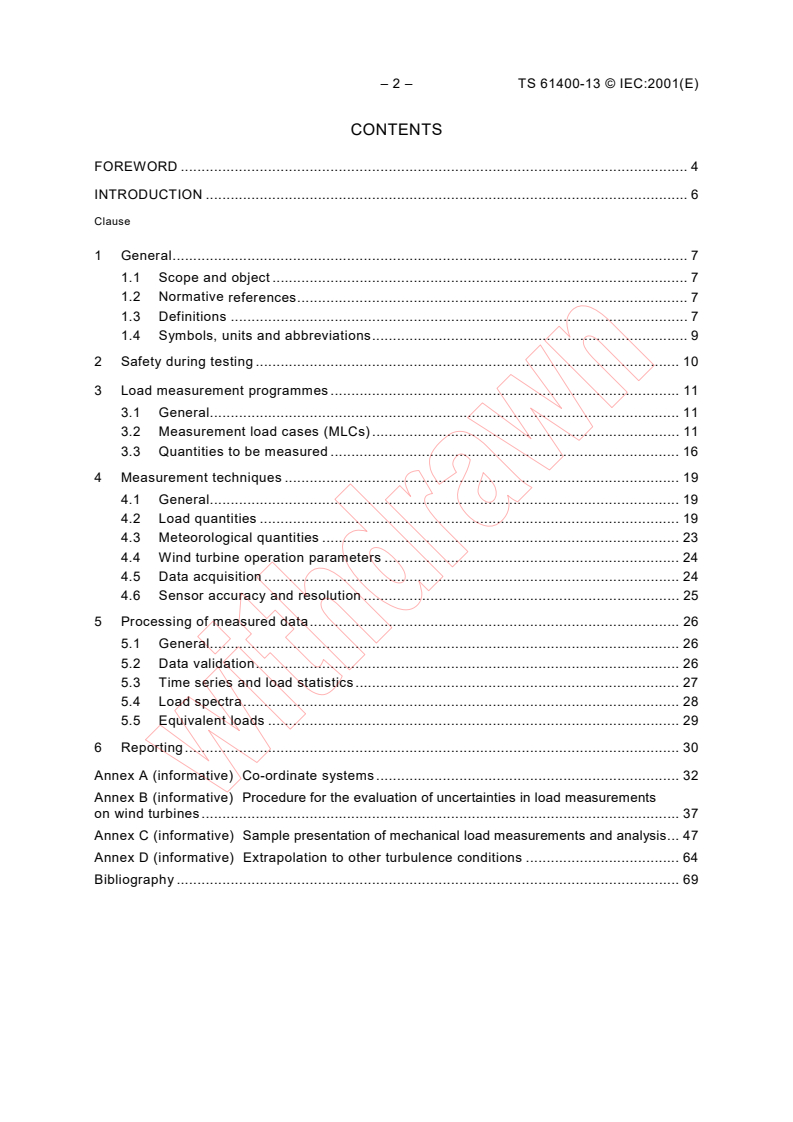
– 2 – TS 61400-13 © IEC:2001(E)
CONTENTS
FOREWORD . 4
INTRODUCTION .6
Clause
1 General. 7
1.1 Scope and object . 7
1.2 Normative references. 7
1.3 Definitions . 7
1.4 Symbols, units and abbreviations. 9
2 Safety during testing . 10
3 Load measurement programmes . 11
3.1 General. 11
3.2 Measurement load cases (MLCs). 11
3.3 Quantities to be measured . 16
4 Measurement techniques . 19
4.1 General. 19
4.2 Load quantities . 19
4.3 Meteorological quantities . 23
4.4 Wind turbine operation parameters . 24
4.5 Data acquisition . 24
4.6 Sensor accuracy and resolution . 25
5 Processing of measured data. 26
5.1 General. 26
5.2 Data validation. 26
5.3 Time series and load statistics . 27
5.4 Load spectra. 28
5.5 Equivalent loads . 29
6 Reporting. 30
Annex A (informative) Co-ordinate systems. 32
Annex B (informative) Procedure for the evaluation of uncertainties in load measurements
on wind turbines . 37
Annex C (informative) Sample presentation of mechanical load measurements and analysis. 47
Annex D (informative) Extrapolation to other turbulence conditions . 64
Bibliography . 69
TS 61400-13 © IEC:2001(E) – 3 –
Figure 1 – Fundamental wind turbine loads: tower base, tower top, rotor and blades. 18
Figure A.1 – Blade co-ordinate system . 32
Figure A.2 – Hub co-ordinate system. 33
Figure A.3 – Nacelle co-ordinate system . 33
Figure A.4 – Tower co-ordinate system . 34
Figure A.5 – Yaw misalignment . 35
Figure A.6 – Cone angle and tilt angle. 35
Figure C.1 – Meteorological quantities record time series. 49
Figure C.2 – Wind turbine operational quantities record time series . 50
Figure C.3 – Wind turbine mechanical load time series (first minute of record) . 51
Figure C.4 – Wind turbine mechanical load time series (first minute of record) . 52
Figure C.5 – Azimuthal variation of blade and shaft loads . 53
Figure C.6 – Frequency spectral density functions for blade, rotor and tower loads . 54
Figure C.7 – Fatigue spectra for blade, rotor and tower loads. 55
Figure C.8 – Meteorological quantities statistics. 56
Figure C.9 – Wind turbine operational quantities statistics
.................................................... 57
Figure C.10 – Blade-root flapwise and lead-lag bending-moment statistics. 58
Figure C.11 – Rotor mechanical load statistics . 59
Figure C.12 – Tower load statistics
...................................................................................... 60
Figure C.13 – Fatigue equivalent loads for blade root bending moments and shaft torque . 61
Figure C.14 – Fatigue equivalent loads for rotor yaw and tilt moments and tower torsion
...... 62
Figure C.15 – Fatigue equivalent loads for tower base bending moment
............................... 63
Figure D.1 – Linear extrapolation of fatigue spectra to higher turbulence intensity levels. 65
Figure D.2 – Turbulence intensity versus wind speed . 67
Figure D.3 – Mean amplitude (1st statistical moment) of flap-bending moment
versus wind speed. 67
Figure D.4 – Coefficient of variation (2nd statistical moment) of flap-bending moment
versus wind speed. 68
Figure D.5 – Skewness (3rd statistical moment) of flap-bending moment versus wind speed . 68
Figure D.6 – Measured and extrapolated spectra of flap-bending moment ranges . 68
Table 1 – MLCs during steady-state operation related to the DLCs defined in IEC 61400-1. 12
Table 2 – Measurement of transient load cases related to the DLCs defined in IEC 61400-1. 13
Table 3 – Capture matrix for normal power production. 14
Table 4 – Capture matrix for power production plus occurrence of fault . 15
Table 5 – Capture matrix for parked condition . 15
Table 6 – Capture matrix for normal transient events. 15
Table 7 – Capture matrix for other than normal transient events. 16
Table 8 – Wind turbine fundamental load quantities. 16
Table 9 – Meteorological quantities . 17
Table 10 – Wind turbine operation quantities. 17
Table 11 – Target standard uncertainties for the various non-load quantities. 25
Table C.1 – Capture matrix. 47
Table C.2 – Record brief statistical description. 48
– 4 – TS 61400-13 © IEC:2001(E)
INTERNATIONAL ELECTROTECHNICAL COMMISSION
____________
WIND TURBINE GENERATOR SYSTEMS –
Part 13: Measurement of mechanical loads
FOREWORD
1) The IEC (International Electrotechnical Commission) is a worldwide organization for standardization comprising
all national electrotechnical committees (IEC National Committees). The object of the IEC is to promote
international co-operation on all questions concerning standardization in the electrical and electronic fields. To
this end and in addition to other activities, the IEC publishes International Standards. Their preparation is
entrusted to technical committees; any IEC National Committee interested in the subject dealt with may
participate in this preparatory work. International, governmental and non-governmental organizations liaising
with the IEC also participate in this preparation. The IEC collaborates closely with the International
Organization for Standardization (ISO) in accordance with conditions determined by agreement between the
two organizations.
2) The formal decisions or agreements of the IEC on technical matters express, as nearly as possible, an
international consensus of opinion on the relevant subjects since each technical committee has representation
from all interested National Committees.
3) The documents produced have the form of recommendations for international use and are published in the form
of standards, technical specifications, technical reports or guides and they are accepted by the National
Committees in that sense.
4) In order to promote international unification, IEC National Committees undertake to apply IEC International
Standards transparently to the maximum extent possible in their national and regional standards. Any
divergence between the IEC Standard and the corresponding national or regional standard shall be clearly
indicated in the latter.
5) The IEC provides no marking procedure to indicate its approval and cannot be rendered responsible for any
equipment declared to be in conformity with one of its standards.
6) Attention is drawn to the possibility that some of the elements of this technical specification may be the subject
of patent rights. The IEC shall not be held responsible for identifying any or all such patent rights.
The main task of IEC technical committees is to prepare International Standards. In
exceptional circumstances, a technical committee may propose the publication of a technical
specification when
the required support cannot be obtained for the publication of an International Standard,
despite repeated efforts, or
the subject is still under technical development or where, for any other reason, there is the
future but no immediate possibility of an agreement on an International Standard.
Technical specifications are subject to review within three years of publication to decide
whether they can be transformed into International Standards.
IEC 61400-13, which is a technical specification, has been prepared by IEC technical
committee 88: Wind turbine systems.
The text of this technical specification is based on the following documents:
Enquiry draft Report on voting
88/120/CDV 88/132/RVC
Full information on the voting for the approval of this technical specification can be found in
the report on voting indicated in the above table.
TS 61400-13 © IEC:2001(E) – 5 –
This publication has been drafted in accordance with the ISO/IEC Directives, Part 3.
The committee has decided that the contents of this publication will remain unchanged
until 2004. At this date, the publication will be
reconfirmed;
withdrawn;
replaced by a revised edition, or
amended.
A bilingual version of this technical specification may be issued at a later date.
– 6 – TS 61400-13 © IEC:2001(E)
INTRODUCTION
In the process of structural design of a wind turbine, thorough understanding about, and
accurate quantification of, the loading is of utmost importance.
In the design stage, loads can be predicted with aeroelastic models and codes. However,
such models have their shortcomings and uncertainties, and they always need to be validated
by measurement. Furthermore, measurements can be used for the direct determination of
structural loads in specific conditions.
Mechanical load measurements can be used both as the basis for design and as the basis for
certification. Design aspects for wind turbines are covered by IEC 61400-1 whilst certification
*
procedures are described in IEC WT 01 . This technical specification is aimed at the test
engineer who will design and implement the test programme to meet the specific design or
certification needs. The specification provides specific guidance on load measurements on
key structural components and load paths. Data analysis procedures are also outlined.
The specification describes how to collect various types of time-series or statistical load
information. Two types of situation are considered – steady-state operation and transient
operation. The prescribed measurement load cases mirror the design load cases within
IEC 61400-1, the wind turbine safety standard.
___________
*
IEC WT 01:2001, IEC System for Conformity Testing and Certification of Wind Turbines – Rules and
procedures
TS 61400-13 © IEC:2001(E) – 7 –
WIND TURBINE GENERATOR SYSTEMS –
Part 13: Measurement of mechanical loads
1 General
1.1 Scope and object
This part of IEC 61400 deals with mechanical load measurements on wind turbines. It mainly
focuses on large (>40 m ) electricity generating horizontal axis wind turbines. However, the
methods described might be applicable to other wind turbines as well (for example,
mechanical water pumpers, vertical axis turbines).
The object of this specification is to describe the methodology and corresponding techniques
for the experimental determination of the mechanical loading on wind turbines. This technical
specification is intended to act as a guide for carrying out measurements used for verification
of codes and/or for direct determination of the structural loading. This specification is not only
intended as one coherent measurement specification but can also be used for more limited
measurement campaigns.
1.2 Normative references
The following normative documents contain provisions which, through reference in this text,
constitute provisions of this part of IEC 61400. For dated references, subsequent
amendments to, or revisions of, any of these publications do not apply. However, parties to
agreements based on this part of IEC 61400 are encouraged to investigate the possibility of
applying the most recent editions of the normative documents indicated below. For undated
references, the latest edition of the normative document referred to applies. Members of IEC
and ISO maintain registers of currently valid International Standards.
IEC 60050(415):1999, International Electrotechnical Vocabulary (IEV) – Part 415: Wind turbine
generator systems
IEC 61400-1:1999, Wind turbine generator systems – Part 1: Safety requirements
IEC 61400-12:1998, Wind turbine generator systems – Part 12: Wind turbine power performance
testing
ISO 1995, Guide to the expression of uncertainty in measurement
ISO 2394:1998, General principles on reliability for structures
1.3 Definitions
For the purpose of this technical specification, the definitions related to wind turbine systems
or wind energy in general of IEC 60050(415) and the following definitions apply.
1.3.1
blade
rotating aerodynamically active part of the rotor
1.3.2
blade root
that part of the rotor blade that is connected to the hub of the rotor
– 8 – TS 61400-13 © IEC:2001(E)
1.3.3
calibration load
forces and moments applied during calibration
1.3.4
capture matrix
organization of the measured time series according to mean wind speeds and turbulence
intensities
1.3.5
chord
length of a reference straight line (the chord line) that joins, by certain defined conventions,
the leading and trailing edges of a blade airfoil cross-section
1.3.6
chord line
reference straight line that joins, by certain defined conventions, the leading and trailing
edges of a blade airfoil cross-section
1.3.7
design loads
loads that the turbine is designed to withstand. They are obtained by applying the appropriate
partial load factors to the characteristic values
1.3.8
flap
direction which is perpendicular to the swept surface of the undeformed rotor blade axis
1.3.9
hub
fixture for attaching the blades or blade assembly to the rotor shaft
1.3.10
lead-lag
direction which is parallel to the plane of the swept surface and perpendicular to the
longitudinal axis of the undeformed rotor blade
1.3.11
nacelle
housing which contains the drive train and other equipment on the top of a HAWT tower
1.3.12
natural frequency (eigenfrequency)
frequency at which a structure will choose to vibrate when perturbed and allowed to vibrate freely
1.3.13
outboard
towards the blade tip
1.3.14
partial safety factors
factors that are applied to loads and material strengths to account for uncertainties in the
representative (characteristic) values
1.3.15
radial position
distance from the rotor centre in a plane perpendicular to the rotor axis
TS 61400-13 © IEC:2001(E) – 9 –
1.3.16
rotor centre
point on the main shaft in the plane perpendicular to the main shaft that contains the blade
co-ordinate origin of the reference blade
1.3.17
rotor plane
plane perpendicular to the main shaft and which includes the rotor centre
1.3.18
spanwise
direction parallel to the longitudinal axis of a rotor blade
1.3.19
steady-state operation
state of operation of the turbine during which it remains in a steady state such as during
power production, power production + fault condition and when parked or idling and for which
the external conditions also remain essentially steady or characterized by stationary random
processes for the duration of the measurement
1.3.20
transient event
event during which the state of operation of the wind turbine changes, such as during shut-down
1.3.21
test load
forces and moments applied during a test
1.3.22
turbulence intensity
turbulence intensity is the ratio of the standard deviation of the wind speed in a given time
interval to the mean wind speed in the same time interval
1.3.23
yaw position
angle between the vertical projection of the centre line of the main shaft on the tower base
and the X-axis of the tower co-ordinate system (which is to be defined as appropriate
according to the site and the shape of the tower cross-section). The yaw position is positive
rotating counter-clockwise (top view)
1.4 Symbols, units and abbreviations
1.4.1 Symbols and units
ε strain –
ϕ angle for yaw misalignment [°]
F
B number of blades –
f frequency [Hz]
F forces [N]
I turbulence intensity –
I index for wind speed bin –
j index for accumulated number of alternating load cycles –
k index for specific load –
M blade-root lead-lag bending moment [Nm]
be
M blade-root flap-bending moment [Nm]
bf
M equivalent load [Nm, N]
eq
– 10 – TS 61400-13 © IEC:2001(E)
M tower base normal bending moment [Nm]
tm
M tower base lateral bending moment [Nm]
tl
M rotor tilt moment [Nm]
tilt
M tower top normal moment [Nm]
ttm
M tower top lateral moment [Nm]
ttl
M tower top torsion moment [Nm]
ttt
m slope of S-N curve –
n number of measurements/results –
N number of cycles to failure –
R rotor radius [m]
e
R extrapolated load range [Nm, N]
ijk
m
R measured load range [Nm, N]
ijk
S load amplitude [Nm, N]
s type A standard uncertainty –
I
T rotor torque [Nm]
rotor
u measured value for uncertainty assessment –
u type B standard uncertainty –
I
x , y , z blade co-ordinates (see figure A.1) –
b b b
x , y , z hub co-ordinates (see figure A.2) –
h h h
x input quantity –
I
x , y , z nacelle co-ordinates (see figure A.3) –
n n n
x , y , z tower co-ordinates (see figure A.4) –
t t t
y quantity to be measured –
v extreme wind speed with return period of one year [m/s]
e1
v wind speed at hub height [m/s]
hub
v cut-in wind speed [m/s]
in
v rated wind speed [m/s]
r
v cut-out wind speed [m/s]
out
1.4.2 Abbreviations
MLC measurement load case
DLC design load case
SO steady-state operation
TE transient event
TI turbulence intensity
2 Safety during testing
Certain measurement load cases involve deliberate operation of the turbine in extreme and/or
emergency fault conditions (for example, grid loss). As the purpose of the tests and
measurements in most cases is to verify loads on a prototype turbine, it shall not be assumed
that the turbine will behave and respond as intended. Therefore, such tests shall always be
assumed to be dangerous and due regard shall be taken for personnel safety. On this basis,
such tests shall be initiated and observed from a safe position, usually at a certain distance
upwind the rotor plane and they shall not be carried out with personnel inside or on the nacelle or
tower or within the rotor plane. All tests and test procedures shall be agreed with the turbine
manufacturer before implementation to ensure that the turbine integrity, and hence that personnel
safety, is not compromised. Requirements from existing applicable safety standards shall be
followed.
TS 61400-13 © IEC:2001(E) – 11 –
3 Load measurement programmes
3.1 General
The measurement programme involves collecting both a comprehensive statistical database
and a set of time series, which define the behaviour of the turbine in certain specific
situations. In this clause, a system of measurement load cases (MLCs) is defined to
determine the wind turbine loads in conditions corresponding to a selection of design load
cases (DLCs) of IEC 61400-1. The MLCs may directly be used for documentation of the load
in relation to the DLCs, or the MLCs may provide a basis for the validation of calculation
models at specific and well-defined external conditions. Subsequently, the models can be
used to estimate the loads at the design conditions. This clause also provides specifications
for the quantities to be measured.
3.2 Measurement load cases (MLCs)
3.2.1 General
This subclause describes how to build up load measurement campaigns from a number of
well-defined MLCs. The MLCs are defined in relation to the DLCs, described in IEC 61400-1.
Hence, not all DLCs can be reasonably verified by measurement.
The MLCs define the main external conditions and the operational conditions of the turbine
during the measurement campaigns. The external conditions include meteorological para-
meters such as wind speed, turbulence intensity and air density. The operational conditions
include operational parameters such as rotational speed, yaw error, electrical power and
blade pitch angle. The operational conditions depend on the wind turbine configuration and
shall be specified for each particular case.
Due to the stochastic character of the external conditions, measurements of each MLC have
to be repeated several times in order to reduce the statistical uncertainty. The minimum
number of measurements at each MLC is specified in this subclause.
Some of the DLCs of IEC 61400-1 and covered by MLCs defined in this specification are
specified at external conditions that are difficult to achieve during a measurement campaign.
In particular, the high wind speeds for those DLCs are difficult to obtain during the
measurement campaign or at a specific site. For example, it is not possible to forcefully apply
the extreme coherent gust to the turbine. In such cases, these load cases shall be assessed
at wind speeds which are as high as possible.
The measured time histories are classified in two ways: one considering steady-state
operation (SO) and one considering transient events (TE). In this way, all measurements can
be classified in measurement load cases which relate to the IEC 61400-1 DLCs.
Tables 1 and 2 show the MLCs that are recommended to be recorded. The MLCs defined in
the tables may not be complete. Additional MLCs may be necessary depending on the wind
turbine concept and control and safety strategy.
3.2.2 MLCs during steady-state operation
Power production
During power production, measurements shall be performed in the wind speed range from
cut-in to cut-out and in a range of turbulence intensity levels described in the following
subclause.
– 12 – TS 61400-13 © IEC:2001(E)
Power production with occurrence of fault
According to IEC 61400-1 any fault in the control or protection systems, or any internal fault in
the electrical systems being significant for the wind turbine loading, shall be considered to
occur during power production. The occurrence of a fault in the control system, which is
considered as a normal event, shall be analysed. A typical fault condition could be the
operation at extreme yaw misalignment due to a faulty wind vane, which might not be relevant
for a free yaw wind turbine. Faults in the protection system or in the internal electrical system,
not causing an immediate shut-down of the wind turbine and consequently leading to higher
fatigue loading, shall be considered. An example could be operation with one tip brake
activated. The possible fault conditions shall be considered for each wind turbine and
application in order to define the measurement campaigns.
Parked, idling
The loads on the parked wind turbine, which may be either in a standstill or idling condition,
shall be measured. It is recommended that measurements be performed at wind speeds as
high as possible.
Table 1 – MLCs during steady-state operation related to the DLCs defined in IEC 61400-1
MLC Measurement load DLC number Wind condition Remarks
number case MLC (IEC 61400-1) at DLC
1.1 Power production 1.2 v < v < v * In this mode of operation, the wind
in hub out
turbine is running and connected to
the grid
1.2 Power production 2.3 v < v < v * Any fault in the control or protection
in hub out
plus occurrence of system, which does not cause an
fault immediate shut-down of the turbine
1.3 Parked, idling 6.2 v < v < 0,75 v * When the wind turbine is parked,
in hub e1
the rotor may either be stopped or
idling
* Has to be divided further into wind speed bins and turbulence bins.
3.2.3 MLCs during transient events
Start-up
This design situation includes all events resulting in loads on the wind turbine during the
transients from standstill or idling to power production. The normal start-up of the turbine shall
be performed slightly below cut-out wind speed and at cut-in wind speed. If the turbine
operates at more than one fixed speed, cut-in on the different rotational speeds shall be
evaluated too.
Normal shut-down
This design situation includes all events resulting in loads on a wind turbine during the normal
transient caused by going from a power production situation to a standstill or idling condition.
The normal shut-down is recommended to be performed at cut-in wind speed, at rated power
and at cut-out wind speed.
Emergency shut-down
The loads arising from emergency shut-down shall be considered. It is recommended to
perform the emergency shut-down near cut-in wind speed and above rated wind speed.
TS 61400-13 © IEC:2001(E) – 13 –
Grid failure
The loads arising from grid failure shall be considered. It is recommended to perform the
simulation of grid disconnection above rated wind speed and near cut-out wind speed.
Overspeed activation of the protection system
The loads during activation of the protection system due to turbine overspeed shall be
measured. All combinations of braking procedures and activation methods shall be
considered. It is recommended to perform this test above rated wind speed.
Table 2 – Measurement of transient load cases related to the DLCs defined in IEC 61400-1
MLC Measurement load case MLC DLC Target wind speed
and > + 2 m/s
2.1 Start-up 3.1 v v
in r
2.2. Normal shut-down 4.1 v , v and > v + 2 m/s
in r r
2.3 Emergency shut-down 5.1 v and > v + 2 m/s
in r
2.4 Grid failure 1.5 v and > v + 2 m/s
r r
2.5 Overspeed activation of the protection system 5.1 > v + 2 m/s
r
Ideally the measurements should be taken at v . As this is impractical, the measurements are
out
taken at wind speeds higher than v + 2 m/s.
r
3.2.4 Capture matrix
The capture matrix is used to organize the measured time series. The capture matrix has two
objectives: it can be used as a guideline for programming the data acquisition system for
automatic and unattended operation and it can be used as a tool to decide when the
measurement requirements are fulfilled.
For steady-state operation, the operational condition is defined and the mean wind speed and
turbulence intensity are calculated. If it is decided to store the time series, the relevant matrix
element is updated. Consequently, it is simple to decide when the recommended number of time
series is reached. For a transient event the actual wind speed is written in the capture matrix.
The bin sizes of the matrix and the number of data sets in each matrix element have to be adapted
for each specific measurement campaign. If the relevant status parameters from the control
system are recorded, capturing the measurements during some of the transient events can be
recorded automatically too. The scheme of the complete capture matrix is given in table 3.
If the measurement site terrain characteristics differ significantly in the various wind direction
sectors, the capture matrix can additionally be divided into pre-selected wind directions
sectors. The overall requirements on the database remain the same.
Power production
During the measurement campaign the data should be classified according to the wind speed
and turbulence intensity. Even though there is no requirement on the turbulence intensity at
high wind speeds, the recorded data shall be classified according to the turbulence bins.
It is recommended that the wind speed be divided into bin intervals of 1 m/s and the
turbulence intensity into 2 % bin intervals. The accumulated number of 10-min time series at
each wind speed bin up to v shall be at least 30. This corresponds to 5 h of raw data in total
r
at each wind speed bin from v to v . In addition to the totally required amount of data, the
in r
measurements shall be recorded at different turbulence intensities. As a minimum four
turbulence bins at each wind speed bin should include at least three time series.
– 14 – TS 61400-13 © IEC:2001(E)
In the wind speed range from v to v minus 5 m/s the accumulated number of 10-min time
r out
series at each wind speed bin shall be at least eight. No further conditions are put on
the turbulence intensity in the same range of v to v minus 5 m/s. In the wind speed bin
r out
from v minus 5 m/s up to v , the duration of the time series to be recorded may be
out out
reduced to 2 min. At least three time series at each wind speed bin from v minus 5 m/s to
out
v minus 1 m/s should be recorded. At least one time series shall be recorded at v .
out out
No conditions are put on the turbulence intensity in the range from v minus 5 m/s to v .
out out
The 2-min time series may be derived from the 10-min time series, on condition that there is
no overlap in the resulting 2-min series.
Power production and occurrence of fault
The wind speed is divided into three intervals, from v minus 6 m/s to v minus 2 m/s, from
r r
v minus 2 m/s to v plus 2 m/s, and for wind speeds larger than v plus 2 m/s. The duration of
r r r
each time series shall be more than 2 min. The relevant fault conditions shall be evaluated for
each particular case.
Parked (standstill or idling)
The wind speed bin size for standstill or idling MLCs is recommended to be 4 m/s. The
duration of the time series is recommended to be 10 min. Measurements at parked conditions
should be made at a variety of yaw misalignment angles, including the most unfavourable
inflow angles.
Table 3 – Capture matrix for normal power production
Normal power production
Wind speed bin size: 1 m/s
Turbulence bin size: 2 %
Time series
10 min At least 2 min
length
Wind (m/s) ⇒ v - … 4,5 …… v……… v …… v
in r m out
I (%) ⇓ 5,5
<3
3-5
5-7
7-9
…
…
27-29
>29
Minimum 4 4 4 4 4 4 4 4 – – – – – –
number of
turbulence bins
with at least
three time series
Minimum 30 30 30 30 30 30 30 8 8 8 3 3 3 1
recommended
number of time
series for
empirical load
determination
Minimum
ν − 2 to ν + 2 (ν + 2) +ν
v to v − 2
r r ( v + 2 ) + v
in r r out
r out
ν + 2 to
recommended r to v
out
measurement
hours for model
3 h
3 h
3 h
1 h
validation
NOTE The recommended number of time series at each wind speed bin is given in the last but one row. The actual number of
measurements can be updated in the white cells.
TS 61400-13 © IEC:2001(E) – 15 –
Table 4 – Capture matrix for power production plus occurrence of fault
Power production plus occurrence of fault
Time series length 2 min 2 min 2 min
Wind (m/s) v < v < v – 2 m/s v – 2 m/s < v < v + 2 m/s v + 2 m/s < v
in r r r r
Fault condition
Fault No. 1 2 2 2
Fault No. 2 2 2 2
………….
Fault No. n 2 2 2
NOTE The recommended number of time series at each fault condition is shown in the grey elements. The
actual number of measurements can be filled in the white cells.
Table 5 – Capture matrix for parked condition
Parked (standing still and/or idling)
Time series record
Minimum 2 min
length
Parking modes All design driving parking modes
(for example, idling, standstill)
Yaw angles At least the two most unfavourable angles
Record mean wind
(v to v – 2 m/s) (v – 2 m/s to v + 2 m/s) above v + 2 m/s
in r r r r
speed ranges
Minimum total time 20 min 20 min 20 min
Actual number of
measurements
Table 6 – Capture matrix for normal transient events
Normal start-up and shut-down events
Event (v to v – 2) (v – 2 to v + 2) above v + 2
in r r r r
Start-up Recommended
3 – 3
number
Actual measured
wind speed (m/s)
Normal shut- Recommended
3 3 3
down number
Actual measured
wind speed (m/s)
NOTE 1 The actual measured wind speed is the average over the duration of the transient event.
NOTE 2 The actual wind speed measured during the transient event shall be filled in the white cells.
– 16 – TS 61400-13 © IEC:2001(E)
Table 7 – Capture matrix for other than normal transient events
Other transient events
Event Most critical wind speed
Grid failure Recommended number 3
Actual measured wind speed (m/s)
Emergency shut down Recommended number 3
Actual measured wind speed (m/s)
Overspeed combinations Recommended number 3
Actual measured wind speed (m/s)
Other design critical transients Recommended number 3
Actual measured wind speed (m/s)
NOTE 1 The actual measured wind speed is the average over the duration of the transient event.
NOTE 2 The actual wind speed measured during the transient event shall be filled in the white
cells.
3.3 Quantities to be measured
3.3.1 General
The relevant physical quantities to be measured in order to characterize the loading of wind
turbines can be classified into
– load quantities (for example, blade loads, rotor loads and tower loads);
– meteorological parameters (for example, wind speed and direction, ambient temperature
and air pressure and other);
– operational parameters (for example, power, rotational speed, pitch angles, yaw position,
azimuth angle).
In the following subclause, a more detailed specification is given for the various categories of
measurement quantities.
3.3.2 Load quantities
The measurements aim at the determination of the fundamental loads on the wind turbine.
These are the basic loads on crucial locations of the wind turbine construction from which the
loading in all the relevant wind turbine structural components can be derived. The
fundamental loads to be measured are listed in table 8. Figure 1 indicates the load vectors on
the wind turbine structure. The co-ordinate systems to use for the description of the load
quantities are given in annex A. If specific loads such as actuator loads (for example, yaw and
pitch) are critical to safe operation then they should also be measured.
Table 8 – Wind turbine fundamental load quantities
Load quantities Specification Comments
Blade root loads Flap bending Blade 1: mandatory
Lead-lag bending Other blades: recommended
Rotor loads Tilt moment The tilt and yaw moment can be measured in
the rotating frame of reference or on the fixed
Yaw moment
system (for example, on the tower)
Rotor torque
Tower loads Bottom bending in two directions
TS 61400-13 © IEC:2001(E) – 17 –
3.3.3 Meteorological parameters
Table 9 lists the meteorological quantities to be measured in load measuring programmes.
Table 9 – Meteorological quantities
Quantity Importance level Comments
Wind speed Mandatory At hub height
Wind shear Recommended
Wind direction Mandatory At hub height
Air temperature Mandatory Influences material properties
Temperature gradient Recommended
Air density Mandatory Derived from air temperature and air pressure
(which may be derived from the altitude taking
into account ISO atmosphere)
3.3.4 Wind turbine operation quantities
Table 10 lists the operation quantities which are or may be required.
Table 10 – Wind turbine operation quantities
Quantity Importance level Comments
Electrical power Mandatory
Rotor speed Mandatory
Pitch angle Mandatory Only for variable pitch turbines
Yaw position Mandatory
Rotor azimuth Mandatory If yaw and tilt moment are measured on the
rotor shaft
Grid connection Recommended
Brake status Recommended
Wind turbine status Useful Relevant parameters may be derived from
control panel of wind turbine
– 18 – TS 61400-13 © IEC:2001(E)
Blade loads
M
yaw
M
ttt
M
bf
M
bll
M
tilt M
T ttn
Rotor
M
ttl
Rotor loads
Wind Tower top loads
Wind
M
tn
M
tl
Tower loads
IEC 801/01
Figure 1 – Fundamental wind turbine loads: tower base, tower top, rotor and blades
TS 61400-13 © IEC:2001(E) – 19 –
4 Measurement techniques
4.1 General
In this clause, the measurement techniques for the various types of quantities in load
measurement programmes are described. These techniques include
− instrumentation;
− calibration;
− signal conditioning (where relevant).
If, with respect to calibration, for a particular type of sensor, nothing is specifically mentioned,
sensor calibrations should be performed and documented.
Furthermore, this clause gives recommendations with respect to the data-acquisition methods
in load measurement programmes.
4.2 Load quantities
4.2.1 Sensors
This subclause deals with load sensors, selection of suitable locations and recommended
deployment procedures. Before dealing with the specifics of measuring loads on wind
turbines, the following points will be highlighted:
− recommended types of load sensors;
− general considerations for sensor location;
− calibration procedures to ensure accurate and reliable performance of the instrumentation.
4.2.1.1 Types of sensors
A load sensor is a device that directly or indirectly measures the load experienced by a
system or component. Typical devices include, but are not limited to
− strain gauge bridges;
− load cells/torque tubes (including piezoelectric cells);
− accelerometers, velocity, rotation and displacement transducers.
For wind turbines, it will seldom be possible to place a load cell in a main load path. For this
reason, strain gauges applied to the structure are selected as the recommended type of
sensor. It is recommended that the strain gauge output be related direct to an applied load
level. This is achieved by establishing static calibration relationships. It is important to realize
that dynamic behaviour of the structure or component can modify this relationship so that the
strain gauge will indicate gross internal loads rather than externally applied loads. In strain
gauge application, it is particularly important to avoid wire temperature effects and cross-
sensitivity and to ensure proper temperature compensation. Cross-sensitivity is the
undesirab
...