


IEC TS 60034-2-3:2013
(Main)Rotating electrical machines - Part 2-3: Specific test methods for determining losses and efficiency of converter-fed AC induction motors
General Information
- Abstract
IEC/TS 60034-2-3:2013 specifies test methods for determining losses and efficiencies of converter-fed AC induction motors within the scope of IEC 60034-1. The AC induction motor is then part of a variable frequency power drive system (PDS) as defined in IEC 61800-2, IEC 61800-4 or IEC/TS 61800-8. The additional harmonic losses determined by use of this technical specification are for comparison of different motor designs.
- Status
- Replaced
- Publication Date
- 27-Nov-2013
- Technical Committee
- TC 2 - Rotating machinery
- Drafting Committee
- WG 28 - TC 2/WG 28
- Current Stage
- DELPUB - Deleted Publication
- Start Date
- 19-Mar-2020
- Completion Date
- 28-Aug-2026
Buy Documents
IEC TS 60034-2-3:2013 - Rotating electrical machines - Part 2-3: Specific test methods for determining losses and efficiency of converter-fed AC induction motors Released:11/28/2013
Relations
- Effective Date
- 25-Aug-2026
- Effective Date
- 20-Feb-2026
- Effective Date
- 20-Feb-2026
- Effective Date
- 20-Feb-2026
- Effective Date
- 20-Feb-2026
- Effective Date
- 20-Feb-2026
- Effective Date
- 15-Mar-2024
- Effective Date
- 05-Sep-2023
Buy Documents
IEC TS 60034-2-3:2013 - Rotating electrical machines - Part 2-3: Specific test methods for determining losses and efficiency of converter-fed AC induction motors Released:11/28/2013
Get Certified
Connect with accredited certification bodies for this standard

IMQ S.p.A. (Certification)
Italian electrical product certification.

SLG Prüf- und Zertifizierungs GmbH
German testing and certification body.

UL Solutions
Global safety science company with testing, inspection and certification.
Sponsored listings
Frequently Asked Questions
IEC TS 60034-2-3:2013 is a technical specification published by the International Electrotechnical Commission (IEC). Its full title is "Rotating electrical machines - Part 2-3: Specific test methods for determining losses and efficiency of converter-fed AC induction motors". This standard covers: IEC/TS 60034-2-3:2013 specifies test methods for determining losses and efficiencies of converter-fed AC induction motors within the scope of IEC 60034-1. The AC induction motor is then part of a variable frequency power drive system (PDS) as defined in IEC 61800-2, IEC 61800-4 or IEC/TS 61800-8. The additional harmonic losses determined by use of this technical specification are for comparison of different motor designs.
IEC/TS 60034-2-3:2013 specifies test methods for determining losses and efficiencies of converter-fed AC induction motors within the scope of IEC 60034-1. The AC induction motor is then part of a variable frequency power drive system (PDS) as defined in IEC 61800-2, IEC 61800-4 or IEC/TS 61800-8. The additional harmonic losses determined by use of this technical specification are for comparison of different motor designs.
IEC TS 60034-2-3:2013 is classified under the following ICS (International Classification for Standards) categories: 29.160.01 - Rotating machinery in general. The ICS classification helps identify the subject area and facilitates finding related standards.
IEC TS 60034-2-3:2013 has the following relationships with other standards: It is inter standard links to EN 17038-2:2019, EN 60034-30-1:2014, EN 61800-9-1:2017, EN 61800-9-2:2017, EN 50598-2:2014, CLC IEC/TS 60034-30-2:2021, IEC 60034-2-3:2024, IEC 60034-2-3:2020. Understanding these relationships helps ensure you are using the most current and applicable version of the standard.
IEC TS 60034-2-3:2013 is available in PDF format for immediate download after purchase. The document can be added to your cart and obtained through the secure checkout process. Digital delivery ensures instant access to the complete standard document.
Standards Content (Sample)
IEC/TS 60034-2-3 ®
Edition 1.0 2013-11
TECHNICAL
SPECIFICATION
SPÉCIFICATION
TECHNIQUE
colour
inside
Rotating electrical machines –
Part 2-3: Specific test methods for determining losses and efficiency
of converter-fed AC induction motors
Machines électriques tournantes –
Partie 2-3: Méthodes d'essai spécifiques pour la détermination des pertes et
du rendement des moteurs à induction en courant alternatif alimentés
par convertisseur
IEC/TS 60034-2-3:2013
All rights reserved. Unless otherwise specified, no part of this publication may be reproduced or utilized in any form
or by any means, electronic or mechanical, including photocopying and microfilm, without permission in writing from
either IEC or IEC's member National Committee in the country of the requester.
If you have any questions about IEC copyright or have an enquiry about obtaining additional rights to this publication,
please contact the address below or your local IEC member National Committee for further information.
Droits de reproduction réservés. Sauf indication contraire, aucune partie de cette publication ne peut être reproduite ni
utilisée sous quelque forme que ce soit et par aucun procédé, électronique ou mécanique, y compris la photocopie et les
microfilms, sans l'accord écrit de la CEI ou du Comité national de la CEI du pays du demandeur.
Si vous avez des questions sur le copyright de la CEI ou si vous désirez obtenir des droits supplémentaires sur cette
publication, utilisez les coordonnées ci-après ou contactez le Comité national de la CEI de votre pays de résidence.
IEC Central Office Tel.: +41 22 919 02 11
3, rue de Varembé Fax: +41 22 919 03 00
CH-1211 Geneva 20 info@iec.ch
Switzerland www.iec.ch
About the IEC
The International Electrotechnical Commission (IEC) is the leading global organization that prepares and publishes
International Standards for all electrical, electronic and related technologies.
About IEC publications
The technical content of IEC publications is kept under constant review by the IEC. Please make sure that you have the
latest edition, a corrigenda or an amendment might have been published.
Useful links:
IEC publications search - www.iec.ch/searchpub Electropedia - www.electropedia.org
The advanced search enables you to find IEC publications The world's leading online dictionary of electronic and
by a variety of criteria (reference number, text, technical electrical terms containing more than 30 000 terms and
committee,…). definitions in English and French, with equivalent terms in
It also gives information on projects, replaced and additional languages. Also known as the International
withdrawn publications. Electrotechnical Vocabulary (IEV) on-line.
IEC Just Published - webstore.iec.ch/justpublished Customer Service Centre - webstore.iec.ch/csc
Stay up to date on all new IEC publications. Just Published If you wish to give us your feedback on this publication
details all new publications released. Available on-line and or need further assistance, please contact the
also once a month by email. Customer Service Centre: csc@iec.ch.
A propos de la CEI
La Commission Electrotechnique Internationale (CEI) est la première organisation mondiale qui élabore et publie des
Normes internationales pour tout ce qui a trait à l'électricité, à l'électronique et aux technologies apparentées.
A propos des publications CEI
Le contenu technique des publications de la CEI est constamment revu. Veuillez vous assurer que vous possédez
l’édition la plus récente, un corrigendum ou amendement peut avoir été publié.
Liens utiles:
Recherche de publications CEI - www.iec.ch/searchpub Electropedia - www.electropedia.org
La recherche avancée vous permet de trouver des Le premier dictionnaire en ligne au monde de termes
publications CEI en utilisant différents critères (numéro de électroniques et électriques. Il contient plus de 30 000
référence, texte, comité d’études,…). termes et définitions en anglais et en français, ainsi que
Elle donne aussi des informations sur les projets et les les termes équivalents dans les langues additionnelles.
publications remplacées ou retirées. Egalement appelé Vocabulaire Electrotechnique
International (VEI) en ligne.
Just Published CEI - webstore.iec.ch/justpublished
Service Clients - webstore.iec.ch/csc
Restez informé sur les nouvelles publications de la CEI.
Just Published détaille les nouvelles publications parues. Si vous désirez nous donner des commentaires sur
Disponible en ligne et aussi une fois par mois par email. cette publication ou si vous avez des questions
contactez-nous: csc@iec.ch.
IEC/TS 60034-2-3 ®
Edition 1.0 2013-11
TECHNICAL
SPECIFICATION
SPÉCIFICATION
TECHNIQUE
colour
inside
Rotating electrical machines –
Part 2-3: Specific test methods for determining losses and efficiency
of converter-fed AC induction motors
Machines électriques tournantes –
Partie 2-3: Méthodes d'essai spécifiques pour la détermination des pertes et
du rendement des moteurs à induction en courant alternatif alimentés
par convertisseur
INTERNATIONAL
ELECTROTECHNICAL
COMMISSION
COMMISSION
ELECTROTECHNIQUE
PRICE CODE
INTERNATIONALE
CODE PRIX S
ICS 29.160 ISBN 978-2-8322-1275-2
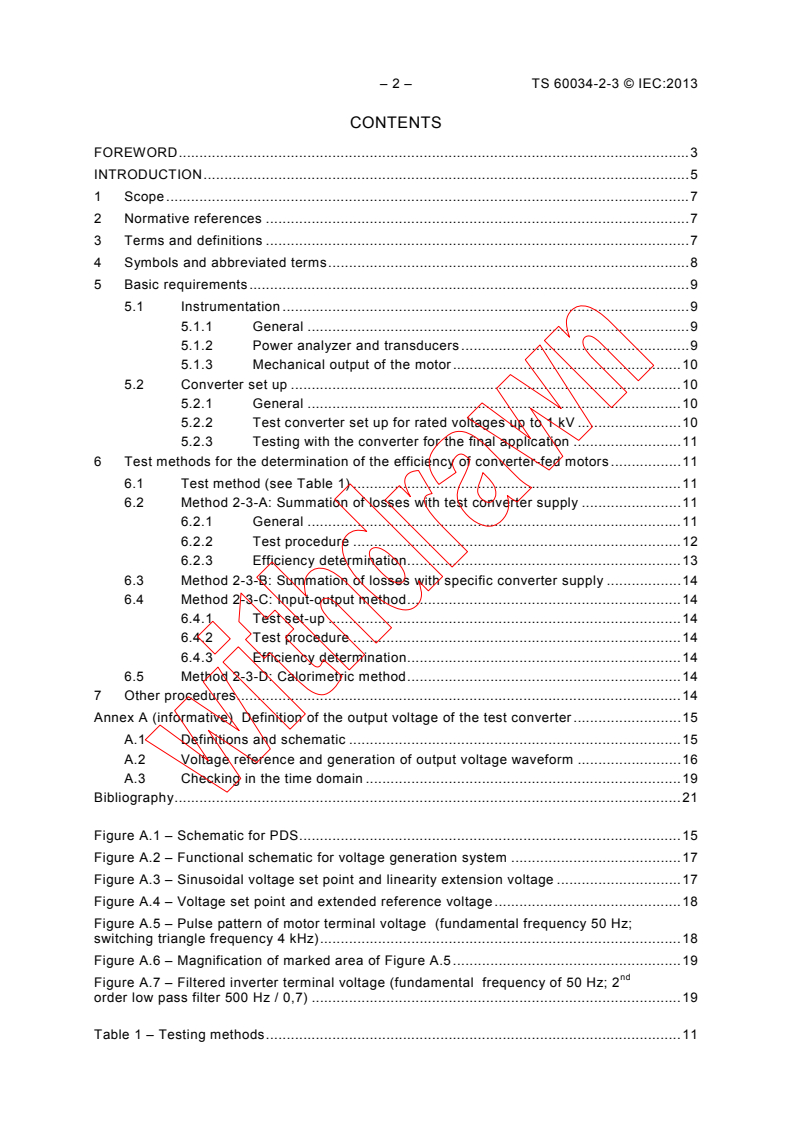
– 2 – TS 60034-2-3 © IEC:2013
CONTENTS
FOREWORD . 3
INTRODUCTION . 5
1 Scope . 7
2 Normative references . 7
3 Terms and definitions . 7
4 Symbols and abbreviated terms . 8
5 Basic requirements . 9
5.1 Instrumentation . 9
5.1.1 General . 9
5.1.2 Power analyzer and transducers . 9
5.1.3 Mechanical output of the motor . 10
5.2 Converter set up . 10
5.2.1 General . 10
5.2.2 Test converter set up for rated voltages up to 1 kV . 10
5.2.3 Testing with the converter for the final application . 11
6 Test methods for the determination of the efficiency of converter-fed motors . 11
6.1 Test method (see Table 1) . 11
6.2 Method 2-3-A: Summation of losses with test converter supply . 11
6.2.1 General . 11
6.2.2 Test procedure . 12
6.2.3 Efficiency determination . 13
6.3 Method 2-3-B: Summation of losses with specific converter supply . 14
6.4 Method 2-3-C: Input-output method . 14
6.4.1 Test set-up . 14
6.4.2 Test procedure . 14
6.4.3 Efficiency determination . 14
6.5 Method 2-3-D: Calorimetric method . 14
7 Other procedures . 14
Annex A (informative) Definition of the output voltage of the test converter . 15
A.1 Definitions and schematic . 15
A.2 Voltage reference and generation of output voltage waveform . 16
A.3 Checking in the time domain . 19
Bibliography . 21
Figure A.1 – Schematic for PDS . 15
Figure A.2 – Functional schematic for voltage generation system . 17
Figure A.3 – Sinusoidal voltage set point and linearity extension voltage . 17
Figure A.4 – Voltage set point and extended reference voltage . 18
Figure A.5 – Pulse pattern of motor terminal voltage (fundamental frequency 50 Hz;
switching triangle frequency 4 kHz) . 18
Figure A.6 – Magnification of marked area of Figure A.5 . 19
nd
Figure A.7 – Filtered inverter terminal voltage (fundamental frequency of 50 Hz; 2
order low pass filter 500 Hz / 0,7) . 19
Table 1 – Testing methods . 11
TS 60034-2-3 © IEC:2013 – 3 –
INTERNATIONAL ELECTROTECHNICAL COMMISSION
____________
ROTATING ELECTRICAL MACHINES –
Part 2-3: Specific test methods for determining losses
and efficiency of converter-fed AC induction motors
FOREWORD
1) The International Electrotechnical Commission (IEC) is a worldwide organization for standardization comprising
all national electrotechnical committees (IEC National Committees). The object of IEC is to promote
international co-operation on all questions concerning standardization in the electrical and electronic fields. To
this end and in addition to other activities, IEC publishes International Standards, Technical Specifications,
Technical Reports, Publicly Available Specifications (PAS) and Guides (hereafter referred to as “IEC
Publication(s)”). Their preparation is entrusted to technical committees; any IEC National Committee interested
in the subject dealt with may participate in this preparatory work. International, governmental and non-
governmental organizations liaising with the IEC also participate in this preparation. IEC collaborates closely
with the International Organization for Standardization (ISO) in accordance with conditions determined by
agreement between the two organizations.
2) The formal decisions or agreements of IEC on technical matters express, as nearly as possible, an international
consensus of opinion on the relevant subjects since each technical committee has representation from all
interested IEC National Committees.
3) IEC Publications have the form of recommendations for international use and are accepted by IEC National
Committees in that sense. While all reasonable efforts are made to ensure that the technical content of IEC
Publications is accurate, IEC cannot be held responsible for the way in which they are used or for any
misinterpretation by any end user.
4) In order to promote international uniformity, IEC National Committees undertake to apply IEC Publications
transparently to the maximum extent possible in their national and regional publications. Any divergence
between any IEC Publication and the corresponding national or regional publication shall be clearly indicated in
the latter.
5) IEC itself does not provide any attestation of conformity. Independent certification bodies provide conformity
assessment services and, in some areas, access to IEC marks of conformity. IEC is not responsible for any
services carried out by independent certification bodies.
6) All users should ensure that they have the latest edition of this publication.
7) No liability shall attach to IEC or its directors, employees, servants or agents including individual experts and
members of its technical committees and IEC National Committees for any personal injury, property damage or
other damage of any nature whatsoever, whether direct or indirect, or for costs (including legal fees) and
expenses arising out of the publication, use of, or reliance upon, this IEC Publication or any other IEC
Publications.
8) Attention is drawn to the Normative references cited in this publication. Use of the referenced publications is
indispensable for the correct application of this publication.
9) Attention is drawn to the possibility that some of the elements of this IEC Publication may be the subject of
patent rights. IEC shall not be held responsible for identifying any or all such patent rights.
The main task of IEC technical committees is to prepare International Standards. In
exceptional circumstances, a technical committee may propose the publication of a technical
specification when
• the required support cannot be obtained for the publication of an International Standard,
despite repeated efforts, or
• the subject is still under technical development or where, for any other reason, there is the
future but no immediate possibility of an agreement on an International Standard.
Technical specifications are subject to review within three years of publication to decide
whether they can be transformed into International Standards.
IEC/TS 60034-2-3, which is a technical specification, has been prepared by IEC technical
committee 2: Rotating machinery.
– 4 – TS 60034-2-3 © IEC:2013
The text of this technical specification is based on the following documents:
Enquiry draft Report on voting
2/1696/DTS 2/1719/RVC
Full information on the voting for the approval of this technical specification can be found in
the report on voting indicated in the above table.
NOTE A table of cross-references of all IEC TC 2 publications can be found on the IEC TC 2 dashboard on the
IEC website.
This publication has been drafted in accordance with the ISO/IEC Directives, Part 2.
The committee has decided that the contents of this publication will remain unchanged until
the stability date indicated on the IEC web site under "http://webstore.iec.ch" in the data
related to the specific publication. At this date, the publication will be
• transformed into an International standard,
• reconfirmed,
• withdrawn,
• replaced by a revised edition, or
• amended.
IMPORTANT – The 'colour inside' logo on the cover page of this publication indicates
that it contains colours which are considered to be useful for the correct
understanding of its contents. Users should therefore print this document using a
colour printer.
TS 60034-2-3 © IEC:2013 – 5 –
INTRODUCTION
The objective of this technical specification is to define test methods for determining the
additional harmonic motor losses of converter-fed induction motors. These losses appear in
addition to the losses on nominally sinusoidal power supply as determined by the methods of
IEC 60034-2-1. Results determined according to this specification are intended to allow for
comparison of the harmonic losses of different AC induction motors when fed by converters.
In power-drive systems (PDS), the motor and the frequency converter are often manufactured
by different suppliers. While motors of the same design are produced in large quantities, they
may be operated from the grid or from frequency converters of many different types, supplied
by many different manufacturers. The individual converter properties (switching frequency, DC
link voltage level, etc.) may influence the system efficiency as well. It is impractical to
determine the additional harmonic motor losses for every combination of motor, frequency
converter, connection cable, output filter and parameter settings. Accepting that it is
extremely difficult to specify motor efficiency for converter operation, this specification
describes a limited number of approaches, depending on the voltage level and the rating of
the machine under test.
The procedures described in this specification result in a single number, the harmonic loss
ratio r , which is the ratio of the additional harmonic motor losses and the motor losses
HL
measured using a nominally sinusoidal voltage power supply.
The losses determined according to this specification are not intended to represent the losses
in the final application. They provide, however, an objective basis for comparing different
motor designs with respect to suitability for converter operation.
The methods in this technical specification apply to induction motors used with variable
frequency drives. However, the application to other AC motors or DC motors and converters,
is not excluded. The methods are mainly intended for motors fed by voltage source
converters.
In general, when fed from a converter, the motor losses are higher than during operation on a
nominally sinusoidal system. The additional harmonic losses depend on the spectrum of the
impressed converter output quantity (either current or voltage) which is influenced by its
circuitry and control method. For further information see IEC/TS 60034-25.
This technical specification is aimed at evaluating the additional harmonic motor losses
resulting from non-sinusoidal power supply and consequently the efficiency of the converter-
fed motor. It is not the purpose of this technical specification to define test procedures either
for power drive systems or for frequency converters alone.
This technical specification is applicable to motors rated for 50 Hz or 60 Hz fundamental
frequency. However, for other rated motor frequencies the test procedure may be applied
provided a suitable power source is available, e.g. a 4-pole motor used at 3 000 rpm can be
tested with 100 Hz and actual voltage rating.
Low-voltage motors
Experience has shown that the additional harmonic motor losses generally increase with load.
The methods in this technical specification are based on supplies from converters with pulse
width modulation (PWM) and constant pulse pattern. This is generally the case for voltage
source converters except for over-modulation. Such voltage source converters have by far the
largest market share in the low-voltage industrial drive market.
With respect to these types of converters and the growing need for verification of compliance
with national energy efficiency regulations, this technical specification introduces a so-called
test converter for testing low voltage motors.
– 6 – TS 60034-2-3 © IEC:2013
In principle, the test converter is a voltage source with a clearly defined and reproducible
harmonic content to supply the machine under test. The motor efficiency is to be determined
at rated load for 50 Hz or 60 Hz. Defining 50 Hz or 60 Hz as test conditions has the
advantage of providing a direct comparison of motor efficiency for grid and converter
operation.
The above outlined test converter concept is a new approach to weigh the converter impact
on an electrical machine without being forced having the final converter for testing. By
releasing this technical specification, test facilities are invited to gain practical experience with
this approach and to provide feedback for further refinement of the test procedure.
Limitations for low-voltage motors and high-voltage motors with multi-level converters
It has to be noted that the test method described herein is only a standardized method
intended to give comparable efficiency figures for standardized test conditions. A motor
ranking with respect to suitability for converter operation may be derived, but it is not possible
to determine the actual motor losses for operation with a specific converter which would
require a test of the whole power drive system (PDS).
Deviations are also expected for motors driven by multi-level voltage source or current source
converters where the additional harmonic motor losses differ much more depending on speed
and load than for two-level voltage source converters. Hence the determination of losses and
efficiency should preferably use procedures where the motor is operated together with the
same converter with which it is driven in service.
Another option is the determination of the additional harmonic motor losses by calculation. If
this is requested by the customer, the converter manufacturer has to provide the pulse pattern
for the motor manufacturer.
TS 60034-2-3 © IEC:2013 – 7 –
ROTATING ELECTRICAL MACHINES –
Part 2-3: Specific test methods for determining losses
and efficiency of converter-fed AC induction motors
1 Scope
This technical specification specifies test methods for determining losses and efficiencies of
converter-fed AC induction motors within the scope of IEC 60034-1. The AC induction motor
is then part of a variable frequency power drive system (PDS) as defined in IEC 61800-2,
IEC 61800-4 or IEC/TS 61800-8.
The additional harmonic losses determined by use of this technical specification are for
comparison of different motor designs, but they are not appropriate to be used for efficiency
determination of a PDS in a driven application with its wide range of torque versus speed
operating points.
2 Normative references
The following documents, in whole or in part, are normatively referenced in this document and
are indispensable for its application. For dated references, only the edition cited applies. For
undated references, the latest edition of the referenced document (including any
amendments) applies.
IEC 60034-1, Rotating electrical machines – Part 1: Rating and performance
IEC 60034-2-1:2007, Rotating electrical machines – Part 2-1: Standard methods for
determining losses and efficiency from tests (excluding machines for traction vehicles)
IEC 60034-2-2, Rotating electrical machines – Part 2-2: Specific methods for determining
separate losses of large machines from test – Supplement to IEC 60034-2-1
IEC 61000-2-4, Electromagnetic compatibility (EMC) – Part 2-4: Environment – Compatibility
levels in industrial plants for low-frequency conducted disturbances
IEC/TS 61800-8, Adjustable speed electrical power drive systems – Part 8: Specification of
voltage on the power interface
3 Terms and definitions
For the purposes of this document the terms and definitions given in IEC 60034-1, IEC 60034-
2-1 as well as the following apply.
3.1
motor losses with converter supply
when powered by a converter, motor losses are a combination of losses caused by
fundamental frequency (usually 50 Hz or 60 Hz) and losses caused by the converter
harmonics
– 8 – TS 60034-2-3 © IEC:2013
3.2
fundamental losses
fundamental losses in the motor can be segregated into five different components: iron losses
(varying with motor frequency and applied fundamental voltage), friction and windage losses
(varying with motor speed), rotor winding losses, stator winding losses and additional load
losses (all three varying with motor current). Fundamental losses are the losses of a motor
running with rated voltage at fundamental frequency (usually 50 Hz or 60 Hz), without any
harmonics.
3.3
harmonic losses
harmonic losses are produced in the motor by the non-sinusoidal voltage and current
waveforms generated by the converter and are in addition to the fundamental losses of iron,
rotor-winding, stator-winding and additional-load loss.
4 Symbols and abbreviated terms
For the purposes of this document the symbols given in IEC 60034-2-1, IEC TS 61800-8 as
well as the following apply.
PWM Pulsewidth modulation,
f Frequency, Hz,
f Fundamental motor frequency, Hz,
Mot
f Rated motor frequency, Hz,
N
f Switching frequency, Hz,
sw
f Maximum frequency of measuring equipment, Hz,
r
–1
n Speed, s
p Number of pole pairs,
P Constant losses according to IEC 60034-2-1:2007, method 2-1-1B at nominally
C
sinusoidal power supply, W,
Constant losses according to IEC 60034-2-1:2007, method 2-1-1B at test-
P
CC
converter supply, W,
P Iron losses at rated frequency, W,
fe
P Friction and windage losses at rated speed, W,
fw
P Friction and windage losses at synchronous speed, W,
fw0
P Total additional harmonic motor losses, W,
HL
P Load-dependent part of the additional harmonic motor losses, W,
HL Load
P Constant part of the additional harmonic motor losses, W,
HL No-Load
P Additional load losses at rated load according to IEC 60034-2-1:2007, method
LL
2-1-1B at nominally sinusoidal power supply, W,
P Additional load losses at rated load according to IEC 60034-2-1:2007, method
LLC
2-1-1B at converter supply, W,
P Residual losses according to IEC 60034-2-1:2007, method 2-1-1B at nominally
Lr
sinusoidal power supply, W,
P Residual losses according to IEC 60034-2-1:2007, method 2-1-1B at converter
LrC
supply, W,
P Rotor winding losses according to IEC 60034-2-1:2007, method 2-1-1B at
r
nominally sinusoidal power supply, W,
P Stator winding losses according to IEC 60034-2-1:2007, method 2-1-1B at
s
nominally sinusoidal power supply, W,
TS 60034-2-3 © IEC:2013 – 9 –
P Total losses according to IEC 60034-2-1:2007, method 2-1-1B at nominally
Tsin
sinusoidal power supply, W,
P Total losses according to IEC 60034-2-1:2007, method 2-1-1B when supplied
T test-converter
by the test converter, W,
P Input power at nominally sinusoidal power supply, W,
P Input power at converter supply, W,
1C
P Output power at nominally sinusoidal power supply, W,
P Output power at converter supply, W,
2C
r Ratio of harmonic voltage losses related to nominally sinusoidal voltage losses
HL
expressed in percentage and rounded to a full number,
s Slip,
T Machine torque at sinusiodal power supply, Nm,
T Machine torque at converter supply, Nm,
C
U Fundamental motor voltage, V,
Mot
U Rated motor voltage, V.
N
5 Basic requirements
5.1 Instrumentation
5.1.1 General
In the case of AC machines, unless otherwise stated in this technical specification, the
arithmetic average of the three line currents and voltages shall be used.
When testing electric motors under load, fluctuations in the output power and other measured
quantities may be unavoidable. Therefore for each load point several measurements over a
period of time (approximately 30 s) shall be simultaneously sampled and the average of these
values shall be used for the determination of efficiency.
Considering the harmonics involved in converters feeding AC motors and their contribution to
the motor losses, the measuring equipment has to be selected according to the range of
relevant frequencies with sufficient accuracy.
For temperature measurements a thermo-sensor installed in the hot-spot may be optionally
used, as described in IEC 60034-2-1:2007.
5.1.2 Power analyzer and transducers
The instrumentation for measuring power and current at the motor’s input shall basically meet
the requirements of IEC 60034-2-1:2007, but due to higher frequency components the
following additional requirements have to be met.
The nominal accuracy of the power meters shall be 0,2 % or better at 50 Hz/60 Hz and 0,5 %
up to a frequency f of at least:
r
f = 10 × f for PWM converter output.
r
sw
The measurement range shall be chosen adequately in relation to the measured currents and
voltages.
It is preferred to feed current and voltage directly into the power analyser. If an external
current transducer is required, no conventional current transformers shall be used. Instead,
wide bandwidth shunts or zero-flux transducers shall be used.
– 10 – TS 60034-2-3 © IEC:2013
The bandwidth of the current sensors and acquisition channels shall range at least from 0 Hz
to 100 kHz.
Internal filters in digital power meters shall be turned off.
For power measurement the three-wattmeter method is recommended. The two-wattmeter
method (Aaron-connection) is acceptable, but it has to be noted that not all available
equipment is capable to compensate the possible errors of this method. This capability shall
be verified from the equipment manufacturer data sheets.
All cables used to transmit measurement signals shall be shielded.
5.1.3 Mechanical output of the motor
The instrumentation for measuring torque and speed at the motor's output shall meet the
requirements of IEC 60034-2-1:2007.
5.2 Converter set up
5.2.1 General
For all test methods using the test converter, it should be parameterized according to the
requirements of this specification or, if a unique combination of converter and motor is to be
tested, the converter should be parameterized for the specific application. The chosen
parameter settings shall be recorded in the test report.
5.2.2 Test converter set up for rated voltages up to 1 kV
The test converter has to be understood as a voltage source independent of load current, set
at rated voltage and fundamental frequency (50 Hz or 60 Hz) of the motor under test.
It has to be noted, that the so-called test converter operating mode is not intended or
requested for any commercial application. The purpose of the test converter set up is only to
establish comparable test conditions for motors designed for operation with commercially
available converters.
The following reference conditions are defined:
• Two level voltage source converter.
• No motor current feedback control activated (to be deactivated, if necessary).
• “Slip compensation” shall not be applied.
• No additional components influencing output voltage or output current shall be installed
between the test converter and the motor, except those required for the measuring
instruments.
= U at 50 Hz or 60 Hz. The
• Fundamental motor voltage equal to rated motor voltage U
Mot N
input voltage of the test converter shall be set to a value that allows rated motor voltage to
be applied and to avoid overmodulation. However the converter input voltage shall not be
higher than just needed to fulfill the above.
• Fundamental motor frequency equal to rated motor frequency f = f (50 Hz, 60 Hz).
Mot N
= 4 kHz for rated output powers up to 90 kW.
• Switching frequency f
SW
• Switching frequency f = 2 kHz for output powers above 90 kW.
SW
Annex A defines the test converter output stage and establishes test methods to check its
conformity. The test converter can be fed by an appropriate AC or DC input.
TS 60034-2-3 © IEC:2013 – 11 –
A shielded cable shall connect the test converter to the motor. The cable length shall be less
than 100 m. The cable size shall be selected according to the motor rating.
5.2.3 Testing with the converter for the final application
For converters with voltage ratings above 1 kV a generally accepted test converter and cable
length cannot be specified. Such motors, cables and converters can only be tested as a
complete power drive system because the pulse patterns of frequency converters for higher
output powers vary between manufacturers and differ greatly between no-load and rated load.
6 Test methods for the determination of the efficiency of converter-fed motors
6.1 Test method (see Table 1)
Table 1 – Test methods
Ref Method Description Subclause Required facility
2-3-A Summation of losses: Harmonic loss 6.2 Sinusoidal supply and test
determination with test- converter supply for full-load
Test converter supply
converter according to operation
Annex A
Summation of losses:
2-3-B Harmonic loss 6.3 Sinusoidal supply and specific
determination with converter supply for full-load
Supply with specific
converter for final operation
converter for final
application
application
2-3-C Input-output Torque measurement 6.4 Dynamometer for full-load;
specific converter supply
2-3-D Calorimetric Loss determination 6.5 Specific converter supply.
from coolant
Measurement according to
temperature rise
IEC 60034-2-2
6.2 Method 2-3-A: Summation of losses with test converter supply
6.2.1 General
Even for voltage source converters with an output voltage and pulse pattern which is
independent of load, experience has shown that the additional harmonic motor losses
basically increase with load. For low voltage converters, a constant pulse pattern is generally
the case as long as the voltage modulation amplitude is not reaching the limit of the
intermediate circuit voltage.
Therefore, the total additional loss caused by converter supply can be determined from a
load-test at fundamental frequency supply and a load-test at converter supply. The additional
harmonic loss is the difference of the measured losses of both tests.
A sinusoidal voltage source according to IEC 61000-2-4, class 1, shall be available in addition
to the converter to perform these tests (nominally sinusoidal power supply).
The converter used for these tests is a test converter as specified in Annex A. Using the test-
converter allows for comparison of efficiency figures of different machines, because the pulse
pattern is fixed and comparable. This is not the case for a specific converter with a specific
control mechanism as described by method 2-3-B. In that case the output voltage depends on
manufacturer specific control schemes.
– 12 – TS 60034-2-3 © IEC:2013
6.2.2 Test procedure
The sequence of tests is as follows:
• Perform a load test with sinusoidal power supply of rated frequency and rated voltage
according to IEC 60034-2-1:2007, method 2-1-1B, 6.1.2.1.1 for the determination of the
total losses P .
Tsin
• Determine the load losses according to IEC 60034-2-1:2007, method 2-1-1B, 6.1.2.1.2.
• Perform a load curve test with sinusoidal power supply of rated frequency and rated
voltage according to IEC 60034-2-1:2007, method 2-1-1B, 6.1.2.1.3 and determine the
losses accordingly.
• Perform a no-load test with sinusoidal power supply of rated frequency and rated voltage
according to IEC 60034-2-1:2007, method 2-1-1B, 6.1.2.1.4.
• Determine the constant losses P at sinusoidal power supply according to IEC 60034-2-
C
1:2007, method 2-1-1B, 6.1.2.1.5.
• Perform a load curve test with test converter supply of rated frequency and rated voltage
according to IEC 60034-2-1:2007, method 2-1-1B, 6.1.2.1.3 and determine the losses
accordingly.
• Perform a no-load test with test converter supply of rated frequency and rated voltage
according to IEC 60034-2-1:2007, method 2-1-1B, 6.1.2.1.4.
• Determine the constant losses P at test converter supply according to IEC 60034-2-
CC
1:2007, method 2-1-1B, 6.1.2.1.5.
Load-dependent additional harmonic losses – Residual losses P and P
LL LLC
Based on the above mentioned tests, the residual losses shall be determined according to
IEC 60034-2-1:2007, method 2-1-1B, 6.1.2.1.6.
The residual losses shall be determined for each load point by subtracting from the input
power: the output power, the uncorrected stator winding losses at the resistance of the test,
the iron losses, the windage and friction losses, and the uncorrected rotor winding losses
corresponding to the determined value of slip.
This has to be done for sinusoidal power supply
P = P − P − P − P − P − P
Lr 1 2 s r fe fw
and test converter supply
P = P − P − P − P − P − P .
LrC 1C 2C s r fe fw
P to be determined for the same load points as P .
LrC Lr
Where
p× n
2,5
P = P ⋅ (1− s) with s= 1−
fw fw0
f
are the corrected friction and windage losses according to IEC 60034-2-1:2007.
For both cases the residual loss data shall be smoothed by using the linear regression
analysis in accordance to IEC 60034-2-1, based on expressing the losses as a function of the
square of the load torque:
TS 60034-2-3 © IEC:2013 – 13 –
2 2
P = A⋅ T + B and P = A ⋅ T + B
Lr LrC C C
C
When the slope constants A and A are established, a value of additional load losses for
C
rated load point shall be determined for sinusoidal and converter supply respectively by using
the formulas:
2 2
P = A⋅ T and P = A ⋅ T
LL LLC C
N N
The additional load losses P cover now all load-dependent additional losses, i.e. those
LLC
caused by the fundamental load current and the load-dependent part of those caused by the
harmonics of the test converter.
The difference between the additional load losses for operation with the test converter and
with a sinusoidal power supply gives the load-dependent part of the additional harmonic motor
losses:
P = P − P
HL LLC LL
Load
Constant additional harmonic losses – Constant losses P and P
C CC
The difference between the no-load losses for operation with the test converter P and with
CC
a sinusoidal power supply P is the constant part of the additional harmonic motor losses:
C
P = P − P
HL CC C
No−Load
6.2.3 Efficiency determination
The difference between the additional load losses for operation with the test converter and
with a sinusoidal power supply are the additional harmonic motor losses.
P = P + P
HL HL HL
No−Load Load
The additional harmonic motor losses shall be added to the fundamental motor losses as
determined with a sinusoidal power supply according to IEC 60034-2-1:2007, method 2-1-1B
in order to obtain the motor efficiency under frequency converter operation.
P = P + P
T test-converter Tsin HL
The efficiency at test converter supply is determined from
P
η=
P + P
2 T test-converter
The harmonic loss ratio is given by
P
HL
r = ⋅100 %
HL
P
T sin
It should be rounded to a full (integer) number.
– 14 – TS 60034-2-3 © IEC:2013
6.3 Method 2-3-B: Summation of losses with specific converter supply
The total additional loss caused by converter supply shall be determined from a load-test at
fundamental frequency supply and a load-test at converter supply with the specific converter
for the final application. Apart from using the specific converter system, the test procedure is
equal to method 2-3-A.
6.4 Method 2-3-C: Input-output method
6.4.1 Test set-up
This is a test method in which the mechanical power P of a machine is determined by
2C
measurement of the shaft torque and speed. The electrical power P of the stator is
1C
measured in the same test.
6.4.2 Test procedure
Tests shall be conducted with the specific converter for the final application and an
assembled motor with the essential components in place, to obtain test conditions equal or
very similar to normal operating conditions.
Couple the motor under test to a load machine with a dynamometer. Operate the machine
under test at rated torque until thermal equilibrium (rate of change of 1 K or less per half hour)
has been reached.
At the end of the test, record:
T Output torque
n Speed
P Input power at specific converter supply
1C
6.4.3 Efficiency determination
Calculate the output power: P = 2π⋅ T⋅ n
2C
P
2C
Calculate the efficiency: η =
P
1C
6.5 Method 2-3-D: Calorimetric method
Efficiency may also be determined by calorimetric measurement of the total losses of the
tested equipment within the primary or secondary water cooling circuit. Test procedures for
this method shall be in accordance with IEC 60034-2-2.
7 Other procedures
If the motor rating exceeds the available testing capabilities, the determination of the
additional harmonic losses caused by converter operation based on calculations may be an
alternative procedure to give an order of magnitude of the additional losses. This calculation
has to be based on the real pulse patterns of the converter, the frequency-dependent
equivalent circuit parameters of the electric motor and by using motor models capable to
cover the effects of the harmonics.
TS 60034-2-3 © IEC:2013 – 15 –
Annex A
(informative)
Definition of the output voltage of the test converter
A.1 Definitions and schematic
For the purposes of this part of the document, the following terms and definitions apply in
addition to Clause 4.
NP Neutral point
SP Star point
U , U , U DC link voltages of the converter section. U means the voltage of the
d d+ d– d+
positive rail, U the potential of the negative rail with reference to NP.
d–
U , U , U Phase to NP voltages at the inverter output; block shaped in steady state
U V W
operation.
U* , U* , U* Set-points of the phase to NP voltages at the inverter output.
U V W
U , U , U Phase to starpoint voltages at the inverter output; block shaped in steady
UD VD WD
state operation.
U* , U* , U* Set-points of the phase to starpoint voltages; sinusoidal in steady state
UD VD WD
operation.
U Common mode voltage related to the star point of the motor.
CCM
U Amplitude of set-points of the phase voltages of the motor; constant in
ref
steady state operation.
f Frequency set-point of the motor voltage; constant in steady state
1ref
operation.
U* Linearity extension voltage. Common mode voltage used in the
ext
modulator.
S , S , S Switching commands for the inverter phases.
U V W
U
d+
U
UD
M
U
VD
NP
SP
U
U
U
WD
U
V
U
d−
U
W
U
CCM
IEC 2859/13
Converter reference point
Figure A.1 – Schematic for PDS
Figure A.1 shows star-connected motor, nevertheless the technical specification can also be
applied to delta-connected motors with internal or external star-points.
– 16 – TS 60034-2-3 © IEC:2013
The output voltage of the inverter (U , U , U ) can be divided into the differential mode (also
U V W
known as symmetrical) voltage system (U , U , U ) and the common mode voltage to the
UD VD WD
reference point of the converter (U ).
CCM
The differential mode voltage expresses the voltages of the three motor phases. For each
phase, it can be calculated as the difference of the inverter output voltage and the common
mode voltage.
This is e.g. for phase U:
U = U −U
UD U CCM
The common mode voltage can be calculated as follows:
U = (U + U + U )/ 3
CCM U V W
A.2 Voltage reference and generation of output voltage waveform
This clause describes a method to realize the pulse pattern of the test inverter and it explains,
why the measurements should look like shown in Figure A.3.
A basic controller generates the set points of the absolute value of the desired mot
...