


IEC 60317-0-6:2001
(Main)Specifications for particular types of winding wires - Part 0-6: General requirements - Glass-fibre wound resin or varnish impregnated, bare or enamelled round copper wire
Specifications for particular types of winding wires - Part 0-6: General requirements - Glass-fibre wound resin or varnish impregnated, bare or enamelled round copper wire
IEC 60317-0-6:2001 specifies general requirements of glass-fibre wound resin or varnish impregnated, bare or enamelled, round copper winding wires. The range of nominal conductor diameters is given in the relevant specification sheet. When a reference is made to a winding wire according to one of the IEC 60317 series, the following information should be given in the description:
– reference to IEC specification;
– nominal conductor diameter in millimetres;
– grade of coating and glass covering.
EXAMPLE: IEC 60317-48 0,500 1G2
Spécifications pour types particuliers de fils de bobinage - Partie 0-6: Prescriptions générales - Fil de section circulaire en cuivre nu ou émaillé, guipé de fibres de verre imprégnées de résine ou de vernis
IEC 60317-0-6:2001 spécifie les prescriptions générales relatives au fil de section circulaire en cuivre, nu ou émaillé, recouvert d'un guipage de fibres de verre imprégnées de résine ou de vernis. La gamme des diamètres nominaux des conducteurs est donnée dans la feuille de spécification applicable. Quand il est fait référence à un fil de bobinage conforme à l'une des spécifications de la série IEC 60317, il est recommandé que les informations suivantes soient données dans la description:
– référence de la spécification IEC;
– diamètre nominal du conducteur en millimètres;
– grade du revêtement et de l’enveloppe de fibre de verre.
EXEMPLE: IEC 60317-48 0,500 1G2
General Information
- Status
- Published
- Publication Date
- 07-May-2001
- Technical Committee
- TC 55 - Winding wires
- Drafting Committee
- WG 1 - TC 55/WG 1
- Current Stage
- DELPUB - Deleted Publication
- Start Date
- 09-Jun-2020
- Completion Date
- 07-Sep-2018
Relations
- Effective Date
- 05-Sep-2023
- Effective Date
- 05-Sep-2023
Overview
IEC 60317-0-6:2001 is an important international standard developed by the International Electrotechnical Commission (IEC) specifying the general requirements for a particular type of winding wire. This standard focuses on glass-fibre wound resin or varnish impregnated, bare or enamelled round copper wire used primarily in electrical and electronic applications. It defines mandatory characteristics such as dimensions, mechanical and electrical properties, coating grades, testing methods, and environmental resistance to ensure consistent quality and performance of copper winding wires.
The standard covers copper wires with nominal conductor diameters as specified in related IEC documents and provides a clear framework for wire identification, including reference to IEC specifications, nominal diameters, and grades of coating and glass fibre covering.
Key Topics
Scope and Application
Specifies general requirements for various types of round copper winding wires, impregnated with resin or varnish and wound with glass fibre. The document is applicable to both bare and enamelled wires with defined conductor diameters.Dimensional and Mechanical Properties
Defines conductor diameter, tolerance on ovality, minimal diameter increase due to glass fibre covering, and maximum overall diameter. Also addresses elongation, springiness, flexibility, and adherence of the winding wires to guarantee reliability in practical use.Electrical Characteristics
Includes requirements for electrical resistance, breakdown voltage, dielectric dissipation factor, and insulation continuity to ensure optimal electrical performance and safety.Thermal and Environmental Resistance
Specifies resistance to heat shock, thermoplasticity, abrasion, solvents, refrigerants, hydrolysis, transformer oil, and solderability. These criteria evaluate the wire’s durability and operational stability in a range of demanding environments.Testing and Quality Assurance
Details standardized test methods to assess parameters such as pinholes, microcracks detection, heat or solvent bonding adherence, and mass loss. This thorough testing framework ensures product reliability and compliance.Identification and Marking
Provides guidelines for describing winding wires using IEC reference numbers, conductor diameter in millimeters, grade of coating, and glass covering specifications for precise identification.
Applications
IEC 60317-0-6 winding wires are crucial in the manufacturing and repair of:
Electric Motors and Generators
Where glass-fibre wound copper wires provide excellent insulation and mechanical strength against thermal and mechanical stress.Transformers and Inductors
Guaranteeing long-term electrical insulation and heat resistance to support reliable energy transfer and electromagnetic performance.Electromechanical Devices
Used in winding coils of relays, solenoids, and other components requiring durable, high-quality insulated copper wire.Electrical Coils and Windings
Ensuring electrical safety and mechanical robustness in both industrial and consumer electronic equipment.
Related Standards
IEC 60317-0-6 is part of the IEC 60317 series which covers specifications for various types of winding wires. Users should also consult related documents for detailed requirements on particular wire types, including:
- IEC 60317-48: Specifications for enamelled round copper wire with specific insulation and coating grades.
- Other parts of IEC 60317 dealing with varying materials, wire shapes, and insulation types.
For comprehensive and up-to-date information, stakeholders are encouraged to review the latest amendments and corrigenda available from the IEC Webstore and keep abreast of changes in associated IEC technical publications.
Keywords: IEC 60317-0-6, glass-fibre wound copper wire, enamelled copper wire, winding wire standards, electrical winding wires, copper wire specifications, electrotechnical standards, insulation requirements, winding wire testing, electrical coil wire, IEC winding wire standards, resin impregnated copper wire.
IEC 60317-0-6:2001 - Specifications for particular types of winding wires - Part 0-6: General requirements - Glass-fibre wound resin or varnish impregnated, bare or enamelled round copper wire
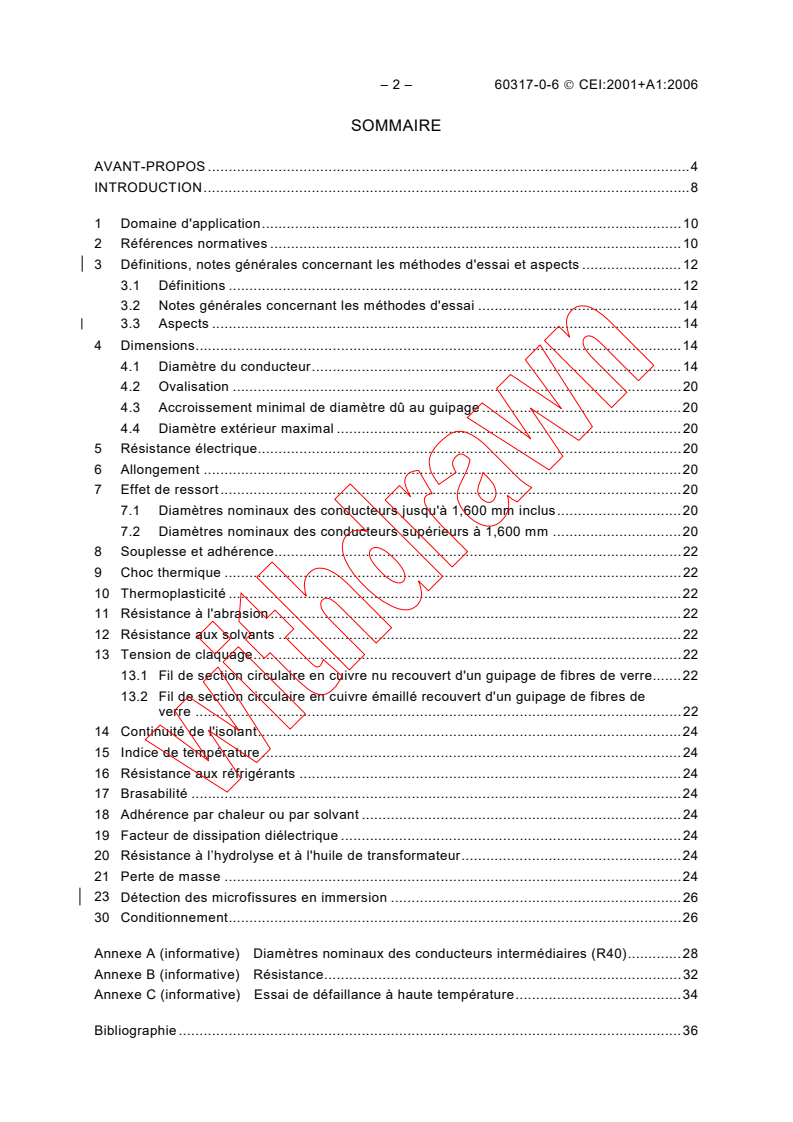
IEC 60317-0-6:2001+AMD1:2006 CSV - Specifications for particular types of winding wires - Part 0-6: General requirements - Glass-fibre wound resin or varnish impregnated, bare or enamelled round copper wire Released:1/18/2007 Isbn:283188912X
Get Certified
Connect with accredited certification bodies for this standard

Intertek Testing Services NA Inc.
Intertek certification services in North America.

UL Solutions
Global safety science company with testing, inspection and certification.

ANCE
Mexican certification and testing association.
Sponsored listings
Frequently Asked Questions
IEC 60317-0-6:2001 is a standard published by the International Electrotechnical Commission (IEC). Its full title is "Specifications for particular types of winding wires - Part 0-6: General requirements - Glass-fibre wound resin or varnish impregnated, bare or enamelled round copper wire". This standard covers: IEC 60317-0-6:2001 specifies general requirements of glass-fibre wound resin or varnish impregnated, bare or enamelled, round copper winding wires. The range of nominal conductor diameters is given in the relevant specification sheet. When a reference is made to a winding wire according to one of the IEC 60317 series, the following information should be given in the description: – reference to IEC specification; – nominal conductor diameter in millimetres; – grade of coating and glass covering. EXAMPLE: IEC 60317-48 0,500 1G2
IEC 60317-0-6:2001 specifies general requirements of glass-fibre wound resin or varnish impregnated, bare or enamelled, round copper winding wires. The range of nominal conductor diameters is given in the relevant specification sheet. When a reference is made to a winding wire according to one of the IEC 60317 series, the following information should be given in the description: – reference to IEC specification; – nominal conductor diameter in millimetres; – grade of coating and glass covering. EXAMPLE: IEC 60317-48 0,500 1G2
IEC 60317-0-6:2001 is classified under the following ICS (International Classification for Standards) categories: 29.060.10 - Wires. The ICS classification helps identify the subject area and facilitates finding related standards.
IEC 60317-0-6:2001 has the following relationships with other standards: It is inter standard links to IEC 60317-0-6:2001/AMD1:2006, IEC 60317-0-6:2020. Understanding these relationships helps ensure you are using the most current and applicable version of the standard.
IEC 60317-0-6:2001 is available in PDF format for immediate download after purchase. The document can be added to your cart and obtained through the secure checkout process. Digital delivery ensures instant access to the complete standard document.
Standards Content (Sample)
NORME CEI
INTERNATIONALE IEC
60317-0-6
INTERNATIONAL
Première édition
STANDARD
First edition
2001-05
Spécifications pour types particuliers
de fils de bobinage –
Partie 0-6:
Prescriptions générales –
Fil de section circulaire en cuivre nu ou émaillé,
guipé de fibres de verre imprégnées de résine
ou de vernis
Specifications for particular types
of winding wires –
Part 0-6:
General requirements –
Glass-fibre wound resin or varnish impregnated,
bare or enamelled round copper wire
Numéro de référence
Reference number
CEI/IEC 60317-0-6:2001
Numérotation des publications Publication numbering
Depuis le 1er janvier 1997, les publications de la CEI As from 1 January 1997 all IEC publications are
sont numérotées à partir de 60000. Ainsi, la CEI 34-1 issued with a designation in the 60000 series. For
devient la CEI 60034-1. example, IEC 34-1 is now referred to as IEC 60034-1.
Editions consolidées Consolidated editions
Les versions consolidées de certaines publications de la The IEC is now publishing consolidated versions of its
CEI incorporant les amendements sont disponibles. Par publications. For example, edition numbers 1.0, 1.1
exemple, les numéros d’édition 1.0, 1.1 et 1.2 indiquent and 1.2 refer, respectively, to the base publication,
respectivement la publication de base, la publication de the base publication incorporating amendment 1 and
base incorporant l’amendement 1, et la publication de the base publication incorporating amendments 1
base incorporant les amendements 1 et 2. and 2.
Informations supplémentaires Further information on IEC publications
sur les publications de la CEI
Le contenu technique des publications de la CEI est The technical content of IEC publications is kept
constamment revu par la CEI afin qu'il reflète l'état under constant review by the IEC, thus ensuring that
actuel de la technique. Des renseignements relatifs à the content reflects current technology. Information
cette publication, y compris sa validité, sont dispo- relating to this publication, including its validity, is
nibles dans le Catalogue des publications de la CEI available in the IEC Catalogue of publications
(voir ci-dessous) en plus des nouvelles éditions, (see below) in addition to new editions, amendments
amendements et corrigenda. Des informations sur les and corrigenda. Information on the subjects under
sujets à l’étude et l’avancement des travaux entrepris consideration and work in progress undertaken by the
par le comité d’études qui a élaboré cette publication, technical committee which has prepared this
ainsi que la liste des publications parues, sont publication, as well as the list of publications issued,
également disponibles par l’intermédiaire de: is also available from the following:
• Site web de la CEI (www.iec.ch) • IEC Web Site (www.iec.ch)
• Catalogue des publications de la CEI • Catalogue of IEC publications
Le catalogue en ligne sur le site web de la CEI The on-line catalogue on the IEC web site
(www.iec.ch/catlg-f.htm) vous permet de faire des (www.iec.ch/catlg-e.htm) enables you to search
recherches en utilisant de nombreux critères, by a variety of criteria including text searches,
comprenant des recherches textuelles, par comité technical committees and date of publication. On-
d’études ou date de publication. Des informations line information is also available on recently
en ligne sont également disponibles sur les issued publications, withdrawn and replaced
nouvelles publications, les publications rempla- publications, as well as corrigenda.
cées ou retirées, ainsi que sur les corrigenda.
• IEC Just Published
• IEC Just Published
Ce résumé des dernières publications parues
This summary of recently issued publications
(www.iec.ch/JP.htm) est aussi disponible par
(www.iec.ch/JP.htm) is also available by email.
courrier électronique. Veuillez prendre contact
Please contact the Customer Service Centre (see
avec le Service client (voir ci-dessous) pour plus
below) for further information.
d’informations.
• Service clients
• Customer Service Centre
Si vous avez des questions au sujet de cette
If you have any questions regarding this
publication ou avez besoin de renseignements
publication or need further assistance, please
supplémentaires, prenez contact avec le Service
contact the Customer Service Centre:
clients:
Email: custserv@iec.ch
Email: custserv@iec.ch
Tél: +41 22 919 02 11
Tel: +41 22 919 02 11
Fax: +41 22 919 03 00
Fax: +41 22 919 03 00
.
NORME CEI
INTERNATIONALE IEC
60317-0-6
INTERNATIONAL
Première édition
STANDARD
First edition
2001-05
Spécifications pour types particuliers
de fils de bobinage –
Partie 0-6:
Prescriptions générales –
Fil de section circulaire en cuivre nu ou émaillé,
guipé de fibres de verre imprégnées de résine
ou de vernis
Specifications for particular types
of winding wires –
Part 0-6:
General requirements –
Glass-fibre wound resin or varnish impregnated,
bare or enamelled round copper wire
IEC 2001 Droits de reproduction réservés Copyright - all rights reserved
Aucune partie de cette publication ne peut être reproduite ni No part of this publication may be reproduced or utilized in
utilisée sous quelque forme que ce soit et par aucun procédé, any form or by any means, electronic or mechanical,
électronique ou mécanique, y compris la photocopie et les including photocopying and microfilm, without permission in
microfilms, sans l'accord écrit de l'éditeur. writing from the publisher.
International Electrotechnical Commission 3, rue de Varembé Geneva, Switzerland
Telefax: +41 22 919 0300 e-mail: inmail@iec.ch IEC web site http://www.iec.ch
CODE PRIX
Commission Electrotechnique Internationale
Q
PRICE CODE
International Electrotechnical Commission
Pour prix, voir catalogue en vigueur
For price, see current catalogue
– 2 – 60317-0-6 CEI:2001
SOMMAIRE
AVANT-PROPOS . 4
INTRODUCTION .6
1 Domaine d'application . 8
2 Références normatives. 8
3 Définitions et notes générales concernant les méthodes d'essai . 10
3.1 Définitions. 10
3.2 Notes générales concernant les méthodes d'essai. 10
4 Dimensions . 12
4.1 Diamètre du conducteur . 12
4.2 Ovalisation. 18
4.3 Accroissement minimal de diamètre dû au guipage. 18
4.4 Diamètre extérieur maximal. 18
5 Résistance électrique . 18
6 Allongement. 18
7 Effet de ressort . 18
7.1 Diamètres nominaux des conducteurs jusqu'à 1,600 mm inclus . 18
7.2 Diamètres nominaux des conducteurs supérieurs à 1,600 mm . 18
8 Souplesse et adhérence . 20
9 Choc thermique. 20
10 Thermoplasticité. 20
11 Résistance à l'abrasion . 20
12 Résistance aux solvants. 20
13 Tension de claquage . 20
13.1 Fil de section circulaire en cuivre nu recouvert d'un guipage de fibres de
verre . 20
13.2 Fil de section circulaire en cuivre émaillé recouvert d'un guipage de fibres de
verre . 20
14 Continuité de l'isolant . 22
15 Indice de température . 22
16 Résistance aux réfrigérants. 22
17 Brasabilité. 22
18 Adhérence par chaleur ou par solvant. 22
19 Facteur de dissipation diélectrique. 22
20 Résistance à l’hydrolyse et à l'huile de transformateur . 22
21 Perte de masse. 22
30 Conditionnement . 24
Annexe A (informative) Diamètres nominaux des conducteurs intermédiaires (R40) . 26
Annexe B (informative) Résistance . 30
Annexe C (informative) Essai de défaillance à haute température . 32
Bibliographie . 34
60317-0-6 IEC:2001 – 3 –
CONTENTS
FOREWORD . 5
INTRODUCTION .7
1 Scope . 9
2 Normative references . 9
3 Definitions and general notes on methods of test. 11
3.1 Definitions. 11
3.2 General notes on methods of test. 11
4 Dimensions . 13
4.1 Conductor diameter. 13
4.2 Out of roundness of conductor . 19
4.3 Minimum increase in diameter due to the covering. 19
4.4 Maximum overall diameter . 19
5 Electrical resistance . 19
6 Elongation. 19
7 Springiness .19
7.1 Nominal conductor diameters up to and including 1,600 mm . 19
7.2 Nominal conductor diameters over 1,600 mm . 19
8 Flexibility and adherence. 21
9 Heat shock.21
10 Cut-through. 21
11 Resistance to abrasion. 21
12 Resistance to solvent . 21
13 Breakdown voltage. 21
13.1 Glass-fibre covered round copper wires. 21
13.2 Glass-fibre covered enamelled round copper wires . 21
14 Continuity of covering. 23
15 Temperature index . 23
16 Resistance to refrigerants . 23
17 Solderability . 23
18 Heat or solvent bonding. 23
19 Dielectric dissipation factor. 23
20 Resistance to hydrolysis and to transformer oil . 23
21 Loss of mass.23
30 Packaging . 13
Annex A (informative) Diameters for intermediate nominal conductor diameters (R40). 27
Annex B (informative) Resistance . 31
Annex C (informative) High temperature failure test . 33
Bibliography . 35
– 4 – 60317-0-6 CEI:2001
COMMISSION ELECTROTECHNIQUE INTERNATIONALE
___________
SPÉCIFICATIONS POUR TYPES PARTICULIERS DE FILS DE BOBINAGE –
Partie 0-6: Prescriptions générales –
Fil de section circulaire en cuivre nu ou émaillé,
guipé de fibres de verre imprégnées de résine ou de vernis
AVANT-PROPOS
1) La CEI (Commission Electrotechnique Internationale) est une organisation mondiale de normalisation
composée de l’ensemble des comités électrotechniques nationaux (Comités nationaux de la CEI). La CEI a
pour objet de favoriser la coopération internationale pour toutes les questions de normalisation dans les
domaines de l’électricité et de l’électronique. A cet effet, la CEI, entre autres activités, publie des Normes
internationales. Leur élaboration est confiée à des comités d’études, aux travaux desquels tout Comité national
intéressé par le sujet traité peut participer. Les organisations internationales, gouvernementales et non
gouvernementales, en liaison avec la CEI, participent également aux travaux. La CEI collabore étroitement
avec l’Organisation Internationale de Normalisation (ISO), selon des conditions fixées par accord entre les deux
organisations.
2) Les décisions ou accords officiels de la CEI concernant des questions techniques, représentent, dans la
mesure du possible, un accord international sur les sujets étudiés, étant donné que les Comités nationaux
intéressés sont représentés dans chaque comité d’études.
3) Les documents produits se présentent sous la forme de recommandations internationales; ils sont publiés
comme normes, spécifications techniques, rapports techniques ou guides et agréés comme tels par les
Comités nationaux.
4) Dans le but d'encourager l'unification internationale, les Comités nationaux de la CEI s’engagent à appliquer de
façon transparente, dans toute la mesure possible, les Normes internationales de la CEI dans leurs normes
nationales et régionales. Toute divergence entre la norme de la CEI et la norme nationale ou régionale
correspondante doit être indiquée en termes clairs dans cette dernière.
5) La CEI n'a fixé aucune procédure concernant le marquage comme indication d'approbation et sa responsabilité
n'est pas engagée quand un matériel est déclaré conforme à l'une de ses normes.
6) L’attention est attirée sur le fait que certains des éléments de la présente Norme internationale peuvent faire
l’objet de droits de propriété intellectuelle ou de droits analogues. La CEI ne saurait être tenue pour
responsable de ne pas avoir identifié de tels droits de propriété et de ne pas avoir signalé leur existence.
La Norme internationale CEI 60317-0-6 a été établie par le comité d’études 55 de la CEI: Fils
de bobinage.
Le texte de cette norme est issu des documents suivants:
FDIS Rapport de vote
55/744/FDIS 55/748/RVD
Le rapport de vote indiqué dans le tableau ci-dessus donne toute information sur le vote ayant
abouti à l'approbation de cette norme.
Cette publication a été rédigée selon les Directives ISO/CEI, Partie 3.
Les annexes A, B et C sont données uniquement à titre d’information.
Le comité a décidé que le contenu de cette publication ne sera pas modifié avant 2007. A cette
date, la publication sera
reconduite;
supprimée;
remplacée par une édition révisée, ou
amendée.
60317-0-6 IEC:2001 – 5 –
INTERNATIONAL ELECTROTECHNICAL COMMISSION
____________
SPECIFICATIONS FOR PARTICULAR TYPES OF WINDING WIRES –
Part 0-6: General requirements –
Glass-fibre wound resin or varnish impregnated,
bare or enamelled round copper wire
FOREWORD
1) The IEC (International Electrotechnical Commission) is a worldwide organization for standardization comprising
all national electrotechnical committees (IEC National Committees). The object of the IEC is to promote
international co-operation on all questions concerning standardization in the electrical and electronic fields. To
this end and in addition to other activities, the IEC publishes International Standards. Their preparation is
entrusted to technical committees; any IEC National Committee interested in the subject dealt with may
participate in this preparatory work. International, governmental and non-governmental organizations liaising
with the IEC also participate in this preparation. The IEC collaborates closely with the International Organization
for Standardization (ISO) in accordance with conditions determined by agreement between the two
organizations.
2) The formal decisions or agreements of the IEC on technical matters express, as nearly as possible, an
international consensus of opinion on the relevant subjects since each technical committee has representation
from all interested National Committees.
3) The documents produced have the form of recommendations for international use and are published in the form
of standards, technical specifications, technical reports or guides and they are accepted by the National
Committees in that sense.
4) In order to promote international unification, IEC National Committees undertake to apply IEC International
Standards transparently to the maximum extent possible in their national and regional standards. Any
divergence between the IEC Standard and the corresponding national or regional standard shall be clearly
indicated in the latter.
5) The IEC provides no marking procedure to indicate its approval and cannot be rendered responsible for any
equipment declared to be in conformity with one of its standards.
6) Attention is drawn to the possibility that some of the elements of this International Standard may be the subject
of patent rights. The IEC shall not be held responsible for identifying any or all such patent rights.
International Standard IEC 60317-0-6 has been prepared by IEC technical committee 55:
Winding wires.
The text of this standard is based on the following documents:
FDIS Report on voting
55/744/FDIS 55/748/RVD
Full information on the voting for the approval of this standard can be found in the report on
voting indicated in the above table.
This publication has been drafted in accordance with the ISO/IEC Directives, Part 3.
Annexes A, B and C are for information only.
The committee has decided that the contents of this publication will remain unchanged until
2007. At this date, the publication will be
•
reconfirmed;
• withdrawn;
• replaced by a revised edition, or
• amended.
– 6 – 60317-0-6 CEI:2001
INTRODUCTION
Cette partie de la CEI 60317 constitue l’un des éléments d’une série de normes traitant des fils
isolés utilisés dans les enroulements d’appareils électriques. Cette série comporte trois
groupes définissant respectivement:
1) Fils de bobinage – Méthodes d'essai (CEI 60851);
2) Spécifications pour types particuliers de fils de bobinage (CEI 60317);
3) Conditionnement des fils de bobinage (CEI 60264).
60317-0-6 IEC:2001 – 7 –
INTRODUCTION
This part of IEC 60317 is one of a series which deals with insulated wires used for windings in
electrical equipment. The series has three groups describing:
1) Winding wires – Test methods (IEC 60851);
2) Specifications for particular types of winding wires (IEC 60317);
3) Packaging of winding wires (IEC 60264).
– 8 – 60317-0-6 CEI:2001
SPÉCIFICATIONS POUR TYPES PARTICULIERS DE FILS DE BOBINAGE –
Partie 0-6: Prescriptions générales –
Fil de section circulaire en cuivre nu ou émaillé,
guipé de fibres de verre imprégnées de résine ou de vernis
1 Domaine d'application
La présente partie de la CEI 60317 spécifie les prescriptions générales relatives au fil de
section circulaire en cuivre, nu ou émaillé, recouvert d'un guipage de fibres de verre
imprégnées de résine ou de vernis.
La gamme des diamètres nominaux des conducteurs est donnée dans la feuille de spécifi-
cation applicable.
Quand il est fait référence à un fil de bobinage conforme à l'une des spécifications de la série
CEI 60317, il est recommandé que les informations suivantes soient données dans la
description:
– référence de la spécification CEI;
– diamètre nominal du conducteur en millimètres;
– grade du revêtement et de l’enveloppe de fibre de verre.
EXEMPLE: IEC 60317-48 0,500 1G2
2 Références normatives
Les documents normatifs suivants contiennent des dispositions qui, par suite de la référence
qui en est faite, constituent des dispositions valables pour la présente partie de la CEI 60317.
Pour les références datées, les amendements ultérieurs ou les révisions de ces publications
ne s’appliquent pas. Toutefois, les parties prenantes aux accords fondés sur la présente partie
de la CEI 60317 sont invitées à rechercher la possibilité d’appliquer les éditions les plus
récentes des normes indiquées ci-après. Pour les références non datées, la dernière édition
du document normatif en référence s’applique. Les membres de la CEI et de l’ISO possèdent
le registre des Normes internationales en vigueur.
CEI 60851-5:1996, Fils de bobinage – Méthodes d'essai – Partie 5: Propriétés électriques
CEI 60851-6:1996, Fils de bobinage – Méthodes d'essai – Partie 6: Propriétés thermiques
ISO 3:1973, Nombres normaux – Séries de nombres normaux
___________
Il existe une édition consolidée 3.1 (1997) qui comprend la CEI 60851-5 (1996) ainsi que l'amendement 1
(1997).
60317-0-6 IEC:2001 – 9 –
SPECIFICATIONS FOR PARTICULAR TYPES OF WINDING WIRES –
Part 0-6: General requirements –
Glass-fibre wound resin or varnish impregnated,
bare or enamelled round copper wire
1 Scope
This part of IEC 60317 specifies general requirements of glass-fibre wound resin or varnish
impregnated, bare or enamelled, round copper winding wires.
The range of nominal conductor diameters is given in the relevant specification sheet.
When a reference is made to a winding wire according to one of the IEC 60317 series, the
following information should be given in the description:
– reference to IEC specification;
– nominal conductor diameter in millimetres;
– grade of coating and glass covering.
EXAMPLE: IEC 60317-48 0,500 1G2
2 Normative references
The following normative documents contain provisions which, through reference in this text,
constitute provisions of this part of IEC 60317. For dated references, subsequent amendments
to, or revisions of, any of these publications do not apply. However, parties to agreements
based on this part of IEC 60317 are encouraged to investigate the possibility of applying the
most recent editions of the normative documents indicated below. For undated references, the
latest edition of the normative document referred to applies. Members of IEC and ISO maintain
registers of currently valid International Standards.
IEC 60851-5:1996, Winding wires – Test methods – Part 5: Electrical properties
IEC 60851-6:1996, Winding wires – Test methods – Part 6: Thermal properties
ISO 3:1973, Preferred numbers – Series of preferred numbers
___________
A consolidated edition 3.1 exists (1997) that includes IEC 60851-5 (1996) and its amendment 1 (1997).
– 10 – 60317-0-6 CEI:2001
3 Définitions et notes générales concernant les méthodes d'essai
3.1 Définitions
Pour les besoins de la présente partie de la CEI 60317, les définitions suivantes s’appliquent.
3.1.1
revêtement
matériau déposé sur un conducteur ou sur un fil par des moyens appropriés, puis séché et/ou
cuit
3.1.2
conducteur
métal nu après enlèvement de l'isolant
3.1.3
enveloppe
matériau enroulé, rubané ou tressé autour d'un conducteur nu ou revêtu
3.1.4
craquelure
fente dans l'isolant qui rend visible le conducteur sous un grossissement donné
3.1.5
fil émaillé
fil de bobinage revêtu d'un isolant fait d'une résine cuite
3.1.6
grade
gamme d’accroissement de dimension dû à l’isolant
3.1.7
isolant
revêtement ou enveloppe sur le conducteur qui a pour fonction particulière de supporter la
tension électrique
3.1.8
dimension nominale du conducteur
désignation de la taille du conducteur selon la CEI 60317
3.1.9
fil de bobinage
fil utilisé pour fabriquer un bobinage qui fournit un champ magnétique
3.1.10
fil
fil conducteur revêtu ou enveloppé d'un isolant
3.2 Notes générales concernant les méthodes d'essai
Toutes les méthodes d'essai utilisées dans la présente norme figurent dans les différentes
parties de la CEI 60851.
Les numéros d'articles dans la présente norme sont identiques aux numéros d'essais
respectifs de ces parties de la CEI 60851.
60317-0-6 IEC:2001 – 11 –
3 Definitions and general notes on methods of test
3.1 Definitions
For the purpose of this part of IEC 60317, the following definitions apply:
3.1.1
coating
material deposited on a conductor or wire by suitable means and then dried and/or cured
3.1.2
conductor
bare metal
...
IEC 60317-0-6
Edition 1.1 2007-01
INTERNATIONAL
STANDARD
NORME
INTERNATIONALE
Specifications for particular types of winding wires –
Part 0-6: General requirements – Glass-fibre wound resin or varnish
impregnated, bare or enamelled round copper wire
Spécifications pour types particuliers de fils de bobinage –
Partie 0-6: Prescriptions générales – Fil de section circulaire en cuivre nu
ou émaillé, guipé de fibres de verre imprégnées de résine ou de vernis
All rights reserved. Unless otherwise specified, no part of this publication may be reproduced or utilized in any form or by
any means, electronic or mechanical, including photocopying and microfilm, without permission in writing from either IEC or
IEC's member National Committee in the country of the requester.
If you have any questions about IEC copyright or have an enquiry about obtaining additional rights to this publication,
please contact the address below or your local IEC member National Committee for further information.
Droits de reproduction réservés. Sauf indication contraire, aucune partie de cette publication ne peut être reproduite
ni utilisée sous quelque forme que ce soit et par aucun procédé, électronique ou mécanique, y compris la photocopie
et les microfilms, sans l'accord écrit de la CEI ou du Comité national de la CEI du pays du demandeur.
Si vous avez des questions sur le copyright de la CEI ou si vous désirez obtenir des droits supplémentaires sur cette
publication, utilisez les coordonnées ci-après ou contactez le Comité national de la CEI de votre pays de résidence.
IEC Central Office
3, rue de Varembé
CH-1211 Geneva 20
Switzerland
Email: inmail@iec.ch
Web: www.iec.ch
About the IEC
The International Electrotechnical Commission (IEC) is the leading global organization that prepares and publishes
International Standards for all electrical, electronic and related technologies.
About IEC publications
The technical content of IEC publications is kept under constant review by the IEC. Please make sure that you have the
latest edition, a corrigenda or an amendment might have been published.
ƒ Catalogue of IEC publications: www.iec.ch/searchpub
The IEC on-line Catalogue enables you to search by a variety of criteria (reference number, text, technical committee,…).
It also gives information on projects, withdrawn and replaced publications.
ƒ IEC Just Published: www.iec.ch/online_news/justpub
Stay up to date on all new IEC publications. Just Published details twice a month all new publications released. Available
on-line and also by email.
ƒ Electropedia: www.electropedia.org
The world's leading online dictionary of electronic and electrical terms containing more than 20 000 terms and definitions
in English and French, with equivalent terms in additional languages. Also known as the International Electrotechnical
Vocabulary online.
ƒ Customer Service Centre: www.iec.ch/webstore/custserv
If you wish to give us your feedback on this publication or need further assistance, please visit the Customer Service
Centre FAQ or contact us:
Email: csc@iec.ch
Tel.: +41 22 919 02 11
Fax: +41 22 919 03 00
A propos de la CEI
La Commission Electrotechnique Internationale (CEI) est la première organisation mondiale qui élabore et publie des
normes internationales pour tout ce qui a trait à l'électricité, à l'électronique et aux technologies apparentées.
A propos des publications CEI
Le contenu technique des publications de la CEI est constamment revu. Veuillez vous assurer que vous possédez
l’édition la plus récente, un corrigendum ou amendement peut avoir été publié.
ƒ Catalogue des publications de la CEI: www.iec.ch/searchpub/cur_fut-f.htm
Le Catalogue en-ligne de la CEI vous permet d’effectuer des recherches en utilisant différents critères (numéro de référence,
texte, comité d’études,…). Il donne aussi des informations sur les projets et les publications retirées ou remplacées.
ƒ Just Published CEI: www.iec.ch/online_news/justpub
Restez informé sur les nouvelles publications de la CEI. Just Published détaille deux fois par mois les nouvelles
publications parues. Disponible en-ligne et aussi par email.
ƒ Electropedia: www.electropedia.org
Le premier dictionnaire en ligne au monde de termes électroniques et électriques. Il contient plus de 20 000 termes et
définitions en anglais et en français, ainsi que les termes équivalents dans les langues additionnelles. Egalement appelé
Vocabulaire Electrotechnique International en ligne.
ƒ Service Clients: www.iec.ch/webstore/custserv/custserv_entry-f.htm
Si vous désirez nous donner des commentaires sur cette publication ou si vous avez des questions, visitez le FAQ du
Service clients ou contactez-nous:
Email: csc@iec.ch
Tél.: +41 22 919 02 11
Fax: +41 22 919 03 00
IEC 60317-0-6
Edition 1.1 2007-01
INTERNATIONAL
STANDARD
NORME
INTERNATIONALE
Specifications for particular types of winding wires –
Part 0-6: General requirements – Glass-fibre wound resin or varnish
impregnated, bare or enamelled round copper wire
Spécifications pour types particuliers de fils de bobinage –
Partie 0-6: Prescriptions générales – Fil de section circulaire en cuivre nu
ou émaillé, guipé de fibres de verre imprégnées de résine ou de vernis
INTERNATIONAL
ELECTROTECHNICAL
COMMISSION
COMMISSION
ELECTROTECHNIQUE
PRICE CODE
INTERNATIONALE
CF
CODE PRIX
ICS 29.060.10 ISBN 2-8318-8912-X
– 2 – 60317-0-6 © CEI:2001+A1:2006
SOMMAIRE
AVANT-PROPOS .4
INTRODUCTION.8
1 Domaine d'application.10
2 Références normatives.10
3 Définitions, notes générales concernant les méthodes d'essai et aspects .12
3.1 Définitions .12
3.2 Notes générales concernant les méthodes d'essai .14
3.3 Aspects .14
4 Dimensions.14
4.1 Diamètre du conducteur.14
4.2 Ovalisation .20
4.3 Accroissement minimal de diamètre dû au guipage .20
4.4 Diamètre extérieur maximal .20
5 Résistance électrique.20
6 Allongement .20
7 Effet de ressort.20
7.1 Diamètres nominaux des conducteurs jusqu'à 1,600 mm inclus.20
7.2 Diamètres nominaux des conducteurs supérieurs à 1,600 mm .20
8 Souplesse et adhérence.22
9 Choc thermique.22
10 Thermoplasticité .22
11 Résistance à l'abrasion.22
12 Résistance aux solvants .22
13 Tension de claquage.22
13.1 Fil de section circulaire en cuivre nu recouvert d'un guipage de fibres de verre.22
13.2 Fil de section circulaire en cuivre émaillé recouvert d'un guipage de fibres de
verre .22
14 Continuité de l'isolant.24
15 Indice de température .24
16 Résistance aux réfrigérants .24
17 Brasabilité .24
18 Adhérence par chaleur ou par solvant .24
19 Facteur de dissipation diélectrique .24
20 Résistance à l’hydrolyse et à l'huile de transformateur.24
21 Perte de masse .24
23 Détection des microfissures en immersion .26
30 Conditionnement.26
Annexe A (informative) Diamètres nominaux des conducteurs intermédiaires (R40).28
Annexe B (informative) Résistance.32
Annexe C (informative) Essai de défaillance à haute température.34
Bibliographie .36
60317-0-6 © IEC:2001+A1:2006 – 3 –
CONTENTS
FOREWORD.5
INTRODUCTION.9
1 Scope.11
2 Normative references.11
3 Definitions, general notes on methods of test and appearance .13
3.1 Definitions .13
3.2 General notes on methods of test .15
3.3 Appearance .15
4 Dimensions.15
4.1 Conductor diameter .15
4.2 Out of roundness of conductor .21
4.3 Minimum increase in diameter due to the covering .21
4.4 Maximum overall diameter .21
5 Electrical resistance.21
6 Elongation .21
7 Springiness.21
7.1 Nominal conductor diameters up to and including 1,600 mm .21
7.2 Nominal conductor diameters over 1,600 mm.21
8 Flexibility and adherence .23
9 Heat shock .23
10 Cut-through .23
11 Resistance to abrasion .23
12 Resistance to solvent.23
13 Breakdown voltage .23
13.1 Glass-fibre covered round copper wires .23
13.2 Glass-fibre covered enamelled round copper wires .23
14 Continuity of covering .25
15 Temperature index.25
16 Resistance to refrigerants .25
17 Solderability.25
18 Heat or solvent bonding .25
19 Dielectric dissipation factor .25
20 Resistance to hydrolysis and to transformer oil.25
21 Loss of mass .25
23 Pin hole .27
30 Conditionnement.27
Annex A (informative) Diameters for intermediate nominal conductor diameters (R40) .29
Annex B (informative) Resistance.33
Annex C (informative) High temperature failure test.35
Bibliography .37
– 4 – 60317-0-6 © CEI:2001+A1:2006
COMMISSION ELECTROTECHNIQUE INTERNATIONALE
___________
SPÉCIFICATIONS POUR TYPES PARTICULIERS DE FILS DE BOBINAGE –
Partie 0-6: Prescriptions générales –
Fil de section circulaire en cuivre nu ou émaillé,
guipé de fibres de verre imprégnées de résine ou de vernis
AVANT-PROPOS
1) La Commission Electrotechnique Internationale (CEI) est une organisation mondiale de normalisation composée
de l'ensemble des comités électrotechniques nationaux (Comités nationaux de la CEI). La CEI a pour objet de
favoriser la coopération internationale pour toutes les questions de normalisation dans les domaines de
l'électricité et de l'électronique. A cet effet, la CEI – entre autres activités – publie des Normes internationales,
des Spécifications techniques, des Rapports techniques, des Spécifications accessibles au public (PAS) et des
Guides (ci-après dénommés "Publication(s) de la CEI"). Leur élaboration est confiée à des comités d'études,
aux travaux desquels tout Comité national intéressé par le sujet traité peut participer. Les organisations
internationales, gouvernementales et non gouvernementales, en liaison avec la CEI, participent également aux
travaux. La CEI collabore étroitement avec l'Organisation Internationale de Normalisation (ISO), selon des
conditions fixées par accord entre les deux organisations.
2) Les décisions ou accords officiels de la CEI concernant les questions techniques représentent, dans la mesure
du possible, un accord international sur les sujets étudiés, étant donné que les Comités nationaux de la CEI
intéressés sont représentés dans chaque comité d’études.
3) Les Publications de la CEI se présentent sous la forme de recommandations internationales et sont agréées
comme telles par les Comités nationaux de la CEI. Tous les efforts raisonnables sont entrepris afin que la CEI
s'assure de l'exactitude du contenu technique de ses publications; la CEI ne peut pas être tenue responsable de
l'éventuelle mauvaise utilisation ou interprétation qui en est faite par un quelconque utilisateur final.
4) Dans le but d'encourager l'uniformité internationale, les Comités nationaux de la CEI s'engagent, dans toute la
mesure possible, à appliquer de façon transparente les Publications de la CEI dans leurs publications
nationales et régionales. Toutes divergences entre toutes Publications de la CEI et toutes publications
nationales ou régionales correspondantes doivent être indiquées en termes clairs dans ces dernières.
5) La CEI n’a prévu aucune procédure de marquage valant indication d’approbation et n'engage pas sa
responsabilité pour les équipements déclarés conformes à une de ses Publications.
6) Tous les utilisateurs doivent s'assurer qu'ils sont en possession de la dernière édition de cette publication.
7) Aucune responsabilité ne doit être imputée à la CEI, à ses administrateurs, employés, auxiliaires ou
mandataires, y compris ses experts particuliers et les membres de ses comités d'études et des Comités
nationaux de la CEI, pour tout préjudice causé en cas de dommages corporels et matériels, ou de tout autre
dommage de quelque nature que ce soit, directe ou indirecte, ou pour supporter les coûts (y compris les frais
de justice) et les dépenses découlant de la publication ou de l'utilisation de cette Publication de la CEI ou de
toute autre Publication de la CEI, ou au crédit qui lui est accordé.
8) L'attention est attirée sur les références normatives citées dans cette publication. L'utilisation de publications
référencées est obligatoire pour une application correcte de la présente publication.
9) L’attention est attirée sur le fait que certains des éléments de la présente Publication de la CEI peuvent faire
l’objet de droits de propriété intellectuelle ou de droits analogues. La CEI ne saurait être tenue pour
responsable de ne pas avoir identifié de tels droits de propriété et de ne pas avoir signalé leur existence.
La Norme internationale CEI 60317-0-6 a été établie par le comité d’études 55 de la CEI: Fils
de bobinage.
La présente version consolidée de la CEI 60317-0-6 comprend la première édition (2001)
[documents 55/744/FDIS et 55/748/RVD] et son amendement 1 (2006) [documents
55/992/CDV et 55/1002/RVC].
Le contenu technique de cette version consolidée est donc identique à celui de l'édition de
base et à son amendement; cette version a été préparée par commodité pour l'utilisateur.
Elle porte le numéro d'édition 1.1.
Une ligne verticale dans la marge indique où la publication de base a été modifiée par
l'amendement 1.
Les annexes A, B et C sont données uniquement à titre d’information.
60317-0-6 © IEC:2001+A1:2006 – 5 –
INTERNATIONAL ELECTROTECHNICAL COMMISSION
____________
SPECIFICATIONS FOR PARTICULAR TYPES OF WINDING WIRES –
Part 0-6: General requirements –
Glass-fibre wound resin or varnish impregnated,
bare or enamelled round copper wire
FOREWORD
1) The International Electrotechnical Commission (IEC) is a worldwide organization for standardization comprising
all national electrotechnical committees (IEC National Committees). The object of IEC is to promote
international co-operation on all questions concerning standardization in the electrical and electronic fields. To
this end and in addition to other activities, IEC publishes International Standards, Technical Specifications,
Technical Reports, Publicly Available Specifications (PAS) and Guides (hereafter referred to as “IEC
Publication(s)”). Their preparation is entrusted to technical committees; any IEC National Committee interested
in the subject dealt with may participate in this preparatory work. International, governmental and non-
governmental organizations liaising with the IEC also participate in this preparation. IEC collaborates closely
with the International Organization for Standardization (ISO) in accordance with conditions determined by
agreement between the two organizations.
2) The formal decisions or agreements of IEC on technical matters express, as nearly as possible, an international
consensus of opinion on the relevant subjects since each technical committee has representation from all
interested IEC National Committees.
3) IEC Publications have the form of recommendations for international use and are accepted by IEC National
Committees in that sense. While all reasonable efforts are made to ensure that the technical content of IEC
Publications is accurate, IEC cannot be held responsible for the way in which they are used or for any
misinterpretation by any end user.
4) In order to promote international uniformity, IEC National Committees undertake to apply IEC Publications
transparently to the maximum extent possible in their national and regional publications. Any divergence
between any IEC Publication and the corresponding national or regional publication shall be clearly indicated in
the latter.
5) IEC provides no marking procedure to indicate its approval and cannot be rendered responsible for any
equipment declared to be in conformity with an IEC Publication.
6) All users should ensure that they have the latest edition of this publication.
7) No liability shall attach to IEC or its directors, employees, servants or agents including individual experts and
members of its technical committees and IEC National Committees for any personal injury, property damage or
other damage of any nature whatsoever, whether direct or indirect, or for costs (including legal fees) and
expenses arising out of the publication, use of, or reliance upon, this IEC Publication or any other IEC
Publications.
8) Attention is drawn to the Normative references cited in this publication. Use of the referenced publications is
indispensable for the correct application of this publication.
9) Attention is drawn to the possibility that some of the elements of this IEC Publication may be the subject of
patent rights. IEC shall not be held responsible for identifying any or all such patent rights.
International Standard IEC 60317-0-6 has been prepared by IEC technical committee 55:
Winding wires.
This consolidated version of IEC 60317-0-6 consists of the first edition (2001) [documents
55/744/FDIS and 55/748/RVD] and its amendment 1 (2006) [documents 55/992/CDV and
55/1002/RVC].
The technical content is therefore identical to the base edition and its amendment and has
been prepared for user convenience.
It bears the edition number 1.1.
A vertical line in the margin shows where the base publication has been modified by
amendment 1.
Annexes A, B and C are for information only.
– 6 – 60317-0-6 © CEI:2001+A1:2006
Le comité a décidé que le contenu de la publication de base et de ses amendements ne sera
pas modifié avant la date de maintenance indiquée sur le site web de la CEI sous
"http://webstore.iec.ch" dans les données relatives à la publication recherchée. A cette date,
la publication sera
• reconduite,
• supprimée,
• remplacée par une édition révisée, ou
• amendée.
60317-0-6 © IEC:2001+A1:2006 – 7 –
The committee has decided that the contents of the base publication and its amendments will
remain unchanged until the maintenance result date indicated on the IEC web site under
"http://webstore.iec.ch" in the data related to the specific publication. At this date,
the publication will be
• reconfirmed,
• withdrawn,
• replaced by a revised edition, or
• amended.
– 8 – 60317-0-6 © CEI:2001+A1:2006
INTRODUCTION
Cette partie de la CEI 60317 constitue l’un des éléments d’une série de normes traitant des fils
isolés utilisés dans les enroulements d’appareils électriques. Cette série comporte trois
groupes définissant respectivement:
1) Fils de bobinage – Méthodes d'essai (CEI 60851);
2) Spécifications pour types particuliers de fils de bobinage (CEI 60317);
3) Conditionnement des fils de bobinage (CEI 60264).
60317-0-6 © IEC:2001+A1:2006 – 9 –
INTRODUCTION
This part of IEC 60317 is one of a series which deals with insulated wires used for windings in
electrical equipment. The series has three groups describing:
1) Winding wires – Test methods (IEC 60851);
2) Specifications for particular types of winding wires (IEC 60317);
3) Packaging of winding wires (IEC 60264).
– 10 – 60317-0-6 © CEI:2001+A1:2006
SPÉCIFICATIONS POUR TYPES PARTICULIERS DE FILS DE BOBINAGE –
Partie 0-6: Prescriptions générales –
Fil de section circulaire en cuivre nu ou émaillé,
guipé de fibres de verre imprégnées de résine ou de vernis
1 Domaine d'application
La présente partie de la CEI 60317 spécifie les prescriptions générales relatives au fil de
section circulaire en cuivre, nu ou émaillé, recouvert d'un guipage de fibres de verre
imprégnées de résine ou de vernis.
La gamme des diamètres nominaux des conducteurs est donnée dans la feuille de spécifi-
cation applicable.
Quand il est fait référence à un fil de bobinage conforme à l'une des spécifications de la série
CEI 60317, il est recommandé que les informations suivantes soient données dans la
description:
– référence de la spécification CEI;
– diamètre nominal du conducteur en millimètres;
– grade du revêtement et de l’enveloppe de fibre de verre.
Le revêtement doit être caractérisé par les différents grades d'épaisseur suivants:
– GL1: conducteur nu couvert d'une tresse de fibre de verre.
– GL2: conducteur nu couvert de deux tresses de fibre de verre.
– Grade 1 GL1: conducteur émaillé grade 1 couvert d'une tresse de fibre de verre.
– Grade 1 GL2: conducteur émaillé grade 1 couvert de deux tresses de fibre de verre.
– Grade 2 GL1: conducteur émaillé grade 2 couvert d'une tresse de fibre de verre.
– Grade 2 GL2: conducteur émaillé grade 2 couvert de deux tresses de fibre de verre.
2 Références normatives
Les documents de référence suivants sont indispensables pour l'application du présent
document. Pour les références datées, seule l'édition citée s'applique. Pour les références non
datées, la dernière édition du document de référence s'applique (y compris les éventuels
amendements).
CEI 60851 (toutes les parties), Fils de bobinage – Méthodes d'essai
CEI 60851-5 (1996), Fils de bobinage – Méthodes d'essai – Partie 5: Propriétés électriques
Amendement 1 (1997)
Amendement 2 (2004)
ISO 3, Nombres normaux – Séries de nombres normaux
60317-0-6 © IEC:2001+A1:2006 – 11 –
SPECIFICATIONS FOR PARTICULAR TYPES OF WINDING WIRES –
Part 0-6: General requirements –
Glass-fibre wound resin or varnish impregnated,
bare or enamelled round copper wire
1 Scope
This part of IEC 60317 specifies general requirements of glass-fibre wound resin or varnish
impregnated, bare or enamelled, round copper winding wires.
The range of nominal conductor diameters is given in the relevant specification sheet.
When a reference is made to a winding wire according to one of the IEC 60317 series, the
following information should be given in the description:
– reference to IEC specification;
– nominal conductor diameter in millimetres;
– grade of coating and glass covering.
The coating shall be characterised by the following different grades of thickness:
– GL1, bare conductor with 1 layer of glass fibre
– GL2, bare conductor with 2 layers of glass fibre
– grade 1 GL1, enamelled grade 1 (grade 1) with 1 layer of glass fibre (GL1)
– grade 1 GL2, enamelled grade 1 (grade 1) with 2 layers of glass fibre (GL2)
– grade 2 GL1, enamelled grade 2 (grade 2) with 1 layer of glass fibre (GL1)
– grade 2 GL2, enamelled grade 2 (grade 2) with 2 layers of glass fibre (GL2)
2 Normative references
The following referenced documents are indispensable for the application of this document. For
dated references, only the edition cited applies. For undated references, the latest edition of
the referenced document (including any amendments) applies.
IEC 60851 (all parts), Winding wires – Test methods
IEC 60851-5 (1996), Winding wires – Test methods – Part 5: Electrical properties
Amendment 1 (1997)
Amendment 2 (2004)
ISO 3, Preferred numbers – Series of preferred numbers
– 12 – 60317-0-6 © CEI:2001+A1:2006
3 Définitions, notes générales concernant les méthodes d'essai et aspects
3.1 Définitions
Pour les besoins de la présente partie de la CEI 60317, les définitions suivantes s’appliquent.
3.1.1
revêtement
matériau déposé sur un conducteur ou sur un fil par des moyens appropriés, puis séché et/ou
cuit
3.1.2
conducteur
métal nu après enlèvement de l'isolant
3.1.3
enveloppe
matériau enroulé, rubané ou tressé autour d'un conducteur nu ou revêtu
3.1.4
craquelure
fente dans l'isolant qui rend visible le conducteur sous un grossissement donné
3.1.5
fil émaillé
fil de bobinage revêtu d'un isolant fait d'une résine cuite
3.1.6
grade
gamme d’accroissement de dimension dû à l’isolant
3.1.7
isolant
revêtement ou enveloppe sur le conducteur qui a pour fonction particulière de supporter la
tension électrique
3.1.8
dimension nominale du conducteur
désignation de la taille du conducteur selon la CEI 60317
3.1.9
fil de bobinage
fil utilisé pour fabriquer un bobinage qui fournit un champ magnétique
3.1.10
fil
fil conducteur revêtu ou enveloppé d'un isolant
3.1.11
vision normale
vision p
...
Questions, Comments and Discussion
Ask us and Technical Secretary will try to provide an answer. You can facilitate discussion about the standard in here.
Loading comments...