

IEC 61156-6:2020
(Main)Multicore and symmetrical pair/quad cables for digital communications - Part 6: Symmetrical pair/quad cables with transmission characteristics up to 1 000 MHz - Work area wiring - Sectional specification
General Information
- Abstract
IEC 61156-6:2020 describes the cables intended primarily for working area wiring as defined in ISO/IEC 11801 (all parts). It covers cable designs comprising individually screened, common screened and unscreened pairs or quads. The transmission characteristics and the frequency range of the cables are specified at 20 °C. These cables can be used for various communication channels which use as many as four pairs simultaneously. In this sense, this document provides the cable characteristics required by system developers to evaluate new systems. This fourth edition cancels and replaces the third edition published in 2010 and Amendment 1:2012. It includes the following significant technical changes with respect to the previous edition:
- additional balance levels with respect to MICE implementation by certain cabling specifications;
- reference to current standards and technical reports with respect to measurement techniques and remote powering
- Status
- Published
- Publication Date
- 02-Apr-2020
- Technical Committee
- SC 46C - Wires and symmetric cables
- Drafting Committee
- WG 7 - TC 46/SC 46C/WG 7
- Current Stage
- PPUB - Publication issued
- Start Date
- 03-Apr-2020
- Completion Date
- 06-Mar-2020
Buy Documents
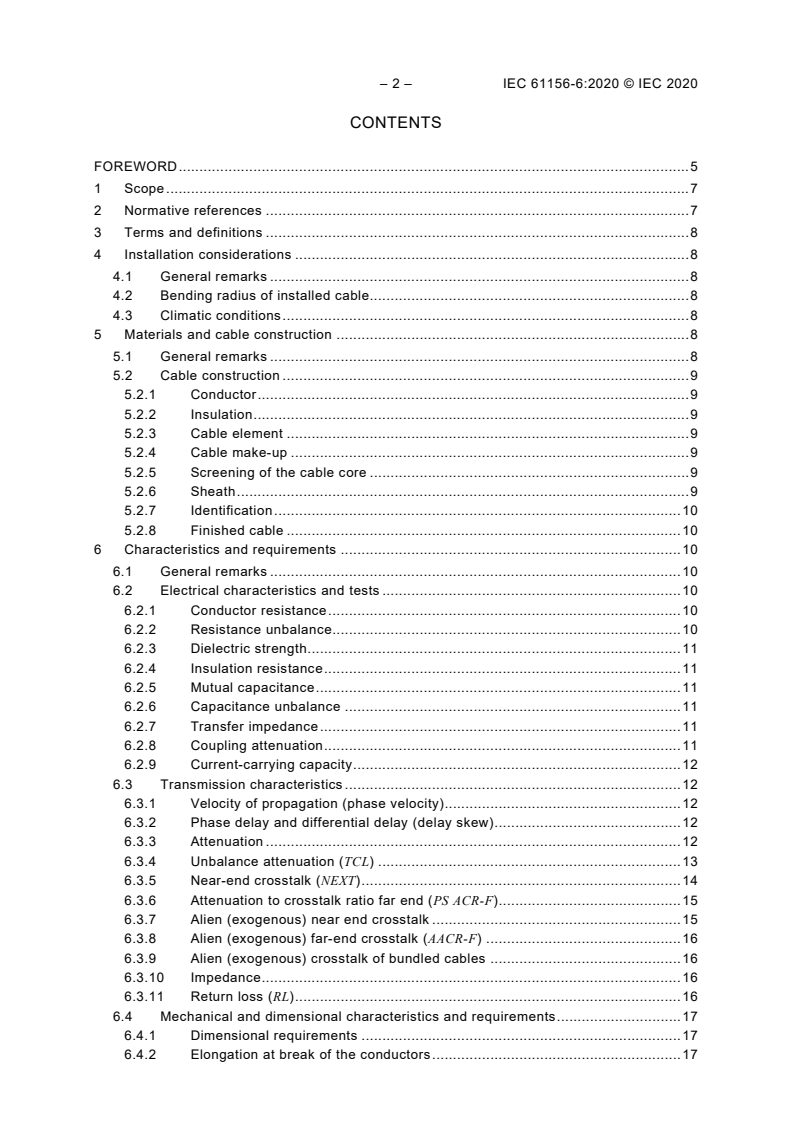
IEC 61156-6:2020 - Multicore and symmetrical pair/quad cables for digital communications - Part 6: Symmetrical pair/quad cables with transmission characteristics up to 1 000 MHz - Work area wiring - Sectional specification Released:4/3/2020
IEC 61156-6:2020 RLV - Multicore and symmetrical pair/quad cables for digital communications - Part 6: Symmetrical pair/quad cables with transmission characteristics up to 1 000 MHz - Work area wiring - Sectional specification Released:4/3/2020
Overview - IEC 61156-6:2020 (Work area wiring, up to 1 000 MHz)
IEC 61156-6:2020 is the fourth edition sectional specification for multicore and symmetrical pair/quad cables intended primarily for work area wiring as defined in ISO/IEC 11801. It covers symmetrical pair and quad cable designs (individually screened, common screened and unscreened) with transmission characteristics specified up to 1 000 MHz at 20 °C. This edition updates balance levels for MICE environments and adds references for modern measurement techniques and remote powering (PoE) considerations.
Key topics and technical requirements
- Cable types and construction
- Individually screened pairs, common screened pairs/quads, and unscreened options for work area use.
- Conductor, insulation, sheath and identification requirements.
- Electrical and transmission characteristics
- Attenuation, impedance, return loss, velocity of propagation, phase delay and delay skew.
- Pair balance parameters and additional balance levels for different MICE (Mechanical, Internal, Climatic, Electromagnetic) conditions.
- Crosstalk and interference
- Near-end crosstalk (NEXT), power-sum NEXT, attenuation-to-crosstalk ratios (PS ACR-F), and alien (exogenous) crosstalk metrics (ANEXT, AACR-F).
- Transfer impedance and coupling attenuation limits for screened constructions.
- Mechanical, environmental and safety tests
- Dimensional, tensile, bending, crush, impact, thermal ageing, cold bend, damp heat, flame propagation, smoke, halogen and toxic gas emissions.
- Measurement and test references
- Normative references to current measurement techniques and test methods, enabling consistent lab evaluation.
Practical applications and who uses this standard
- Cable manufacturers - design and certify pair/quad cables for work area deployments up to 1 000 MHz.
- System developers and network designers - evaluate cable characteristics required for high-speed digital channels using up to four pairs simultaneously.
- Cabling specifiers and consultants - select appropriate screened/unscreened cables for office and enterprise work areas, considering MICE conditions and remote powering (PoE).
- Test laboratories and installers - verify compliance for electrical, mechanical and environmental performance; use specified test procedures to qualify products on acceptance.
- Standards writers and procurement teams - reference sectional specification to define procurement and acceptance criteria for structured cabling projects.
Related standards
- IEC 61156-1 (general requirements for multicore and symmetrical pair/quad cables)
- ISO/IEC 11801 (generic cabling for customer premises)
- Other parts of the IEC 61156 series for different frequency ranges or cable applications
Keywords: IEC 61156-6:2020, work area wiring, symmetrical pair/quad cables, multicore cables, up to 1000 MHz, transmission characteristics, ISO/IEC 11801, MICE, remote powering, NEXT, transfer impedance, return loss.
Relations
- Effective Date
- 05-Sep-2023
- Effective Date
- 05-Sep-2023
Buy Documents
IEC 61156-6:2020 - Multicore and symmetrical pair/quad cables for digital communications - Part 6: Symmetrical pair/quad cables with transmission characteristics up to 1 000 MHz - Work area wiring - Sectional specification Released:4/3/2020
IEC 61156-6:2020 RLV - Multicore and symmetrical pair/quad cables for digital communications - Part 6: Symmetrical pair/quad cables with transmission characteristics up to 1 000 MHz - Work area wiring - Sectional specification Released:4/3/2020
Get Certified
Connect with accredited certification bodies for this standard

ANCE
Mexican certification and testing association.

Intertek Slovenia
Intertek testing, inspection, and certification services in Slovenia.

LNE (Laboratoire National de Métrologie et d'Essais)
French national laboratory for metrology and testing.
Sponsored listings
Frequently Asked Questions
IEC 61156-6:2020 is a standard published by the International Electrotechnical Commission (IEC). Its full title is "Multicore and symmetrical pair/quad cables for digital communications - Part 6: Symmetrical pair/quad cables with transmission characteristics up to 1 000 MHz - Work area wiring - Sectional specification". This standard covers: IEC 61156-6:2020 describes the cables intended primarily for working area wiring as defined in ISO/IEC 11801 (all parts). It covers cable designs comprising individually screened, common screened and unscreened pairs or quads. The transmission characteristics and the frequency range of the cables are specified at 20 °C. These cables can be used for various communication channels which use as many as four pairs simultaneously. In this sense, this document provides the cable characteristics required by system developers to evaluate new systems. This fourth edition cancels and replaces the third edition published in 2010 and Amendment 1:2012. It includes the following significant technical changes with respect to the previous edition: - additional balance levels with respect to MICE implementation by certain cabling specifications; - reference to current standards and technical reports with respect to measurement techniques and remote powering
IEC 61156-6:2020 describes the cables intended primarily for working area wiring as defined in ISO/IEC 11801 (all parts). It covers cable designs comprising individually screened, common screened and unscreened pairs or quads. The transmission characteristics and the frequency range of the cables are specified at 20 °C. These cables can be used for various communication channels which use as many as four pairs simultaneously. In this sense, this document provides the cable characteristics required by system developers to evaluate new systems. This fourth edition cancels and replaces the third edition published in 2010 and Amendment 1:2012. It includes the following significant technical changes with respect to the previous edition: - additional balance levels with respect to MICE implementation by certain cabling specifications; - reference to current standards and technical reports with respect to measurement techniques and remote powering
IEC 61156-6:2020 is classified under the following ICS (International Classification for Standards) categories: 33.120.20 - Wires and symmetrical cables. The ICS classification helps identify the subject area and facilitates finding related standards.
IEC 61156-6:2020 has the following relationships with other standards: It is inter standard links to IEC 61156-6:2010/AMD1:2012, IEC 61156-6:2010. Understanding these relationships helps ensure you are using the most current and applicable version of the standard.
IEC 61156-6:2020 is available in PDF format for immediate download after purchase. The document can be added to your cart and obtained through the secure checkout process. Digital delivery ensures instant access to the complete standard document.
Standards Content (Sample)
IEC 61156-6 ®
Edition 4.0 2020-04
INTERNATIONAL
STANDARD
Multicore and symmetrical pair/quad cables for digital communications –
Part 6: Symmetrical pair/quad cables with transmission characteristics
up to 1 000 MHz – Work area wiring – Sectional specification
All rights reserved. Unless otherwise specified, no part of this publication may be reproduced or utilized in any form
or by any means, electronic or mechanical, including photocopying and microfilm, without permission in writing from
either IEC or IEC's member National Committee in the country of the requester. If you have any questions about IEC
copyright or have an enquiry about obtaining additional rights to this publication, please contact the address below or
your local IEC member National Committee for further information.
IEC Central Office Tel.: +41 22 919 02 11
3, rue de Varembé info@iec.ch
CH-1211 Geneva 20 www.iec.ch
Switzerland
About the IEC
The International Electrotechnical Commission (IEC) is the leading global organization that prepares and publishes
International Standards for all electrical, electronic and related technologies.
About IEC publications
The technical content of IEC publications is kept under constant review by the IEC. Please make sure that you have the
latest edition, a corrigendum or an amendment might have been published.
IEC publications search - webstore.iec.ch/advsearchform Electropedia - www.electropedia.org
The advanced search enables to find IEC publications by a The world's leading online dictionary on electrotechnology,
variety of criteria (reference number, text, technical containing more than 22 000 terminological entries in English
committee,…). It also gives information on projects, replaced and French, with equivalent terms in 16 additional languages.
and withdrawn publications. Also known as the International Electrotechnical Vocabulary
(IEV) online.
IEC Just Published - webstore.iec.ch/justpublished
Stay up to date on all new IEC publications. Just Published IEC Glossary - std.iec.ch/glossary
details all new publications released. Available online and 67 000 electrotechnical terminology entries in English and
once a month by email. French extracted from the Terms and Definitions clause of
IEC publications issued since 2002. Some entries have been
IEC Customer Service Centre - webstore.iec.ch/csc collected from earlier publications of IEC TC 37, 77, 86 and
If you wish to give us your feedback on this publication or CISPR.
need further assistance, please contact the Customer Service
Centre: sales@iec.ch.
IEC 61156-6 ®
Edition 4.0 2020-04
INTERNATIONAL
STANDARD
Multicore and symmetrical pair/quad cables for digital communications –
Part 6: Symmetrical pair/quad cables with transmission characteristics
up to 1 000 MHz – Work area wiring – Sectional specification
INTERNATIONAL
ELECTROTECHNICAL
COMMISSION
ICS 33.120.20 ISBN 978-2-8322-7971-7
– 2 – IEC 61156-6:2020 © IEC 2020
CONTENTS
FOREWORD . 5
1 Scope . 7
2 Normative references . 7
3 Terms and definitions . 8
4 Installation considerations . 8
4.1 General remarks . 8
4.2 Bending radius of installed cable. 8
4.3 Climatic conditions . 8
5 Materials and cable construction . 8
5.1 General remarks . 8
5.2 Cable construction . 9
5.2.1 Conductor . 9
5.2.2 Insulation . 9
5.2.3 Cable element . 9
5.2.4 Cable make-up . 9
5.2.5 Screening of the cable core . 9
5.2.6 Sheath . 9
5.2.7 Identification . 10
5.2.8 Finished cable . 10
6 Characteristics and requirements . 10
6.1 General remarks . 10
6.2 Electrical characteristics and tests . 10
6.2.1 Conductor resistance . 10
6.2.2 Resistance unbalance. 10
6.2.3 Dielectric strength . 11
6.2.4 Insulation resistance . 11
6.2.5 Mutual capacitance . 11
6.2.6 Capacitance unbalance . 11
6.2.7 Transfer impedance . 11
6.2.8 Coupling attenuation . 11
6.2.9 Current-carrying capacity . 12
6.3 Transmission characteristics . 12
6.3.1 Velocity of propagation (phase velocity) . 12
6.3.2 Phase delay and differential delay (delay skew) . 12
6.3.3 Attenuation . 12
6.3.4 Unbalance attenuation (TCL) . 13
6.3.5 Near-end crosstalk (NEXT) . 14
6.3.6 Attenuation to crosstalk ratio far end (PS ACR-F) . 15
6.3.7 Alien (exogenous) near end crosstalk . 15
6.3.8 Alien (exogenous) far-end crosstalk (AACR-F) . 16
6.3.9 Alien (exogenous) crosstalk of bundled cables . 16
6.3.10 Impedance . 16
6.3.11 Return loss (RL) . 16
6.4 Mechanical and dimensional characteristics and requirements . 17
6.4.1 Dimensional requirements . 17
6.4.2 Elongation at break of the conductors . 17
6.4.3 Tensile strength of the insulation . 17
6.4.4 Elongation at break of the insulation . 17
6.4.5 Adhesion of the insulation to the conductor . 17
6.4.6 Elongation at break of the sheath . 17
6.4.7 Tensile strength of the sheath . 17
6.4.8 Crush test of the cable . 17
6.4.9 Impact test of the cable . 18
6.4.10 Bending under tension . 18
6.4.11 Repeated bending of the cable . 18
6.4.12 Tensile performance of the cable . 18
6.4.13 Shock-test requirements of the cable . 18
6.4.14 Bump-test requirements of the cable . 18
6.4.15 Vibration-test requirements of the cable . 18
6.5 Environmental characteristics . 18
6.5.1 Shrinkage of the insulation . 18
6.5.2 Wrapping test of the insulation after thermal ageing . 18
6.5.3 Bending test of the insulation at low temperature . 18
6.5.4 Elongation at break of the sheath after ageing . 18
6.5.5 Tensile strength of the sheath after ageing . 18
6.5.6 Sheath pressure test at high temperature . 19
6.5.7 Cold bend test of the cable . 19
6.5.8 Heat shock test . 19
6.5.9 Damp heat steady state . 19
6.5.10 Solar radiation . 19
6.5.11 Solvents and contaminating fluids . 19
6.5.12 Salt mist and sulphur dioxide . 19
6.5.13 Water immersion . 19
6.5.14 Hygroscopicity . 19
6.5.15 Wicking. 19
6.5.16 Flame propagation characteristics of a single cable . 19
6.5.17 Flame propagation characteristics of bunched cables . 19
6.5.18 Halogen gas evolution . 19
6.5.19 Smoke generation . 20
6.5.20 Toxic gas emission . 20
6.5.21 Integrated fire test . 20
7 Introduction to the blank detail specification . 20
Annex A (informative) Blank detail specification . 21
Bibliography . 26
Table 1 – Cable categories . 7
Table 2 – Transfer impedance . 11
Table 3 – Coupling attenuation in dB . 12
Table 4 – Attenuation, constant values . 13
Table 5 – Near-end unbalance attenuation . 14
Table 6 – Worst pair PS NEXT(1) values . 14
Table 7 – Worst pair PS ACR-F(1) . 15
Table 8 – PS ANEXT . 15
– 4 – IEC 61156-6:2020 © IEC 2020
Table 9 – PS AACR-F . 16
Table 10 – Return loss . 17
INTERNATIONAL ELECTROTECHNICAL COMMISSION
____________
MULTICORE AND SYMMETRICAL PAIR/QUAD
CABLES FOR DIGITAL COMMUNICATIONS –
Part 6: Symmetrical pair/quad cables with transmission
characteristics up to 1 000 MHz – Work area wiring –
Sectional specification
FOREWORD
1) The International Electrotechnical Commission (IEC) is a worldwide organization for standardization comprising
all national electrotechnical committees (IEC National Committees). The object of IEC is to promote
international co-operation on all questions concerning standardization in the electrical and electronic fields. To
this end and in addition to other activities, IEC publishes International Standards, Technical Specifications,
Technical Reports, Publicly Available Specifications (PAS) and Guides (hereafter referred to as “IEC
Publication(s)”). Their preparation is entrusted to technical committees; any IEC National Committee interested
in the subject dealt with may participate in this preparatory work. International, governmental and non-
governmental organizations liaising with the IEC also participate in this preparation. IEC collaborates closely
with the International Organization for Standardization (ISO) in accordance with conditions determined by
agreement between the two organizations.
2) The formal decisions or agreements of IEC on technical matters express, as nearly as possible, an international
consensus of opinion on the relevant subjects since each technical committee has representation from all
interested IEC National Committees.
3) IEC Publications have the form of recommendations for international use and are accepted by IEC National
Committees in that sense. While all reasonable efforts are made to ensure that the technical content of IEC
Publications is accurate, IEC cannot be held responsible for the way in which they are used or for any
misinterpretation by any end user.
4) In order to promote international uniformity, IEC National Committees undertake to apply IEC Publications
transparently to the maximum extent possible in their national and regional publications. Any divergence
between any IEC Publication and the corresponding national or regional publication shall be clearly indicated in
the latter.
5) IEC itself does not provide any attestation of conformity. Independent certification bodies provide conformity
assessment services and, in some areas, access to IEC marks of conformity. IEC is not responsible for any
services carried out by independent certification bodies.
6) All users should ensure that they have the latest edition of this publication.
7) No liability shall attach to IEC or its directors, employees, servants or agents including individual experts and
members of its technical committees and IEC National Committees for any personal injury, property damage or
other damage of any nature whatsoever, whether direct or indirect, or for costs (including legal fees) and
expenses arising out of the publication, use of, or reliance upon, this IEC Publication or any other IEC
Publications.
8) Attention is drawn to the Normative references cited in this publication. Use of the referenced publications is
indispensable for the correct application of this publication.
9) Attention is drawn to the possibility that some of the elements of this IEC Publication may be the subject of
patent rights. IEC shall not be held responsible for identifying any or all such patent rights.
International Standard IEC 61156-6 has been prepared by subcommittee 46C: Wires and
symmetric cables, of IEC technical committee 46: Cables, wires, waveguides, RF connectors,
RF and microwave passive components and accessories.
This fourth edition cancels and replaces the third edition published in 2010 and
Amendment 1:2012. This edition constitutes a technical revision.
This edition includes the following significant technical changes with respect to the previous
edition:
a) additional balance levels with respect to MICE implementation by certain cabling
specifications;
– 6 – IEC 61156-6:2020 © IEC 2020
b) reference to current standards and technical reports with respect to measurement
techniques and remote powering.
The text of this International Standard is based on the following documents:
FDIS Report on voting
46C/1141/FDIS 46C/1145/RVD
Full information on the voting for the approval of this International Standard can be found in
the report on voting indicated in the above table.
This document has been drafted in accordance with the ISO/IEC Directives, Part 2.
This International Standard is to be used in conjunction with IEC 61156-1:2007 and
IEC 61156-1:2007/AMD1:2009.
A list of all parts in the IEC 61156 series, published under the general title Multicore and
symmetrical pair/quad cables for digital communications, can be found on the IEC website.
The committee has decided that the contents of this document will remain unchanged until the
stability date indicated on the IEC website under "http://webstore.iec.ch" in the data related to
the specific document. At this date, the document will be
• reconfirmed,
• withdrawn,
• replaced by a revised edition, or
• amended.
MULTICORE AND SYMMETRICAL PAIR/QUAD
CABLES FOR DIGITAL COMMUNICATIONS –
Part 6: Symmetrical pair/quad cables with transmission
characteristics up to 1 000 MHz – Work area wiring –
Sectional specification
1 Scope
This part of IEC 61156 describes the cables intended primarily for working area wiring as
defined in ISO/IEC 11801 (all parts).
It covers cable designs comprising individually screened, common screened and unscreened
pairs or quads. The transmission characteristics and the frequency range (see Table 1) of the
cables are specified at 20 °C.
Table 1 – Cable categories
Maximum referenced
Cable designation frequency
MHz
Category 5e 100
Category 6 250
Category 6 500
A
Category 7 600
Category 7 1 000
A
These cables can be used for various communication channels which use as many as four
pairs simultaneously. In this sense, this document provides the cable characteristics required
by system developers to evaluate new systems.
The cables covered by this document are intended to operate with voltages and currents
normally encountered in communication systems. While these cables are not intended to be
used in conjunction with low impedance sources, for example the electric power supplies of
public utility mains, they are intended to be used to support the delivery of low voltage remote
powering applications such as IEEE 802.3af (Power over Ethernet) or further developments
for example according to IEEE 802.3at or IEEE 802.3bt. More information on the capacity to
support these applications according to the installation practices are given in IEC 61156-1-4,
IEC TR 61156-1-6 and ISO/IEC TS 29125.
2 Normative references
The following documents are referred to in the text in such a way that some or all of their
content constitutes requirements of this document. For dated references, only the edition
cited applies. For undated references, the latest edition of the referenced document (including
any amendments) applies.
IEC 61156-1:2007, Multicore and symmetrical pair/quad cables for digital communications –
Part 1: Generic specification
IEC 61156-1:2007/AMD1:2009
– 8 – IEC 61156-6:2020 © IEC 2020
IEC 62153-4-3, Metallic communication cables test methods – Part 4-3: Electromagnetic
compatibility (EMC) – Surface transfer impedance – Triaxial method
IEC 62153-4-5, Metallic communication cables test methods – Part 4-5: Electromagnetic
compatibility (EMC) – Coupling or screening attenuation – Absorbing clamp method
IEC 62153-4-9, Metallic communication cable test methods – Part 4-9: Electromagnetic
compatibility (EMC) – Coupling attenuation of screened balanced cables, triaxial method
3 Terms and definitions
For the purposes of this document, the terms and definitions given in IEC 61156-1 apply.
ISO and IEC maintain terminological databases for use in standardization at the following
addresses:
• IEC Electropedia: available at http://www.electropedia.org/
• ISO Online browsing platform: available at http://www.iso.org/obp
4 Installation considerations
4.1 General remarks
Installation considerations are defined in IEC 61156-1:2007, Clause 4.
4.2 Bending radius of installed cable
The bending radius of the installed cable shall not be less than four times the outside
diameter of the cable.
4.3 Climatic conditions
Under static conditions, the cable shall operate at least in the temperature range of the
environment from –20 °C to +60 °C.
The attenuation increase due to the elevated operating temperature (temperature of the
environment) is described in 6.3.3.2.
In the case of application of remote powering, the maximum temperature of the conductor
shall not exceed the maximum operation temperature under static conditions in order to
maintain the integrity of the dielectric material performance which is aligned to the
environmental temperature range.
Extended temperature ranges are permitted and may be specified in the relevant detail
specification.
5 Materials and cable construction
5.1 General remarks
The choice of materials and cable construction shall be suitable for the intended application
and installation of the cable. Particular care shall be taken to meet any special requirements
for EMC and fire performance (such as burning properties, smoke generation, evolution of
halogen gas).
The cable construction shall be in accordance with the details and dimensions given in the
relevant detail specification.
5.2 Cable construction
5.2.1 Conductor
The conductor shall be a solid or stranded annealed copper, in accordance with
IEC 61156-1:2007, 5.2.1 and should have a nominal diameter between 0,4 mm and 0,65 mm.
A conductor diameter of up to 0,8 mm may be used.
5.2.2 Insulation
The conductor shall be insulated with a suitable material. Examples of suitable materials are:
– polyolefin;
– fluoropolymer;
– low-smoke zero-halogen thermoplastic material.
5.2.3 Cable element
5.2.3.1 General
The cable element shall be a pair or quad and shall be twisted.
5.2.3.2 Screening of the cable element
When required, the screen for the cable element shall be in accordance with
IEC 61156-1:2007, 5.2.3.2.
5.2.4 Cable make-up
A spacer may be used to separate the cable elements. The cable elements, including spacers,
shall be assembled to form the cable core.
The core of the cable may be wrapped with a protective layer of non-hygroscopic and non-
wicking material.
5.2.5 Screening of the cable core
When required by the relevant detail specification, a screen for the cable core shall be
provided.
The screen shall be in accordance with IEC 61156-1:2007, 5.2.5.
5.2.6 Sheath
The sheath material shall consist of a suitable material.
Examples of suitable materials are
– polyolefin;
– PVC;
– fluoropolymer;
– low-smoke zero-halogen thermoplastic material.
– 10 – IEC 61156-6:2020 © IEC 2020
The sheath shall be continuous, having a thickness as uniform as possible. A non-metallic
ripcord may be provided. When provided, the ripcord shall be non-hygroscopic and
non-wicking.
The colour of the sheath is not specified but it should be specified in the relevant detail
specification.
5.2.7 Identification
Each length of cable shall be identified with the supplier's details and, when required, by
means of a traceability code, using one of the following methods:
– appropriately coloured threads or tapes,
– with a printed tape,
– printing on the cable core wrapping,
– marking on the sheath.
Additional markings, such as length marking are permitted If used, such markings should be
indicated in the relevant detail specification.
5.2.8 Finished cable
The finished cable shall be adequately protected for storage and shipment.
6 Characteristics and requirements
6.1 General remarks
Clause 6 lists the characteristics and minimum requirements of a cable complying with this
document. Test methods shall be in accordance with IEC 61156-1:2007 and
IEC 61156-1:2007/AMD1:2009, Clause 6.
The tests according to 6.2 shall be carried out on a cable length of not less than 100 m,
unless otherwise specified.
All the tests according to 6.3 should be carried out on a cable length of 100 m, unless
otherwise specified. If suitable, respective lengths correction formulas according to
IEC 61156-1 shall be used. For Category 7 , unless the test is performed with very sensitive
A
test equipment, it is recommended to limit the cable length to 50 m for a better accuracy in
high frequencies.
In case balunless measurements are made, the procedures should be as per
IEC TR 61156-1-2:2009 and IEC TR 61156-1-2:2009/AMD1:2014 which covers the application
of balunless measurement technology.
6.2 Electrical characteristics and tests
6.2.1 Conductor resistance
The maximum conductor resistance at, or corrected to, 20 °C shall not exceed 14,5 Ω/100 m
of cable.
6.2.2 Resistance unbalance
6.2.2.1 Resistance unbalance within a pair
The resistance unbalance shall not exceed 2,0 %.
6.2.2.2 Resistance unbalance between pairs
The pair-to-pair resistance unbalance shall not exceed 5,0 %.
6.2.3 Dielectric strength
There shall be no failures when a test is performed on a conductor/conductor and, where
screen(s) are present, on a conductor/screen with 1,0 kV DC for 1 min or, alternatively, with
2,5 kV DC for 2 s. An AC voltage may be used. The AC voltage levels in these cases shall be
0,7 kV AC for 1 min or, alternatively, 1,7 kV AC for 2 s.
6.2.4 Insulation resistance
The test shall be performed on
– conductor/conductor;
– conductor/screen (when present).
The minimum insulation resistance at or corrected to 20 °C shall be not less than
5 000 MΩ · km.
6.2.5 Mutual capacitance
The mutual capacitance
...
IEC 61156-6 ®
Edition 4.0 2020-04
REDLINE VERSION
INTERNATIONAL
STANDARD
colour
inside
Multicore and symmetrical pair/quad cables for digital communications –
Part 6: Symmetrical pair/quad cables with transmission characteristics
up to 1 000 MHz – Work area wiring – Sectional specification
All rights reserved. Unless otherwise specified, no part of this publication may be reproduced or utilized in any form
or by any means, electronic or mechanical, including photocopying and microfilm, without permission in writing from
either IEC or IEC's member National Committee in the country of the requester. If you have any questions about IEC
copyright or have an enquiry about obtaining additional rights to this publication, please contact the address below or
your local IEC member National Committee for further information.
IEC Central Office Tel.: +41 22 919 02 11
3, rue de Varembé info@iec.ch
CH-1211 Geneva 20 www.iec.ch
Switzerland
About the IEC
The International Electrotechnical Commission (IEC) is the leading global organization that prepares and publishes
International Standards for all electrical, electronic and related technologies.
About IEC publications
The technical content of IEC publications is kept under constant review by the IEC. Please make sure that you have the
latest edition, a corrigendum or an amendment might have been published.
IEC publications search - webstore.iec.ch/advsearchform Electropedia - www.electropedia.org
The advanced search enables to find IEC publications by a The world's leading online dictionary on electrotechnology,
variety of criteria (reference number, text, technical containing more than 22 000 terminological entries in English
committee,…). It also gives information on projects, replaced and French, with equivalent terms in 16 additional languages.
and withdrawn publications. Also known as the International Electrotechnical Vocabulary
(IEV) online.
IEC Just Published - webstore.iec.ch/justpublished
Stay up to date on all new IEC publications. Just Published IEC Glossary - std.iec.ch/glossary
details all new publications released. Available online and 67 000 electrotechnical terminology entries in English and
once a month by email. French extracted from the Terms and Definitions clause of
IEC publications issued since 2002. Some entries have been
IEC Customer Service Centre - webstore.iec.ch/csc collected from earlier publications of IEC TC 37, 77, 86 and
If you wish to give us your feedback on this publication or CISPR.
need further assistance, please contact the Customer Service
Centre: sales@iec.ch.
IEC 61156-6 ®
Edition 4.0 2020-04
REDLINE VERSION
INTERNATIONAL
STANDARD
colour
inside
Multicore and symmetrical pair/quad cables for digital communications –
Part 6: Symmetrical pair/quad cables with transmission characteristics
up to 1 000 MHz – Work area wiring – Sectional specification
INTERNATIONAL
ELECTROTECHNICAL
COMMISSION
ICS 33.120.20 ISBN 978-2-8322-8148-2
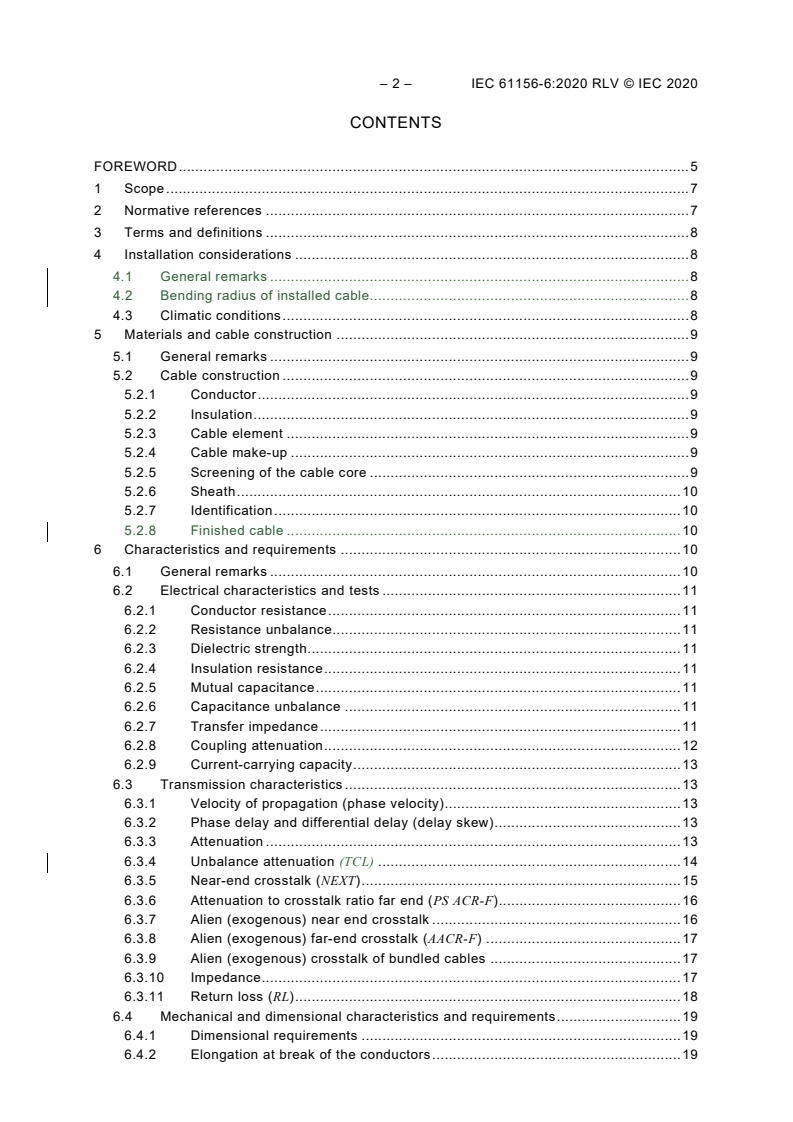
– 2 – IEC 61156-6:2020 RLV © IEC 2020
CONTENTS
FOREWORD . 5
1 Scope . 7
2 Normative references . 7
3 Terms and definitions . 8
4 Installation considerations . 8
4.1 General remarks . 8
4.2 Bending radius of installed cable. 8
4.3 Climatic conditions . 8
5 Materials and cable construction . 9
5.1 General remarks . 9
5.2 Cable construction . 9
5.2.1 Conductor . 9
5.2.2 Insulation . 9
5.2.3 Cable element . 9
5.2.4 Cable make-up . 9
5.2.5 Screening of the cable core . 9
5.2.6 Sheath . 10
5.2.7 Identification . 10
5.2.8 Finished cable . 10
6 Characteristics and requirements . 10
6.1 General remarks . 10
6.2 Electrical characteristics and tests . 11
6.2.1 Conductor resistance . 11
6.2.2 Resistance unbalance. 11
6.2.3 Dielectric strength . 11
6.2.4 Insulation resistance . 11
6.2.5 Mutual capacitance . 11
6.2.6 Capacitance unbalance . 11
6.2.7 Transfer impedance . 11
6.2.8 Coupling attenuation . 12
6.2.9 Current-carrying capacity . 13
6.3 Transmission characteristics . 13
6.3.1 Velocity of propagation (phase velocity) . 13
6.3.2 Phase delay and differential delay (delay skew) . 13
6.3.3 Attenuation . 13
6.3.4 Unbalance attenuation (TCL) . 14
6.3.5 Near-end crosstalk (NEXT) . 15
6.3.6 Attenuation to crosstalk ratio far end (PS ACR-F) . 16
6.3.7 Alien (exogenous) near end crosstalk . 16
6.3.8 Alien (exogenous) far-end crosstalk (AACR-F) . 17
6.3.9 Alien (exogenous) crosstalk of bundled cables . 17
6.3.10 Impedance . 17
6.3.11 Return loss (RL) . 18
6.4 Mechanical and dimensional characteristics and requirements . 19
6.4.1 Dimensional requirements . 19
6.4.2 Elongation at break of the conductors . 19
6.4.3 Tensile strength of the insulation . 19
6.4.4 Elongation at break of the insulation . 19
6.4.5 Adhesion of the insulation to the conductor . 19
6.4.6 Elongation at break of the sheath . 19
6.4.7 Tensile strength of the sheath . 19
6.4.8 Crush test of the cable . 19
6.4.9 Impact test of the cable . 19
6.4.10 Bending under tension . 19
6.4.11 Repeated bending of the cable . 19
6.4.12 Tensile performance of the cable . 19
6.4.13 Shock-test requirements of the cable . 20
6.4.14 Bump-test requirements of the cable . 20
6.4.15 Vibration-test requirements of the cable . 20
6.5 Environmental characteristics . 20
6.5.1 Shrinkage of the insulation . 20
6.5.2 Wrapping test of the insulation after thermal ageing . 20
6.5.3 Bending test of the insulation at low temperature . 20
6.5.4 Elongation at break of the sheath after ageing . 20
6.5.5 Tensile strength of the sheath after ageing . 20
6.5.6 Sheath pressure test at high temperature . 20
6.5.7 Cold bend test of the cable . 20
6.5.8 Heat shock test . 20
6.5.9 Damp heat steady state . 20
6.5.10 Solar radiation . 21
6.5.11 Solvents and contaminating fluids . 21
6.5.12 Salt mist and sulphur dioxide . 21
6.5.13 Water immersion . 21
6.5.14 Hygroscopicity . 21
6.5.15 Wicking. 21
6.5.16 Flame propagation characteristics of a single cable . 21
6.5.17 Flame propagation characteristics of bunched cables . 21
6.5.18 Halogen gas evolution . 21
6.5.19 Smoke generation . 21
6.5.20 Toxic gas emission . 21
6.5.21 Integrated fire test . 21
7 Introduction to the blank detail specification . 22
Annex A (informative) Blank detail specification . 23
Bibliography . 28
.................................................................................................
Figure 1 – Impedance template
Table 1 – Cable categories . 7
Table 2 – Transfer impedance . 12
Table 3 – Coupling attenuation in dB . 12
Table 4 – Attenuation, constant values . 14
Table 5 – Near-end unbalance attenuation . 15
Table 6 – Worst pair PS NEXT(1) values . 15
– 4 – IEC 61156-6:2020 RLV © IEC 2020
Table 7 – Worst pair PS ACR-F(1) . 16
Table 8 – PS ANEXT . 16
Table 9 – PS AACR-F (PS AELFEXT) . 17
Table 10 – Return loss . 18
INTERNATIONAL ELECTROTECHNICAL COMMISSION
____________
MULTICORE AND SYMMETRICAL PAIR/QUAD
CABLES FOR DIGITAL COMMUNICATIONS –
Part 6: Symmetrical pair/quad cables with transmission
characteristics up to 1 000 MHz – Work area wiring –
Sectional specification
FOREWORD
1) The International Electrotechnical Commission (IEC) is a worldwide organization for standardization comprising
all national electrotechnical committees (IEC National Committees). The object of IEC is to promote
international co-operation on all questions concerning standardization in the electrical and electronic fields. To
this end and in addition to other activities, IEC publishes International Standards, Technical Specifications,
Technical Reports, Publicly Available Specifications (PAS) and Guides (hereafter referred to as “IEC
Publication(s)”). Their preparation is entrusted to technical committees; any IEC National Committee interested
in the subject dealt with may participate in this preparatory work. International, governmental and non-
governmental organizations liaising with the IEC also participate in this preparation. IEC collaborates closely
with the International Organization for Standardization (ISO) in accordance with conditions determined by
agreement between the two organizations.
2) The formal decisions or agreements of IEC on technical matters express, as nearly as possible, an international
consensus of opinion on the relevant subjects since each technical committee has representation from all
interested IEC National Committees.
3) IEC Publications have the form of recommendations for international use and are accepted by IEC National
Committees in that sense. While all reasonable efforts are made to ensure that the technical content of IEC
Publications is accurate, IEC cannot be held responsible for the way in which they are used or for any
misinterpretation by any end user.
4) In order to promote international uniformity, IEC National Committees undertake to apply IEC Publications
transparently to the maximum extent possible in their national and regional publications. Any divergence
between any IEC Publication and the corresponding national or regional publication shall be clearly indicated in
the latter.
5) IEC itself does not provide any attestation of conformity. Independent certification bodies provide conformity
assessment services and, in some areas, access to IEC marks of conformity. IEC is not responsible for any
services carried out by independent certification bodies.
6) All users should ensure that they have the latest edition of this publication.
7) No liability shall attach to IEC or its directors, employees, servants or agents including individual experts and
members of its technical committees and IEC National Committees for any personal injury, property damage or
other damage of any nature whatsoever, whether direct or indirect, or for costs (including legal fees) and
expenses arising out of the publication, use of, or reliance upon, this IEC Publication or any other IEC
Publications.
8) Attention is drawn to the Normative references cited in this publication. Use of the referenced publications is
indispensable for the correct application of this publication.
9) Attention is drawn to the possibility that some of the elements of this IEC Publication may be the subject of
patent rights. IEC shall not be held responsible for identifying any or all such patent rights.
This redline version of the official IEC Standard allows the user to identify the changes
made to the previous edition. A vertical bar appears in the margin wherever a change
has been made. Additions are in green text, deletions are in strikethrough red text.
– 6 – IEC 61156-6:2020 RLV © IEC 2020
International Standard IEC 61156-6 has been prepared by subcommittee 46C: Wires and
symmetric cables, of IEC technical committee 46: Cables, wires, waveguides, RF connectors,
RF and microwave passive components and accessories.
This fourth edition cancels and replaces the third edition published in 2010 and
Amendment 1:2012. This edition constitutes a technical revision.
This edition includes the following significant technical changes with respect to the previous
edition:
a) additional balance levels with respect to MICE implementation by certain cabling
specifications;
b) reference to current standards and technical reports with respect to measurement
techniques and remote powering.
The text of this International Standard is based on the following documents:
FDIS Report on voting
46C/1141/FDIS 46C/1145/RVD
Full information on the voting for the approval of this International Standard can be found in
the report on voting indicated in the above table.
This document has been drafted in accordance with the ISO/IEC Directives, Part 2.
This International Standard is to be used in conjunction with IEC 61156-1:2007 and
IEC 61156-1:2007/AMD1:2009.
A list of all parts in the IEC 61156 series, published under the general title Multicore and
symmetrical pair/quad cables for digital communications, can be found on the IEC website.
The committee has decided that the contents of this document will remain unchanged until the
stability date indicated on the IEC website under "http://webstore.iec.ch" in the data related to
the specific document. At this date, the document will be
• reconfirmed,
• withdrawn,
• replaced by a revised edition, or
• amended.
IMPORTANT – The 'colour inside' logo on the cover page of this publication indicates
that it contains colours which are considered to be useful for the correct
understanding of its contents. Users should therefore print this document using a
colour printer.
MULTICORE AND SYMMETRICAL PAIR/QUAD
CABLES FOR DIGITAL COMMUNICATIONS –
Part 6: Symmetrical pair/quad cables with transmission
characteristics up to 1 000 MHz – Work area wiring –
Sectional specification
1 Scope
This part of IEC 61156 makes reference to IEC 61156-1. The cables described herein are
intended primarily for work area wiring as defined in ISO/IEC 11801 and ISO/IEC 24702.
This part of IEC 61156 describes the cables intended primarily for working area wiring as
defined in ISO/IEC 11801 (all parts).
It covers cable designs comprising individually screened, common screened and unscreened
pairs or quads. The transmission characteristics and the frequency range (see Table 1) of the
cables are specified at 20 °C.
Table 1 – Cable categories
Maximum referenced
Cable designation frequency
MHz
Category 5e 100
Category 6 250
Category 6 500
A
Category 7 600
Category 7 1 000
A
These cables can be used for various communication channels which use as many as four
pairs simultaneously. In this sense, this document provides the cable characteristics required
by system developers to evaluate new systems.
The cables covered by this document are intended to operate with voltages and currents
normally encountered in communication systems. While these cables are not intended to be
used in conjunction with low impedance sources, for example the electric power supplies of
public utility mains, they are intended to be used to support the delivery of low voltage and
remote powering applications such as IEEE 802.3af (Power over Ethernet) and or further
developments for example according to IEEE 802.3at (Power over Ethernet Plus) or IEEE
802.3bt. More information on the capacity to support these applications according to the
installation practices are given in IEC 61156-1-4, IEC TR 61156-1-6 and ISO/IEC TS 29125.
2 Normative references
The following documents are referred to in the text in such a way that some or all of their
content constitutes requirements of this document. For dated references, only the edition
cited applies. For undated references, the latest edition of the referenced document (including
any amendments) applies.
– 8 – IEC 61156-6:2020 RLV © IEC 2020
IEC 61156-1:2007, Multicore and symmetrical pair/quad cables for digital communications –
Part 1: Generic specification
IEC 61156-1:2007/AMD1:2009
IEC 61156-6-1, Multicore and symmetrical pair/quad cables for digital communications –
Part 6-1: Symmetrical pair/quad cables with transmission characteristics up to 1 000 MHz –
Work area wiring – Blank detail specification
IEC 62153-4-3, Metallic communication cables test methods – Part 4-3: Electromagnetic
compatibility (EMC) – Surface transfer impedance – Triaxial method
IEC 62153-4-5, Metallic communication cables test methods – Part 4-5: Electromagnetic
compatibility (EMC) – Coupling or screening attenuation – Absorbing clamp method
IEC 62153-4-9, Metallic communication cable test methods – Part 4-9: Electromagnetic
compatibility (EMC) – Coupling attenuation of screened balanced cables, triaxial method
3 Terms and definitions
For the purposes of this document, the terms and definitions given in IEC 61156-1 apply.
ISO and IEC maintain terminological databases for use in standardization at the following
addresses:
• IEC Electropedia: available at http://www.electropedia.org/
• ISO Online browsing platform: available at http://www.iso.org/obp
4 Installation considerations
See Clause 4 of IEC 61156-1.
4.1 General remarks
Installation considerations are defined in IEC 61156-1:2007, Clause 4.
4.2 Bending radius of installed cable
The bending radius of the installed cable shall not be less than four times the outside
diameter of the cable.
4.3 Climatic conditions
Under static conditions, the cables shall operate in the temperature range from –20 °C to
+60 °C. The conductor and cable temperature dependence is specified for screened and
unscreened cables and should be taken into account for the design of an actual cabling
system.
Under static conditions, the cable shall operate at least in the temperature range of the
environment from –20 °C to +60 °C.
The attenuation increase due to the elevated operating temperature (temperature of the
environment) is described in 6.3.3.2.
In the case of application of remote powering, the maximum temperature of the conductor
shall not exceed the maximum operation temperature under static conditions in order to
maintain the integrity of the dielectric material performance which is aligned to the
environmental temperature range.
Extended temperature ranges are permitted and may be specified in the relevant detail
specification.
5 Materials and cable construction
5.1 General remarks
The choice of materials and cable construction shall be suitable for the intended application
and installation of the cable. Particular care shall be taken to meet any special requirements
for EMC and fire performance (such as burning properties, smoke generation, evolution of
halogen gas, etc.).
The cable construction shall be in accordance with the details and dimensions given in the
relevant detail specification.
5.2 Cable construction
5.2.1 Conductor
The conductor shall be a solid or stranded annealed copper, in accordance with
IEC 61156-1:2007, 5.2.1 and should have a nominal diameter between 0,4 mm and 0,65 mm.
A conductor diameter of up to 0,8 mm may be used.
5.2.2 Insulation
The conductor shall be insulated with a suitable material. Examples of suitable materials are:
– polyolefin;
– fluoropolymer;
– low-smoke zero-halogen thermoplastic material.
5.2.3 Cable element
5.2.3.1 General
The cable element shall be a pair or quad and shall be twisted.
5.2.3.2 Screening of the cable element
When required, the screen for the cable element shall be in accordance with
IEC 61156-1:2007, 5.2.3.12.
5.2.4 Cable make-up
A spacer may be used to separate the cable elements. The cable elements, including spacers,
shall be assembled to form the cable core.
The core of the cable may be wrapped with a protective layer of non-hygroscopic and non-
wicking material.
5.2.5 Screening of the cable core
When required by the relevant detail specification, a screen for the cable core shall be
provided.
– 10 – IEC 61156-6:2020 RLV © IEC 2020
The screen shall be in accordance with IEC 61156-1:2007, 5.2.5.
5.2.6 Sheath
The sheath material shall consist of a suitable material.
Examples of suitable materials are
– polyolefin;
– PVC;
– fluoropolymer;
– low-smoke zero-halogen thermoplastic material.
The sheath shall be continuous, having a thickness as uniform as possible. A non-metallic
ripcord may be provided. When provided, the ripcord shall be non-hygroscopic and
non-wicking.
The colour of the sheath is not specified but it should be specified in the relevant detail
specification.
5.2.7 Identification
Each length of cable shall be identified with the supplier's details and, when required, by
means of a traceability code, using one of the following methods:
– appropriately coloured threads or tapes,
– with a printed tape,
– printing on the cable core wrapping,
– marking on the sheath.
Additional markings, such as length marking, etc., are permitted If used, such markings shall
refer to this should be indicated in the relevant detail specification.
5.2.8 Finished cable
The finished cable shall be adequately protected for storage and shipment.
6 Characteristics and requirements
6.1 General remarks
Clause 6 lists the characteristics and minimum requirements of a cable complying with this
document. Test methods shall be in accordance with IEC 61156-1:2007 and
IEC 61156-1:2007/AMD1:2009, Clause 6.
The tests according to 6.2 shall be carried out on a cable length of not less than 100 m,
unless otherwise specified.
All the tests according to 6.3 should be carried out on a cable length of 100 m, unless
otherwise specified. If suitable, respective lengths correction formulas according to
IEC 61156-1 shall be used. For Category 7 , unless the test is performed with very sensitive
A
test equipment, it is recommended to limit the cable length to 50 m for a better accuracy in
high frequencies.
In case balunless measurements are made, the procedures should be as per
IEC TR 61156-1-2:2009 and IEC TR 61156-1-2:2009/AMD1:2014 which covers the application
of balunless measurement technology.
6.2 Electrical characteristics and tests
NOTE The tests should be carried out on a cable length of not less than 100 m, unless otherwise specified.
6.2.1 Conductor resistance
The maximum conductor resistance at, or corrected to, 20 °C shall not exceed 14,5 Ω/100 m
of cable.
6.2.2 Resistance unbalance
6.2.2.1 Resistance unbalance within a pair
The resistance unbalance shall not exceed 2,0 %.
6.2.2.2 Resistance unbalance between pairs
The pair-to-pair resistance unbalance shall not exceed 4 % 5,0 %.
6.2.3 Dielectric strength
There shall be no failures when a test is performed on a conductor/conductor and, where
screen(s) are present, on a conductor/screen with 1,0 kV DC for 1 min or, alternatively, with
2,5 kV DC for 2 s. An AC voltage may be used. The AC voltage levels in these cases shall be
0,7 kV AC for 1 min or, alternatively, 1,7 kV AC for 2 s.
6.2.4 Insulation resistance
The test shall be performed on
– conductor/conductor;
– conductor/screen (when present).
The minimum insulation resistance at or corrected to 20 °C shall be not less than 5 000 MΩ.m
5 000 MΩ · km.
6.2.5 Mutual capacitance
The mutual capacitance is not specified but may be indicated in the relevant detail
specification.
6.2.6 Capacitance unbalance
The maximum capacitance unbalance pair to ground shall not exceed 1 600 pF/km at a
frequency of 800 Hz or 1 000 Hz.
6.2.7 Transfer impedance
For cables containing a screen or screens, two grades of performance are recognized for
transfer impedance. The transfer impedance measured using the triaxial method
(IEC 62153-4-3) shall not exceed the values shown in Table 2 at the discrete frequencies
indicated for each grade.
– 12 – IEC 61156-6:2020 RLV © IEC 2020
Table 2 – Transfer impedance
Frequency Maximum surface transfer impedance
MHz mΩ/m
Grade 1 Grade 2
1 10 50
10 10 100
30 30 200
100 100 1 000
Maximum surface transfer impedance
Frequency range
mΩ/m
MHz
Grade 1 Grade 2
-0,176 0,301
1 to 10 Z ≤ 15 × f Z ≤ 50 × f
t t
0,6309
10 to 30 Z ≤ 10 × f/10 Z ≤ 23,392 × f
t t
1,3368
30 to 100 Z ≤ 10 × f/10 Z ≤ 2,120 6 × f
t t
NOTE The screen longitudinal DC resistance of 30 mΩ/m or less is an indicator for fulfilling the transfer
impedance requirement of Grade 2. A measurement of DC resistance cannot replace a transfer impedance
measurement.
6.2.8 Coupling attenuation
Three Four types of performance are recognized for coupling attenuation. When measured
using the absorbing clamp method (IEC 62153-4-5) or the triaxial method (IEC 62153-4-9),
the coupling attenuation in the frequency range from f = 30 MHz to 1 000 MHz shall meet the
requirements indicated in Table 3. For screened cables, Type II is the minimum coupling
attenuation requirement.
Table 3 – Coupling attenuation in dB
Coupling attenuation type Frequency range Coupling attenuation
MHz dB
30 to 100 ≥85
Type I
100 to 1 000
≥85 – 20 × log (f /100)
30 to 100
≥55
Type II
100 to 1 000 ≥55 – 20 × log (f /100)
30 to 100
≥40
Type III
100 to 1 000
≥40 – 20 × log (f /100)
NOTE For screened cables, the triaxial method of IEC 62153-4-9 may also be used.
Frequency range
Coupling attenuation type
MHz
30 to 100 100 to 1 000
Type I ≥ 85 ≥ 85 – 20 × log (f /100)
Type Ib ≥ 70 ≥ 70 – 20 × log (f /100)
Type II ≥ 55 – 20 × log (f /100)
≥ 55
Type III
≥ 40 ≥ 40 – 20 × log (f /100)
6.2.9 Current-carrying capacity
The maximum current-carrying capacity is not specified but may be indicated in the relevant
detail specification. Further guidance with respect to current carrying capacity is provided by
ISO/IEC TS 29125 and the test method described in IEC 61156-1-4.
6.3 Transmission characteristics
NOTE All the tests should be carried out on a cable length of 100 m, unless otherwise specified. Cat 7a test
lengths should be 50 m.
6.3.1 Velocity of propagation (phase velocity)
NOTE The requirement is not specified but may be indicated in the relevant detail
specification.
6.3.2 Phase delay and differential delay (delay skew)
6.3.2.1 Phase delay
The phase delay, τ, shall not exceed the value obtained from Equation (1) in the frequency
range from 4 MHz to the maximum referenced frequency,
τ = 534 + (1)
f
where
τ is the phase delay in ns/100 m;
f is the frequency in MHz.
6.3.2.2 Differential delay (delay skew)
When measured at (20 ± 1 20 ± 3) °C, the maximum delay skew between any two pairs shall
not exceed 45 ns/100 m for Category 5e, Category 6, Category 6 cables and 25 ns/100 m for
A
Category 7 and Category 7 cables in the frequency range from 4 MHz to the maximum
A
referenced frequency.
6.3.3 Attenuation
6.3.3.1 Attenuation at 20 °C ambient temperature
The maximum attenuation α of any pair in the frequency range indicated in Table 4 shall not
exceed the value obtained from Equation (2) using the corresponding values of the constants
a, b and c given in Table 4.
c
α = a × f + b × f + (2)
f
where
α is the attenuation expressed in dB/100 m;
f is the frequency in MHz.
– 14 – IEC 61156-6:2020 RLV © IEC 2020
Table 4 – Attenuation, constant values
Cable designation Constants
Frequency range
MHz
a b c
a
Category 5e 1 to 100 2,866 0,033 3 0,300
Category 6 1 to 250 2,730 0,026 0,375
Category 6 1 to 500 2,730 0,0136 5 0,375
A
Category 7 1 to 600 2,700 0,015 0,300
Category 7 1 to 1 000 2,700 0,007 5 0,300 0,360
A
The cable performance between 1 MHz and 4 MHz is achieved by design only and it is
therefore not necessary to test for this performance below 4 MHz.
a
To understand the historical background: 2,866 was arrived at by
1,5 × 1,91 = 2,866 as an approximate 150 % factor to accommodate smaller
conductor stranding and also ILD since 2,866/1,5 = 1,910 6 fitted the old
ISO/IEC 11801 model; the actual 150 % attenuation should be a factor of 2,951.
6.3.3.2 Attenuation at elevated operating temperature
The increase in of the maximum attenuation from Equation (2) due to an elevated
environmental temperature shall not be more than above 20°C is obtained by calculation as
follows:
– for unscreened cables: 0,4 %/°C, for the temperature range from 20 °C to 40 °C and
0,6 %/°C for the temperature range 40 °C to 60 °C.
– for screened cables: 0,2 %/°C in the temperature range 20 °C to 60 °C.
In the case of application of remote powering, the actual conductor temperature shall be
considered to calculate the attenuation increase. If an extended environmental temperature
range is specified (see 4.3) the temperature coefficients given in 6.3.3.2 might not be
applicable. The method provided in IEC 61156-1 shall be used to determine temperature
coefficients in this case.
6.3.4 Unbalance attenuation (TCL)
Two Four levels of performance are recognized for unbalance attenuation. The minimum near-
end unbalance attenuation (transverse conversion loss or TCL) shall not be less than the
value obtained from Equation (3) (Level 1) and from Equation (4) (level 2) to Equation (6)
(Level 4), for all frequencies, f, in the frequency ranges indicated in Table 5.
Level 1: TCL 40,0−×10 log ( f ) (dB) (3)
Level 2: TCL 50,0−×10 log f (dB) (4)
( )
Level 3: TCL 60,0−×10 log f (dB) (5)
( )
Level 4: TCL 70,0−×10 log f (dB) (6)
( )
NOTE If the intention is to increase the frequency range of balance measurements, IEC TR 61156-1-2 provides
guidance on the respective (e.g. balunless) measurement techniques.
=
=
=
=
Table 5 – Near-end unbalance attenuation
Frequency range
Cable category
MHz
Category 5e 1 to 100
Category 6 1 to 250
Category 6 1 to 250
A
Category 7 1 to 250
Category 7 1 to 250
A
For those frequencies where the calculated value of TCL is greater than 50 dB, the
requirement shall be 50 dB. TCL requirements for frequencies higher than 250 MHz may be
defined in the detail specification.
The minimum equal-level far-end unbalance attenuation (equal-level transverse conversion
transfer loss or EL TCTL) for all categories shall not be less than the value obtained from
Equation (7) to Equation (9) for all frequencies, f, in the range from 1 MHz to 30 MHz.
Level 1, Level 2 EL TCTL 35,0− 20×log ( f ) (dB) /100 m (7)
Level 3 EL TCTL 45,0− 20×log f (dB) (8)
( )
Level 4 EL TCTL 55,0− 20×log f (dB) (9)
( )
For those frequencies where the calculated value of EL TCTL is greater than 40 dB, the
requirement shall be 40 dB. EL TCTL requirements for frequencies higher than 30 MHz may
be defined in the detail specification.
6.3.5 Near-end crosstalk (NEXT)
The worst pair power sum near end crosstalk, PS NEXT, in the frequency range indicated in
Table 6 shall not be less than the value obtained from Equation (10) using the corresponding
value of PS NEXT(1) given in Table 6.
PS NEXT ( f ) PS NEXT (1)−×15 log ( f ) (dB) (10)
Table 6 – Worst pair PS NEXT(1) values
Frequency range PS NEXT(1)
Cable designation
MHz dB
Category 5e 1 to 100 62,3
Category 6 1 to 250 72,3
Category 6 1 to 500 72,3
A
Category 7 1 to 600 99,4
Category 7 1 to 1 000 105,4 102,4
A
The cable performance between 1 MHz and 4 MHz is achieved by design only and it
is therefore not necessary to test for this performance below 4 MHz.
For those frequencies where the calculated value of PS NEXT is greater than 75 dB, the
requirement shall be 75 dB.
=
=
=
=
– 16 – IEC 61156-6:2020 RLV © IEC 2020
The minimum pair-to-pair NEXT for any pair combination shall be at least 3 dB better than the
PS NEXT for any pair.
6.3.6 Attenuation to crosstalk ratio far end (PS ACR-F)
The worst pair power sum attenuation to crosstalk ratio far end, PS ACR-F, in the frequency
range indicated in Table 7 shall not be less than the value obtained from Equation (11) using
the corresponding value of the PS ACR-F(1) given in Table 7.
PS ACR− F( f ) PS ACR− F(1)− 20×log ( f ) (dB/100 m) (11)
Table 7 – Worst pair PS ACR-F(1)
Frequency range PS ACR-F(1)
Cable designation
MHz dB/ 100 m
Category 5e 1 to 100 61,0
Category 6 1 to 250 65,0
Category 6 1 to 500 65, 0
A
Category 7 1 to 600 91,0
Category 7 1 to 1 000 91, 0
A
NOTE 1 If FEXT loss is greater than 70 dB, PS ACR-F loss may not be measured.
NOTE 2 The cable performance between 1 MHz and 4 MHz is achieved by design only
and it is therefore not necessary to test for this performance below 4 MHz.
For those frequencies where the calculated value of PS ACR-F is greater than 75 dB, the
requirement shall be 75 dB.
The minimum pair-to-pair ACR-F for any pair combination shall be at least 3 dB better than the
PS ACR-F for any pair.
6.3.7 Alien (exogenous) near end crosstalk
Alien (exogenous) near-end crosstalk, ANEXT, is only a measurement consideration for
unscreened Type III cables according to 6.2.8. For Type I, Type Ib and Type II screened
cables as defined in Table 3, ANEXT is proven by design.
The PS ANEXT (power sum alien (exogenous) near-end crosstalk) of cable when tested in
accordance with IEC 61156-1:2007, 6.3.7.1 shall be not less than the values obtained from
Table 8.
Table 8 – PS ANEXT
Category Frequency range Minimum PS ANEXT
MHz dB
Category 6 1 ≤ f ≤ to 500 92,5 – 15 × log (f)
A 10
Category 7 105 107,5 – 15 × log (f)
1 ≤ f ≤ to 1 000
A 10
NOTE Calculated values greater than 67 dB revert to a value of 67 dB.
=
6.3.8 Alien (exogenous) far-end crosstalk (AACR-F)
Alien (exogenous) far end crosstalk is only a measurement consideration for unscreened
cables. For Type I, Type Ib and Type II screened cables as defined in Table 3, the alien
(exogenous) far-end crosstalk (ACR-F) is proven by design.
The PS AACR-F (power-sum alien attenuation to crosstalk ratio far end) of cable when tested in
accordance with IEC 61156-1:2007, 6.3.8 shall be not less than the values obtained from
Table 9.
Table 9 – PS AACR-F (PS AELFEXT)
Category Frequency range Minimum PS AACR-F
MHz dB
Category 6 1 ≤ f ≤ to 500 78,2 – 20 × log (f)
A 10
Category 7 92 93,2 – 20 × log (f)
1 ≤ f ≤ to 1 000
A 10
NOTE Calculated values greater than 67 dB revert to a value of 67 dB.
6.3.9 Alien (exogenous) crosstalk of bundled cables
The minimum requirement is not specified but should be stated in the relevant detail
specification.
6.3.10 Impedance
The measured characteristic impedance in accordance with 6.3.10.1.1 of IEC 61156-1, for
each cable category shall fall within the impedance template limits given in Figure 1. The
relevant template limits are derived using Equation (8), Equation (9) and Equation (10) for the
corresponding cable category, frequency range and return loss requirement given in Table 10.
Cables that meet the requirements of the template are not required to be measured for return
loss; alternately, cables that meet the return loss requirements given in 6.3.11 are not
required to be measured for characteristic impedance.
The upper impedance limit, Zu of the template is given by Equation (8),
1+ ρ
Zu=Z × (8)
o
1− ρ
The lower impedance limit, Zl of the template is given by Equation (9),
1− ρ
Zl=Z × (9)
o
1+ ρ
where
Z is 100 Ω;
o
ρ is the reflection coefficient.
The reflection coefficient, ρ, is calculated from Equation (10).
RL
−
ρ = 10 (10)
– 18 – IEC 61156-6:2020 RLV © IEC 2020
where RL is the return loss given in 6.3.11.
Upper limit Zu
Lower limit ZI
Frequency (MHz)
IEC 2510/09
Figure 1 – Impedance template
The impedance requirement is specified as fitted or mean characteristic impedance at a
certain frequency.
Further background on the measurement of fitted and mean characteristic impedance can be
found in IEC TR 61156-1-2. Recommendations given in IEC TR 61156-1-2 and
IEC TR 61156-1-5 for improvement of measurement uncertainty should be considered.
The impedance measured in accordance with IEC 61156-1:2007 and
IEC 61156-1:2007/AMD1:2009, 6.3.10.2 or 6.3.10.3, shall be 100 Ω ± 5 Ω at 100 MHz. The
return loss shall also be measured.
6.3.11 Return loss (RL)
The minimum return loss of any pair in the frequency range indicated in Table 10 shall not be
less than the values in Table 10 for the respective categories.
Table 10 – Return loss
Frequency range Return loss
Cable category
MHz dB
All (see Note 1) 1 to 10 20,0 + 5,0 × log (f)
All 10 to 20 25,0
Category 5e 20 to 100 25,0 – 8,6 × log (f /20)
Category 6 20 to 250 25,0 – 8,6 × log (f /20)
a
Category 6 (see Note 2) 20 to 500 25,0 – 8,6 × log (f /20)
A 10
a
Category 7 (see Note 2) 20 to 600 25,0 – 8,6 × log (f /20)
a
Category 7 (see Note 2) 20 to 600
...