


IEC 60034-19:2014
(Main)Rotating electrical machines - Part 19: Specific test methods for d.c. machines on conventional and rectifier-fed supplies
General Information
- Abstract
IEC 60034-19:2014 applies to d.c. machines rated 1 kW and above operating on rectifier-fed power supplies, d.c. buses or other d.c. sources and provides standardized methods intended to determine characteristic quantities for conventional and rectifier-fed d.c. machines. These methods supplement the requirements in IEC 60034-1 and IEC 60034-2-1. The main changes with regard to the previous edition are as follows:
- description of the procedure for black band testing has been detailed and clarified;
- procedures for measurement of the magnetization curves under no-load and load conditions have been added.
- Status
- Published
- Publication Date
- 24-Sep-2014
- Technical Committee
- TC 2 - Rotating machinery
- Drafting Committee
- WG 28 - TC 2/WG 28
- Current Stage
- PPUB - Publication issued
- Start Date
- 25-Sep-2014
- Completion Date
- 31-Oct-2014
Overview
IEC 60034-19:2014 is an international standard published by the International Electrotechnical Commission (IEC) that defines specific test methods for d.c. machines operating on conventional and rectifier-fed supplies. Targeted at d.c. machines rated 1 kW and above, this standard provides standardized procedures to evaluate key performance characteristics under various supply conditions including rectifier-fed power supplies and d.c. buses.
This edition updates and clarifies earlier methodologies, notably enhancing the description of the black band testing procedure and introducing new methods for determining magnetization curves under both no-load and loaded operating conditions. These test methods complement the general requirements outlined in IEC 60034-1 and IEC 60034-2-1, enabling manufacturers, testing laboratories, and end users to accurately assess and verify machine performance.
Key Topics
- Current and Voltage Ripple Measurement: Procedures for quantifying ripple factors and form factors intrinsic to rectifier-fed operation that affect machine performance and efficiency.
- Armature Circuit Inductance: Detailed tests for measuring the inductance of armature circuits in shunt, compound-wound, and series-excited machines critical for dynamic response analysis.
- Shunt-Field Inductance Determination: Methods accounting for both saturated and unsaturated conditions, including effects of eddy currents.
- Black Band Testing: Expanded guidance on identifying the black-band zone on the commutator, which is vital for machine commutation quality and service lifespan.
- Maximum Permissible Rate of Armature Current Change: Assessing the machine's electrical limits to avoid damage from rapid current transients.
- Additional Losses and Efficiency: Procedures tailored to rectify-fed d.c. motors for measuring losses unique to power electronic supply systems to ensure accurate efficiency calculations.
- Speed Regulation and Shunt Regulation Curves: Tests to establish operational stability and performance under variable load conditions.
- Magnetization Curves: Newly added detailed procedures to measure magnetic characteristics under no-load and loaded operation, crucial for design and diagnostic purposes.
Applications
IEC 60034-19:2014 serves a critical role in:
- Design Verification: Enabling manufacturers to validate d.c. machines meet specified performance metrics when fed from rectifier sources or conventional supplies.
- Quality Assurance: Providing laboratories with standardized testing protocols that ensure repeatable and reliable results for product certification.
- Performance Optimization: Helping engineers analyze electrical characteristics that influence machine efficiency, reliability, and service life.
- Maintenance and Diagnostics: Assisting service providers in detecting commutation problems and magnetic saturation issues through black band and magnetization curve tests.
- Research & Development: Furnishing detailed data acquisition methods supporting innovation and improvement of d.c. machine technologies interfacing with modern power electronics.
Related Standards
IEC 60034-19:2014 is designed to be used in conjunction with other key IEC standards covering electrical machines, including:
- IEC 60034-1: Rotating electrical machines - Part 1: Rating and performance
- IEC 60034-2-1: Rotating electrical machines - Part 2-1: Standard methods for determining losses and efficiency
- Additional IEC standards addressing machine safety, electromagnetic compatibility, and testing methods.
These complementary standards collectively provide a comprehensive framework for the evaluation, design, and application of d.c. machines in electrical engineering.
Keywords: IEC 60034-19, d.c. machines testing, rectifier-fed d.c. machines, black band testing, magnetization curves, armature inductance, shunt-field inductance, current ripple measurement, electrical machine standards, rotating electrical machines tests, d.c. motor efficiency, IEC standards for electrical machines.
Get Certified
Connect with accredited certification bodies for this standard

IMQ S.p.A. (Certification)
Italian electrical product certification.

SLG Prüf- und Zertifizierungs GmbH
German testing and certification body.

UL Solutions
Global safety science company with testing, inspection and certification.
Sponsored listings
Frequently Asked Questions
IEC 60034-19:2014 is a standard published by the International Electrotechnical Commission (IEC). Its full title is "Rotating electrical machines - Part 19: Specific test methods for d.c. machines on conventional and rectifier-fed supplies". This standard covers: IEC 60034-19:2014 applies to d.c. machines rated 1 kW and above operating on rectifier-fed power supplies, d.c. buses or other d.c. sources and provides standardized methods intended to determine characteristic quantities for conventional and rectifier-fed d.c. machines. These methods supplement the requirements in IEC 60034-1 and IEC 60034-2-1. The main changes with regard to the previous edition are as follows: - description of the procedure for black band testing has been detailed and clarified; - procedures for measurement of the magnetization curves under no-load and load conditions have been added.
IEC 60034-19:2014 applies to d.c. machines rated 1 kW and above operating on rectifier-fed power supplies, d.c. buses or other d.c. sources and provides standardized methods intended to determine characteristic quantities for conventional and rectifier-fed d.c. machines. These methods supplement the requirements in IEC 60034-1 and IEC 60034-2-1. The main changes with regard to the previous edition are as follows: - description of the procedure for black band testing has been detailed and clarified; - procedures for measurement of the magnetization curves under no-load and load conditions have been added.
IEC 60034-19:2014 is classified under the following ICS (International Classification for Standards) categories: 29.160.01 - Rotating machinery in general. The ICS classification helps identify the subject area and facilitates finding related standards.
IEC 60034-19:2014 is available in PDF format for immediate download after purchase. The document can be added to your cart and obtained through the secure checkout process. Digital delivery ensures instant access to the complete standard document.
Standards Content (Sample)
IEC 60034-19 ®
Edition 2.0 2014-09
INTERNATIONAL
STANDARD
NORME
INTERNATIONALE
Rotating electrical machines –
Part 19: Specific test methods for d.c. machines on conventional and
rectifier-fed supplies
Machines électriques tournantes –
Partie 19: Méthodes spécifiques d'essai pour machines à courant continu à
alimentation conventionnelle ou redressée
All rights reserved. Unless otherwise specified, no part of this publication may be reproduced or utilized in any form
or by any means, electronic or mechanical, including photocopying and microfilm, without permission in writing from
either IEC or IEC's member National Committee in the country of the requester. If you have any questions about IEC
copyright or have an enquiry about obtaining additional rights to this publication, please contact the address below or
your local IEC member National Committee for further information.
Droits de reproduction réservés. Sauf indication contraire, aucune partie de cette publication ne peut être reproduite
ni utilisée sous quelque forme que ce soit et par aucun procédé, électronique ou mécanique, y compris la photocopie
et les microfilms, sans l'accord écrit de l'IEC ou du Comité national de l'IEC du pays du demandeur. Si vous avez des
questions sur le copyright de l'IEC ou si vous désirez obtenir des droits supplémentaires sur cette publication, utilisez
les coordonnées ci-après ou contactez le Comité national de l'IEC de votre pays de résidence.
IEC Central Office Tel.: +41 22 919 02 11
3, rue de Varembé Fax: +41 22 919 03 00
CH-1211 Geneva 20 info@iec.ch
Switzerland www.iec.ch
About the IEC
The International Electrotechnical Commission (IEC) is the leading global organization that prepares and publishes
International Standards for all electrical, electronic and related technologies.
About IEC publications
The technical content of IEC publications is kept under constant review by the IEC. Please make sure that you have the
latest edition, a corrigenda or an amendment might have been published.
IEC Catalogue - webstore.iec.ch/catalogue Electropedia - www.electropedia.org
The stand-alone application for consulting the entire The world's leading online dictionary of electronic and
bibliographical information on IEC International Standards, electrical terms containing more than 30 000 terms and
Technical Specifications, Technical Reports and other definitions in English and French, with equivalent terms in 14
documents. Available for PC, Mac OS, Android Tablets and additional languages. Also known as the International
iPad. Electrotechnical Vocabulary (IEV) online.
IEC publications search - www.iec.ch/searchpub IEC Glossary - std.iec.ch/glossary
The advanced search enables to find IEC publications by a More than 55 000 electrotechnical terminology entries in
variety of criteria (reference number, text, technical English and French extracted from the Terms and Definitions
committee,…). It also gives information on projects, replaced clause of IEC publications issued since 2002. Some entries
and withdrawn publications. have been collected from earlier publications of IEC TC 37,
77, 86 and CISPR.
IEC Just Published - webstore.iec.ch/justpublished
Stay up to date on all new IEC publications. Just Published IEC Customer Service Centre - webstore.iec.ch/csc
details all new publications released. Available online and If you wish to give us your feedback on this publication or
also once a month by email. need further assistance, please contact the Customer Service
Centre: csc@iec.ch.
A propos de l'IEC
La Commission Electrotechnique Internationale (IEC) est la première organisation mondiale qui élabore et publie des
Normes internationales pour tout ce qui a trait à l'électricité, à l'électronique et aux technologies apparentées.
A propos des publications IEC
Le contenu technique des publications IEC est constamment revu. Veuillez vous assurer que vous possédez l’édition la
plus récente, un corrigendum ou amendement peut avoir été publié.
Catalogue IEC - webstore.iec.ch/catalogue Electropedia - www.electropedia.org
Application autonome pour consulter tous les renseignements
Le premier dictionnaire en ligne de termes électroniques et
bibliographiques sur les Normes internationales,
électriques. Il contient plus de 30 000 termes et définitions en
Spécifications techniques, Rapports techniques et autres
anglais et en français, ainsi que les termes équivalents dans
documents de l'IEC. Disponible pour PC, Mac OS, tablettes
14 langues additionnelles. Egalement appelé Vocabulaire
Android et iPad.
Electrotechnique International (IEV) en ligne.
Recherche de publications IEC - www.iec.ch/searchpub
Glossaire IEC - std.iec.ch/glossary
Plus de 55 000 entrées terminologiques électrotechniques, en
La recherche avancée permet de trouver des publications IEC
en utilisant différents critères (numéro de référence, texte, anglais et en français, extraites des articles Termes et
comité d’études,…). Elle donne aussi des informations sur les Définitions des publications IEC parues depuis 2002. Plus
projets et les publications remplacées ou retirées. certaines entrées antérieures extraites des publications des
CE 37, 77, 86 et CISPR de l'IEC.
IEC Just Published - webstore.iec.ch/justpublished
Service Clients - webstore.iec.ch/csc
Restez informé sur les nouvelles publications IEC. Just
Published détaille les nouvelles publications parues. Si vous désirez nous donner des commentaires sur cette
Disponible en ligne et aussi une fois par mois par email. publication ou si vous avez des questions contactez-nous:
csc@iec.ch.
IEC 60034-19 ®
Edition 2.0 2014-09
INTERNATIONAL
STANDARD
NORME
INTERNATIONALE
Rotating electrical machines –
Part 19: Specific test methods for d.c. machines on conventional and
rectifier-fed supplies
Machines électriques tournantes –
Partie 19: Méthodes spécifiques d'essai pour machines à courant continu à
alimentation conventionnelle ou redressée
INTERNATIONAL
ELECTROTECHNICAL
COMMISSION
COMMISSION
ELECTROTECHNIQUE
PRICE CODE
INTERNATIONALE
CODE PRIX S
ICS 29.160 ISBN 978-2-8322-1861-7
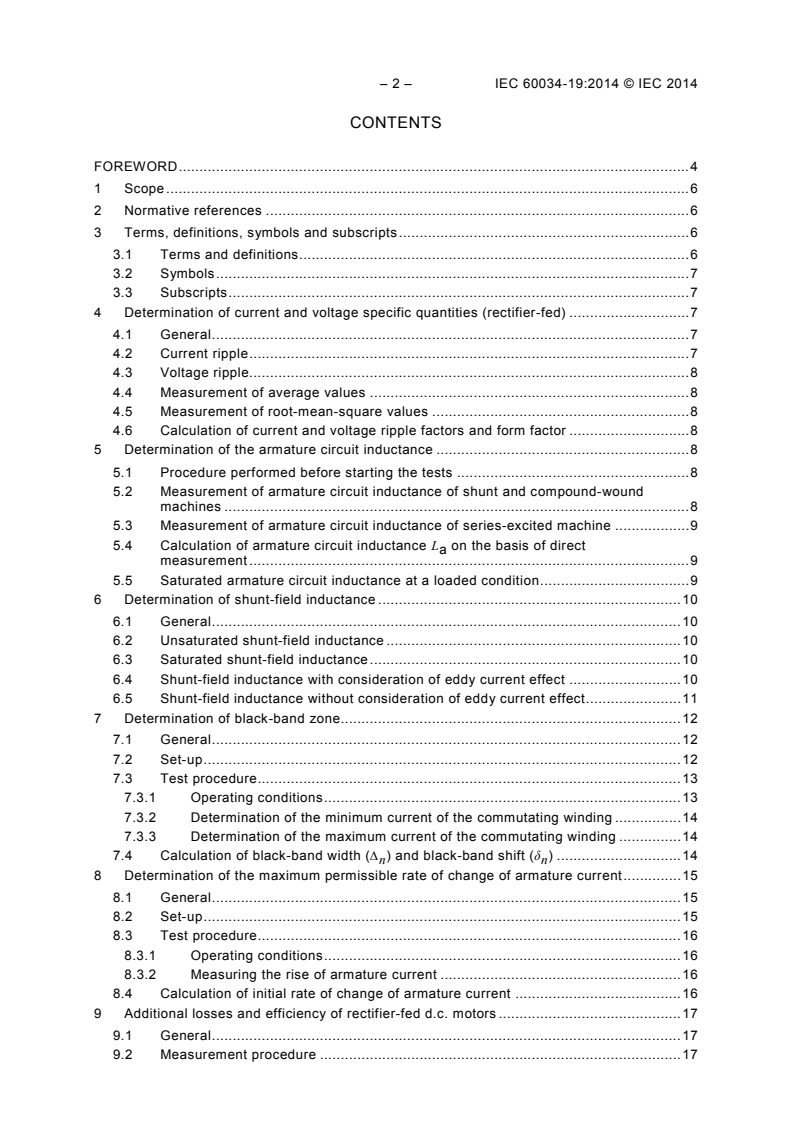
– 2 – IEC 60034-19:2014 © IEC 2014
CONTENTS
FOREWORD . 4
1 Scope . 6
2 Normative references . 6
3 Terms, definitions, symbols and subscripts . 6
3.1 Terms and definitions . 6
3.2 Symbols . 7
3.3 Subscripts . 7
4 Determination of current and voltage specific quantities (rectifier-fed) . 7
4.1 General . 7
4.2 Current ripple . 7
4.3 Voltage ripple. 8
4.4 Measurement of average values . 8
4.5 Measurement of root-mean-square values . 8
4.6 Calculation of current and voltage ripple factors and form factor . 8
5 Determination of the armature circuit inductance . 8
5.1 Procedure performed before starting the tests . 8
5.2 Measurement of armature circuit inductance of shunt and compound-wound
machines . 8
5.3 Measurement of armature circuit inductance of series-excited machine . 9
5.4 Calculation of armature circuit inductance L on the basis of direct
a
measurement . 9
5.5 Saturated armature circuit inductance at a loaded condition . 9
6 Determination of shunt-field inductance . 10
6.1 General . 10
6.2 Unsaturated shunt-field inductance . 10
6.3 Saturated shunt-field inductance . 10
6.4 Shunt-field inductance with consideration of eddy current effect . 10
6.5 Shunt-field inductance without consideration of eddy current effect . 11
7 Determination of black-band zone. 12
7.1 General . 12
7.2 Set-up . 12
7.3 Test procedure . 13
7.3.1 Operating conditions . 13
7.3.2 Determination of the minimum current of the commutating winding . 14
7.3.3 Determination of the maximum current of the commutating winding . 14
7.4 Calculation of black-band width (∆ ) and black-band shift (δ ) . 14
n n
8 Determination of the maximum permissible rate of change of armature current . 15
8.1 General . 15
8.2 Set-up . 15
8.3 Test procedure . 16
8.3.1 Operating conditions . 16
8.3.2 Measuring the rise of armature current . 16
8.4 Calculation of initial rate of change of armature current . 16
9 Additional losses and efficiency of rectifier-fed d.c. motors . 17
9.1 General . 17
9.2 Measurement procedure . 17
9.3 Calculation of efficiency . 18
10 Determination of speed regulation . 18
10.1 General . 18
10.2 Operating conditions . 18
10.3 Test procedure . 18
10.4 Determination of speed regulation . 18
11 Determination of the shunt regulation curve . 18
11.1 General . 18
11.2 Operating conditions . 19
11.3 Test procedure . 19
11.4 Determination of the shunt regulation curve . 19
12 Determination of the magnetisation curve . 19
12.1 General . 19
12.2 Operating conditions . 19
12.3 Test procedure . 19
12.3.1 General . 19
12.3.2 Test at no-load . 19
12.3.3 Test at rated load . 20
12.4 Determination of the magnetisation curve . 20
Figure 1 – Determination of saturated armature circuit inductance . 9
Figure 2 – Test circuit for saturated shunt field inductance measurement . 10
Figure 3 – Determination of the field inductance . 11
Figure 4 – Test circuit for black-band testing . 12
Figure 5 – Additional generator used to boost or subtract the armature current . 13
Figure 6 – Black-band zone for a specified constant speed of rotation . 14
Figure 7 – Test circuit for rate of change of armature current measurement . 15
Figure 8 – Transient build-up of armature current . 16
Figure 9 – Test circuit for measurement of ripple losses . 17
– 4 – IEC 60034-19:2014 © IEC 2014
INTERNATIONAL ELECTROTECHNICAL COMMISSION
____________
ROTATING ELECTRICAL MACHINES –
Part 19: Specific test methods for d.c. machines
on conventional and rectifier-fed supplies
FOREWORD
1) The International Electrotechnical Commission (IEC) is a worldwide organization for standardization comprising
all national electrotechnical committees (IEC National Committees). The object of IEC is to promote
international co-operation on all questions concerning standardization in the electrical and electronic fields. To
this end and in addition to other activities, IEC publishes International Standards, Technical Specifications,
Technical Reports, Publicly Available Specifications (PAS) and Guides (hereafter referred to as “IEC
Publication(s)”). Their preparation is entrusted to technical committees; any IEC National Committee interested
in the subject dealt with may participate in this preparatory work. International, governmental and non-
governmental organizations liaising with the IEC also participate in this preparation. IEC collaborates closely
with the International Organization for Standardization (ISO) in accordance with conditions determined by
agreement between the two organizations.
2) The formal decisions or agreements of IEC on technical matters express, as nearly as possible, an international
consensus of opinion on the relevant subjects since each technical committee has representation from all
interested IEC National Committees.
3) IEC Publications have the form of recommendations for international use and are accepted by IEC National
Committees in that sense. While all reasonable efforts are made to ensure that the technical content of IEC
Publications is accurate, IEC cannot be held responsible for the way in which they are used or for any
misinterpretation by any end user.
4) In order to promote international uniformity, IEC National Committees undertake to apply IEC Publications
transparently to the maximum extent possible in their national and regional publications. Any divergence
between any IEC Publication and the corresponding national or regional publication shall be clearly indicated in
the latter.
5) IEC itself does not provide any attestation of conformity. Independent certification bodies provide conformity
assessment services and, in some areas, access to IEC marks of conformity. IEC is not responsible for any
services carried out by independent certification bodies.
6) All users should ensure that they have the latest edition of this publication.
7) No liability shall attach to IEC or its directors, employees, servants or agents including individual experts and
members of its technical committees and IEC National Committees for any personal injury, property damage or
other damage of any nature whatsoever, whether direct or indirect, or for costs (including legal fees) and
expenses arising out of the publication, use of, or reliance upon, this IEC Publication or any other IEC
Publications.
8) Attention is drawn to the Normative references cited in this publication. Use of the referenced publications is
indispensable for the correct application of this publication.
9) Attention is drawn to the possibility that some of the elements of this IEC Publication may be the subject of
patent rights. IEC shall not be held responsible for identifying any or all such patent rights.
International Standard IEC 60034-19 has been prepared by IEC technical committee 2:
Rotating machinery.
This second edition cancels and replaces the first edition published in 1995. It constitutes a
technical revision. The main technical changes with regard to the previous edition are as
follows:
a) The description of the procedure for black band testing has been detailed and clarified.
b) Procedures for measurement of the magnetization curves under no-load and load
conditions have been added.
The text of this standard is based on the following documents:
FDIS Report on voting
2/1756/FDIS 2/1764/RVD
Full information on the voting for the approval of this standard can be found in the report on
voting indicated in the above table.
This publication has been drafted in accordance with the ISO/IEC Directives, Part 2.
NOTE A table of cross-references of all IEC TC 2 publications can be found on the IEC TC 2 dashboard on the
IEC website.
The committee has decided that the contents of this publication will remain unchanged until
the stability date indicated on the IEC web site under "http://webstore.iec.ch" in the data
related to the specific publication. At this date, the publication will be
• reconfirmed,
• withdrawn,
• replaced by a revised edition, or
• amended.
– 6 – IEC 60034-19:2014 © IEC 2014
ROTATING ELECTRICAL MACHINES –
Part 19: Specific test methods for d.c. machines
on conventional and rectifier-fed supplies
1 Scope
This part of IEC 60034 applies to d.c. machines rated 1 kW and above operating on rectifier-
fed power supplies, d.c. buses or other d.c. sources.
Standardized methods are provided for determining characteristic quantities for conventional
and rectifier-fed d.c. machines.
Excluded are d.c machines for specific applications.
These methods supplement the requirements in IEC 60034-1 and IEC 60034-2-1.
NOTE It is not intended that this standard should be interpreted as requiring the carrying out of any or all of the
tests described therein on any given machine.
2 Normative references
The following documents, in whole or in part, are normatively referenced in this document and
are indispensable for its application. For dated references, only the edition cited applies. For
undated references, the latest edition of the referenced document (including any
amendments) applies.
IEC 60034-1, Rotating electrical machines – Part 1: Rating and performance
IEC 60034-2-1, Rotating electrical machines – Part 2-1: Standard methods for determining
losses and efficiency from tests (excluding machines for traction vehicles)
3 Terms, definitions, symbols and subscripts
3.1 Terms and definitions
For the purposes of this document, the following terms and definitions apply.
3.1.1
current ripple
peak-to-peak amplitude of the armature current of rectifier-fed d.c. machines
3.1.2
voltage ripple
peak-to-peak amplitude of the terminal voltage of rectifier-fed d.c. machines
3.1.3
time constant
time to achieve 63,2 % of steady-state value after applying a d.c. step input, assuming a first
order system
3.1.4
black band zone
interval between the current limits of the commutating poles, between which sparkless
commutation is attainable for load currents up to and including rated current
3.1.5
sparkless
absence of any type of sparking
3.2 Symbols
C is the capacitance, [F]
f is the frequency, [Hz]
I, i is the current, [A]
L is the inductance, [H]
–1
n is the speed, [min ]
P is the power, [W]
R is the winding resistance, [Ω]
t is the time, [s]
U is the voltage, [V]
Δ is the black band width, [%]
n
δ is the black band shift, [%]
n
𝜏 is the time constant, [s]
θ is the phase angle
3.3 Subscripts
1 input
2 output
a armature
b boost
e exciter
f field
LL additional loss
n test point
N rated condition
s subtract
0 no-load
∞ ultimate
4 Determination of current and voltage specific quantities (rectifier-fed)
4.1 General
This test serves to determine the variation of the terminal voltage and armature current for
rectifier-fed d.c. machines at rated conditions.
4.2 Current ripple
The armature current ripple is best measured with an oscilloscope incorporating capability for
reading both d.c. and a.c. values. An alternative method is to use a peak-to-peak reading
– 8 – IEC 60034-19:2014 © IEC 2014
voltmeter, reading the voltage drop across a non-inductive resistor in series with the armature
circuit.
4.3 Voltage ripple
The voltage ripple may be measured using an oscilloscope, a suitable oscillograph or an
electronic peak-to-peak indicating voltmeter in series with an appropriate blocking capacitor of
sufficient size not to affect the a.c. readings.
It should be noted that in measuring the peak-to-peak value, deviations from the main
waveform due to high frequency spikes should be ignored.
4.4 Measurement of average values
In the case of rectifier supply, the average d.c. values of armature voltage and current can be
measured using permanent-magnet moving-coil type instruments, or other instruments
including digital instrumentation known to provide true average readings.
4.5 Measurement of root-mean-square values
Root-mean-square values can be measured using electrodynamometer type, moving-iron
type, or other instruments including digital instrumentation known to provide true r.m.s.
readings. AC instrumentation of the type using rectifiers to sense only a portion of the voltage
or current signal and instruments whose calibration is based on the assumption of a
sinusoidal waveform shall not be used. Oscilloscope readings of the voltage and current
signals are recommended.
4.6 Calculation of current and voltage ripple factors and form factor
The current ripple factors and the form factor shall be calculated using the formulas of
IEC 60034-1, with maximum, minimum, average and r.m.s. waveform values measured
according to 4.2 to 4.5 of this part. The voltage ripple factor shall be calculated similar to the
current ripple factor.
5 Determination of the armature circuit inductance
5.1 Procedure performed before starting the tests
It is recommended to measure the armature circuit inductance by applying a single phase
50 Hz or 60 Hz alternating current to the armature circuit terminals of the machine. The rotor
shall be locked to prevent rotation. Normal carbon brushes can be used if the alternating
current is limited to approximately 20 % of the current rating of the machine to avoid
overheating of the brushes or of the commutator during the short tests. The brushes shall be
completely in contact with the commutator surface and inspected before the test is started
and after the test is finished.
In declaring values of inductance it shall be stated whether the value refers to the saturated or
unsaturated condition.
Measure and record the r.m.s. value of voltage U, current I, frequency f and the phase angle θ
between voltage and current. The phase angle may be determined using suitable means such
as an oscilloscope or a phasemeter, or by an indirect method, e.g. using a wattmeter.
5.2 Measurement of armature circuit inductance of shunt and compound-wound
machines
The armature circuit inductance of shunt and compound-wound machines is to be measured
for both unsaturated and saturated conditions.
For the unsaturated test the shunt-field winding shall be short-circuited to avoid high voltages
being induced in the winding. For the saturated test the shunt field is excited as for rated
operation from a d.c. power supply, having a current ripple not exceeding 6 %.
5.3 Measurement of armature circuit inductance of series-excited machine
The test on a series-excited machine is to be done for the saturated condition only. This test
shall be carried out with the series-field winding separately excited at rated current using a
d.c. power supply having a current ripple factor not exceeding 6 %.
The saturated inductance, so determined, does not include the inductance contributed by the
series-field which shall be determined as described in 6.3 for the saturated shunt-field test.
5.4 Calculation of armature circuit inductance L on the basis of direct measurement
a
The armature inductance L is given by:
a
𝑈∙ sin𝜃
𝐿 =
𝑎
2𝜋∙𝑓∙𝐼
where U, I, f and θ are determined according to 5.1.
5.5 Saturated armature circuit inductance at a loaded condition
To determine the saturated armature circuit inductance under load, the machine to be tested
shall be operated as a generator at about the specified load current, and an a.c. current of
about 20 % of the rated current shall be superposed on the d.c. load current by using an a.c.
generator, a capacitor C and an inductor L, as shown in Figure 1.
AC generator
G
A
C
L
Machine to be
tested
G V
Load
Commutating and
compensating
Sh
windings
A
Frequency analyser,
oscillograph for
measurement of U, I, θ
IEC
Figure 1 – Determination of saturated armature circuit inductance
The armature circuit inductance is calculated by the same formula as that in 5.4, using the
r.m.s. values of a.c. voltage U and a.c. current I.
– 10 – IEC 60034-19:2014 © IEC 2014
6 Determination of shunt-field inductance
6.1 General
The shunt-field inductance is to be determined from the rate of rise of shunt-field current upon
abrupt application of voltage to the shunt-field terminals. The effective shunt-field inductance
is calculated from the rate of rise of direct-axis flux as indicated by the armature voltage
appearing at the brushes. During the test the machine is driven at rated full-field speed with
the armature open-circuited. The test is to be done for both unsaturated and saturated
conditions.
In declaring values of inductance it shall be stated whether the value refers to the saturated or
unsaturated condition.
6.2 Unsaturated shunt-field inductance
To find the unsaturated inductance, the shunt-field shall be excited from a voltage source
having a regulation at rated full-field excitation of the test machine of less than 2 %. The
shunt-field voltage is slowly cycled twice between the value yielding rated armature voltage
and zero, and then the armature voltage is reduced to approximately 50 % of rated value.
After recording, the shunt-field voltage is reduced to zero and the field circuit is opened. Then
the shunt-field voltage is reset to the recorded value. The shunt-field circuit is closed, and
then the shunt-field voltage and current, and the armature voltage are observed and recorded
against time.
6.3 Saturated shunt-field inductance
To find the saturated inductance, the shunt-field excitation shall be set (see Figure 2) so that
an abrupt change in field voltage produces a change in open circuit armature voltage from
90 % to 110 % rated value. With the switch closed, the shunt-field supply voltage U is
f
adjusted to produce a field current yielding 110 % of rated armature voltage. With the switch
opened, R (see Figure 2) is cycled twice between the values yielding 90 % and 110 % of
ext
rated armature voltage, finishing at the 90 % value. The switch is then closed, and the shunt-
field voltage and current and the armature voltage are recorded against time.
Shunt field
R
ext
U
U
f
a
IEC
Figure 2 – Test circuit for saturated shunt-field inductance measurement
6.4 Shunt-field inductance with consideration of eddy current effect
The field inductance can be calculated taken the effect of eddy currents in the iron core of the
machine on the transient field current into account.
)/I
The values of (I – I against time t are evaluated using a logarithmic scale for the
f∞ f f∞
former, where I is the magnitude of change in field current after the abrupt application of field
f
. In Figure 3 two points p and q are arbitrarily chosen
voltage and I is the ultimate value of I
f∞ f
within the straight part of the plot. The value "a" is read on the logarithmic scale at the
intersection with the ordinate of the extension of the straight line passing through the two
points p and q.
I – I
f∞ f
a
I
f∞
p
b
q
b
0,1
t
t t
1 2
IEC
Figure 3 – Determination of the field inductance
The value "c" shall be calculated by:
log b – log b
e 1 e 2
c=
t – t
2 1
where
b and b are the values of (I – I )/I at the time t and t respectively. The value of the
1 2 f∞ f f∞ 1 2
field inductance is as follows:
𝑎
𝐿 =𝑅∙
f f
𝑐
where
R is the field resistance.
f
NOTE This formula is based on the following approximate formula:
𝑡
𝜏
−
f
𝜏 + 𝜏
e
f
𝐼 =𝐼 ∙�1− ∙ e �
f f∞
𝜏 + 𝜏
f e
where
τ is the time constant of the field circuit and τ is the time constant of the equivalent eddy
f e
current circuit.
6.5 Shunt-field inductance without consideration of eddy current effect
When the effect of eddy current in the iron core may be neglected the experimental values of
shunt-field inductance shall be evaluated from the following expressions:
L = R × τ
f fI
f
L = R × τ
feff f aU
where
L is the shunt-field inductance;
f
L is the shunt-field effective inductance;
feff
– 12 – IEC 60034-19:2014 © IEC 2014
R is the d.c. shunt-field resistance measured directly after the test has been completed;
f
τ is the time to achieve 63,2 % of field-current change;
fI
τ is the time to achieve 63,2 % of armature-voltage change.
aU
7 Determination of black band zone
7.1 General
The purpose of black band testing is to determine the limits of over- or under-commutation,
between which sparkless commutation is attainable for load currents up to and including rated
current. To vary the magnetic field in the quadrature axis, a low voltage additional generator
is connected in parallel across the commutating-pole winding (and compensating winding,
when fitted) according to Figure 4.
Compensation winding
Commutating winding
Exciter
IEC
Figure 4 – Test circuit for black band testing
Black band testing is applicable to all machines fitted with commutating poles and shall be
done at rated base speed and also at rated maximum speed (if applicable). When possible the
test shall be done with the machine on load. For machines rated at 500 kW and above, black
band testing may be done under generator short-circuit condition. If the test is done with the
machine running as a motor, the latter shall be fed from a source of smooth current.
When the test is performed under short-circuit condition, a field current close to zero shall be
adjusted and permanently checked for the whole range of armature current up to rated
current. A small increase of the field may cause that the control over the armature current is
lost.
7.2 Set-up
For most reliable results, it is recommended that the tests be done on the machine when at its
normal operating temperature. It is essential that all brushes are completely in contact with
the commutator before starting tests.
It is preferable to perform black band testing using a pure d.c. armature supply. When this is
not possible, a rectifier-fed supply is to be used. In such cases it may be necessary to insert a
suitable inductance into the circuit of the armature supply.
Induction
machine
DC
machine
If the commutating winding and the compensating winding (if any) are connected in series, the
additional generator shall be connected as shown in Figure 4. Figure 4 illustrates the short-
circuit condition.
If the commutating winding and/or compensating winding is divided and its parts are
connected on different sides of the armature winding, the change of commutating current is
effected on the armature winding. An additional generator is connected directly across the
brushes of the machine on test, used to boost or subtract the armature current (see Figure 5).
Machine on test
½ commutating and/or ½ commutating and/or
compensating windings compensating windings
Additional generator
IEC
Figure 5 – Additional generator used to boost or subtract the armature current
If the commutating winding is connected on one side of the armature winding and the
compensating winding on the other side, then the change of current of the commutating poles
is achieved by connecting a low-voltage generator in parallel with the commutating winding.
The boost current (I ) or subtract current (I ) shall be corrected to an equivalent current (I )
b s beff
by means of the formula:
𝑤
z
𝐼 = ∙𝐼
b eff b
𝑤 +𝑤 ∙𝑎⁄𝑎
z k z k
where
w is the number of turns on one interpole;
z
w is the number of turns of compensating winding falling to one pole;
k
a is the number of interpole winding parallel paths;
z
a is the number of compensating winding parallel paths.
k
7.3 Test procedure
7.3.1 Operating conditions
The tests shall be performed at armature currents ranging from 0 to 100 % of the rated
armature current.
When increasing or decreasing the current to the commutating winding, constant values of
rotational speed and field current shall be maintained.
The tests are repeated at other values of armature current to obtain further readings which
are plotted against armature current in order to find the upper and lower limits of the black
band (see Figure 6).
– 14 – IEC 60034-19:2014 © IEC 2014
% Boost
∆ (width) δ (shift)
n n
Armature
100 % 150 %
50 %
current
Rated value
% Subtract
IEC
Figure 6 – Black band zone for a specified constant speed of rotation
7.3.2 Determination of the minimum current of the commutating winding
To find the minimum current of the commutating winding at a particular load, current is
subtracted from the commutating winding. The subtract current is increased until sparking is
observed at the commutator, and is gradually decreased until sparking is observed to have
just ceased.
7.3.3 Determination of the maximum current of the commutating winding
To find the maximum current of the commutating winding at a particular load, current is
boosted into the commutating winding. The boost current is increased until sparking is
observed at the commutator, and is gradually decreased until sparking is observed to have
just ceased.
7.4 Calculation of black band width (∆ ) and black band shift (δ )
n n
The percentage black band width at each test point shall be expressed as:
100 ∙ (𝐼 −𝐼 )
b s
∆ = 𝑝𝑒𝑟 𝑐𝑒𝑛𝑡
𝑛
𝐼
aN
The percentage black band shift shall be expressed as:
100 ∙ (𝐼 +𝐼 )
b s
𝛿 = 𝑝𝑒𝑟 𝑐𝑒𝑛𝑡
𝑛
2 ∙ 𝐼
aN
where
I is the maximum boost current (according to 7.3.3);
b
I is the maximum subtract current (according to 7.3.2);
s
I is the rated armature current.
aN
In cases where the half black band width is smaller than the black band shift, sparking is to be
expected.
It is generally considered that the ideal setting occurs when the shift is equal to zero, i.e.
when the horizontal axis lies centrally between the two limits.
8 Determination of the maximum permissible rate of change of armature
current
8.1 General
The maximum permissible rate of change of the armature current shall be determined by the
acceptable limit of commutation. When average and/or initial rates of change of armature
current values are agreed between manufacturer and purchaser, the test under consideration
may be performed to verify that at specified values commutation is not at its limit.
8.2 Set-up
The test circuit is shown in Figure 7.
R L
ad ad
L
f
i
f
IEC
Figure 7 – Test circuit for rate of change of armature current measurement
To find a starting value of the external resistance R , let
ad
and R values of inductance and resistance of the armature;
L
ac ac
L values of inductance of the external inductor;
ad
(Δi/Δt) average rate of change of armature current;
avg
I rated armature current;
aN
I peak armature current.
a,max
– 16 – IEC 60034-19:2014 © IEC 2014
The external resistance R can then be estimated from:
ad
𝑈
a
𝑅 = −𝑅
ad ac
𝐼
a,max
where:
Δ𝑖
( )
𝑈 = 3,16 × 𝐿 +𝐿 ×� � ×𝐼
a ac ad aN
Δ𝑡
avg
8.3 Test procedure
8.3.1 Operating conditions
The test is performed with the machine operating as a motor at no-load, rated speed and
constant field current. Compound wound machines shall have the series winding disconnected
during the test, and series wound machines shall be excited separately.
8.3.2 Measuring the rise of armature current
The supply shall be disconnected from the motor and the load resistor and inductor connected
across the terminals.
The rate of rise of current shall be recorded on a storage oscilloscope or a recording
instrument having a suitable response.
Commutation is assessed by any means that the manufacturer considers reliable. If
commutation is not at its limit, the values of circuit parameters shall be adjusted accordingly
and the test repeated until the maximum acceptable rate of rise of current is obtained. The
parameters to be changed can be either the external resistor and inductor, or alternatively the
field current which can be adjusted prior to the test (see Figure 7).
8.4 Calculation of initial rate of change of armature current
Referring to Figure 8, the average rate of change of current (Δi/Δt) (in per unit value) is
avg
given by:
I
a
d
i
d
t = 0
t
0,95 I I
a,max a,max
0,632 I
a,max
τ t
t
3τ =
0,95
IEC
Figure 8 – Transient build-up of armature current
Δ𝑖 0,95 ×𝐼 0,95 ×𝐼
a,max a,max
� � = =
Δ𝑡 𝑡 ×𝐼 3𝜏 ×𝐼
avg 0,95 aN aN
where:
t = 3τ is the time taken for the armature current to increase from zero to 0,95 I
0,95 a,max
The time constant τ is given by:
(𝐿 +𝐿 )
ac ad
𝜏 =
)
(𝑅 +𝑅
ac ad
The initial rate of change of the armature current (in p.u.) is then calculated as:
where
L and R are the values of inductance and resistance, respectively, of the machine
ac ac
armature circuit;
L and R are the values of inductance and resistance, respectively, connected externally
ad ad
across the machine terminals.
9 Additional losses and efficiency of rectifier-fed d.c. motors
9.1 General
Whenever the current ripple of the armature current exceeds 10 %, consideration shall be
given to the additional losses caused by the alternating component of the armature current in
addition to the losses specified in IEC 60034-2-1.
9.2 Measurement procedure
The motor is fed by the inverter as intended for final use. The additional losses shall be
determined by a low-cosine wattmeter, the series winding of which is connected directly to the
secondary winding of an air-core current transformer, and the parallel winding is connected in
series with the capacitor to block the d.c. component of voltage signal. The primary winding of
the air-core transformer is connected in series with the armature circuit of the motor. The
measuring circuit consists of a wattmeter, an air-core transformer and a blocking capacitor, as
shown in Figure 9.
L
C
f
i
f W
IEC
Figure 9 – Test circuit for measurement of ripple losses
– 18 – IEC 60034-19:2014 © IEC 2014
The instruments and components used shall be suitable for giving accurate results at least up
to 360 Hz.
9.3 Calculation of efficiency
The efficiency of rectifier-fed d.c. motors shall be defined as:
𝑃
η =η∙
LL
𝑃 +𝑃
1 LL
where
P is the motor input power during tests with pure d.c. supply;
P is the additional loss produced by alternating component of the armature current as
LL
measured by the wattmeter;
η is the efficiency defined in accordance with IEC 60034-2-1 for tests with pure d.c. supply.
10 Determination of speed regulation
10.1 General
The purpose of the test is to find the variation in the motor speed as the load is decreased
uniformly from rated load to no-load with constant field current. The motor may be fed from a
rectifier, a d.c. bus or other d.c. source.
10.2 Operating conditions
It is recommended that the test be performed at operating temperature. Test points shall be
taken rapidly so that the temperature of the windings does not change appreciably.
10.3 Test procedure
The motor shall be operated at rated armature voltage and rated field current. If a field
rheostat is used in service, the rheostat is adjusted to obtain rated speed at rated armature
current and voltage. It is necessary to remove and apply full load several times until
consistent readings are obtained. After that the respective full load and no-load speeds may
be recorded.
10.4 Determination of speed regulation
The speed regulation shall be determined by the following formula:
𝑛 −𝑛
0 N
∆𝑛 =
𝑛
N
where
Δn is the per unit regulation;
n is the speed at no-load;
n is the speed at rated load.
N
11 Determination of the shunt regulation curve
11.1 General
The purpose o
...