

IEC 60734:2012
(Main)Household electrical appliances - Performance - Water for testing
General Information
- Abstract
IEC 60734:2012 describes the preparation of four types of water of different hardness, conductivity and alkalinity, intended to be used for testing the performance of household appliances such as washing machines, dishwashers, tumble dryers, steam irons etc. It defines the characteristics of these waters and establishes various methods to be used for obtaining them. It also includes specifications for required measurements.
- Status
- Published
- Publication Date
- 26-Jun-2012
- Technical Committee
- SC 59D - Performance of household and similar electrical laundry appliances
- Drafting Committee
- WG 16 - TC 59/SC 59D/WG 16
- Current Stage
- PPUB - Publication issued
- Start Date
- 27-Jun-2012
- Completion Date
- 30-Jun-2012
Overview
IEC 60734:2012 is an international standard published by the International Electrotechnical Commission (IEC) that specifies the preparation and characteristics of water used for testing the performance of household electrical appliances. This standard focuses on defining water types with varying degrees of hardness, alkalinity, and conductivity to ensure consistent and reproducible testing conditions for appliances such as washing machines, dishwashers, tumble dryers, steam irons, and more. It establishes precise preparation methods and measurement requirements to produce standardized test water, critical for reliable performance evaluations.
Key Topics
- Water Types: IEC 60734:2012 defines four types of water - soft, medium hard, hard, and very hard - each with specified hardness, alkalinity, and conductivity levels essential for appliance performance testing.
- Water Hardness: The standard clarifies terms including:
- Total hardness (sum of calcium and magnesium ions)
- Temporary hardness (related to bicarbonate content)
- Permanent hardness (difference between total and temporary hardness)
- Alkalinity and Conductivity: The ability of the water to neutralize acids (alkalinity) and to conduct electricity (conductivity) are thoroughly characterized for each water type.
- Preparation Methods: Four preparation methods are detailed:
- Method B: Prepares water with precise temporary and permanent hardness by adding hardening salts to demineralized water, controlling alkalinity and conductivity.
- Methods C1 and C2: Use natural water sources to adjust hardness, with C1 starting from harder water and C2 from softer water; these focus primarily on hardness without controlling alkalinity and conductivity.
- Method C3: A newer natural water preparation method that allows control over hardness, alkalinity, and conductivity-addressing needs, especially for tumble dryer testing.
- Measurement and Accuracy: The standard specifies methods for accurate measurement of hardness, alkalinity, pH, conductivity, and limits for contaminants like heavy metals and chlorides.
- Storage and Stability: Guidelines on storage conditions to preserve standard water quality, including the effects of heat.
Applications
IEC 60734:2012 is essential for laboratories, manufacturers, and testing agencies involved in:
- Appliance Performance Testing: Ensuring repeatable and comparable test results for household appliances by standardizing water quality.
- Quality Control: Verifying appliance performance under controlled water conditions representative of user environments.
- Research and Development: Developing and validating new household appliance technologies under consistent water conditions.
- Regulatory Compliance: Meeting international testing norms to facilitate global trade and product approvals.
Specifically, it supports testing in:
- Washing machines and dishwashers where water hardness and composition affect cleaning efficiency.
- Tumble dryers where water conductivity and alkalinity influence performance.
- Steam irons that require specific water qualities to assess functionality and durability.
Related Standards
IEC 60734:2012 references and complements several water quality and measurement standards, critical for its application:
- ISO 6059: Water quality – Determination of calcium and magnesium ions (EDTA titrimetric method).
- ISO 7888: Water quality – Determination of electrical conductivity.
- ISO 9963-1: Water quality – Determination of alkalinity (total and composite alkalinity).
- ISO 10523: Water quality – Determination of pH.
These standards provide the methodologies for precise measurement and ensure consistency in applying IEC 60734 during testing.
By adhering to IEC 60734:2012, manufacturers and testing labs optimize the reliability of performance evaluations for household electrical appliances, supporting enhanced product quality and customer satisfaction worldwide. For more information and access to the full standard, visit the IEC Webstore.
Relations
- Effective Date
- 05-Sep-2023
Frequently Asked Questions
IEC 60734:2012 is a standard published by the International Electrotechnical Commission (IEC). Its full title is "Household electrical appliances - Performance - Water for testing". This standard covers: IEC 60734:2012 describes the preparation of four types of water of different hardness, conductivity and alkalinity, intended to be used for testing the performance of household appliances such as washing machines, dishwashers, tumble dryers, steam irons etc. It defines the characteristics of these waters and establishes various methods to be used for obtaining them. It also includes specifications for required measurements.
IEC 60734:2012 describes the preparation of four types of water of different hardness, conductivity and alkalinity, intended to be used for testing the performance of household appliances such as washing machines, dishwashers, tumble dryers, steam irons etc. It defines the characteristics of these waters and establishes various methods to be used for obtaining them. It also includes specifications for required measurements.
IEC 60734:2012 is classified under the following ICS (International Classification for Standards) categories: 97.060 - Laundry appliances. The ICS classification helps identify the subject area and facilitates finding related standards.
IEC 60734:2012 has the following relationships with other standards: It is inter standard links to IEC 60734:2001. Understanding these relationships helps ensure you are using the most current and applicable version of the standard.
IEC 60734:2012 is available in PDF format for immediate download after purchase. The document can be added to your cart and obtained through the secure checkout process. Digital delivery ensures instant access to the complete standard document.
Standards Content (Sample)
IEC 60734 ®
Edition 4.0 2012-06
INTERNATIONAL
STANDARD
NORME
INTERNATIONALE
Household electrical appliances – Performance – Water for testing
Appareils électrodomestiques – Aptitude à la fonction – Eau pour les essais
All rights reserved. Unless otherwise specified, no part of this publication may be reproduced or utilized in any form
or by any means, electronic or mechanical, including photocopying and microfilm, without permission in writing from
either IEC or IEC's member National Committee in the country of the requester.
If you have any questions about IEC copyright or have an enquiry about obtaining additional rights to this publication,
please contact the address below or your local IEC member National Committee for further information.
Droits de reproduction réservés. Sauf indication contraire, aucune partie de cette publication ne peut être reproduite ni
utilisée sous quelque forme que ce soit et par aucun procédé, électronique ou mécanique, y compris la photocopie et les
microfilms, sans l'accord écrit de la CEI ou du Comité national de la CEI du pays du demandeur.
Si vous avez des questions sur le copyright de la CEI ou si vous désirez obtenir des droits supplémentaires sur cette
publication, utilisez les coordonnées ci-après ou contactez le Comité national de la CEI de votre pays de résidence.
IEC Central Office Tel.: +41 22 919 02 11
3, rue de Varembé Fax: +41 22 919 03 00
CH-1211 Geneva 20 info@iec.ch
Switzerland www.iec.ch
About the IEC
The International Electrotechnical Commission (IEC) is the leading global organization that prepares and publishes
International Standards for all electrical, electronic and related technologies.
About IEC publications
The technical content of IEC publications is kept under constant review by the IEC. Please make sure that you have the
latest edition, a corrigenda or an amendment might have been published.
Useful links:
IEC publications search - www.iec.ch/searchpub Electropedia - www.electropedia.org
The advanced search enables you to find IEC publications The world's leading online dictionary of electronic and
by a variety of criteria (reference number, text, technical electrical terms containing more than 30 000 terms and
committee,…). definitions in English and French, with equivalent terms in
It also gives information on projects, replaced and additional languages. Also known as the International
withdrawn publications. Electrotechnical Vocabulary (IEV) on-line.
IEC Just Published - webstore.iec.ch/justpublished Customer Service Centre - webstore.iec.ch/csc
Stay up to date on all new IEC publications. Just Published If you wish to give us your feedback on this publication
details all new publications released. Available on-line and or need further assistance, please contact the
also once a month by email. Customer Service Centre: csc@iec.ch.
A propos de la CEI
La Commission Electrotechnique Internationale (CEI) est la première organisation mondiale qui élabore et publie des
Normes internationales pour tout ce qui a trait à l'électricité, à l'électronique et aux technologies apparentées.
A propos des publications CEI
Le contenu technique des publications de la CEI est constamment revu. Veuillez vous assurer que vous possédez
l’édition la plus récente, un corrigendum ou amendement peut avoir été publié.
Liens utiles:
Recherche de publications CEI - www.iec.ch/searchpub Electropedia - www.electropedia.org
La recherche avancée vous permet de trouver des Le premier dictionnaire en ligne au monde de termes
publications CEI en utilisant différents critères (numéro de électroniques et électriques. Il contient plus de 30 000
référence, texte, comité d’études,…). termes et définitions en anglais et en français, ainsi que
Elle donne aussi des informations sur les projets et les les termes équivalents dans les langues additionnelles.
publications remplacées ou retirées. Egalement appelé Vocabulaire Electrotechnique
International (VEI) en ligne.
Just Published CEI - webstore.iec.ch/justpublished
Service Clients - webstore.iec.ch/csc
Restez informé sur les nouvelles publications de la CEI.
Just Published détaille les nouvelles publications parues. Si vous désirez nous donner des commentaires sur
Disponible en ligne et aussi une fois par mois par email. cette publication ou si vous avez des questions
contactez-nous: csc@iec.ch.
IEC 60734 ®
Edition 4.0 2012-06
INTERNATIONAL
STANDARD
NORME
INTERNATIONALE
Household electrical appliances – Performance – Water for testing
Appareils électrodomestiques – Aptitude à la fonction – Eau pour les essais
INTERNATIONAL
ELECTROTECHNICAL
COMMISSION
COMMISSION
ELECTROTECHNIQUE
PRICE CODE
INTERNATIONALE
CODE PRIX N
ICS 97.060 ISBN 978-2-83220-139-8
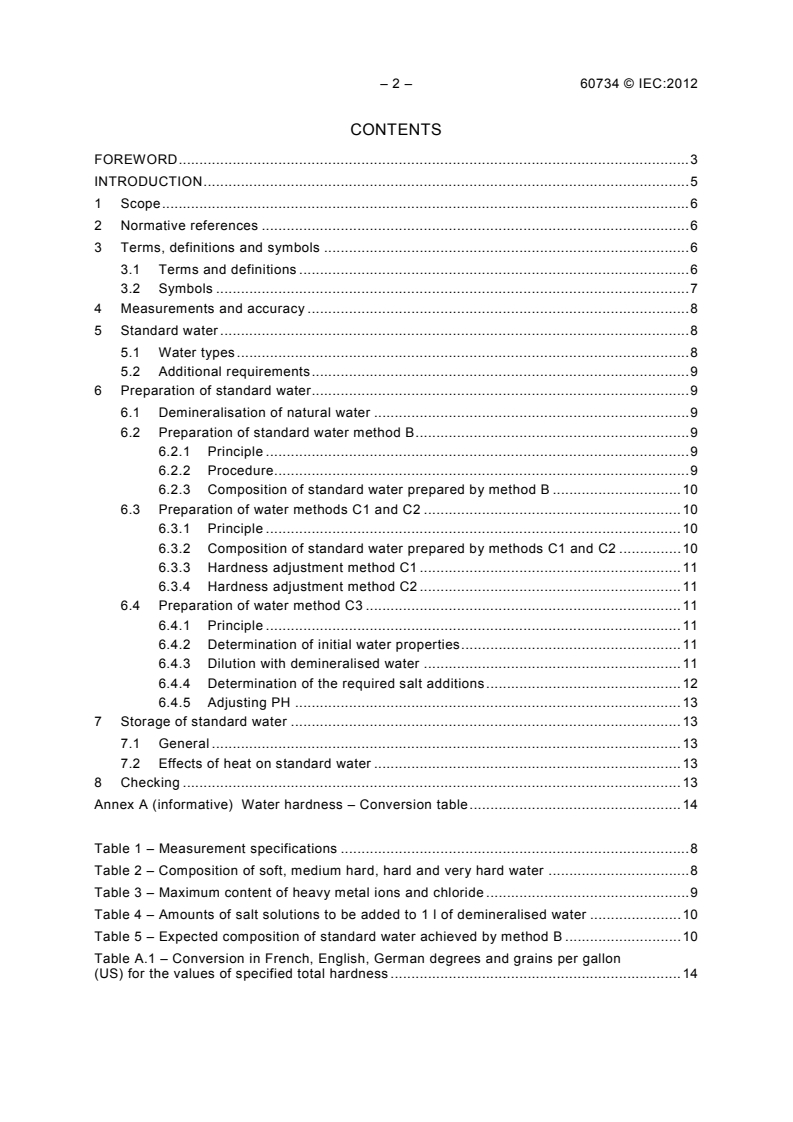
– 2 – 60734 © IEC:2012
CONTENTS
FOREWORD . 3
INTRODUCTION . 5
1 Scope . 6
2 Normative references . 6
3 Terms, definitions and symbols . 6
3.1 Terms and definitions . 6
3.2 Symbols . 7
4 Measurements and accuracy . 8
5 Standard water . 8
5.1 Water types . 8
5.2 Additional requirements . 9
6 Preparation of standard water. 9
6.1 Demineralisation of natural water . 9
6.2 Preparation of standard water method B . 9
6.2.1 Principle . 9
6.2.2 Procedure . 9
6.2.3 Composition of standard water prepared by method B . 10
6.3 Preparation of water methods C1 and C2 . 10
6.3.1 Principle . 10
6.3.2 Composition of standard water prepared by methods C1 and C2 . 10
6.3.3 Hardness adjustment method C1 . 11
6.3.4 Hardness adjustment method C2 . 11
6.4 Preparation of water method C3 . 11
6.4.1 Principle . 11
6.4.2 Determination of initial water properties . 11
6.4.3 Dilution with demineralised water . 11
6.4.4 Determination of the required salt additions . 12
6.4.5 Adjusting PH . 13
7 Storage of standard water . 13
7.1 General . 13
7.2 Effects of heat on standard water . 13
8 Checking . 13
Annex A (informative) Water hardness – Conversion table . 14
Table 1 – Measurement specifications . 8
Table 2 – Composition of soft, medium hard, hard and very hard water . 8
Table 3 – Maximum content of heavy metal ions and chloride . 9
Table 4 – Amounts of salt solutions to be added to 1 l of demineralised water . 10
Table 5 – Expected composition of standard water achieved by method B . 10
Table A.1 – Conversion in French, English, German degrees and grains per gallon
(US) for the values of specified total hardness . 14
60734 © IEC:2012 – 3 –
INTERNATIONAL ELECTROTECHNICAL COMMISSION
____________
HOUSEHOLD ELECTRICAL APPLIANCES –
PERFORMANCE – WATER FOR TESTING
FOREWORD
1) The International Electrotechnical Commission (IEC) is a worldwide organization for standardization comprising
all national electrotechnical committees (IEC National Committees). The object of IEC is to promote
international co-operation on all questions concerning standardization in the electrical and electronic fields. To
this end and in addition to other activities, IEC publishes International Standards, Technical Specifications,
Technical Reports, Publicly Available Specifications (PAS) and Guides (hereafter referred to as “IEC
Publication(s)”). Their preparation is entrusted to technical committees; any IEC National Committee interested
in the subject dealt with may participate in this preparatory work. International, governmental and non-
governmental organizations liaising with the IEC also participate in this preparation. IEC collaborates closely
with the International Organization for Standardization (ISO) in accordance with conditions determined by
agreement between the two organizations.
2) The formal decisions or agreements of IEC on technical matters express, as nearly as possible, an international
consensus of opinion on the relevant subjects since each technical committee has representation from all
interested IEC National Committees.
3) IEC Publications have the form of recommendations for international use and are accepted by IEC National
Committees in that sense. While all reasonable efforts are made to ensure that the technical content of IEC
Publications is accurate, IEC cannot be held responsible for the way in which they are used or for any
misinterpretation by any end user.
4) In order to promote international uniformity, IEC National Committees undertake to apply IEC Publications
transparently to the maximum extent possible in their national and regional publications. Any divergence
between any IEC Publication and the corresponding national or regional publication shall be clearly indicated in
the latter.
5) IEC itself does not provide any attestation of conformity. Independent certification bodies provide conformity
assessment services and, in some areas, access to IEC marks of conformity. IEC is not responsible for any
services carried out by independent certification bodies.
6) All users should ensure that they have the latest edition of this publication.
7) No liability shall attach to IEC or its directors, employees, servants or agents including individual experts and
members of its technical committees and IEC National Committees for any personal injury, property damage or
other damage of any nature whatsoever, whether direct or indirect, or for costs (including legal fees) and
expenses arising out of the publication, use of, or reliance upon, this IEC Publication or any other IEC
Publications.
8) Attention is drawn to the Normative references cited in this publication. Use of the referenced publications is
indispensable for the correct application of this publication.
9) Attention is drawn to the possibility that some of the elements of this IEC Publication may be the subject of
patent rights. IEC shall not be held responsible for identifying any or all such patent rights.
International standard IEC 60734 has been prepared by subcommittee 59D: Home laundry
appliances, of IEC Technical Committee 59: Performance of household and similar electrical
appliances.
This fourth edition cancels and replaces the third edition published in 2001. This edition
constitutes a technical revision.
This edition includes the following significant technical changes with respect to the previous
edition:
a) four types of standard water, from soft to very hard, are defined with specification for
hardness, alkalinity and conductivity;
b) preparation method A is no longer maintained; and
c) method C3 is added to prepare water of specified hardness, conductivity and alkalinity
starting with natural water while the natural water based methods C1 and C2 focus on
water hardness only, without allowing control or setting of alkalinity and conductivity.
– 4 – 60734 © IEC:2012
The text of this standard is based on the following documents:
FDIS Report on voting
59/398/FDIS 59/399/RVD
Full information on the voting for the approval of this standard can be found in the report on
voting indicated in the above table.
This publication has been drafted in accordance with the ISO/IEC Directives, Part 2.
Words in bold in the text are defined in Clause 3.
The committee has decided that the contents of this publication will remain unchanged until
the stability date indicated on the IEC web site under "http://webstore.iec.ch" in the data
related to the specific publication. At this date, the publication will be
• reconfirmed,
• withdrawn,
• replaced by a revised edition, or
• amended.
60734 © IEC:2012 – 5 –
INTRODUCTION
This publication specifies water qualities with regard to hardness, alkalinity and conductivity
and describes several methods to prepare water to be used for testing household appliances
in cases where the water quality is important for the reproducibility of the test results. The
described methods allow the preparation of water complying with all three target requirements
(hardness, alkalinity, conductivity), or just hardness – depending on the requirements set
out in the referring appliance test method.
Compared to the third edition of IEC 60734 (2001), method A is no longer maintained and
another method, method C3, is added.
Method B is used to prepare water of the correct total hardness. Preparation starts with
demineralised water in which hardening salts are dissolved. It will give water specified
temporary as well as permanent hardness, whilst complying with the specifications for
alkalinity and conductivity.
Method C1 starts with natural water with higher hardness than required, while method C2
starts with soft natural water, which is hardened. Depending on the composition of the natural
water, several other ions might be present. Restrictions regarding the amounts are given for
some ions, which may influence the cleaning results when testing washing machines and
dishwashers. No specification regarding temporary and permanent hardness is given.
The development of method C3 appreciates the need for water of specified conductivity and
alkalinity for testing the performance of tumble dryers. While synthetic method B meets this
need, the natural water based methods C1 and C2 focus on water hardness only without
allowing control or setting of alkalinity and conductivity. The new method C3, which starts
with natural water, fills that gap.
– 6 – 60734 © IEC:2012
HOUSEHOLD ELECTRICAL APPLIANCES –
PERFORMANCE – WATER FOR TESTING
1 Scope
This International Standard describes the preparation of four types of water of different
hardness, conductivity and alkalinity, intended to be used for testing the performance of
household appliances such as washing machines, dishwashers, tumble dryers, steam irons
etc.
It defines the characteristics of these waters and establishes various methods to be used for
obtaining them. It also includes specifications for required measurements.
2 Normative references
The following documents, in whole or in part, are normatively referenced in this document and
are indispensable for its application. For dated references, only the edition cited applies. For
undated references, the latest edition of the referenced document (including any
amendments) applies.
ISO 6059, Water quality – Determination of the sum of calcium and magnesium – EDTA
titrimetric method
ISO 7888, Water quality – Determination of electrical conductivity
ISO 9963-1, Water quality – Determination of alkalinity – Part 1: Determination of total and
composite alkalinity
ISO 10523, Water quality – Determination of pH
3 Terms, definitions and symbols
3.1 Terms and definitions
For the purposes of this document, the following definitions apply.
3.1.1
water hardness
parameter indicating the quantity of alkaline earth salts (bicarbonates, sulphates, chlorides
etc.) present in the water
3.1.2
total hardness
sum of calcium and magnesium ions in the water
3.1.3
temporary hardness
fraction of the total hardness equivalent to the bicarbonate content
3.1.4
permanent hardness
difference between the total hardness and the temporary hardness
60734 © IEC:2012 – 7 –
3.1.5
alkalinity
ability of a solution to neutralize acids to the equivalence point of carbonate or bicarbonate,
i.e. equals the stoichiometric sum of the bases in the solution
3.1.6
conductivity
ability of a solution to conduct an electric current, i.e. measure of the stoichiometric sum of
the ions dissolved in the solution
3.2 Symbols
Symbol Unit Definition
A mmol/l initial alkalinity
A mmol/l target alkalinity
req
c (Fe) mg/l initial iron content
c (Fe) mg/l maximum iron content
max
c (Cu) mg/l initial copper content
c (Cu) mg/l maximum copper content
max
c (Mn) mg/l initial manganese content
c (Mn) mg/l maximum manganese content
max
-
c (Cl ) mmol/l initial chloride content
-
c (Cl ) mmol/l maximum chloride content
max
cond initial conductivity
µS/cm
cond target conductivity
µS/cm
req
dil – dilution factor
dil – lowest possible dilution factor that allows the preparation of
min
water to meet all requirements
dil – lowest possible dilution factor that allows the preparation of
min(h,A,cond)
water to meet the total hardness, alkalinity and
conductivity requirements
dil – lowest possible dilution factor that allows the preparation of
min(Fe)
water to meet the maximum iron content requirement
dil – lowest possible dilution factor that allows the preparation of
min(Cu)
water to meet the maximum copper content requirement
dil – lowest possible dilution factor that allows the preparation of
min(Mn)
water to meet the maximum manganese content
requirement
dil – lowest possible dilution factor that allows the preparation of
min(Cl-)
water to meet the maximum chloride content requirement
k – constants
A
k – constants
H
h initial total hardness
h target total hardness
req
addition ml quantity of solution to be added to reach required
A
alkalinity
addition ml quantity of solution to be added to reach required total
h
hardness
addition ml quantity of solution to be added to reach required
cond
conductivity
– 8 – 60734 © IEC:2012
4 Measurements and accuracy
Measurements according to this International Standard shall comply with the following
specifications in Table 1:
Table 1 – Measurement specifications
Parameter Unit Minimum Additional requirements and remarks
accuracy
Total hardness mmol/l See ISO 6059 for specifications of such determination.
± 2 %
3-
Alkalinity mmol/l The alkalinity is measured as the concentration of (HCO ). If
± 5 %
determined by titration with hydrochloric acid the endpoint shall
be pH 4,5 – the stoichiometric factor then is 1.
See ISO 9963-1 for specifications of such determination.
Conductivity
µS/cm ± 5 % See ISO 7888 for specifications of such determination.
at 20 °C
pH - The accuracy requirement shall be met over a temperature
± 0,05
range of 15 °C to 25 °C.
See ISO 10523 for specifications of such determination.
Content of iron, copper, - - The requirements for these parameters are maximum content
manganese or chloride requirements. The accuracy of the measurement shall be
sufficient to prove compliance with these requirements.
5 Standard water
5.1 Water types
In Table 2, different water types are defined, which are all referred to by their level of total
hardness and specified with specific levels of total hardness, alkalinity, conductivity and
pH.
Table 2 – Composition of soft, medium hard, hard and very hard water
Water type
Standard
Property Unit
Standard soft Standard hard Standard very
medium hard
water water hard water
water
mmol/l
0,50 1,50 2,50 3,50
Total hardness
2+ 2+ ± 0,20 ± 0,20 ± 0,20 ± 0,20
(Ca /Mg )
mmol/l
0,67 2,00 3,35 4,70
Alkalinity
-
± 0,20 ± 0,20 ± 0,20 ± 0,20
(HCO )
Conductivity 150 450 750 1050
µS/cm
(at 20 °C) ± 50 ± 100 ± 150 ± 250
pH
- 8,0 to 8,5 7,5 to 7,9 7,3 to 7,7 -
(at 20 °C)
Other test methods and standards referring to the water types in this International Standard
may require to meet all or only selected properties given in Table 2.
NOTE With the specification of these four standard waters it is possible to select one or more standardised
waters, which would approximate the local natural waters available. If any other water hardness is needed, it can
be prepared in a similar way by interpolation of the given specifications.
60734 © IEC:2012 – 9 –
5.2 Additional requirements
Other test methods and standards referring to the water types described in this International
Standard may also require that any or all of the specifications shown in Table 3 are met.
Table 3 – Maximum content of heavy metal ions and chloride
Water type
Standard Standard
Property Unit
Standard Standard
medium hard very hard
soft water hard water
water water
Max. iron content, c (Fe) mg/l 0,1
max
Max. copper content, c (Cu) mg/l 0,05
max
Max. manganese content, c (Mn) mg/l 0,05
max
Not
-
Max. chloride content, c (Cl ) mmol/l 4,5
max
applicable
NOTE Iron, copper and manganese can influence bleach performance if the water is used for cleaning
purposes. The chloride content may be of relevance for testing dishwashers. Standard very hard water does not
meet the chloride content requirement.
6 Preparation of standard water
6.1 Demineralisation of natural water
Natural water is demineralised so that its specific resistance is 100 000 Ω/cm or more (i.e. its
conductivity is 10 μS/cm at maximum). Water of this quality can be obtained e.g. using
mixed cation and anion exchange resins or by reverse osmosis.
When an ion exchange resin is new, the first one or two preparations should be discarded.
This is not necessary after each normal regeneration.
6.2 Preparation of standard water method B
6.2.1 Principle
This preparation method starts with demineralised water to which salts are added to achieve
the specified water properties.
6.2.2 Procedure
Prepare the following solutions of salts in demineralised water:
− Solution 1 NaHCO 67,2 g/l (800 mmol/l)
− Solution 2 MgSO · 7H O 38,0 g/l (154,2 mmol/l)
4 2
− Solution 3 CaCl ·2H O 65,6 g/l (446,1 mmol/l)
2 2
Add specified amounts of the three solutions as given in Table 4 to 0,7 l of demineralised
water and add up to 1,0 l for preparation of the desired standard water. If large amounts of
water are prepared, the addition may be performed through automatic dosage. Finally, adjust
the pH to the range specified in Table 2 with HCl or NaOH before use.
– 10 – 60734 © IEC:2012
Table 4 – Amounts of salt solutions to be added to 1 l of demineralised water
Water type
Solution
Standard soft Standard medium Standard hard Standard very
water hard water water hard water
Solution 1
0,83 ml 2,50 ml 4,17 ml 5,84 ml
(NaHCO )
Solution 2
0,83 ml 2,50 ml 4,17 ml 5,84 ml
(MgSO ·7H O)
4 2
Solution 3
0,83 ml 2,50 ml 4,17 ml 5,84 ml
(CaCl ·2H O)
2 2
6.2.3 Composition of standard water prepared by method B
The temporary hardness component of the water consists of calcium and magnesium
hydrogen carbonates Ca(HCO ) and Mg(HCO ) . The permanent hardness component
3 2 3 2
consists of the chlorides and sulphates of calcium and magnesium (CaCl , CaSO , MgCl ,
2 4 2
MgSO ). Composition of standard water achieved by method B is shown in Table 5.
Table 5 – Expected composition of standard water achieved by method B
Water type
Standard soft Standard Standard hard Standard very
water medium hard water hard water
Ions Mol. weight
water
Ion concentrations
(mmol/l)
2+
Ca 40,0 0,37 1,11 1,85 2,59
2+
Mg 24,3 0,13 0,39 0,65 0,91
HCO 61,0 0,67 2,00 3,35 4,68
–
Cl 35,5 0,75 2,23 3,75 5,23
SO 96,0 0,13 0,39 0,65 0,91
+
Na 23,0 0,67 2,00 3,35 4,68
Temporary hardness (mmol/l) 0,33 1,00 1,67 2,34
6.3 Preparation of water methods C1 and C2
6.3.1 Principle
Methods C1 and C2 allow to prepare standard water of specified total hardness starting with
natural water. Methods C1 and C2 do not adjust alkalinity or conductivity.
6.3.2 Composition of standard water prepared by methods C1 and C2
If the test method or standard referring to the water types in this standard also requires any or
all of the specifications of Table 3 to be met (maximum content of heavy metals and chloride),
the natural water shall be analyzed regarding the respective (required) properties. If the
content of iron, copper, manganese or chloride in the natural water exceeds the limits
specified in 5.2, first dilute the natural water with demineralised water.
No differentiation is made between temporary hardness and permanent hardness. The
2+ 2+
Ca /Mg ratio shall be 1,5 to 9.
60734 © IEC:2012 – 11 –
The hardness of the natural water is analyzed for its calcium and magnesium content. If the
calcium/magnesium ratio is outside the limits, adjustments are made by dissolving some of
the missing ions in the form of calcium chloride (CaCl ·2H O) or magnesium sulphate
2 2
(MgSO ·7 H O).
4 2
6.3.3 Hardness adjustment method C1
Method C1 is used if the adjusted natural water is harder than the required total hardness.
Some of the natural water is softened by replacing calcium and magnesium against sodium by
means of a cation exchange resin or by use of demineralised water for dilution. If the pH is
too low, some CO shall be removed by air bubbling.
6.3.4 Hardness adjustment method C2
Method C2 is used if the natural water is too soft. The soft natural water is mixed with calcium
and magnesium salts in such a way that the required hardness is obtained.
6.4 Preparation of water method C3
6.4.1 Principle
Method C3 allows to prepare standard water of specified total hardness, alkalinity and
conductivity starting with natural water.
6.4.2 Determination of initial water properties
The natural water shall be analyzed regarding total hardness h , alkalinity A and
0 0
conductivity cond .
If the test method or standard referring to the water types in this standard also requires any or
all of the specifications of Table 3 to be met (maximum content of heavy metals and chloride),
the natural water shall additionally be analyzed regarding the respective (required) properties:
-
c (Fe), c (Cu), c (Mn), c (Cl )
0 0 0 0
6.4.3 Dilution with demineralised water
6.4.3.1 Determination of the dilution factor
With the determined values for initial total hardness h , alkalinity A and conductivity cond
0 0 0
and the target values for these measures, a minimum dilution factor dil for these
min (h,A,cond)
parameters can be calculated as:
cond − k A − k h
0 A 0 H 0
dil =
min (h,A,cond)
cond − k A − k h
req A req H req
with k and k being the following constants:
A H
µS / cm µS / cm
k = 100 k = 224
A
H
mmol/l
mmol/l
Other dilution factors dil will also allow preparation of water of specified total
min(h,A,cond)
hardness, alkalinity and conductivity as long as the calculation of salt additions according
to 6.4.4 results in quantities equal to or larger than 0 ml.
If the test method or standard referring to the water types in this standard also requires any or
all of the specifications of Table 3 to be met (maximum content of heavy metals and chloride),
the respective minimum dilution factors are determined as:
– 12 – 60734 © IEC:2012
−
c (Fe)
c (Cu) c (Mn) c (Cl )
0 0 0 0
dil = dil = dil =
dil =
min (Fe) min (Cu) min (Mn)
−
min (Cl ) −
c (Fe) c (Cu) c (Mn)
max max max c (Cl )
max
, , ,
The overall minimum required dilution factor is the highest of the determined minimum dilution
factors:
dil = max { dil ; dil ; dil ; dil ; dil }
min min (h,A,cond) min (Fe) min (Cu) min (Mn) −
min (Cl )
Depending on the result of the calculation, two cases can be distinguished:
Dilution with demineralised water is required. The minimum dilution factor in
dil > 1
min
that case is the calculated value dil .
min
dil ≤ 1 No dilution is necessary. The minimum dilution factor in that case is dil = 1.
min min
The established value for the required minimum dilution factor dil represents the lowest
min
possible dilution that allows the preparation of water to meet all requirements. For practical
may also be selected, e.g. in order to
reasons, any actual dilution factor greater than dil
min
run the process with a rounded dilution factor. The calculations in the following preparation
steps are based on the selected actual dilution factor dil:
dil ≥ dil
min
6.4.3.2 Dilution
The natural water shall be diluted with demineralised water to reach the selected dilution
factor dil.
6.4.4 Determination of the required salt additions
6.4.4.1 General
The adjustment of alkalinity, total hardness and conductivity is done with highly
concentrated salt solutions in water. The addition of the salt content adjusts the respective
parameters. The addition of the water in which the salts are dissolved represents a dilution.
However, the resulting dilution factor is very close to 1 (due to the highly concentrated
solutions) and is therefore negligible.
6.4.4.2 Adjusting alkalinity
In case alkalinity needs to be adjusted, this shall be done with a solution of 800 mmol/l
(67,2 g/l) NaHCO in demineralised water.
The quantity of that solution in ml to be added to each litre of water is:
A
A −
req
dil
addition =
alkalinity
0,8×mmol/ml
NOTE Depending on the initial and target alkalinity and the selected dilution factor, the result of calculating the
required quantity of the solution above may also be 0 ml/l.
6.4.4.3 Adjusting total hardness
In case total hardness needs to be adjusted, this shall be done with a solution of
446,1 mmol/l (65,6 g/l) CaCl ·2H O in demineralised water.
2 2
60734 © IEC:2012 – 13 –
The quantity of that solution in ml to be added to each litre of water is:
h
h −
req
dil
addition =
h
0,4461× mmol/ml
NOTE Depending on the initial and target total hardness and the selected dilution factor, the result of calculating
the required quantity of the solution above can also be 0 ml/l.
6.4.4.4 Adjusting conductivity
In case conductivity needs to be adjusted, this shall be done with a solution of 500 mmol/l
(29,22 g/l) NaCl and 500 mmol/l (71,02 g/l) Na SO in demineralised water.
2 4
The quantity of that solution in ml to be added to each litre of (diluted) water is:
(cond − k A − k h )
0 A 0 H 0
(cond − k A − k h )−
req A req H req
dil
addition = × ml/l
cond
120×µS/cm
NOTE Depending on the initial and target conductivity and the selected dilution factor, the result of calculating
the required quantity of the solution above can also be 0 ml/l.
6.4.5 Adjusting PH
Adjust the pH to within the ranges given in Table 2 with HCl or NaOH before use.
7 Storage of standard water
7.1 General
Preferably standard water shall be stored in closed tanks to exclude both air and light, to
and also to prevent contamination and growth of organic matter. If the
prevent loss of CO
tank is kept closed, the storage life is about one month but if the tank is left open the storage
life is about one day.
7.2 Effects of heat on standard water
When standard hard water is heated from 20 °C to 90 °C, scale forming will start at about
85 °C depending on the rate of heating. If it is heated to a lower temperature and kept heated,
scale formation will also occur. Over 60 °C, crystalline aragonite will be formed. Under 40 °C,
crystalline calcite will be formed.
NOTE Aragonite is voluminous with a needle structure and can rapidly obstruct small openings. Calcite is less
voluminous but has a hard structure.
8 Checking
Check all required water parameters prior to use.
– 14 – 60734 © IEC:2012
Annex A
(informative)
Water hardness – Conversion table
A.1 Correspondence of water hardness units
1 mmol/l = 2,0 milliequivalents = 2 mval/l
= 100 ppm of CaCO
= 10 parts per 100 000
= 10 French degrees (°f)
= 7,0 English degrees (°e)
= 5,6 German degrees (°dH)
= 5,8 US grains per gallon (gpg)
A.2 Conversion into different degrees of hardness
Table A.1 gives the values for French degrees, English degrees, German degrees and grains
per gallon (US) corresponding to the values of total hardness used in this standard.
Table A.1 – Conversion in French, English, German degrees and grains per gallon (US)
for the values of specified total hardness
Total hardness French degree English degree German degree Grains / gallon
mmol/l (US)
0,50 5 3,5 2,8 2,9
1,50 15 10,5 8,4 8,8
2,50 25 17,5 14,0 14,6
3,50 35 24,5 19,6 20,5
___________
– 16 – 60734 © CEI:2012
SOMMAIRE
AVANT-PROPOS . 17
INTRODUCTION . 19
1 Domaine d’application . 20
2 Références normatives . 20
3 Termes, définitions et symboles . 20
3.1 Termes et définitions . 20
3.2 Symboles . 21
4 Mesures et précision . 22
5 Eau normalisée . 22
5.1 Types d’eau . 22
5.2 Exigences supplémentaires . 23
6 Préparation de l’eau normalisée . 23
6.1 Déminéralisation de l’eau naturelle . 23
6.2 Préparation de l’eau normalisée par la méthode B . 24
6.2.1 Principe . 24
6.2.2 Procédure . 24
6.2.3 Composition de l’eau normalisée préparée par la méthode B . 24
6.3 Préparation de l’eau par les méthodes C1 et C2 . 25
6.3.1 Principe . 25
6.3.2 Composition d’une eau normalisée préparée par les méthodes C1 et
C2 . 25
6.3.3 Ajustement de la dureté par la méthode C1 . 25
6.3.4 Ajustement de la dureté par la méthode C2 . 25
6.4 Préparation de l’eau par la méthode C3 . 26
6.4.1 Principe . 26
6.4.2 Détermination des propriétés initiales de l’eau . 26
6.4.3 Dilution avec de l’eau déminéralisée . 26
6.4.4 Détermination des additions de sels nécessaires . 27
6.4.5 Ajustement du PH . 28
7 Conservation de l’eau normalisée . 28
7.1 Généralités. 28
7.2 Effets de la chaleur sur l’eau normalisée . 28
8 Vérification . 28
Annexe A (informative) Dureté de l’eau – Tableau de conversion . 29
Tableau 1 – Spécifications de mesure . 22
Tableau 2 – Composition d’une eau douce, moyennement dure, dure et très dure . 23
Tableau 3 – Teneur maximale en ions de métaux lourds et en chlorure . 23
Tableau 4 – Quantités de solutions de sels à ajouter à 1 l d’eau déminéralisée . 24
Tableau 5 – Composition prévue de l’eau normalisée obtenue avec la méthode B . 25
Tableau A.1 – Conversion en degrés français, anglais, allemand et en grains par
gallon (américains) pour les valeurs de dureté totale spécifiée . 29
60734 © CEI:2012 – 17 –
COMMISSION ÉLECTROTECHNIQUE INTERNATIONALE
____________
APPAREILS ÉLECTRODOMESTIQUES –
APTITUDE À LA FONCTION –
EAU POUR LES ESSAIS
AVANT-PROPOS
1) La Commission Electrotechnique Internationale (CEI) est une organisation mondiale de normalisation
composée de l'ensemble des comités électrotechniques nationaux (Comités nationaux de la CEI). La CEI a
pour objet de favoriser la coopération internationale pour toutes les questions de normalisation dans les
domaines de l'électricité et de l'électronique. A cet effet, la CEI – entre autres activités – publie des Normes
internationales, des Spécifications techniques, des Rapports techniques, des Spécifications accessibles au
public (PAS) et des Guides (ci-après dénommés "Publication(s) de la CEI"). Leur élaboration est confiée à des
comités d'études, aux travaux desquels tout Comité national intéressé par le sujet traité peut participer. Les
organisations internationales, gouvernementales et non gouvernementales, en liaison avec la CEI, participent
également aux travaux. La CEI collabore étroitement avec l'Organisation Internationale de Normalisation (ISO),
selon des conditions fixées par accord entre les deux organisations.
2) Les décisions ou accords officiels de la CEI concernant les questions techniques représentent, dans la mesure
du possible, un accord international sur les sujets étudiés, étant donné que les Comités nationaux de la CEI
intéressés sont représentés dans chaque comité d’études.
3) Les Publications de la CEI se présentent sous la forme de recommandations internationales et sont agréées
comme telles par les Comités nationaux de la CEI. Tous les efforts raisonnables sont entrepris afin que la CEI
s'assure de l'exactitude du contenu technique de ses publications; la CEI ne peut pas être tenue responsable
de l'éventuelle mauvaise utilisation ou interprétation qui en est faite par un quelconque utilisateur final.
4) Dans le but d'encourager l'uniformité internationale, les Comités nationaux de la CEI s'engagent, dans toute la
mesure possible, à appliquer de façon transparente les Publications de la CEI dans leurs publications
nationales et régionales. Toutes divergences entre toutes Publications de la CEI et toutes publications
nationales ou régionales correspondantes doivent être indiquées en termes clairs dans ces dernières.
5) La CEI elle-même ne fournit aucune attestation de conformité. Des organismes de certification indépendants
fournissent des services d'évaluation de conformité et, dans certains secteurs, accèdent aux marques de
conformité de la CEI. La CEI n'est responsable d'aucun des services effectués par les organismes de
certification indépendants.
6) Tous les utilisateurs doivent s'assurer qu'ils sont en possession de la dernière édition de cette publication.
7) Aucune responsabilité ne doit être imputée à la CEI, à ses administrateurs, employés, auxiliaires ou
mandataires, y compris ses experts particuliers et les membres de ses comités d'études et des Comités
nationaux de la CEI, pour tout préjudice causé en cas de dommages corporels et matériels, ou de tout autre
dommage de quelque nature que ce soit, directe ou indirecte, ou pour supporter les coûts (y compris les frais
de justice) et les dépenses découlant de la publication ou de l'utilisation de cette Publication de la CEI ou de
toute autre Publication de la CEI, ou au crédit qui lui est accordé.
8) L'attention est attirée sur les références normatives citées dans cette publication. L'utilisation de publications
référencées est obligatoire pour une application correcte de la présente publication.
9) L’attention est attirée sur le fait que certains des éléments de la présente Publication de la CEI peuvent faire
l’objet de droits de brevet. La CEI ne saurait être tenue pour responsable de ne pas avoir identifié de tels droits
de brevets et de ne pas avoir signalé leur existence.
La Norme internationale CEI 60734 a été établie par le sous-comité 59D: Appareils de lavage
du linge, du comité d’études 59 de la CEI: Aptitude à la fonction des appareils
électrodomestiques et analogues.
Cette quatrième
...