

IEC 61121:2012
(Main)Tumble dryers for household use - Methods for measuring the performance
General Information
- Abstract
IEC 61121:2012 is applicable to household electric tumble dryers of the automatic and non-automatic type, with or without a cold water supply and incorporating a heating device. This excludes tumble dryers which use gas or other fuels as a heating source. The object is to state and define the principal performance characteristics of household electric tumble dryers of interest to users and to describe standard methods for measuring these characteristics. This edition includes significant technical changes with respect to the previous edition and content has been reorganised into a more logical and simple structure.
- Status
- Published
- Publication Date
- 15-Feb-2012
- Technical Committee
- SC 59D - Performance of household and similar electrical laundry appliances
- Drafting Committee
- MT 14 - TC 59/SC 59D/MT 14
- Current Stage
- PPUB - Publication issued
- Start Date
- 16-Feb-2012
- Completion Date
- 15-Mar-2012
Buy Documents
IEC 61121:2012 - Tumble dryers for household use - Methods for measuring the performance Released:2/16/2012
IEC 61121:2012 - Tumble dryers for household use - Methods for measuring the performance Released:2/16/2012
Overview - IEC 61121:2012 (Tumble dryers performance measurement)
IEC 61121:2012 is the international standard that defines methods for measuring the performance of household electric tumble dryers (automatic and non‑automatic types) that incorporate an electrical heating device. The standard specifically excludes tumble dryers using gas or other fuels. Its objective is to state and define principal performance characteristics of interest to users and to describe reproducible, standardized test methods for measuring those characteristics. Edition 4.0 (2012) reorganizes content, clarifies measurement conditions and updates test‑load and conditioning requirements.
Key technical topics and requirements
The standard covers a full test framework and technical requirements, including:
- Terms, definitions and symbols - standardized vocabulary to ensure consistent interpretation.
- Requirements and rated capacity - mechanisms to define and report dryer capacity and dimensions.
- Test conditions, materials and instrumentation - specified ambient conditions (electricity, water, temperature, humidity), test loads, detergents and accuracy of instruments.
- Preparation of test loads and dryers - normalization, conditioning, wetting and pre‑treatment procedures for reproducible results.
- Performance measurements and test procedures - standardized steps to measure:
- Energy consumption and programme time
- Water consumption (for condenser/heat‑pump types with water systems)
- Condensation efficiency (for condenser dryers)
- Evenness of drying and final moisture content
- Exhaust air volume
- Assessment and reporting - methods to correct and assess measured values, validity criteria for test runs/series, and required test report data.
- Annexes - normative and informative guidance including standard exhaust duct specifications, test report templates, and methods for determining test load size.
Notable 2012 updates clarify water conductivity limits for sensitive automatic dryers, align terms with related IEC standards (e.g., IEC 60456), and revise cotton test‑load specifications to reflect available materials.
Practical applications and who uses IEC 61121
IEC 61121 is used by:
- Appliance manufacturers - for product development, internal performance verification and claims substantiation.
- Test laboratories and certification bodies - to perform reproducible compliance and performance testing.
- Regulators and energy labeling programs - as a reference for test methods supporting efficiency labeling and regulation.
- Design and quality engineers - to benchmark energy, water use and drying performance across models.
- Procurement teams and consumer advocates - to interpret manufacturer performance data and compare products.
Adopting IEC 61121 testing ensures consistent, comparable metrics such as energy consumption, condensation efficiency, and drying evenness across household tumble dryers.
Related standards
- IEC 60456:2010 (referenced for common definitions and test concepts)
- National/regional energy labeling and ecodesign regulations commonly reference IEC test methods for compliance (consult local authorities for specific references).
Relations
- Effective Date
- 05-Sep-2023
- Effective Date
- 05-Sep-2023
- Effective Date
- 05-Sep-2023
Buy Documents
IEC 61121:2012 - Tumble dryers for household use - Methods for measuring the performance Released:2/16/2012
IEC 61121:2012 - Tumble dryers for household use - Methods for measuring the performance Released:2/16/2012
Frequently Asked Questions
IEC 61121:2012 is a standard published by the International Electrotechnical Commission (IEC). Its full title is "Tumble dryers for household use - Methods for measuring the performance". This standard covers: IEC 61121:2012 is applicable to household electric tumble dryers of the automatic and non-automatic type, with or without a cold water supply and incorporating a heating device. This excludes tumble dryers which use gas or other fuels as a heating source. The object is to state and define the principal performance characteristics of household electric tumble dryers of interest to users and to describe standard methods for measuring these characteristics. This edition includes significant technical changes with respect to the previous edition and content has been reorganised into a more logical and simple structure.
IEC 61121:2012 is applicable to household electric tumble dryers of the automatic and non-automatic type, with or without a cold water supply and incorporating a heating device. This excludes tumble dryers which use gas or other fuels as a heating source. The object is to state and define the principal performance characteristics of household electric tumble dryers of interest to users and to describe standard methods for measuring these characteristics. This edition includes significant technical changes with respect to the previous edition and content has been reorganised into a more logical and simple structure.
IEC 61121:2012 is classified under the following ICS (International Classification for Standards) categories: 97.060 - Laundry appliances. The ICS classification helps identify the subject area and facilitates finding related standards.
IEC 61121:2012 has the following relationships with other standards: It is inter standard links to IEC 61121:2002/COR2:2003, IEC 61121:2002, IEC 61121:2002/AMD1:2005. Understanding these relationships helps ensure you are using the most current and applicable version of the standard.
IEC 61121:2012 is available in PDF format for immediate download after purchase. The document can be added to your cart and obtained through the secure checkout process. Digital delivery ensures instant access to the complete standard document.
Standards Content (Sample)
IEC 61121 ®
Edition 4.0 2012-02
INTERNATIONAL
STANDARD
Tumble dryers for household use – Methods for measuring the performance
All rights reserved. Unless otherwise specified, no part of this publication may be reproduced or utilized in any form
or by any means, electronic or mechanical, including photocopying and microfilm, without permission in writing from
either IEC or IEC's member National Committee in the country of the requester.
If you have any questions about IEC copyright or have an enquiry about obtaining additional rights to this publication,
please contact the address below or your local IEC member National Committee for further information.
IEC Central Office Tel.: +41 22 919 02 11
3, rue de Varembé Fax: +41 22 919 03 00
CH-1211 Geneva 20 info@iec.ch
Switzerland www.iec.ch
About the IEC
The International Electrotechnical Commission (IEC) is the leading global organization that prepares and publishes
International Standards for all electrical, electronic and related technologies.
About IEC publications
The technical content of IEC publications is kept under constant review by the IEC. Please make sure that you have the
latest edition, a corrigenda or an amendment might have been published.
Useful links:
IEC publications search - www.iec.ch/searchpub Electropedia - www.electropedia.org
The advanced search enables you to find IEC publications The world's leading online dictionary of electronic and
by a variety of criteria (reference number, text, technical electrical terms containing more than 30 000 terms and
committee,…). definitions in English and French, with equivalent terms in
It also gives information on projects, replaced and additional languages. Also known as the International
withdrawn publications. Electrotechnical Vocabulary (IEV) on-line.
IEC Just Published - webstore.iec.ch/justpublished Customer Service Centre - webstore.iec.ch/csc
Stay up to date on all new IEC publications. Just Published If you wish to give us your feedback on this publication
details all new publications released. Available on-line and or need further assistance, please contact the
also once a month by email. Customer Service Centre: csc@iec.ch.
IEC 61121 ®
Edition 4.0 2012-02
INTERNATIONAL
STANDARD
Tumble dryers for household use – Methods for measuring the performance
INTERNATIONAL
ELECTROTECHNICAL
COMMISSION
PRICE CODE
X
ICS 97.060 ISBN 978-2-88912-909-6
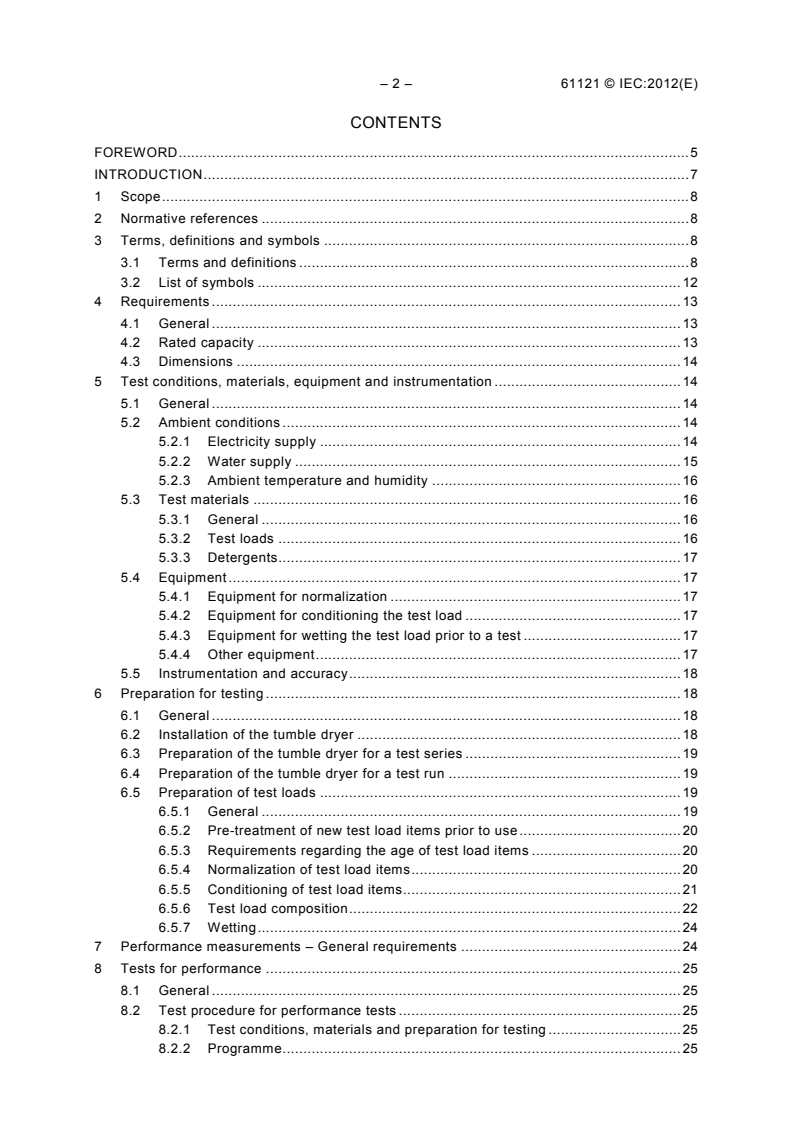
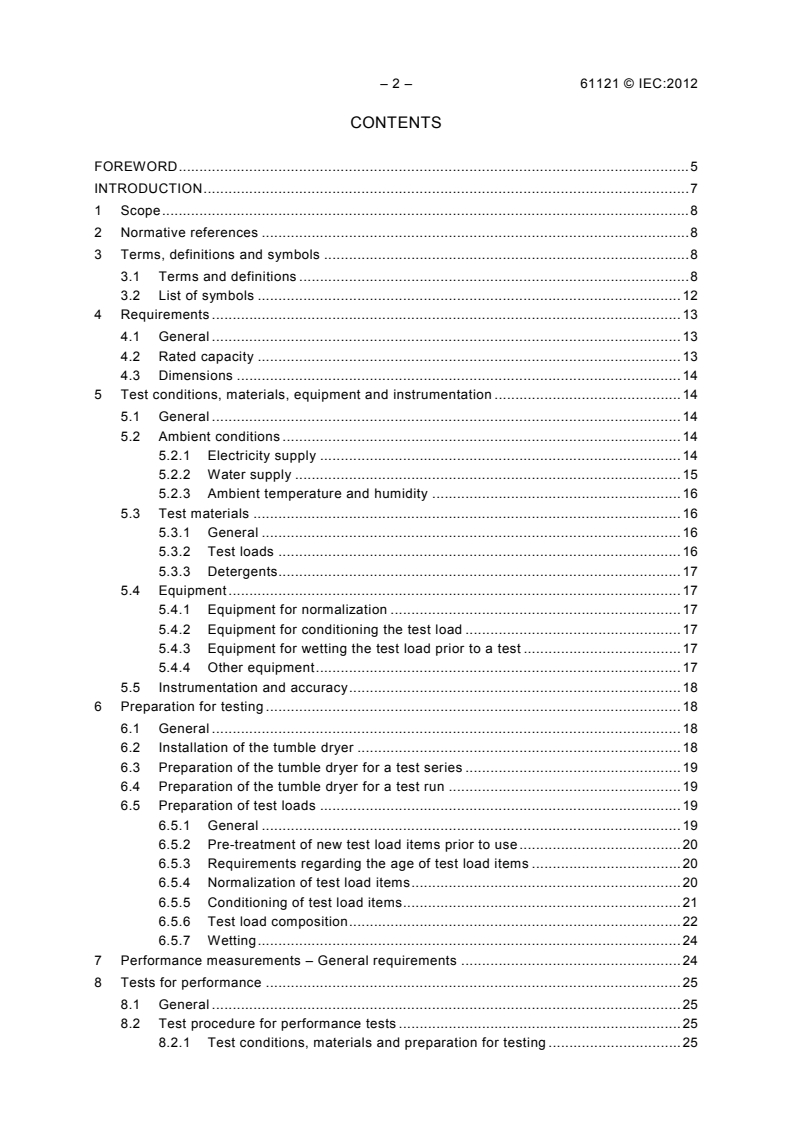
– 2 – 61121 © IEC:2012(E)
CONTENTS
FOREWORD . 5
INTRODUCTION . 7
1 Scope . 8
2 Normative references . 8
3 Terms, definitions and symbols . 8
3.1 Terms and definitions . 8
3.2 List of symbols . 12
4 Requirements . 13
4.1 General . 13
4.2 Rated capacity . 13
4.3 Dimensions . 14
5 Test conditions, materials, equipment and instrumentation . 14
5.1 General . 14
5.2 Ambient conditions . 14
5.2.1 Electricity supply . 14
5.2.2 Water supply . 15
5.2.3 Ambient temperature and humidity . 16
5.3 Test materials . 16
5.3.1 General . 16
5.3.2 Test loads . 16
5.3.3 Detergents . 17
5.4 Equipment . 17
5.4.1 Equipment for normalization . 17
5.4.2 Equipment for conditioning the test load . 17
5.4.3 Equipment for wetting the test load prior to a test . 17
5.4.4 Other equipment . 17
5.5 Instrumentation and accuracy . 18
6 Preparation for testing . 18
6.1 General . 18
6.2 Installation of the tumble dryer . 18
6.3 Preparation of the tumble dryer for a test series . 19
6.4 Preparation of the tumble dryer for a test run . 19
6.5 Preparation of test loads . 19
6.5.1 General . 19
6.5.2 Pre-treatment of new test load items prior to use . 20
6.5.3 Requirements regarding the age of test load items . 20
6.5.4 Normalization of test load items . 20
6.5.5 Conditioning of test load items . 21
6.5.6 Test load composition . 22
6.5.7 Wetting . 24
7 Performance measurements – General requirements . 24
8 Tests for performance . 25
8.1 General . 25
8.2 Test procedure for performance tests . 25
8.2.1 Test conditions, materials and preparation for testing . 25
8.2.2 Programme . 25
61121 © IEC:2012(E) – 3 –
8.2.3 Test load . 26
8.2.4 Test procedure . 26
8.2.5 Validity of a test run . 26
8.2.6 Validity of a test series . 27
8.3 Measurements to determine water and energy consumption and programme
time . 27
8.3.1 General . 27
8.3.2 Procedure . 28
8.4 Measurements to determine condensation efficiency . 28
8.4.1 General . 28
8.4.2 Procedure . 28
8.5 Measurements to determine evenness of drying . 28
8.5.1 General . 28
8.5.2 Procedure . 28
8.6 Measurements to determine exhaust air volume . 29
9 Assessment of performance . 29
9.1 General . 29
9.2 Final moisture content of the load . 29
9.3 Corrected electrical energy consumption . 30
9.4 Corrected water consumption . 30
9.5 Corrected programme time . 31
9.6 Condensation efficiency . 32
9.7 Evenness of drying . 32
9.8 Exhaust air volume . 33
10 Data to be reported . 33
Annex A (normative) Reference list . 34
Annex B (normative) Nominal and standard exhaust duct for tumble dryer testing . 35
Annex C (informative) Flow diagrams . 38
Annex D (normative) Test report – data to be reported . 40
Annex E (normative) Procedure to determine test load size where rated capacity is not
declared . 44
Annex F (normative) Flexible initial moisture content method . 45
Annex G (informative) Assessment of evenness of drying . 47
Annex H (informative) Measurement of exhaust air volume . 48
Bibliography . 50
Figure B.1 – Pressure/volumetric air flow curve . 35
Figure B.2 – Standard exhaust duct (dimensions are in millimetres). 36
Figure B.3 – Standard exhaust simulator (dimensions are in millimetres) . 37
Figure C.1 – Decision chart illustrating the requirements for a valid test series for
automatic tumble dryers . 38
Figure C.2 – Decision chart illustrating the requirements for a valid test series for non
automatic tumble dryers . 39
Figure H.1 – Suction chamber setup . 49
Table 1 – List of symbols . 12
Table 2 – Specification of instruments . 18
– 4 – 61121 © IEC:2012(E)
Table 3 – Number of items in the cotton test load for various test load masses . 22
Table 4 – Number of items in the synthetic/blends test load for various test load
masses . 23
Table 5 – Specifications for initial moisture content in the test load . 24
Table 6 – Specification for final moisture content of the test load after drying . 26
Table D.1 – Identification data . 40
Table D.2 – Test measurements . 41
Table D.3 – Test conditions and materials . 43
Table D.4 – Weighted average age – Cotton load . 43
61121 © IEC:2012(E) – 5 –
INTERNATIONAL ELECTROTECHNICAL COMMISSION
____________
TUMBLE DRYERS FOR HOUSEHOLD USE –
METHODS FOR MEASURING THE PERFORMANCE
FOREWORD
1) The International Electrotechnical Commission (IEC) is a worldwide organization for standardization comprising
all national electrotechnical committees (IEC National Committees). The object of IEC is to promote
international co-operation on all questions concerning standardization in the electrical and electronic fields. To
this end and in addition to other activities, IEC publishes International Standards, Technical Specifications,
Technical Reports, Publicly Available Specifications (PAS) and Guides (hereafter referred to as “IEC
Publication(s)”). Their preparation is entrusted to technical committees; any IEC National Committee interested
in the subject dealt with may participate in this preparatory work. International, governmental and non-
governmental organizations liaising with the IEC also participate in this preparation. IEC collaborates closely
with the International Organization for Standardization (ISO) in accordance with conditions determined by
agreement between the two organizations.
2) The formal decisions or agreements of IEC on technical matters express, as nearly as possible, an international
consensus of opinion on the relevant subjects since each technical committee has representation from all
interested IEC National Committees.
3) IEC Publications have the form of recommendations for international use and are accepted by IEC National
Committees in that sense. While all reasonable efforts are made to ensure that the technical content of IEC
Publications is accurate, IEC cannot be held responsible for the way in which they are used or for any
misinterpretation by any end user.
4) In order to promote international uniformity, IEC National Committees undertake to apply IEC Publications
transparently to the maximum extent possible in their national and regional publications. Any divergence
between any IEC Publication and the corresponding national or regional publication shall be clearly indicated in
the latter.
5) IEC itself does not provide any attestation of conformity. Independent certification bodies provide conformity
assessment services and, in some areas, access to IEC marks of conformity. IEC is not responsible for any
services carried out by independent certification bodies.
6) All users should ensure that they have the latest edition of this publication.
7) No liability shall attach to IEC or its directors, employees, servants or agents including individual experts and
members of its technical committees and IEC National Committees for any personal injury, property damage or
other damage of any nature whatsoever, whether direct or indirect, or for costs (including legal fees) and
expenses arising out of the publication, use of, or reliance upon, this IEC Publication or any other IEC
Publications.
8) Attention is drawn to the Normative references cited in this publication. Use of the referenced publications is
indispensable for the correct application of this publication.
9) Attention is drawn to the possibility that some of the elements of this IEC Publication may be the subject of
patent rights. IEC shall not be held responsible for identifying any or all such patent rights.
International Standard IEC 61121 has been prepared by subcommittee 59D: Home laundry
appliances, of IEC technical committee 59: Performance of household and similar electrical
appliances.
This fourth edition cancels and replaces the third edition published in 2002 and Amendment 1
(2005). This edition constitutes a technical revision.
This edition includes the following significant technical changes with respect to the previous
edition:
a) General:
• more terms have been defined and some previous definitions have been streamlined,
in addition to the correction of some symbols and equations;
• where possible, definitions and terms have been used in common with
IEC 60456:2010;
• the content has been organised into a more logical and simple structure, and repetitive
sections have been removed.
– 6 – 61121 © IEC:2012(E)
b) Conditions of measurement:
• the wording of various sections has been revised to reduce ambiguity;
• limits have been defined for water characteristics for automatic tumble dryers that are
sensitive to conductivity as well as methods to adjust these characteristics where
necessary.
c) Reproducibility and repeatability of test results:
• revision of the specification for the cotton test load to include suitable test materials
which are currently available on the market;
• more careful definition of the process and conditions for pre-treatment, conditioning
and normalization.
d) Test methods:
• accuracy of measurement has been defined for all instruments;
• limits and interpretations of the allowable final moisture content for each type of
dryer are now defined;
• practical advice regarding the test procedure has been given with the aim of reducing
ambiguity.
Words in bold in the text are defined in Clause 3.
The text of this standard is based on the following documents:
FDIS Report on voting
59D/393/FDIS 59D/395/RVD
Full information on the voting for the approval of this standard can be found in the report on
voting indicated in the above table.
This publication has been drafted in accordance with the ISO/IEC Directives, Part 2.
The committee has decided that the contents of this publication will remain unchanged until
the stability date indicated on the IEC web site under "http://webstore.iec.ch" in the data
related to the specific publication. At this date, the publication will be
• reconfirmed,
• withdrawn,
• replaced by a revised edition, or
• amended.
A bilingual version of this publication may be issued at a later date.
61121 © IEC:2012(E) – 7 –
INTRODUCTION
This fourth edition has been developed in light of experience with use of the third edition of
IEC 61121. The structure has been revised to ensure that this remains harmonised with the
IEC 60456:2010 for clothes washers.
– 8 – 61121 © IEC:2012(E)
TUMBLE DRYERS FOR HOUSEHOLD USE –
METHODS FOR MEASURING THE PERFORMANCE
1 Scope
This International Standard is applicable to household electric tumble dryers of the
automatic and non-automatic type, with or without a cold water supply and incorporating a
heating device. This excludes tumble dryers which use gas or other fuels as a heating
source.
The object is to state and define the principal performance characteristics of household
electric tumble dryers of interest to users and to describe standard methods for measuring
these characteristics.
NOTE This International Standard applies also to tumble dryers for communal use in blocks of flats or in
launderettes. It does not apply to tumble dryers for commercial laundries.
2 Normative references
The following documents, in whole or in part, are normatively referenced in this document and
are indispensable for its application. For dated references, only the edition cited applies. For
undated references, the latest edition of the referenced document (including any
amendments) applies.
IEC 60335-2-11:2008, Household and similar electrical appliances – Safety – Part 2-11:
Particular requirements for tumble dryers
IEC 60456:2010, Clothes washing machines for household use – Methods for measuring the
performance
IEC 60734:- , Household electrical appliances – Performance – Water for testing
IEC 62053-21:2003, Electricity metering equipment (a.c.) – Particular requirements – Part 21:
Static meters for active energy (classes 1 and 2)
IEC 62301:2011, Household electrical appliances – Measurement of standby power
ISO 5167-1:2003, Measurement of fluid flow by means of pressure differential devices
inserted in circular cross-section conduits running full – Part 1: General principles and
requirements
ISO 80000-1:2009, Quantities and units – Part 1: General
3 Terms, definitions and symbols
3.1 Terms and definitions
For the purposes of this document, the following terms and definitions apply:
___________
To be published.
61121 © IEC:2012(E) – 9 –
3.1.1
tumble dryer
appliance in which textiles are dried by tumbling in a rotating drum, through which air is
passed
3.1.2
air vented tumble dryer
tumble dryer that draws in fresh air which is passed over the textiles and where the resulting
moist air is exhausted into the room or vented outside
3.1.3
condenser tumble dryer
tumble dryer which includes a device for removing moisture from the air used for the drying
process
3.1.4
automatic tumble dryer
tumble dryer which switches off the drying process when a certain moisture content of the
load is reached
Note 1 to entry: This may include systems that use conductivity or temperature sensing.
3.1.5
non-automatic tumble dryer
tumble dryer which does not switch off the drying process when a certain moisture content
of the load is reached, usually controlled by a timer, but may also be controlled manually
3.1.6
test load
textile load used for testing
3.1.7
pre-treatment
processing of a new test load prior to its first use to avoid rapid changes of characteristics
during the tests
3.1.8
conditioning
bringing the test load into thermodynamic equilibrium with the defined ambient air conditions
of temperature and humidity
Note 1 to entry: The process of conditioning is not the same as "wetting" which is described in 6.5.7.
3.1.9
test run
single performance assessment
3.1.10
test series
group of test runs on a tumble dryer which, collectively, are used to assess the performance
of that tumble dryer
3.1.11
operation
each performance of a function that occurs during the tumble dryer drying process such as
heating up, drying, cooling, anti-creasing
– 10 – 61121 © IEC:2012(E)
3.1.12
programme
series of operations which are pre-defined within the tumble dryer and which are declared
by the manufacturer as suitable for drying certain types of textiles
3.1.13
end of the programme
moment in time when the tumble dryer indicates the programme is complete and the load is
accessible to the user
Note 1 to entry: Where there is no such indicator and the door is locked during operation, the programme is
deemed to be complete when the load is accessible to the user. Where there is no indicator and the door is not
locked during operation, the programme is deemed to be complete when the power consumption of the appliance
drops to a steady state condition and it is not performing any function. For non-automatic tumble dryers, the
programme is deemed to be complete when it is stopped by the operator.
Note 2 to entry: An indication of the end of the programme may be in the form of a light (on or off), a sound, an
indicator shown on a display or the release of a door or latch. In some tumble dryers there may be a short delay
from an end of the programme indicator until the load is accessible by the user.
3.1.14
programme time
period of time from the initiation of the programme (excluding any user programmed delay)
until the end of the programme
3.1.15
cycle
complete drying process, as defined by the selected programme, consisting of a series of
operations including any operations that occur after the end of the programme
Note 1 to entry: Examples of operations that may occur after the completion of the programme are monitoring
and anti- creasing operations (where applicable).
3.1.16
cycle time
period of time from the initiation of the programme (excluding any user programmed delay)
until all activity ceases. Activity is considered to have ceased when the power consumption
reverts to a steady state condition that persists indefinitely without user intervention. If there
is no activity after the end of the programme, the cycle time is equal to the programme
time
Note 1 to entry: Cycle time includes any activity that may occur for a limited period after the end of the
programme. Any cyclic event that occurs indefinitely is considered to be steady state.
3.1.17
normalization
processing of a test load after a pre-determined number of cycles to bring the test load to a
normal state prior to testing
3.1.18
rated capacity
maximum mass in kg of dry textiles of a particular defined type, which the manufacturer
declares can be treated in a specific programme
3.1.19
test load mass
actual mass of the test load
61121 © IEC:2012(E) – 11 –
3.1.20
nominal test load mass
mass of dry textiles of a particular type for which the performance of the tumble dryer will be
tested (rated capacity or part load). Target value toward which the conditioned test load
mass will be adjusted
3.1.21
moisture content
ratio of the difference between test load mass and the conditioned test load mass to the
conditioned test load mass expressed in percent
3.1.22
initial moisture content
moisture content of a test load prior to a test run
3.1.23
final moisture content
moisture content of a test load at the end of a test run
3.1.24
off mode
condition where the product is switched off using appliance controls or switches that are
accessible and intended for operation by the user during normal use to attain the lowest
power consumption that may persist for an indefinite time while connected to a mains power
source and used in accordance with the manufacturer’s instructions.
Note 1 to entry: Where the tumble dryer has no controls or switches that can bring it to the off mode condition, it
is left to revert to a steady state power consumption by its own accord.
3.1.25
left on mode
the lowest power consumption mode that may persist for an indefinite time after the
completion of the programme and unloading of the machine without any further intervention
of the user
Note 1 to entry: In some products this mode may be an equivalent power to off mode.
3.1.26
rated voltage
voltage assigned to the appliance by the manufacturer
– 12 – 61121 © IEC:2012(E)
3.2 List of symbols
The symbols are listed in Table 1.
Table 1 – List of symbols
Symbol Unit Definition
- constant part of the regression line
a
- weighted average age of the test load expressed as the number of test runs
A
age of item after conditioning
A -
k
- slope part of the regression line
b
arithmetical average of the condensation efficiency of all valid test runs
C %
condensation efficiency for test run j
C %
j
kg/l density of water
d
arithmetical average of the corrected energy consumption of all valid test runs
E kWh
corrected electric energy consumption for test run j
E kWh
j
kWh measured electric energy consumption for test run j
E
mj
kWh/kg specific energy consumption
E
s
F m /min volumetric flow rate
- test run number
j
- test load item number
k
–3 2 6
K - constant = 1,9 * 10 Pa h /m
l arithmetical average of the corrected water consumption of all valid test runs
L
l corrected water consumption for test run j
L
j
measured water consumption for test run j
L l
mj
l/kg specific water consumption
L
s
g Conditioned mass of textile sample (Figure H.1)
m
c
number of test runs
n -
- number of items in the test load
N
Pa static pressure
p
off mode power
P W
off
W left on mode power
P
on
- standard deviation of measured results
S
standard deviation of the measured final moisture content for all valid test runs
S -
b
- arithmetical average of the evenness of drying of all valid test runs
S
w
- evenness of drying for a single test run
s
wj
arithmetical average of the programme time of all valid test runs
t min
min/kg specific programme time
t
s
min corrected programme time for test run j
t
j
measured programme time for test run j
t min
mj
l clothes container volume
V
c
m³ exhaust air volume
V
rated capacity for the type of load tested
W g
g mass of the conditioned test load
W
g mass of conditioned test load item k
W
0k
61121 © IEC:2012(E) – 13 –
Symbol Unit Definition
g mass of the test load after drying
W
f
mass of test load after drying for test run j
W g
fj
mass of test load item k after drying
W g
fk
g mass of the test load after wetting
W
i
mass of water collected in the condenser reservoir during test run j
W g
wj
x - i-th term of parameter x
i
- mean of all terms of parameter x
x
i
- performance parameter (energy consumption or programme time)
Y
- number of table tennis balls
y
b
% arithmetical average of the measured final moisture content of all valid test
μ
f
runs
% arithmetical average final moisture content of all the individual items in the test
μ
fjav
load
μ % target final moisture content
f0
% measured final moisture content after test run j
μ
fj
% measured final moisture content of the test load item k for each valid test run j
μ
fjk
μ % measured initial moisture content for test run j
ij
% nominal initial moisture content
μ
i0
4 Requirements
4.1 General
This international standard does not specify minimum performance requirements for tumble
dryers. This International Standard does however set methods for the measurement of
following performance parameters:
• Electric energy consumption;
• Water consumption;
• Programme time;
• Condensation efficiency;
• Evenness of drying;
• Volumetric flow rate of exhaust air;
• Off mode power and left on mode power.
Any claims of performance referring to this International Standard for these parameters shall
be measured in accordance with the requirements of this standard. Any claims of performance
referring to this document at other than rated capacity shall be qualified with load type and
capacity used for the test (refer to Clause 7 for details).
4.2 Rated capacity
The manufacturer or supplier shall declare the rated capacity at 0,5 kg intervals for each
relevant textile type. Relevant textile types are cotton and synthetic/blends.
The rated capacity for any textile type shall not exceed the maximum mass of dry laundry, in
kilograms, to be used in the appliance in accordance with 3.1.9 of IEC 60335-2-11:2008.
– 14 – 61121 © IEC:2012(E)
If the rated capacity is not declared by the manufacturer, the rated capacity shall be
deduced from the clothes container volume (see 4.3) as described in Annex E.
Where the manufacturer gives a range of values for the rated capacity for a particular textile
type, the maximum value shall be used.
NOTE For different textiles the rated capacity of an appliance may be different.
4.3 Dimensions
Where a manufacturer declares dimensions, these shall be in accordance with the following
requirements, as applicable. The dimensions shall be given in cm and shall be rounded to the
nearest whole cm.
• Height = vertical dimension measured from the lower edge (on the floor) to the upper edge
of the top, with the door/lid closed. If adjustable levelling feet are provided, they shall be
moved up and down to determine minimum and maximum possible heights.
• Max height = maximum vertical dimension measured from the lower edge (on the floor) to
a horizontal plane at the maximum height of the tumble dryer with the door/lid open. If
adjustable levelling feet are provided, they shall be moved up and down to determine
minimum and maximum possible heights.
• Width = horizontal dimension, between the sides, as measured between two parallel
vertical planes against the sides of the tumble dryer, including all projections.
• Depth = horizontal dimension as measured from a vertical rear plane against the tumble
dryer and the most prominent part of the front, knobs and handles not being taken into
account, with the door/lid closed, including all projections.
• Max depth = horizontal dimension as measured from a vertical rear plane against the
tumble dryer and the most prominent part of the front knobs and handles not being taken
into account, with the door/lid open (generally when at right angles to the machine front),
including all projections.
• Clothes container volume = the volume of the container in which textiles are placed, where
required, shall be determined in accordance with Annex E.
NOTE Dimension max height is generally only applicable to top access tumble dryers while dimension max depth
is generally only applicable to front access tumble dryers.
5 Test conditions, materials, equipment and instrumentation
5.1 General
The tolerances specified for parameters within this International Standard, using the symbol
‘±’, indicate the allowable limits of variation from the specified parameter outside which the
test or results shall be invalid. The statement of tolerance does not permit the deliberate
variation of these specified parameters.
5.2 Ambient conditions
5.2.1 Electricity supply
The supply voltage at the power outlet to each tumble dryer shall be maintained at the rated
voltage ± 2 % throughout the test. If a voltage range is indicated, then the supply voltage
shall be the nominal voltage of the country in which the appliance is intended to be used.
The supply frequency to each tumble dryer shall be maintained at the rated frequency ± 1 %
throughout the test. If a frequency range is indicated, the test frequency shall be the nominal
frequency of the country in which the machine is intended to be used.
61121 © IEC:2012(E) – 15 –
The measured voltage and frequency of the power supply used during testing shall be
reported.
Voltage stabilisers shall ensure that the normal operation of the tumble dryer does not
cause undue distortion of the voltage waveform.
5.2.2 Water supply
5.2.2.1 General
This section describes the specifications for water to be used for preparing test loads,
wetting test loads and for use in water cooled condensers.
In all cases the water supply shall meet the requirements given in 5.2.2.2 and 5.2.2.3.
Water used for normalising test loads and wetting test loads shall meet the requirements of
5.2.2.2, 5.2.2.3 and 5.2.2.4.
Water used for wetting test loads for testing conductivity controlled automatic tumble dryers
shall meet the requirements of 5.2.2.2, 5.2.2.3, 5.2.2.4 and 5.2.2.5.
NOTE The performance of a dryer may differ according to the quality of the water used to wet the test load.
5.2.2.2 Water temperature
The temperature of the cold water supply shall be (15 ± 2) °C. The measured water
temperature shall be reported.
5.2.2.3 Water pressure
The pressure of the water supply during water intake at each appliance water inlet shall
be maintained at (240 ± 50) kPa. The measured water pressure shall be reported.
5.2.2.4 Water hardness
Either standard hard water with a total hardness of (2,5 ± 0,2) mmol/l or standard soft water
with a total hardness of (0,5 ± 0,2) mmol/l shall be used. If available, naturally occurring water
of the correct total hardness may be used. Alternatively, water of the correct total hardness
shall be prepared according to IEC 60734.
The water used for wetting a load shall always be of the same hardness as the water which is
used for the previous normalization.
The total hardness of the water used shall be reported.
5.2.2.5 Water alkalinity and conductivity
When testing conductivity controlled automatic tumble dryers, the characteristics of the
water used for wetting the test load can have a large influence on the test results. The water
characteristics are defined in terms of hardness, alkalinity and conductivity.
For the purpose of testing automatic tumble dryers the water for wetting the test load shall
have the characteristics of water prepared according to Method B of IEC 60734.
If water characteristics need to be adjusted, Method B or Method C3 of IEC 60734 shall be
followed.
The alkalinity and conductivity of the water used shall be reported.
– 16 – 61121 © IEC:2012(E)
NOTE Method B of IEC 60734 describes how to prepare artificial water based on demineralised water. Method C3
of IEC 60734 describes how to produce water with the same characteristics as with Method B but based on natural
water.
5.2.3 Ambient temperature and humidity
5.2.3.1 Ambient temperature and relative humidity for tumble dryer testing
The ambient temperature of the test room shall be maintained at (23 ± 2) °C throughout the
tumble dryer test. The ambient temperature shall be measured in the vicinity of the tumble
dryer being tested. The maximum and minimum measured temperatures shall be reported
and rounded to the nearest 0,5 °C.
The ambient relative humidity of the test room shall be maintained at (55 ± 5) % throughout
the tumble dryer test. The ambient relative humidity shall be measured in the vicinity of the
tumble dryer being tested. The maximum and minimum measured ambient relative humidity
for tumble dryer testing shall be reported rounded to the nearest whole percentage.
The ambient temperature and relative humidity shall not be influenced by the appliance itself
or other appliances in the laboratory.
5.2.3.2 Ambient temperature and ambient relative humidity for conditioning of test
load items
Where an ambient controlled room or chamber is used for conditioning the test load, the
following conditions shall be maintained:
• ambient temperature: (20 ± 2) °C;
• ambient relative humidity: (65 ± 5) %.
The measured ambient temperature and relative humidity for conditioning test load items
shall be reported. The ambient temperature shall be rounded to the nearest 0,5 °C, the
ambient relative humidity shall be rounded to the nearest whole percentage.
NOTE Requirements for conditioning the test load are specified in 6.5.5.2.
5.3 Test materials
5.3.1 General
This section sets out the specifications for test materials required for tumble dryer testing to
this International Standard, including:
• Test loads (load items);
• Detergent.
NOTE Suitable sources of test materials are given in A.8.
5.3.2 Test loads
5.3.2.1 Cotton test load
Where a cotton load is specified for testing, the cotton test load shall consist of sheets,
pillowcases and towels as specified in A.2.
5.3.2.2 Synthetics/blends test load
Where a synthetics/blends load is specified for testing, the synthetics/blends test load shall
consist of men’s shirts and pillowcases as defined in A.2.
61121 © IEC:2012(E) – 17 –
5.3.3 Detergents
The specification for the IEC 60456:2010 reference detergent A* base powder is defined in
A.1. Detergent dosage is specified in 6.5.4.2 and 6.5.4.3.
5.4 Equipment
5.4.1 Equipment for normalization
The specification for the reference washing machine which is used for the normalization of
test loads is defined in A.9.
NOTE Other clothes washing machines can be used provided that they have the same washing and rinsing
performance according to IEC 60456:2010 or better in the relevant programme. They may be used up to their
rated capacity.
5.4.2 Equipment for conditioning the test load
This International Standard requires test load items to be treated in a controlled manner prior
to their use in performance tests in order to determine their mass under standardised ambient
conditions. The alternative methods of conditioning the test load items are:
• Leaving the test load items in a room or chamber with a controlled ambient
temperature and humidity (refer to 5.2.3.2) until their remaining moisture content is in
equilibrium with the ambient conditions. Refer to 6.5.5.2 for details.
• Treating the test load items in a clothes dryer of specified performance to ensure that
the test load items are in a “bone dry” state. Refer to 6.5.5.3 for details. Annex A.3
sets out the method and the specifications for a tumble dryer which is used for this
method.
5.4.3 Equipment for wetting the test load prior to a test
Any washing machine may be used to wet the load prior to a test, provided it has the following
features:
• a rated capacity which is equal to or greater than the load being wetted;
• at least one rinse operation with a duration of at least five minutes;
• the rinse shall consist of a volume of water in litres at least three times the mass of the
test load in kilograms;
• a spin drying operation capable of achieving the desired initial moisture content.
5.4.4 Other equipment
This International Standard requires the measurement of a range of parameters during testing
of a tumble dryer. These parameters include the following:
• mass;
• electrical parameters (voltage, energy, power and frequency);
• temperature of water and air;
• relative humidity;
• water pressure;
• total water hardness;
• conductivity of water (conductivity sensing dryers only);
• alkalinity of water (conductivity sensing dryers only);
• time.
– 18 – 61121 © IEC:2012(E)
The specifications of instruments used to take the measurements for some of these
parameters are explicitly defined in 5.5.
NOTE Several different instruments for the measurement of mass are likely to be required for tasks such as mass
of load items and the whole test
...
IEC 61121 ®
Edition 4.0 2012-02
INTERNATIONAL
STANDARD
NORME
INTERNATIONALE
Tumble dryers for household use – Methods for measuring the performance
Sèche-linge à tambour à usage domestique – Méthodes de mesure de l'aptitude
à la fonction
All rights reserved. Unless otherwise specified, no part of this publication may be reproduced or utilized in any form
or by any means, electronic or mechanical, including photocopying and microfilm, without permission in writing from
either IEC or IEC's member National Committee in the country of the requester.
If you have any questions about IEC copyright or have an enquiry about obtaining additional rights to this publication,
please contact the address below or your local IEC member National Committee for further information.
Droits de reproduction réservés. Sauf indication contraire, aucune partie de cette publication ne peut être reproduite ni
utilisée sous quelque forme que ce soit et par aucun procédé, électronique ou mécanique, y compris la photocopie et les
microfilms, sans l'accord écrit de la CEI ou du Comité national de la CEI du pays du demandeur.
Si vous avez des questions sur le copyright de la CEI ou si vous désirez obtenir des droits supplémentaires sur cette
publication, utilisez les coordonnées ci-après ou contactez le Comité national de la CEI de votre pays de résidence.
IEC Central Office Tel.: +41 22 919 02 11
3, rue de Varembé Fax: +41 22 919 03 00
CH-1211 Geneva 20 info@iec.ch
Switzerland www.iec.ch
About the IEC
The International Electrotechnical Commission (IEC) is the leading global organization that prepares and publishes
International Standards for all electrical, electronic and related technologies.
About IEC publications
The technical content of IEC publications is kept under constant review by the IEC. Please make sure that you have the
latest edition, a corrigenda or an amendment might have been published.
Useful links:
IEC publications search - www.iec.ch/searchpub Electropedia - www.electropedia.org
The advanced search enables you to find IEC publications The world's leading online dictionary of electronic and
by a variety of criteria (reference number, text, technical electrical terms containing more than 30 000 terms and
committee,…). definitions in English and French, with equivalent terms in
It also gives information on projects, replaced and additional languages. Also known as the International
withdrawn publications. Electrotechnical Vocabulary (IEV) on-line.
IEC Just Published - webstore.iec.ch/justpublished Customer Service Centre - webstore.iec.ch/csc
Stay up to date on all new IEC publications. Just Published If you wish to give us your feedback on this publication
details all new publications released. Available on-line and or need further assistance, please contact the
also once a month by email. Customer Service Centre: csc@iec.ch.
A propos de la CEI
La Commission Electrotechnique Internationale (CEI) est la première organisation mondiale qui élabore et publie des
Normes internationales pour tout ce qui a trait à l'électricité, à l'électronique et aux technologies apparentées.
A propos des publications CEI
Le contenu technique des publications de la CEI est constamment revu. Veuillez vous assurer que vous possédez
l’édition la plus récente, un corrigendum ou amendement peut avoir été publié.
Liens utiles:
Recherche de publications CEI - www.iec.ch/searchpub Electropedia - www.electropedia.org
La recherche avancée vous permet de trouver des Le premier dictionnaire en ligne au monde de termes
publications CEI en utilisant différents critères (numéro de électroniques et électriques. Il contient plus de 30 000
référence, texte, comité d’études,…). termes et définitions en anglais et en français, ainsi que
Elle donne aussi des informations sur les projets et les les termes équivalents dans les langues additionnelles.
publications remplacées ou retirées. Egalement appelé Vocabulaire Electrotechnique
International (VEI) en ligne.
Just Published CEI - webstore.iec.ch/justpublished
Service Clients - webstore.iec.ch/csc
Restez informé sur les nouvelles publications de la CEI.
Just Published détaille les nouvelles publications parues. Si vous désirez nous donner des commentaires sur
Disponible en ligne et aussi une fois par mois par email. cette publication ou si vous avez des questions
contactez-nous: csc@iec.ch.
IEC 61121 ®
Edition 4.0 2012-02
INTERNATIONAL
STANDARD
NORME
INTERNATIONALE
Tumble dryers for household use – Methods for measuring the performance
Sèche-linge à tambour à usage domestique – Méthodes de mesure de l'aptitude
à la fonction
INTERNATIONAL
ELECTROTECHNICAL
COMMISSION
COMMISSION
ELECTROTECHNIQUE
PRICE CODE
INTERNATIONALE
X
CODE PRIX
ICS 97.060 ISBN 978-2-8322-0936-3
– 2 – 61121 © IEC:2012
CONTENTS
FOREWORD . 5
INTRODUCTION . 7
1 Scope . 8
2 Normative references . 8
3 Terms, definitions and symbols . 8
3.1 Terms and definitions . 8
3.2 List of symbols . 12
4 Requirements . 13
4.1 General . 13
4.2 Rated capacity . 13
4.3 Dimensions . 14
5 Test conditions, materials, equipment and instrumentation . 14
5.1 General . 14
5.2 Ambient conditions . 14
5.2.1 Electricity supply . 14
5.2.2 Water supply . 15
5.2.3 Ambient temperature and humidity . 16
5.3 Test materials . 16
5.3.1 General . 16
5.3.2 Test loads . 16
5.3.3 Detergents . 17
5.4 Equipment . 17
5.4.1 Equipment for normalization . 17
5.4.2 Equipment for conditioning the test load . 17
5.4.3 Equipment for wetting the test load prior to a test . 17
5.4.4 Other equipment . 17
5.5 Instrumentation and accuracy . 18
6 Preparation for testing . 18
6.1 General . 18
6.2 Installation of the tumble dryer . 18
6.3 Preparation of the tumble dryer for a test series . 19
6.4 Preparation of the tumble dryer for a test run . 19
6.5 Preparation of test loads . 19
6.5.1 General . 19
6.5.2 Pre-treatment of new test load items prior to use . 20
6.5.3 Requirements regarding the age of test load items . 20
6.5.4 Normalization of test load items . 20
6.5.5 Conditioning of test load items . 21
6.5.6 Test load composition . 22
6.5.7 Wetting . 24
7 Performance measurements – General requirements . 24
8 Tests for performance . 25
8.1 General . 25
8.2 Test procedure for performance tests . 25
8.2.1 Test conditions, materials and preparation for testing . 25
61121 © IEC:2012 – 3 –
8.2.2 Programme . 25
8.2.3 Test load . 26
8.2.4 Test procedure . 26
8.2.5 Validity of a test run . 26
8.2.6 Validity of a test series . 27
8.3 Measurements to determine water and energy consumption and programme
time . 27
8.3.1 General . 27
8.3.2 Procedure . 28
8.4 Measurements to determine condensation efficiency . 28
8.4.1 General . 28
8.4.2 Procedure . 28
8.5 Measurements to determine evenness of drying . 28
8.5.1 General . 28
8.5.2 Procedure . 28
8.6 Measurements to determine exhaust air volume . 29
9 Assessment of performance . 29
9.1 General . 29
9.2 Final moisture content of the load . 29
9.3 Corrected electrical energy consumption . 30
9.4 Corrected water consumption . 30
9.5 Corrected programme time . 31
9.6 Condensation efficiency . 32
9.7 Evenness of drying . 32
9.8 Exhaust air volume . 33
10 Data to be reported . 33
Annex A (normative) Reference list . 34
Annex B (normative) Nominal and standard exhaust duct for tumble dryer testing . 35
Annex C (informative) Flow diagrams . 38
Annex D (normative) Test report – data to be reported . 40
Annex E (normative) Procedure to determine test load size where rated capacity is not
declared . 44
Annex F (normative) Flexible initial moisture content method . 45
Annex G (informative) Assessment of evenness of drying . 47
Annex H (informative) Measurement of exhaust air volume . 48
Bibliography . 50
Figure B.1 – Pressure/volumetric air flow curve . 35
Figure B.2 – Standard exhaust duct (dimensions are in millimetres). 36
Figure B.3 – Standard exhaust simulator (dimensions are in millimetres) . 37
Figure C.1 – Decision chart illustrating the requirements for a valid test series for
automatic tumble dryers . 38
Figure C.2 – Decision chart illustrating the requirements for a valid test series for non
automatic tumble dryers . 39
Figure H.1 – Suction chamber setup . 49
Table 1 – List of symbols . 12
– 4 – 61121 © IEC:2012
Table 2 – Specification of instruments . 18
Table 3 – Number of items in the cotton test load for various test load masses . 22
Table 4 – Number of items in the synthetic/blends test load for various test load
masses . 23
Table 5 – Specifications for initial moisture content in the test load . 24
Table 6 – Specification for final moisture content of the test load after drying . 26
Table D.1 – Identification data . 40
Table D.2 – Test measurements . 41
Table D.3 – Test conditions and materials . 43
Table D.4 – Weighted average age – Cotton load . 43
61121 © IEC:2012 – 5 –
INTERNATIONAL ELECTROTECHNICAL COMMISSION
____________
TUMBLE DRYERS FOR HOUSEHOLD USE –
METHODS FOR MEASURING THE PERFORMANCE
FOREWORD
1) The International Electrotechnical Commission (IEC) is a worldwide organization for standardization comprising
all national electrotechnical committees (IEC National Committees). The object of IEC is to promote
international co-operation on all questions concerning standardization in the electrical and electronic fields. To
this end and in addition to other activities, IEC publishes International Standards, Technical Specifications,
Technical Reports, Publicly Available Specifications (PAS) and Guides (hereafter referred to as “IEC
Publication(s)”). Their preparation is entrusted to technical committees; any IEC National Committee interested
in the subject dealt with may participate in this preparatory work. International, governmental and non-
governmental organizations liaising with the IEC also participate in this preparation. IEC collaborates closely
with the International Organization for Standardization (ISO) in accordance with conditions determined by
agreement between the two organizations.
2) The formal decisions or agreements of IEC on technical matters express, as nearly as possible, an international
consensus of opinion on the relevant subjects since each technical committee has representation from all
interested IEC National Committees.
3) IEC Publications have the form of recommendations for international use and are accepted by IEC National
Committees in that sense. While all reasonable efforts are made to ensure that the technical content of IEC
Publications is accurate, IEC cannot be held responsible for the way in which they are used or for any
misinterpretation by any end user.
4) In order to promote international uniformity, IEC National Committees undertake to apply IEC Publications
transparently to the maximum extent possible in their national and regional publications. Any divergence
between any IEC Publication and the corresponding national or regional publication shall be clearly indicated in
the latter.
5) IEC itself does not provide any attestation of conformity. Independent certification bodies provide conformity
assessment services and, in some areas, access to IEC marks of conformity. IEC is not responsible for any
services carried out by independent certification bodies.
6) All users should ensure that they have the latest edition of this publication.
7) No liability shall attach to IEC or its directors, employees, servants or agents including individual experts and
members of its technical committees and IEC National Committees for any personal injury, property damage or
other damage of any nature whatsoever, whether direct or indirect, or for costs (including legal fees) and
expenses arising out of the publication, use of, or reliance upon, this IEC Publication or any other IEC
Publications.
8) Attention is drawn to the Normative references cited in this publication. Use of the referenced publications is
indispensable for the correct application of this publication.
9) Attention is drawn to the possibility that some of the elements of this IEC Publication may be the subject of
patent rights. IEC shall not be held responsible for identifying any or all such patent rights.
International Standard IEC 61121 has been prepared by subcommittee 59D: Home laundry
appliances, of IEC technical committee 59: Performance of household and similar electrical
appliances.
This fourth edition cancels and replaces the third edition published in 2002 and Amendment 1
(2005). This edition constitutes a technical revision.
This edition includes the following significant technical changes with respect to the previous
edition:
a) General:
• more terms have been defined and some previous definitions have been streamlined,
in addition to the correction of some symbols and equations;
• where possible, definitions and terms have been used in common with
IEC 60456:2010;
• the content has been organised into a more logical and simple structure, and repetitive
sections have been removed.
– 6 – 61121 © IEC:2012
b) Conditions of measurement:
• the wording of various sections has been revised to reduce ambiguity;
• limits have been defined for water characteristics for automatic tumble dryers that are
sensitive to conductivity as well as methods to adjust these characteristics where
necessary.
c) Reproducibility and repeatability of test results:
• revision of the specification for the cotton test load to include suitable test materials
which are currently available on the market;
• more careful definition of the process and conditions for pre-treatment, conditioning
and normalization.
d) Test methods:
• accuracy of measurement has been defined for all instruments;
• limits and interpretations of the allowable final moisture content for each type of
dryer are now defined;
• practical advice regarding the test procedure has been given with the aim of reducing
ambiguity.
Words in bold in the text are defined in Clause 3.
This bilingual version (2013-07) corresponds to the monolingual English version, published in
2012-02.
The text of this standard is based on the following documents:
FDIS Report on voting
59D/393/FDIS 59D/395/RVD
Full information on the voting for the approval of this standard can be found in the report on
voting indicated in the above table.
The French version of this standard has not been voted upon.
This publication has been drafted in accordance with the ISO/IEC Directives, Part 2.
The committee has decided that the contents of this publication will remain unchanged until
the stability date indicated on the IEC web site under "http://webstore.iec.ch" in the data
related to the specific publication. At this date, the publication will be
• reconfirmed,
• withdrawn,
• replaced by a revised edition, or
• amended.
61121 © IEC:2012 – 7 –
INTRODUCTION
This fourth edition has been developed in light of experience with use of the third edition of
IEC 61121. The structure has been revised to ensure that this remains harmonised with the
IEC 60456:2010 for clothes washers.
– 8 – 61121 © IEC:2012
TUMBLE DRYERS FOR HOUSEHOLD USE –
METHODS FOR MEASURING THE PERFORMANCE
1 Scope
This International Standard is applicable to household electric tumble dryers of the
automatic and non-automatic type, with or without a cold water supply and incorporating a
heating device. This excludes tumble dryers which use gas or other fuels as a heating
source.
The object is to state and define the principal performance characteristics of household
electric tumble dryers of interest to users and to describe standard methods for measuring
these characteristics.
NOTE This International Standard applies also to tumble dryers for communal use in blocks of flats or in
launderettes. It does not apply to tumble dryers for commercial laundries.
2 Normative references
The following documents, in whole or in part, are normatively referenced in this document and
are indispensable for its application. For dated references, only the edition cited applies. For
undated references, the latest edition of the referenced document (including any
amendments) applies.
IEC 60335-2-11:2008, Household and similar electrical appliances – Safety – Part 2-11:
Particular requirements for tumble dryers
IEC 60456:2010, Clothes washing machines for household use – Methods for measuring the
performance
IEC 60734:- , Household electrical appliances – Performance – Water for testing
IEC 62053-21:2003, Electricity metering equipment (a.c.) – Particular requirements – Part 21:
Static meters for active energy (classes 1 and 2)
IEC 62301:2011, Household electrical appliances – Measurement of standby power
ISO 5167-1:2003, Measurement of fluid flow by means of pressure differential devices
inserted in circular cross-section conduits running full – Part 1: General principles and
requirements
ISO 80000-1:2009, Quantities and units – Part 1: General
3 Terms, definitions and symbols
3.1 Terms and definitions
For the purposes of this document, the following terms and definitions apply:
___________
To be published.
61121 © IEC:2012 – 9 –
3.1.1
tumble dryer
appliance in which textiles are dried by tumbling in a rotating drum, through which air is
passed
3.1.2
air vented tumble dryer
tumble dryer that draws in fresh air which is passed over the textiles and where the resulting
moist air is exhausted into the room or vented outside
3.1.3
condenser tumble dryer
tumble dryer which includes a device for removing moisture from the air used for the drying
process
3.1.4
automatic tumble dryer
tumble dryer which switches off the drying process when a certain moisture content of the
load is reached
Note 1 to entry: This may include systems that use conductivity or temperature sensing.
3.1.5
non-automatic tumble dryer
tumble dryer which does not switch off the drying process when a certain moisture content
of the load is reached, usually controlled by a timer, but may also be controlled manually
3.1.6
test load
textile load used for testing
3.1.7
pre-treatment
processing of a new test load prior to its first use to avoid rapid changes of characteristics
during the tests
3.1.8
conditioning
bringing the test load into thermodynamic equilibrium with the defined ambient air conditions
of temperature and humidity
Note 1 to entry: The process of conditioning is not the same as "wetting" which is described in 6.5.7.
3.1.9
test run
single performance assessment
3.1.10
test series
group of test runs on a tumble dryer which, collectively, are used to assess the performance
of that tumble dryer
3.1.11
operation
each performance of a function that occurs during the tumble dryer drying process such as
heating up, drying, cooling, anti-creasing
– 10 – 61121 © IEC:2012
3.1.12
programme
series of operations which are pre-defined within the tumble dryer and which are declared
by the manufacturer as suitable for drying certain types of textiles
3.1.13
end of the programme
moment in time when the tumble dryer indicates the programme is complete and the load is
accessible to the user
Note 1 to entry: Where there is no such indicator and the door is locked during operation, the programme is
deemed to be complete when the load is accessible to the user. Where there is no indicator and the door is not
locked during operation, the programme is deemed to be complete when the power consumption of the appliance
drops to a steady state condition and it is not performing any function. For non-automatic tumble dryers, the
programme is deemed to be complete when it is stopped by the operator.
Note 2 to entry: An indication of the end of the programme may be in the form of a light (on or off), a sound, an
indicator shown on a display or the release of a door or latch. In some tumble dryers there may be a short delay
from an end of the programme indicator until the load is accessible by the user.
3.1.14
programme time
period of time from the initiation of the programme (excluding any user programmed delay)
until the end of the programme
3.1.15
cycle
complete drying process, as defined by the selected programme, consisting of a series of
operations including any operations that occur after the end of the programme
Note 1 to entry: Examples of operations that may occur after the completion of the programme are monitoring
and anti- creasing operations (where applicable).
3.1.16
cycle time
period of time from the initiation of the programme (excluding any user programmed delay)
until all activity ceases. Activity is considered to have ceased when the power consumption
reverts to a steady state condition that persists indefinitely without user intervention. If there
is no activity after the end of the programme, the cycle time is equal to the programme
time
Note 1 to entry: Cycle time includes any activity that may occur for a limited period after the end of the
programme. Any cyclic event that occurs indefinitely is considered to be steady state.
3.1.17
normalization
processing of a test load after a pre-determined number of cycles to bring the test load to a
normal state prior to testing
3.1.18
rated capacity
maximum mass in kg of dry textiles of a particular defined type, which the manufacturer
declares can be treated in a specific programme
3.1.19
test load mass
actual mass of the test load
61121 © IEC:2012 – 11 –
3.1.20
nominal test load mass
mass of dry textiles of a particular type for which the performance of the tumble dryer will be
tested (rated capacity or part load). Target value toward which the conditioned test load
mass will be adjusted
3.1.21
moisture content
ratio of the difference between test load mass and the conditioned test load mass to the
conditioned test load mass expressed in percent
3.1.22
initial moisture content
moisture content of a test load prior to a test run
3.1.23
final moisture content
moisture content of a test load at the end of a test run
3.1.24
off mode
condition where the product is switched off using appliance controls or switches that are
accessible and intended for operation by the user during normal use to attain the lowest
power consumption that may persist for an indefinite time while connected to a mains power
source and used in accordance with the manufacturer’s instructions.
Note 1 to entry: Where the tumble dryer has no controls or switches that can bring it to the off mode condition, it
is left to revert to a steady state power consumption by its own accord.
3.1.25
left on mode
the lowest power consumption mode that may persist for an indefinite time after the
completion of the programme and unloading of the machine without any further intervention
of the user
Note 1 to entry: In some products this mode may be an equivalent power to off mode.
3.1.26
rated voltage
voltage assigned to the appliance by the manufacturer
– 12 – 61121 © IEC:2012
3.2 List of symbols
The symbols are listed in Table 1.
Table 1 – List of symbols
Symbol Unit Definition
- constant part of the regression line
a
- weighted average age of the test load expressed as the number of test runs
A
age of item after conditioning
A -
k
- slope part of the regression line
b
arithmetical average of the condensation efficiency of all valid test runs
C %
condensation efficiency for test run j
C %
j
kg/l density of water
d
arithmetical average of the corrected energy consumption of all valid test runs
E kWh
corrected electric energy consumption for test run j
E kWh
j
kWh measured electric energy consumption for test run j
E
mj
kWh/kg specific energy consumption
E
s
F m /min volumetric flow rate
- test run number
j
- test load item number
k
–3 2 6
K - constant = 1,9 * 10 Pa h /m
l arithmetical average of the corrected water consumption of all valid test runs
L
l corrected water consumption for test run j
L
j
measured water consumption for test run j
L l
mj
l/kg specific water consumption
L
s
g Conditioned mass of textile sample (Figure H.1)
m
c
number of test runs
n -
- number of items in the test load
N
Pa static pressure
p
off mode power
P W
off
W left on mode power
P
on
- standard deviation of measured results
S
standard deviation of the measured final moisture content for all valid test runs
S -
b
- arithmetical average of the evenness of drying of all valid test runs
S
w
- evenness of drying for a single test run
s
wj
arithmetical average of the programme time of all valid test runs
t min
min/kg specific programme time
t
s
min corrected programme time for test run j
t
j
measured programme time for test run j
t min
mj
l clothes container volume
V
c
m³ exhaust air volume
V
rated capacity for the type of load tested
W g
g mass of the conditioned test load
W
g mass of conditioned test load item k
W
0k
61121 © IEC:2012 – 13 –
Symbol Unit Definition
g mass of the test load after drying
W
f
mass of test load after drying for test run j
W g
fj
mass of test load item k after drying
W g
fk
g mass of the test load after wetting
W
i
mass of water collected in the condenser reservoir during test run j
W g
wj
x - i-th term of parameter x
i
- mean of all terms of parameter x
x
i
- performance parameter (energy consumption or programme time)
Y
- number of table tennis balls
y
b
% arithmetical average of the measured final moisture content of all valid test
μ
f
runs
% arithmetical average final moisture content of all the individual items in the test
μ
fjav
load
μ % target final moisture content
f0
% measured final moisture content after test run j
μ
fj
% measured final moisture content of the test load item k for each valid test run j
μ
fjk
μ % measured initial moisture content for test run j
ij
% nominal initial moisture content
μ
i0
4 Requirements
4.1 General
This international standard does not specify minimum performance requirements for tumble
dryers. This International Standard does however set methods for the measurement of
following performance parameters:
• Electric energy consumption;
• Water consumption;
• Programme time;
• Condensation efficiency;
• Evenness of drying;
• Volumetric flow rate of exhaust air;
• Off mode power and left on mode power.
Any claims of performance referring to this International Standard for these parameters shall
be measured in accordance with the requirements of this standard. Any claims of performance
referring to this document at other than rated capacity shall be qualified with load type and
capacity used for the test (refer to Clause 7 for details).
4.2 Rated capacity
The manufacturer or supplier shall declare the rated capacity at 0,5 kg intervals for each
relevant textile type. Relevant textile types are cotton and synthetic/blends.
The rated capacity for any textile type shall not exceed the maximum mass of dry laundry, in
kilograms, to be used in the appliance in accordance with 3.1.9 of IEC 60335-2-11:2008.
– 14 – 61121 © IEC:2012
If the rated capacity is not declared by the manufacturer, the rated capacity shall be
deduced from the clothes container volume (see 4.3) as described in Annex E.
Where the manufacturer gives a range of values for the rated capacity for a particular textile
type, the maximum value shall be used.
NOTE For different textiles the rated capacity of an appliance may be different.
4.3 Dimensions
Where a manufacturer declares dimensions, these shall be in accordance with the following
requirements, as applicable. The dimensions shall be given in cm and shall be rounded to the
nearest whole cm.
• Height = vertical dimension measured from the lower edge (on the floor) to the upper edge
of the top, with the door/lid closed. If adjustable levelling feet are provided, they shall be
moved up and down to determine minimum and maximum possible heights.
• Max height = maximum vertical dimension measured from the lower edge (on the floor) to
a horizontal plane at the maximum height of the tumble dryer with the door/lid open. If
adjustable levelling feet are provided, they shall be moved up and down to determine
minimum and maximum possible heights.
• Width = horizontal dimension, between the sides, as measured between two parallel
vertical planes against the sides of the tumble dryer, including all projections.
• Depth = horizontal dimension as measured from a vertical rear plane against the tumble
dryer and the most prominent part of the front, knobs and handles not being taken into
account, with the door/lid closed, including all projections.
• Max depth = horizontal dimension as measured from a vertical rear plane against the
tumble dryer and the most prominent part of the front knobs and handles not being taken
into account, with the door/lid open (generally when at right angles to the machine front),
including all projections.
• Clothes container volume = the volume of the container in which textiles are placed, where
required, shall be determined in accordance with Annex E.
NOTE Dimension max height is generally only applicable to top access tumble dryers while dimension max depth
is generally only applicable to front access tumble dryers.
5 Test conditions, materials, equipment and instrumentation
5.1 General
The tolerances specified for parameters within this International Standard, using the symbol
‘±’, indicate the allowable limits of variation from the specified parameter outside which the
test or results shall be invalid. The statement of tolerance does not permit the deliberate
variation of these specified parameters.
5.2 Ambient conditions
5.2.1 Electricity supply
The supply voltage at the power outlet to each tumble dryer shall be maintained at the rated
voltage ± 2 % throughout the test. If a voltage range is indicated, then the supply voltage
shall be the nominal voltage of the country in which the appliance is intended to be used.
The supply frequency to each tumble dryer shall be maintained at the rated frequency ± 1 %
throughout the test. If a frequency range is indicated, the test frequency shall be the nominal
frequency of the country in which the machine is intended to be used.
The measured voltage and frequency of the power supply used during testing shall be
reported.
61121 © IEC:2012 – 15 –
Voltage stabilisers shall ensure that the normal operation of the tumble dryer does not
cause undue distortion of the voltage waveform.
5.2.2 Water supply
5.2.2.1 General
This section describes the specifications for water to be used for preparing test loads,
wetting test loads and for use in water cooled condensers.
In all cases the water supply shall meet the requirements given in 5.2.2.2 and 5.2.2.3.
Water used for normalising test loads and wetting test loads shall meet the requirements of
5.2.2.2, 5.2.2.3 and 5.2.2.4.
Water used for wetting test loads for testing conductivity controlled automatic tumble dryers
shall meet the requirements of 5.2.2.2, 5.2.2.3, 5.2.2.4 and 5.2.2.5.
NOTE The performance of a dryer may differ according to the quality of the water used to wet the test load.
5.2.2.2 Water temperature
The temperature of the cold water supply shall be (15 ± 2) °C. The measured water
temperature shall be reported.
5.2.2.3 Water pressure
The pressure of the water supply during water intake at each appliance water inlet shall
be maintained at (240 ± 50) kPa. The measured water pressure shall be reported.
5.2.2.4 Water hardness
Either standard hard water with a total hardness of (2,5 ± 0,2) mmol/l or standard soft water
with a total hardness of (0,5 ± 0,2) mmol/l shall be used. If available, naturally occurring water
of the correct total hardness may be used. Alternatively, water of the correct total hardness
shall be prepared according to IEC 60734.
The water used for wetting a load shall always be of the same hardness as the water which is
used for the previous normalization.
The total hardness of the water used shall be reported.
5.2.2.5 Water alkalinity and conductivity
When testing conductivity controlled automatic tumble dryers, the characteristics of the
water used for wetting the test load can have a large influence on the test results. The water
characteristics are defined in terms of hardness, alkalinity and conductivity.
For the purpose of testing automatic tumble dryers the water for wetting the test load shall
have the characteristics of water prepared according to Method B of IEC 60734.
If water characteristics need to be adjusted, Method B or Method C3 of IEC 60734 shall be
followed.
The alkalinity and conductivity of the water used shall be reported.
– 16 – 61121 © IEC:2012
NOTE Method B of IEC 60734 describes how to prepare artificial water based on demineralised water. Method C3
of IEC 60734 describes how to produce water with the same characteristics as with Method B but based on natural
water.
5.2.3 Ambient temperature and humidity
5.2.3.1 Ambient temperature and relative humidity for tumble dryer testing
The ambient temperature of the test room shall be maintained at (23 ± 2) °C throughout the
tumble dryer test. The ambient temperature shall be measured in the vicinity of the tumble
dryer being tested. The maximum and minimum measured temperatures shall be reported
and rounded to the nearest 0,5 °C.
The ambient relative humidity of the test room shall be maintained at (55 ± 5) % throughout
the tumble dryer test. The ambient relative humidity shall be measured in the vicinity of the
tumble dryer being tested. The maximum and minimum measured ambient relative humidity
for tumble dryer testing shall be reported rounded to the nearest whole percentage.
The ambient temperature and relative humidity shall not be influenced by the appliance itself
or other appliances in the laboratory.
5.2.3.2 Ambient temperature and ambient relative humidity for conditioning of test
load items
Where an ambient controlled room or chamber is used for conditioning the test load, the
following conditions shall be maintained:
• ambient temperature: (20 ± 2) °C;
• ambient relative humidity: (65 ± 5) %.
The measured ambient temperature and relative humidity for conditioning test load items
shall be reported. The ambient temperature shall be rounded to the nearest 0,5 °C, the
ambient relative humidity shall be rounded to the nearest whole percentage.
NOTE Requirements for conditioning the test load are specified in 6.5.5.2.
5.3 Test materials
5.3.1 General
This section sets out the specifications for test materials required for tumble dryer testing to
this International Standard, including:
• Test loads (load items);
• Detergent.
NOTE Suitable sources of test materials are given in A.8.
5.3.2 Test loads
5.3.2.1 Cotton test load
Where a cotton load is specified for testing, the cotton test load shall consist of sheets,
pillowcases and towels as specified in A.2.
5.3.2.2 Synthetics/blends test load
Where a synthetics/blends load is specified for testing, the synthetics/blends test load shall
consist of men’s shirts and pillowcases as defined in A.2.
61121 © IEC:2012 – 17 –
5.3.3 Detergents
The specification for the IEC 60456:2010 reference detergent A* base powder is defined in
A.1. Detergent dosage is specified in 6.5.4.2 and 6.5.4.3.
5.4
...