

IEC 60793-1-44:2023
(Main)Optical fibres - Part 1-44: Measurement methods and test procedures - Cut-off wavelength
General Information
- Abstract
IEC 60793-1-44:2023 establishes uniform requirements for measuring the cut-off wavelength of single-mode optical fibre, thereby assisting in the inspection of fibres and cables for commercial purposes. This document gives methods for measuring the cut-off wavelength for uncabled or cabled single mode telecom fibre. These procedures apply to all category B and C fibre types. There are three methods of deployment for measuring the cut-off wavelength:
- method A: cable cut-off using uncabled fibre 22 m long sample, lcc;
- method B: cable cut-off using cabled fibre 22 m long sample, lcc;
- method C: fibre cut-off using uncabled fibre 2 m long sample, lc.
All methods require a reference measurement. There are two reference-scan techniques, either or both of which can be used with all methods:
- bend-reference technique;
- multimode-reference technique using category A1(OM1-OM5) multimode fibre.
This third edition cancels and replaces the second edition published in 2011. This edition constitutes a technical revision. This edition includes the following significant technical changes with respect to the previous edition:
a) used the diameter of the fibre loops to describe deployment;
b) added Annex D related to cut-off curve artifacts;
c) reorganized information and added more figures to clarify concepts.
- Status
- Published
- Publication Date
- 23-Jul-2023
- Technical Committee
- SC 86A - Fibres and cables
- Drafting Committee
- WG 1 - TC 86/SC 86A/WG 1
- Current Stage
- PPUB - Publication issued
- Start Date
- 24-Jul-2023
- Completion Date
- 23-Jun-2023
Buy Documents
IEC 60793-1-44:2023 - Optical fibres - Part 1-44: Measurement methods and test procedures - Cut-off wavelength Released:7/24/2023
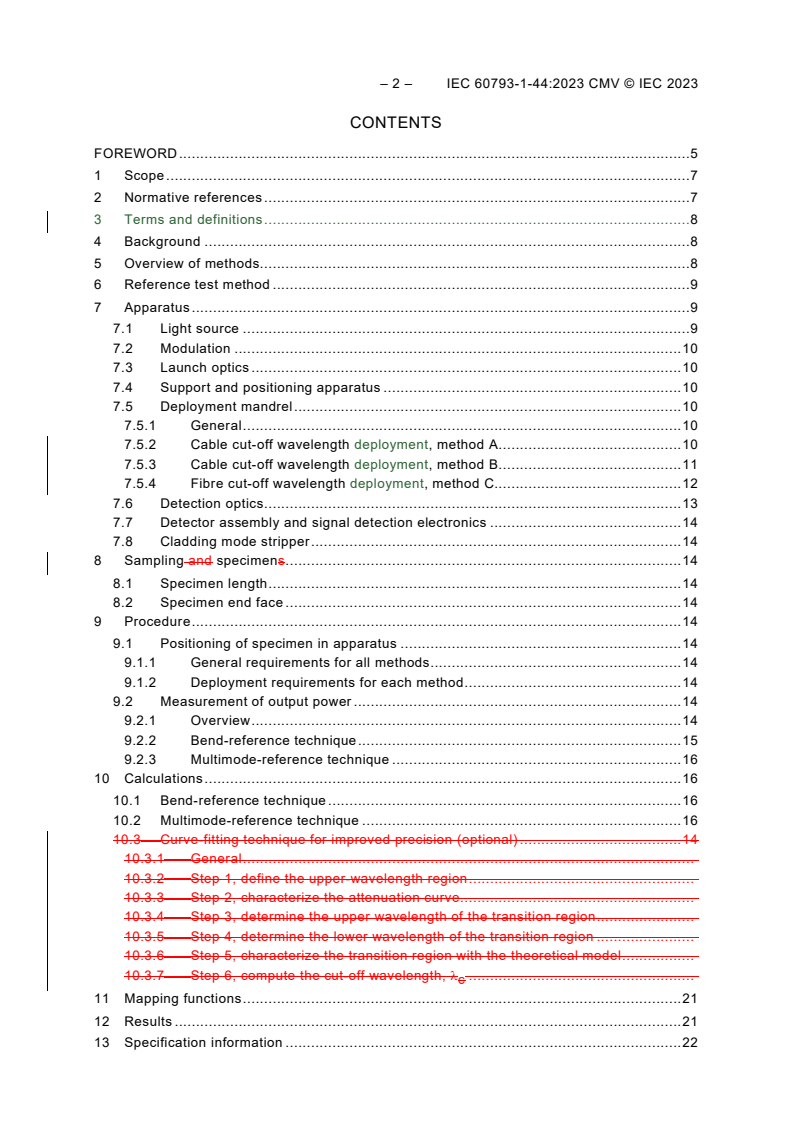
REDLINE IEC 60793-1-44:2023 CMV - Optical fibres - Part 1-44: Measurement methods and test procedures - Cut-off wavelength Released:7/24/2023


IEC 60793-1-44:2023 - Optical fibres - Part 1-44: Measurement methods and test procedures - Cut-off wavelength/24/2023
Overview
IEC 60793-1-44:2023 - "Optical fibres - Part 1-44: Measurement methods and test procedures - Cut-off wavelength" specifies standardized procedures for measuring the cut-off wavelength of single‑mode optical fibres. The standard establishes uniform requirements used for inspection and commercial acceptance of uncabled and cabled telecom fibres across category B and C fibre types. The third edition (2023) is a technical revision of the 2011 edition and adds clarifications (loop diameter deployment), Annex D on cut-off curve artifacts, and more figures to aid interpretation.
Keywords: IEC 60793-1-44:2023, cut-off wavelength, optical fibres, single-mode, measurement methods.
Key topics and technical requirements
- Scope and applicability
- Procedures apply to uncabled and cabled single‑mode telecom fibres for categories B and C.
- Three deployment methods
- Method A - cable cut-off using an uncabled fibre sample, 22 m (λcc).
- Method B - cable cut-off using a cabled fibre sample, 22 m (λcc).
- Method C - fibre cut-off using an uncabled fibre sample, 2 m (λc).
- Reference-scan techniques (required for all methods)
- Bend-reference technique (mode filtering via controlled bends).
- Multimode-reference technique using category A1 (OM1–OM5) multimode fibre.
- Apparatus and measurements
- Requirements and guidance for light sources, modulation, launch optics, detection optics, detectors, cladding‑mode strippers, deployment mandrels and specimen end‑face preparation.
- Detailed procedures for specimen positioning, output power measurement, calculations, mapping functions, and result reporting.
- Analysis and artifacts
- Annex D describes cut‑off curve artifacts and a curve‑fitting technique to filter artifacts and compute the cut‑off wavelength reliably.
- Documentation
- Normative references and cross‑references to the IEC 60793‑1 series (measurement methods and test procedures).
Practical applications and who uses this standard
- Manufacturers of single‑mode optical fibre and cabled products: to verify performance during production and for commercial acceptance testing.
- Qualification and testing laboratories: to perform repeatable, repeatable cut‑off measurements and provide test reports that align with international practice.
- Telecommunications procurement and quality assurance teams: to specify acceptance criteria and interpret supplier test data.
- Research and development groups working on fibre designs requiring validated mode‑field and cut‑off characterization.
Benefits include consistent test methods for vendor comparisons, traceable results for contract compliance, and guidance to mitigate measurement artifacts.
Related standards
- IEC 60793-1-1 (general measurement methods) and other parts of the IEC 60793-1 series for complementary measurement and terminology guidance.
Relations
- Effective Date
- 05-Sep-2023
Buy Documents
IEC 60793-1-44:2023 - Optical fibres - Part 1-44: Measurement methods and test procedures - Cut-off wavelength Released:7/24/2023
REDLINE IEC 60793-1-44:2023 CMV - Optical fibres - Part 1-44: Measurement methods and test procedures - Cut-off wavelength Released:7/24/2023
IEC 60793-1-44:2023 - Optical fibres - Part 1-44: Measurement methods and test procedures - Cut-off wavelength/24/2023
Get Certified
Connect with accredited certification bodies for this standard

ANCE
Mexican certification and testing association.

Intertek Slovenia
Intertek testing, inspection, and certification services in Slovenia.

LNE (Laboratoire National de Métrologie et d'Essais)
French national laboratory for metrology and testing.
Sponsored listings
Frequently Asked Questions
IEC 60793-1-44:2023 is a standard published by the International Electrotechnical Commission (IEC). Its full title is "Optical fibres - Part 1-44: Measurement methods and test procedures - Cut-off wavelength". This standard covers: IEC 60793-1-44:2023 establishes uniform requirements for measuring the cut-off wavelength of single-mode optical fibre, thereby assisting in the inspection of fibres and cables for commercial purposes. This document gives methods for measuring the cut-off wavelength for uncabled or cabled single mode telecom fibre. These procedures apply to all category B and C fibre types. There are three methods of deployment for measuring the cut-off wavelength: - method A: cable cut-off using uncabled fibre 22 m long sample, lcc; - method B: cable cut-off using cabled fibre 22 m long sample, lcc; - method C: fibre cut-off using uncabled fibre 2 m long sample, lc. All methods require a reference measurement. There are two reference-scan techniques, either or both of which can be used with all methods: - bend-reference technique; - multimode-reference technique using category A1(OM1-OM5) multimode fibre. This third edition cancels and replaces the second edition published in 2011. This edition constitutes a technical revision. This edition includes the following significant technical changes with respect to the previous edition: a) used the diameter of the fibre loops to describe deployment; b) added Annex D related to cut-off curve artifacts; c) reorganized information and added more figures to clarify concepts.
IEC 60793-1-44:2023 establishes uniform requirements for measuring the cut-off wavelength of single-mode optical fibre, thereby assisting in the inspection of fibres and cables for commercial purposes. This document gives methods for measuring the cut-off wavelength for uncabled or cabled single mode telecom fibre. These procedures apply to all category B and C fibre types. There are three methods of deployment for measuring the cut-off wavelength: - method A: cable cut-off using uncabled fibre 22 m long sample, lcc; - method B: cable cut-off using cabled fibre 22 m long sample, lcc; - method C: fibre cut-off using uncabled fibre 2 m long sample, lc. All methods require a reference measurement. There are two reference-scan techniques, either or both of which can be used with all methods: - bend-reference technique; - multimode-reference technique using category A1(OM1-OM5) multimode fibre. This third edition cancels and replaces the second edition published in 2011. This edition constitutes a technical revision. This edition includes the following significant technical changes with respect to the previous edition: a) used the diameter of the fibre loops to describe deployment; b) added Annex D related to cut-off curve artifacts; c) reorganized information and added more figures to clarify concepts.
IEC 60793-1-44:2023 is classified under the following ICS (International Classification for Standards) categories: 33.180.10 - Fibres and cables. The ICS classification helps identify the subject area and facilitates finding related standards.
IEC 60793-1-44:2023 has the following relationships with other standards: It is inter standard links to IEC 60793-1-44:2011. Understanding these relationships helps ensure you are using the most current and applicable version of the standard.
IEC 60793-1-44:2023 is available in PDF format for immediate download after purchase. The document can be added to your cart and obtained through the secure checkout process. Digital delivery ensures instant access to the complete standard document.
Standards Content (Sample)
IEC 60793-1-44 ®
Edition 3.0 2023-07
INTERNATIONAL
STANDARD
colour
inside
Optical fibres –
Part 1-44: Measurement methods and test procedures – Cut-off wavelength
All rights reserved. Unless otherwise specified, no part of this publication may be reproduced or utilized in any form
or by any means, electronic or mechanical, including photocopying and microfilm, without permission in writing from
either IEC or IEC's member National Committee in the country of the requester. If you have any questions about IEC
copyright or have an enquiry about obtaining additional rights to this publication, please contact the address below or
your local IEC member National Committee for further information.
IEC Secretariat Tel.: +41 22 919 02 11
3, rue de Varembé info@iec.ch
CH-1211 Geneva 20 www.iec.ch
Switzerland
About the IEC
The International Electrotechnical Commission (IEC) is the leading global organization that prepares and publishes
International Standards for all electrical, electronic and related technologies.
About IEC publications
The technical content of IEC publications is kept under constant review by the IEC. Please make sure that you have the
latest edition, a corrigendum or an amendment might have been published.
IEC publications search - webstore.iec.ch/advsearchform IEC Products & Services Portal - products.iec.ch
The advanced search enables to find IEC publications by a
Discover our powerful search engine and read freely all the
variety of criteria (reference number, text, technical publications previews. With a subscription you will always have
committee, …). It also gives information on projects, replaced access to up to date content tailored to your needs.
and withdrawn publications.
Electropedia - www.electropedia.org
IEC Just Published - webstore.iec.ch/justpublished
The world's leading online dictionary on electrotechnology,
Stay up to date on all new IEC publications. Just Published
containing more than 22 300 terminological entries in English
details all new publications released. Available online and once
and French, with equivalent terms in 19 additional languages.
a month by email.
Also known as the International Electrotechnical Vocabulary
(IEV) online.
IEC Customer Service Centre - webstore.iec.ch/csc
If you wish to give us your feedback on this publication or need
further assistance, please contact the Customer Service
Centre: sales@iec.ch.
IEC 60793-1-44 ®
Edition 3.0 2023-07
INTERNATIONAL
STANDARD
colour
inside
Optical fibres –
Part 1-44: Measurement methods and test procedures – Cut-off wavelength
INTERNATIONAL
ELECTROTECHNICAL
COMMISSION
ICS 33.180.10 ISBN 978-2-8322-7033-2
– 2 – IEC 60793-1-44:2023 © IEC 2023
CONTENTS
FOREWORD . 4
1 Scope . 6
2 Normative references . 6
3 Terms and definitions . 6
4 Background . 7
5 Overview of methods . 7
6 Reference test method . 8
7 Apparatus . 8
7.1 Light source . 8
7.2 Modulation . 8
7.3 Launch optics . 8
7.4 Support and positioning apparatus . 8
7.5 Deployment mandrel . 9
7.5.1 General . 9
7.5.2 Cable cut-off wavelength deployment, method A . 9
7.5.3 Cable cut-off wavelength deployment, method B . 9
7.5.4 Fibre cut-off wavelength deployment, method C. 9
7.6 Detection optics . 10
7.7 Detector assembly and signal detection electronics . 10
7.8 Cladding mode stripper . 10
8 Sampling specimen . 10
8.1 Specimen length . 10
8.2 Specimen end face . 10
9 Procedure . 11
9.1 Positioning of specimen in apparatus . 11
9.1.1 General requirements for all methods . 11
9.1.2 Deployment requirements for each method . 11
9.2 Measurement of output power . 11
9.2.1 Overview . 11
9.2.2 Bend-reference technique . 12
9.2.3 Multimode-reference technique . 12
10 Calculations . 12
10.1 Bend-reference technique . 12
10.2 Multimode-reference technique . 13
11 Mapping functions . 14
12 Results . 14
13 Specification information . 15
Annex A (normative) Requirements specific to method A – Cable cut-off wavelength,
λ
, using uncabled fibre . 16
cc
A.1 Specimen length . 16
A.2 Procedure – Position specimen on deployment mandrel . 16
Annex B (normative) Requirements specific to method B – Cable cut-off wavelength,
λ , using cabled fibre . 17
cc
B.1 Specimen length . 17
B.2 Procedure – Position specimen on deployment mandrel . 17
Annex C (normative) Requirements specific to method C – Fibre cut-off wavelength,λ . 18
c
C.1 Specimen length . 18
C.2 Procedure – Position specimen on deployment mandrel . 18
Annex D (informative) Cut-off curve artifacts . 20
D.1 Description of curve artifacts . 20
D.2 Curve-fitting technique for artifact filtering . 20
D.2.1 Overview . 20
D.2.2 General . 21
D.2.3 Step 1: define the upper wavelength region . 22
D.2.4 Step 2: characterize the spectral transmittance . 22
D.2.5 Step 3: calculate the deviation of the spectral transmittance from the
linear fit . 22
D.2.6 Step 4: determine the end wavelength of the transition region . 23
D.2.7 Step 5: determine the start wavelength of the transition region . 23
D.2.8 Step 6: characterize the transition region with the theoretical model . 23
D.2.9 Step 7: compute the cut-off wavelength, λ . 24
c
D.3 Fibre deployment method for artifact attenuation . 25
Bibliography . 27
Figure 1 – Cut-off measurement system block diagram . 7
Figure 2 – Deployment configuration for cable cut-off wavelength λ , method A . 9
cc
Figure 3 – Deployment configuration for cable cut-off wavelength λ , method B . 9
cc
Figure 4 – Standard deployment for fibre cut-off wavelength measurement . 10
Figure 5 – Cut-off wavelength using the bend-reference technique . 11
Figure 6 – Cut-off wavelength using the multimode-reference technique . 12
Figure 7 – Cable cut-off vs fibre cut-off for a specific fibre (multimode reference) . 14
Figure A.1 – Alternative cable cut-off deployment . 16
Figure C.1 – Alternative fibre cut-off deployment – Sliding semi-circle . 18
Figure C.2 – Alternative fibre cut-off deployment – Multi-bend . 19
Figure C.3 – Alternative fibre cut-off deployment – Large curve . 19
Figure D.1 – Cut-off curve with linear fit error (multimode reference) . 20
Figure D.2 – Fibre cut-off curve fitting technique (multimode reference) . 21
Figure D.3 – Curve fitting regions . 21
Figure D.4 – Fibre cut-off curve with artifacts (multimode reference) . 25
Figure D.5 – Fibre cut-off curve with artifacts (bend reference) . 25
Figure D.6 – Fibre deployment with large diameter bends for mode filtering . 26
Figure D.7 – Fibre cut-off curve with mode attenuation (multimode reference) . 26
– 4 – IEC 60793-1-44:2023 © IEC 2023
INTERNATIONAL ELECTROTECHNICAL COMMISSION
____________
OPTICAL FIBRES –
Part 1-44: Measurement methods and test procedures –
Cut-off wavelength
FOREWORD
1) The International Electrotechnical Commission (IEC) is a worldwide organization for standardization comprising
all national electrotechnical committees (IEC National Committees). The object of IEC is to promote international
co-operation on all questions concerning standardization in the electrical and electronic fields. To this end and
in addition to other activities, IEC publishes International Standards, Technical Specifications, Technical Reports,
Publicly Available Specifications (PAS) and Guides (hereafter referred to as "IEC Publication(s)"). Their
preparation is entrusted to technical committees; any IEC National Committee interested in the subject dealt with
may participate in this preparatory work. International, governmental and non-governmental organizations liaising
with the IEC also participate in this preparation. IEC collaborates closely with the International Organization for
Standardization (ISO) in accordance with conditions determined by agreement between the two organizations.
2) The formal decisions or agreements of IEC on technical matters express, as nearly as possible, an international
consensus of opinion on the relevant subjects since each technical committee has representation from all
interested IEC National Committees.
3) IEC Publications have the form of recommendations for international use and are accepted by IEC National
Committees in that sense. While all reasonable efforts are made to ensure that the technical content of IEC
Publications is accurate, IEC cannot be held responsible for the way in which they are used or for any
misinterpretation by any end user.
4) In order to promote international uniformity, IEC National Committees undertake to apply IEC Publications
transparently to the maximum extent possible in their national and regional publications. Any divergence between
any IEC Publication and the corresponding national or regional publication shall be clearly indicated in the latter.
5) IEC itself does not provide any attestation of conformity. Independent certification bodies provide conformity
assessment services and, in some areas, access to IEC marks of conformity. IEC is not responsible for any
services carried out by independent certification bodies.
6) All users should ensure that they have the latest edition of this publication.
7) No liability shall attach to IEC or its directors, employees, servants or agents including individual experts and
members of its technical committees and IEC National Committees for any personal injury, property damage or
other damage of any nature whatsoever, whether direct or indirect, or for costs (including legal fees) and
expenses arising out of the publication, use of, or reliance upon, this IEC Publication or any other IEC
Publications.
8) Attention is drawn to the Normative references cited in this publication. Use of the referenced publications is
indispensable for the correct application of this publication.
9) Attention is drawn to the possibility that some of the elements of this IEC Publication may be the subject of patent
rights. IEC shall not be held responsible for identifying any or all such patent rights.
IEC 60793-1-44 has been prepared by subcommittee 86A: Fibres and cables, of IEC technical
committee 86: Fibre optics. It is an International Standard.
This third edition cancels and replaces the second edition published in 2011. This edition
constitutes a technical revision.
This edition includes the following significant technical changes with respect to the previous
edition:
a) used the diameter of the fibre loops to describe deployment;
b) added Annex D related to cut-off curve artifacts;
c) reorganized information and added more figures to clarify concepts.
The text of this International Standard is based on the following documents:
Draft Report on voting
86A/2314/FDIS 86A/2327/RVD
Full information on the voting for its approval can be found in the report on voting indicated in
the above table.
The language used for the development of this International Standard is English.
This document was drafted in accordance with ISO/IEC Directives, Part 2, and developed in
accordance with ISO/IEC Directives, Part 1 and ISO/IEC Directives, IEC Supplement, available
at www.iec.ch/members_experts/refdocs. The main document types developed by IEC are
described in greater detail at www.iec.ch/publications.
This document is to be read in conjunction with IEC 60793-1-1.
A list of all parts of the IEC 60793-1 series, published under the general title Optical fibres –
Measurement methods and test procedures, can be found on the IEC website.
The committee has decided that the contents of this document will remain unchanged until the
stability date indicated on the IEC website under webstore.iec.ch in the data related to the
specific document. At this date, the document will be
• reconfirmed,
• withdrawn,
• replaced by a revised edition, or
• amended.
IMPORTANT – The "colour inside" logo on the cover page of this document indicates that it
contains colours which are considered to be useful for the correct understanding of its
contents. Users should therefore print this document using a colour printer.
– 6 – IEC 60793-1-44:2023 © IEC 2023
OPTICAL FIBRES –
Part 1-44: Measurement methods and test procedures –
Cut-off wavelength
1 Scope
This part of IEC 60793 establishes uniform requirements for measuring the cut-off wavelength
of single-mode optical fibre, thereby assisting in the inspection of fibres and cables for
commercial purposes.
This document gives methods for measuring the cut-off wavelength for uncabled or cabled
single mode telecom fibre. These procedures apply to all category B and C fibre types.
There are three methods of deployment for measuring the cut-off wavelength:
• method A: cable cut-off using uncabled fibre 22 m long sample, λ ;
cc
• method B: cable cut-off using cabled fibre 22 m long sample, λ ;
cc
• method C: fibre cut-off using uncabled fibre 2 m long sample, λ .
c
All methods require a reference measurement. There are two reference-scan techniques, either
or both of which can be used with all methods:
• bend-reference technique;
• multimode-reference technique using category A1(OM1-OM5) multimode fibre.
2 Normative references
The following documents are referred to in the text in such a way that some or all of their content
constitutes requirements of this document. For dated references, only the edition cited applies.
For undated references, the latest edition of the referenced document (including any
amendments) applies.
IEC 60793-1-1, Optical fibres – Part 1-1: Measurement methods and test procedures – General
and guidance
3 Terms and definitions
No terms and definitions are listed in this document.
ISO and IEC maintain terminology databases for use in standardization at the following
addresses:
• IEC Electropedia: available at https://www.electropedia.org/
• ISO Online browsing platform: available at https://www.iso.org/obp
4 Background
Theoretical cut-off wavelength is the shortest wavelength at which only the fundamental mode
can propagate in a single-mode fibre, as computed from the refractive index profile of the fibre.
In optical fibres, the change from multimode to single mode behaviour does not occur at an
isolated wavelength, but rather smoothly over a range of wavelengths. For purposes of
determining fibre performance in a telecommunications network, theoretical cut-off wavelength
is less useful than the lower value actually measured when the fibre is deployed.
Measured cut-off wavelength is defined as the wavelength greater than which the ratio between
the total power, including launched higher-order modes, and the fundamental mode power has
decreased to less than 0,1 dB. According to this definition, the second-order (LP ) mode
undergoes 19,3 dB more attenuation than the fundamental (LP ) mode at the cut-off
wavelength.
Because measured cut-off wavelength depends on the length and bends of the fibre, the
resulting value of cut-off wavelength depends on whether the measured fibre is configured in a
deployed, cabled condition or if it is short and uncabled. Consequently, there are two overall
types of cut-off wavelength:
• cable cut-off wavelength (λ ) measured in an uncabled fibre deployment condition
cc
(method A), or in a cabled condition (method B);
• fibre cut-off wavelength (λ ) measured on a short length of uncabled, primary-coated fibre
c
(method C).
Cable cut-off wavelength is the preferred attribute to be specified and measured.
5 Overview of methods
All of the methods shall use the transmitted-power technique. A general system block diagram
is depicted in Figure 1. A fibre specimen is scanned by a wavelength spectrum. The output
optical power is measured and stored. This stored data is then analysed against a reference
power spectrum. The reference scan normalizes any wavelength-dependent fluctuations in the
measurement equipment that is not associated with the loss of the LP mode. The resulting
attenuation will thus properly characterize the cut-off wavelength.
Figure 1 – Cut-off measurement system block diagram
The reference scan uses one of the following two techniques:
• bend reference where a small diameter bend is added to the fibre specimen;
• multimode reference where the optical power through an A1(OM1-OM5) fibre is measured.
– 8 – IEC 60793-1-44:2023 © IEC 2023
Either reference technique can determine the cut-off wavelength of a fibre specimen in a cabled
or uncabled condition.
The fibre cut-off wavelength,λ , measured under the standard length and bend conditions
c
described in this document, will generally exhibit a value larger than the cable cut-off
wavelength, λ . For normal installed cable spans, it is common for the measured λ value to
cc c
exceed the long fibre’s transmission wavelength.
Cable cut-off wavelength is more useful in describing an installed network system performance
and capability, while fibre cut-off would apply to short cables or pigtails. The two cut-off
wavelengths can be mapped to each other for a specific fibre type and cut-off measurement
method. The customer and the supplier shall agree to the confidence level of each mapping
function established (see Clause 11 for details).
6 Reference test method
Method A, cable cut-off wavelength using uncabled fibre, is the reference test method (RTM).
This method shall be used to settle any disputes.
7 Apparatus
7.1 Light source
Provide a filtered white light source, with line width not greater than 10 nm, stable in position
and intensity. The light source should be capable of operating over the wavelength range
1 000 nm to 1 600 nm for most category B fibres. An operating range of 800 nm to 1 700 nm
may be necessary for some B-655 fibres, B-656 fibres or category C fibres. A scanning
monochromator with a halogen bulb is one example of this kind of source.
7.2 Modulation
Modulate the light source to prevent ambient light affecting the results, and to aid signal
recovery. A mechanical chopper with a reference output is a suitable arrangement.
7.3 Launch optics
Provide launch optics, such as a lens system or a multimode fibre, to overfill the test fibre over
the full range of measurement wavelengths. This launch is relatively insensitive to the input end
face position of the single-mode fibre and is able to excite the fundamental and any higher-order
modes in the specimen. If using a butt splice, provide means of avoiding interference effects.
When using a multimode fibre, overfilling the reference fibre can produce an undesired ripple
effect in the power-transmission spectrum. Restrict the launch sufficiently to eliminate the ripple
effect. One example of restricted launch is in method A, attenuation by cut-back, of
IEC 60793-1-40. Another example of restricted launch is a mandrel-wrap mode filter with
sufficient (approximately 4 dB) insertion loss.
7.4 Support and positioning apparatus
Provide a means to stably support the input and output ends of the specimen for the duration
of the test; vacuum chucks, magnetic chucks, or connectors may be used for this purpose.
Support the fibre ends such that they can be repeatedly positioned in the launch and detection
λ in method B, provide a means to suitably support the cable ends.
optics. When measuring
cc
The mechanism used to hold the fibre ends allows for fibre positioning with respect to the launch
and detection optics. Holding and moving of the fibre should not cause micro-bends that affect
the measurement accuracy.
7.5 Deployment mandrel
7.5.1 Gene
...
IEC 60793-1-44 ®
Edition 3.0 2023-07
COMMENTED VERSION
INTERNATIONAL
STANDARD
colour
inside
Optical fibres –
Part 1-44: Measurement methods and test procedures – Cut-off wavelength
All rights reserved. Unless otherwise specified, no part of this publication may be reproduced or utilized in any form
or by any means, electronic or mechanical, including photocopying and microfilm, without permission in writing from
either IEC or IEC's member National Committee in the country of the requester. If you have any questions about IEC
copyright or have an enquiry about obtaining additional rights to this publication, please contact the address below or
your local IEC member National Committee for further information.
IEC Secretariat Tel.: +41 22 919 02 11
3, rue de Varembé info@iec.ch
CH-1211 Geneva 20 www.iec.ch
Switzerland
About the IEC
The International Electrotechnical Commission (IEC) is the leading global organization that prepares and publishes
International Standards for all electrical, electronic and related technologies.
About IEC publications
The technical content of IEC publications is kept under constant review by the IEC. Please make sure that you have the
latest edition, a corrigendum or an amendment might have been published.
IEC publications search - webstore.iec.ch/advsearchform IEC Products & Services Portal - products.iec.ch
The advanced search enables to find IEC publications by a
Discover our powerful search engine and read freely all the
variety of criteria (reference number, text, technical publications previews. With a subscription you will always have
committee, …). It also gives information on projects, replaced access to up to date content tailored to your needs.
and withdrawn publications.
Electropedia - www.electropedia.org
IEC Just Published - webstore.iec.ch/justpublished
The world's leading online dictionary on electrotechnology,
Stay up to date on all new IEC publications. Just Published
containing more than 22 300 terminological entries in English
details all new publications released. Available online and once
and French, with equivalent terms in 19 additional languages.
a month by email.
Also known as the International Electrotechnical Vocabulary
(IEV) online.
IEC Customer Service Centre - webstore.iec.ch/csc
If you wish to give us your feedback on this publication or need
further assistance, please contact the Customer Service
Centre: sales@iec.ch.
IEC 60793-1-44 ®
Edition 3.0 2023-07
COMMENTED VERSION
INTERNATIONAL
STANDARD
colour
inside
Optical fibres –
Part 1-44: Measurement methods and test procedures – Cut-off wavelength
INTERNATIONAL
ELECTROTECHNICAL
COMMISSION
ICS 33.180.10 ISBN 978-2-8322-7323-4
– 2 – IEC 60793-1-44:2023 CMV © IEC 2023
CONTENTS
FOREWORD .5
1 Scope .7
2 Normative references .7
3 Terms and definitions .8
4 Background .8
5 Overview of methods .8
6 Reference test method .9
7 Apparatus .9
7.1 Light source .9
7.2 Modulation . 10
7.3 Launch optics . 10
7.4 Support and positioning apparatus . 10
7.5 Deployment mandrel . 10
7.5.1 General . 10
7.5.2 Cable cut-off wavelength deployment, method A . 10
7.5.3 Cable cut-off wavelength deployment, method B . 11
7.5.4 Fibre cut-off wavelength deployment, method C. 12
7.6 Detection optics . 13
7.7 Detector assembly and signal detection electronics . 14
7.8 Cladding mode stripper . 14
8 Sampling and specimens . 14
8.1 Specimen length . 14
8.2 Specimen end face . 14
9 Procedure . 14
9.1 Positioning of specimen in apparatus . 14
9.1.1 General requirements for all methods . 14
9.1.2 Deployment requirements for each method . 14
9.2 Measurement of output power . 14
9.2.1 Overview . 14
9.2.2 Bend-reference technique . 15
9.2.3 Multimode-reference technique . 16
10 Calculations . 16
10.1 Bend-reference technique . 16
10.2 Multimode-reference technique . 16
10.3 Curve-fitting technique for improved precision (optional) . 14
10.3.1 General .
10.3.2 Step 1, define the upper-wavelength region .
10.3.3 Step 2, characterize the attenuation curve .
10.3.4 Step 3, determine the upper wavelength of the transition region .
10.3.5 Step 4, determine the lower wavelength of the transition region .
10.3.6 Step 5, characterize the transition region with the theoretical model .
10.3.7 Step 6, compute the cut-off wavelength, λ .
c
11 Mapping functions . 21
12 Results . 21
13 Specification information . 22
Annex A (normative) Requirements specific to method A – Cable cut-off wavelength,
λ , using uncabled fibre . 23
cc
A.1 Specimen length . 23
A.2 Procedure – Position specimen on deployment mandrel . 23
Annex B (normative) Requirements specific to method B – Cable cut-off wavelength,
λ , using cabled fibre . 24
cc
B.1 Specimen length . 24
B.2 Procedure – Position specimen on deployment mandrel . 24
Annex C (normative) Requirements specific to method C – Fibre cut-off wavelength,
λ . 25
c
C.1 Specimen length . 25
C.2 Procedure – Position specimen on deployment mandrel . 25
Annex D (informative) Cut-off curve artifacts . 27
D.1 Description of curve artifacts . 27
D.2 Curve-fitting technique for artifact filtering . 27
D.2.1 Overview . 27
D.2.2 General . 28
D.2.3 Step 1: define the upper wavelength region . 29
D.2.4 Step 2: characterize the spectral transmittance . 29
D.2.5 Step 3: calculate the deviation of the spectral transmittance from the
linear fit . 29
D.2.6 Step 4: determine the end wavelength of the transition region . 30
D.2.7 Step 5: determine the start wavelength of the transition region . 30
D.2.8 Step 6: characterize the transition region with the theoretical model . 30
D.2.9 Step 7: compute the cut-off wavelength, λ . 31
c
D.3 Fibre deployment method for artifact attenuation . 32
Bibliography . 34
List of comments . 35
Figure 1 – Cut-off measurement system block diagram .9
Figure 2 – Deployment configuration for cable cut-off wavelength λ , method A . 11
cc
Figure 3 – Deployment configuration for cable cut-off wavelength λ , method B . 12
cc
Figure 3 – Default configuration to measure λ
c.
Figure 4 – Deployment configurations for fibre cut-off measurement .
Figure 4 – Standard deployment for fibre cut-off wavelength measurement . 13
Figure 5 – Cut-off wavelength using the bend-reference technique . 15
Figure 6 – Cut-off wavelength using the multimode-reference technique . 15
Figure 7 – Cable cut-off vs fibre cut-off for a specific fibre (multimode reference) . 21
Figure A.1 – Alternative cable cut-off deployment . 23
Figure C.1 – Alternative fibre cut-off deployment – Sliding semi-circle. 25
Figure C.2 – Alternative fibre cut-off deployment – Multi-bend . 26
Figure C.3 – Alternative fibre cut-off deployment – Large curve . 26
Figure D.1 – Cut-off curve with linear fit error (multimode reference) . 27
Figure D.2 – Fibre cut-off curve fitting technique (multimode reference) . 28
Figure D.3 – Curve fitting regions . 28
– 4 – IEC 60793-1-44:2023 CMV © IEC 2023
Figure D.4 – Fibre cut-off curve with artifacts (multimode reference) . 32
Figure D.5 – Fibre cut-off curve with artifacts (bend reference) . 32
Figure D.6 – Fibre deployment with large diameter bends for mode filtering . 33
Figure D.7 – Fibre cut-off curve with mode attenuation (multimode reference) . 33
INTERNATIONAL ELECTROTECHNICAL COMMISSION
____________
OPTICAL FIBRES –
Part 1-44: Measurement methods and test procedures –
Cut-off wavelength
FOREWORD
1) The International Electrotechnical Commission (IEC) is a worldwide organization for standardization comprising
all national electrotechnical committees (IEC National Committees). The object of IEC is to promote international
co-operation on all questions concerning standardization in the electrical and electronic fields. To this end and
in addition to other activities, IEC publishes International Standards, Technical Specifications, Technical Reports,
Publicly Available Specifications (PAS) and Guides (hereafter referred to as "IEC Publication(s)"). Their
preparation is entrusted to technical committees; any IEC National Committee interested in the subject dealt with
may participate in this preparatory work. International, governmental and non-governmental organizations liaising
with the IEC also participate in this preparation. IEC collaborates closely with the International Organization for
Standardization (ISO) in accordance with conditions determined by agreement between the two organizations.
2) The formal decisions or agreements of IEC on technical matters express, as nearly as possible, an international
consensus of opinion on the relevant subjects since each technical committee has representation from all
interested IEC National Committees.
3) IEC Publications have the form of recommendations for international use and are accepted by IEC National
Committees in that sense. While all reasonable efforts are made to ensure that the technical content of IEC
Publications is accurate, IEC cannot be held responsible for the way in which they are used or for any
misinterpretation by any end user.
4) In order to promote international uniformity, IEC National Committees undertake to apply IEC Publications
transparently to the maximum extent possible in their national and regional publications. Any divergence between
any IEC Publication and the corresponding national or regional publication shall be clearly indicated in the latter.
5) IEC itself does not provide any attestation of conformity. Independent certification bodies provide conformity
assessment services and, in some areas, access to IEC marks of conformity. IEC is not responsible for any
services carried out by independent certification bodies.
6) All users should ensure that they have the latest edition of this publication.
7) No liability shall attach to IEC or its directors, employees, servants or agents including individual experts and
members of its technical committees and IEC National Committees for any personal injury, property damage or
other damage of any nature whatsoever, whether direct or indirect, or for costs (including legal fees) and
expenses arising out of the publication, use of, or reliance upon, this IEC Publication or any other IEC
Publications.
8) Attention is drawn to the Normative references cited in this publication. Use of the referenced publications is
indispensable for the correct application of this publication.
9) Attention is drawn to the possibility that some of the elements of this IEC Publication may be the subject of patent
rights. IEC shall not be held responsible for identifying any or all such patent rights.
This commented version (CMV) of the official standard IEC 60793-1-44:2023 edition 3.0
allows the user to identify the changes made to the previous IEC 60793-1-44:2011
edition 2.0. Furthermore, comments from IEC SC 86A experts are provided to explain the
reasons of the most relevant changes, or to clarify any part of the content.
A vertical bar appears in the margin wherever a change has been made. Additions are in
green text, deletions are in strikethrough red text. Experts' comments are identified by a
blue-background number. Mouse over a number to display a pop-up note with the
comment.
This publication contains the CMV and the official standard. The full list of comments is
available at the end of the CMV.
– 6 – IEC 60793-1-44:2023 CMV © IEC 2023
IEC 60793-1-44 has been prepared by subcommittee 86A: Fibres and cables, of IEC technical
committee 86: Fibre optics. It is an International Standard.
This third edition cancels and replaces the second edition published in 2011. This edition
constitutes a technical revision.
This edition includes the following significant technical changes with respect to the previous
edition:
a) used the diameter of the fibre loops to describe deployment;
b) added Annex D related to cut-off curve artifacts;
c) reorganized information and added more figures to clarify concepts.
The text of this International Standard is based on the following documents:
Draft Report on voting
86A/2314/FDIS 86A/2327/RVD
Full information on the voting for its approval can be found in the report on voting indicated in
the above table.
The language used for the development of this International Standard is English.
This document was drafted in accordance with ISO/IEC Directives, Part 2, and developed in
accordance with ISO/IEC Directives, Part 1 and ISO/IEC Directives, IEC Supplement, available
at www.iec.ch/members_experts/refdocs. The main document types developed by IEC are
described in greater detail at www.iec.ch/publications.
This document is to be read in conjunction with IEC 60793-1-1.
A list of all parts of the IEC 60793-1 series, published under the general title Optical fibres –
Measurement methods and test procedures, can be found on the IEC website.
The committee has decided that the contents of this document will remain unchanged until the
stability date indicated on the IEC website under webstore.iec.ch in the data related to the
specific document. At this date, the document will be
• reconfirmed,
• withdrawn,
• replaced by a revised edition, or
• amended.
IMPORTANT – The "colour inside" logo on the cover page of this document indicates that it
contains colours which are considered to be useful for the correct understanding of its
contents. Users should therefore print this document using a colour printer.
OPTICAL FIBRES –
Part 1-44: Measurement methods and test procedures –
Cut-off wavelength
1 Scope
This part of IEC 60793 establishes uniform requirements for measuring the cut-off wavelength
of single-mode optical fibre, thereby assisting in the inspection of fibres and cables for
commercial purposes.
This document gives methods for measuring the cut-off wavelength of fibre and cable for
uncabled or cabled single mode telecom fibre. These procedures apply to all category B and C
fibre types.
There are two methods for measuring cable cut-off wavelength, λ :
cc
• Method A: using uncabled fibre;
• Method B: using cabled fibre.
There is only one method (Method C) for measuring fibre cut-off wavelength, λ .
c
The test method in this standard describes procedures for determining the cut-off wavelength
of a sample fibre in either an uncabled condition (λ ) or in a cable (λ ). Three default
c cc
configurations are given here: any different configuration will be given in a detail specification.
These procedures apply to all category B and C fibre types (see Normative references).
There are three methods of deployment for measuring the cut-off wavelength:
• method A: cable cut-off using uncabled fibre 22 m long sample, λ ;
cc
• method B: cable cut-off using cabled fibre 22 m long sample, λ ;
cc
• method C: fibre cut-off using uncabled fibre 2 m long sample, λ .
c
All methods require a reference measurement. There are two reference-scan techniques, either
or both of which may can be used with all methods:
• bend-reference technique;
• multimode-reference technique using category A1(OM1-OM5) multimode fibre.
2 Normative references
The following documents are referred to in the text in such a way that some or all of their content
constitutes requirements of this document. For dated references, only the edition cited applies.
For undated references, the latest edition of the referenced document (including any
amendments) applies.
IEC 60793-1-1, Optical fibres – Part 1-1: Measurement methods and test procedures – General
and guidance
IEC 60793-1-40, Optical fibres – Part 1-40: Measurement methods and test procedures –
Attenuation
– 8 – IEC 60793-1-44:2023 CMV © IEC 2023
3 Terms and definitions
No terms and definitions are listed in this document.
ISO and IEC maintain terminology databases for use in standardization at the following
addresses:
• IEC Electropedia: available at https://www.electropedia.org/
• ISO Online browsing platform: available at https://www.iso.org/obp
4 Background
Theoretical cut-off wavelength is the shortest wavelength at which only the fundamental mode
can propagate in a single-mode fibre, as computed from the refractive index profile of the fibre.
In optical fibres, the change from multimode to single mode behaviour does not occur at an
isolated wavelength, but rather smoothly over a range of wavelengths. For purposes of
determining fibre performance in a telecommunications network, theoretical cut-off wavelength
is less useful than the lower value actually measured when the fibre is deployed.
Measured cut-off wavelength is defined as the wavelength greater than which the ratio between
the total power, including launched higher-order modes, and the fundamental mode power has
decreased to less than 0,1 dB. According to this definition, the second-order (LP ) mode
undergoes 19,3 dB more attenuation than the fundamental (LP ) mode at the cut-off
wavelength. 1
Because measured cut-off wavelength depends on the length and bends of the fibre, the
resulting value of cut-off wavelength depends on whether the measured fibre is configured in a
deployed, cabled condition or if it is short and uncabled. Consequently, there are two overall
types of cut-off wavelength:
• cable cut-off wavelength (λ ) measured in an uncabled fibre deployment condition
cc
(method A), or in a cabled condition (method B);
• fibre cut-off wavelength (λ ) measured on a short length of uncabled, primary-coated fibre
c
(method C).
Cable cut-off wavelength is the preferred attribute to be specified and measured.
5 Overview of methods
All of the methods shall use the transmitted-power technique, which measures the variation
with wavelength of the transmitted power of a fibre under test compared to a reference
transmitted-power wavelength scan. The reference scan normalizes wavelength-dependent
fluctuations in the measurement equipment so that the attenuation of the LP mode in the
specimen can be properly characterized and the cut-off wavelength precisely determined.
All of the methods shall use the transmitted-power technique. A general system block diagram
is depicted in Figure 1. A fibre specimen is scanned by a wavelength spectrum. The output
optical power is measured and stored. This stored data is then analysed against a reference
power spectrum. The reference scan normalizes any wavelength-dependent fluctuations in the
measurement equipment that is not associated with the loss of the LP mode. The resulting
attenuation will thus properly characterize the cut-off wavelength.
Figure 1 – Cut-off measurement system block diagram 2
The reference scan uses one of the following two techniques:
• the specimen with an additional, smaller-radius fibre bend;
• a (separate) category A1 multimode fibre.
• bend reference where a small diameter bend is added to the fibre specimen;
• multimode reference where the optical power through an A1(OM1-OM5) fibre is measured.
This procedure Either reference technique can determine the cut-off wavelength of a fibre
specimen in either a cabled or uncabled condition. Each method has its own default
configurations; the detail specification will give any different configuration required.
The fibre cut-off wavelength,λ , measured under the standard length and bend conditions
c
described in this document, will generally exhibit a value larger than the cable cut-off
wavelength, λ . For normal installed cable spans, it is common for the measured λ value to
cc c
exceed the system long fibre’s transmission wavelength. Thus Cable cut-off wavelength is the
more useful description of system performance and capability.
For short cables, e.g. a pigtail with a length shorter (and possibly a bending radius larger) than
described in this method, the cable may introduce modal noise near the cut-off wavelength
when lossy splices are present (>0,5 dB).
Cable cut-off wavelength is more useful in describing an installed network system performance
and capability, while fibre cut-off would apply to short cables or pigtails. The two cut-off
wavelengths can be mapped to each other for a specific fibre type and cut-off measurement
method. The customer and the supplier shall agree to the confidence level of each mapping
function established (see Clause 11 for details).
6 Reference test method
Method A, cable cut-off wavelength using uncabled fibre, is the reference test method (RTM).
This method shall be used to settle any disputes.
The apparatus for each method is described in Clause 7.
7 Apparatus
7.1 Light source
Provide a filtered white light source, with line width not greater than 10 nm, stable in position
and intensity. The light source should be capable of operating over the wavelength range
1 000 nm to 1 600 nm for most category B fibres. An operating range of 800 nm to 1 700 nm
– 10 – IEC 60793-1-44:2023 CMV © IEC 2023
may be necessary for some B4 B-655 fibres, B5 B-656 fibres or some category C fibres. A
scanning monochromator with a halogen bulb is one example of this kind of source.
7.2 Modulation
Modulate the light source to prevent ambient light affecting the results, and to aid signal
recovery. A mechanical chopper with a reference output is a suitable arrangement.
7.3 Launch optics
Provide launch optics, such as a lens system or a multimode fibre, to overfill the test fibre over
the full range of measurement wavelengths. This launch is relatively insensitive to the input end
face position of the single-mode fibre and is sufficient able to excite the fundamental and any
higher-order modes in the specimen. If using a butt splice, provide means of avoiding
interference effects.
When using a multimode fibre, overfilling the reference fibre can produce an undesired ripple
effect in the power-transmission spectrum. Restrict the launch sufficiently to eliminate the ripple
effect. One example of restricted launch is in method A, attenuation by cut-back, of
IEC 60793-1-40. Another example of restricted launch is a mandrel-wrap mode filter with
sufficient (approximately 4 dB) insertion loss.
7.4 Support and positioning apparatus
Provide a means to stably support the input and output ends of the specimen for the duration
of the test; vacuum chucks, magnetic chucks, or connectors may be used for this purpose.
Support the fibre ends such that they can be repeatedly positioned in the launch and detection
optics. When measuring λ in method B, provide a means to suitably support the cable ends.
cc
The mechanism used to hold the fibre ends allows for fibre positioning with respect to the launch
and detection optics. Holding and moving of the fibre should not cause micro-bends that affect
the measurement accuracy. 3
7.5 Deployment mandrel
7.5.1 General
Use a means to stably support the input and output ends of the specimen for the duration of the
measurement. Support the fibre ends so that they can be repeatedly and stably positioned with
respect to the launch and detection optics without introducing microbends into the specimen.
The fibre specimen’s two ends, input and output, are mechanically held in place during the
measurement. The deployment and length of the specimen, together with the support
apparatus, are key elements of the measurement method, and they distinguish the types of
cut-off wavelength.
Additional, alternative deployments may be used if the results obtained have been
demonstrated to be empirically equivalent to the results obtained using the standard
deployment, to within 10 nm, or they are greater than those achieved with the standard
configurations.
7.5.2 Cable cut-off wavelength deployment, method A
Provide a means to make an 80 mm diameter loop at each end of the specimen and a loop of
diameter ≥ 280 mm in the central portion. See Figure 2.
NOTE Two loops at one end can be substituted for one loop at each end.
∅ ≥ 280 mm
∅ = 80 mm ∅ = 80 mm
22 m of fibre
IEC 701/11
Dimensions in millimetres
Figure 2 – Deployment configuration for cable cut-off wavelength λ , method A
cc
7.5.3 Cable cut-off wavelength deployment, method B
Provide a means to make an 80 mm diameter loop at each end of the specimen. See Figure 3.
The cabled fibre between the two 80 mm loops has a bending diameter greater than 280 mm.
NOTE Two loops at one end can be substituted for one loop at each end.
∅ = 80 mm ∅ = 80 mm
1 m 20 m 1 m
IEC 702/11
– 12 – IEC 60793-1-44:2023 CMV © IEC 2023
Dimensions in millimetres
Figure 3 – Deployment configuration for cable cut-off wavelength λ , method B
cc
7.5.4 Fibre cut-off wavelength deployment, method C 4
Provide a circular mandrel as the initial fibre cut-off wavelength deployment. (See Figure 4a).
A split, semicircular mandrel with a radius of 140 mm that is capable of sliding, hence able to
take up slack fibre, is an alternative deployment . (See Figures 3 and 4b).
NOTE The introduction of a minimum bend of the cable sufficient to permit connection of the two ends of the whole
specimen to the measurement setup is allowed.
Launch Receive
r
rr
Lower semicircular mandrel able
to slide to take up slack fibre
IEC 703/11
Figure 3 – Default configuration to measure λ
c
L
r
IEC 704/11
Key
r = 140 mm
L = 2 m (entire fibre length)
Figure 4a) – Initial deployment configuration for fibre cut-off wavelength measurement – circular mandrel
L L
r r r
r r
IEC 705/11
Key
r = 140 mm
L = 2 m (entire fibre length)
Figure 4b) – Alternative deployment configuration for fibre cut-off wavelength measurement – split mandrel
Figure 4 – Deployment configurations for fibre cut-off measurement
Provide means to route a fibre specimen through one complete circular loop having a diameter
equal to 280 mm, see Figure 4.
Dimensions in millimetres
Figure 4 – Standard deployment for fibre cut-off wavelength measurement
7.6 Detection optics
Couple all power emitted from the specimen onto the active region of the detector. As examples,
an optical lens system, a butt splice with a multimode fibre pigtailed to a detector, or direct
coupling may be used.
– 14 – IEC 60793-1-44:2023 CMV © IEC 2023
7.7 Detector assembly and signal detection electronics
Use a detector that is sensitive to the output radiation over the range of wavelengths to be
measured and that is linear over the range of intensities encountered. A typical system might
include a germanium or InGaAs photodiode, operating in the photo-voltaic mode, and a
current-sensitive preamplifier, with synchronous detection by a lock-in amplifier. Generally, a
computer is required to analyse the data.
7.8 Cladding mode stripper
Provide a means to remove cladding-mode power from the specimen. Under some
circumstances, the fibre coating will perform this function; otherwise, provide methods or
devices that extract cladding-mode power at the input and output ends of the specimen.
8 Sampling and specimens
8.1 Specimen length
Choose the specimen length according to which parameter is being measured and, if the
parameter is cable cut-off wavelength, the method to be used. See the appropriate annex:
Annex A or Annex B for the cable cut-off wavelength measurement or Annex C for fibre cut-off
wavelength.
8.2 Specimen end face
Prepare a flat end face, orthogonal to the fibre axis, at the input and output ends of each
specimen. An optical fibre cleaver is often used to achieve very flat and clean end faces.
9 Procedure
9.1 Positioning of specimen in apparatus
9.1.1 General requirements for all methods
Align the input and output ends of the specimen to the launch and detection optics. Do not
change the launch and detection conditions during the course of the measurement.
Unless otherwise specified, when installing the specimen in the apparatus, and when using a
cladding-mode stripper, take care to avoid imposing any additional fibre bends smaller
than those specified in the configuration for the particular measurement being made.
9.1.2 Deployment requirements for each method
Deploy the specimen using the information in Clause 7 and the following annexes:
• cable cut-off wavelength, method A (see Annex A);
• cable cut-off wavelength, method B (see Annex B);
• fibre cut-off wavelength, method C (see Annex C).
9.2 Measurement of output power
9.2.1 Overview
Record the output power, P (λ), along the wavelength range, in increments of 10 nm or less.
s
The range shall be broad enough to encompass the expected cut-off wavelength and, as
outlined below, ultimately result in a curve similar to that in Figure 5 (using the bend-reference
technique) or Figure 6 (using the multimode-reference technique). The measured power is then
normalized by the reference power producing curves similar to Figure 5, bend reference and
Figure 6 multimode reference.
Figure 5 – Cut-off wavelength using the bend-reference technique 5
Key
A (λ) = The spectral transmittance referenced to the multimode fibre (dB)
m
Figure 6 – Cut-off wavelength using the multimode-reference technique
9.2.2 Bend-reference technique
With input and output conditions unchanged, introduce a smaller-diameter bend between input
and the output. Record the transmitted spectral power, P (λ), over the same wavelength range
b
and with the same spectral increments as in making the original measurement on the specimen.
The exact value of the smaller diameter may be determined prior to measurement; it should be
small enough to attenuate the second-order mode, but not too small in order to avoid
macrobending effects at higher wavelengths. A radius between 10 and 30 mm is typical for most
B1.1 to B5 fibres. For some B6 fibres, the radius shall be much smaller, and this measurement
technique may not be adequate for these fibres. See Note to 10.1. A diameter between 20 mm
and 60 mm is typical for most B652 to B656 fibres.
– 16 – IEC 60793-1-44:2023 CMV © IEC 2023
For some bend insensitive fibres (category B-657), the diameter may need to be smaller, and
this measurement technique may not be adequate for these fibres. Curve artifacts can persist
and require the use of both techniques described in Annex D. 6
9.2.3 Multimode-reference technique
Replace the specimen with a short (< 10 m) length of category A1(OM1-OM5) multimode fibre
as a reference. Record the transmitted signal power, P (λ), over the same wavelength range
m
and with the same spectral increments as in making the original measurement on the specimen.
NOTE The power using the multimode-reference technique, P (λ), may be stored in a computer for use in repetitive
m
measurements on different specimens.
Ripples can occur in the reference spectrum P (λ). Provide a means to add mode mixing which can reduce this
m
effect; this can be done by wrapping a multimode fibre at least 5 times around a mandrel 10 mm to 20 mm in diameter.
A1(OM2-OM5) type multimode fibres are preferred for this technique.
10 Calculations
10.1 Bend-reference technique
Calculate the spectral transmittance of the specimen without the smaller-radius small diameter
bend, referenced to the condition where the smaller-radius bend is introduced:
P λ
( )
s
A λ = 10log (1)
( ) in dB
b 10
P λ
( )
b
where
A (λ) is the spectral transmittance referenced to the smaller-radius small diameter bend (dB);
b
P (λ) is the output power spectral optical power through the fibre specimen;
s
P (λ) is the transmitted spectral optical power through the sample with the smaller-radius
b
small diameter bend introduced.
Figure 5 shows a schematic result. The short and long wavelength edges are determined by
the specimen deployed with and without the smaller-radius bend, respectively. Determine the
longest wavelength at which A (λ) = 0,1 dB from Figure 5. This is the cut-off wavelength,
b
provided that ∆A is equal to or greater than 2 dB.
b
If ∆A < 2 dB, or if it is unobservable, broaden the wavelength scan and enlarge the single-
b
mode launch conditions, or decrease the smaller-bend radius. Repeat these adjustments and
the measurement procedure until ∆A > 2 dB.
b
NOTE For certain implementations of bend-insensitive fibres (category B6 B-657), ∆A will not
b
reach 2 dB loss, because of the very nature of these fibres. It is recommended to use the
multimode-reference technique as reference scan for these fibres. See Annex D for dealing with
curve artifacts that can affect the results.
10.2 Multimode-reference technique
Calculate the spectral transmittance of the specimen, referenced to that of the multimode fibre:
P λ
( )
s
A (λ) = 10log (2)
m 10
P λ
( )
m
where
A (λ) is the spectral transmittance referenced to the multimode fibre (dB);
m
P (λ) is the output spectral optical power through the specimen;
s
P (λ) is the transmitted signal spectral optical power through the multimode reference fibre.
m
Figure 6 shows a schematic result.
Fit a straight line to the long-wavelength portion of A (λ), displacing it upward by 0,1 dB, as
m
shown by the dashed line in Figure 6. Determine the longest wavelength at which this displaced
line intersects with A (λ). This is the cut-off wavelength, provided that ∆A is equal to or greater
m m
than 2 dB. Between measured data points, A (λ) is defined by linear interpolation.
m
If ∆A < 2 dB, or if it is unobservable, broaden the wavelength scan and enlarge the single-mode
m
launch conditions. Repeat these adjustments and the measurement procedure until ∆A > 2 dB,
m
and until the long-wavelength tail is of adequate length to be fitted by a straight line.
NOTE 1 When using the multimode-reference technique, fibres with high cut-off wavelengths, when combined with
reference fibres with high water peaks, can have erroneous values reported as cut-off wavelength.
NOTE 2 For certain implementations of bend-insensitive fibres (category B6 B-657), the bend-
reference technique is not the optimal technique as reference scan. For these fibres, the
multimode-reference technique is recommended. See Annex D for dealing with curve artifacts
that can affect the results.
10.3 Curve-fitting technique for improved precision (optional)
10.3.1 General
In the absence of spurious humps or excessive noise in the upper-wavelength region, accurate
values for cut-off wavelength can be determined without curve fitting.
If curve fitting is considered necessary for improving precision, there are six steps. The first two
steps define the LP region, or upper-wavelength region. The next two steps define the
transition region, where LP attenuation begins to increase. The fifth step characterizes this
region according to a theoretical model. The last step computes the cut-off wavelength from the
characterization parameters.
This analysis is applicable for λ and λ measured by all methods, using either the bend-
c cc
reference technique or the multimode-reference technique.
The term α(λ) represents either A (λ) or A (λ).
b m
10.3.2 Step 1, define the upper-wavelength region
10.3.2.1 Using the bend-reference technique
One method to identify the lower wavelength of the upper wavelength region is to find the
maximum attenuation wavelength. For wavelengths greater than the maximum attenuation
– 18 – IEC 60793-1-44:2023 CMV © IEC 2023
wavelength, the lower wavelength of the region is the wavelength at which the following function
is a minimum: α(λ) – 8 + 8λ, with λ in μm.
The upper wavelength of the upper wavelength region is the lowest wavelength value of the
upper wavelength region plus 150 nm.
10.3.2.2 Using the multimode-reference technique
One method to identify the lower wavelength of the upper wavelength region is to find the
maximum slope wavelength, the wavelength at which the first difference, α(λ) - α (λ + 10 nm),
is largest. For wavelengths greater than the maximum slope wavelength, the lower wavelength
of the region is the wavelength at which the attenuation is a minimum.
10.3.3 Step 2, characterize the attenuation curve
Characterize the attenuation curve, α(λ), of the upper wavelength region as a linear equation
in wavelength, λ :
α(λ) = A + B (λ in µm) (3)
u u
where
α(λ) is the attenuation curve;
A and B are median attenuation values (dB).
u u
a) Using the bend-reference technique
Set B to 0 and A to the median attenuation values in the upper wavelength region. Then define
u u
a function, a(λ), to represent the difference between the attenuation and the line fit to the upper
wavelength region:
a(λ) = α(λ) – A – B λ (λ in µm) (4)
u u
where
a(λ) is the function representing the difference between attenuation and line fit (dB);
A and B are as defined for Equation (3).
u u
b) Using the multimode-reference technique
Fit the attenuation values using a special technique to avoid the effects of positive humps:
a) Find A and B by simplex regression so that the sum of the absolute values of error is
u u
minimum, and such that all errors are non-negative.
b) Determine
...
IEC 60793-1-44 ®
Edition 3.0 2023-07
INTERNATIONAL
STANDARD
NORME
INTERNATIONALE
colour
inside
Optical fibres –
Part 1-44: Measurement methods and test procedures – Cut-off wavelength
Fibres optiques –
Partie 1-44: Méthodes de mesure et procédures d’essai – Longueur d’onde de
coupure
All rights reserved. Unless otherwise specified, no part of this publication may be reproduced or utilized in any form
or by any means, electronic or mechanical, including photocopying and microfilm, without permission in writing from
either IEC or IEC's member National Committee in the country of the requester. If you have any questions about IEC
copyright or have an enquiry about obtaining additional rights to this publication, please contact the address below or
your local IEC member National Committee for further information.
Droits de reproduction réservés. Sauf indication contraire, aucune partie de cette publication ne peut être reproduite ni
utilisée sous quelque forme que ce soit et par aucun procédé, électronique ou mécanique, y compris la photocopie et
les microfilms, sans l'accord écrit de l'IEC ou du Comité national de l'IEC du pays du demandeur. Si vous avez des
questions sur le copyright de l'IEC ou si vous désirez obtenir des droits supplémentaires sur cette publication, utilisez
les coordonnées ci-après ou contactez le Comité national de l'IEC de votre pays de résidence.
IEC Secretariat Tel.: +41 22 919 02 11
3, rue de Varembé info@iec.ch
CH-1211 Geneva 20 www.iec.ch
Switzerland
About the IEC
The International Electrotechnical Commission (IEC) is the leading global organization that prepares and publishes
International Standards for all electrical, electronic and related technologies.
About IEC publications
The technical content of IEC publications is kept under constant review by the IEC. Please make sure that you have the
latest edition, a corrigendum or an amendment might have been published.
IEC publications search - webstore.iec.ch/advsearchform IEC Products & Services Portal - products.iec.ch
The advanced search enables to find IEC publications by a Discover our powerful search engine and read freely all the
variety of criteria (reference number, text, technical publications previews. With a subscription you will always have
committee, …). It also gives information on projects, replaced access to up to date content tailored to your needs.
and withdrawn publications.
Electropedia - www.electropedia.org
IEC Just Published - webstore.iec.ch/justpublished
The world's leading online dictionary on electrotechnology,
Stay up to date on all new IEC publications. Just Published
containing more than 22 300 terminological entries in English
details all new publications released. Available online and once
and French, with equivalent terms in 19 additional languages.
a month by email.
Also known as the International Electrotechnical Vocabulary
(IEV) online.
IEC Customer Service Centre - webstore.iec.ch/csc
If you wish to give us your feedback on this publication or need
further assistance, please contact the Customer Service
Centre: sales@iec.ch.
A propos de l'IEC
La Commission Electrotechnique Internationale (IEC) est la première organisation mondiale qui élabore et publie des
Normes internationales pour tout ce qui a trait à l'électricité, à l'électronique et aux technologies apparentées.
A propos des publications IEC
Le contenu technique des publications IEC est constamment revu. Veuillez vous assurer que vous possédez l’édition la
plus récente, un corrigendum ou amendement peut avoir été publié.
Recherche de publications IEC - IEC Products & Services Portal - products.iec.ch
webstore.iec.ch/advsearchform Découvrez notre puissant moteur de recherche et consultez
La recherche avancée permet de trouver des publications IEC gratuitement tous les aperçus des publications. Avec un
en utilisant différents critères (numéro de référence, texte, abonnement, vous aurez toujours accès à un contenu à jour
comité d’études, …). Elle donne aussi des informations sur les adapté à vos besoins.
projets et les publications remplacées ou retirées.
Electropedia - www.electropedia.org
IEC Just Published - webstore.iec.ch/justpublished
Le premier dictionnaire d'électrotechnologie en ligne au monde,
Restez informé sur les nouvelles publications IEC. Just
avec plus de 22 300 articles terminologiques en anglais et en
Published détaille les nouvelles publications parues.
français, ainsi que les termes équivalents dans 19 langues
Disponible en ligne et une fois par mois par email.
additionnelles. Egalement appelé Vocabulaire
Electrotechnique International (IEV) en ligne.
Service Clients - webstore.iec.ch/csc
Si vous désirez nous donner des commentaires sur cette
publication ou si vous avez des questions contactez-nous:
sales@iec.ch.
IEC 60793-1-44 ®
Edition 3.0 2023-07
INTERNATIONAL
STANDARD
NORME
INTERNATIONALE
colour
inside
Optical fibres –
Part 1-44: Measurement methods and test procedures – Cut-off wavelength
Fibres optiques –
Partie 1-44: Méthodes de mesure et procédures d’essai – Longueur d’onde de
coupure
INTERNATIONAL
ELECTROTECHNICAL
COMMISSION
COMMISSION
ELECTROTECHNIQUE
INTERNATIONALE
ICS 33.180.10 ISBN 978-2-8322-7967-0
– 2 – IEC 60793-1-44:2023 © IEC 2023
CONTENTS
FOREWORD . 4
1 Scope . 6
2 Normative references . 6
3 Terms and definitions . 6
4 Background . 7
5 Overview of methods . 7
6 Reference test method . 8
7 Apparatus . 8
7.1 Light source . 8
7.2 Modulation . 8
7.3 Launch optics . 8
7.4 Support and positioning apparatus . 8
7.5 Deployment mandrel . 9
7.5.1 General . 9
7.5.2 Cable cut-off wavelength deployment, method A . 9
7.5.3 Cable cut-off wavelength deployment, method B . 9
7.5.4 Fibre cut-off wavelength deployment, method C. 9
7.6 Detection optics . 10
7.7 Detector assembly and signal detection electronics . 10
7.8 Cladding mode stripper . 10
8 Sampling specimen . 10
8.1 Specimen length . 10
8.2 Specimen end face . 10
9 Procedure . 11
9.1 Positioning of specimen in apparatus . 11
9.1.1 General requirements for all methods . 11
9.1.2 Deployment requirements for each method . 11
9.2 Measurement of output power . 11
9.2.1 Overview . 11
9.2.2 Bend-reference technique . 12
9.2.3 Multimode-reference technique . 12
10 Calculations . 12
10.1 Bend-reference technique . 12
10.2 Multimode-reference technique . 13
11 Mapping functions . 14
12 Results . 14
13 Specification information . 15
Annex A (normative) Requirements specific to method A – Cable cut-off wavelength,
λ
, using uncabled fibre . 16
cc
A.1 Specimen length . 16
A.2 Procedure – Position specimen on deployment mandrel . 16
Annex B (normative) Requirements specific to method B – Cable cut-off wavelength,
λ , using cabled fibre . 17
cc
B.1 Specimen length . 17
B.2 Procedure – Position specimen on deployment mandrel . 17
Annex C (normative) Requirements specific to method C – Fibre cut-off wavelength,λ . 18
c
C.1 Specimen length . 18
C.2 Procedure – Position specimen on deployment mandrel . 18
Annex D (informative) Cut-off curve artifacts . 20
D.1 Description of curve artifacts . 20
D.2 Curve-fitting technique for artifact filtering . 20
D.2.1 Overview . 20
D.2.2 General . 21
D.2.3 Step 1: define the upper wavelength region . 22
D.2.4 Step 2: characterize the spectral transmittance . 22
D.2.5 Step 3: calculate the deviation of the spectral transmittance from the
linear fit . 22
D.2.6 Step 4: determine the end wavelength of the transition region . 23
D.2.7 Step 5: determine the start wavelength of the transition region . 23
D.2.8 Step 6: characterize the transition region with the theoretical model . 23
D.2.9 Step 7: compute the cut-off wavelength, λ . 24
c
D.3 Fibre deployment method for artifact attenuation . 25
Bibliography . 27
Figure 1 – Cut-off measurement system block diagram . 7
Figure 2 – Deployment configuration for cable cut-off wavelength λ , method A . 9
cc
Figure 3 – Deployment configuration for cable cut-off wavelength λ , method B . 9
cc
Figure 4 – Standard deployment for fibre cut-off wavelength measurement . 10
Figure 5 – Cut-off wavelength using the bend-reference technique . 11
Figure 6 – Cut-off wavelength using the multimode-reference technique . 12
Figure 7 – Cable cut-off vs fibre cut-off for a specific fibre (multimode reference) . 14
Figure A.1 – Alternative cable cut-off deployment . 16
Figure C.1 – Alternative fibre cut-off deployment – Sliding semi-circle . 18
Figure C.2 – Alternative fibre cut-off deployment – Multi-bend . 19
Figure C.3 – Alternative fibre cut-off deployment – Large curve . 19
Figure D.1 – Cut-off curve with linear fit error (multimode reference) . 20
Figure D.2 – Fibre cut-off curve fitting technique (multimode reference) . 21
Figure D.3 – Curve fitting regions . 21
Figure D.4 – Fibre cut-off curve with artifacts (multimode reference) . 25
Figure D.5 – Fibre cut-off curve with artifacts (bend reference) . 25
Figure D.6 – Fibre deployment with large diameter bends for mode filtering . 26
Figure D.7 – Fibre cut-off curve with mode attenuation (multimode reference) . 26
– 4 – IEC 60793-1-44:2023 © IEC 2023
INTERNATIONAL ELECTROTECHNICAL COMMISSION
____________
OPTICAL FIBRES –
Part 1-44: Measurement methods and test procedures –
Cut-off wavelength
FOREWORD
1) The International Electrotechnical Commission (IEC) is a worldwide organization for standardization comprising
all national electrotechnical committees (IEC National Committees). The object of IEC is to promote international
co-operation on all questions concerning standardization in the electrical and electronic fields. To this end and
in addition to other activities, IEC publishes International Standards, Technical Specifications, Technical Reports,
Publicly Available Specifications (PAS) and Guides (hereafter referred to as "IEC Publication(s)"). Their
preparation is entrusted to technical committees; any IEC National Committee interested in the subject dealt with
may participate in this preparatory work. International, governmental and non-governmental organizations liaising
with the IEC also participate in this preparation. IEC collaborates closely with the International Organization for
Standardization (ISO) in accordance with conditions determined by agreement between the two organizations.
2) The formal decisions or agreements of IEC on technical matters express, as nearly as possible, an international
consensus of opinion on the relevant subjects since each technical committee has representation from all
interested IEC National Committees.
3) IEC Publications have the form of recommendations for international use and are accepted by IEC National
Committees in that sense. While all reasonable efforts are made to ensure that the technical content of IEC
Publications is accurate, IEC cannot be held responsible for the way in which they are used or for any
misinterpretation by any end user.
4) In order to promote international uniformity, IEC National Committees undertake to apply IEC Publications
transparently to the maximum extent possible in their national and regional publications. Any divergence between
any IEC Publication and the corresponding national or regional publication shall be clearly indicated in the latter.
5) IEC itself does not provide any attestation of conformity. Independent certification bodies provide conformity
assessment services and, in some areas, access to IEC marks of conformity. IEC is not responsible for any
services carried out by independent certification bodies.
6) All users should ensure that they have the latest edition of this publication.
7) No liability shall attach to IEC or its directors, employees, servants or agents including individual experts and
members of its technical committees and IEC National Committees for any personal injury, property damage or
other damage of any nature whatsoever, whether direct or indirect, or for costs (including legal fees) and
expenses arising out of the publication, use of, or reliance upon, this IEC Publication or any other IEC
Publications.
8) Attention is drawn to the Normative references cited in this publication. Use of the referenced publications is
indispensable for the correct application of this publication.
9) Attention is drawn to the possibility that some of the elements of this IEC Publication may be the subject of patent
rights. IEC shall not be held responsible for identifying any or all such patent rights.
IEC 60793-1-44 has been prepared by subcommittee 86A: Fibres and cables, of IEC technical
committee 86: Fibre optics. It is an International Standard.
This third edition cancels and replaces the second edition published in 2011. This edition
constitutes a technical revision.
This edition includes the following significant technical changes with respect to the previous
edition:
a) used the diameter of the fibre loops to describe deployment;
b) added Annex D related to cut-off curve artifacts;
c) reorganized information and added more figures to clarify concepts.
The text of this International Standard is based on the following documents:
Draft Report on voting
86A/2314/FDIS 86A/2327/RVD
Full information on the voting for its approval can be found in the report on voting indicated in
the above table.
The language used for the development of this International Standard is English.
This document was drafted in accordance with ISO/IEC Directives, Part 2, and developed in
accordance with ISO/IEC Directives, Part 1 and ISO/IEC Directives, IEC Supplement, available
at www.iec.ch/members_experts/refdocs. The main document types developed by IEC are
described in greater detail at www.iec.ch/publications.
This document is to be read in conjunction with IEC 60793-1-1.
A list of all parts of the IEC 60793-1 series, published under the general title Optical fibres –
Measurement methods and test procedures, can be found on the IEC website.
The committee has decided that the contents of this document will remain unchanged until the
stability date indicated on the IEC website under webstore.iec.ch in the data related to the
specific document. At this date, the document will be
• reconfirmed,
• withdrawn,
• replaced by a revised edition, or
• amended.
IMPORTANT – The "colour inside" logo on the cover page of this document indicates
that it contains colours which are considered to be useful for the correct understanding
of its contents. Users should therefore print this document using a colour printer.
– 6 – IEC 60793-1-44:2023 © IEC 2023
OPTICAL FIBRES –
Part 1-44: Measurement methods and test procedures –
Cut-off wavelength
1 Scope
This part of IEC 60793 establishes uniform requirements for measuring the cut-off wavelength
of single-mode optical fibre, thereby assisting in the inspection of fibres and cables for
commercial purposes.
This document gives methods for measuring the cut-off wavelength for uncabled or cabled
single mode telecom fibre. These procedures apply to all category B and C fibre types.
There are three methods of deployment for measuring the cut-off wavelength:
• method A: cable cut-off using uncabled fibre 22 m long sample, λ ;
cc
• method B: cable cut-off using cabled fibre 22 m long sample, λ ;
cc
• method C: fibre cut-off using uncabled fibre 2 m long sample, λ .
c
All methods require a reference measurement. There are two reference-scan techniques, either
or both of which can be used with all methods:
• bend-reference technique;
• multimode-reference technique using category A1(OM1-OM5) multimode fibre.
2 Normative references
The following documents are referred to in the text in such a way that some or all of their content
constitutes requirements of this document. For dated references, only the edition cited applies.
For undated references, the latest edition of the referenced document (including any
amendments) applies.
IEC 60793-1-1, Optical fibres – Part 1-1: Measurement methods and test procedures – General
and guidance
3 Terms and definitions
No terms and definitions are listed in this document.
ISO and IEC maintain terminology databases for use in standardization at the following
addresses:
• IEC Electropedia: available at https://www.electropedia.org/
• ISO Online browsing platform: available at https://www.iso.org/obp
4 Background
Theoretical cut-off wavelength is the shortest wavelength at which only the fundamental mode
can propagate in a single-mode fibre, as computed from the refractive index profile of the fibre.
In optical fibres, the change from multimode to single mode behaviour does not occur at an
isolated wavelength, but rather smoothly over a range of wavelengths. For purposes of
determining fibre performance in a telecommunications network, theoretical cut-off wavelength
is less useful than the lower value actually measured when the fibre is deployed.
Measured cut-off wavelength is defined as the wavelength greater than which the ratio between
the total power, including launched higher-order modes, and the fundamental mode power has
decreased to less than 0,1 dB. According to this definition, the second-order (LP ) mode
undergoes 19,3 dB more attenuation than the fundamental (LP ) mode at the cut-off
wavelength.
Because measured cut-off wavelength depends on the length and bends of the fibre, the
resulting value of cut-off wavelength depends on whether the measured fibre is configured in a
deployed, cabled condition or if it is short and uncabled. Consequently, there are two overall
types of cut-off wavelength:
• cable cut-off wavelength (λ ) measured in an uncabled fibre deployment condition
cc
(method A), or in a cabled condition (method B);
• fibre cut-off wavelength (λ ) measured on a short length of uncabled, primary-coated fibre
c
(method C).
Cable cut-off wavelength is the preferred attribute to be specified and measured.
5 Overview of methods
All of the methods shall use the transmitted-power technique. A general system block diagram
is depicted in Figure 1. A fibre specimen is scanned by a wavelength spectrum. The output
optical power is measured and stored. This stored data is then analysed against a reference
power spectrum. The reference scan normalizes any wavelength-dependent fluctuations in the
measurement equipment that is not associated with the loss of the LP mode. The resulting
attenuation will thus properly characterize the cut-off wavelength.
Figure 1 – Cut-off measurement system block diagram
The reference scan uses one of the following two techniques:
• bend reference where a small diameter bend is added to the fibre specimen;
• multimode reference where the optical power through an A1(OM1-OM5) fibre is measured.
– 8 – IEC 60793-1-44:2023 © IEC 2023
Either reference technique can determine the cut-off wavelength of a fibre specimen in a cabled
or uncabled condition.
The fibre cut-off wavelength,λ , measured under the standard length and bend conditions
c
described in this document, will generally exhibit a value larger than the cable cut-off
wavelength, λ . For normal installed cable spans, it is common for the measured λ value to
cc c
exceed the long fibre’s transmission wavelength.
Cable cut-off wavelength is more useful in describing an installed network system performance
and capability, while fibre cut-off would apply to short cables or pigtails. The two cut-off
wavelengths can be mapped to each other for a specific fibre type and cut-off measurement
method. The customer and the supplier shall agree to the confidence level of each mapping
function established (see Clause 11 for details).
6 Reference test method
Method A, cable cut-off wavelength using uncabled fibre, is the reference test method (RTM).
This method shall be used to settle any disputes.
7 Apparatus
7.1 Light source
Provide a filtered white light source, with line width not greater than 10 nm, stable in position
and intensity. The light source should be capable of operating over the wavelength range
1 000 nm to 1 600 nm for most category B fibres. An operating range of 800 nm to 1 700 nm
may be necessary for some B-655 fibres, B-656 fibres or category C fibres. A scanning
monochromator with a halogen bulb is one example of this kind of source.
7.2 Modulation
Modulate the light source to prevent ambient light affecting the results, and to aid signal
recovery. A mechanical chopper with a reference output is a suitable arrangement.
7.3 Launch optics
Provide launch optics, such as a lens system or a multimode fibre, to overfill the test fibre over
the full range of measurement wavelengths. This launch is relatively insensitive to the input end
face position of the single-mode fibre and is able to excite the fundamental and any higher-order
modes in the specimen. If using a butt splice, provide means of avoiding interference effects.
When using a multimode fibre, overfilling the reference fibre can produce an undesired ripple
effect in the power-transmission spectrum. Restrict the launch sufficiently to eliminate the ripple
effect. One example of restricted launch is in method A, attenuation by cut-back, of
IEC 60793-1-40. Another example of restricted launch is a mandrel-wrap mode filter with
sufficient (approximately 4 dB) insertion loss.
7.4 Support and positioning apparatus
Provide a means to stably support the input and output ends of the specimen for the duration
of the test; vacuum chucks, magnetic chucks, or connectors may be used for this purpose.
Support the fibre ends such that they can be repeatedly positioned in the launch and detection
λ in method B, provide a means to suitably support the cable ends.
optics. When measuring
cc
The mechanism used to hold the fibre ends allows for fibre positioning with respect to the launch
and detection optics. Holding and moving of the fibre should not cause micro-bends that affect
the measurement accuracy.
7.5 Deployment mandrel
7.5.1 General
The fibre specimen’s two ends, input and output, are mechanically held in place during the
measurement. The deployment and length of the specimen, together with the support
apparatus, are key elements of the measurement method, and they distinguish the types of
cut-off wavelength.
Additional, alternative deployments may be used if the results obtained have been
demonstrated to be empirically equivalent to the results obtained using the standard
deployment, to within 10 nm, or they are greater than those achieved with the standard
configurations.
7.5.2 Cable cut-off wavelength deployment, method A
Provide a means to make an 80 mm diameter loop at each end of the specimen and a loop of
diameter ≥ 280 mm in the central portion. See Figure 2.
Dimensions in millimetres
Figure 2 – Deployment configuration for cable cut-off wavelength λ , method A
cc
7.5.3 Cable cut-off wavelength deployment, method B
Provide a means to make an 80 mm diameter loop at each end of the specimen. See Figure 3.
The cabled fibre between the two 80 mm loops has a bending diameter greater than 280 mm.
Dimensions in millimetres
Figure 3 – Deployment configuration for cable cut-off wavelength λ , method B
cc
7.5.4 Fibre cut-off wavelength deployment, method C
Provide means to route a fibre specimen through one complete circular loop having a diameter
equal to 280 mm, see Figure 4.
– 10 – IEC 60793-1-44:2023 © IEC 2023
Dimensions in millimetres
Figure 4 – Standard deployment for fibre cut-off wavelength measurement
7.6 Detection optics
Couple all power emitted from the specimen onto the active region of the detector. As examples,
an optical lens system, a butt splice with a multimode fibre pigtailed to a detector, or direct
coupling may be used.
7.7 Detector assembly and signal detection electronics
Use a detector that is sensitive to the output radiation over the range of wavelengths to be
measured and that is linear over the range of intensities encountered. A typical system might
include a germanium or InGaAs photodiode, operating in the photo-voltaic mode, and a
current-sensitive preamplifier, with synchronous detection by a lock-in amplifier. Generally, a
computer is required to analyse the data.
7.8 Cladding mode stripper
Provide a means to remove cladding-mode power from the specimen. Under some
circumstances, the fibre coating will perform this function; otherwise, provide methods or
devices that extract cladding-mode power at the input and output ends of the specimen.
8 Sampling specimen
8.1 Specimen length
Choose the specimen length according to which parameter is being measured and, if the
parameter is cable cut-off wavelength, the method to be used. See the appropriate annex:
Annex A or Annex B for the cable cut-off wavelength measurement or Annex C for fibre cut-off
wavelength.
8.2 Specimen end face
Prepare a flat end face, orthogonal to the fibre axis, at the input and output ends of each
specimen. An optical fibre cleaver is often used to achieve very flat and clean end faces.
9 Procedure
9.1 Positioning of specimen in apparatus
9.1.1 General requirements for all methods
Align the input and output ends of the specimen to the launch and detection optics. Do not
change the launch and detection conditions during the course of the measurement.
Unless otherwise specified, when installing the specimen in the apparatus, and when using a
cladding-mode stripper, avoid imposing any additional fibre bends smaller than those specified
in the configuration for the particular measurement being made.
9.1.2 Deployment requirements for each method
Deploy the specimen using the information in Clause 7 and the following annexes:
• cable cut-off wavelength, method A (see Annex A);
• cable cut-off wavelength, method B (see Annex B);
• fibre cut-off wavelength, method C (see Annex C).
9.2 Measurement of output power
9.2.1 Overview
Record the output power, P (λ), along the wavelength range, in increments of 10 nm or less.
s
The range shall be broad enough to encompass the expected cut-off wavelength. The measured
power is then normalized by the reference power producing curves similar to Figure 5, bend
reference and Figure 6 multimode reference.
Figure 5 – Cut-off wavelength using the bend-reference technique
– 12 – IEC 60793-1-44:2023 © IEC 2023
Figure 6 – Cut-off wavelength using the multimode-reference technique
9.2.2 Bend-reference technique
With input and output conditions unchanged, introduce a smaller-diameter bend between input
and the output. Record the transmitted spectral power, P (λ), over the same wavelength range
b
and with the same spectral increments as in making the original measurement on the specimen.
The exact value of the smaller diameter may be determined prior to measurement; it should be
small enough to attenuate the second-order mode, but not too small in order to avoid
macrobending effects at higher wavelengths. A diameter between 20 mm and 60 mm is typical
for most B652 to B656 fibres.
For some bend insensitive fibres (category B-657), the diameter may need to be smaller, and
this measurement technique may not be adequate for these fibres. Curve artifacts can persist
and require the use of both techniques described in Annex D.
9.2.3 Multimode-reference technique
Replace the specimen with a short (< 10 m) length of category A1(OM1-OM5) multimode fibre
as a reference. Record the transmitted signal power, P (λ), over the same wavelength range
m
and with the same spectral increments as in making the original measurement on the specimen.
NOTE Ripples can occur in the reference spectrum P (λ). Provide a means to add mode mixing which can reduce
m
this effect; this can be done by wrapping a multimode fibre at least 5 times around a mandrel 10 mm to 20 mm in
diameter. A1(OM2-OM5) type multimode fibres are preferred for this technique.
10 Calculations
10.1 Bend-reference technique
Calculate the spectral transmittance of the specimen without the small diameter bend,
referenced to the condition where the smaller-radius bend is introduced:
P λ
( )
s
A λ = 10log
( ) in dB (1)
b 10
P(λ)
b
where
A (λ) is the spectral transmittance referenced to the small diameter bend (dB);
b
P (λ) is the spectral optical power through the fibre specimen;
s
P (λ) is the spectral optical power through the sample with small diameter bend.
b
Figure 5 shows a schematic result. The short and long wavelength edges are determined by
the specimen deployed with and without the smaller-radius bend, respectively. Determine the
longest wavelength at which A (λ) = 0,1 dB from Figure 5. This is the cut-off wavelength,
b
provided that ∆A is equal to or greater than 2 dB.
b
If ∆A < 2 dB, or if it is unobservable, broaden the wavelength scan and enlarge the single-
b
mode launch conditions, or decrease the smaller-bend radius. Repeat these adjustments and
the measurement procedure until ∆A > 2 dB.
b
For certain implementations of bend-insensitive fibres (category B-657), ∆A will not reach 2 dB
b
loss, because of the very nature of these fibres. It is recommended to use the multimode-
reference technique as reference scan for these fibres. See Annex D for dealing with curve
artifacts that can affect the results.
10.2 Multimode-reference technique
Calculate the spectral transmittance of the specimen, referenced to that of the multimode fibre:
P λ
( )
s
A (λ)= 10log (2)
m 10
P λ
( )
m
where
A (λ) is the spectral transmittance referenced to the multimode fibre (dB);
m
P (λ) is the spectral optical power through the specimen;
s
P (λ) is the spectral optical power through the multimode reference fibre.
m
Figure 6 shows a schematic result.
Fit a straight line to the long-wavelength portion of A (λ), displacing it upward by 0,1 dB, as
m
shown by the dashed line in Figure 6. Determine the longest wavelength at which this displaced
line intersects with A (λ). This is the cut-off wavelength, provided that ∆A is equal to or greater
m m
than 2 dB. Between measured data points, A (λ) is defined by linear interpolation.
m
If ∆A < 2 dB, or if it is unobservable, broaden the wavelength scan and enlarge the single-mode
m
launch conditions. Repeat these adjustments and the measurement procedure until ∆A > 2 dB,
m
and until the long-wavelength tail is of adequate length to be fitted by a straight line.
NOTE When using the multimode-reference technique, fibres with high cut-off wavelengths, when combined with
reference fibres with high water peaks, can have erroneous values reported as cut-off wavelength.
For certain implementations of bend-insensitive fibres (category B-657), the bend-reference
technique is not the optimal technique as reference scan. For these fibres, the
multimode-reference technique is recommended. See Annex D for dealing with curve artifacts
that can affect the results.
– 14 – IEC 60793-1-44:2023 © IEC 2023
11 Mapping functions
A mapping function is a formula by which the measured results of one type of cut-off wavelength
are used to predict the results that one would obtain from another type. Figure 7 illustrates the
cut-off wavelength difference between the fibre cut-off method C and the cable cut-off method A
for a specific fibre type.
An empirical mapping function is specific to a particular fibre type and method. Generate
mapping functions by doing an experiment in which a variety of fibre specimens between the
two fibre deployment methods are sampled. A linear regression of the respective values will
often produce a satisfactory mapping function. When establishing criteria for fibre selection,
residual errors in the regression shall be taken into account.
Figure 7 – Cable cut-off vs fibre cut-off for a specific fibre (multimode reference)
12 Results
12.1 Report the following information with each measurement:
• date and title of measurement;
• identification of specimen;
• measurement results.
12.2 The following information shall be available upon request:
• if measuring cable cut-off wavelength, the method used: A or B;
• length of specimen;
• reference technique used (bend or multimode);
• type of multimode fibre used (if using multimode-reference technique);
• description of all key equipment used: light source, launch optics, cladding-mode stripper,
specimen-support mechanisms, and detection optics;
• description of monochromator (spectral scanning range, spectral width, and incremental
steps);
• description of detection and recording techniques;
• description of deployment configuration used;
• typical plot of the spectral curve, A (λ) or A (λ);
b m
• date and certificate of latest calibration of measurement equipment.
13 Specification information
The detail specification shall specify the following information:
• type of fibre or cable to be measured;
• failure or acceptance criteria;
• information to be reported;
• any deviations to the procedure that apply.
– 16 – IEC 60793-1-44:2023 © IEC 2023
Annex A
(normative)
Requirements specific to method A –
Cable cut-off wavelength, λ , using uncabled fibre
cc
A.1 Specimen length
Use a 22 m ± 1 m total length of (uncabled) optical fibre.
A.2 Procedure – Position specimen on deployment mandrel
In order to conservatively simulate cabling effects, the specimen has a central coil 20 m long
with a minimum diameter of 280 mm (see Figure 2). The 20 m fibre coil has a minimum diameter
of 280 mm and should be loosely coiled with minimal stress. The remaining fibre is used to
create two 1 m long ends. This specimen is then placed in front of the measurement instrument
where an 80 mm diameter loop is applied to each end. The 80 mm loops simulate the effects of
a splice organizer. Figure A.1 shows an alternative deployment method for cable cut-off.
Alternative to placing loop at each end, two 80 mm loops can be place at one end.
Since λ represents a maximum cut-off value, this configuration is sufficient to ensure
cc
specification compliance, because any further effects of cabling, installation, and deployment
can only reduce further the cable cut-off wavelength value.
Dimensions in millimetres
Figure A.1 – Alternative cable cut-off deployment
Annex B
(normative)
Requirements specific to method B –
Cable cut-off wavelength, λ , using cabled fibre
cc
B.1 Specimen length
Use a 22 m ± 1 m total length of optical cable, with a 1 m length of decabled fibre at each end.
B.2 Procedure – Position specimen on deployment mandrel
Expose 1 m of cabled fibre from each end, and deploy the specimen as shown in Figure 3. The
middle 20 m of the jacketed cable shall be substantially straight having any bend greater than
280 mm so that the deployment does not have a significant effect on the subsequent
measurement results. To simulate the effects of splice organizers, apply one loop of 80 mm
diameter to each 1 m end of the decabled fibre length or two loops of 80 mm diameter to one
end of the decabled fibre. The cabled ends should be secured as to not move during
measurement.
NOTE For short cables, for example a pigtail with a length shorter (and possibly a bending radius larger) than
described in this method, it is possible the cable introduces modal noise near the cut-off wavelength when lossy
splices are present (> 0,5 dB).
– 18 – IEC 60793-1-44:2023 © IEC 2023
Annex C
(normative)
Requirements specific to method C –
Fibre cut-off wavelength, λ
c
C.1 Specimen length
Use an optical fibre with a total length of 2 m ± 0,2 m.
C.2 Procedure – Position specimen on deployment mandrel
Bend the specimen into a loosely constrained circular loop having a diameter of 280 mm
(see Figure 4).
Alternatively, the loop placed in the fibre may consist of two arcs (each of 180°) of 280 mm
diameter connected by tangents. This set-up is shown in Figure C.1, where the lower semi-
circular mandrel is allowed to move to take up any slack fibre without requiring the movement
of any of the optics, or placing any significant tension on the rest of the fibre specimen. The
remaining fibre shall be substantially free of external stresses.
Dimensions in millimetres
Figure C.1 – Alternative fibre cut-off deployment – Sliding semi-circle
There are a variety of alternative deployments; Figure C.2 and Figure C.3 depict other
variations. Alternative deployments may have larger bends greater than 280 mm as long as
they do not significantly affect the measurement result. Alternate deployment methods are
compared to the deviation from the standard method and should not exceed 10 nm. When
evaluating the deviation accuracy, one should also measure the deviation of deployment,
meaning the variation of the measurement when the same fibre is redeployed.
Dimensions in millimetres
Figure C.2 – Alternative fibre cut-off deployment – Multi-bend
Dimensions in millimetres
Figure C.3 – Alternative fibre cut-off deployment – Large curve
– 20 – IEC 60793-1-44:2023 © IEC 2023
Annex D
(informative
...