

IEC 60601-2-20:2020
(Main)Medical electrical equipment - Part 2-20: Particular requirements for the basic safety and essential performance of infant transport incubators
General Information
- Abstract
IEC 60601-2-20:2020 applies to the BASIC SAFETY and ESSENTIAL PERFORMANCE of INFANT TRANSPORT INCUBATOR equipment, as defined in 201.3.208, also referred to as ME EQUIPMENT. If a clause or subclause is specifically intended to be applicable to ME EQUIPMENT only, or to ME SYSTEMS only, the title and content of that clause or subclause will say so. If that is not the case, the clause or subclause applies both to ME EQUIPMENT and to ME SYSTEMS, as relevant. HAZARDS inherent in the intended physiological function of ME EQUIPMENT or ME SYSTEMS within the scope of this document are not covered by specific requirements in this document, except in 7.2.13 and 8.4.1 of the general standard. IEC 60601-2-20:2020 specifies safety requirements for INFANT TRANSPORT INCUBATORS, but alternate methods of compliance with a specific clause, by demonstrating equivalent safety, will not be judged as non-compliant, if the MANUFACTURER has demonstrated in his RISK MANAGEMENT FILE that the RISK presented by the HAZARD has been found to be of an acceptable level when weighed against the benefit of treatment from the device.
This particular standard does not apply to:
- devices supplying heat via BLANKETS, PADS or MATTRESSES in medical use; for information, see IEC 60601-2-35;
- INFANT INCUBATORS which are not INFANT TRANSPORT INCUBATOR; for information see IEC 60601-2-19;
- INFANT RADIANT WARMERS; for information, see IEC 60601-2-21;
- INFANT PHOTOTHERAPY; for information, see IEC 60601-2-50.
IEC 60601-2-20:2020 cancels and replaces the second edition published in 2009 and Amendment 1:2016. This edition constitutes a technical revision.
IEC 60601-2-20:2020 includes the following significant technical change with respect to the previous edition: re-dating of normative references.
- Status
- Published
- Publication Date
- 08-Nov-2023
- Technical Committee
- SC 62D - Particular medical equipment, software, and systems
- Drafting Committee
- MT 21 - TC 62/SC 62D/MT 21
- Current Stage
- PPUB - Publication issued
- Start Date
- 02-Sep-2020
- Completion Date
- 14-Aug-2020
Buy Documents
IEC 60601-2-20:2020 - Medical electrical equipment - Part 2-20: Particular requirements for the basic safety and essential performance of infant transport incubators Released:9/2/2020
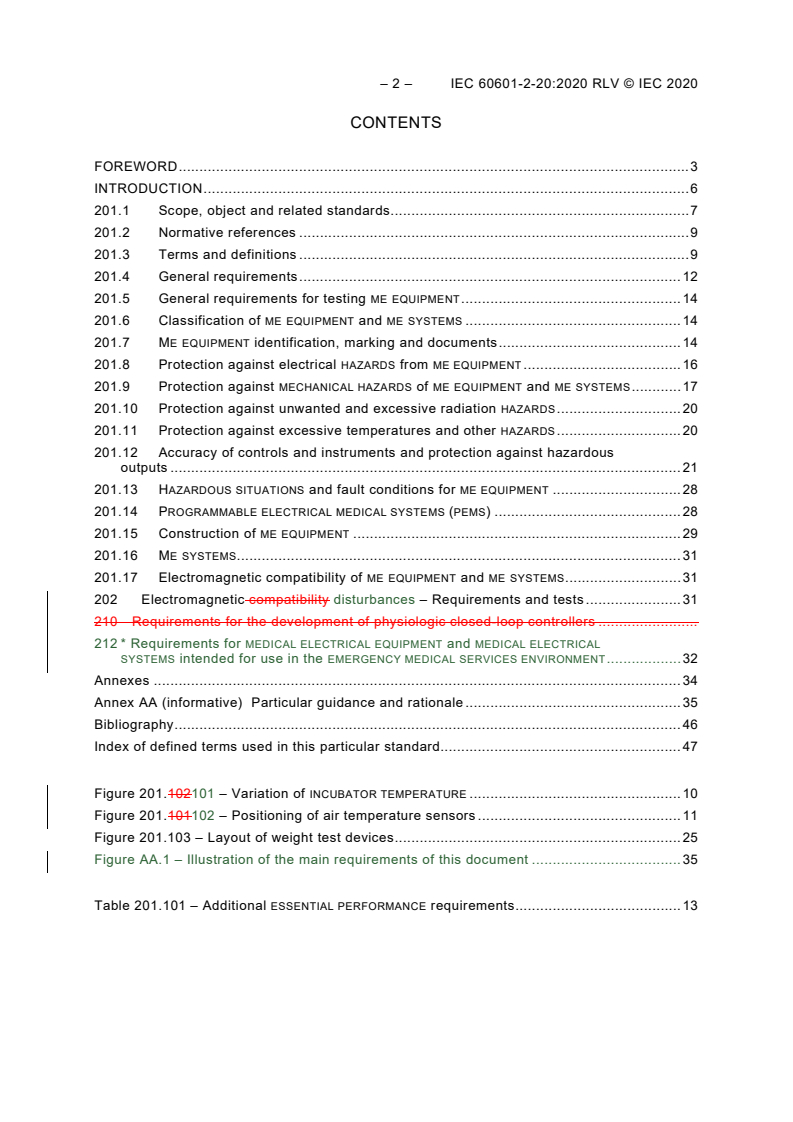
IEC 60601-2-20:2020 RLV - Medical electrical equipment - Part 2-20: Particular requirements for the basic safety and essential performance of infant transport incubators Released:9/2/2020
IEC 60601-2-20:2020 - Medical electrical equipment - Part 2-20: Particular requirements for the basic safety and essential performance of infant transport incubators Released:9/2/2020

IEC 60601-2-20:2020+AMD1:2023 CSV - Medical electrical equipment - Part 2-20: Particular requirements for the basic safety and essential performance of infant transport incubators Released:11/9/2023
Overview
IEC 60601-2-20:2020 is the particular standard in the IEC 60601 series that specifies requirements for the basic safety and essential performance of infant transport incubators (medical electrical - ME - equipment). It amends and supplements the general standard IEC 60601-1 and focuses on design, testing and documentation that minimize hazards to patients and operators during transport. The edition 3.0 (2020) cancels the 2009 edition and aligns normative references for current use.
Key topics and requirements
- Scope and applicability - Applies specifically to infant transport incubators as defined in the standard (see Clause 201.3.208). It explicitly excludes heating via blankets/pads/mattresses, non-transport incubators, radiant warmers and phototherapy devices.
- Basic safety & essential performance - Requirements build on IEC 60601-1 to address functions unique to transport incubators (temperature control, enclosure safety, mobility and robustness during transport).
- Risk management - Manufacturers may use alternate means of compliance if the Risk Management File demonstrates equivalent safety and acceptable risk versus clinical benefit.
- Electrical and mechanical protection - Clauses address protection against electrical hazards, mechanical hazards, excessive temperatures and hazardous outputs.
- Accuracy and controls - Requirements and tests for the accuracy of temperature controls, sensors and user interfaces that affect infant thermal environment.
- Programmable and EMC requirements - Special provisions for programmable electrical medical systems (PEMS) and electromagnetic compatibility (EMC) to ensure reliable operation in transport environments.
- Identification, marking and documentation - Labelling, instructions for use and test records required to support safe operation and conformity assessment.
- Testing and verification - Defined tests to verify compliance with the particular requirements; informative guidance and rationale are provided in Annex AA.
Practical applications - who uses this standard
- Medical device manufacturers - design, development, verification and regulatory submissions for infant transport incubators.
- Test laboratories and conformity assessors - type testing and certification against IEC 60601-2-20 requirements.
- Regulatory agencies and notified bodies - evaluation of safety and essential performance for market approval.
- Clinical engineers and procurement teams - specification, selection and acceptance testing of transport incubators for ambulances, neonatal transfer services and air/ground emergency transport.
- Risk managers and quality teams - integrating standard requirements into device risk management and post-market surveillance.
Related standards
- IEC 60601-1 (general standard for basic safety and essential performance)
- IEC 60601-1-2 (EMC)
- IEC 60601-2-19 (stationary infant incubators)
- IEC 60601-2-21 (infant radiant warmers)
- IEC 60601-2-35 (heated mattresses/pads)
- IEC 60601-2-50 (infant phototherapy)
Keywords: IEC 60601-2-20:2020, infant transport incubator, medical electrical equipment, basic safety, essential performance, risk management, IEC 60601.
Relations
- Effective Date
- 05-Sep-2023
- Effective Date
- 05-Sep-2023
- Effective Date
- 05-Sep-2023
- Effective Date
- 05-Sep-2023
- Effective Date
- 05-Sep-2023
Buy Documents
IEC 60601-2-20:2020 - Medical electrical equipment - Part 2-20: Particular requirements for the basic safety and essential performance of infant transport incubators Released:9/2/2020
IEC 60601-2-20:2020 RLV - Medical electrical equipment - Part 2-20: Particular requirements for the basic safety and essential performance of infant transport incubators Released:9/2/2020
IEC 60601-2-20:2020 - Medical electrical equipment - Part 2-20: Particular requirements for the basic safety and essential performance of infant transport incubators Released:9/2/2020
IEC 60601-2-20:2020+AMD1:2023 CSV - Medical electrical equipment - Part 2-20: Particular requirements for the basic safety and essential performance of infant transport incubators Released:11/9/2023
Get Certified
Connect with accredited certification bodies for this standard

BSI Group
BSI (British Standards Institution) is the business standards company that helps organizations make excellence a habit.

TÜV Rheinland
TÜV Rheinland is a leading international provider of technical services.

TÜV SÜD
TÜV SÜD is a trusted partner of choice for safety, security and sustainability solutions.
Sponsored listings
Frequently Asked Questions
IEC 60601-2-20:2020 is a standard published by the International Electrotechnical Commission (IEC). Its full title is "Medical electrical equipment - Part 2-20: Particular requirements for the basic safety and essential performance of infant transport incubators". This standard covers: IEC 60601-2-20:2020 applies to the BASIC SAFETY and ESSENTIAL PERFORMANCE of INFANT TRANSPORT INCUBATOR equipment, as defined in 201.3.208, also referred to as ME EQUIPMENT. If a clause or subclause is specifically intended to be applicable to ME EQUIPMENT only, or to ME SYSTEMS only, the title and content of that clause or subclause will say so. If that is not the case, the clause or subclause applies both to ME EQUIPMENT and to ME SYSTEMS, as relevant. HAZARDS inherent in the intended physiological function of ME EQUIPMENT or ME SYSTEMS within the scope of this document are not covered by specific requirements in this document, except in 7.2.13 and 8.4.1 of the general standard. IEC 60601-2-20:2020 specifies safety requirements for INFANT TRANSPORT INCUBATORS, but alternate methods of compliance with a specific clause, by demonstrating equivalent safety, will not be judged as non-compliant, if the MANUFACTURER has demonstrated in his RISK MANAGEMENT FILE that the RISK presented by the HAZARD has been found to be of an acceptable level when weighed against the benefit of treatment from the device. This particular standard does not apply to: - devices supplying heat via BLANKETS, PADS or MATTRESSES in medical use; for information, see IEC 60601-2-35; - INFANT INCUBATORS which are not INFANT TRANSPORT INCUBATOR; for information see IEC 60601-2-19; - INFANT RADIANT WARMERS; for information, see IEC 60601-2-21; - INFANT PHOTOTHERAPY; for information, see IEC 60601-2-50. IEC 60601-2-20:2020 cancels and replaces the second edition published in 2009 and Amendment 1:2016. This edition constitutes a technical revision. IEC 60601-2-20:2020 includes the following significant technical change with respect to the previous edition: re-dating of normative references.
IEC 60601-2-20:2020 applies to the BASIC SAFETY and ESSENTIAL PERFORMANCE of INFANT TRANSPORT INCUBATOR equipment, as defined in 201.3.208, also referred to as ME EQUIPMENT. If a clause or subclause is specifically intended to be applicable to ME EQUIPMENT only, or to ME SYSTEMS only, the title and content of that clause or subclause will say so. If that is not the case, the clause or subclause applies both to ME EQUIPMENT and to ME SYSTEMS, as relevant. HAZARDS inherent in the intended physiological function of ME EQUIPMENT or ME SYSTEMS within the scope of this document are not covered by specific requirements in this document, except in 7.2.13 and 8.4.1 of the general standard. IEC 60601-2-20:2020 specifies safety requirements for INFANT TRANSPORT INCUBATORS, but alternate methods of compliance with a specific clause, by demonstrating equivalent safety, will not be judged as non-compliant, if the MANUFACTURER has demonstrated in his RISK MANAGEMENT FILE that the RISK presented by the HAZARD has been found to be of an acceptable level when weighed against the benefit of treatment from the device. This particular standard does not apply to: - devices supplying heat via BLANKETS, PADS or MATTRESSES in medical use; for information, see IEC 60601-2-35; - INFANT INCUBATORS which are not INFANT TRANSPORT INCUBATOR; for information see IEC 60601-2-19; - INFANT RADIANT WARMERS; for information, see IEC 60601-2-21; - INFANT PHOTOTHERAPY; for information, see IEC 60601-2-50. IEC 60601-2-20:2020 cancels and replaces the second edition published in 2009 and Amendment 1:2016. This edition constitutes a technical revision. IEC 60601-2-20:2020 includes the following significant technical change with respect to the previous edition: re-dating of normative references.
IEC 60601-2-20:2020 is classified under the following ICS (International Classification for Standards) categories: 11.040.10 - Anaesthetic, respiratory and reanimation equipment. The ICS classification helps identify the subject area and facilitates finding related standards.
IEC 60601-2-20:2020 has the following relationships with other standards: It is inter standard links to IEC 60601-2-20:2020/AMD1:2023, IEC 60601-2-20:2009, IEC 60601-2-20:2009/COR1:2012, IEC 60601-2-20:2009/AMD1:2016, IEC 60601-2-20:2009/COR2:2013. Understanding these relationships helps ensure you are using the most current and applicable version of the standard.
IEC 60601-2-20:2020 is available in PDF format for immediate download after purchase. The document can be added to your cart and obtained through the secure checkout process. Digital delivery ensures instant access to the complete standard document.
Standards Content (Sample)
IEC 60601-2-20 ®
Edition 3.0 2020-09
INTERNATIONAL
STANDARD
Medical electrical equipment –
Part 2-20: Particular requirements for the basic safety and essential performance
of infant transport incubators
All rights reserved. Unless otherwise specified, no part of this publication may be reproduced or utilized in any form
or by any means, electronic or mechanical, including photocopying and microfilm, without permission in writing from
either IEC or IEC's member National Committee in the country of the requester. If you have any questions about IEC
copyright or have an enquiry about obtaining additional rights to this publication, please contact the address below or
your local IEC member National Committee for further information.
IEC Central Office Tel.: +41 22 919 02 11
3, rue de Varembé info@iec.ch
CH-1211 Geneva 20 www.iec.ch
Switzerland
About the IEC
The International Electrotechnical Commission (IEC) is the leading global organization that prepares and publishes
International Standards for all electrical, electronic and related technologies.
About IEC publications
The technical content of IEC publications is kept under constant review by the IEC. Please make sure that you have the
latest edition, a corrigendum or an amendment might have been published.
IEC publications search - webstore.iec.ch/advsearchform Electropedia - www.electropedia.org
The advanced search enables to find IEC publications by a The world's leading online dictionary on electrotechnology,
variety of criteria (reference number, text, technical containing more than 22 000 terminological entries in English
committee,…). It also gives information on projects, replaced and French, with equivalent terms in 16 additional languages.
and withdrawn publications. Also known as the International Electrotechnical Vocabulary
(IEV) online.
IEC Just Published - webstore.iec.ch/justpublished
Stay up to date on all new IEC publications. Just Published IEC Glossary - std.iec.ch/glossary
details all new publications released. Available online and once 67 000 electrotechnical terminology entries in English and
a month by email. French extracted from the Terms and Definitions clause of IEC
publications issued since 2002. Some entries have been
IEC Customer Service Centre - webstore.iec.ch/csc collected from earlier publications of IEC TC 37, 77, 86 and
If you wish to give us your feedback on this publication or need CISPR.
further assistance, please contact the Customer Service
Centre: sales@iec.ch.
IEC 60601-2-20 ®
Edition 3.0 2020-09
INTERNATIONAL
STANDARD
Medical electrical equipment –
Part 2-20: Particular requirements for the basic safety and essential performance
of infant transport incubators
INTERNATIONAL
ELECTROTECHNICAL
COMMISSION
ICS 11.040.10 ISBN 978-2-8322-8647-0
– 2 – IEC 60601-2-20:2020 © IEC 2020
CONTENTS
FOREWORD . 3
INTRODUCTION . 6
201.1 Scope, object and related standards . 7
201.2 Normative references . 9
201.3 Terms and definitions. 9
201.4 General requirements . 11
201.5 General requirements for testing ME EQUIPMENT . 13
201.6 Classification of ME EQUIPMENT and ME SYSTEMS . 13
201.7 ME EQUIPMENT identification, marking and documents . 13
201.8 Protection against electrical HAZARDS from ME EQUIPMENT . 15
201.9 Protection against MECHANICAL HAZARDS of ME EQUIPMENT and ME SYSTEMS . 15
201.10 Protection against unwanted and excessive radiation HAZARDS . 18
201.11 Protection against excessive temperatures and other HAZARDS . 18
201.12 Accuracy of controls and instruments and protection against hazardous
outputs . 20
201.13 HAZARDOUS SITUATIONS and fault conditions for ME EQUIPMENT . 26
201.14 PROGRAMMABLE ELECTRICAL MEDICAL SYSTEMS (PEMS) . 27
201.15 Construction of ME EQUIPMENT . 27
201.16 ME SYSTEMS . 29
201.17 Electromagnetic compatibility of ME EQUIPMENT and ME SYSTEMS . 29
202 Electromagnetic disturbances – Requirements and tests . 29
212 * Requirements for MEDICAL ELECTRICAL EQUIPMENT and MEDICAL ELECTRICAL
SYSTEMS intended for use in the EMERGENCY MEDICAL SERVICES ENVIRONMENT . 29
212.5 * Classification of ME EQUIPMENT and ME SYSTEMS . 30
212.7 * Protection against electrical HAZARDS from ME EQUIPMENT . 30
212.9 Accuracy of controls and instruments and protection against hazardous
outputs . 30
Annexes . 31
Annex AA (informative) Particular guidance and rationale . 32
Bibliography . 42
Index of defined terms used in this particular standard. 43
Figure 201.101 – Variation of INCUBATOR TEMPERATURE . 10
Figure 201.102 – Positioning of air temperature sensors . 11
Figure 201.103 – Layout of weight test devices . 24
Figure AA.1 – Illustration of the main requirements of this document . 32
Table 201.101 – Additional ESSENTIAL PERFORMANCE requirements . 12
INTERNATIONAL ELECTROTECHNICAL COMMISSION
____________
MEDICAL ELECTRICAL EQUIPMENT –
Part 2-20: Particular requirements for the basic safety and
essential performance of infant transport incubators
FOREWORD
1) The International Electrotechnical Commission (IEC) is a worldwide organization for standardization comprising
all national electrotechnical committees (IEC National Committees). The object of IEC is to promote
international co-operation on all questions concerning standardization in the electrical and electronic fields. To
this end and in addition to other activities, IEC publishes International Standards, Technical Specifications,
Technical Reports, Publicly Available Specifications (PAS) and Guides (hereafter referred to as "IEC
Publication(s)"). Their preparation is entrusted to technical committees; any IEC National Committee interested
in the subject dealt with may participate in this preparatory work. International, governmental and non-
governmental organizations liaising with the IEC also participate in this preparation. IEC collaborates closely
with the International Organization for Standardization (ISO) in accordance with conditions determined by
agreement between the two organizations.
2) The formal decisions or agreements of IEC on technical matters express, as nearly as possible, an international
consensus of opinion on the relevant subjects since each technical committee has representation from all
interested IEC National Committees.
3) IEC Publications have the form of recommendations for international use and are accepted by IEC National
Committees in that sense. While all reasonable efforts are made to ensure that the technical content of IEC
Publications is accurate, IEC cannot be held responsible for the way in which they are used or for any
misinterpretation by any end user.
4) In order to promote international uniformity, IEC National Committees undertake to apply IEC Publications
transparently to the maximum extent possible in their national and regional publications. Any divergence
between any IEC Publication and the corresponding national or regional publication shall be clearly indicated in
the latter.
5) IEC provides no marking procedure to indicate its approval and cannot be rendered responsible for any
equipment declared to be in conformity with an IEC Publication.
6) All users should ensure that they have the latest edition of this publication.
7) No liability shall attach to IEC or its directors, employees, servants or agents including individual experts and
members of its technical committees and IEC National Committees for any personal injury, property damage or
other damage of any nature whatsoever, whether direct or indirect, or for costs (including legal fees) and
expenses arising out of the publication, use of, or reliance upon, this IEC Publication or any other IEC
Publications.
8) Attention is drawn to the Normative references cited in this publication. Use of the referenced publications is
indispensable for the correct application of this publication.
9) Attention is drawn to the possibility that some of the elements of this IEC Publication may be the subject of
patent rights. IEC shall not be held responsible for identifying any or all such patent rights.
International standard IEC 60601-2-20 has been prepared by IEC Subcommittee 62D
Electromedical equipment, of IEC Technical Committee 62: Electrical equipment in medical
practice.
This third edition cancels and replaces the second edition published in 2009 and
Amendment 1:2016. This edition constitutes a technical revision.
This edition includes the following significant technical change with respect to the previous
edition: re-dating of normative references.
– 4 – IEC 60601-2-20:2020 © IEC 2020
The text of this International Standard is based on the following documents:
FDIS Report on voting
62D/1763/FDIS 62D/1773/RVD
Full information on the voting for the approval of this International Standard can be found in
the report on voting indicated in the above table.
This publication has been drafted in accordance with the ISO/IEC Directives, Part 2.
In this document, the following print types are used:
– requirements and definitions: roman type;
– test specifications: italic type;
– informative material appearing outside of tables, such as notes, examples and references: in smaller type.
Normative text of tables is also in a smaller type;
– TERMS DEFINED IN CLAUSE 3 OF THE GENERAL STANDARD, IN THIS PARTICULAR STANDARD OR AS
NOTED: SMALL CAPITALS.
In referring to the structure of this document, the term
– "clause" means one of the seventeen numbered divisions within the table of contents,
inclusive of all subdivisions (e.g. Clause 7 includes subclauses 7.1, 7.2, etc.);
– "subclause" means a numbered subdivision of a clause (e.g. 7.1, 7.2 and 7.2.1 are all
subclauses of Clause 7).
References to clauses within this document are preceded by the term "Clause" followed by
the clause number. References to subclauses within this particular standard are by number
only.
In this document, the conjunctive "or" is used as an "inclusive or" so a statement is true if any
combination of the conditions is true.
The verbal forms used in this document conform to usage described in Clause 7 of the
ISO/IEC Directives, Part 2. For the purposes of this document, the auxiliary verb:
– "shall" means that compliance with a requirement or a test is mandatory for compliance
with this document;
– "should" means that compliance with a requirement or a test is recommended but is not
mandatory for compliance with this document;
– "may" is used to describe a permissible way to achieve compliance with a requirement or
test.
An asterisk (*) as the first character of a title or at the beginning of a paragraph or table title
indicates that there is guidance or rationale related to that item in Annex AA.
A list of all parts of the IEC 60601 series, published under the general title Medical electrical
equipment, can be found on the IEC website.
The committee has decided that the contents of this document will remain unchanged until the
stability date indicated on the IEC website under "http://webstore.iec.ch" in the data related to
the specific document. At this date, the document will be
• reconfirmed,
• withdrawn,
• replaced by a revised edition, or
• amended.
NOTE The attention of users of this document is drawn to the fact that equipment manufacturers and testing
organizations may need a transitional period following publication of a new, amended or revised IEC publication in
which to make products in accordance with the new requirements and to equip themselves for conducting new or
revised tests. It is the recommendation of the committee that the content of this publication be adopted for
implementation nationally not earlier than 3 years from the date of publication.
– 6 – IEC 60601-2-20:2020 © IEC 2020
INTRODUCTION
The minimum safety requirements specified in this particular standard are considered to
provide for a practical degree of safety in the operation of INFANT TRANSPORT INCUBATOR
equipment.
This particular standard amends and supplements IEC 60601-1, Medical electrical equipment
– Part 1: General requirements for basic safety and essential performance, hereinafter
referred to as the "general standard".
The requirements are followed by specifications for the relevant tests.
A general guidance and rationale for the requirements of this particular standard are given in
Annex AA. It is considered that knowledge of the reasons for these requirements will not only
facilitate the proper application of this particular standard but will, in due course, expedite any
revision necessitated by changes in clinical practice or as a result of developments in
technology. However, Annex AA does not form part of the requirements of this document.
MEDICAL ELECTRICAL EQUIPMENT –
Part 2-20: Particular requirements for the basic safety and
essential performance of infant transport incubators
201.1 Scope, object and related standards
Clause 1 of the general standard applies, except as follows:
201.1.1 Scope
Replacement:
This part of IEC 60601 applies to the BASIC SAFETY and ESSENTIAL PERFORMANCE of INFANT
TRANSPORT INCUBATOR equipment, as defined in 201.3.208, also referred to as ME EQUIPMENT.
If a clause or subclause is specifically intended to be applicable to ME EQUIPMENT only, or to
ME SYSTEMS only, the title and content of that clause or subclause will say so. If that is not the
case, the clause or subclause applies both to ME EQUIPMENT and to ME SYSTEMS, as relevant.
HAZARDS inherent in the intended physiological function of ME EQUIPMENT or ME SYSTEMS
within the scope of this document are not covered by specific requirements in this document,
except in 7.2.13 and 8.4.1 of the general standard.
NOTE See also 4.2 of the general standard.
This particular standard specifies safety requirements for INFANT TRANSPORT INCUBATORS, but
alternate methods of compliance with a specific clause, by demonstrating equivalent safety,
will not be judged as non-compliant, if the MANUFACTURER has demonstrated in his RISK
that the RISK presented by the HAZARD has been found to be of an
MANAGEMENT FILE
acceptable level when weighed against the benefit of treatment from the device.
This particular standard does not apply to:
– devices supplying heat via BLANKETS, PADS or MATTRESSES in medical use; for information,
see IEC 60601-2-35 [1] ;
– INFANT INCUBATORS which are not INFANT TRANSPORT INCUBATOR; for information see
IEC 60601-2-19 [2];
– INFANT RADIANT WARMERS; for information, see IEC 60601-2-21 [3];
– INFANT PHOTOTHERAPY; for information, see IEC 60601-2-50 [4].
201.1.2 Object
Replacement:
The object of this particular standard is to establish particular BASIC SAFETY and ESSENTIAL
PERFORMANCE requirements for INFANT TRANSPORT INCUBATORS as defined in 201.3.208, which
minimize HAZARDS to the PATIENT and OPERATOR, and to specify tests by which compliance
with the requirements can be verified.
____________
The general standard is IEC 60601-1 and IEC 60601-1:2005/AMD1:2012, Medical electrical equipment – Part 1:
General requirements for basic safety and essential performance.
Figures between square brackets refer to the Bibliography.
– 8 – IEC 60601-2-20:2020 © IEC 2020
201.1.3 Collateral standards
Addition:
This particular standard refers to those applicable collateral standards that are listed in
Clause 2 of the general standard and Clause 201.2 of this particular standard.
IEC 60601-1-2:2014 and IEC 60601-1-12:2014 apply as modified in Clauses 202 and 212.
IEC 60601-1-3 and IEC 60601-1-10 do not apply. All other published collateral standards in
the IEC 60601-1 series apply as published.
201.1.4 * Particular standards
Replacement:
In the IEC 60601 series, particular standards may modify, replace or delete requirements
contained in the general standard and collateral standards as appropriate for the particular
ME EQUIPMENT under consideration, and may add other BASIC SAFETY and ESSENTIAL
PERFORMANCE requirements.
A requirement of a particular standard takes priority over the general standard.
For brevity, IEC 60601-1 and IEC 60601-1:2005/AMD1:2012 are referred to in this particular
standard as the general standard. Collateral standards are referred to by their document
number.
The numbering of clauses and subclauses of this particular standard corresponds to that of
the general standard with the prefix "201" (e.g. 201.1 in this document addresses the content
of Clause 1 of the general standard) or applicable collateral standard with the prefix "20x"
where x is the final digit(s) of the collateral standard document number (e.g. 202.4 in this
particular standard addresses the content of Clause 4 of the IEC 60601-1-2 collateral
standard, 203.4 in this particular standard addresses the content of Clause 4 of the
IEC 60601-1-3 collateral standard, etc.). The changes to the text of the general standard and
applicable collateral standards are specified by the use of the following words:
"Replacement" means that the clause or subclause of the general standard or applicable
collateral standard is replaced completely by the text of this particular standard.
"Addition" means that the text of this particular standard is additional to the requirements of
the general standard or applicable collateral standard.
"Amendment" means that the clause or subclause of the general standard or applicable
collateral standard is amended as indicated by the text of this particular standard.
Subclauses, figures or tables which are additional to those of the general standard are
numbered starting from 201.101. However, due to the fact that definitions in the general
standard are numbered 3.1 through 3.147, additional definitions in this document are
numbered beginning from 201.3.201. Additional annexes are lettered AA, BB, etc., and
additional items aa), bb), etc.
Subclauses, figures or tables which are additional to those of a collateral standard are
numbered starting from 20x, where "x" is the number of the collateral standard, e.g. 202 for
IEC 60601-1-2, 203 for IEC 60601-1-3, etc.
The term "this document" is used to make reference to the general standard, any applicable
collateral standards and this particular standard taken together.
Where there is no corresponding clause or subclause in this particular standard, the clause or
subclause of the general standard or applicable collateral standard, although possibly not
relevant, applies without modification; where it is intended that any part of the general
standard or applicable collateral standard, although possibly relevant, is not to be applied, a
statement to that effect is given in this particular standard.
KIN TEMPERATURE SENSORS which are applied to operate a BABY CONTROLLED TRANSPORT
S
INCUBATOR including the displayed value are not considered to be a CLINICAL THERMOMETER in
the sense of the particular standard ISO 80601-2-56.
201.2 Normative references
NOTE Informative references are listed in the Bibliography.
Clause 2 of the general standard applies, except as follows:
Addition:
IEC 60601-1:2005, Medical electrical equipment – Part 1: General requirements for basic
safety and essential performance
IEC 60601-1:2005/AMD1:2012
ISO 32, Gas cylinders for medical use – Marking for identification of content
ISO 407, Small medical gas cylinders – Pin-index yoke-type valve connections
Replacement:
IEC 60601-1-2:2014, Medical electrical equipment – Part 1-2: General requirements for basic
safety and essential performance – Collateral standard: Electromagnetic disturbances –
Requirements and tests
201.3 Terms and definitions
For the purposes of this document, the terms and definitions given in IEC 60601-1:2005 and
IEC 60601-1:2005/AMD1:2012 and the following apply.
ISO and IEC maintain terminological databases for use in standardization at the following
addresses:
• IEC Electropedia: available at http://www.electropedia.org/
• ISO Online browsing platform: available at http://www.iso.org/obp
NOTE An index of defined terms is found beginning on page 43.
Addition:
201.3.201
AIR CONTROLLED TRANSPORT INCUBATOR
INCUBATOR in which the air temperature is automatically controlled by an air temperature
sensor close to a value set by the OPERATOR
201.3.202
AVERAGE TEMPERATURE
average of temperature readings taken at regular intervals at any specified point in the
COMPARTMENT achieved during STEADY TEMPERATURE CONDITION
– 10 – IEC 60601-2-20:2020 © IEC 2020
201.3.203
AVERAGE TRANSPORT INCUBATOR TEMPERATURE
average of the INFANT TRANSPORT INCUBATOR TEMPERATURE readings taken at regular intervals
achieved during STEADY TEMPERATURE CONDITION
SEE Figure 201.101
Figure 201.101 – Variation of INCUBATOR TEMPERATURE
201.3.204
BABY CONTROLLED TRANSPORT INCUBATOR
AIR CONTROLLED TRANSPORT INCUBATOR which has the additional capability of automatically
controlling the INCUBATOR air temperature in order to maintain the temperature as measured
by a SKIN TEMPERATURE SENSOR according to the CONTROL TEMPERATURE set by the OPERATOR
201.3.205
COMPARTMENT
environmentally-controlled enclosure intended to contain an INFANT and with transparent
section(s) which allows for viewing of the INFANT
201.3.206
CONTROL TEMPERATURE
temperature selected at the temperature control
201.3.207
INFANT
PATIENT up to the age of three months and a weight less than 10 kg
* 201.3.208
INFANT TRANSPORT INCUBATOR
TRANSPORTABLE ME EQUIPMENT that is equipped with a COMPARTMENT and a TRANSPORTABLE
ELECTRICAL POWER SOURCE with the means to control the environment of the INFANT primarily
by heated air within the COMPARTMENT
201.3.209
SKIN TEMPERATURE
temperature of the skin of the INFANT at a point on which the SKIN TEMPERATURE SENSOR is
placed
201.3.210
SKIN TEMPERATURE SENSOR
sensing device intended to measure the INFANT's SKIN TEMPERATURE
201.3.211
STEADY TEMPERATURE CONDITION
TRANSPORT INCUBATOR TEMPERATURE does not vary by more than
condition reached when the
1 °C over a period of 1 h
SEE Figure 201.101
201.3.212
TRANSPORT INCUBATOR TEMPERATURE
temperature of the air at a point 10 cm above the centre of the MATTRESS surface in the
COMPARTMENT
SEE Figure 201.102, point M
Key
M TRANSPORT INCUBATOR TEMPERATURE sensor
A, B, C, D air temperature sensor
The measuring points A to D and M are in a plane parallel to and at a distance of 10 cm from the MATTRESS.
Figure 201.102 – Positioning of air temperature sensors
201.3.213
TRANSPORTABLE ELECTRICAL POWER SOURCE
rechargeable battery and battery charger intended to provide the electrical power necessary
to operate the INFANT TRANSPORT INCUBATOR
201.4 General requirements
Clause 4 of the general standard applies, except as follows:
201.4.1 Conditions for application to ME EQUIPMENT or ME SYSTEMS
Addition:
For ME EQUIPMENT which combines alternative heat sources, for instance INCUBATORS with
integrated INFANT RADIANT WARMERS, devices supplying heat via BLANKETS, PADS or
MATTRESSES, etc., the safety requirements of the particular standards for these alternative
heat sources, if any, shall be met. The safety requirements of this particular standard shall not
MANUFACTURER, details of which
be altered by such additional heat sources specified by the
are provided in the instruction for use.
Compliance is checked by the tests of Clause 201.11 and 201.15.4.2.1 of the relevant
particular standards.
– 12 – IEC 60601-2-20:2020 © IEC 2020
201.4.3 * ESSENTIAL PERFORMANCE
Addition:
201.4.3.101 ESSENTIAL PERFORMANCE of INFANT TRANSPORT INCUBATORS
Additional ESSENTIAL PERFORMANCE requirements are found in the subclauses listed in
Table 201.101.
Table 201.101 – Additional ESSENTIAL PERFORMANCE requirements
Requirement Subclause
ESSENTIAL PERFORMANCE requirement 1 201.12.1.104 or generation of a visual and audible
alarm in compliance with 201.9.6.2.1.102
ESSENTIAL PERFORMANCE requirement 2 201.12.1.106 or generation of a visual and audible
alarm in compliance with 201.9.6.2.1.102
201.4.10 Power supply
Additional subclauses:
201.4.10.101 * Ability to operate with different power supply sources
The INFANT TRANSPORT INCUBATOR shall have a TRANSPORTABLE ELECTRICAL POWER SOURCE
consisting of a rechargeable battery and battery charger designed to operate from an
alternating current supply voltage. It shall also be designed to operate from at least one
external direct and one external alternating current SUPPLY MAINS as specified in the
instructions for use. All requirements of the general standard and this particular standard shall
continue to be met.
Compliance is checked by repeating the tests in 201.12.1.101, 201.12.1.102, 201.12.1.104
and 201.12.1.106 with the INFANT TRANSPORT INCUBATOR operating at an ambient temperature
of 15 °C ± 1 °C when supplied from each of its SUPPLY MAINS in turn. This also includes the
TRANSPORTABLE ELECTRICAL POWER SOURCE.
201.4.10.102 Capacity of TRANSPORTABLE ELECTRICAL POWER SOURCE
The capacity of any TRANSPORTABLE ELECTRICAL POWER SOURCE shall be sufficient to maintain
the INFANT TRANSPORT INCUBATOR at a temperature in accordance with the following test during
at least 90 min.
Compliance is checked by inspection and the following test:
The INFANT TRANSPORT INCUBATOR with a fully charged battery shall be placed in an
environment with an ambient temperature of 15 °C ± 1 °C. It shall be operated from the
SUPPLY MAINS until a STEADY TEMPERATURE CONDITION has been established at a CONTROL
TEMPERATURE of 36 °C and then set to operate from any TRANSPORTABLE ELECTRICAL POWER
SOURCE. The INFANT TRANSPORT INCUBATOR TEMPERATURE shall be maintained within 2 °C of
the CONTROL TEMPERATURE.
This test shall be conducted while all the electrical powered ACCESSORIES, as specified by the
MANUFACTURER, are in operation and making the maximum demand upon the external
TRANSPORTABLE ELECTRICAL POWER SOURCE.
201.4.10.103 Overcharge of TRANSPORTABLE ELECTRICAL POWER SOURCE
It shall not be possible to overcharge and damage the TRANSPORTABLE ELECTRICAL POWER
SOURCE even if the ME EQUIPMENT is left connected to the AC electrical power source for an
indefinite period. Controls which affect the rate of recharge or the final battery voltage level
shall not be accessible to the OPERATOR without the aid of a TOOL.
Compliance is checked by inspection.
201.5 General requirements for testing ME EQUIPMENT
Clause 5 of the general standard applies, except as follows:
201.5.3 * Ambient temperature, humidity, atmospheric pressure
Addition to a):
The ME EQUIPMENT shall comply with the requirements of this document when operating within
an ambient temperature between +10 °C and +30 °C.
If not otherwise specified in this particular standard, all tests shall be carried out at an
ambient temperature within the range of 21 °C to 26 °C and an ambient air velocity less than
1,0 m/s and greater than 0,3 m/s.
201.5.4 Other conditions
Addition item to the existing list:
aa) If not otherwise specified, the CONTROL TEMPERATURE shall be 36 °C and shall always
exceed the ambient temperature by at least 3 °C.
201.6 Classification of ME EQUIPMENT and ME SYSTEMS
Clause 6 of the general standard applies.
201.7 ME EQUIPMENT identification, marking and documents
Clause 7 of the general standard applies, except as follows:
201.7.2 Marking on the outside of ME EQUIPMENT or ME EQUIPMENT parts
(see also Table C.1 of the general standard)
Additional subclauses:
201.7.2.101 * Oxygen monitor
INFANT TRANSPORT INCUBATOR not equipped with an integral oxygen monitor and which
An
provides means for oxygen administration shall be marked in a prominent position with a text
which states: "Use an oxygen monitor when oxygen is administered".
NOTE See also 7.5 of the general standard.
201.7.2.102 Heater surface temperature
If a heater is accessible without the use of a TOOL, a notice, symbol (see 7.5 of the general
standard) or marking shall be displayed adjacent to the heater giving warning of high surface
temperature.
201.7.4 Marking of controls and instruments (see also Table C.3 of the general standard)
201.7.4.2 * Control devices
Addition:
– 14 – IEC 60601-2-20:2020 © IEC 2020
Temperature controls shall be clearly marked with temperature settings on or adjacent to the
control. The markings shall be provided at intervals of not greater than 1 °C for AIR
CONTROLLED TRANSPORT INCUBATORS and not greater than 0,5 °C for BABY CONTROLLED
TRANSPORT INCUBATORS.
Marking of the maximum and the minimum values of controls and indicators shall be such that
no confusion can arise with regard to the position of the control and/or the indicated values.
201.7.9.2.2 Warning and safety notices
Addition:
The instructions for use shall contain the following additional items.
INFANT TRANSPORT INCUBATOR should be used only by
a) * A statement that an
appropriately trained personnel and under the direction of qualified medical personnel
familiar with currently known RISKS and benefits of INFANT TRANSPORT INCUBATOR use.
b) * A warning that direct sunlight or other radiant heat sources can cause an increase in
TRANSPORT INCUBATOR TEMPERATURE to dangerous levels.
c) * A statement that the use of oxygen increases the danger of fire and that auxiliary
equipment producing sparks shall not be placed in the INFANT TRANSPORT INCUBATOR.
d) * A warning that even small quantities of flammable agents, such as ether and alcohol,
left in the INFANT TRANSPORT INCUBATOR can cause fire in connection with oxygen.
e) A warning against possible use of the SKIN TEMPERATURE SENSOR as a rectal
temperature sensor, if such a warning is applicable.
f) A statement of the maximum loads which can be applied to all supports and mounting
brackets for ACCESSORIES and ancillary equipment.
g) For TYPE B APPLIED PARTS, where the INFANT may not be isolated from earth, a warning
that particular care shall be taken to ensure that additional ME EQUIPMENT connected to
the INFANT is electrically safe.
ALARM SYSTEM.
h) An information on how and when to verify the functionality of the
i) For oxygen administration into the COMPARTMENT:
– a warning stating that administration of oxygen may increase the noise level for the
INFANT within the INFANT TRANSPORT INCUBATOR;
– an explanation of the operation of supplementary oxygen equipment supplied for
use with the INFANT TRANSPORT INCUBATOR or as specified in the ACCOMPANYING
;
DOCUMENTS
– a statement that an oxygen analyser shall be used when oxygen is delivered to the
INFANT.
j) Details of any specified combinations of ME EQUIPMENT (see 201.4.1).
k) * A statement that the INFANT TRANSPORT INCUBATOR cannot differentiate between an
increase in core temperature with a cold skin (fever) and a low core and SKIN
TEMPERATURE (hypothermia), and a recommendation to monitor the temperature of the
PATIENT.
201.7.9.2.8 * Start-up PROCEDURE
Addition:
The instructions for use shall additionally contain a specification of the warm-up time of the
INFANT TRANSPORT INCUBATOR measured as specified in 201.12.1.107.
201.7.9.2.9 Operating instructions
Addition:
The instructions for use shall contain the following additional items.
a) * A recommendation of the position and method of use of the SKIN TEMPERATURE SENSOR.
b) * Information about the range of CONTROL TEMPERATURE and relative humidity of the
INFANT TRANSPORT INCUBATOR. If the INFANT TRANSPORT INCUBATOR is not supplied with
means for control of the degree of humidity, this shall be stated in the instructions for
use.
c) * When applicable, a statement of the maximum allowed weight of additional equipment
which might be placed on shelves connected to the INFANT TRANSPORT INCUBATOR.
d) Information on the external supply circuits with which the INFANT TRANSPORT INCUBATOR
can be operated according to 201.4.10.101. Additionally, the MANUFACTURER shall specify
in the ACCOMPANYING DOCUMENTS the polarity of the electrical connections as necessary.
e) A statement:
– of the mass and external dimensions of the INFANT TRANSPORT INCUBATOR including
that of the specified external TRANSPORTABLE ELECTRICAL POWER SOURCE and with
oxygen delivery system and trolley, if provided;
– with which means and in what way a fixation of the INFANT TRANSPORT INCUBATOR
within an emergency vehicle is achieved;
– of the minimum ambient temperature, humidity and atmospheric pressure to which the
INFANT TRANSPORT INCUBATOR can be exposed and still meet with the requirements of
this document;
– of how the INFANT's movements can be limited within the INFANT TRANSPORT INCUBATOR
during transport.
201.7.9.3 Technical description (see also Table C.6 of the general standard)
201.7.9.3.1 General
Additional item to the first paragraph:
– the maximum CO concentration (see 201.12.4.2.101).
201.8 Protection against electrical HAZARDS from ME EQUIPMENT
Clause 8 of the general standard applies.
201.9 Protection against MECHANICAL HAZARDS of ME EQUIPMENT and ME SYSTEMS
Clause 9 of the general standard applies, except as follows:
201.9.2 MECHANICAL HAZARDS associated with moving parts
201.9.2.1 General
Addition:
This requirement is not applicable to an air circulating fan if it is accessible only when no
INFANT is present in the INFANT TRANSPORT INCUBATOR and appropriate ME EQUIPMENT parts are
removed for cleaning.
201.9.4.2.1 Instability in transport position
Addition:
The INFANT TRANSPORT INCUBATORS shall remain stable when tilted 10° in NORMAL USE and
when tilted 20° during transportation.
– 16 – IEC 60601-2-20:2020 © IEC 2020
Compliance is checked by the following test:
The INFANT TRANSPORT INCUBATOR is placed in any possible position of NORMAL USE on a plane
inclined at an angle of 0,18 rad (10°) to the horizontal plane. If wheels are present, they shall
be temporarily fixed in their most disadvantageous position. Doors and drawers and the like
shall be placed in the most disadvantageous position during NORMAL USE. The MATTRESS tray
shall be extended outside the enclosure.
The test shall be repeated at an angle of 0,36 rad (20°), in which case the MATTRESS tray shall
not be extended outside the enclosure. Doors and drawers and the like shall be placed in their
most disadvantageous position during transportation.
201.9.4.3 Instability from unwanted lateral movement (including sliding)
Additional subclauses:
201.9.4.3.101 Tip-over force
The lateral force to cause the INFANT TRANSPORT INCUBATOR to tip over shall be greater than
100 N.
Compliance is checked by the following test:
With the INFANT TRANSPORT INCUBATOR wheels locked and with the ME EQUIPMENT in the worst-
case configuration of parts and ACCESSORIES, a lateral force shall be applied and measured
using a force gauge. The point of application shall be at the highest point of the body of the
ME EQUIPMENT. The INFANT TRANSPORT INCUBATOR shall not tip over when the force is 100 N or
less.
201.9.4.3.102 * Prevention of movements
If the ME EQUIPMENT is mounted on wheels, the MANUFACTURER shall provide a means to
prevent movement of the ME EQUIPMENT on a slope of at least 10° to the horizontal.
Compliance is checked by inspection and by the following test:
Place the ME EQUIPMENT with its wheels in a locked position and with all ACCESSORIES fitted,
on a plane inclined at an angle of 10° to the horizontal. Report whether the ME EQUIPMENT is in
a maintain position.
201.9.4.3.103 Prevention of INFANT's movements
A means shall be provided to limit the INFANT's movement to a defined area within the
COMPARTMENT during NORMAL USE.
Compliance is checked by inspection.
201.9.4.3.104 * Prevention of vibration
A means should be provided to limit the INFANT's vibration within the COMPARTMENT during
transportation.
201.9.6.2 Acoustic energy
201.9.6.2.1 Audible acoustic energy
Additional subclauses:
201.9.6.2.1.101 Sound level within the COMPARTMENT
In NORMAL USE, the sound level within the COMPARTMENT shall not exceed sound pressure level
of 60 dB(A) except as specified in 201.9.6.2.1.103.
Compliance is checked by the following test:
With the microphone of a sound level meter complying with the requirements of
IEC 61672-1 [5], positioned 100 mm to 150 mm above the centre of the INFANT tray, the
measured sound level shall not exceed the specified values. For this test, the INFANT
INCUBATOR shall be operated at a CONTROL TEMPERATURe of 36 °C and at a
TRANSPORT
maximum humidity. The background sound level measured inside the COMPARTMENT shall be
at least 10 dB(A) below that which is measured during the test.
201.9.6.2.1.102 * Audible alarms sound level
Auditory ALARM SIGNALS shall have a sound level of at least 65 dB(A) at a distance of 3 m
perpendicular to the front of the control unit in a reflecting room. The auditory alarm may be
adjusted by the OPERATOR to a minimum lower level of 50 dB(A) measured with the range
setting of an A-weighted scale. If the frequency of the auditory alarms is adjustable by the
OPERATOR, these requirements shall apply to all the individual selectable frequencies.
Compliance is checked by inspection and measurement of the audible alarm level using a
sound level meter, as required in 201.9.6.2.1.101, placed 1,5 m above the floor and 3 m from
the control unit. For this test, the INFANT TRANSPORT INCUBATOR shall be operated at a CONTROL
of 36°C and at a maximum humidity. The background sound level measured
TEMPERATURE
shall be at least 10 dB(A) below that which is measured during the test.
201.9.6.2.1.103 * Audible alarms sound level within COMPARTMENT
When any INFANT TRANSPORT INCUBATOR alarm is sounding, the sound level in the
COMPARTMENT shall not exceed a sound pressure level of 80 dB(A). If the frequency of the
auditory alarms is adjustable by the OPERATOR, this shall apply to all the individual selectable
frequencies.
Compliance is checked by the following test:
The alarm shall be actuated and the measurement shall be carried out as described in
201.9.6.2.1.101.
201.9.8 MECHANICAL HAZARDS associated with support systems
201.9.8.3 Strength of PATIENT or OPERATOR support or suspension systems
201.9.8.3.1 General
Amendment:
The normal load for an INFANT is reduced to 10 kg (see 201.3.207).
Additional subclauses:
201.9.8.3.101 * Barriers
For devices with an integral bed, suitable barriers such as walls or side panels shall prevent
the PATIENT from falling off. Barriers intended to be opened or removed to allow access to the
INFANT, such as doors, ports etc., shall close so as not to open under the test conditions
specified below. It shall not be possible for barriers to be insecurely closed or latched whilst
appearing to be engaged. The mechanical integrity of the INFANT TRANSPORT INCUBATOR shall
be maintained under the following test conditions.
– 18 – IEC 60601-2-20:2020 © IEC 2020
Compliance is checked by inspection and by the following test:
With all access port doors deliberately made as insecure as possible, without the use of a
TOOL, whilst still appearing to be engaged, a horizontal force shall be applied to the centre of
the access port door. The force shall be increased gradually from zero to 20 N in an interval
of 5 s to 10 s and shall be held at maximum for 5 s. The barriers shall remain in the closed
position.
201.9.8.3.102 MATTRESS tray
For devices with an integral bed, if the MATTRESS tray can be extended outside the enclosure,
it shall be restrained to ensure that the tray remains attached to the INCUBATOR, is supported
and does not tip under the weight of the INFANT.
Compliance is checked by the following test:
A gradually increasing downward force is applied to the middle of the outside edge of the
MATTRESS tray whilst in the fully extended position. The force is increased over 5 s to 10 s
intervals until it equals 100 N and shall be maintained for a period of 1 min. The tray shall not
incline by more than 5° to the horizontal axis of the INCUBATOR and there shall be no visible
evidence of damage to the supporting structures.
Additional subclause:
201.9.8.101 Supports and mounting brackets for ACCESSORIES
Supports and mounting brackets for ACCESSORIES shall be suitable and of adequate strength
for their purpose.
Compliance is checked by inspection and by the following test:
A gradually increasing force is applied so as to act vertically through the centre of the
supports and mounting brackets, for example an ACCESSORY shelf in the extended position
with a MANUFACTURER's recommended load. The force is increased from zero in a 5 s to 10 s
interval, until it equals three times the recommended load and is sustained for a period of
1 min. There shall be no evidence of damage to the items under test.
201.10 Protection against unwanted and excessive radiation HAZARDS
Clause 10 of the general standard applies.
201.11 Protection against excessive temperatures and other HAZARDS
Clause 11 of the general standard applies, except as follows:
201.11.1.2.2 APPLIED PARTS not intend
...
IEC 60601-2-20 ®
Edition 3.0 2020-09
REDLINE VERSION
INTERNATIONAL
STANDARD
colour
inside
Medical electrical equipment –
Part 2-20: Particular requirements for the basic safety and essential performance
of infant transport incubators
All rights reserved. Unless otherwise specified, no part of this publication may be reproduced or utilized in any form
or by any means, electronic or mechanical, including photocopying and microfilm, without permission in writing from
either IEC or IEC's member National Committee in the country of the requester. If you have any questions about IEC
copyright or have an enquiry about obtaining additional rights to this publication, please contact the address below or
your local IEC member National Committee for further information.
IEC Central Office Tel.: +41 22 919 02 11
3, rue de Varembé info@iec.ch
CH-1211 Geneva 20 www.iec.ch
Switzerland
About the IEC
The International Electrotechnical Commission (IEC) is the leading global organization that prepares and publishes
International Standards for all electrical, electronic and related technologies.
About IEC publications
The technical content of IEC publications is kept under constant review by the IEC. Please make sure that you have the
latest edition, a corrigendum or an amendment might have been published.
IEC publications search - webstore.iec.ch/advsearchform Electropedia - www.electropedia.org
The advanced search enables to find IEC publications by a The world's leading online dictionary on electrotechnology,
variety of criteria (reference number, text, technical containing more than 22 000 terminological entries in English
committee,…). It also gives information on projects, replaced and French, with equivalent terms in 16 additional languages.
and withdrawn publications. Also known as the International Electrotechnical Vocabulary
(IEV) online.
IEC Just Published - webstore.iec.ch/justpublished
Stay up to date on all new IEC publications. Just Published IEC Glossary - std.iec.ch/glossary
details all new publications released. Available online and 67 000 electrotechnical terminology entries in English and
once a month by email. French extracted from the Terms and Definitions clause of
IEC publications issued since 2002. Some entries have been
IEC Customer Service Centre - webstore.iec.ch/csc collected from earlier publications of IEC TC 37, 77, 86 and
If you wish to give us your feedback on this publication or CISPR.
need further assistance, please contact the Customer Service
Centre: sales@iec.ch.
IEC 60601-2-20 ®
Edition 3.0 2020-09
REDLINE VERSION
INTERNATIONAL
STANDARD
colour
inside
Medical electrical equipment –
Part 2-20: Particular requirements for the basic safety and essential
performance of infant transport incubators
INTERNATIONAL
ELECTROTECHNICAL
COMMISSION
ICS 11.040.10 ISBN 978-2-8322-8842-9
– 2 – IEC 60601-2-20:2020 RLV © IEC 2020
CONTENTS
FOREWORD . 3
INTRODUCTION . 6
201.1 Scope, object and related standards. 7
201.2 Normative references . 9
201.3 Terms and definitions . 9
201.4 General requirements . 12
201.5 General requirements for testing ME EQUIPMENT . 14
201.6 Classification of ME EQUIPMENT and ME SYSTEMS . 14
201.7 ME EQUIPMENT identification, marking and documents . 14
201.8 Protection against electrical HAZARDS from ME EQUIPMENT . 16
201.9 Protection against MECHANICAL HAZARDS of ME EQUIPMENT and ME SYSTEMS . 17
201.10 Protection against unwanted and excessive radiation HAZARDS . 20
201.11 Protection against excessive temperatures and other HAZARDS . 20
201.12 Accuracy of controls and instruments and protection against hazardous
outputs . 21
201.13 HAZARDOUS SITUATIONS and fault conditions for ME EQUIPMENT . 28
201.14 PROGRAMMABLE ELECTRICAL MEDICAL SYSTEMS (PEMS) . 28
201.15 Construction of ME EQUIPMENT . 29
201.16 ME SYSTEMS. 31
201.17 Electromagnetic compatibility of ME EQUIPMENT and ME SYSTEMS . 31
202 Electromagnetic compatibility disturbances – Requirements and tests . 31
210 Requirements for the development of physiologic closed-loop controllers .
212 * Requirements for MEDICAL ELECTRICAL EQUIPMENT and MEDICAL ELECTRICAL
SYSTEMS intended for use in the EMERGENCY MEDICAL SERVICES ENVIRONMENT . 32
Annexes . 34
Annex AA (informative) Particular guidance and rationale . 35
Bibliography . 46
Index of defined terms used in this particular standard. 47
Figure 201.102101 – Variation of INCUBATOR TEMPERATURE . 10
Figure 201.101102 – Positioning of air temperature sensors . 11
Figure 201.103 – Layout of weight test devices . 25
Figure AA.1 – Illustration of the main requirements of this document . 35
Table 201.101 – Additional ESSENTIAL PERFORMANCE requirements . 13
INTERNATIONAL ELECTROTECHNICAL COMMISSION
____________
MEDICAL ELECTRICAL EQUIPMENT –
Part 2-20: Particular requirements for the basic safety and
essential performance of infant transport incubators
FOREWORD
1) The International Electrotechnical Commission (IEC) is a worldwide organization for standardization comprising
all national electrotechnical committees (IEC National Committees). The object of IEC is to promote
international co-operation on all questions concerning standardization in the electrical and electronic fields. To
this end and in addition to other activities, IEC publishes International Standards, Technical Specifications,
Technical Reports, Publicly Available Specifications (PAS) and Guides (hereafter referred to as "IEC
Publication(s)"). Their preparation is entrusted to technical committees; any IEC National Committee interested
in the subject dealt with may participate in this preparatory work. International, governmental and non-
governmental organizations liaising with the IEC also participate in this preparation. IEC collaborates closely
with the International Organization for Standardization (ISO) in accordance with conditions determined by
agreement between the two organizations.
2) The formal decisions or agreements of IEC on technical matters express, as nearly as possible, an international
consensus of opinion on the relevant subjects since each technical committee has representation from all
interested IEC National Committees.
3) IEC Publications have the form of recommendations for international use and are accepted by IEC National
Committees in that sense. While all reasonable efforts are made to ensure that the technical content of IEC
Publications is accurate, IEC cannot be held responsible for the way in which they are used or for any
misinterpretation by any end user.
4) In order to promote international uniformity, IEC National Committees undertake to apply IEC Publications
transparently to the maximum extent possible in their national and regional publications. Any divergence
between any IEC Publication and the corresponding national or regional publication shall be clearly indicated in
the latter.
5) IEC provides no marking procedure to indicate its approval and cannot be rendered responsible for any
equipment declared to be in conformity with an IEC Publication.
6) All users should ensure that they have the latest edition of this publication.
7) No liability shall attach to IEC or its directors, employees, servants or agents including individual experts and
members of its technical committees and IEC National Committees for any personal injury, property damage or
other damage of any nature whatsoever, whether direct or indirect, or for costs (including legal fees) and
expenses arising out of the publication, use of, or reliance upon, this IEC Publication or any other IEC
Publications.
8) Attention is drawn to the Normative references cited in this publication. Use of the referenced publications is
indispensable for the correct application of this publication.
9) Attention is drawn to the possibility that some of the elements of this IEC Publication may be the subject of
patent rights. IEC shall not be held responsible for identifying any or all such patent rights.
This redline version of the official IEC Standard allows the user to identify the changes
made to the previous edition. A vertical bar appears in the margin wherever a change
has been made. Additions are in green text, deletions are in strikethrough red text.
– 4 – IEC 60601-2-20:2020 RLV © IEC 2020
International standard IEC 60601-2-20 has been prepared by IEC Subcommittee 62D
Electromedical equipment, of IEC Technical Committee 62: Electrical equipment in medical
practice.
This third edition cancels and replaces the second edition published in 2009 and
Amendment 1:2016. This edition constitutes a technical revision.
This edition includes the following significant technical change with respect to the previous
edition: re-dating of normative references.
The text of this International Standard is based on the following documents:
FDIS Report on voting
62D/1763/FDIS 62D/1773/RVD
Full information on the voting for the approval of this International Standard can be found in
the report on voting indicated in the above table.
This publication has been drafted in accordance with the ISO/IEC Directives, Part 2.
In this document, the following print types are used:
– requirements and definitions: roman type;
– test specifications: italic type;
– informative material appearing outside of tables, such as notes, examples and references: in smaller type.
Normative text of tables is also in a smaller type;
– TERMS DEFINED IN CLAUSE 3 OF THE GENERAL STANDARD, IN THIS PARTICULAR STANDARD OR AS
NOTED: SMALL CAPITALS.
In referring to the structure of this document, the term
– "clause" means one of the seventeen numbered divisions within the table of contents,
inclusive of all subdivisions (e.g. Clause 7 includes subclauses 7.1, 7.2, etc.);
– "subclause" means a numbered subdivision of a clause (e.g. 7.1, 7.2 and 7.2.1 are all
subclauses of Clause 7).
References to clauses within this document are preceded by the term "Clause" followed by
the clause number. References to subclauses within this particular standard are by number
only.
In this document, the conjunctive "or" is used as an "inclusive or" so a statement is true if any
combination of the conditions is true.
The verbal forms used in this document conform to usage described in Clause 7 of the
ISO/IEC Directives, Part 2. For the purposes of this document, the auxiliary verb:
– "shall" means that compliance with a requirement or a test is mandatory for compliance
with this document;
– "should" means that compliance with a requirement or a test is recommended but is not
mandatory for compliance with this document;
– "may" is used to describe a permissible way to achieve compliance with a requirement or
test.
An asterisk (*) as the first character of a title or at the beginning of a paragraph or table title
indicates that there is guidance or rationale related to that item in Annex AA.
A list of all parts of the IEC 60601 series, published under the general title Medical electrical
equipment, can be found on the IEC website.
The committee has decided that the contents of this document will remain unchanged until the
stability date indicated on the IEC website under "http://webstore.iec.ch" in the data related to
the specific document. At this date, the document will be
• reconfirmed,
• withdrawn,
• replaced by a revised edition, or
• amended.
NOTE The attention of users of this document is drawn to the fact that equipment manufacturers and testing
organizations may need a transitional period following publication of a new, amended or revised IEC publication in
which to make products in accordance with the new requirements and to equip themselves for conducting new or
revised tests. It is the recommendation of the committee that the content of this publication be adopted for
implementation nationally not earlier than 3 years from the date of publication.
IMPORTANT – The 'colour inside' logo on the cover page of this publication indicates
that it contains colours which are considered to be useful for the correct
understanding of its contents. Users should therefore print this document using a
colour printer.
– 6 – IEC 60601-2-20:2020 RLV © IEC 2020
INTRODUCTION
The minimum safety requirements specified in this particular standard are considered to
provide for a practical degree of safety in the operation of INFANT TRANSPORT INCUBATOR
equipment.
This particular standard amends and supplements IEC 60601-1:2005, Medical electrical
equipment – Part 1: General requirements for basic safety and essential performance,
hereinafter referred to as the "general standard".
The requirements are followed by specifications for the relevant tests.
A general guidance and rationale for the requirements of this particular standard are given in
Annex AA. It is considered that knowledge of the reasons for these requirements will not only
facilitate the proper application of this particular standard but will, in due course, expedite any
revision necessitated by changes in clinical practice or as a result of developments in
technology. However, Annex AA does not form part of the requirements of this document.
MEDICAL ELECTRICAL EQUIPMENT –
Part 2-20: Particular requirements for the basic safety and
essential performance of infant transport incubators
201.1 Scope, object and related standards
Clause 1 of the general standard applies, except as follows:
201.1.1 Scope
Replacement:
This part of IEC 60601 applies to the BASIC SAFETY and ESSENTIAL PERFORMANCE of INFANT
TRANSPORT INCUBATOR equipment, as defined in 201.3.211208, also referred to as
ME EQUIPMENT.
If a clause or subclause is specifically intended to be applicable to ME EQUIPMENT only, or to
ME SYSTEMS only, the title and content of that clause or subclause will say so. If that is not the
case, the clause or subclause applies both to ME EQUIPMENT and to ME SYSTEMS, as relevant.
HAZARDS inherent in the intended physiological function of ME EQUIPMENT or ME SYSTEMS
within the scope of this document are not covered by specific requirements in this document,
except in 7.2.13 and 8.4.1 of the general standard.
NOTE See also 4.2 of the general standard.
This particular standard specifies safety requirements for INFANT TRANSPORT INCUBATORS, but
alternate methods of compliance with a specific clause, by demonstrating equivalent safety,
MANUFACTURER has demonstrated in his RISK
will not be judged as non-compliant, if the
MANAGEMENT FILE that the RISK presented by the HAZARD has been found to be of an
acceptable level when weighed against the benefit of treatment from the device.
This particular standard does not apply to:
– devices supplying heat via BLANKETS, PADS or MATTRESSES in medical use; for information,
see IEC 80601-2-35 IEC 60601-2-35 [1] ;
– INFANT INCUBATORS which are not INFANT TRANSPORT INCUBATOR; for information see
IEC 60601-2-19 [2];
– INFANT RADIANT WARMERS; for information, see IEC 60601-2-21 [3];
– INFANT PHOTOTHERAPY; for information, see IEC 60601-2-50 [4].
201.1.2 Object
Replacement:
The object of this particular standard is to establish particular BASIC SAFETY and ESSENTIAL
PERFORMANCE requirements for INFANT TRANSPORT INCUBATORS as defined in 201.3.211208,
____________
The general standard is IEC 60601-1 and IEC 60601-1:2005/AMD1:2012, Medical electrical equipment – Part 1:
General requirements for basic safety and essential performance.
Figures between square brackets refer to the Bibliography.
– 8 – IEC 60601-2-20:2020 RLV © IEC 2020
which minimize HAZARDS to the PATIENT and OPERATOR, and to specify tests by which
compliance with the requirements can be verified.
201.1.3 * Collateral standards
Addition:
This particular standard refers to those applicable collateral standards that are listed in
Clause 2 of the general standard and Clause 201.2 of this particular standard.
IEC 60601-1-2:2014 and IEC 60601-1-10 IEC 60601-1-12:2014 apply as modified in Clauses
202 and 210 respectively 212. IEC 60601-1-3 and IEC 60601-1-10 does not apply. All other
published collateral standards in the IEC 60601-1 series apply as published.
201.1.4 * Particular standards
Replacement:
In the IEC 60601 series, particular standards may modify, replace or delete requirements
contained in the general standard and collateral standards as appropriate for the particular
ME EQUIPMENT under consideration, and may add other BASIC SAFETY and ESSENTIAL
PERFORMANCE requirements.
A requirement of a particular standard takes priority over the general standard.
For brevity, IEC 60601-1 and IEC 60601-1:2005/AMD1:2012 is are referred to in this
particular standard as the general standard. Collateral standards are referred to by their
document number.
The numbering of clauses and subclauses of this particular standard corresponds to that of
the general standard with the prefix "201" (e.g. 201.1 in this document addresses the content
of Clause 1 of the general standard) or applicable collateral standard with the prefix "20x"
where x is the final digit(s) of the collateral standard document number (e.g. 202.4 in this
particular standard addresses the content of Clause 4 of the IEC 60601-1-2 collateral
standard, 203.4 in this particular standard addresses the content of Clause 4 of the
IEC 60601-1-3 collateral standard, etc.). The changes to the text of the general standard and
applicable collateral standards are specified by the use of the following words:
"Replacement" means that the clause or subclause of the general standard or applicable
collateral standard is replaced completely by the text of this particular standard.
"Addition" means that the text of this particular standard is additional to the requirements of
the general standard or applicable collateral standard.
"Amendment" means that the clause or subclause of the general standard or applicable
collateral standard is amended as indicated by the text of this particular standard.
Subclauses, figures or tables which are additional to those of the general standard are
numbered starting from 201.101. However, due to the fact that definitions in the general
standard are numbered 3.1 through 3.139 3.147, additional definitions in this document are
numbered beginning from 201.3.201. Additional annexes are lettered AA, BB, etc., and
additional items aa), bb), etc.
Subclauses, figures or tables which are additional to those of a collateral standard are
numbered starting from 20x, where "x" is the number of the collateral standard, e.g. 202 for
IEC 60601-1-2, 203 for IEC 60601-1-3, etc.
The term "this document" is used to make reference to the general standard, any applicable
collateral standards and this particular standard taken together.
Where there is no corresponding clause or subclause in this particular standard, the clause or
subclause of the general standard or applicable collateral standard, although possibly not
relevant, applies without modification; where it is intended that any part of the general
standard or applicable collateral standard, although possibly relevant, is not to be applied, a
statement to that effect is given in this particular standard.
SKIN TEMPERATURE SENSORS which are applied to operate a BABY CONTROLLED TRANSPORT
INCUBATOR including the displayed value are not considered to be a CLINICAL THERMOMETER in
the sense of the particular standard ISO 80601-2-56.
201.2 Normative references
NOTE Informative references are listed in the Bibliography.
Clause 2 of the general standard applies, except as follows:
Amendment:
IEC 60601-1-2:2007, Medical electrical equipment – Part 1-2: General requirements for basic
safety and essential performance – Collateral standard: Electromagnetic compatibility –
Requirements and tests
Addition:
IEC 60601-1-10:2007, Medical electrical equipment – Part 1-10: General requirements for
basic safety and essential performance – Collateral Standard: Requirements for the
development of physiologic closed-loop controllers
IEC 60601-1:2005, Medical electrical equipment – Part 1: General requirements for basic
safety and essential performance
IEC 60601-1:2005/AMD1:2012
ISO 32, Gas cylinders for medical use – Marking for identification of content
ISO 407, Small medical gas cylinders – Pin-index yoke-type valve connections
Replacement:
IEC 60601-1-2:2014, Medical electrical equipment – Part 1-2: General requirements for basic
safety and essential performance – Collateral standard: Electromagnetic disturbances –
Requirements and tests
201.3 Terms and definitions
For the purposes of this document, the terms and definitions given in IEC 60601-1:2005,
apply, except as follows: and IEC 60601-1:2005/AMD1:2012 and the following apply.
ISO and IEC maintain terminological databases for use in standardization at the following
addresses:
• IEC Electropedia: available at http://www.electropedia.org/
• ISO Online browsing platform: available at http://www.iso.org/obp
– 10 – IEC 60601-2-20:2020 RLV © IEC 2020
NOTE An index of defined terms is found beginning on page 47.
Addition:
201.3.201
AIR CONTROLLED TRANSPORT INCUBATOR
INCUBATOR in which the air temperature is automatically controlled by an air temperature
sensor close to a value set by the OPERATOR
201.3.202
AVERAGE TEMPERATURE
average of temperature readings taken at regular intervals at any specified point in the
COMPARTMENT achieved during STEADY TEMPERATURE CONDITION
201.3.203
AVERAGE TRANSPORT INCUBATOR TEMPERATURE
average of the INFANT TRANSPORT INCUBATOR TEMPERATURE readings taken at regular intervals
achieved during STEADY TEMPERATURE CONDITION (see Figure 201.102)
SEE Figure 201.101
Figure 201.101 – Variation of INCUBATOR TEMPERATURE
201.3.204
BABY CONTROLLED TRANSPORT INCUBATOR
AIR CONTROLLED TRANSPORT INCUBATOR which has the additional capability of automatically
controlling the INCUBATOR air temperature in order to maintain the temperature as measured
by a SKIN TEMPERATURE SENSOR according to the CONTROL TEMPERATURE set by the OPERATOR
NOTE An INFANT TRANSPORT INCUBATOR operating as a BABY CONTROLLED INCUBATOR is a PHYSIOLOGIC CLOSED-
LOOP CONTROLLER as defined in IEC 60601-1-10.
201.3.205
COMPARTMENT
environmentally-controlled enclosure intended to contain an INFANT and with transparent
section(s) which allows for viewing of the INFANT
201.3.206
CONTROL TEMPERATURE
temperature selected at the temperature control
201.3.207
INFANT
PATIENT up to the age of three months and a weight less than 10 kg
* 201.3.208
INFANT TRANSPORT INCUBATOR
TRANSPORTABLE ME EQUIPMENT that is equipped with a COMPARTMENT and a TRANSPORTABLE
ELECTRICAL POWER SOURCE with the means to control the environment of the INFANT primarily
by heated air within the COMPARTMENT
201.3.209
SKIN TEMPERATURE
temperature of the skin of the INFANT at a point on which the SKIN TEMPERATURE SENSOR is
placed
201.3.210
SKIN TEMPERATURE SENSOR
sensing device intended to measure the INFANT's SKIN TEMPERATURE
201.3.211
STEADY TEMPERATURE CONDITION
TRANSPORT INCUBATOR TEMPERATURE does not vary by more than
condition reached when the
1 °C over a period of 1 h (see Figure 201.102)
SEE Figure 201.101
201.3.212
TRANSPORT INCUBATOR TEMPERATURE
temperature of the air at a point 10 cm above the centre of the MATTRESS surface in the
COMPARTMENT (see Figure 201.101, point M)
SEE Figure 201.102, point M
Key
M TRANSPORT INCUBATOR TEMPERATURE sensor
A, B, C, D air temperature sensor
The measuring points A to D and M are in a plane parallel to and at a distance of 10 cm from the MATTRESS.
Figure 201.102 – Positioning of air temperature sensors
– 12 – IEC 60601-2-20:2020 RLV © IEC 2020
C
A
M
D
B
IEC 253/09
Key
M = INCUBATOR TEMPERATURE sensor
A, B, C, D = Air temperature sensor
The measuring points A to D and M are in a plane parallel to and at a distance of 10 cm from the
MATTRESS.
Figure 201.101 – Positioning of air temperature sensors
INCUBATOR
Temperature
TEMPERATURE
variation
AVERAGE
INCUBATOR
TEMPERATURE
11 °C
Ambient
temperature
Time
Warm up time Steady temperature condition
IEC 254/09
Figure 201.102 – Variation of INCUBATOR TEMPERATURE
201.3.213
TRANSPORTABLE ELECTRICAL POWER SOURCE
rechargeable battery and battery charger intended to provide the electrical power necessary
to operate the INFANT TRANSPORT INCUBATOR
201.4 General requirements
Clause 4 of the general standard applies, except as follows:
201.4.1 Conditions for application to ME EQUIPMENT or ME SYSTEMS
Addition:
For ME EQUIPMENT which combines alternative heat sources, for instance INCUBATORS with
integrated INFANT RADIANT WARMERS, devices supplying heat via BLANKETS, PADS or
MATTRESSES, etc., the safety requirements of the particular standards for these alternative
heat sources, if any, shall be met. The safety requirements of this particular standard shall not
be altered by such additional heat sources specified by the MANUFACTURER, details of which
are provided in the instruction for use.
Compliance is checked by the tests of Clause 201.11 and 201.15.4.2.1 of the relevant
particular standards.
SSENTIAL PERFORMANCE
201.4.3 * E
Additional subclause:
Addition:
201.4.3.101 ESSENTIAL PERFORMANCE of INFANT TRANSPORT INCUBATORS
Additional ESSENTIAL PERFORMANCE requirements are found in the subclauses listed in
Table 201.101.
Table 201.101 – Additional ESSENTIAL PERFORMANCE requirements
Requirement Subclause
ESSENTIAL PERFORMANCE requirement 1 201.12.1.104 or generation of a visual and audible
alarm in compliance with 201.9.6.2.1.102
ESSENTIAL PERFORMANCE requirement 2 201.12.1.106 or generation of a visual and audible
alarm in compliance with 201.9.6.2.1.102
201.4.10 Power supply
Additional subclauses:
201.4.10.101 * Ability to operate with different power supply sources
The INFANT TRANSPORT INCUBATOR shall have a TRANSPORTABLE ELECTRICAL POWER SOURCE
consisting of a rechargeable battery and battery charger designed to operate from an
alternating current supply voltage. It shall also be designed to operate from at least one
external direct and one external alternating current SUPPLY MAINS as specified in the
instructions for use. All requirements of the general standard and this particular standard shall
continue to be met.
Compliance is checked by repeating the tests in 201.12.1.101, 201.12.1.102,
201.12.1.105104 and 201.12.1.107106 with the INFANT TRANSPORT INCUBATOR operating at an
ambient temperature of 15 °C ± 1 °C when supplied from each of its SUPPLY MAINS in turn.
This also includes the TRANSPORTABLE ELECTRICAL POWER SOURCE.
201.4.10.102 Capacity of TRANSPORTABLE ELECTRICAL POWER SOURCE
The capacity of any TRANSPORTABLE ELECTRICAL POWER SOURCE shall be sufficient to maintain
the INFANT TRANSPORT INCUBATOR at a temperature in accordance with the following test during
at least 90 min.
Compliance is checked by inspection and the following test:
The INFANT TRANSPORT INCUBATOR with a fully charged battery shall be placed in an
environment with an ambient temperature of 15 °C ± 1 °C. It shall be operated from the
SUPPLY MAINS until a STEADY TEMPERATURE CONDITION has been established at a CONTROL
TEMPERATURE of 36 °C and then set to operate from any TRANSPORTABLE ELECTRICAL POWER
SOURCE. The INFANT TRANSPORT INCUBATOR TEMPERATURE shall be maintained within 2 °C of
the CONTROL TEMPERATURE.
– 14 – IEC 60601-2-20:2020 RLV © IEC 2020
This test shall be conducted while all the electrical powered ACCESSORIES, as specified by the
MANUFACTURER, are in operation and making the maximum demand upon the external
TRANSPORTABLE ELECTRICAL POWER SOURCE.
201.4.10.103 Overcharge of TRANSPORTABLE ELECTRICAL POWER SOURCE
It shall not be possible to overcharge and damage the TRANSPORTABLE ELECTRICAL POWER
SOURCE even if the ME EQUIPMENT is left connected to the AC electrical power source for an
indefinite period. Controls which affect the rate of recharge or the final battery voltage level
OPERATOR without the aid of a TOOL.
shall not be accessible to the
Compliance is checked by inspection.
201.5 General requirements for testing ME EQUIPMENT
Clause 5 of the general standard applies, except as follows:
201.5.3 * Ambient temperature, humidity, atmospheric pressure
Addition to a):
The ME EQUIPMENT shall comply with the requirements of this document when operating within
the following conditions:
an ambient temperature between +10 °C and +30 °C.
If not otherwise specified in this particular standard, all tests shall be carried out at an
ambient temperature within the range of 21 °C to 26 °C and an ambient air velocity less than
1,0 m/s and greater than 0,3 m/s.
201.5.4 Other conditions
Addition item to the existing list:
aa) If not otherwise specified, the CONTROL TEMPERATURE shall be 36 °C and shall always
exceed the ambient temperature by at least 3 °C.
201.6 Classification of ME EQUIPMENT and ME SYSTEMS
Clause 6 of the general standard applies.
201.7 ME EQUIPMENT identification, marking and documents
Clause 7 of the general standard applies, except as follows:
201.7.2 Marking on the outside of ME EQUIPMENT or ME EQUIPMENT parts
(see also Table C.1 of the general standard)
Additional subclauses:
201.7.2.101 * Oxygen monitor
An INFANT TRANSPORT INCUBATOR not equipped with an integral oxygen monitor and which
provides means for oxygen administration shall be marked in a prominent position with a text
which states: "Use an oxygen monitor when oxygen is administered".
NOTE See also 7.5 of the general standard.
201.7.2.102 Heater surface temperature
If a heater is accessible without the use of a TOOL, a notice, symbol (see 7.5 of the general
standard) or marking shall be displayed adjacent to the heater giving warning of high surface
temperature.
201.7.4 Marking of controls and instruments (see also Table C.3 of the general standard)
201.7.4.2 * Control devices
Addition:
Temperature controls shall be clearly marked with temperature settings on or adjacent to the
control. The markings shall be provided at intervals of not greater than 1 °C for AIR
CONTROLLED TRANSPORT INCUBATORS and not greater than 0,5 °C for BABY CONTROLLED
TRANSPORT INCUBATORS.
Marking of the maximum and the minimum values of controls and indicators shall be such that
no confusion can arise with regard to the position of the control and/or the indicated values.
201.7.9.2.2 Warning and safety notices
Addition:
The instructions for use shall contain the following additional items.
* a) * A statement that an INFANT TRANSPORT INCUBATOR should be used only by
appropriately trained personnel and under the direction of qualified medical personnel
familiar with currently known RISKS and benefits of INFANT TRANSPORT INCUBATOR use.
* b) * A warning that direct sunlight or other radiant heat sources can cause an increase in
TRANSPORT INCUBATOR TEMPERATURE to dangerous levels.
* c) * A statement that the use of oxygen increases the danger of fire and that auxiliary
equipment producing sparks shall not be placed in the INFANT TRANSPORT INCUBATOR.
* d) * A warning that even small quantities of flammable agents, such as ether and alcohol,
left in the INFANT TRANSPORT INCUBATOR can cause fire in connection with oxygen.
e) A warning against possible use of the SKIN TEMPERATURE SENSOR as a rectal
temperature sensor, if such a warning is applicable.
f) A statement of the maximum loads which can be applied to all supports and mounting
brackets for ACCESSORIES and ancillary equipment.
g) For TYPE B APPLIED PARTS, where the INFANT may not be isolated from earth, a warning
that particular care must shall be taken to ensure that additional ME EQUIPMENT
connected to the INFANT is electrically safe.
h) An information on how and when to verify the functionality of the ALARM SYSTEM.
i) For oxygen administration into the COMPARTMENT:
– a warning stating that administration of oxygen may increase the noise level for the
INFANT within the INFANT TRANSPORT INCUBATOR;
– an explanation of the operation of supplementary oxygen equipment supplied for
use with the INFANT TRANSPORT INCUBATOR or as specified in the ACCOMPANYING
DOCUMENTS;
– a statement that an oxygen analyser shall be used when oxygen is delivered to the
INFANT.
j) Details of any specified combinations of ME EQUIPMENT (see 201.4.1).
– 16 – IEC 60601-2-20:2020 RLV © IEC 2020
k) * A statement that the INFANT TRANSPORT INCUBATOR cannot differentiate between an
increase in core temperature with a cold skin (fever) and a low core and SKIN
TEMPERATURE (hypothermia), and a recommendation to monitor the temperature of the
PATIENT.
201.7.9.2.8 * Start-up PROCEDURE
Addition:
The instructions for use shall additionally contain a specification of the warm-up time of the
INFANT TRANSPORT INCUBATOR measured as specified in 201.12.1.108107.
201.7.9.2.9 *Operating instructions
Addition:
The instructions for use shall contain the following additional items.
a) * A recommendation of the position and method of use of the SKIN TEMPERATURE SENSOR.
*
*b) * Information about the range of CONTROL TEMPERATURE and relative humidity of the
INFANT TRANSPORT INCUBATOR. If the INFANT TRANSPORT INCUBATOR is not supplied with
means for control of the degree of humidity, this shall be stated in the instructions for
use.
*c) * When applicable, a statement of the maximum allowed weight of additional equipment
which might be placed on shelves connected to the INFANT TRANSPORT INCUBATOR.
d) Information on the external supply circuits with which the INFANT TRANSPORT INCUBATOR
can be operated according to 201.4.10.101. Additionally, the MANUFACTURER shall specify
in the ACCOMPANYING DOCUMENTS the polarity of the electrical connections as necessary.
e) A statement:
– of the mass and external dimensions of the INFANT TRANSPORT INCUBATOR including
that of the specified external TRANSPORTABLE ELECTRICAL POWER SOURCE and with
oxygen delivery system and trolley, if provided;
– with which means and in what way a fixation of the INFANT TRANSPORT INCUBATOR
within an emergency vehicle is achieved;
– of the minimum ambient temperature, humidity and atmospheric pressure to which the
INFANT TRANSPORT INCUBATOR can be exposed and still meet with the requirements of
this document;
– of how the INFANT's movements can be limited within the INFANT TRANSPORT INCUBATOR
during transport.
201.7.9.3 Technical description (see also Table C.6 of the general standard)
201.7.9.3.1 General
Additional item to the first paragraph:
– the MANUFACTURER shall specify in the ACCOMPANYING DOCUMENTS the maximum CO
concentration (see sub-clause 201.12.4.2.101)
– the maximum CO concentration (see 201.12.4.2.101).
201.8 Protection against electrical HAZARDS from ME EQUIPMENT
Clause 8 of the general standard applies.
201.9 Protection against MECHANICAL HAZARDS of ME EQUIPMENT and ME SYSTEMS
Clause 9 of the general standard applies, except as follows:
201.9.2 MECHANICAL HAZARDS associated with moving parts
201.9.2.1 General
Addition at end of the subclause:
This requirement is not applicable to an air circulating fan if it is accessible only when no
INFANT is present in the INFANT TRANSPORT INCUBATOR and appropriate ME EQUIPMENT parts are
removed for cleaning.
201.9.4.2.1 Instability in transport position
Addition:
The INFANT TRANSPORT INCUBATORS shall remain stable when tilted 10° in NORMAL USE and
when tilted 20° during transportation.
Compliance is checked by the following test:
INFANT TRANSPORT INCUBATOR is placed in any possible position of NORMAL USE on a plane
The
inclined at an angle of 0,18 rad (10°) to the horizontal plane. If wheels are present, they shall
be temporarily fixed in their most disadvantageous position. Doors and drawers and the like
shall be placed in the most disadvantageous position during NORMAL USE. The MATTRESS tray
shall be extended outside the enclosure.
The test shall be repeated at an angle of 0,36 rad (20°), in which case the MATTRESS tray shall
not be extended outside the enclosure. Doors and drawers and the like shall be placed in their
most disadvantageous position during transportation.
201.9.4.3 Instability from unwanted lateral movement (including sliding)
Additional subclauses:
201.9.4.3.101 Tip-over force
The lateral force to cause the INFANT TRANSPORT INCUBATOR to tip over shall be greater than
100 N.
Compliance is checked by the following test:
With the INFANT TRANSPORT INCUBATOR wheels locked and with the ME EQUIPMENT in the worst-
case configuration of parts and ACCESSORIES, a lateral force shall be applied and measured
using a force gauge. The point of application shall be at the highest point of the body of the
ME EQUIPMENT. The INFANT TRANSPORT INCUBATOR shall not tip over when the force is 100 N or
less.
201.9.4.3.102 * Prevention of movements
If the ME EQUIPMENT is mounted on wheels, the MANUFACTURER shall provide a means to
prevent movement of the ME EQUIPMENT on a slope of at least 10° to the horizontal.
Compliance is checked by inspection and by the following test:
– 18 – IEC 60601-2-20:2020 RLV © IEC 2020
Place the ME EQUIPMENT with its wheels in a locked position and with all ACCESSORIES fitted,
on a plane inclined at an angle of 10° to the horizontal. Report whether the ME EQUIPMENT is in
a maintain position.
201.9.4.3.103 Prevention of INFANT's movements
A means shall be provided to limit the INFANT's movement to a defined area within the
COMPARTMENT during NORMAL USE.
Compliance is checked by inspection.
201.9.4.3.104 * Prevention of vibration
A means should be provided to limit the INFANT's vibration within the COMPARTMENT during
transportation.
201.9.6.2 Acoustic energy
201.9.6.2.1 Audible acoustic energy
Additional subclauses:
201.9.6.2.1.101 Sound level within the COMPARTMENT
In NORMAL USE, the sound level within the COMPARTMENT shall not exceed sound pressure level
of 60 dB(A) except as specified in 201.9.6.2.1.103.
Compliance is checked by the following test:
With the microphone of a sound level meter complying with the requirements of
IEC 61672-1 [5], positioned 100 mm to 150 mm above the centre of the INFANT tray, the
INFANT
measured sound level shall not exceed the specified values. For this test, the
TRANSPORT INCUBATOR shall be operated at a CONTROL TEMPERATURe of 36 °C and at a
maximum humidity. The background sound level measured inside the COMPARTMENT shall be
at least 10 dB(A) below that which is measured during the test.
201.9.6.2.1.102 * Audible alarms sound level
Auditory ALARM SIGNALS shall have a sound level of at least 65 dB(A) at a distance of 3 m
perpendicular to the front of the control unit in a reflecting room. The auditory alarm may be
adjusted by the OPERATOR to a minimum lower level of 50 dB(A) measured with the range
setting of an A-weighted scale. If the frequency of the auditory alarms is adjustable by the
OPERATOR, these requirements shall apply to all the individual selectable frequencies.
Compliance is checked by inspection and measurement of the audible alarm level using a
sound level meter, as required in 201.12.3.104 of this particular standard 201.9.6.2.1.101,
placed 1,5 m above the floor and 3 m from the control unit. For this test, the INFANT
TRANSPORT INCUBATOR shall be operated at a CONTROL TEMPERATURE of 36°C and at a
maximum humidity. The background sound level measured shall be at least 10 dB(A) below
that which is measured during the test.
201.9.6.2.1.103 * Audible alarms sound level within COMPARTMENT
When any INFANT TRANSPORT INCUBATOR alarm is sounding, the sound level in the
COMPARTMENT shall not exceed a sound pressure level of 80 dB(A). If the frequency of the
auditory alarms is adjustable by the OPERATOR, this shall apply to all the individual selectable
frequencies.
Compliance is checked by the following test:
The alarm shall be actuated and the measurement shall be carried out as described in
201.9.6.2.1.101.
201.9.8 MECHANICAL HAZARDS associated with support systems
The general standard applies, except as follows:
201.9.8.3 Strength of PATIENT or OPERATOR support or suspension systems
201.9.8.3.1 General
Amendment:
The normal load for an INFANT PATIENT is reduced to 10 kg (see 201.3.201207).
Additional subclauses:
201.9.8.3.101 * Barriers
For devices with an integral bed, suitable barriers such as walls or side panels shall prevent
PATIENT from falling off. Barriers intended to be opened or removed to allow access to the
the
INFANT, such as doors, ports etc., shall close so as not to open under the test conditions
specified below. It shall not be possible for barriers to be insecurely closed or latched whilst
appearing to be engaged. The mechanical integrity of the INFANT TRANSPORT INCUBATOR s
...
IEC 60601-2-20 ®
Edition 3.0 2020-09
INTERNATIONAL
STANDARD
NORME
INTERNATIONALE
Medical electrical equipment –
Part 2-20: Particular requirements for the basic safety and essential performance
of infant transport incubators
Appareils électromédicaux –
Partie 2-20: Exigences particulières pour la sécurité de base et les performances
essentielles des incubateurs de transport pour nouveau-nés
All rights reserved. Unless otherwise specified, no part of this publication may be reproduced or utilized in any form
or by any means, electronic or mechanical, including photocopying and microfilm, without permission in writing from
either IEC or IEC's member National Committee in the country of the requester. If you have any questions about IEC
copyright or have an enquiry about obtaining additional rights to this publication, please contact the address below or
your local IEC member National Committee for further information.
Droits de reproduction réservés. Sauf indication contraire, aucune partie de cette publication ne peut être reproduite
ni utilisée sous quelque forme que ce soit et par aucun procédé, électronique ou mécanique, y compris la photocopie
et les microfilms, sans l'accord écrit de l'IEC ou du Comité national de l'IEC du pays du demandeur. Si vous avez des
questions sur le copyright de l'IEC ou si vous désirez obtenir des droits supplémentaires sur cette publication, utilisez
les coordonnées ci-après ou contactez le Comité national de l'IEC de votre pays de résidence.
IEC Central Office Tel.: +41 22 919 02 11
3, rue de Varembé info@iec.ch
CH-1211 Geneva 20 www.iec.ch
Switzerland
About the IEC
The International Electrotechnical Commission (IEC) is the leading global organization that prepares and publishes
International Standards for all electrical, electronic and related technologies.
About IEC publications
The technical content of IEC publications is kept under constant review by the IEC. Please make sure that you have the
latest edition, a corrigendum or an amendment might have been published.
IEC publications search - webstore.iec.ch/advsearchform IEC online collection - oc.iec.ch
The advanced search enables to find IEC publications by a Discover our powerful search engine and read freely all the
variety of criteria (reference number, text, technical publications previews. With a subscription you will always
committee, …). It also gives information on projects, replaced have access to up to date content tailored to your needs.
and withdrawn publications.
Electropedia - www.electropedia.org
IEC Just Published - webstore.iec.ch/justpublished
The world's leading online dictionary on electrotechnology,
Stay up to date on all new IEC publications. Just Published
containing more than 22 000 terminological entries in English
details all new publications released. Available online and
and French, with equivalent terms in 18 additional languages.
once a month by email.
Also known as the International Electrotechnical Vocabulary
(IEV) online.
IEC Customer Service Centre - webstore.iec.ch/csc
If you wish to give us your feedback on this publication or
need further assistance, please contact the Customer Service
Centre: sales@iec.ch.
A propos de l'IEC
La Commission Electrotechnique Internationale (IEC) est la première organisation mondiale qui élabore et publie des
Normes internationales pour tout ce qui a trait à l'électricité, à l'électronique et aux technologies apparentées.
A propos des publications IEC
Le contenu technique des publications IEC est constamment revu. Veuillez vous assurer que vous possédez l’édition la
plus récente, un corrigendum ou amendement peut avoir été publié.
Recherche de publications IEC - IEC online collection - oc.iec.ch
webstore.iec.ch/advsearchform Découvrez notre puissant moteur de recherche et consultez
La recherche avancée permet de trouver des publications IEC gratuitement tous les aperçus des publications. Avec un
en utilisant différents critères (numéro de référence, texte, abonnement, vous aurez toujours accès à un contenu à jour
comité d’études, …). Elle donne aussi des informations sur adapté à vos besoins.
les projets et les publications remplacées ou retirées.
Electropedia - www.electropedia.org
IEC Just Published - webstore.iec.ch/justpublished
Le premier dictionnaire d'électrotechnologie en ligne au
Restez informé sur les nouvelles publications IEC. Just
monde, avec plus de 22 000 articles terminologiques en
Published détaille les nouvelles publications parues.
anglais et en français, ainsi que les termes équivalents dans
Disponible en ligne et une fois par mois par email.
16 langues additionnelles. Egalement appelé Vocabulaire
Electrotechnique International (IEV) en ligne.
Service Clients - webstore.iec.ch/csc
Si vous désirez nous donner des commentaires sur cette
publication ou si vous avez des questions contactez-nous:
sales@iec.ch.
IEC 60601-2-20 ®
Edition 3.0 2020-09
INTERNATIONAL
STANDARD
NORME
INTERNATIONALE
Medical electrical equipment –
Part 2-20: Particular requirements for the basic safety and essential
performance of infant transport incubators
Appareils électromédicaux –
Partie 2-20: Exigences particulières pour la sécurité de base et les performances
essentielles des incubateurs de transport pour nouveau-nés
INTERNATIONAL
ELECTROTECHNICAL
COMMISSION
COMMISSION
ELECTROTECHNIQUE
INTERNATIONALE
ICS 11.040.10 ISBN 978-2-8322-9981-4
– 2 – IEC 60601-2-20:2020 © IEC 2020
CONTENTS
FOREWORD . 3
INTRODUCTION . 6
201.1 Scope, object and related standards . 7
201.2 Normative references . 9
201.3 Terms and definitions. 9
201.4 General requirements . 11
201.5 General requirements for testing ME EQUIPMENT . 13
201.6 Classification of ME EQUIPMENT and ME SYSTEMS . 13
201.7 ME EQUIPMENT identification, marking and documents . 13
201.8 Protection against electrical HAZARDS from ME EQUIPMENT . 15
201.9 Protection against MECHANICAL HAZARDS of ME EQUIPMENT and ME SYSTEMS . 15
201.10 Protection against unwanted and excessive radiation HAZARDS . 18
201.11 Protection against excessive temperatures and other HAZARDS . 18
201.12 Accuracy of controls and instruments and protection against hazardous
outputs . 20
201.13 HAZARDOUS SITUATIONS and fault conditions for ME EQUIPMENT . 26
201.14 PROGRAMMABLE ELECTRICAL MEDICAL SYSTEMS (PEMS) . 27
201.15 Construction of ME EQUIPMENT . 27
201.16 ME SYSTEMS . 29
201.17 Electromagnetic compatibility of ME EQUIPMENT and ME SYSTEMS . 29
202 Electromagnetic disturbances – Requirements and tests . 29
212 * Requirements for MEDICAL ELECTRICAL EQUIPMENT and MEDICAL ELECTRICAL
SYSTEMS intended for use in the EMERGENCY MEDICAL SERVICES ENVIRONMENT . 29
212.5 * Classification of ME EQUIPMENT and ME SYSTEMS . 30
212.7 * Protection against electrical HAZARDS from ME EQUIPMENT . 30
212.9 Accuracy of controls and instruments and protection against hazardous
outputs . 30
Annexes . 31
Annex AA (informative) Particular guidance and rationale . 32
Bibliography . 42
Index of defined terms used in this particular standard. 43
Figure 201.101 – Variation of INCUBATOR TEMPERATURE . 10
Figure 201.102 – Positioning of air temperature sensors . 11
Figure 201.103 – Layout of weight test devices . 24
Figure AA.1 – Illustration of the main requirements of this document . 32
Table 201.101 – Additional ESSENTIAL PERFORMANCE requirements . 12
INTERNATIONAL ELECTROTECHNICAL COMMISSION
____________
MEDICAL ELECTRICAL EQUIPMENT –
Part 2-20: Particular requirements for the basic safety and
essential performance of infant transport incubators
FOREWORD
1) The International Electrotechnical Commission (IEC) is a worldwide organization for standardization comprising
all national electrotechnical committees (IEC National Committees). The object of IEC is to promote
international co-operation on all questions concerning standardization in the electrical and electronic fields. To
this end and in addition to other activities, IEC publishes International Standards, Technical Specifications,
Technical Reports, Publicly Available Specifications (PAS) and Guides (hereafter referred to as "IEC
Publication(s)"). Their preparation is entrusted to technical committees; any IEC National Committee interested
in the subject dealt with may participate in this preparatory work. International, governmental and non-
governmental organizations liaising with the IEC also participate in this preparation. IEC collaborates closely
with the International Organization for Standardization (ISO) in accordance with conditions determined by
agreement between the two organizations.
2) The formal decisions or agreements of IEC on technical matters express, as nearly as possible, an international
consensus of opinion on the relevant subjects since each technical committee has representation from all
interested IEC National Committees.
3) IEC Publications have the form of recommendations for international use and are accepted by IEC National
Committees in that sense. While all reasonable efforts are made to ensure that the technical content of IEC
Publications is accurate, IEC cannot be held responsible for the way in which they are used or for any
misinterpretation by any end user.
4) In order to promote international uniformity, IEC National Committees undertake to apply IEC Publications
transparently to the maximum extent possible in their national and regional publications. Any divergence
between any IEC Publication and the corresponding national or regional publication shall be clearly indicated in
the latter.
5) IEC provides no marking procedure to indicate its approval and cannot be rendered responsible for any
equipment declared to be in conformity with an IEC Publication.
6) All users should ensure that they have the latest edition of this publication.
7) No liability shall attach to IEC or its directors, employees, servants or agents including individual experts and
members of its technical committees and IEC National Committees for any personal injury, property damage or
other damage of any nature whatsoever, whether direct or indirect, or for costs (including legal fees) and
expenses arising out of the publication, use of, or reliance upon, this IEC Publication or any other IEC
Publications.
8) Attention is drawn to the Normative references cited in this publication. Use of the referenced publications is
indispensable for the correct application of this publication.
9) Attention is drawn to the possibility that some of the elements of this IEC Publication may be the subject of
patent rights. IEC shall not be held responsible for identifying any or all such patent rights.
International standard IEC 60601-2-20 has been prepared by IEC Subcommittee 62D
Electromedical equipment, of IEC Technical Committee 62: Electrical equipment in medical
practice.
This third edition cancels and replaces the second edition published in 2009 and
Amendment 1:2016. This edition constitutes a technical revision.
This edition includes the following significant technical change with respect to the previous
edition: re-dating of normative references.
– 4 – IEC 60601-2-20:2020 © IEC 2020
The text of this International Standard is based on the following documents:
FDIS Report on voting
62D/1763/FDIS 62D/1773/RVD
Full information on the voting for the approval of this International Standard can be found in
the report on voting indicated in the above table.
This publication has been drafted in accordance with the ISO/IEC Directives, Part 2.
In this document, the following print types are used:
– requirements and definitions: roman type;
– test specifications: italic type;
– informative material appearing outside of tables, such as notes, examples and references: in smaller type.
Normative text of tables is also in a smaller type;
– TERMS DEFINED IN CLAUSE 3 OF THE GENERAL STANDARD, IN THIS PARTICULAR STANDARD OR AS
NOTED: SMALL CAPITALS.
In referring to the structure of this document, the term
– "clause" means one of the seventeen numbered divisions within the table of contents,
inclusive of all subdivisions (e.g. Clause 7 includes subclauses 7.1, 7.2, etc.);
– "subclause" means a numbered subdivision of a clause (e.g. 7.1, 7.2 and 7.2.1 are all
subclauses of Clause 7).
References to clauses within this document are preceded by the term "Clause" followed by
the clause number. References to subclauses within this particular standard are by number
only.
In this document, the conjunctive "or" is used as an "inclusive or" so a statement is true if any
combination of the conditions is true.
The verbal forms used in this document conform to usage described in Clause 7 of the
ISO/IEC Directives, Part 2. For the purposes of this document, the auxiliary verb:
– "shall" means that compliance with a requirement or a test is mandatory for compliance
with this document;
– "should" means that compliance with a requirement or a test is recommended but is not
mandatory for compliance with this document;
– "may" is used to describe a permissible way to achieve compliance with a requirement or
test.
An asterisk (*) as the first character of a title or at the beginning of a paragraph or table title
indicates that there is guidance or rationale related to that item in Annex AA.
A list of all parts of the IEC 60601 series, published under the general title Medical electrical
equipment, can be found on the IEC website.
The committee has decided that the contents of this document will remain unchanged until the
stability date indicated on the IEC website under "http://webstore.iec.ch" in the data related to
the specific document. At this date, the document will be
• reconfirmed,
• withdrawn,
• replaced by a revised edition, or
• amended.
NOTE The attention of users of this document is drawn to the fact that equipment manufacturers and testing
organizations may need a transitional period following publication of a new, amended or revised IEC publication in
which to make products in accordance with the new requirements and to equip themselves for conducting new or
revised tests. It is the recommendation of the committee that the content of this publication be adopted for
implementation nationally not earlier than 3 years from the date of publication.
– 6 – IEC 60601-2-20:2020 © IEC 2020
INTRODUCTION
The minimum safety requirements specified in this particular standard are considered to
provide for a practical degree of safety in the operation of INFANT TRANSPORT INCUBATOR
equipment.
This particular standard amends and supplements IEC 60601-1, Medical electrical equipment
– Part 1: General requirements for basic safety and essential performance, hereinafter
referred to as the "general standard".
The requirements are followed by specifications for the relevant tests.
A general guidance and rationale for the requirements of this particular standard are given in
Annex AA. It is considered that knowledge of the reasons for these requirements will not only
facilitate the proper application of this particular standard but will, in due course, expedite any
revision necessitated by changes in clinical practice or as a result of developments in
technology. However, Annex AA does not form part of the requirements of this document.
MEDICAL ELECTRICAL EQUIPMENT –
Part 2-20: Particular requirements for the basic safety and
essential performance of infant transport incubators
201.1 Scope, object and related standards
Clause 1 of the general standard applies, except as follows:
201.1.1 Scope
Replacement:
This part of IEC 60601 applies to the BASIC SAFETY and ESSENTIAL PERFORMANCE of INFANT
TRANSPORT INCUBATOR equipment, as defined in 201.3.208, also referred to as ME EQUIPMENT.
If a clause or subclause is specifically intended to be applicable to ME EQUIPMENT only, or to
ME SYSTEMS only, the title and content of that clause or subclause will say so. If that is not the
case, the clause or subclause applies both to ME EQUIPMENT and to ME SYSTEMS, as relevant.
HAZARDS inherent in the intended physiological function of ME EQUIPMENT or ME SYSTEMS
within the scope of this document are not covered by specific requirements in this document,
except in 7.2.13 and 8.4.1 of the general standard.
NOTE See also 4.2 of the general standard.
This particular standard specifies safety requirements for INFANT TRANSPORT INCUBATORS, but
alternate methods of compliance with a specific clause, by demonstrating equivalent safety,
will not be judged as non-compliant, if the MANUFACTURER has demonstrated in his RISK
that the RISK presented by the HAZARD has been found to be of an
MANAGEMENT FILE
acceptable level when weighed against the benefit of treatment from the device.
This particular standard does not apply to:
– devices supplying heat via BLANKETS, PADS or MATTRESSES in medical use; for information,
see IEC 60601-2-35 [1] ;
– INFANT INCUBATORS which are not INFANT TRANSPORT INCUBATOR; for information see
IEC 60601-2-19 [2];
– INFANT RADIANT WARMERS; for information, see IEC 60601-2-21 [3];
– INFANT PHOTOTHERAPY; for information, see IEC 60601-2-50 [4].
201.1.2 Object
Replacement:
The object of this particular standard is to establish particular BASIC SAFETY and ESSENTIAL
PERFORMANCE requirements for INFANT TRANSPORT INCUBATORS as defined in 201.3.208, which
minimize HAZARDS to the PATIENT and OPERATOR, and to specify tests by which compliance
with the requirements can be verified.
____________
The general standard is IEC 60601-1 and IEC 60601-1:2005/AMD1:2012, Medical electrical equipment – Part 1:
General requirements for basic safety and essential performance.
Figures between square brackets refer to the Bibliography.
– 8 – IEC 60601-2-20:2020 © IEC 2020
201.1.3 Collateral standards
Addition:
This particular standard refers to those applicable collateral standards that are listed in
Clause 2 of the general standard and Clause 201.2 of this particular standard.
IEC 60601-1-2:2014 and IEC 60601-1-12:2014 apply as modified in Clauses 202 and 212.
IEC 60601-1-3 and IEC 60601-1-10 do not apply. All other published collateral standards in
the IEC 60601-1 series apply as published.
201.1.4 * Particular standards
Replacement:
In the IEC 60601 series, particular standards may modify, replace or delete requirements
contained in the general standard and collateral standards as appropriate for the particular
ME EQUIPMENT under consideration, and may add other BASIC SAFETY and ESSENTIAL
PERFORMANCE requirements.
A requirement of a particular standard takes priority over the general standard.
For brevity, IEC 60601-1 and IEC 60601-1:2005/AMD1:2012 are referred to in this particular
standard as the general standard. Collateral standards are referred to by their document
number.
The numbering of clauses and subclauses of this particular standard corresponds to that of
the general standard with the prefix "201" (e.g. 201.1 in this document addresses the content
of Clause 1 of the general standard) or applicable collateral standard with the prefix "20x"
where x is the final digit(s) of the collateral standard document number (e.g. 202.4 in this
particular standard addresses the content of Clause 4 of the IEC 60601-1-2 collateral
standard, 203.4 in this particular standard addresses the content of Clause 4 of the
IEC 60601-1-3 collateral standard, etc.). The changes to the text of the general standard and
applicable collateral standards are specified by the use of the following words:
"Replacement" means that the clause or subclause of the general standard or applicable
collateral standard is replaced completely by the text of this particular standard.
"Addition" means that the text of this particular standard is additional to the requirements of
the general standard or applicable collateral standard.
"Amendment" means that the clause or subclause of the general standard or applicable
collateral standard is amended as indicated by the text of this particular standard.
Subclauses, figures or tables which are additional to those of the general standard are
numbered starting from 201.101. However, due to the fact that definitions in the general
standard are numbered 3.1 through 3.147, additional definitions in this document are
numbered beginning from 201.3.201. Additional annexes are lettered AA, BB, etc., and
additional items aa), bb), etc.
Subclauses, figures or tables which are additional to those of a collateral standard are
numbered starting from 20x, where "x" is the number of the collateral standard, e.g. 202 for
IEC 60601-1-2, 203 for IEC 60601-1-3, etc.
The term "this document" is used to make reference to the general standard, any applicable
collateral standards and this particular standard taken together.
Where there is no corresponding clause or subclause in this particular standard, the clause or
subclause of the general standard or applicable collateral standard, although possibly not
relevant, applies without modification; where it is intended that any part of the general
standard or applicable collateral standard, although possibly relevant, is not to be applied, a
statement to that effect is given in this particular standard.
KIN TEMPERATURE SENSORS which are applied to operate a BABY CONTROLLED TRANSPORT
S
INCUBATOR including the displayed value are not considered to be a CLINICAL THERMOMETER in
the sense of the particular standard ISO 80601-2-56.
201.2 Normative references
NOTE Informative references are listed in the Bibliography.
Clause 2 of the general standard applies, except as follows:
Addition:
IEC 60601-1:2005, Medical electrical equipment – Part 1: General requirements for basic
safety and essential performance
IEC 60601-1:2005/AMD1:2012
ISO 32, Gas cylinders for medical use – Marking for identification of content
ISO 407, Small medical gas cylinders – Pin-index yoke-type valve connections
Replacement:
IEC 60601-1-2:2014, Medical electrical equipment – Part 1-2: General requirements for basic
safety and essential performance – Collateral standard: Electromagnetic disturbances –
Requirements and tests
201.3 Terms and definitions
For the purposes of this document, the terms and definitions given in IEC 60601-1:2005 and
IEC 60601-1:2005/AMD1:2012 and the following apply.
ISO and IEC maintain terminological databases for use in standardization at the following
addresses:
• IEC Electropedia: available at http://www.electropedia.org/
• ISO Online browsing platform: available at http://www.iso.org/obp
NOTE An index of defined terms is found beginning on page 43.
Addition:
201.3.201
AIR CONTROLLED TRANSPORT INCUBATOR
INCUBATOR in which the air temperature is automatically controlled by an air temperature
sensor close to a value set by the OPERATOR
201.3.202
AVERAGE TEMPERATURE
average of temperature readings taken at regular intervals at any specified point in the
COMPARTMENT achieved during STEADY TEMPERATURE CONDITION
– 10 – IEC 60601-2-20:2020 © IEC 2020
201.3.203
AVERAGE TRANSPORT INCUBATOR TEMPERATURE
average of the INFANT TRANSPORT INCUBATOR TEMPERATURE readings taken at regular intervals
achieved during STEADY TEMPERATURE CONDITION
SEE Figure 201.101
Figure 201.101 – Variation of INCUBATOR TEMPERATURE
201.3.204
BABY CONTROLLED TRANSPORT INCUBATOR
AIR CONTROLLED TRANSPORT INCUBATOR which has the additional capability of automatically
controlling the INCUBATOR air temperature in order to maintain the temperature as measured
by a SKIN TEMPERATURE SENSOR according to the CONTROL TEMPERATURE set by the OPERATOR
201.3.205
COMPARTMENT
environmentally-controlled enclosure intended to contain an INFANT and with transparent
section(s) which allows for viewing of the INFANT
201.3.206
CONTROL TEMPERATURE
temperature selected at the temperature control
201.3.207
INFANT
PATIENT up to the age of three months and a weight less than 10 kg
* 201.3.208
INFANT TRANSPORT INCUBATOR
TRANSPORTABLE ME EQUIPMENT that is equipped with a COMPARTMENT and a TRANSPORTABLE
ELECTRICAL POWER SOURCE with the means to control the environment of the INFANT primarily
by heated air within the COMPARTMENT
201.3.209
SKIN TEMPERATURE
temperature of the skin of the INFANT at a point on which the SKIN TEMPERATURE SENSOR is
placed
201.3.210
SKIN TEMPERATURE SENSOR
sensing device intended to measure the INFANT's SKIN TEMPERATURE
201.3.211
STEADY TEMPERATURE CONDITION
TRANSPORT INCUBATOR TEMPERATURE does not vary by more than
condition reached when the
1 °C over a period of 1 h
SEE Figure 201.101
201.3.212
TRANSPORT INCUBATOR TEMPERATURE
temperature of the air at a point 10 cm above the centre of the MATTRESS surface in the
COMPARTMENT
SEE Figure 201.102, point M
Key
M TRANSPORT INCUBATOR TEMPERATURE sensor
A, B, C, D air temperature sensor
The measuring points A to D and M are in a plane parallel to and at a distance of 10 cm from the MATTRESS.
Figure 201.102 – Positioning of air temperature sensors
201.3.213
TRANSPORTABLE ELECTRICAL POWER SOURCE
rechargeable battery and battery charger intended to provide the electrical power necessary
to operate the INFANT TRANSPORT INCUBATOR
201.4 General requirements
Clause 4 of the general standard applies, except as follows:
201.4.1 Conditions for application to ME EQUIPMENT or ME SYSTEMS
Addition:
For ME EQUIPMENT which combines alternative heat sources, for instance INCUBATORS with
integrated INFANT RADIANT WARMERS, devices supplying heat via BLANKETS, PADS or
MATTRESSES, etc., the safety requirements of the particular standards for these alternative
heat sources, if any, shall be met. The safety requirements of this particular standard shall not
MANUFACTURER, details of which
be altered by such additional heat sources specified by the
are provided in the instruction for use.
Compliance is checked by the tests of Clause 201.11 and 201.15.4.2.1 of the relevant
particular standards.
– 12 – IEC 60601-2-20:2020 © IEC 2020
201.4.3 * ESSENTIAL PERFORMANCE
Addition:
201.4.3.101 ESSENTIAL PERFORMANCE of INFANT TRANSPORT INCUBATORS
Additional ESSENTIAL PERFORMANCE requirements are found in the subclauses listed in
Table 201.101.
Table 201.101 – Additional ESSENTIAL PERFORMANCE requirements
Requirement Subclause
ESSENTIAL PERFORMANCE requirement 1 201.12.1.104 or generation of a visual and audible
alarm in compliance with 201.9.6.2.1.102
ESSENTIAL PERFORMANCE requirement 2 201.12.1.106 or generation of a visual and audible
alarm in compliance with 201.9.6.2.1.102
201.4.10 Power supply
Additional subclauses:
201.4.10.101 * Ability to operate with different power supply sources
The INFANT TRANSPORT INCUBATOR shall have a TRANSPORTABLE ELECTRICAL POWER SOURCE
consisting of a rechargeable battery and battery charger designed to operate from an
alternating current supply voltage. It shall also be designed to operate from at least one
external direct and one external alternating current SUPPLY MAINS as specified in the
instructions for use. All requirements of the general standard and this particular standard shall
continue to be met.
Compliance is checked by repeating the tests in 201.12.1.101, 201.12.1.102, 201.12.1.104
and 201.12.1.106 with the INFANT TRANSPORT INCUBATOR operating at an ambient temperature
of 15 °C ± 1 °C when supplied from each of its SUPPLY MAINS in turn. This also includes the
TRANSPORTABLE ELECTRICAL POWER SOURCE.
201.4.10.102 Capacity of TRANSPORTABLE ELECTRICAL POWER SOURCE
The capacity of any TRANSPORTABLE ELECTRICAL POWER SOURCE shall be sufficient to maintain
the INFANT TRANSPORT INCUBATOR at a temperature in accordance with the following test during
at least 90 min.
Compliance is checked by inspection and the following test:
The INFANT TRANSPORT INCUBATOR with a fully charged battery shall be placed in an
environment with an ambient temperature of 15 °C ± 1 °C. It shall be operated from the
SUPPLY MAINS until a STEADY TEMPERATURE CONDITION has been established at a CONTROL
TEMPERATURE of 36 °C and then set to operate from any TRANSPORTABLE ELECTRICAL POWER
SOURCE. The INFANT TRANSPORT INCUBATOR TEMPERATURE shall be maintained within 2 °C of
the CONTROL TEMPERATURE.
This test shall be conducted while all the electrical powered ACCESSORIES, as specified by the
MANUFACTURER, are in operation and making the maximum demand upon the external
TRANSPORTABLE ELECTRICAL POWER SOURCE.
201.4.10.103 Overcharge of TRANSPORTABLE ELECTRICAL POWER SOURCE
It shall not be possible to overcharge and damage the TRANSPORTABLE ELECTRICAL POWER
SOURCE even if the ME EQUIPMENT is left connected to the AC electrical power source for an
indefinite period. Controls which affect the rate of recharge or the final battery voltage level
shall not be accessible to the OPERATOR without the aid of a TOOL.
Compliance is checked by inspection.
201.5 General requirements for testing ME EQUIPMENT
Clause 5 of the general standard applies, except as follows:
201.5.3 * Ambient temperature, humidity, atmospheric pressure
Addition to a):
The ME EQUIPMENT shall comply with the requirements of this document when operating within
an ambient temperature between +10 °C and +30 °C.
If not otherwise specified in this particular standard, all tests shall be carried out at an
ambient temperature within the range of 21 °C to 26 °C and an ambient air velocity less than
1,0 m/s and greater than 0,3 m/s.
201.5.4 Other conditions
Addition item to the existing list:
aa) If not otherwise specified, the CONTROL TEMPERATURE shall be 36 °C and shall always
exceed the ambient temperature by at least 3 °C.
201.6 Classification of ME EQUIPMENT and ME SYSTEMS
Clause 6 of the general standard applies.
201.7 ME EQUIPMENT identification, marking and documents
Clause 7 of the general standard applies, except as follows:
201.7.2 Marking on the outside of ME EQUIPMENT or ME EQUIPMENT parts
(see also Table C.1 of the general standard)
Additional subclauses:
201.7.2.101 * Oxygen monitor
INFANT TRANSPORT INCUBATOR not equipped with an integral oxygen monitor and which
An
provides means for oxygen administration shall be marked in a prominent position with a text
which states: "Use an oxygen monitor when oxygen is administered".
NOTE See also 7.5 of the general standard.
201.7.2.102 Heater surface temperature
If a heater is accessible without the use of a TOOL, a notice, symbol (see 7.5 of the general
standard) or marking shall be displayed adjacent to the heater giving warning of high surface
temperature.
201.7.4 Marking of controls and instruments (see also Table C.3 of the general standard)
201.7.4.2 * Control devices
Addition:
– 14 – IEC 60601-2-20:2020 © IEC 2020
Temperature controls shall be clearly marked with temperature settings on or adjacent to the
control. The markings shall be provided at intervals of not greater than 1 °C for AIR
CONTROLLED TRANSPORT INCUBATORS and not greater than 0,5 °C for BABY CONTROLLED
TRANSPORT INCUBATORS.
Marking of the maximum and the minimum values of controls and indicators shall be such that
no confusion can arise with regard to the position of the control and/or the indicated values.
201.7.9.2.2 Warning and safety notices
Addition:
The instructions for use shall contain the following additional items.
INFANT TRANSPORT INCUBATOR should be used only by
a) * A statement that an
appropriately trained personnel and under the direction of qualified medical personnel
familiar with currently known RISKS and benefits of INFANT TRANSPORT INCUBATOR use.
b) * A warning that direct sunlight or other radiant heat sources can cause an increase in
TRANSPORT INCUBATOR TEMPERATURE to dangerous levels.
c) * A statement that the use of oxygen increases the danger of fire and that auxiliary
equipment producing sparks shall not be placed in the INFANT TRANSPORT INCUBATOR.
d) * A warning that even small quantities of flammable agents, such as ether and alcohol,
left in the INFANT TRANSPORT INCUBATOR can cause fire in connection with oxygen.
e) A warning against possible use of the SKIN TEMPERATURE SENSOR as a rectal
temperature sensor, if such a warning is applicable.
f) A statement of the maximum loads which can be applied to all supports and mounting
brackets for ACCESSORIES and ancillary equipment.
g) For TYPE B APPLIED PARTS, where the INFANT may not be isolated from earth, a warning
that particular care shall be taken to ensure that additional ME EQUIPMENT connected to
the INFANT is electrically safe.
ALARM SYSTEM.
h) An information on how and when to verify the functionality of the
i) For oxygen administration into the COMPARTMENT:
– a warning stating that administration of oxygen may increase the noise level for the
INFANT within the INFANT TRANSPORT INCUBATOR;
– an explanation of the operation of supplementary oxygen equipment supplied for
use with the INFANT TRANSPORT INCUBATOR or as specified in the ACCOMPANYING
;
DOCUMENTS
– a statement that an oxygen analyser shall be used when oxygen is delivered to the
INFANT.
j) Details of any specified combinations of ME EQUIPMENT (see 201.4.1).
k) * A statement that the INFANT TRANSPORT INCUBATOR cannot differentiate between an
increase in core temperature with a cold skin (fever) and a low core and SKIN
TEMPERATURE (hypothermia), and a recommendation to monitor the temperature of the
PATIENT.
201.7.9.2.8 * Start-up PROCEDURE
Addition:
The instructions for use shall additionally contain a specification of the warm-up time of the
INFANT TRANSPORT INCUBATOR measured as specified in 201.12.1.107.
201.7.9.2.9 Operating instructions
Addition:
The instructions for use shall contain the following additional items.
a) * A recommendation of the position and method of use of the SKIN TEMPERATURE SENSOR.
b) * Information about the range of CONTROL TEMPERATURE and relative humidity of the
INFANT TRANSPORT INCUBATOR. If the INFANT TRANSPORT INCUBATOR is not supplied with
means for control of the degree of humidity, this shall be stated in the instructions for
use.
c) * When applicable, a statement of the maximum allowed weight of additional equipment
which might be placed on shelves connected to the INFANT TRANSPORT INCUBATOR.
d) Information on the external supply circuits with which the INFANT TRANSPORT INCUBATOR
can be operated according to 201.4.10.101. Additionally, the MANUFACTURER shall specify
in the ACCOMPANYING DOCUMENTS the polarity of the electrical connections as necessary.
e) A statement:
– of the mass and external dimensions of the INFANT TRANSPORT INCUBATOR including
that of the specified external TRANSPORTABLE ELECTRICAL POWER SOURCE and with
oxygen delivery system and trolley, if provided;
– with which means and in what way a fixation of the INFANT TRANSPORT INCUBATOR
within an emergency vehicle is achieved;
– of the minimum ambient temperature, humidity and atmospheric pressure to which the
INFANT TRANSPORT INCUBATOR can be exposed and still meet with the requirements of
this document;
– of how the INFANT's movements can be limited within the INFANT TRANSPORT INCUBATOR
during transport.
201.7.9.3 Technical description (see also Table C.6 of the general standard)
201.7.9.3.1 General
Additional item to the first paragraph:
– the maximum CO concentration (see 201.12.4.2.101).
201.8 Protection against electrical HAZARDS from ME EQUIPMENT
Clause 8 of the general standard applies.
201.9 Protection against MECHANICAL HAZARDS of ME EQUIPMENT and ME SYSTEMS
Clause 9 of the general standard applies, except as follows:
201.9.2 MECHANICAL HAZARDS associated with moving parts
201.9.2.1 General
Addition:
This requirement is not applicable to an air circulating fan if it is accessible only when no
INFANT is present in the INFANT TRANSPORT INCUBATOR and appropriate ME EQUIPMENT parts are
removed for cleaning.
201.9.4.2.1 Instability in transport position
Addition:
The INFANT TRANSPORT INCUBATORS shall remain stable when tilted 10° in NORMAL USE and
when tilted 20° during transportation.
– 16 – IEC 60601-2-20:2020 © IEC 2020
Compliance is checked by the following test:
The INFANT TRANSPORT INCUBATOR is placed in any possible position of NORMAL USE on a plane
inclined at an angle of 0,18 rad (10°) to the horizontal plane. If wheels are present, they shall
be temporarily fixed in their most disadvantageous position. Doors and drawers and the like
shall be placed in the most disadvantageous position during NORMAL USE. The MATTRESS tray
shall be extended outside the enclosure.
The test shall be repeated at an angle of 0,36 rad (20°), in which case the MATTRESS tray shall
not be extended outside the enclosure. Doors and drawers and the like shall be placed in their
most disadvantageous position during transportation.
201.9.4.3 Instability from unwanted lateral movement (including sliding)
Additional subclauses:
201.9.4.3.101 Tip-over force
The lateral force to cause the INFANT TRANSPORT INCUBATOR to tip over shall be greater than
100 N.
Compliance is checked by the following test:
With the INFANT TRANSPORT INCUBATOR wheels locked and with the ME EQUIPMENT in the worst-
case configuration of parts and ACCESSORIES, a lateral force shall be applied and measured
using a force gauge. The point of application shall be at the highest point of the body of the
ME EQUIPMENT. The INFANT TRANSPORT INCUBATOR shall not tip over when the force is 100 N or
less.
201.9.4.3.102 * Prevention of movements
If the ME EQUIPMENT is mounted on wheels, the MANUFACTURER shall provide a means to
prevent movement of the ME EQUIPMENT on a slope of at least 10° to the horizontal.
Compliance is checked by inspection and by the following test:
Place the ME EQUIPMENT with its wheels in a locked position and with all ACCESSORIES fitted,
on a plane inclined at an angle of 10° to the horizontal. Report whether the ME EQUIPMENT is in
a maintain position.
201.9.4.3.103 Prevention of INFANT's movements
A means shall be provided to limit the INFANT's movement to a defined area within the
COMPARTMENT during NORMAL USE.
Compliance is checked by inspection.
201.9.4.3.104 * Prevention of vibration
A means should be provided to limit the INFANT's vibration within the COMPARTMENT during
transportation.
201.9.6.2 Acoustic energy
201.9.6.2.1 Audible acoustic energy
Additional subclauses:
201.9.6.2.1.101 Sound level within the COMPARTMENT
In NORMAL USE, the sound level within the COMPARTMENT shall not exceed sound pressure level
of 60 dB(A) except as specified in 201.9.6.2.1.103.
Compliance is checked by the following test:
With the microphone of a sound level meter complying with the requirements of
IEC 61672-1 [5], positioned 100 mm to 150 mm above the centre of the INFANT tray, the
measured sound level shall not exceed the specified values. For this test, the INFANT
INCUBATOR shall be operated at a CONTROL TEMPERATURe of 36 °C and at a
TRANSPORT
maximum humidity. The background sound level measured inside the COMPARTMENT shall be
at least 10 dB(A) below that which is measured during the test.
201.9.6.2.1.102 * Audible alarms sound level
Auditory ALARM SIGNALS shall have a sound level of at least 65 dB(A) at a distance of 3 m
perpendicular to the front of the control unit in a reflecting room. The auditory alarm may be
adjusted by the OPERATOR to a minimum lower level of 50 dB(A) measured with the range
setting of an A-weighted scale. If the frequency of the auditory alarms is adjustable by the
OPERATOR, these requirements shall apply to all the individual selectable frequencies.
Compliance is checked by inspection and measurement of the audible alarm level using a
sound level meter, as required in 201.9.6.2.1.101, placed 1,5 m above the floor and 3 m from
the control unit. For this test, the INFANT TRANSPORT INCUBATOR shall be operated at a CONTROL
of 36°C and at a maximum humidity. The background sound level measured
TEMPERATURE
shall be at least 10 dB(A) below that which is measured during the test.
201.9.6.2.1.103 * Audible alarms sound level within COMPARTMENT
When any INFANT TRANSPORT INCUBATOR alarm is sounding, the sound level in the
COMPARTMENT shall not exceed a sound pressure level of 80 dB(A). If the frequency of the
auditory alarms is adjustable by the OPERATOR, this shall apply to all the individual selectable
frequencies.
Compliance is checked by the following test:
The alarm shall be actuated and the measurement shall be carried out as described in
201.9.6.2.1.101.
201.9.8 MECHANICAL HAZARDS associated with support systems
201.9.8.3 Strength of P
...
IEC 60601-2-20 ®
Edition 3.1 2023-11
CONSOLIDATED VERSION
INTERNATIONAL
STANDARD
NORME
INTERNATIONALE
colour
inside
Medical electrical equipment –
Part 2-20: Particular requirements for the basic safety and essential performance
of infant transport incubators
Appareils électromédicaux –
Partie 2-20: Exigences particulières pour la sécurité de base et les performances
essentielles des incubateurs de transport pour nouveau-nés
All rights reserved. Unless otherwise specified, no part of this publication may be reproduced or utilized in any form
or by any means, electronic or mechanical, including photocopying and microfilm, without permission in writing from
either IEC or IEC's member National Committee in the country of the requester. If you have any questions about IEC
copyright or have an enquiry about obtaining additional rights to this publication, please contact the address below or
your local IEC member National Committee for further information.
Droits de reproduction réservés. Sauf indication contraire, aucune partie de cette publication ne peut être reproduite ni
utilisée sous quelque forme que ce soit et par aucun procédé, électronique ou mécanique, y compris la photocopie et
les microfilms, sans l'accord écrit de l'IEC ou du Comité national de l'IEC du pays du demandeur. Si vous avez des
questions sur le copyright de l'IEC ou si vous désirez obtenir des droits supplémentaires sur cette publication, utilisez
les coordonnées ci-après ou contactez le Comité national de l'IEC de votre pays de résidence.
IEC Secretariat Tel.: +41 22 919 02 11
3, rue de Varembé info@iec.ch
CH-1211 Geneva 20 www.iec.ch
Switzerland
About the IEC
The International Electrotechnical Commission (IEC) is the leading global organization that prepares and publishes
International Standards for all electrical, electronic and related technologies.
About IEC publications
The technical content of IEC publications is kept under constant review by the IEC. Please make sure that you have the
latest edition, a corrigendum or an amendment might have been published.
IEC publications search - webstore.iec.ch/advsearchform IEC Products & Services Portal - products.iec.ch
The advanced search enables to find IEC publications by a Discover our powerful search engine and read freely all the
variety of criteria (reference number, text, technical publications previews. With a subscription you will always have
committee, …). It also gives information on projects, replaced access to up to date content tailored to your needs.
and withdrawn publications.
Electropedia - www.electropedia.org
IEC Just Published - webstore.iec.ch/justpublished
The world's leading online dictionary on electrotechnology,
Stay up to date on all new IEC publications. Just Published
containing more than 22 300 terminological entries in English
details all new publications released. Available online and once
and French, with equivalent terms in 19 additional languages.
a month by email.
Also known as the International Electrotechnical Vocabulary
(IEV) online.
IEC Customer Service Centre - webstore.iec.ch/csc
If you wish to give us your feedback on this publication or need
further assistance, please contact the Customer Service
Centre: sales@iec.ch.
A propos de l'IEC
La Commission Electrotechnique Internationale (IEC) est la première organisation mondiale qui élabore et publie des
Normes internationales pour tout ce qui a trait à l'électricité, à l'électronique et aux technologies apparentées.
A propos des publications IEC
Le contenu technique des publications IEC est constamment revu. Veuillez vous assurer que vous possédez l’édition la
plus récente, un corrigendum ou amendement peut avoir été publié.
Recherche de publications IEC - Découvrez notre puissant moteur de recherche et consultez
webstore.iec.ch/advsearchform gratuitement tous les aperçus des publications. Avec un
La recherche avancée permet de trouver des publications IEC abonnement, vous aurez toujours accès à un contenu à jour
en utilisant différents critères (numéro de référence, texte, adapté à vos besoins.
comité d’études, …). Elle donne aussi des informations sur les
projets et les publications remplacées ou retirées. Electropedia - www.electropedia.org
Le premier dictionnaire d'électrotechnologie en ligne au monde,
IEC Just Published - webstore.iec.ch/justpublished
avec plus de 22 300 articles terminologiques en anglais et en
Restez informé sur les nouvelles publications IEC. Just
français, ainsi que les termes équivalents dans 19 langues
Published détaille les nouvelles publications parues.
additionnelles. Egalement appelé Vocabulaire
Disponible en ligne et une fois par mois par email.
Electrotechnique International (IEV) en ligne.
Service Clients - webstore.iec.ch/csc
Si vous désirez nous donner des commentaires sur cette
publication ou si vous avez des questions contactez-nous:
sales@iec.ch.
IEC Products & Services Portal - products.iec.ch
IEC 60601-2-20 ®
Edition 3.1 2023-11
CONSOLIDATED VERSION
INTERNATIONAL
STANDARD
NORME
INTERNATIONALE
colour
inside
Medical electrical equipment –
Part 2-20: Particular requirements for the basic safety and essential performance
of infant transport incubators
Appareils électromédicaux –
Partie 2-20: Exigences particulières pour la sécurité de base et les performances
essentielles des incubateurs de transport pour nouveau-nés
INTERNATIONAL
ELECTROTECHNICAL
COMMISSION
COMMISSION
ELECTROTECHNIQUE
INTERNATIONALE
ICS 11.040.10 ISBN 978-2-8322-7856-7
IEC 60601-2-20 ®
Edition 3.1 2023-11
CONSOLIDATED VERSION
REDLINE VERSION
VERSION REDLINE
colour
inside
Medical electrical equipment –
Part 2-20: Particular requirements for the basic safety and essential performance
of infant transport incubators
Appareils électromédicaux –
Partie 2-20: Exigences particulières pour la sécurité de base et les performances
essentielles des incubateurs de transport pour nouveau-nés
– 2 – IEC 60601-2-20:2020+AMD1:2023 CSV
© IEC 2020
CONTENTS
FOREWORD . 3
INTRODUCTION . 6
INTRODUCTION to Amendment 1 . 6
201.1 Scope, object and related standards. 7
201.2 Normative references . 9
201.3 Terms and definitions . 10
201.4 General requirements . 12
201.5 General requirements for testing ME EQUIPMENT . 13
201.6 Classification of ME EQUIPMENT and ME SYSTEMS . 14
201.7 ME EQUIPMENT identification, marking and documents . 14
201.8 Protection against electrical HAZARDS from ME EQUIPMENT . 16
201.9 Protection against MECHANICAL HAZARDS of ME EQUIPMENT and ME SYSTEMS . 16
201.10 Protection against unwanted and excessive radiation HAZARDS . 19
201.11 Protection against excessive temperatures and other HAZARDS . 19
201.12 Accuracy of controls and instruments and protection against hazardous
outputs . 21
201.13 HAZARDOUS SITUATIONS and fault conditions for ME EQUIPMENT . 27
201.14 PROGRAMMABLE ELECTRICAL MEDICAL SYSTEMS (PEMS) . 28
201.15 Construction of ME EQUIPMENT . 28
201.16 ME SYSTEMS. 30
201.17 Electromagnetic compatibility of ME EQUIPMENT and ME SYSTEMS . 30
202 * Electromagnetic disturbances – Requirements and tests . 30
212 * Requirements for MEDICAL ELECTRICAL EQUIPMENT and MEDICAL ELECTRICAL
SYSTEMS intended for use in the EMERGENCY MEDICAL SERVICES ENVIRONMENT . 30
Annexes . 33
Annex AA (informative) Particular guidance and rationale . 34
Bibliography . 46
Index of defined terms used in this particular standard. 47
Figure 201.101 – Variation of INCUBATOR TEMPERATURE . 10
Figure 201.102 – Positioning of air temperature sensors . 12
Figure 201.103 – Layout of weight test devices . 25
Figure AA.1 – Illustration of the main requirements of this document . 34
Table 201.101 – Additional ESSENTIAL PERFORMANCE requirements . 12
© IEC 2020
INTERNATIONAL ELECTROTECHNICAL COMMISSION
____________
MEDICAL ELECTRICAL EQUIPMENT –
Part 2-20: Particular requirements for the basic safety and
essential performance of infant transport incubators
FOREWORD
1) The International Electrotechnical Commission (IEC) is a worldwide organization for standardization comprising
all national electrotechnical committees (IEC National Committees). The object of IEC is to promote
international co-operation on all questions concerning standardization in the electrical and electronic fields. To
this end and in addition to other activities, IEC publishes International Standards, Technical Specifications,
Technical Reports, Publicly Available Specifications (PAS) and Guides (hereafter referred to as "IEC
Publication(s)"). Their preparation is entrusted to technical committees; any IEC National Committee interested
in the subject dealt with may participate in this preparatory work. International, governmental and non-
governmental organizations liaising with the IEC also participate in this preparation. IEC collaborates closely
with the International Organization for Standardization (ISO) in accordance with conditions determined by
agreement between the two organizations.
2) The formal decisions or agreements of IEC on technical matters express, as nearly as possible, an international
consensus of opinion on the relevant subjects since each technical committee has representation from all
interested IEC National Committees.
3) IEC Publications have the form of recommendations for international use and are accepted by IEC National
Committees in that sense. While all reasonable efforts are made to ensure that the technical content of IEC
Publications is accurate, IEC cannot be held responsible for the way in which they are used or for any
misinterpretation by any end user.
4) In order to promote international uniformity, IEC National Committees undertake to apply IEC Publications
transparently to the maximum extent possible in their national and regional publications. Any divergence
between any IEC Publication and the corresponding national or regional publication shall be clearly indicated in
the latter.
5) IEC provides no marking procedure to indicate its approval and cannot be rendered responsible for any
equipment declared to be in conformity with an IEC Publication.
6) All users should ensure that they have the latest edition of this publication.
7) No liability shall attach to IEC or its directors, employees, servants or agents including individual experts and
members of its technical committees and IEC National Committees for any personal injury, property damage or
other damage of any nature whatsoever, whether direct or indirect, or for costs (including legal fees) and
expenses arising out of the publication, use of, or reliance upon, this IEC Publication or any other IEC
Publications.
8) Attention is drawn to the Normative references cited in this publication. Use of the referenced publications is
indispensable for the correct application of this publication.
9) Attention is drawn to the possibility that some of the elements of this IEC Publication may be the subject of
patent rights. IEC shall not be held responsible for identifying any or all such patent rights.
This consolidated version of the official IEC Standard and its amendment has been
prepared for user convenience.
IEC 60601-2-20 edition 3.1 contains the third edition (2020-09) [documents
62D/1763/FDIS and 62D/1773/RVD] and its amendment 1 (2023-11) [documents
62D/2068/FDIS and 62D/2086/RVD].
In this Redline version, a vertical line in the margin shows where the technical content
is modified by amendment 1. Additions are in green text, deletions are in strikethrough
red text. A separate Final version with all changes accepted is available in this
publication.
– 4 – IEC 60601-2-20:2020+AMD1:2023 CSV
© IEC 2020
International standard IEC 60601-2-20 has been prepared by IEC Subcommittee 62D
Electromedical equipment, of IEC Technical Committee 62: Electrical equipment in medical
practice.
This third edition constitutes a technical revision.
This edition includes the following significant technical change with respect to the previous
edition: re-dating of normative references.
This publication has been drafted in accordance with the ISO/IEC Directives, Part 2.
In this document, the following print types are used:
– requirements and definitions: roman type;
– test specifications: italic type;
– informative material appearing outside of tables, such as notes, examples and references: in smaller type.
Normative text of tables is also in a smaller type;
– TERMS DEFINED IN CLAUSE 3 OF THE GENERAL STANDARD, IN THIS PARTICULAR STANDARD OR AS
NOTED: SMALL CAPITALS.
In referring to the structure of this document, the term
– "clause" means one of the seventeen numbered divisions within the table of contents,
inclusive of all subdivisions (e.g. Clause 7 includes subclauses 7.1, 7.2, etc.);
– "subclause" means a numbered subdivision of a clause (e.g. 7.1, 7.2 and 7.2.1 are all
subclauses of Clause 7).
References to clauses within this document are preceded by the term "Clause" followed by
the clause number. References to subclauses within this particular standard are by number
only.
In this document, the conjunctive "or" is used as an "inclusive or" so a statement is true if any
combination of the conditions is true.
The verbal forms used in this document conform to usage described in Clause 7 of the
ISO/IEC Directives, Part 2. For the purposes of this document, the auxiliary verb:
– "shall" means that compliance with a requirement or a test is mandatory for compliance
with this document;
– "should" means that compliance with a requirement or a test is recommended but is not
mandatory for compliance with this document;
– "may" is used to describe a permissible way to achieve compliance with a requirement or
test.
An asterisk (*) as the first character of a title or at the beginning of a paragraph or table title
indicates that there is guidance or rationale related to that item in Annex AA.
A list of all parts of the IEC 60601 series, published under the general title Medical electrical
equipment, can be found on the IEC website.
© IEC 2020
The committee has decided that the contents of this document and its amendment will remain
unchanged until the stability date indicated on the IEC website under webstore.iec.ch in the
data related to the specific document. At this date, the document will be
• reconfirmed,
• withdrawn,
• replaced by a revised edition, or
• amended.
NOTE The attention of users of this document is drawn to the fact that equipment manufacturers and testing
organizations may need a transitional period following publication of a new, amended or revised IEC publication in
which to make products in accordance with the new requirements and to equip themselves for conducting new or
revised tests. It is the recommendation of the committee that the content of this publication be adopted for
implementation nationally not earlier than 3 years from the date of publication.
IMPORTANT – The 'colour inside' logo on the cover page of this publication indicates
that it contains colours which are considered to be useful for the correct
understanding of its contents. Users should therefore print this document using a
colour printer.
– 6 – IEC 60601-2-20:2020+AMD1:2023 CSV
© IEC 2020
INTRODUCTION
The minimum safety requirements specified in this particular standard are considered to
provide for a practical degree of safety in the operation of INFANT TRANSPORT INCUBATOR
equipment.
This particular standard amends and supplements IEC 60601-1, Medical electrical equipment
– Part 1: General requirements for basic safety and essential performance, hereinafter
referred to as the "general standard".
The requirements are followed by specifications for the relevant tests.
A general guidance and rationale for the requirements of this particular standard are given in
Annex AA. It is considered that knowledge of the reasons for these requirements will not only
facilitate the proper application of this particular standard but will, in due course, expedite any
revision necessitated by changes in clinical practice or as a result of developments in
technology. However, Annex AA does not form part of the requirements of this document.
INTRODUCTION to Amendment 1
At the October 2019 meeting of IEC SC 62D in Shanghai, China, the subcommittee discussed
the need for administrative/technical changes to most 62D standards after completion of the
amendment projects within the IEC 60601-1 series. Those projects were all completed and
the amendments published in 2020.
The full list of IEC SC 62D documents that will be amended or revised can be found within the
IEC document 62D/1792/DC. The results and comments on the DC can be found within
62D/1808/INF. The review report for this amendment is 62D/1817/RR.
© IEC 2020
MEDICAL ELECTRICAL EQUIPMENT –
Part 2-20: Particular requirements for the basic safety and
essential performance of infant transport incubators
201.1 Scope, object and related standards
Clause 1 of the general standard applies, except as follows:
201.1.1 Scope
Replacement:
This part of IEC 60601 applies to the BASIC SAFETY and ESSENTIAL PERFORMANCE of INFANT
TRANSPORT INCUBATOR equipment, as defined in 201.3.208, also referred to as ME EQUIPMENT.
If a clause or subclause is specifically intended to be applicable to ME EQUIPMENT only, or to
ME SYSTEMS only, the title and content of that clause or subclause will say so. If that is not the
case, the clause or subclause applies both to ME EQUIPMENT and to ME SYSTEMS, as relevant.
HAZARDS inherent in the intended physiological function of ME EQUIPMENT or ME SYSTEMS
within the scope of this document are not covered by specific requirements in this document,
except in 7.2.13 and 8.4.1 of the general standard.
NOTE See also 4.2 of the general standard.
This particular standard specifies safety requirements for INFANT TRANSPORT INCUBATORS, but
alternate methods of compliance with a specific clause, by demonstrating equivalent safety,
will not be judged as non-compliant, if the MANUFACTURER has demonstrated in his RISK
that the RISK presented by the HAZARD has been found to be of an
MANAGEMENT FILE
acceptable level when weighed against the benefit of treatment from the device.
This particular standard does not apply to:
– devices supplying heat via BLANKETS, PADS or MATTRESSES in medical use; for information,
see IEC 60601-2-35 [1] ;
– INFANT INCUBATORS which are not INFANT TRANSPORT INCUBATOR; for information see
IEC 60601-2-19 [2];
– INFANT RADIANT WARMERS; for information, see IEC 60601-2-21 [3];
– INFANT PHOTOTHERAPY; for information, see IEC 60601-2-50 [4].
201.1.2 Object
Replacement:
The object of this particular standard is to establish particular BASIC SAFETY and ESSENTIAL
PERFORMANCE requirements for INFANT TRANSPORT INCUBATORS as defined in 201.3.208, which
minimize HAZARDS to the PATIENT and OPERATOR, and to specify tests by which compliance
with the requirements can be verified.
____________
The general standard is IEC 60601-1:2005, IEC 60601-1:2005/AMD1:2012 and IEC 60601‑1:2005/AMD2:2020,
Medical electrical equipment – Part 1: General requirements for basic safety and essential performance.
Figures between square brackets refer to the Bibliography.
– 8 – IEC 60601-2-20:2020+AMD1:2023 CSV
© IEC 2020
201.1.3 * Collateral standards
Addition:
This particular standard refers to those applicable collateral standards that are listed in
Clause 2 of the general standard and Clause 201.2 of this particular standard.
IEC 60601-1-2:2014 and IEC 60601‑1‑2:2014/AMD1:2020 and IEC 60601-1-12:2014 and
IEC 60601‑1‑12:2014/AMD1:2020 apply as modified in Clauses 202 and 212. IEC 60601-1-3
and IEC 60601-1-10 do not apply. All other published collateral standards in the IEC 60601-1
series apply as published.
If a BABY CONTROLLED TRANSPORT INCUBATOR is based on a temperature measurement that is
substantially influenced by the INFANT'S core or body temperature IEC 60601‑1‑10:2007,
IEC 60601‑1‑10:2007/AMD1:2013 and IEC 60601‑1‑10:2007/AMD2:2020 apply. Examples for
temperature measurements stipulating applicability of IEC 60601‑1‑10:2007,
IEC 60601‑1‑10:2007/AMD1:2013 and IEC 60601‑1‑10:2007/AMD2:2020 are provided in
Annex AA.
201.1.4 * Particular standards
Replacement:
In the IEC 60601 series, particular standards may modify, replace or delete requirements
contained in the general standard and collateral standards as appropriate for the particular
ME EQUIPMENT under consideration, and may add other BASIC SAFETY and ESSENTIAL
PERFORMANCE requirements.
A requirement of a particular standard takes priority over the general standard.
For brevity, IEC 60601-1:2005, IEC 60601-1:2005/AMD1:2012 and
IEC 60601‑1:2005/AMD2:2020 are referred to in this particular standard as the general
standard. Collateral standards are referred to by their document number.
The numbering of clauses and subclauses of this particular standard corresponds to that of
the general standard with the prefix "201" (e.g. 201.1 in this document addresses the content
of Clause 1 of the general standard) or applicable collateral standard with the prefix "20x"
where x is the final digit(s) of the collateral standard document number (e.g. 202.4 in this
particular standard addresses the content of Clause 4 of the IEC 60601-1-2 collateral
standard, 203.4 in this particular standard addresses the content of Clause 4 of the
IEC 60601-1-3 collateral standard, etc.). The changes to the text of the general standard and
applicable collateral standards are specified by the use of the following words:
"Replacement" means that the clause or subclause of the general standard or applicable
collateral standard is replaced completely by the text of this particular standard.
"Addition" means that the text of this particular standard is additional to the requirements of
the general standard or applicable collateral standard.
ral standard or applicable
"Amendment" means that the clause or subclause of the gene
collateral standard is amended as indicated by the text of this particular standard.
Subclauses, figures or tables which are additional to those of the general standard are
numbered starting from 201.101. However, due to the fact that definitions in the general
standard are numbered 3.1 through 3.147, additional definitions in this document are
numbered beginning from 201.3.201. Additional annexes are lettered AA, BB, etc., and
additional items aa), bb), etc.
© IEC 2020
Subclauses, figures or tables which are additional to those of a collateral standard are
numbered starting from 20x, where "x" is the number of the collateral standard, e.g. 202 for
IEC 60601-1-2, 203 for IEC 60601-1-3, etc.
The term "this document" is used to make reference to the general standard, any applicable
collateral standards and this particular standard taken together.
Where there is no corresponding clause or subclause in this particular standard, the clause or
subclause of the general standard or applicable collateral standard, although possibly not
relevant, applies without modification; where it is intended that any part of the general
standard or applicable collateral standard, although possibly relevant, is not to be applied, a
statement to that effect is given in this particular standard.
SKIN TEMPERATURE SENSORS which are applied to operate a BABY CONTROLLED TRANSPORT
including the displayed value are not considered to be a CLINICAL THERMOMETER in
INCUBATOR
the sense of the particular standard ISO 80601-2-56.
IEC 80601‑2‑49 [9] applies to an INFANT TRANSPORT INCUBATOR supplied with dedicated
physiological monitoring. Measured parameters related to the inherent function of an INFANT
TRANSPORT INCUBATOR i.e. the SKIN TEMPERATURE, are not considered to be a physiological
monitoring unit as per IEC 80601‑2‑49 [9].
201.2 Normative references
NOTE Informative references are listed in the Bibliography.
Clause 2 of the general standard applies, except as follows:
Addition:
IEC 60601‑1:2005, Medical electrical equipment – Part 1: General requirements for basic
safety and essential performance
IEC 60601‑1:2005/AMD1:2012
IEC 60601‑1:2005/AMD2:2020
IEC 60601‑1‑8:2006, Medical electrical equipment – Part 1‑8: General requirements for basic
safety and essential performance – Collateral standard: General requirements, tests and
guidance for alarm systems in medical electrical equipment and medical electrical systems
IEC 60601‑1‑8:2006/AMD1:2012
IEC 60601‑1‑8:2006/AMD2:2020
IEC 60601‑1‑12:2014, Medical electrical equipment – Part 1-12: General requirements for
basic safety and essential performance – Collateral Standard: Requirements for medical
electrical equipment and medical electrical systems intended for use in the emergency
medical services environment
IEC 60601‑1‑12:2014/AMD1:2020
ISO 32, Gas cylinders for medical use – Marking for identification of content
ISO 407, Small medical gas cylinders – Pin-index yoke-type valve connections
Replacement:
IEC 60601‑1‑2:2014, Medical electrical equipment – Part 1‑2: General requirements for basic
safety and essential performance – Collateral standard: Electromagnetic disturbances –
Requirements and tests
IEC 60601‑1‑2:2014/AMD1:2020
– 10 – IEC 60601-2-20:2020+AMD1:2023 CSV
© IEC 2020
201.3 Terms and definitions
For the purposes of this document, the terms and definitions given in IEC 60601-1:2005,
IEC 60601-1:2005/AMD1:2012 and IEC 60601‑1:2005/AMD2:2020 and the following apply.
ISO and IEC maintain terminological databases for use in standardization at the following
addresses:
• IEC Electropedia: available at http://www.electropedia.org/
• ISO Online browsing platform: available at http://www.iso.org/obp
NOTE An index of defined terms is found beginning on page 47.
Addition:
201.3.201
AIR CONTROLLED TRANSPORT INCUBATOR
INCUBATOR in which the air temperature is automatically controlled by an air temperature
sensor close to a value set by the OPERATOR
201.3.202
AVERAGE TEMPERATURE
average of temperature readings taken at regular intervals at any specified point in the
COMPARTMENT achieved during STEADY TEMPERATURE CONDITION
201.3.203
AVERAGE TRANSPORT INCUBATOR TEMPERATURE
average of the INFANT TRANSPORT INCUBATOR TEMPERATURE readings taken at regular intervals
achieved during STEADY TEMPERATURE CONDITION
SEE Figure 201.101
Figure 201.101 – Variation of INCUBATOR TEMPERATURE
201.3.204
BABY CONTROLLED TRANSPORT INCUBATOR
AIR CONTROLLED TRANSPORT INCUBATOR which has the additional capability of automatically
controlling the INCUBATOR air temperature in order to maintain the temperature as measured
by a SKIN TEMPERATURE SENSOR according to the CONTROL TEMPERATURE set by the OPERATOR
© IEC 2020
201.3.205
COMPARTMENT
environmentally-controlled enclosure intended to contain an INFANT and with transparent
section(s) which allows for viewing of the INFANT
201.3.206
CONTROL TEMPERATURE
temperature selected at the temperature control
201.3.207
INFANT
PATIENT up to the age of three months and a weight less than 10 kg
Note 1 to entry: INFANT includes premature/pre‑born baby and neonate baby/newborn baby.
* 201.3.208
INFANT TRANSPORT INCUBATOR
TRANSPORTABLE ME EQUIPMENT that is equipped with a COMPARTMENT and a TRANSPORTABLE
ELECTRICAL POWER SOURCE with the means to control the environment of the INFANT primarily
by heated air within the COMPARTMENT
201.3.209
SKIN TEMPERATURE
temperature of the skin of the INFANT at a point on which the SKIN TEMPERATURE SENSOR is
placed
201.3.210
SKIN TEMPERATURE SENSOR
sensing device intended to measure the INFANT's SKIN TEMPERATURE
201.3.211
STEADY TEMPERATURE CONDITION
condition reached when the TRANSPORT INCUBATOR TEMPERATURE does not vary by more than
1 °C over a period of 1 h
SEE Figure 201.101
201.3.212
TRANSPORT INCUBATOR TEMPERATURE
MATTRESS surface in the
temperature of the air at a point 10 cm above the centre of the
COMPARTMENT
SEE Figure 201.102, point M
– 12 – IEC 60601-2-20:2020+AMD1:2023 CSV
© IEC 2020
Key
M TRANSPORT INCUBATOR TEMPERATURE sensor
A, B, C, D air temperature sensor
The measuring points A to D and M are in a plane parallel to and at a distance of 10 cm from the MATTRESS.
Figure 201.102 – Positioning of air temperature sensors
201.3.213
TRANSPORTABLE ELECTRICAL POWER SOURCE
rechargeable battery and battery charger intended to provide the electrical power necessary
to operate the INFANT TRANSPORT INCUBATOR
201.4 General requirements
Clause 4 of the general standard applies, except as follows:
201.4.1 Conditions for application to ME EQUIPMENT or ME SYSTEMS
Addition:
For ME EQUIPMENT which combines alternative heat sources, for instance INCUBATORS with
integrated INFANT RADIANT WARMERS, devices supplying heat via BLANKETS, PADS or
MATTRESSES, etc., the safety requirements of the particular standards for these alternative
heat sources, if any, shall be met. The safety requirements of this particular standard shall not
be altered by such additional heat sources specified by the MANUFACTURER, details of which
are provided in the instruction for use.
Compliance is checked by the tests of Clause 201.11 and 201.15.4.2.1 of the relevant
particular standards.
201.4.3 * ESSENTIAL PERFORMANCE
Addition:
201.4.3.101 ESSENTIAL PERFORMANCE of INFANT TRANSPORT INCUBATORS
Additional ESSENTIAL PERFORMANCE requirements are found in the subclauses listed in
Table 201.101.
Table 201.101 – Additional ESSENTIAL PERFORMANCE requirements
Requirement Subclause
ESSENTIAL PERFORMANCE requirement 1 201.12.1.104 or generation of a visual and audible
alarm in compliance with 201.9.6.2.1.102
ESSENTIAL PERFORMANCE requirement 2 201.12.1.106 or generation of a visual and audible
alarm in compliance with 201.9.6.2.1.102
© IEC 2020
201.4.10 Power supply
Additional subclauses:
201.4.10.101 * Ability to operate with different power supply sources
The INFANT TRANSPORT INCUBATOR shall have a TRANSPORTABLE ELECTRICAL POWER SOURCE
consisting of a rechargeable battery and battery charger designed to operate from an
alternating current supply voltage. It shall also be designed to operate from at least one
external direct and one external alternating current SUPPLY MAINS as specified in the
instructions for use. All requirements of the general standard and this particular standard shall
continue to be met.
Compliance is checked by repeating the tests in 201.12.1.101, 201.12.1.102, 201.12.1.104
and 201.12.1.106 with the INFANT TRANSPORT INCUBATOR operating at an ambient temperature
of 15 °C ± 1 °C when supplied from each of its SUPPLY MAINS in turn. This also includes the
TRANSPORTABLE ELECTRICAL POWER SOURCE.
201.4.10.102 Capacity of TRANSPORTABLE ELECTRICAL POWER SOURCE
The capacity of any TRANSPORTABLE ELECTRICAL POWER SOURCE shall be sufficient to maintain
the INFANT TRANSPORT INCUBATOR at a temperature in accordance with the following test during
at least 90 min.
Compliance is checked by inspection and the following test:
The INFANT TRANSPORT INCUBATOR with a fully charged battery shall be placed in an
environment with an ambient temperature of 15 °C ± 1 °C. It shall be operated from the
SUPPLY MAINS until a STEADY TEMPERATURE CONDITION has been established at a CONTROL
TEMPERATURE of 36 °C and then set to operate from any TRANSPORTABLE ELECTRICAL POWER
SOURCE. The INFANT TRANSPORT INCUBATOR TEMPERATURE shall be maintained within 2 °C of
the CONTROL TEMPERATURE.
This test shall be conducted while all the electrical powered ACCESSORIES, as specified by the
MANUFACTURER, are in operation and making the maximum demand upon the external
TRANSPORTABLE ELECTRICAL POWER SOURCE.
201.4.10.103 Overcharge of TRANSPORTABLE ELECTRICAL POWER SOURCE
It shall not be possible to overcharge and damage the TRANSPORTABLE ELECTRICAL POWER
SOURCE even if the ME EQUIPMENT is left connected to the AC electrical power source for an
indefinite period. Controls which affect the rate of recharge or the final battery voltage level
shall not be accessible to the OPERATOR without the aid of a TOOL.
Compliance is checked by inspection.
201.5 General requirements for testing ME EQUIPMENT
Clause 5 of the general standard applies, except as follows:
201.5.3 * Ambient temperature, humidity, atmospheric pressure
Addition to a):
The ME EQUIPMENT shall comply with the requirements of this document when operating within
an ambient temperature between +10 °C and +30 °C.
– 14 – IEC 60601-2-20:2020+AMD1:2023 CSV
© IEC 2020
If not otherwise specified in this particular standard, all tests shall be carried out at an
ambient temperature within the range of 21 °C to 26 °C and an ambient air velocity less than
1,0 m/s and greater than 0,3 m/s.
201.5.4 Other conditions
Addition item to the existing list:
aa) If not otherwise specified, the CONTROL TEMPERATURE shall be 36 °C and shall always
exceed the ambient temperature by at least 3 °C.
201.6 Classification of ME EQUIPMENT and ME SYSTEMS
Clause 6 of the general standard applies.
201.7 ME EQUIPMENT identification, marking and documents
Clause 7 of the general standard applies, except as follows:
201.7.2 Marking on the outside of ME EQUIPMENT or ME EQUIPMENT parts
(see also Table C.1 of the general standard)
Additional subclauses:
201.7.2.101 * Oxygen monitor
An INFANT TRANSPORT INCUBATOR not equipped with an integral oxygen monitor and which
provides means for oxygen administration shall be marked in a prominent position with a text
which states: "Use an oxygen monitor when oxygen is administered".
NOTE See also 7.5 of the general standard.
201.7.2.102 Heater surface temperature
If a heater is accessible without the use of a TOOL, a notice, symbol (see 7.5 of the general
standard) or marking shall be displayed adjacent to the heater giving warning of high surface
temperature.
201.7.4 Marking of controls and instruments (see also Table C.3 of the general standard)
201.7.4.2 * Control devices
Addition:
Temperature controls shall be clearly marked with temperature settings on or adjacent to the
control. The markings shall be provided at intervals of not greater than 1 °C for AIR
CONTROLLED TRANSPORT INCUBATORS and not greater than 0,5 °C for BABY CONTROLLED
TRANSPORT INCUBATORS.
Marking of the maximum and the minimum values of controls and indicators shall be such that
no confusion can arise with regard to the position of the control and/or the indicated values.
201.7.9.2.2 Warning and safety notices
Addition:
The instructions for use shall contain the following additional items.
© IEC 2020
a) * A statement that an INFANT TRANSPORT INCUBATOR should be used only by
appropriately trained personnel and under the direction of qualified medical personnel
familiar with currently known RISKS and benefits of INFANT TRANSPORT INCUBATOR use.
b) * A warning that direct sunlight or other radiant heat sources can cause an increase in
TRANSPORT INCUBATOR TEMPERATURE to dangerous levels.
c) * A statement that the use of oxygen increases the danger of fire and that auxiliary
equipment producing sparks shall not be placed in the INFANT TRANSPORT INCUBATOR.
d) * A warning that even small quantities of flammable agents, such as ether and alcohol,
left in the INFANT TRANSPORT INCUBATOR can cause fire in connection with oxygen.
SKIN TEMPERATURE SENSOR as a rectal
e) A warning against possible use of the
temperature sensor, if such a warning is applicable.
f) A statement of the maximum loads which can be applied to all supports and mounting
brackets for ACCESSORIES and ancillary equipment.
g) For TYPE B APPLIED PARTS, where the INFANT may not be isolated from earth, a warning
that particular care shall be taken to ensure that additional ME EQUIPMENT connected to
the INFANT is electrically safe.
h) An information on how and when to verify the functionality of the ALARM SYSTEM.
i) For oxygen administration into the COMPARTMENT:
– a warning stating that administration of oxygen may increase the noise level for the
INFANT within the INFANT TRANSPORT INCUBATOR;
– an explanation of the operation of supplementary oxygen equipment supplied for
INFANT TRANSPORT INCUBATOR or as specified in the ACCOMPANYING
use with the
DOCUMENTS;
– a statement that an oxygen analyser shall be used when oxygen is delivered to the
INFANT.
j) Details of any specified combinations of ME EQUIPMENT (see 201.4.1).
k) * A statement that the INFANT TRANSPORT INCUBATOR cannot differentiate between an
SKIN
increase in core temperature with a cold skin (fever) and a low core and
TEMPERATURE (hypothermia), and a recommendation to monitor the temperature of the
PATIENT.
201.7.9.2.8 * Start-up PROCEDURE
Addition:
The instructions for use shall additionally contain a specification of the warm-up time of the
INFANT TRANSPORT INCUBATOR measured as specified in 201.12.1.107.
201.7.9.2.9 Operating instructions
Addition:
The instructions for use shall contain the following additional items.
a) * A recommendation of the position and method of use of the SKIN TEMPERATURE SENSOR.
b) * Information about the range of CONTROL TEMPERATURE and relative humidity of the
INFANT TRANSPORT INCUBATOR. If the INFANT TRANSPORT INCUBATOR is not supplied with
means for control of the degree of humidity, this shall be stated in the instructions for
use.
c) * When applicable, a statement of the maximum allowed weight of additional equipment
which might be placed on shelves connected to the INFANT TRANSPORT INCUBATOR.
d) Information on the external supply circuits with which the INFANT TRANSPORT INCUBATOR
can be operated according to 201.4.10.101. Additionally, the MANUFACTURER shall specify
in the ACCOMPANYING DOCUMENTS the polarity of the electrical connections as necessary.
– 16 – IEC 60601-2-20:2020+AMD1:2023 CSV
© IEC 2020
e) A statement:
– of the mass and external dimensions of the INFANT TRANSPORT INCUBATOR including
that of the specified external TRANSPORTABLE ELECTRICAL POWER SOURCE and with
oxygen delivery system and trolley, if provided;
– with which means and in what way a fixation of the INFANT TRANSPORT INCUBATOR
within an emergency vehicle is achieved;
– of the minimum ambient temperature, humidity and atmospheric pressure to which the
INFANT TRANSPORT INCUBATOR can be exposed and still meet with the requirements of
this document;
INFANT's movements can be limited within the INFANT TRANSPORT INCUBATOR
– of how the
during transport.
201.7.9.3 Technical description (see also Table C.6 of the general standard)
201.7.9.3.1 General
Additional item to the first paragraph:
– the maximum CO concentration (see 201.12.4.2.101).
201.8 Protection against electrical HAZARDS from ME EQUIPMENT
Clause 8 of the general standard applies.
201.9 Protection against MECHANICAL HAZARDS of ME EQUIPMENT and ME SYSTEMS
Clause 9 of the general standard applies, except as follows:
201.9.2 MECHANICAL HAZARDS associated with moving parts
201.9.2.1 General
Addition:
This requirement is not applicable to an air circulating fan if it is accessible only when no
INFANT is present in the INFANT TRANSPORT INCUBATOR and appropriate ME EQUIPMENT parts are
removed for cleaning.
201.9.4.2.1 Instability in transport position
Addition:
The INFANT TRANSPORT INCUBATORS shall remain stable when tilted 10° in NORMAL USE and
when tilted 20° during transportation.
Compliance is checked by the following test:
The INFANT TRANSPORT INCUBATOR is placed in any possible position of NORMAL USE on a plane
inclined at an angle of 0,18 rad (10°) to the horizontal plane. If wheels are present, they shall
be temporarily fixed in their most disadvantageous position. Doors and drawers and the like
shall be placed in the most disadvantageous position during NORMAL USE. The MATTRESS tray
shall be extended outside the enclosure.
The test shall be repeated at an angle of 0,36 rad (20°), in which case the MATTRESS tray shall
not be extended outside the enclosure. Doors and drawers and the like shall be placed in their
most disadvantageous position during transportation.
© IEC 2020
201.9.4.3 Instability from unwanted lateral movement (including sliding)
Additional subclauses:
201.9.4.3.101 Tip-over force
The lateral force to cause the INFANT TRANSPORT INCUBATOR to tip over shall be greater than
100 N.
Compliance is checked by the following test:
With the INFANT TRANSPORT INCUBATOR wheels locked and with the ME EQUIPMENT in the worst-
case configuration of parts and ACCESSORIES, a lateral force shall be applied and measured
using a force gauge. The point of application shall be at the highest point of the body of the
ME EQUIPMENT. The INF
...