


IEC 60556:2006
(Main)Gyromagnetic materials intended for application at microwave frequencies - Measuring methods for properties
Gyromagnetic materials intended for application at microwave frequencies - Measuring methods for properties
IEC 60556:2006 describes methods of measuring the properties used to specify polycrystalline microwave ferrites in accordance with IEC 60392 and for general use in ferrite technology. These measuring methods are intended for the investigation of materials, generally referred to as ferrites, for application at microwave frequencies. It includes editorial improvements as well as improvements to the figures.
This publication is to be read in conjunction with IEC 60392:1972.
Matériaux gyromagnétiques destinés à des applications hyperfréquences - Méthodes de mesure des propriétés
La CEI 60556:2006 décrit des méthodes de mesure des propriétés utilisées pour spécifier des ferrites polycristallins pour hyperfréquences conformément à la CEI 60392 et l'utilisation générale de la technologie des ferrites. Ces méthodes de mesure sont destinées à l'étude de matériaux, les ferrites, pour les applications hyperfréquences. Elle inclut des améliorations éditoriales et des améliorations des figures.
Cette publication doit être lue conjointement avec la CEI 60392:1972.
General Information
- Status
- Published
- Publication Date
- 26-Apr-2006
- Technical Committee
- TC 51 - Magnetic components, ferrite and magnetic powder materials
- Drafting Committee
- MT 7 - TC 51/MT 7
- Current Stage
- PPUB - Publication issued
- Start Date
- 27-Apr-2006
- Completion Date
- 31-Dec-2006
Relations
- Effective Date
- 05-Sep-2023
- Effective Date
- 05-Sep-2023
- Effective Date
- 05-Sep-2023
Overview
IEC 60556:2006 - "Gyromagnetic materials intended for application at microwave frequencies - Measuring methods for properties" is an IEC international standard that specifies standardized measurement methods for polycrystalline microwave ferrites and related gyromagnetic materials. Published as the second edition (2006), the document describes test methods and apparatus used to determine the magnetic, microwave and dielectric properties needed to specify ferrites for microwave applications. This publication is to be read in conjunction with IEC 60392:1972.
Key topics and technical requirements
The standard defines procedures, test specimens and accuracy considerations for measuring core material properties used in ferrite technology. Major technical topics include:
- Saturation magnetization (M) - methods and apparatus such as the vibrating coil method (VCM) and vibrating sample method (VSM), calibration and data presentation.
- Magnetization at specified field (M(H)) - measurement circuits, hysteresis considerations and sample preparation.
- Gyromagnetic resonance linewidth (ΔH) and effective Landé factor (g or g_eff) - resonance measurement theory, cavity and stripline setups, measurement procedure and calculation.
- Spin-wave resonance linewidth (ΔHk) and effective linewidth (ΔHeff) - test cavities, pulse and CW techniques, and interpretation.
- Complex permittivity (εr) - resonant cavity methods for dielectric constant and loss at microwave frequencies.
- Apparent density (ρapp) - mensuration and water densitometry methods for bulk density.
- Instrumentation: resonant cavities, stripline resonators, TE cavities, coil arrangements, Miller integrator and block diagrams for test setups.
- Metrology: calibration procedures, accuracy statements, data presentation formats and sample descriptions.
The standard includes editorial and figure improvements and specifies sample geometries, measurement procedures, calculation formulas and expected accuracy categories without prescribing proprietary equipment.
Applications and who uses it
IEC 60556:2006 is intended for:
- Ferrite and magnetic-ceramic manufacturers establishing material specifications.
- R&D laboratories characterizing microwave ferrites and gyromagnetic materials.
- RF/microwave component designers (isolators, circulators, phase shifters) who require reliable material parameters.
- Test laboratories and quality control units performing acceptance tests and comparative studies.
- Standards bodies and procurement teams referencing uniform measurement methods.
Practical applications include material selection and qualification for microwave components, performance prediction of ferrite-based devices, and reproducible test reporting for product datasheets.
Related standards
- IEC 60392:1972 - to be read in conjunction with IEC 60556 for specification context.
- Other IEC publications on magnetic materials and microwave measurement techniques may be relevant when integrating material data into device design.
For accurate implementation, obtain the full IEC 60556:2006 text from the IEC catalogue and follow the specified apparatus and calibration practices.
Buy Documents
IEC 60556:2006 - Gyromagnetic materials intended for application at microwave frequencies - Measuring methods for properties Released:4/27/2006 Isbn:2831886058
IEC 60556:2006 - Gyromagnetic materials intended for application at microwave frequencies - Measuring methods for properties

IEC 60556:2006+AMD1:2016 CSV - Gyromagnetic materials intended for application at microwavefrequencies - Measuring methods for properties Released:3/31/2016 Isbn:9782832232927
Get Certified
Connect with accredited certification bodies for this standard

Intertek Testing Services NA Inc.
Intertek certification services in North America.

UL Solutions
Global safety science company with testing, inspection and certification.

ANCE
Mexican certification and testing association.
Sponsored listings
Frequently Asked Questions
IEC 60556:2006 is a standard published by the International Electrotechnical Commission (IEC). Its full title is "Gyromagnetic materials intended for application at microwave frequencies - Measuring methods for properties". This standard covers: IEC 60556:2006 describes methods of measuring the properties used to specify polycrystalline microwave ferrites in accordance with IEC 60392 and for general use in ferrite technology. These measuring methods are intended for the investigation of materials, generally referred to as ferrites, for application at microwave frequencies. It includes editorial improvements as well as improvements to the figures. This publication is to be read in conjunction with IEC 60392:1972.
IEC 60556:2006 describes methods of measuring the properties used to specify polycrystalline microwave ferrites in accordance with IEC 60392 and for general use in ferrite technology. These measuring methods are intended for the investigation of materials, generally referred to as ferrites, for application at microwave frequencies. It includes editorial improvements as well as improvements to the figures. This publication is to be read in conjunction with IEC 60392:1972.
IEC 60556:2006 is classified under the following ICS (International Classification for Standards) categories: 29.100.10 - Magnetic components. The ICS classification helps identify the subject area and facilitates finding related standards.
IEC 60556:2006 has the following relationships with other standards: It is inter standard links to IEC 60556:2006/AMD1:2016, IEC 60556:1982/AMD2:2004, IEC 60556:1982/AMD1:1997. Understanding these relationships helps ensure you are using the most current and applicable version of the standard.
IEC 60556:2006 is available in PDF format for immediate download after purchase. The document can be added to your cart and obtained through the secure checkout process. Digital delivery ensures instant access to the complete standard document.
Standards Content (Sample)
INTERNATIONAL IEC
STANDARD 60556
Second edition
2006-04
Gyromagnetic materials intended
for application at microwave frequencies –
Measuring methods for properties
Reference number
Publication numbering
As from 1 January 1997 all IEC publications are issued with a designation in the
60000 series. For example, IEC 34-1 is now referred to as IEC 60034-1.
Consolidated editions
The IEC is now publishing consolidated versions of its publications. For example,
edition numbers 1.0, 1.1 and 1.2 refer, respectively, to the base publication, the
base publication incorporating amendment 1 and the base publication incorporating
amendments 1 and 2.
Further information on IEC publications
The technical content of IEC publications is kept under constant review by the IEC,
thus ensuring that the content reflects current technology. Information relating to
this publication, including its validity, is available in the IEC Catalogue of
publications (see below) in addition to new editions, amendments and corrigenda.
Information on the subjects under consideration and work in progress undertaken
by the technical committee which has prepared this publication, as well as the list
of publications issued, is also available from the following:
• IEC Web Site (www.iec.ch)
• Catalogue of IEC publications
The on-line catalogue on the IEC web site (www.iec.ch/searchpub) enables you to
search by a variety of criteria including text searches, technical committees
and date of publication. On-line information is also available on recently issued
publications, withdrawn and replaced publications, as well as corrigenda.
• IEC Just Published
This summary of recently issued publications (www.iec.ch/online_news/ justpub)
is also available by email. Please contact the Customer Service Centre (see
below) for further information.
• Customer Service Centre
If you have any questions regarding this publication or need further assistance,
please contact the Customer Service Centre:
Email: custserv@iec.ch
Tel: +41 22 919 02 11
Fax: +41 22 919 03 00
INTERNATIONAL IEC
STANDARD 60556
Second edition
2006-04
Gyromagnetic materials intended
for application at microwave frequencies –
Measuring methods for properties
IEC 2006 Copyright - all rights reserved
No part of this publication may be reproduced or utilized in any form or by any means, electronic or
mechanical, including photocopying and microfilm, without permission in writing from the publisher.
International Electrotechnical Commission, 3, rue de Varembé, PO Box 131, CH-1211 Geneva 20, Switzerland
Telephone: +41 22 919 02 11 Telefax: +41 22 919 03 00 E-mail: inmail@iec.ch Web: www.iec.ch
PRICE CODE
Commission Electrotechnique Internationale XA
International Electrotechnical Commission
МеждународнаяЭлектротехническаяКомиссия
For price, see current catalogue
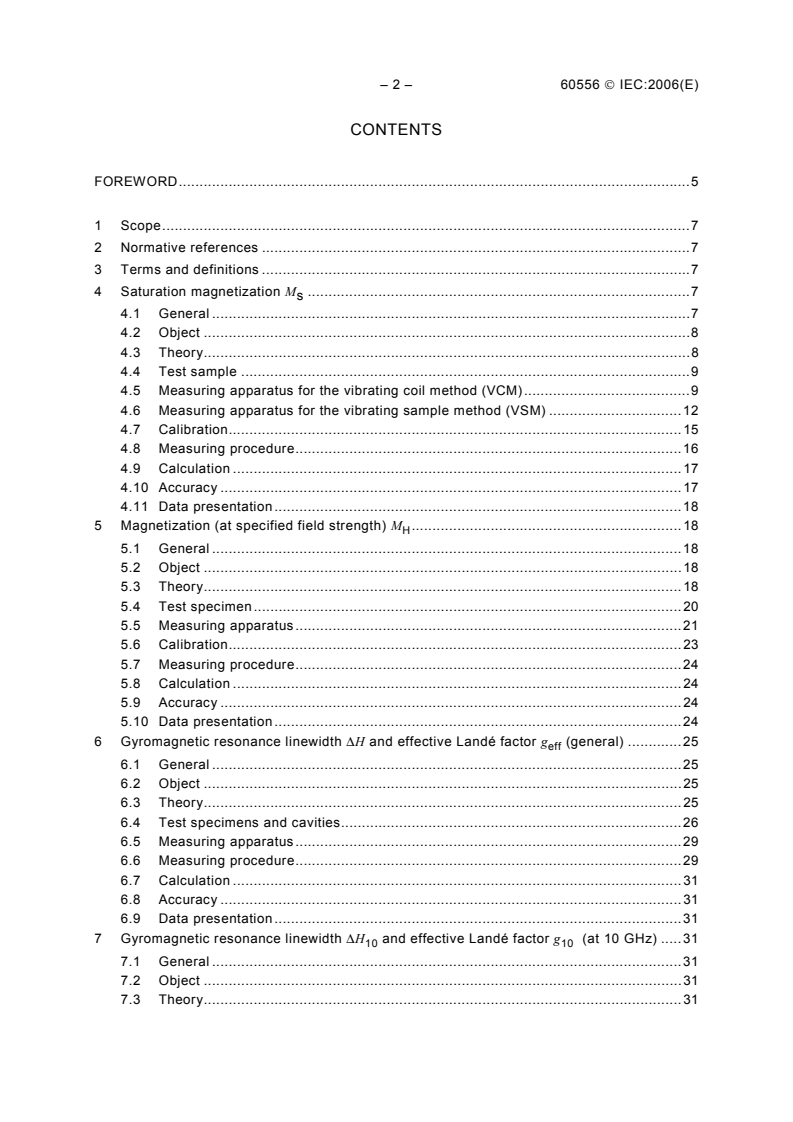
– 2 – 60556 IEC:2006(E)
CONTENTS
FOREWORD.5
1 Scope.7
2 Normative references .7
3 Terms and definitions .7
4 Saturation magnetization M .7
s
4.1 General .7
4.2 Object .8
4.3 Theory.8
4.4 Test sample .9
4.5 Measuring apparatus for the vibrating coil method (VCM).9
4.6 Measuring apparatus for the vibrating sample method (VSM) .12
4.7 Calibration.15
4.8 Measuring procedure.16
4.9 Calculation .17
4.10 Accuracy .17
4.11 Data presentation.18
5 Magnetization (at specified field strength) M .18
H
5.1 General .18
5.2 Object .18
5.3 Theory.18
5.4 Test specimen.20
5.5 Measuring apparatus.21
5.6 Calibration.23
5.7 Measuring procedure.24
5.8 Calculation .24
5.9 Accuracy .24
5.10 Data presentation.24
6 Gyromagnetic resonance linewidth ΔH and effective Landé factor g (general) .25
eff
6.1 General .25
6.2 Object .25
6.3 Theory.25
6.4 Test specimens and cavities.26
6.5 Measuring apparatus.29
6.6 Measuring procedure.29
6.7 Calculation .31
6.8 Accuracy .31
6.9 Data presentation.31
7 Gyromagnetic resonance linewidth ΔH and effective Landé factor g (at 10 GHz) .31
10 10
7.1 General .31
7.2 Object .31
7.3 Theory.31
60556 IEC:2006(E) – 3 –
7.4 Test specimen and cavity .32
7.5 Measuring apparatus.33
7.6 Measuring procedure.33
7.7 Calculation .34
7.8 Accuracy .34
7.9 Data presentation.35
8 Spin-wave resonance linewidth ΔH .35
k
8.1 General .35
8.2 Object .35
8.3 Theory.35
8.4 Test specimen and cavity .38
8.5 Measuring apparatus.39
8.6 Calibration.39
8.7 Measuring procedure.39
8.8 Calculation .40
8.9 Accuracy .40
8.10 Data presentation.40
9 Effective linewidth ΔH .40
eff
9.1 General .40
9.2 Object .40
9.3 Theory.41
9.4 Test specimen and cavity .43
9.5 Measuring apparatus.43
9.6 Calibration.44
9.7 Apparatus adjustment.44
9.8 Measuring procedure.45
9.9 Calculation .46
9.10 Accuracy .46
9.11 Data presentation.46
10 Complex permittivity ε .47
r
10.1 General .47
10.2 Object .47
10.3 Theory.47
10.4 Test specimen and cavity .50
10.5 Measuring apparatus.50
10.6 Measurement procedure.51
10.7 Calculation .51
10.8 Accuracy .52
10.9 Data presentation.52
11 Apparent density ρ .52
app
11.1 General .52
11.2 Apparent density (by mensuration) .52
11.3 Apparent density (by water densitometry).54
Bibliography.56
– 4 – 60556 IEC:2006(E)
Figure 1 – Vibrating coil method – Sample and coils arrangement .9
Figure 2 – Magnetic field configuration .10
Figure 3 – Measuring apparatus (VCM).12
Figure 4 – Vibrating sample method – Sample and coil arrangement .13
Figure 5 – Measuring apparatus (VSM).14
Figure 6 – Hysteresis curves for a magnetic material: B(H) curve, M(H) curve .19
Figure 7 – Test sample with compensation unit.20
Figure 8 – Test specimen.21
Figure 9 – Measuring circuit for determining magnetization (at specified field strength) M .22
H
Figure 10 – Miller integrator .23
Figure 11 – Cavity for measurement of gyromagnetic resonance linewidth and
effective Landé factor .27
Figure 12 – Stripline resonator for measurement of gyromagnetic resonance linewidth
and effective Landé factor at low frequency .28
Figure 13 – Schematic diagram of the equipment required for measurement of
gyromagnetic resonance linewidth and effective Landé factor .30
Figure 14 – Schematic diagram of the equipment required for measurement of
gyromagnetic resonance linewidth and effective Landé factor at 10 GHz .34
Figure 15 – Subsidiary absorption and saturation of the normal resonance .36
Figure 16 – Pulse deterioration at onset of subsidiary resonance.36
Figure 17 – Measured critical r.f. field strength as a function of pulse duration t .37
d
Figure 18 – Typical TE cavity for the measurement of spin-wave resonance
linewidth at about 9,3 GHz.38
Figure 19 – Block diagram of spin-wave resonance linewidth test equipment .39
Figure 20 – Sectional view of the cavity with specimen .42
Figure 21 – Dimensions of a cavity designed for resonance at a frequency of 9,1 GHz .42
Figure 22 – Schematic diagram of equipment for measuring effective linewidth ΔH .44
eff
Figure 23 – Determination of Q .46
Figure 24 – Ideal resonant cavity with specimen, used for theoretical calculation
(sectional view).48
Figure 25 – Dimensions of the resonant cavity with specimen.50
Figure 26 – Schematic diagram of equipment required for the measurement of
complex dielectric constant.51
60556 IEC:2006(E) – 5 –
INTERNATIONAL ELECTROTECHNICAL COMMISSION
____________
GYROMAGNETIC MATERIALS
INTENDED FOR APPLICATION AT MICROWAVE FREQUENCIES –
MEASURING METHODS FOR PROPERTIES
FOREWORD
1) The International Electrotechnical Commission (IEC) is a worldwide organization for standardization comprising
all national electrotechnical committees (IEC National Committees). The object of IEC is to promote
international co-operation on all questions concerning standardization in the electrical and electronic fields. To
this end and in addition to other activities, IEC publishes International Standards, Technical Specifications,
Technical Reports, Publicly Available Specifications (PAS) and Guides (hereafter referred to as “IEC
Publication(s)”). Their preparation is entrusted to technical committees; any IEC National Committee interested
in the subject dealt with may participate in this preparatory work. International, governmental and non-
governmental organizations liaising with the IEC also participate in this preparation. IEC collaborates closely
with the International Organization for Standardization (ISO) in accordance with conditions determined by
agreement between the two organizations.
2) The formal decisions or agreements of IEC on technical matters express, as nearly as possible, an international
consensus of opinion on the relevant subjects since each technical committee has representation from all
interested IEC National Committees.
3) IEC Publications have the form of recommendations for international use and are accepted by IEC National
Committees in that sense. While all reasonable efforts are made to ensure that the technical content of IEC
Publications is accurate, IEC cannot be held responsible for the way in which they are used or for any
misinterpretation by any end user.
4) In order to promote international uniformity, IEC National Committees undertake to apply IEC Publications
transparently to the maximum extent possible in their national and regional publications. Any divergence
between any IEC Publication and the corresponding national or regional publication shall be clearly indicated in
the latter.
5) IEC provides no marking procedure to indicate its approval and cannot be rendered responsible for any
equipment declared to be in conformity with an IEC Publication.
6) All users should ensure that they have the latest edition of this publication.
7) No liability shall attach to IEC or its directors, employees, servants or agents including individual experts and
members of its technical committees and IEC National Committees for any personal injury, property damage or
other damage of any nature whatsoever, whether direct or indirect, or for costs (including legal fees) and
expenses arising out of the publication, use of, or reliance upon, this IEC Publication or any other IEC
Publications.
8) Attention is drawn to the Normative references cited in this publication. Use of the referenced publications is
indispensable for the correct application of this publication.
9) Attention is drawn to the possibility that some of the elements of this IEC Publication may be the subject of
patent rights. IEC shall not be held responsible for identifying any or all such patent rights.
International Standard IEC 60556 has been prepared by IEC technical committee 51:
Magnetic components and ferrite materials.
This second edition cancels and replaces the first edition, published in 1982, its amendment 1
(1997) and amendment 2 (2004). This edition constitutes a technical revision.
This second edition is a consolidation of the first edition and its amendments 1 and 2.
It includes editorial improvements as well as improvements to the figures.
This standard is to be read in conjunction with IEC 60392.
– 6 – 60556 IEC:2006(E)
The text of this standard is based on the following documents:
FDIS Report on voting
51/850/FDIS 51/859/RVD
Full information on the voting for the approval of this standard can be found in the report on
voting indicated in the above table.
This publication has been drafted in accordance with the ISO/IEC Directives, Part 2.
The committee has decided that the contents of this publication will remain unchanged until
the maintenance result date indicated on the IEC web site under "http://webstore.iec.ch" in
the data related to the specific publication. At this date, the publication will be
• reconfirmed;
• withdrawn;
• replaced by a revised edition, or
• amended.
A bilingual version of this publication may be issued at a later date.
60556 IEC:2006(E) – 7 –
GYROMAGNETIC MATERIALS
INTENDED FOR APPLICATION AT MICROWAVE FREQUENCIES –
MEASURING METHODS FOR PROPERTIES
1 Scope
This International Standard describes methods of measuring the properties used to specify
polycrystalline microwave ferrites in accordance with IEC 60392 and for general use in ferrite
technology. These measuring methods are intended for the investigation of materials,
generally referred to as ferrites, for application at microwave frequencies.
Single crystals and thin films generally fall outside the scope of this standard.
NOTE 1 For the purposes of this standard, the words “ferrite” and “microwave” are used in a broad sense:
– by “ferrites” is meant not only magneto-dielectric chemical components having a spinel crystal structure, but
also materials with garnet and hexagonal structures;
– the “microwave” region is taken to include wavelengths approximately between 1 m and 1 mm, the main interest
being concentrated on the region 0,3 m to 10 mm.
NOTE 2 Examples of components employing microwave ferrites are non-reciprocal devices such as circulators,
isolators and non-reciprocal phase-shifters. These constitute the major field of application, but the materials may
be used in reciprocal devices as well, for example, modulators and (reciprocal) phase-shifters. Other applications
include gyromagnetic filters, limiters and more sophisticated devices, such as parametric amplifiers.
2 Normative references
The following referenced documents are indispensable for the application of this document.
For dated references, only the edition cited applies. For undated references, the latest edition
of the referenced document (including any amendment) applies.
IEC 60050-221, International Electrotechnical Vocabulary (IEV) – Part 221: Magnetic materials
components
IEC 60205:2006, Calculation of the effective parameters of magnetic piece parts
IEC 60392:1972, Guide for the drafting of specifications for microwave ferrites
3 Terms and definitions
For the purposes of this document, the terms and definitions given in IEC 60050-221 apply.
4 Saturation magnetization M
s
4.1 General
Saturation magnetization is a characteristic parameter of ferrite materials. It is widely used in
theoretical calculations, for instance in computation of tensor permeability components (see
IEC 60050-221). In a variety of microwave applications, saturation magnetization determines
the lower frequency limit of the device, mainly due to the occurrence of so-called low-field
loss when the material is unsaturated.
– 8 – 60556 IEC:2006(E)
4.2 Object
The object is to give two similar techniques for measuring saturation magnetization. These
are the vibrating coil method (VCM) and vibrating sample method (VSM).
The vibrating coil method [1] [2] has the advantages of easier sample mounting and simpler
mechanical arrangement when measurements over a range of temperatures are required,
particularly at low temperatures.
The vibrating sample method is more accurate, given a similar degree of elaboration in
electronic apparatus.
The equipment needed in both cases is very similar and the calibration methods are identical.
The same test samples can be used for either technique.
4.3 Theory
When a sphere of isotropic magnetic material is placed in a uniform magnetic field, the sphere
becomes uniformly magnetized in the direction parallel to the applied field. The sphere now
produces its own external magnetic field, equivalent to that of a magnetic dipole at the centre
of the sphere and orientated parallel to the direction of magnetization.
If a small detection coil (in practice a pair wound in opposition) is now vibrated at small
amplitude, close to the sample sphere and in a direction at right angles to the applied field, a
voltage e , will be induced in the coil, proportional to the rate of change of flux ϕ due to the
s s
sample at the mean coil position x whose value is given by
dϕ dx
s
e = −N ⋅ ⋅ (1)
s
dx dt
x
where N is the number of turns on the coil.
The motion of the coil, in the x-direction, is given by
x = x + δ sin ωt (2)
where
x is displacement at time t;
ω is angular frequency;
δ is vibration amplitude.
If the unknown sample is now replaced by a calibrating sample of known saturation
magnetization M and volume V , inducing a voltage e , the magnetization of the sample M
c c c s
may be found by comparison:
M e V
s s c
= ⋅ (3)
M e V
c c s
If the induced voltages e and e give rise to readings E and E from the apparatus, then
s c s c
E d
s c
M = M ⋅ ⋅ (4)
s c
E d
c s
and d are diameters of the sample and calibrating spheres, respectively.
where d
s c
—————————
Figures in square brackets refer to the bibliography.
60556 IEC:2006(E) – 9 –
Identical equations apply in the VSM case, when the sample is vibrated while the coil remains
stationary.
4.4 Test sample
For the dipole assumption to be valid, the test sample shall be a sphere, whose deviation from
roundness is not more than 0,5 %. The percentage deviation from roundness is defined as
max. diameter − min. diameter
× 100 (5)
min. diameter
For most ferrite materials, a diameter of about 2,5 mm is suitable. If it is less than 1 mm, a
reasonable signal-to-noise ratio will be difficult to achieve, particularly when M is low.
s
Spheres larger than about 4 mm are less convenient to make and it is not so easy to maintain
a uniform applied field over the volume of the sphere.
It may be permissible to use other than spherical samples, provided that the induced voltage
can be shown to be a linear function of the magnetization to within the accuracy required, and
that the calibration sample has identical dimensions to the samples to be measured.
4.5 Measuring apparatus for the vibrating coil method (VCM)
4.5.1 Arrangement of detection coils and sample
A schematic diagram of the arrangement of the detection coils and the sample is shown in
Figure 1. Figure 2 indicates the directions of the applied and sample fields.
The sample is rigidly mounted between the pole-pieces of an electromagnet, in such a way
that its position relative to the detection coils is reproducible to ±0,1 mm in any direction. All
parts of the sample holder shall be made of non-magnetic material.
The detection coils are an identical pair wound in series opposition. They are attached to the
vibrator by a rigid, non-magnetic arm and are located as close to the sample as practicable.
Their axes are normally parallel to the direction of vibration, but other configurations are
acceptable.
Vibration
x
Electromagnet pole
Electromagnet pole
z
Sample
y
Detection coils
IEC 555/06
Figure 1 – Vibrating coil method – Sample and coils arrangement
– 10 – 60556 IEC:2006(E)
Applied magnetic field
Electromagnet pole
Electromagnet pole
x
z
Dipole field of sample
y
IEC 556/06
Figure 2 – Magnetic field configuration
The direction of vibration (the x-direction) is at 90° to the z-axis of the electromagnet (Figure
1), i.e. perpendicular to the magnetostatic field direction, and the amplitude shall be of the
order of 0,05 mm to 0,5 mm. The frequency is not critical, but would normally be between
20 Hz and 200 Hz, although frequencies outside that range are acceptable. Motion of the coils
in the z- and y-directions shall be limited by means of suitable mounting to not more than 1 %
of that in the x-direction. Some means of stabilizing the vibration amplitude by use of a
feedback loop may be incorporated if required.
4.5.2 The electromagnet
The magnetostatic field shall be capable of fully saturating a spherical specimen of the
–1
material to be measured. For most microwave ferrites, a field of 300 kAm will be adequate,
–1
but for the hexagonal, barium-based ferrites, a field up to 500 kAm may be needed. The
current supply to the electromagnet shall be such as to maintain the field stable to 0,5 %.
At the mean position of the detection coils, the transverse field shall be not more than 1 % of
the longitudinal field (H ).
z
Since the uniformity of the field is dependent on the field-strength, measurements shall
always be made at the applied field at which calibration and zero-setting (see 4.8) have been
carried out.
4.5.3 Elimination of applied field effects
If the applied field were wholly uniform and had no radial components, while the direction of
vibration was exactly at right angles to the applied field, the theory of 4.3 could be applied
directly to the experimental arrangement of Figure 1.
However, as indicated in Figure 2, the applied field is not uniform, and its direction and
magnitude vary from point to point. Moreover, it is impracticable to make an identical pair of
detection coils. The angle of vibration will deviate from 90° and some residual motion in the y-
and z-directions will always be present.
Voltages will therefore be induced in the coils by the inhomogeneity of the applied field. The
effect of H is considerably lessened by winding the coils in opposition, so that voltages due
z
to H tend to cancel out whereas those due to the sample dipole field will add up.
z
However, complete cancellation cannot in general be achieved with one pair of coils alone.
Therefore, a second pair of coils, the compensating coils, is used. These are mounted on the
same formers as the sample coils, but are wound in series, so that the voltages induced by H
z
are additive. A compensating voltage can then be obtained, which may be adjusted in
amplitude and phase to balance out the voltage induced in the sample coils by H .
z
60556 IEC:2006(E) – 11 –
The effect of H is more difficult to eliminate because the voltages induced in the sample coils
x
will be added in the same way as those due to the dipole field. However, in general, the
variation of H with x will be different from that of the sample dipole field. The two signals will
x
therefore differ in phase and may be distinguished by means of a phase sensitive detector.
4.5.4 Electronic instrumentation
A schematic diagram of the measuring apparatus is shown in Figure 3. The vibrator is driven
by a low-frequency oscillator (9), which may be tunable, and a power amplifier. The amplitude
of the oscillator output and the gain of the power amplifier shall be sufficiently stable to
provide a constant drive to the vibrator to within ±0,3 %, after warm-up. If this is not possible,
some means of stabilizing the vibration amplitude shall be provided. The oscillator frequency
shall be stable to 0,05 % after warm-up.
The output from the compensating coils (1(c)) is balanced against that of the sample coils
(1(s)) by means of the difference amplifier (4), using the variable attenuator (2) and phase
shifter (3). The phase shifter shall be fully variable over 360° and its resolution shall be at
least ±0,1°. Neither the phase shifter nor the attenuator needs to be calibrated.
The difference amplifier shall have a low enough noise level at low frequencies to allow
precise zero setting. The exact requirements will depend on the design of the coils and other
equipment. A variable gain control may be incorporated.
The low-pass filter (5) shall reduce all harmonics by at least 20 dB with respect to the
fundamental frequency.
The selective amplifier, which is tuned to the oscillator frequency, shall have a bandwidth of
the order of 1 % and shall be tunable if the oscillator is not tunable.
The phase-sensitive detector (7) shall have a resolution better than 3° and either the
reference or signal channel shall be variable over 360° in phase. The phase setting shall be
independent of the amplitude of the input to either channel.
The meter (8) may be an analogue or digital type. When measurements are to be made over a
range of temperatures, an X–Y-recorder may be substituted for the meter, one axis to record
a linear function of magnetization, the other a linear function of temperature. Both axes shall
be calibrated to the accuracy required. The temperature measuring device, normally a
thermocouple, shall be in close thermal contact with the sample itself.
All the electronic instruments shall have adequate temperature stability to ensure the required
accuracy over the range of ambient temperatures to be met in use.
– 12 – 60556 IEC:2006(E)
Sample
coils
Selective
1(s)
low-frequency
Phase-sensitive
amplifier
detector
Difference
4 5 7
amplifier
Compensating
coils
Meter or
Low-pass
filter digital voltmeter
1(c)
Attenuator Phase shifter
Oscilloscope
Low-frequency
oscillator
Power
amplifier
Vibrator
IEC 557/06
Figure 3 – Measuring apparatus (VCM)
4.6 Measuring apparatus for the vibrating sample method (VSM)
4.6.1 Arrangement of detection coils and sample
In the vibrating sample case, the detection coils (Figure 4) are rigidly mounted between the
pole-pieces of the electromagnet, but in such a way that frequent small adjustments are
possible. Normally, their axes are at right angles to the applied field and parallel to the
direction of vibration, but other configurations [5] are acceptable. The mean sample position
is on the axis of the electromagnet, normally located symmetrically with respect to the
detection coils. Its position shall be reproducible to ±0,1 mm. It is rigidly mounted on a non-
magnetic vibrating arm, attached to a vibrator, and is as close to the detection coils as
practicable.
The direction of vibration (the x-direction) is at 90° to the z-axis of the electromagnet
(Figure 4), i.e. perpendicular to the magnetostatic field direction, and the amplitude shall be of
the order of 0,05 mm to 0,5 mm. The frequency is not critical, but would normally be between
20 Hz and 200 Hz, although frequencies outside that range are acceptable. Motion of the
sample in the z- and y-directions shall be limited by means of a suitable mounting to not more
than 1 % of that in the x-direction. Some means of stabilizing the vibration amplitude by use of
a feedback loop may be incorporated if necessary.
A small permanent magnet is attached to the vibrating arm, far enough away from the
electromagnet to be unaffected by it. Two small coils are mounted rigidly on either side of this
magnet to detect its field. A small coil carrying a precisely controlled direct current may be
used instead of the magnet.
60556 IEC:2006(E) – 13 –
Permanent magnet or d.c. coil
Balancing coils
Vibration
Electromagnet pole x
Electromagnet pole
z
Detection coils
y
Sample
IEC 558/06
Figure 4 – Vibrating sample method – Sample and coil arrangement
4.6.2 The electromagnet
No precautions need be taken to counteract curvature and non-uniformity of applied field,
provided that a uniformity of about 3 % over the volume of the sample is maintained. A radial
field of up to 1 % of the longitudinal field is permissible.
The magnetostatic field shall be capable of fully saturating a spherical specimen of the
–1
material to be measured. For most microwave ferrites, a field of 300 kAm will be adequate,
–1
but for the hexagonal, barium-based ferrites a field up to 500 kAm may be needed. The
current supply shall maintain the field stable to about 0,5 %.
4.6.3 Electronic instrumentation
A schematic diagram of the electronic instrumentation is shown in Figure 5. The simplest
arrangement uses only items 1 to 8, and allows point-by-point measurements to be made at
fixed temperatures. The calibrated potential divider (3) is used to balance the voltage induced
in the balancing coils against that in the sample coils. The null point is observed by means of
the oscilloscope (5). Magnetization is calculated from the potential divider setting.
Alternatively, the null balance may be made with the empty sample holder in position. The
out-of-balance signal on insertion of a sample is then proportional to magnetization. This
signal may be read directly from the meter (5) or oscilloscope. For continuous plotting of M
s
as a function of temperature, an X–Y-recorder may be substituted for the oscilloscope.
Greater sensitivity and better stability may be obtained by use of a phase sensitive detector (9)
to detect the signal, which may then be observed by means of a meter or recorder.
If a d.c. coil (12) is used instead of a permanent magnet to obtain the balancing voltage,
automatic null balancing may be achieved by feeding the output of this phase sensitive
detector to the d.c. coil. The current in the coil is then directly proportional to magnetization.
The coil current may be measured by means of a d.c. ammeter in series with it, or by a high-
resistance voltmeter in parallel with the coil. In the second case, variations in coil resistance
due to temperature changes shall be compatible with the degree of accuracy required in M .
s
– 14 – 60556 IEC:2006(E)
Sample
coils
1(s)
Difference
Oscilloscope
amplifier
4 5
or meter
(selective)
Balancing
coils
1(b)
Potential
Phase shifter
divider
Meter or
digital voltmeter
Phase-sensitive
detector
Low-frequency
Power
oscillator
amplifier
DC voltmeter
Ammeter
Vibrator
DC coil
Buffer
amplifier
IEC 559/06
Figure 5 – Measuring apparatus (VSM)
The vibrator is driven by a low-frequency oscillator, which may be tunable, and a power
amplifier. The amplitude of the oscillator output and the gain of the power amplifier shall be
sufficiently stable to maintain the drive to the vibrator at a constant level, to within 0,3 % after
warm-up. If this is not possible, some means of stabilizing the vibration amplitude shall be
provided. The oscillator frequency shall be stable to within 0,05 % after warm-up.
The potential divider shall be continuously variable with a resolution of 0,01 % or better and
shall be calibrated to the accuracy required.
The difference amplifier shall have a sufficiently low noise level and shall incorporate, or be
followed by, a selective amplifier with a bandwidth of the order of 3 %, tuned to the oscillator
frequency. The selective stage shall be tunable if the oscillator is not tunable.
The requirements for the phase-sensitive detector are not stringent. A resolution of 10° is
adequate. The phase setting shall be independent of the amplitude of the input to either
channel.
The meters may be analogue or digital types. When measurements are to be made over a
range of temperatures, an X–Y-recorder may be substituted for the meter, one axis to be a
linear function of magnetization, the other a linear function of temperature. Both shall be
calibrated to the accuracy required. The temperature measuring device, normally a
thermocouple, shall be in close thermal contact with the sample itself.
All the electronic equipment shall have adequate temperature stability to maintain the
required accuracy over the range of ambient temperatures generally encountered in use.
60556 IEC:2006(E) – 15 –
4.7 Calibration
4.7.1 Comparison method
This method, which is equally applicable to either the vibrating coil or the vibrating sample
methods, calls for a standard sample whose saturation magnetization is accurately known.
The most usual material for the standard is pure nickel, but other materials may be used if
their saturation magnetization is known accurately enough.
The calibration sample shall be a sphere (if the samples to be measured are spheres) and be
of a similar order of size. (If samples other than spheres have to be measured, calibration
samples with identical dimensions shall be used.) The calibration sphere shall show a
deviation from roundness of not more than 0,5 % and its mean diameter shall be known to
within 0,1 %. Standard metallic spheres shall be fully annealed before use.
The density of the material to be used as a standard shall first be determined. The generally
accepted value for the saturation magnetization of 99,995 % pure nickel with a density of
–3 –1
8,90 g⋅cm , is 485,6 kAm at 23 °C. For less dense material:
485,6 × density
–1
M = (kAm) (6)
s
8,90
However, the actual value for a specific sample may differ from this by as much as 1 % [3],
depending on purity, state of strain, applied field, or ambient temperature. The accuracy of
the comparison method is therefore limited.
4.7.2 “Slope” method
This method, which is equally applicable to either the vibrating coil or the vibrating sample
methods, is based on the observation that the voltage induced in the detection coils by a
spherical specimen is directly proportional to the applied field over the lower region of the
magnetization curve [4]. Furthermore, the constant of proportionality is independent of the
permeability, provided that the latter is sufficiently high.
According to 4.3, the voltmeter reading E , for any sample x, can be written:
x
E = kM d (7)
X X X
where
M is the magnetization of the sample at a (low) value of applied magnetostatic field
x
strength H ;
d is the sample diameter;
x
k is the constant.
In the region below saturation, the (linear) relationship between M and H is given by the
x 0
following equations:
M =()µ − 1 H (8)
x x i
H = H − NM (9)
i 0 x
where
H is the magnetostatic field strength inside the sample;
i
µ is the relative permeability of the sample;
x
N is the demagnetization factor which is equal to one-third for a perfect sphere.
– 16 – 60556 IEC:2006(E)
Elimination of H between equations (8) and (9) yields:
i
H = + N M (10)
0 x
µ − 1
x
Elimination of M between equations (7) and (10) yields:
x
H
0 3
E = k d (11)
X
X
1/()µ − 1 + N
x
The linear part of the graph of E as a function of H has a slope which, according to equation
x 0
(11), is equal to
kd
ΔE
X X
= (12)
ΔH 1/()µ − 1 + N
0 x
If µ is sufficiently high, for example 2 000, the first term in the denominator can be neglected
x
in comparison with N, and the parameter k can be expressed as
ΔE / ΔH
x 0
(13)
k =
3d
X
to within an error of 0,15 %.
A deviation from roundness of 0,25 % leads to a maximum error in N of
...
IEC 60556 ®
Edition 2.0 2006-04
INTERNATIONAL
STANDARD
NORME
INTERNATIONALE
Gyromagnetic materials intended for application at microwave frequencies –
Measuring methods for properties
Matériaux gyromagnétiques destinés à des applications hyperfréquences –
Méthodes de mesure des propriétés
All rights reserved. Unless otherwise specified, no part of this publication may be reproduced or utilized in any form or by
any means, electronic or mechanical, including photocopying and microfilm, without permission in writing from either IEC or
IEC's member National Committee in the country of the requester.
If you have any questions about IEC copyright or have an enquiry about obtaining additional rights to this publication,
please contact the address below or your local IEC member National Committee for further information.
Droits de reproduction réservés. Sauf indication contraire, aucune partie de cette publication ne peut être reproduite
ni utilisée sous quelque forme que ce soit et par aucun procédé, électronique ou mécanique, y compris la photocopie
et les microfilms, sans l'accord écrit de la CEI ou du Comité national de la CEI du pays du demandeur.
Si vous avez des questions sur le copyright de la CEI ou si vous désirez obtenir des droits supplémentaires sur cette
publication, utilisez les coordonnées ci-après ou contactez le Comité national de la CEI de votre pays de résidence.
IEC Central Office
3, rue de Varembé
CH-1211 Geneva 20
Switzerland
Email: inmail@iec.ch
Web: www.iec.ch
About the IEC
The International Electrotechnical Commission (IEC) is the leading global organization that prepares and publishes
International Standards for all electrical, electronic and related technologies.
About IEC publications
The technical content of IEC publications is kept under constant review by the IEC. Please make sure that you have the
latest edition, a corrigenda or an amendment might have been published.
Catalogue of IEC publications: www.iec.ch/searchpub
The IEC on-line Catalogue enables you to search by a variety of criteria (reference number, text, technical committee,…).
It also gives information on projects, withdrawn and replaced publications.
IEC Just Published: www.iec.ch/online_news/justpub
Stay up to date on all new IEC publications. Just Published details twice a month all new publications released. Available
on-line and also by email.
Electropedia: www.electropedia.org
The world's leading online dictionary of electronic and electrical terms containing more than 20 000 terms and definitions
in English and French, with equivalent terms in additional languages. Also known as the International Electrotechnical
Vocabulary online.
Customer Service Centre: www.iec.ch/webstore/custserv
If you wish to give us your feedback on this publication or need further assistance, please visit the Customer Service
Centre FAQ or contact us:
Email: csc@iec.ch
Tel.: +41 22 919 02 11
Fax: +41 22 919 03 00
A propos de la CEI
La Commission Electrotechnique Internationale (CEI) est la première organisation mondiale qui élabore et publie des
normes internationales pour tout ce qui a trait à l'électricité, à l'électronique et aux technologies apparentées.
A propos des publications CEI
Le contenu technique des publications de la CEI est constamment revu. Veuillez vous assurer que vous possédez
l’édition la plus récente, un corrigendum ou amendement peut avoir été publié.
Catalogue des publications de la CEI: www.iec.ch/searchpub/cur_fut-f.htm
Le Catalogue en-ligne de la CEI vous permet d’effectuer des recherches en utilisant différents critères (numéro de référence,
texte, comité d’études,…). Il donne aussi des informations sur les projets et les publications retirées ou remplacées.
Just Published CEI: www.iec.ch/online_news/justpub
Restez informé sur les nouvelles publications de la CEI. Just Published détaille deux fois par mois les nouvelles
publications parues. Disponible en-ligne et aussi par email.
Electropedia: www.electropedia.org
Le premier dictionnaire en ligne au monde de termes électroniques et électriques. Il contient plus de 20 000 termes et
définitions en anglais et en français, ainsi que les termes équivalents dans les langues additionnelles. Egalement appelé
Vocabulaire Electrotechnique International en ligne.
Service Clients: www.iec.ch/webstore/custserv/custserv_entry-f.htm
Si vous désirez nous donner des commentaires sur cette publication ou si vous avez des questions, visitez le FAQ du
Service clients ou contactez-nous:
Email: csc@iec.ch
Tél.: +41 22 919 02 11
Fax: +41 22 919 03 00
IEC 60556 ®
Edition 2.0 2006-04
INTERNATIONAL
STANDARD
NORME
INTERNATIONALE
Gyromagnetic materials intended for application at microwave frequencies –
Measuring methods for properties
Matériaux gyromagnétiques destinés à des applications hyperfréquences –
Méthodes de mesure des propriétés
INTERNATIONAL
ELECTROTECHNICAL
COMMISSION
COMMISSION
ELECTROTECHNIQUE
PRICE CODE
INTERNATIONALE
CODE PRIX XA
ICS 29.100.10 ISBN 978-2-88912-595-1
– 2 – 60556 IEC:2006
CONTENTS
FOREWORD . 5
1 Scope . 7
2 Normative references . 7
3 Terms and definitions . 7
4 Saturation magnetization M . 7
s
4.1 General . 7
4.2 Object . 8
4.3 Theory . 8
4.4 Test sample . 9
4.5 Measuring apparatus for the vibrating coil method (VCM) . 9
4.6 Measuring apparatus for the vibrating sample method (VSM) . 12
4.7 Calibration . 15
4.8 Measuring procedure . 16
4.9 Calculation . 17
4.10 Accuracy . 17
4.11 Data presentation . 18
5 Magnetization (at specified field strength) M . 18
H
5.1 General . 18
5.2 Object . 18
5.3 Theory . 18
5.4 Test specimen . 20
5.5 Measuring apparatus . 21
5.6 Calibration . 23
5.7 Measuring procedure . 24
5.8 Calculation . 24
5.9 Accuracy . 24
5.10 Data presentation . 24
6 Gyromagnetic resonance linewidth ∆H and effective Landé factor g (general) . 25
eff
6.1 General . 25
6.2 Object . 25
6.3 Theory . 25
6.4 Test specimens and cavities . 26
6.5 Measuring apparatus . 29
6.6 Measuring procedure . 29
6.7 Calculation . 31
6.8 Accuracy . 31
6.9 Data presentation . 31
7 Gyromagnetic resonance linewidth ∆H and effective Landé factor g (at 10 GHz) . 31
10 10
7.1 General . 31
7.2 Object . 31
7.3 Theory . 31
7.4 Test specimen and cavity . 32
7.5 Measuring apparatus . 33
7.6 Measuring procedure . 33
7.7 Calculation . 34
7.8 Accuracy . 34
60556 IEC:2006 – 3 –
7.9 Data presentation . 35
8 Spin-wave resonance linewidth ∆H . 35
k
8.1 General . 35
8.2 Object . 35
8.3 Theory . 35
8.4 Test specimen and cavity . 38
8.5 Measuring apparatus . 39
8.6 Calibration . 39
8.7 Measuring procedure . 39
8.8 Calculation . 40
8.9 Accuracy . 40
8.10 Data presentation . 40
9 Effective linewidth ∆H . 40
eff
9.1 General . 40
9.2 Object . 40
9.3 Theory . 41
9.4 Test specimen and cavity . 43
9.5 Measuring apparatus . 43
9.6 Calibration . 44
9.7 Apparatus adjustment . 44
9.8 Measuring procedure . 45
9.9 Calculation . 46
9.10 Accuracy . 46
9.11 Data presentation . 46
10 Complex permittivity ε . 47
r
10.1 General . 47
10.2 Object . 47
10.3 Theory . 47
10.4 Test specimen and cavity . 50
10.5 Measuring apparatus . 50
10.6 Measurement procedure . 51
10.7 Calculation . 51
10.8 Accuracy . 52
10.9 Data presentation . 52
11 Apparent density ρ . 52
app
11.1 General . 52
11.2 Apparent density (by mensuration) . 52
11.3 Apparent density (by water densitometry) . 54
Bibliography . 56
Figure 1 – Vibrating coil method – Sample and coils arrangement . 9
Figure 2 – Magnetic field configuration . 10
Figure 3 – Measuring apparatus (VCM) . 12
Figure 4 – Vibrating sample method – Sample and coil arrangement . 13
Figure 5 – Measuring apparatus (VSM) . 14
Figure 6 – Hysteresis curves for a magnetic material: B(H) curve, M(H) curve . 19
Figure 7 – Test sample with compensation unit . 20
– 4 – 60556 IEC:2006
Figure 8 – Test specimen . 21
Figure 9 – Measuring circuit for determining magnetization (at specified field strength) M . 22
H
Figure 10 – Miller integrator . 23
Figure 11 – Cavity for measurement of gyromagnetic resonance linewidth and
effective Landé factor . 27
Figure 12 – Stripline resonator for measurement of gyromagnetic resonance linewidth
and effective Landé factor at low frequency . 28
Figure 13 – Schematic diagram of the equipment required for measurement of
gyromagnetic resonance linewidth and effective Landé factor . 30
Figure 14 – Schematic diagram of the equipment required for measurement of
gyromagnetic resonance linewidth and effective Landé factor at 10 GHz . 34
Figure 15 – Subsidiary absorption and saturation of the normal resonance . 36
Figure 16 – Pulse deterioration at onset of subsidiary resonance . 36
Figure 17 – Measured critical r.f. field strength as a function of pulse duration t . 37
d
Figure 18 – Typical TE cavity for the measurement of spin-wave resonance
linewidth at about 9,3 GHz . 38
Figure 19 – Block diagram of spin-wave resonance linewidth test equipment . 39
Figure 20 – Sectional view of the cavity with specimen . 42
Figure 21 – Dimensions of a cavity designed for resonance at a frequency of 9,1 GHz . 42
Figure 22 – Schematic diagram of equipment for measuring effective linewidth ∆H . 44
eff
Figure 23 – Determination of Q . 46
Figure 24 – Ideal resonant cavity with specimen, used for theoretical calculation
(sectional view) . 48
Figure 25 – Dimensions of the resonant cavity with specimen . 50
Figure 26 – Schematic diagram of equipment required for the measurement of
complex dielectric constant . 51
60556 IEC:2006 – 5 –
INTERNATIONAL ELECTROTECHNICAL COMMISSION
____________
GYROMAGNETIC MATERIALS
INTENDED FOR APPLICATION AT MICROWAVE FREQUENCIES –
MEASURING METHODS FOR PROPERTIES
FOREWORD
1) The International Electrotechnical Commission (IEC) is a worldwide organization for standardization comprising
all national electrotechnical committees (IEC National Committees). The object of IEC is to promote
international co-operation on all questions concerning standardization in the electrical and electronic fields. To
this end and in addition to other activities, IEC publishes International Standards, Technical Specifications,
Technical Reports, Publicly Available Specifications (PAS) and Guides (hereafter referred to as “IEC
Publication(s)”). Their preparation is entrusted to technical committees; any IEC National Committee interested
in the subject dealt with may participate in this preparatory work. International, governmental and non-
governmental organizations liaising with the IEC also participate in this preparation. IEC collaborates closely
with the International Organization for Standardization (ISO) in accordance with conditions determined by
agreement between the two organizations.
2) The formal decisions or agreements of IEC on technical matters express, as nearly as possible, an international
consensus of opinion on the relevant subjects since each technical committee has representation from all
interested IEC National Committees.
3) IEC Publications have the form of recommendations for international use and are accepted by IEC National
Committees in that sense. While all reasonable efforts are made to ensure that the technical content of IEC
Publications is accurate, IEC cannot be held responsible for the way in which they are used or for any
misinterpretation by any end user.
4) In order to promote international uniformity, IEC National Committees undertake to apply IEC Publications
transparently to the maximum extent possible in their national and regional publications. Any divergence
between any IEC Publication and the corresponding national or regional publication shall be clearly indicated in
the latter.
5) IEC itself does not provide any attestation of conformity. Independent certification bodies provide conformity
assessment services and, in some areas, access to IEC marks of conformity. IEC is not responsible for any
services carried out by independent certification bodies.
6) All users should ensure that they have the latest edition of this publication.
7) No liability shall attach to IEC or its directors, employees, servants or agents including individual experts and
members of its technical committees and IEC National Committees for any personal injury, property damage or
other damage of any nature whatsoever, whether direct or indirect, or for costs (including legal fees) and
expenses arising out of the publication, use of, or reliance upon, this IEC Publication or any other IEC
Publications.
8) Attention is drawn to the Normative references cited in this publication. Use of the referenced publications is
indispensable for the correct application of this publication.
9) Attention is drawn to the possibility that some of the elements of this IEC Publication may be the subject of
patent rights. IEC shall not be held responsible for identifying any or all such patent rights.
International Standard IEC 60556 has been prepared by IEC technical committee 51:
Magnetic components and ferrite materials.
This second edition cancels and replaces the first edition, published in 1982, its amendment 1
(1997) and amendment 2 (2004). This edition constitutes a technical revision.
This second edition is a consolidation of the first edition and its amendments 1 and 2.
It includes editorial improvements as well as improvements to the figures.
This standard is to be read in conjunction with IEC 60392.
This bilingual version (2011-07) replaces the English version.
– 6 – 60556 IEC:2006
The text of this standard is based on the following documents:
FDIS Report on voting
51/850/FDIS 51/859/RVD
Full information on the voting for the approval of this standard can be found in the report on
voting indicated in the above table.
The French version of this standard has not been voted upon.
This publication has been drafted in accordance with the ISO/IEC Directives, Part 2.
The committee has decided that the contents of this publication will remain unchanged until
the stability date indicated on the IEC web site under "http://webstore.iec.ch" in the data
related to the specific publication. At this date, the publication will be
• reconfirmed,
• withdrawn,
• replaced by a revised edition, or
• amended.
60556 IEC:2006 – 7 –
GYROMAGNETIC MATERIALS
INTENDED FOR APPLICATION AT MICROWAVE FREQUENCIES –
MEASURING METHODS FOR PROPERTIES
1 Scope
This International Standard describes methods of measuring the properties used to specify
polycrystalline microwave ferrites in accordance with IEC 60392 and for general use in ferrite
technology. These measuring methods are intended for the investigation of materials,
generally referred to as ferrites, for application at microwave frequencies.
Single crystals and thin films generally fall outside the scope of this standard.
NOTE 1 For the purposes of this standard, the words “ferrite” and “microwave” are used in a broad sense:
– by “ferrites” is meant not only magneto-dielectric chemical components having a spinel crystal structure, but
also materials with garnet and hexagonal structures;
– the “microwave” region is taken to include wavelengths approximately between 1 m and 1 mm, the main interest
being concentrated on the region 0,3 m to 10 mm.
NOTE 2 Examples of components employing microwave ferrites are non-reciprocal devices such as circulators,
isolators and non-reciprocal phase-shifters. These constitute the major field of application, but the materials may
be used in reciprocal devices as well, for example, modulators and (reciprocal) phase-shifters. Other applications
include gyromagnetic filters, limiters and more sophisticated devices, such as parametric amplifiers.
2 Normative references
The following referenced documents are indispensable for the application of this document.
For dated references, only the edition cited applies. For undated references, the latest edition
of the referenced document (including any amendment) applies.
IEC 60050-221, International Electrotechnical Vocabulary (IEV) – Part 221: Magnetic materials
components
IEC 60205:2006, Calculation of the effective parameters of magnetic piece parts
IEC 60392:1972, Guide for the drafting of specifications for microwave ferrites
3 Terms and definitions
For the purposes of this document, the terms and definitions given in IEC 60050-221 apply.
4 Saturation magnetization M
s
4.1 General
Saturation magnetization is a characteristic parameter of ferrite materials. It is widely used in
theoretical calculations, for instance in computation of tensor permeability components (see
IEC 60050-221). In a variety of microwave applications, saturation magnetization determines
the lower frequency limit of the device, mainly due to the occurrence of so-called low-field
loss when the material is unsaturated.
– 8 – 60556 IEC:2006
4.2 Object
The object is to give two similar techniques for measuring saturation magnetization. These
are the vibrating coil method (VCM) and vibrating sample method (VSM).
The vibrating coil method [1] [2] has the advantages of easier sample mounting and simpler
mechanical arrangement when measurements over a range of temperatures are required,
particularly at low temperatures.
The vibrating sample method is more accurate, given a similar degree of elaboration in
electronic apparatus.
The equipment needed in both cases is very similar and the calibration methods are identical.
The same test samples can be used for either technique.
4.3 Theory
When a sphere of isotropic magnetic material is placed in a uniform magnetic field, the sphere
becomes uniformly magnetized in the direction parallel to the applied field. The sphere now
produces its own external magnetic field, equivalent to that of a magnetic dipole at the centre
of the sphere and orientated parallel to the direction of magnetization.
If a small detection coil (in practice a pair wound in opposition) is now vibrated at small
amplitude, close to the sample sphere and in a direction at right angles to the applied field, a
voltage e , will be induced in the coil, proportional to the rate of change of flux ϕ due to the
s s
sample at the mean coil position x whose value is given by
dϕ dx
s
e =−N⋅ ⋅ (1)
s
dx dt
x
where N is the number of turns on the coil.
The motion of the coil, in the x-direction, is given by
x= x +δ sin ωt (2)
where
x is displacement at time t;
ω is angular frequency;
δ is vibration amplitude.
If the unknown sample is now replaced by a calibrating sample of known saturation
magnetization M and volume V , inducing a voltage e , the magnetization of the sample M
c c c s
may be found by comparison:
M e V
s s c
= ⋅ (3)
M e V
c c s
If the induced voltages e and e give rise to readings E and E from the apparatus, then
s c s c
E d
s c
M = M ⋅ ⋅ (4)
s c
E d
c s
where d and d are diameters of the sample and calibrating spheres, respectively.
s c
—————————
Figures in square brackets refer to the bibliography.
60556 IEC:2006 – 9 –
Identical equations apply in the VSM case, when the sample is vibrated while the coil remains
stationary.
4.4 Test sample
For the dipole assumption to be valid, the test sample shall be a sphere, whose deviation from
roundness is not more than 0,5 %. The percentage deviation from roundness is defined as
max. diameter − min. diameter
×100 (5)
min. diameter
For most ferrite materials, a diameter of about 2,5 mm is suitable. If it is less than 1 mm, a
reasonable signal-to-noise ratio will be difficult to achieve, particularly when M is low.
s
Spheres larger than about 4 mm are less convenient to make and it is not so easy to maintain
a uniform applied field over the volume of the sphere.
It may be permissible to use other than spherical samples, provided that the induced voltage
can be shown to be a linear function of the magnetization to within the accuracy required, and
that the calibration sample has identical dimensions to the samples to be measured.
4.5 Measuring apparatus for the vibrating coil method (VCM)
4.5.1 Arrangement of detection coils and sample
A schematic diagram of the arrangement of the detection coils and the sample is shown in
Figure 1. Figure 2 indicates the directions of the applied and sample fields.
The sample is rigidly mounted between the pole-pieces of an electromagnet, in such a way
that its position relative to the detection coils is reproducible to ±0,1 mm in any direction. All
parts of the sample holder shall be made of non-magnetic material.
The detection coils are an identical pair wound in series opposition. They are attached to the
vibrator by a rigid, non-magnetic arm and are located as close to the sample as practicable.
Their axes are normally parallel to the direction of vibration, but other configurations are
acceptable.
Vibration
x
Electromagnet pole
Electromagnet pole
z
Sample
y
Detection coils
IEC 555/06
Figure 1 – Vibrating coil method – Sample and coils arrangement
– 10 – 60556 IEC:2006
Applied magnetic field
Electromagnet pole
Electromagnet pole
x
z
Dipole field of sample
y
IEC 556/06
Figure 2 – Magnetic field configuration
The direction of vibration (the x-direction) is at 90° to the z-axis of the electromagnet
(Figure 1), i.e. perpendicular to the magnetostatic field direction, and the amplitude shall be of
the order of 0,05 mm to 0,5 mm. The frequency is not critical, but would normally be between
20 Hz and 200 Hz, although frequencies outside that range are acceptable. Motion of the coils
in the z- and y-directions shall be limited by means of suitable mounting to not more than 1 %
of that in the x-direction. Some means of stabilizing the vibration amplitude by use of a
feedback loop may be incorporated if required.
4.5.2 The electromagnet
The magnetostatic field shall be capable of fully saturating a spherical specimen of the
–1
material to be measured. For most microwave ferrites, a field of 300 kAm will be adequate,
–1
but for the hexagonal, barium-based ferrites, a field up to 500 kAm may be needed. The
current supply to the electromagnet shall be such as to maintain the field stable to 0,5 %.
At the mean position of the detection coils, the transverse field shall be not more than 1 % of
the longitudinal field (H ).
z
Since the uniformity of the field is dependent on the field-strength, measurements shall
always be made at the applied field at which calibration and zero-setting (see 4.8) have been
carried out.
4.5.3 Elimination of applied field effects
If the applied field were wholly uniform and had no radial components, while the direction of
vibration was exactly at right angles to the applied field, the theory of 4.3 could be applied
directly to the experimental arrangement of Figure 1.
However, as indicated in Figure 2, the applied field is not uniform, and its direction and
magnitude vary from point to point. Moreover, it is impracticable to make an identical pair of
detection coils. The angle of vibration will deviate from 90° and some residual motion in the y-
and z-directions will always be present.
Voltages will therefore be induced in the coils by the inhomogeneity of the applied field. The
effect of H is considerably lessened by winding the coils in opposition, so that voltages due
z
to H tend to cancel out whereas those due to the sample dipole field will add up.
z
However, complete cancellation cannot in general be achieved with one pair of coils alone.
Therefore, a second pair of coils, the compensating coils, is used. These are mounted on the
same formers as the sample coils, but are wound in series, so that the voltages induced by H
z
are additive. A compensating voltage can then be obtained, which may be adjusted in
amplitude and phase to balance out the voltage induced in the sample coils by H .
z
60556 IEC:2006 – 11 –
The effect of H is more difficult to eliminate because the voltages induced in the sample coils
x
will be added in the same way as those due to the dipole field. However, in general, the
variation of H with x will be different from that of the sample dipole field. The two signals will
x
therefore differ in phase and may be distinguished by means of a phase sensitive detector.
4.5.4 Electronic instrumentation
A schematic diagram of the measuring apparatus is shown in Figure 3. The vibrator is driven
by a low-frequency oscillator (9), which may be tunable, and a power amplifier. The amplitude
of the oscillator output and the gain of the power amplifier shall be sufficiently stable to
provide a constant drive to the vibrator to within ±0,3 %, after warm-up. If this is not possible,
some means of stabilizing the vibration amplitude shall be provided. The oscillator frequency
shall be stable to 0,05 % after warm-up.
The output from the compensating coils (1(c)) is balanced against that of the sample coils
(1(s)) by means of the difference amplifier (4), using the variable attenuator (2) and phase
shifter (3). The phase shifter shall be fully variable over 360° and its resolution shall be at
least ±0,1°. Neither the phase shifter nor the attenuator needs to be calibrated.
The difference amplifier shall have a low enough noise level at low frequencies to allow
precise zero setting. The exact requirements will depend on the design of the coils and other
equipment. A variable gain control may be incorporated.
The low-pass filter (5) shall reduce all harmonics by at least 20 dB with respect to the
fundamental frequency.
The selective amplifier, which is tuned to the oscillator frequency, shall have a bandwidth of
the order of 1 % and shall be tunable if the oscillator is not tunable.
The phase-sensitive detector (7) shall have a resolution better than 3° and either the
reference or signal channel shall be variable over 360° in phase. The phase setting shall be
independent of the amplitude of the input to either channel.
The meter (8) may be an analogue or digital type. When measurements are to be made over a
range of temperatures, an X–Y-recorder may be substituted for the meter, one axis to record
a linear function of magnetization, the other a linear function of temperature. Both axes shall
be calibrated to the accuracy required. The temperature measuring device, normally a
thermocouple, shall be in close thermal contact with the sample itself.
All the electronic instruments shall have adequate temperature stability to ensure the required
accuracy over the range of ambient temperatures to be met in use.
– 12 – 60556 IEC:2006
Sample
coils
Selective
1(s)
low-frequency
Phase-sensitive
amplifier
detector
Difference
4 5 7
amplifier
Compensating
coils
Meter or
Low-pass
filter digital voltmeter
1(c)
Attenuator
Phase shifter
Oscilloscope
Low-frequency
oscillator
Power
amplifier
Vibrator
IEC 557/06
Figure 3 – Measuring apparatus (VCM)
4.6 Measuring apparatus for the vibrating sample method (VSM)
4.6.1 Arrangement of detection coils and sample
In the vibrating sample case, the detection coils (Figure 4) are rigidly mounted between the
pole-pieces of the electromagnet, but in such a way that frequent small adjustments are
possible. Normally, their axes are at right angles to the applied field and parallel to the
direction of vibration, but other configurations [5] are acceptable. The mean sample position
is on the axis of the electromagnet, normally located symmetrically with respect to the
detection coils. Its position shall be reproducible to ±0,1 mm. It is rigidly mounted on a non-
magnetic vibrating arm, attached to a vibrator, and is as close to the detection coils as
practicable.
The direction of vibration (the x-direction) is at 90° to the z-axis of the electromagnet
(Figure 4), i.e. perpendicular to the magnetostatic field direction, and the amplitude shall be of
the order of 0,05 mm to 0,5 mm. The frequency is not critical, but would normally be between
20 Hz and 200 Hz, although frequencies outside that range are acceptable. Motion of the
sample in the z- and y-directions shall be limited by means of a suitable mounting to not more
than 1 % of that in the x-direction. Some means of stabilizing the vibration amplitude by use of
a feedback loop may be incorporated if necessary.
A small permanent magnet is attached to the vibrating arm, far enough away from the
electromagnet to be unaffected by it. Two small coils are mounted rigidly on either side of this
magnet to detect its field. A small coil carrying a precisely controlled direct current may be
used instead of the magnet.
60556 IEC:2006 – 13 –
Permanent magnet or d.c. coil
Balancing coils
Vibration
Electromagnet pole x
Electromagnet pole
z
Detection coils
y
Sample
IEC 558/06
Figure 4 – Vibrating sample method – Sample and coil arrangement
4.6.2 The electromagnet
No precautions need be taken to counteract curvature and non-uniformity of applied field,
provided that a uniformity of about 3 % over the volume of the sample is maintained. A radial
field of up to 1 % of the longitudinal field is permissible.
The magnetostatic field shall be capable of fully saturating a spherical specimen of the
–1
material to be measured. For most microwave ferrites, a field of 300 kAm will be adequate,
–1
but for the hexagonal, barium-based ferrites a field up to 500 kAm may be needed. The
current supply shall maintain the field stable to about 0,5 %.
4.6.3 Electronic instrumentation
A schematic diagram of the electronic instrumentation is shown in Figure 5. The simplest
arrangement uses only items 1 to 8, and allows point-by-point measurements to be made at
fixed temperatures. The calibrated potential divider (3) is used to balance the voltage induced
in the balancing coils against that in the sample coils. The null point is observed by means of
the oscilloscope (5). Magnetization is calculated from the potential divider setting.
Alternatively, the null balance may be made with the empty sample holder in position. The
out-of-balance signal on insertion of a sample is then proportional to magnetization. This
signal may be read directly from the meter (5) or oscilloscope. For continuous plotting of M
s
as a function of temperature, an X–Y-recorder may be substituted for the oscilloscope.
Greater sensitivity and better stability may be obtained by use of a phase sensitive detector (9)
to detect the signal, which may then be observed by means of a meter or recorder.
If a d.c. coil (12) is used instead of a permanent magnet to obtain the balancing voltage,
automatic null balancing may be achieved by feeding the output of this phase sensitive
detector to the d.c. coil. The current in the coil is then directly proportional to magnetization.
The coil current may be measured by means of a d.c. ammeter in series with it, or by a high-
resistance voltmeter in parallel with the coil. In the second case, variations in coil resistance
due to temperature changes shall be compatible with the degree of accuracy required in M .
s
– 14 – 60556 IEC:2006
Sample
coils
1(s)
Difference
Oscilloscope
amplifier
or meter
(selective)
Balancing
coils
1(b)
Potential
Phase shifter
divider
Meter or
digital voltmeter
Phase-sensitive
detector
Low-frequency
Power
oscillator amplifier
DC voltmeter
Ammeter
8 12
Vibrator
DC coil
Buffer
amplifier
IEC 559/06
Figure 5 – Measuring apparatus (VSM)
The vibrator is driven by a low-frequency oscillator, which may be tunable, and a power
amplifier. The amplitude of the oscillator output and the gain of the power amplifier shall be
sufficiently stable to maintain the drive to the vibrator at a constant level, to within 0,3 % after
warm-up. If this is not possible, some means of stabilizing the vibration amplitude shall be
provided. The oscillator frequency shall be stable to within 0,05 % after warm-up.
The potential divider shall be continuously variable with a resolution of 0,01 % or better and
shall be calibrated to the accuracy required.
The difference amplifier shall have a sufficiently low noise level and shall incorporate, or be
followed by, a selective amplifier with a bandwidth of the order of 3 %, tuned to the oscillator
frequency. The selective stage shall be tunable if the oscillator is not tunable.
The requirements for the phase-sensitive detector are not stringent. A resolution of 10° is
adequate. The phase setting shall be independent of the amplitude of the input to either
channel.
The meters may be analogue or digital types. When measurements are to be made over a
range of temperatures, an X–Y-recorder may be substituted for the meter, one axis to be a
linear function of magnetization, the other a linear function of temperature. Both shall be
calibrated to the accuracy required. The temperature measuring device, normally a
thermocouple, shall be in close thermal contact with the sample itself.
All the electronic equipment shall have adequate temperature stability to maintain the
required accuracy over the range of ambient temperatures generally encountered in use.
60556 IEC:2006 – 15 –
4.7 Calibration
4.7.1 Comparison method
This method, which is equally applicable to either the vibrating coil or the vibrating sample
methods, calls for a standard sample whose saturation magnetization is accurately known.
The most usual material for the standard is pure nickel, but other materials may be used if
their saturation magnetization is known accurately enough.
The calibration sample shall be a sphere (if the samples to
...
IEC 60556 ®
Edition 2.1 2016-03
CONSOLIDATED VERSION
INTERNATIONAL
STANDARD
NORME
INTERNATIONALE
colour
inside
Gyromagnetic materials intended for application at microwave frequencies –
Measuring methods for properties
Matériaux gyromagnétiques destinés à des applications hyperfréquences –
Méthodes de mesure des propriétés
All rights reserved. Unless otherwise specified, no part of this publication may be reproduced or utilized in any form
or by any means, electronic or mechanical, including photocopying and microfilm, without permission in writing from
either IEC or IEC's member National Committee in the country of the requester. If you have any questions about IEC
copyright or have an enquiry about obtaining additional rights to this publication, please contact the address below or
your local IEC member National Committee for further information.
Droits de reproduction réservés. Sauf indication contraire, aucune partie de cette publication ne peut être reproduite
ni utilisée sous quelque forme que ce soit et par aucun procédé, électronique ou mécanique, y compris la photocopie
et les microfilms, sans l'accord écrit de l'IEC ou du Comité national de l'IEC du pays du demandeur. Si vous avez des
questions sur le copyright de l'IEC ou si vous désirez obtenir des droits supplémentaires sur cette publication, utilisez
les coordonnées ci-après ou contactez le Comité national de l'IEC de votre pays de résidence.
IEC Central Office Tel.: +41 22 919 02 11
3, rue de Varembé Fax: +41 22 919 03 00
CH-1211 Geneva 20 info@iec.ch
Switzerland www.iec.ch
About the IEC
The International Electrotechnical Commission (IEC) is the leading global organization that prepares and publishes
International Standards for all electrical, electronic and related technologies.
About IEC publications
The technical content of IEC publications is kept under constant review by the IEC. Please make sure that you have the
latest edition, a corrigenda or an amendment might have been published.
IEC Catalogue - webstore.iec.ch/catalogue Electropedia - www.electropedia.org
The stand-alone application for consulting the entire The world's leading online dictionary of electronic and
bibliographical information on IEC International Standards, electrical terms containing 20 000 terms and definitions in
Technical Specifications, Technical Reports and other English and French, with equivalent terms in 15 additional
documents. Available for PC, Mac OS, Android Tablets and languages. Also known as the International Electrotechnical
iPad. Vocabulary (IEV) online.
IEC publications search - www.iec.ch/searchpub IEC Glossary - std.iec.ch/glossary
The advanced search enables to find IEC publications by a 65 000 electrotechnical terminology entries in English and
variety of criteria (reference number, text, technical French extracted from the Terms and Definitions clause of
committee,…). It also gives information on projects, replaced IEC publications issued since 2002. Some entries have been
and withdrawn publications. collected from earlier publications of IEC TC 37, 77, 86 and
CISPR.
IEC Just Published - webstore.iec.ch/justpublished
Stay up to date on all new IEC publications. Just Published IEC Customer Service Centre - webstore.iec.ch/csc
details all new publications released. Available online and If you wish to give us your feedback on this publication or
also once a month by email. need further assistance, please contact the Customer Service
Centre: csc@iec.ch.
A propos de l'IEC
La Commission Electrotechnique Internationale (IEC) est la première organisation mondiale qui élabore et publie des
Normes internationales pour tout ce qui a trait à l'électricité, à l'électronique et aux technologies apparentées.
A propos des publications IEC
Le contenu technique des publications IEC est constamment revu. Veuillez vous assurer que vous possédez l’édition la
plus récente, un corrigendum ou amendement peut avoir été publié.
Catalogue IEC - webstore.iec.ch/catalogue Electropedia - www.electropedia.org
Application autonome pour consulter tous les renseignements
Le premier dictionnaire en ligne de termes électroniques et
bibliographiques sur les Normes internationales,
électriques. Il contient 20 000 termes et définitions en anglais
Spécifications techniques, Rapports techniques et autres
et en français, ainsi que les termes équivalents dans 15
documents de l'IEC. Disponible pour PC, Mac OS, tablettes
langues additionnelles. Egalement appelé Vocabulaire
Android et iPad.
Electrotechnique International (IEV) en ligne.
Recherche de publications IEC - www.iec.ch/searchpub
Glossaire IEC - std.iec.ch/glossary
La recherche avancée permet de trouver des publications IEC
65 000 entrées terminologiques électrotechniques, en anglais
en utilisant différents critères (numéro de référence, texte,
et en français, extraites des articles Termes et Définitions des
comité d’études,…). Elle donne aussi des informations sur les
publications IEC parues depuis 2002. Plus certaines entrées
projets et les publications remplacées ou retirées.
antérieures extraites des publications des CE 37, 77, 86 et
CISPR de l'IEC.
IEC Just Published - webstore.iec.ch/justpublished
Restez informé sur les nouvelles publications IEC. Just Service Clients - webstore.iec.ch/csc
Published détaille les nouvelles publications parues. Si vous désirez nous donner des commentaires sur cette
Disponible en ligne et aussi une fois par mois par email. publication ou si vous avez des questions contactez-nous:
csc@iec.ch.
IEC 60556 ®
Edition 2.1 2016-03
CONSOLIDATED VERSION
INTERNATIONAL
STANDARD
NORME
INTERNATIONALE
colour
inside
Gyromagnetic materials intended for application at microwave frequencies –
Measuring methods for properties
Matériaux gyromagnétiques destinés à des applications hyperfréquences –
Méthodes de mesure des propriétés
INTERNATIONAL
ELECTROTECHNICAL
COMMISSION
COMMISSION
ELECTROTECHNIQUE
INTERNATIONALE
ICS 29.100.10 ISBN 978-2-8322-3292-7
IEC 60556 ®
Edition 2.1 2016-03
CONSOLIDATED VERSION
REDLINE VERSION
VERSION REDLINE
colour
inside
Gyromagnetic materials intended for application at microwave frequencies –
Measuring methods for properties
Matériaux gyromagnétiques destinés à des applications hyperfréquences –
Méthodes de mesure des propriétés
– 2 – IEC 60556:2006+AMD1:2016 CSV
IEC 2016
CONTENTS
FOREWORD. 6
1 Scope . 8
2 Normative references . 8
3 Terms and definitions . 8
4 Saturation magnetization M . 8
s
4.1 General . 8
4.2 Object . 9
4.3 Theory. 9
4.4 Test sample . 10
4.5 Measuring apparatus for the vibrating coil method (VCM) . 10
5.5 Measuring apparatus . 22
5.4 Test specimen . 21
4.7 Calibration . 16
4.8 Measuring procedure . 17
4.9 Calculation . 18
4.10 Accuracy . 18
4.11 Data presentation . 19
5 Magnetization (at specified field strength) M . 19
H
5.1 General . 19
5.2 Object . 19
5.3 Theory. 19
4.6 Measuring apparatus for the vibrating sample method (VSM) . 13
5.6 Calibration . 24
5.7 Measuring procedure . 25
5.8 Calculation . 25
5.9 Accuracy . 25
5.10 Data presentation . 25
6 Gyromagnetic resonance linewidth ∆H and effective Landé factor g (general) . 26
eff
6.1 General . 26
6.2 Object . 26
6.3 Theory. 26
6.4 Test specimens and cavities . 27
6.5 Measuring apparatus . 30
6.6 Measuring procedure . 30
6.7 Calculation . 32
6.8 Accuracy . 32
6.9 Data presentation . 32
7 Gyromagnetic resonance linewidth ∆H and effective Landé factor g (at
10 10
10 GHz) . 32
7.1 General . 32
7.2 Object . 32
7.3 Theory. 32
7.4 Test specimen and cavity . 33
7.5 Measuring apparatus . 34
7.6 Measuring procedure . 34
7.7 Calculation . 35
IEC 2016
7.8 Accuracy . 35
7.9 Data presentation . 36
8 Spin-wave resonance linewidth ∆H . 36
k
8.1 General . 36
8.2 Object . 36
8.3 Theory. 36
8.4 Test specimen and cavity . 39
8.5 Measuring apparatus . 40
8.6 Calibration . 40
8.7 Measuring procedure . 40
8.8 Calculation . 41
8.9 Accuracy . 41
8.10 Data presentation . 41
9 Effective linewidth ∆H . 41
eff
9.1 General . 41
9.2 Object . 41
9.3 Theory. 42
9.4 Test specimen and cavity . 44
9.5 Measuring apparatus . 44
9.6 Calibration . 45
9.7 Apparatus adjustment . 45
9.8 Measuring procedure . 46
9.9 Calculation . 47
9.10 Accuracy . 47
9.11 Data presentation . 47
10 Complex permittivity e . 48
r
10.1 General . 48
10.2 Object . 48
10.3 Theory. 48
10.4 Test specimen and cavity . 51
10.5 Measuring apparatus . 51
10.6 Measurement procedure . 52
10.7 Calculation . 52
10.8 Accuracy . 53
10.9 Data presentation . 53
11 Apparent density ρ . 53
app
11.1 General . 53
11.2 Apparent density (by mensuration) . 53
11.3 Apparent density (by water densitometry) . 55
12 Gyromagnetic resonance linewidth ΔH and effective gyromagnetic ratio γ by non
eff
resonant method . 56
12.1 General . 56
12.2 Object . 57
12.3 Measuring methods . 57
Annex A (informative) Method to calculate the linewidth using a spreadsheet software
program . 73
Bibliography . 75
– 4 – IEC 60556:2006+AMD1:2016 CSV
© IEC 2016
Figure 1 – Vibrating coil method – Sample and coils arrangement . 10
Figure 2 – Magnetic field configuration . 11
Figure 3 – Measuring apparatus (VCM) . 13
Figure 4 – Vibrating sample method – Sample and coil arrangement . 14
Figure 5 – Measuring apparatus (VSM) . 15
Figure 6 – Hysteresis curves for a magnetic material: B(H) curve, M(H) curve . 20
Figure 7 – Test sample with compensation unit . 21
Figure 8 – Test specimen . 22
Figure 9 – Measuring circuit for determining magnetization (at specified
field strength) M . 23
H
Figure 10 – Miller integrator . 24
Figure 11 – Cavity for measurement of gyromagnetic resonance linewidth and
effective Landé factor . 28
Figure 12 – Stripline resonator for measurement of gyromagnetic resonance linewidth
and effective Landé factor at low frequency . 29
Figure 13 – Schematic diagram of the equipment required for measurement of
gyromagnetic resonance linewidth and effective Landé factor . 31
Figure 14 – Schematic diagram of the equipment required for measurement of
gyromagnetic resonance linewidth and effective Landé factor at 10 GHz . 35
Figure 15 – Subsidiary absorption and saturation of the normal resonance . 37
Figure 16 – Pulse deterioration at onset of subsidiary resonance . 37
Figure 17 – Measured critical r.f. field strength as a function of pulse duration t . 38
d
Figure 18 – Typical TE cavity for the measurement of spin-wave resonance
linewidth at about 9,3 GHz . 39
Figure 19 – Block diagram of spin-wave resonance linewidth test equipment . 40
Figure 20 – Sectional view of the cavity with specimen . 43
Figure 21 – Dimensions of a cavity designed for resonance at a frequency of 9,1 GHz . 43
Figure 22 – Schematic diagram of equipment for measuring effective linewidth ΔH . 45
eff
Figure 23 – Determination of Q . 47
Figure 24 – Ideal resonant cavity with specimen, used for theoretical calculation
(sectional view) . 49
Figure 25 – Dimensions of the resonant cavity with specimen . 51
Figure 26 – Schematic diagram of equipment required for the measurement of
complex dielectric constant . 52
Figure 27 – Schematic drawing of short-circuited microstrip line fixture with specimen. 58
Figure 28 – Equivalent circuits of short-circuited microstrip line . 58
Figure 29 – Cross-sectional drawing of all-shielded shorted microstrip line with
specimen . 59
Figure 30 – Block diagram of measurement system . 60
Figure 31 –Observed absorption curve of imaginary part ημ”L of inductance for a
o
5 mm square garnet specimen with 0,232 mm thickness and Ms = 0,08 T . 62
Figure 32 – Assumed equivalent circuit of the test fixture . 63
Figure 33 – Structure of test fixture to measure resonance linewidth by transmission . 64
Figure 34 – Model to measure resonance linewidth by transmission . 65
Figure 35 – Test fixture for measurement of resonance linewidth by transmission . 66
Figure 36 – Example of a test fixture (tolerance: Class f) . 67
© IEC 2016
Figure 37 – Block diagram of the equipment for measuring the resonance linewidth . 68
Figure 38 – Measurement procedures . 69
Figure 39 – Steps to obtain resonance linewidth by numerical analysis . 71
Table 1 – Typical dimensions of test fixture . 59
Table 2 – Specimen shape and typical dimensions . 59
Table 3 – The fixture constants for 5 mm long specimens . 64
Table A.1 – Example of the linewidth calculation using a spreadsheet software
program . 74
– 6 – IEC 60556:2006+AMD1:2016 CSV
IEC 2016
INTERNATIONAL ELECTROTECHNICAL COMMISSION
____________
GYROMAGNETIC MATERIALS
INTENDED FOR APPLICATION AT MICROWAVE FREQUENCIES –
MEASURING METHODS FOR PROPERTIES
FOREWORD
1) The International Electrotechnical Commission (IEC) is a worldwide organization for standardization comprising
all national electrotechnical committees (IEC National Committees). The object of IEC is to promote
international co-operation on all questions concerning standardization in the electrical and electronic fields. To
this end and in addition to other activities, IEC publishes International Standards, Technical Specifications,
Technical Reports, Publicly Available Specifications (PAS) and Guides (hereafter referred to as “IEC
Publication(s)”). Their preparation is entrusted to technical committees; any IEC National Committee interested
in the subject dealt with may participate in this preparatory work. International, governmental and non-
governmental organizations liaising with the IEC also participate in this preparation. IEC collaborates closely
with the International Organization for Standardization (ISO) in accordance with conditions determined by
agreement between the two organizations.
2) The formal decisions or agreements of IEC on technical matters express, as nearly as possible, an international
consensus of opinion on the relevant subjects since each technical committee has representation from all
interested IEC National Committees.
3) IEC Publications have the form of recommendations for international use and are accepted by IEC National
Committees in that sense. While all reasonable efforts are made to ensure that the technical content of IEC
Publications is accurate, IEC cannot be held responsible for the way in which they are used or for any
misinterpretation by any end user.
4) In order to promote international uniformity, IEC National Committees undertake to apply IEC Publications
transparently to the maximum extent possible in their national and regional publications. Any divergence
between any IEC Publication and the corresponding national or regional publication shall be clearly indicated in
the latter.
5) IEC itself does not provide any attestation of conformity. Independent certification bodies provide conformity
assessment services and, in some areas, access to IEC marks of conformity. IEC is not responsible for any
services carried out by independent certification bodies.
6) All users should ensure that they have the latest edition of this publication.
7) No liability shall attach to IEC or its directors, employees, servants or agents including individual experts and
members of its technical committees and IEC National Committees for any personal injury, property damage or
other damage of any nature whatsoever, whether direct or indirect, or for costs (including legal fees) and
expenses arising out of the publication, use of, or reliance upon, this IEC Publication or any other IEC
Publications.
8) Attention is drawn to the Normative references cited in this publication. Use of the referenced publications is
indispensable for the correct application of this publication.
9) Attention is drawn to the possibility that some of the elements of this IEC Publication may be the subject of
patent rights. IEC shall not be held responsible for identifying any or all such patent rights.
This consolidated version of the official IEC Standard and its amendment has been prepared
for user convenience.
IEC 60556 edition 2.1 contains the second edition (2006-04) [documents 51/850/FDIS and
51/859/RVD] and its amendment 1 (2016-03) [documents 51/1064/CDV and 51/1089A/RVC].
In this Redline version, a vertical line in the margin shows where the technical content is
modified by amendment 1. Additions are in green text, deletions are in strikethrough red text.
A separate Final version with all changes accepted is available in this publication.
IEC 2016
International Standard IEC 60556 has been prepared by IEC technical committee 51:
Magnetic components and ferrite materials.
This second edition is a consolidation of the first edition and its amendments 1 and 2.
It includes editorial improvements as well as improvements to the figures.
This standard is to be read in conjunction with IEC 60392.
The French version of this standard has not been voted upon.
This publication has been drafted in accordance with the ISO/IEC Directives, Part 2.
The committee has decided that the contents of the base publication and its amendment will
remain unchanged until the stability date indicated on the IEC web site under
"http://webstore.iec.ch" in the data related to the specific publication. At this date, the
publication will be
• reconfirmed,
• withdrawn,
• replaced by a revised edition, or
• amended.
IMPORTANT – The 'colour inside' logo on the cover page of this publication indicates
that it contains colours which are considered to be useful for the correct
understanding of its contents. Users should therefore print this document using a
colour printer.
– 8 – IEC 60556:2006+AMD1:2016 CSV
IEC 2016
GYROMAGNETIC MATERIALS
INTENDED FOR APPLICATION AT MICROWAVE FREQUENCIES –
MEASURING METHODS FOR PROPERTIES
1 Scope
This International Standard describes methods of measuring the properties used to specify
polycrystalline microwave ferrites in accordance with IEC 60392 and for general use in ferrite
technology. These measuring methods are intended for the investigation of materials,
generally referred to as ferrites, for application at microwave frequencies.
Single crystals and thin films generally fall outside the scope of this standard.
NOTE 1 For the purposes of this standard, the words “ferrite” and “microwave” are used in a broad sense:
– by “ferrites” is meant not only magneto-dielectric chemical components having a spinel crystal structure, but
also materials with garnet and hexagonal structures;
– the “microwave” region is taken to include wavelengths approximately between 1 m and 1 mm, the main interest
being concentrated on the region 0,3 m to 10 mm.
NOTE 2 Examples of components employing microwave ferrites are non-reciprocal devices such as circulators,
isolators and non-reciprocal phase-shifters. These constitute the major field of application, but the materials may
be used in reciprocal devices as well, for example, modulators and (reciprocal) phase-shifters. Other applications
include gyromagnetic filters, limiters and more sophisticated devices, such as parametric amplifiers.
2 Normative references
The following referenced documents are indispensable for the application of this document.
For dated references, only the edition cited applies. For undated references, the latest edition
of the referenced document (including any amendment) applies.
IEC 60050-221, International Electrotechnical Vocabulary (IEV) – Part 221: Magnetic materials
components
IEC 60205:2006, Calculation of the effective parameters of magnetic piece parts
IEC 60392:1972, Guide for the drafting of specifications for microwave ferrites
3 Terms and definitions
For the purposes of this document, the terms and definitions given in IEC 60050-221 apply.
4 Saturation magnetization M
s
4.1 General
Saturation magnetization is a characteristic parameter of ferrite materials. It is widely used in
theoretical calculations, for instance in computation of tensor permeability components (see
IEC 60050-221). In a variety of microwave applications, saturation magnetization determines
the lower frequency limit of the device, mainly due to the occurrence of so-called low-field
loss when the material is unsaturated.
IEC 2016
4.2 Object
The object is to give two similar techniques for measuring saturation magnetization. These
are the vibrating coil method (VCM) and vibrating sample method (VSM).
The vibrating coil method [1] [2] has the advantages of easier sample mounting and simpler
mechanical arrangement when measurements over a range of temperatures are required,
particularly at low temperatures.
The vibrating sample method is more accurate, given a similar degree of elaboration in
electronic apparatus.
The equipment needed in both cases is very similar and the calibration methods are identical.
The same test samples can be used for either technique.
4.3 Theory
When a sphere of isotropic magnetic material is placed in a uniform magnetic field, the sphere
becomes uniformly magnetized in the direction parallel to the applied field. The sphere now
produces its own external magnetic field, equivalent to that of a magnetic dipole at the centre
of the sphere and orientated parallel to the direction of magnetization.
If a small detection coil (in practice a pair wound in opposition) is now vibrated at small
amplitude, close to the sample sphere and in a direction at right angles to the applied field, a
voltage e , will be induced in the coil, proportional to the rate of change of flux ϕ due to the
s s
sample at the mean coil position x whose value is given by
dϕ dx
s
e = −N ⋅ ⋅ (1)
s
dx dt
x
where N is the number of turns on the coil.
The motion of the coil, in the x-direction, is given by
x = x + δ sin ωt (2)
where
x is displacement at time t;
ω is angular frequency;
δ is vibration amplitude.
If the unknown sample is now replaced by a calibrating sample of known saturation
magnetization M and volume V , inducing a voltage e , the magnetization of the sample M
c c c s
may be found by comparison:
M e V
s s c
= ⋅ (3)
M e V
c c s
If the induced voltages e and e give rise to readings E and E from the apparatus, then
s c s c
E d
s c
M = M ⋅ ⋅ (4)
s c
E d
c s
where d and d are diameters of the sample and calibrating spheres, respectively.
s c
—————————
Figures in square brackets refer to the bibliography.
– 10 – IEC 60556:2006+AMD1:2016 CSV
IEC 2016
Identical equations apply in the VSM case, when the sample is vibrated while the coil remains
stationary.
4.4 Test sample
For the dipole assumption to be valid, the test sample shall be a sphere, whose deviation from
roundness is not more than 0,5 %. The percentage deviation from roundness is defined as
max. diameter − min. diameter
×100 (5)
min. diameter
For most ferrite materials, a diameter of about 2,5 mm is suitable. If it is less than 1 mm, a
reasonable signal-to-noise ratio will be difficult to achieve, particularly when M is low.
s
Spheres larger than about 4 mm are less convenient to make and it is not so easy to maintain
a uniform applied field over the volume of the sphere.
It may be permissible to use other than spherical samples, provided that the induced voltage
can be shown to be a linear function of the magnetization to within the accuracy required, and
that the calibration sample has identical dimensions to the samples to be measured.
4.5 Measuring apparatus for the vibrating coil method (VCM)
4.5.1 Arrangement of detection coils and sample
A schematic diagram of the arrangement of the detection coils and the sample is shown in
Figure 1. Figure 2 indicates the directions of the applied and sample fields.
The sample is rigidly mounted between the pole-pieces of an electromagnet, in such a way
that its position relative to the detection coils is reproducible to ±0,1 mm in any direction. All
parts of the sample holder shall be made of non-magnetic material.
The detection coils are an identical pair wound in series opposition. They are attached to the
vibrator by a rigid, non-magnetic arm and are located as close to the sample as practicable.
Their axes are normally parallel to the direction of vibration, but other configurations are
acceptable.
Vibration
x
Electromagnet pole
Electromagnet pole
z
Sample
y
Detection coils
IEC 555/06
Figure 1 – Vibrating coil method – Sample and coils arrangement
IEC 2016
Applied magnetic field
Electromagnet pole
Electromagnet pole
x
z
Dipole field of sample
y
IEC 556/06
Figure 2 – Magnetic field configuration
The direction of vibration (the x-direction) is at 90° to the z-axis of the electromagnet
(Figure 1), i.e. perpendicular to the magnetostatic field direction, and the amplitude shall be of
the order of 0,05 mm to 0,5 mm. The frequency is not critical, but would normally be between
20 Hz and 200 Hz, although frequencies outside that range are acceptable. Motion of the coils
in the z- and y-directions shall be limited by means of suitable mounting to not more than 1 %
of that in the x-direction. Some means of stabilizing the vibration amplitude by use of a
feedback loop may be incorporated if required.
4.5.2 The electromagnet
The magnetostatic field shall be capable of fully saturating a spherical specimen of the
–1
material to be measured. For most microwave ferrites, a field of 300 kAm will be adequate,
–1
but for the hexagonal, barium-based ferrites, a field up to 500 kAm may be needed. The
current supply to the electromagnet shall be such as to maintain the field stable to 0,5 %.
At the mean position of the detection coils, the transverse field shall be not more than 1 % of
the longitudinal field (H ).
z
Since the uniformity of the field is dependent on the field-strength, measurements shall
always be made at the applied field at which calibration and zero-setting (see 4.8) have been
carried out.
4.5.3 Elimination of applied field effects
If the applied field were wholly uniform and had no radial components, while the direction of
vibration was exactly at right angles to the applied field, the theory of 4.3 could be applied
directly to the experimental arrangement of Figure 1.
However, as indicated in Figure 2, the applied field is not uniform, and its direction and
magnitude vary from point to point. Moreover, it is impracticable to make an identical pair of
detection coils. The angle of vibration will deviate from 90° and some residual motion in the y-
and z-directions will always be present.
Voltages will therefore be induced in the coils by the inhomogeneity of the applied field. The
effect of H is considerably lessened by winding the coils in opposition, so that voltages due
z
to H tend to cancel out whereas those due to the sample dipole field will add up.
z
However, complete cancellation cannot in general be achieved with one pair of coils alone.
Therefore, a second pair of coils, the compensating coils, is used. These are mounted on the
same formers as the sample coils, but are wound in series, so that the voltages induced by H
z
are additive. A compensating voltage can then be obtained, which may be adjusted in
amplitude and phase to balance out the voltage induced in the sample coils by H .
z
– 12 – IEC 60556:2006+AMD1:2016 CSV
IEC 2016
The effect of H is more difficult to eliminate because the voltages induced in the sample coils
x
will be added in the same way as those due to the dipole field. However, in general, the
variation of H with x will be different from that of the sample dipole field. The two signals will
x
therefore differ in phase and may be distinguished by means of a phase sensitive detector.
4.5.4 Electronic instrumentation
A schematic diagram of the measuring apparatus is shown in Figure 3. The vibrator is driven
by a low-frequency oscillator (9), which may be tunable, and a power amplifier. The amplitude
of the oscillator output and the gain of the power amplifier shall be sufficiently stable to
provide a constant drive to the vibrator to within ±0,3 %, after warm-up. If this is not possible,
some means of stabilizing the vibration amplitude shall be provided. The oscillator frequency
shall be stable to 0,05 % after warm-up.
The output from the compensating coils (1(c)) is balanced against that of the sample coils
(1(s)) by means of the difference amplifier (4), using the variable attenuator (2) and phase
shifter (3). The phase shifter shall be fully variable over 360° and its resolution shall be at
least ±0,1°. Neither the phase shifter nor the attenuator needs to be calibrated.
The difference amplifier shall have a low enough noise level at low frequencies to allow
precise zero setting. The exact requirements will depend on the design of the coils and other
equipment. A variable gain control may be incorporated.
The low-pass filter (5) shall reduce all harmonics by at least 20 dB with respect to the
fundamental frequency.
The selective amplifier, which is tuned to the oscillator frequency, shall have a bandwidth of
the order of 1 % and shall be tunable if the oscillator is not tunable.
The phase-sensitive detector (7) shall have a resolution better than 3° and either the
reference or signal channel shall be variable over 360° in phase. The phase setting shall be
independent of the amplitude of the input to either channel.
The meter (8) may be an analogue or digital type. When measurements are to be made over a
range of temperatures, an X–Y-recorder may be substituted for the meter, one axis to record
a linear function of magnetization, the other a linear function of temperature. Both axes shall
be calibrated to the accuracy required. The temperature measuring device, normally a
thermocouple, shall be in close thermal contact with the sample itself.
All the electronic instruments shall have adequate temperature stability to ensure the required
accuracy over the range of ambient temperatures to be met in use.
IEC 2016
Sample
coils
Selective
1(s)
low-frequency
Phase-sensitive
amplifier
detector
Difference
4 5 7
amplifier
Compensating
coils
Meter or
Low-pass
filter digital voltmeter
1(c)
Attenuator Phase shifter
Oscilloscope
Low-frequency
oscillator
Power
amplifier
Vibrator
IEC 557/06
Figure 3 – Measuring apparatus (VCM)
4.6 Measuring apparatus for the vibrating sample method (VSM)
4.6.1 Arrangement of detection coils and sample
In the vibrating sample case, the detection coils (Figure 4) are rigidly mounted between the
pole-pieces of the electromagnet, but in such a way that frequent small adjustments are
possible. Normally, their axes are at right angles to the applied field and parallel to the
direction of vibration, but other configurations [5] are acceptable. The mean sample position
is on the axis of the electromagnet, normally located symmetrically with respect to the
detection coils. Its position shall be reproducible to ±0,1 mm. It is rigidly mounted on a non-
magnetic vibrating arm, attached to a vibrator, and is as close to the detection coils as
practicable.
The direction of vibration (the x-direction) is at 90° to the z-axis of the electromagnet
(Figure 4), i.e. perpendicular to the magnetostatic field direction, and the amplitude shall be of
the order of 0,05 mm to 0,5 mm. The frequency is not critical, but would normally be between
20 Hz and 200 Hz, although frequencies outside that range are acceptable. Motion of the
sample in the z- and y-directions shall be limited by means of a suitable mounting to not more
than 1 % of that in the x-direction. Some means of stabilizing the vibration amplitude by use of
a feedback loop may be incorporated if necessary.
...
Questions, Comments and Discussion
Ask us and Technical Secretary will try to provide an answer. You can facilitate discussion about the standard in here.
Loading comments...