

IEC 61000-2-10:2021
(Main)Electromagnetic compatibility (EMC) - Part 2-10: Environment - Description of HEMP environment - Conducted disturbance
General Information
- Abstract
IEC 61000-2-10:2021 defines the high-altitude electromagnetic pulse (HEMP) conducted environment that is one of the consequences of a high-altitude nuclear explosion.Those dealing with this subject consider two cases:
high-altitude nuclear explosions;
low-altitude nuclear explosions.
For civil systems the most important case is the high-altitude nuclear explosion. In this case, the other effects of the nuclear explosion such as blast, ground shock, thermal and nuclear ionizing radiation are not present at the ground level. However, the electromagnetic pulse associated with the explosion can cause disruption of, and damage to, communication, electronic and electric power systems thereby upsetting the stability of modern society. The object of this document is to establish a common reference for the conducted HEMP environment in order to select realistic stresses to apply to victim equipment to evaluate their performance. This second edition cancels and replaces the first edition published in 1998. This edition constitutes a technical revision. This edition includes the following significant technical changes with respect to the previous edition:
a new Annex E has been added to describe the time waveform characteristics of the response of simple linear antennas to aid in the development of test methods;
technical support for this waveform is provided in Annex E.
a procedure to use the waveforms presented in Annex E along with the peak values previously provided in Annex C is provided.
- Status
- Published
- Publication Date
- 17-Nov-2021
- Technical Committee
- SC 77C - High power transient phenomena
- Drafting Committee
- MT 61000-2-10 - TC 77/SC 77C/MT 61000-2-10
- Current Stage
- PPUB - Publication issued
- Start Date
- 18-Nov-2021
- Completion Date
- 17-Dec-2021
Overview
IEC 61000-2-10:2021 is an international EMC standard that defines the HEMP (high‑altitude electromagnetic pulse) conducted environment - the conducted disturbance caused by a nuclear burst at high altitude. Edition 2.0 (2021) updates the 1998 edition and establishes a common reference for realistic conducted stress levels to be applied to equipment and systems for vulnerability assessment and hardening. The standard addresses both high‑altitude and low‑altitude bursts but focuses on high‑altitude nuclear explosions as the principal civil concern, where blast and thermal effects at ground level are absent but intense electromagnetic coupling can disrupt communications, electronics and electric power systems.
Key Topics and Technical Requirements
- Conducted HEMP environment classification: early‑time, intermediate‑time and late‑time conducted parameters are defined to characterize the temporal behavior of HEMP coupling into lines and equipment.
- External and internal conducted environments: guidance for both long external conductors (transmission lines, cables, antennas) and internal cabling within buildings or equipment.
- Antenna currents and responses: quantified responses for simple linear antennas (monopoles, dipoles) including peak load currents and voltages; Annex C provides response evaluations and statistical distributions.
- Waveform descriptions and test procedure support: a new Annex E supplies time‑waveform characteristics for antenna responses and a procedure to combine these waveforms with peak values from Annex C to develop realistic test signals.
- Coupling to long lines: informative annexes (A and B) discuss elevated and buried conductor coupling for early‑ and intermediate‑time HEMP, with tabulated values for common‑mode short‑circuit currents (Tables 1–2).
- Practical test parameters: tables and figures give peak values, time histories and recommended parameters to define conducted stress levels for laboratory testing.
Practical Applications and Who Uses This Standard
IEC 61000-2-10 is used by:
- EMC and systems engineers designing or evaluating equipment for HEMP resilience.
- Power utilities and grid designers assessing vulnerability of transmission/distribution networks.
- Telecommunications and data center operators planning hardening and continuity strategies.
- Test laboratories developing HEMP conducted‑disturbance test methods and waveforms.
- Critical infrastructure owners, manufacturers and national security agencies performing vulnerability assessments, mitigation design and procurement specifications.
Practical uses include selecting realistic test stresses, modelling coupling to long lines and antennas, defining internal cable current expectations, and supporting the development of laboratory test waveforms that reflect real HEMP threats.
Related Standards
- IEC 61000 series (general EMC guidance)
- IEC 61000‑4‑18 (referenced in Annex E for damped oscillatory waveform examples)
- Other national/defense HEMP and hardening guidelines (used together with IEC 61000-2-10 for comprehensive protection strategies)
Keywords: IEC 61000-2-10, HEMP conducted environment, electromagnetic compatibility, conducted disturbance, antenna currents, EMC test waveforms, high‑altitude electromagnetic pulse, vulnerability assessment, critical infrastructure.
Relations
- Effective Date
- 05-Sep-2023
Get Certified
Connect with accredited certification bodies for this standard

ANCE
Mexican certification and testing association.

Intertek Slovenia
Intertek testing, inspection, and certification services in Slovenia.

LNE (Laboratoire National de Métrologie et d'Essais)
French national laboratory for metrology and testing.
Sponsored listings
Frequently Asked Questions
IEC 61000-2-10:2021 is a standard published by the International Electrotechnical Commission (IEC). Its full title is "Electromagnetic compatibility (EMC) - Part 2-10: Environment - Description of HEMP environment - Conducted disturbance". This standard covers: IEC 61000-2-10:2021 defines the high-altitude electromagnetic pulse (HEMP) conducted environment that is one of the consequences of a high-altitude nuclear explosion.Those dealing with this subject consider two cases: high-altitude nuclear explosions; low-altitude nuclear explosions. For civil systems the most important case is the high-altitude nuclear explosion. In this case, the other effects of the nuclear explosion such as blast, ground shock, thermal and nuclear ionizing radiation are not present at the ground level. However, the electromagnetic pulse associated with the explosion can cause disruption of, and damage to, communication, electronic and electric power systems thereby upsetting the stability of modern society. The object of this document is to establish a common reference for the conducted HEMP environment in order to select realistic stresses to apply to victim equipment to evaluate their performance. This second edition cancels and replaces the first edition published in 1998. This edition constitutes a technical revision. This edition includes the following significant technical changes with respect to the previous edition: a new Annex E has been added to describe the time waveform characteristics of the response of simple linear antennas to aid in the development of test methods; technical support for this waveform is provided in Annex E. a procedure to use the waveforms presented in Annex E along with the peak values previously provided in Annex C is provided.
IEC 61000-2-10:2021 defines the high-altitude electromagnetic pulse (HEMP) conducted environment that is one of the consequences of a high-altitude nuclear explosion.Those dealing with this subject consider two cases: high-altitude nuclear explosions; low-altitude nuclear explosions. For civil systems the most important case is the high-altitude nuclear explosion. In this case, the other effects of the nuclear explosion such as blast, ground shock, thermal and nuclear ionizing radiation are not present at the ground level. However, the electromagnetic pulse associated with the explosion can cause disruption of, and damage to, communication, electronic and electric power systems thereby upsetting the stability of modern society. The object of this document is to establish a common reference for the conducted HEMP environment in order to select realistic stresses to apply to victim equipment to evaluate their performance. This second edition cancels and replaces the first edition published in 1998. This edition constitutes a technical revision. This edition includes the following significant technical changes with respect to the previous edition: a new Annex E has been added to describe the time waveform characteristics of the response of simple linear antennas to aid in the development of test methods; technical support for this waveform is provided in Annex E. a procedure to use the waveforms presented in Annex E along with the peak values previously provided in Annex C is provided.
IEC 61000-2-10:2021 is classified under the following ICS (International Classification for Standards) categories: 33.100.01 - Electromagnetic compatibility in general. The ICS classification helps identify the subject area and facilitates finding related standards.
IEC 61000-2-10:2021 has the following relationships with other standards: It is inter standard links to IEC 61000-2-10:1998. Understanding these relationships helps ensure you are using the most current and applicable version of the standard.
IEC 61000-2-10:2021 is available in PDF format for immediate download after purchase. The document can be added to your cart and obtained through the secure checkout process. Digital delivery ensures instant access to the complete standard document.
Standards Content (Sample)
IEC 61000-2-10 ®
Edition 2.0 2021-11
INTERNATIONAL
STANDARD
colour
inside
BASIC EMC PUBLICATION
Electromagnetic compatibility (EMC) –
Part 2-10: Environment – Description of HEMP environment – Conducted
disturbance
All rights reserved. Unless otherwise specified, no part of this publication may be reproduced or utilized in any form
or by any means, electronic or mechanical, including photocopying and microfilm, without permission in writing from
either IEC or IEC's member National Committee in the country of the requester. If you have any questions about IEC
copyright or have an enquiry about obtaining additional rights to this publication, please contact the address below or
your local IEC member National Committee for further information.
IEC Central Office Tel.: +41 22 919 02 11
3, rue de Varembé info@iec.ch
CH-1211 Geneva 20 www.iec.ch
Switzerland
About the IEC
The International Electrotechnical Commission (IEC) is the leading global organization that prepares and publishes
International Standards for all electrical, electronic and related technologies.
About IEC publications
The technical content of IEC publications is kept under constant review by the IEC. Please make sure that you have the
latest edition, a corrigendum or an amendment might have been published.
IEC publications search - webstore.iec.ch/advsearchform IEC online collection - oc.iec.ch
The advanced search enables to find IEC publications by a Discover our powerful search engine and read freely all the
variety of criteria (reference number, text, technical publications previews. With a subscription you will always
committee, …). It also gives information on projects, replaced have access to up to date content tailored to your needs.
and withdrawn publications.
Electropedia - www.electropedia.org
IEC Just Published - webstore.iec.ch/justpublished
The world's leading online dictionary on electrotechnology,
Stay up to date on all new IEC publications. Just Published
containing more than 22 000 terminological entries in English
details all new publications released. Available online and
and French, with equivalent terms in 18 additional languages.
once a month by email.
Also known as the International Electrotechnical Vocabulary
(IEV) online.
IEC Customer Service Centre - webstore.iec.ch/csc
If you wish to give us your feedback on this publication or
need further assistance, please contact the Customer Service
Centre: sales@iec.ch.
IEC 61000-2-10 ®
Edition 2.0 2021-11
INTERNATIONAL
STANDARD
colour
inside
BASIC EMC PUBLICATION
Electromagnetic compatibility (EMC) –
Part 2-10: Environment – Description of HEMP environment – Conducted
disturbance
INTERNATIONAL
ELECTROTECHNICAL
COMMISSION
ICS 33.100.01 ISBN 978-2-8322-1050-6
– 2 – IEC 61000-2-10:2021 © IEC 2021
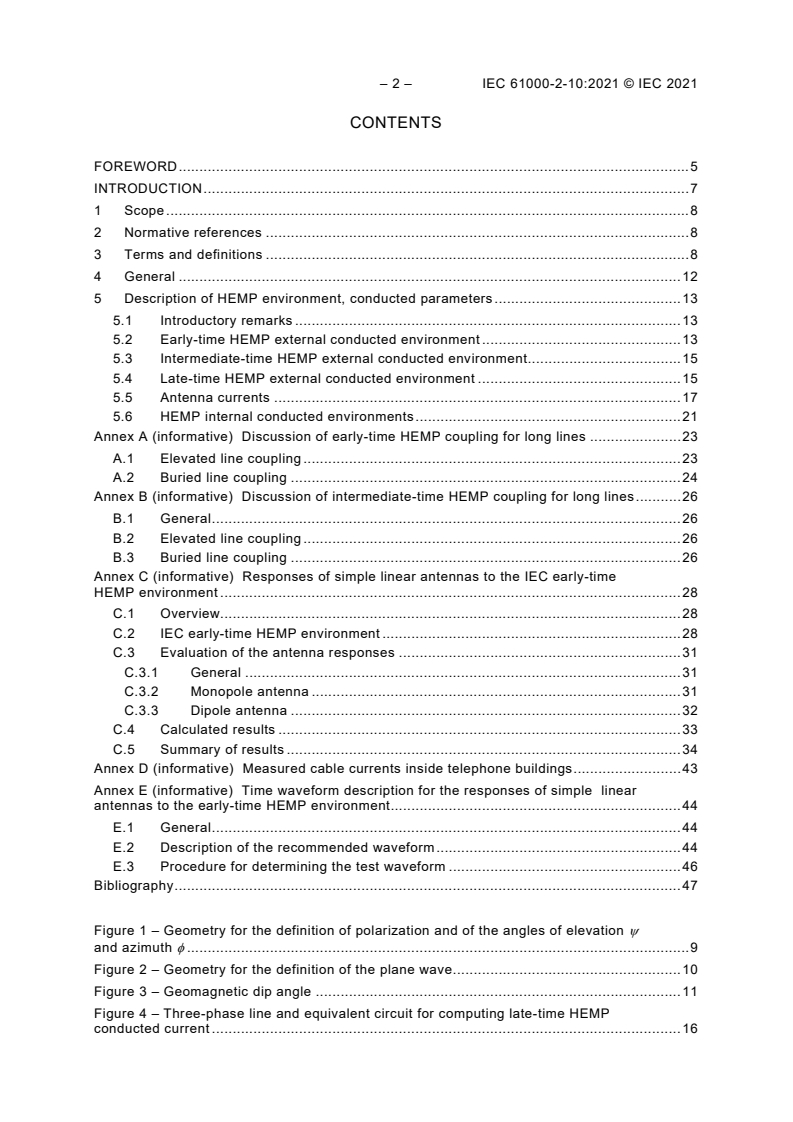
CONTENTS
FOREWORD . 5
INTRODUCTION . 7
1 Scope . 8
2 Normative references . 8
3 Terms and definitions . 8
4 General . 12
5 Description of HEMP environment, conducted parameters . 13
5.1 Introductory remarks . 13
5.2 Early-time HEMP external conducted environment . 13
5.3 Intermediate-time HEMP external conducted environment. 15
5.4 Late-time HEMP external conducted environment . 15
5.5 Antenna currents . 17
5.6 HEMP internal conducted environments . 21
Annex A (informative) Discussion of early-time HEMP coupling for long lines . 23
A.1 Elevated line coupling . 23
A.2 Buried line coupling . 24
Annex B (informative) Discussion of intermediate-time HEMP coupling for long lines . 26
B.1 General . 26
B.2 Elevated line coupling . 26
B.3 Buried line coupling . 26
Annex C (informative) Responses of simple linear antennas to the IEC early-time
HEMP environment . 28
C.1 Overview. 28
C.2 IEC early-time HEMP environment . 28
C.3 Evaluation of the antenna responses . 31
C.3.1 General . 31
C.3.2 Monopole antenna . 31
C.3.3 Dipole antenna . 32
C.4 Calculated results . 33
C.5 Summary of results . 34
Annex D (informative) Measured cable currents inside telephone buildings . 43
Annex E (informative) Time waveform description for the responses of simple linear
antennas to the early-time HEMP environment . 44
E.1 General . 44
E.2 Description of the recommended waveform . 44
E.3 Procedure for determining the test waveform . 46
Bibliography . 47
Figure 1 – Geometry for the definition of polarization and of the angles of elevation ψ
and azimuth φ . 9
Figure 2 – Geometry for the definition of the plane wave . 10
Figure 3 – Geomagnetic dip angle . 11
Figure 4 – Three-phase line and equivalent circuit for computing late-time HEMP
conducted current . 16
Figure 5 – Centre-loaded dipole antenna of length l and radius a, excited by an
incident early-time HEMP field . 18
Figure A.1 – Variation of peak coupled cable current versus local geomagnetic dip
angle . 23
Figure C.1 – Illustration of the incident HEMP field . 29
Figure C.2 – HEMP tangent radius R defining the illuminated region, shown as a
t
function of burst height (HOB) . 29
Figure C.3 – Geometry of the monopole antenna . 32
Figure C.4 – Geometry of the dipole antenna . 33
Figure C.5 – Cumulative probability distributions for the peak responses for the 1 m
vertical monopole antenna load currents and voltages . 34
Figure C.6 – Cumulative probability distributions for the peak responses for the 3 m
vertical monopole antenna load currents and voltages . 35
Figure C.7 – Cumulative probability distributions for the peak responses for the 10 m
vertical monopole antenna load currents and voltages . 36
Figure C.8 – Cumulative probability distributions for the peak responses for the 100 m
vertical monopole antenna load currents and voltages . 37
Figure C.9 – Cumulative probability distributions for the peak responses for the 1 m
horizontal dipole antenna load currents and voltages . 38
Figure C.10 – Cumulative probability distributions for the peak responses for the 3 m
horizontal dipole antenna load currents and voltages . 39
Figure C.11 – Cumulative probability distributions for the peak responses for the 10 m
horizontal dipole antenna load currents and voltages . 40
Figure C.12 – Cumulative probability distributions for the peak responses for the 100 m
horizontal dipole antenna load current and voltages . 41
Figure C.13 – Plot of multiplicative correction factors for correcting the values of V ,
oc
I , I and V for antennas having other L/a ratios . 42
sc L L
Figure E.1 – Comparison of a computation and an analytic formula for a 1 m wire
illuminated by the E HEMP with the field parallel to the wire (and no ground present) [11] . 45
Figure E.2 – General waveform of the damped oscillatory waveform from
IEC 61000-4-18 [14]. 45
Table 1 – Early-time HEMP conducted common-mode short-circuit currents including
the time history and peak value I as a function of severity level, length L (in metres)
pk
and ground conductivity σ . 14
g
Table 2 – Intermediate-time HEMP conducted common-mode short-circuit currents
including the time history and peak value I as a function of length L (in metres) and
pk
ground conductivity σ . 15
g
Table 3 – Maximum peak electric dipole antenna load current versus frequency for
antenna principal frequencies . 19
Table 4 – HEMP response levels for V for the vertical monopole antenna . 19
oc
Table 5 – HEMP response levels for I for the vertical monopole antenna . 20
sc
a
Table 6 – HEMP response levels for I for the loaded vertical monopole antenna . 20
L
Table 7 – HEMP response levels for V for the horizontal dipole antenna . 20
oc
Table 8 – HEMP response levels for I for the horizontal dipole antenna . 21
sc
a
Table 9 – HEMP response levels for I for the loaded horizontal dipole antenna . 21
L
– 4 – IEC 61000-2-10:2021 © IEC 2021
Table A.1 – Rectified impulse (RI) and computed effective pulse widths for vertical
polarization of the early-time HEMP for an elevated conductor (h = 10 m) . 24
Table A.2 – Coupled early-time HEMP currents for a buried conductor (z = –1 m) . 25
Table A.3 – Waveform parameters for early-time HEMP buried conductor coupling
(z = −1 m) . 25
Table A.4 –Average waveform parameters for early-time HEMP buried conductor
currents . 25
Table B.1 – Coupled HEMP intermediate-time short-circuit currents for an elevated
conductor (h = 10 m) . 26
Table B.2 – Coupled HEMP intermediate-time short-circuit currents for a buried
conductor (h = –1 m) . 26
Table D.1 – Estimated internal peak-to-peak cable currents (I ) from direct HEMP
PP
illumination (from [8]) . 43
Table D.2 – Damped sinusoid waveform characteristics for internal cable currents
(measured) (from [8]) . 43
Table E.1 – Waveform parameters to be used in Formula (E.1) . 46
INTERNATIONAL ELECTROTECHNICAL COMMISSION
____________
ELECTROMAGNETIC COMPATIBILITY (EMC) –
Part 2-10: Environment – Description of HEMP environment –
Conducted disturbance
FOREWORD
1) The International Electrotechnical Commission (IEC) is a worldwide organization for standardization comprising
all national electrotechnical committees (IEC National Committees). The object of IEC is to promote international
co-operation on all questions concerning standardization in the electrical and electronic fields. To this end and
in addition to other activities, IEC publishes International Standards, Technical Specifications, Technical Reports,
Publicly Available Specifications (PAS) and Guides (hereafter referred to as “IEC Publication(s)”). Their
preparation is entrusted to technical committees; any IEC National Committee interested in the subject dealt with
may participate in this preparatory work. International, governmental and non-governmental organizations liaising
with the IEC also participate in this preparation. IEC collaborates closely with the International Organization for
Standardization (ISO) in accordance with conditions determined by agreement between the two organizations.
2) The formal decisions or agreements of IEC on technical matters express, as nearly as possible, an international
consensus of opinion on the relevant subjects since each technical committee has representation from all
interested IEC National Committees.
3) IEC Publications have the form of recommendations for international use and are accepted by IEC National
Committees in that sense. While all reasonable efforts are made to ensure that the technical content of IEC
Publications is accurate, IEC cannot be held responsible for the way in which they are used or for any
misinterpretation by any end user.
4) In order to promote international uniformity, IEC National Committees undertake to apply IEC Publications
transparently to the maximum extent possible in their national and regional publications. Any divergence between
any IEC Publication and the corresponding national or regional publication shall be clearly indicated in the latter.
5) IEC itself does not provide any attestation of conformity. Independent certification bodies provide conformity
assessment services and, in some areas, access to IEC marks of conformity. IEC is not responsible for any
services carried out by independent certification bodies.
6) All users should ensure that they have the latest edition of this publication.
7) No liability shall attach to IEC or its directors, employees, servants or agents including individual experts and
members of its technical committees and IEC National Committees for any personal injury, property damage or
other damage of any nature whatsoever, whether direct or indirect, or for costs (including legal fees) and
expenses arising out of the publication, use of, or reliance upon, this IEC Publication or any other IEC
Publications.
8) Attention is drawn to the Normative references cited in this publication. Use of the referenced publications is
indispensable for the correct application of this publication.
9) Attention is drawn to the possibility that some of the elements of this IEC Publication may be the subject of patent
rights. IEC shall not be held responsible for identifying any or all such patent rights.
IEC 61000-2-10 has been prepared by subcommittee 77C: High power transient phenomena,
of IEC technical committee 77: Electromagnetic compatibility. It is an International Standard.
It forms Part 2-10 of IEC 61000. It has the status of a basic EMC publication in accordance with
IEC Guide 107.
This second edition cancels and replaces the first edition published in 1998. This edition
constitutes a technical revision.
This edition includes the following significant technical changes with respect to the previous
edition:
a) a new Annex E has been added to describe the time waveform characteristics of the
response of simple linear antennas to aid in the development of test methods;
b) technical support for this waveform is provided in Annex E.
– 6 – IEC 61000-2-10:2021 © IEC 2021
c) a procedure to use the waveforms presented in Annex E along with the peak values
previously provided in Annex C is provided.
The text of this International Standard is based on the following documents:
Draft Report on voting
77C/318/FDIS 77C/321/RVD
Full information on the voting for its approval can be found in the report on voting indicated in
the above table.
The language used for the development of this International Standard is English.
This document was drafted in accordance with ISO/IEC Directives, Part 2, and developed in
accordance with ISO/IEC Directives, Part 1 and ISO/IEC Directives, IEC Supplement, available
at www.iec.ch/members_experts/refdocs. The main document types developed by IEC are
described in greater detail at www.iec.ch/standardsdev/publications.
A list of all parts in the IEC 61000 series, published under the general title Electromagnetic
compatibility, can be found on the IEC website.
The committee has decided that the contents of this document will remain unchanged until the
stability date indicated on the IEC website under webstore.iec.ch in the data related to the
specific document. At this date, the document will be
• reconfirmed,
• withdrawn,
• replaced by a revised edition, or
• amended.
IMPORTANT – The "colour inside" logo on the cover page of this document indicates that it
contains colours which are considered to be useful for the correct understanding of its
contents. Users should therefore print this document using a colour printer.
INTRODUCTION
IEC 61000 is published in separate parts according to the following structure:
Part 1: General
General considerations (introduction, fundamental principles)
Definitions, terminology
Part 2: Environment
Description of the environment
Classification of the environment
Compatibility levels
Part 3: Limits
Emission limits
Immunity limits (insofar as these limits do not fall under the responsibility of the product
committees)
Part 4: Testing and measurement techniques
Measurement techniques
Testing techniques
Part 5: Installation and mitigation guidelines
Installation guidelines
Mitigation methods and devices
Part 6: Generic standards
Part 9: Miscellaneous
Each part is further subdivided into several parts, published either as international standards
or as technical specifications or technical reports, some of which have already been published
as sections. Others will be published with the part number followed by a dash and a second
number identifying the subdivision (example: IEC 61000-6-1).
The IEC has initiated the preparation of standardized methods to protect civilian society from
the effects of high-power electromagnetic environments including the high-altitude
electromagnetic pulse. Such environments could disrupt systems for communications, electric
power, information technology, etc.
This part of IEC 61000 is an international standard that establishes the HEMP conducted
disturbances that are the result of coupling by the radiated HEMP disturbances.
– 8 – IEC 61000-2-10:2021 © IEC 2021
ELECTROMAGNETIC COMPATIBILITY (EMC) –
Part 2-10: Environment – Description of HEMP environment –
Conducted disturbance
1 Scope
This part of IEC 61000 defines the high-altitude electromagnetic pulse (HEMP) conducted
environment that is one of the consequences of a high-altitude nuclear explosion.
Those dealing with this subject consider two cases:
– high-altitude nuclear explosions;
– low-altitude nuclear explosions.
For civil systems the most important case is the high-altitude nuclear explosion. In this case,
the other effects of the nuclear explosion such as blast, ground shock, thermal and nuclear
ionizing radiation are not present at the ground level.
However, the electromagnetic pulse associated with the explosion can cause disruption of, and
damage to, communication, electronic and electric power systems thereby upsetting the stability
of modern society.
The object of this document is to establish a common reference for the conducted HEMP
environment in order to select realistic stresses to apply to victim equipment to evaluate their
performance.
2 Normative references
The following documents are referred to in the text in such a way that some or all of their content
constitutes requirements of this document. For dated references, only the edition cited applies.
For undated references, the latest edition of the referenced document (including any
amendments) applies.
IEC 61000-2-9, Electromagnetic compatibility (EMC) – Part 2: Environment – Section 9:
Description of HEMP environment – Radiated disturbance
IEC 61000-4-24, Electromagnetic compatibility (EMC) – Part 4-24: Testing and measurement
techniques – Test methods for protective devices for HEMP conducted disturbance
3 Terms and definitions
For the purposes of this document, the following terms and definitions apply.
ISO and IEC maintain terminological databases for use in standardization at the following
addresses:
• IEC Electropedia: available at http://www.electropedia.org/
• ISO Online browsing platform: available at http://www.iso.org/obp
3.1
angle of elevation ψ
angle ψ measured in the vertical plane between a flat horizontal surface such as the ground
and the propagation vector
SEE: Figure 1.
Figure 1 – Geometry for the definition of polarization and
of the angles of elevation ψ and azimuth φ
3.2
azimuth angle φ
angle between the projection of the propagation vector on the ground plane and the principal
axis of the victim object
Note 1 to entry: It is the z axis for the transmission line of Figure 1.
3.3
composite waveform
waveform which maximizes the important features of a waveform
3.4
coupling
interaction of the HEMP field with a system to produce currents and voltages on system surfaces
and cables
Note 1 to entry: Voltages result from the induced charges and are only defined at low frequencies with wavelengths
larger than the surface or gap dimensions
3.5
direction of propagation of the electromagnetic wave
�⃗
direction of the propagation vector 𝑘𝑘, perpendicular to the plane containing the vectors of the
electric and magnetic fields
Note 1 to entry: See Figure 2.
– 10 – IEC 61000-2-10:2021 © IEC 2021
Figure 2 – Geometry for the definition of the plane wave
3.6
E1
early-time HEMP electric field
3.7
E2
intermediate-time HEMP electric field
3.8
E3
late-time HEMP electric field
3.9
electromagnetic pulse
EMP
any electromagnetic field waveform abruptly rising and falling in the time domain created by a
nuclear detonation at any altitude
3.10
geomagnetic dip angle
θ
dip
B
dip angle of the geomagnetic flux density vector , measured from the local horizontal in the
e
magnetic north-south plane
Note 1 to entry: θ = 90° at the magnetic north pole, –90° at the magnetic south pole (see Figure 3).
dip
Figure 3 – Geomagnetic dip angle
3.11
high-altitude electromagnetic pulse
HEMP
high-altitude electromagnetic pulse created by a high-altitude nuclear explosion
3.12
high-altitude nuclear explosion
height of burst above 30 km altitude
3.13
horizontal polarization
position of the electromagnetic wave in which the magnetic field vector is in the incidence plane
and the electric field vector is perpendicular to the incidence plane and thus parallel to the
ground plane
Note 1 to entry: This type of polarization is also called perpendicular or transverse electric (TE) (see Figure 1).
3.14
incidence plane
plane formed by the propagation vector and the normal to the ground plane
3.15
low-altitude nuclear explosion
height of burst below 1 km altitude
3.16
NEMP
nuclear EMP
all types of EMP produced by a nuclear explosion
3.17
point-of-entry
PoE
physical location (point) on an electromagnetic barrier, where EM energy can enter or exit a
topological volume, unless an adequate PoE protective device is provided
Note 1 to entry: A PoE is not limited to a geometrical point. PoEs are classified as aperture PoEs or conductive
PoEs according to the type of penetration. They are also classified as architectural, mechanical, structural or
electrical PoEs, according to the functions they serve.
– 12 – IEC 61000-2-10:2021 © IEC 2021
3.18
pulse width
time interval between the points on the leading and trailing edges of a pulse at which the
instantaneous value is 50 % of the peak pulse amplitude, unless otherwise stated
3.19
rectified impulse
integral of the absolute value of a time waveform’s amplitude over a specified time interval
3.20
rise time
time interval between the instants in which the instantaneous amplitude of a pulse first reaches
specified lower and upper limits, namely 10 % and 90 % of the peak pulse amplitude, unless
otherwise stated
3.21
short-circuit current
value of current that flows when the output terminals of a circuit are shorted
Note 1 to entry: This current is normally of interest when checking the performance of surge protection devices.
3.22
source impedance
impedance presented by a source of energy to the input terminals of a device or network
3.23
vertical polarization
position of the electromagnetic wave in which the electric field vector is in the incidence plane,
and the magnetic field vector is perpendicular to the incidence plane and thus parallel to the
ground plane
Note 1 to entry: See Figure 1.
Note 2 to entry: This type of polarization is also called parallel or transverse magnetic (TM).
4 General
A high-altitude (above 30 km) nuclear burst produces three types of electromagnetic pulses
which are observed on the earth's surface:
1) early-time HEMP (fast);
2) intermediate-time HEMP (medium);
3) late-time HEMP (slow).
Historically most of the interest has been focused on the early-time HEMP which was previously
referred to simply as HEMP. Here the term high-altitude EMP or HEMP will be used to include
all three types. The term nuclear electromagnetic pulse (NEMP) covers many categories of
nuclear EMPs including those produced by surface bursts (source region EMPs (SREMPs)) or
created on space systems (system generated EMPs SGEMPs)).
Because the HEMP is produced by a high-altitude detonation, other nuclear weapon
environments such as gamma rays, heat and shock waves at the earth's surface are not
observed at the earth’s surface. HEMP was reported from high-altitude nuclear tests in the
South Pacific by the U.S. and over the USSR during the early 1960s, producing effects on
electronic equipment on the ground far from the burst location.
This document presents the conducted HEMP environment induced on metallic lines, such as
cables or power lines, external and internal to installations, and external antennas.
5 Description of HEMP environment, conducted parameters
5.1 Introductory remarks
The electromagnetic field generated by a high-altitude nuclear explosion described in
IEC 61000-2-9 can induce currents and voltages in all metallic structures. These currents and
voltages propagating in conductors represent the conducted environment. This means that the
conducted environment is a secondary phenomenon, a consequence of the radiated field alone.
All metallic structures (i.e., wires, conductors, pipes, ducts, etc.) will be affected by the HEMP.
The conducted environment is important because it can direct the HEMP energy to sensitive
electronics through signal, power, and grounding connections. It should be noted that there are
two distinct categories of conductors: external and internal conductors (with regard to a building
or any other enclosure). While this can seem simplistic, this separation is critical in terms of the
information to be provided in this document.
The difference between these two types of conductors is explained by electromagnetic topology.
In general, external conductors are those which are located outside of a building and are
completely exposed to the full HEMP environment. This category includes power, metallic
communication lines, antenna cables, and water and gas pipes (if metallic). For the purposes
of this document, the conductors can be elevated above the ground or buried in the earth.
Internal conductors are those which are located in a partially or completely shielded building
where the HEMP fields have been reduced by the building. This is a much more complex
situation, because the HEMP field waveforms will be significantly altered by the building shield,
and the coupling to internal wires and cables is consequently very difficult to calculate, although
some measured data are available from simulated HEMP tests.
In this document the external conducted common mode environments are calculated using
simplified conductor geometries and the specified HEMP environments for the early,
intermediate, and late-time waveforms. These conducted external environments are intended
to be used to evaluate the performance of protection devices outside of a building, and because
of variations in telecom and power systems, the effects of transformers and telephone splice
boxes are not considered here. This process results in approximate, but well-defined waveforms
that are needed to test protective elements on external conductors in a standardized manner.
For the internal conductors, a procedure is defined to estimate the conducted environments
appropriate for equipment testing. For unshielded multiconductor wires, it is assumed that the
line-to-ground currents are equal to the common-mode current.
5.2 Early-time HEMP external conducted environment
For the early-time HEMP, the high-amplitude electric field couples efficiently to antennas and
to any exposed lines such as power and telephone lines. The antenna coupling mechanism is
extremely variable and dependent on the details of the antenna design. In many cases, it is
advisable to perform continuous wave (CW) testing of an antenna and to "combine" the
response function of the antenna with the incident HEMP environment using a convolution
technique. However, simple formulae have been provided to compute the response of thin
antennas (see 5.5). For long lines, it is possible to perform a comprehensive set of common
mode calculations that are reliable and depend only upon a few parameters. These parameters
include conductor length, exposure situation (above ground or buried), and the surface ground
conductivity (for depths between 0 m and 5 m). In addition, because the HEMP coupling is
dependent on angle of elevation and polarization (see Figure 1), it is possible to statistically
examine the probability of producing particular levels of current.
– 14 – IEC 61000-2-10:2021 © IEC 2021
Table 1 describes the calculated, coupled, common-mode short-circuit currents and the
Thévenin equivalent source impedances (used to determine the open-circuit voltages) as
functions of severity level, length of conductor, and ground conductivity. These results are
appropriate for the common-mode currents flowing on bare wires, overhead insulated wires,
and the shields of shielded cables or coaxial transmission lines. For shielded cables one should
use measured or specified cable transfer impedances to determine internal wire currents and
voltages. Although some waveform variation occurs for different exposure geometries, a single
time waveform is specified for elevated lines. The waveform is defined in terms of the rise time
(10 % to 90 %) and the pulse width (at half maximum); when the pulse characteristics of rise
time and pulse width are described together, the usual description is ∆t /∆t .
r pw
In Table 1 a severity level of 99 % indicates that 99 % of the currents produced will be less than
this value. The buried line currents calculated vary much less with angle of incidence and
indicate a very broad probability distribution (small differences between 10 % and 90 %
severity) and therefore are not described in terms of severity levels; variations are shown for
ground conductivity. In terms of applicability for Table 1, the elevated conductor currents are
accurate for heights above 5 m while the buried currents can be used for conductors slightly (h
< 30 cm) above the surface and below the surface. For conductor heights below 5 m, the values
in Table 1 can be linearly interpolated (between 0,3 m and 5 m). For cases where the lines from
an elevated geometry enter the ground in an insulated manner, the currents will initially
resemble waveform 1, decreasing as a function of burial distance until waveform 2 is reached
(requires approximately 20 m). Consult Annex A for further information regarding the derivation
of these waveforms.
Table 1 – Early-time HEMP conducted common-mode short-circuit currents
including the time history and peak value I as a function of severity level,
pk
length L (in metres) and ground conductivity σ
g
Elevated conductor
I
pk
A
Severity L > 200 m 100 ≤ L ≤ 200 m L < 100 m
a
(%)
50 500 500 5,0 × L
90 1 500 7,5 × L 7,5 × L
99 4 000 20 × L 20 × L
a
Percentage of currents smaller than the indicated value.
Waveform 1: 10/100 ns.
Source impedance: Z = 400 Ω.
s
Buried conductor
I
pk
A
σ All lengths > 10 m
g
S/m
−2
−3
−4
Waveform 2: 25/500 ns.
Source impedance: Z = 50 Ω.
s
5.3 Intermediate-time HEMP external conducted environment
The intermediate-time HEMP environment only couples efficiently to long conductors in excess
of 1 km. It is therefore of interest primarily for external conductors such as power and commu-
nication lines. Because the pulse width of this environment is much wider than that of the early-
time environment, the coupling varies less as a function of angle of elevation. This means that
the statistical variation is less important than in the case of the early-time coupling. On the other
hand, the ground conductivity is more important here, affecting the coupling to elevated lines
in addition to buried lines. See Annex B for a more detailed discussion.
Table 2 describes the conducted external environment as a function of line length and ground
conductivity (to depths of 1 km).
Table 2 – Intermediate-time HEMP conducted common-mode
short-circuit currents including the time history and peak value I
pk
as a function of length L (in metres) and ground conductivity σ
g
Elevated conductor
I
pk
A
σ
L > 10 000 m 1 000 ≤ L ≤ 10 000 m 100 ≤ L ≤ 1 000 m L < 100 m
g
S/m
−2
150 75 0,05 × L 0
−3
350 200 0,15 × L 0
−4
800 600 0,45 × L 0
Waveform 3: 25/1 500 µs.
Source impedance: Z = 400 Ω.
s
Buried conductor
I
pk
A
σ L > 1 000 m 100 ≤ L ≤ 1 000 m L < 100 m
g
S/m
−2
50 0,05 × L 0
−3
150 0,15 × L 0
−4
450 0,45 × L 0
Waveform 3: 25/1 500 µs.
Source impedance: Z = 50 Ω.
s
5.4 Late-time HEMP external conducted environment
The late-time HEMP environment is only important for coupling to long external conductors such
as power and communication lines. In this case, however, the computation of short-circuit
currents for typical cases of interest is not easily accomplished. This is because the late-time
HEMP environment is described as a voltage source that is produced in the earth which induces
currents to flow only in conductors that are connected to the earth at two or more points. Since
the current that flows is strongly dependent on the resistance present in the circuit, an analytical
method is provided here to develop a standard conducted environment.
– 16 – IEC 61000-2-10:2021 © IEC 2021
In order to describe the method to be used, an example case is provided. In Figure 4a), a three-
phase Y-delta power configuration is shown along with an equivalent circuit in Figure 4b) (where
E is the peak value of the late-time HEMP). Note that the problem can be described as a quasi-
o
DC problem with the voltage source calculated directly from the late-time HEMP environment.
Since the highest frequencies contained in the late-time HEMP environment are of the order of
1 Hz, this is clearly appropriate. It can therefore be assumed that the voltage source V has the
s
same time dependence as E . Given that the resistances shown in the lower portion of Figure 4
o
(the parallel Y winding resistances R and the "footing" or grounding resistances R ) are not
y f
frequency dependent for f < 1 Hz, then the induced current I will have the same time
pk
dependence as E .
o
a) Three-phase line and transformer configuration
b) Simple equivalent circuit where E is the induced
o
late-time HEMP electric field
Figure 4 – Three-phase line and equivalent circuit for computing
late-time HEMP conducted current
Using the example provided, the peak current can be calculated as:
EL
O
I =
pk (1)
2(R ++R ) rL
f y L
where
r is the parallel wire resistance per unit length (Ω/m);
L
R is the ground resistance (Ω);
f
R is the parallel winding resistance in one transformer (Ω);
y
L is the line length (m).
For a long transmission line in North America, a 500 kV line would have a resistance per unit
−6
length of 8,3 × 10 Ω/m, a transformer winding resistance of 0,06 Ω and a grounding resistance
of 0,75 Ω. For a 10 m length line and a peak field E of 0,04 V/m (from IEC 61000-2-9), this
o
formula results in a peak current of approximately 1 630 A. Given this peak value, the current
time waveform can be approximated by a unipolar pulse with a rise time and pulse width of
1/50 s. To simulate the waveform for this example, one could use a voltage source of 4 kV with
a source impedance of 2,45 Ω. It is important to recognize the necessity to ground transformers
in order to use the circuit in Figure 4. Some transformers are delta-delta and do not possess a
direct path to ground as shown in the figure.
Formula (1) above can easily be translated to cover cases other than power lines by computing
the total resistance in the circuit, and dividing it into the total voltage induced over the length of
the conductor. Formula (1) is provided for the case of long cables over land, and for deep
undersea cables the currents calculated may be reduced by up to a factor of 100. This reduction
is due to the behaviour of the electric field E which is inversely proportional to the square root
o
of the deep ground conductivity (to depths of 10 km to 100 km). For freshwater lakes or shallow
seas, the currents may not be reduced as much.
5.5 Antenna currents
Antennas come in many different sizes and shapes. At frequencies in the VLF and LF range
(3 kHz to 300 kHz), such antennas are often in the form of very long wires which are sometimes
buried in the earth. Antennas in the MF band (300 kHz to 3 000 kHz) are often in the form of a
vertical tower which is fed against a buried counterpoise grid buried in the earth. In the HF and
VHF bands (3 MHz to 30 MHz and 30 MHz to 300 MHz, respectively), the antennas typically
appear as centre-fed dipoles, and at the higher frequencies (UHF, SHF, etc.) they become more
like a distributed system, involving reflecting dishes and radiating apertures.
Usually, antennas are operated in a narrow band of frequencies located around a fundamental
design frequency. In order to enhance their narrow-band performance, such antennas are often
"tuned" by adding lumped impedance elements, by adding additional passive elements near the
active antenna, or by locating the antenna in an array.
Given such a large variation in antenna configurations, it is difficult to provide an accurate
response specification (current and voltage waveforms) for every type of antenna. As an
approximate model, however, it is possible to consider the simple thin-wire vertical dipole
antenna shown in Figure 5, and to use its response as an indication of what would be the
responses for other more complex antennas. Of course, this model is applicable only to
antennas of the electric dipole class: loop (i.e., magnetic) antennas and aperture antennas are
not adequately modelled by this simple structure. For more complex antennas, it is recommended
that CW illumination or high-level pulse testing be performed to evaluate antenna responses.
These types of test methods are described in IEC 61000-4-23.
The antenna in Figure 5 is assumed to be loaded by a nominal 50 Ω resistance, which is typical
of a realistic in-band load on the antenna. The antenna has an end-to-end length of l and a
In (l/a).
radius of a; these parameters are used to compute the form parameter Ω = 2
The resonance b
...