


IEC PAS 62543:2008
(Main)DC transmission using voltage sourced converters
DC transmission using voltage sourced converters
IEC/PAS 62543 describes the VSC transmission technology, with a particular view to the issues to be considered when it is applied at voltages above 100 kV d.c., and power in excess of 100 MW. It provides information about the equipment included in a VSC transmission scheme, as well as the characteristics and performance that can be expected.
General Information
- Status
- Replaced
- Publication Date
- 09-Mar-2008
- Current Stage
- DELPUB - Deleted Publication
- Start Date
- 30-Mar-2011
- Completion Date
- 14-Feb-2026
Relations
- Effective Date
- 05-Sep-2023
- Effective Date
- 05-Sep-2023
Get Certified
Connect with accredited certification bodies for this standard

Intertek Testing Services NA Inc.
Intertek certification services in North America.

UL Solutions
Global safety science company with testing, inspection and certification.

ANCE
Mexican certification and testing association.
Sponsored listings
Frequently Asked Questions
IEC PAS 62543:2008 is a technical specification published by the International Electrotechnical Commission (IEC). Its full title is "DC transmission using voltage sourced converters". This standard covers: IEC/PAS 62543 describes the VSC transmission technology, with a particular view to the issues to be considered when it is applied at voltages above 100 kV d.c., and power in excess of 100 MW. It provides information about the equipment included in a VSC transmission scheme, as well as the characteristics and performance that can be expected.
IEC/PAS 62543 describes the VSC transmission technology, with a particular view to the issues to be considered when it is applied at voltages above 100 kV d.c., and power in excess of 100 MW. It provides information about the equipment included in a VSC transmission scheme, as well as the characteristics and performance that can be expected.
IEC PAS 62543:2008 is classified under the following ICS (International Classification for Standards) categories: 29.200 - Rectifiers. Convertors. Stabilized power supply. The ICS classification helps identify the subject area and facilitates finding related standards.
IEC PAS 62543:2008 has the following relationships with other standards: It is inter standard links to IEC TR 62543:2011, IEC TR 62543:2022. Understanding these relationships helps ensure you are using the most current and applicable version of the standard.
IEC PAS 62543:2008 is available in PDF format for immediate download after purchase. The document can be added to your cart and obtained through the secure checkout process. Digital delivery ensures instant access to the complete standard document.
Standards Content (Sample)
IEC/PAS 62543
Edition 1.0 2008-03
PUBLICLY AVAILABLE
SPECIFICATION
PRE-STANDARD
DC transmission using voltage sourced converters
IEC/PAS 62543:2008(E)
All rights reserved. Unless otherwise specified, no part of this publication may be reproduced or utilized in any form
or by any means, electronic or mechanical, including photocopying and microfilm, without permission in writing from
either IEC or IEC's member National Committee in the country of the requester.
If you have any questions about IEC copyright or have an enquiry about obtaining additional rights to this publication,
please contact the address below or your local IEC member National Committee for further information.
IEC Central Office
3, rue de Varembé
CH-1211 Geneva 20
Switzerland
Email: inmail@iec.ch
Web: www.iec.ch
About the IEC
The International Electrotechnical Commission (IEC) is the leading global organization that prepares and publishes
International Standards for all electrical, electronic and related technologies.
About IEC publications
The technical content of IEC publications is kept under constant review by the IEC. Please make sure that you have the
latest edition, a corrigenda or an amendment might have been published.
ƒ Catalogue of IEC publications: www.iec.ch/searchpub
The IEC on-line Catalogue enables you to search by a variety of criteria (reference number, text, technical committee,…).
It also gives information on projects, withdrawn and replaced publications.
ƒ IEC Just Published: www.iec.ch/online_news/justpub
Stay up to date on all new IEC publications. Just Published details twice a month all new publications released. Available
on-line and also by email.
ƒ Electropedia: www.electropedia.org
The world's leading online dictionary of electronic and electrical terms containing more than 20 000 terms and definitions
in English and French, with equivalent terms in additional languages. Also known as the International Electrotechnical
Vocabulary online.
ƒ Customer Service Centre: www.iec.ch/webstore/custserv
If you wish to give us your feedback on this publication or need further assistance, please visit the Customer Service
Centre FAQ or contact us:
Email: csc@iec.ch
Tel.: +41 22 919 02 11
Fax: +41 22 919 03 00
IEC/PAS 62543
Edition 1.0 2008-03
PUBLICLY AVAILABLE
SPECIFICATION
PRE-STANDARD
DC transmission using voltage sourced converters
INTERNATIONAL
ELECTROTECHNICAL
COMMISSION
PRICE CODE
XH
ICS 29.200 ISBN 2-8318-9639-8
– 2 – PAS 62543 © IEC:2008(E)
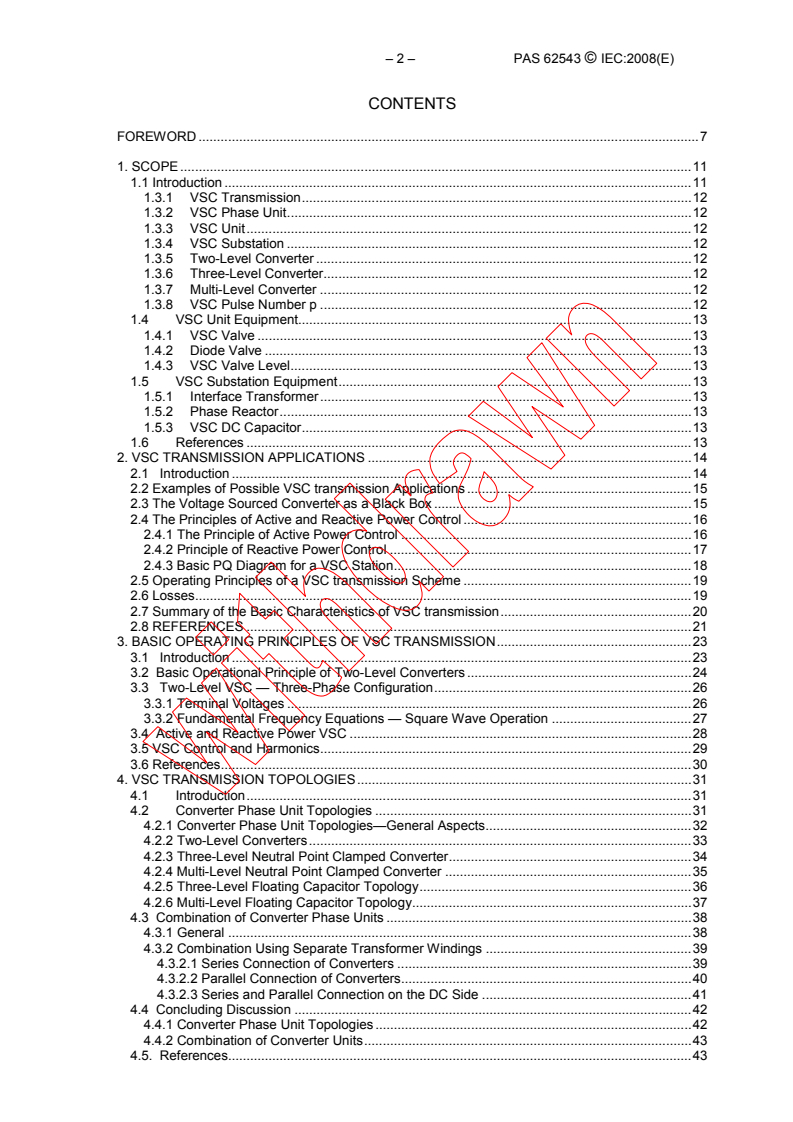
CONTENTS
FOREWORD .7
1. SCOPE .11
1.1 Introduction .11
1.3.1 VSC Transmission.12
1.3.2 VSC Phase Unit.12
1.3.3 VSC Unit.12
1.3.4 VSC Substation .12
1.3.5 Two-Level Converter .12
1.3.6 Three-Level Converter.12
1.3.7 Multi-Level Converter .12
1.3.8 VSC Pulse Number p .12
1.4 VSC Unit Equipment.13
1.4.1 VSC Valve .13
1.4.2 Diode Valve .13
1.4.3 VSC Valve Level.13
1.5 VSC Substation Equipment.13
1.5.1 Interface Transformer.13
1.5.2 Phase Reactor.13
1.5.3 VSC DC Capacitor.13
1.6 References .13
2. VSC TRANSMISSION APPLICATIONS .14
2.1 Introduction .14
2.2 Examples of Possible VSC transmission Applications .15
2.3 The Voltage Sourced Converter as a Black Box .15
2.4 The Principles of Active and Reactive Power Control .16
2.4.1 The Principle of Active Power Control .16
2.4.2 Principle of Reactive Power Control .17
2.4.3 Basic PQ Diagram for a VSC Station.18
2.5 Operating Principles of a VSC transmission Scheme .19
2.6 Losses.19
2.7 Summary of the Basic Characteristics of VSC transmission.20
2.8 REFERENCES .21
3. BASIC OPERATING PRINCIPLES OF VSC TRANSMISSION.23
3.1 Introduction .23
3.2 Basic Operational Principle of Two-Level Converters .24
3.3 Two-Level VSC — Three-Phase Configuration.26
3.3.1 Terminal Voltages .26
3.3.2 Fundamental Frequency Equations — Square Wave Operation .27
3.4 Active and Reactive Power VSC .28
3.5 VSC Control and Harmonics.29
3.6 References.30
4. VSC TRANSMISSION TOPOLOGIES.31
4.1 Introduction.31
4.2 Converter Phase Unit Topologies .31
4.2.1 Converter Phase Unit Topologies—General Aspects.32
4.2.2 Two-Level Converters.33
4.2.3 Three-Level Neutral Point Clamped Converter.34
4.2.4 Multi-Level Neutral Point Clamped Converter .35
4.2.5 Three-Level Floating Capacitor Topology.36
4.2.6 Multi-Level Floating Capacitor Topology.37
4.3 Combination of Converter Phase Units .38
4.3.1 General .38
4.3.2 Combination Using Separate Transformer Windings .39
4.3.2.1 Series Connection of Converters .39
4.3.2.2 Parallel Connection of Converters.40
4.3.2.3 Series and Parallel Connection on the DC Side .41
4.4 Concluding Discussion .42
4.4.1 Converter Phase Unit Topologies .42
4.4.2 Combination of Converter Units.43
4.5. References.43
PAS 62543 © IEC:2008(E) – 3 –
5. VSC TRANSMISSION VALVES.44
5.1 Introduction.44
5.2 Semiconductors for VSC Transmission .44
5.2.1 Overview of High Power Semiconductors.44
5.2.2 Thyristors.44
5.2.3 GTO and IGCT (GCT) .45
5.2.4 IGBT Type Devices .45
5.2.5 Comparison of Devices.46
5.3 VSC Valve Design Considerations .47
5.3.1 Reliability (IGBT) .47
5.3.2 IGBT Current Rating.47
5.3.3 Transient Current Requirements.47
5.3.4 Diode Requirements .48
5.4 Thermal Design .49
5.4.1 Converter Power Losses.49
5.4.2 Cooling System Design .50
5.4.3 IGBT Losses.50
5.4.4 Voltage Rating .50
5.4.4.1 Aspects of Series Connection [5-1].51
5.4.4.2 Commutation Process .51
5.5 Mechanical Structure of the Valve [5-1].52
5.6 Valve Hall or Valve Enclosures .53
5.7 References .53
6. OTHER MAIN EQUIPMENT FOR VSC TRANSMISSION SCHEMES.54
6.1 Introduction .54
6.2 Power Components of a VSC transmission Scheme.55
6.3 VSC Substation Circuit-breaker.56
6.4 AC System Side Harmonic Filters .56
6.5 Radiofrequency Interference Filters .57
6.6 Interface Transformers and Phase Reactors .57
6.7 Converter Side Harmonic Filters and HF Blocking Filter.58
6.8 VSC DC Capacitor.60
6.9 DC Filter .61
6.10 Neutral Point Grounding Branch .61
6.11 DC Reactor.61
6.12 Common Mode Blocking Reactor.62
6.13 DC Cable and Overhead Transmission Lines.63
6.14 Special Aspects for Back-to-Back DC Transmission Systems .63
6.15 References .64
7. VSC CONTROL .65
7.1 Introduction .65
7.2 Modes of Control .66
7.2.1 AC Voltage Control .68
7.2.2 Power Control .68
7.2.3 Reactive Power Control.69
7.2.4 DC Voltage Control.69
7.2.5 Current Control.70
7.2.6 Frequency Control.70
7.3 Information Requirements for Controls .70
7.4 Performance of Controls .70
7.5 Levels of Controls .71
7.5.1 Firing Control.71
7.5.2 Converter Unit Control.72
7.5.3 System Control.72
7.6 Coordination of Controls.72
7.6.1 Supply to a Load with No Other Source of Generation.73
7.6.2 Interconnection of Two or More AC Power Systems.73
7.6.3 Telecommunication Between Converter Stations.75
7.6.4 Supply from a Wind Farm .76
7.7 References.76
– 4 – PAS 62543 © IEC:2008(E)
8. FAULT PERFORMANCE AND PROTECTION REQUIREMENTS .77
8.1 Protection System Philosophy.77
8.2 Type of Protection and Fault Clearing Actions .78
8.3 VSC Substation Protection .79
8.4 Internal Faults in the VSC Substation.79
8.4.1 Internal AC Bus Fault.79
8.4.2 DC Bus Fault .80
8.4.3 Component Failure.80
8.4.3.1 VSC Valve Failure (see Chapter 5) .80
8.4.3.2 VSC DC Capacitor Failure .80
8.4.3.3 Phase Reactor Failure.81
8.5 External Faults and Switching Transients on the AC Side .81
8.5.1 AC Voltage Dip.81
8.5.2 AC Temporary Overvoltage.81
8.5.3 AC Lightning Overvoltage .82
8.5.4 AC Switching Overvoltage.82
8.5.5 AC Voltage Phase Shifting .82
8.5.6 AC Voltage Phase Unbalance.82
8.5.7 DC Overvoltage.83
8.5.8 Post-Fault Recovery.83
8.6 Faults on the DC Transmission Line or Cable.83
8.6.1 DC Cable Fault.83
8.6.2 DC Overhead Line Fault.83
8.6.3 DC Bus Overvoltage (d.c. overhead line only) .84
8.6.4 DC Overvoltage.84
8.6.5 Other Protection Actions.84
8.7 References.84
9. HARMONIC PERFORMANCE.85
9.1 Introduction.85
9.2 Wave Distortion .85
9.3 Fundamental and Harmonics .86
9.3.1 Three-Phase 2-Level VSC .86
9.3.2. Pulse Width Modulation (PWM).86
9.3.3 Multi-Pulse and Multi-Level Converters .89
9.3.4 Comparison of the Harmonic Content at the AC Terminals of the VSC Valve Units.90
9.4 Harmonic Voltages on Power Systems Due to VSC Operation .92
9.5 Design Considerations for Harmonic Filters (AC side).94
9.6 DC Side Filtering .94
9.7 References.95
10. ENVIRONMENTAL IMPACT.97
10.1 Introduction.97
10.2 Audible Noise .97
10.3 Visual Impact.98
10.4 Electric and Magnetic Fields (EMF ) .98
10.5 Electromagnetic Compatibility (EMC).98
10.6 References .100
11. APPLICATION STUDIES.101
11.1 Introduction .101
11.2 Feasibility Studies.102
11.2.1 Economic Justification of a VSC Scheme .103
11.2.2 Comparing Alternative Termination Points for the VSC Scheme.103
11.2.3 Comparing the Selected Scheme with Alternative Solutions.104
11.2.4 Preparing an Outline Specification for the VSC transmission Project .105
11.3 Specification Studies .105
11.3.1 Specifying the Performance Requirements for the VSC Scheme .106
11.3.2 AC System Data for the Design of the VSC Scheme .107
11.4 Implementation Studies .107
11.5 Modelling of the VSC Scheme.108
11.5.1 Load-Flow Modelling Requirements.109
11.5.2 Short-Circuit and Harmonics Modelling Requirements.109
11.5.3 Electromechanical Stability Modelling Requirements .109
11.5.4 Electromagnetic Transient Modelling Requirements .110
11.6 References .111
PAS 62543 © IEC:2008(E) – 5 –
12. TESTING AND COMMISSIONING .112
12.1 Introduction.112
12.2 The Testing and Commissioning Process.112
12.3 Factory Tests .113
12.3.1 Component Tests.113
12.3.2 Control System Tests .113
12.4 Site Tests (Commissioning).114
12.4.1 General.114
12.4.2 Precommissioning Tests.114
12.4.3 Subsystem Tests.114
12.4.4 System Tests .116
12.4.4.1 High-Voltage Energisation.116
12.4.4.2 Converter Operational Tests .117
12.4.5 Trial Operation.118
12.4.6 Acceptance Tests.118
12.5 References .119
13. LIFE-CYCLE COST.120
13.1 Introduction.120
13.2 Determination of the Profitability of an Investment.120
13.3 Life-cycle Costing .120
13.3.1 Operational Life.121
13.3.2 Interest and Inflation Rates — Calculation of Present Value .121
13.3.3 Initial Costs of the System .121
13.3.4 Cost of Spare Parts .121
13.3.5 Annual Costs of System Losses .122
13.3.6 Cost of Periodic Refurbishment .122
13.3.7 Annual Operating Costs of the System .122
13.3.8 Annual Maintenance Costs of the System.123
13.3.9 Annual Cost of Unavailability .123
13.3.10 Salvage Value or Disposal Costs of VSC transmission Systems .123
13.3.10.1 Salvage Value .123
13.3.10.2 Disposal Cost .123
13.4 Benefits of Controllability.124
13.5 References .124
14. COMPARISON OF LINE COMMUTATED CONVERTER AND VSC .125
14.1 Introduction.125
14.2 Differences Resulting from the Commutation Principle.125
14.2.1 Dependence on an AC Voltage Source .125
14.2.2 Reactive-Power Consumption or Generation.125
14.2.3 Short-Circuit Level Requirement for Stable Operation.126
14.2.4 Harmonics and Filter Requirements.126
14.2.5 Overvoltages in the AC System .127
14.2.6 Robustness against AC System Faults.127
14.3 Differences Resulting from the Source Type.127
14.3.1 Protection against DC System Faults.127
14.3.2 Flexibility of the Power Flow Reversal in the Multi-Terminal HVDC System .127
14.3.3 Cost, Losses, Reliability and the Availability of the Large-Scale HVDC System.128
14.4 Summary.128
14.5 References .130
15. VSC TRANSMISSION OUTLOOK.131
15.1 Introduction.131
15.2 Future Trends.131
15.2.1 Reliability.131
15.2.2 Capital Cost of a VSC transmission Installation .131
15.2.3 Controllable Switching Components .131
15.2.4 Power Losses.133
15.2.5 Increased DC Voltage and Power Rating of DC Extruded Cables.133
15.2.6 Utilisation of the Functionality and Controllability of VSC transmission.133
15.3 References .134
16. CONCLUSION .135
APPENDIX A: LIST OF VSC TRANSMISSION SCHEMES .137
– 6 – PAS 62543 © IEC:2008(E)
APPENDIX B: FUNCTIONAL SPECIFICATION FOR A VSC TRANSMISSION SYSTEM .153
1. Introduction.153
2. Utility and Manufacturer Information Requirements.153
2.1 General Requirements.154
2.2 Power System Characteristics .154
2.3a DC Line/Cable (In case of Turnkey, supplied by the converter manufacturer) .155
2.3b DC Line/Cable (Not supplied by the converter manufacturer).155
2.4 Steady-State Performance.156
2.5 Dynamic Performance, Control and Monitoring Facilities.156
2.6 Maintenance and Spares .157
2.7 Site and Environmental.157
2.8 Factory and Commissioning Tests.158
2.9 Other Considerations .158
3. Equipment Design Standards.158
APPENDIX C: OVERVIEW OF LINE COMMUTATED CONVERTER BASED, HVDC.160
1. Introduction.160
2. System Configuration .160
2.1 Converters.161
2.2 Converter Transformers .162
2.3 Harmonic Filters .162
2.4 Shunt Capacitors.162
2.5 DC Reactors .162
2.6 DC Connections .162
3. HVDC System Control and Operating Characteristics .162
4. List of LCC HVDC Schemes.164
5. References.166
PAS 62543 © IEC:2008(E) – 7 –
INTERNATIONAL ELECTROTECHNICAL COMMISSION
____________
DC TRANSMISSION USING VOLTAGE SOURCED CONVERTERS
FOREWORD
1) The International Electrotechnical Commission (IEC) is a worldwide organization for standardization
comprising all national electrotechnical committees (IEC National Committees). The object of IEC is to
promote international co-operation on all questions concerning standardization in the electrical and
electronic fields. To this end and in addition to other activities, IEC publishes International Standards,
Technical Specifications, Technical Reports, Publicly Available Specifications (PAS) and Guides (hereafter
referred to as “IEC Publication(s)”). Their preparation is entrusted to technical committees; any IEC National
Committee interested in the subject dealt with may participate in this preparatory work. International,
governmental and non-governmental organizations liaising with the IEC also participate in this preparation.
IEC collaborates closely with the International Organization for Standardization (ISO) in accordance with
conditions determined by agreement between the two organizations.
2) The formal decisions or agreements of IEC on technical matters express, as nearly as possible, an
international consensus of opinion on the relevant subjects since each technical committee has
representation from all interested IEC National Committees.
3) IEC Publications have the form of recommendations for international use and are accepted by IEC National
Committees in that sense. While all reasonable efforts are made to ensure that the technical content of IEC
Publications is accurate, IEC cannot be held responsible for the way in which they are used or for any
misinterpretation by any end user.
4) In order to promote international uniformity, IEC National Committees undertake to apply IEC Publications
transparently to the maximum extent possible in their national and regional publications. Any divergence
between any IEC Publication and the corresponding national or regional publication shall be clearly indicated
in the latter.
5) IEC provides no marking procedure to indicate its approval and cannot be rendered responsible for any
equipment declared to be in conformity with an IEC Publication.
6) All users should ensure that they have the latest edition of this publication.
7) No liability shall attach to IEC or its directors, employees, servants or agents including individual experts and
members of its technical committees and IEC National Committees for any personal injury, property damage
or other damage of any nature whatsoever, whether direct or indirect, or for costs (including legal fees) and
expenses arising out of the publication, use of, or reliance upon, this IEC Publication or any other IEC
Publications.
8) Attention is drawn to the Normative references cited in this publication. Use of the referenced publications is
indispensable for the correct application of this publication.
9) Attention is drawn to the possibility that some of the elements of this IEC Publication may be the subject of
patent rights. IEC shall not be held responsible for identifying any or all such patent rights.
A PAS is a technical specification not fulfilling the requirements for a standard but made
available to the public.
IEC-PAS 62543 was submitted by the CIGRÉ (International Council on Large Electric
Systems) and has been processed by subcommittee 22F: Power electronics for electrical
transmission and distribution systems, of IEC technical committee 22: Power electronic
systems and equipment.
The text of this PAS is based on the This PAS was approved for publication by
following document: the P-members of the committee
concerned as indicated in the following
document:
Draft PAS Report on voting
22F/129/NP 22F/148/RVN
Following publication of this PAS, which is a pre-standard publication, the technical
committee or subcommittee concerned will investigate the possibility of transforming it into
an International Standard.
This PAS shall remain valid for an initial maximum period of 3 years starting from the
publication date. The validity may be extended for a single 3-year period, following which it
shall be revised to become another type of normative document, or shall be withdrawn.
– 8 – PAS 62543 © IEC:2008(E)
DC TRANSMISSION USING VOLTAGE SOURCED CONVERTERS
INTRODUCTION
HVDC transmission was first put into commercial service in 1954 and has since been used
extensively for the interconnection of asynchronous a.c. networks and for the transmission of power
over long distances. The switching elements used for the conversion between a.c. and d.c. were
able to switch on as commanded, but depended on a naturally occurring current zero for the turn-off
process. Thus the technology relies on the presence of an a.c. voltage in the network for the
commutation process, and is known as line commutated converter (LCC) HVDC technology. In this
PAS, it will be referred to as LCC HVDC. This technology is still used extensively for HVDC
transmission. LCC HVDC schemes installed by the end of 2004 have a total rating in excess of
60 GW, with more being added each year.
The use of voltage sourced converters for d.c. power transmission (VSC transmission) was
introduced with the commissioning in 1997 of the 3MW, ± 10kVd.c. technology demonstrator at
Hellsjön, Sweden. VSC transmission enables reliable and controllable power transfer between
networks. In principle, the operation of its converters (rectifier and inverter) at the two ends of the
VSC transmission does not rely on the strength of the connected a.c. systems. Furthermore, it
provides independent control of the reactive power at the two ends and independently of the active
power transfer over the d.c. transmission.
The object of this PAS is to describe the VSC transmission technology, with a particular view to the
issues to be considered when it is applied at voltages above 100 kVdc, and power in excess of 100
MW. It provides information about the equipment included in a VSC transmission scheme, as well
as the characteristics and performance that can be expected.
The information presented here is aimed at several groups of people:
• transmission network owners/operators planning to build a VSC transmission scheme;
• those involved in the specification of a VSC transmission scheme, for example transmission
or distribution network owners/operators;
• investors considering inter-connectors and other merchant transmission links;
• anyone wanting to know more about the VSC transmission technology.
Some readers may have technical interests and some may have non-technical interests. Therefore,
this PAS has been structured in such a way that different needs can be met by reading selected
sections.
For readers without particular interest in the detailed technical issues, the chapters
...
Questions, Comments and Discussion
Ask us and Technical Secretary will try to provide an answer. You can facilitate discussion about the standard in here.
Loading comments...