

IEC TR 62001-5:2021
(Main)High-voltage direct current (HVDC) systems - Guidance to the specification and design evaluation of AC filters - Part 5: AC side harmonics and appropriate harmonic limits for HVDC systems with voltage sourced converters (VSC)
General Information
- Abstract
IEC TR 62001:2021(E), which is a Technical Report, provides guidance on the state-of-the art of VSC technology in relation to harmonics and predicted future developments, on the harmonic profile of present and predicted future VSC architectures and how they are characterised and modelled – as voltage sources, current sources, or otherwise. It also assesses the harmonic impedance of VSC and the possible impact on pre-existing background harmonics emanating from loads or generation units in the supply network and considers how VSC harmonics are assessed under current IEC standards and national regulations, and identify areas where improvements could be made, research can be needed, or other bodies consulted, for example when considering interharmonics. This document can be a reference source on the subject, which will also contain recommendations for use by those charged with modifying existing standards to adapt to VSC HVDC systems.
- Status
- Published
- Publication Date
- 24-Aug-2021
- Current Stage
- PPUB - Publication issued
- Start Date
- 25-Aug-2021
- Completion Date
- 31-Aug-2021
Buy Documents
IEC TR 62001-5:2021 - High-voltage direct current (HVDC) systems - Guidance to the specification and design evaluation of AC filters - Part 5: AC side harmonics and appropriate harmonic limits for HVDC systems with voltage sourced converters (VSC) Released:8/25/2021
Overview
IEC TR 62001-5:2021 - High-voltage direct current (HVDC) systems: Guidance to the specification and design evaluation of AC filters - Part 5: AC side harmonics and appropriate harmonic limits for HVDC systems with voltage sourced converters (VSC) - is a Technical Report that surveys the state-of-the-art in VSC HVDC harmonics. It explains harmonic generation, modelling and assessment methods, discusses harmonic impedance and stability, and provides recommendations for specifying AC filters and setting appropriate harmonic limits for VSC-based HVDC projects.
Key topics and technical coverage
The report addresses technical topics important to engineers, planners and standards developers, including:
- Harmonic generation and profiles for present and emerging VSC architectures (voltage-source/current-source characterisation).
- Harmonic impedance of VSCs, including passive and active impedance behaviour and the converter’s dual impact on point-of-common-coupling (PCC) harmonics.
- Harmonic limits and assessment: considerations for setting voltage/current emission and amplification limits, treatment of even-order harmonics and interharmonics, and implications of excessively low limits.
- Modelling and verification: time- and frequency-domain models, analytical and numerical linearisation approaches, model validation and provision of models for studies.
- Harmonic stability and resonance: theory, analysis methods (impedance-based stability, passivity analysis, network scans), and documented case studies.
- Mitigation techniques: passive filters, active damping via converter control, optimisation between passive and active measures, and specific issues (unbalance, cross‑modulation).
- Measurement and compliance: recommended approaches to verify harmonic performance and grouping/discretisation of interharmonics.
Practical applications and users
This Technical Report is a practical reference for:
- HVDC and grid interconnection designers specifying AC filters and harmonic limits for VSC converters.
- Utility planners and system operators assessing power quality and network compatibility.
- Manufacturers of converters and filter equipment developing hardware and control strategies to meet network requirements.
- Standards committees, regulators and consultants updating limits or adapting existing standards to VSC HVDC systems.
- Researchers investigating interharmonics, harmonic stability, or advanced mitigation strategies.
Related standards and guidance
IEC TR 62001-5:2021 references and discusses alignment with existing standards and practices (including treatment of high-frequency harmonics and standards such as IEEE Std 519-2014). It is intended to inform amendments to IEC and national standards, identify research gaps and suggest cross‑body consultations where needed.
Keywords: IEC TR 62001-5:2021, HVDC, VSC, harmonics, AC filters, harmonic limits, interharmonics, harmonic impedance, harmonic stability, power quality.
Buy Documents
IEC TR 62001-5:2021 - High-voltage direct current (HVDC) systems - Guidance to the specification and design evaluation of AC filters - Part 5: AC side harmonics and appropriate harmonic limits for HVDC systems with voltage sourced converters (VSC) Released:8/25/2021
Get Certified
Connect with accredited certification bodies for this standard

IMQ S.p.A. (Certification)
Italian electrical product certification.

SLG Prüf- und Zertifizierungs GmbH
German testing and certification body.

UL Solutions
Global safety science company with testing, inspection and certification.
Sponsored listings
Frequently Asked Questions
IEC TR 62001-5:2021 is a technical report published by the International Electrotechnical Commission (IEC). Its full title is "High-voltage direct current (HVDC) systems - Guidance to the specification and design evaluation of AC filters - Part 5: AC side harmonics and appropriate harmonic limits for HVDC systems with voltage sourced converters (VSC)". This standard covers: IEC TR 62001:2021(E), which is a Technical Report, provides guidance on the state-of-the art of VSC technology in relation to harmonics and predicted future developments, on the harmonic profile of present and predicted future VSC architectures and how they are characterised and modelled – as voltage sources, current sources, or otherwise. It also assesses the harmonic impedance of VSC and the possible impact on pre-existing background harmonics emanating from loads or generation units in the supply network and considers how VSC harmonics are assessed under current IEC standards and national regulations, and identify areas where improvements could be made, research can be needed, or other bodies consulted, for example when considering interharmonics. This document can be a reference source on the subject, which will also contain recommendations for use by those charged with modifying existing standards to adapt to VSC HVDC systems.
IEC TR 62001:2021(E), which is a Technical Report, provides guidance on the state-of-the art of VSC technology in relation to harmonics and predicted future developments, on the harmonic profile of present and predicted future VSC architectures and how they are characterised and modelled – as voltage sources, current sources, or otherwise. It also assesses the harmonic impedance of VSC and the possible impact on pre-existing background harmonics emanating from loads or generation units in the supply network and considers how VSC harmonics are assessed under current IEC standards and national regulations, and identify areas where improvements could be made, research can be needed, or other bodies consulted, for example when considering interharmonics. This document can be a reference source on the subject, which will also contain recommendations for use by those charged with modifying existing standards to adapt to VSC HVDC systems.
IEC TR 62001-5:2021 is classified under the following ICS (International Classification for Standards) categories: 29.200 - Rectifiers. Convertors. Stabilized power supply. The ICS classification helps identify the subject area and facilitates finding related standards.
IEC TR 62001-5:2021 is available in PDF format for immediate download after purchase. The document can be added to your cart and obtained through the secure checkout process. Digital delivery ensures instant access to the complete standard document.
Standards Content (Sample)
IEC TR 62001-5 ®
Edition 1.0 2021-08
TECHNICAL
REPORT
colour
inside
High-voltage direct current (HVDC) systems – Guidance to the specification and
design evaluation of AC filters –
Part 5: AC side harmonics and appropriate harmonic limits for HVDC systems
with voltage sourced converters (VSC)
All rights reserved. Unless otherwise specified, no part of this publication may be reproduced or utilized in any form
or by any means, electronic or mechanical, including photocopying and microfilm, without permission in writing from
either IEC or IEC's member National Committee in the country of the requester. If you have any questions about IEC
copyright or have an enquiry about obtaining additional rights to this publication, please contact the address below or
your local IEC member National Committee for further information.
IEC Central Office Tel.: +41 22 919 02 11
3, rue de Varembé info@iec.ch
CH-1211 Geneva 20 www.iec.ch
Switzerland
About the IEC
The International Electrotechnical Commission (IEC) is the leading global organization that prepares and publishes
International Standards for all electrical, electronic and related technologies.
About IEC publications
The technical content of IEC publications is kept under constant review by the IEC. Please make sure that you have the
latest edition, a corrigendum or an amendment might have been published.
IEC publications search - webstore.iec.ch/advsearchform IEC online collection - oc.iec.ch
The advanced search enables to find IEC publications by a Discover our powerful search engine and read freely all the
variety of criteria (reference number, text, technical publications previews. With a subscription you will always
committee, …). It also gives information on projects, replaced have access to up to date content tailored to your needs.
and withdrawn publications.
Electropedia - www.electropedia.org
IEC Just Published - webstore.iec.ch/justpublished
The world's leading online dictionary on electrotechnology,
Stay up to date on all new IEC publications. Just Published
containing more than 22 000 terminological entries in English
details all new publications released. Available online and
and French, with equivalent terms in 18 additional languages.
once a month by email.
Also known as the International Electrotechnical Vocabulary
(IEV) online.
IEC Customer Service Centre - webstore.iec.ch/csc
If you wish to give us your feedback on this publication or
need further assistance, please contact the Customer Service
Centre: sales@iec.ch.
IEC TR 62001-5 ®
Edition 1.0 2021-08
TECHNICAL
REPORT
colour
inside
High-voltage direct current (HVDC) systems – Guidance to the specification and
design evaluation of AC filters –
Part 5: AC side harmonics and appropriate harmonic limits for HVDC systems
with voltage sourced converters (VSC)
INTERNATIONAL
ELECTROTECHNICAL
COMMISSION
ICS 29.200 ISBN 978-2-8322-1008-2
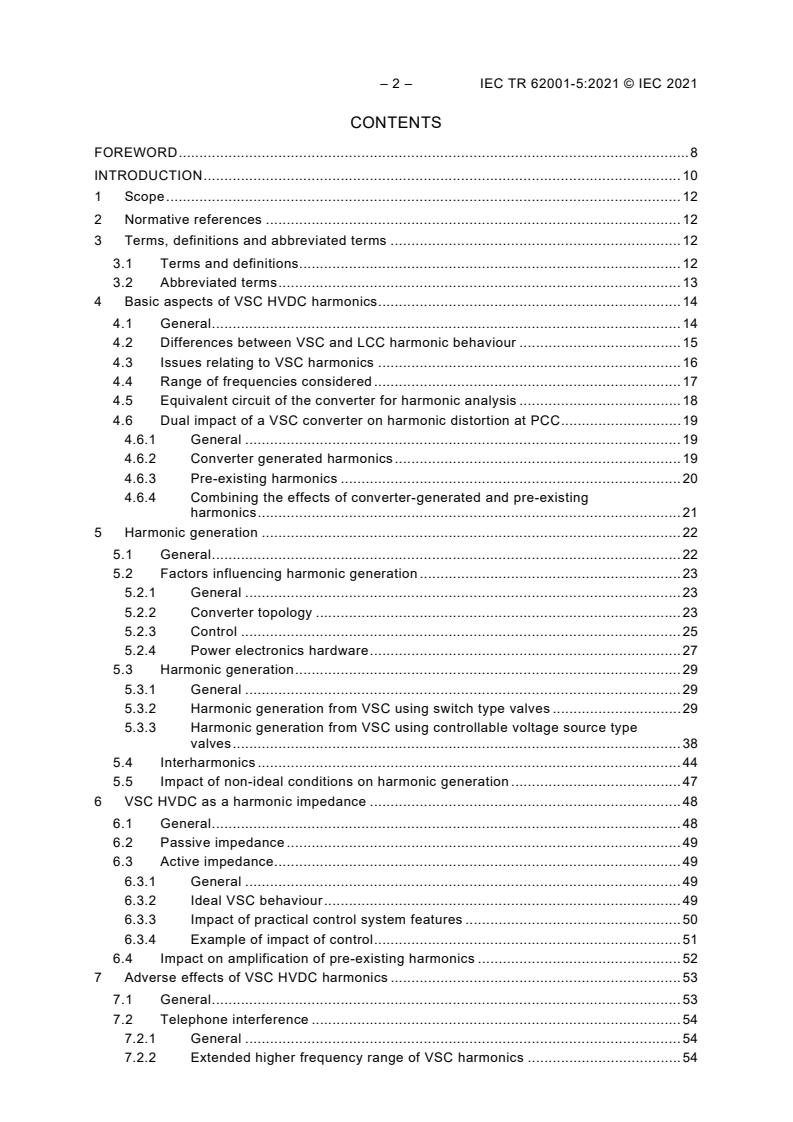
– 2 – IEC TR 62001-5:2021 © IEC 2021
CONTENTS
FOREWORD . 8
INTRODUCTION . 10
1 Scope . 12
2 Normative references . 12
3 Terms, definitions and abbreviated terms . 12
3.1 Terms and definitions. 12
3.2 Abbreviated terms . 13
4 Basic aspects of VSC HVDC harmonics . 14
4.1 General . 14
4.2 Differences between VSC and LCC harmonic behaviour . 15
4.3 Issues relating to VSC harmonics . 16
4.4 Range of frequencies considered . 17
4.5 Equivalent circuit of the converter for harmonic analysis . 18
4.6 Dual impact of a VSC converter on harmonic distortion at PCC . 19
4.6.1 General . 19
4.6.2 Converter generated harmonics . 19
4.6.3 Pre-existing harmonics . 20
4.6.4 Combining the effects of converter-generated and pre-existing
harmonics . 21
5 Harmonic generation . 22
5.1 General . 22
5.2 Factors influencing harmonic generation . 23
5.2.1 General . 23
5.2.2 Converter topology . 23
5.2.3 Control . 25
5.2.4 Power electronics hardware . 27
5.3 Harmonic generation . 29
5.3.1 General . 29
5.3.2 Harmonic generation from VSC using switch type valves . 29
5.3.3 Harmonic generation from VSC using controllable voltage source type
valves . 38
5.4 Interharmonics . 44
5.5 Impact of non-ideal conditions on harmonic generation . 47
6 VSC HVDC as a harmonic impedance . 48
6.1 General . 48
6.2 Passive impedance . 49
6.3 Active impedance. 49
6.3.1 General . 49
6.3.2 Ideal VSC behaviour . 49
6.3.3 Impact of practical control system features . 50
6.3.4 Example of impact of control . 51
6.4 Impact on amplification of pre-existing harmonics . 52
7 Adverse effects of VSC HVDC harmonics . 53
7.1 General . 53
7.2 Telephone interference . 54
7.2.1 General . 54
7.2.2 Extended higher frequency range of VSC harmonics . 54
7.2.3 Interharmonics . 54
7.2.4 AC cable connecting HVDC station to the PCC . 55
7.3 PLC, metering and ripple control . 55
7.3.1 General . 55
7.3.2 Extended higher frequency range of VSC harmonics . 56
7.3.3 Interharmonics . 56
7.4 Railway signal interference . 57
7.5 Digital telecommunications systems . 57
8 Harmonic limits . 58
8.1 General . 58
8.2 Deleterious effects of excessively low limits . 58
8.3 Standards and practice . 59
8.4 Perception of VSC in setting limits . 60
8.5 Emission and amplification limits . 60
8.6 Relevance of standards for VSC . 61
8.7 Existing standards . 61
8.8 Higher frequency harmonics . 62
8.8.1 General . 62
8.8.2 IEEE Std 519-2014 [7] . 63
8.8.3 Shortcomings in the context of VSC . 64
8.9 Even order harmonic limits . 64
8.10 Interharmonics . 64
8.10.1 General . 64
8.10.2 Treatment of interharmonics in existing standards . 65
8.10.3 Discussion and recommendations . 66
8.11 Interharmonics discretization and grouping methodologies. 67
8.11.1 Suggested method . 67
8.11.2 Power quality indices for interharmonic grouping . 70
8.11.3 Network impedance loci for interharmonic grouping . 71
8.12 Assessment as a harmonic voltage or current source . 72
8.13 Assessment of THD, TIF, THFF, IT . 73
8.14 Measurement and verification of harmonic compliance . 74
8.15 Recommendations . 75
9 Harmonic mitigation techniques . 76
9.1 General . 76
9.2 Passive filtering . 76
9.3 Active damping and active filtering by converter control . 78
9.4 Optimization between passive and active mitigation . 79
9.5 Specific mitigation issues and techniques . 79
9.5.1 Unbalanced phase reactances or voltages . 79
9.5.2 Power oscillations due to AC supply voltage unbalance . 83
9.5.3 Harmonic cross-modulation between AC and DC sides . 85
9.5.4 Cross-modulation of DC side fundamental frequency current . 87
10 Modelling . 88
10.1 Provision of models . 88
10.2 Time and frequency domain . 88
10.3 Modelling of the converter control for harmonic and resonance studies . 89
10.4 Converter linearization by analytical approach . 90
10.4.1 General . 90
– 4 – IEC TR 62001-5:2021 © IEC 2021
10.4.2 VSC-MMC linearized model . 90
10.4.3 Input impedance . 90
10.4.4 Advantages of analytical method . 91
10.4.5 Drawbacks of analytical method . 91
10.5 Deriving the converter impedance by numerical approach . 91
10.5.1 Methodology . 91
10.5.2 Advantages of numerical method . 93
10.5.3 Drawbacks of numerical method . 94
10.6 Choice between analytical and numerical methods . 94
10.7 Model validation . 94
10.8 Network impedance modelling . 95
11 Harmonic stability . 97
11.1 General . 97
11.2 Literature review . 98
11.3 Definitions . 99
11.4 Theory . 100
11.4.1 General . 100
11.4.2 Passive harmonic resonance . 100
11.4.3 Active behaviour of converters . 102
11.4.4 Active impedance of a VSC with a generic current control . 102
11.4.5 Harmonic instability . 103
11.5 Analysis methods . 106
11.5.1 General . 106
11.5.2 Network impedance scans . 106
11.5.3 Passivity analysis . 107
11.5.4 Impedance-based stability analysis. 110
11.5.5 Modal analysis in rotating reference frame . 114
11.5.6 Electro-magnetic-transient simulation . 116
11.5.7 Recommendations . 117
11.6 System-wide studies . 117
11.7 Real experiences of harmonic stability in the context of HVDC systems . 118
11.7.1 General . 118
11.7.2 Case A: High power rating VSC HVDC system . 118
11.7.3 Case B: Offshore wind farm . 120
11.7.4 Case C: Back-to-back converter in a 500 kV network . 122
12 Conclusion . 124
Bibliography . 126
Figure 1 – Frequency range of VSC waveform . 17
Figure 2 – Harmonic representation of a VSC station for harmonics analysis . 18
Figure 3 – Harmonic contribution by the converter . 20
Figure 4 – Amplification of the background harmonics . 20
Figure 5 – Two-level converter . 24
Figure 6 – Three-level converter . 24
Figure 7 – Modular multi-level converter (MMC) . 24
Figure 8 – Cascaded two-level converter (CTL) . 24
Figure 9 – HVDC VSC converter control structure . 25
Figure 10 – Interlocking example . 28
Figure 11 – Semiconductor voltage drop . 29
Figure 12 – References and carrier for a two level converter using PWM with pulse
number of 9 . 30
Figure 13 – Reference, carrier and the resulting phase voltage for one phase of a two
level converter using PWM with pulse number of 9 . 30
Figure 14 – Harmonic spectrum, phase to ground, of a two level converter using PWM
with pulse number of 39 . 31
Figure 15 – Harmonic spectrum, phase to ground, of a two level converter using PWM
with pulse number 39 after removal of the zero sequence orders . 31
Figure 16 – Extended harmonic spectrum of a two level converter using PWM with
pulse number 39 after removal of the zero sequence orders . 32
Figure 17 – Fundamental and phase voltage for one phase of a two-level converter
using OPWM . 33
Figure 18 – Harmonic spectrum, phase to ground, of a two-level converter using
OPWM . 33
Figure 19 – Harmonic spectrum, phase to ground, of a two level converter using
OPWM after removal of the zero sequence . 34
Figure 20 – Extended harmonic spectrum, phase to ground, of a two-level converter
using OPWM after removal of the zero sequence . 34
Figure 21 – References and carriers for a three level converter with pulse number of 9 . 35
Figure 22 – Reference, carriers and the resulting phase voltage for one phase of a
three level converter with pulse number of 9 . 36
Figure 23 – Harmonic spectrum, phase-ground, of a three level converter,pulse
number of 39 . 36
Figure 24 – Harmonic spectrum, phase to ground, of a three level converter with pulse
number of 39 after removal of the zero sequence . 37
Figure 25 – Extended harmonic spectrum, phase to ground, of a three level converter
with pulse number of 39 after removal of the zero sequence . 37
Figure 26 – Voltage source representation of the MMC . 38
Figure 27 – Valve voltage generation . 40
Figure 28 – Harmonic spectrum for one arm of the MMC converter . 40
Figure 29 – Harmonic spectrum for one arm of the MMC converter (extended
frequency range). 41
Figure 30 – Reference and carriers for three adjacent cells . 42
Figure 31 – Zoomed – reference and carriers for three adjacent cells and resulting
voltage . 43
Figure 32 – Reference and voltage for one arm . 43
Figure 33 – Harmonic spectrum for one arm of a CTL converter. 44
Figure 34 – Harmonic spectrum for one arm of a CTL converter – extended frequency
range . 44
Figure 35 – Voltage synthesization with optimum time step of the valve control
operation . 45
Figure 36 – Voltage synthesization with an alternative time step of the valve control
operation . 46
Figure 37 – Illustrative impact of sorting and selection algorithms on interharmonic
generation . 46
Figure 38 – Active and passive impedance elements . 49
Figure 39 – Control of AC voltage or current . 50
– 6 – IEC TR 62001-5:2021 © IEC 2021
Figure 40 – Illustrative impact of the I-control inner control loop time response (to 5 %
relative error) on the positive sequence converter impedance . 52
Figure 41 – Proposed grouping methodology . 68
Figure 42 – Comparison with grouping methodology of IEC 61000-4-7 [3] . 68
Figure 43 – Centred harmonic subgroup . 69
Figure 44 – Harmonic group . 70
Figure 45 – Harmonic impedance frequency ranges for LCC . 71
Figure 46 – Harmonic impedance frequency ranges for VSC with proposed
methodology . 72
Figure 47 – Harmonic impedance frequency ranges for VSC with IEC 61000-4-7
grouping methodology. 72
Figure 48 – AC filter located at primary (network) side of converter transformer. 77
Figure 49 – AC filter located at the secondary (converter) side of converter
transformer . 77
Figure 50 – Example of a converter station scheme with asymmetrical phase
reactances . 80
Figure 51 – Example of converter plant and control scheme . 80
Figure 52 – Current control scheme . 81
Figure 53 – Time-domain response of positive and negative sequence voltages and
currents and active power when the converter does not compensate for effect of
phase reactance unbalances . 82
Figure 54 – Time-domain response of positive and negative sequence voltages and
currents and the active power when the converter controls phase currents to be
balanced . 83
Figure 55 – Power oscillations between AC and DC sides due to unbalanced AC
conditions when the converter does not control the fluctuations of energy between
arms and the grid currents . 84
Figure 56 – Influence of distortions at the AC and DC side voltages and the
propagation through the control . 86
th
Figure 57 – 6 harmonic content in DC side voltage of MMC . 86
Figure 58 – Resulting AC side voltage with modification of control at t = 4 s . 87
Figure 59 – VSC HVDC transmission system . 90
Figure 60 – VSC station model using the small-signal approach . 90
Figure 61 – Model evolution in decreasing complexity . 92
Figure 62 – Switching function model of MMC arm . 92
Figure 63 – Time domain to frequency domain stratagem . 92
Figure 64 – Example of a circuit to linearize a network and a VSC including controllers . 93
Figure 65 – Dynamic interactions between components and study framework . 98
Figure 66 – RLC circuit and time-domain response to a step disturbance . 100
Figure 67 – Connection of the converter station to a passive network . 101
Figure 68 – Bode plot of the converter, network and equivalent impedances . 101
Figure 69 – Dynamic scheme of the current controller and phase reactor . 102
Figure 70 – Bode plot of the converter passive and active impedance . 103
Figure 71 – Example of a network composed of a VSC and a frequency-dependent AC
system for the study of control interactions . 104
Figure 72 – Dynamic interaction between the active VSC impedance and the network
passive impedance . 104
Figure 73 – Bode plot of the VSC and network impedance, including active converter
effects . 105
Figure 74 – Results of EMT simulation study of the investigated system . 106
Figure 75 – Example output of passivity analysis . 109
Figure 76 – Comparison of passivity analysis of converter system without (blue line)
and with (red line) harmonic damper . 110
Figure 77 – Simple network, consisting of source and load . 111
Figure 78 – Loop gain of the simple network . 111
Figure 79 – Bode diagram of the frequency dependent impedance of a converter and
the grid . 112
Figure 80 – Small-signal representation of two interconnected AC systems . 113
Figure 81 – Sample impedance stability results . 114
Figure 82 – Sample modal analysis results . 116
Figure 83 – Circuit configuration of the negative resistance test case . 119
Figure 84 – Frequency response of Network 1 and the converter station. 119
Figure 85 – Phase angle from Figure 84 zoomed in the y axis . 120
Figure 86 – AC voltage at PCC1 and zoomed extract . 120
Figure 87 – Schematic view of the main components of the case B grid connection
system . 121
Figure 88 – Example of frequency scan at the offshore substation in case B . 122
Figure 89 – Illustrations of the system in case C . 123
Figure 90 – Bode diagram of converter and grid impedances in case C and time-
domain simulation with the control implemented in the EMT tool . 123
Table 1 – Indicative summation exponents . 21
Table 2 – Indicative planning levels for harmonic voltages (in percent of the
fundamental voltage) in MV, HV and EHV power systems . 61
Table 3 – Current limits for system rated > 161 kV . 63
Table 4 – Summary of IEC TR 61000-3-6 [5] recommended voltage planning levels . 65
Table 5 – Phase margins at intersections . 112
– 8 – IEC TR 62001-5:2021 © IEC 2021
INTERNATIONAL ELECTROTECHNICAL COMMISSION
____________
HIGH-VOLTAGE DIRECT CURRENT (HVDC) SYSTEMS –
GUIDANCE TO THE SPECIFICATION AND DESIGN
EVALUATION OF AC FILTERS –
Part 5: AC side harmonics and appropriate harmonic
limits for HVDC systems with voltage sourced converters (VSC)
FOREWORD
1) The International Electrotechnical Commission (IEC) is a worldwide organization for standardization comprising
all national electrotechnical committees (IEC National Committees). The object of IEC is to promote international
co-operation on all questions concerning standardization in the electrical and electronic fields. To this end and
in addition to other activities, IEC publishes International Standards, Technical Specifications, Technical Reports,
Publicly Available Specifications (PAS) and Guides (hereafter referred to as "IEC Publication(s)"). Their
preparation is entrusted to technical committees; any IEC National Committee interested in the subject dealt with
may participate in this preparatory work. International, governmental and non-governmental organizations liaising
with the IEC also participate in this preparation. IEC collaborates closely with the International Organization for
Standardization (ISO) in accordance with conditions determined by agreement between the two organizations.
2) The formal decisions or agreements of IEC on technical matters express, as nearly as possible, an international
consensus of opinion on the relevant subjects since each technical committee has representation from all
interested IEC National Committees.
3) IEC Publications have the form of recommendations for international use and are accepted by IEC National
Committees in that sense. While all reasonable efforts are made to ensure that the technical content of IEC
Publications is accurate, IEC cannot be held responsible for the way in which they are used or for any
misinterpretation by any end user.
4) In order to promote international uniformity, IEC National Committees undertake to apply IEC Publications
transparently to the maximum extent possible in their national and regional publications. Any divergence between
any IEC Publication and the corresponding national or regional publication shall be clearly indicated in the latter.
5) IEC itself does not provide any attestation of conformity. Independent certification bodies provide conformity
assessment services and, in some areas, access to IEC marks of conformity. IEC is not responsible for any
services carried out by independent certification bodies.
6) All users should ensure that they have the latest edition of this publication.
7) No liability shall attach to IEC or its directors, employees, servants or agents including individual experts and
members of its technical committees and IEC National Committees for any personal injury, property damage or
other damage of any nature whatsoever, whether direct or indirect, or for costs (including legal fees) and
expenses arising out of the publication, use of, or reliance upon, this IEC Publication or any other IEC
Publications.
8) Attention is drawn to the Normative references cited in this publication. Use of the referenced publications is
indispensable for the correct application of this publication.
9) Attention is drawn to the possibility that some of the elements of this IEC Publication may be the subject of patent
rights. IEC shall not be held responsible for identifying any or all such patent rights.
IEC TR 62001-5 has been prepared by subcommittee 22F: Power electronics for electrical
transmission and distribution systems, of IEC technical committee 22: Power electronic systems
and equipment. It is a Technical Report.
The text of this document is based on the following documents:
Draft Report on voting
22F/616/DTR 22F/621B/RVDTR
Full information on the voting for its approval can be found in the report on voting indicated in
the above table.
The language used for the development of this document is English.
A list of all parts in the IEC 62001 series, published under the general title High-voltage direct
current (HVDC) systems – Guidance to the specification and design evaluation of AC filters,
can be found on the IEC website.
This document was drafted in accordance with ISO/IEC Directives, Part 2, and developed in
accordance with ISO/IEC Directives, Part 1 and ISO/IEC Directives, IEC Supplement, available
at www.iec.ch/members_experts/refdocs. The main document types developed by IEC are
described in greater detail at www.iec.ch/standardsdev/publications.
The committee has decided that the contents of this document will remain unchanged until the
stability date indicated on the IEC website under webstore.iec.ch in the data related to the
specific document. At this date, the document will be
• reconfirmed,
• withdrawn,
• replaced by a revised edition, or
• amended.
IMPORTANT – The "colour inside" logo on the cover page of this document indicates
that it contains colours which are considered to be useful for the correct understanding
of its contents. Users should therefore print this document using a colour printer.
– 10 – IEC TR 62001-5:2021 © IEC 2021
INTRODUCTION
The IEC TR 62001 series is structured in five parts:
IEC TR 62001-1 – Overview
This part concerns specifications of AC filters for high-voltage direct current (HVDC) systems
with line-commutated converters, permissible distortion limits, harmonic generation, filter
arrangements, filter performance calculation, filter switching and reactive power management
and customer specified parameters and requirements.
IEC TR 62001-2 – Performance
This part deals with current-based interference criteria, field measurements and verification.
IEC TR 62001-3 – Modelling
This part addresses the harmonic interaction across converters, pre-existing harmonics,
AC network impedance modelling, simulation of AC filter performance.
IEC TR 62001-4 – Equipment
This part concerns steady-state and transient ratings of AC filters and their components, power
losses, audible noise, design issues and special applications, filter protection, seismic
requirements, equipment design and test parameters.
IEC TR 62001-5 – AC side harmonics and appropriate harmonic limits for high-voltage direct
current (HVDC) systems with voltage sourced converters (VSC)
This part concerns specific issues of AC filter design related to VSC HVDC systems. The rapid
proliferation, increasing power, and technical advances of voltage source converter (VSC)
HVDC technology in recent years has had a revolutionary impact on large-scale electrical power
transmission. In the sphere of harmonics and filtering, the introduction of VSC technology has
been highly significant. The harmonic signature of these converters is not only smaller in
magnitude than equivalent line commutated converter (LCC) HVDC schemes, but also radically
different in nature. Due to the switching and control methods which may be used for VSC, the
generation of non-integer harmonics (interharmonics) may be an inherent characteristic of the
conversion process. The frequency range of interest has also extended upwards.
The existing national and international regulations and recommendations governing harmonics
were originally written considering the types of converters and associated harmonics relevant
at the time of their production. With the arrival of new conversion technologies, the guidelines
available are proving inadequate to deal with new harmonic profiles. Individual regulatory
bodies are hastening to adapt their practices to the new technology and this document aims to
aid them by providing a firm basis of appropriate technical knowledge.
The implications of VSC transmission for harmonic generation are perhaps not widely enough
understood throughout the industry in terms of the frequencies and magnitudes produced and
the necessity (or otherwise) of having dedicated filters. The modelling of a VSC as a harmonic
voltage source rather than a current source may also not be fully appreciated in its implications
for regulatory methodologies. The generation of interharmonics due to the control techniques
used by some VSC HVDC converters also has profound implications.
A further topic of interest is the effect of VSC installations on pre-existing (background)
harmonics. Some designs of VSC now produce a waveform so clean that it is quasi-sinusoidal
and in many applications harmonic filters may not be required for mitigation of the harmonics
generated by the converter. However, the converter will have a harmonic impedance as seen
from the network, and it is important to be able to assess this harmonic impedance and calculate
its impact in terms of possible amplification (or damping) of the pre-existing network harmonics.
In some instances, this amplification of pre-existing harmonics may be the only reason for
having to install filtering for a HVDC VSC.
The above aspects mainly refer to steady-state power quality issues. A separate topic is the
interaction of the VSC HVDC control system with physical resonances in the connected power
system. Electric power grid development is tending towards an increasing installation of
underground and submarine cables, especially in the context of dispersed renewable
generation. In addition, the phase-out of conventional generation together with the increasing
installation of new generation sources coupled via converters and the changing characteristics
of network loads will result in a reduction of harmonic damping in the system. Some converter
control loops can have a bandwidth of several hundred hertz, and thus are able to interact with
grid resonances. As a consequence, oscillations related to system harmonic resonances might
appear and new mitigation techniques and assessment methods may become a challenge.
Depending on system damping, such oscillations may be damped, sustained in steady-state or
increase until some form of tripping or shutdown occurs. This phenomenon has become widely
known as "harmonic stability" and although the suitability of this name may be questioned, it
has been adopted in this document.
– 12 – IEC TR 62001-5:2021 © IEC 2021
HIGH-VOLTAGE DIRECT CURRENT (HVDC) SYSTEMS –
GUIDANCE TO THE SPECIFICATION AND DESIGN
EVALUATION OF AC FILTERS –
Part 5: AC side harmonics and appropriate harmonic
limits for HVDC systems with
...