

IEC 60974-1:1998/AMD2:2003
(Amendment)Amendment 2 - Arc welding equipment - Part 1: Welding power sources
General Information
- Abstract
- Status
- Published
- Publication Date
- 27-Apr-2003
- Technical Committee
- TC 26 - Electric welding
- Drafting Committee
- JWG 1 - TC 26/JWG 1
- Current Stage
- DELPUB - Deleted Publication
- Start Date
- 25-Jul-2005
- Completion Date
- 28-Aug-2026
Overview
IEC 60974-1:1998/AMD2:2003 is an important amendment to the international standard governing arc welding equipment, specifically focusing on Part 1: Welding power sources. Prepared by the International Electrotechnical Commission (IEC) Technical Committee 26 on Electric Welding, this amendment updates definitions, testing requirements, and safety measures essential for manufacturers and users of welding power sources. The standard ensures product reliability, operator safety, and harmonizes product characteristics worldwide.
Key Topics
Duty Cycle (Duty Factor) Redefinition
The amendment revises the definition of duty cycle (3.37), clarifying it as the ratio of continuous on-load welding time to the total cycle time, set at 10 minutes. For example, a 60% duty cycle means 6 minutes of operation followed by 4 minutes of no load, essential for understanding equipment performance limits.Minimum Creepage Distances
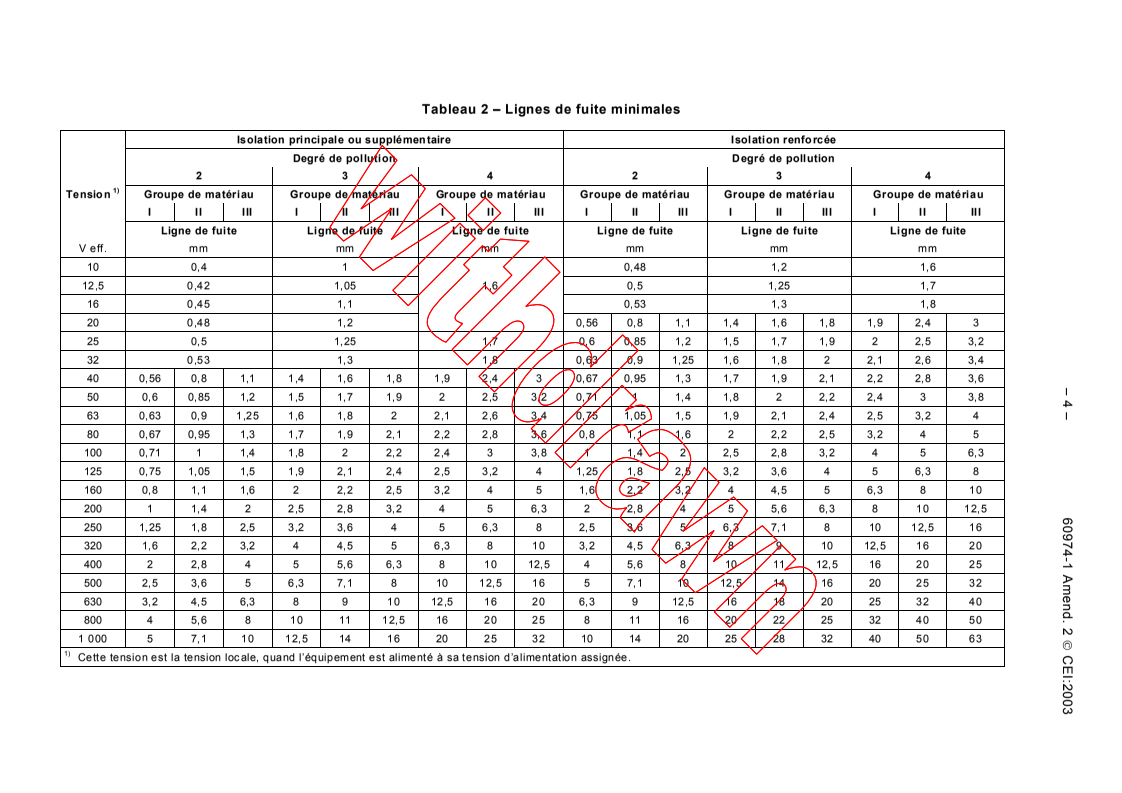
Updated Table 2 specifies minimum creepage distances for various insulation types and pollution degrees. These distances are critical for preventing electrical faults and ensuring operational safety under rated supply voltages.Dielectric Strength Testing
The amendment enhances dielectric strength test protocols, allowing manufacturers discretion in gradually applying test voltages and specifying conditions under which components may be disconnected or shorted during testing. It emphasizes operator safety with recommended overload settings and clear instructions for testing complete welding power sources.Protection Requirements
Changes include updated protections offered by equipment enclosures and specific requirements for plasma cutting systems, addressing insulation and voltage thresholds to maintain safety during both normal and fault conditions.Equipment Coupling and Auxiliary Power Supplies
Clarifications are made on the current ratings for supply coupling devices and the marking requirements for auxiliary power output terminals. This ensures compatibility and safety during welding power source installation and use.Physical Durability
The amendment defines testing methods for the mechanical robustness of enclosures, such as impact resistance using pendulum hammers or drop tests, to guarantee equipment can withstand physical stresses in real-world conditions.
Applications
Welding Equipment Manufacturing
Manufacturers use this amendment as a guideline to design, test, and certify welding power sources that meet international safety, performance, and reliability criteria.Quality Assurance and Testing Labs
Testing facilities apply these updated dielectric strength and creepage distance requirements to verify compliance during product certification and routine inspection.Safety Compliance and Risk Management
Safety officers and engineers employ the amendment’s definitions and protection guidelines to assess workplace welding equipment hazards and implement proper safety protocols.Welding Equipment Maintenance and Repair
Maintenance teams reference specified test voltages and insulation requirements to ensure reconditioned or repaired welding power sources continue to meet safety standards.
Related Standards
- IEC 60529 – Degrees of protection provided by enclosures (IP Code), referenced for touch safety tests on plasma cutting systems.
- IEC 61558-2-4 – Safety of transformers for auxiliary power supplies, relevant where additional auxiliary power connections are involved.
- Other Parts of IEC 60974 – Comprehensive series covering welding equipment, including electrodes and torches, complementing Part 1 by addressing peripheral equipment standards.
This amendment reinforces IEC 60974-1 as a critical resource for ensuring welding power sources are safe, durable, and internationally compliant, supporting the global welding industry in maintaining high standards for equipment quality and operator safety.
Relations
- Effective Date
- 05-Sep-2023
- Effective Date
- 05-Sep-2023
Get Certified
Connect with accredited certification bodies for this standard

DVS-ZERT GmbH
German welding certification society.
CARES (UK Certification Authority for Reinforcing Steels)
UK certification for reinforcing steels and construction.
EWF/IIW (European/International Welding Federation)
International welding personnel certification.
Sponsored listings
Frequently Asked Questions
IEC 60974-1:1998/AMD2:2003 is a standard published by the International Electrotechnical Commission (IEC). Its full title is "Amendment 2 - Arc welding equipment - Part 1: Welding power sources". This standard covers: Amendment 2 - Arc welding equipment - Part 1: Welding power sources
Amendment 2 - Arc welding equipment - Part 1: Welding power sources
IEC 60974-1:1998/AMD2:2003 is classified under the following ICS (International Classification for Standards) categories: 25.160.30 - Welding equipment. The ICS classification helps identify the subject area and facilitates finding related standards.
IEC 60974-1:1998/AMD2:2003 has the following relationships with other standards: It is inter standard links to IEC 60974-1:1998, IEC 60974-1:2005. Understanding these relationships helps ensure you are using the most current and applicable version of the standard.
IEC 60974-1:1998/AMD2:2003 is available in PDF format for immediate download after purchase. The document can be added to your cart and obtained through the secure checkout process. Digital delivery ensures instant access to the complete standard document.
Standards Content (Sample)
NORME CEI
INTERNATIONALE IEC
60974-1
INTERNATIONAL
STANDARD
AMENDEMENT 2
AMENDMENT 2
2003-04
Amendement 2
Matériel de soudage électrique –
Partie 1:
Sources de courant pour soudage
Amendment 2
Arc welding equipment –
Part 1:
Welding power sources
IEC 2003 Droits de reproduction réservés Copyright - all rights reserved
International Electrotechnical Commission, 3, rue de Varembé, PO Box 131, CH-1211 Geneva 20, Switzerland
Telephone: +41 22 919 02 11 Telefax: +41 22 919 03 00 E-mail: inmail@iec.ch Web: www.iec.ch
CODE PRIX
V
Commission Electrotechnique Internationale
PRICE CODE
International Electrotechnical Commission
Международная Электротехническая Комиссия
Pour prix, voir catalogue en vigueur
For price, see current catalogue
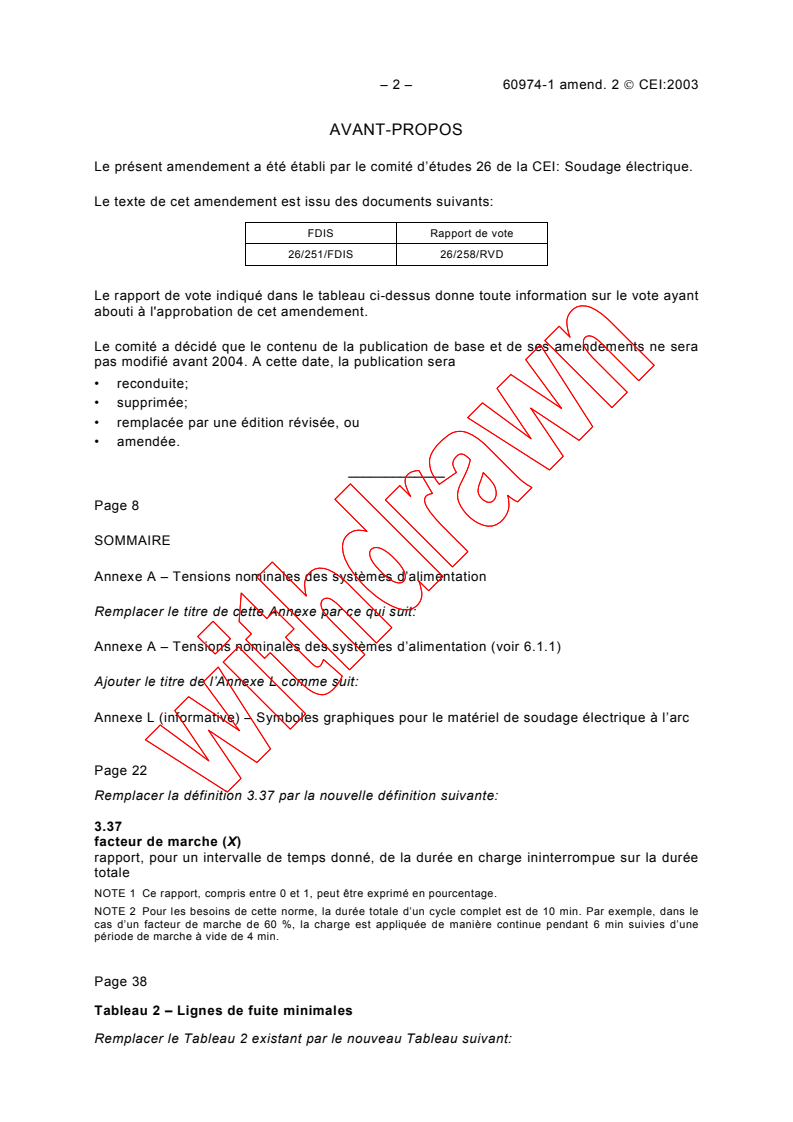
– 2 – 60974-1 amend. 2 CEI:2003
AVANT-PROPOS
Le présent amendement a été établi par le comité d’études 26 de la CEI: Soudage électrique.
Le texte de cet amendement est issu des documents suivants:
FDIS Rapport de vote
26/251/FDIS 26/258/RVD
Le rapport de vote indiqué dans le tableau ci-dessus donne toute information sur le vote ayant
abouti à l'approbation de cet amendement.
Le comité a décidé que le contenu de la publication de base et de ses amendements ne sera
pas modifié avant 2004. A cette date, la publication sera
• reconduite;
• supprimée;
• remplacée par une édition révisée, ou
• amendée.
_____________
Page 8
SOMMAIRE
Annexe A – Tensions nominales des systèmes d’alimentation
Remplacer le titre de cette Annexe par ce qui suit:
Annexe A – Tensions nominales des systèmes d’alimentation (voir 6.1.1)
Ajouter le titre de l’Annexe L comme suit:
Annexe L (informative) – Symboles graphiques pour le matériel de soudage électrique à l’arc
Page 22
Remplacer la définition 3.37 par la nouvelle définition suivante:
3.37
facteur de marche (X)
rapport, pour un intervalle de temps donné, de la durée en charge ininterrompue sur la durée
totale
NOTE 1 Ce rapport, compris entre 0 et 1, peut être exprimé en pourcentage.
NOTE 2 Pour les besoins de cette norme, la durée totale d’un cycle complet est de 10 min. Par exemple, dans le
cas d’un facteur de marche de 60 %, la charge est appliquée de manière continue pendant 6 min suivies d’une
période de marche à vide de 4 min.
Page 38
Tableau 2 – Lignes de fuite minimales
Remplacer le Tableau 2 existant par le nouveau Tableau suivant:
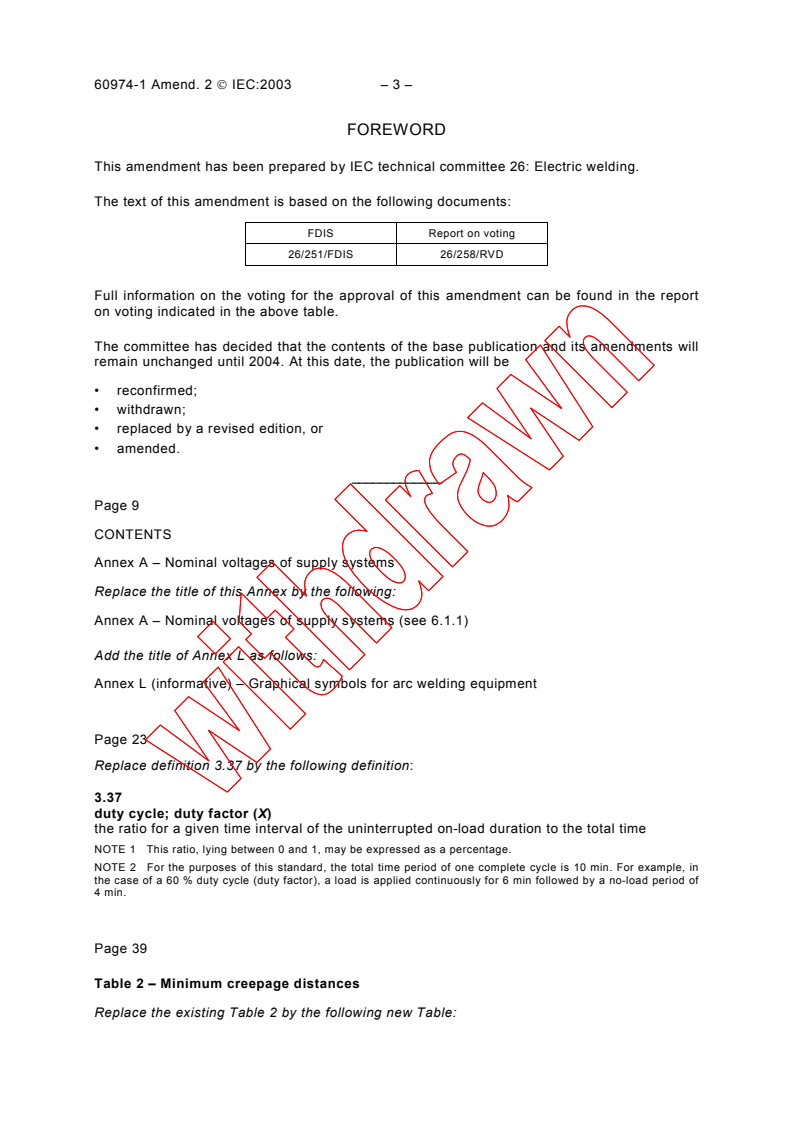
60974-1 Amend. 2 IEC:2003 – 3 –
FOREWORD
This amendment has been prepared by IEC technical committee 26: Electric welding.
The text of this amendment is based on the following documents:
FDIS Report on voting
26/251/FDIS 26/258/RVD
Full information on the voting for the approval of this amendment can be found in the report
on voting indicated in the above table.
The committee has decided that the contents of the base publication and its amendments will
remain unchanged until 2004. At this date, the publication will be
• reconfirmed;
• withdrawn;
• replaced by a revised edition, or
• amended.
_____________
Page 9
CONTENTS
Annex A – Nominal voltages of supply systems
Replace the title of this Annex by the following:
Annex A – Nominal voltages of supply systems (see 6.1.1)
Add the title of Annex L as follows:
Annex L (informative) – Graphical symbols for arc welding equipment
Page 23
Replace definition 3.37 by the following definition:
3.37
duty cycle; duty factor (X)
the ratio for a given time interval of the uninterrupted on-load duration to the total time
NOTE 1 This ratio, lying between 0 and 1, may be expressed as a percentage.
NOTE 2 For the purposes of this standard, the total time period of one complete cycle is 10 min. For example, in
the case of a 60 % duty cycle (duty factor), a load is applied continuously for 6 min followed by a no-load period of
4 min.
Page 39
Table 2 – Minimum creepage distances
Replace the existing Table 2 by the following new Table:
– 4 – 60974-1 Amend. 2 CEI:2003
Tableau 2 – Lignes de fuite minimales
Isolation principale ou supplémentaire Isolation renforcée
Degré de pollution Degré de pollution
23 4 2 3 4
1)
Tension Groupe de matériau Groupe de matériau Groupe de matériau Groupe de matériau Groupe de matériau Groupe de matériau
I II III I II III I II III I II III I II III I II III
Ligne de fuite Ligne de fuite Ligne de fuite Ligne de fuite Ligne de fuite Ligne de fuite
V eff. mm mm mm mm mm mm
10 0,4 1 0,48 1,2 1,6
12,5 0,42 1,05 1,6 0,5 1,25 1,7
16 0,45 1,1 0,53 1,3 1,8
20 0,48 1,2 0,56 0,8 1,1 1,4 1,6 1,8 1,9 2,4 3
25 0,5 1,25 1,7 0,6 0,85 1,2 1,5 1,7 1,9 2 2,5 3,2
32 0,53 1,3 1,8 0,63 0,9 1,25 1,6 1,8 2 2,1 2,6 3,4
40 0,56 0,8 1,1 1,4 1,6 1,8 1,9 2,4 3 0,67 0,95 1,3 1,7 1,9 2,1 2,2 2,8 3,6
50 0,6 0,85 1,2 1,5 1,7 1,9 2 2,5 3,2 0,71 1 1,4 1,8 2 2,2 2,4 3 3,8
63 0,63 0,9 1,25 1,6 1,8 2 2,1 2,6 3,4 0,75 1,05 1,5 1,9 2,1 2,4 2,5 3,2 4
80 0,67 0,95 1,3 1,7 1,9 2,1 2,2 2,8 3,6 0,8 1,1 1,6 2 2,2 2,5 3,2 4 5
100 0,71 1 1,4 1,8 2 2,2 2,4 3 3,8 1 1,4 2 2,5 2,8 3,2 4 5 6,3
125 0,75 1,05 1,5 1,9 2,1 2,4 2,5 3,2 4 1,25 1,8 2,5 3,2 3,6 4 5 6,3 8
160 0,8 1,1 1,6 2 2,2 2,5 3,2 4 5 1,6 2,2 3,2 4 4,5 5 6,3 8 10
200 1 1,4 2 2,5 2,8 3,2 4 5 6,3 2 2,8 4 5 5,6 6,3 8 10 12,5
250 1,25 1,8 2,5 3,2 3,6 4 5 6,3 8 2,5 3,6 5 6,3 7,1 8 10 12,5 16
320 1,6 2,2 3,2 4 4,5 5 6,3 8 10 3,2 4,5 6,3 8 9 10 12,5 16 20
400 2 2,8 4 5 5,6 6,3 8 10 12,5 4 5,6 8 10 11 12,5 16 20 25
500 2,5 3,6 5 6,3 7,1 8 10 12,5 16 5 7,1 10 12,5 14 16 20 25 32
630 3,2 4,5 6,3 8 9 10 12,5 16 20 6,3 9 12,5 16 18 20 25 32 40
800 4 5,6 8 10 11 12,5 16 20 25 8 111620222532 40 50
1 000 5 7,1 10 12,5 14 16 20 25 32 10 142025283240 50 63
1)
Cette tension est la tension locale, quand l’équipement est alimenté à sa tension d’alimentation assignée.
60974-1 Amend. 2 IEC:2003 – 5 –
Table 2 – Minimum creepage distances
Basic or supplementary insulation Reinforced insulation
Pollution degree Pollution degree
23 4 2 3 4
1)
Voltage
Material group Material group Material group Material group Material group Material group
I II III I II III I II III I II III I II III I II III
Creepage distance Creepage distance Creepage distance Creepage distance Creepage distance Creepage distance
V r.m.s. mm mm mm mm mm mm
10 0,4 1 0,48 1,2 1,6
12,5 0,42 1,05 1,6 0,5 1,25 1,7
16 0,45 1,1 0,53 1,3 1,8
20 0,48 1,2 0,56 0,8 1,1 1,4 1,6 1,8 1,9 2,4 3
25 0,5 1,25 1,7 0,6 0,85 1,2 1,5 1,7 1,9 2 2,5 3,2
32 0,53 1,3 1,8 0,63 0,9 1,25 1,6 1,8 2 2,1 2,6 3,4
40 0,56 0,8 1,1 1,4 1,6 1,8 1,9 2,4 3 0,67 0,95 1,3 1,7 1,9 2,1 2,2 2,8 3,6
50 0,6 0,85 1,2 1,5 1,7 1,9 2 2,5 3,2 0,71 1 1,4 1,8 2 2,2 2,4 3 3,8
63 0,63 0,9 1,25 1,6 1,8 2 2,1 2,6 3,4 0,75 1,05 1,5 1,9 2,1 2,4 2,5 3,2 4
80 0,67 0,95 1,3 1,7 1,9 2,1 2,2 2,8 3,6 0,8 1,1 1,6 2 2,2 2,5 3,2 4 5
100 0,71 1 1,4 1,8 2 2,2 2,4 3 3,8 1 1,4 2 2,5 2,8 3,2 4 5 6,3
125 0,75 1,05 1,5 1,9 2,1 2,4 2,5 3,2 4 1,25 1,8 2,5 3,2 3,6 4 5 6,3 8
160 0,8 1,1 1,6 2 2,2 2,5 3,2 4 5 1,6 2,2 3,2 4 4,5 5 6,3 8 10
200 1 1,4 2 2,5 2,8 3,2 4 5 6,3 2 2,8 4 5 5,6 6,3 8 10 12,5
250 1,25 1,8 2,5 3,2 3,6 4 5 6,3 8 2,5 3,6 5 6,3 7,1 8 10 12,5 16
320 1,6 2,2 3,2 4 4,5 5 6,3 8 10 3,2 4,5 6,3 8 9 10 12,5 16 20
400 2 2,8 4 5 5,6 6,3 8 10 12,5 4 5,6 8 10 11 12,5 16 20 25
500 2,5 3,6 5 6,3 7,1 8 10 12,5 16 5 7,1 10 12,5 14 16 20 25 32
630 3,2 4,5 6,3 8 9 10 12,5 16 20 6,3 9 12,5 16 18 20 25 32 40
800 4 5,6 8 10 11 12,5 16 20 25 8 11 16 20 22 25 32 40 50
1 000 5 7,1 10 12,5 14 16 20 25 32 1014202528324050 63
1)
This voltage is the working voltage, when equipment is supplied at its rated voltage supply.
– 6 – 60974-1 Amend.2 CEI:2003
Page 40
6.1.4 Rigidité diélectrique
Ajouter, à la page 42, après le second alinéa qui suit le Tableau 4 (juste au-dessus de la ligne
“Essai en variante:.”), la note suivante:
NOTE Pour la sécurité de l’opérateur, le réglage le plus bas du réglage de surcharge (10 mA) est recommandé.
Remplacer le texte qui suit la ligne “Essai en variante:…” par ce qui suit:
Les composants ne doivent pas être déconnectés ni court-circuités à moins qu’ils ne
satisfassent aux exigences de a), b) ou c) ci-dessous:
a) Les composants sont conçus et essayés conformément aux normes correspondantes qui
spécifient une tension plus faible que le niveau de la tension d’essai prévu par cette
norme. Exemple: moteurs des ventilateurs et moteurs des pompes.
Les composants sont incorporés complètement soit au circuit d’alimentation et aux parties
conductrices accessibles soit au circuit de sortie et aux parties conductrices accessibles,
et leur déconnexion n’isole pas une partie de ce circuit à essayer.
b) Les composants incorporés complètement, soit au circuit d’alimentation soit au circuit de
sortie, peuvent être court-circuités ou déconnectés pendant l’essai de rigidité diélectrique,
pour autant que leur déconnexion n’isole pas une partie de ce circuit à essayer. Exemple:
circuits électroniques.
c) Les circuits destinés à éliminer les parasites ou les condensateurs destinés à la protection
entre le circuit d’alimentation ou le circuit de soudage et toutes les parties conductrices
accessibles peuvent être déconnectés pendant l’essai s’ils sont conformes aux normes
correspondantes.
Les circuits de commande connectés à la borne du conducteur de protection ne doivent
pas être déconnectés pendant l’essai et sont donc essayés comme parties conductrices
accessibles.
A la discrétion du fabricant, la tension d’essai peut être portée lentement à sa pleine valeur.
Les tensions d’essai entre le circuit d’alimentation, les parties conductrices accessibles
et le circuit de soudage peuvent être appliquées simultanément. Un exemple est donné
à l’Annexe B.
Les sources de courant de soudage comprenant un redresseur doivent être essayées après
montage de la source de courant de soudage complète, le redresseur demeurant
convenablement connecté au circuit de sortie du transformateur ou de l’alternateur. Les
redresseurs, leurs dispositifs de protection et les autres dispositifs à semi-conducteurs ou
condensateurs, peuvent être court-circuités pendant l’essai.
Les sources de courant de soudage à moteur thermique doivent être soumises aux mêmes
essais.
NOTE Lorsque cette prescription s’applique à l’essai des sources de courant de soudage usagées, soigneuse-
ment nettoyées (par exemple après maintenance ou réparation sans remplacement d’enroulement), il convient que
leur isolation résiste à 30 % des valeurs données au Tableau 4 ou ne soit pas inférieure à 1 500 V c.a. eff. entre
les circuits d’alimentation et de sortie.
La conformité doit être vérifiée par application de la tension d’essai pendant:
a) 60 s (essai de type);
b) 5 s (essai individuel de série)
ou
c) 1 s (essai individuel de série avec tension d’essai augmentée de 20 %).
60974-1 Amend. 2 IEC:2003 – 7 –
Page 41
6.1.4 Dielectric strength
Add, on page 43, after the second paragraph following Table 4 (just above the line
“Alternative test:.”), the following note:
NOTE For the operator’s safety, the lowest setting of overload setting (10 mA) is recommended.
Replace the text after the line “Alternative test:…” by the following:
Components shall not be disconnected or short-circuited unless the requirements of a), b)
or c) below are met:
a) The components are designed and tested to relevant standards that specify a voltage
lower than the test voltage level of this standard. Example: fan motors and pump motors.
The components are completely incorporated within either the input circuit and exposed
conductive parts or the output circuit and exposed conductive parts and their
disconnection does not stop a portion of that circuit from being tested.
b) Components completely incorporated within either the input or the output circuits
may be short-circuited or disconnected during the dielectric strength test, provided that
their disconnection does not stop a portion of that circuit from being tested.
Example: electronic circuits.
c) Interference suppression networks or protection capacitors between the input or welding
circuit and any exposed conductive part may be disconnected during the test if they
conform to their relevant standards.
Control circuits connected to the protective conductor terminal shall not be disconnected
during testing and they are then tested as exposed conductive parts.
The test voltage may be raised to the full value slowly at the discretion of the manufacturer.
The test voltages between the input circuit, the exposed conductive parts and the welding
circuit may be applied simultaneously. An example is given in Annex B.
Welding power sources incorporating a rectifier shall be tested after assembly of the complete
welding power source, with the power rectifier remaining properly connected to the output
circuit of the transformer or alternator. Rectifiers, their protective devices and other solid-state
electronic components or capacitors, may be short-circuited during the test.
Mechanically powered welding power sources shall undergo the same test.
NOTE If this requirement is applied to the testing of properly cleaned, used welding power sources (for example
after maintenance or repair without provision of new windings), their insulation should withstand 30 % of the values
given in Table 4 or not less than 1 500 V a.c. r.m.s. between input and output circuit.
Conformity shall be checked by application of the test voltage for:
a) 60 s (type test);
b) 5 s (routine test)
or
c) 1 s (routine test with the test voltage increased by 20 %).
– 8 – 60974-1 Amend.2 CEI:2003
Page 44
6.2.1 Degré de protection procuré par l’enveloppe
Supprimer le troisième alinéa.
Page 50
Remplacer le paragraphe 6.3.5 (dans l’Amendement 1) par le nouveau paragraphe suivant:
6.3.5 Exigences supplémentaires pour les systèmes de coupage plasma
Les tuyères, qui pour des raisons techniques ne peuvent être protégées contre les contacts
directs, doivent être considérées comme étant suffisamment protégées en cas de défaut
normal et de défaut unique, lorsqu’elles répondent aux exigences suivantes:
a) en l’absence du courant d’alimentation de l’arc:
si la tension entre la tuyère et la pièce mise en oeuvre et/ou la terre ne dépasse pas la
valeur de crête de 68 V ou 48 V efficaces,
et
b) pour les systèmes manuels, en présence du courant d’alimentation:
les côtés de la tuyère ne sont pas accessibles au doigt d’épreuve selon la CEI 60529
lorsqu’elle est placée sur une surface plate avec son axe perpendiculaire à celle-ci,
ou
la tension continue entre la tuyère et la pièce mise en oeuvre et/ou la terre ne dépasse
pas 113 V crête lorsque, pendant le coupage et le gougeage, la tuyère est placée à la
distance recommandée par le fabricant par rapport à une surface plate avec son axe
perpendiculaire à la surface,
ou
c) si les tensions de a) ou b) sont dépassées:
les tensions sont réduites comme spécifié dans l’Article 13.
NOTE Un exemple de défaut est une condition anormale résultant d’une électrode en contact avec la tuyère due
à l’absence de canons isolants, au collage de la tuyère avec l’électrode, à un élément conducteur entre la tuyère et
l’électrode, à des pièces inadaptées, à des pièces desserrées, à l’abrasion de l’électrode, à des pièces mal
positionnées, à un facteur de marche excessif, à un courant excessif ou à un débit de gaz incorrect.
60974-1 Amend. 2 IEC:2003 – 9 –
Page 45
6.2.1 Protection provided by the enclosure
Delete the third paragraph.
Page 51
Replace the existing Subclause 6.3.5 (in amendment 1) by the following new subclause:
6.3.5 Additional requirements for plasma cutting systems
Plasma tips, which for technical reasons cannot be protected against direct contact, shall be
considered sufficiently protected from normal and single fault conditions if the following
requirements are fulfilled:
a) when no arc current is present:
if the voltage between the plasma tip and the workpiece and/or earth is no higher than
the peak value of 68 V or 48 V r.m.s.
and
b) for manual systems, when an arc is present:
the sides of the plasma tip cannot be touched by the test finger according to IEC 60529
when it is placed on a flat surface with its centre line perpendicular to it,
or
the d.c. voltage between the plasma tip and the workpiece and/or earth is not higher
than 113 V peak when the plasma tip is placed at the distance recommended
by the manufacturer during cutting and gouging, from a flat surface with the centreline
perpendicular to the surface,
or
c) when the voltage of a) or b) is exceeded:
the voltages are reduced as specified in Clause 13.
NOTE An example of a fault is an abnormal condition resulting from the electrode being in contact with the
plasma tip because of missing insulators, sticking of the plasma tip to the electrode, conductive material between
plasma tip and electrode, wrong parts, loose parts, electrode abrasion, parts inserted incorrectly, excessive duty
cycle (duty factor), excessive current or incorrect gas flow.
– 10 – 60974-1 Amend.2 CEI:2003
Page 76
10.9 Dispositif de couplage de l’alimentation (fiche de prise de courant montée)
Remplacer le premier alinéa par ce qui suit:
Si un dispositif de couplage de l’alimentation est fourni comme partie de l’équipement de
soudage à l’arc, ses caractéristiques assignées de courant ne doivent pas être inférieures
à a) et b) pour tous les systèmes d’alimentation.
Pour les systèmes d’alimentation de 125 V les caractéristiques assignées de courant ne
doivent pas, de plus, être inférieures soit à c) soit à d).
Page 86
11.5 Alimentation de dispositifs extérieurs
Remplacer, à la page 88, le point c) par ce qui suit:
c) un transformateur de sécurité conforme à la CEI 61558-2-4 avec des caractéristiques
assignées de tension secondaire jusqu’à 120 V eff., si toutes les parties conductrices
accessibles du dispositif extérieur sont connectées, selon les recommandations du
fabricant, au conducteur de protection qui est protégé contre le courant de soudage, par
exemple par relais sensible à la terre ou par isolation des parties métalliques concernées,
par exemple par l’enveloppe.
Ajouter le nouvel alinéa suivant après le point c):
Les dispositifs extérieurs peuvent comprendre des télécommandes, des dispositifs
d’amorçage et de stabilisation d’arc, des torches ou traceurs de soudure ou d’autres
dispositifs contenant une connexion au circuit de soudage.
11.6 Sortie d’alimentation auxiliaire
Remplacer le troisième alinéa par ce qui suit:
Près des bornes de sortie ou socles de prises de courant fournissant cette énergie, le courant
disponible, la tension, le facteur de marche lorsqu’il est inférieur à 100 %, la fréquence, le
nombre de phases ou le courant continu et le statut du neutre (par exemple mis à la terre ou
non), suivant ce qui est approprié, doivent être marqués de manière claire et indélébile.
Page 92
14.1 Enveloppe
Remplacer la première phrase du point a) par ce qui suit:
a) Par un essai de choc en utilisant un marteau pendulaire de choc conformément à I.1 ou
un corps de chute conformément à I.2 ou des moyens équivalents, comme suit:
60974-1 Amend. 2 IEC:2003 – 11 –
Page 77
10.9 Supply coupling device (attachment plug)
Replace the first paragraph by the following:
If a supply coupling device is provided as a part of the arc welding equipment, its current
rating shall not be less than a) and b) for all power systems.
For 125 V power systems, the current rating shall, additionally, not be less than either c) or
d).
Page 87
11.5 Power supply to external devices
Replace, on page 89, item c) by the following:
c) an isolating transformer in accordance with IEC 61558-2-4 with a secondary voltage rating
up to 120 V r.m.s. if all exposed conductive parts of the external device, as recommended
by the manufacturer, are connected to the protective earth conductor that is protected
against the welding current, for example by a current sensing relay or by insulation of the
relevant metal parts, for example by an enclosure.
Add the following new paragraph after item c):
External devices may include remote controls, arc striking and stabilizing devices (ASSD),
torches or seam trackers or other devices containing a connection to the welding circuit.
11.6 Auxiliary power output
Replace the third paragraph by the following:
Near the output terminals or outlets of such power, the available current, the voltage, the duty
cycle (duty factor) if less than 100 %, the frequency, the number of phases or d.c. and the
status of the neutral (for example earthed or unearthed) as appropriate shall be clearly
and indelibly marked.
Page 93
14.1 Enclosure
Replace the first sentence of item a) by the following:
a) By an impact test using a pendulum impact hammer in accordance with annex I.1 or using
a free fall weight in accordance with annex I.2 or equivalent means as follows:
– 12 – 60974-1 Amend.2 CEI:2003
Page 98
15.2 Contenu
Ajouter à la case 4, à la page 100, le symbole et le texte suivants:
Source de courant de technologie onduleur délivrant un courant
c.a. et c.c.
Ajouter à la case 8, à la page 102, le symbole et le texte suivants:
Courant continu ou alternatif à la même sortie, et en plus la
fréquence assignée en hertz
Remplacer le texte du point a) de la case 9 par ce qui suit:
a) Valeur de crête dans le cas de courant continu
Remplacer le texte de la case 10 par ce qui suit:
… A/… V à … A/… V Plage de débit, courant minimal et maximal de soudage et tension
en charge correspondante.
Remplacer le texte des cases 11a, 11b et 11c par ce qui suit:
11a, 11b, 11c … % Valeurs du facteur de marche à la température de l’air ambiant
de 40 °C
Page 104
15.3 Tolérances
Remplacer la première phrase par ce qui suit:
Par surveillance des tolérances de composants et de fabrication, les fabricants doivent
garantir que les valeurs de la plaque signalétique restent dans les tolérances suivantes:
60974-1 Amend. 2 IEC:2003 – 13 –
Page 99
15.2 Contents
Add to box 4, on page 101, the following symbol and text:
Inverter power source with a.c and d.c. output
Add to box 8 on page 103 the following symbol and text:
Direct or alternating current at the same output, and additionally
the rated frequency in hertz
Replace the text of item a) of box 9 by the following:
a) Peak value in case of direct current
Replace the text of box 10 by the following:
… A/… V to … A/… V Range of output, minimum and maximum welding current and their
corresponding load voltage.
Replace the text of boxes 11a, 11b and 11c by the following:
11a, 11b, 11c … % Values of the duty cycle (duty factor) at an ambient air
temperature of 40 °C
Page 105
15.3 Tolerances
Replace the first sentence by the following:
Manufacturers shall meet rating plate values within the following tolerances by controlling
component and manufacturing tolerances:
– 14 – 60974-1 Amend.2 CEI:2003
Page 110
17.2 Marquages
Remplacer les paragraphes existants 17.2 et 17.3 par le nouveau paragraphe suivant 17.2:
17.2 Marquages
Chaque source de courant de soudage doit porter un marquage clair et indélébile sur ou à
proximité de la face avant ou à proximité du dispositif de commutation marche/arrêt avec une
combinaison de symboles avertisseurs,
Attention! Lire le manuel d’instructions
indiquant que le soudage à l’arc et le coupage plasma peuvent être dangereux pour
l’opérateur et pour les personnes qui se trouvent dans la zone de travail et que les
instructions doivent être consultées avant la mise en fonctionnement.
Le texte équivalent suivant peut être utilisé:
Avertissement: Lire le manuel d’instructions avant le fonctionnement et la maintenance de
cet équipement.
Pour d’autres marquages supplémentaires, voir l’Annexe L.
La conformité doit être vérifiée par examen visuel et selon un essai de durabilité décrit dans
l’Article 15.
Page 112
Annexe A
Remplacer le titre et le texte de l’Annexe A par ce qui suit:
60974-1 Amend. 2 IEC:2003 – 15 –
Page 111
17.2 Markings
Replace the existing Subclauses 17.2 and 17.3 by the following new Sublause 17.2:
17.2 Markings
Each welding power source shall be clearly and indelibly marked on or near the front panel or
near the on/off switching device with the warning symbol combination,
Caution! Read operator’s manual
indicating that arc welding and plasma cutting can be injurious to the operator and persons in
the work area and that the instructions shall be consulted before operating.
The following equivalent wording may be used:
Warning: Read instruction manuals before operating and servicing this equipment.
For other additional markings, see Annex L.
Conformity shall be checked by visual inspection and by testing in accordance with the
durability test in Clause 15.
Page 113
Annex A
Replace the title and text of Annex A by the following:
– 16 – 60974-1 Amend.2 CEI:2003
Annexe A
(informative)
Tensions nominales des systèmes d’alimentation (voir 6.1.1)
Tableau A.1
Tensions nominales utilisées actuellement dans le monde
Systèmes triphasés Systèmes triphasés Systèmes Systèmes
à quatre fils à trois fils monophasés à deux monophasés à trois
fils fils
Avec neutre à la Sans terre c.a. ou c.c. c.a. ou c.c.
Tension phase
terre
neutre
déduite des
tensions
nominales
c.a. ou c.c.
jusqu’à et
y compris
VV V V V
50 – – 12,5; 24; 25; 30; 42; 30-60
100 66/115 66 60 –
150 120/208; 127/220 115; 120; 127 110; 120 110-220; 120-240
300 220/380; 230/400; 220; 230; 240; 220 220-440
240/415; 260/440; 260; 277
277/480 347; 380; 400;
415; 440; 480;
600 347/600; 380/660; 500; 577; 600 480 480-960
400/690; 417/720;
480/830
1 000 – 660; 690; 720; 830; 1 000 –
1 000
NOTE 1 Valeurs issues du tableau B.1 de la CEI 60664-1.
NOTE 2 Dans les colonnes 2 et 5 la valeur inférieure est la tension phase neutre, pendant que la valeur
supérieure est la tension entre phases.
NOTE 3 Dans les colonnes 3 et 4 les valeurs sont la tension entre phases.
Page 144
Annexe K
Ajouter, après l'annexe K, la nouvelle annexe L suivante:
60974-1 Amend. 2 IEC:2003 – 17 –
Annex A
(informative)
Nominal voltages of supply systems (see 6.1.1)
Nominal voltages presently used in the world
Three-phase four- Three-phase three- Single-phase two- Single-phase three-
wire systems wire systems wire systems wire systems
with earthed neutral unearthed a.c. or d.c. a.c. or d.c.
Voltage line-
to-neutral
derived from
nominal voltages
a.c. or d.c.
up to and
including
VV V V V
50 – – 12,5; 24; 25; 30; 42; 30 - 60
100 66/115 66 60 –
150 120/208; 127/220 115; 120; 127 110; 120 110 - 220; 120 - 240
300 220/380; 230/400; 220; 230; 240; 220 220 - 440
240/415; 260/440; 260; 277
277/480 347; 380; 400;
415; 440; 480;
600 347/600; 380/660; 500; 577; 600 480 480 - 960
400/690; 417/720;
480/830
1 000 – 660; 690; 720; 830; 1 000 –
1 000
NOTE 1 Values taken from Table B.1 of IEC 60664-1.
NOTE 2 In columns 2 and 5, the lower value is the voltage line-to-neutral, while the higher value is the voltage
line-to-line.
NOTE 3 In columns 3 and 4 the values are the voltage line-to-line.
Page 145
Annex K
Add, after Annex K, the following new Annex L:
– 18 – 60974-1 Amend.2 CEI:2003
Annexe L
(informative)
Symboles graphiques pour le matériel
de soudage électrique à l’arc
Cette annexe décrit des symboles qui ne sont pas tous normalisés de manière internationale,
mais en usage pratique dans l’industrie du soudage. Le TC 26 et le SC 3C ont décidé de
considérer ces symboles en vue d’une introduction possible dans la CEI 60417. Quand ce
travail sera terminé, cette annexe sera modifiée en conséquence.
Cette annexe contient les symboles graphiques destinés aux équipements destinés au
soudage à l’arc et aux procédés connexes pour identifier les commandes, les indicateurs, les
points de connexion, les fonctions et pour sélectionner les procédés.
Ces symboles sont destinés à être utilisés sur la face, la plaque signalétique et toute
documentation pour les équipements de soudage à l’arc ou procédés connexes.
Cette annexe ne couvre pas les symboles graphiques utilisés pour avertir de risques
personnels immédiats ou potentiels pour le personnel qui utilise l’équipement.
NOTE 1 Pour les symboles sur la sécurité voir ISO 3864.
NOTE 2 Pour les instructions d’installation voir CEI 62081 et CEI 62079
L.1 Utilisation des symboles
L.1.1 Généralités
Il est recommandé de placer ces symboles sur l’équipement pour informer sur l’utilisation et le
fonctionnement. Des exemples de panneaux de contrôle sont donnés à l'article L.4.
L.1.2 Sélection des symboles
Les symboles indiqués dans l'article L.2 peuvent être utilisés soit seuls soit en combinaison
pour atteindre le but désiré. Des exemples de combinaisons sont donnés à l'article L.3.
L.1.3 Dimension des symboles
Pour l’utilisation de ces symboles, il peut être nécessaire soit de réduire soit d’agrandir
l’original jusqu’à la taille appropriée. Dans le cas de symboles composés de plusieurs
éléments graphiques, ou quand la hauteur est réduite au minimum, il convient de vérifier
qu’une claire identification est encore possible et que la lisibilité est suffisante. Il faut aussi
tenir compte de l’éclairage disponible, l’éloignement de l’utilisateur, et des conditions
opératoires possibles en tant que facteurs pour la sélection de la dimension.
La dimension minimale recommandée est de 6 mm carré.
L.1.4 Utilisation de couleur
En général, la forme graphique d’un symbole reproduite en noir sur blanc ou en blanc sur noir
devrait être suffisante pour son identification.
60974-1 Amend. 2 IEC:2003 – 19 –
Annex L
(informative)
Graphical symbols for arc welding equipment
This annex describes symbols, which are not all internationaly standardized, but of practical
use in the welding industry. TC 26 and SC 3C have decided to considered those symbols for a
future possible inclusion in IEC 60417. When this process will be terminated, this annex will
be modified accordingly.
This Annex contains graphic symbols for arc welding and allied processes equipment to
identify controls, indicators, connection points, functions, and to select processes.
The symbols are for use on the panel, the rating plate and any documentation for arc welding
and allied processes equipment.
This Annex does not cover graphic symbols used to alert personnel of immediate or potential
personal hazards in the use of the equipment.
NOTE 1 For safety symbols, see ISO 3864-1.
NOTE 2 For installation instructions, see IEC 62081 and IEC 62079.
L.1 Use of symbols
L.1.1 General
Symbols should be placed on equipment to instruct on use and operation. Examples of control
panel are given in Clause L.4.
L.1.2 Selection of symbols
Symbols specified in Clause L.2 can be used either as a single item or in combination to fit
the intended application. Examples of combinations are given in Clause L.3.
L.1.3 Size of symbols
For the application of these symbols, it may be necessary either to reduce or to enlarge the
original to a suitable size. In the case of symbols composed of several graphic elements, or
when reducing to minimum height, check that clear identification is still possible and legibility
is adequate. Available light, user distance, and possible operating conditions as factors during
size selection should also be considered.
Recommended minimum symbol size is 6 mm square.
L.1.4 Use of color
In general, the graphic form of a symbol reproduced in black on white or white on black
should be sufficient for its identification.
– 20 – 60974-1 Amend.2 CEI:2003
Pour atteindre les buts de ces symboles, un contraste suffisant entre le symbole et le fond est
le plus important. Aussi longtemps que le symbole est clairement délimité et complètement
lisible, une véritable sélection de couleur n’est pas obligatoire. Il convient de faire attention
que certaines couleurs, comme le rouge, l’orange, et le jaune sont désignées comme des
couleurs d’avertissement sur la sécurité.
L.2 Symboles
Cet article présente la suite des symboles avec leur numéro de référence, le mot clé ou une
phrase pour la fonction, l’utilisation et la source.
L.2.1 Lettres symboles
Le tableau L.1 donne une liste de lettres, qu’il est possible d’utiliser comme symbole.
Tableau L.1 — Lettres utilisées comme symboles
Fonction, mot clé ou phrase Lettre Unité
Ampérage I A
Courant conventionnel de soudage I A
Tension conventionnelle de soudage U V
Diamètre mm
∅
Cycle de marche; facteur de marche X %
Fréquence f Hz
Puissance P W
Puissance consommée P W
Courant assigné à vide I A
Tension assignée à vide U V
Courant d’alimentation assignée I A
Tension d’alimentation assignée U V
–1
Vitesse de rotation n min
Température T °C
temps t s, min,h
Tension U V
60974-1 Amend. 2 IEC:2003 – 21 –
For the purposes of these symbols, adequate contrast between symbol and background is
most important. As long as the symbol is clearly delineated and fully legible, actual color
selection is not mandatory. Be aware that certain colors, such as red, orange, and yellow are
designated as safety-alerting colors.
L.2 Symbols
This clause presents the symbols along with their reference number, function keyword or
phrase, application and source.
L.2.1 Letter symbols
Table L.1 gives a list of letters, which may be used in a symbol.
Table L.1 – Letters used as symbols
Function, keyword or phrase Letter Unit
Amperage I A
Conventional welding current I A
Conventional welding voltage U V
Diameter ∅ mm
Duty cycle; duty factor X %
Frequency f Hz
Power P W
Power consumption P W
Rated no load current I A
Rated no load voltage U V
Rated supply current I A
Rated supply voltage U V
−1
Speed of rotation n min
Temperature T °C
Time t s, min, h
Voltage U V
– 22 – 60974-1 Amend.2 CEI:2003
L.2.2 Symboles graphiques
L.2.2.1 Symboles pour décrire le bouton ou la commande
N° SOURCE SYMBOLE FONCTION, MOT CLE OU APPLICATION
PHRASE
1. IEC 60417 - Variability Pour indiquer une
5004 augmentation/diminution
Variabilité
continue de quantité
Verändern einer Grösse NOTE le symbole a la
possibilité d’être incurvé
L.2.2.2 Symboles pour indiquer la position d’un bouton ou d’une commande
N° SOURCE SYMBOLE FONCTION, MOT CLE ET APPLICATION
PHRASE
2. IEC 60417 - On (power) Pour indiquer la connexion au
5007 réseau, au moins pour les
Marche (mise sous tension)
interrupteurs et leurs
positions, et dans tous les cas
Ein (unter Spannung setzen)
où la sécurité est impliquée.
3. IEC 60417 - Off (power) Pour indiquer la déconnexion
5008 au réseau, au moins pour les
Arrêt (mise hors tension)
interrupteurs et leurs
positions, et dans tous les cas
Aus (ausser Spannung
où la sécurité est impliquée.
setzen)
4. IEC 60417 - IN-position of a bistable push Pour indiquer la position
5268 control enfoncée d'un bouton-
poussoir où le poussoir
Position enfoncée d'un
enfoncé est utilisé pour mettre
bouton-poussoir à deux
sous énergie ou arrêter
positions stables
l’énergie d’une fonction.
Gedrückte Stellung eines NOTE A utiliser avec un
bistabilen Druckschalters symbole de fonction
60974-1 Amend. 2 IEC:2003 – 23 –
L.2.2 Graphical symbols
L.2.2.1 Symbols to describe the switch or control
N° SOURCE SYMBOL FUNCTION, KEYWORD APPLICATION
OR PHRASE
1. IEC 60417- Variability To signify an
5004 increase/decrease of a
Variabilité
quantity continuously
NOTE Symbol may be
Verändern einer Gröβe
curved.
L.2.2.2 Symbols to indicate switch or control position
N° SOURCE SYMBOL FUNCTION, KEYWORD APPLICATION
OR PHRASE
2. IEC 60417- On (power) To indicate connection to
5007 the mains, at least for mains
Marche (mise sous tension)
switches or their positions,
and all those cases where
Ein (unter Spannung setzen)
safety is involved
3. IEC 60417- Off (power) To indicate disconnection from
5008 the mains, at least for mains
Arrêt (mise hors tension)
switches or their positions,
and all those cases where
Aus (auβer Spannung setzen)
safety is involved
4. IEC 60417- IN-position of a bistable push To signify the IN-position of a
5268 control push control where the push
control is used to energize or
Position enfoncée d'un
deenergize a function
bouton-poussoir à deux
NOTE To be used together
positions stables
with a function symbol.
Gedrückte Stellung eines
bistabilen Druckschalters
– 24 – 60974-1 Amend.2 CEI:2003
N° SOURCE SYMBOLE FONCTION, MOT CLE ET APPLICATION
PHRASE
5. IEC 60417 - OUT-position of a bistable Pour indiquer la position sortie
5269 push control d'un bouton-poussoir où le
poussoir enfoncé est utilisé
Position sortie d'un bouton-
pour mettre sous énergie ou
poussoir à deux positions
arrêter l’énergie d’une
stables
fonction.
Ungedrückte Stellung eines NOTE A utiliser avec un
bistabilen Druckschalters symbole de fonction
6. IEC 60417 - Locked Pour indiquer une fonction ou
5569 une commande fermée
Fermé
NOTE A utiliser avec un
Verriegelt symbole de fonction
7. IEC 60417 - Unlocked Pour indiquer une fonction ou
5570 une commande ouverte
Ouvert
NOTE A utiliser avec un
Entriegelt symbole de fonction
L.2.2.3 Symboles pour indiquer un bouton ou une commande de fonction
N° SOURCE SYMBOLE FONCTION, MOT CLE OU APPLICATION
PHRASE
8. Continuous welding Pour indiquer que le soudage
est continu
Soudage continu
Durchgehendes Schweiβen
9. Intermittent (stitch) welding Pour indiquer que le soudage
est intermittent
Soudage avec cordon
discontinu
Unterbrochenes Schweißen
60974-1 Amend. 2 IEC:2003 – 25 –
N° SOURCE SYMBOL FUNCTION, KEYWORD APPLICATION
OR PHRASE
5. IEC 60417- OUT-position of a bistable To signify the OUT-position of
5269 push control a push control where the push
control is used to energize or
Position sortie d'un bouton-
deenergize a function
poussoir à deux positions
NOTE To be used together
stables
with a function symbol.
Ungedrückte Stellung eines
bistabilen Druckschalters
6. IEC 60417- Locked To signify a locked function or
5569 control
Fermé
NOTE To be used together
Verriegelt with a function symbol.
7. IEC 60417- Unlocked To signify an unlocked
5570 function or control
Ouvert
NOTE To be used together
Entriegelt with a function symbol.
L.2.2.3 Symbols to indicate switch or control function
N° SOURCE SYMBOL FUNCTION, KEYWORD APPLICATION
OR PHRASE
8. Continuous welding To signify a continuous
welding
Soudage continu
Durchgehendes Schweiβen
9. Intermittent (stitch) welding To signify an intermittent
(stitch) welding
Soudage avec cordon
discontinu
Unterbrochenes Schweiβen
– 26 – 60974-1 Amend.2 CEI:2003
N° SOURCE SYMBOLE FONCTION, MOT CLE OU APPLICATION
PHRASE
10. Arc spot welding Pour indiquer un soudage à
l’arc par point
Soudage par point à l’arc
Lichtbogen-Punkt Schweißen
11. ISO 7000 - Manual control Pour indiquer la position du
0096 bouton pour la commande
Commande manuelle
manuelle
Handbetätigung
12. Arc striking without contact Pour indiquer uen fonction
d’amorçage d’arc TIG qui cré
Amorçage de l’arc sans
un arc sans contact
contact
Berührungslose Zündung
13. Arc striking with contact Pour indiquer une fonction
d’amorçage d’arc TIG qui crée
Amorçage de l’arc au contact
un arc avec un contact
Berührungszündung
14. Pilot arc starting Pour indiquer un arc pilote
partant d’une torche plasma
Amorçage de l’arc pilote
Zündung des Pilotlichtbogens
15. ISO 7000 - Purging of air (by gaz) Pour indiquer une purge de
0474 l’air par un gaz
Purge de l’air (par gaz)
Mit Schutzgas spülen
60974-1 Amend. 2 IEC:2003 – 27 –
N° SOURCE SYMBOL FUNCTION, KEYWORD APPLICATION
OR PHRASE
10. Arc spot welding To signify an arc spot welding
Soudage à l’arc par point
Lichtbogen-Punkt Schweiβen
11. ISO 7000 - Manual control To signify the switch position
0096 for manual control
Commande manuelle
Handbetätigung
12. Arc striking without contact To signify a TIG arc striking
function which initiates an arc
Amorçage de l’arc sans
without contact
contact
Berührungslose Zündung
13. Arc striking with contact To signify a TIG arc striking
function which initiates an arc
Amorçage de l’arc au contact
with contact
Berührungszündung
14. Pilot arc starting To signify pilot arc starting of
a plasma torch
Amorçage de l’arc pilote
Zündung des Pilotlichtbogens
15. ISO 7000 - Purging of air (by gaz) To signify purging of the air
0474 by gas
Purge de l’air (par gaz)
Mit Schutzgas spülen
– 28 – 60974-1 Amend.2 CEI:2003
N° SOURCE SYMBOLE FONCTION, MOT CLE OU APPLICATION
PHRASE
16. ISO 7000 - Wire feed drive Pour indiquer une
0823 alimentation en fil ou une
Déroulement du fil
fonction d’alimentation en fil
Drahtvorschub
17. Wire burnback control Pour indiquer une commande
de remontée de fil à la fin de
Contrôle de remontée de fil
la soudure
Regeln des Drahtrückbrandes
18. ISO 7000 - Direction of continuous Pour indiquer la direction
0004 rotation (clockwise) d’une rotation continue
Sens de mouvement continu
de rotation (aiguille d’une
montre)
Drehbewegung (im
Uhrzeigersinn)
19. ISO 7000 - Direction of continuous Pour indiquer la direction
0004 rotation (anti clockwise) d’une rotation continue
Sens de mouvement continu
de rotation (inverse de
l’aiguille d’une montre)
Drehbewegung (entgegen
dem Uhrzeigersinn)
L.2.2.4 Symboles pour indiquer une connexion électrique
N° SOURCE SYMBOLE FONCTION, MOT CLE OU APPLICATION
PHRASE
20. IEC 60417 - Plus; positive polarity Pour indiquer une polarité
5005 positive
Plus; Pôle positif
Positive Polarität
60974-1 Amend. 2 IEC:2003 – 29 –
N° SOURCE SYMBOL FUNCTION, KEYWORD APPLICATION
OR PHRASE
16. ISO 7000 - Wire feed drive To signify a wire feeder or
0823 wire feed control
Déroulement du fil
Drahtvorschub
17. Wire burnback control To signify burnback control at
the end of the weld
Contrôle de remontée de fil
Regeln des Drahtrückbrandes
18. ISO 7000 - Direction of continuous To signify a direction
0004 rotation (clockwise) of continuous rotation
Sens de mouvement continu
de rotation (aiguille d’une
montre)
Drehbewegung
(im Uhrzeigersinn)
19. ISO 7000 - Direction of continuous To signify a direction of
0004 rotation (anti clockwise) continuous rotation
Sens de mouvement continu
de rotation (inverse de
l’aiguille d’une montre)
Drehbewegung (entgegen
dem Uhrzeigersinn)
L.2.2.4 Symbols to indicate electrical connection
N° SOURCE SYMBOL FUNCTION, KEYWORD APPLICATION
OR PHRASE
20. IEC 60417- Plus; positive polarity To signify positive polarity
Plus; pôle positif
Positive Polarität
– 30 – 60974-1 Amend.2 CEI:2003
N° SOURCE SYMBOLE FONCTION, MOT CLE OU APPLICATION
PHRASE
21. IEC 60417 - Minus; Negative polarity Pour indiquer une polarité
5006 négative
Moins
...