

IEC TR 62285:2023
(Main)Application guidelines for nonlinear coefficient measuring methods
General Information
- Abstract
IEC TR 62285:2023 which is a Technical Report, provides guidelines for uniform measurements of the nonlinear coefficient of class B single-mode fibres (see IEC 60793-2-50) in the 1 550 nm region. Measurements of the nonlinear coefficient are used to characterise specific single-mode fibre designs for the purpose of system design relative to power levels and distortion or noise effects derived from the nonlinear optical behaviour. This third edition cancels and replaces the second edition published in 2005. It constitutes a technical revision. This edition includes the following signification technical changes with respect to the previous revision:
a) change fibre type of pigtail to B-652.D fibre or fibre of same type with the fibre under test;
b) modifications on Figure A.1 and Formulas (A.3), (A.4);
c) add example values and recommended method A test conditions for B-G.654.E fibre, update Table C.1.
- Status
- Published
- Publication Date
- 29-Oct-2023
- Technical Committee
- SC 86A - Fibres and cables
- Drafting Committee
- WG 1 - TC 86/SC 86A/WG 1
- Current Stage
- PPUB - Publication issued
- Start Date
- 30-Oct-2023
- Completion Date
- 17-Jul-2023
Buy Documents
IEC TR 62285:2023 - Application guidelines for nonlinear coefficient measuring methods Released:10/30/2023
IEC TR 62285:2023 RLV - Application guidelines for nonlinear coefficient measuring methods Released:10/30/2023
Overview
IEC TR 62285:2023 - Application guidelines for nonlinear coefficient measuring methods provides harmonized guidance for measuring the nonlinear coefficient of class B single‑mode fibres (see IEC 60793‑2‑50) in the 1 550 nm region. The Technical Report explains standardized test methods, apparatus, procedures, calculations and documentation needed to characterise fibre nonlinear optical behaviour (e.g., effects that lead to distortion, noise or power‑dependent impairments) for system design and fibre specification.
This third edition (2023) is a technical revision of the 2005 report and includes updated test‑pigtail recommendations (B‑652.D or same type as the fibre under test), modifications to annex figures and formulas, and example/recommended test conditions for B‑G.654.E fibres.
Key topics and requirements
- Scope & Purpose: Uniform measurement of the nonlinear coefficient in the 1550 nm window to support system design relative to power levels and nonlinear impairments.
- Methods covered:
- Annex A - Continuous wave dual‑frequency method (Method A): apparatus layout, calibration, spectral analysis, and phase/intensity calculations.
- Annex B - Pulsed single‑frequency method (Method B / PM): pulsed source measurement, peak‑power evaluation, pulsewidth and phase shift analysis.
- Apparatus & components: guidance on light sources, input/output optics and positioners, cladding mode strippers, bandpass filters, optical spectrum analysers (OSA), power meters (calibrated per IEC 61315), pulsewidth measurement and computer processing.
- Samples & test specimens: selection of fibre length, pigtail matching (B‑652.D or same type), and representative test conditions (see Table C.1 and Annex C guidance).
- Procedures & calculations: standardised measurement sequences, calibration steps, formulas to derive nonlinear coefficient (n2/Aeff or nLc), and interpretation of SPM/XPM/FWM related results.
- Documentation: required measurement metadata and optional information available on request to ensure repeatability and traceability.
Applications and users
- Who uses it: fibre manufacturers, test laboratories, system designers, optical network equipment vendors, and standards bodies involved in fibre characterisation and link budget or nonlinearity budgeting.
- Practical uses:
- Characterising fibre designs for high‑power coherent transmission systems.
- Predicting and mitigating nonlinear impairments (self‑phase modulation, cross‑phase modulation, four‑wave mixing, stimulated Brillouin scattering).
- Validating product specifications and supporting supplier claims for optical fibre nonlinear performance.
- Providing standardised test data for simulation and system margin calculations.
Related standards
- IEC 60793‑2‑50 - Product specification for class B single‑mode fibres
- IEC 60793‑1 (all parts) - Measurement methods and test procedures for optical fibres
- IEC 60793‑1‑1 / 1‑40 / 1‑42 - General guidance, attenuation, chromatic dispersion
- IEC 61315 - Calibration of fibre optic power meters
Keywords: IEC TR 62285, nonlinear coefficient, single‑mode fibre, 1550 nm, continuous wave method, pulsed method, nonlinear optical behaviour, fibre characterisation.
Relations
- Effective Date
- 05-Sep-2023
Buy Documents
IEC TR 62285:2023 - Application guidelines for nonlinear coefficient measuring methods Released:10/30/2023
IEC TR 62285:2023 RLV - Application guidelines for nonlinear coefficient measuring methods Released:10/30/2023
Get Certified
Connect with accredited certification bodies for this standard

ANCE
Mexican certification and testing association.

Intertek Slovenia
Intertek testing, inspection, and certification services in Slovenia.

LNE (Laboratoire National de Métrologie et d'Essais)
French national laboratory for metrology and testing.
Sponsored listings
Frequently Asked Questions
IEC TR 62285:2023 is a technical report published by the International Electrotechnical Commission (IEC). Its full title is "Application guidelines for nonlinear coefficient measuring methods". This standard covers: IEC TR 62285:2023 which is a Technical Report, provides guidelines for uniform measurements of the nonlinear coefficient of class B single-mode fibres (see IEC 60793-2-50) in the 1 550 nm region. Measurements of the nonlinear coefficient are used to characterise specific single-mode fibre designs for the purpose of system design relative to power levels and distortion or noise effects derived from the nonlinear optical behaviour. This third edition cancels and replaces the second edition published in 2005. It constitutes a technical revision. This edition includes the following signification technical changes with respect to the previous revision: a) change fibre type of pigtail to B-652.D fibre or fibre of same type with the fibre under test; b) modifications on Figure A.1 and Formulas (A.3), (A.4); c) add example values and recommended method A test conditions for B-G.654.E fibre, update Table C.1.
IEC TR 62285:2023 which is a Technical Report, provides guidelines for uniform measurements of the nonlinear coefficient of class B single-mode fibres (see IEC 60793-2-50) in the 1 550 nm region. Measurements of the nonlinear coefficient are used to characterise specific single-mode fibre designs for the purpose of system design relative to power levels and distortion or noise effects derived from the nonlinear optical behaviour. This third edition cancels and replaces the second edition published in 2005. It constitutes a technical revision. This edition includes the following signification technical changes with respect to the previous revision: a) change fibre type of pigtail to B-652.D fibre or fibre of same type with the fibre under test; b) modifications on Figure A.1 and Formulas (A.3), (A.4); c) add example values and recommended method A test conditions for B-G.654.E fibre, update Table C.1.
IEC TR 62285:2023 is classified under the following ICS (International Classification for Standards) categories: 33.180.10 - Fibres and cables. The ICS classification helps identify the subject area and facilitates finding related standards.
IEC TR 62285:2023 has the following relationships with other standards: It is inter standard links to IEC TR 62285:2005. Understanding these relationships helps ensure you are using the most current and applicable version of the standard.
IEC TR 62285:2023 is available in PDF format for immediate download after purchase. The document can be added to your cart and obtained through the secure checkout process. Digital delivery ensures instant access to the complete standard document.
Standards Content (Sample)
IEC TR 62285 ®
Edition 3.0 2023-10
TECHNICAL
REPORT
colour
inside
Application guidelines for nonlinear coefficient measuring methods
All rights reserved. Unless otherwise specified, no part of this publication may be reproduced or utilized in any form
or by any means, electronic or mechanical, including photocopying and microfilm, without permission in writing from
either IEC or IEC's member National Committee in the country of the requester. If you have any questions about IEC
copyright or have an enquiry about obtaining additional rights to this publication, please contact the address below or
your local IEC member National Committee for further information.
IEC Secretariat Tel.: +41 22 919 02 11
3, rue de Varembé info@iec.ch
CH-1211 Geneva 20 www.iec.ch
Switzerland
About the IEC
The International Electrotechnical Commission (IEC) is the leading global organization that prepares and publishes
International Standards for all electrical, electronic and related technologies.
About IEC publications
The technical content of IEC publications is kept under constant review by the IEC. Please make sure that you have the
latest edition, a corrigendum or an amendment might have been published.
IEC publications search - webstore.iec.ch/advsearchform IEC Products & Services Portal - products.iec.ch
The advanced search enables to find IEC publications by a Discover our powerful search engine and read freely all the
variety of criteria (reference number, text, technical publications previews. With a subscription you will always have
committee, …). It also gives information on projects, replaced access to up to date content tailored to your needs.
and withdrawn publications.
Electropedia - www.electropedia.org
IEC Just Published - webstore.iec.ch/justpublished
The world's leading online dictionary on electrotechnology,
Stay up to date on all new IEC publications. Just Published
containing more than 22 300 terminological entries in English
details all new publications released. Available online and once
and French, with equivalent terms in 19 additional languages.
a month by email.
Also known as the International Electrotechnical Vocabulary
(IEV) online.
IEC Customer Service Centre - webstore.iec.ch/csc
If you wish to give us your feedback on this publication or need
further assistance, please contact the Customer Service
Centre: sales@iec.ch.
IEC TR 62285 ®
Edition 3.0 2023-10
TECHNICAL
REPORT
colour
inside
Application guidelines for nonlinear coefficient measuring methods
INTERNATIONAL
ELECTROTECHNICAL
COMMISSION
ICS 33.180.10 ISBN 978-2-8322-7739-3
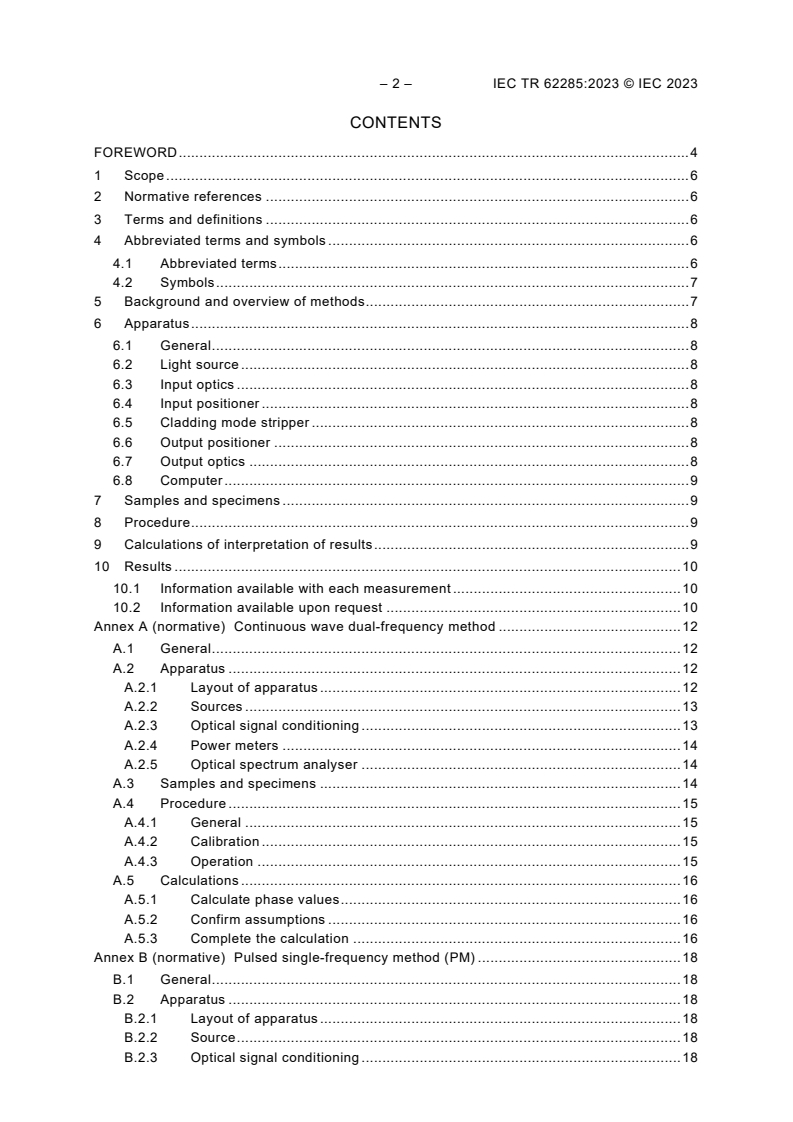
– 2 – IEC TR 62285:2023 © IEC 2023
CONTENTS
FOREWORD . 4
1 Scope . 6
2 Normative references . 6
3 Terms and definitions . 6
4 Abbreviated terms and symbols . 6
4.1 Abbreviated terms . 6
4.2 Symbols . 7
5 Background and overview of methods . 7
6 Apparatus . 8
6.1 General . 8
6.2 Light source . 8
6.3 Input optics . 8
6.4 Input positioner . 8
6.5 Cladding mode stripper . 8
6.6 Output positioner . 8
6.7 Output optics . 8
6.8 Computer . 9
7 Samples and specimens . 9
8 Procedure . 9
9 Calculations of interpretation of results . 9
10 Results . 10
10.1 Information available with each measurement . 10
10.2 Information available upon request . 10
Annex A (normative) Continuous wave dual-frequency method . 12
A.1 General . 12
A.2 Apparatus . 12
A.2.1 Layout of apparatus . 12
A.2.2 Sources . 13
A.2.3 Optical signal conditioning . 13
A.2.4 Power meters . 14
A.2.5 Optical spectrum analyser . 14
A.3 Samples and specimens . 14
A.4 Procedure . 15
A.4.1 General . 15
A.4.2 Calibration . 15
A.4.3 Operation . 15
A.5 Calculations . 16
A.5.1 Calculate phase values . 16
A.5.2 Confirm assumptions . 16
A.5.3 Complete the calculation . 16
Annex B (normative) Pulsed single-frequency method (PM) . 18
B.1 General . 18
B.2 Apparatus . 18
B.2.1 Layout of apparatus . 18
B.2.2 Source . 18
B.2.3 Optical signal conditioning . 18
B.2.4 Power meters . 19
B.2.5 Optical pulsewidth measurement . 19
B.2.6 Optical spectrum analyser . 19
B.3 Samples and specimens . 19
B.4 Procedure . 20
B.5 Calculations . 20
B.5.1 Peak power . 20
B.5.2 Phase shift . 20
B.5.3 Complete the calculations . 20
Annex C (informative) Guidance on the selection of fibre test length, power and
difference in optical wavelength when using method A . 22
Bibliography . 23
Figure A.1 – Output spectral characteristics . 12
Figure A.2 – Apparatus for method A . 13
Figure A.3 – Relationship of phase to intensity ratio. 16
Figure A.4 – Relationship of phase to power . 17
Figure B.1 – Test set-up for method B . 18
Figure B.2 – Output spectra . 19
Figure B.3 – Phase vs. peak input power for method B . 21
Table C.1 – Fibre characteristics for method A (representative values) . 22
– 4 – IEC TR 62285:2023 © IEC 2023
INTERNATIONAL ELECTROTECHNICAL COMMISSION
____________
APPLICATION GUIDELINES FOR NONLINEAR
COEFFICIENT MEASURING METHODS
FOREWORD
1) The International Electrotechnical Commission (IEC) is a worldwide organization for standardization comprising
all national electrotechnical committees (IEC National Committees). The object of IEC is to promote international
co-operation on all questions concerning standardization in the electrical and electronic fields. To this end and
in addition to other activities, IEC publishes International Standards, Technical Specifications, Technical Reports,
Publicly Available Specifications (PAS) and Guides (hereafter referred to as “IEC Publication(s)”). Their
preparation is entrusted to technical committees; any IEC National Committee interested in the subject dealt with
may participate in this preparatory work. International, governmental and non-governmental organizations liaising
with the IEC also participate in this preparation. IEC collaborates closely with the International Organization for
Standardization (ISO) in accordance with conditions determined by agreement between the two organizations.
2) The formal decisions or agreements of IEC on technical matters express, as nearly as possible, an international
consensus of opinion on the relevant subjects since each technical committee has representation from all
interested IEC National Committees.
3) IEC Publications have the form of recommendations for international use and are accepted by IEC National
Committees in that sense. While all reasonable efforts are made to ensure that the technical content of IEC
Publications is accurate, IEC cannot be held responsible for the way in which they are used or for any
misinterpretation by any end user.
4) In order to promote international uniformity, IEC National Committees undertake to apply IEC Publications
transparently to the maximum extent possible in their national and regional publications. Any divergence between
any IEC Publication and the corresponding national or regional publication shall be clearly indicated in the latter.
5) IEC itself does not provide any attestation of conformity. Independent certification bodies provide conformity
assessment services and, in some areas, access to IEC marks of conformity. IEC is not responsible for any
services carried out by independent certification bodies.
6) All users should ensure that they have the latest edition of this publication.
7) No liability shall attach to IEC or its directors, employees, servants or agents including individual experts and
members of its technical committees and IEC National Committees for any personal injury, property damage or
other damage of any nature whatsoever, whether direct or indirect, or for costs (including legal fees) and
expenses arising out of the publication, use of, or reliance upon, this IEC Publication or any other IEC
Publications.
8) Attention is drawn to the Normative references cited in this publication. Use of the referenced publications is
indispensable for the correct application of this publication.
9) Attention is drawn to the possibility that some of the elements of this IEC Publication may be the subject of patent
rights. IEC shall not be held responsible for identifying any or all such patent rights.
IEC TR 62285 has been prepared by subcommittee 86A: Fibres and cables, of IEC technical
committee 86: Fibre optics. It is a Technical Report.
This third edition cancels and replaces the second edition published in 2005. It constitutes a
technical revision.
This edition includes the following signification technical changes with respect to the previous
revision:
a) change fibre type of pigtail to B-652.D fibre or fibre of same type with the fibre under test;
b) modifications on Figure A.1 and Formulas (A.3), (A.4);
c) add example values and recommended method A test conditions for B-G.654.E fibre, update
Table C.1.
The text of this Technical Report is based on the following documents:
Draft Report on voting
86A/2190/DTR 86A/2325/RVDTR
Full information on the voting for its approval can be found in the report on voting indicated in
the above table.
The language used for the development of this Technical Report is English.
This document was drafted in accordance with ISO/IEC Directives, Part 2, and developed in
accordance with ISO/IEC Directives, Part 1 and ISO/IEC Directives, IEC Supplement, available
at www.iec.ch/members_experts/refdocs. The main document types developed by IEC are
described in greater detail at www.iec.ch/publications.
The committee has decided that the contents of this document will remain unchanged until the
stability date indicated on the IEC website under webstore.iec.ch in the data related to the
specific document. At this date, the document will be
• reconfirmed,
• withdrawn,
• replaced by a revised edition, or
• amended.
IMPORTANT – The "colour inside" logo on the cover page of this document indicates that it
contains colours which are considered to be useful for the correct understanding of its
contents. Users should therefore print this document using a colour printer.
– 6 – IEC TR 62285:2023 © IEC 2023
APPLICATION GUIDELINES FOR NONLINEAR
COEFFICIENT MEASURING METHODS
1 Scope
This document provides guidelines for uniform measurements of the nonlinear coefficient of
class B single-mode fibres (see IEC 60793-2-50) in the 1 550 nm region.
Measurements of the nonlinear coefficient are used to characterise specific single-mode fibre
designs for the purpose of system design relative to power levels and distortion or noise effects
derived from the nonlinear optical behaviour.
2 Normative references
The following documents are referred to in the text in such a way that some or all of their content
constitutes requirements of this document. For dated references, only the edition cited applies.
For undated references, the latest edition of the referenced document (including any
amendments) applies.
IEC 60793-1 (all parts), Optical fibres – Part 1: Measurement methods and test procedures
IEC 60793-2, Optical fibres – Part 2: Product specifications – General
3 Terms and definitions
For the purposes of this document, the terms and definitions given in IEC 60793-2 and
IEC 60793-1 (all parts) apply.
ISO and IEC maintain terminological databases for use in standardization at the following
addresses:
• IEC Electropedia: available at http://www.electropedia.org/
• ISO Online browsing platform: available at http://www.iso.org/obp
4 Abbreviated terms and symbols
4.1 Abbreviated terms
ASE amplified spontaneous emission
BPF bandpass filter
CW continuous wave
EDFA erbium doped fibre amplifier
FWM four-wave mixing
OSA optical spectrum analyser
SPM self-phase modulation
SBS stimulated Brillouin scattering
VA variable attenuator
XPM cross-phase modulation
4.2 Symbols
A effective area
eff
D chromatic dispersion coefficient
I intensity
k slope
L specimen length
J () Bessel function of the first kind of integer order n
n
L effective length
eff
nLc non-linear coefficient
n Kerr nonlinear refractive index
n /A non-linear coefficient
2 eff
P input power
P peak input power
peak
R ratio
ν optical frequency
α attenuation coefficient (Np/m)
α attenuation coefficient (dB/km)
dB
ϕ non-linear phase shift
λ wavelength
ω angular optical frequency
5 Background and overview of methods
The nonlinear coefficient (nLc) is the ratio of the Kerr nonlinear refractive index n to the
effective area A [1] , expressed as:
eff
n
nLc = (1)
A
eff
The nonlinear coefficient is related to the following nonlinear optical distortion effects as a
combined parameter:
– self-phase modulation (SPM);
– cross-phase modulation (XPM);
– four-wave mixing (FWM).
Other fibre attributes, such as chromatic dispersion and polarisation mode dispersion, also
influence the transmission.
Two methods are given, with details specific to each in normative annexes. They are:
– Method A Continuous wave dual-frequency;
– Method B Pulsed single-frequency.
___________
The numbers in square brackets refer to the Bibliography.
– 8 – IEC TR 62285:2023 © IEC 2023
Both methods require injecting very high power (5 dBm or more) into the fibre, measurement of
this power (absolute) and measurement of the output spectrum (which is modified by nonlinear
effects). Both methods use calculations that combine these measured results with those derived
from other measurements such as attenuation (see IEC 60793-1-40) and chromatic dispersion
(see IEC 60793-1-42). Both methods have limitations on the length of fibre that can be
measured – in relationship with the chromatic dispersion at the wavelength being measured.
Method A [1] requires injecting the light of two wavelengths into the fibre. The light of both
wavelengths is constant at various power levels. At higher power, the lights beat due to the
nonlinear effect and produce an output spectrum that is spread. The relationship of the power
level to a particular metric of spectrum spreading is used to calculate the nonlinear coefficient.
Method B [3], [4] requires injecting pulsed light at a single wavelength. The pulses would be of
duration substantially less than 1 ns and the input peak power of these pulses would be
measured and related to the nonlinear spreading of the output spectrum.
6 Apparatus
6.1 General
The following apparatus is common to both measurement methods. Annex A and Annex B
include layout drawings and other equipment requirements for each of the methods,
respectively.
6.2 Light source
See Annex A and Annex B for detailed characteristics of the light sources.
6.3 Input optics
The input optics can include one or more lasers, polarisation controllers, couplers, polarisers,
amplifiers, bandpass filters, variable attenuators and power meters. Oscilloscopes may be
needed for method B. See Annex A and Annex B for specific details.
6.4 Input positioner
Provide means of positioning the input end of the specimen to the input optics. Typically, this
connection is with a fusion splice to a short (1 m) pigtail of type B-652.D fibre or fibre of same
type with the fibre under test.
6.5 Cladding mode stripper
Use a device that extracts cladding modes. Under some circumstances, the fibre coating will
perform this function.
6.6 Output positioner
Provide a suitable means for aligning the fibre to the output optics. Typically, this connection is
with a fusion splice to a pigtail of type B-652.D fibre or fibre of sa
...
IEC TR 62285 ®
Edition 3.0 2023-10
REDLINE VERSION
TECHNICAL
REPORT
colour
inside
Application guidelines for nonlinear coefficient measuring methods
All rights reserved. Unless otherwise specified, no part of this publication may be reproduced or utilized in any form
or by any means, electronic or mechanical, including photocopying and microfilm, without permission in writing from
either IEC or IEC's member National Committee in the country of the requester. If you have any questions about IEC
copyright or have an enquiry about obtaining additional rights to this publication, please contact the address below or
your local IEC member National Committee for further information.
IEC Secretariat Tel.: +41 22 919 02 11
3, rue de Varembé info@iec.ch
CH-1211 Geneva 20 www.iec.ch
Switzerland
About the IEC
The International Electrotechnical Commission (IEC) is the leading global organization that prepares and publishes
International Standards for all electrical, electronic and related technologies.
About IEC publications
The technical content of IEC publications is kept under constant review by the IEC. Please make sure that you have the
latest edition, a corrigendum or an amendment might have been published.
IEC publications search - webstore.iec.ch/advsearchform IEC Products & Services Portal - products.iec.ch
The advanced search enables to find IEC publications by a Discover our powerful search engine and read freely all the
variety of criteria (reference number, text, technical publications previews. With a subscription you will always have
committee, …). It also gives information on projects, replaced access to up to date content tailored to your needs.
and withdrawn publications.
Electropedia - www.electropedia.org
IEC Just Published - webstore.iec.ch/justpublished
The world's leading online dictionary on electrotechnology,
Stay up to date on all new IEC publications. Just Published
containing more than 22 300 terminological entries in English
details all new publications released. Available online and once
and French, with equivalent terms in 19 additional languages.
a month by email.
Also known as the International Electrotechnical Vocabulary
(IEV) online.
IEC Customer Service Centre - webstore.iec.ch/csc
If you wish to give us your feedback on this publication or need
further assistance, please contact the Customer Service
Centre: sales@iec.ch.
IEC TR 62285 ®
Edition 3.0 2023-10
REDLINE VERSION
TECHNICAL
REPORT
colour
inside
Application guidelines for nonlinear coefficient measuring methods
INTERNATIONAL
ELECTROTECHNICAL
COMMISSION
ICS 33.180.10 ISBN 978-2-8322-7769-0
– 2 – IEC TR 62285:2023 RLV © IEC 2023
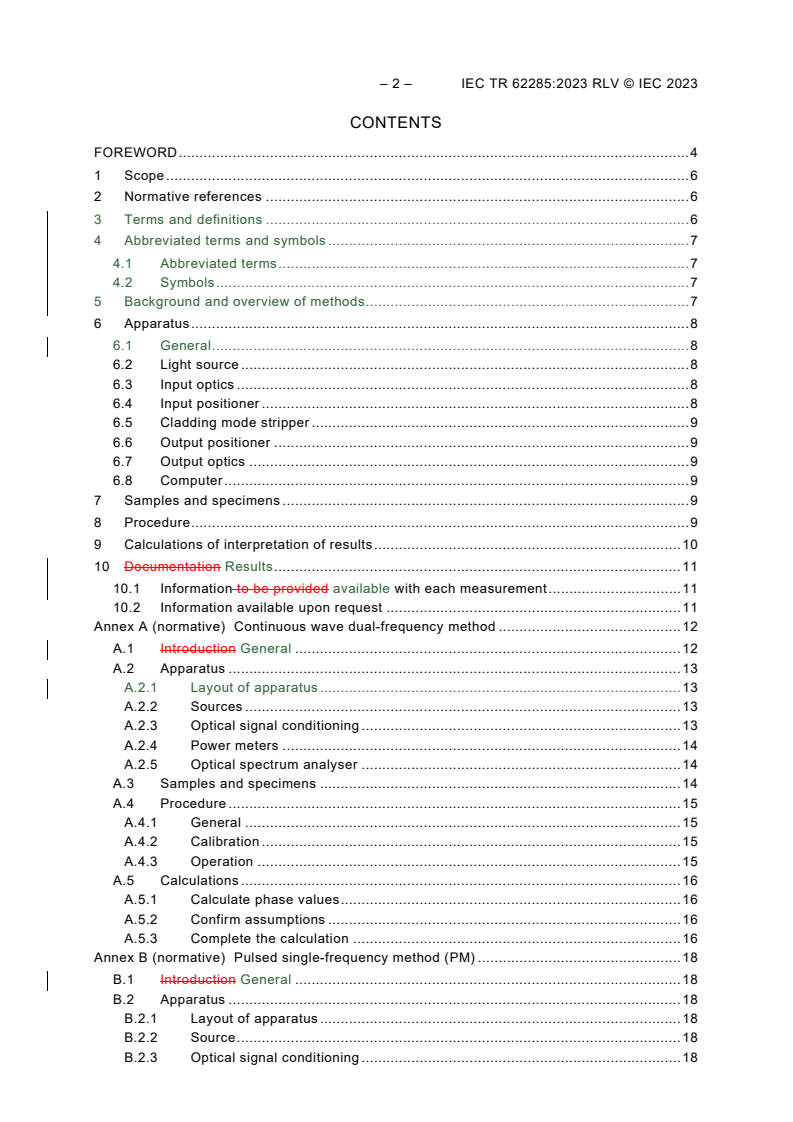
CONTENTS
FOREWORD . 4
1 Scope . 6
2 Normative references . 6
3 Terms and definitions . 6
4 Abbreviated terms and symbols . 7
4.1 Abbreviated terms . 7
4.2 Symbols . 7
5 Background and overview of methods . 7
6 Apparatus . 8
6.1 General . 8
6.2 Light source . 8
6.3 Input optics . 8
6.4 Input positioner . 8
6.5 Cladding mode stripper . 9
6.6 Output positioner . 9
6.7 Output optics . 9
6.8 Computer . 9
7 Samples and specimens . 9
8 Procedure . 9
9 Calculations of interpretation of results . 10
10 Documentation Results . 11
10.1 Information to be provided available with each measurement . 11
10.2 Information available upon request . 11
Annex A (normative) Continuous wave dual-frequency method . 12
A.1 Introduction General . 12
A.2 Apparatus . 13
A.2.1 Layout of apparatus . 13
A.2.2 Sources . 13
A.2.3 Optical signal conditioning . 13
A.2.4 Power meters . 14
A.2.5 Optical spectrum analyser . 14
A.3 Samples and specimens . 14
A.4 Procedure . 15
A.4.1 General . 15
A.4.2 Calibration . 15
A.4.3 Operation . 15
A.5 Calculations . 16
A.5.1 Calculate phase values . 16
A.5.2 Confirm assumptions . 16
A.5.3 Complete the calculation . 16
Annex B (normative) Pulsed single-frequency method (PM) . 18
B.1 Introduction General . 18
B.2 Apparatus . 18
B.2.1 Layout of apparatus . 18
B.2.2 Source . 18
B.2.3 Optical signal conditioning . 18
B.2.4 Power meters . 19
B.2.5 Optical pulsewidth measurement . 19
B.2.6 Optical spectrum analyser . 19
B.3 Samples and specimens . 19
B.4 Procedure . 20
B.5 Calculations . 20
B.5.1 Peak power . 20
B.5.2 Phase shift . 20
B.5.3 Complete the calculations . 20
Annex C (informative) List of acronyms and symbols .
Annex C (informative) Guidance on the selection of fibre test length, power and
difference in optical wavelength when using method A . 23
Bibliography . 24
Figure A.1 – Output spectral characteristics . 12
Figure A.2 – Apparatus for method A . 13
Figure A.3 – Relationship of phase to intensity ratio. 16
Figure A.4 – Relationship of phase to power . 17
Figure B.1 – Test set-up for method B . 18
Figure B.2 – Output spectra . 19
Figure B.3 – Phase vs. peak input power for method B . 21
Table C.1 – Fibre characteristics for method A (representative values) . 23
– 4 – IEC TR 62285:2023 RLV © IEC 2023
INTERNATIONAL ELECTROTECHNICAL COMMISSION
____________
APPLICATION GUIDELINES FOR NONLINEAR
COEFFICIENT MEASURING METHODS
FOREWORD
1) The International Electrotechnical Commission (IEC) is a worldwide organization for standardization comprising
all national electrotechnical committees (IEC National Committees). The object of IEC is to promote international
co-operation on all questions concerning standardization in the electrical and electronic fields. To this end and
in addition to other activities, IEC publishes International Standards, Technical Specifications, Technical Reports,
Publicly Available Specifications (PAS) and Guides (hereafter referred to as “IEC Publication(s)”). Their
preparation is entrusted to technical committees; any IEC National Committee interested in the subject dealt with
may participate in this preparatory work. International, governmental and non-governmental organizations liaising
with the IEC also participate in this preparation. IEC collaborates closely with the International Organization for
Standardization (ISO) in accordance with conditions determined by agreement between the two organizations.
2) The formal decisions or agreements of IEC on technical matters express, as nearly as possible, an international
consensus of opinion on the relevant subjects since each technical committee has representation from all
interested IEC National Committees.
3) IEC Publications have the form of recommendations for international use and are accepted by IEC National
Committees in that sense. While all reasonable efforts are made to ensure that the technical content of IEC
Publications is accurate, IEC cannot be held responsible for the way in which they are used or for any
misinterpretation by any end user.
4) In order to promote international uniformity, IEC National Committees undertake to apply IEC Publications
transparently to the maximum extent possible in their national and regional publications. Any divergence between
any IEC Publication and the corresponding national or regional publication shall be clearly indicated in the latter.
5) IEC itself does not provide any attestation of conformity. Independent certification bodies provide conformity
assessment services and, in some areas, access to IEC marks of conformity. IEC is not responsible for any
services carried out by independent certification bodies.
6) All users should ensure that they have the latest edition of this publication.
7) No liability shall attach to IEC or its directors, employees, servants or agents including individual experts and
members of its technical committees and IEC National Committees for any personal injury, property damage or
other damage of any nature whatsoever, whether direct or indirect, or for costs (including legal fees) and
expenses arising out of the publication, use of, or reliance upon, this IEC Publication or any other IEC
Publications.
8) Attention is drawn to the Normative references cited in this publication. Use of the referenced publications is
indispensable for the correct application of this publication.
9) Attention is drawn to the possibility that some of the elements of this IEC Publication may be the subject of patent
rights. IEC shall not be held responsible for identifying any or all such patent rights.
This redline version of the official IEC Standard allows the user to identify the changes
made to the previous edition IEC TR 62285:2005. A vertical bar appears in the margin
wherever a change has been made. Additions are in green text, deletions are in
strikethrough red text.
IEC TR 62285 has been prepared by subcommittee 86A: Fibres and cables, of IEC technical
committee 86: Fibre optics. It is a Technical Report.
This third edition cancels and replaces the second edition published in 2005. It constitutes a
technical revision.
This edition includes the following signification technical changes with respect to the previous
revision:
a) change fibre type of pigtail to B-652.D fibre or fibre of same type with the fibre under test;
b) modifications on Figure A.1 and Formulas (A.3), (A.4);
c) add example values and recommended method A test conditions for B-G.654.E fibre, update
Table C.1.
The text of this Technical Report is based on the following documents:
Draft Report on voting
86A/2190/DTR 86A/2325/RVDTR
Full information on the voting for its approval can be found in the report on voting indicated in
the above table.
The language used for the development of this Technical Report is English.
This document was drafted in accordance with ISO/IEC Directives, Part 2, and developed in
accordance with ISO/IEC Directives, Part 1 and ISO/IEC Directives, IEC Supplement, available
at www.iec.ch/members_experts/refdocs. The main document types developed by IEC are
described in greater detail at www.iec.ch/publications.
The committee has decided that the contents of this document will remain unchanged until the
stability date indicated on the IEC website under webstore.iec.ch in the data related to the
specific document. At this date, the document will be
• reconfirmed,
• withdrawn,
• replaced by a revised edition, or
• amended.
IMPORTANT – The "colour inside" logo on the cover page of this document indicates that it
contains colours which are considered to be useful for the correct understanding of its
contents. Users should therefore print this document using a colour printer.
– 6 – IEC TR 62285:2023 RLV © IEC 2023
APPLICATION GUIDELINES FOR NONLINEAR
COEFFICIENT MEASURING METHODS
1 Scope
This document provides guidance guidelines for uniform measurements of the nonlinear
coefficient of class B single-mode fibres (see IEC 60793-2-50) in the 1 550 nm region.
Measurements of the nonlinear coefficient are used to characterise specific single-mode fibre
designs for the purpose of system design relative to power levels and distortion or noise effects
derived from the nonlinear optical behaviour.
2 Normative references
The following documents are referred to in the text in such a way that some or all of their content
constitutes requirements of this document. For dated references, only the edition cited applies.
For undated references, the latest edition of the referenced document (including any
amendments) applies.
IEC 60793-1-1, Optical fibres – Part 1-1: Measurement methods and test procedures – General
and guidance
IEC 60793-1-40, Optical fibres – Part 1-40: Measurement methods and test procedures –
Attenuation
IEC 60793-1-42, Optical fibres – Part 1-42: Measurement methods and test procedures –
Chromatic dispersion
IEC 60793-2-50, Optical fibres – Part 2-50: Product specifications – Sectional specification for
class B single-mode fibres
IEC 61315, Calibration of fibre optic power meters
IEC 60793-1 (all parts), Optical fibres – Part 1: Measurement methods and test procedures
IEC 60793-2, Optical fibres – Part 2: Product specifications – General
3 Terms and definitions
For the purposes of this document, the terms and definitions given in IEC 60793-2 and
IEC 60793-1 (all parts) apply.
ISO and IEC maintain terminological databases for use in standardization at the following
addresses:
• IEC Electropedia: available at http://www.electropedia.org/
• ISO Online browsing platform: available at http://www.iso.org/obp
4 Abbreviated terms and symbols
4.1 Abbreviated terms
ASE amplified spontaneous emission
BPF bandpass filter
CW continuous wave
EDFA erbium doped fibre amplifier
FWM four-wave mixing
OSA optical spectrum analyser
SPM self-phase modulation
SBS stimulated Brillouin scattering
VA variable attenuator
XPM cross-phase modulation
4.2 Symbols
A effective area
eff
D chromatic dispersion coefficient
I intensity
k slope
L specimen length
J () Bessel function of the first kind of integer order n
n
L effective length
eff
nLc non-linear coefficient
n Kerr nonlinear refractive index
n /A non-linear coefficient
2 eff
P input power
P peak input power
peak
R ratio
ν optical frequency
α attenuation coefficient (Np/m)
α attenuation coefficient (dB/km)
dB
ϕ non-linear phase shift
λ wavelength
ω angular optical frequency
5 Background and overview of methods
The nonlinear coefficient (nLc) is the ratio of the Kerr nonlinear refractive index n to the
effective area A [1] , expressed as:
eff
___________
The numbers in square brackets refer to the Bibliography.
– 8 – IEC TR 62285:2023 RLV © IEC 2023
n
(1)
nLc =
A
eff
The nonlinear coefficient is related to the following nonlinear optical distortion effects as a
combined parameter:
– self-phase modulation (SPM);
– cross-phase modulation (XPM);
– four-wave mixing (FWM).
Other fibre attributes, such as chromatic dispersion and polarisation mode dispersion, also
influence the transmission.
Two methods are given, with details specific to each in normative annexes. They are:
– Method A Continuous wave dual-frequency;
– Method B Pulsed single-frequency.
Both methods require injecting very high power (5 dBm or more) into the fibre, measurement of
this power (absolute) and measurement of the output spectrum (which is modified by nonlinear
effects). Both methods use calculations that combine these measured results with those derived
from other measurements such as attenuation (see IEC 60793-1-40) and chromatic dispersion
(see IEC 60793-1-42). Both methods have limitations on the length of fibre that can be
measured – in relationship with the chromatic dispersion at the wavelength being measured.
Method A [1] requires injecting the light of two wavelengths into the fibre. The light of both
wavelengths is constant at various power levels. At higher power, the lights beat due to the
nonlinear effect and produce an output spectrum that is spread. The relationship of the power
level to a particular metric of spectrum spreading is used to calculate the nonlinear coefficient.
Method B [3], [4] requires injecting pulsed light at a single wavelength. The pulses should would
be of duration substantially less than 1 ns and the input peak power of these pulses should
would be measured and related to the nonlinear spreading of the output spectrum.
6 Apparatus
6.1 General
The following apparatus is common to both measurement methods. Annex A and Annex B
include layout drawings and other equipment requirements for each of the methods,
respectively.
6.2 Light source
See Annex A and Annex B for detailed characteristics of the light sources.
6.3 Input optics
The input optics can include one or more lasers, polarisation controllers, couplers, polarisers,
amplifiers, bandpass filters, variable attenuators, couplers and power meters. Bandpass filters
and Oscilloscopes may be needed for method B. See Annex A and Annex B for specific details.
6.4 Input positioner
Provide means of positioning the input end of the specimen to the light source input optics.
Typically, this connection is with a fusion splice to a short (1 m) pigtail of type B1.1 fibre B-
652.D fibre or fibre of same type with the fibre under test.
6.5 Cladding mode stripper
Use a device that extracts cladding modes. Under some circumstances, the fibre coating will
perform this function.
6.6 Output positioner
Provide a suitable means for aligning the fibre to the output optics. Typically, this connection is
with a fusion splice to a pigtail of type B1.1 fibre B-652.D fibre or fibre of same type with the
fibre under test.
6.7 Output optics
The output optics include a power meter and optical spectrum analyser (OSA). An oscilloscope
may be required for method B. See Annex A and Annex B for details.
6.8 Computer
Use a computer to perform operations such as controlling the apparatus, taking intensity
measurements and processing the data to obtain the final results.
7 Samples and specimens
A specimen is a known length of single-mode optical fibre (see IEC 60793-2-50). The sample
and pigtails should would be fixed in position at a nominally constant temperature throughout
the measurement. Standard ambient atmospheric conditions (see IEC 60793-1-1) should would
be employed, unless otherwise specified.
End faces for the input and output ends of the test sample should would be prepared as
appropriate to obtain low loss fusion splices.
The measurement method is limited with regard to the measurable length because of chromatic
dispersion. For this reason, the specimen is normally cut from a longer piece of fibre that has
been characterised for attenuation coefficient α and chromatic dispersion D at the wavelength
dB
of interest (1 550 nm). The length of the fibre after being cut-back is referred to as L.
Annex C provides guidance on the optimum selection of length for different chromatic
dispersion coefficient values.
The fibre may be deployed on a common shipping spool.
8 Procedure
The test procedure is as follows:
a) deploy the fibre or cable and prepare the ends;
b) attach the ends to the input and output optics;
c) engage the computer to complete the scans and measurements found in Annex A
and Annex B for the measurement method;
d) complete documentation.
– 10 – IEC TR 62285:2023 RLV © IEC 2023
9 Calculations of interpretation of results
Unless otherwise specified, the units are in meters, seconds, watts, and radians.
The fundamental relationships for the two methods are nearly the same, so they are presented
here for comparison.
2π n
Method A ϕ = L 2P (2)
eff
λ A
eff
2π n
Method B ϕ = L P (3)
eff peak
λ A
eff
where
ϕ is the nonlinear phase shift (rad);
λ is the wavelength (m) (centre of two wavelengths for method A);
L is the effective length (m);
eff
P is the input power (W) (both either wavelengths for method A);
P is the peak input power (W) (method B).
peak
If peak input power of method B were equal to twice the input power of method A, the two
equations would be identical.
The effective length is defined as the following:
1− exp(− αL)
L =
(4)
eff
α
where
L is the length (m);
α is the “natural” attenuation coefficient (Np/m).
α
dB -3
α ×10 (5)
4,343
where
α is the normal attenuation coefficient (dB/km).
dB
The two methods differ in how the phase shift is determined as a function of input power. Once
the relationship between phase shift and power has been determined, the inverse of Formula
(2) or (3), to obtain the nonlinear coefficient, is easily computed with the other known quantities.
For type B1.1 fibre, the non-linear coefficient has been measured to be approximately
–10 –1
2,9 × 10 W , provided as an example of the result.
Provided as examples of the result, the nonlinear coefficient has been measured to be
–10 –1
– approximately 2,9 × 10 W for type B-652 fibre;
–10 –1 2
– approximately 2,0 × 10 W for type B-654.E fibres with A around 110 μm ;
eff
–10 –1 –10 –1
– and approximately 1,7 × 10 W to 1,8 × 10 W for type B-654.E fibres with A
eff
around 130 μm [5].
=
10 Documentation Results
10.1 Information to be provided available with each measurement
The following information are reported with each measurement:
– date and title of measurement;
– specimen identification;
– Measurement date
–1
– nonlinear coefficient: n /A ( W );
2 eff
– fibre dispersion coefficient (ps/(nm⋅ km));
– fibre attenuation coefficient (dB /km);
– fibre length (m).
10.2 Information available upon request
The following information are available upon request:
– measurement method used;
– description of the equipment set-up;
– wavelength(s) of the source;
– pulse duration (method B only);
– typical input power levels;
– fibre effective area: A (μm ).
eff
– 12 – IEC TR 62285:2023 RLV © IEC 2023
Annex A
(normative)
Continuous wave dual-frequency method
A.1 Introduction General
Annex A contains requirements specific to method A. The principle of the method is to inject
two continuous wave (CW) optical frequencies, ω and ω , into the specimen at various power
a b
levels. The two frequencies beat due to nonlinear effects and create sidebands at frequencies
(2ω – ω ) and (2ω – ω ) (see Figure A.1). The relative intensity of the sidebands I to the
a b b a 1
intensity of the main bands I is related to both the phase shift and power injected.
–10
–20
–30
–40
–50
–60
1 562,5 1 563,0 1 563,5 1 564,0 1 564,5 1 565,0
Wavelength nm
IEC 1832/02
Figure A.1 – Output spectral characteristics
Intensity (arbitrary units)
A.2 Apparatus
A.2.1 Layout of apparatus
Figure A.2 shows a typical arrangement of the test apparatus.
Figure A.2 – Apparatus for method A
A.2.2 Sources
Two laser sources, L and L in Figure A.2, are operated in the CW mode at optical frequencies,
1 2
ω and ω , both within the frequency window of corresponding to optical wavelength (1 550 ±
a b
10) nm. The frequency difference, ∆ω = ω – ω , corresponds to a wavelength difference ∆λ ,
0 a b 0
which places an upper limit on the spectral width of each of the sources: the source spectral
widths should would not exceed 0,1 × ∆λ . The lower limit on the spectral width is set by the
need to avoid stimulated Brillouin scattering (SBS) (see A.2.4).
The wavelength separation difference lower limit is set by the ability of the OSA to resolve the
sidebands, and the upper limit is set by the chromatic dispersion of the specimen (see Clause
A.3). A typical separation could be 0,035 THz (0,28 nm), but others are feasible depending on
the other details of the set-up.
The source powers should would be within ±0,2 dB of one another. The source power is further
conditioned by polarisers, optically amplified, and variably attenuated. The minimum injected
power is set by the limit at which the sidebands are induced. The maximum is set by the need
to avoid SBS.
A.2.3 Optical signal conditioning
Polarisation controllers, combiners couplers, amplifiers, variable optical attenuators and
polarisers should would be used in combination so that the lights injected into the specimen are
in the same polarisation state and within ±0,2 dB of one another.
In the example of Figure A.2, the erbium doped fibre amplifier (EDFA) is used to boost the
power to levels sufficient to induce nonlinear effects. This generates amplified spontaneous
emission (ASE) which should would be removed by either:
– 14 – IEC TR 62285:2023 RLV © IEC 2023
a) a bandpass filter (BPF) as shown in Figure A.2, or
b) a subtraction of the baseline as determined in the region of the sidebands of the OSA.
NOTE An accurate baseline subtraction can be obtained by measuring the phase response of the measurement
system without a test fibre in place.
A.2.4 Power meters
Figure A.2 shows two power meters: one to monitor forward propagation of light injected into
the specimen and the other to monitor back-reflected light that could be induced by SBS – to
ensure that it remains in the spontaneous, and not the stimulated regime.
Power meters should would be linear and accurate to within ±3 % for the levels used in the test
(see IEC 61315 for calibration details).
The power detected by the forward power meter can be calibrated with regard to the power
injected into the specimen by cutting the specimen immediately after the splice and measuring
the output power at this point.
NOTE 1 The output power emitted from the cut-back specimen will be reduced by Fresnel reflection of
approximately 3 % – which should will be taken into account. The required power values are those that are launched
into the specimen without the cut.
NOTE 2 Some set-ups feature a third power meter to confirm the splice loss at least one power level following the
primary test measurements. Alternatively, measurement of the output of the full specimen, in conjunction with fibre
attenuation coefficient and length, can be used to confirm the splice loss.
For a source whose spectral width is much less than the 0,038 THz spontaneous Brillouin
linewidth, the threshold for SBS is approximately 20 mW. Increasing the source spectral width
to 100 MHz raises this threshold to approximately 100 mW. Other strategies for reducing SBS
include:
– modulating the sources at 100 MHz to 1 GHz to increase the effective width;
– reducing the maximum power level;
– reducing the fibre length.
A.2.5 Optical spectrum analyser
The optical spectrum emerging from the specimen is measured with an OSA. The resolution
should would be sufficient to clearly resolve the sidebands.
A.3 Samples and specimens
The fibre chromatic dispersion coefficient D (ps/(nm⋅km)) should be known at the test
wavelength before the test is conducted. The length of the specimen may be reduced so the
following restriction is satisfied:
∆ω
(A.1)
2π × c ϕ D L << 1
max
ω
0
where
m/s);
c is the speed of light in vacuum (2,997 924 58 × 10
ϕ is the maximum anticipated phase shift (rad);
max
∆ω is the difference in optical angular frequencies (rad/s);
ω is the average of the two optical angular frequencies (rad/s);
|D| is the absolute value of dispersion coefficient (s/(m⋅km));
L is the specimen length (km).
Example:
λ = 1 550,00 nm
a
λ = 1 550,28 nm
b
D = 17,0 ps/(nm⋅km) = 0,017 s/(m⋅km)
L = 0,5 km
ϕ = 0,3 rad
max
Formula (A.1) reduces to:
2πc 1 550,14 − ××0,3 0,017×0,5 =0,157 (A.2)
1550,00 1550,28
Annex C gives guidance on the selection of values to use for specimen test length, power, and
wavelength difference (see Table C.1).
A.4 Procedure
A.4.1 General
The procedure requires stepping through a series of power levels. For each power level, the
power injected into the specimen is measured or calculated and the ratio of the intensity of the
sideband to the main band is measured on the OSA.
A.4.2 Calibration
Attach a calibrated power meter to the output of the source end of the system. Cycle through
the desired power levels and at each measure the power with the forward power meter and with
the calibration power meter. Remove the effect of Fresnel reflection on the light emitted from
the system on the detected output power. The relationship between the measured powers
should would be used to determine the power launched into the specimen based on the light
measured by the forward power meter on normal measurements.
A.4.3 Operation
Attach the specimen to both the source and receive ends of the system with fusion splices.
Cycle through the power levels – indexed with i. For each:
– record the measured power levels and calculate the power injected into the specimen, P ;
i
– complete the OSA scan of the output spectrum;
– if necessary, subtract the amplifier induced ASE noise from the OSA data;
– determine the intensity of the main lobes bands, I , and sidebands, I . See Figure A.1;
0 1
– determine the ratio of the sidelobes sidebands to main lobes bands as R = I1/I0;
i
– confirm the absence of Brillouin scattering SBS;
– take any output power measurements that may be used to confirm splice losses.
Disconnect the specimen and take any power measurements that may be needed to confirm
the splice loss.
– 16 – IEC TR 62285:2023 RLV © IEC 2023
Complete any adjustments to the input power values that may be done with output power
measurements or post disconnection measurements.
A.5 Calculations
A.5.1 Calculate phase values
For each power level, calculate the phase shift ϕ by inverting the following ratio of Bessel
i
functions:
2 2
J (ϕ / 2) + J (ϕ / 2)
i i
0 1
R = (A3)
i
2 2
J (ϕ / 2) + J (ϕ / 2)
i i
1 2
J φ/ 22+J φ/
( ) ( )
12ii
(A.3)
R =
i
J φ/ 2 +J φ/ 2
( ) ( )
01ii
This inversion can be done in various ways, one of which is to:
a) calculate the R intensity ratio for each of a range of phase values using Equation A.3;
b) plot phase versus R (see Figure A.3);
c) characterise the relationship across the range of phase values that are anticipated.
Figure A.3 – Relationship of phase to intensity ratio
A.5.2 Confirm assumptions
Confirm that the range of phase conforms with Formula (A.1). If this is not confirmed, either
eliminate the data outside the limit or repeat the measurement with a different length of fibre.
A.5.3 Complete the calculation
Form a plot of phase (rad) vs. power (W) similar to that shown in Figure A.4 and perform a
linear regression to obtain the intercept and slope 𝑘𝑘 of the fitted data.
–1
The nonlinear coefficient (W ) is computed with slope 𝑘𝑘 of the linear regression as:
n slope ⋅λ
2 0
= (A.4)
A 4πL
eff eff
n k ⋅λ
2 0
= (A.4)
A 4πL
eff eff
where
slope k is the fitted regression slope (rad/W);
λ is the test wavelength average of input wavelengths (m);
L is the effective length (m) [see Clause 9].
eff
Figure A.4 – Relationship of phase to power
– 18 – IEC TR 62285:2023 RLV © IEC 2023
Annex B
(normative)
Pulsed single-frequency method (PM)
B.1 Introduction General
Annex B contains requirements specific to method B, pulsed single-frequency method. The
principle of the method is to launch a pulsed, narrow spectral width light that is at a power
sufficient to induce self-phase modulation at a given level. The peak-input power at this level is
used to calculate the nonlinear coefficient.
B.2 Apparatus
B.2.1 Layout of apparatus
Figure B.1 shows a sample layout of the apparatus, along with some of the options.
Figure B.1 – Test set-up for method B
B.2.2 Source
Use a transform limited Gaussian optical source with a stable wavelength (no mode hopping)
such as:
– mode locked laser diode;
– gain switched laser diode;
– transform limited Gaussian pulsed laser diode.
To avoid electrostriction effects, the pulse width ∆τ (ps), should would be less than 1 ns. Pulse
widths in the range of 20 ps to 100 ps are recommended. For such pulses, a repetition rate of
around 2 GHz is used.
The source should would be within (1 550 ± 10) nm. The spectral width ∆ν (THz) requirement
of the light injected into the specimen, which can also be modified with a BPF, is interactive
with the pulse width. For the transform limited Gaussian case, the product, ∆τ × ∆ν, should
would be approximately 0,5.
B.2.3 Optical signal conditioning
The light is amplified to levels needed to induce significant nonlinear effects with one or more
amplifiers and band pass filters to remove ASE.
A variable optical attenuator is used to fine tune the input power to obtain the optimum
spreading of the output spectrum as viewed on the OSA.
B.2.4 Power meters
Power meters should would be linear and accurate to within ± 3 % for the levels used in the test
(see IEC 61315 for calibration details).
The power meter at the source end of the system is used to determine the input power after the
optimum power has been identified. This is done by cutting the specimen off the system and
completing the measurement. This value, in conjunction with the pulse data, is used to calculate
the peak-input power.
The power meter at the receive end of the system is used to evaluate the transmitted power to
confirm proper set-up and to confirm that no SBS is occurring.
B.2.5 Optical pulsewidth measurement
This involves a combination of detector and oscilloscope.
Both units are used in conjunction with the power meter measurements to determine the peak-
input power of the pulses.
B.2.6 Optical spectrum analyser
The optical spectrum emerging from the specimen is measured with an OSA. The resolution
should would be sufficient to clearly resolve the sidebands which are induced by nonlinear
effects. See Figure B.2.
Figure B.2 – Output spectra
B.3 Samples and specimens
The combination of chromatic dispersion coefficient D (ps/(nm⋅km)), value and sign, at the test
wavelength and effective area, are interactive with regard to the length L (km) of the specimen
that can be tested.
The limiting condition is expressed with the product of dispersion coefficient and length, D × L
(ps/nm). If this product is not suitable, the fibre should would be cut to a length that is suitable.
– 20 – IEC TR 62285:2023 RLV © IEC 2023
For specimens with higher effective area and positive dispersion coefficient, (types B1.1, B1.2,
B1.3 types B-652, B-654, and some category B4 B-655 fibres), D × L should would be less than
8,0 ps/nm.
For specimens with lower effective area and positive dispersion coefficient (category B2 B-653
and some category B4 B-655 fibres), D × L should would be less than 2,0 ps/nm.
For fibres with significant negative dispersion, such as those used for dispersion
accommodation, pulse compression can alter the results. For these fibres, the pulse
compression (ps) from the transform limit is calculated using D × L, the pulse width, and the
spectral width.
If the pulse compression is less than 15 ps, the length is suitable. If the pulse compression is
larger, either the length should would be decreased or the pulse width should would be
increased (but not over approximately 100 ps).
B.4 Procedure
The specimen is connected to the source and receives receive ends of the system with fusion
splices.
The input power is varied with the variable attenuator until a symmetric spectrum with an integer
number of peaks, M, such as shown in Figure B.2, is obtained. The output power and output
pulse shapes are measured at this optimal setting.
The specimen is cut at the source end on the far side of the splice and the power and pulse
shape at the optimum setting is measured.
NOTE To enhance the precision of the result, the test can be applied at multiple optimal power settings to produce
output spectra with different numbers of peaks as long as the variable attenuator can be restored to these settings
after the specimen is cut.
B.5 Calculations
B.5.1 Peak power
Use the power meter values, the measured pulse shape and the repetition rate to calculate the
(W), at the input and output ends of the specimen.
peak input power, P
peak
The peak output power in combination with the fibre attenuation coefficient can be used to
confirm the input power value.
B.5.2 Phase shift
The phase shift ϕ (rad) is calculated from the number of peaks in the output spectrum, M
(integer), as:
ϕ = π (M − 0,5)
(B.1)
B.5.3 Complete the calculations
-1
If a single power setting was completed, the nonlinear coefficient (W ) can be calculated as:
n ϕλ
=
(B.2)
A 2πL P
eff eff peak
where
ϕ is the phase shift (rad);
λ is the test wavelength (m);
L is the effective length (m) [see Clause 9];
eff
P is the peak input power (W).
peak
If multiple power settings were completed, the phase shift vs. peak power can be plotted (see
Figure B.3) and fitted with a linear regression to obtain the intercept and slope 𝑘𝑘. In this case,
the nonlinear coefficient can be computed (using the same definitions) as:
n slope ⋅ λ
= (B3)
A 2πL
eff eff
n k ⋅λ
2 0
= (B.3)
A 2πL
eff eff
where
k is the fitted regression slope (rad/W).
Figure B.3 – Phase vs. peak input power for method B
– 22 – IEC TR 62285:2023 RLV © IEC 2023
Annex C
(normative)
List of acronyms and symbols
nLc Non-linear coefficient
n /A Non-linear coefficient
2 eff
A Effective area
eff
SPM Self-phase modulation
XPM Cross-phase modulation
FWM Four-wave mixing
cw Continuous wave
OSA Optical spectrum analyser
EDFA Erbium doped fibre amplifier
ASE Amplified spontaneous emission
BPF Bandpass filter
SBS Stimulated Brillouin scattering
ϕ Non-linear phase shift
λ Wavelength
ω Angular optical frequency (rad/ps)
ν Optical frequency (THz)
L Effective length
eff
P Input power
P Peak input power
peak
α Attenuation coefficient (dB/km)
dB
α Attenuation coefficient (nepers/m)
D Chromatic dispersion coefficient
L Specimen length
I Intensity
J () Bessel function
I
R Ratio
Annex C
(informative)
Guidance on the selection of
...