


IEC PAS 62255-1:2001
(Main)Multi-pair cables used in high bit rate digital access telecommunication networks - Part 1: Outdoor cables
General Information
- Abstract
This specification defines outdoor multi-pair cables for use in high bit rate digital telecommunication networks with their relative definitions and requirements.
- Status
- Replaced
- Publication Date
- 20-Jun-2001
- Technical Committee
- SC 46C - Wires and symmetric cables
- Drafting Committee
- MT 62255 - TC 46/SC 46C/MT 62255
- Current Stage
- DELPUB - Deleted Publication
- Start Date
- 07-Nov-2003
- Completion Date
- 28-Aug-2026

Relations
- Effective Date
- 05-Sep-2023
Get Certified
Connect with accredited certification bodies for this standard

ANCE
Mexican certification and testing association.

Intertek Slovenia
Intertek testing, inspection, and certification services in Slovenia.

LNE (Laboratoire National de Métrologie et d'Essais)
French national laboratory for metrology and testing.
Sponsored listings
Frequently Asked Questions
IEC PAS 62255-1:2001 is a technical specification published by the International Electrotechnical Commission (IEC). Its full title is "Multi-pair cables used in high bit rate digital access telecommunication networks - Part 1: Outdoor cables". This standard covers: This specification defines outdoor multi-pair cables for use in high bit rate digital telecommunication networks with their relative definitions and requirements.
This specification defines outdoor multi-pair cables for use in high bit rate digital telecommunication networks with their relative definitions and requirements.
IEC PAS 62255-1:2001 is classified under the following ICS (International Classification for Standards) categories: 33.120.20 - Wires and symmetrical cables. The ICS classification helps identify the subject area and facilitates finding related standards.
IEC PAS 62255-1:2001 has the following relationships with other standards: It is inter standard links to IEC 62255-1:2003. Understanding these relationships helps ensure you are using the most current and applicable version of the standard.
IEC PAS 62255-1:2001 is available in PDF format for immediate download after purchase. The document can be added to your cart and obtained through the secure checkout process. Digital delivery ensures instant access to the complete standard document.
Standards Content (Sample)
IEC/PAS 62255-1
Edition 1.0
2001-06
PRE-STANDARD
Multi-pair cables
used in high bit rate digital access
telecommunication networks –
Part 1:
Outdoor cables
PUBLI C LY AVAI LABLE SPECI F I CATI O N
IN TER N A TION AL Reference number
E L E C T R OT E CHNI CA L
IEC/PAS 62255-1
C O MMI S S I O N
IEC/PAS 62255-1
Edition 1.0
2001-06
PRE-STANDARD
Multi-pair cables
used in high bit rate digital access
telecommunication networks –
Part 1:
Outdoor cables
PUBLI C LY AVAI LABLE SPECI F I CATI O N
IN TER N A TION AL Reference number
E L E C T R OT E CHNI CA L
IEC/PAS 62255-1
C O MMI S S I O N
– 2 – Copyright © 2001, IEC
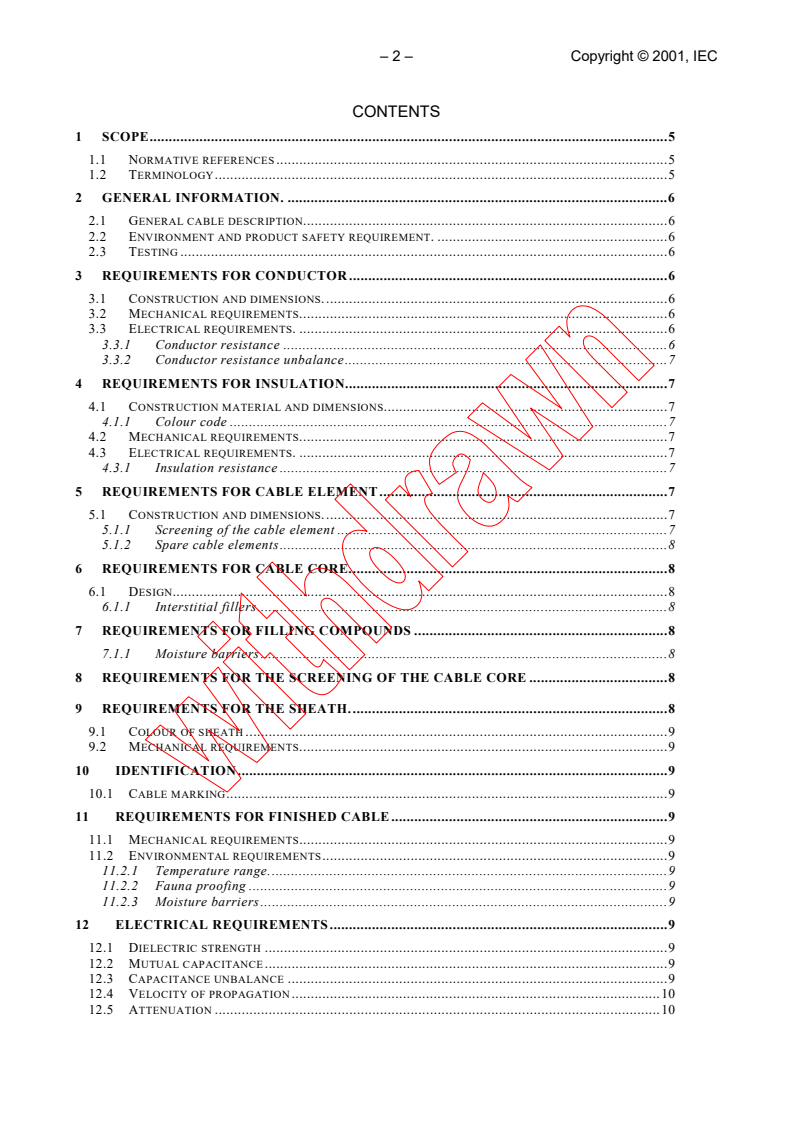
CONTENTS
1 SCOPE.5
1.1 NORMATIVE REFERENCES .5
1.2 TERMINOLOGY.5
2 GENERAL INFORMATION. .6
2.1 GENERAL CABLE DESCRIPTION.6
2.2 ENVIRONMENT AND PRODUCT SAFETY REQUIREMENT. .6
2.3 TESTING .6
3 REQUIREMENTS FOR CONDUCTOR .6
3.1 CONSTRUCTION AND DIMENSIONS.6
3.2 MECHANICAL REQUIREMENTS.6
3.3 ELECTRICAL REQUIREMENTS. .6
3.3.1 Conductor resistance .6
3.3.2 Conductor resistance unbalance.7
4 REQUIREMENTS FOR INSULATION.7
4.1 CONSTRUCTION MATERIAL AND DIMENSIONS.7
4.1.1 Colour code .7
4.2 MECHANICAL REQUIREMENTS.7
4.3 ELECTRICAL REQUIREMENTS. .7
4.3.1 Insulation resistance .7
5 REQUIREMENTS FOR CABLE ELEMENT .7
5.1 CONSTRUCTION AND DIMENSIONS.7
5.1.1 Screening of the cable element .7
5.1.2 Spare cable elements.8
6 REQUIREMENTS FOR CABLE CORE.8
6.1 DESIGN.8
6.1.1 Interstitial fillers.8
7 REQUIREMENTS FOR FILLING COMPOUNDS .8
7.1.1 Moisture barriers.8
8 REQUIREMENTS FOR THE SCREENING OF THE CABLE CORE .8
9 REQUIREMENTS FOR THE SHEATH. .8
9.1 COLOUR OF SHEATH .9
9.2 MECHANICAL REQUIREMENTS.9
10 IDENTIFICATION.9
10.1 CABLE MARKING.9
11 REQUIREMENTS FOR FINISHED CABLE .9
11.1 MECHANICAL REQUIREMENTS.9
11.2 ENVIRONMENTAL REQUIREMENTS.9
11.2.1 Temperature range.9
11.2.2 Fauna proofing .9
11.2.3 Moisture barriers.9
12 ELECTRICAL REQUIREMENTS.9
12.1 DIELECTRIC STRENGTH .9
12.2 MUTUAL CAPACITANCE .9
12.3 CAPACITANCE UNBALANCE .9
12.4 VELOCITY OF PROPAGATION.10
12.5 ATTENUATION .10
12.6 LONGITUDINAL CONVERSION LOSS (LCL) .10
12.7 NEAR END CROSSTALK (NEXT) .10
12.8 EQUAL LEVEL FAR-END CROSSTALK (ELFEXT).10
12.9 POWER SUM (PS) OF CROSSTALK LOSS .11
12.10 CHARACTERISTIC IMPEDANCE .11
12.11 COUPLING ATTENUATION .11
12.12 TRANSFER IMPEDANCE .11
13 PRODUCT QUALIFICATION REQUIREMENTS.11
– 4 – Copyright © 2001, IEC
INTERNATIONAL ELECTROTECHNICAL COMMISSION
____________
MULTI-PAIR CABLES USED IN HIGH BIT RATE DIGITAL ACCESS
TELECOMMUNICATION NETWORKS –
Part 1: Outdoor cables
FOREWORD
A PAS is a technical specification not fulfilling the requirements for a standard, but made available to the
public and established in an organization operating under given procedures.
IEC-PAS 62255-1 has been processed by subcommittee 46C: Wires and symmetric cables, of IEC technical
committee 46: Cables, wires, waveguides, RF connectors and accessories for communication and signalling.
The text of this PAS is based on the This PAS was approved for
following document: publication by the P-members of the
committee concerned as indicated in
the following document:
Draft PAS Report on voting
46C/432/PAS 46C/473/RVD
Following publication of this PAS, the technical committee or subcommittee concerned will investigate the
possibility of transforming the PAS into an International Standard.
1) The IEC (International Electrotechnical Commission) is a worldwide organization for standardization comprising all
national electrotechnical committees (IEC National Committees). The object of the IEC is to promote international co-
operation on all questions concerning standardization in the electrical and electronic fields. To this end and in addition
to other activities, the IEC publishes International Standards. Their preparation is entrusted to technical committees;
any IEC National Committee interested in the subject dealt with may participate in this preparatory work. International,
governmental and non-governmental organizations liaising with the IEC also participate in this preparation. The IEC
collaborates closely with the International Organization for Standardization (ISO) in accordance with conditions
determined by agreement between the two organizations.
2) The formal decisions or agreements of the IEC on technical matters express, as nearly as possible, an international
consensus of opinion on the relevant subjects since each technical committee has representation from all interested
National Committees.
3) The documents produced have the form of recommendations for international use and are published in the form of
standards, technical specifications, technical reports or guides and they are accepted by the National Committees in
that sense.
4) In order to promote international unification, IEC National Committees undertake to apply IEC International Standards
transparently to the maximum extent possible in their national and regional standards. Any divergence between the
IEC Standard and the corresponding national or regional standard shall be clearly indicated in the latter.
5) The IEC provides no marking procedure to indicate its approval and cannot be rendered responsible for any equipment
declared to be in conformity with one of its standards.
6) Attention is drawn to the possibility that some of the elements of this PAS may be the subject of patent rights. The IEC
shall not be held responsible for identifying any or all such patent rights.
MULTI-PAIR CABLES USED IN HIGH BIT RATE DIGITAL ACCESS
TELECOMMUNICATION NETWORKS –
Part 1: Outdoor cables
1 Scope
T his specification defines outdoor multi-pair cables for use in high bit rate digital telecommunication
net works with their relative definitions and requirements
It covers water tight cables, with an overall screen, characterised up to 30 MHz, to be used in
out door networks (for example in the subscriber access loop).
T he electrical, mechanical, transmission performance characteristics of the screened cables,
r elated to their reference test methods, are detailed.
1.1 Normative references
This standard incorporates by dated or undated reference, provisions from other publications.
These normative references are cited at the appropriate places in the text and the cited
publications are listed hereafter. For dated references, subsequent amendments to or revisions of
these publications apply to this PAS only when incorporated in it by amendment or revision. For
undated references, the latest edition of the cited publication applies, together with any
amendments.
IEC 61156-1, Multicore and Symmetrical Pair/Quad Cables for Digital Communications :Part 1:
Generic specification
IEC 60028:1925, International standard of resistance for copper
IEC 60050, International Electrotechnical Vocabulary (IEV)
IEC 60068, Environmental testing
IEC 60304:1982, Standard colours for insulation for low-frequency cables and wires
IEC 60344:1980, Guide to the calculation of resistance of plain and coated copper con-
ductors of low-frequency cables and wires
IEC 60811-1, Common test methods for insulating and sheathing materials of electric
cables - Part 1: Methods for general application
IEC 60811-1-2:1985, Common test methods for insulating and sheathing materials of
...