

IEC 62255-1:2003
(Main)Multicore and symmetrical pair/quad cables for broadband digital communications (high bit rate digital access telecommunication networks) - Outside plant cables - Part 1: Generic specification
General Information
- Abstract
Applicable to polyolefin insulated symmetrical pair/quad telecommunication cables, filled or unfilled with copper conductor intended for broadband digital communications in the local outdoor network.
- Status
- Published
- Publication Date
- 06-Nov-2003
- Technical Committee
- SC 46C - Wires and symmetric cables
- Drafting Committee
- MT 1 - TC 46/SC 46C/MT 1
- Current Stage
- PPUB - Publication issued
- Start Date
- 07-Nov-2003
- Completion Date
- 31-Mar-2004
Buy Documents
IEC 62255-1:2003 - Multicore and symmetrical pair/quad cables for broadband digital communications (high bit rate digital access telecommunication networks) - Outside plant cables - Part 1: Generic specification Released:11/7/2003
IEC 62255-1:2003 - Multicore and symmetrical pair/quad cables for broadband digital communications (high bit rate digital access telecommunication networks) - Outside plant cables - Part 1: Generic specification Released:11/7/2003
Overview
IEC 62255-1:2003 is the IEC generic specification for multicore and symmetrical pair/quad outside plant cables used in broadband digital communications (high bit rate digital access telecommunication networks). It applies to polyolefin‑insulated symmetrical pair/quad telecommunication cables - filled or unfilled - with copper conductors intended for the local outdoor network. The standard defines characteristics, materials and construction principles, and the types of tests and test methods required to validate outside‑plant broadband cables.
Key Topics and Requirements
- Scope and cable types
- Covers local outdoor cables (typically 6–300 pairs) and drop cables (typically 2–6 pairs).
- Differentiates filled and unfilled designs and cable bandwidth classes (maximum referenced frequencies: 30 MHz, 60 MHz, 100 MHz).
- Conductor
- Solid annealed copper in accordance with IEC 60028.
- Nominal conductor diameter range: 0.5 mm to 0.9 mm.
- Joints in conductors permitted; joint tensile strength not less than 90% of adjacent conductor.
- Insulation and materials
- Polyolefin insulation (solid, cellular or multilayer systems allowed).
- Insulation thickness and type to suit termination and performance requirements.
- Optional water‑blocking/filling compounds to prevent longitudinal water migration.
- Cable structure
- Elements are twisted pairs or quads; variable lay lengths, oscillated pairing/quadding permitted.
- Provisions for screening, sheath, ripcord, strength members, color coding and identification as specified in detail specifications.
- Test methods
- Specifies categories of tests: electrical, transmission, mechanical/dimensional, and environmental.
- Installation considerations reference IEC 60794‑1‑1 guidance while requirements are finalized.
- Documentation
- Requires detail specifications to indicate color codes, construction dimensions and other local requirements.
Applications and Users
- Who uses it: cable manufacturers, telecom network designers, outside‑plant installers, test laboratories, procurement/specification authors and telecom operators.
- Practical uses: specifying and qualifying outdoor multicore pair/quad cables for local access networks, ensuring interoperability and environmental suitability (aerial, buried and drop installations), and guiding type testing for broadband performance up to 100 MHz.
- Benefits: provides a consistent framework to select materials, verify mechanical and transmission performance, and mitigate water ingress and environmental risks in outside‑plant broadband cabling.
Related Standards
- IEC 61156‑1 (multicore pair/quad generic spec for digital communications)
- IEC 60028 (copper conductor resistance)
- IEC 60304 (insulation colour codes)
- IEC 60794‑1‑1 (installation guidance for optical and cable systems)
- IEC 60811 series (material test methods)
Keywords: IEC 62255-1, multicore cables, symmetrical pair/quad cables, outside plant cables, broadband digital communications, polyolefin insulated, filled/unfilled cables, high bit rate access networks.
Relations
- Effective Date
- 05-Sep-2023
Buy Documents
IEC 62255-1:2003 - Multicore and symmetrical pair/quad cables for broadband digital communications (high bit rate digital access telecommunication networks) - Outside plant cables - Part 1: Generic specification Released:11/7/2003
IEC 62255-1:2003 - Multicore and symmetrical pair/quad cables for broadband digital communications (high bit rate digital access telecommunication networks) - Outside plant cables - Part 1: Generic specification Released:11/7/2003
Get Certified
Connect with accredited certification bodies for this standard

ANCE
Mexican certification and testing association.

Intertek Slovenia
Intertek testing, inspection, and certification services in Slovenia.

LNE (Laboratoire National de Métrologie et d'Essais)
French national laboratory for metrology and testing.
Sponsored listings
Frequently Asked Questions
IEC 62255-1:2003 is a standard published by the International Electrotechnical Commission (IEC). Its full title is "Multicore and symmetrical pair/quad cables for broadband digital communications (high bit rate digital access telecommunication networks) - Outside plant cables - Part 1: Generic specification". This standard covers: Applicable to polyolefin insulated symmetrical pair/quad telecommunication cables, filled or unfilled with copper conductor intended for broadband digital communications in the local outdoor network.
Applicable to polyolefin insulated symmetrical pair/quad telecommunication cables, filled or unfilled with copper conductor intended for broadband digital communications in the local outdoor network.
IEC 62255-1:2003 is classified under the following ICS (International Classification for Standards) categories: 33.120.20 - Wires and symmetrical cables. The ICS classification helps identify the subject area and facilitates finding related standards.
IEC 62255-1:2003 has the following relationships with other standards: It is inter standard links to IEC PAS 62255-1:2001. Understanding these relationships helps ensure you are using the most current and applicable version of the standard.
IEC 62255-1:2003 is available in PDF format for immediate download after purchase. The document can be added to your cart and obtained through the secure checkout process. Digital delivery ensures instant access to the complete standard document.
Standards Content (Sample)
INTERNATIONAL IEC
STANDARD
62255-1
First edition
2003-11
Multicore and symmetrical pair/quad cables
for broadband digital communications
(high bit rate digital access telecommunication
networks) – Outside plant cables –
Part 1:
Generic specification
Reference number
Publication numbering
As from 1 January 1997 all IEC publications are issued with a designation in the
60000 series. For example, IEC 34-1 is now referred to as IEC 60034-1.
Consolidated editions
The IEC is now publishing consolidated versions of its publications. For example,
edition numbers 1.0, 1.1 and 1.2 refer, respectively, to the base publication, the
base publication incorporating amendment 1 and the base publication incorporating
amendments 1 and 2.
Further information on IEC publications
The technical content of IEC publications is kept under constant review by the IEC,
thus ensuring that the content reflects current technology. Information relating to
this publication, including its validity, is available in the IEC Catalogue of
publications (see below) in addition to new editions, amendments and corrigenda.
Information on the subjects under consideration and work in progress undertaken
by the technical committee which has prepared this publication, as well as the list
of publications issued, is also available from the following:
• IEC Web Site (www.iec.ch)
• Catalogue of IEC publications
The on-line catalogue on the IEC web site (www.iec.ch/searchpub) enables you to
search by a variety of criteria including text searches, technical committees
and date of publication. On-line information is also available on recently issued
publications, withdrawn and replaced publications, as well as corrigenda.
• IEC Just Published
This summary of recently issued publications (www.iec.ch/online_news/ justpub)
is also available by email. Please contact the Customer Service Centre (see
below) for further information.
• Customer Service Centre
If you have any questions regarding this publication or need further assistance,
please contact the Customer Service Centre:
Email: custserv@iec.ch
Tel: +41 22 919 02 11
Fax: +41 22 919 03 00
INTERNATIONAL IEC
STANDARD
62255-1
First edition
2003-11
Multicore and symmetrical pair/quad cables
for broadband digital communications
(high bit rate digital access telecommunication
networks) – Outside plant cables –
Part 1:
Generic specification
IEC 2003 Copyright - all rights reserved
No part of this publication may be reproduced or utilized in any form or by any means, electronic or
mechanical, including photocopying and microfilm, without permission in writing from the publisher.
International Electrotechnical Commission, 3, rue de Varembé, PO Box 131, CH-1211 Geneva 20, Switzerland
Telephone: +41 22 919 02 11 Telefax: +41 22 919 03 00 E-mail: inmail@iec.ch Web: www.iec.ch
PRICE CODE
Commission Electrotechnique Internationale
P
International Electrotechnical Commission
Международная Электротехническая Комиссия
For price, see current catalogue
– 2 – 62255-1 IEC:2003(E)
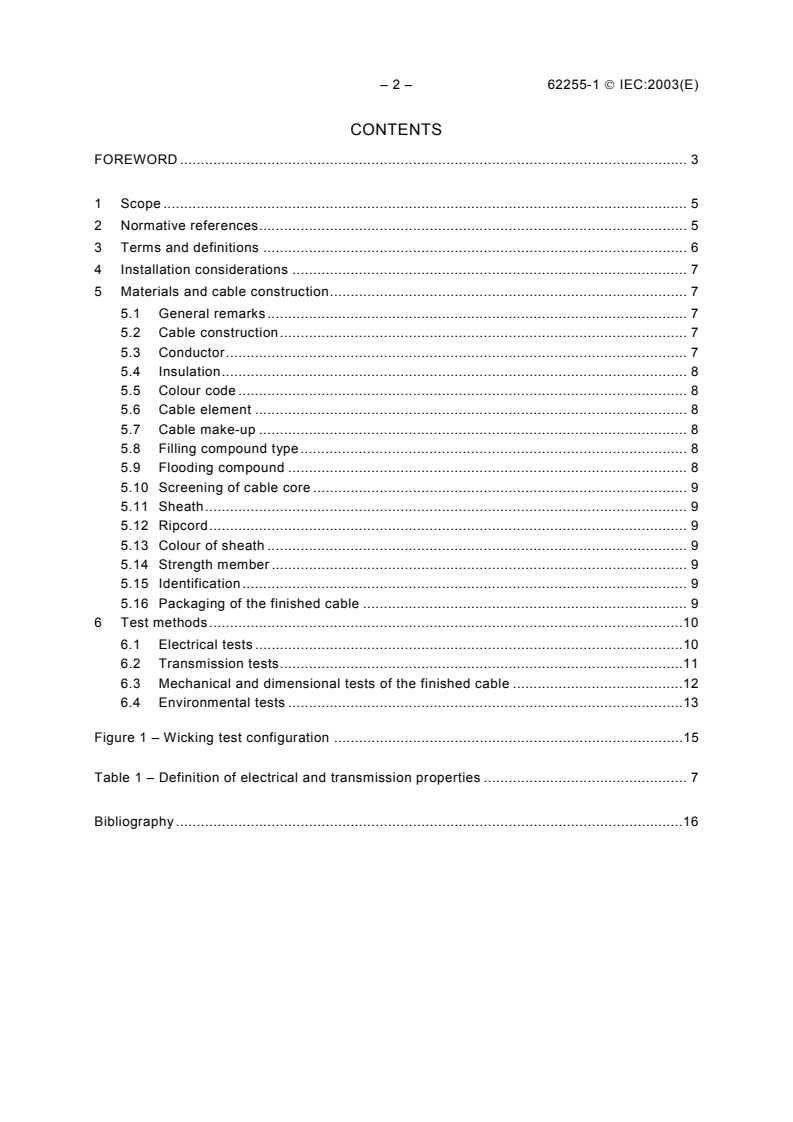
CONTENTS
FOREWORD . 3
1 Scope . 5
2 Normative references. 5
3 Terms and definitions . 6
4 Installation considerations . 7
5 Materials and cable construction. 7
5.1 General remarks. 7
5.2 Cable construction. 7
5.3 Conductor. 7
5.4 Insulation. 8
5.5 Colour code . 8
5.6 Cable element . 8
5.7 Cable make-up . 8
5.8 Filling compound type. 8
5.9 Flooding compound . 8
5.10 Screening of cable core . 9
5.11 Sheath. 9
5.12 Ripcord. 9
5.13 Colour of sheath . 9
5.14 Strength member . 9
5.15 Identification. 9
5.16 Packaging of the finished cable . 9
6 Test methods.10
6.1 Electrical tests .10
6.2 Transmission tests.11
6.3 Mechanical and dimensional tests of the finished cable .12
6.4 Environmental tests .13
Figure 1 – Wicking test configuration .15
Table 1 – Definition of electrical and transmission properties . 7
Bibliography.16
62255-1 IEC:2003(E) – 3 –
INTERNATIONAL ELECTROTECHNICAL COMMISSION
____________
MULTICORE AND SYMMETRICAL PAIR/QUAD CABLES
FOR BROADBAND DIGITAL COMMUNICATIONS (HIGH BIT RATE
DIGITAL ACCESS TELECOMMUNICATION NETWORKS) –
OUTSIDE PLANT CABLES –
Part 1: Generic specification
FOREWORD
1) The International Electrotechnical Commission (IEC) is a worldwide organization for standardization comprising
all national electrotechnical committees (IEC National Committees). The object of IEC is to promote
international co-operation on all questions concerning standardization in the electrical and electronic fields. To
this end and in addition to other activities, IEC publishes International Standards, Technical Specifications,
Technical Reports, Publicly Available Specifications (PAS) and Guides (hereafter referred to as “IEC
Publication(s)”). Their preparation is entrusted to technical committees; any IEC National Committee interested
in the subject dealt with may participate in this preparatory work. International, governmental and non-
governmental organizations liaising with the IEC also participate in this preparation. IEC collaborates closely
with the International Organization for Standardization (ISO) in accordance with conditions determined by
agreement between the two organizations.
2) The formal decisions or agreements of IEC on technical matters express, as nearly as possible, an international
consensus of opinion on the relevant subjects since each technical committee has representation from all
interested IEC National Committees.
3) IEC Publications have the form of recommendations for international use and are accepted by IEC National
Committees in that sense. While all reasonable efforts are made to ensure that the technical content of IEC
Publications is accurate, IEC cannot be held responsible for the way in which they are used or for any
misinterpretation by any end user.
4) In order to promote international uniformity, IEC National Committees undertake to apply IEC Publications
transparently to the maximum extent possible in their national and regional publications. Any divergence
between any IEC Publication and the corresponding national or regional publication shall be clearly indicated in
the latter.
5) IEC provides no marking procedure to indicate its approval and cannot be rendered responsible for any
equipment declared to be in conformity with an IEC Publication.
6) All users should ensure that they have the latest edition of this publication.
7) No liability shall attach to IEC or its directors, employees, servants or agents including individual experts and
members of its technical committees and IEC National Committees for any personal injury, property damage or
other damage of any nature whatsoever, whether direct or indirect, or for costs (including legal fees) and
expenses arising out of the publication, use of, or reliance upon, this IEC Publication or any other IEC
Publications.
8) Attention is drawn to the Normative references cited in this publication. Use of the referenced publications is
indispensable for the correct application of this publication.
9) Attention is drawn to the possibility that some of the elements of this IEC Publication may be the subject of
patent rights. IEC shall not be held responsible for identifying any or all such patent rights.
International Standard IEC 62255-1 has been prepared by subcommittee 46C: Wires and
symmetric cables, of IEC technical committee 46: Cables, wires, waveguides, r.f. connectors,
r.f. and microwave passive components and accessories.
The text of this standard is based on the following documents:
FDIS Report on voting
46C/622/FDIS 46C/632/RVD
Full information on the voting for the approval of this standard can be found in the report on
voting indicated in the above table.
– 4 – 62255-1 IEC:2003(E)
This standard consists of this part 1, which forms the generic specification, and the other
parts, which form the sectional specifications, under the general title Multicore and
symmetrical pair/quad cables for broadband digital communications (high bit rate digital
access telecommunication networks) − Outside plant cables:
Part 1: eneric specification
NOTE The general design details and requirements are common to all broadband cables/wires and are applicable
to Parts 2 to 5.
Part 2: Sectional specification for unfilled cables
Part 2-1: Blank detail specification for unfilled cables
Part 3: Sectional specification for filled cables
Part 3-1: Blank detail specification for filled cables
Part 4: Sectional specification for aerial drop cables
Part 4-1: Blank detail specification for aerial drop cables
Part 5: Sectional specification for filled drop cables
Part 6: Blank detail specification for filled drop cables
This publication has been drafted in accordance with the ISO/IEC Directives, Part 2.
The committee has decided that the contents of this publication will remain unchanged until
2008. At this date, the publication will be
• reconfirmed;
• withdrawn;
• replaced by a revised edition, or
• amended.
62255-1 IEC:2003(E) – 5 –
MULTICORE AND SYMMETRICAL PAIR/QUAD CABLES
FOR BROADBAND DIGITAL COMMUNICATIONS (HIGH BIT RATE
DIGITAL ACCESS TELECOMMUNICATION NETWORKS) –
OUTSIDE PLANT CABLES –
Part 1: Generic specification
1 Scope
This part of IEC 62255 is applicable to polyolefin insulated symmetrical pair/quad
telecommunication cables, filled or unfilled with copper conductor intended for broadband
digital communications in the local outdoor network.
It provides definitions of characteristics, establishes general requirement for materials and
cable construction, and details test methods and procedures.
Cables are differentiated by bandwidth. They have a maximum referenced frequency of
30 MHz, 60 MHz and 100 MHz.
The local cables covered by this standard are divided into two types based on cable design –
filled and unfilled.
These cables have typically 6 to 300 pairs.
The drop cables covered by this standard are divided into two types based on method of
installation – aerial and buried.
Drop cables typically have a pair-count of 2 to 6 pairs.
2 Normative references
The following referenced documents are indispensable for the application of this document.
For dated references, only the edition cited applies. For undated references, the latest edition
of the referenced document (including any amendments) applies.
IEC 60028, International standard of resistance for copper
IEC 60050-300:2001, International Electrotechnical Vocabulary – Electrical and electronic
measurements and measuring instruments – Part 311: General terms relating to
measurements – Part 312: General terms relating to electrical measurements – Part 313:
Types of electrical measuring instruments – Part 314: Specific terms according to the type of
instrument
IEC 60189-1, Low-frequency cables and wires with PVC insulation and PVC sheath – Part 1:
General test and measuring methods
IEC 60304, Standard colours for insulation for low frequency cables and wires
IEC 60332-1, Tests on electric cables under fire conditions – Part 1: Test on a single vertical
insulated wire or cable
– 6 – 62255-1 IEC:2003(E)
IEC 60344, Guide to the calculation of resistance of plain and coated copper conductors of
low-frequency cables and wires
IEC 60708-1, Low-frequency cables with polyolefin insulation and moisture barrier polyolefin
sheath – Part 1: General design details and requirements
IEC 60794-1-2, Optical fibre cables – Part 1-2: Generic specification – Basic optical cable test
procedures
IEC 60811-1-1, Common test methods for insulating and sheathing materials of electric and
optical cables – Part 1-1: General application – Measurement of thickness and overall
dimensions – Test for determining the mechanical properties
IEC 60811-1-3, Common test methods for insulating and sheathing materials of electric and
optical cables – Part 1-3: Methods for general application – Methods for determining the
density – Water absorption test – Shrinkage test
IEC 60811-1-4, Common test methods for insulating and sheathing materials of electric
cables – Part 1: Methods for general application – Section Four: Tests at low temperature
IEC 60811-4-2, Common test methods for insulating and sheathing materials of electric
cables – Part 4: Methods specific to polyethylene and polypropylene compounds – Section
Two: Elongation at break after pre-conditioning – Wrapping test after pre-conditioning –
Wrapping test after thermal ageing in air
IEC 61156-1:2002, Multicore and symmetrical pair/quad cables for digital communications –
Part 1: Generic specification
IEC 61156-5, Multicore and symmetrical pair/quad cables for digital communication – Part 5:
Symmetrical pair/quad cables with transmission characteristics up to 600 MHz – Horizontal
floor wiring – Sectional specification
IEC 61196-1, Radio-frequency cables – Part 1: Generic specification – General, definitions,
requirements and test methods
IEC 62012-1, Multicore and symmetrical pair/quad cables for digital communications to be
used in harsh environments – Part 1: Generic specification
3 Terms and definitions
For the purposes of this document, the following definitions given in IEC 61156-1 and some of
the definitions given in IEC 60050-300 apply.
62255-1 IEC:2003(E) – 7 –
Table 1 – Definition of electrical and transmission properties
IEC referenced
Parameter Clause
standard
Resistance unbalance 61156-1 2.1.1
Pair or one side of a quad to earth capacitance unbalance 61156-1 2.1.2
Pair or one side of a quad to screen capacitance unbalance 61156-1 2.1.3
Mutual capacitance of a pair 61156-1 2.1.4
Velocity of propagation (phase velocity)1 61156-1 2.1.5
Attenuation 61156-1 2.1.6
Unbalance attenuation 61156-1 2.1.7
Near-end crosstalk loss (NEXT) 61156-1 2.1.8
Far-end crosstalk loss (FEXT) 61156-1 2.1.9
Power sum of near-end and far-end crosstalk 61156-1 2.1.10
Characteristic impedance 61156-1 2.1.11
Surface transfer impedance 61156-1 2.1.12
Group propagation delay 61156-1 2.1.13
Differential phase delay (skew) 61156-1 2.1.16
4 Installation considerations
The requirements are under consideration. In the meantime, IEC 60794-1-1 should be used
as guidance.
5 Materials and cable construction
5.1 General remarks
The choice of materials and cable construction shall be suitable for the intended application
and installation of the cable. Particular care shall be taken to meet any special requirements
resulting from the local climatic conditions or method of installation.
5.2 Cable construction
The cable construction shall be in accordance with the details and dimensions given in the
relevan
...
IEC 62255-1
Edition 1.0 2003-11
INTERNATIONAL
STANDARD
NORME
INTERNATIONALE
Multicore and symmetrical pair/quad cables for broadband digital
communications (high bit rate digital access telecommunication networks) –
Outside plant cables –
Part 1: Generic specification
Câbles multiconducteurs à paires symétriques et quartes pour transmissions
numériques large bande (réseau d’accès télécommunications numériques à haut
débit) – Câbles pour installations extérieures –
Partie 1: Spécification générique
All rights reserved. Unless otherwise specified, no part of this publication may be reproduced or utilized in any form or by
any means, electronic or mechanical, including photocopying and microfilm, without permission in writing from either IEC or
IEC's member National Committee in the country of the requester.
If you have any questions about IEC copyright or have an enquiry about obtaining additional rights to this publication,
please contact the address below or your local IEC member National Committee for further information.
Droits de reproduction réservés. Sauf indication contraire, aucune partie de cette publication ne peut être reproduite
ni utilisée sous quelque forme que ce soit et par aucun procédé, électronique ou mécanique, y compris la photocopie
et les microfilms, sans l'accord écrit de la CEI ou du Comité national de la CEI du pays du demandeur.
Si vous avez des questions sur le copyright de la CEI ou si vous désirez obtenir des droits supplémentaires sur cette
publication, utilisez les coordonnées ci-après ou contactez le Comité national de la CEI de votre pays de résidence.
IEC Central Office
3, rue de Varembé
CH-1211 Geneva 20
Switzerland
Email: inmail@iec.ch
Web: www.iec.ch
About the IEC
The International Electrotechnical Commission (IEC) is the leading global organization that prepares and publishes
International Standards for all electrical, electronic and related technologies.
About IEC publications
The technical content of IEC publications is kept under constant review by the IEC. Please make sure that you have the
latest edition, a corrigenda or an amendment might have been published.
ƒ Catalogue of IEC publications: www.iec.ch/searchpub
The IEC on-line Catalogue enables you to search by a variety of criteria (reference number, text, technical committee,…).
It also gives information on projects, withdrawn and replaced publications.
ƒ IEC Just Published: www.iec.ch/online_news/justpub
Stay up to date on all new IEC publications. Just Published details twice a month all new publications released. Available
on-line and also by email.
ƒ Electropedia: www.electropedia.org
The world's leading online dictionary of electronic and electrical terms containing more than 20 000 terms and definitions
in English and French, with equivalent terms in additional languages. Also known as the International Electrotechnical
Vocabulary online.
ƒ Customer Service Centre: www.iec.ch/webstore/custserv
If you wish to give us your feedback on this publication or need further assistance, please visit the Customer Service
Centre FAQ or contact us:
Email: csc@iec.ch
Tel.: +41 22 919 02 11
Fax: +41 22 919 03 00
A propos de la CEI
La Commission Electrotechnique Internationale (CEI) est la première organisation mondiale qui élabore et publie des
normes internationales pour tout ce qui a trait à l'électricité, à l'électronique et aux technologies apparentées.
A propos des publications CEI
Le contenu technique des publications de la CEI est constamment revu. Veuillez vous assurer que vous possédez
l’édition la plus récente, un corrigendum ou amendement peut avoir été publié.
ƒ Catalogue des publications de la CEI: www.iec.ch/searchpub/cur_fut-f.htm
Le Catalogue en-ligne de la CEI vous permet d’effectuer des recherches en utilisant différents critères (numéro de référence,
texte, comité d’études,…). Il donne aussi des informations sur les projets et les publications retirées ou remplacées.
ƒ Just Published CEI: www.iec.ch/online_news/justpub
Restez informé sur les nouvelles publications de la CEI. Just Published détaille deux fois par mois les nouvelles
publications parues. Disponible en-ligne et aussi par email.
ƒ Electropedia: www.electropedia.org
Le premier dictionnaire en ligne au monde de termes électroniques et électriques. Il contient plus de 20 000 termes et
définitions en anglais et en français, ainsi que les termes équivalents dans les langues additionnelles. Egalement appelé
Vocabulaire Electrotechnique International en ligne.
ƒ Service Clients: www.iec.ch/webstore/custserv/custserv_entry-f.htm
Si vous désirez nous donner des commentaires sur cette publication ou si vous avez des questions, visitez le FAQ du
Service clients ou contactez-nous:
Email: csc@iec.ch
Tél.: +41 22 919 02 11
Fax: +41 22 919 03 00
IEC 62255-1
Edition 1.0 2003-11
INTERNATIONAL
STANDARD
NORME
INTERNATIONALE
Multicore and symmetrical pair/quad cables for broadband digital
communications (high bit rate digital access telecommunication networks) –
Outside plant cables –
Part 1: Generic specification
Câbles multiconducteurs à paires symétriques et quartes pour transmissions
numériques large bande (réseau d’accès télécommunications numériques à
haut débit) – Câbles pour installations extérieures –
Partie 1: Spécification générique
INTERNATIONAL
ELECTROTECHNICAL
COMMISSION
COMMISSION
ELECTROTECHNIQUE
PRICE CODE
INTERNATIONALE
P
CODE PRIX
ICS 33.120.20 ISBN 2-8318-8757-7
– 2 – 62255-1 © CEI:2003
SOMMAIRE
AVANT-PROPOS.4
1 Domaine d’application .8
2 Références normatives.8
3 Termes et définitions .10
4 Considérations d’installation.12
5 Matériaux et construction du câble .12
5.1 Remarques générales .12
5.2 Construction du câble.12
5.3 Conducteur .12
5.4 Enveloppe isolante .14
5.5 Code de couleurs .14
5.6 Elément de câblage.14
5.7 Constitution du câble.14
5.8 Matériau de remplissage .14
5.9 Matériau d’enrobage .16
5.10 Ecran sur l’âme du câble .16
5.11 Gaine .16
5.12 Filin de déchirement .16
5.13 Couleur de la gaine .16
5.14 Renfort de traction.16
5.15 Identification.16
5.16 Emballage du câble terminé .18
6 Méthodes d’essais.18
6.1 Essais électriques .18
6.2 Essais de transmission.20
6.3 Essais mécaniques et dimensionnels du câble terminé.22
6.4 Essais d’environnement .24
Bibliographie.30
Figure 1 – Effet de mèche- Configuration de l’essai .28
Tableau 1 – Définition des caractéristiques électriques et de transmission .12
62255-1 © IEC:2003 – 3 –
CONTENTS
FOREWORD.3
1 Scope.9
2 Normative references.9
3 Terms and definitions .11
4 Installation considerations.13
5 Materials and cable construction .13
5.1 General remarks.13
5.2 Cable construction.13
5.3 Conductor.13
5.4 Insulation.15
5.5 Colour code.15
5.6 Cable element.15
5.7 Cable make-up.15
5.8 Filling compound type .15
5.9 Flooding compound.17
5.10 Screening of cable core.17
5.11 Sheath.17
5.12 Ripcord.17
5.13 Colour of sheath.17
5.14 Strength member.17
5.15 Identification.17
5.16 Packaging of the finished cable .19
6 Test methods.19
6.1 Electrical tests.19
6.2 Transmission tests.21
6.3 Mechanical and dimensional tests of the finished cable .23
6.4 Environmental tests.25
Bibliography.16
Figure 1 – Wicking test configuration .29
Table 1 – Definition of electrical and transmission properties .13
– 4 – 62255-1 © CEI:2003
COMMISSION ÉLECTROTECHNIQUE INTERNATIONALE
____________
CÂBLES MULTICONDUCTEURS À PAIRES SYMÉTRIQUES ET QUARTES
POUR TRANSMISSIONS NUMÉRIQUES LARGE BANDE (RÉSEAU D’ACCÈS
TÉLÉCOMMUNICATIONS NUMÉRIQUES À HAUT DÉBIT) –
CÂBLES POUR INSTALLATIONS EXTÉRIEURES –
Partie 1: Spécification générique
AVANT-PROPOS
1) La Commission Electrotechnique Internationale (CEI) est une organisation mondiale de normalisation
composée de l'ensemble des comités électrotechniques nationaux (Comités nationaux de la CEI). La CEI a
pour objet de favoriser la coopération internationale pour toutes les questions de normalisation dans les
domaines de l'électricité et de l'électronique. A cet effet, la CEI – entre autres activités – publie des Normes
internationales, des Spécifications techniques, des Rapports techniques, des Spécifications accessibles au
public (PAS) et des Guides (ci-après dénommés "Publication(s) de la CEI"). Leur élaboration est confiée à des
comités d'études, aux travaux desquels tout Comité national intéressé par le sujet traité peut participer. Les
organisations internationales, gouvernementales et non gouvernementales, en liaison avec la CEI, participent
également aux travaux. La CEI collabore étroitement avec l'Organisation Internationale de Normalisation (ISO),
selon des conditions fixées par accord entre les deux organisations.
2) Les décisions ou accords officiels de la CEI concernant les questions techniques représentent, dans la mesure
du possible, un accord international sur les sujets étudiés, étant donné que les Comités nationaux de la CEI
intéressés sont représentés dans chaque comité d’études.
3) Les Publications de la CEI se présentent sous la forme de recommandations internationales et sont agréées
comme telles par les Comités nationaux de la CEI. Tous les efforts raisonnables sont entrepris afin que la CEI
s'assure de l'exactitude du contenu technique de ses publications; la CEI ne peut pas être tenue responsable
de l'éventuelle mauvaise utilisation ou interprétation qui en est faite par un quelconque utilisateur final.
4) Dans le but d'encourager l'uniformité internationale, les Comités nationaux de la CEI s'engagent, dans toute la
mesure possible, à appliquer de façon transparente les Publications de la CEI dans leurs publications
nationales et régionales. Toutes divergences entre toutes Publications de la CEI et toutes publications
nationales ou régionales correspondantes doivent être indiquées en termes clairs dans ces dernières.
5) La CEI n’a prévu aucune procédure de marquage valant indication d’approbation et n'engage pas sa
responsabilité pour les équipements déclarés conformes à une de ses Publications.
6) Tous les utilisateurs doivent s'assurer qu'ils sont en possession de la dernière édition de cette publication.
7) Aucune responsabilité ne doit être imputée à la CEI, à ses administrateurs, employés, auxiliaires ou
mandataires, y compris ses experts particuliers et les membres de ses comités d'études et des Comités
nationaux de la CEI, pour tout préjudice causé en cas de dommages corporels et matériels, ou de tout autre
dommage de quelque nature que ce soit, directe ou indirecte, ou pour supporter les coûts (y compris les frais
de justice) et les dépenses découlant de la publication ou de l'utilisation de cette Publication de la CEI ou de
toute autre Publication de la CEI, ou au crédit qui lui est accordé.
8) L'attention est attirée sur les références normatives citées dans cette publication. L'utilisation de publications
référencées est obligatoire pour une application correcte de la présente publication.
9) L’attention est attirée sur le fait que certains des éléments de la présente Publication de la CEI peuvent faire
l’objet de droits de propriété intellectuelle ou de droits analogues. La CEI ne saurait être tenue pour
responsable de ne pas avoir identifié de tels droits de propriété et de ne pas avoir signalé leur existence.
La Norme internationale CEI 62255-1 a été préparée par le sous-comité 46C: Fils et câbles
symétriques, du comité d'étude 46 de la CEI: Câbles, fils, guides d’ondes, connecteurs et
accessoires pour communication et signalisation.
Cette version bilingue, publiée en 2006-07, correspond à la version anglaise.
Dans cette version bilingue, les références normatives ont été mises à jour par rapport à la
version monolingue anglaise (2003).
Le texte anglais de cette norme est issu des documents 46C/622/FDIS et 46C/632/RVD.
Le rapport de vote 46C/632/RVD donne toute information sur le vote ayant abouti à l'appro-
bation de cette norme.
62255-1 © IEC:2003 – 5 –
INTERNATIONAL ELECTROTECHNICAL COMMISSION
____________
MULTICORE AND SYMMETRICAL PAIR/QUAD CABLES
FOR BROADBAND DIGITAL COMMUNICATIONS (HIGH BIT RATE
DIGITAL ACCESS TELECOMMUNICATION NETWORKS) –
OUTSIDE PLANT CABLES –
Part 1: Generic specification
FOREWORD
1) The International Electrotechnical Commission (IEC) is a worldwide organization for standardization comprising
all national electrotechnical committees (IEC National Committees). The object of IEC is to promote
international co-operation on all questions concerning standardization in the electrical and electronic fields. To
this end and in addition to other activities, IEC publishes International Standards, Technical Specifications,
Technical Reports, Publicly Available Specifications (PAS) and Guides (hereafter referred to as “IEC
Publication(s)”). Their preparation is entrusted to technical committees; any IEC National Committee interested
in the subject dealt with may participate in this preparatory work. International, governmental and non-
governmental organizations liaising with the IEC also participate in this preparation. IEC collaborates closely
with the International Organization for Standardization (ISO) in accordance with conditions determined by
agreement between the two organizations.
2) The formal decisions or agreements of IEC on technical matters express, as nearly as possible, an international
consensus of opinion on the relevant subjects since each technical committee has representation from all
interested IEC National Committees.
3) IEC Publications have the form of recommendations for international use and are accepted by IEC National
Committees in that sense. While all reasonable efforts are made to ensure that the technical content of IEC
Publications is accurate, IEC cannot be held responsible for the way in which they are used or for any
misinterpretation by any end user.
4) In order to promote international uniformity, IEC National Committees undertake to apply IEC Publications
transparently to the maximum extent possible in their national and regional publications. Any divergence
between any IEC Publication and the corresponding national or regional publication shall be clearly indicated in
the latter.
5) IEC provides no marking procedure to indicate its approval and cannot be rendered responsible for any
equipment declared to be in conformity with an IEC Publication.
6) All users should ensure that they have the latest edition of this publication.
7) No liability shall attach to IEC or its directors, employees, servants or agents including individual experts and
members of its technical committees and IEC National Committees for any personal injury, property damage or
other damage of any nature whatsoever, whether direct or indirect, or for costs (including legal fees) and
expenses arising out of the publication, use of, or reliance upon, this IEC Publication or any other IEC
Publications.
8) Attention is drawn to the Normative references cited in this publication. Use of the referenced publications is
indispensable for the correct application of this publication.
9) Attention is drawn to the possibility that some of the elements of this IEC Publication may be the subject of
patent rights. IEC shall not be held responsible for identifying any or all such patent rights.
International Standard IEC 62255-1 has been prepared by subcommittee 46C: Wires and
symmetric cables, of IEC technical committee 46: Cables, wires, waveguides, r.f. connectors,
r.f. and microwave passive components and accessories.
This bilingual version, published in 2006-07, corresponds to the English version.
The normative references have been up dated compared to the monolingual English version
(2003).
The text of this standard is based on the following documents:
FDIS Report on voting
46C/622/FDIS 46C/632/RVD
Full information on the voting for the approval of this standard can be found in the report on
voting indicated in the above table.
– 6 – 62255-1 © CEI:2003
La version française de cette norme n'a pas été soumise au vote.
Cette publication a été rédigée en conformité avec les Directives ISO/CEI, Partie 2.
Cette norme se compose de cette partie 1, qui constitue la spécification générique, et des
autres parties, qui constituent les spécifications intermédiaires, sous le titre général Câbles
multiconducteurs à paires symétriques et quartes pour transmissions numériques large bande
(réseau d’accès télécommunications numériques à haut débit) – Câbles pour installations
extérieures.
Partie 1: Spécification générique
NOTE Les détails de conception générale et les exigences sont communs à tous les câbles/fils large bande et
sont applicables aux parties 2 à 5.
Partie 2: Spécification intermédiaire pour câbles non remplis
Partie 2-1: Spécification particulière cadre pour câbles non remplis
Partie 3: Spécification intermédiaire pour câbles remplis
Partie 3-1: Spécification particulière cadre pour câbles remplis
Partie 4: Spécification intermédiaire pour câbles de branchement aériens
Partie 4-1: Spécification particulière cadre pour câbles de branchement aériens
Partie 5: Spécification intermédiaire pour câbles de branchement remplis
Partie 5-1: Spécification particulière cadre pour câbles de branchement remplis
Le comité a décidé que le contenu de cette publication ne sera pas modifié avant la date de
maintenance indiquée sur le site web de la CEI sous «http://webstore.CEI.ch» dans les
données relatives à la publication recherchée. A cette date, la publication sera
• reconduite;
• supprimée;
• remplacée par une édition révisée, ou
• amendée.
62255-1 © IEC:2003 – 7 –
The French version of this standard has not been voted upon.
This publication has been drafted in accordance with the ISO/IEC Directives, Part 2.
This standard consists of this part 1, which forms the generic specification, and the other
parts, which form the sectional specifications, under the general title Multicore and
symmetrical pair/quad cables for broadband digital communications (high bit rate digital
access telecommunication networks) − Outside plant cables:
Part 1: Generic specification
NOTE The general design details and requirements are common to all broadband cables/wires and are applicable
to Parts 2 to 5.
Part 2: Sectional specification for unfilled cables
Part 2-1: Blank detail specification for unfilled cables
Part 3: Sectional specification for filled cables
Part 3-1: Blank detail specification for filled cables
Part 4: Sectional specification for aerial drop cables
Part 4-1: Blank detail specification for aerial drop cables
Part 5: Sectional specification for filled drop cables
Part 6: Blank detail specification for filled drop cables
The committee has decided that the contents of this publication will remain unchanged until
the maintenance result date indicated on the IEC web site under "http://webstore.iec.ch" in
the data related to the specific publication. At this date, the publication will be
• reconfirmed;
• withdrawn;
• replaced by a revised edition, or
• amended.
– 8 – 62255-1 © CEI:2003
CÂBLES MULTICONDUCTEURS À PAIRES SYMÉTRIQUES ET QUARTES
POUR TRANSMISSIONS NUMÉRIQUES LARGE BANDE (RÉSEAU D’ACCÈS
TÉLÉCOMMUNICATIONS NUMÉRIQUES À HAUT DÉBIT) –
CÂBLES POUR INSTALLATIONS EXTÉRIEURES
Partie 1: Spécification générique
1 Domaine d’application
Cette partie de la CEI 62255 est applicable à des câbles de télécommunications à paires
symétriques et quartes, remplis ou non, avec conducteur cuivre isolé polyoléfine, destinés
aux transmissions numérique large bande dans le réseau local en extérieur.
Elle fournit les définitions des caractéristiques, les exigences générales pour les matériaux et
la construction du câble, ainsi que des détails sur les méthodes d’essai et les procédures.
Les câbles sont différenciés par la bande passante. Ils ont une fréquence de référence
maximale de 30 MHz, 60 MHz and 100 MHz.
Les câbles de réseaux locaux couverts par cette norme sont divisés en deux types suivant la
conception du câble- rempli ou non.
Ces câbles ont typiquement une contenance de 6 à 300 paires.
Les câbles de raccordement couverts par cette norme sont répartis en deux types suivant le
mode d’installation- aérien ou enterré.
Les câbles de raccordement ont typiquement une contenance de 2 à 6 paires.
2 Références normatives
Les documents en référence qui suivent sont indispensables pour la mise en application de
ce document. Pour les références datées, seule l’édition citée s’applique. Pour les références
non datées, la dernière édition du document en référence (y compris les éventuels
amendements) s’applique.
CEI 60028, Spécification internationale d'un cuivre-type recuit
CEI 60050-300:2001, Vocabulaire Electrotechnique International – Mesures et appareils de
mesure électriques et électroniques – Partie 311: Termes généraux concernant les mesures –
Partie 312: Termes généraux concernant les mesures électriques – Partie 313: Types
d'appareils électriques de mesure – Partie 314: Termes spécifiques selon le type d'appareil
CEI 60189-1:1986, Câbles et fils pour basses fréquences isolés au PVC et sous gaine de
PVC – Première partie: Méthodes générales d'essai et de vérification
CEI 60304, Couleurs de référence de l'enveloppe isolante pour câbles et fils pour basses
fréquences
CEI 60332-1-1, Essais des câbles électriques et à fibres optiques soumis au feu – Partie 1-1:
Essai de propagation verticale de la flamme sur conducteur ou câble isolé – Appareillage
d'essai
62255-1 © IEC:2003 – 9 –
MULTICORE AND SYMMETRICAL PAIR/QUAD CABLES
FOR BROADBAND DIGITAL COMMUNICATIONS (HIGH BIT RATE
DIGITAL ACCESS TELECOMMUNICATION NETWORKS) –
OUTSIDE PLANT CABLES –
Part 1: Generic specification
1 Scope
This part of IEC 62255 is applicable to polyolefin insulated symmetrical pair/quad telecom-
munication cables, filled or unfilled with copper conductor intended for broadband digital
communications in the local outdoor network.
It provides definitions of characteristics, establishes general requirement for materials and
cable construction, and details test methods and procedures.
Cables are differentiated by bandwidth. They have a maximum referenced frequency of
30 MHz, 60 MHz and 100 MHz.
The local cables covered by this standard are divided into two types based on cable design –
filled and unfilled.
These cables have typically 6 to 300 pairs.
The drop cables covered by this standard are divided into two types based on method of
installation – aerial and buried.
Drop cables typically have a pair-count of 2 to 6 pairs.
2 Normative references
The following referenced documents are indispensable for the application of this document.
For dated references, only the edition cited applies. For undated references, the latest edition
of the referenced document (including any amendments) applies.
IEC 60028, International standard of resistance for copper
IEC 60050-300:2001, International Electrotechnical Vocabulary – Electrical and electronic
measurements and measuring instruments – Part 311: General terms relating to
measurements – Part 312: General terms relating to electrical measurements – Part 313:
Types of electrical measuring instruments – Part 314: Specific terms according to the type of
instrument
IEC 60189-1:1986, Low-frequency cables and wires with PVC insulation and PVC sheath –
Part 1: General test and measuring methods
IEC 60304, Standard colours for insulation for low frequency cables and wires
IEC 60332-1-1, Tests on electric and optical fibre cables under fire conditions – Part 1-1: Test
for vertical flame propagation for a single insulated wire or cable – Apparatus
– 10 – 62255-1 © CEI:2003
CEI 60708:2005, Low-frequency cables with polyolefin insulation and moisture barrier
polyolefin sheath (disponible en anglais uniquement)
CEI 60794-1-2, Câbles à fibres optiques – Partie 1-2: Spécification générique – Procédures
de base applicables aux essais des câbles optiques
CEI 60811-1:1993, Méthodes d'essais communes pour les matériaux d'isolation et de gainage
des câbles électriques et des câbles optiques – Partie 1-1: Méthodes d'application générale –
Mesure des épaisseurs et des dimensions extérieures – Détermination des propriétés
mécaniques
CEI 60811-1-3:1993, Méthodes d'essais communes pour matériaux d'isolation et de gainage
des câbles électriques et optiques – Partie 1-3: Application générale – Méthodes de
détermination de la masse volumique – Essais d'absorption d'eau – Essai de rétraction
CEI 60811-1-4:1985, Méthodes d'essais communes pour les matériaux d'isolation et de
gainage des câbles électriques – Première partie: Méthodes d'application générale – Section
quatre: Essais à basse température
CEI 60811-4-2:2004, Matériaux d'isolation et de gainage des câbles électriques et optiques –
Méthodes d'essais communes – Partie 4-2: Méthodes spécifiques pour les mélanges
polyéthylène et polypropylène – Résistance à la traction et allongement à la rupture après
conditionnement à température élevée – Essai d'enroulement après conditionnement à
température élevée – Essai d'enroulement après vieillissement thermique dans l'air – Mesure
de l'augmentation de masse – Essai de stabilité à long terme – Méthode d'essai pour
l'oxydation catalytique par le cuivre
CEI 61156-1:2002, Câbles multiconducteurs à paires symétriques et quartes pour
transmissions numériques – Partie 1: Spécification générique
CEI 61156-5:2002, Câbles multiconducteurs à paires symétriques et quartes pour
transmissions numériques – Partie 5: Câbles à paires symétriques et quartes avec
caractéristiques de transmission allant jusqu'à 600 MHz – Câble capillaire – Spécification
intermédiaire
CEI 62012-1:2004, Câbles multiconducteurs à paires symétriques et quartes pour
transmissions numériques utilisés en environnements sévéres – Partie 1: Spécification
générique
CEI 62153 (toutes les parties), Méthodes d'essai des câbles métalliques de communication
3 Termes et définitions
Pour les besoins du présent document, les définitions suivantes données dans la CEI 61156-1
et quelques-unes des définitions données dans la CEI 60050-300 s’appliquent.
62255-1 © IEC:2003 – 11 –
IEC 60708:2005, Low-frequency cables with polyolefin insulation and moisture barrier
polyolefin sheath
IEC 60794-1-2, Optical fibre cables – Part 1-2: Generic specification – Basic optical cable test
procedures
IEC 60811-1-1:1993, Common test methods for insulating and sheathing materials of electric
and optical cables – Part 1-1: Methods for general application – Measurement of thickness
and overall dimensions – Test for determining the mechanical properties
IEC 60811-1-3:1993, Common test methods for insulating and sheathing materials of electric
and optical cables – Part 1-3: General application – Methods for determining the density –
Water absorption tests – Shrinkage test
IEC 60811-1-4:1985, Common test methods for insulating and sheathing materials of electric
cables – Part 1: Methods for general application – Section Four: Tests at low temperature
IEC 60811-4-2:2004, Insulating and sheathing materials of electric and optical cables –
Common test methods – Part 4-2: Methods specific to polyethylene and polypropylene
compounds – Tensile strength and elongation at break after conditioning at elevated
temperature – Wrapping test after conditioning at elevated temperature – Wrapping test after
thermal ageing in air – Measurement of mass increase – Long-term stability test – Test
method for copper-catalyzed oxidative degradation
IEC 61156-1:2002, Multicore and symmetrical pair/quad cables for digital communications –
Part 1: Generic specification
IEC 61156-5:2002, Multicore and symmetrical pair/quad cables for digital communication –
Part 5: Symmetrical pair/quad cables with transmission characteristics up to 600 MHz –
Horizontal floor wiring – Sectional specification
IEC 62012-1:2004, Multicore and symmetrical pair/quad cables for digital communications to
be used in harsh environments – Part 1: Generic specification
IEC 62153 (all parts), Metallic communication cables test methods
3 Terms and definitions
For the purposes of this document, the following definitions given in IEC 61156-1 and some of
the definitions given in IEC 60050-300 apply.
– 12 – 62255-1 © CEI:2003
Tableau 1 – Définition des caractéristiques électriques et de transmission
Norme CEI de
Caractéristique Paragraphe
référence
Déséquilibre de résistance 61156-1 2.1.1
Déséquilibre de capacité paire/terre ou réel/terre 61156-1 2.1.2
Déséquilibre de capacité paire/écran ou réel/écran 61156-1 2.1.3
Capacité mutuelle d’une paire 61156-1 2.1.4
Vitesse de propagation (vitesse de phase)1 61156-1 2.1.5
Affaiblissement linéique 61156-1 2.1.6
Affaiblissement de symétrie 61156-1 2.1.7
Affaiblissement de paradiaphonie (NEXT) 61156-1 2.1.8
Télédiaphonie (FEXT) 61156-1 2.1.9
Affaiblissement total de paradiaphonie et de télédiaphonie 61156-1 2.1.10
Impédance caractéristique 61156-1 2.1.11
Impédance de transfert de surface 61156-1 2.1.12
Temps de propagation de phase 61156-1 2.1.13
Ecart de retard de phase (distorsion) 61156-1 2.1.16
4 Considérations d’installation
Les exigences sont à l’étude. En attendant, il convient d’utiliser la CEI 60794-1-1 à titre de
guide.
5 Matériaux et construction du câble
5.1 Remarques générales
Le choix des matériaux et la construction des câbles doivent convenir à l'application d'usage
et l'installation du câble. Une attention particulière doit être prise pour répondre à toutes les
exigences spéciales résultant des conditions climatiques locales ou de la méthode
d’installation.
5.2 Construction du câble
La construction des câbles doit être conforme aux détails et aux dimensions donnés dans la
spécification particulière appropriée.
5.3 Conducteur
Le conducteur doit être en cuivre recuit massif en conformité avec la CEI 60028.
Le conducteur doit avoir un diamètre nominal compris entre 0,5 mm et 0,9 mm.
Des soudures sur conducteur nu sont permises. Elles doivent être exemptes de grosseurs et
de projections saillantes.
———————
La vitesse de propagation, la vitesse de groupe et la vitesse de phase sont approximativement égales pour les
fréquences supérieures à 1 MHz lorsqu'elles sont mesurées sur câbles symétriques, c’est-à-dire lorsque les
câbles fonctionnent en mode équilibré.
62255-1 © IEC:2003 – 13 –
Table 1 – Definition of electrical and transmission properties
IEC referenced
Parameter Subclause
standard
Resistance unbalance 61156-1 2.1.1
Pair or one side of a quad to earth capacitance unbalance 61156-1 2.1.2
Pair or one side of a quad to screen capacitance unbalance 61156-1 2.1.3
Mutual capacitance of a pair 61156-1 2.1.4
Velocity of propagation (phase velocity) 1 61156-1 2.1.5
Attenuation 61156-1 2.1.6
Unbalance attenuation 61156-1 2.1.7
Near-end crosstalk loss (NEXT) 61156-1 2.1.8
Far-end crosstalk loss (FEXT) 61156-1 2.1.9
Power sum of near-end and far-end crosstalk 61156-1 2.1.10
Characteristic impedance 61156-1 2.1.11
Surface transfer impedance 61156-1 2.1.12
Group propagation delay 61156-1 2.1.13
Differential phase delay (skew) 61156-1 2.1.16
4 Installation considerations
The requirements are under consideration. In the meantime, IEC 60794-1-1 should be used
as guidance.
5 Materials and cable construction
5.1 General remarks
The choice of materials and cable construction shall be suitable for the intended application
and installation of the cable. Particular care shall be taken to meet any special requirements
resulting from the local climatic conditions or method of installation.
5.2 Cable construction
The cable construction shall be in accordance with the details and dimensions given in the
relevant detail specification.
5.3 Conductor
The conductor shall be a solid annealed copper conductor in accordance with IEC 60028.
The conductor shall have a nominal diameter between 0,5 mm and 0,9 mm.
Joints in the uninsulated conductors are allowed. Joints in uninsulated conductors shall be
free from lumps and sharp projections.
———————
1 The velocity of propagation, group velocity and phase velocity are approximately equal for frequencies greater
than 1 MHz when measured on symmetric cables, i.e. when the cables are operated in a balanced mode.
– 14 – 62255-1 © CEI:2003
La résistance à la rupture de tout conducteur comprenant une soudure ne doit pas être
inférieure à 90 % de la résistance à la rupture d’une portion adjacente du conducteur hors de
la zone de soudure.
5.4 Enveloppe isolante
Le conducteur doit être isolé avec un matériau thermoplastique adapté.
Le type d’enveloppe isolante du conducteur doit être soit massif soit cellulaire ou toute
combinaison des deux. L’enveloppe isolante peut comporter ou non une peau diélectrique
massive. Le matériau pour la peau peut être différent du matériau de base. D’autres systèmes
d’enveloppe isolante multicouches peuvent être utilisés.
L'enveloppe isolante doit être continue et doit avoir une épaisseur telle que le câble terminé
satisfasse aux exigences spécifiées.
Des soudures sur conducteurs isolés sont permises. Elles doivent être exemptes de
grosseurs et être réisolées avec un matériau diélectrique.
L'épaisseur nominale de l'enveloppe doit être compatible avec la méthode de raccordement
des conducteurs.
5.5 Code de couleurs
Le code de couleurs n'est pas spécifié mais doit être indiqué dans la spécification particulière
applicable. Les couleurs doivent être facilement identifiables et il convient qu'elles
correspondent aux couleurs standard de la CEI 60304.
5.6 Elément de câblage
L'élément de câblage doit être une paire torsadée ou une quarte.
Une longueur variable du pas, ou un pairage ou un quartage oscillant est permis.
5.7 Constitution du câble
Les éléments de câblage doivent être assemblés pour former l’âme du câble. Le câble peut
contenir des matériaux qui gonflent en présence d’eau de manière à empêcher la pénétration
longitudinale d’eau.
L'âme du câble peut être enveloppée avec une couche de protection en matériau non
hygroscopique.
5.8 Matériau de remplissage
L’âme du câble peut être remplie avec un matériau de remplissage approprié.
Exemples de matériaux de remplissage appropriés:
– polyéthylène/gelée de pétrole;
– caoutchouc thermoplastique expansé;
– gel thixotropique absorbant;
– polymères superabsorbants (SAP).
Le type de matériau de remplissage doit être indiqué dans la spécification particulière
applicable.
62255-1 © IEC:2003 – 15 –
The tensile strength of any conductor containing a joint shall not be less than 90 % of the
tensile strength of an adjacent length of conductor outside the joint area.
5.4 Insulation
The conductor shall be insulated with a suitable polyolefin material.
The type of conductor insulation shall be either solid or cellular or any combination thereof.
The insulation may be made with or without a solid dielectric skin. The skin material may be
different from the base material. Other multilayer insulating systems may be used.
The insulation shall be continuous and shall have a thickness such that the finished cable
meets the specified requirements.
Joints in insulated conductors are allowed. Joints shall be free from lumps and reinsulated
with a dielectric material.
The nominal thickness of the insulation shall be compatible with the method of conductor
termination.
5.5 Colour code
The colour code is not specified but shall be indicated in the relevant detail specification. The
colours shall be readily identifiable and should correspond with the standard colours shown in
IEC 60304.
5.6 Cable element
The cable element shall be a twisted pair or quad.
Variable lay length or oscillated pairing or quadding is allowed.
5.7 Cable make-up
The cable elements shall be assembled to form the cable core. The cable may contain water
swellable materials in order to prevent longitudinal water migration.
The core of the cable may be wrapped with a protective layer of non-hygroscopic material.
5.8 Filling compound type
The core of the cable may be filled with a suitable filling compound.
Examples of suitable filling compounds are:
– polyethylene/petroleum jelly;
– extended thermoplastic rubber;
– absorbent thixotropic gel;
– superabsorbent polymers.
The type of filling compound shall be indicated in the relevant detail specification.
– 16 – 62255-1 © CEI:2003
Le matériau de remplissage doit être compatible avec tous les matériaux des composants
avec lesquels il entre en contact.
5.9 Matériau d’enrobage
Un matériau d’enrobage peut être prévu comme barrière d’étanchéité. Le matériau
d’enrobage doit être uniformément mélangé. Le matériau d’enrobage doit être compatible
avec tous les matériaux des composants avec lesquels il entre en contact.
Le matériau d’enrobage doit avoir des propriétés adhésives suffisantes pour satisfaire aux
exigences de la spécification intermédiaire applicable concernant l’adhérence de la gaine
dans le cas où elle n’est pas contrecollée au ruban métallique.
5.10 Ecran sur l’âme du câble
Un écran sur l’âme du câble peut être prévu.
Un matelas de protection (rubané, appliqué en long, ou extrudé) peut être appliqué sous et/ou
sur l’écran.
5.11 Gaine
Le matériau de gainage doit être un matériau thermoplastique adapté. Exemples de matériaux
appropriés:
– polyoléfine;
– PVC.
La gaine doit être continue avec une épaisseur aussi uniforme que possible.
La gaine doit être posée de manière à s’appliquer étroitement à l’âme du câble.
La gaine peut comporter une couche additionnelle de matériau polymère, par exemple
polyamide, de manière à satisfaire une exigence de fonctionnement exceptionnel.
5.12 Filin de déchirement
Un ou plusieurs filins de
...