

IEC 60810:2017
(Main)Lamps, light sources and LED packages for road vehicles - Performance requirements
General Information
- Abstract
IEC 60810:2017 is applicable to filament lamps, discharge lamps, LED light sources and LED packages to be used in road vehicles, i.e. in headlamps, fog-lamps, signalling lamps and interior lighting. It is especially applicable to those lamps and light sources which are listed in IEC 60809.
This fifth edition cancels and replaces the fourth edition published in 2014 and Amendment 1:2017. This edition constitutes a technical revision. This edition includes the following significant technical changes with respect to the previous edition:
- update and clarification of the title and scope;
- introduction of new LED light sources;
- introduction of requirements for LED light sources;
- introduction of guidelines on LED package robustness validation for LED packages.
- Status
- Published
- Publication Date
- 27-Apr-2022
- Technical Committee
- SC 34A - Electric light sources
- Current Stage
- PPUB - Publication issued
- Start Date
- 25-Sep-2017
- Completion Date
- 14-Oct-2017
Buy Documents
IEC 60810:2017 RLV - Lamps, light sources and LED packages for road vehicles - Performance requirements Released:9/25/2017
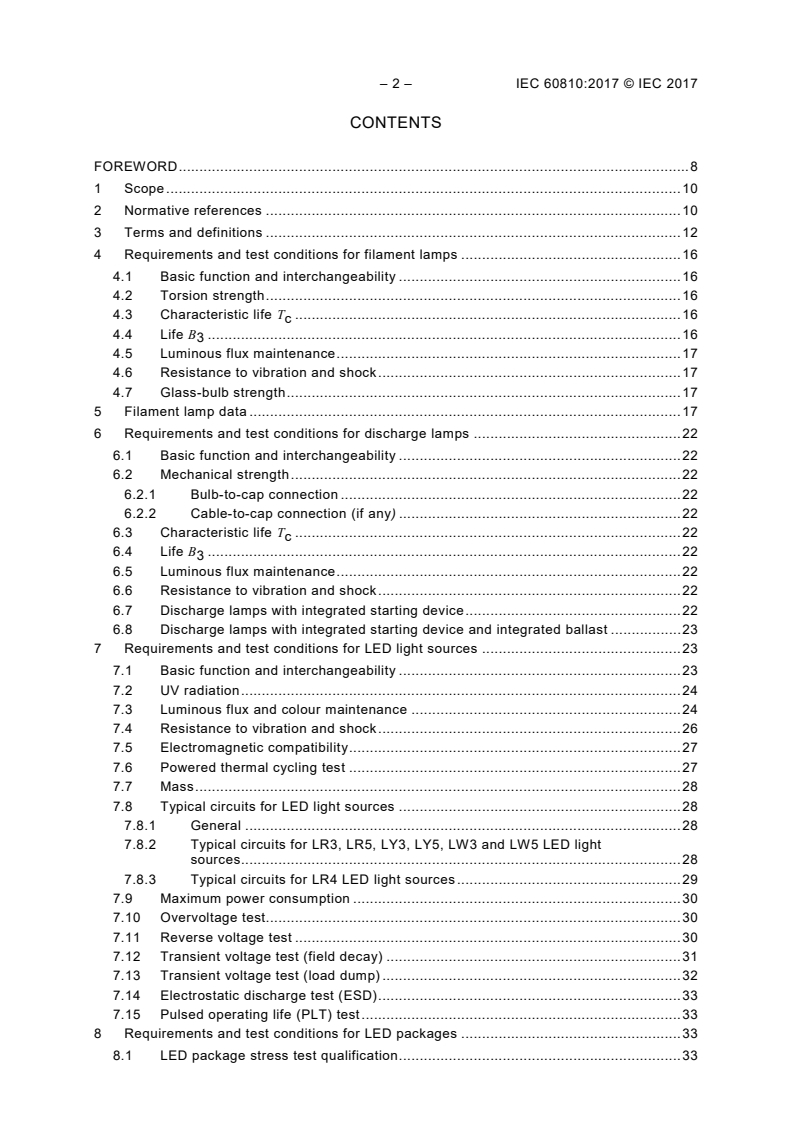
IEC 60810:2017 - Lamps, light sources and LED packages for road vehicles - Performance requirements Released:9/25/2017

IEC 60810:2017+AMD1:2019+AMD2:2022 CSV - Lamps, light sources and LED packages for road vehicles - Performance requirements Released:4/28/2022

IEC 60810:2017+AMD1:2019 CSV - Lamps, light sources and LED packages for road vehicles - Performance requirements Released:4/8/2019
Overview
IEC 60810:2017 - Lamps, light sources and LED packages for road vehicles - Performance requirements is the 5th edition (2017) of the IEC international standard that defines performance, test and validation requirements for filament lamps, discharge lamps, LED light sources and LED packages used in road-vehicle lighting (headlamps, fog lamps, signalling lamps and interior lighting). This edition updates the scope and introduces new LED light source requirements and guidelines for LED package robustness validation, superseding the 2014 edition and its amendment.
Key topics and technical requirements
IEC 60810 covers a broad range of performance and verification topics important for automotive lighting components:
- Scope & interchangeability: Basic function and fit/interchangeability requirements for lamps and light sources intended for vehicle use.
- Photometric and life performance: Luminous flux, colour maintenance and characteristic life / life B tests and procedures.
- Mechanical robustness: Vibration, shock, torsion strength, glass-bulb strength, bulb deflection and mass/packaging checks. (See references to vibration mounting per IEC 60068-2-47.)
- Electrical resilience: Overvoltage, reverse voltage, transient tests (field decay, load dump), maximum power consumption and EMC considerations.
- LED-specific tests: Powered thermal cycling, pulsed operating life (PLT), ESD, UV radiation limits, typical circuit definitions, and EMC/thermal management topics for LED light sources.
- LED package qualification: Stress-test qualification flow including HTOL, TMCL, WHTOL, PTMCL, ESD (HBM/MM), solderability/resistance to soldering heat, bond/die shear, vibration/shock, DPA, corrosion and dew/FMGC tests.
- Production and sampling: Lot and production requirements, pre/post-stress electrical and visual checks, and pass/fail criteria for qualification/requalification.
Practical applications and users
IEC 60810 is essential for ensuring safety, reliability and regulatory compliance in automotive lighting. Typical users include:
- Automotive OEMs specifying lighting performance for vehicles (headlamps, fog-lamps, signalling and interior lighting)
- Lamp and LED component manufacturers validating product designs and production lots
- Test and certification laboratories performing photometric, mechanical, thermal and electrical tests
- Suppliers of ballasts, drivers and thermal management systems for LED light sources
- Regulatory bodies and standards committees aligning national requirements with international practice
Related standards
- IEC 60809 (listed lamps referred to in the scope)
- IEC 60068 series (environmental testing mounting/conditioning references)
IEC 60810 provides a comprehensive, practical framework for testing and qualifying vehicle lamps and LED packages - a must-read for manufacturers, test labs and OEMs involved in automotive lighting development and compliance.
Relations
- Effective Date
- 05-Sep-2023
- Effective Date
- 05-Sep-2023
- Effective Date
- 05-Sep-2023
- Effective Date
- 05-Sep-2023
Buy Documents
IEC 60810:2017 RLV - Lamps, light sources and LED packages for road vehicles - Performance requirements Released:9/25/2017
IEC 60810:2017 - Lamps, light sources and LED packages for road vehicles - Performance requirements Released:9/25/2017
IEC 60810:2017+AMD1:2019+AMD2:2022 CSV - Lamps, light sources and LED packages for road vehicles - Performance requirements Released:4/28/2022
IEC 60810:2017+AMD1:2019 CSV - Lamps, light sources and LED packages for road vehicles - Performance requirements Released:4/8/2019
Get Certified
Connect with accredited certification bodies for this standard

IMQ S.p.A. (Certification)
Italian electrical product certification.

SLG Prüf- und Zertifizierungs GmbH
German testing and certification body.

UL Solutions
Global safety science company with testing, inspection and certification.
Sponsored listings
Frequently Asked Questions
IEC 60810:2017 is a standard published by the International Electrotechnical Commission (IEC). Its full title is "Lamps, light sources and LED packages for road vehicles - Performance requirements". This standard covers: IEC 60810:2017 is applicable to filament lamps, discharge lamps, LED light sources and LED packages to be used in road vehicles, i.e. in headlamps, fog-lamps, signalling lamps and interior lighting. It is especially applicable to those lamps and light sources which are listed in IEC 60809. This fifth edition cancels and replaces the fourth edition published in 2014 and Amendment 1:2017. This edition constitutes a technical revision. This edition includes the following significant technical changes with respect to the previous edition: - update and clarification of the title and scope; - introduction of new LED light sources; - introduction of requirements for LED light sources; - introduction of guidelines on LED package robustness validation for LED packages.
IEC 60810:2017 is applicable to filament lamps, discharge lamps, LED light sources and LED packages to be used in road vehicles, i.e. in headlamps, fog-lamps, signalling lamps and interior lighting. It is especially applicable to those lamps and light sources which are listed in IEC 60809. This fifth edition cancels and replaces the fourth edition published in 2014 and Amendment 1:2017. This edition constitutes a technical revision. This edition includes the following significant technical changes with respect to the previous edition: - update and clarification of the title and scope; - introduction of new LED light sources; - introduction of requirements for LED light sources; - introduction of guidelines on LED package robustness validation for LED packages.
IEC 60810:2017 is classified under the following ICS (International Classification for Standards) categories: 29.140.99 - Other standards related to lamps. The ICS classification helps identify the subject area and facilitates finding related standards.
IEC 60810:2017 has the following relationships with other standards: It is inter standard links to IEC 60810:2017/AMD1:2019, IEC 60810:2017/AMD2:2022, IEC 60810:2014/AMD1:2017, IEC 60810:2014. Understanding these relationships helps ensure you are using the most current and applicable version of the standard.
IEC 60810:2017 is available in PDF format for immediate download after purchase. The document can be added to your cart and obtained through the secure checkout process. Digital delivery ensures instant access to the complete standard document.
Standards Content (Sample)
IEC 60810 ®
Edition 5.0 2017-09
REDLINE VERSION
INTERNATIONAL
STANDARD
colour
inside
Lamps, light sources and LED packages for road vehicles –
Performance requirements
All rights reserved. Unless otherwise specified, no part of this publication may be reproduced or utilized in any form
or by any means, electronic or mechanical, including photocopying and microfilm, without permission in writing from
either IEC or IEC's member National Committee in the country of the requester. If you have any questions about IEC
copyright or have an enquiry about obtaining additional rights to this publication, please contact the address below or
your local IEC member National Committee for further information.
IEC Central Office Tel.: +41 22 919 02 11
3, rue de Varembé Fax: +41 22 919 03 00
CH-1211 Geneva 20 info@iec.ch
Switzerland www.iec.ch
About the IEC
The International Electrotechnical Commission (IEC) is the leading global organization that prepares and publishes
International Standards for all electrical, electronic and related technologies.
About IEC publications
The technical content of IEC publications is kept under constant review by the IEC. Please make sure that you have the
latest edition, a corrigenda or an amendment might have been published.
IEC Catalogue - webstore.iec.ch/catalogue Electropedia - www.electropedia.org
The stand-alone application for consulting the entire The world's leading online dictionary of electronic and
bibliographical information on IEC International Standards, electrical terms containing 20 000 terms and definitions in
Technical Specifications, Technical Reports and other English and French, with equivalent terms in 16 additional
documents. Available for PC, Mac OS, Android Tablets and languages. Also known as the International Electrotechnical
iPad. Vocabulary (IEV) online.
IEC publications search - www.iec.ch/searchpub IEC Glossary - std.iec.ch/glossary
The advanced search enables to find IEC publications by a 65 000 electrotechnical terminology entries in English and
variety of criteria (reference number, text, technical French extracted from the Terms and Definitions clause of
committee,…). It also gives information on projects, replaced IEC publications issued since 2002. Some entries have been
and withdrawn publications. collected from earlier publications of IEC TC 37, 77, 86 and
CISPR.
IEC Just Published - webstore.iec.ch/justpublished
Stay up to date on all new IEC publications. Just Published IEC Customer Service Centre - webstore.iec.ch/csc
details all new publications released. Available online and If you wish to give us your feedback on this publication or
also once a month by email. need further assistance, please contact the Customer Service
Centre: csc@iec.ch.
IEC 60810 ®
Edition 5.0 2017-09
REDLINE VERSION
INTERNATIONAL
STANDARD
colour
inside
Lamps, light sources and LED packages for road vehicles –
Performance requirements
INTERNATIONAL
ELECTROTECHNICAL
COMMISSION
ICS 29.140.99 ISBN 978-2-8322-4855-3
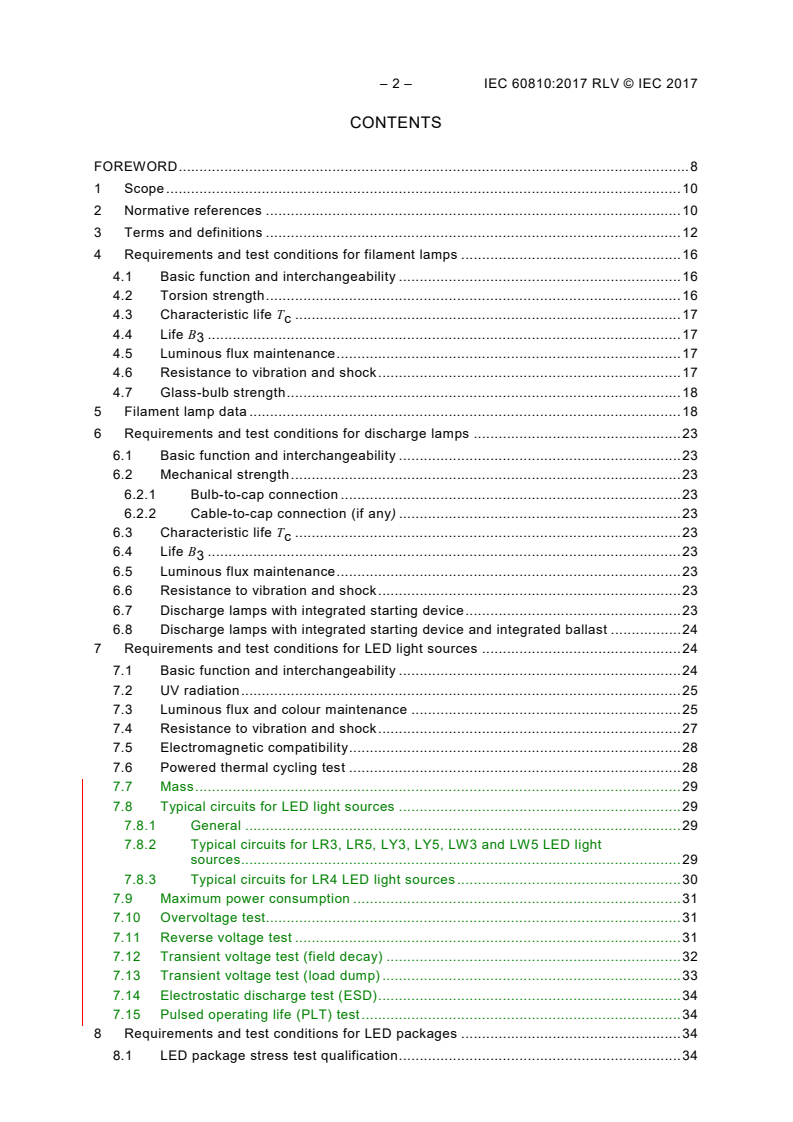
– 2 – IEC 60810:2017 RLV © IEC 2017
CONTENTS
FOREWORD . 8
1 Scope . 10
2 Normative references . 10
3 Terms and definitions . 12
4 Requirements and test conditions for filament lamps . 16
4.1 Basic function and interchangeability . 16
4.2 Torsion strength . 16
4.3 Characteristic life T . 17
c
4.4 Life B . 17
4.5 Luminous flux maintenance . 17
4.6 Resistance to vibration and shock . 17
4.7 Glass-bulb strength . 18
5 Filament lamp data . 18
6 Requirements and test conditions for discharge lamps . 23
6.1 Basic function and interchangeability . 23
6.2 Mechanical strength . 23
6.2.1 Bulb-to-cap connection . 23
6.2.2 Cable-to-cap connection (if any) . 23
6.3 Characteristic life T . 23
c
6.4 Life B . 23
6.5 Luminous flux maintenance . 23
6.6 Resistance to vibration and shock . 23
6.7 Discharge lamps with integrated starting device . 23
6.8 Discharge lamps with integrated starting device and integrated ballast . 24
7 Requirements and test conditions for LED light sources . 24
7.1 Basic function and interchangeability . 24
7.2 UV radiation . 25
7.3 Luminous flux and colour maintenance . 25
7.4 Resistance to vibration and shock . 27
7.5 Electromagnetic compatibility . 28
7.6 Powered thermal cycling test . 28
7.7 Mass . 29
7.8 Typical circuits for LED light sources . 29
7.8.1 General . 29
7.8.2 Typical circuits for LR3, LR5, LY3, LY5, LW3 and LW5 LED light
sources. 29
7.8.3 Typical circuits for LR4 LED light sources . 30
7.9 Maximum power consumption . 31
7.10 Overvoltage test. 31
7.11 Reverse voltage test . 31
7.12 Transient voltage test (field decay) . 32
7.13 Transient voltage test (load dump) . 33
7.14 Electrostatic discharge test (ESD) . 34
7.15 Pulsed operating life (PLT) test . 34
8 Requirements and test conditions for LED packages . 34
8.1 LED package stress test qualification . 34
8.2 Test samples . 35
8.2.1 Lot requirements. 35
8.2.2 Production requirements . 35
8.2.3 Pre- and post-stress test requirements . 36
8.2.4 Assembly of LED packages on test boards . 36
8.2.5 Moisture pre-conditioning (MP) . 36
8.2.6 Thermal resistance (TR) test . 36
8.3 Definition of failure criteria . 36
8.4 Choice between test conditions . 37
8.5 Criteria for passing qualification/requalification . 37
8.6 Qualification test definition . 37
8.6.1 Pre- and post- electrical and photometric test . 37
8.6.2 Pre- and post- external visual (EV) test . 37
8.6.3 High temperature operating life (HTOL) test . 38
8.6.4 Temperature cycling (TMCL) test . 38
8.6.5 Wet high temperature operating life (WHTOL) test . 38
8.6.6 Power temperature cycling (PTMCL) test . 39
8.6.7 Electrostatic discharge, human body model (ESD-HBM) test . 39
8.6.8 Electrostatic discharge, machine model (ESD-MM) test . 39
8.6.9 Destructive physical analysis (DPA) test . 39
8.6.10 Physical dimensions (PD) test . 39
8.6.11 Vibrations variable frequency (VVF) test . 39
8.6.12 Mechanical shock (MS) test . 40
8.6.13 Resistance to soldering heat (RSH-TTW) test . 40
8.6.14 Resistance to soldering heat (RSH-reflow) test . 40
8.6.15 Solderability (SO) test. 40
8.6.16 Thermal shock (TMSK) test . 40
8.6.17 Hydrogen sulphide (H S) test . 41
8.6.18 Pulsed operating life (PLT) test . 41
8.6.19 Dew (DEW) test . 41
8.6.20 Flowing mixed gas corrosion (FMGC) test . 42
8.6.22 Bond shear test (BS) . 43
8.6.23 Die shear test (DS) . 43
8.6.21 Wire bond pull test (WBP) . 43
Annex A (normative) Life test conditions for filament lamps . 44
A.1 Ageing . 44
A.2 Test voltage . 44
A.3 Operating position and operating conditions . 44
A.4 Switching cycle . 44
A.4.1 Single-filament lamps . 44
A.4.2 Dual-filament lamps for headlamps . 45
A.4.3 Dual-filament lamps for light signalling equipment . 45
A.5 Luminous flux and colour maintenance . 45
Annex B (normative) Vibration tests . 46
B.1 General . 46
B.2 Test conditions . 47
B.2.1 General . 47
B.2.2 Mounting (see IEC 60068-2-47) . 47
B.2.3 Measuring points . 47
– 4 – IEC 60810:2017 RLV © IEC 2017
B.2.4 Control point . 47
B.2.5 Conditioning . 47
B.2.6 Axis of vibration . 47
B.2.7 WBR test – Basic motion . 48
B.3 Test conditions . 48
B.3.1 General . 48
B.3.2 Narrowband random vibration tests. 48
B.3.3 Wideband random vibration tests . 49
Annex C (normative) Glass-bulb strength test . 51
C.1 General . 51
C.2 Test equipment and procedure . 51
C.2.1 Principle of the test equipment . 51
C.2.2 Test conditions . 51
C.2.3 Requirements for plates . 52
C.3 Requirements . 52
C.4 Evaluation . 53
C.4.1 General . 53
C.4.2 Assessment based on attributes . 53
C.4.3 Assessment based on variables . 53
Annex D (normative) Life and luminous flux maintenance test conditions for discharge
lamps . 55
D.1 Ageing . 55
D.2 Test circuit and test voltage . 55
D.3 Burning position and operating conditions . 55
D.4 Switching cycle . 55
D.5 Luminous flux maintenance . 57
Annex E (normative) Bulb deflection test. 58
E.1 General . 58
E.2 Test set-up and procedure . 58
E.3 Requirement . 58
Annex F (informative) Guidance on equipment design . 59
F.1 Pinch temperature limit . 59
F.2 Solder temperature limit . 59
F.3 Maximum filament lamp outline . 59
F.4 Maximum surge voltage . 59
F.5 Recommended instructions for use and handling of halogen filament lamps . 59
F.6 Recommended instructions for use and handling of discharge lamps . 60
Annex G (informative) Information for Ballast design . 65
Annex H (informative) Symbols . 66
H.1 General . 66
H.2 Symbol indicating that lamps operate at high temperatures . 67
H.3 Symbol indicating that care should be taken to avoid touching the bulb. 67
H.4 Symbol indicating that the use of protective gloves is advised . 67
H.5 Symbol indicating that lamps with scratched or otherwise damaged bulbs
should not be used. 67
H.6 Symbol indicating that before handling, the lamp shall be switched off . 67
H.7 Symbol indicating that the use of eye protection is advised . 67
H.8 Symbol indicating that during operation, the lamp emits UV-radiation . 68
H.9 Symbol indicating that the lamp shall be operated only in a luminaire with a
protective shield . 68
H.10 Symbol indicating dangerous voltage . 69
H.11 Pictogram for instruction "Non-ECE" . 69
H.12 Pictogram for instruction "Interior lighting only" . 70
Annex I (normative) Luminous flux maintenance test conditions for LED light sources . 71
I.1 Ageing . 71
I.2 Test voltage . 71
I.3 Operating conditions . 71
I.3.1 Test rack . 71
I.3.2 LED light sources with integrated thermal management . 71
I.3.3 LED light sources with external thermal management . 71
I.4 Switching cycle . 72
I.4.1 Single-function LED light sources . 72
I.4.2 Dual-function LED light sources for headlamps . 72
I.4.3 Multiple-function LED light sources for light signalling equipment . 72
I.5 Luminous flux maintenance measurements . 73
I.6 Colour measurement . 73
Annex J (normative) Destructive physical analysis for LED packages . 74
J.1 Description . 74
J.2 Equipment . 74
J.3 Procedure . 74
J.4 Failure criteria . 74
Annex K (informative) Communication sheet LED package testing . 75
Annex L (normative) Re-testing matrix for LED packages testing . 78
Annex M (informative) Guidelines for LED packages robustness validation . 79
M.1 General . 79
M.2 Test samples . 81
M.2.1 Lot requirements. 81
M.2.2 Production requirements . 82
M.2.3 Pre- and post-stress test requirements . 82
M.2.4 Assembly of LED packages on test boards . 82
M.3 Definition of end-of-test criteria . 82
M.4 Test sequence of over-stress testing . 82
M.5 Over-stress test definition . 83
M.5.1 Pre- and post-electrical and photometric test . 83
M.5.2 Pre- and post-external visual (EV) test . 83
M.5.3 High temperature operating life (HTOL) and low temperature operating
life (LTOL) tests . 83
M.5.4 Temperature cycling (TMCL) test . 84
M.5.5 Wet high temperature operating life (WHTOL) test . 84
M.5.6 Power temperature cycling (PTMCL) test . 85
M.5.7 Thermal shock (TMSK) test . 85
M.6 Destructive physical analysis (DPA) test . 86
M.7 Projection models . 86
Bibliography . 90
Figure 1 – Examples of LED packages . 14
– 6 – IEC 60810:2017 RLV © IEC 2017
Figure 2 – Example of an LED module without integrated heatsink . 14
Figure 3 – Example of an LED module with integrated heatsink . 15
Figure 4 – Example of a replaceable LED light source . 15
Figure 5 – Example of a non-replaceable LED light source . 16
Figure 6 – Position of the centre of gravity (shaded areas). 24
Figure 7 – Extract from IEC 60068-2-14 Test Nb, showing the temperature cycle
profile . 28
Figure 8 – Typical electrical circuit for an LR3, LR5, LY3, LY5, LW3 and LW5 LED
light source . 30
Figure 9 – Typical electrical circuit for an LR4 LED light source . 30
Figure 10 – Profile of pulse 1 from ISO 7637-2 . 32
Figure 11 – Profile of pulse 2a from ISO 7637-2 . 33
Figure 12 – Temperature–humidity characteristics for the DEW test . 42
Figure B.1 – Recommended equipment layout for vibration testing . 50
Figure C.1 – Diagrammatic sketch of the principle of the test equipment . 51
Figure D.1 – Superposition of on/off switching and power switching cycle . 56
Figure E.1 – Sketch of the test set-up . 58
Figure F.1 – Voltage surges for 12 V filament lamps – Maximum tolerable duration for
a voltage surge as a function of its height . 60
Figure F.2 – Maximum filament lamp outlines H1 . 61
Figure F.3 – Maximum filament lamp outlines H2 . 62
Figure F.4 – Maximum filament lamp outlines H3 . 63
Figure F.5 – Maximum filament lamp outlines P21W, PY21W, P21/4W and P21/5W . 64
Figure H.1 – Pictogram for instruction "Non-ECE" . 69
Figure H.2 – Pictogram for instruction "Interior lighting only" . 70
Figure M.1 – Concept of over-stress testing for two stress parameters . 80
Figure M.2 – Flow diagram for the robustness validation process. 81
Table 1 – Conditions of compliance for life B . 17
Table 2 – Conditions of compliance for the vibration test . 17
Table 3 – Rated life values for continuous operation . 19
Table 4 – Rated luminous flux-maintenance values for continuous operation . 22
Table 5 – Minimum L B values for standardised replaceable LED light sources . 26
70 10
Table 6 – Typical “on”-times for the different functions per 100 000 km drive distance,
a
based on an average speed of 33,6 km/h . 27
Table 7 – Example of product data . 27
Table 8 – Temperature classes for the powered thermal cycling test . 28
Table 9 – Maximum mass for LED light sources . 29
Table 10 – Maximum power consumption . 31
Table 11 – Test parameters for pulse 1 from ISO 7637-2 . 32
Table 12 – Test parameters for pulse 2a from ISO 7637-2 . 33
Table B.1 – Vibration test on motor vehicle lamps – Test conditions . 48
Table B.2 – Vibration test on motor vehicle lamps − Standard test
conditions(narrowband). 48
Table B.3 – Vibration test on motor vehicle lamps − Heavy-duty test conditions . 49
Table B.4 – Vibration test on motor vehicle lamps – Standard test conditions(wideband)
(wideband) . 49
Table C.1 – Compression strength . 52
Table C.2 – Inspection by attributes – Double sampling plan . 53
Table C.3 – Inspection by variables – "S" method of assessment . 54
Table D.1 – On/off switching cycle . 55
Table D.2 – Power switching cycle . 56
Table D.3 – Fast power switching cycle . 57
Table G.1 – Open circuit voltage . 65
Table I.1 – Examples of possible product data . 72
Table L.1 – Retesting matrix .
Table M.1 – Typical over-stress matrix for two stress parameters . 83
Table M.2 – Acceleration models . 87
– 8 – IEC 60810:2017 RLV © IEC 2017
INTERNATIONAL ELECTROTECHNICAL COMMISSION
____________
LAMPS, LIGHT SOURCES AND LED PACKAGES FOR
ROAD VEHICLES – PERFORMANCE REQUIREMENTS
FOREWORD
1) The International Electrotechnical Commission (IEC) is a worldwide organization for standardization comprising
all national electrotechnical committees (IEC National Committees). The object of IEC is to promote
international co-operation on all questions concerning standardization in the electrical and electronic fields. To
this end and in addition to other activities, IEC publishes International Standards, Technical Specifications,
Technical Reports, Publicly Available Specifications (PAS) and Guides (hereafter referred to as “IEC
Publication(s)”). Their preparation is entrusted to technical committees; any IEC National Committee interested
in the subject dealt with may participate in this preparatory work. International, governmental and non-
governmental organizations liaising with the IEC also participate in this preparation. IEC collaborates closely
with the International Organization for Standardization (ISO) in accordance with conditions determined by
agreement between the two organizations.
2) The formal decisions or agreements of IEC on technical matters express, as nearly as possible, an international
consensus of opinion on the relevant subjects since each technical committee has representation from all
interested IEC National Committees.
3) IEC Publications have the form of recommendations for international use and are accepted by IEC National
Committees in that sense. While all reasonable efforts are made to ensure that the technical content of IEC
Publications is accurate, IEC cannot be held responsible for the way in which they are used or for any
misinterpretation by any end user.
4) In order to promote international uniformity, IEC National Committees undertake to apply IEC Publications
transparently to the maximum extent possible in their national and regional publications. Any divergence
between any IEC Publication and the corresponding national or regional publication shall be clearly indicated in
the latter.
5) IEC itself does not provide any attestation of conformity. Independent certification bodies provide conformity
assessment services and, in some areas, access to IEC marks of conformity. IEC is not responsible for any
services carried out by independent certification bodies.
6) All users should ensure that they have the latest edition of this publication.
7) No liability shall attach to IEC or its directors, employees, servants or agents including individual experts and
members of its technical committees and IEC National Committees for any personal injury, property damage or
other damage of any nature whatsoever, whether direct or indirect, or for costs (including legal fees) and
expenses arising out of the publication, use of, or reliance upon, this IEC Publication or any other IEC
Publications.
8) Attention is drawn to the Normative references cited in this publication. Use of the referenced publications is
indispensable for the correct application of this publication.
9) Attention is drawn to the possibility that some of the elements of this IEC Publication may be the subject of
patent rights. IEC shall not be held responsible for identifying any or all such patent rights.
This redline version of the official IEC Standard allows the user to identify the changes
made to the previous edition. A vertical bar appears in the margin wherever a change
has been made. Additions are in green text, deletions are in strikethrough red text.
International Standard IEC 60810 has been prepared by subcommittee 34A: Lamps, of IEC
technical committee 34: Lamps and related equipment.
This fifth edition cancels and replaces the fourth edition published in 2014 and
Amendment 1:2017. This edition constitutes a technical revision.
This edition includes the following significant technical changes with respect to the previous
edition:
a) update and clarification of the title and scope;
b) introduction of new LED light sources;
c) introduction of requirements for LED light sources;
d) introduction of guidelines on LED package robustness validation for LED packages.
The text of this International Standard is based on the following documents:
FDIS Report on voting
34A/2021/FDIS 34A/2033/RVD
Full information on the voting for the approval of this International Standard can be found in
the report on voting indicated in the above table.
This document has been drafted in accordance with the ISO/IEC Directives, Part 2.
The committee has decided that the contents of this document will remain unchanged until the
stability date indicated on the IEC website under "http://webstore.iec.ch" in the data related to
the specific document. At this date, the document will be
reconfirmed,
withdrawn,
replaced by a revised edition, or
amended.
IMPORTANT – The 'colour inside' logo on the cover page of this publication indicates
that it contains colours which are considered to be useful for the correct
understanding of its contents. Users should therefore print this document using a
colour printer.
– 10 – IEC 60810:2017 RLV © IEC 2017
LAMPS, LIGHT SOURCES AND LED PACKAGES FOR
ROAD VEHICLES – PERFORMANCE REQUIREMENTS
1 Scope
This document is applicable to lamps (filament lamps, discharge lamps, LED light sources)
and LED packages to be used in road vehicles, i.e. in headlamps, fog-lamps, signalling lamps
and interior lighting. It is especially applicable to those lamps and light sources which are
listed in IEC 60809. However, the standard may also be used for other lamps falling under the
scope of this standard.
It specifies requirements and test methods for the measurement of performance charac-
teristics such as lamp life, luminous flux maintenance, torsion strength, glass bulb strength
and resistance to vibration and shock. Moreover, information on temperature limits, maximum
lamp outlines and maximum tolerable voltage surges is given as guidance for lighting and
electrical equipment design.
For some of the requirements given in this document, reference is made to data given in
tables. For lamps not listed in such tables, the relevant data are supplied by the lamp
manufacturer or responsible vendor.
The performance requirements are additional to the basic requirements specified in
IEC 60809. They are, however, not intended to be used by authorities for legal type-approval
purposes.
NOTE 1 In the various vocabularies and standards, different terms are used for "incandescent lamp"
(IEC 60050-845:1987, 845-07-04) and "discharge lamp" (IEC 60050-845:1987, 845-07-17). In this document,
"filament lamp" and "discharge lamp" are used. However, where only “lamp” is written both types are meant, unless
the context clearly shows that it applies to one type only.
NOTE 2 This document does not apply to luminaires.
NOTE 3 In this document, the term LED light source is used, in other standards the term LED lamps can be used
to describe similar products.
2 Normative references
The following documents are referred to in the text in such a way that some or all of their
content constitutes requirements of this document. For dated references, only the edition
cited applies. For undated references, the latest edition of the referenced document (including
any amendments) applies.
IEC 60050 (all parts), International Electrotechnical Vocabulary (available at
IEC 60050-845, International Electrotechnical Vocabulary – Part 845: Lighting (available at
http://www.electropedia.org)
IEC 60061-1, Lamp caps and holders together with gauges for the control of
interchangeability and safety – Part 1: Lamp caps
IEC 60068-2-6:1995, Environmental testing – Part 2-6: Tests – Test Fc: Vibration (sinusoidal)
IEC 60068-2-14, Environmental testing – Part 2–14: Tests – Test N: Change of temperature
IEC 60068-2-43, Environmental testing – Part 2-43: Tests – Test Kd: Hydrogen sulphide test
for contacts and connections
IEC 60068-2-58, Environmental testing – Part 2-58: Tests – Test Td: Test methods for
solderability, resistance to dissolution of metallization and to soldering heat of surface
mounting devices (SMD)
IEC 60068-2-60, Environmental testing – Part 2-60: Tests – Test Ke: Flowing mixed gas
corrosion test
IEC 60410:1973, Sampling plans and procedures for inspection by attributes
IEC 60809:2014, Lamps for road vehicles – Dimensional, electrical and luminous
requirements
CISPR 25, Vehicles, boats and internal combustion engines – Radio disturbance
characteristics – Limits and methods of measurement for the protection of on-board receivers
ISO 7637-2:2011, Road vehicles – Electrical disturbances from conduction and coupling –
Part 2: Electrical transient conduction along supply lines only
ISO 10605, Road vehicles – Test methods for electrical disturbances from electrostatic
discharge
United Nations Vehicle Regulations – 1958 Agreement, Agreement concerning the adoption of
uniform technical prescriptions for wheeled vehicles, equipment and parts which can be fitted
and/or be used on wheeled vehicles and the conditions for reciprocal recognition of approvals
granted on the basis of these prescriptions
(available at www.unece.org/trans/main/wp29/wp29regs.html)
Addendum 36: Regulation No. 37, Uniform provisions concerning the approval of filament
lamps for use in approved lamp units of power-driven vehicles and of their trailers
Addendum 37: Regulation No. 38, Uniform provisions concerning the approval of rear fog
lamps for power-driven vehicles and their trailers
Addendum 47: Regulation No 48, Uniform provisions concerning the approval of vehicles
with regard to the installation of lighting and light-signalling devices
Addendum 100: Regulation No. 101, Uniform provisions concerning the approval of
passenger cars powered by an internal combustion engine only, or powered by a hybrid
electric power train with regard to the measurement of the emission of carbon dioxide and
fuel consumption and/or the measurement of electric energy consumption and electric
range, and of categories M1 and N1 vehicles powered by an electric power train only with
regard to the measurement of electric energy consumption and electric range
Addendum 122: Regulation No. 123, Uniform provisions concerning the approval of
adaptive front-lighting systems (AFS) for motor vehicles
Addendum 127: Regulation No. 128, Uniform provisions concerning the approval of light
emitting diode (LED) light sources for use in approved lamp units on power-driven
JESD22-A100D, Cycled temperature humidity bias life test
JESD22-A101C, Steady-state temperature humidity bias life test
JESD22-A104D JESD22-A104E, Temperature cycling
___________
Also known as The 1958 Agreement. In the text of this document the regulations under this agreement are
referred to as, for example, UN Regulation 37 or R37.
– 12 – IEC 60810:2017 RLV © IEC 2017
JESD22-A105C, Power and temperature cycling
JESD22-A106B, Thermal shock
JESD22-A108D, Temperature, bias, and operating life
JESD22-A113F, Preconditioning of plastic surface mount devices prior to reliability testing
JESD22-A115C, Electrostatic discharge (ESD) sensitivity testing machine model (MM)
JESD22-B101B, External visual
JESD22-B103B, Vibration, variable frequency
JESD22-B110B, Mechanical shock
JESD22-B106D, Resistance to solder shock for through-hole mounted devices
JESD22-B116:1998, Wire Bond Shear Test Method
JESD51-50:2012-04, Overview of methodologies for the thermal measurement of single- and
multi-chip, single- and multi-pnjunction light-emitting diodes (LEDs)
JESD51-51:2012-04, Implementation of the electrical test method for the measurement of real
thermal resistance and impedance of light-emitting diodes with exposed co
...
IEC 60810 ®
Edition 5.0 2017-09
INTERNATIONAL
STANDARD
NORME
INTERNATIONALE
colour
inside
Lamps, light sources and LED packages for road vehicles –
Performance requirements
Lampes, sources lumineuses et LED encapsulées pour véhicules routiers –
Exigences de performances
All rights reserved. Unless otherwise specified, no part of this publication may be reproduced or utilized in any form
or by any means, electronic or mechanical, including photocopying and microfilm, without permission in writing from
either IEC or IEC's member National Committee in the country of the requester. If you have any questions about IEC
copyright or have an enquiry about obtaining additional rights to this publication, please contact the address below or
your local IEC member National Committee for further information.
Droits de reproduction réservés. Sauf indication contraire, aucune partie de cette publication ne peut être reproduite
ni utilisée sous quelque forme que ce soit et par aucun procédé, électronique ou mécanique, y compris la photocopie
et les microfilms, sans l'accord écrit de l'IEC ou du Comité national de l'IEC du pays du demandeur. Si vous avez des
questions sur le copyright de l'IEC ou si vous désirez obtenir des droits supplémentaires sur cette publication, utilisez
les coordonnées ci-après ou contactez le Comité national de l'IEC de votre pays de résidence.
IEC Central Office Tel.: +41 22 919 02 11
3, rue de Varembé Fax: +41 22 919 03 00
CH-1211 Geneva 20 info@iec.ch
Switzerland www.iec.ch
About the IEC
The International Electrotechnical Commission (IEC) is the leading global organization that prepares and publishes
International Standards for all electrical, electronic and related technologies.
About IEC publications
The technical content of IEC publications is kept under constant review by the IEC. Please make sure that you have the
latest edition, a corrigenda or an amendment might have been published.
IEC Catalogue - webstore.iec.ch/catalogue Electropedia - www.electropedia.org
The stand-alone application for consulting the entire The world's leading online dictionary of electronic and
bibliographical information on IEC International Standards, electrical terms containing 20 000 terms and definitions in
Technical Specifications, Technical Reports and other English and French, with equivalent terms in 16 additional
documents. Available for PC, Mac OS, Android Tablets and languages. Also known as the International Electrotechnical
iPad. Vocabulary (IEV) online.
IEC publications search - www.iec.ch/searchpub IEC Glossary - std.iec.ch/glossary
The advanced search enables to find IEC publications by a 65 000 electrotechnical terminology entries in English and
variety of criteria (reference number, text, technical French extracted from the Terms and Definitions clause of
committee,…). It also gives information on projects, replaced IEC publications issued since 2002. Some entries have been
and withdrawn publications. collected from earlier publications of IEC TC 37, 77, 86 and
CISPR.
IEC Just Published - webstore.iec.ch/justpublished
Stay up to date on all new IEC publications. Just Published IEC Customer Service Centre - webstore.iec.ch/csc
details all new publications released. Available online and If you wish to give us your feedback on this publication or
also once a month by email. need further assistance, please contact the Customer Service
Centre: csc@iec.ch.
A propos de l'IEC
La Commission Electrotechnique Internationale (IEC) est la première organisation mondiale qui élabore et publie des
Normes internationales pour tout ce qui a trait à l'électricité, à l'électronique et aux technologies apparentées.
A propos des publications IEC
Le contenu technique des publications IEC est constamment revu. Veuillez vous assurer que vous possédez l’édition la
plus récente, un corrigendum ou amendement peut avoir été publié.
Catalogue IEC - webstore.iec.ch/catalogue Electropedia - www.electropedia.org
Application autonome pour consulter tous les renseignements
Le premier dictionnaire en ligne de termes électroniques et
bibliographiques sur les Normes internationales,
électriques. Il contient 20 000 termes et définitions en anglais
Spécifications techniques, Rapports techniques et autres
et en français, ainsi que les termes équivalents dans 16
documents de l'IEC. Disponible pour PC, Mac OS, tablettes
langues additionnelles. Egalement appelé Vocabulaire
Android et iPad.
Electrotechnique International (IEV) en ligne.
Recherche de publications IEC - www.iec.ch/searchpub
Glossaire IEC - std.iec.ch/glossary
La recherche avancée permet de trouver des publications IEC 65 000 entrées terminologiques électrotechniques, en anglais
en utilisant différents critères (numéro de référence, texte, et en français, extraites des articles Termes et Définitions des
comité d’études,…). Elle donne aussi des informations sur les publications IEC parues depuis 2002. Plus certaines entrées
projets et les publications remplacées ou retirées. antérieures extraites des publications des CE 37, 77, 86 et
CISPR de l'IEC.
IEC Just Published - webstore.iec.ch/justpublished
Service Clients - webstore.iec.ch/csc
Restez informé sur les nouvelles publications IEC. Just
Published détaille les nouvelles publications parues. Si vous désirez nous donner des commentaires sur cette
Disponible en ligne et aussi une fois par mois par email. publication ou si vous avez des questions contactez-nous:
csc@iec.ch.
IEC 60810 ®
Edition 5.0 2017-09
INTERNATIONAL
STANDARD
NORME
INTERNATIONALE
colour
inside
Lamps, light sources and LED packages for road vehicles –
Performance requirements
Lampes, sources lumineuses et LED encapsulées pour véhicules routiers –
Exigences de performances
INTERNATIONAL
ELECTROTECHNICAL
COMMISSION
COMMISSION
ELECTROTECHNIQUE
INTERNATIONALE
ICS 29.140.99 ISBN 978-2-8322-4818-8
– 2 – IEC 60810:2017 © IEC 2017
CONTENTS
FOREWORD . 8
1 Scope . 10
2 Normative references . 10
3 Terms and definitions . 12
4 Requirements and test conditions for filament lamps . 16
4.1 Basic function and interchangeability . 16
4.2 Torsion strength . 16
4.3 Characteristic life T . 16
c
4.4 Life B . 16
4.5 Luminous flux maintenance . 17
4.6 Resistance to vibration and shock . 17
4.7 Glass-bulb strength . 17
5 Filament lamp data . 17
6 Requirements and test conditions for discharge lamps . 22
6.1 Basic function and interchangeability . 22
6.2 Mechanical strength . 22
6.2.1 Bulb-to-cap connection . 22
6.2.2 Cable-to-cap connection (if any) . 22
6.3 Characteristic life T . 22
c
6.4 Life B . 22
6.5 Luminous flux maintenance . 22
6.6 Resistance to vibration and shock . 22
6.7 Discharge lamps with integrated starting device . 22
6.8 Discharge lamps with integrated starting device and integrated ballast . 23
7 Requirements and test conditions for LED light sources . 23
7.1 Basic function and interchangeability . 23
7.2 UV radiation . 24
7.3 Luminous flux and colour maintenance . 24
7.4 Resistance to vibration and shock . 26
7.5 Electromagnetic compatibility . 27
7.6 Powered thermal cycling test . 27
7.7 Mass . 28
7.8 Typical circuits for LED light sources . 28
7.8.1 General . 28
7.8.2 Typical circuits for LR3, LR5, LY3, LY5, LW3 and LW5 LED light
sources. 28
7.8.3 Typical circuits for LR4 LED light sources . 29
7.9 Maximum power consumption . 30
7.10 Overvoltage test. 30
7.11 Reverse voltage test . 30
7.12 Transient voltage test (field decay) . 31
7.13 Transient voltage test (load dump) . 32
7.14 Electrostatic discharge test (ESD) . 33
7.15 Pulsed operating life (PLT) test . 33
8 Requirements and test conditions for LED packages . 33
8.1 LED package stress test qualification . 33
8.2 Test samples . 34
8.2.1 Lot requirements. 34
8.2.2 Production requirements . 34
8.2.3 Pre- and post-stress test requirements . 34
8.2.4 Assembly of LED packages on test boards . 35
8.2.5 Moisture pre-conditioning (MP) . 35
8.2.6 Thermal resistance (TR) test . 35
8.3 Definition of failure criteria . 35
8.4 Choice between test conditions . 36
8.5 Criteria for passing qualification/requalification . 36
8.6 Qualification test . 36
8.6.1 Pre- and post- electrical and photometric test . 36
8.6.2 Pre- and post- external visual (EV) test . 36
8.6.3 High temperature operating life (HTOL) test . 36
8.6.4 Temperature cycling (TMCL) test . 37
8.6.5 Wet high temperature operating life (WHTOL) test . 37
8.6.6 Power temperature cycling (PTMCL) test . 37
8.6.7 Electrostatic discharge, human body model (ESD-HBM) test . 38
8.6.8 Electrostatic discharge, machine model (ESD-MM) test . 38
8.6.9 Destructive physical analysis (DPA) test . 38
8.6.10 Physical dimensions (PD) test . 38
8.6.11 Vibrations variable frequency (VVF) test . 38
8.6.12 Mechanical shock (MS) test . 38
8.6.13 Resistance to soldering heat (RSH-TTW) test . 38
8.6.14 Resistance to soldering heat (RSH-reflow) test . 39
8.6.15 Solderability (SO) test. 39
8.6.16 Thermal shock (TMSK) test . 39
8.6.17 Hydrogen sulphide (H S) test . 39
8.6.18 Pulsed operating life (PLT) test . 39
8.6.19 Dew (DEW) test . 40
8.6.20 Flowing mixed gas corrosion (FMGC) test . 41
8.6.21 Wire bond pull test (WBP) . 41
8.6.22 Bond shear test (BS) . 42
8.6.23 Die shear test (DS) . 42
Annex A (normative) Life test conditions for filament lamps . 43
A.1 Ageing . 43
A.2 Test voltage . 43
A.3 Operating position and operating conditions . 43
A.4 Switching cycle . 43
A.4.1 Single-filament lamps . 43
A.4.2 Dual-filament lamps for headlamps . 44
A.4.3 Dual-filament lamps for light signalling equipment . 44
A.5 Luminous flux and colour maintenance . 44
Annex B (normative) Vibration tests . 45
B.1 General . 45
B.2 Test conditions . 46
B.2.1 General . 46
B.2.2 Mounting (see IEC 60068-2-47) . 46
B.2.3 Measuring points . 46
– 4 – IEC 60810:2017 © IEC 2017
B.2.4 Control point . 46
B.2.5 Conditioning . 46
B.2.6 Axis of vibration . 46
B.2.7 WBR test – Basic motion . 47
B.3 Test conditions . 47
B.3.1 General . 47
B.3.2 Narrowband random vibration tests. 47
B.3.3 Wideband random vibration tests . 48
Annex C (normative) Glass-bulb strength test . 50
C.1 General . 50
C.2 Test equipment and procedure . 50
C.2.1 Principle of the test equipment . 50
C.2.2 Test conditions . 50
C.2.3 Requirements for plates . 51
C.3 Requirements . 51
C.4 Evaluation . 52
C.4.1 General . 52
C.4.2 Assessment based on attributes . 52
C.4.3 Assessment based on variables . 52
Annex D (normative) Life and luminous flux maintenance test conditions for discharge
lamps . 54
D.1 Ageing . 54
D.2 Test circuit and test voltage . 54
D.3 Burning position and operating conditions . 54
D.4 Switching cycle . 54
D.5 Luminous flux maintenance . 56
Annex E (normative) Bulb deflection test. 57
E.1 General . 57
E.2 Test set-up and procedure . 57
E.3 Requirement . 57
Annex F (informative) Guidance on equipment design . 58
F.1 Pinch temperature limit . 58
F.2 Solder temperature limit . 58
F.3 Maximum filament lamp outline . 58
F.4 Maximum surge voltage . 58
F.5 Recommended instructions for use and handling of halogen filament lamps . 58
F.6 Recommended instructions for use and handling of discharge lamps . 59
Annex G (informative) Ballast design . 64
Annex H (informative) Symbols . 65
H.1 General . 65
H.2 Symbol indicating that lamps operate at high temperatures . 66
H.3 Symbol indicating that care should be taken to avoid touching the bulb. 66
H.4 Symbol indicating that the use of protective gloves is advised . 66
H.5 Symbol indicating that lamps with scratched or otherwise damaged bulbs
should not be used. 66
H.6 Symbol indicating that before handling, the lamp shall be switched off . 66
H.7 Symbol indicating that the use of eye protection is advised . 66
H.8 Symbol indicating that during operation, the lamp emits UV-radiation . 67
H.9 Symbol indicating that the lamp shall be operated only in a luminaire with a
protective shield . 67
H.10 Symbol indicating dangerous voltage . 68
H.11 Pictogram for instruction "Non-ECE" . 68
H.12 Pictogram for instruction "Interior lighting only" . 69
Annex I (normative) Luminous flux maintenance test conditions for LED light sources . 70
I.1 Ageing . 70
I.2 Test voltage . 70
I.3 Operating conditions . 70
I.3.1 Test rack . 70
I.3.2 LED light sources with integrated thermal management . 70
I.3.3 LED light sources with external thermal management . 70
I.4 Switching cycle . 71
I.4.1 Single-function LED light sources . 71
I.4.2 Dual-function LED light sources for headlamps . 71
I.4.3 Multiple-function LED light sources for light signalling equipment . 71
I.5 Luminous flux maintenance measurements . 72
I.6 Colour measurement . 72
Annex J (normative) Destructive physical analysis for LED packages . 73
J.1 Description . 73
J.2 Equipment . 73
J.3 Procedure . 73
J.4 Failure criteria . 73
Annex K (informative) Communication sheet LED package testing . 74
Annex L (normative) Re-testing matrix for LED packages testing . 77
Annex M (informative) Guidelines for LED packages robustness validation . 78
M.1 General . 78
M.2 Test samples . 80
M.2.1 Lot requirements. 80
M.2.2 Production requirements . 81
M.2.3 Pre- and post-stress test requirements . 81
M.2.4 Assembly of LED packages on test boards . 81
M.3 Definition of end-of-test criteria . 81
M.4 Test sequence of over-stress testing . 81
M.5 Over-stress test definition . 82
M.5.1 Pre- and post-electrical and photometric test . 82
M.5.2 Pre- and post-external visual (EV) test . 82
M.5.3 High temperature operating life (HTOL) and low temperature operating
life (LTOL) tests . 82
M.5.4 Temperature cycling (TMCL) test . 83
M.5.5 Wet high temperature operating life (WHTOL) test . 83
M.5.6 Power temperature cycling (PTMCL) test . 84
M.5.7 Thermal shock (TMSK) test . 84
M.6 Destructive physical analysis (DPA) test . 85
M.7 Projection models . 85
Bibliography . 89
Figure 1 – Examples of LED packages . 14
– 6 – IEC 60810:2017 © IEC 2017
Figure 2 – Example of an LED module without integrated heatsink . 14
Figure 3 – Example of an LED module with integrated heatsink . 14
Figure 4 – Example of a replaceable LED light source . 15
Figure 5 – Example of a non-replaceable LED light source . 15
Figure 6 – Position of the centre of gravity (shaded areas). 23
Figure 7 – Extract from IEC 60068-2-14 Test Nb, showing the temperature cycle
profile . 27
Figure 8 – Typical electrical circuit for an LR3, LR5, LY3, LY5, LW3 and LW5 LED
light source . 29
Figure 9 – Typical electrical circuit for an LR4 LED light source . 29
Figure 10 – Profile of pulse 1 from ISO 7637-2 . 31
Figure 11 – Profile of pulse 2a from ISO 7637-2 . 32
Figure 12 – Temperature–humidity characteristics for the DEW test . 41
Figure B.1 – Recommended equipment layout for vibration testing . 49
Figure C.1 – Diagrammatic sketch of the principle of the test equipment . 50
Figure D.1 – Superposition of on/off switching and power switching cycle . 55
Figure E.1 – Sketch of the test set-up . 57
Figure F.1 – Voltage surges for 12 V filament lamps – Maximum tolerable duration for
a voltage surge as a function of its height . 59
Figure F.2 – Maximum filament lamp outlines H1 . 60
Figure F.3 – Maximum filament lamp outlines H2 . 61
Figure F.4 – Maximum filament lamp outlines H3 . 62
Figure F.5 – Maximum filament lamp outlines P21W, PY21W, P21/4W and P21/5W . 63
Figure H.1 – Pictogram for instruction "Non-ECE" . 68
Figure H.2 – Pictogram for instruction "Interior lighting only" . 69
Figure M.1 – Concept of over-stress testing for two stress parameters . 79
Figure M.2 – Flow diagram for the robustness validation process. 80
Table 1 – Conditions of compliance for life B . 17
Table 2 – Conditions of compliance for the vibration test . 17
Table 3 – Rated life values for continuous operation . 18
Table 4 – Rated luminous flux-maintenance values for continuous operation . 21
Table 5 – Minimum L B values for replaceable LED light sources . 25
70 10
Table 6 – Typical “on”-times for the different functions per 100 000 km drive distance,
a
based on an average speed of 33,6 km/h . 26
Table 7 – Example of product data . 26
Table 8 – Temperature classes for the powered thermal cycling test . 27
Table 9 – Maximum mass for LED light sources . 28
Table 10 – Maximum power consumption . 30
Table 11 – Test parameters for pulse 1 from ISO 7637-2 . 31
Table 12 – Test parameters for pulse 2a from ISO 7637-2 . 32
Table B.1 – Vibration test on motor vehicle lamps – Test conditions . 47
Table B.2 – Vibration test on motor vehicle lamps − Standard test conditions
(narrowband) . 47
Table B.3 – Vibration test on motor vehicle lamps − Heavy-duty test conditions . 48
Table B.4 – Vibration test on motor vehicle lamps – Standard test conditions
(wideband) . 48
Table C.1 – Compression strength . 51
Table C.2 – Inspection by attributes – Double sampling plan . 52
Table C.3 – Inspection by variables – "S" method of assessment . 53
Table D.1 – On/off switching cycle . 54
Table D.2 – Power switching cycle . 55
Table D.3 – Fast power switching cycle . 56
Table G.1 – Open circuit voltage . 64
Table I.1 – Examples of possible product data . 71
Table M.1 – Typical over-stress matrix for two stress parameters . 82
Table M.2 – Acceleration models . 86
– 8 – IEC 60810:2017 © IEC 2017
INTERNATIONAL ELECTROTECHNICAL COMMISSION
____________
LAMPS, LIGHT SOURCES AND LED PACKAGES FOR
ROAD VEHICLES – PERFORMANCE REQUIREMENTS
FOREWORD
1) The International Electrotechnical Commission (IEC) is a worldwide organization for standardization comprising
all national electrotechnical committees (IEC National Committees). The object of IEC is to promote
international co-operation on all questions concerning standardization in the electrical and electronic fields. To
this end and in addition to other activities, IEC publishes International Standards, Technical Specifications,
Technical Reports, Publicly Available Specifications (PAS) and Guides (hereafter referred to as “IEC
Publication(s)”). Their preparation is entrusted to technical committees; any IEC National Committee interested
in the subject dealt with may participate in this preparatory work. International, governmental and non-
governmental organizations liaising with the IEC also participate in this preparation. IEC collaborates closely
with the International Organization for Standardization (ISO) in accordance with conditions determined by
agreement between the two organizations.
2) The formal decisions or agreements of IEC on technical matters express, as nearly as possible, an international
consensus of opinion on the relevant subjects since each technical committee has representation from all
interested IEC National Committees.
3) IEC Publications have the form of recommendations for international use and are accepted by IEC National
Committees in that sense. While all reasonable efforts are made to ensure that the technical content of IEC
Publications is accurate, IEC cannot be held responsible for the way in which they are used or for any
misinterpretation by any end user.
4) In order to promote international uniformity, IEC National Committees undertake to apply IEC Publications
transparently to the maximum extent possible in their national and regional publications. Any divergence
between any IEC Publication and the corresponding national or regional publication shall be clearly indicated in
the latter.
5) IEC itself does not provide any attestation of conformity. Independent certification bodies provide conformity
assessment services and, in some areas, access to IEC marks of conformity. IEC is not responsible for any
services carried out by independent certification bodies.
6) All users should ensure that they have the latest edition of this publication.
7) No liability shall attach to IEC or its directors, employees, servants or agents including individual experts and
members of its technical committees and IEC National Committees for any personal injury, property damage or
other damage of any nature whatsoever, whether direct or indirect, or for costs (including legal fees) and
expenses arising out of the publication, use of, or reliance upon, this IEC Publication or any other IEC
Publications.
8) Attention is drawn to the Normative references cited in this publication. Use of the referenced publications is
indispensable for the correct application of this publication.
9) Attention is drawn to the possibility that some of the elements of this IEC Publication may be the subject of
patent rights. IEC shall not be held responsible for identifying any or all such patent rights.
International Standard IEC 60810 has been prepared by subcommittee 34A: Lamps, of IEC
technical committee 34: Lamps and related equipment.
This fifth edition cancels and replaces the fourth edition published in 2014 and
Amendment 1:2017. This edition constitutes a technical revision.
This edition includes the following significant technical changes with respect to the previous
edition:
a) update and clarification of the title and scope;
b) introduction of new LED light sources;
c) introduction of requirements for LED light sources;
d) introduction of guidelines on LED package robustness validation for LED packages.
The text of this International Standard is based on the following documents:
FDIS Report on voting
34A/2021/FDIS 34A/2033/RVD
Full information on the voting for the approval of this International Standard can be found in
the report on voting indicated in the above table.
This document has been drafted in accordance with the ISO/IEC Directives, Part 2.
The committee has decided that the contents of this document will remain unchanged until the
stability date indicated on the IEC website under "http://webstore.iec.ch" in the data related to
the specific document. At this date, the document will be
• reconfirmed,
• withdrawn,
• replaced by a revised edition, or
• amended.
IMPORTANT – The 'colour inside' logo on the cover page of this publication indicates
that it contains colours which are considered to be useful for the correct
understanding of its contents. Users should therefore print this document using a
colour printer.
– 10 – IEC 60810:2017 © IEC 2017
LAMPS, LIGHT SOURCES AND LED PACKAGES FOR
ROAD VEHICLES – PERFORMANCE REQUIREMENTS
1 Scope
This document is applicable to filament lamps, discharge lamps, LED light sources and LED
packages to be used in road vehicles, i.e. in headlamps, fog-lamps, signalling lamps and
interior lighting. It is especially applicable to those lamps and light sources which are listed in
IEC 60809.
It specifies requirements and test methods for the measurement of performance charac-
teristics such as lamp life, luminous flux maintenance, torsion strength, glass bulb strength
and resistance to vibration and shock. Moreover, information on temperature limits, maximum
lamp outlines and maximum tolerable voltage surges is given as guidance for lighting and
electrical equipment design.
For some of the requirements given in this document, reference is made to data given in
tables. For lamps not listed in such tables, the relevant data are supplied by the lamp
manufacturer or responsible vendor.
The performance requirements are additional to the basic requirements specified in
IEC 60809. They are, however, not intended to be used by authorities for legal type-approval
purposes.
NOTE 1 In the various vocabularies and standards, different terms are used for "incandescent lamp"
(IEC 60050-845:1987, 845-07-04) and "discharge lamp" (IEC 60050-845:1987, 845-07-17). In this document,
"filament lamp" and "discharge lamp" are used. However, where only “lamp” is written both types are meant, unless
the context clearly shows that it applies to one type only.
NOTE 2 This document does not apply to luminaires.
NOTE 3 In this document, the term LED light source is used, in other standards the term LED lamps can be used
to describe similar products.
2 Normative references
The following documents are referred to in the text in such a way that some or all of their
content constitutes requirements of this document. For dated references, only the edition
cited applies. For undated references, the latest edition of the referenced document (including
any amendments) applies.
IEC 60050-845, International Electrotechnical Vocabulary – Part 845: Lighting (available at
http://www.electropedia.org)
IEC 60061-1, Lamp caps and holders together with gauges for the control of
interchangeability and safety – Part 1: Lamp caps
IEC 60068-2-14, Environmental testing – Part 2–14: Tests – Test N: Change of temperature
IEC 60068-2-43, Environmental testing – Part 2-43: Tests – Test Kd: Hydrogen sulphide test
for contacts and connections
IEC 60068-2-58, Environmental testing – Part 2-58: Tests – Test Td: Test methods for
solderability, resistance to dissolution of metallization and to soldering heat of surface
mounting devices (SMD)
IEC 60068-2-60, Environmental testing – Part 2-60: Tests – Test Ke: Flowing mixed gas
corrosion test
IEC 60809:2014, Lamps for road vehicles – Dimensional, electrical and luminous
requirements
CISPR 25, Vehicles, boats and internal combustion engines – Radio disturbance
characteristics – Limits and methods of measurement for the protection of on-board receivers
ISO 7637-2:2011, Road vehicles – Electrical disturbances from conduction and coupling –
Part 2: Electrical transient conduction along supply lines only
ISO 10605, Road vehicles – Test methods for electrical disturbances from electrostatic
discharge
United Nations Vehicle Regulations – 1958 Agreement, Agreement concerning the adoption of
uniform technical prescriptions for wheeled vehicles, equipment and parts which can be fitted
and/or be used on wheeled vehicles and the conditions for reciprocal recognition of approvals
granted on the basis of these prescriptions
(available at www.unece.org/trans/main/wp29/wp29regs.html)
Addendum 36: Regulation No. 37, Uniform provisions concerning the approval of filament
lamps for use in approved lamp units of power-driven vehicles and of their trailers
Addendum 47: Regulation No 48, Uniform provisions concerning the approval of vehicles
with regard to the installation of lighting and light-signalling devices
Addendum 100
...
IEC 60810 ®
Edition 5.2 2022-04
CONSOLIDATED VERSION
INTERNATIONAL
STANDARD
NORME
INTERNATIONALE
colour
inside
Lamps, light sources and LED packages for road vehicles – Performance
requirements
Lampes, sources lumineuses et LED encapsulées pour véhicules routiers –
Exigences de performances
All rights reserved. Unless otherwise specified, no part of this publication may be reproduced or utilized in any form
or by any means, electronic or mechanical, including photocopying and microfilm, without permission in writing from
either IEC or IEC's member National Committee in the country of the requester. If you have any questions about IEC
copyright or have an enquiry about obtaining additional rights to this publication, please contact the address below or
your local IEC member National Committee for further information.
Droits de reproduction réservés. Sauf indication contraire, aucune partie de cette publication ne peut être reproduite
ni utilisée sous quelque forme que ce soit et par aucun procédé, électronique ou mécanique, y compris la photocopie
et les microfilms, sans l'accord écrit de l'IEC ou du Comité national de l'IEC du pays du demandeur. Si vous avez des
questions sur le copyright de l'IEC ou si vous désirez obtenir des droits supplémentaires sur cette publication, utilisez
les coordonnées ci-après ou contactez le Comité national de l'IEC de votre pays de résidence.
IEC Secretariat Tel.: +41 22 919 02 11
3, rue de Varembé info@iec.ch
CH-1211 Geneva 20 www.iec.ch
Switzerland
About the IEC
The International Electrotechnical Commission (IEC) is the leading global organization that prepares and publishes
International Standards for all electrical, electronic and related technologies.
About IEC publications
The technical content of IEC publications is kept under constant review by the IEC. Please make sure that you have the
latest edition, a corrigendum or an amendment might have been published.
IEC publications search - webstore.iec.ch/advsearchform IEC Products & Services Portal - products.iec.ch
The advanced search enables to find IEC publications by a Discover our powerful search engine and read freely all the
variety of criteria (reference number, text, technical publications previews. With a subscription you will always
committee, …). It also gives information on projects, replaced have access to up to date content tailored to your needs.
and withdrawn publications.
Electropedia - www.electropedia.org
IEC Just Published - webstore.iec.ch/justpublished
The world's leading online dictionary on electrotechnology,
Stay up to date on all new IEC publications. Just Published
containing more than 22 300 terminological entries in English
details all new publications released. Available online and
and French, with equivalent terms in 19 additional languages.
once a month by email.
Also known as the International Electrotechnical Vocabulary
(IEV) online.
IEC Customer Service Centre - webstore.iec.ch/csc
If you wish to give us your feedback on this publication or
need further assistance, please contact the Customer Service
Centre: sales@iec.ch.
A propos de l'IEC
La Commission Electrotechnique Internationale (IEC) est la première organisation mondiale qui élabore et publie des
Normes internationales pour tout ce qui a trait à l'électricité, à l'électronique et aux technologies apparentées.
A propos des publications IEC
Le contenu technique des publications IEC est constamment revu. Veuillez vous assurer que vous possédez l’édition la
plus récente, un corrigendum ou amendement peut avoir été publié.
Recherche de publications IEC - IEC Products & Services Portal - products.iec.ch
webstore.iec.ch/advsearchform Découvrez notre puissant moteur de recherche et consultez
La recherche avancée permet de trouver des publications IEC gratuitement tous les aperçus des publications. Avec un
en utilisant différents critères (numéro de référence, texte, abonnement, vous aurez toujours accès à un contenu à jour
comité d’études, …). Elle donne aussi des informations sur adapté à vos besoins.
les projets et les publications remplacées ou retirées.
Electropedia - www.electropedia.org
IEC Just Published - webstore.iec.ch/justpublished
Le premier dictionnaire d'électrotechnologie en ligne au
Restez informé sur les nouvelles publications IEC. Just
monde, avec plus de 22 300 articles terminologiques en
Published détaille les nouvelles publications parues.
anglais et en français, ainsi que les termes équivalents dans
Disponible en ligne et une fois par mois par email.
19 langues additionnelles. Egalement appelé Vocabulaire
Electrotechnique International (IEV) en ligne.
Service Clients - webstore.iec.ch/csc
Si vous désirez nous donner des commentaires sur cette
publication ou si vous avez des questions contactez-nous:
sales@iec.ch.
IEC 60810 ®
Edition 5.2 2022-04
CONSOLIDATED VERSION
INTERNATIONAL
STANDARD
NORME
INTERNATIONALE
colour
inside
Lamps, light sources and LED packages for road vehicles – Performance
requirements
Lampes, sources lumineuses et LED encapsulées pour véhicules routiers –
Exigences de performances
INTERNATIONAL
ELECTROTECHNICAL
COMMISSION
COMMISSION
ELECTROTECHNIQUE
INTERNATIONALE
ICS 29.140.99 ISBN 978-2-8322-4688-7
IEC 60810 ®
Edition 5.2 2022-04
CONSOLIDATED VERSION
REDLINE VERSION
VERSION REDLINE
colour
inside
Lamps, light sources and LED packages for road vehicles – Performance
requirements
Lampes, sources lumineuses et LED encapsulées pour véhicules routiers –
Exigences de performances
– 2 – IEC 60810:2017+AMD1:2019
+AMD2:2022 CSV © IEC 2022
CONTENTS
FOREWORD . 8
1 Scope . 10
2 Normative references . 10
3 Terms and definitions . 12
4 Requirements and test conditions for filament lamps . 16
4.1 Basic function and interchangeability . 16
4.2 Torsion strength . 16
4.3 Characteristic life T . 16
c
4.4 Life B . 16
4.5 Luminous flux maintenance . 17
4.6 Resistance to vibration and shock . 17
4.7 Glass-bulb strength . 17
5 Filament lamp data . 17
6 Requirements and test conditions for discharge lamps . 22
6.1 Basic function and interchangeability . 22
6.2 Mechanical strength . 22
6.2.1 Bulb-to-cap connection . 22
6.2.2 Cable-to-cap connection (if any) . 22
6.3 Characteristic life T . 22
c
6.4 Life B . 22
6.5 Luminous flux maintenance . 22
6.6 Resistance to vibration and shock . 22
6.7 Discharge lamps with integrated starting device . 22
6.8 Discharge lamps with integrated starting device and integrated ballast . 23
6.9 White colour groups . 23
7 Requirements and test conditions for LED light sources . 24
7.1 Basic function and interchangeability . 24
7.2 UV radiation . 25
7.3 Luminous flux and colour maintenance . 25
7.4 Resistance to vibration and shock . 27
7.5 Electromagnetic compatibility . 28
7.6 Powered thermal cycling test . 28
7.7 Mass . 29
7.8 Typical circuits for LED light sources . 29
7.8.1 General . 29
7.8.2 Typical circuits for LR3, LR5, LY3, LY5, LW3, LW5 and L1/6 LED light
sources. 29
7.8.3 Typical circuits for LR4 LED light sources . 30
7.9 Maximum power consumption and minimum current draw . 31
7.10 Overvoltage test. 32
7.11 Reverse voltage test . 32
7.12 Transient voltage test (field decay) . 32
7.13 Transient voltage test (load dump) . 33
7.14 Electrostatic discharge test (ESD) . 34
7.15 Pulsed operating life (PLT) test . 35
7.16 White colour groups . 36
+AMD2:2022 CSV © IEC 2022
8 Requirements and test conditions for LED packages . 37
8.1 LED package stress test qualification . 37
8.2 Test samples . 38
8.2.1 Lot requirements. 38
8.2.2 Production requirements . 38
8.2.3 Pre- and post-stress test requirements . 39
8.2.4 Assembly of LED packages on test boards . 39
8.2.5 Moisture pre-conditioning (MP) . 39
8.2.6 Thermal resistance (TR) test . 39
8.3 Definition of failure criteria . 39
8.4 Choice between test conditions . 40
8.5 Criteria for passing qualification/requalification . 40
8.6 Qualification test . 40
8.6.1 Pre- and post- electrical and photometric test . 40
8.6.2 Pre- and post- external visual (EV) test . 41
8.6.3 High temperature operating life (HTOL) test . 41
8.6.4 Temperature cycling (TMCL) test . 41
8.6.5 Wet high temperature operating life (WHTOL) test . 41
8.6.6 Power temperature cycling (PTMCL) test . 42
8.6.7 Electrostatic discharge, human body model (ESD-HBM) test . 42
8.6.8 Electrostatic discharge, machine model (ESD-MM) test . 42
8.6.9 Destructive physical analysis (DPA) test . 42
8.6.10 Physical dimensions (PD) test . 42
8.6.11 Vibrations variable frequency (VVF) test . 42
8.6.12 Mechanical shock (MS) test . 43
8.6.13 Resistance to soldering heat (RSH-TTW) test . 43
8.6.14 Resistance to soldering heat (RSH-reflow) test . 43
8.6.15 Solderability (SO) test. 43
8.6.16 Thermal shock (TMSK) test . 43
8.6.17 Hydrogen sulphide (H S) test . 44
8.6.18 Pulsed operating life (PLT) test . 44
8.6.19 Dew (DEW) test . 44
8.6.20 Flowing mixed gas corrosion (FMGC) test . 45
8.6.21 Wire bond pull test (WBP) . 46
8.6.22 Bond shear test (BS) . 46
8.6.23 Die shear test (DS) . 46
Annex A (normative) Life test conditions for filament lamps . 47
A.1 Ageing . 47
A.2 Test voltage . 47
A.3 Operating position and operating conditions . 47
A.4 Switching cycle . 47
A.4.1 Single-filament lamps . 47
A.4.2 Dual-filament lamps for headlamps . 48
A.4.3 Dual-filament lamps for light signalling equipment . 48
A.5 Luminous flux and colour maintenance . 48
Annex B (normative) Vibration tests . 49
B.1 General . 49
B.2 Test conditions . 50
B.2.1 General . 50
– 4 – IEC 60810:2017+AMD1:2019
+AMD2:2022 CSV © IEC 2022
B.2.2 Mounting (see IEC 60068-2-47) . 50
B.2.3 Measuring points . 50
B.2.4 Control point . 50
B.2.5 Conditioning . 50
B.2.6 Axis of vibration . 50
B.2.7 WBR test – Basic motion . 51
B.3 Test conditions . 51
B.3.1 General . 51
B.3.2 Narrowband random vibration tests. 51
B.3.3 Wideband random vibration tests . 52
Annex C (normative) Glass-bulb strength test . 54
C.1 General . 54
C.2 Test equipment and procedure . 54
C.2.1 Principle of the test equipment . 54
C.2.2 Test conditions . 54
C.2.3 Requirements for plates . 55
C.3 Requirements . 55
C.4 Evaluation . 56
C.4.1 General . 56
C.4.2 Assessment based on attributes . 56
C.4.3 Assessment based on variables . 56
Annex D (normative) Life and luminous flux maintenance test conditions for discharge
lamps . 58
D.1 Ageing . 58
D.2 Test circuit and test voltage . 58
D.3 Burning position and operating conditions . 58
D.4 Switching cycle . 58
D.5 Luminous flux maintenance . 60
Annex E (normative) Bulb deflection test. 61
E.1 General . 61
E.2 Test set-up and procedure . 61
E.3 Requirement . 61
Annex F (informative) Guidance on equipment design . 62
F.1 Pinch temperature limit . 62
F.2 Solder temperature limit . 62
F.3 Maximum filament lamp outline . 62
F.4 Maximum surge voltage . 62
F.5 Recommended instructions for use and handling of halogen filament lamps . 62
F.6 Recommended instructions for use and handling of discharge lamps . 63
Annex G (informative) Ballast design . 68
Annex H (informative) Symbols . 69
H.1 General . 69
H.2 Symbol indicating that lamps operate at high temperatures . 70
H.3 Symbol indicating that care should be taken to avoid touching the bulb. 70
H.4 Symbol indicating that the use of protective gloves is advised . 70
H.5 Symbol indicating that lamps with scratched or otherwise damaged bulbs
should not be used. 70
H.6 Symbol indicating that before handling, the lamp shall be switched off . 70
H.7 Symbol indicating that the use of eye protection is advised . 70
+AMD2:2022 CSV © IEC 2022
H.8 Symbol indicating that during operation, the lamp emits UV-radiation . 71
H.9 Symbol indicating that the lamp shall be operated only in a luminaire with a
protective shield . 71
H.10 Symbol indicating dangerous voltage . 72
H.11 Pictogram for instruction "Non-ECE" . 72
H.12 Pictogram for instruction "Interior lighting only" . 73
Annex I (normative) Luminous flux maintenance test conditions for LED light sources . 74
I.1 Ageing . 74
I.2 Test voltage . 74
I.3 Operating conditions . 74
I.3.1 Test rack . 74
I.3.2 LED light sources with integrated thermal management . 74
I.3.3 LED light sources with external thermal management . 74
I.4 Switching cycle . 75
I.4.1 Single-function LED light sources . 75
I.4.2 Dual-function LED light sources for headlamps . 75
I.4.3 Multiple-function LED light sources for light signalling equipment . 75
I.5 Luminous flux maintenance measurements . 76
I.6 Colour measurement . 76
Annex J (normative) Destructive physical analysis for LED packages . 77
J.1 Description . 77
J.2 Equipment . 77
J.3 Procedure . 77
J.4 Failure criteria . 77
Annex K (informative) Communication sheet LED package testing . 78
Annex L (normative) Re-testing matrix for LED packages testing . 81
Annex M (informative) Guidelines for LED packages robustness validation . 82
M.1 General . 82
M.2 Test samples . 84
M.2.1 Lot requirements. 84
M.2.2 Production requirements . 85
M.2.3 Pre- and post-stress test requirements . 85
M.2.4 Assembly of LED packages on test boards . 85
M.3 Definition of end-of-test criteria . 85
M.4 Test sequence of over-stress testing . 85
M.5 Over-stress test definition . 86
M.5.1 Pre- and post-electrical and photometric test . 86
M.5.2 Pre- and post-external visual (EV) test . 86
M.5.3 High temperature operating life (HTOL) and low temperature operating
life (LTOL) tests . 86
M.5.4 Temperature cycling (TMCL) test . 87
M.5.5 Wet high temperature operating life (WHTOL) test . 87
M.5.6 Power temperature cycling (PTMCL) test . 88
M.5.7 Thermal shock (TMSK) test . 89
M.6 Destructive physical analysis (DPA) test . 89
M.7 Projection models . 89
Bibliography . 93
– 6 – IEC 60810:2017+AMD1:2019
+AMD2:2022 CSV © IEC 2022
Figure 1 – Examples of LED packages . 14
Figure 2 – Example of an LED module without integrated heatsink . 14
Figure 3 – Example of an LED module with integrated heatsink . 14
Figure 4 – Example of a replaceable LED light source . 15
Figure 5 – Example of a non-replaceable LED light source . 15
Figure 6 – Position of the centre of gravity (shaded areas). 23
Figure 14 – Three white colour groups for discharge lamps . 24
Figure 7 – Extract from IEC 60068-2-14 Test Nb, showing the temperature cycle
profile . 28
Figure 8 – Typical electrical circuit for an LR3, LR5, LY3, LY5, LW3, LW5 and L1/6
LED light source . 30
Figure 9 – Typical electrical circuit for an LR4 LED light source . 30
Figure 10 – Profile of pulse 1 from ISO 7637-2 . 33
Figure 11 – Profile of pulse 2a from ISO 7637-2 . 34
Figure 13 – Three white colour groups for LED light sources . 37
Figure 12 – Temperature–humidity characteristics for the DEW test . 45
Figure B.1 – Recommended equipment layout for vibration testing . 53
Figure C.1 – Diagrammatic sketch of the principle of the test equipment . 54
Figure D.1 – Superposition of on/off switching and power switching cycle . 59
Figure E.1 – Sketch of the test set-up . 61
Figure F.1 – Voltage surges for 12 V filament lamps – Maximum tolerable duration for
a voltage surge as a function of its height . 63
Figure F.2 – Maximum filament lamp outlines H1 . 64
Figure F.3 – Maximum filament lamp outlines H2 . 65
Figure F.4 – Maximum filament lamp outlines H3 . 66
Figure F.5 – Maximum filament lamp outlines P21W, PY21W, P21/4W and P21/5W . 67
Figure H.1 – Pictogram for instruction "Non-ECE" . 72
Figure H.2 – Pictogram for instruction "Interior lighting only" . 73
Figure M.1 – Concept of over-stress testing for two stress parameters . 83
Figure M.2 – Flow diagram for the robustness validation process. 84
Table 1 – Conditions of compliance for life B . 17
Table 2 – Conditions of compliance for the vibration test . 17
Table 3 – Rated life values for continuous operation . 18
Table 4 – Rated luminous flux-maintenance values for continuous operation . 21
Table 17 – Three white colour groups, their abbreviation, nominal CCT and CIE x-
coordinate boundary value for discharge lamps . 24
Table 5 – Minimum L B values for replaceable LED light sources . 26
70 10
Table 6 – Typical “on”-times for the different functions per 100 000 km drive distance,
a
based on an average speed of 33,6 km/h . 27
Table 7 – Example of product data . 27
Table 8 – Temperature classes for the powered thermal cycling test . 28
Table 9 – Maximum mass for LED light sources . 29
Table 10 – Maximum power consumption . 31
Table 13 – Minimum current draw at normal operation . 31
+AMD2:2022 CSV © IEC 2022
Table 11 – Test parameters for pulse 1 from ISO 7637-2 . 33
Table 12 – Test parameters for pulse 2a from ISO 7637-2 . 34
Table 14 – ESD packaging, handling (light source not connected) . 35
Table 15 – ESD powered test (light source connected) . 35
Table 16 – Three white colour groups, their abbreviation, nominal CCT and CIE x-
coordinate boundary value for LED light sources . 36
Table B.1 – Vibration test on motor vehicle lamps – Test conditions . 51
Table B.2 – Vibration test on motor vehicle lamps − Standard test conditions
(narrowband) . 51
Table B.3 – Vibration test on motor vehicle lamps − Heavy-duty test conditions . 52
Table B.4 – Vibration test on motor vehicle lamps – Standard test conditions
(wideband) . 52
Table C.1 – Compression strength . 55
Table C.2 – Inspection by attributes – Double sampling plan . 56
Table C.3 – Inspection by variables – "S" method of assessment . 57
Table D.1 – On/off switching cycle . 58
Table D.2 – Power switching cycle . 59
Table D.3 – Fast power switching cycle . 60
Table G.1 – Open circuit voltage . 68
Table I.1 – Examples of possible product data . 75
Table M.1 – Typical over-stress matrix for two stress parameters . 86
Table M.2 – Acceleration models . 90
– 8 – IEC 60810:2017+AMD1:2019
+AMD2:2022 CSV © IEC 2022
INTERNATIONAL ELECTROTECHNICAL COMMISSION
____________
LAMPS, LIGHT SOURCES AND LED PACKAGES FOR
ROAD VEHICLES – PERFORMANCE REQUIREMENTS
FOREWORD
1) The International Electrotechnical Commission (IEC) is a worldwide organization for standardization comprising
all national electrotechnical committees (IEC National Committees). The object of IEC is to promote
international co-operation on all questions concerning standardization in the electrical and electronic fields. To
this end and in addition to other activities, IEC publishes International Standards, Technical Specifications,
Technical Reports, Publicly Available Specifications (PAS) and Guides (hereafter referred to as “IEC
Publication(s)”). Their preparation is entrusted to technical committees; any IEC National Committee interested
in the subject dealt with may participate in this preparatory work. International, governmental and non-
governmental organizations liaising with the IEC also participate in this preparation. IEC collaborates closely
with the International Organization for Standardization (ISO) in accordance with conditions determined by
agreement between the two organizations.
2) The formal decisions or agreements of IEC on technical matters express, as nearly as possible, an international
consensus of opinion on the relevant subjects since each technical committee has representation from all
interested IEC National Committees.
3) IEC Publications have the form of recommendations for international use and are accepted by IEC National
Committees in that sense. While all reasonable efforts are made to ensure that the technical content of IEC
Publications is accurate, IEC cannot be held responsible for the way in which they are used or for any
misinterpretation by any end user.
4) In order to promote international uniformity, IEC National Committees undertake to apply IEC Publications
transparently to the maximum extent possible in their national and regional publications. Any divergence
between any IEC Publication and the corresponding national or regional publication shall be clearly indicated in
the latter.
5) IEC itself does not provide any attestation of conformity. Independent certification bodies provide conformity
assessment services and, in some areas, access to IEC marks of conformity. IEC is not responsible for any
services carried out by independent certification bodies.
6) All users should ensure that they have the latest edition of this publication.
7) No liability shall attach to IEC or its directors, employees, servants or agents including individual experts and
members of its technical committees and IEC National Committees for any personal injury, property damage or
other damage of any nature whatsoever, whether direct or indirect, or for costs (including legal fees) and
expenses arising out of the publication, use of, or reliance upon, this IEC Publication or any other IEC
Publications.
8) Attention is drawn to the Normative references cited in this publication. Use of the referenced publications is
indispensable for the correct application of this publication.
9) Attention is drawn to the possibility that some of the elements of this IEC Publication may be the subject of
patent rights. IEC shall not be held responsible for identifying any or all such patent rights.
This consolidated version of the official IEC Standard and its amendments has been
prepared for user convenience.
IEC 60810 edition 5.2 contains the fifth edition (2017-09) [documents 34A/2021/FDIS and
34A/2033/RVD], its amendment 1 (2019-04) [documents 34A/2106/CDV and
34A/2129/RVC] and its amendment 2 (2022-04) [documents 34A/2272/FDIS and
34A/2277/RVD].
In this Redline version, a vertical line in the margin shows where the technical content
is modified by amendments 1 and 2. Additions are in green text, deletions are in
strikethrough red text. A separate Final version with all changes accepted is available
in this publication.
+AMD2:2022 CSV © IEC 2022
International Standard IEC 60810 has been prepared by subcommittee 34A: Lamps, of IEC
technical committee 34: Lamps and related equipment.
This fifth edition constitutes a technical revision.
This edition includes the following significant technical changes with respect to the previous
edition:
a) update and clarification of the title and scope;
b) introduction of new LED light sources;
c) introduction of requirements for LED light sources;
d) introduction of guidelines on LED package robustness validation for LED packages.
This document has been drafted in accordance with the ISO/IEC Directives, Part 2.
The committee has decided that the contents of the base publication and its amendments will
remain unchanged until the stability date indicated on the IEC web site under
"http://webstore.iec.ch" in the data related to the specific publication. At this date, the
publication will be
• reconfirmed,
• withdrawn,
• replaced by a revised edition, or
• amended.
IMPORTANT – The 'colour inside' logo on the cover page of this publication indicates
that it contains colours which are considered to be useful for the correct
understanding of its contents. Users should therefore print this document using a
colour printer.
– 10 – IEC 60810:2017+AMD1:2019
+AMD2:2022 CSV © IEC 2022
LAMPS, LIGHT SOURCES AND LED PACKAGES FOR
ROAD VEHICLES – PERFORMANCE REQUIREMENTS
1 Scope
This document is applicable to filament lamps, discharge lamps, LED light sources and LED
packages to be used in road vehicles, i.e. in headlamps, fog-lamps, signalling lamps and
interior lighting. It is especially applicable to those lamps and light sources which are listed in
IEC 60809.
It specifies requirements and test methods for the measurement of performance charac-
teristics such as lamp life, luminous flux maintenance, torsion strength, glass bulb strength
and resistance to vibration and shock. Moreover, information on temperature limits, maximum
lamp outlines and maximum tolerable voltage surges is given as guidance for lighting and
electrical equipment design.
For some of the requirements given in this document, reference is made to data given in
tables. For lamps not listed in such tables, the relevant data are supplied by the lamp
manufacturer or responsible vendor.
The performance requirements are additional to the basic requirements specified in
IEC 60809. They are, however, not intended to be used by authorities for legal type-approval
purposes.
NOTE 1 In the various vocabularies and standards, different terms are used for "incandescent lamp"
(IEC 60050-845:1987, 845-07-04) and "discharge lamp" (IEC 60050-845:1987, 845-07-17). In this document,
"filament lamp" and "discharge lamp" are used. However, where only “lamp” is written both types are meant, unless
the context clearly shows that it applies to one type only.
NOTE 2 This document does not apply to luminaires.
NOTE 3 In this document, the term LED light source is used, in other standards the term LED lamps can be used
to describe similar products.
2 Normative references
The following documents are referred to in the text in such a way that some or all of their
content constitutes requirements of this document. For dated references, only the edition
cited applies. For undated references, the latest edition of the referenced document (including
any amendments) applies.
IEC 60050-845, International Electrotechnical Vocabulary – Part 845: Lighting (available at
http://www.electropedia.org)
IEC 60061-1, Lamp caps and holders together with gauges for the control of
interchangeability and safety – Part 1: Lamp caps
IEC 60068-2-14, Environmental testing – Part 2–14: Tests – Test N: Change of temperature
IEC 60068-2-43, Environmental testing – Part 2-43: Tests – Test Kd: Hydrogen sulphide test
for contacts and connections
IEC 60068-2-58, Environmental testing – Part 2-58: Tests – Test Td: Test methods for
solderability, resistance to dissolution of metallization and to soldering heat of surface
mounting devices (SMD)
----------
...
IEC 60810 ®
Edition 5.1 2019-04
CONSOLIDATED VERSION
INTERNATIONAL
STANDARD
NORME
INTERNATIONALE
colour
inside
Lamps, light sources and LED packages for road vehicles –
Performance requirements
Lampes, sources lumineuses et LED encapsulées pour véhicules routiers –
Exigences de performances
All rights reserved. Unless otherwise specified, no part of this publication may be reproduced or utilized in any form
or by any means, electronic or mechanical, including photocopying and microfilm, without permission in writing from
either IEC or IEC's member National Committee in the country of the requester. If you have any questions about IEC
copyright or have an enquiry about obtaining additional rights to this publication, please contact the address below or
your local IEC member National Committee for further information.
Droits de reproduction réservés. Sauf indication contraire, aucune partie de cette publication ne peut être reproduite
ni utilisée sous quelque forme que ce soit et par aucun procédé, électronique ou mécanique, y compris la photocopie
et les microfilms, sans l'accord écrit de l'IEC ou du Comité national de l'IEC du pays du demandeur. Si vous avez des
questions sur le copyright de l'IEC ou si vous désirez obtenir des droits supplémentaires sur cette publication, utilisez
les coordonnées ci-après ou contactez le Comité national de l'IEC de votre pays de résidence.
IEC Central Office Tel.: +41 22 919 02 11
3, rue de Varembé info@iec.ch
CH-1211 Geneva 20 www.iec.ch
Switzerland
About the IEC
The International Electrotechnical Commission (IEC) is the leading global organization that prepares and publishes
International Standards for all electrical, electronic and related technologies.
About IEC publications
The technical content of IEC publications is kept under constant review by the IEC. Please make sure that you have the
latest edition, a corrigendum or an amendment might have been published.
IEC publications search - webstore.iec.ch/advsearchform Electropedia - www.electropedia.org
The advanced search enables to find IEC publications by a The world's leading online dictionary on electrotechnology,
variety of criteria (reference number, text, technical containing more than 22 000 terminological entries in English
committee,…). It also gives information on projects, replaced and French, with equivalent terms in 16 additional languages.
and withdrawn publications. Also known as the International Electrotechnical Vocabulary
(IEV) online.
IEC Just Published - webstore.iec.ch/justpublished
Stay up to date on all new IEC publications. Just Published IEC Glossary - std.iec.ch/glossary
details all new publications released. Available online and 67 000 electrotechnical terminology entries in English and
once a month by email. French extracted from the Terms and Definitions clause of
IEC publications issued since 2002. Some entries have been
IEC Customer Service Centre - webstore.iec.ch/csc collected from earlier publications of IEC TC 37, 77, 86 and
If you wish to give us your feedback on this publication or CISPR.
need further assistance, please contact the Customer Service
Centre: sales@iec.ch.
A propos de l'IEC
La Commission Electrotechnique Internationale (IEC) est la première organisation mondiale qui élabore et publie des
Normes internationales pour tout ce qui a trait à l'électricité, à l'électronique et aux technologies apparentées.
A propos des publications IEC
Le contenu technique des publications IEC est constamment revu. Veuillez vous assurer que vous possédez l’édition la
plus récente, un corrigendum ou amendement peut avoir été publié.
Recherche de publications IEC - Electropedia - www.electropedia.org
webstore.iec.ch/advsearchform Le premier dictionnaire d'électrotechnologie en ligne au
La recherche avancée permet de trouver des publications IEC monde, avec plus de 22 000 articles terminologiques en
en utilisant différents critères (numéro de référence, texte, anglais et en français, ainsi que les termes équivalents dans
comité d’études,…). Elle donne aussi des informations sur les 16 langues additionnelles. Egalement appelé Vocabulaire
projets et les publications remplacées ou retirées. Electrotechnique International (IEV) en ligne.
IEC Just Published - webstore.iec.ch/justpublished Glossaire IEC - std.iec.ch/glossary
Restez informé sur les nouvelles publications IEC. Just 67 000 entrées terminologiques électrotechniques, en anglais
Published détaille les nouvelles publications parues. et en français, extraites des articles Termes et Définitions des
Disponible en ligne et une fois par mois par email. publications IEC parues depuis 2002. Plus certaines entrées
antérieures extraites des publications des CE 37, 77, 86 et
Service Clients - webstore.iec.ch/csc CISPR de l'IEC.
Si vous désirez nous donner des commentaires sur cette
publication ou si vous avez des questions contactez-nous:
sales@iec.ch.
IEC 60810 ®
Edition 5.1 2019-04
CONSOLIDATED VERSION
INTERNATIONAL
STANDARD
NORME
INTERNATIONALE
colour
inside
Lamps, light sources and LED packages for road vehicles –
Performance requirements
Lampes, sources lumineuses et LED encapsulées pour véhicules routiers –
Exigences de performances
INTERNATIONAL
ELECTROTECHNICAL
COMMISSION
COMMISSION
ELECTROTECHNIQUE
INTERNATIONALE
ICS 29.140.99 ISBN 978-2-8322-6815-5
IEC 60810 ®
Edition 5.1 2019-04
CONSOLIDATED VERSION
REDLINE VERSION
VERSION REDLINE
colour
inside
Lamps, light sources and LED packages for road vehicles –
Performance requirements
Lampes, sources lumineuses et LED encapsulées pour véhicules routiers –
Exigences de performances
– 2 – IEC 60810:2017+AMD1:2019 CSV
© IEC 2019
CONTENTS
FOREWORD . 8
1 Scope . 10
2 Normative references . 10
3 Terms and definitions . 12
4 Requirements and test conditions for filament lamps . 16
4.1 Basic function and interchangeability . 16
4.2 Torsion strength . 16
4.3 Characteristic life T . 16
c
4.4 Life B . 16
4.5 Luminous flux maintenance . 17
4.6 Resistance to vibration and shock . 17
4.7 Glass-bulb strength . 17
5 Filament lamp data . 17
6 Requirements and test conditions for discharge lamps . 22
6.1 Basic function and interchangeability . 22
6.2 Mechanical strength . 22
6.2.1 Bulb-to-cap connection . 22
6.2.2 Cable-to-cap connection (if any) . 22
6.3 Characteristic life T . 22
c
6.4 Life B . 22
6.5 Luminous flux maintenance . 22
6.6 Resistance to vibration and shock . 22
6.7 Discharge lamps with integrated starting device . 22
6.8 Discharge lamps with integrated starting device and integrated ballast . 23
7 Requirements and test conditions for LED light sources . 23
7.1 Basic function and interchangeability . 23
7.2 UV radiation . 24
7.3 Luminous flux and colour maintenance . 24
7.4 Resistance to vibration and shock . 26
7.5 Electromagnetic compatibility . 27
7.6 Powered thermal cycling test . 27
7.7 Mass . 28
7.8 Typical circuits for LED light sources . 28
7.8.1 General . 28
7.8.2 Typical circuits for LR3, LR5, LY3, LY5, LW3, LW5 and L1/6 LED light
sources. 28
7.8.3 Typical circuits for LR4 LED light sources . 29
7.9 Maximum power consumption and minimum current draw . 30
7.10 Overvoltage test. 31
7.11 Reverse voltage test . 31
7.12 Transient voltage test (field decay) . 31
7.13 Transient voltage test (load dump) . 32
7.14 Electrostatic discharge test (ESD) . 33
7.15 Pulsed operating life (PLT) test . 34
7.16 White colour groups . 35
8 Requirements and test conditions for LED packages . 36
© IEC 2019
8.1 LED package stress test qualification . 36
8.2 Test samples . 37
8.2.1 Lot requirements. 37
8.2.2 Production requirements . 37
8.2.3 Pre- and post-stress test requirements . 37
8.2.4 Assembly of LED packages on test boards . 38
8.2.5 Moisture pre-conditioning (MP) . 38
8.2.6 Thermal resistance (TR) test . 38
8.3 Definition of failure criteria . 38
8.4 Choice between test conditions . 39
8.5 Criteria for passing qualification/requalification . 39
8.6 Qualification test . 39
8.6.1 Pre- and post- electrical and photometric test . 39
8.6.2 Pre- and post- external visual (EV) test . 39
8.6.3 High temperature operating life (HTOL) test . 39
8.6.4 Temperature cycling (TMCL) test . 40
8.6.5 Wet high temperature operating life (WHTOL) test . 40
8.6.6 Power temperature cycling (PTMCL) test . 40
8.6.7 Electrostatic discharge, human body model (ESD-HBM) test . 41
8.6.8 Electrostatic discharge, machine model (ESD-MM) test . 41
8.6.9 Destructive physical analysis (DPA) test . 41
8.6.10 Physical dimensions (PD) test . 41
8.6.11 Vibrations variable frequency (VVF) test . 41
8.6.12 Mechanical shock (MS) test . 41
8.6.13 Resistance to soldering heat (RSH-TTW) test . 42
8.6.14 Resistance to soldering heat (RSH-reflow) test . 42
8.6.15 Solderability (SO) test. 42
8.6.16 Thermal shock (TMSK) test . 42
8.6.17 Hydrogen sulphide (H S) test . 42
8.6.18 Pulsed operating life (PLT) test . 43
8.6.19 Dew (DEW) test . 43
8.6.20 Flowing mixed gas corrosion (FMGC) test . 44
8.6.21 Wire bond pull test (WBP) . 44
8.6.22 Bond shear test (BS) . 45
8.6.23 Die shear test (DS) . 45
Annex A (normative) Life test conditions for filament lamps . 46
A.1 Ageing . 46
A.2 Test voltage . 46
A.3 Operating position and operating conditions . 46
A.4 Switching cycle . 46
A.4.1 Single-filament lamps . 46
A.4.2 Dual-filament lamps for headlamps . 47
A.4.3 Dual-filament lamps for light signalling equipment . 47
A.5 Luminous flux and colour maintenance . 47
Annex B (normative) Vibration tests . 48
B.1 General . 48
B.2 Test conditions . 49
B.2.1 General . 49
B.2.2 Mounting (see IEC 60068-2-47) . 49
– 4 – IEC 60810:2017+AMD1:2019 CSV
© IEC 2019
B.2.3 Measuring points . 49
B.2.4 Control point . 49
B.2.5 Conditioning . 49
B.2.6 Axis of vibration . 49
B.2.7 WBR test – Basic motion . 50
B.3 Test conditions . 50
B.3.1 General . 50
B.3.2 Narrowband random vibration tests. 50
B.3.3 Wideband random vibration tests . 51
Annex C (normative) Glass-bulb strength test . 53
C.1 General . 53
C.2 Test equipment and procedure . 53
C.2.1 Principle of the test equipment . 53
C.2.2 Test conditions . 53
C.2.3 Requirements for plates . 54
C.3 Requirements . 54
C.4 Evaluation . 55
C.4.1 General . 55
C.4.2 Assessment based on attributes . 55
C.4.3 Assessment based on variables . 55
Annex D (normative) Life and luminous flux maintenance test conditions for discharge
lamps . 57
D.1 Ageing . 57
D.2 Test circuit and test voltage . 57
D.3 Burning position and operating conditions . 57
D.4 Switching cycle . 57
D.5 Luminous flux maintenance . 59
Annex E (normative) Bulb deflection test. 60
E.1 General . 60
E.2 Test set-up and procedure . 60
E.3 Requirement . 60
Annex F (informative) Guidance on equipment design . 61
F.1 Pinch temperature limit . 61
F.2 Solder temperature limit . 61
F.3 Maximum filament lamp outline . 61
F.4 Maximum surge voltage . 61
F.5 Recommended instructions for use and handling of halogen filament lamps . 61
F.6 Recommended instructions for use and handling of discharge lamps . 62
Annex G (informative) Ballast design . 67
Annex H (informative) Symbols . 68
H.1 General . 68
H.2 Symbol indicating that lamps operate at high temperatures . 69
H.3 Symbol indicating that care should be taken to avoid touching the bulb. 69
H.4 Symbol indicating that the use of protective gloves is advised . 69
H.5 Symbol indicating that lamps with scratched or otherwise damaged bulbs
should not be used. 69
H.6 Symbol indicating that before handling, the lamp shall be switched off . 69
H.7 Symbol indicating that the use of eye protection is advised . 69
H.8 Symbol indicating that during operation, the lamp emits UV-radiation . 70
© IEC 2019
H.9 Symbol indicating that the lamp shall be operated only in a luminaire with a
protective shield . 70
H.10 Symbol indicating dangerous voltage . 71
H.11 Pictogram for instruction "Non-ECE" . 71
H.12 Pictogram for instruction "Interior lighting only" . 72
Annex I (normative) Luminous flux maintenance test conditions for LED light sources . 73
I.1 Ageing . 73
I.2 Test voltage . 73
I.3 Operating conditions . 73
I.3.1 Test rack . 73
I.3.2 LED light sources with integrated thermal management . 73
I.3.3 LED light sources with external thermal management . 73
I.4 Switching cycle . 74
I.4.1 Single-function LED light sources . 74
I.4.2 Dual-function LED light sources for headlamps . 74
I.4.3 Multiple-function LED light sources for light signalling equipment . 74
I.5 Luminous flux maintenance measurements . 75
I.6 Colour measurement . 75
Annex J (normative) Destructive physical analysis for LED packages . 76
J.1 Description . 76
J.2 Equipment . 76
J.3 Procedure . 76
J.4 Failure criteria . 76
Annex K (informative) Communication sheet LED package testing . 77
Annex L (normative) Re-testing matrix for LED packages testing . 80
Annex M (informative) Guidelines for LED packages robustness validation . 81
M.1 General . 81
M.2 Test samples . 83
M.2.1 Lot requirements. 83
M.2.2 Production requirements . 84
M.2.3 Pre- and post-stress test requirements . 84
M.2.4 Assembly of LED packages on test boards . 84
M.3 Definition of end-of-test criteria . 84
M.4 Test sequence of over-stress testing . 84
M.5 Over-stress test definition . 85
M.5.1 Pre- and post-electrical and photometric test . 85
M.5.2 Pre- and post-external visual (EV) test . 85
M.5.3 High temperature operating life (HTOL) and low temperature operating
life (LTOL) tests . 85
M.5.4 Temperature cycling (TMCL) test . 86
M.5.5 Wet high temperature operating life (WHTOL) test . 86
M.5.6 Power temperature cycling (PTMCL) test . 87
M.5.7 Thermal shock (TMSK) test . 88
M.6 Destructive physical analysis (DPA) test . 88
M.7 Projection models . 88
Bibliography . 92
Figure 1 – Examples of LED packages . 14
– 6 – IEC 60810:2017+AMD1:2019 CSV
© IEC 2019
Figure 2 – Example of an LED module without integrated heatsink . 14
Figure 3 – Example of an LED module with integrated heatsink . 14
Figure 4 – Example of a replaceable LED light source . 15
Figure 5 – Example of a non-replaceable LED light source . 15
Figure 6 – Position of the centre of gravity (shaded areas). 23
Figure 7 – Extract from IEC 60068-2-14 Test Nb, showing the temperature cycle
profile . 27
Figure 8 – Typical electrical circuit for an LR3, LR5, LY3, LY5, LW3, LW5 and L1/6
LED light source . 29
Figure 9 – Typical electrical circuit for an LR4 LED light source . 29
Figure 10 – Profile of pulse 1 from ISO 7637-2 . 32
Figure 11 – Profile of pulse 2a from ISO 7637-2 . 33
Figure 12 – Temperature–humidity characteristics for the DEW test . 44
Figure 13 – Three white colour groups . 36
Figure B.1 – Recommended equipment layout for vibration testing . 52
Figure C.1 – Diagrammatic sketch of the principle of the test equipment . 53
Figure D.1 – Superposition of on/off switching and power switching cycle . 58
Figure E.1 – Sketch of the test set-up . 60
Figure F.1 – Voltage surges for 12 V filament lamps – Maximum tolerable duration for
a voltage surge as a function of its height . 62
Figure F.2 – Maximum filament lamp outlines H1 . 63
Figure F.3 – Maximum filament lamp outlines H2 . 64
Figure F.4 – Maximum filament lamp outlines H3 . 65
Figure F.5 – Maximum filament lamp outlines P21W, PY21W, P21/4W and P21/5W . 66
Figure H.1 – Pictogram for instruction "Non-ECE" . 71
Figure H.2 – Pictogram for instruction "Interior lighting only" . 72
Figure M.1 – Concept of over-stress testing for two stress parameters . 82
Figure M.2 – Flow diagram for the robustness validation process. 83
Table 1 – Conditions of compliance for life B . 17
Table 2 – Conditions of compliance for the vibration test . 17
Table 3 – Rated life values for continuous operation . 18
Table 4 – Rated luminous flux-maintenance values for continuous operation . 21
Table 5 – Minimum L B values for replaceable LED light sources . 25
70 10
Table 6 – Typical “on”-times for the different functions per 100 000 km drive distance,
a
based on an average speed of 33,6 km/h . 26
Table 7 – Example of product data . 26
Table 8 – Temperature classes for the powered thermal cycling test . 27
Table 9 – Maximum mass for LED light sources . 28
Table 10 – Maximum power consumption . 30
Table 11 – Test parameters for pulse 1 from ISO 7637-2 . 32
Table 12 – Test parameters for pulse 2a from ISO 7637-2 . 33
Table 13 – Minimum current draw at normal operation . 30
Table 14 – ESD packaging, handling (light source not connected) . 34
© IEC 2019
Table 15 – ESD powered test (light source connected) . 34
Table 16 – Three white colour groups, their abbreviation, nominal CCT and
CIE xcoordinate boundary value . 35
Table B.1 – Vibration test on motor vehicle lamps – Test conditions . 50
Table B.2 – Vibration test on motor vehicle lamps − Standard test conditions
(narrowband) . 50
Table B.3 – Vibration test on motor vehicle lamps − Heavy-duty test conditions . 51
Table B.4 – Vibration test on motor vehicle lamps – Standard test conditions
(wideband) . 51
Table C.1 – Compression strength . 54
Table C.2 – Inspection by attributes – Double sampling plan . 55
Table C.3 – Inspection by variables – "S" method of assessment . 56
Table D.1 – On/off switching cycle . 57
Table D.2 – Power switching cycle . 58
Table D.3 – Fast power switching cycle . 59
Table G.1 – Open circuit voltage . 67
Table I.1 – Examples of possible product data . 74
Table M.1 – Typical over-stress matrix for two stress parameters . 85
Table M.2 – Acceleration models . 89
– 8 – IEC 60810:2017+AMD1:2019 CSV
© IEC 2019
INTERNATIONAL ELECTROTECHNICAL COMMISSION
____________
LAMPS, LIGHT SOURCES AND LED PACKAGES FOR
ROAD VEHICLES – PERFORMANCE REQUIREMENTS
FOREWORD
1) The International Electrotechnical Commission (IEC) is a worldwide organization for standardization comprising
all national electrotechnical committees (IEC National Committees). The object of IEC is to promote
international co-operation on all questions concerning standardization in the electrical and electronic fields. To
this end and in addition to other activities, IEC publishes International Standards, Technical Specifications,
Technical Reports, Publicly Available Specifications (PAS) and Guides (hereafter referred to as “IEC
Publication(s)”). Their preparation is entrusted to technical committees; any IEC National Committee interested
in the subject dealt with may participate in this preparatory work. International, governmental and non-
governmental organizations liaising with the IEC also participate in this preparation. IEC collaborates closely
with the International Organization for Standardization (ISO) in accordance with conditions determined by
agreement between the two organizations.
2) The formal decisions or agreements of IEC on technical matters express, as nearly as possible, an international
consensus of opinion on the relevant subjects since each technical committee has representation from all
interested IEC National Committees.
3) IEC Publications have the form of recommendations for international use and are accepted by IEC National
Committees in that sense. While all reasonable efforts are made to ensure that the technical content of IEC
Publications is accurate, IEC cannot be held responsible for the way in which they are used or for any
misinterpretation by any end user.
4) In order to promote international uniformity, IEC National Committees undertake to apply IEC Publications
transparently to the maximum extent possible in their national and regional publications. Any divergence
between any IEC Publication and the corresponding national or regional publication shall be clearly indicated in
the latter.
5) IEC itself does not provide any attestation of conformity. Independent certification bodies provide conformity
assessment services and, in some areas, access to IEC marks of conformity. IEC is not responsible for any
services carried out by independent certification bodies.
6) All users should ensure that they have the latest edition of this publication.
7) No liability shall attach to IEC or its directors, employees, servants or agents including individual experts and
members of its technical committees and IEC National Committees for any personal injury, property damage or
other damage of any nature whatsoever, whether direct or indirect, or for costs (including legal fees) and
expenses arising out of the publication, use of, or reliance upon, this IEC Publication or any other IEC
Publications.
8) Attention is drawn to the Normative references cited in this publication. Use of the referenced publications is
indispensable for the correct application of this publication.
9) Attention is drawn to the possibility that some of the elements of this IEC Publication may be the subject of
patent rights. IEC shall not be held responsible for identifying any or all such patent rights.
This consolidated version of the official IEC Standard and its amendment has been
prepared for user convenience.
IEC 60810 edition 5.1 contains the fifth edition (2017-09) [documents 34A/2021/FDIS and
34A/2033/RVD] and its amendment 1 (2019-04) [documents 34A/2106/CDV and 34A/2129/
RVC].
In this Redline version, a vertical line in the margin shows where the technical content
is modified by amendment 1. Additions are in green text, deletions are in strikethrough
red text. A separate Final version with all changes accepted is available in
this publication.
© IEC 2019
International Standard IEC 60810 has been prepared by subcommittee 34A: Lamps, of IEC
technical committee 34: Lamps and related equipment.
This fifth edition constitutes a technical revision.
This edition includes the following significant technical changes with respect to the previous
edition:
a) update and clarification of the title and scope;
b) introduction of new LED light sources;
c) introduction of requirements for LED light sources;
d) introduction of guidelines on LED package robustness validation for LED packages.
This document has been drafted in accordance with the ISO/IEC Directives, Part 2.
The committee has decided that the contents of the base publication and its amendment will
remain unchanged until the stability date indicated on the IEC web site under
"http://webstore.iec.ch" in the data related to the specific publication. At this date, the
publication will be
• reconfirmed,
• withdrawn,
• replaced by a revised edition, or
• amended.
IMPORTANT – The 'colour inside' logo on the cover page of this publication indicates
that it contains colours which are considered to be useful for the correct
understanding of its contents. Users should therefore print this document using a
colour printer.
– 10 – IEC 60810:2017+AMD1:2019 CSV
© IEC 2019
LAMPS, LIGHT SOURCES AND LED PACKAGES FOR
ROAD VEHICLES – PERFORMANCE REQUIREMENTS
1 Scope
This document is applicable to filament lamps, discharge lamps, LED light sources and LED
packages to be used in road vehicles, i.e. in headlamps, fog-lamps, signalling lamps and
interior lighting. It is especially applicable to those lamps and light sources which are listed in
IEC 60809.
It specifies requirements and test methods for the measurement of performance charac-
teristics such as lamp life, luminous flux maintenance, torsion strength, glass bulb strength
and resistance to vibration and shock. Moreover, information on temperature limits, maximum
lamp outlines and maximum tolerable voltage surges is given as guidance for lighting and
electrical equipment design.
For some of the requirements given in this document, reference is made to data given in
tables. For lamps not listed in such tables, the relevant data are supplied by the lamp
manufacturer or responsible vendor.
The performance requirements are additional to the basic requirements specified in
IEC 60809. They are, however, not intended to be used by authorities for legal type-approval
purposes.
NOTE 1 In the various vocabularies and standards, different terms are used for "incandescent lamp"
(IEC 60050-845:1987, 845-07-04) and "discharge lamp" (IEC 60050-845:1987, 845-07-17). In this document,
"filament lamp" and "discharge lamp" are used. However, where only “lamp” is written both types are meant, unless
the context clearly shows that it applies to one type only.
NOTE 2 This document does not apply to luminaires.
NOTE 3 In this document, the term LED light source is used, in other standards the term LED lamps can be used
to describe similar products.
2 Normative references
The following documents are referred to in the text in such a way that some or all of their
content constitutes requirements of this document. For dated references, only the edition
cited applies. For undated references, the latest edition of the referenced document (including
any amendments) applies.
IEC 60050-845, International Electrotechnical Vocabulary – Part 845: Lighting (available at
http://www.electropedia.org)
IEC 60061-1, Lamp caps and holders together with gauges for the control of
interchangeability and safety – Part 1: Lamp caps
IEC 60068-2-14, Environmental testing – Part 2–14: Tests – Test N: Change of temperature
IEC 60068-2-43, Environmental testing – Part 2-43: Tests – Test Kd: Hydrogen sulphide test
for contacts and connections
IEC 60068-2-58, Environmental testing – Part 2-58: Tests – Test Td: Test methods for
solderability, resistance to dissolution of metallization and to soldering heat of surface
mounting devices (SMD)
© IEC 2019
IEC 60068-2-60, Environmental testing – Part 2-60: Tests – Test Ke: Flowing mixed gas
corrosion test
IEC 60809:2014, Lamps for road vehicles – Dimensional, electrical and luminous
requirements
CIE 015:2018, Colorimetry
CISPR 25, Vehicles, boats and internal combustion engines – Radio disturbance
characteristics – Limits and metho
...