

IEC 63403-1:2024
(Main)Horticultural lighting - LED packages for horticultural lighting - Part 1: Specification sheet
General Information
- Abstract
IEC 63403-1:2024 specifies the requirements for specification sheets relating to LED packages designed for horticultural lighting purposes.
LED packages designed for horticultural lighting purposes in this document can be designed for emission of white light or emission of optical radiation at specified wavelengths.
LED packages for horticultural lighting purposes are usually designed into LED modules or luminaires.
This document does not contain compliance criteria, which can be affected by module or luminaire design, and are assumed to be plant species and growth stage dependent.
- Status
- Published
- Publication Date
- 07-Feb-2024
- Technical Committee
- TC 34 - Lighting
- Drafting Committee
- WG 19 - TC 34/WG 19
- Current Stage
- PPUB - Publication issued
- Start Date
- 08-Feb-2024
- Completion Date
- 23-Feb-2024
Overview
IEC 63403-1:2024, published by the International Electrotechnical Commission (IEC), specifies the requirements for specification sheets relating to LED packages designed for horticultural lighting. This standard addresses LED packages used in horticultural lighting systems, covering both packages emitting white light and those emitting optical radiation at specific wavelengths. The requirements provide a common framework for manufacturers to report relevant performance, operational, mechanical, and packaging details for these devices, promoting consistency and transparency across the horticultural lighting industry.
Key Topics
- Scope: Addresses specification sheets for LED packages intended for horticultural purposes. It is applicable to both white-light and wavelength-specific emission packages, typically incorporated into LED modules or luminaires.
- Performance Characteristics: The standard outlines the necessary information to be included, such as:
- Wavelength and chromaticity specifications (centroid/dominant wavelength or chromaticity coordinates)
- Spectral power distribution and spectral photon flux distribution
- Photon intensity distribution
- Photon flux versus forward current and temperature
- Photon flux maintenance and efficacy
- Forward voltage characteristics
- Spectrum maintenance and spectral change with temperature and current
- Operational Characteristics: Includes operational limits (such as maximum junction temperature, forward current, voltage), thermal/electrical characteristics, current-voltage relationships, and current de-rating.
- Mechanical Characteristics: Requires dimensional data, mechanical interface details (geometry, pad locations, electrical contact identification), and weight of the LED package.
- Processing & Packaging: Information on assembly (e.g., reflow process) and packaging for shipment and handling (e.g., format, number of units per package) must be provided.
Applications
IEC 63403-1:2024 serves as a guideline for manufacturers, system integrators, and users of horticultural LED packages to:
- Product Specification: Ensure all relevant performance and operational attributes are clearly defined, enabling fair comparison and informed selection.
- Design Integration: Support proper integration of LED packages into horticultural luminaires and modules, crucial for achieving desired plant growth results.
- Quality Assurance: Facilitate reliable performance assessment and validation by standardizing the information provided by suppliers.
- Supply Chain Consistency: Enhance compatibility and interchangeability by unifying reporting requirements across different suppliers and product families.
- Supporting Innovation: Provide a foundation for further development and specification of horticultural lighting systems, especially as plant cultivation practices and LED technologies evolve.
Related Standards
IEC 63403-1:2024 is part of the IEC 63403 series on horticultural lighting focused on LED packages. It references and complements several key international and industry standards:
- IEC 60050-845 (International Electrotechnical Vocabulary - Lighting): Terminology and definitions for lighting.
- IEC 60286-3: Packaging of surface mount components on continuous tapes.
- IEC 60749-26: Electrostatic discharge (ESD) sensitivity testing for semiconductor devices.
- IEC 63013: LED packages - Long-term luminous and radiant flux maintenance projection.
- CIE 225:2017: Optical Measurement of High-Power LEDs.
- ANSI/IES LM-80-20: Measuring Luminous Flux and Color Maintenance of LED Packages, Arrays, and Modules.
Practical Value
Adopting IEC 63403-1:2024 improves transparency in LED horticultural lighting by standardizing specification sheets, supporting better decision-making, system compatibility, and product quality across the industry. This standard is particularly valuable in commercial greenhouse operations, vertical farming, and controlled-environment agriculture, where precise and reliable horticultural lighting is essential for optimizing plant growth and yield.
For more information or access to the standard, visit the official IEC webstore.
Get Certified
Connect with accredited certification bodies for this standard

IMQ S.p.A. (Certification)
Italian electrical product certification.

SLG Prüf- und Zertifizierungs GmbH
German testing and certification body.

UL Solutions
Global safety science company with testing, inspection and certification.
Sponsored listings
Frequently Asked Questions
IEC 63403-1:2024 is a standard published by the International Electrotechnical Commission (IEC). Its full title is "Horticultural lighting - LED packages for horticultural lighting - Part 1: Specification sheet". This standard covers: IEC 63403-1:2024 specifies the requirements for specification sheets relating to LED packages designed for horticultural lighting purposes. LED packages designed for horticultural lighting purposes in this document can be designed for emission of white light or emission of optical radiation at specified wavelengths. LED packages for horticultural lighting purposes are usually designed into LED modules or luminaires. This document does not contain compliance criteria, which can be affected by module or luminaire design, and are assumed to be plant species and growth stage dependent.
IEC 63403-1:2024 specifies the requirements for specification sheets relating to LED packages designed for horticultural lighting purposes. LED packages designed for horticultural lighting purposes in this document can be designed for emission of white light or emission of optical radiation at specified wavelengths. LED packages for horticultural lighting purposes are usually designed into LED modules or luminaires. This document does not contain compliance criteria, which can be affected by module or luminaire design, and are assumed to be plant species and growth stage dependent.
IEC 63403-1:2024 is classified under the following ICS (International Classification for Standards) categories: 29.140.99 - Other standards related to lamps. The ICS classification helps identify the subject area and facilitates finding related standards.
IEC 63403-1:2024 is available in PDF format for immediate download after purchase. The document can be added to your cart and obtained through the secure checkout process. Digital delivery ensures instant access to the complete standard document.
Standards Content (Sample)
IEC 63403-1 ®
Edition 1.0 2024-02
INTERNATIONAL
STANDARD
NORME
INTERNATIONALE
Horticultural lighting – LED packages for horticultural lighting –
Part 1: Specification sheet
Eclairage horticole – Boîtiers LED pour l'éclairage horticole –
Partie 1: Feuille de spécification
All rights reserved. Unless otherwise specified, no part of this publication may be reproduced or utilized in any form
or by any means, electronic or mechanical, including photocopying and microfilm, without permission in writing from
either IEC or IEC's member National Committee in the country of the requester. If you have any questions about IEC
copyright or have an enquiry about obtaining additional rights to this publication, please contact the address below or
your local IEC member National Committee for further information.
Droits de reproduction réservés. Sauf indication contraire, aucune partie de cette publication ne peut être reproduite ni
utilisée sous quelque forme que ce soit et par aucun procédé, électronique ou mécanique, y compris la photocopie et
les microfilms, sans l'accord écrit de l'IEC ou du Comité national de l'IEC du pays du demandeur. Si vous avez des
questions sur le copyright de l'IEC ou si vous désirez obtenir des droits supplémentaires sur cette publication, utilisez
les coordonnées ci-après ou contactez le Comité national de l'IEC de votre pays de résidence.
IEC Secretariat Tel.: +41 22 919 02 11
3, rue de Varembé info@iec.ch
CH-1211 Geneva 20 www.iec.ch
Switzerland
About the IEC
The International Electrotechnical Commission (IEC) is the leading global organization that prepares and publishes
International Standards for all electrical, electronic and related technologies.
About IEC publications
The technical content of IEC publications is kept under constant review by the IEC. Please make sure that you have the
latest edition, a corrigendum or an amendment might have been published.
IEC publications search - webstore.iec.ch/advsearchform IEC Products & Services Portal - products.iec.ch
The advanced search enables to find IEC publications by a Discover our powerful search engine and read freely all the
variety of criteria (reference number, text, technical publications previews, graphical symbols and the glossary.
committee, …). It also gives information on projects, replaced With a subscription you will always have access to up to date
and withdrawn publications. content tailored to your needs.
IEC Just Published - webstore.iec.ch/justpublished
Electropedia - www.electropedia.org
Stay up to date on all new IEC publications. Just Published
The world's leading online dictionary on electrotechnology,
details all new publications released. Available online and once
containing more than 22 500 terminological entries in English
a month by email.
and French, with equivalent terms in 25 additional languages.
Also known as the International Electrotechnical Vocabulary
IEC Customer Service Centre - webstore.iec.ch/csc
(IEV) online.
If you wish to give us your feedback on this publication or need
further assistance, please contact the Customer Service
Centre: sales@iec.ch.
A propos de l'IEC
La Commission Electrotechnique Internationale (IEC) est la première organisation mondiale qui élabore et publie des
Normes internationales pour tout ce qui a trait à l'électricité, à l'électronique et aux technologies apparentées.
A propos des publications IEC
Le contenu technique des publications IEC est constamment revu. Veuillez vous assurer que vous possédez l’édition la
plus récente, un corrigendum ou amendement peut avoir été publié.
Recherche de publications IEC - IEC Products & Services Portal - products.iec.ch
webstore.iec.ch/advsearchform Découvrez notre puissant moteur de recherche et consultez
La recherche avancée permet de trouver des publications IEC gratuitement tous les aperçus des publications, symboles
en utilisant différents critères (numéro de référence, texte, graphiques et le glossaire. Avec un abonnement, vous aurez
comité d’études, …). Elle donne aussi des informations sur les toujours accès à un contenu à jour adapté à vos besoins.
projets et les publications remplacées ou retirées.
Electropedia - www.electropedia.org
IEC Just Published - webstore.iec.ch/justpublished
Le premier dictionnaire d'électrotechnologie en ligne au monde,
Restez informé sur les nouvelles publications IEC. Just
avec plus de 22 500 articles terminologiques en anglais et en
Published détaille les nouvelles publications parues.
français, ainsi que les termes équivalents dans 25 langues
Disponible en ligne et une fois par mois par email.
additionnelles. Egalement appelé Vocabulaire
Electrotechnique International (IEV) en ligne.
Service Clients - webstore.iec.ch/csc
Si vous désirez nous donner des commentaires sur cette
publication ou si vous avez des questions contactez-nous:
sales@iec.ch.
IEC 63403-1 ®
Edition 1.0 2024-02
INTERNATIONAL
STANDARD
NORME
INTERNATIONALE
Horticultural lighting – LED packages for horticultural lighting –
Part 1: Specification sheet
Eclairage horticole – Boîtiers LED pour l'éclairage horticole –
Partie 1: Feuille de spécification
INTERNATIONAL
ELECTROTECHNICAL
COMMISSION
COMMISSION
ELECTROTECHNIQUE
INTERNATIONALE
ICS 29.140.99 ISBN 978-2-8322-8163-5
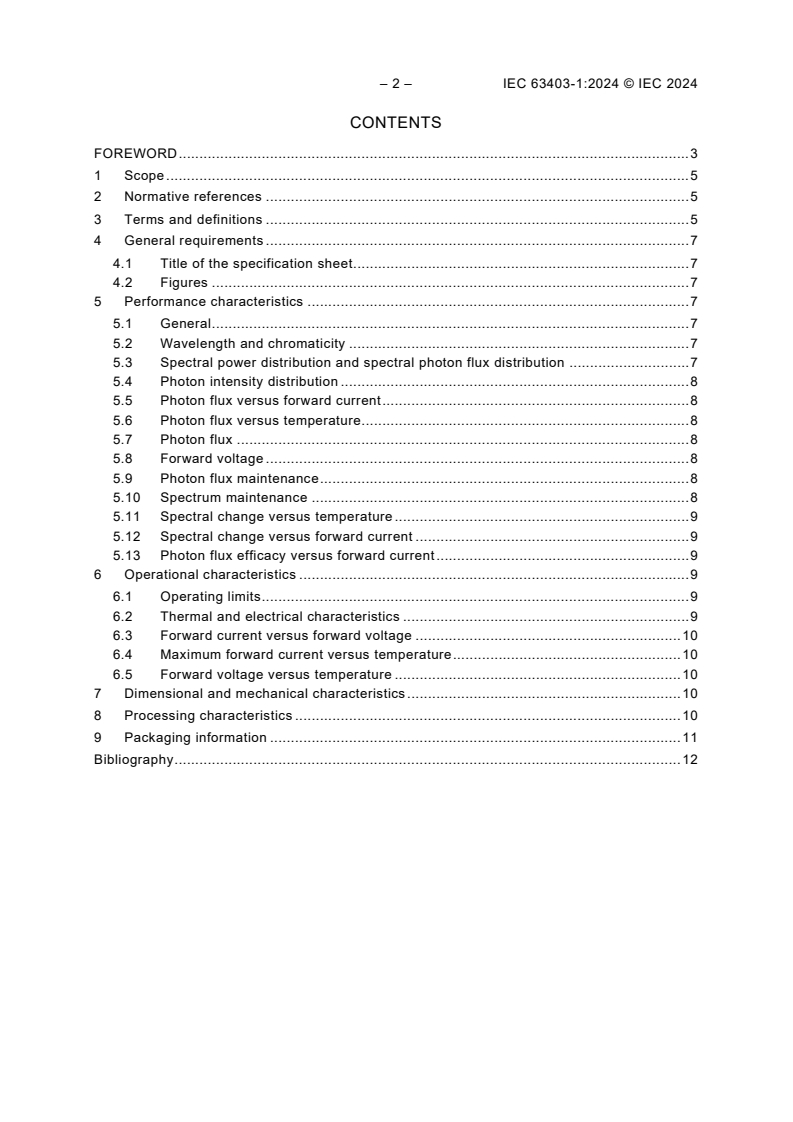
– 2 – IEC 63403-1:2024 © IEC 2024
CONTENTS
FOREWORD . 3
1 Scope . 5
2 Normative references . 5
3 Terms and definitions . 5
4 General requirements . 7
4.1 Title of the specification sheet . 7
4.2 Figures . 7
5 Performance characteristics . 7
5.1 General . 7
5.2 Wavelength and chromaticity . 7
5.3 Spectral power distribution and spectral photon flux distribution . 7
5.4 Photon intensity distribution . 8
5.5 Photon flux versus forward current . 8
5.6 Photon flux versus temperature. 8
5.7 Photon flux . 8
5.8 Forward voltage . 8
5.9 Photon flux maintenance . 8
5.10 Spectrum maintenance . 8
5.11 Spectral change versus temperature . 9
5.12 Spectral change versus forward current . 9
5.13 Photon flux efficacy versus forward current . 9
6 Operational characteristics . 9
6.1 Operating limits . 9
6.2 Thermal and electrical characteristics . 9
6.3 Forward current versus forward voltage . 10
6.4 Maximum forward current versus temperature . 10
6.5 Forward voltage versus temperature . 10
7 Dimensional and mechanical characteristics . 10
8 Processing characteristics . 10
9 Packaging information . 11
Bibliography . 12
INTERNATIONAL ELECTROTECHNICAL COMMISSION
____________
HORTICULTURAL LIGHTING –
LED PACKAGES FOR HORTICULTURAL LIGHTING –
Part 1: Specification sheet
FOREWORD
1) The International Electrotechnical Commission (IEC) is a worldwide organization for standardization comprising
all national electrotechnical committees (IEC National Committees). The object of IEC is to promote international
co-operation on all questions concerning standardization in the electrical and electronic fields. To this end and
in addition to other activities, IEC publishes International Standards, Technical Specifications, Technical Reports,
Publicly Available Specifications (PAS) and Guides (hereafter referred to as “IEC Publication(s)”). Their
preparation is entrusted to technical committees; any IEC National Committee interested in the subject dealt with
may participate in this preparatory work. International, governmental and non-governmental organizations liaising
with the IEC also participate in this preparation. IEC collaborates closely with the International Organization for
Standardization (ISO) in accordance with conditions determined by agreement between the two organizations.
2) The formal decisions or agreements of IEC on technical matters express, as nearly as possible, an international
consensus of opinion on the relevant subjects since each technical committee has representation from all
interested IEC National Committees.
3) IEC Publications have the form of recommendations for international use and are accepted by IEC National
Committees in that sense. While all reasonable efforts are made to ensure that the technical content of IEC
Publications is accurate, IEC cannot be held responsible for the way in which they are used or for any
misinterpretation by any end user.
4) In order to promote international uniformity, IEC National Committees undertake to apply IEC Publications
transparently to the maximum extent possible in their national and regional publications. Any divergence between
any IEC Publication and the corresponding national or regional publication shall be clearly indicated in the latter.
5) IEC itself does not provide any attestation of conformity. Independent certification bodies provide conformity
assessment services and, in some areas, access to IEC marks of conformity. IEC is not responsible for any
services carried out by independent certification bodies.
6) All users should ensure that they have the latest edition of this publication.
7) No liability shall attach to IEC or its directors, employees, servants or agents including individual experts and
members of its technical committees and IEC National Committees for any personal injury, property damage or
other damage of any nature whatsoever, whether direct or indirect, or for costs (including legal fees) and
expenses arising out of the publication, use of, or reliance upon, this IEC Publication or any other IEC
Publications.
8) Attention is drawn to the Normative references cited in this publication. Use of the referenced publications is
indispensable for the correct application of this publication.
9) IEC draws attention to the possibility that the implementation of this document may involve the use of (a)
patent(s). IEC takes no position concerning the evidence, validity or applicability of any claimed patent rights in
respect thereof. As of the date of publication of this document, IEC had not received notice of (a) patent(s), which
may be required to implement this document. However, implementers are cautioned that this may not represent
the latest information, which may be obtained from the patent database available at https://patents.iec.ch. IEC
shall not be held responsible for identifying any or all such patent rights.
IEC 63403-1 has been prepared by IEC technical committee 34: Lighting. It is an International
Standard.
The text of this International Standard is based on the following documents:
Draft Report on voting
34/1142/FDIS 34/1161/RVD
Full information on the voting for its approval can be found in the report on voting indicated in
the above table.
The language used for the development of this International Standard is English.
– 4 – IEC 63403-1:2024 © IEC 2024
This document was drafted in accordance with ISO/IEC Directives, Part 2, and developed in
accordance with ISO/IEC Directives, Part 1 and ISO/IEC Directives, IEC Supplement, available
at www.iec.ch/members_experts/refdocs. The main document types developed by IEC are
described in greater detail at www.iec.ch/publications.
A list of all parts in the IEC 63403 series, published under the general title Horticultural lighting
– LED packages for horticultural lighting, can be found on the IEC website.
The committee has decided that the contents of this document will remain unchanged until the
stability date indicated on the IEC website under webstore.iec.ch in the data related to the
specific document. At this date, the document will be
• reconfirmed,
• withdrawn, or
• revised.
HORTICULTURAL LIGHTING –
LED PACKAGES FOR HORTICULTURAL LIGHTING –
Part 1: Specification sheet
1 Scope
This part of IEC 63403 specifies the requirements for specification sheets relating to LED
packages designed for horticultural lighting purposes.
LED packages designed for horticultural lighting purposes in this document can be designed
for emission of white light or emission of optical radiation at specified wavelengths.
LED packages for horticultural lighting purposes are usually designed into LED modules or
luminaires.
This document does not contain compliance criteria, which can be affected by module or
luminaire design, and are assumed to be plant species and growth stage dependent.
2 Normative references
There are no normative references in this document.
3 Terms and definitions
For the purposes of this document, the following terms and definitions apply.
ISO and IEC maintain terminology databases for use in standardization at the following
addresses:
• IEC Electropedia: available at https://www.electropedia.org/
• ISO Online browsing platform: available at https://www.iso.org/obp
3.1
LED package
single electric component comprising principally at least one LED die
Note 1 to entry: An LED package does not include the control unit of the control gear, does not include a cap, is
not connected directly to the supply voltage and does not include active electronic components.
Note 2 to entry: An LED package is a discrete component and part of the LED module or LED lamp.
Note 3 to entry: An LED package can include one or more of the following:
• optical elements;
• light converters (phosphors);
• thermal, mechanical, and electric interfaces;
• components to address ESD concerns.
[SOURCE: IEC 60050-845:2020, 845-27-065]
– 6 – IEC 63403-1:2024 © IEC 2024
3.2
junction temperature
tj
temperature at the p-n junction
Note 1 to entry: Junction temperature is expressed in degree Celsius (°C).
[SOURCE: IEC 60050-845:2020, 845-27-068]
3.3
bin
specification of an LED die or LED package, or a set
thereof, by means of a range of performance characteristics
Note 1 to entry: The characteristic can include chromaticity, photometric, radiometric, and electrical performance.
Note 2 to entry: The designation of a bin is often referred to as the "bin code".
[SOURCE: IEC 60050-845:2020, 845-27-066]
3.4
family
set of LED packages characterized by common features
3.5
brand name
name used by a manufacturer to distinguish its products from products made by other
manufacturers
3.6
centroid wavelength
λ
c
wavelength at the weighted centre of a spectrum
Note 1 to entry: The centroid wavelength is the weighted average of each wavelength and can be calculated as
∞
λ⋅S λ dλ
( )
∫
λ =
c
∞
S λ dλ
( )
∫
where λ is the wavelength and S(λ) is the spectral power distribution.
Note 2 to entry: The centroid wavelength is normally used for LED packages based on LED die(s) emitting nearly
monochromatic radiation.
3.7
dominant wavelength
wavelength of the monochromatic stimulus that, when additively mixed
in suitable proportions with the specified achromatic stimulus, matches the colour stimulus
considered in the CIE 1931 x, y chromaticity diagram
Note 1 to entry: The dominant wavelength is expressed in nanometre (nm).
[SOURCE: IEC 60050-845:2020, 845-23-062, modified – Note 1 to entry has been deleted.]
3.8
photon flux efficacy
photon flux emitted divided by the electrical input power of the LED
. -1
Note 1 to entry: The photon flux efficacy for horticultural lighting is expressed in micromole per Joule (µmol J ).
4 General requirements
4.1 Title of the specification sheet
The title of the specification sheet shall indicate the brand name and the product name.
NOTE The product name can be the name of an individual LED package or the name of a family.
The applicability for horticultural lighting shall be clearly indicated either in the title or other
places on the first page of the specification sheet.
4.2 Figures
The specification sheet shall provide photos or renderings of the LED package or a
representative member of the family at the beginning of the specification information.
Figures shall be given in linear scale and fully saturated colours. Any key to figures shall be
placed outside the graphic display area. Graph axes shall be provided with characteristics and
units using a minimum 8-point typeface. No background shall be used behind the figures.
5 Performance characteristics
5.1 General
Typical values and characteristics of LED packages of the same model shall be indicated in the
specification sheet.
5.2 Wavelength and chromaticity
For LED packages based on LED dies emitting monochromatic radiation, the specification sheet
shall indicate
a) the centroid wavelength in nm or
b) the dominant wavelength in nm.
NOTE The wavelength can be given as one typical value or value as minimum and maximum.
For the polychromatic LED packages, the specification sheet shall indicate the chromaticity
coordinates.
5.3 Spectral power distribution and spectral photon flux distribution
The specification sheet shall provide the spectral power distribution or the spectral photon flux
distribution in a graphical format. The distribution shall be normalized by the total power or by
the peak spectral power. Information shall include the following:
a) wavelength on the horizontal axis including a 300 nm to 800 nm or a wider range;
b) relative radiant power or relative photon flux on the vertical axis for a typical spectrum
including information on the basis of the normalization (by total power or by spectral peak
power);
c) forward current used for binning;
d) junction or case temperature.
– 8 – IEC 63403-1:2024 © IEC 2024
5.4 Photon intensity distribution
The specification sheet shall provide the photon intensity (angular) distribution in polar or
Cartesian coordinates in a graphical format together with the following information:
a) coordinates where 0° is assigned to the centre of the intensity distribution;
b) relative photon intensity normalized to the maximum photon intensity;
c) forward current used for binning;
d) junction or case temperature;
e) cross-section angle (e.g. 0° or 45°), if multiple cross-section angles are given.
5.5 Photon flux versus forward current
The specification sheet shall provide the photon flux versus forward current in a graphical format
together with the following information:
a) forward current on the horizontal axis;
b) relative photon flux on the vertical axis;
c) reference current used for the normalization;
d) junction or case temperature.
5.6 Photon flux versus temperature
The specification sheet shall provide the relative photon flux versus temperature in a graphical
format with the following information:
a) junction or case temperature in °C on the horizontal axis;
b) relative photon flux, the ratio of photon flux at a junction or case temperature versus the
reference temperature on the vertical axis with the reference temperature specified;
c) forward current used for binning.
5.7 Photon flux
The specification sheet shall provide the photon flux bins at a junction temperature of 85 °C.
The characteristics can be obtained either
a) by a measurement at 85 °C or
b) by a measurement at 25 °C and a calculation.
5.8 Forward voltage
The specification sheet shall provide the forward voltage bins at 85 °C.
The characteristics can be obtained either
a) by a measurement at 85 °C or
b) by a measurement at 25 °C and a calculation.
5.9 Photon flux maintenance
The specification sheet should specify the photon flux maintenance and projection obtained
according to IEC 63013 if available.
5.10 Spectrum maintenance
The specification sheet should specify the wavelength shift over time obtained according to
ANSI/IES LM-80-20 if available.
5.11 Spectral change versus temperature
The specification sheet shall specify the spectral change over temperature.
For LED packages based on LED dies emitting monochromatic radiation, the spectral change
is described by centroid wavelength or dominant wavelength.
For polychromatic LED packages, the spectral change is described by chromaticity coordinates.
5.12 Spectral change versus forward current
The specification sheet shall specify the spectral change over forward current.
For LED packages based on LED dies emitting monochromatic radiation, the spectral change
is described by centroid wavelength or dominant wavelength.
For polychromatic LED packages, the spectral change is described by chromaticity coordinates.
5.13 Photon flux efficacy versus forward current
The specification sheet shall specify the photon flux efficacy versus forward current.
6 Operational characteristics
6.1 Operating limits
The specification sheet shall provide the following operating limits in a table format with the
following information:
a) maximum junction or case temperature;
b) maximum forward current;
c) maximum forward pulse current, pulse width and duty cycle (if applicable);
d) maximum reverse voltage;
e) test conditions or criteria for claimed values, if applicable;
f) minimum forward current.
The specification sheet should provide any combinations of operating values that result in
unintended use.
6.2 Thermal and electrical characteristics
The specification sheet shall provide the following information in a table format:
a) thermal resistance based on the dissipated power (P – P ) or electrical input
electrical optical
(P ), together with the information which basis has been used and if the thermal
electrical
resistance from junction to case or from junction to soldering point is specified;
NOTE 1 See CIE 225:2017 for more information on thermal resistance.
b) forward voltage;
c) minimum withstand voltage or class to human body model (HBM) electrostatic discharge
(ESD).
NOTE 2 See IEC 60749-26:2018 for more information on HBM ESD and the component classification levels.
– 10 – IEC 63403-1:2024 © IEC 2024
6.3 Forward current versus forward voltage
The specification sheet shall provide the forward current versus forward voltage in a graphical
format together with the following information:
a) typical forward voltage on the horizontal axis;
b) forward current on the vertical axis;
c) junction or case temperature in °C.
6.4 Maximum forward current versus temperature
The specification sheet shall provide the forward current versus temperature (current de-rating)
in a graphic format. The graphical information shall include the following:
a) junction temperature on the horizontal axis;
b) maximum forward current on the vertical axis;
c) low current limit (if applicable).
If a family of forward current versus temperature curves is provided, the thermal resistance
specified in 6.2 for each curve shall be indicated.
6.5 Forward voltage versus temperature
The specification sheet shall provide forward voltage versus temperature in a graphical or in a
table format. If the forward voltage is linearly related to the temperature, it may instead be
written as a coefficient describing the slope. Graphical information shall contain the following:
a) junction temperature in °C on the horizontal axis;
b) forward voltage difference from typical voltage or actual forward voltage on the vertical axis.
7 Dimensional and mechanical characteristics
The specification sheet shall contain the following information about the LED package in a
graphical format:
a) geometry and sizes;
b) location and size of solder pads on the LED package;
c) identification of electrical contacts;
d) recommended location and size of solder pads on the printed circuit board (PCB).
The specification sheet shall contain the weight of the LED package in mg.
8 Processing characteristics
For surface-mounted LEDs using a reflow process, recommendations regarding the reflow
characteristics and reflow process method shall be provided in the specification sheet. For n
...