


IEC 62463:2010
(Main)Radiation protection instrumentation - X-ray systems for the screening of persons for security and the carrying of illicit items
General Information
- Abstract
IEC 62463:2010 lays down standard requirements and also specifies general characteristics, general test procedures, radiation characteristics, electrical characteristics, environmental influences, mechanical characteristics, safety requirements; provides examples of acceptable methods in terms of dose to the whole or part of the body for each screening procedure and the time taken for each screening procedure.
- Status
- Published
- Publication Date
- 27-Jun-2010
- Technical Committee
- SC 45B - Radiation protection instrumentation
- Drafting Committee
- WG 9 - TC 45/SC 45B/WG 9
- Current Stage
- DELPUB - Deleted Publication
- Start Date
- 30-Jul-2024
- Completion Date
- 07-Jan-2022
Overview
IEC 62463:2010 is an international standard dedicated to radiation protection instrumentation, specifically focusing on X-ray systems used for the screening of persons to ensure security and detect illicit items. Developed by the International Electrotechnical Commission (IEC), this standard establishes the requirements for the design, testing, and operation of security X-ray screening systems with an emphasis on safety and radiation protection.
The standard sets out comprehensive guidelines covering general characteristics, test procedures, radiation and electrical characteristics, environmental influences, mechanical properties, and safety requirements for X-ray security screening devices. It also provides methodologies to assess radiation dose exposure to the whole or specific parts of the body during screening procedures, ensuring minimal risk to both operators and screened individuals.
Key Topics
- Scope and Classification: Defines the range of X-ray screening equipment covered, classification of systems, and their primary applications in security contexts.
- Test Procedures: Describes standardized testing methodologies to evaluate system performance under defined conditions, including radiation output and system controls.
- Radiation Characteristics: Specifies requirements for tube potential and ambient dose equivalent at the point of screening, focusing on minimizing radiation exposure.
- Safety Requirements: Addresses shielding, safety indicators, interlocks, and mandatory safeguards to protect both operators and individuals from unnecessary radiation risks.
- Electrical and Environmental Conditions: Covers supply voltage standards, electromagnetic compatibility (EMC), temperature and humidity tolerances to ensure reliable operation under various conditions.
- Mechanical Robustness: Includes testing for mechanical shocks, vibrations, and impact resistance to guarantee durable operation in security screening environments.
- Documentation: Mandates detailed manuals, type test reports, and certification procedures for compliance verification.
Applications
IEC 62463:2010 is essential for manufacturers, security agencies, and regulatory bodies involved with:
- Security Screening at Airports and Border Crossings: Ensures that X-ray scanners used for personnel screening operate within safe radiation limits while reliably detecting contraband and illicit materials.
- Event Security and Public Transportation: Helps design and deploy portable or fixed X-ray screening systems that comply with international radiation safety requirements.
- Customs and Law Enforcement: Facilitates the adoption of standardized X-ray inspection tools that balance detection accuracy with occupational safety.
- Radiation Safety Compliance: Provides a benchmark for certification, inspection, and maintenance of screening equipment to meet legal and regulatory radiation protection standards.
- Design and Development of Security Equipment: Guides manufacturers on essential performance and safety parameters for the development of new X-ray screening technologies.
Related Standards
To ensure comprehensive safety and performance in radiation protection related to X-ray screening systems, IEC 62463:2010 aligns and references several complementary standards:
- IAEA Safety Standards (Safety Series No. 115): International Basic Safety Standards for Protection Against Ionizing Radiation, providing foundational radiation safety principles.
- IEC 61010: Safety requirements for electrical equipment for measurement, control, and laboratory use.
- IEC 60601: Medical electrical equipment standards relevant to radiation-producing devices.
- ISO/IEC Directives, Part 2: Guidelines for standard development processes ensuring consistent and internationally recognized documentation.
Summary
IEC 62463:2010 offers an authoritative framework for the design, testing, and operation of X-ray systems used in person screening for security purposes. By emphasizing radiation protection, safety mechanisms, and rigorous testing, this standard helps safeguard individuals and operators from undue radiation exposure while maintaining effective detection of illicit items. Security organizations, manufacturers, and regulatory authorities benefit from this standard's comprehensive approach to ensuring reliable, safe, and compliant X-ray screening systems worldwide.
Keywords: IEC 62463, radiation protection instrumentation, X-ray security systems, screening persons, illicit items detection, radiation safety, security screening standards, electromagnetic compatibility, mechanical testing, dose measurement, ionizing radiation safety.
Relations
- Effective Date
- 05-Sep-2023
Get Certified
Connect with accredited certification bodies for this standard

NSF International
Global independent organization facilitating standards development and certification.

CIS Institut d.o.o.
Personal Protective Equipment (PPE) certification body. Notified Body NB-2890 for EU Regulation 2016/425 PPE.

Kiwa BDA Testing
Building and construction product certification.
Sponsored listings
Frequently Asked Questions
IEC 62463:2010 is a standard published by the International Electrotechnical Commission (IEC). Its full title is "Radiation protection instrumentation - X-ray systems for the screening of persons for security and the carrying of illicit items". This standard covers: IEC 62463:2010 lays down standard requirements and also specifies general characteristics, general test procedures, radiation characteristics, electrical characteristics, environmental influences, mechanical characteristics, safety requirements; provides examples of acceptable methods in terms of dose to the whole or part of the body for each screening procedure and the time taken for each screening procedure.
IEC 62463:2010 lays down standard requirements and also specifies general characteristics, general test procedures, radiation characteristics, electrical characteristics, environmental influences, mechanical characteristics, safety requirements; provides examples of acceptable methods in terms of dose to the whole or part of the body for each screening procedure and the time taken for each screening procedure.
IEC 62463:2010 is classified under the following ICS (International Classification for Standards) categories: 13.280 - Radiation protection. The ICS classification helps identify the subject area and facilitates finding related standards.
IEC 62463:2010 has the following relationships with other standards: It is inter standard links to IEC 62463:2024. Understanding these relationships helps ensure you are using the most current and applicable version of the standard.
IEC 62463:2010 is available in PDF format for immediate download after purchase. The document can be added to your cart and obtained through the secure checkout process. Digital delivery ensures instant access to the complete standard document.
Standards Content (Sample)
IEC 62463 ®
Edition 1.0 2010-06
INTERNATIONAL
STANDARD
NORME
INTERNATIONALE
Radiation protection instrumentation – X-ray systems for the screening of
persons for security and the carrying of illicit items
Instrumentation pour la radioprotection – Systèmes radiographiques aux
rayons X pour le contrôle des individus dans le cadre de la sécurité et du
transport d’objets illicites
All rights reserved. Unless otherwise specified, no part of this publication may be reproduced or utilized in any form or by
any means, electronic or mechanical, including photocopying and microfilm, without permission in writing from either IEC or
IEC's member National Committee in the country of the requester.
If you have any questions about IEC copyright or have an enquiry about obtaining additional rights to this publication,
please contact the address below or your local IEC member National Committee for further information.
Droits de reproduction réservés. Sauf indication contraire, aucune partie de cette publication ne peut être reproduite
ni utilisée sous quelque forme que ce soit et par aucun procédé, électronique ou mécanique, y compris la photocopie
et les microfilms, sans l'accord écrit de la CEI ou du Comité national de la CEI du pays du demandeur.
Si vous avez des questions sur le copyright de la CEI ou si vous désirez obtenir des droits supplémentaires sur cette
publication, utilisez les coordonnées ci-après ou contactez le Comité national de la CEI de votre pays de résidence.
IEC Central Office
3, rue de Varembé
CH-1211 Geneva 20
Switzerland
Email: inmail@iec.ch
Web: www.iec.ch
About the IEC
The International Electrotechnical Commission (IEC) is the leading global organization that prepares and publishes
International Standards for all electrical, electronic and related technologies.
About IEC publications
The technical content of IEC publications is kept under constant review by the IEC. Please make sure that you have the
latest edition, a corrigenda or an amendment might have been published.
ƒ Catalogue of IEC publications: www.iec.ch/searchpub
The IEC on-line Catalogue enables you to search by a variety of criteria (reference number, text, technical committee,…).
It also gives information on projects, withdrawn and replaced publications.
ƒ IEC Just Published: www.iec.ch/online_news/justpub
Stay up to date on all new IEC publications. Just Published details twice a month all new publications released. Available
on-line and also by email.
ƒ Electropedia: www.electropedia.org
The world's leading online dictionary of electronic and electrical terms containing more than 20 000 terms and definitions
in English and French, with equivalent terms in additional languages. Also known as the International Electrotechnical
Vocabulary online.
ƒ Customer Service Centre: www.iec.ch/webstore/custserv
If you wish to give us your feedback on this publication or need further assistance, please visit the Customer Service
Centre FAQ or contact us:
Email: csc@iec.ch
Tel.: +41 22 919 02 11
Fax: +41 22 919 03 00
A propos de la CEI
La Commission Electrotechnique Internationale (CEI) est la première organisation mondiale qui élabore et publie des
normes internationales pour tout ce qui a trait à l'électricité, à l'électronique et aux technologies apparentées.
A propos des publications CEI
Le contenu technique des publications de la CEI est constamment revu. Veuillez vous assurer que vous possédez
l’édition la plus récente, un corrigendum ou amendement peut avoir été publié.
ƒ Catalogue des publications de la CEI: www.iec.ch/searchpub/cur_fut-f.htm
Le Catalogue en-ligne de la CEI vous permet d’effectuer des recherches en utilisant différents critères (numéro de référence,
texte, comité d’études,…). Il donne aussi des informations sur les projets et les publications retirées ou remplacées.
ƒ Just Published CEI: www.iec.ch/online_news/justpub
Restez informé sur les nouvelles publications de la CEI. Just Published détaille deux fois par mois les nouvelles
publications parues. Disponible en-ligne et aussi par email.
ƒ Electropedia: www.electropedia.org
Le premier dictionnaire en ligne au monde de termes électroniques et électriques. Il contient plus de 20 000 termes et
définitions en anglais et en français, ainsi que les termes équivalents dans les langues additionnelles. Egalement appelé
Vocabulaire Electrotechnique International en ligne.
ƒ Service Clients: www.iec.ch/webstore/custserv/custserv_entry-f.htm
Si vous désirez nous donner des commentaires sur cette publication ou si vous avez des questions, visitez le FAQ du
Service clients ou contactez-nous:
Email: csc@iec.ch
Tél.: +41 22 919 02 11
Fax: +41 22 919 03 00
IEC 62463 ®
Edition 1.0 2010-06
INTERNATIONAL
STANDARD
NORME
INTERNATIONALE
Radiation protection instrumentation – X-ray systems for the screening of
persons for security and the carrying of illicit items
Instrumentation pour la radioprotection – Systèmes radiographiques aux
rayons X pour le contrôle des individus dans le cadre de la sécurité et du
transport d’objets illicites
INTERNATIONAL
ELECTROTECHNICAL
COMMISSION
COMMISSION
ELECTROTECHNIQUE
PRICE CODE
INTERNATIONALE
U
CODE PRIX
ICS 13.280 ISBN 978-2-88912-024-6
– 2 – 62463 © IEC:2010
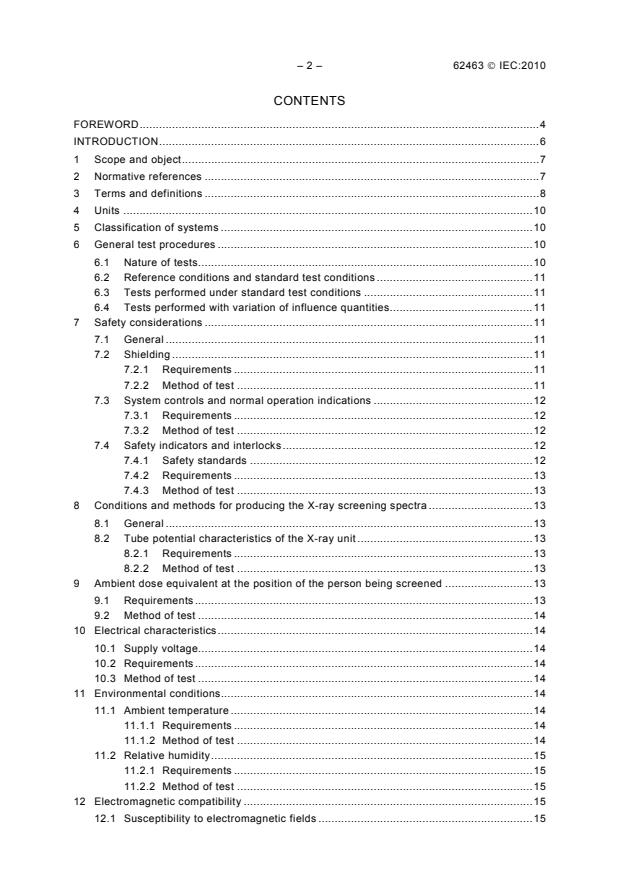
CONTENTS
FOREWORD.4
INTRODUCTION.6
1 Scope and object.7
2 Normative references .7
3 Terms and definitions .8
4 Units .10
5 Classification of systems .10
6 General test procedures .10
6.1 Nature of tests.10
6.2 Reference conditions and standard test conditions .11
6.3 Tests performed under standard test conditions .11
6.4 Tests performed with variation of influence quantities.11
7 Safety considerations .11
7.1 General .11
7.2 Shielding .11
7.2.1 Requirements .11
7.2.2 Method of test .11
7.3 System controls and normal operation indications .12
7.3.1 Requirements .12
7.3.2 Method of test .12
7.4 Safety indicators and interlocks.12
7.4.1 Safety standards .12
7.4.2 Requirements .13
7.4.3 Method of test .13
8 Conditions and methods for producing the X-ray screening spectra .13
8.1 General .13
8.2 Tube potential characteristics of the X-ray unit .13
8.2.1 Requirements .13
8.2.2 Method of test .13
9 Ambient dose equivalent at the position of the person being screened .13
9.1 Requirements.13
9.2 Method of test .14
10 Electrical characteristics.14
10.1 Supply voltage.14
10.2 Requirements.14
10.3 Method of test .14
11 Environmental conditions.14
11.1 Ambient temperature .14
11.1.1 Requirements .14
11.1.2 Method of test .14
11.2 Relative humidity.15
11.2.1 Requirements .15
11.2.2 Method of test .15
12 Electromagnetic compatibility .15
12.1 Susceptibility to electromagnetic fields .15
62463 © IEC:2010 – 3 –
12.1.1 Requirements .15
12.1.2 Method of test .15
12.2 Conducted disturbances induced by bursts and radio frequencies .16
12.2.1 Requirements .16
12.2.2 Method of test .16
12.3 Surges and ring waves .16
12.3.1 Requirements .16
12.3.2 Method of test .16
12.4 Electrostatic discharge .16
12.4.1 Requirements .16
12.4.2 Method of test .17
13 Mechanical characteristics.17
13.1 Mechanical shocks .17
13.1.1 Requirements .17
13.1.2 Method of test .17
13.2 Vibration test.17
13.2.1 Requirements .17
13.2.2 Method of test .17
13.3 Microphonic/impact .18
13.3.1 Requirements .18
13.3.2 Method of test .18
14 Documentation .18
14.1 Manual .18
14.2 Type test report.18
14.3 Certificate .18
Annex A (normative) Measurement and calculation of ambient dose equivalent per
scan at the reference point .21
Annex B (informative) Requirements of International Basic Safety Standards for
Protection Against Ionizing Radiation and For the Safety of Radiation Sources (BSS).
IAEA Safety Series No. 115, 1996. .25
Annex C (informative) Leakage localization meter and use .26
Bibliography.27
Figure A.1 – Charge Q versus time t, measured at a pencil-beam scanner (backscatter)
by means of the Hx(10) secondary standard ionization chamber .23
Table 1 – Reference conditions and standard test conditions .19
Table 2 – Tests performed under standard test conditions .19
Table 3 – Tests performed with variations of influence quantities.20
– 4 – 62463 © IEC:2010
INTERNATIONAL ELECTROTECHNICAL COMMISSION
____________
RADIATION PROTECTION INSTRUMENTATION –
X-RAY SYSTEMS FOR THE SCREENING OF PERSONS
FOR SECURITY AND THE CARRYING OF ILLICIT ITEMS
FOREWORD
1) The International Electrotechnical Commission (IEC) is a worldwide organization for standardization comprising
all national electrotechnical committees (IEC National Committees). The object of IEC is to promote
international co-operation on all questions concerning standardization in the electrical and electronic fields. To
this end and in addition to other activities, IEC publishes International Standards, Technical Specifications,
Technical Reports, Publicly Available Specifications (PAS) and Guides (hereafter referred to as “IEC
Publication(s)”). Their preparation is entrusted to technical committees; any IEC National Committee interested
in the subject dealt with may participate in this preparatory work. International, governmental and non-
governmental organizations liaising with the IEC also participate in this preparation. IEC collaborates closely
with the International Organization for Standardization (ISO) in accordance with conditions determined by
agreement between the two organizations.
2) The formal decisions or agreements of IEC on technical matters express, as nearly as possible, an international
consensus of opinion on the relevant subjects since each technical committee has representation from all
interested IEC National Committees.
3) IEC Publications have the form of recommendations for international use and are accepted by IEC National
Committees in that sense. While all reasonable efforts are made to ensure that the technical content of IEC
Publications is accurate, IEC cannot be held responsible for the way in which they are used or for any
misinterpretation by any end user.
4) In order to promote international uniformity, IEC National Committees undertake to apply IEC Publications
transparently to the maximum extent possible in their national and regional publications. Any divergence
between any IEC Publication and the corresponding national or regional publication shall be clearly indicated in
the latter.
5) IEC itself does not provide any attestation of conformity. Independent certification bodies provide conformity
assessment services and, in some areas, access to IEC marks of conformity. IEC is not responsible for any
services carried out by independent certification bodies.
6) All users should ensure that they have the latest edition of this publication.
7) No liability shall attach to IEC or its directors, employees, servants or agents including individual experts and
members of its technical committees and IEC National Committees for any personal injury, property damage or
other damage of any nature whatsoever, whether direct or indirect, or for costs (including legal fees) and
expenses arising out of the publication, use of, or reliance upon, this IEC Publication or any other IEC
Publications.
8) Attention is drawn to the Normative references cited in this publication. Use of the referenced publications is
indispensable for the correct application of this publication.
9) Attention is drawn to the possibility that some of the elements of this IEC Publication may be the subject of
patent rights. IEC shall not be held responsible for identifying any or all such patent rights.
International Standard IEC 62463 has been prepared by subcommittee 45B: Radiation
protection instrumentation, of IEC technical committee 45: Nuclear instrumentation.
The text of this standard is based on the following documents:
FDIS Report on voting
45B/642/FDIS 45B/658/RVD
Full information on the voting for the approval of this standard can be found in the report on
voting indicated in the above table.
This publication has been drafted in accordance with the ISO/IEC Directives, Part 2.
62463 © IEC:2010 – 5 –
The committee has decided that the contents of this publication will remain unchanged until
the stability date indicated on the IEC web site under "http://webstore.iec.ch" in the data
related to the specific publication. At this date, the publication will be
• reconfirmed,
• withdrawn,
• replaced by a revised edition, or
• amended.
– 6 – 62463 © IEC:2010
INTRODUCTION
The existence of this standard does not indicate approval of the use of the relevant
equipments. However these equipments exist and are used in some countries and are likely to
be used to scan persons of all nationalities including nationals of those countries which ban
their use. If other international organisations ban their use, this standard could be withdrawn.
Meanwhile it is considered valuable to have this standard to reduce the radiation doses to
members of the public and others likely to have to use the equipments. Personnel X-ray
screening assemblies are used to examine persons in order to detect objects such as:
weapons, explosives, smuggled or stolen items such as drugs or diamonds. The screening
devices can be divided into three types: one type using the Compton backscattered X-rays
(Backscatter system) for the image creation, one using the transmitted X-rays (Transmission
system) for the image creation, and a third type as a combination of the two types
(Backscatter + Transmission).
All three types consist of an X-ray unit and a detector unit, and take about 10 s to perform a
scan.
The systems are operated by and the image is viewed on an external computer. Sophisticated
software is used to evaluate the complex images and to enable the detection of hidden
objects.
The main difference between the system types is the position of the detectors. Usually, they
also differ in the tube voltage range used.
Backscatter X-ray systems, (B), use a narrow pencil shaped beam that scans the subject at
high speed in a horizontal and vertical direction. Large detectors are installed on the same
side of the subject as the X-ray source. The person stands in front of the enclosure and is
scanned by the X-ray beam having a typical cross-sectional area of approximately 25 mm ;
this of course is the quantity limiting the spatial resolution of the system. Usually the person is
scanned twice, once from the front and then from the back. Sometimes lateral scans are also
performed. Typical systems use fixed peak voltage (kV) and current (mA) settings for the X-
ray source. These are typically 50 kV and 5 mA. The total aluminium equivalent filtration is in
the range of 1 mm to 7 mm.
Transmission X-ray systems, (T), often use a vertical fan–shaped beam of X-rays and a linear
array of detectors. The person stands between the X-ray tube and the detector array and is
scanned by the X-ray beam having a typical width of approximately 2 mm. The limiting
quantity for the spatial resolution is the size of the detector elements. Typical systems use a
fixed peak voltage (kV) and current (mA). Settings are in the range of about 140 kV to 220 kV
and 0,1 mA to about 4 mA. The total aluminium equivalent thickness is in the range of about
1 mm to about 16 mm. The systems are capable of detecting objects within the body.
Backscatter plus transmission X-ray systems, (BT), are systems that use both backscattered
and transmitted X-rays, during the same scan procedure.
62463 © IEC:2010 – 7 –
RADIATION PROTECTION INSTRUMENTATION –
X-RAY SYSTEMS FOR THE SCREENING OF PERSONS
FOR SECURITY AND THE CARRYING OF ILLICIT ITEMS
1 Scope and object
This International Standard is applicable to X-ray systems designed for screening people to
detect if they are carrying objects that could be used for criminal purposes, e.g., terrorist use,
drug smuggling and theft. These objects include weapons, explosives, chemical and biological
agents and other concealed items.
Three types of X-ray screening systems are currently in use. These are backscatter systems,
transmission systems and combination backscatter/transmission systems. With backscatter
systems the X-rays are used to detect objects hidden under or within the person’s clothing.
With transmission systems objects swallowed or hidden in body cavities may be detected.
Combined devices can be used to get both pieces of information simultaneously.
The object of this standard is to lay down standard requirements and also to specify general
characteristics, general test procedures, radiation characteristics, electrical characteristics,
environmental influences, mechanical characteristics, safety requirements and to provide
examples of acceptable methods in terms of dose to the whole or part of the body for each
screening procedure and the time taken for each screening procedure.
In particular the standard addresses the design requirements as they relate to the radiation
protection of the people being screened, people who are in the vicinity of the equipment and
the operators. The standard does not address the performance requirements for the quality of
the object detection.
2 Normative references
The following referenced documents are indispensable for the application of this document.
For dated references, only the edition cited applies. For undated references, the latest edition
of the referenced document (including any amendments) applies.
IEC 60038:2009, IEC standard voltages
IEC 60050-393:2003, International Electrotechnical Vocabulary (IEV) – Part 393: Nuclear
instrumentation – Physical phenomena and basic concepts
IEC 60050-394:2007, International Electrotechnical Vocabulary (IEV) – Part 394: Nuclear
instrumentation – Instruments, systems, equipments and detectors
IEC 60068-2-27, Environmental testing – Part 2-27: Tests – Test Ea and guidance: Shock
IEC 60068-2-75:1997, Environmental testing – Part 2-75: Tests – Test Eh: Hammer tests
IEC 61000-4-2, Electromagnetic compatibility (EMC) – Part 4-2: Testing and measurement
techniques – Electrostatic discharge immunity test
IEC 61000-4-3, Electromagnetic compatibility (EMC) – Part 4-3: Testing and measurement
techniques – Radiated, radio-frequency, electromagnetic field immunity test
– 8 – 62463 © IEC:2010
IEC 61000-4-4, Electromagnetic compatibility (EMC) – Part 4-4: Testing and measurement
techniques – Electric fast transient/burst immunity test
IEC 61000-4-5, Electromagnetic compatibility (EMC) – Part 4-5: Testing and measurement
techniques – Surge immunity test
IEC 61000-4-6, Electromagnetic compatibility (EMC) – Part 4-6: Testing and measurement
techniques – Immunity to conducted disturbances, induced by radio-frequency fields
IEC 61000-4-12, Electromagnetic compatibility (EMC) – Part 4-12: Testing and measurement
techniques – Ring wave immunity test
IEC 61187, Electrical and electronic equipment – Documentation
IEC 61508 (all parts), Functional safety of electrical/electronic/programmable electronic safety
related systems
ISO 4037 (all parts), X and gamma reference radiation for calibrating dosemeters and
doserate meters and for determining their response as a function of photon energy
ISO 4037-1:1996, X and gamma reference radiation for calibrating dosemeters and doserate
meters and for determining their response as a function of photon energy – Part 1: Radiation
characteristics and production method
3 Terms and definitions
For the purposes of this document, the following terms and definitions apply. The general
terminology concerning X-ray screening systems is given in IEC 60050-393:2003 and
IEC 60050-394:2007.
3.1
ambient dose equivalent, Hx(d)
the ambient dose equivalent at a point in a radiation field, is the dose equivalent that would
be produced by the corresponding expanded and aligned field, in the ICRU sphere at a depth,
d, on the radius opposing the direction of the aligned field
[ICRU 51]
NOTE 1 The recommended depth, d, for strongly penetrating radiation is 10 mm, and ambient dose equivalent at
*
this depth may be written as Hx (10).
NOTE 2 Soft tissue means ICRU 4-element, see ICRU 39.
3.2
constant potential X-ray unit
unit in which the ripple of the high voltage does not exceed ±10 %
3.3
exposure beam location
that part of the external surface of the system enclosure through which the collimated X-ray
beam passes
3.4
half value layer (air kerma), HVL or HVLx
the thickness of the specified material which attenuates the beam of radiation to an extent
such that the air kerma rate is reduced to one half of its original value. In this definition, the
contribution of all scattered radiation, other than any which might be present initially in the
beam concerned, is deemed to be excluded.
62463 © IEC:2010 – 9 –
[ICRU 17]
3.5
filtration
the total filtration is made up of the fixed filtration and any additional filtration used by the
manufacturer.
The fixed filtration comprises the inherent filtration of the tube, plus that due to the monitor
ionisation chamber.
The inherent filtration of the tube is due to the various constituent elements (glass of the bulb,
oil, window, etc.) and is expressed, for a given high voltage, as the thickness of an aluminium
filter which, in the absence of the constituent elements of the tube, would supply a radiation
having the same first HVL.
3.6
monitor instrument
instrument with an alarm used to monitor the stability of the ambient dose equivalent rate
during an irradiation or to compare the ambient dose equivalent rate during a screening with
the reference dose equivalent rate determined during the type testing
3.7
mode of operation
backscatter, transmission or backscatter and transmission system and scanning technique
3.8
operator
person authorised and fully trained to operate the system
3.9
reference instrument
instrument whose calibration is traceable either directly or indirectly to primary standards held
by a national primary laboratory or to an acknowledged reference laboratory which holds
appropriate standards
3.10
reference point
the point within the space that may be occupied by the person being screened receiving the
maximum dose and at which for the purpose of the testing requirements of this standard the
X-ray spectra (or HVL) and reference ambient dose equivalent per screening procedure is
measured
3.11
safety interlocks
devices which are intended to prevent or interrupt the generation of X-radiation whenever
safety is compromised by access to the interior of the system, operational irregularity or
equipment failure
3.12
scan
the scanning cycle consisting of the operation necessary to produce one view (e.g., front
view)
3.13
scanning system
the whole equipment used to produce a scan, including the X-ray generator and collimator
3.14
screening procedure
the sum of all scans necessary to examine one person
– 10 – 62463 © IEC:2010
3.15
enclosure
the containment within which the X-ray unit and its scanning system are enclosed
3.16
ripple
ratio, expressed as a percentage, defined for a given current by the formula:
(U – U ) × 100/U
max min max
where U is the maximum value and U the minimum value of the voltage.
max min
3.17
user
the person being screened by the equipment
3.18
X-ray unit
assembly comprising a high voltage supply, an X-ray tube with its protective housing, and
high voltage electrical connections
3.19
X-ray tube
vacuum tube designed to produce X-rays by bombardment of the anode by a beam of
electrons accelerated through a potential difference
4 Units
In this standard, the units are the multiples and sub-multiples of units of the International
System of Units (SI) . The following non-SI units are also used:
Time: years, days, hours (h), minutes (min).
–19
For energy: electron-volt (eV), (1 eV = 1,602 × 10 J).
NOTE Definitions of the radiation quantities and dosimetric terms are given in IEC 60050-393 and IEC 60050-394.
5 Classification of systems
Systems are classified according to whether they are backscatter X-ray systems, (B) or
transmission X-ray systems, (T), or combined backscatter and transmission systems, (BT).
6 General test procedures
6.1 Nature of tests
Unless otherwise specified in the individual subclauses, all tests enumerated in this standard
are to be considered as “type tests”.
___________
th
(SI International Bureau of Weights and Measures: The International System of Units, 8 edition 2006).
62463 © IEC:2010 – 11 –
6.2 Reference conditions and standard test conditions
Reference and standard test conditions are given in Table 1. Reference conditions are those
conditions to which the performance of the instrument is referred and standard test conditions
indicate the necessary tolerances in practical testing. Except where otherwise specified, the
tests in this standard shall be performed under the standard test conditions given in the third
column of Table 1.
6.3 Tests performed under standard test conditions
Tests performed under standard test conditions are listed in Table 2, which indicates, for each
characteristic under test, requirements according to the subclause where the corresponding
test method is described.
6.4 Tests performed with variation of influence quantities
For those tests intended to determine the effects of variations in the influence quantities given
in Table 3, all other influence quantities shall be maintained within the limits for the standard
test conditions given in Table 1 unless otherwise specified in the test procedure concerned.
7 Safety considerations
7.1 General
The manufacturer shall provide a description of the radiation safety systems that are designed
to prevent, during normal operation of the X-ray screening system, accidental exposure to the
operator and public and for ensuring that the person being screened is not exposed above
manufacturers stated maximum dose per screening procedure (see Clause 9). The
accompanying manual provided by the manufacturer shall include details of the fail-safe
features of the radiation safety exposure circuit. These details shall also include functional
test instructions.
The manufacturer shall reference the radiological and electrical safety considerations used for
the system by quoting applicable IEC and ISO publications, see 7.4.1.
7.2 Shielding
7.2.1 Requirements
When a person is being screened and the X-ray beam is emanating, shutter or beam stop
open, the ambient dose equivalent rate to any area where other members of the public or the
–1
operator have access should not exceed 2,5 μSv⋅h taken over several scans. Where the
doserate could exceed this value at a distance in excess of 30 cm from any external surface
the manufacturer shall provide an isodose contour at this value. National regulations may
stipulate lower limits.
7.2.2 Method of test
The direction in which the highest dose per screening procedure is emitted shall be identified
by measurement. (Technical drawings and further physical aspects may assist in determining
this but should not be relied upon.) Careful consideration should be given to control stations,
fissures around doors, ventilation openings, shielding joints and any other vulnerable areas
based on technical drawings. If there are outer doors or removable panels that are not locked
or interlocked, the radiation survey shall be repeated with the doors open and panels
removed. At the distance specified in 7.2.1, from the surface of the device the ambient dose
equivalent per screening procedure (that means the sum of all scans necessary to examine a
person) shall be measured. The X-ray scanner shall be operated in the mode with the
greatest high voltage, greatest tube current and the smallest total filtration allowed to be used
in operation. This shall be done for at least five subsequent screening procedures following
each other as fast as the device is able to perform. The total dose over all these screening
– 12 – 62463 © IEC:2010
procedures shall be divided by the time all these screening procedures took. This value plus
the overall uncertainty (k = 2) shall not exceed the ambient dose equivalent rate requirement
listed in 7.2.1.
This dose equivalent rate shall be determined by a reference instrument having a response
that is within 20 % of the true value over the energy range from 25 keV to the maximum
energy in keV corresponding to the maximum operating voltage of the X-ray tube.
7.3 System controls and normal operation indications
7.3.1 Requirements
The operating conditions, namely the tube voltage and tube current, for each mode of
operation shall be pre-set by the manufacturer and shall not be alterable by the system
operator. If there is more than one mode, prior to each scan a mode indicator shall be clearly
visible to the operator.
The operators control panel shall show the following:
• Electrical power to the system is on. Only the operator is permitted to switch on the power
and this should require the use of a key.
• When the X-rays are being produced an “X-rays on” illuminated sign shall operate.
• The voltage and current for the operating mode shall be displayed when required by an
engineer or maintenance staff.
• Indication shall be made for both when the shutter or beam stop is open and/or for when
the scan is taking place, “scan on”.
• The production of x-rays shall only start if the illuminated sign “X-rays” is ready to operate.
Sufficient diagnostics shall be designed into the system to facilitate fault finding and to
provide local and remote information on the status of the system. A self-test device shall be
provided to perform self-testing continuously. Operation of the equipment after fault detection
must be prevented until the fault is cleared. The manufacturer shall produce a test plan which
shall demonstrate the normal operation of the system. This test plan shall contain all normal
operational features, diagnostics, self-test facilities and safety features of the system.
If the moveable parts, e.g., the platform, X-ray unit or chopper, do not work properly the
system shall shut down automatically.
7.3.2 Method of test
Using the manufacturer’s test plan verify that the operator’s control panel displays the
information as required in 7.3.1.
Testing is done automatically by the software and related electronics. Interlocks, indications
and alarms shall be independent of the system’s normal controls and operation indicators.
7.4 Safety indicators and interlocks
7.4.1 Safety standards
Appropriate requirements shall apply concerning specification, design, manufacturing,
installation and operation of the equipment, with respect to the necessary hardware and
software. The requirements shall be agreed between manufacturer and purchaser. In
particular the purchaser (operator) shall decide the appropriate safety standard applicable to
the site in which the system will be placed. The basic safety standard IEC 61508 Functional
Safety of Electrical/ Electronic/Programmable electronic systems shall apply, as appropriate
according to the required Safety Integrity Level (SIL) specified for the system.
62463 © IEC:2010 – 13 –
7.4.2 Requirements
Operational interlocks shall terminate the production of X-rays in the event of any operational
problem that could result in abnormal or unintended radiation emission. Either through
redundancy or special design, a malfunction of any operational interlock or any system
monitoring an operational interlock shall also terminate X-ray production regardless of the
actual radiation emission. This shall include, but is not limited to: unintended stopping or
slowing of the scanning motion, abnormal or unintended X-ray source output, computer safety
system malfunction, termination malfunction, and when applicable, X-ray shutter or beam stop
mechanism malfunction.
7.4.3 Method of test
The manufacturer shall produce a test plan in accordance with IEC 61508 which shall
demonstrate the operation of the safety alarms and interlocks for the SIL level specified.
The system shall be switched on and allowed to run its start up and self-test routines. A fault
condition in each one of the monitored parameters shall be simulated and the warning or fault
description recorded.
8 Conditions and methods for producing the X-ray screening spectra
8.1 General
In practice the spectra of the radiation produced depends primarily on:
– the high-voltage across the X-ray tube;
– the thickness and nature of the total filtration;
– the type and nature of the target.
8.2 Tube potential characteristics of the X-ray unit
8.2.1 Requirements
The conventionally true value of the potential shall be known to within ±5 %.
8.2.2 Method of test
Calibrate, at several points close to their stated operating tube potential, and under normal
operating conditions, the equipment used to indicate the tube potential. The best methods
employ a calibrated resistor chain or involve the measurement of the maximum photon energy
by spectrometry. If the calibration is determined by spectrometry, the tube potential shall be
found from the intersection of the extrapolated linear high energy part of the spectrum with
the energy axis. Advice on methods of accomplishing this are described in ISO 4037-1.
9 Ambient dose equivalent at the position of the person being screened
9.1 Requirements
The ambient dose equivalent, Hx(10), at the reference point shall not exceed 0,4 μSv per
screening procedure (that means the sum of all scans necessary to examine a person) for
backscatter systems, (B) and 5 μSv per screening procedure (that means the sum of all scans
necessary to examine a person) for transmission systems (T) and backscatter and
transmission systems, (BT). Other values may be specified as required by national
regulations.
– 14 – 62463 © IEC:2010
9.2 Method of test
The method used to determine the reference point of maximum dose and the dose at that
point for each screening procedure shall be as described in Annex A. Measurements shall be
made with a reference instrument. Calculation is not sufficient.
With the X-ray scanner operating in the mode with greatest high voltage, the greatest tube
current, and the smallest total filtration, the ambient dose equivalent per scan procedure (that
means the sum of all scans necessary to examine a person) shall be measured at the
reference point applying the methods described in Annex A. This value plus the overall
uncertainty (k = 2) shall not exceed the ambient dose equivalent requirements listed in 9.1.
10 Electrical characteristics
10.1 Supply voltage
The system shall be designed to operate from a single-phase a.c. supply voltage in one of the
following categories in accordance with IEC 60038:
– Series I: 230 V.
– Series II: 120 V and/or 240 V.
NOTE Nominal single phase power supplies of 100 V, 50 Hz or 60 Hz and of 117 V and/or 234 V, 60 Hz are used
in some countries and a nominal single-phase power of 110 V, 50 Hz is also used as an alternative supply in other
countries.
10.2 Requirements
The system shall be capable of operating from mains supply voltage tolerance from –10 % to
+10 % and supply frequencies of 47 Hz to 51 Hz (57 Hz to 61 Hz in countries where the
nominal frequency is 60 Hz) without the variation in the reference dose exceeding ±10 %.
10.3 Method of test
The ambient dose equivalent per scan at the reference point should first be measured under
reference conditions. Then the ambient dose equivalent per scan should be measured over
the voltage and frequency ranges given in 10.1 and none of these values should differ from
the reference ambient dose equivalent per scan by more than ± 10 %.
11 Environmental conditions
11.1 Ambient temperature
11.1.1 Requirements
The equipment should be capable of operating over the temperature range –10 °C to +50 °C
with changes in the reference ambient dose equivalent per scan not exceeding ±10 % with all
the safety systems operational.
11.1.2 Method of test
The reference ambient dose equivalent per scan at the reference position should first be
measured at 20 °C under reference conditions.
The equipment shall be operated at a temperature of at or below –10 °C and the ambient
dose equivalent per scan measured The equipment shall have been kept at –10 °C for at least
2 h before the test. The equipment shall also be operated at a temperature of 50 °C or higher
and the test repeated after being at 50 °C for at least 2 h.
62463 © IEC:2010 – 15 –
The high voltage applied to the X-ray tube and the current taken shall also be monitored
under reference conditions and again after the equipment has been in the environment at
–10 °C
...