

ISO 80601-2-69:2014
(Main)Medical electrical equipment -- Part 2-69: Particular requirements for basic safety and essential performance of oxygen concentrator equipment
General Information
- Abstract
ISO 80601-2-69:2014 specifies requirements for the basic safety and essential performance of an oxygen concentrator in combination with its accessories, hereafter referred to as ME equipment, intended to increase the oxygen concentration of gas intended to be delivered to a single patient. Such oxygen concentrators are typically intended for use in the home healthcare environment, including transit-operable use by a single patient in various environments including any private and public transportation as well as in commercial aircraft. ISO 80601-2-69:2014 is applicable to a transit-operable and non-transit-operable oxygen concentrator. It is applicable to an oxygen concentrator integrated into or used with other medical devices, ME equipment or ME systems.
- Status
- Published
- Publication Date
- 11-May-2014
- Technical Committee
- SC 62D - Particular medical equipment, software, and systems
- Drafting Committee
- JWG 12 - TC 62/SC 62D/JWG 12
- Current Stage
- DELPUB - Deleted Publication
- Start Date
- 09-Nov-2020
- Completion Date
- 09-Feb-2018
Buy Documents

ISO 80601-2-69:2014 - Medical electrical equipment -- Part 2-69: Particular requirements for basic safety and essential performance of oxygen concentrator equipment Released:5/12/2014

ISO 80601-2-69:2014 - Medical electrical equipment -- Part 2-69: Particular requirements for basic safety and essential performance of oxygen concentrator equipment Released:5/12/2014
Overview
ISO 80601-2-69:2014 - Medical electrical equipment - Particular requirements for basic safety and essential performance of oxygen concentrator equipment - is a particular standard in the IEC/ISO 60601 series. It specifies safety and essential-performance requirements for oxygen concentrators and their accessories, intended to increase the oxygen concentration of gas delivered to a single patient. The scope explicitly covers both transit‑operable and non‑transit‑operable concentrators for the home healthcare environment (including public and private transport and commercial aircraft) and devices integrated into other ME equipment or systems.
Keywords: ISO 80601-2-69:2014, oxygen concentrator standard, medical electrical equipment, basic safety, essential performance, home healthcare, transit-operable.
Key topics and technical requirements
ISO 80601-2-69:2014 builds on the general IEC 60601-1 framework and adds particular requirements that reflect the unique risks of oxygen concentrators. Major technical topics include:
- Scope and definitions specific to oxygen concentrators and accessories.
- Identification, marking and documentation requirements (labelling, symbols and user information).
- Protection against electrical and mechanical hazards, excessive temperature, unwanted radiation and contamination of breathing gas pathways.
- Accuracy of controls and instruments, and protection against hazardous outputs (including oxygen delivery performance tests).
- Hazardous situations and fault conditions testing, plus requirements for Programmable Electrical Medical Systems (PEMS).
- Construction and ME system integration, including EMC (electromagnetic compatibility) considerations.
- Accessories and interfaces: outlet connectors, signal input/output parts, remote-control and distributed alarm connections.
- Infection control: requirements and tests for cleaning and disinfection procedures.
- Fire risk mitigation: measures and tests to prevent propagation of fire into the concentrator and its accessories.
- Performance characteristics: the standard recognises typical oxygen concentrations produced by concentrators (commonly ~82–96%, product gas up to ~95%) and requires validation of delivery performance.
Practical applications
This standard is applied to:
- Design and development of home and portable oxygen concentrators.
- Test protocols for verifying oxygen delivery, safety, EMC, cleaning/disinfection and fire resistance.
- Selection and certification of accessories (tubing, conserving equipment, humidifiers, outlet connectors).
- Integration of concentrators into larger ME systems (e.g., anaesthesia setups, filling systems).
Who uses this standard
- Medical device manufacturers and designers of oxygen concentrators and accessories.
- Certification and testing laboratories conducting safety and performance evaluations.
- Regulatory authorities and conformity assessment bodies.
- Biomedical engineers, procurement specialists and hospital/homecare teams assessing device compliance.
Related standards
- IEC/ISO 60601-1 (general medical electrical safety)
- IEC 60601-1-11 (home healthcare environment)
- IEC 60601-1-2 (electromagnetic compatibility) and other collateral standards referenced within ISO 80601-2-69.
Relations
- Effective Date
- 05-Sep-2023
Buy Documents
ISO 80601-2-69:2014 - Medical electrical equipment -- Part 2-69: Particular requirements for basic safety and essential performance of oxygen concentrator equipment Released:5/12/2014
ISO 80601-2-69:2014 - Medical electrical equipment -- Part 2-69: Particular requirements for basic safety and essential performance of oxygen concentrator equipment Released:5/12/2014
Get Certified
Connect with accredited certification bodies for this standard

BSI Group
BSI (British Standards Institution) is the business standards company that helps organizations make excellence a habit.

TÜV Rheinland
TÜV Rheinland is a leading international provider of technical services.

TÜV SÜD
TÜV SÜD is a trusted partner of choice for safety, security and sustainability solutions.
Sponsored listings
Frequently Asked Questions
ISO 80601-2-69:2014 is a standard published by the International Electrotechnical Commission (IEC). Its full title is "Medical electrical equipment -- Part 2-69: Particular requirements for basic safety and essential performance of oxygen concentrator equipment". This standard covers: ISO 80601-2-69:2014 specifies requirements for the basic safety and essential performance of an oxygen concentrator in combination with its accessories, hereafter referred to as ME equipment, intended to increase the oxygen concentration of gas intended to be delivered to a single patient. Such oxygen concentrators are typically intended for use in the home healthcare environment, including transit-operable use by a single patient in various environments including any private and public transportation as well as in commercial aircraft. ISO 80601-2-69:2014 is applicable to a transit-operable and non-transit-operable oxygen concentrator. It is applicable to an oxygen concentrator integrated into or used with other medical devices, ME equipment or ME systems.
ISO 80601-2-69:2014 specifies requirements for the basic safety and essential performance of an oxygen concentrator in combination with its accessories, hereafter referred to as ME equipment, intended to increase the oxygen concentration of gas intended to be delivered to a single patient. Such oxygen concentrators are typically intended for use in the home healthcare environment, including transit-operable use by a single patient in various environments including any private and public transportation as well as in commercial aircraft. ISO 80601-2-69:2014 is applicable to a transit-operable and non-transit-operable oxygen concentrator. It is applicable to an oxygen concentrator integrated into or used with other medical devices, ME equipment or ME systems.
ISO 80601-2-69:2014 is classified under the following ICS (International Classification for Standards) categories: 11.040.10 - Anaesthetic, respiratory and reanimation equipment. The ICS classification helps identify the subject area and facilitates finding related standards.
ISO 80601-2-69:2014 has the following relationships with other standards: It is inter standard links to ISO 80601-2-69:2020. Understanding these relationships helps ensure you are using the most current and applicable version of the standard.
ISO 80601-2-69:2014 is available in PDF format for immediate download after purchase. The document can be added to your cart and obtained through the secure checkout process. Digital delivery ensures instant access to the complete standard document.
Standards Content (Sample)
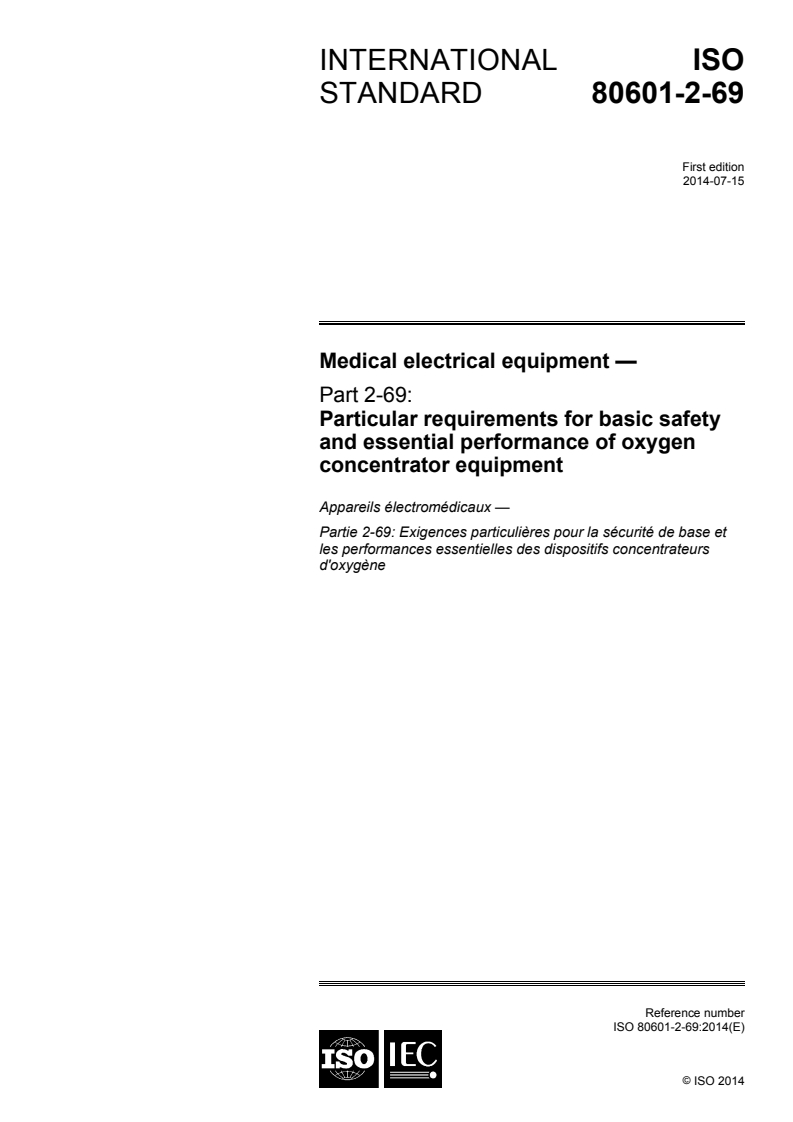
INTERNATIONAL ISO
STANDARD 80601-2-69
First edition
2014-07-15
Medical electrical equipment —
Part 2-69:
Particular requirements for basic safety
and essential performance of oxygen
concentrator equipment
Appareils électromédicaux —
Partie 2-69: Exigences particulières pour la sécurité de base et
les performances essentielles des dispositifs concentrateurs
d'oxygène
Reference number
©
ISO 2014
© ISO 2014
All rights reserved. Unless otherwise specified, no part of this publication may be reproduced or utilized in any form or by any means,
electronic or mechanical, including photocopying and microfilm, without permission in writing from either ISO at the address below or
ISO's member body in the country of the requester.
ISO copyright office
Case postale 56 CH-1211 Geneva 20
Tel. + 41 22 749 01 11
Fax + 41 22 749 09 47
E-mail copyright@iso.org
Web www.iso.org
Published in Switzerland
ii
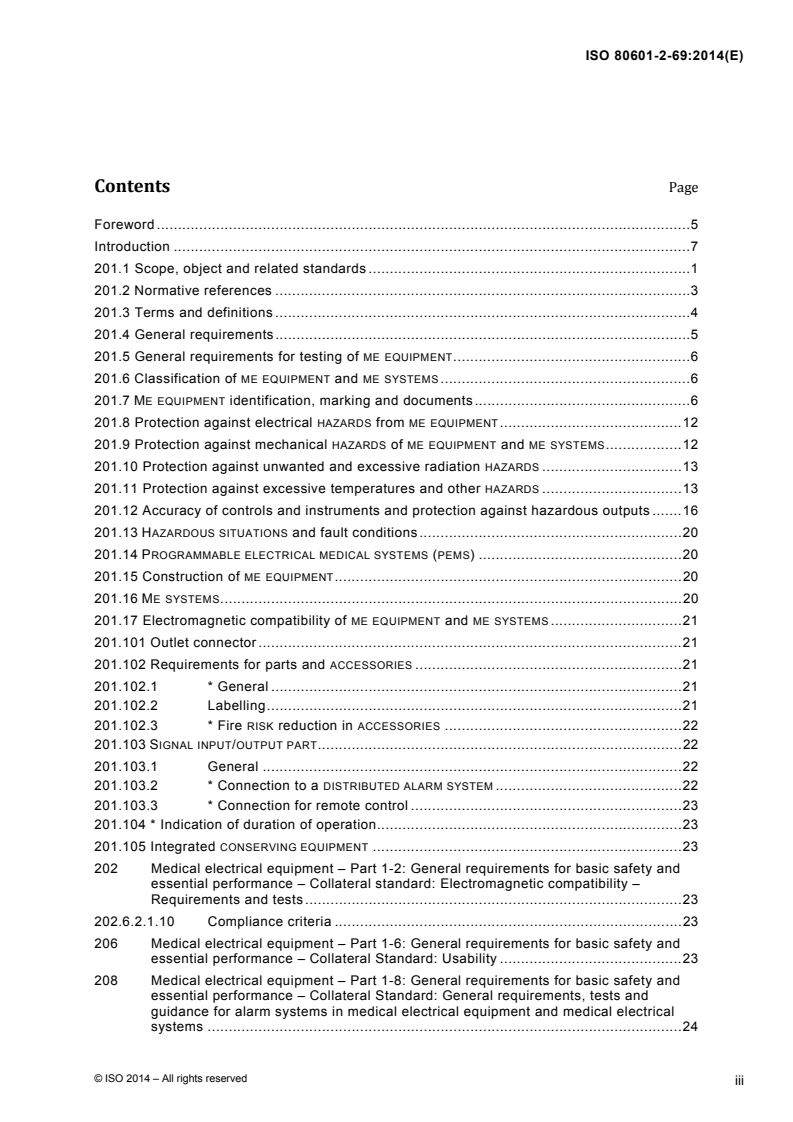
Contents Page
Foreword . 5
Introduction . 7
201.1 Scope, object and related standards . 1
201.2 Normative references . 3
201.3 Terms and definitions . 4
201.4 General requirements . 5
201.5 General requirements for testing of ME EQUIPMENT . 6
201.6 Classification of ME EQUIPMENT and ME SYSTEMS . 6
201.7 ME EQUIPMENT identification, marking and documents . 6
201.8 Protection against electrical HAZARDS from ME EQUIPMENT . 12
201.9 Protection against mechanical HAZARDS of ME EQUIPMENT and ME SYSTEMS . 12
201.10 Protection against unwanted and excessive radiation HAZARDS . 13
201.11 Protection against excessive temperatures and other HAZARDS . 13
201.12 Accuracy of controls and instruments and protection against hazardous outputs . 16
201.13 HAZARDOUS SITUATIONS and fault conditions . 20
201.14 PROGRAMMABLE ELECTRICAL MEDICAL SYSTEMS (PEMS) . 20
201.15 Construction of ME EQUIPMENT . 20
201.16 ME SYSTEMS . 20
201.17 Electromagnetic compatibility of ME EQUIPMENT and ME SYSTEMS . 21
201.101 Outlet connector . 21
201.102 Requirements for parts and ACCESSORIES . 21
201.102.1 * General . 21
201.102.2 Labelling . 21
201.102.3 * Fire RISK reduction in ACCESSORIES . 22
201.103 SIGNAL INPUT/OUTPUT PART . 22
201.103.1 General . 22
201.103.2 * Connection to a DISTRIBUTED ALARM SYSTEM . 22
201.103.3 * Connection for remote control . 23
201.104 * Indication of duration of operation . 23
201.105 Integrated CONSERVING EQUIPMENT . 23
202 Medical electrical equipment – Part 1-2: General requirements for basic safety and
essential performance – Collateral standard: Electromagnetic compatibility –
Requirements and tests . 23
202.6.2.1.10 Compliance criteria . 23
206 Medical electrical equipment – Part 1-6: General requirements for basic safety and
essential performance – Collateral Standard: Usability . 23
208 Medical electrical equipment – Part 1-8: General requirements for basic safety and
essential performance – Collateral Standard: General requirements, tests and
guidance for alarm systems in medical electrical equipment and medical electrical
systems . 24
iii
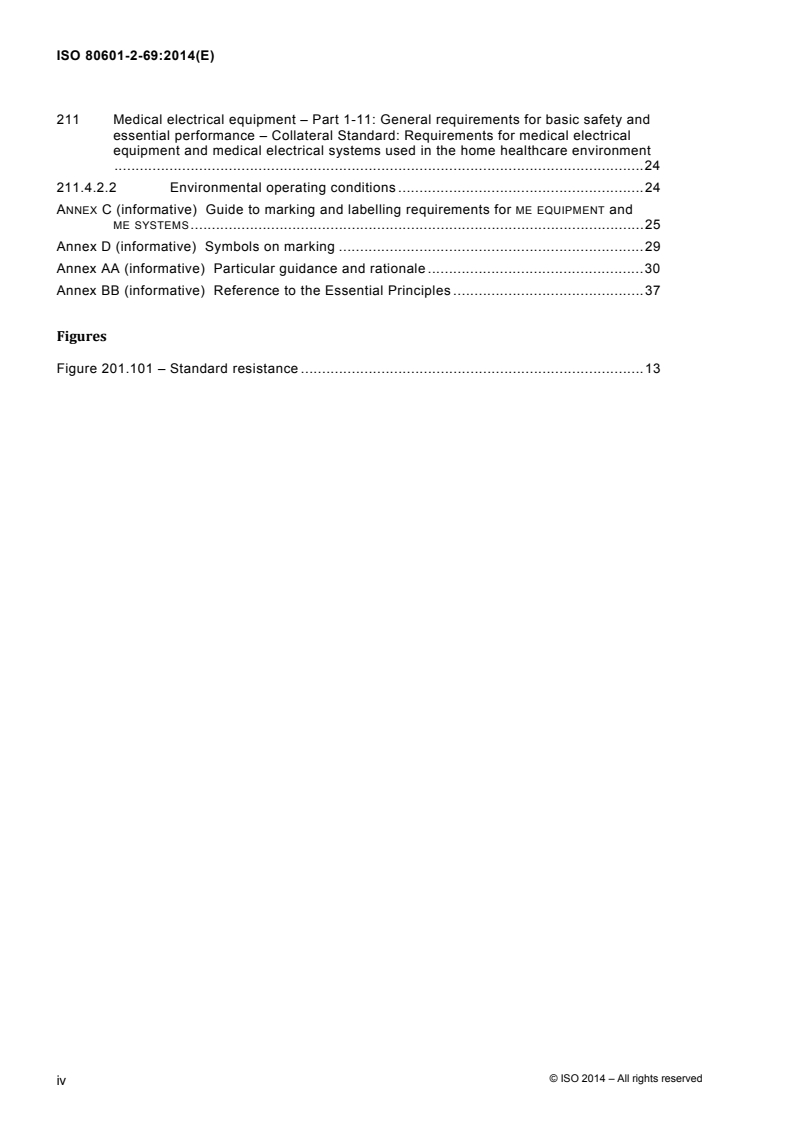
211 Medical electrical equipment – Part 1-11: General requirements for basic safety and
essential performance – Collateral Standard: Requirements for medical electrical
equipment and medical electrical systems used in the home healthcare environment
............................................................................................................................. 24
211.4.2.2 Environmental operating conditions . 24
ANNEX C (informative) Guide to marking and labelling requirements for ME EQUIPMENT and
ME SYSTEMS . 25
Annex D (informative) Symbols on marking . 29
Annex AA (informative) Particular guidance and rationale . 30
Annex BB (informative) Reference to the Essential Principles . 37
Figures
Figure 201.101 – Standard resistance . 13
iv
Foreword
ISO (the International Organization for Standardization) is a worldwide federation of national
standards bodies (ISO member bodies). The work of preparing International Standards is normally
carried out through ISO technical committees. Each member body interested in a subject for which
a technical committee has been established has the right to be represented on that committee.
International organizations, governmental and non-governmental, in liaison with ISO, also take part
in the work. ISO collaborates closely with the International Electrotechnical Commission (IEC) on all
matters of electrotechnical standardization.
International Standards are drafted in accordance with the rules given in the ISO/IEC Directives,
Part 2.
The main task of technical committees is to prepare International Standards. Draft International
Standards adopted by the technical committees are circulated to the member bodies for voting.
Publication as an International Standard requires approval by at least 75 % of the member bodies
casting a vote.
Attention is drawn to the possibility that some of the elements of this document may be the subject
of patent rights. ISO shall not be held responsible for identifying any or all such patent rights.
ISO/IEC 80601-2-69 was prepared by a joint working group of Technical Committee ISO/TC 121,
Anaesthetic and respiratory equipment, Subcommittee SC 3, Lung ventilators and related
equipment and Technical Committee IEC/TC 62, Electrical equipment in medical practice,
Subcommittee SC D, Electrical equipment.
This first edition of ISO 80601-2-69 cancels and replaces the first edition of ISO 8359:1996. This
edition of ISO 80601-2-69 constitutes a major technical revision of ISO 8359:1996 and includes an
alignment with the third edition of IEC 60601-1 and IEC 60601-1-11.
The most significant changes are the following modifications:
– extending the scope to include not only the OXYGEN CONCENTRATOR but also its ACCESSORIES,
where the characteristics of those ACCESSORIES can affect the BASIC SAFETY and ESSENTIAL
PERFORMANCE of the OXYGEN CONCENTRATOR;
– identification of ESSENTIAL PERFORMANCE for an OXYGEN CONCENTRATOR and its ACCESSORIES;
– and the following additions:
tests for oxygen delivery performance;
new symbols;
new requirement for a means to prevent the propagation of fire into the OXYGEN CONCENTRATOR
and its ACCESSORIES;
tests for cleaning and disinfection PROCEDURES; and
consideration of contamination of the breathing gas delivered to the PATIENT from the gas
pathways.
In this standard, the following print types are used:
– Requirements and definitions: roman type.
– Test specifications: italic type.
v
– Informative material appearing outside of tables, such as notes, examples and references: in smaller type.
Normative text of tables is also in a smaller type.
– TERMS DEFINED IN CLAUSE 3 OF THE GENERAL STANDARD, IN THIS PARTICULAR STANDARD OR AS NOTED:
SMALL CAPITALS TYPE.
In referring to the structure of this standard, the term
– "clause” means one of the seventeen numbered divisions within the table of contents, inclusive of
all subdivisions (e.g. Clause 7 includes subclauses 7.1, 7.2, etc.);
– “subclause” means a numbered subdivision of a clause (e.g. 201.7.1, 201.7.2 and 201.7.2.1 are
all subclauses of Clause 201.7).
References to clauses within this standard are preceded by the term “Clause” followed by the
clause number. References to subclauses within this particular standard are by number only.
In this standard, the conjunctive “or” is used as an “inclusive or” so a statement is true if any
combination of the conditions is true.
The verbal forms used in this standard conform to usage described in Annex H of the ISO/IEC
Directives, Part 2. For the purposes of this standard, the auxiliary verb:
– “shall” means that compliance with a requirement or a test is mandatory for compliance with this
standard;
– “should” means that compliance with a requirement or a test is recommended but is not
mandatory for compliance with this standard;
– “may” is used to describe a permissible way to achieve compliance with a requirement or test.
An asterisk (*) as the first character of a title or at the beginning of a paragraph or table title
indicates that there is guidance or rationale related to that item in Annex A.
The attention of Member Bodies and National Committees is drawn to the fact that equipment
manufacturers and testing organizations may need a transitional period following publication of a
new, amended or revised ISO or IEC publication in which to make products in accordance with the
new requirements and to equip themselves for conducting new or revised tests. It is the
recommendation of the committee that the content of this publication not be adopted for mandatory
implementation nationally earlier than 3 years from the date of publication for equipment newly
designed and not earlier than 5 years from the date of publication for equipment already in
production.
vi
Introduction
Oxygen supplementation can be part of management of PATIENTS with chronic, acute–on-chronic
and acute respiratory disorders. The amount of supplemental oxygen depends on the individual
PATIENT’S needs under various conditions. The managing healthcare team typically prescribes the
endpoint of treatment, for example a target value for oxygen saturation. The amount of
supplemental oxygen can be controlled by the flowrate.
The goal of long term oxygen therapy is to keep the oxygen saturation above 90 % in PATIENTS that
require supplemental oxygen. The flowrate should be adjusted for rest, exertion, and sleep to meet
the individual PATIENT’S needs under these various conditions. Ideally, the resting flowrate is
adjusted to maintain SpO > 90 % as indicated by pulse oximetry.
Supplemental oxygen is supplied by various sources: MEDICAL GAS PIPELINE SYSTEMS, OXYGEN
CONCENTRATORS, compressed gas cylinders, and liquid oxygen reservoirs. This standard covers the
particular requirements for BASIC SAFETY and ESSENTIAL PERFORMANCE of OXYGEN CONCENTRATORS.
OXYGEN CONCENTRATORS produce oxygen enriched air from room air for delivery to a PATIENT
requiring oxygen therapy. The most common OXYGEN CONCENTRATOR uses molecular sieve beds to
filter and concentrate oxygen molecules from the ambient air, generating oxygen concentrations of
typically 82 % to 96 %. The main component of this type of OXYGEN CONCENTRATOR is the molecular
sieve, which adsorbs nitrogen from air to produce a product gas which is a mixture of typically up to
95 % oxygen and 5 % of other gases. The periodic adsorbing and purging of nitrogen is referred to
as the pressure swing adsorption process.
vii
INTERNATIONAL STANDARD ISO 80601-2-69:2014(E)
Medical electrical equipment —
Part 2-69:
Particular requirements for basic safety and essential
performance of oxygen concentrator equipment
201.1 Scope, object and related standards
IEC 60601-1:2005+Amendment 1:2012, Clause 1 applies, except as follows:
201.1.1 Scope
IEC 60601-1:2005+Amendment 1:2012, 1.1 is replaced by:
This particular standard specifies requirements for the BASIC SAFETY and ESSENTIAL PERFORMANCE of an
OXYGEN CONCENTRATOR in combination with its ACCESSORIES, hereafter referred to as ME EQUIPMENT,
intended to increase the oxygen concentration of gas intended to be delivered to a single PATIENT. Such
OXYGEN CONCENTRATORS are typically intended for use in the HOME HEALTHCARE ENVIRONMENT, including
TRANSIT‐OPERABLE use by a single PATIENT in various environments including any private and public
transportation as well as in commercial aircraft.
NOTE 1 Such an OXYGEN CONCENTRATOR can also be used in professional healthcare facilities.
This particular standard is applicable to a TRANSIT‐OPERABLE and non‐TRANSIT‐OPERABLE OXYGEN
CONCENTRATOR. This particular standard is applicable to an OXYGEN CONCENTRATOR integrated into or used
with other medical devices, ME EQUIPMENT or ME SYSTEMS.
EXAMPLE 1 An OXYGEN CONCENTRATOR with integrated oxygen CONSERVING EQUIPMENT [10] or humidifier [4].
EXAMPLE 2 An OXYGEN CONCENTRATOR used with a flowmeter stand.
EXAMPLE 3 An OXYGEN CONCENTRATOR as part of an anaesthetic system for use in areas with limited logistical
supplies of electricity and anaesthetic gases. [3]
EXAMPLE 4 An OXYGEN CONCENTRATOR with an integrated liquid reservoir or gas cylinder filling system.
This particular standard is also applicable to those ACCESSORIES intended by their MANUFACTURER to be
connected to an OXYGEN CONCENTRATOR, where the characteristics of those ACCESSORIES can affect the
BASIC SAFETY or ESSENTIAL PERFORMANCE of the OXYGEN CONCENTRATOR.
This particular standard does not specify the requirements for OXYGEN CONCENTRATORS for use with a
MEDICAL GAS PIPELINE SYSTEM which are given in ISO 10083.
If a clause or subclause is specifically intended to be applicable to ME EQUIPMENT only, or to ME SYSTEMS
only, the title and content of that clause or subclause will say so. If that is not the case, the clause or
subclause applies both to ME EQUIPMENT and to ME SYSTEMS, as relevant.
HAZARDS inherent in the intended physiological function of ME EQUIPMENT or ME SYSTEMS within the scope
of this standard are not covered by specific requirements in this standard except in 7.2.13 and 8.4.1 of
the general standard.
NOTE 2 See also 4.2 of the General Standard.
This International Standard is a particular standard in the IEC 60601‐1 series of standards.
201.1.2 Object
IEC 60601-1:2005, 1.2 is replaced by:
The object of this International Standard is to establish particular BASIC SAFETY and ESSENTIAL
PERFORMANCE requirements for an OXYGEN CONCENTRATOR [as defined in 201.3.203] and its ACCESSORIES.
NOTE ACCESSORIES are included because the combination of the OXYGEN CONCENTRATOR and the ACCESSORIES
needs to be adequately safe. ACCESSORIES can have a significant impact on the BASIC SAFETY or ESSENTIAL PERFORMANCE
of an OXYGEN CONCENTRATOR.
201.1.3 Collateral standards
IEC 60601-1:2005+Amendment 1:2012, 1.3 applies with the following addition:
This particular standard refers to those applicable collateral standards that are listed in IEC 60601‐
1:2005+Amendment 1:2012, Clause 2 of the general standard and 201.2 of this particular standard.
IEC 60601‐1‐3:2008+Amendment 1:2013 does not apply.
201.1.4 Particular standards
IEC 60601-1:2005+Amendment 1:2012, 1.4 is replaced by:
In the IEC 60601 series, particular standards may modify, replace or delete requirements contained in
the general standard, including the collateral standards, as appropriate for the particular ME EQUIPMENT
under consideration, and may add other BASIC SAFETY or ESSENTIAL PERFORMANCE requirements.
A requirement of a particular standard takes priority over the general standard or the collateral
standards.
For brevity, IEC 60601‐1:2005+Amendment 1:2012 is referred to in this particular standard as the
general standard. Collateral standards are referred to by their document number.
The numbering of clauses and subclauses of this particular standard corresponds to those of the general
standard with the prefix “201” (e.g. 201.1 in this standard addresses the content of Clause 1 of the
general standard) or applicable collateral standard with the prefix “2xx” where xx is the final digits of
the collateral standard document number (e.g. 202.4 in this particular standard addresses the content
of Clause 4 of the IEC 60601‐1‐2 collateral standard, 208.4 in this particular standard addresses the
content of Clause 4 of the IEC 60601‐1‐8 collateral standard, etc.). The changes to the text of the general
standard are specified by the use of the following words:
"Replacement" means that the clause or subclause of the general standard or applicable collateral
standard is replaced completely by the text of this particular standard.
"Addition" means that the text of this particular standard is additional to the requirements of the
general standard or applicable collateral standard.
"Amendment" means that the clause or subclause of the general standard or applicable collateral
standard is amended as indicated by the text of this particular standard.
Subclauses or figures that are additional to those of the general standard are numbered starting from
201.101, additional annexes are lettered AA, BB, etc., and additional items aa), bb), etc.
Subclauses or figures that are additional to those of a collateral standard are numbered starting from
2xx, where “x” is the number of the collateral standard, e.g. 202 for IEC 60601‐1‐2, 203 for IEC 60601‐1‐
3, etc.
The term "this standard" is used to make reference to the general standard, any applicable collateral
standards and this particular standard taken together.
Where there is no corresponding clause or subclause in this particular standard, the section, clause or
subclause of the general standard or applicable collateral standard, although possibly not relevant,
applies without modification; where it is intended that any part of the general standard or applicable
collateral standard, although possibly relevant, is not to be applied, a statement to that effect is given in
this particular standard.
201.2 Normative references
The following referenced documents are indispensable for the application of this document. The way in
which these referenced documents are cited in normative requirements determines the extent (in
whole or in part) to which they apply. For dated references, only the edition cited applies. For undated
references, the latest edition of the referenced document (including any amendments) applies.
NOTE Informative references are listed in the Bibliography beginning on page 37.
IEC 60601-1:2005+Amendment 1:2012, Clause 2 applies, except as follows:
Replacement:
IEC 60601‐1‐2:2007, Medical electrical equipment – Part 1-2: General requirements for basic safety and
essential performance – Collateral Standard: Electromagnetic compatibility – Requirements and tests
IEC 60601‐1‐6:2010, Medical electrical equipment – Part 1-6: General requirements for basic safety and
essential performance – Collateral standard: Usability
+Amendment 1:2013
IEC 60601‐1‐8:2006, Medical electrical equipment - Part 1-8: General requirements for basic safety and
essential performance - Collateral Standard: General requirements, tests and guidance for alarm systems
in medical electrical equipment and medical electrical systems
+Amendment 1:2012
IEC 60601‐1‐11:2010, Medical electrical equipment – Part 1-11: General requirements for basic safety
and essential performance – Collateral Standard: Requirements for medical electrical equipment and
medical electrical systems used in the home healthcare environment
Addition:
ISO 3744:2010, Acoustics -- Determination of sound power levels and sound energy levels of noise sources
using sound pressure -- Engineering methods for an essentially free field over a reflecting plane
ISO 7000:2012, Graphical symbols for use on equipment -- Registered symbols
ISO 7010:2011, Graphical symbols -- Safety colours and safety signs -- Registered safety signs
+Amendment 1:2012
+Amendment 2:2012
ISO 14937:2009, Sterilization of health care products -- General requirements for characterization of a
sterilizing agent and the development, validation and routine control of a sterilization process for medical
devices
ISO 15223‐1:2012, Medical devices — Symbols to be used with medical device labels, labelling and
information to be supplied — Part 1: General requirements
ISO/DIS 14644‐1:2010, Cleanrooms and associated controlled environments -- Part 1: Classification of air
cleanliness by particle concentration
ISO 17664:2004, Sterilization of medical devices -- Information to be provided by the manufacturer for the
processing of resterilizable medical devices
ISO 80369‐1:2010, Small-bore connectors for liquids and gases in healthcare applications — Part 1:
General requirements
ISO 80601‐2‐67:2014, Medical Electrical Equipment — Part 2-67: Particular requirements for basic
safety and essential performance of oxygen conserving equipment
IEC 60601‐1:2005, Medical electrical equipment – Part 1: General requirements for basic safety and
essential performance
Amendment 1:2012
IEC 62366:2007, Medical devices – Application of usability engineering to medical devices
+Amendment 1:2014
EN 15986:2011, Symbol for use in the labelling of medical devices - Requirements for labelling of medical
devices containing phthalates
201.3 Terms and definitions
For the purposes of this document, the terms and definitions given in ISO 3744:2010, ISO 4135:2001,
ISO 7396‐1:2007, IEC 60601‐1:2005+Amendment 1:2012, IEC 60601‐1‐2:2007,
IEC 60601‐1‐6:2010+Amendment 1:2013, IEC 60601‐1‐8:2006+Amendment 1:2012,
IEC 60601‐1‐11:2010, IEC 62366:2007+Amendment 1:2014 and the following apply.
NOTE An index of defined terms is found beginning on page 38.
Addition:
201.3.201
FLOW-DIRECTION-SENSITIVE COMPONENT
component or ACCESSORY through which gas flow has to be in one direction only for proper functioning
or PATIENT safety
[ISO 4135:2001, definition 3.1.7, modified]
201.3.202
MAXIMUM LIMITED PRESSURE
P
LIM max
highest pressure at the outlet of the OXYGEN CONCENTRATOR during NORMAL USE or under SINGLE FAULT
CONDITION
201.3.203
OXYGEN CONCENTRATOR
ME EQUIPMENT, which by selective removal of constituents of ambient air, increases the concentration of
oxygen in the output gas
201.4 General requirements
IEC 60601-1:2005+Amendment 1:2012, Clause 4 applies, except as follows:
201.4.3 ESSENTIAL PERFORMANCE
IEC 60601-1:2005+Amendment 1:2012, 4.3 applies, except as follows:
Additional subclause:
201.4.3.101 * Additional requirements for ESSENTIAL PERFORMANCE
Additional ESSENTIAL PERFORMANCE requirements are found in the subclauses listed in Table 201.101.
Table 201.101 — Distributed ESSENTIAL PERFORMANCE requirements
Requirement Subclause
a
Delivery of oxygen, in both NORMAL CONDITION and SINGLE FAULT CONDITION, within
201.12.1.101
the performance levels as indicated in the instructions for use or generation of
201.12.1.102
an ALARM CONDITION
201.12.1.103
power supply failure TECHNICAL ALARM CONDITION 201.11.8.101.1
INTERNAL ELECTRICAL POWER SOURCE nears depletion TECHNICAL ALARM 201.11.8.101.2
CONDITION
low oxygen concentration TECHNICAL ALARM CONDITION 201.12.4.102
malfunction TECHNICAL ALARM CONDITION 201.13.2.101
Start‐up period TECHNICAL ALARM CONDITION 201.12.4.4.101.2
a
Subclause 202.6.2.1.10 indicates methods of evaluating delivered oxygen concentration as
acceptance criteria following specific tests required by this standard.
201.4.6 * ME EQUIPMENT or ME SYSTEM parts that contact the PATIENT
Amendment (add at end of 4.6 prior to the compliance check):
The gas pathways of an OXYGEN CONCENTRATOR or its parts or ACCESSORIES shall be subject to the
requirements for APPLIED PARTS according to this subclause. An OXYGEN CONCENTRATOR or its parts or
ACCESSORIES that can come into contact with the PATIENT shall be subject to the requirements for APPLIED
PARTS according to this subclause.
201.5 General requirements for testing of ME EQUIPMENT
IEC 60601-1:2005+Amendment 1:2012, Clause 5 applies, except as follows:
Addition:
201.5.101 Additional requirements for general requirements for testing of ME EQUIPMENT
201.5.101.1 * ME EQUIPMENT testing errors
For the purposes of this standard, tolerances declared in the ACCOMPANYING DOCUMENTS shall include the
uncertainty of the measurement used to determine the specification.
201.6 Classification of ME EQUIPMENT and ME SYSTEMS
IEC 60601-1:2005+Amendment 1:2012, Clause 6 applies.
201.7 ME EQUIPMENT identification, marking and documents
IEC 60601-1:2005+Amendment 1:2012, Clause 7 applies, except as follows:
201.7.1.2 * Legibility of markings
IEC 60601-1:2005+Amendment 1:2012, 7.1.2 applies, except as follows:
Replacement (at the end of the second sentence of the second paragraph of the compliance check):
Replace ‘1 m’ with ‘1 m and for BODY-WORN ME EQUIPMENT 0,5 m’
Additional subclauses:
201.7.2.4.101 Additional requirements for ACCESSORIES
ACCESSORIES supplied separately shall fulfil the requirements of 201.7.2.101 and shall be marked with an
indication of any limitations or adverse effects of the ACCESSORY on the BASIC SAFETY or ESSENTIAL
PERFORMANCE of an OXYGEN CONCENTRATOR, if applicable. If marking the ACCESSORY is not practicable, this
information may be placed in the instructions for use.
Check compliance by inspection and inspection of the RISK MANAGEMENT FILE for any limitations or adverse
effects of the ACCESSORY.
201.7.2.13.101 Additional requirements for physiological effects
Any natural rubber latex‐containing components in the gas pathways or ACCESSORIES shall be marked as
containing latex. Such marking shall be CLEARLY LEGIBLE. Symbol 5.45 from ISO 15223‐1:2012, (Table
201.D.1.101, symbol 3) may be used. The instructions for use shall also disclose any natural rubber
latex‐containing components.
Check compliance by inspection.
201.7.2.17.101 Additional requirements for protective packaging
The indication of single use shall be consistent for a MODEL OR TYPE REFERENCE. The packaging for a MODEL
OR TYPE REFERENCE that is for single use shall be marked accordingly.
Packages shall be CLEARLY LEGIBLE and shall be marked as follows.
a) with a description of the contents.
b) with an identification reference to the batch, type or serial number or symbol 5.1.5 or symbol
5.1.7 from ISO 15223-1:2012 (Table 201.D.1.101, symbol 1 or symbol 2).
c) with, for packages containing natural rubber latex, the word "LATEX", or symbol 5.35 from
ISO 15223-1:2012 (Table 201.D.1.101, symbol 3).
Check compliance by inspection.
201.7.2.101 Additional requirements for marking on the outside of ME EQUIPMENT or
ME EQUIPMENT parts
The marking of ME EQUIPMENT, parts or ACCESSORIES shall be CLEARLY LEGIBLE and shall include the
following
a) any particular storage and/or handling instructions.
b) any particular warnings and/or precautions relevant to the immediate operation of the OXYGEN
CONCENTRATOR.
If applicable, the marking of OPERATOR‐accessible ME EQUIPMENT, parts or ACCESSORIES shall be CLEARLY
LEGIBLE and shall include the following:
c) an arrow indicating the direction of the flow for FLOW-DIRECTION-SENSITIVE COMPONENTS that are
OPERATOR-removable without the use of a TOOL.
d) a warning against removal of the ACCESS COVER by unauthorized persons.
Check compliance by inspection.
201.7.4.3 * Units of measurement
IEC 60601-1:2005+Amendment 1:2012, 7.4.3 applies, except as follows:
Amendment (add to the bottom as a new row in Table 1):
Gas volume and flowrate specifications for gas delivered to the PATIENT shall be expressed at ATPD
(ambient temperature and pressure, dry).
NOTE For the purposes of this standard, ATPD is local atmospheric pressure and temperature, dry.
201.7.5 Safety signs
IEC 60601-1:2005+Amendment 1:2012, 7.5 applies, except as follows:
Amendment (add before the compliance test):
The following safety signs shall be CLEARLY LEGIBLE from the intended position of the OPERATOR and shall
include the following markings:
a) safety sign ISO 7010-P002 (Table 201.D.2.101, safety sign 1) or a warning to the effect of “No
Smoking”.
b) safety sign ISO 7010-P003 (Table 201.D.2.101, safety sign 2) or a warning to the effect of “No
Open Flame”.
201.7.9.1 Additional general
IEC 60601-1:2005+Amendment 1:2012, 7.9.1 applies, except as follows:
Amendment (replace the first dash with):
– Name or trade name and address of
the MANUFACTURER; and
where the MANUFACTURER does not have an address within the locale, an authorized
representative within the locale,
to which the RESPONSIBLE ORGANIZATION can refer;
201.7.9.2 Instructions for use
IEC 60601-1:2005+Amendment 1:2012, 7.9.2 applies, except as follows:
Additional subclauses:
201.7.9.2.1.101 Additional general requirements
The instructions for use shall include the following:
a) a statement of the time required from switching on the OXYGEN CONCENTRATOR until it can be
relied upon to deliver the set flowrate and concentration of oxygen;
b) a statement that the air intake as well as the exhaust of the OXYGEN CONCENTRATOR should be
located in a well-ventilated area;
c) a statement advising the OPERATOR of actions to take when the OXYGEN CONCENTRATOR indicates
an abnormal condition;
d) a statement that the OXYGEN CONCENTRATOR should be located so as to avoid pollutants or fumes;
e) if the OXYGEN CONCENTRATOR, its parts or ACCESSORIES are intended for single use, information on
known characteristics and technical factors known to the MANUFACTURER that could pose a RISK if
the OXYGEN CONCENTRATOR, its parts or ACCESSORIES would be reused;
f) a statement to the effect that the oxygen delivery settings of the oxygen concentrator should periodically
reassessed for the effectiveness of the therapy.
NOTE In some countries, the supervising clinician has the responsibility to periodically reassess the oxygen delivery
settings.
If applicable, the instructions for use shall disclose the following:
g) at least one type of humidifier which is suitable for use with the OXYGEN CONCENTRATOR and its
preferred location.
Check compliance by inspection.
201.7.9.2.2.101 Additional requirements for warnings and safety notices
The instructions for use shall include:
a) a warning statement to the effect that “WARNING: There is a risk of fire associated with oxygen
enrichment during oxygen therapy. Do not use the oxygen concentrator or accessories near sparks or
open flames.”
b) a warning statement to the effect that “WARNING: To ensure receiving the therapeutic amount of
oxygen delivery according to your medical condition [insert model and brand] must
be used only after one or more settings have been individually determined or prescribed for you
at your specific activity levels.
be used with the specific combination of parts and accessories that are in line with the
specification of the concentrator manufacturer and that were used while your settings were
determined.”
c) a warning statement to the effect that “WARNING: Use only water-based lotions or salves that are
oxygen-compatible before and during oxygen therapy. Never use petroleum or oil-based lotions or salves
to avoid the risk of fire and burns”.
d) a warning statement to the effect that “WARNING: Do not lubricate fittings, connections, tubing, or other
accessories of the oxygen concentrator to avoid the risk of fire and burns.”
e) a warning statement to the effect that “WARNING: Use only spare parts recommended by the
manufacturer to ensure proper function and to avoid the risk of fire and burns.”
f) a warning statement to the effect that “WARNING: Use of this device at an altitude above [insert
maximum RATED altitude] or outside a temperature of [insert RATED temperature range] or a relative
humidity above [insert maximum RATED relative humidity] is expected to adversely affect the flowrate and
the percentage of oxygen and consequently the quality of the therapy.”
g) a warning statement to the effect that “WARNING: Oxygen makes it easier for a fire to start and spread.
Do not leave the nasal cannula or mask on bed coverings or chair cushions, if the oxygen concentrator is
turned on, but not in use; the oxygen will make the materials flammable. Turn the oxygen concentrator off
when not in use to prevent oxygen enrichment.”
h) a warning statement to the effect that “WARNING: If you feel discomfort or are experiencing a medical
emergency while undergoing oxygen therapy, seek medical assistance immediately to avoid harm.”
i) a warning statement to the effect that “WARNING: Geriatric, paediatric or any other patient unable to
communicate discomfort can require additional monitoring and or a distributed alarm system to convey the
information about the discomfort and or the medical urgency to the responsible care giver to avoid harm.”
j) a warning statement to the effect that “WARNING: Smoking during oxygen therapy is dangerous and is
likely to result in facial burns or death. Do not allow smoking within the same room where the oxygen
concentrator or any oxygen carrying accessories are located.
If you intend to smoke, you must always turn the oxygen concentrator off, remove the cannula and
leave the room where either the cannula or mask or the oxygen concentrator is located. If unable to
leave the room, you must wait 10 minutes after you have turned the oxygen concentrator off before
smoking.”
k) a warning statement to the effect that “WARNING: Open flames during oxygen therapy are dangerous
and is likely to result in fire or death. Do not allow open flames within 2 m of the oxygen concentrator or
any oxygen carrying accessories.”
Check compliance by inspection of the instructions for use.
201.7.9.2.5.101 Additional requirements for ME EQUIPMENT description
The instructions for use shall include
a) a statement to the effect that the oxygen delivery setting has to be determined for each patient individually
with the configuration of the equipment to be used, including accessories.
b) a statement to the effect that the proper placement and positioning of the PATIENT interface is critical to the
effectiveness of the therapy.
EXAMPLE The proper placement and positioning of the prongs of the nasal cannula in the nose is critical
to the amount of oxygen delivered to the respiratory system of the patient.
c) a diagram for the connection of OPERATOR-detachable parts either supplied or recommended.
d) the RATED range of both the oxygen delivery flowrate and the concentration of oxygen as a function of
flowrate:
at STPD (standard temperature and pressure dry) conditions; and
NOTE For the purposes of this standard, STPD is 101,3 kPa at an operating temperature of 20 °C, dry.
over the RATED ranges of ambient temperature, humidity and atmospheric pressure.
201.7.9.2.8.101 * Additional requirements for start-up PROCEDURE
NOTE For the purposes of this standard, a start‐up PROCEDURE is a pre‐use functional test that is used to
determine whether the OXYGEN CONCENTRATOR is ready for use.
The instructions for use shall include:
a) details how the OPERATOR can check for proper operation of the OXYGEN CONCENTRATOR including a
qualitative test for system gas leakage and gas flowrate at the application ACCESSORY.
EXAMPLE 1 Connect the nasal cannula to the gas outlet connector of the oxygen concentrator or, if used, to
the bubble humidifier outlet connector per the manufacturer’s instructions. With the oxygen concentrator
turned on adjust the flowmeter to the desired flowrate. Gas should be flowing freely to the nasal cannula. You
should be able to hear or feel the flow of gas to the prongs of the nasal cannula. Wave your hand in front of the
prongs. If you do not feel the gas flowing, check the cannula connections for leaks.
EXAMPLE 2 Place the end of the nasal cannula under the surface of a half ‐full cup of water and look for the
bubbles.
b) how to functionally check the ALARM SIGNALS. Portions of this test may be automatically performed by the
OXYGEN CONCENTRATOR or may require OPERATOR action.
EXAMPLE Combination of the power‐on self‐test routines and OPERATOR action that functionally check the
ALARM SIGNALS.
c) a diagram for the set-up of OPERATOR-detachable parts either supplied or recommended by the
MANUFACTURER.
Check compliance by inspection.
201.7.9.2.9.101 Additional requirements for operating instructions
The instructions for use of an OXYGEN CONCENTRATOR shall include an explanation of the meaning of the
IP classification marked on the ENCLOSURE.
If applicable, the instructions for use shall include the PROCEDURE necessary to determine the remaining
capacity or operation time of the INTERNAL ELECTRICAL POWER SOURCE.
Check compliance by inspection.
201.7.9.2.12 Cleaning, disinfection, and sterilization
IEC 60601-1:2005+Amendment 1:2012, 7.9.2.12 applies, except as follows:
Amendment: (add after NORMAL USE)
and SINGLE FAULT CONDITION
Amendment: (add after bulleted list)
The instructions for use shall identify the portions of the gas pathways through the OXYGEN
CONCENTRATOR that can become contaminated with body fluids or expired gases during both NORMAL
CONDITION and SINGLE FAULT CONDITION.
201.7.9.2.13.101 Additional requirements for maintenance
The instructions for use shall include
a) the intervals at which cleaning PROCEDURES need to be performed and the items required for such
cleaning.
b) a statement to the effect that no lubricants other than those recommended by the manufacturer are to be
used.
c) if applicable, the INTERNAL ELECTRICAL POWER SOURCE care and maintenance PROCEDURES, including
instructions for recharging or replacement.
201.7.9.2.14.101 Additional requirements for ACCESSORIES, supplementary equipment, used
material
If applicable, the instructions for use shall disclose
a) any restrictions on the OPERATOR-accessible components on the OXYGEN CONCENTRATOR and within the
set-up of the application ACCESSORIES.
EXAMPLE 1 Where such components are FLOW‐DIRECTION‐SENSITIVE COMPONENTS.
b) any adverse effect of any recommended ACCESSORY on the ESSENTIAL PERFORMANCE or BASIC SAFETY of
the OXYGEN CONCENTRATOR.
EXAMPLE 2 Use of a paediatric cannula on an adult PATIENT.
Check compliance by inspection and inspection of the RISK MANAGEMENT FILE for any adverse effect of any
recommended ACCESSORY.
201.7.9.2.16.101 * Additional requirements for reference to the technical description
Where the technical description is supplied as a separate document from the instructions for use, then
the instructions for use shall, wherever appropriate, provide a cross‐reference to the additional
information available in the technical description.
Check compliance by inspection.
201.7.9.3.101 Additional requirements for the technical description
The technical description shall include
a) a description of the principles of operation of the OXYGEN CONCENTRATOR.
b) a pneumatic diagram of the OXYGEN CONCENTRATOR, including a diagram for the connection of OPERATOR-
detachable parts either supplied or recommended in the instructions for use.
c) a description of a method for SERVICE PERSONNEL to check the function of the ALARM SYSTEM for each of
the ALARM CONDITIONS specified in this standard, if not performed automatically during start-up. The
technical description shall disclose which checks are performed automatically.
Check compliance by inspection of the technical description.
201.8 Protection against electrical HAZARDS from ME EQUIPMENT
IEC 60601-1:2005+Amendment 1:2012, Clause 8 applies, except as follows:
201.9 Protection against mechanical HAZARDS of ME EQUIPMENT and ME SYSTEMS
IEC 60601-1:2005+Amendment 1:2012, Clause 9 applies, except as follows:
Additional subclauses:
201.9.6.2.1.101 Additional requirements for audible acoustic energy
The A‐weighted SOUND PRESSURE LEVEL emitted by the OXYGEN CONCENTRATOR when tested in accordance
with the method in this subclause shall be disclosed in the instructions for use:
– for an OXYGEN CONCENTRATOR with a continuous flow mode, at a flowrate setting of 3 l/min or the
maximum flowrate setting if this is less than 3 l/min as well as for the maximum flowrate setting if
this setting is greater or equal than 4 l/min; and
– for an OXYGEN CONCENTRATOR with integrated oxygen CONSERVING EQUIPMENT, the maximum
demand flow rate setting of NORMAL USE.
The SOUND POWER LEVEL and the tested flowrate also shall be disclosed in the instructions for use.
Check compliance with the following test:
a) For an OXYGEN CONCENTRATOR with a continuous flow mode, place the OXYGEN CONCENTRATOR on the
sound-reflecting plane and attach 10 m ± 1 m of oxygen tubing.
b) Attach the sta
...
NORME ISO
INTERNATIONALE 80601-2-69
Première édition
2014-07-15
Appareils électromédicaux —
Partie 2-69:
Exigences particulières pour la sécurité
de base et les performances essentielles
des dispositifs concentrateurs d'oxygène
Medical electrical equipment —
Part 2-69: Particular requirements for basic safety and essential
performance of oxygen concentrator equipment
Numéro de référence
©
ISO 2014
DOCUMENT PROTÉGÉ PAR COPYRIGHT
© ISO 2014
Droits de reproduction réservés. Sauf prescription différente, aucune partie de cette publication ne peut être reproduite ni utilisée sous
quelque forme que ce soit et par aucun procédé, électronique ou mécanique, y compris la photocopie et les microfilms, sans l'accord écrit
de l'ISO à l'adresse ci-après ou du comité membre de l'ISO dans le pays du demandeur.
ISO copyright office
Case postale 56 CH-1211 Geneva 20
Tel. + 41 22 749 01 11
Fax + 41 22 749 09 47
E-mail copyright@iso.org
Web www.iso.org
Publié en Suisse
ii © ISO 2014 – Tous droits réservés
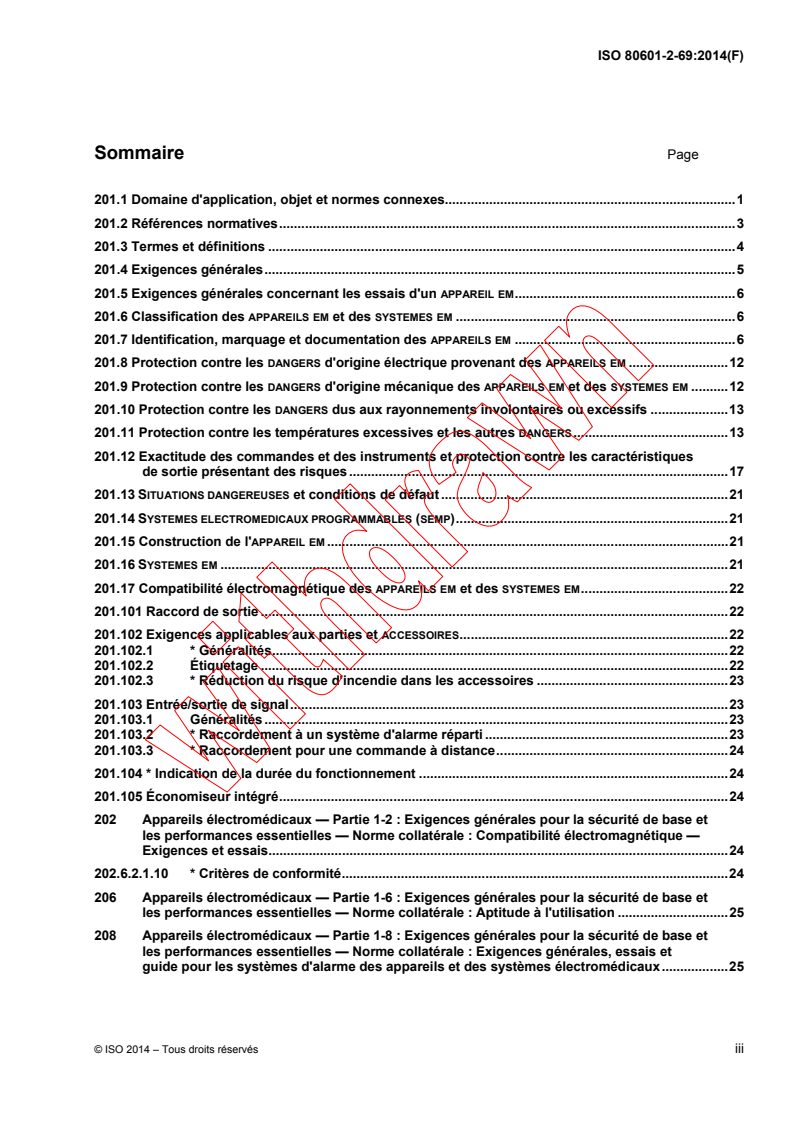
Sommaire Page
201.1 Domaine d'application, objet et normes connexes . 1
201.2 Références normatives . 3
201.3 Termes et définitions . 4
201.4 Exigences générales . 5
201.5 Exigences générales concernant les essais d'un APPAREIL EM . 6
201.6 Classification des APPAREILS EM et des SYSTEMES EM . 6
201.7 Identification, marquage et documentation des APPAREILS EM . 6
201.8 Protection contre les DANGERS d'origine électrique provenant des APPAREILS EM . 12
201.9 Protection contre les DANGERS d'origine mécanique des APPAREILS EM et des SYSTEMES EM . 12
201.10 Protection contre les DANGERS dus aux rayonnements involontaires ou excessifs . 13
201.11 Protection contre les températures excessives et les autres DANGERS . 13
201.12 Exactitude des commandes et des instruments et protection contre les caractéristiques
de sortie présentant des risques . 17
201.13 SITUATIONS DANGEREUSES et conditions de défaut . 21
201.14 SYSTEMES ELECTROMEDICAUX PROGRAMMABLES (SEMP) . 21
201.15 Construction de l'APPAREIL EM . 21
201.16 SYSTEMES EM . 21
201.17 Compatibilité électromagnétique des APPAREILS EM et des SYSTEMES EM . 22
201.101 Raccord de sortie . 22
201.102 Exigences applicables aux parties et ACCESSOIRES . 22
201.102.1 * Généralités . 22
201.102.2 Étiquetage . 22
201.102.3 * Réduction du risque d'incendie dans les accessoires . 23
201.103 Entrée/sortie de signal . 23
201.103.1 Généralités . 23
201.103.2 * Raccordement à un système d'alarme réparti . 23
201.103.3 * Raccordement pour une commande à distance . 24
201.104 * Indication de la durée du fonctionnement . 24
201.105 Économiseur intégré . 24
202 Appareils électromédicaux — Partie 1-2 : Exigences générales pour la sécurité de base et
les performances essentielles — Norme collatérale : Compatibilité électromagnétique —
Exigences et essais . 24
202.6.2.1.10 * Critères de conformité . 24
206 Appareils électromédicaux — Partie 1-6 : Exigences générales pour la sécurité de base et
les performances essentielles — Norme collatérale : Aptitude à l'utilisation . 25
208 Appareils électromédicaux — Partie 1-8 : Exigences générales pour la sécurité de base et
les performances essentielles — Norme collatérale : Exigences générales, essais et
guide pour les systèmes d'alarme des appareils et des systèmes électromédicaux . 25
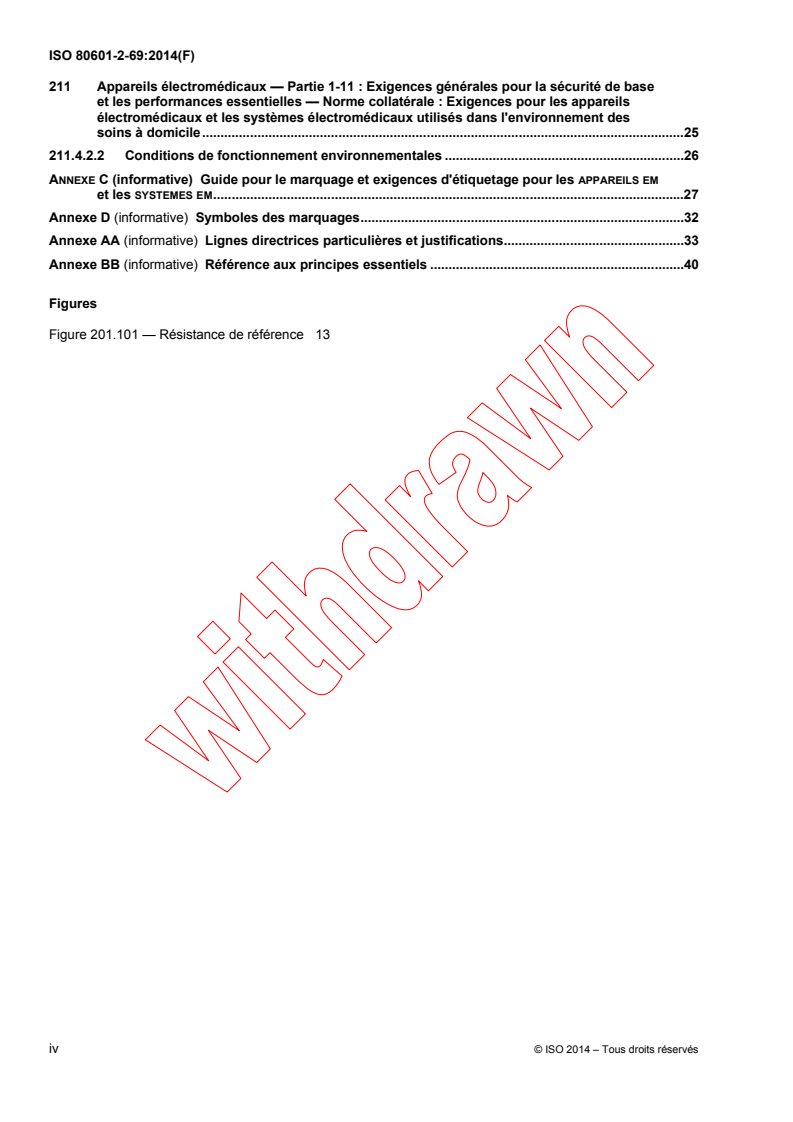
211 Appareils électromédicaux — Partie 1-11 : Exigences générales pour la sécurité de base
et les performances essentielles — Norme collatérale : Exigences pour les appareils
électromédicaux et les systèmes électromédicaux utilisés dans l'environnement des
soins à domicile .25
211.4.2.2 Conditions de fonctionnement environnementales .26
ANNEXE C (informative) Guide pour le marquage et exigences d'étiquetage pour les APPAREILS EM
et les SYSTEMES EM .27
Annexe D (informative) Symboles des marquages .32
Annexe AA (informative) Lignes directrices particulières et justifications .33
Annexe BB (informative) Référence aux principes essentiels .40
Figures
Figure 201.101 — Résistance de référence 13
iv © ISO 2014 – Tous droits réservés
Avant-propos
L'ISO (Organisation internationale de normalisation) est une fédération mondiale d'organismes nationaux de
normalisation (comités membres de l'ISO). L'élaboration des Normes internationales est en général confiée
aux comités techniques de l'ISO. Chaque comité membre intéressé par une étude a le droit de faire partie du
comité technique créé à cet effet. Les organisations internationales, gouvernementales et non
gouvernementales, en liaison avec l'ISO participent également aux travaux. L'ISO collabore étroitement avec
la Commission électrotechnique internationale (IEC) en ce qui concerne la normalisation électrotechnique.
Les Normes internationales sont rédigées conformément aux règles données dans les Directives ISO/IEC,
Partie 2.
La tâche principale des comités techniques est d'élaborer les Normes internationales. Les projets de Normes
internationales adoptés par les comités techniques sont soumis aux comités membres pour vote. Leur
publication comme Normes internationales requiert l'approbation de 75 % au moins des comités membres
votants.
L'attention est appelée sur le fait que certains des éléments du présent document peuvent faire l'objet de
droits de propriété intellectuelle ou de droits analogues. L'ISO ne saurait être tenue pour responsable de ne
pas avoir identifié de tels droits de propriété et averti de leur existence.
L'ISO/IEC 80601-2-69 a été élaborée par le comité technique ISO/TC 121, Matériel d'anesthésie et de
réanimation respiratoire, sous-comité SC 3, Ventilateurs pulmonaires et équipements connexes et par le
comité technique IEC/TC 62, Équipements électriques dans la pratique médicale, sous-comité SC D,
Équipements électriques.
Cette première édition de l'ISO 80601-2-69 annule et remplace la première édition de l'ISO 8359:1996. Cette
édition de l'ISO 80601-2-69 constitue une révision technique majeure de l'ISO 8359:1996 et inclut un
alignement sur la troisième édition de l’IEC 60601-1 et sur l’IEC 60601-1-11.
Les plus importantes modifications apportées sont les suivantes :
généralisation du domaine d'application afin d'inclure non seulement le CONCENTRATEUR D'OXYGENE mais
également ses ACCESSOIRES, du fait que les caractéristiques de ces ACCESSOIRES peuvent avoir un impact
sur la SECURITE DE BASE et les PERFORMANCES ESSENTIELLES du CONCENTRATEUR D'OXYGENE,
identification des PERFORMANCES ESSENTIELLES pour le CONCENTRATEUR D'OXYGENE et ses ACCESSOIRES,
et les éléments suivants ont été ajoutés :
essais des performances de fourniture d'oxygène,
nouveaux symboles,
nouvelle exigence applicable à un moyen d'empêcher la propagation de flammes dans le
CONCENTRATEUR D'OXYGENE et ses ACCESSOIRES,
essai des PROCEDURES de nettoyage et de désinfection et
prise en considération de l'éventuelle contamination du gaz respiratoire délivré au PATIENT et
provenant des voies d'acheminement de gaz.
Dans la présente Norme, les caractères suivants sont employés :
Exigences et définitions : caractères romains.
Modalités d'essais : caractères italiques.
Indications de nature informative hors des tableaux, comme les notes, les exemples et les références : petits caractères.
Le texte normatif à l'intérieur des tableaux est également en petits caractères.
TERMES DEFINIS DANS L'ARTICLE 3 DE LA NORME GENERALE, DANS LA PRESENTE NORME PARTICULIERE OU TELS QUE
MENTIONNES : PETITES MAJUSCULES.
Concernant la structure de la présente Norme, le terme
« article » désigne l'une des dix-sept sections numérotées dans la table des matières, avec toutes ses
subdivisions (par exemple, l'Article 7 inclut les Paragraphes 7.1, 7.2, etc.),
« paragraphe » désigne une subdivision numérotée d'un article (par exemple, 201.7.1, 201.7.2 et 201.7.2.1
sont des paragraphes appartenant à l'Article 201.7).
Dans la présente Norme, les références à des articles sont précédées du mot « Article » suivi du numéro de
l'articl e concerné. Dans la présente Norme, les références aux paragraphes utilisent uniquement le numéro
du paragraphe concerné.
Dans la présente Norme, la conjonction « ou » est utilisée avec la valeur d'un « ou inclusif », ainsi un énoncé
est vrai si une combinaison des conditions quelle qu'elle soit est vraie.
Les formes verbales utilisées dans la présente Norme sont conformes à l'usage donné à l'Annexe H des
Directives ISO/IEC, Partie 2. Pour les besoins de la présente Norme :
« devoir » mis au présent de l'indicatif signifie que la satisfaction à une exigence ou à un essai est obligatoire
pour la conformité à la présente Norme,
« il convient/il est recommandé » signifie que la satisfaction à une exigence ou à un essai est recommandée
mais n'est pas obligatoire pour la conformité à la présente Norme,
« pouvoir » mis au présent de l'indicatif est utilisé pour décrire un moyen admissible de satisfaire à une
exigence ou à un essai.
Lorsqu'un astérisque (*) est utilisé comme premier caractère devant un titre, au début d'un titre de paragraphe
ou de tableau, il indique l'existence d'une ligne directrice ou d'une justification à consulter à l'Annexe A.
L'attention des Organismes Membres et des Comités Nationaux est appelée sur le fait que les fabricants
d'équipements et les organisations en charge des essais peuvent avoir besoin d'une période de transition
après la publication d'une norme ISO ou IEC nouvelle, amendée ou révisée, leur permettant de rendre leurs
produits conformes aux nouvelles exigences et de s'équiper afin de pouvoir mener les essais nouveaux ou
révisés. Le comité formule la recommandation que le contenu de la présente Norme ne soit pas considéré
comme une obligation de mise en œuvre sur le plan national dans les trois années à compter de la date de
publication pour un équipement de conception nouvelle et dans les cinq années à compter de la date de
publication pour un équipement déjà placé en cycle de fabrication.
vi © ISO 2014 – Tous droits réservés
Introduction
La supplémentation en oxygène peut faire partie de la gestion des PATIENTS présentant des troubles
respiratoires chroniques, aigus et aigus en plus d'être chroniques. La quantité de supplément d'oxygène varie
en fonction des besoins individuels du PATIENT dans différentes conditions. L'équipe chargée de gérer les
soins de santé prescrit habituellement l'objectif du traitement, par exemple une valeur cible pour la saturation
en oxygène. La quantité de supplément d'oxygène peut être contrôlée par le débit.
Le but d'une oxygénothérapie à long terme est de maintenir la saturation en oxygène au-dessus de 90 %
chez les PATIENTS nécessitant un supplément d'oxygène. Il convient d'ajuster le débit pour le repos, l'effort
PATIENT dans ces différentes conditions.
physique et le sommeil afin de satisfaire aux besoins individuels du
En principe, le débit au repos est ajusté de sorte à maintenir une SpO > 90 % selon l'oxymétrie de pouls.
Le supplément d'oxygène est fourni par différentes sources : des SYSTEMES DE DISTRIBUTION DE GAZ MEDICAUX,
des CONCENTRATEURS D'OXYGENE, des bouteilles de gaz comprimé et des réservoirs d'oxygène liquide. La
présente Norme couvre les exigences particulières applicables à la SECURITE DE BASE et aux PERFORMANCES
ESSENTIELLES des CONCENTRATEURS D'OXYGENE. Les CONCENTRATEURS D'OXYGENE produisent de l'air enrichi en
oxygène à partir de l'air ambiant en vue d'une fourniture à un PATIENT nécessitant une oxygénothérapie. Les
CONCENTRATEURS D'OXYGENE les plus courants utilisent des lits de tamis moléculaires pour filtrer et concentrer
les molécules d'oxygène de l'air ambiant, en générant des concentrations en oxygène habituellement
comprises entre 82 % et 96 %. Le principal composant de ce type de CONCENTRATEUR D'OXYGENE est le tamis
moléculaire, qui adsorbe l'azote de l'air afin de produire un gaz habituellement constitué d'un mélange de
95 % d'oxygène et de 5 % d'autres gaz. L'adsorption et la purge périodiques de l'azote constituent le
processus d'adsorption par oscillation de la pression.
NORME INTERNATIONALE ISO 80601-2-69:2014(F)
Appareils électromédicaux —
Partie 2-69:
Exigences particulières pour la sécurité de base et les
performances essentielles des dispositifs concentrateurs
d'oxygène
201.1 Domaine d'application, objet et normes connexes
L’IEC 60601-1:2005, Article 1 + Amendement 1:2012 s'appliquent, à l'exception de ce qui suit :
201.1.1 Domaine d'application
L’IEC 60601-1:2005, 1.1 + Amendement 1:2012 sont remplacés par :
La présente Norme particulière spécifie les exigences applicables à la SECURITE DE BASE et aux
PERFORMANCES ESSENTIELLES d'un CONCENTRATEUR D'OXYGENE en combinaison avec ses ACCESSOIRES,
désigné ci-après sous le terme d'APPAREIL EM, visant à augmenter la concentration en oxygène du gaz destiné
à être délivré à un PATIENT unique. De tels CONCENTRATEURS D'OXYGENE sont, en général, destinés à être
utilisés dans un ENVIRONNEMENT DE SOINS A DOMICILE, et sont également OPERATIONNELS EN DEPLACEMENT pour
un PATIENT unique dans divers environnements, dans les transports publics et privés ainsi que dans les
transports aériens.
NOTE 1 Ce type de CONCENTRATEUR D'OXYGENE peut également être utilisé dans des établissements de santé.
La présente Norme particulière est applicable aux CONCENTRATEURS D'OXYGENE OPERATIONNELS EN
DEPLACEMENT et non OPERATIONNELS EN DEPLACEMENT. La présente Norme particulière est applicable aux
CONCENTRATEURS D'OXYGENE intégrés ou utilisés avec d'autres dispositifs médicaux, APPAREILS EM ou
SYSTEMES EM.
EXEMPLE 1 Un CONCENTRATEUR D'OXYGENE à ECONOMISEUR d'oxygène intégré [10] ou humidificateur [4] intégré.
EXEMPLE 2 Un CONCENTRATEUR D'OXYGENE utilisé avec un débitmètre.
EXEMPLE 3 Un CONCENTRATEUR D'OXYGENE faisant partie d'un système d'anesthésie pour utilisation dans des zones
avec équipement logistique limité en électricité et en gaz anesthésiques. [3]
EXEMPLE 4 Un CONCENTRATEUR D'OXYGENE à système de remplissage de réservoir de liquide intégré ou à système de
remplissage de bouteilles de gaz intégré.
La présente Norme particulière s'applique également aux ACCESSOIRES destinés par leur FABRICANT à être
raccordés à un CONCENTRATEUR D'OXYGENE, du fait que les caractéristiques de ces ACCESSOIRES peuvent
avoir un impact sur la SECURITE DE BASE ou sur les PERFORMANCES ESSENTIELLES du CONCENTRATEUR
D'OXYGENE.
La présente Norme particulière ne spécifie pas les exigences applicables à l'utilisation de CONCENTRATEURS
D'OXYGENE avec un SYSTEME DE DISTRIBUTION DE GAZ MEDICAUX, stipulées dans l'ISO 10083.
Si un article ou un paragraphe est spécifiquement destiné à être appliqué uniquement aux APPAREILS EM ou
uniquement aux SYSTEMES EM, le titre et le contenu de l'article ou du paragraphe en question l'indiquent. Si
cela n'est pas le cas, l'article ou le paragraphe s'applique à la fois aux APPAREILS EM et aux SYSTEMES EM,
selon le cas.
Les DANGERS inhérents à la fonction physiologique prévue des APPAREILS EM ou des SYSTEMES EM dans le
cadre d u domaine d'application de la présente Norme ne sont pas couverts par des exigences spécifiques
conte nues dans la présente Norme, à l'exception de 7.2.13 et 8.4.1 de la norme générale.
NOTE 2 Voir également 4.2 de la norme générale.
La présente Norme internationale est une norme particulière de la série de normes IEC 60601-1.
201.1.2 Objet
L’IEC 60601-1:2005, 1.2 est remplacée par :
La présente Norme internationale est destinée à spécifier des exigences particulières concernant la SECURITE
DE BASE et les PERFORMANCES ESSENTIELLES applicables à un CONCENTRATEUR D'OXYGENE [comme défini
en 201.3.203] et à ses ACCESSOIRES.
NOTE Les ACCESSOIRES sont inclus du fait que la combinaison du CONCENTRATEUR D'OXYGENE et des ACCESSOIRES
nécessite un niveau de sécurité adéquat. Les ACCESSOIRES peuvent avoir un impact significatif sur la SECURITE DE BASE ou
sur les PERFORMANCES ESSENTIELLES d'un CONCENTRATEUR D'OXYGENE.
201.1.3 Normes collatérales
L’IEC 60601-1:2005, 1.3 + Amendement 1:2012 s'appliquent avec l'ajout suivant :
La présente Norme particulière fait référence aux normes collatérales applicables qui sont répertoriées dans
l’IEC 60601-1:2005 + Amendement 1:2012, dans l'Article 2 de la norme générale et en 201.2 de la présente
Norme particulière.
L’IEC 60601-1-3:2008 + Amendement 1:2013 ne s'applique pas.
201.1.4 Normes particulières
L’IEC 60601-1:2005, 1.4 + Amendement 1:2012 sont remplacés par :
Dans la série IEC 60601, des normes particulières peuvent modifier, remplacer ou supprimer des exigences
contenues dans la norme générale, notamment les normes collatérales, selon ce qui est approprié pour
l'APPAREIL EM particulier considéré, et elles peuvent ajouter d'autres exigences concernant la SECURITE DE
BASE ou les PERFORMANCES ESSENTIELLES.
Une exigence d'une norme particulière prévaut sur l'exigence correspondante de la norme générale ou des
normes collatérales.
Dans un souci de concision, l’IEC 60601-1:2005 + Amendement 1:2012 sont désignés dans la présente
Norme particulière par l'expression « norme générale ». Les normes collatérales sont désignées par leur
numéro de document.
La numérotation des articles et des paragraphes de la présente Norme particulière correspond à celle de la
norme générale avec le préfixe « 201 » (par exemple, 201.1 dans la présente Norme traite du contenu de
l'Article 1 de la norme générale) ou de la norme collatérale applicable avec le préfixe « 2xx », où xx
représente les chiffres finaux du numéro de document de la norme collatérale (par exemple, 202.4 dans la
présente Norme particulière traite du contenu de l'Article 4 de la norme collatérale IEC 60601-1-2, 208.4 dans
la présente Norme particulière traite du contenu de l'Article 4 de la norme collatérale IEC 60601-1-8, etc.). Les
changements apportés au texte de la norme générale sont spécifiés au moyen des termes suivants :
2 © ISO 2014 – Tous droits réservés
« Remplacement » signifie que l'article ou le paragraphe de la norme générale ou de la norme collatérale
applicable est remplacé totalement par le texte de la présente Norme particulière.
« Ajout » signifie que le texte de la présente Norme particulière s'ajoute aux exigences de la norme générale
ou de la norme collatérale applicable.
« Modification » signifie que l'article ou le paragraphe de la norme générale ou de la norme collatérale
applicable est modifié comme cela est indiqué par le texte de la présente Norme particulière.
Les paragraphes ou les figures ajoutés à ceux de la norme générale sont numérotés à partir de 201.101. Les
annexes supplémentaires sont désignées par les lettres AA, BB, etc. et les éléments supplémentaires par aa),
bb), etc.
Les paragraphes ou les figures qui sont ajoutés à ceux d'une norme collatérale sont numérotés à partir de
2xx, où « x » est le numéro de la norme collatérale, par exemple 202 pour l’IEC 60601-1-2, 203 pour
l’IEC 60601-1-3, etc.
L'expression « la présente Norme » est utilisée pour faire référence à la norme générale, à toutes les normes
collatérales applicables et à la présente Norme particulière considérées ensemble.
Lorsqu'il n'existe aucun article ni aucun paragraphe correspondant dans la présente Norme particulière,
l'article ou le paragraphe de la norme générale ou de la norme collatérale applicable, bien qu'éventuellement
sans intérêt, s'applique sans modification. Lorsqu'il est envisagé que toute partie de la norme générale ou de
la norme collatérale applicable, bien qu'éventuellement intéressante, ne doit pas être appliquée, une
indication est donnée à cet effet dans la présente Norme particulière.
201.2 Références normatives
Les documents ci-après, dans leur intégralité ou non, sont des références normatives indispensables à
l'application du présent document. La manière dont ces documents de référence sont cités dans les
exigences normatives détermine dans quelle mesure ils s'appliquent (en totalité ou en partie). Pour les
références datées, seule l'édition citée s'applique. Pour les références non datées, la dernière édition du
document de référence s'applique (y compris les éventuels amendements).
NOTE Les références informatives sont répertoriées dans la bibliographie commençant à la page 42.
L’IEC 60601-1:2005, Article 2 + Amendement 1:2012 s'appliquent, à l'exception de ce qui suit :
Remplacement :
IEC 60601-1-2:2007, Appareils électromédicaux — Partie 1-2 : Exigences générales pour la sécurité de base
et les performances essentielles — Norme collatérale : Compatibilité électromagnétique — Exigences et
essais
IEC 60601-1-6:2010, Appareils électromédicaux — Partie 1-6 : Exigences générales pour la sécurité de base
et les performances essentielles — Norme collatérale : Aptitude à l'utilisation
+ Amendement 1:2013
IEC 60601-1-8:2006, Appareils électromédicaux — Partie 1-8 : Exigences générales pour la sécurité de base
et les performances essentielles — Norme collatérale : Exigences générales, essais et guide pour les
systèmes d'alarme des appareils et des systèmes électromédicaux
+ Amendement 1:2012
IEC 60601-1-11:2010, Appareils électromédicaux — Partie 1-11 : Exigences générales pour la sécurité de
base et les performances essentielles — Norme collatérale : Exigences pour les appareils électromédicaux et
les systèmes électromédicaux utilisés dans l'environnement des soins à domicile
Ajout :
ISO 3744:2010, Acoustique — Détermination des niveaux de puissance acoustique et des niveaux d'énergie
acoustique émis par les sources de bruit à partir de la pression acoustique — Méthodes d'expertise pour des
conditions approchant celles du champ libre sur plan réfléchissant
ISO 7000:2012, Symboles graphiques utilisables sur le matériel — Symboles enregistrés
ISO 7010:2011, Symboles graphiques — Couleurs de sécurité et signaux de sécurité — Signaux de sécurité
enregi strés
+ Amendement 1:2012
+ Amendement 2:2012
ISO 14937:2009, Stérilisation des produits de santé — Exigences générales pour la caractérisation d'un agent
stérilisant et pour la mise au point, la validation et la vérification de routine d'un processus de stérilisation pour
dispositifs médicaux
ISO 15223-1:2012, Dispositifs médicaux — Symboles à utiliser avec les étiquettes, l'étiquetage et les
informations à fournir relatifs aux dispositifs médicaux — Partie 1 : Exigences générales
ISO/DIS 14644-1:2010, Salles propres et environnements maîtrisés apparentés — Partie 1 : Classification de
la propreté particulaire de l'air
ISO 17664:2004, Stérilisation des dispositifs médicaux — Informations devant être fournies par le fabricant
pour le processus de restérilisation des dispositifs médicaux
ISO 80369-1:2010, Raccords de petite taille pour liquides et gaz utilisés dans le domaine de la santé —
Partie 1 : Exigences générales
ISO 80601-2-67:2014, Appareils électromédicaux — Partie 2-67 : Exigences particulières pour la sécurité de
base et les performances essentielles des économiseurs d'oxygène
IEC 60601-1:2005, Appareils électromédicaux — Partie 1 : Exigences générales pour la sécurité de base et
les performances essentielles
Amendement 1:2012
IEC 62366:2007, Dispositifs médicaux — Application de l'ingénierie de l'aptitude à l'utilisation aux dispositifs
médicaux
+ Amendement 1:2014
EN 15986:2011, Symbole à utiliser pour l'étiquetage des dispositifs médicaux — Exigences relatives à
l'étiquetage des dispositifs médicaux contenant des phtalates
201.3 Termes et définitions
Pour les besoins du présent document, les termes et définitions donnés dans l'ISO 3744:2010,
l'ISO 4135:2001, l'ISO 7396-1:2007, l’IEC 60601-1:2005 + Amendement 1:2012, l’IEC 60601-1-2:2007,
l’IEC 60601-1-6:2010 + Amendement 1:2013, l’IEC 60601-1-8:2006 + Amendement 1:2012, l’IEC 60601-1-
11:2010 et l’IEC 62366:2007 + Amendement 1:2014, ainsi que les suivants s'appliquent.
NOTE Un index des termes définis est fourni à la page 43.
Ajout :
201.3.201
DISPOSITIF SENSIBLE AU SENS DU DEBIT
dispositif ou ACCESSOIRE à travers lequel le courant gazeux ne doit s'écouler que dans une seule direction
PATIENT
pour que soient assurés le fonctionnement correct du dispositif ou la sécurité du
4 © ISO 2014 – Tous droits réservés
[ISO 4135:2001, définition 3.1.7, modifié]
201.3.202
PRESSION LIMITEE MAXIMALE
P
LIM max
pression la plus haute à la sortie du CONCENTRATEUR D'OXYGENE lors d'une UTILISATION NORMALE ou en
CONDITION DE PREMIER DEFAUT
201.3.203
CONCENTRATEUR D'OXYGENE
APPAREIL EM qui, par une suppression sélective des constituants de l'air ambiant, augmente la concentration
en oxygène dans le gaz de sortie
201.4 Exigences générales
L’IEC 60601-1:2005, Article 4 + Amendement 1:2012 s'appliquent, à l'exception de ce qui suit :
201.4.3 PERFORMANCES ESSENTIELLES
L’IEC 60601-1:2005, 4.3 + Amendement 1:2012 s'appliquent, à l'exception de ce qui suit :
Paragraphe supplémentaire :
201.4.3.101 * Exigences supplémentaires concernant les PERFORMANCES ESSENTIELLES
Les exigences supplémentaires concernant les PERFORMANCES ESSENTIELLES sont stipulées dans les
paragraphes répertoriés dans le Tableau 201.101.
Tableau 201.101 — Répartition des exigences concernant les PERFORMANCES ESSENTIELLES
Exigence Paragraphe
a
Fourniture d'oxygène, aussi bien en CONDITION NORMALE qu'en CONDITION DE
201.12.1.101
PREMIER DEFAUT, respectant les niveaux de performance indiqués dans les
201.12.1.102
instructions d'utilisation ou génération d'une CONDITION D'ALARME
201.12.1.103
201.11.8.101.1
CONDITION D'ALARME TECHNIQUE signalant un défaut d'alimentation
CONDITION D'ALARME TECHNIQUE signalant une SOURCE D'ENERGIE 201.11.8.101.2
ELECTRIQUE INTERNE en voie d'épuisement
201.12.4.102
CONDITION D'ALARME TECHNIQUE signalant une faible concentration
en oxygène
CONDITION D'ALARME TECHNIQUE signalant un dysfonctionnement 201.13.2.101
201.12.4.4.101.2
CONDITION D'ALARME TECHNIQUE signalant une période de
démarrage
a
Le Paragraphe 202.6.2.1.10 indique des méthodes d'évaluation de la concentration en
oxygène délivrée par le biais d'essais spécifiques suivant des critères d'acceptation requis par la
présente Norme.
201.4.6 * Parties d'APPAREIL EM ou de SYSTEME EM en contact avec le PATIENT
Modification (ajout à la fin du 4.6 avant la vérification de conformité) :
Les voies d'acheminement de gaz d'un CONCENTRATEUR D'OXYGENE ou ses parties ou ACCESSOIRES doivent
être soumis aux exigences applicables aux PARTIES APPLIQUEES conformément au présent Paragraphe. Un
CONCENTRATEUR D'OXYGENE ou ses parties ou ACCESSOIRES qui peuvent entrer en contact avec le PATIENT
doivent être soumis aux exigences applicables aux PARTIES APPLIQUEES conformément au présent
Paragraphe.
201.5 Exigences générales concernant les essais d'un APPAREIL EM
L’IEC 60601-1:2005, Article 5 + Amendement 1:2012 s'appliquent, à l'exception de ce qui suit :
Ajout :
201.5.101 Exigences supplémentaires s'ajoutant aux exigences générales concernant les
essais d'un APPAREIL EM
201.5.101.1 * Erreurs d'essai d'un APPAREIL EM
Pour les besoins de la présente Norme, les tolérances déclarées dans les DOCUMENTS D'ACCOMPAGNEMENT
doivent inclure l'incertitude des mesures utilisées pour la détermination de la spécification.
201.6 Classification des APPAREILS EM et des SYSTEMES EM
L’IEC 60601-1:2005, Article 6 + Amendement 1:2012 s'appliquent.
201.7 Identification, marquage et documentation des APPAREILS EM
L’IEC 60601-1:2005, Article 7 + Amendement 1:2012 s'appliquent, à l'exception de ce qui suit :
201.7.1.2 * Lisibilité des marquages
L’IEC 60601-1:2005, 7.1.2 + Amendement 1:2012 s'appliquent, à l'exception de ce qui suit :
Remplacement (à la fin de la deuxième phrase du deuxième alinéa de la vérification de conformité) :
Remplacer « de 1 m » par « de 1 m et, pour un APPAREIL EM PORTE SUR LE CORPS, de 0,5 m ».
Paragraphes supplémentaires :
201.7.2.4.101 Exigences supplémentaires applicables aux ACCESSOIRES
Les ACCESSOIRES fournis séparément doivent respecter les exigences du 201.7.2.101 et doivent être marqués
par une indication stipulant toutes limitations ou tous effets néfastes de l'ACCESSOIRE sur la SECURITE DE BASE
ou sur les PERFORMANCES ESSENTIELLES du CONCENTRATEUR D'OXYGENE, le cas échéant. Lorsque le marquage
de l'ACCESSOIRE s'avère impossible, ces informations peuvent figurer dans les instructions d'utilisation.
Vérifier la conformité par inspection et par inspection du DOSSIER DE GESTION DES RISQUES en ce qui concerne
toutes limitations ou tous effets néfastes de l'ACCESSOIRE.
201.7.2.13.101 Exigences supplémentaires concernant les effets physiologiques
Tous composants des voies d'acheminement de gaz ou tous ACCESSOIRES contenant du latex naturel doivent
être marqués comme contenant du latex. Ce marquage doit être CLAIREMENT LISIBLE. Il est permis d'utiliser le
symbole 5.45 de l'ISO 15223-1:2012 (Tableau 201.D.1.101, symbole 3). Les instructions d'utilisation doivent
également décrire tous les composants contenant du latex naturel.
Vérifier la conformité par inspection.
6 © ISO 2014 – Tous droits réservés
201.7.2.17.101 Exigences supplémentaires applicables aux emballages de protection
L'indication d'un usage unique doit concorder avec la REFERENCE DU MODELE OU DU TYPE. L'emballage des
REFERENCES DE MODELE OU DE TYPE destinées à un usage unique doit être marqué en conséquence.
Les emballages doivent être CLAIREMENT LISIBLES et doivent être marqués de la manière suivante :
a) avec une description du contenu,
b) avec une référence d'identification du lot, un numéro de type ou de série ou le symbole 5.1.5 ou 5.1.7 de
l'ISO 15223-1:2012 (Tableau 201.D.1.101, symbole 1 ou symbole 2),
c) avec, pour les emballages contenant du latex naturel, le terme « LATEX » ou le symbole 5.35 de
l'ISO 15223-1:2012 (Tableau 201.D.1.101, symbole 3).
Vérifier la conformité par inspection.
201.7.2.101 Exigences supplémentaires applicables au marquage à l'extérieur des
APPAREILS EM ou de leurs parties
Le marquage d'un APPAREIL EM et de ses parties ou ACCESSOIRES doit être CLAIREMENT LISIBLE et doit inclure
les éléments suivants :
a) toutes les instructions particulières de stockage et/ou de manutention,
b) tous les avertissements particuliers et/ou toutes les précautions particulières pertinents pour le
fonctionnement immédiat du CONCENTRATEUR D'OXYGENE.
Le cas échéant, le marquage d'un APPAREIL EM accessible à l'OPERATEUR et de ses parties ou ACCESSOIRES
doit être CLAIREMENT LISIBLE et doit inclure les éléments suivants :
c) une flèche indiquant le sens du débit pour les DISPOSITIFS SENSIBLES AU SENS DU DEBIT qui peuvent être
retirés par l'OPERATEUR sans l'aide d'un OUTIL,
d) un avertissement précisant que les CAPOTS D'ACCES ne doivent pas être enlevés par une personne non
autorisée.
Vérifier la conformité par inspection.
201.7.4.3 * Unités de mesure
L’IEC 60601-1:2005, 7.4.3 + Amendement 1:2012 s'appliquent, à l'exception de ce qui suit :
Modification (ajout en bas du Tableau 1 d'une nouvelle ligne) :
Les spécifications de volume et de débit applicables au gaz délivré au PATIENT doivent être exprimées dans
les conditions ambiantes de température et de pression en atmosphère sèche.
NOTE Pour les besoins de la présente Norme, les conditions ambiantes de température et de pression en
atmosphère sèche correspondent à la pression et à la température atmosphériques locales, en atmosphère sèche.
201.7.5 Signaux de sécurité
L’IEC 60601-1:2005, 7,5 + Amendement 1:2012 s'appliquent, à l'exception de ce qui suit :
Modification (ajout avant l'essai de conformité) :
Les signaux de sécurité ci-après doivent être CLAIREMENT LISIBLES à partir de la position prévue de
l'OPERATEUR et doivent comprendre les marquages suivants :
a) signal de sécurité ISO 7010-P002 (Tableau 201.D.2.101, signal de sécurité 1) ou avertissement indiquant
« Défense de fumer »,
b) signal de sécurité ISO 7010-P003 (Tableau 201.D.2.101, signal de sécurité 2) ou avertissement indiquant
« Flammes nues interdites ».
201.7.9.1 Exigences générales supplémentaires
L’IEC 60601-1:2005, 7.9.1 + Amendement 1:2012 s'appliquent, à l'exception de ce qui suit :
Modification (rem placer le premier tiret par) :
– le nom ou la dénomination commerciale ainsi que l'adresse
du FABRICANT, et
si le FABRICANT ne dispose pas d'une adresse au niveau d'une zone géographique donnée, du
représentant autorisé dans cette zone,
à laquelle l'ORGANISME RESPONSABLE peut s'adresser.
201.7.9.2 Instructions d'utilisation
L’IEC 60601-1:2005, 7.9.2 + Amendement 1:2012 s'appliquent, à l'exception de ce qui suit :
Paragraphes supplémentaires :
201.7.9.2.1.101 Exigences générales supplémentaires
Les instructions d'utilisation doivent inclure les éléments suivants :
a) une mention stipulant le temps nécessaire à compter du démarrage du CONCENTRATEUR D'OXYGENE avant
que ce dernier ne soit en mesure de fournir le débit et la concentration en oxygène définis,
b) une mention stipulant qu'il convient de placer l'entrée d'air ainsi que l'évacuation du CONCENTRATEUR
D'OXYGENE dans un espace bien aéré,
c) une mention conseillant l'OPERATEUR sur les mesures à prendre lorsque le CONCENTRATEUR D'OXYGENE
indique une condition anormale,
d) une mention stipulant qu'il convient de placer le CONCENTRATEUR D'OXYGENE dans un endroit exempt de
polluants et de fumées,
e) si le CONCENTRATEUR D'OXYGENE et ses parties ou ACCESSOIRES sont destinés à un usage unique, des
informations sur les caractéristiques et facteurs techniques connus du FABRICANT qui sont susceptibles
d'engendrer un RISQUE si le CONCENTRATEUR D'OXYGENE et ses parties ou ACCESSOIRES sont réutilisés,
f) une mention stipulant qu'il convient de réexaminer de manière périodique les réglages de fourniture
d'oxygène du concentrateur d'oxygène pour l'efficacité du traitement.
NOTE Dans certains pays, il incombe au médecin superviseur de réexaminer de manière périodique les réglages de
fourniture d'oxygène.
Le cas échéant, les instructions d'utilisation doivent stipuler les éléments suivants :
g) au moins un type d'humidificateur pouvant fonctionner avec le CONCENTRATEUR D'OXYGENE et son
emplacement préférentiel.
Vérifier la conformité par inspection.
201.7.9.2.2.101 Exigences supplémentaires applicables aux avertissements et aux consignes
de sécurité
Les instructions d'utilisation doivent inclure :
8 © ISO 2014 – Tous droits réservés
a) l'avertissement suivant : « AVERTISSEMENT : il existe un risque d'incendie associé à l'enrichissement en
oxygène pendant l'oxygénothérapie. Tenir le concentrateur d'oxygène et ses accessoires à l'écart des
étincelles et des flammes nues »,
b) l'avertissement suivant : « AVERTISSEMENT : de manière à garantir la fourniture d'une quantité
thérapeutique d'oxygène appropriée à votre état médical, le [insérer le modèle et la marque] doit
être utilisé uniquement après qu'un ou plusieurs réglages ont été déterminés ou prescrits de manière
individuelle pour vous selon vos propres niveaux d'activité,
être utilisé avec la combinaison spécifique de parties et accessoires qui sont conformes aux
spécifications du fabricant du concentrateur et qui ont été utilisés lors de la détermination de vos
réglages »,
c) l'avertissement suivant : « AVERTISSEMENT : n'utiliser que des lotions ou des baumes à base d'eau qui
sont étiquetés comme étant compatibles avec l'oxygène avant et pendant l'oxygénothérapie. Ne jamais
utiliser de lotions ou de baumes à base de pétrole ou d'huile afin d'éviter le risque d'incendie et de
brûlures »,
d) l'avertissement suivant : « AVERTISSEMENT : ne pas lubrifier les appareillages, raccords, systèmes de
tubulures ou autres accessoires du concentrateur d'oxygène afin d'éviter le risque d'incendie et de
brûlures »,
e) l'avertissement suivant : « AVERTISSEMENT : n'utiliser que des pièces de rechange recommandées par
le fabricant pour garantir un fonctionnement correct et éviter le risque d'incendie et de brûlures »,
f) l'avertissement suivant : « AVERTISSEMENT : l'utilisation de ce dispositif à une altitude supérieure à
[insérer l'altitude maximale ASSIGNEE] ou à une température en dehors de la plage de [insérer la plage
ASSIGNEE de température] ou à une humidité relative supérieure à [insérer l'humidité relative maximale
ASSIGNEE] est susceptible d'avoir un impact néfaste sur le débit et le pourcentage d'oxygène et par
conséquent, sur la qualité de la thérapie »,
g) l'avertissement suivant : « AVERTISSEMENT : l'oxygène facilite le départ et la propagation d'un incendie.
Ne pas laisser la canule nasale ou le masque sur les couvre-lits ou sur les coussins de siège car si le
concentrateur d'oxygène est en marche mais qu'il n'est pas utilisé, l'oxygène rendra les matériaux
inflammables. Éteindre le concentrateur d'oxygène lorsqu'il n'est pas utilisé pour arrêter l'enrichissement
en oxygène »,
h) l'avertissement suivant : « AVERTISSEMENT : si vous vous sentez mal ou si vous rencontrez une
urgence médicale alors que vous vous trouvez sous oxygénothérapie, demander immédiatement une
assistance médicale afin d'éviter tout dommage »,
i) l'avertissement suivant : « AVERTISSEMENT : un patient gériatrique, pédiatrique ou tout autre type de
patient incapable de communiquer sa gêne peut nécessiter une surveillance supplémentaire et/ou un
système d'alarme réparti pour transmettre les informations concernant la gêne et/ou l'urgence médicale
au personnel soignant responsable afin d'éviter tout dommage »,
j) l'avertissement suivant : « AVERTISSEMENT : fumer pendant une oxygénothérapie est dangereux et est
susceptible de provoquer des brûlures faciales ou le décès. Interdire de fumer dans la pièce où le
concentrateur d'oxygène ou tout accessoire transportant de l'oxygène est placé.
Si vous souhaitez fumer, vous devez toujours éteindre le concentrateur d'oxygène, enlever la canule et
quitter la pièce où la canule/le masque ou le concentrateur d'oxygène sont placés. Si vous ne pouvez pas
quitter la pièce, vous devez attendre 10 min après l'extinction du concentrateur d'oxygène avant de
fumer »,
k) l'avertissement suivant : « AVERTISSEMENT : l'usage de flammes nues pendant une oxygénothérapie
est dangereux et est susceptible de provoquer un incendie ou le décès. Interdire l'usage de flammes nues
à moins de 2 m du concentrateur d'oxygène ou de tout accessoire transportant de l'oxygène ».
Vérifier la conformité par inspection des instructions d'utilisation.
201.7.9.2.5.101 Exigences supplémentaires applicables à la description d'un APPAREIL EM
Les instructions d'utilisation doivent inclure :
a) une mention stipulant que le réglage de la fourniture d'oxygène doit être déterminé pour chaque patient
de façon individuelle avec la configuration des appareils à utiliser, y compris les accessoires,
b) une mention stipulant que l'installation et le positionnement corrects de l'interface PATIENT sont des
facteurs critiques pour l'efficacité du traitement,
EXEMPLE L'installation et le positionnement corrects des embouts de la canule nasale dans le nez sont des
facteurs critiques pour la quantité d'oxygène délivrée à l'appareil respiratoire du patient.
c) un schéma montrant le branchement des parties que l'OPERATEUR peut retirer, qu'il s'agisse de parties
fournies ou recommandées,
d) la plage ASSIGNEE de débit de fourniture d'oxygène et de concentration en oxygène en fonction du débit :
dans les conditions CNTP (conditions normales de température et de pression en atmosphère
sèche) et
NOTE Pour les besoins de la présente
...