

IEC 62343:2013
(Main)Dynamic modules - General and guidance
General Information
- Abstract
IEC 62343:2013 applies to all commercially available optical dynamic modules and devices. It describes the products covered by the IEC 62343-X series, defines terminology, fundamental considerations and basic approaches. The object of this standard is to:
- establish uniform requirements for operation, reliability and environmental properties of DMs to be implemented in the appropriate DM standard,
- provide assistance to the purchaser in the selection of consistently high-quality DM products for his particular applications, as well as in the consultation of the appropriate specific DM standard(s). This standard covers performance templates, performance standards, reliability qualification requirements, hardware and software interfaces and related testing methods. Keywords: optical dynamic modules and devices, DM
- Status
- Published
- Publication Date
- 04-Jun-2013
- Technical Committee
- SC 86C - Fibre optic systems, sensing and active devices
- Drafting Committee
- WG 5 - TC 86/SC 86C/WG 5
- Current Stage
- DELPUB - Deleted Publication
- Start Date
- 23-May-2017
- Completion Date
- 28-Aug-2026
Buy Documents
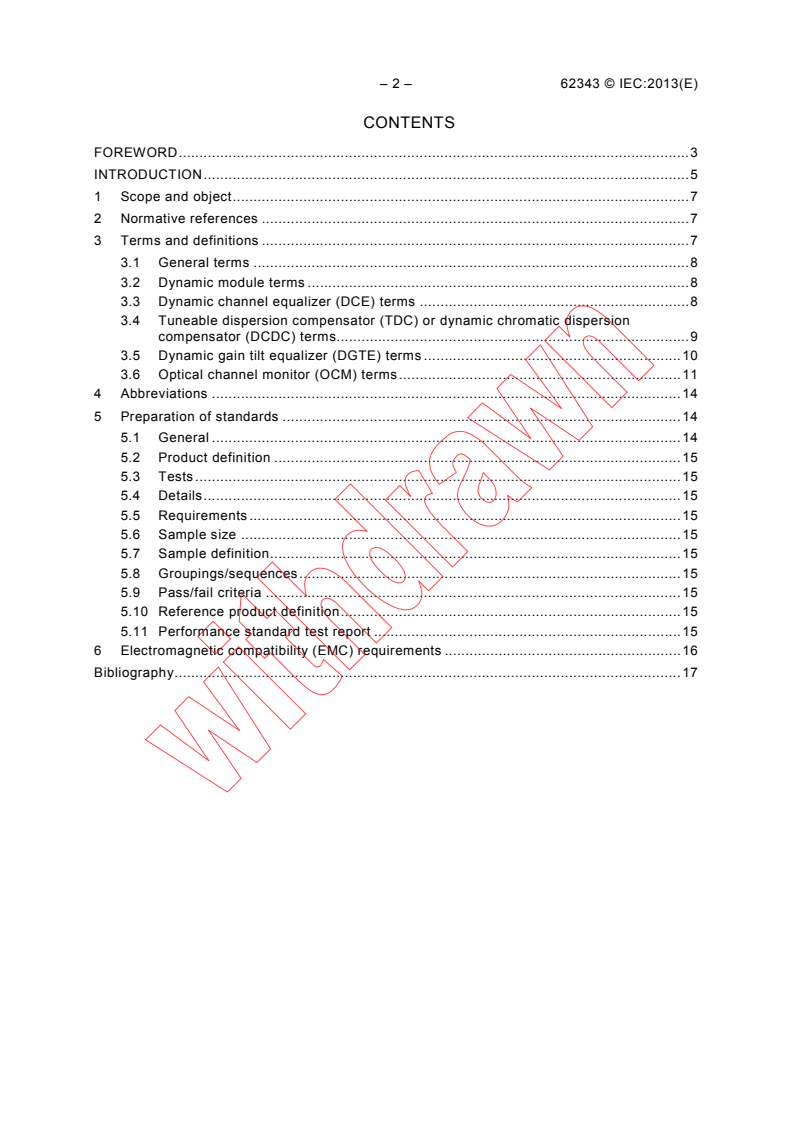
IEC 62343:2013 - Dynamic modules - General and guidance Released:6/5/2013

IEC 62343:2013 - Dynamic modules - General and guidance Released:6/5/2013
Overview
IEC 62343:2013 - Dynamic modules: General and guidance is an international standard that applies to all commercially available optical dynamic modules and devices (DMs). It defines terminology, fundamental considerations and basic approaches for the IEC 62343 series and sets out the objective to:
- establish uniform requirements for operation, reliability and environmental properties of DMs, and
- assist purchasers in selecting consistently high-quality DM products and in identifying the appropriate specific DM standard(s).
The standard frames the dynamic-module concept - “dynamic” (tuning, switching, configuring, continuous optimization via electronics/firmware/software) and “module” (integration of active/passive optical components, often packaged) - and explains why transient behaviour and control intelligence are important considerations.
Key Topics and Requirements
- Scope and definitions: Clear terminology for optical dynamic modules and related components (e.g., dynamic channel equalizer, tuneable dispersion compensator, optical channel monitor).
- Performance frameworks: Guidance on performance templates and the types of optical performance standards to be implemented in the IEC 62343-1 series.
- Reliability and qualification: Principles for reliability qualification testing and environmental property requirements to be carried into part-specific standards (IEC 62343-2 series).
- Interfaces: High-level guidance on hardware and software/firmware interfaces for dynamic modules (expanded in IEC 62343-4 series).
- Test methods: Direction on test method development and reporting conventions (detailed in IEC 62343-5 series).
- Transient behaviour: Emphasis that dynamic modules often display transient characteristics during tuning/switching; such behavior must be characterized in individual module standards.
- Purchaser guidance: How to use the series to compare, specify and procure DMs with predictable operation and reliability.
Practical Applications and Who Uses It
IEC 62343:2013 is valuable for:
- Manufacturers and product designers of optical dynamic modules (e.g., channel gain equalizers, dynamic gain tilt equalizers, tuneable chromatic dispersion compensators, reconfigurable OADMs, variable optical attenuators).
- Test laboratories and qualification engineers developing performance and reliability tests for DMs.
- System integrators and network operators selecting DMs for optical transmission networks who need consistent specifications and interface expectations.
- Procurement specialists evaluating vendor performance templates and conformity to standard requirements.
- Standards developers who extend the IEC 62343 series for new dynamic module types.
Adopting IEC 62343 helps ensure interoperability, repeatable performance characterization, and consistent reliability assessment of optical dynamic modules across the supply chain.
Related Standards
- IEC 62343-1 (Performance standards), IEC 62343-2 (Reliability qualification), IEC 62343-3 (Performance specification templates), IEC 62343-4 (Interfaces), IEC 62343-5 (Test methods), IEC 62343-6 (Technical reports)
- IEC 60050-731 (Optical fibre communications vocabulary)
- IEC/TR 61931 (Fibre optic terminology)
- IEC Guide 107 (EMC drafting guidance)
- Safety considerations: IEC TC 76 (Optical radiation safety and laser equipment)
Relations
- Effective Date
- 05-Sep-2023
Buy Documents
IEC 62343:2013 - Dynamic modules - General and guidance Released:6/5/2013
IEC 62343:2013 - Dynamic modules - General and guidance Released:6/5/2013
Get Certified
Connect with accredited certification bodies for this standard

ANCE
Mexican certification and testing association.

Intertek Slovenia
Intertek testing, inspection, and certification services in Slovenia.

LNE (Laboratoire National de Métrologie et d'Essais)
French national laboratory for metrology and testing.
Sponsored listings
Frequently Asked Questions
IEC 62343:2013 is a standard published by the International Electrotechnical Commission (IEC). Its full title is "Dynamic modules - General and guidance". This standard covers: IEC 62343:2013 applies to all commercially available optical dynamic modules and devices. It describes the products covered by the IEC 62343-X series, defines terminology, fundamental considerations and basic approaches. The object of this standard is to: - establish uniform requirements for operation, reliability and environmental properties of DMs to be implemented in the appropriate DM standard, - provide assistance to the purchaser in the selection of consistently high-quality DM products for his particular applications, as well as in the consultation of the appropriate specific DM standard(s). This standard covers performance templates, performance standards, reliability qualification requirements, hardware and software interfaces and related testing methods. Keywords: optical dynamic modules and devices, DM
IEC 62343:2013 applies to all commercially available optical dynamic modules and devices. It describes the products covered by the IEC 62343-X series, defines terminology, fundamental considerations and basic approaches. The object of this standard is to: - establish uniform requirements for operation, reliability and environmental properties of DMs to be implemented in the appropriate DM standard, - provide assistance to the purchaser in the selection of consistently high-quality DM products for his particular applications, as well as in the consultation of the appropriate specific DM standard(s). This standard covers performance templates, performance standards, reliability qualification requirements, hardware and software interfaces and related testing methods. Keywords: optical dynamic modules and devices, DM
IEC 62343:2013 is classified under the following ICS (International Classification for Standards) categories: 33.180.01 - Fibre optic systems in general; 33.180.99 - Other fibre optic equipment. The ICS classification helps identify the subject area and facilitates finding related standards.
IEC 62343:2013 has the following relationships with other standards: It is inter standard links to IEC 62343:2017. Understanding these relationships helps ensure you are using the most current and applicable version of the standard.
IEC 62343:2013 is available in PDF format for immediate download after purchase. The document can be added to your cart and obtained through the secure checkout process. Digital delivery ensures instant access to the complete standard document.
Standards Content (Sample)
IEC 62343 ®
Edition 1.0 2013-06
INTERNATIONAL
STANDARD
Dynamic modules – General and guidance
All rights reserved. Unless otherwise specified, no part of this publication may be reproduced or utilized in any form
or by any means, electronic or mechanical, including photocopying and microfilm, without permission in writing from
either IEC or IEC's member National Committee in the country of the requester.
If you have any questions about IEC copyright or have an enquiry about obtaining additional rights to this publication,
please contact the address below or your local IEC member National Committee for further information.
IEC Central Office Tel.: +41 22 919 02 11
3, rue de Varembé Fax: +41 22 919 03 00
CH-1211 Geneva 20 info@iec.ch
Switzerland www.iec.ch
About the IEC
The International Electrotechnical Commission (IEC) is the leading global organization that prepares and publishes
International Standards for all electrical, electronic and related technologies.
About IEC publications
The technical content of IEC publications is kept under constant review by the IEC. Please make sure that you have the
latest edition, a corrigenda or an amendment might have been published.
Useful links:
IEC publications search - www.iec.ch/searchpub Electropedia - www.electropedia.org
The advanced search enables you to find IEC publications The world's leading online dictionary of electronic and
by a variety of criteria (reference number, text, technical electrical terms containing more than 30 000 terms and
committee,…). definitions in English and French, with equivalent terms in
It also gives information on projects, replaced and additional languages. Also known as the International
withdrawn publications. Electrotechnical Vocabulary (IEV) on-line.
IEC Just Published - webstore.iec.ch/justpublished Customer Service Centre - webstore.iec.ch/csc
Stay up to date on all new IEC publications. Just Published If you wish to give us your feedback on this publication
details all new publications released. Available on-line and or need further assistance, please contact the
also once a month by email. Customer Service Centre: csc@iec.ch.
IEC 62343 ®
Edition 1.0 2013-06
INTERNATIONAL
STANDARD
Dynamic modules – General and guidance
INTERNATIONAL
ELECTROTECHNICAL
COMMISSION
PRICE CODE
Q
ICS 33.180.01; 33.180.99 ISBN 978-2-83220-854-0
– 2 – 62343 © IEC:2013(E)
CONTENTS
FOREWORD . 3
INTRODUCTION . 5
1 Scope and object . 7
2 Normative references . 7
3 Terms and definitions . 7
3.1 General terms . 8
3.2 Dynamic module terms . 8
3.3 Dynamic channel equalizer (DCE) terms . 8
3.4 Tuneable dispersion compensator (TDC) or dynamic chromatic dispersion
compensator (DCDC) terms . 9
3.5 Dynamic gain tilt equalizer (DGTE) terms . 10
3.6 Optical channel monitor (OCM) terms . 11
4 Abbreviations . 14
5 Preparation of standards . 14
5.1 General . 14
5.2 Product definition . 15
5.3 Tests . 15
5.4 Details . 15
5.5 Requirements . 15
5.6 Sample size . 15
5.7 Sample definition . 15
5.8 Groupings/sequences . 15
5.9 Pass/fail criteria . 15
5.10 Reference product definition . 15
5.11 Performance standard test report . 15
6 Electromagnetic compatibility (EMC) requirements . 16
Bibliography . 17
62343 © IEC:2013(E) – 3 –
INTERNATIONAL ELECTROTECHNICAL COMMISSION
____________
DYNAMIC MODULES –
GENERAL AND GUIDANCE
FOREWORD
1) The International Electrotechnical Commission (IEC) is a worldwide organization for standardization comprising
all national electrotechnical committees (IEC National Committees). The object of IEC is to promote
international co-operation on all questions concerning standardization in the electrical and electronic fields. To
this end and in addition to other activities, IEC publishes International Standards, Technical Specifications,
Technical Reports, Publicly Available Specifications (PAS) and Guides (hereafter referred to as “IEC
Publication(s)”). Their preparation is entrusted to technical committees; any IEC National Committee interested
in the subject dealt with may participate in this preparatory work. International, governmental and non-
governmental organizations liaising with the IEC also participate in this preparation. IEC collaborates closely
with the International Organization for Standardization (ISO) in accordance with conditions determined by
agreement between the two organizations.
2) The formal decisions or agreements of IEC on technical matters express, as nearly as possible, an international
consensus of opinion on the relevant subjects since each technical committee has representation from all
interested IEC National Committees.
3) IEC Publications have the form of recommendations for international use and are accepted by IEC National
Committees in that sense. While all reasonable efforts are made to ensure that the technical content of IEC
Publications is accurate, IEC cannot be held responsible for the way in which they are used or for any
misinterpretation by any end user.
4) In order to promote international uniformity, IEC National Committees undertake to apply IEC Publications
transparently to the maximum extent possible in their national and regional publications. Any divergence
between any IEC Publication and the corresponding national or regional publication shall be clearly indicated in
the latter.
5) IEC itself does not provide any attestation of conformity. Independent certification bodies provide conformity
assessment services and, in some areas, access to IEC marks of conformity. IEC is not responsible for any
services carried out by independent certification bodies.
6) All users should ensure that they have the latest edition of this publication.
7) No liability shall attach to IEC or its directors, employees, servants or agents including individual experts and
members of its technical committees and IEC National Committees for any personal injury, property damage or
other damage of any nature whatsoever, whether direct or indirect, or for costs (including legal fees) and
expenses arising out of the publication, use of, or reliance upon, this IEC Publication or any other IEC
Publications.
8) Attention is drawn to the Normative references cited in this publication. Use of the referenced publications is
indispensable for the correct application of this publication.
9) Attention is drawn to the possibility that some of the elements of this IEC Publication may be the subject of
patent rights. IEC shall not be held responsible for identifying any or all such patent rights.
International Standard IEC 62343 has been prepared by subcommittee 86C: Fibre optic
systems and active devices, of IEC technical committee 86: Fibre optics.
The text of this standard is based on the following documents:
CDV Report on voting
86C/1055/CDV 86C/1088/RVC
Full information on the voting for the approval of this standard can be found in the report on
voting indicated in the above table.
This publication has been drafted in accordance with the ISO/IEC Directives, Part 2.
A list of all the parts in the IEC 62343 series, published under the general title Dynamic
modules, can be found on the IEC website.
The structure of the IEC 62343 series, under the general title Dynamic modules, is as
follows:
– 4 – 62343 © IEC:2013(E)
• 62343-1 series Part 1: Performance standards
• 62343-2 Part 2: Reliability qualification
• 62343-3 Performance specification templates
• 62343-4 series Software and hardware interface standards
• 62343-5 series Test methods
• 62343-6 series Technical reports
The committee has decided that the contents of this publication will remain unchanged until
the stability date indicated on the IEC web site under "http://webstore.iec.ch" in the data
related to the specific publication. At this date, the publication will be
• reconfirmed,
• withdrawn,
• replaced by a revised edition, or
• amended.
A bilingual version of this publication may be issued at a later date.
62343 © IEC:2013(E) – 5 –
INTRODUCTION
This International Standard applies to dynamic devices as defined in IEC/TS 62538. It
contains general guidance for the IEC 62343 series related to dynamic devices, and
definitions which apply to dynamic devices. The dynamic module, or device, has two
distinguishing characteristics: dynamic and module.
“Dynamic” highlights the functions of the products to include “tuning, varying, switching,
configuring, and other continuous optimization,” often accomplished by electronics, firmware,
software or their combinations. The dynamic device usually has a certain level of intelligence
to monitor or measure the situation and make decisions for necessary (optimization) actions.
The behaviour of dynamic modules may be characterized by transient characteristics as the
dynamic module undergoes tuning, switching, configuring and other continuous optimization.
Characterization of transient characteristics will be considered in individual dynamic module
standards.
“Module” defines that the products covered by the standard are the integration of active and
passive components (either or both), through interconnecting materials or devices. The
controlling electronics can be inside or outside the optical package (that contains all or most
of the optical components and interconnection). The product can look like a small printed
wiring board (PWB or child-board with mounted optical module) or a small box (housing) with
optical components and electronics enclosed. In the former case, it is more like an assembly
(generally not packaged in a box or housing) than a module (generally packaged in a box or
housing).
For historical reasons and convenience, a dynamic module or device is referred to as a
dynamic module in the IEC 62343-X series.
The number of dynamic modules and devices is rapidly growing as optical communications
networks evolve. The following list provides some examples of the products covered by the
IEC 62343-X series. It should be noted that the list is not exhaustive and the products to be
covered are not limited by the listed examples:
• channel gain equalizer;
• dynamic channel equalizer;
• dynamic gain tilt equalizer;
• dynamic slope equalizer;
• tuneable chromatic dispersion compensator;
• polarization mode dispersion compensator;
• reconfigurable optical add-drop multiplexer;
• switch with monitoring and controls;
• variable optical attenuator with monitoring and controls.
The IEC 62343 series will cover performance templates, performance standards, reliability
qualification requirements, hardware and software interfaces, and related testing methods.
A complete set of standards related to a dynamic module or device should include the
following:
• optical performance standards;
• reliability qualification standards;
• optical performance specification templates;
• hardware and software interface standards;
• test methods;
– 6 – 62343 © IEC:2013(E)
• technical reports.
The safety standards related to dynamic modules are mostly optical power considerations,
which are covered by IEC TC 76: Optical radiation safety and laser equipment.
Only those dynamic modules for which standards are complete or in preparation are included
in Clause 3. To reflect the rapidly growing market for dynamic modules, additional terms and
definitions will be added in subsequent revisions as the series expands.
It should be noted that optical amplifiers could be regarded as dynamic modules. They are not
included in the IEC 62343-X series, but are covered in their own series of IEC standards.
62343 © IEC:2013(E) – 7 –
DYNAMIC MODULES –
GENERAL AND GUIDANCE
1 Scope and object
This International Standard applies to all commercially available optical dynamic modules and
devices. It describes the products covered by the IEC 62343-X series, defines terminology,
fundamental considerations and basic approaches.
The object of this standard is to
• establish uniform requirements for operation, reliability and environmental properties of
DMs to be implemented in the appropriate DM standard,
• provide assistance to the purchaser in the selection of consistently high-quality DM
products for his particular applications, as well as in the consultation of the appropriate
specific DM standard(s).
This standard covers performance templates, performance standards, reliability qualification
requirements, hardware and software interfaces and related testing methods.
Since a dynamic module integrates an optical module/device, printed wiring board, and
software/firmware, the standards developed in the series will mimic appropriate existing
standards. On the other hand, since "dynamic module" is a relatively new product category,
the dynamic module standards series will not be bounded by the existing practices where
requirements differ.
The safety standards as related to dynamic modules are mostly optical power considerations,
which is covered by IEC TC 76: Optical radiation safety and laser equipment.
2 Normative references
The following documents, in whole or in part, are normatively referenced in this document and
are indispensable for its application. For dated references, only the edition cited applies. For
undated references, the latest edition of the referenced document (including any
amendments) applies.
IEC 60050-731, International Electrotechnical Vocabulary – Chapter 731: Optical fibre
communication
IEC/TR 61931, Fibre optic – Terminology
IEC 62343-1 (all parts), Dynamic modules – Optical performance standards
IEC 62343-3 (all parts), Dynamic modules – Optical performance specification templates
IEC Guide 107, Electromagnetic compatibility – Guide to the drafting of electromagnetic
compatibility publications
3 Terms and definitions
For the purposes of this document, the following terms and definitions apply.
– 8 – 62343 © IEC:2013(E)
The definitions listed in this clause refer to the meaning of the terms used in the specifications
of DMs. Only those parameters listed in the appropriate performance standard in the
IEC 62343-1 series and performance specification templates in the IEC 62343-3 series are
intended to be specified.
The list of parameter definitions of DMs, given in this clause, is divided into subclauses by the
type of DM. See also IEC 60050-731and IEC/TR 61931.
3.1 General terms
3.1.1
optical dynamic device
optical device which is designed to monitor and control dynamically some characteristics of
one or more optical signals, by means of suitable electronic controls, in order to improve or to
maintain definite performances of the system in which it is intended to be inserted
Note 1 to entry: Said characteristics may include optical paths, optical intensities, spectral characteristics,
polarization states, dispersion, etc.
Note 2 to entry: Optical dynamic devices may comprise optical active and optical passive elements or
components.
Note 3 to entry: The control/response time of optical dynamic devices is much larger than the signal time
characteristics and typically may range from few microseconds to tens of seconds.
[SOURCE: IEC/TS 62538:2008, definition 2.1.1]
3.1.2
optical module
packaged integration of optical components and/or elements, accomplishing defined
functionality, typically repairable and re-workable
[SOURCE: IEC/TS 62538:2008, definition 2.2.5, modified – the Notes to entry in the source
have been omitted]
3.2 Dynamic module terms
The following definitions apply to all dynamic modules
3.2.1
operating wavelength range
specified range of wavelengths from λ to λ abo
...
IEC 62343 ®
Edition 1.0 2013-06
INTERNATIONAL
STANDARD
NORME
INTERNATIONALE
Dynamic modules – General and guidance
Modules dynamiques – Généralités et lignes directrices
All rights reserved. Unless otherwise specified, no part of this publication may be reproduced or utilized in any form
or by any means, electronic or mechanical, including photocopying and microfilm, without permission in writing from
either IEC or IEC's member National Committee in the country of the requester. If you have any questions about IEC
copyright or have an enquiry about obtaining additional rights to this publication, please contact the address below or
your local IEC member National Committee for further information.
Droits de reproduction réservés. Sauf indication contraire, aucune partie de cette publication ne peut être reproduite
ni utilisée sous quelque forme que ce soit et par aucun procédé, électronique ou mécanique, y compris la photocopie
et les microfilms, sans l'accord écrit de l'IEC ou du Comité national de l'IEC du pays du demandeur. Si vous avez des
questions sur le copyright de l'IEC ou si vous désirez obtenir des droits supplémentaires sur cette publication, utilisez
les coordonnées ci-après ou contactez le Comité national de l'IEC de votre pays de résidence.
IEC Central Office Tel.: +41 22 919 02 11
3, rue de Varembé Fax: +41 22 919 03 00
CH-1211 Geneva 20 info@iec.ch
Switzerland www.iec.ch
About the IEC
The International Electrotechnical Commission (IEC) is the leading global organization that prepares and publishes
International Standards for all electrical, electronic and related technologies.
About IEC publications
The technical content of IEC publications is kept under constant review by the IEC. Please make sure that you have the
latest edition, a corrigenda or an amendment might have been published.
IEC Catalogue - webstore.iec.ch/catalogue Electropedia - www.electropedia.org
The stand-alone application for consulting the entire The world's leading online dictionary of electronic and
bibliographical information on IEC International Standards, electrical terms containing more than 30 000 terms and
Technical Specifications, Technical Reports and other definitions in English and French, with equivalent terms in 15
documents. Available for PC, Mac OS, Android Tablets and additional languages. Also known as the International
iPad. Electrotechnical Vocabulary (IEV) online.
IEC publications search - www.iec.ch/searchpub IEC Glossary - std.iec.ch/glossary
The advanced search enables to find IEC publications by a More than 60 000 electrotechnical terminology entries in
variety of criteria (reference number, text, technical English and French extracted from the Terms and Definitions
committee,…). It also gives information on projects, replaced clause of IEC publications issued since 2002. Some entries
and withdrawn publications. have been collected from earlier publications of IEC TC 37,
77, 86 and CISPR.
IEC Just Published - webstore.iec.ch/justpublished
Stay up to date on all new IEC publications. Just Published IEC Customer Service Centre - webstore.iec.ch/csc
details all new publications released. Available online and If you wish to give us your feedback on this publication or
also once a month by email. need further assistance, please contact the Customer Service
Centre: csc@iec.ch.
A propos de l'IEC
La Commission Electrotechnique Internationale (IEC) est la première organisation mondiale qui élabore et publie des
Normes internationales pour tout ce qui a trait à l'électricité, à l'électronique et aux technologies apparentées.
A propos des publications IEC
Le contenu technique des publications IEC est constamment revu. Veuillez vous assurer que vous possédez l’édition la
plus récente, un corrigendum ou amendement peut avoir été publié.
Catalogue IEC - webstore.iec.ch/catalogue Electropedia - www.electropedia.org
Application autonome pour consulter tous les renseignements
Le premier dictionnaire en ligne de termes électroniques et
bibliographiques sur les Normes internationales,
électriques. Il contient plus de 30 000 termes et définitions en
Spécifications techniques, Rapports techniques et autres
anglais et en français, ainsi que les termes équivalents dans
documents de l'IEC. Disponible pour PC, Mac OS, tablettes
15 langues additionnelles. Egalement appelé Vocabulaire
Android et iPad.
Electrotechnique International (IEV) en ligne.
Recherche de publications IEC - www.iec.ch/searchpub
Glossaire IEC - std.iec.ch/glossary
La recherche avancée permet de trouver des publications IEC Plus de 60 000 entrées terminologiques électrotechniques, en
en utilisant différents critères (numéro de référence, texte, anglais et en français, extraites des articles Termes et
comité d’études,…). Elle donne aussi des informations sur les Définitions des publications IEC parues depuis 2002. Plus
projets et les publications remplacées ou retirées. certaines entrées antérieures extraites des publications des
CE 37, 77, 86 et CISPR de l'IEC.
IEC Just Published - webstore.iec.ch/justpublished
Service Clients - webstore.iec.ch/csc
Restez informé sur les nouvelles publications IEC. Just
Published détaille les nouvelles publications parues. Si vous désirez nous donner des commentaires sur cette
Disponible en ligne et aussi une fois par mois par email. publication ou si vous avez des questions contactez-nous:
csc@iec.ch.
IEC 62343 ®
Edition 1.0 2013-06
INTERNATIONAL
STANDARD
NORME
INTERNATIONALE
Dynamic modules – General and guidance
Modules dynamiques – Généralités et lignes directrices
INTERNATIONAL
ELECTROTECHNICAL
COMMISSION
COMMISSION
ELECTROTECHNIQUE
INTERNATIONALE
ICS 33.180.01; 33.180.99 ISBN 978-2-8322-2738-1
– 2 – IEC 62343:2013 © IEC 2013
CONTENTS
FOREWORD . 3
INTRODUCTION . 5
1 Scope and object . 7
2 Normative references . 7
3 Terms and definitions . 7
3.1 General terms . 8
3.2 Dynamic module terms . 8
3.3 Dynamic channel equalizer (DCE) terms . 8
3.4 Tuneable dispersion compensator (TDC) or dynamic chromatic dispersion
compensator (DCDC) terms . 10
3.5 Dynamic gain tilt equalizer (DGTE) terms . 10
3.6 Optical channel monitor (OCM) terms . 11
4 Abbreviations . 14
5 Preparation of standards . 15
5.1 General . 15
5.2 Product definition . 15
5.3 Tests . 15
5.4 Details . 15
5.5 Requirements . 15
5.6 Sample size . 15
5.7 Sample definition . 15
5.8 Groupings/sequences . 16
5.9 Pass/fail criteria . 16
5.10 Reference product definition . 16
5.11 Performance standard test report . 16
6 Electromagnetic compatibility (EMC) requirements . 16
Bibliography . 17
INTERNATIONAL ELECTROTECHNICAL COMMISSION
____________
DYNAMIC MODULES –
GENERAL AND GUIDANCE
FOREWORD
1) The International Electrotechnical Commission (IEC) is a worldwide organization for standardization comprising
all national electrotechnical committees (IEC National Committees). The object of IEC is to promote
international co-operation on all questions concerning standardization in the electrical and electronic fields. To
this end and in addition to other activities, IEC publishes International Standards, Technical Specifications,
Technical Reports, Publicly Available Specifications (PAS) and Guides (hereafter referred to as “IEC
Publication(s)”). Their preparation is entrusted to technical committees; any IEC National Committee interested
in the subject dealt with may participate in this preparatory work. International, governmental and non-
governmental organizations liaising with the IEC also participate in this preparation. IEC collaborates closely
with the International Organization for Standardization (ISO) in accordance with conditions determined by
agreement between the two organizations.
2) The formal decisions or agreements of IEC on technical matters express, as nearly as possible, an international
consensus of opinion on the relevant subjects since each technical committee has representation from all
interested IEC National Committees.
3) IEC Publications have the form of recommendations for international use and are accepted by IEC National
Committees in that sense. While all reasonable efforts are made to ensure that the technical content of IEC
Publications is accurate, IEC cannot be held responsible for the way in which they are used or for any
misinterpretation by any end user.
4) In order to promote international uniformity, IEC National Committees undertake to apply IEC Publications
transparently to the maximum extent possible in their national and regional publications. Any divergence
between any IEC Publication and the corresponding national or regional publication shall be clearly indicated in
the latter.
5) IEC itself does not provide any attestation of conformity. Independent certification bodies provide conformity
assessment services and, in some areas, access to IEC marks of conformity. IEC is not responsible for any
services carried out by independent certification bodies.
6) All users should ensure that they have the latest edition of this publication.
7) No liability shall attach to IEC or its directors, employees, servants or agents including individual experts and
members of its technical committees and IEC National Committees for any personal injury, property damage or
other damage of any nature whatsoever, whether direct or indirect, or for costs (including legal fees) and
expenses arising out of the publication, use of, or reliance upon, this IEC Publication or any other IEC
Publications.
8) Attention is drawn to the Normative references cited in this publication. Use of the referenced publications is
indispensable for the correct application of this publication.
9) Attention is drawn to the possibility that some of the elements of this IEC Publication may be the subject of
patent rights. IEC shall not be held responsible for identifying any or all such patent rights.
International Standard IEC 62343 has been prepared by subcommittee 86C: Fibre optic
systems and active devices, of IEC technical committee 86: Fibre optics.
This bilingual version (2015-06) corresponds to the English version, published in 2013-06.
The text of this standard is based on the following documents:
CDV Report on voting
86C/1055/CDV 86C/1088/RVC
Full information on the voting for the approval of this standard can be found in the report on
voting indicated in the above table.
The French version of this standard has not been voted upon.
This publication has been drafted in accordance with the ISO/IEC Directives, Part 2.
– 4 – IEC 62343:2013 © IEC 2013
A list of all the parts in the IEC 62343 series, published under the general title Dynamic
modules, can be found on the IEC website.
The structure of the IEC 62343 series, under the general title Dynamic modules, is as
follows:
• 62343-1 series Part 1: Performance standards
• 62343-2 Part 2: Reliability qualification
• 62343-3 Performance specification templates
• 62343-4 series Software and hardware interface standards
• 62343-5 series Test methods
• 62343-6 series Technical reports
The committee has decided that the contents of this publication will remain unchanged until
the stability date indicated on the IEC web site under "http://webstore.iec.ch" in the data
related to the specific publication. At this date, the publication will be
• reconfirmed,
• withdrawn,
• replaced by a revised edition, or
• amended.
INTRODUCTION
This International Standard applies to dynamic devices as defined in IEC/TS 62538. It
contains general guidance for the IEC 62343 series related to dynamic devices, and
definitions which apply to dynamic devices. The dynamic module, or device, has two
distinguishing characteristics: dynamic and module.
“Dynamic” highlights the functions of the products to include “tuning, varying, switching,
configuring, and other continuous optimization,” often accomplished by electronics, firmware,
software or their combinations. The dynamic device usually has a certain level of intelligence
to monitor or measure the situation and make decisions for necessary (optimization) actions.
The behaviour of dynamic modules may be characterized by transient characteristics as the
dynamic module undergoes tuning, switching, configuring and other continuous optimization.
Characterization of transient characteristics will be considered in individual dynamic module
standards.
“Module” defines that the products covered by the standard are the integration of active and
passive components (either or both), through interconnecting materials or devices. The
controlling electronics can be inside or outside the optical package (that contains all or most
of the optical components and interconnection). The product can look like a small printed
wiring board (PWB or child-board with mounted optical module) or a small box (housing) with
optical components and electronics enclosed. In the former case, it is more like an assembly
(generally not packaged in a box or housing) than a module (generally packaged in a box or
housing).
For historical reasons and convenience, a dynamic module or device is referred to as a
dynamic module in the IEC 62343-X series.
The number of dynamic modules and devices is rapidly growing as optical communications
networks evolve. The following list provides some examples of the products covered by the
IEC 62343-X series. It should be noted that the list is not exhaustive and the products to be
covered are not limited by the listed examples:
• channel gain equalizer;
• dynamic channel equalizer;
• dynamic gain tilt equalizer;
• dynamic slope equalizer;
• tuneable chromatic dispersion compensator;
• polarization mode dispersion compensator;
• reconfigurable optical add-drop multiplexer;
• switch with monitoring and controls;
• variable optical attenuator with monitoring and controls.
The IEC 62343 series will cover performance templates, performance standards, reliability
qualification requirements, hardware and software interfaces, and related testing methods.
A complete set of standards related to a dynamic module or device should include the
following:
• optical performance standards;
• reliability qualification standards;
• optical performance specification templates;
• hardware and software interface standards;
• test methods;
– 6 – IEC 62343:2013 © IEC 2013
• technical reports.
The safety standards related to dynamic modules are mostly optical power considerations,
which are covered by IEC TC 76: Optical radiation safety and laser equipment.
Only those dynamic modules for which standards are complete or in preparation are included
in Clause 3. To reflect the rapidly growing market for dynamic modules, additional terms and
definitions will be added in subsequent revisions as the series expands.
It should be noted that optical amplifiers could be regarded as dynamic modules. They are not
included in the IEC 62343-X series, but are covered in their own series of IEC standards.
DYNAMIC MODULES –
GENERAL AND GUIDANCE
1 Scope and object
This International Standard applies to all commercially available optical dynamic modules and
devices. It describes the products covered by the IEC 62343-X series, defines terminology,
fundamental considerations and basic approaches.
The object of this standard is to
• establish uniform requirements for operation, reliability and environmental properties of
DMs to be implemented in the appropriate DM standard,
• provide assistance to the purchaser in the selection of consistently high-quality DM
products for his particular applications, as well as in the consultation of the appropriate
specific DM standard(s).
This standard covers performance templates, performance standards, reliability qualification
requirements, hardware and software interfaces and related testing methods.
Since a dynamic module integrates an optical module/device, printed wiring board, and
software/firmware, the standards developed in the series will mimic appropriate existing
standards. On the other hand, since "dynamic module" is a relatively new product category,
the dynamic module standards series will not be bounded by the existing practices where
requirements differ.
The safety standards as related to dynamic modules are mostly optical power considerations,
which is covered by IEC TC 76: Optical radiation safety and laser equipment.
2 Normative references
The following documents, in whole or in part, are normatively referenced in this document and
are indispensable for its application. For dated references, only the edition cited applies. For
undated references, the latest edition of the referenced document (including any
amendments) applies.
IEC 60050-731, International Electrotechnical Vocabulary – Chapter 731: Optical fibre
communication
IEC/TR 61931, Fibre optic – Terminology
IEC 62343-1 (all parts), Dynamic modules – Optical performance standards
IEC 62343-3 (all parts), Dynamic modules – Optical performance specification templates
IEC Guide 107, Electromagnetic compatibility – Guide to the drafting of electromagnetic
compatibility publications
3 Terms and definitions
For the purposes of this document, the following terms and definitions apply.
– 8 – IEC 62343:2013 © IEC 2013
The definitions listed in this clause refer to the meaning of the terms used in the specifications
of DMs. Only those parameters listed in the appropriate performance standard in the
IEC 62343-1 series and performance specification templates in the IEC 62343-3 series are
intended to be specified.
The list of parameter definitions of DMs, given in this clause, is divided into subclauses by the
type of DM. See also IEC 60050-731and IEC/TR 61931.
3.1 General terms
3.1.1
optical dynamic device
optical device which is designed to monitor and control dynamically some characteristics of
one or more optical signals, by means of suitable electronic controls, in order to improve or to
maintain definite performances of the system in which it is intended to be inserted
Note 1 to entry: Said characteristics may include optical paths, optical intensities, spectral characteristics,
polarization states, dispersion, etc.
Note 2 to entry: Optical dynamic devices may comprise optical active and optical passive elements or
components.
Note 3 to entry: The control/response time of optical dynamic devices is much larger than the signal time
characteristics and typically may range from few microseconds to tens of seconds.
[SOURCE: IEC/TS 62538:2008, definition 2.1.1]
3.1.2
optical module
packaged integration of optical components and/or elements, accomplishing defined
functionality, typically repairable and re-workable
[SOURCE: IEC/TS 62538:2008, definition 2.2.5, modified – the Notes to entry in the source
have been omitted]
3.2 Dynamic module terms
The following definitions apply to all dynamic modules
3.2.1
operating wavelength range
specified range of wavelengths from λ to λ about a nominal operating wavelength λ ,
imin imax I
within which a dynamic optical module is designed to operate with a specified performance
3.2.2
channel frequency range
frequency range within which a device is expected to operate with a specified performance
Note 1 to entry: For a particular nominal channel central frequency, fnomi, this frequency range is from
f = (f - ∆f ) to f = (f + ∆f ), where ∆f is the maximum channel central frequency deviation.
imin nomi max imax nomi max max
3.2.3
channel spacing
centre-to-centre difference in frequency (or wavelength) between adjacent channels in a
device
3.3 Dynamic channel equalizer (DCE) terms
The following definitions apply to the dynamic channel equalizer
3.3.1
dynamic channel equalizer
DCE
device capable of transforming, by internal or external automatic control, a multichannel input
signal with time-varying averaged powers into an output signal in which all working channel
powers are nominally equal or are set for a required level of pre-emphasis
Note 1 to entry: This device may also provide the extinction of one or more of the input channels.
[SOURCE: IEC 62343-3-1:2010, definition 3.5]
3.3.2
channel non-uniformity
difference between the powers of the channel with the most power (in dBm) and the channel
with the least power (in dBm)
Note 1 to entry: This applies to a multichannel signal across the operating wavelength range.
Note 2 to entry: Channel non-uniformity is expressed in dB.
[SOURCE: IEC 62343-3-1:2010, definition 3.2, modified – Additional information with respect
to applicability has been transferred to Note 1 to entry; Note 2 to entry is additional]
3.3.3
in-band extinction ratio
within the operating wavelength range, the difference between the minimum power of the non-
extinguished channels (in dBm) and the maximum power of the extinguished channels (in
dBm)
Note 1 to entry: In-band extinction ratio is expressed in dB.
[SOURCE: IEC 62343-3-1:2010, definition 3.6, modified – Information relating to the units
(dBm) now appears in the form of Note 1 to entry]
3.3.4
out-of-band attenuation
attenuation of channels that fall outside of the operating wavelength range
Note 1 to entry: Out-of-band attenuation is expressed in dB.
[SOURCE: IEC 62343-3-1:2010, definition 3.8, modified – Information relating to the units
(dB) now appears in the form of Note 1 to entry]
3.3.5
ripple
peak-to-peak difference in insertion loss within a channel frequency (or wavelength) range
[SOURCE: IEC 62343-3-1:2010, definition 3.9]
3.3.6
channel response time
elapsed time it takes a device to transform a channel from a specified initial power level to a
specified final power level desired state, when the resulting output channel non-uniformity
tolerance is met, measured from the time the actuation energy is applied or removed
[SOURCE: IEC 62343-3-1:2010, definition 3.3]
– 10 – IEC 62343:2013 © IEC 2013
3.4 Tuneable dispersion compensator (TDC) or dynamic chromatic dispersion
compensator (DCDC) terms
The following definitions apply to the tuneable dispersion compensator (TDC) or dynamic
chromatic dispersion compensator (DCDC)
3.4.1
tuneable dispersion compensator
dynamic chromatic dispersion compensator
TDC (DCDC)
two-port in-line device that is capable of transforming, by internal or external automatic
control, an input signal with time-varying dispersion into an output signal in which an output
channel dispersion value is set for a required level of value
3.4.2
insertion loss ripple
maximum peak-to-peak variation of the insertion loss within a channel frequency (or
wavelength) range
3.4.3
dispersion tuning time
longest elapsed time it takes a module to change a dispersion setting from an arbitrary initial
dispersion value to a desired final dispersion value, when the resulting dispersion target
tolerance is met
3.5 Dynamic gain tilt equalizer (DGTE) terms
The following definitions apply to the dynamic gain tilt equalizer (DGTE)
3.5.1
dynamic spectral equalizer
DSE
two port in-line dynamic module that converts an input signal with time-varying spectral shape
into an output signal in which spectral shape is nominally flat, or is set for a required spectral
shape for pre-emphasis
3.5.2
dynamic gain tilt equalizer
DGTE
dynamic spectral equalizer used in an optical amplifier that converts input signals with time-
varying gain tilt into output signals in which gain tilt is nominally flat, or is set for a required
gain tilt
3.5.3
dynamic gain tilt range
difference between the maximum and minimum deviation of attenuation over operating
wavelength range, to which the dynamic gain tilt equalizer can be set
3.5.4
positive slope type
type of DGTE for which dynamic gain tilt range can be set for positive gain tilt
3.5.5
negative slope type
type of DGTE for which dynamic gain tilt range can be set for negative gain tilt
3.5.6
both slope type
type of DGTE to which dynamic gain tilt range can be set for both positive and negative gain
tilt
3.5.7
slope linearity
maximum deviation of attenuation between the spectral shape by dynamic gain tilt equalizer
and linear slope over the operating wavelength range
3.5.8
response time
longest elapsed time it takes a dynamic gain tilt equalizer to change a gain tilt setting from an
arbitrary initial gain tilt value to a desired final gain tilt value, when the resulting gain tilt target
tolerance is met
3.6 Optical channel monitor (OCM) terms
The following definitions apply to the optical channel monitor (OCM)
3.6.1
input channel plan
entire set of ITU channels on which the optical channel monitor is reporting
3.6.2
input channel frequency spacing tolerance
centre-to-centre difference in frequency (or wavelength) between adjacent channels in a
device
3.6.3
input channel power dynamic range
full range of input power per channel between the saturation and sensitivity limits
3.6.4
input channel non-uniformity
difference (in dB) between the powers of the channel with the most power (in dBm) and the
channel with the least power (in dBm) during one measurement within the response time
Note 1 to entry: This applies to a multichannel signal across the operating wavelength range.
3.6.5
input adjacent channel non-uniformity
difference between the powers of adjacent channels present during one measurement within
the response time
Note 1 to entry: This applies to a multichannel signal across the operating wavelength range.
Note 2 to entry: In-band extinction ratio is expressed in dB.
3.6.6
input channel non-uniformity for channel identification
difference between the powers of the channel with the most power and the channel with the
least power during one measurement within the response time for positively identifying all
channels present and not falsely identifying channels that are not present
Note 1 to entry: This applies to a multichannel signal across the operating wavelength range.
Note 2 to entry: In-band extinction ratio is expressed in dB.
– 12 – IEC 62343:2013 © IEC 2013
3.6.7
input adjacent channel non-uniformity for channel identification
difference between the powers of adjacent channels present during one measurement within
the response time for positively identifying all channels present and not falsely identifying
channels that are not present
Note 1 to entry: This applies to a multichannel signal across the operating wavelength range.
Note 2 to entry: In-band extinction ratio is expressed in dB.
3.6.8
input total band power dynamic range for channel measurements
full range of input total band power between the saturation or sensitivity limits of channel
measurements
3.6.9
input total band power dynamic range for total band power measurements
full range of input total band power between the saturation or sensitivity limits of total band
power measurements
3.6.10
input OSNR dynamic range
full range of input OSNR per channel within which the power, total band power and OSNR
measurements remain within their respectively specified error limits
3.6.11
input channels bit rates
list of bit rates to which any channel may be modulated
3.6.12
reference measurement bandwidth
integration bandwidth of the optical power measurement
3.6.13
noise equivalent bandwidth
integration bandwidth of the optical noise measurement
3.6.14
channel power absolute error
maximum difference between the measured channel power and the calibrated reference
channel power, within the specified measurement integration bandwidth, during one
measurement within the response time, specified over all input and operating ranges
3.6.15
channel power relative error
maximum variation of the channel power absolute error, during one measurement within the
response time, specified over all input and operating ranges
3.6.16
channel power variability
maximum variation of the channel power absolute error over the repeatability time interval at
a given input and operating condition, specified over all input and operating ranges
3.6.17
channel power resolution interval
smallest increment of the reported channel power measurement value
3.6.18
channel power polarization dependent error
maximum power measurement difference over all polarization states at a given input and
operating condition, during one measurement within the response time, specified over all
input and operating ranges
3.6.19
total band power absolute error
difference between the measured total power and the calibrated total power reference, each
integrated over the frequency band, during one measurement within the response time,
specified over all input and operating ranges
3.6.20
total band power relative error
maximum variation of the total band absolute error, during one measurement within the
response time, specified over all input and operating ranges
3.6.21
total band power variability
maximum variation of the total band power absolute error over the repeatability time interval
at given input and operating conditions, specified over all input and operating ranges
3.6.22
total band power resolution interval
smallest increment of the reported total band power measurement value
3.6.23
frequency absolute error
maximum difference between the measured frequency and the calibrated reference frequency,
during one measurement within the response time, specified over all input and operating
ranges
3.6.24
frequency relative error
maximum variation of the frequency absolute error, during one measurement within the
response time, specified over all input and operating ranges
3.6.25
frequency variability
maximum variation of the frequency absolute error over the repeatability time interval at
given input and operating conditions, specified over all input and operating ranges
3.6.26
frequency resolution interval
smallest increment of the reported frequency measurement value
3.6.27
frequency polarization dependent error
maximum frequency measurement difference over all polarization states at given input and
operating conditions, during one measurement within the response time, specified over all
input and operating ranges
3.6.28
OSNR absolute error
maximum difference between the measured and the calibrated reference OSNR, during one
measurement within the response time, specified over all input and operating ranges
– 14 – IEC 62343:2013 © IEC 2013
3.6.29
OSNR relative error
maximum variation of the OSNR absolute error, during one measurement within the response
time, specified over all input and operating ranges
3.6.30
OSNR variability
maximum variation of the OSNR absolute error over the repeatability time interval at given
input and operating conditions, specified over all input and operating ranges
3.6.31
OSNR resolution interval
smallest increment of the reported OSNR measurement value
3.6.32
OSNR polarization dependent error
maximum OSNR measurement difference over all polarization states at given input and
operating conditions, during one measurement within the response time, specified over all
input and operating ranges
3.6.33
back reflection
fraction of the optical signal reflected at the input optical port over the entire band, specified
over all input and operating ranges
3.6.34
response time
time required to perform the specified measurements for all channels and transfer these
values over the communications interface to the external controller that issues a
measurement request, specified over all input and operating ranges
3.6.35
repeatability time interval
minimum time interval over which a given measurement repeatability is performed
4 Abbreviations
DCDC dynamic chromatic dispersion compensator
DCE dynamic channel equalizer
DGTE dynamic gain tilt equalizer
DM dynamic module
DSE dynamic spectral equalizer
EMC electromagnetic compatibility
ESD electrostatic discharge
OCM optical channel monitor
OSNR optical signal-to-noise ratio
PWB printed wiring board
TDC tuneable dispersion compensator
5 Preparation of standards
5.1 General
In the preparation of a performance standard, the following items shall be considered and
instructions pertaining to them included:
• product definition;
• tests;
• details;
• requirements;
• sample size;
• sample definition;
• groupings/sequences;
• pass/fail criteria;
• reference product definition;
• performance standard test report.
5.2 Product definition
The product to which the performance standard relates shall be clearly defined.
5.3 Tests
The tests to be carried out on the product in order for it to meet the performance standard
shall be clearly defined. No ambiguity or options shall be allowed.
The test method to be used shall be clearly defined for each test. Wherever possible the test
method shall be selected from IEC referenced tests; where this is not possible other test
methods may be defined. If an undefined test method is used, the test method and details to
be specified shall be included in the appropriate annex of the performance standard.
5.4 Details
Details to be considered shall be given for all tests and measurements presented in a
performance standard. These should be directly related to the requirements specified for a
product location within an operating or service environment to which the performance
standard is intended to correspond. No ambiguity or options shall be allowed.
5.5 Requirements
The performance requirements that must be satisfied in order for the product to comply with
the performance standard shall be specified for each test and /or measurement. No
ambiguities shall be allowed.
5.6 Sample size
The sample size for each test shall be defined in an annex of the performance standard.
5.7 Sample definition
The sample to be tested shall be defined in the relevant performance standard.
– 16 – IEC 62343:2013 © IEC 2013
5.8 Groupings/sequences
Test groups and test sequences shall be defined in the appropriate annex of the performance
standard as required by the user, user group or manufacturer. The number of samples for
each test group shall also be defined in the annex.
5.9 Pass/fail criteria
The pass/fail criteria shall be unambiguously stated for each test within the performance
standard. No deviation or exceptions shall be allowed.
5.10 Reference product definition
Where a performance standard requires the use of a reference product or component, the
reference product shall be clearly defined in the appropriate annex of the performance
standard.
5.11 Performance standard test report
Conformance to a performance standard shall be supported by a test report. The test report
shall clearly demonstrate that the tests were carried out in accordance with the requirements
of the performance standard and provide full details of the tests together with a pass/fail
declaration. All test and measurement requirements shall be satisfied before a component
may be declared to be in compliance with the performance standard.
The failure of any product to comply with a particular test or sequence of tests shall be
reported in the performance standard test report. An analysis of the cause of the failure shall
be undertaken and any corrective actions taken shall be described.
If no design changes are made to the product, the test or test sequence where the failure
occurred shall be rerun with the results of both tests reported.
If design changes are made, another complete performance standard test programme shall be
undertaken. Any tests previously completed successfully shall be repeated with new samples.
6 Electromagnetic compatibility (EMC) requirements
The devices and assemblies addressed by the present standard shall comply with suitable
requirements for electromagnetic compatibility (in terms of both, emission and immunity),
depending on particular usage/environment in which they are intended to be installed or
integrated. Guidance to the drafting of such EMC requirements is provided in IEC Guide 107.
Guidance for electrostatic discharge (ESD) is still under study.
Bibliography
IEC 61290 (all parts), Optical amplifier test methods
IEC 61291 (all parts), Optical amplifier specifications
IEC 61292 (all parts), Optical amplifier technical reports
IEC 61300 (all parts), Fibre optic interconnecting devices and passive components – Basic
test and measurement procedures
IEC 61753 (all parts), Fibre optic interconnecting devices and passive components
IEC 62343-2, Dynamic modules – Reliability qualification
IEC 62343-3-1:2010, Dynamic modules – Part 3-1: Performance specification templates –
Dynamic channel equalizers
IEC 62343-4 series, Dynamic modules – Hardware and software interface standards
IEC 62343-5 series, Dynamic modules – Test methods
IEC/TR 62343-6 series, Dynamic modules – Test reports
IEC/TS 62538:2008, Categorization of optical devices
ITU-T Recommendation G.692: Transmission media characteristics – Characteristics of
optical components and sub-systems
___________
___________
Under consideration.
– 18 – IEC 62343:2013 © IEC 2013
SOMMAIRE
AVANT-PROPOS . 19
INTRODUCTION . 21
1 Domaine d’application et objet . 23
2 Références normatives . 23
3 Termes et définitions . 24
3.1 Termes généraux . 24
3.2 Termes relatifs aux modules dynamiques . 24
3.3 Termes relatifs à l'égaliseur de canal de transmission dynamique (DCE) . 25
3.4 Termes relatifs au compensateur de dispersion réglable (TDC) ou au
compensateur de dispersion chromatique dynamique (DCDC) . 26
3.5 Termes relatifs à l'égaliseur dynamique de basculement de gain (DGTE) . 26
3.6 Termes relatifs au contrôleur de canal de transmission optique (OCM) . 27
4 Abréviations . 31
5 Préparation des normes . 31
5.1 Généralités . 31
5.2 Définition du produit . 32
5.3 Essais . 32
5.4 Détails . 32
5.5 Exigences . 32
5.6 Taille d'échantillons . 32
5.7 Définition des échantillons . 32
5.8 Regroupements/séquences . 32
5.9 Critères d’acceptation/de rejet . 32
5.10 Définition de produit de référence . 32
5.11 Rapport d’essai de la norme de performance . 33
6 Exigences relatives à la compatibilité électromagnétique (CEM) . 33
Bibliographie . 34
----
...