

IEC 61400-12-1:2005
(Main)Wind turbines - Part 12-1: Power performance measurements of electricity producing wind turbines
General Information
- Abstract
Specifies a procedure for measuring the power performance characteristics of a single wind turbine and applies to the testing of wind turbines of all types and sizes connected to the electrical power network. Also describes a procedure to be used to determine the power performance characteristics of small wind turbines (as defined in IEC 61400-2) when connected to either the electric power network or a battery bank.
This publication is of high relevance for Smart Grid.
- Status
- Published
- Publication Date
- 15-Dec-2005
- Technical Committee
- TC 88 - Wind energy generation systems
- Drafting Committee
- MT 12 - TC 2/MT 12
- Current Stage
- DELPUB - Deleted Publication
- Start Date
- 03-Mar-2017
- Completion Date
- 28-Aug-2026


Overview
IEC 61400-12-1:2005 is the international standard that defines a uniform procedure for measuring the power performance of electricity-producing wind turbines. It applies to wind turbines of all types and sizes that are connected to the electrical network, and it also provides procedures for small wind turbines (as defined in IEC 61400-2) whether they feed a grid or a battery bank. The standard ensures consistency, accuracy and reproducibility in deriving the turbine power curve, power coefficient, and annual energy production (AEP).
Key topics and requirements
- Measurement procedure: standardized steps for data collection, data rejection, corrections, normalization and derivation of the measured power curve.
- Test equipment: requirements for electric power measurement, wind speed and direction sensors, air density, rotational speed, pitch angle and data acquisition systems.
- Test site assessment: criteria for meteorological mast placement, terrain and obstacle evaluation, plus site calibration procedures (normative annexes).
- Uncertainty analysis: methods for evaluating and reporting measurement uncertainty (normative annexes and informative guidance).
- Anemometry: classification, mounting and in-situ comparison of anemometers (including cup anemometer assessment guidelines).
- Small wind turbine testing: specific procedures when turbines are connected to a battery bank or small-grid installations.
- Reporting: standardized formats for presenting measured power curves, AEP estimates and uncertainty tables.
Applications and users
IEC 61400-12-1 is used by:
- Wind turbine manufacturers for verifying declared performance and generating certified power curves.
- Independent test laboratories and certification bodies performing type testing and compliance verification.
- Project developers and consultants for realistic AEP estimates and performance validation at prospective or operational sites.
- Utilities and Smart Grid integrators that require accurate turbine performance data for forecasting, grid integration studies, dispatch planning and curtailment strategies.
- Researchers studying turbine aerodynamics, metrology and measurement uncertainty.
Practical value
- Enables consistent comparisons between turbines and test sites through a common methodology.
- Reduces uncertainty in AEP estimates used for financial modelling and grid planning.
- Provides clear guidance on instrumentation, site calibration and data handling to improve measurement quality.
- Supports Smart Grid objectives by ensuring reliable generation profiles for demand-response, forecasting and stability analysis.
Related standards
- IEC 61400-2 (small wind turbines) - referenced for small turbine definitions and requirements.
- IEC 61400-12-2 / IEC 61400-12-3 - additional parts addressing verification of individual turbines and wind farm testing (noting these were listed as additions/under consideration in the 2005 edition).
Keywords: IEC 61400-12-1, wind turbine power performance, power curve, AEP, anemometry, measurement uncertainty, site calibration, Smart Grid.
Relations
- Effective Date
- 05-Sep-2023
- Effective Date
- 05-Sep-2023
Get Certified
Connect with accredited certification bodies for this standard

DNV
DNV is an independent assurance and risk management provider.

Lloyd's Register
Lloyd's Register is a global professional services organisation specialising in engineering and technology.
DNV Energy Systems
Energy and renewable energy certification.
Sponsored listings
Frequently Asked Questions
IEC 61400-12-1:2005 is a standard published by the International Electrotechnical Commission (IEC). Its full title is "Wind turbines - Part 12-1: Power performance measurements of electricity producing wind turbines". This standard covers: Specifies a procedure for measuring the power performance characteristics of a single wind turbine and applies to the testing of wind turbines of all types and sizes connected to the electrical power network. Also describes a procedure to be used to determine the power performance characteristics of small wind turbines (as defined in IEC 61400-2) when connected to either the electric power network or a battery bank. This publication is of high relevance for Smart Grid.
Specifies a procedure for measuring the power performance characteristics of a single wind turbine and applies to the testing of wind turbines of all types and sizes connected to the electrical power network. Also describes a procedure to be used to determine the power performance characteristics of small wind turbines (as defined in IEC 61400-2) when connected to either the electric power network or a battery bank. This publication is of high relevance for Smart Grid.
IEC 61400-12-1:2005 is classified under the following ICS (International Classification for Standards) categories: 27.180 - Wind turbine energy systems. The ICS classification helps identify the subject area and facilitates finding related standards.
IEC 61400-12-1:2005 has the following relationships with other standards: It is inter standard links to IEC 61400-12-0:1998, IEC 61400-12-1:2017. Understanding these relationships helps ensure you are using the most current and applicable version of the standard.
IEC 61400-12-1:2005 is available in PDF format for immediate download after purchase. The document can be added to your cart and obtained through the secure checkout process. Digital delivery ensures instant access to the complete standard document.
Standards Content (Sample)
IEC 61400-12-1
Edition 1.0 2005-12
INTERNATIONAL
STANDARD
Wind turbines –
Part 12-1: Power performance measurements of electricity producing wind
turbines
All rights reserved. Unless otherwise specified, no part of this publication may be reproduced or utilized in any form
or by any means, electronic or mechanical, including photocopying and microfilm, without permission in writing from
either IEC or IEC's member National Committee in the country of the requester.
If you have any questions about IEC copyright or have an enquiry about obtaining additional rights to this publication,
please contact the address below or your local IEC member National Committee for further information.
IEC Central Office
3, rue de Varembé
CH-1211 Geneva 20
Switzerland
Email: inmail@iec.ch
Web: www.iec.ch
About the IEC
The International Electrotechnical Commission (IEC) is the leading global organization that prepares and publishes
International Standards for all electrical, electronic and related technologies.
About IEC publications
The technical content of IEC publications is kept under constant review by the IEC. Please make sure that you have the
latest edition, a corrigenda or an amendment might have been published.
ƒ Catalogue of IEC publications: www.iec.ch/searchpub
The IEC on-line Catalogue enables you to search by a variety of criteria (reference number, text, technical committee,…).
It also gives information on projects, withdrawn and replaced publications.
ƒ IEC Just Published: www.iec.ch/online_news/justpub
Stay up to date on all new IEC publications. Just Published details twice a month all new publications released. Available
on-line and also by email.
ƒ Electropedia: www.electropedia.org
The world's leading online dictionary of electronic and electrical terms containing more than 20 000 terms and definitions
in English and French, with equivalent terms in additional languages. Also known as the International Electrotechnical
Vocabulary online.
ƒ Customer Service Centre: www.iec.ch/webstore/custserv
If you wish to give us your feedback on this publication or need further assistance, please visit the Customer Service
Centre FAQ or contact us:
Email: csc@iec.ch
Tel.: +41 22 919 02 11
Fax: +41 22 919 03 00
IEC 61400-12-1
Edition 1.0 2005-12
INTERNATIONAL
STANDARD
Wind turbines –
Part 12-1: Power performance measurements of electricity producing wind
turbines
INTERNATIONAL
ELECTROTECHNICAL
COMMISSION
PRICE CODE
XC
ICS 27.180 ISBN 2-8318-8333-4
– 2 – 61400-12-1 IEC:2005(E)
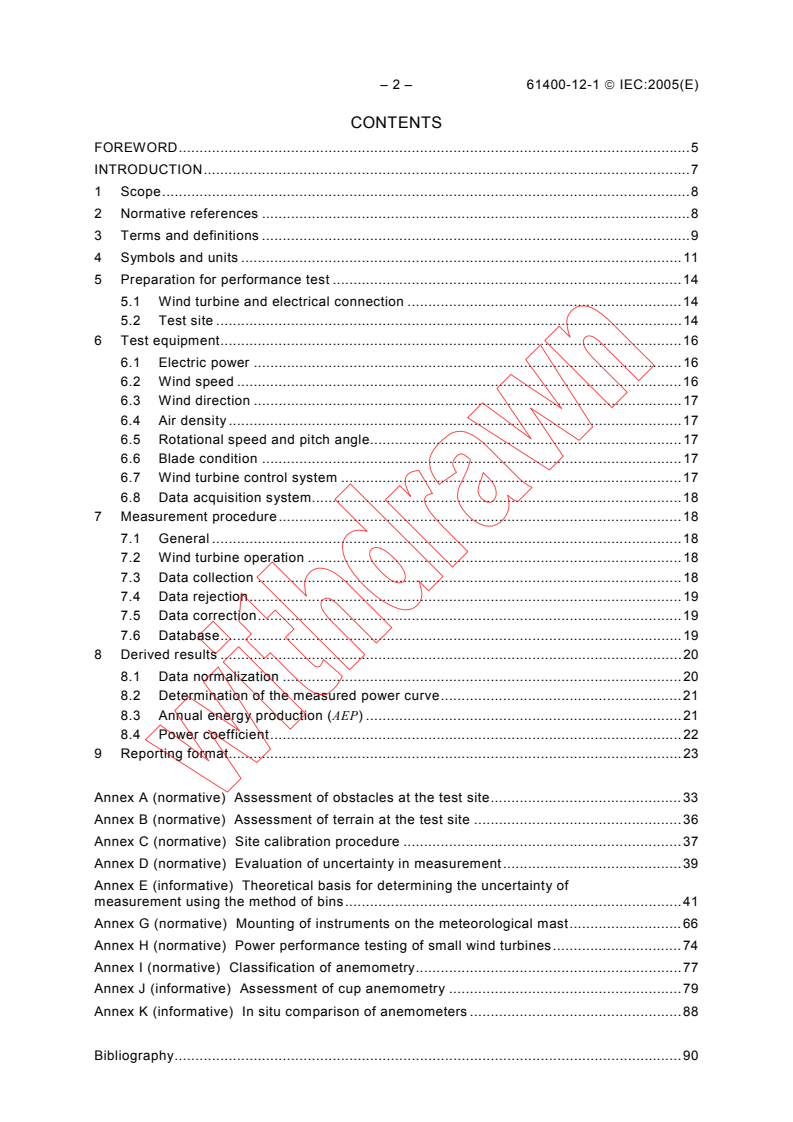
CONTENTS
FOREWORD.5
INTRODUCTION.7
1 Scope.8
2 Normative references .8
3 Terms and definitions .9
4 Symbols and units .11
5 Preparation for performance test .14
5.1 Wind turbine and electrical connection .14
5.2 Test site .14
6 Test equipment.16
6.1 Electric power .16
6.2 Wind speed .16
6.3 Wind direction .17
6.4 Air density.17
6.5 Rotational speed and pitch angle.17
6.6 Blade condition .17
6.7 Wind turbine control system .17
6.8 Data acquisition system.18
7 Measurement procedure.18
7.1 General .18
7.2 Wind turbine operation .18
7.3 Data collection .18
7.4 Data rejection.19
7.5 Data correction.19
7.6 Database.19
8 Derived results .20
8.1 Data normalization .20
8.2 Determination of the measured power curve.21
8.3 Annual energy production (AEP) .21
8.4 Power coefficient.22
9 Reporting format.23
Annex A (normative) Assessment of obstacles at the test site.33
Annex B (normative) Assessment of terrain at the test site .36
Annex C (normative) Site calibration procedure .37
Annex D (normative) Evaluation of uncertainty in measurement.39
Annex E (informative) Theoretical basis for determining the uncertainty of
measurement using the method of bins.41
Annex G (normative) Mounting of instruments on the meteorological mast.66
Annex H (normative) Power performance testing of small wind turbines.74
Annex I (normative) Classification of anemometry.77
Annex J (informative) Assessment of cup anemometry .79
Annex K (informative) In situ comparison of anemometers .88
Bibliography.90
61400-12-1 IEC:2005(E) – 3 –
Figure 1 – Requirements as to distance of the meteorological mast and maximum
allowed measurement sectors.15
Figure 2 – Presentation of example database A and B: power performance test scatter
plots sampled at 1 Hz (mean values averaged over 10 min).26
Figure 3 – Presentation of example measured power curve for databases A and B .27
Figure 4 – Presentation of example C curve for databases A and B.28
p
Figure 5 – Presentation of example site calibration (only the sectors 20° to 30°, 40° to
60°, 160° to 210° and 330° to 350° are valid sectors).29
Figure A.1 – Sectors to exclude due to wakes of neighbouring and operating wind
turbines and significant obstacles .34
Figure A.2 – An example of sectors to exclude due to wakes of the wind turbine under
test, a neighbouring and operating wind turbine and a significant obstacle.35
Figure B.1 – Illustration of area to be assessed, top view.36
Figure G.1 – Example of a top-mounted anemometer and requirements for mounting .66
Figure G.2 – Example of alternative top-mounted primary and control anemometers
positioned side-by-side and wind vane and other instruments on the boom.67
Figure G.3 – Example of a top-mounted anemometer and mounting of control
anemometer, wind vane and other sensors on a boom.68
Figure G.4 – Example of top-mounted primary and control anemometers positioned
side-by-side, wind vane and other instruments on the boom .69
Figure G.5 – Iso-speed plot of local flow speed around a cylindrical mast, normalised
by free-field wind speed (from the left); analysis by 2 dimensional Navier-Stokes
computations .70
Figure G.6 – Centre-line relative wind speed as a function of distance R from the
centre of a tubular mast and mast diameter d .70
Figure G.7 – Representation of a three-legged lattice mast showing the centre-line
wind speed deficit, the actuator disc representation of the mast with the leg distance L
and distance R from the centre of the mast to the point of observation.71
Figure G.8 – Iso-speed plot of local flow speed around a triangular lattice mast with a
C of 0,5 normalised by free-field wind speed (from the left); analysis by 2
T
dimensional Navier-Stokes computation and actuator disc theory .72
Figure G.9 – Centre-line relative wind speed as a function of distance R from the
centre of a triangular lattice mast of face width L for various C values.72
T
Figure J.1 – Measured angular response of a cup anemometer compared to cosine
response.79
Figure J.2 – Wind tunnel torque measurements on a cup anemometer at 8 m/s .80
Figure J.3 – Example of bearing friction torque measurements .81
Figure J.4 – Distribution of vertical wind speed components assuming a fixed ratio
between horizontal and vertical standard deviation in wind speed.82
Figure J.5 – Calculation of the total deviation with respect to the cosine response.83
Figure J.6 – Probability distributions for three different average angles of inflow.84
Figure J.7 – Total deviation from cosine response for three different average angles of
inflow over horizontal turbulence intensity.84
Figure J.8 – Example of an anemometer that does not fulfil the slope criterion .85
Figure J.9 – Example of deviations of a Class 2.0A cup anemometer.87
– 4 – 61400-12-1 IEC:2005(E)
Table 1 – Example of presentation of a measured power curve for database A .30
Table 2 – Example of presentation of a measured power curve for database B .31
Table 3 – Example of presentation of estimated annual energy production (database A).32
Table 4 – Example of presentation of estimated annual energy production (database B).32
Table B.1 – Test site requirements: topographical variations .36
Table D.1 – List of uncertainty components .40
Table E.1 – Expanded uncertainties.43
Table E.2 – List of categories B and A uncertainties .45
Table E.3 – Uncertainties from site calibration .53
Table E.4 – Sensitivity factors (database A).54
Table E.5 – Sensitivity factors (database B).55
Table E.6 – Category B uncertainties (database A) .56
Table E.7 – Category B uncertainties (database B) .57
Table F.1 – Example of evaluation of anemometer calibration uncertainty.62
Table G.1 – Estimation method for C for various types of lattice tower.73
T
Table H.1 – Battery bank voltage settings .76
Table I.1 – Influence parameter ranges (based on 10 min averages) of Classes A and B.78
61400-12-1 IEC:2005(E) – 5 –
INTERNATIONAL ELECTROTECHNICAL COMMISSION
____________
WIND TURBINES –
Part 12-1: Power performance measurements
of electricity producing wind turbines
FOREWORD
1) The International Electrotechnical Commission (IEC) is a worldwide organization for standardization comprising
all national electrotechnical committees (IEC National Committees). The object of IEC is to promote
international co-operation on all questions concerning standardization in the electrical and electronic fields. To
this end and in addition to other activities, IEC publishes International Standards, Technical Specifications,
Technical Reports, Publicly Available Specifications (PAS) and Guides (hereafter referred to as “IEC
Publication(s)”). Their preparation is entrusted to technical committees; any IEC National Committee interested
in the subject dealt with may participate in this preparatory work. International, governmental and non-
governmental organizations liaising with the IEC also participate in this preparation. IEC collaborates closely
with the International Organization for Standardization (ISO) in accordance with conditions determined by
agreement between the two organizations.
2) The formal decisions or agreements of IEC on technical matters express, as nearly as possible, an international
consensus of opinion on the relevant subjects since each technical committee has representation from all
interested IEC National Committees.
3) IEC Publications have the form of recommendations for international use and are accepted by IEC National
Committees in that sense. While all reasonable efforts are made to ensure that the technical content of IEC
Publications is accurate, IEC cannot be held responsible for the way in which they are used or for any
misinterpretation by any end user.
4) In order to promote international uniformity, IEC National Committees undertake to apply IEC Publications
transparently to the maximum extent possible in their national and regional publications. Any divergence
between any IEC Publication and the corresponding national or regional publication shall be clearly indicated in
the latter.
5) IEC provides no marking procedure to indicate its approval and cannot be rendered responsible for any
equipment declared to be in conformity with an IEC Publication.
6) All users should ensure that they have the latest edition of this publication.
7) No liability shall attach to IEC or its directors, employees, servants or agents including individual experts and
members of its technical committees and IEC National Committees for any personal injury, property damage or
other damage of any nature whatsoever, whether direct or indirect, or for costs (including legal fees) and
expenses arising out of the publication, use of, or reliance upon, this IEC Publication or any other IEC
Publications.
8) Attention is drawn to the Normative references cited in this publication. Use of the referenced publications is
indispensable for the correct application of this publication.
9) Attention is drawn to the possibility that some of the elements of this IEC Publication may be the subject of
patent rights. IEC shall not be held responsible for identifying any or all such patent rights.
International Standard IEC 61400-12-1 has been prepared by IEC technical committee 88:
Wind turbines.
This standard cancels and replaces IEC 61400-12 published in 1998. This first edition of IEC
61400-12-1 constitutes a technical revision. IEC 61400-12-2 and IEC 61400-12-3 are
additions to IEC 61400-12-1.
The text of this standard is based on the following documents:
FDIS Report on voting
88/244/FDIS 88/251/RVD
Full information on the voting for the approval of this standard can be found in the report on
voting indicated in the above table.
This publication has been drafted in accordance with the ISO/IEC Directives, Part 2.
– 6 – 61400-12-1 IEC:2005(E)
IEC 61400-12 consists of the following parts, under the general title Wind turbines:
Part 12-1: Power performance measurements of electricity producing wind turbines
Part 12-2: Verification of power performance of individual wind turbines (under consideration)
Part 12-3: Wind farm power performance testing (under consideration)
The committee has decided that the contents of this publication will remain unchanged until
the maintenance result date indicated on the IEC web site under "http://webstore.iec.ch" in
the data related to the specific publication. At this date, the publication will be
• reconfirmed;
• withdrawn;
• replaced by a revised edition, or
• amended.
A bilingual version of this standard may be issued at a later date.
61400-12-1 IEC:2005(E) – 7 –
INTRODUCTION
The purpose of this part of IEC 61400 is to provide a uniform methodology that will ensure
consistency, accuracy and reproducibility in the measurement and analysis of power
performance by wind turbines. The standard has been prepared with the anticipation that it
would be applied by:
– a wind turbine manufacturer striving to meet well-defined power performance requirements
and/or a possible declaration system;
– a wind turbine purchaser in specifying such performance requirements;
– a wind turbine operator who may be required to verify that stated, or required, power
performance specifications are met for new or refurbished units;
– a wind turbine planner or regulator who must be able to accurately and fairly define power
performance characteristics of wind turbines in response to regulations or permit
requirements for new or modified installations.
This standard provides guidance in the measurement, analysis, and reporting of power
performance testing for wind turbines. The standard will benefit those parties involved in the
manufacture, installation planning and permitting, operation, utilization, and regulation of wind
turbines. The technically accurate measurement and analysis techniques recommended in
this standard should be applied by all parties to ensure that continuing development and
operation of wind turbines is carried out in an atmosphere of consistent and accurate
communication relative to environmental concerns. This standard presents measurement and
reporting procedures expected to provide accurate results that can be replicated by others.
Meanwhile, a user of the standard should be aware of differences that arise from large
variations in wind shear and turbulence, and from the chosen criteria for data selection.
Therefore, a user should consider the influence of these differences and the data selection
criteria in relation to the purpose of the test before contracting the power performance
measurements.
A key element of power performance testing is the measurement of wind speed. This standard
prescribes the use of cup anemometers to measure the wind speed. This instrument is robust
and has long been regarded as suitable for this kind of test. Even though suitable wind tunnel
calibration procedures are adhered to, the field flow conditions associated with the fluctuating
wind vector, both in magnitude and direction, will cause different instruments to potentially
perform differently.
Tools and procedures to classify cup anemometers are given in Annexes I and J. However
there will always be a possibility that the result of the test can be influenced by the selection
of the wind speed instrument. Special care should therefore be taken in the selection of the
instruments chosen to measure the wind speed.
– 8 – 61400-12-1 IEC:2005(E)
WIND TURBINES –
Part 12-1: Power performance measurements
of electricity producing wind turbines
1 Scope
This part of IEC 61400 specifies a procedure for measuring the power performance
characteristics of a single wind turbine and applies to the testing of wind turbines of all types
and sizes connected to the electrical power network. In addition, this standard describes a
procedure to be used to determine the power performance characteristics of small wind
turbines (as defined in IEC 61400-2) when connected to either the electric power network or a
battery bank. The procedure can be used for performance evaluation of specific turbines at
specific locations, but equally the methodology can be used to make generic comparisons
between different turbine models or different turbine settings.
The wind turbine power performance characteristics are determined by the measured power
curve and the estimated annual energy production (AEP). The measured power curve is
determined by collecting simultaneous measurements of wind speed and power output at the
test site for a period that is long enough to establish a statistically significant database over a
range of wind speeds and under varying wind and atmospheric conditions. The AEP is
calculated by applying the measured power curve to reference wind speed frequency
distributions, assuming 100 % availability.
The standard describes a measurement methodology that requires the measured power curve
and derived energy production figures to be supplemented by an assessment of uncertainty
sources and their combined effects.
2 Normative references
The following referenced documents are indispensable for the application of this document.
For dated references, only the edition cited applies. For undated references, the latest edition
of the referenced document (including any amendments) applies.
IEC 60044-1:1996, Instrument transformers – Part 1: Current transformers
Amendment 1 (2000)
Amendment 2 (2002)
IEC 60688:1992, Electrical measuring transducers for converting a.c. electrical quantities to
analogue or digital signals
Amendment 1 (1997)
Amendment 2 (2001)
IEC 61400-2:1996, Wind turbine generator systems – Part 1: Safety of small wind turbines
ISO 2533:1975, Standard atmosphere
ISO Guide to the expression of uncertainty in measurement, 1995, ISBN 92-67-10188-9
___________
There exists a consolidated edition 1.2 (2003) that includes edition 1 and its amendments 1 and 2.
61400-12-1 IEC:2005(E) – 9 –
3 Terms and definitions
For the purposes of this document, the following terms and definitions apply.
3.1
accuracy
closeness of the agreement between the result of a measurement and a true value of the
measurand
3.2
annual energy production
AEP
estimate of the total energy production of a wind turbine during a one-year period by applying
the measured power curve to different reference wind speed frequency distributions at hub
height, assuming 100 % availability
3.3
complex terrain
terrain surrounding the test site that features significant variations in topography and terrain
obstacles that may cause flow distortion
3.4
data set
collection of data that was sampled over a continuous period
3.5
distance constant
indication of the response time of an anemometer, defined as the length of air that must pass
the instrument for it to indicate 63 % of the final value for a step input in wind speed
3.6
extrapolated power curve
extension of the measured power curve by estimating power output from the maximum
measured wind speed to cut-out wind speed
3.7
flow distortion
change in air flow caused by obstacles, topographical variations, or other wind turbines that
results in a deviation of the measured wind speed from the free stream wind speed and in a
significant uncertainty
3.8
hub height (wind turbines)
height of the centre of the swept area of the wind turbine rotor above the ground at the tower
NOTE For a vertical axis wind turbine the hub height is the height of the equator plane.
3.9
measured power curve
table and graph that represents the measured, corrected and normalized net power output of
a wind turbine as a function of measured wind speed, measured under a well-defined
measurement procedure
3.10
measurement period
period during which a statistically significant database has been collected for the power
performance test
– 10 – 61400-12-1 IEC:2005(E)
3.11
measurement sector
a sector of wind directions from which data are selected for the measured power curve
3.12
method of bins
data reduction procedure that groups test data for a certain parameter into wind speed
intervals (bins)
NOTE For each bin, the number of data sets or samples and their sum are recorded, and the average parameter
value within each bin is calculated.
3.13
net active electric power
measure of the wind turbine electric power output that is delivered to the electrical power
network
3.14
obstacles
things that blocks the wind and creates distortion of the flow, such as buildings and trees
3.15
pitch angle
angle between the chord line at a defined blade radial location (usually 100 % of the blade
radius) and the rotor plane of rotation
3.16
power coefficient
ratio of the net electric power output of a wind turbine to the power available in the free
stream wind over the rotor swept area
3.17
power performance
measure of the capability of a wind turbine to produce electric power and energy
3.18
rated power
quantity of power assigned, generally by a manufacturer, for a specified operating condition of
a component, device or equipment
NOTE Maximum continuous electrical power output which a wind turbine is designed to achieve under normal
operating conditions.
3.19
standard uncertainty
uncertainty of the result of a measurement expressed as a standard deviation
3.20
swept area
for a horizontal axis turbine, the projected area of the moving rotor upon a plane normal to
axis of rotation. For teetering rotors, it should be assumed that the rotor remains normal to the
low-speed shaft. For a vertical axis turbine, the projected area of the moving rotor upon a
vertical plane.
3.21
test site
location of the wind turbine under test and its surroundings
61400-12-1 IEC:2005(E) – 11 –
3.22
uncertainty in measurement
parameter, associated with the result of a measurement, which characterizes the dispersion of
the values that could reasonably be attributed to the measurand
4 Symbols and units
A swept area of the wind turbine rotor [m ]
AEP annual energy production [Wh]
B barometric pressure [Pa]
B measured air pressure averaged over 10 min [Pa]
10min
C pitot tube head coefficient
h
C power coefficient in bin i
P,i
C generalized aerodynamic torque coefficient
QA
C thrust coefficient
T
c sensitivity factor on a parameter (the partial differential)
c sensitivity factor of air pressure in bin i [W/Pa]
B,i
c sensitivity factor of data acquisition system in bin i
d,i
c sensitivity factor of index parameter
index
c sensitivity factor of component k in bin i
k,i
c sensitivity factor of air density correction in bin i [Wm /kg]
m,i
c sensitivity factor of air temperature in bin i [W/K]
T,i
c sensitivity factor of wind speed in bin i [Ws/m]
V,i
D rotor diameter [m]
D equivalent rotor diameter [m]
e
D rotor diameter of neighbouring and operating wind turbine [m]
n
d mast diameter [m]
F(V) the Rayleigh cumulative probability distribution function for wind speed
f the relative occurrence of wind speed in a wind speed interval
i
H hub height of wind turbine [m]
h height of obstacle minus zero displacement [m]
I inertia of cup anemometer rotor [kgm ]
k class number
k blockage correction factor
b
k wind tunnel calibration factor
c
k wind tunnel correction factor to other tunnels (only used in uncertainty estimate)
f
k humidity correction to density
ρ
K barometer
B,t
K barometer gain
B,s
K barometer sampling
B,d
K temperature transducer
T,t
K temperature transducer gain
T,s
K temperature transducer sampling
T,d
K pressure transducer sensitivity
p,t
K pressure transducer gain
p,s
K pressure transducer sampling conversion
p,d
– 12 – 61400-12-1 IEC:2005(E)
L leg distance of three legged mast [m]
L distance between the wind turbine and the meteorological mast [m]
L distance between the wind turbine or the meteorological mast and an obstacle
e
[m]
L distance between the wind turbine or the meteorological mast and
n
a neighbouring and operating wind turbine [m]
l height of obstacle [m]
h
l width of obstacle [m]
w
M number of uncertainty components in each bin
M number of category A uncertainty components
A
M number of category B uncertainty components
B
N number of bins
N number of hours in one year ≈ 8760 [h]
h
N number of 10 min data sets in wind speed bin i
i
N number of 10 min data sets in wind direction bin j
j
n number of samples within sampling interval
n velocity profile exponent (n=0,14)
P porosity of obstacle (0: solid, 1: no obstacle)
P normalized and averaged power output in bin i [W]
i
P normalized power output [W]
n
P normalized power output of data set j in bin i [W]
n,i,j
P measured power averaged over 10 min [W]
10min
P vapour pressure [Pa]
w
Q aerodynamic torque [Nm]
A
Q friction torque [Nm]
f
R distance to mast centre [m]
R gas constant of dry air (287,05) [J/(kgK)]
R gas constant of water vapour (461,5) [J/kgK]
w
r correlation coefficient
s uncertainty component of category A
s category A standard uncertainty of tunnel wind speed time series
A
s category A standard uncertainty of component k in bin i
k,i
s combined category A uncertainties in bin i
i
s category A standard uncertainty of power in bin i [W]
P,i
s category A standard uncertainty of climatic variations in bin i
w,i
s category A standard uncertainty of wind speed ratios in bin j
α,j
T absolute temperature [K]
TI turbulence intensity
T measured absolute air temperature averaged over 10 min [K]
10min
t mast solidity
t time [s]
U wind speed [m/s]
U centre-line wind speed deficit [m/s]
d
U equivalent horizontal wind speed [m/s]
eq
U free wind speed at height h of obstacle [m/s]
h
61400-12-1 IEC:2005(E) – 13 –
U wind speed in bin i [m/s]
i
U threshold wind speed [m/s]
t
r
U wind speed vector
u longitudinal wind speed component [m/s]
u uncertainty component of category B
u combined standard uncertainty in the estimated annual energy production [Wh]
AEP
u category B standard uncertainty of air pressure in bin i [Pa]
B,i
u combined standard uncertainty of the power in bin i [W]
c,i
u combined category B uncertainties in bin i
i
u category B standard uncertainty of index parameter
index
u category B standard uncertainty of component k in bin i
k,i
u category B standard uncertainty of air density correction in bin i [kg/m ]
m,i
u category B standard uncertainty of power in bin i [W]
P,i
u category B standard uncertainty of wind speed in bin i [m/s]
V,i
u category B standard uncertainty of air temperature in bin i [K]
T,i
u combined standard uncertainty of site calibration in wind speed bin i and wind
α,i,j
direction bin j [m/s]
V wind speed [m/s]
V annual average wind speed at hub height [m/s]
ave
V normalized and averaged wind speed in bin i [m/s]
i
V normalized wind speed [m/s]
n
V normalized wind speed of data set j in bin i [m/s]
n,i,j
V measured wind speed averaged over 10 min [m/s]
10min
v transversal wind speed component [m/s]
v mean flow air speed [m/s]
w vertical wind speed component [m/s]
w weighing function to define deviation envelope
i
X parameter averaged over pre-processing time period
k
X parameter averaged over 10 min
10min
x distance downstream obstacle to met mast or wind turbine [m]
z height above ground [m]
z roughness height [m]
α disturbed sector [°]
α angle of attack [°]
α ratio of wind speeds in wind direction bin j (wind turbine position to meteorological
j
mast position)
ΔU influence of an obstacle in wind speed difference [m/s]
z
ε maximum deviation for any wind speed bin i in the wind speed range [m/s]
max,i
κ von Karman constant 0,4
λ speed ratio
ρ correlation coefficient
ρ air density
ρ reference air density [kg/m ]
ρ derived air density averaged over 10 min [kg/m ]
10min
– 14 – 61400-12-1 IEC:2005(E)
σ standard deviation of the normalized power data in bin i [W]
P,i
σ standard deviation of parameter averaged over 10 min
10min
σ /σ /σ standard deviations of longitudinal/transversal/vertical wind speeds
u v w
φ relative humidity (range 0 to 1)
–1
ω angular speed [s ]
5 Preparation for performance test
The specific test conditions related to the power performance measurement of the wind
turbine shall be well-defined and documented in the test report, as detailed in Clause 9.
5.1 Wind turbine and electrical connection
As detailed in Clause 9, the wind turbine and electrical connection shall be described and
documented to identify uniquely the specific machine configuration that is tested.
5.2 Test site
At the test site a meteorological mast shall be set up in the neighbourhood of the wind turbine
to determine the wind speed that drives the wind turbine. The test site may have significant
influence on the measured power performance of the wind turbine. In particular, flow
distortion effects may cause the wind speed at the meteorological mast and at the wind
turbine to be different, though correlated.
The test site shall be assessed for sources of wind flow distortion in order to
– choose the position of the meteorological mast;
– define a suitable measurement sector;
– estimate appropriate flow correction factors;
– evaluate the uncertainty due to wind flow distortion.
The following factors shall be considered, in particular:
– topographical variations;
– other wind turbines;
– obstacles (buildings, trees, etc.).
The test site shall be documented as detailed in Clause 9.
5.2.1 Location of the meteorological mast
Care shall be taken in locating the meteorological mast. It shall not be located too close to the
wind turbine, since the wind speed will be influenced/changed/affected in front of the wind
turbine. Also, it shall not be located too far from the wind turbine, since the correlation
between wind speed and electric power output will be reduced. The meteorological mast shall
be positioned at a distance from the wind turbine of between 2 and 4 times the rotor diameter
D of the wind turbine. A distance of 2,5 times the rotor diameter D is recommended. In the
case of a vertical axis wind turbine, D is equivalently defined as 2/A π , where A is the
swept area of the rotor, and distance is defined as L+0,5D, where L is the distance between
the centre of the turbine tower and the mast of an equivalent horizontal axis wind turbine.
Prior to carrying out the performance evaluation test and in helping to select the location
for the meteorological mast, account should be taken of the need to exclude measurements
from all sectors in which either the mast or the turbine will be subject to flow disturbance.
61400-12-1 IEC:2005(E) – 15 –
In most cases, the best location for the meteorological mast will be upwind of the turbine in
the direction from which most valid wind is expected to come during the test. In other cases,
however, it may be more appropriate to place the mast alongside the turbine, for example for
a wind turbine that is sited on a ridge.
5.2.2 Measurement sector
The measurement sector(s) shall exclude directions having significant obstacles and other
wind turbines, as seen from both the wind turbine under test and the meteorological mast.
For all neighbouring wind turbines and obstacles, the directions to be excluded due to wake
effects shall be determined using the procedure in Annex A. The disturbed sectors to be
excluded due to the meteorological mast being in the wake of the wind turbine under test are
shown in Figure 1 for distances of 2, 2,5 and 4 times the rotor diameter of the wind turbine.
Reasons to reduce the sector might be special topographic conditions or unexpected
measurement data achieved from directions with complicated structures. All reasons for
reducing the measurement sector shall be clearly documented.
Mast to wind turbine centre line
Mast at 4D
Distance of meteorology
mast to wind 2D and 4D,
2,5D
2,5D is recommended
2D
Wind
turbine
D
Disturbed sector
due to wake of
Maximum measurement sector:
wind turbine on
at 2D: 279°
meteorology mast
at 2,5D: 286°
(Annex A): at 4D: 301°
at 2D: 81°
at 2,5D: 74°
at 4D: 59°
IEC 2027/05
Figure 1 – Requirements as to distance of the meteorological mast
and maximum allowed measurement sectors
5.2.3 Correction factors and uncertainty due to flow distortion originating from
topography
The test site shall be assessed for sources of wind flow distortion due to topographical
variations. The assessment shall identify whether the power curve can be measured without a
required site calibration. If the criteria of Annex B are met, the wind flow regime of the site
does not need a site calibration. However, in assuming that no flow correction factors are
necessary, the applied uncertainty due to flow distortion of the test site shall be a minimum of
2 % of the measured wind speed if the meteorological mast is positioned at a distance
between 2 and 3 times the rotor diameter of the wind turbine and 3 % or greater if the
distance is 3 to 4 times the rotor diameter, unless objective evidence can be provided
quantifying a different uncertainty.
– 16 – 61400-12-1 IEC:2005(E)
If the criteria of Annex B are not met, or a smaller uncertainty due to flow distortion of the test
site is desired, then an experimental test site calibration shall be undertaken. If an
experimental test site calibration is undertaken Annex C shall be used. The measured flow
correction factors for each sector shall be used.
6 Test equipment
6.1 Electric power
The net electric power of the wind turbine shall be measured using a power measurement
device (e.g. power transducer) and be based on measurements of current and voltage on
each phase.
The class of the current transformers shall meet the requirements of IEC 60044-1 and the
class of the voltage transformers, if used, shall meet the requirements of IEC 60186. They
shall be class 0,5 or better.
The accuracy of the power measurement device, if it is a power transducer, shall meet the
requirements of IEC 60688 and shall be class 0,5 or better. If the power measurement device
is not a power transducer then the accuracy should be equivalent to class 0,5 power
transducers. The operating range of the power measurement device shall be set to measure
all positive and negative instantaneous power peaks generated by the wind turbine. As a
guide, the full-scale range of the power measurement device should be set to −50 % to
+200 % of the wind turbine rated power. All data shall be periodically reviewed during the test
to ensure that the range limits of the power measurement device have not been exceeded.
The power transducer shall be calibrated to traceable standards. The power measurement
device shall be mounted between the wind turbine and the electrical connection to ensure that
only the net active electric power (i.e. reduced by self-consumption) is measured. It shall be
stated whether the measurements are made on the turbine side or the network side of the
transformer.
6.2 Wind speed
Wind speed measurements shall be made with a cup anemometer that meets the
requirements in Annex I. For power performance measurements an anemometer with a class
better than 1,7A shall be used. Additionally, in terrain that does not meet the requirements of
Annex B for not requiring a site calibration, it is recommended that a class better than class
2,5B or 1,7S be used. The wind speed to be measured is defined as the average magnitude of
the horizontal component of the instantaneous wind velocity vector , including only the
longitudinal and lateral, but not the vertical, turbulence components. Consequently, the
angular response of the cup anemometer should be cosine shaped (see Annex J). All reported
wind speeds, and all uncertainties connected to operational characteristics shall be related to
this wind speed definition.
The cup anemometer shall be calibrated before and recalibrated after the measurement
campaign. The difference between the regression lines of calibration and recalibration shall
be within ±0,1 m/s in the range 6m/s to 12 m/s. Only the calibration before the measurement
campaign shall be used for the performance test. Calibration of the cup anemometer shall be
made according to the procedure of Annex F. During calibration the cup anemometer shall be
mounted on a vertical tube configuration similar to the one being used during the power
performance test.
___________
It is believed that, by using instruments that are able to measure the wind speed according to this definition
consistent power curves will be obtained in most field conditions. Consistent in this context means that the
power curves measured in inclined flow are essentially similar to the power curves measured under non-
inclined flow conditions. Special care should be taken to achieve a proper mounting (align the instrument) and
special care should also be taken to inspect the anemometer for distorted cups. Improper mounting or distorted
cups may introduce severely biased results.
61400-12-1 IEC:2005(E) – 17 –
As an inferior alternative to the recalibration, it shall be documented that the cup anemometer
maintains its calibration over the duration of the measurement period. The procedure in Annex
K should be used.
The cup anemometer shall
...