

IEC TS 61400-25-71:2019
(Main)Wind energy generation systems - Part 25-71: Communications for monitoring and control of wind power plants - Configuration description language
General Information
- Abstract
IEC TS 61400-25-71:2019 focus on the communications between wind power plant components such as wind turbines and actors such as SCADA systems. Non-IEC 61850/IEC 61400-25 internal communication within wind power plant components is outside the normative scope of the IEC 61400-25 series.
This document describes how to extend the IEC 61400-25 series with the IEC 618506 Substation Configuration description Language (SCL) file format for describing communication-related Intelligent Electronic Device (IED) configurations of a wind turbine, wind power plant controller, meteorological mast, etc. The extension of SCL to the wind domain is intended to simplify integration of wind power plant equipment for clients, as well as their integration to the electrical system. The adoption of SCL allows formalised tool-based exchange of IED parameters, communication system configurations, switch yard (function) structures, as well as description of the relations between them.
The purpose of this format is to formally and efficiently exchange wind turbine and wind power plant IED capability descriptions, and system descriptions between IED engineering tools and the system engineering tool(s) of different manufacturers in a compatible way. The file format is also intended to provide report configuration and alarms as well as HMI interface information from a wind power plant. This information can be used to engineer overlying SCADA systems for the site, for connected DSO, or TSO, or for fleet operators' maintenance and surveillance systems. Finally, the SCL is intended as a documentation of the configuration and topology of the delivered system.
- Status
- Published
- Publication Date
- 12-Sep-2019
- Technical Committee
- TC 88 - Wind energy generation systems
- Drafting Committee
- JWG 25 - TC 88/JWG 25
- Current Stage
- PPUB - Publication issued
- Start Date
- 13-Sep-2019
- Completion Date
- 08-Oct-2019
Buy Documents

IEC TS 61400-25-71:2019 - Wind energy generation systems - Part 25-71: Communications for monitoring and control of wind power plants - Configuration description language Released:9/13/2019
Overview
IEC TS 61400-25-71:2019 defines a configuration description language for wind power plant communications by extending the IEC 61850-6 Substation Configuration description Language (SCL) to the wind domain. The Technical Specification specifies how to represent communication-related Intelligent Electronic Device (IED) configurations - for wind turbines, wind power plant controllers (WPPS), meteorological masts, etc. - enabling formal, tool-based exchange of IED capabilities, communication system configurations, topology, report/alarm setup and HMI interface information for SCADA and system engineering.
Key topics and requirements
- SCL extension for wind: Adapts IEC 61850-6 SCL file format for IEC 61400-25 projects to describe wind-specific IEDs and functions.
- SCL structure and file types: Guidance on SCL sections, file types (ICD/CID/SCD style use cases) and appropriate tool workflows.
- Use cases: IED-level and WPPS-level interface server configuration, client data-flow definition, and topology definition for switchyard and electrical connectivity.
- Protocol mapping: Specification includes mapping and configuration parameters for common utility and control protocols used in wind plants (examples covered: MMS, Web Services, IEC 60870‑5‑101/104, DNP3, OPC UA).
- Schema extensions and examples: Normative SCL schema extensions and informative configuration examples to document IED capability, communication parameters, alarms/reports and HMI mappings.
- Scope boundary: Focuses on communications between wind plant components and external actors (e.g., SCADA). Internal proprietary communications inside components that are not IEC 61850/61400-25 are explicitly outside the normative scope.
Practical applications
- Interoperability & integration: Simplifies multi‑vendor integration by enabling formal exchange of device and system configurations between manufacturers and systems integrators.
- SCADA and system engineering: Use SCL files to automatically generate SCADA points, alarm/report definitions and HMI structure, reducing manual engineering effort.
- Commissioning & documentation: Acts as a definitive documentation of delivered system topology, communication settings and IED capabilities for commissioning, asset handover and O&M.
- Grid connection & operators: Provides DSO/TSO and fleet operators with consistent configuration artifacts to facilitate grid compliance, monitoring and fleet-wide supervision.
Who should use this standard
- Wind turbine OEMs, WPPS vendors and IED manufacturers
- System integrators and SCADA engineers
- Tool vendors (SCL/engineering tools) and commissioning teams
- DSO/TSO integration teams, fleet operators and maintenance organizations
Related standards
- IEC 61400-25 series (wind energy communications)
- IEC 61850 (power utility communication) and IEC 61850‑6 (SCL / Substation Configuration description Language)
Keywords: IEC TS 61400-25-71:2019, SCL, IEC 61850-6, wind power plant configuration, IED configuration, SCADA integration, protocol mapping, MMS, OPC UA, DNP3, IEC 60870-5.
Buy Documents
IEC TS 61400-25-71:2019 - Wind energy generation systems - Part 25-71: Communications for monitoring and control of wind power plants - Configuration description language Released:9/13/2019
Get Certified
Connect with accredited certification bodies for this standard

DNV
DNV is an independent assurance and risk management provider.

Lloyd's Register
Lloyd's Register is a global professional services organisation specialising in engineering and technology.
DNV Energy Systems
Energy and renewable energy certification.
Sponsored listings
Frequently Asked Questions
IEC TS 61400-25-71:2019 is a technical specification published by the International Electrotechnical Commission (IEC). Its full title is "Wind energy generation systems - Part 25-71: Communications for monitoring and control of wind power plants - Configuration description language". This standard covers: IEC TS 61400-25-71:2019 focus on the communications between wind power plant components such as wind turbines and actors such as SCADA systems. Non-IEC 61850/IEC 61400-25 internal communication within wind power plant components is outside the normative scope of the IEC 61400-25 series. This document describes how to extend the IEC 61400-25 series with the IEC 618506 Substation Configuration description Language (SCL) file format for describing communication-related Intelligent Electronic Device (IED) configurations of a wind turbine, wind power plant controller, meteorological mast, etc. The extension of SCL to the wind domain is intended to simplify integration of wind power plant equipment for clients, as well as their integration to the electrical system. The adoption of SCL allows formalised tool-based exchange of IED parameters, communication system configurations, switch yard (function) structures, as well as description of the relations between them. The purpose of this format is to formally and efficiently exchange wind turbine and wind power plant IED capability descriptions, and system descriptions between IED engineering tools and the system engineering tool(s) of different manufacturers in a compatible way. The file format is also intended to provide report configuration and alarms as well as HMI interface information from a wind power plant. This information can be used to engineer overlying SCADA systems for the site, for connected DSO, or TSO, or for fleet operators' maintenance and surveillance systems. Finally, the SCL is intended as a documentation of the configuration and topology of the delivered system.
IEC TS 61400-25-71:2019 focus on the communications between wind power plant components such as wind turbines and actors such as SCADA systems. Non-IEC 61850/IEC 61400-25 internal communication within wind power plant components is outside the normative scope of the IEC 61400-25 series. This document describes how to extend the IEC 61400-25 series with the IEC 618506 Substation Configuration description Language (SCL) file format for describing communication-related Intelligent Electronic Device (IED) configurations of a wind turbine, wind power plant controller, meteorological mast, etc. The extension of SCL to the wind domain is intended to simplify integration of wind power plant equipment for clients, as well as their integration to the electrical system. The adoption of SCL allows formalised tool-based exchange of IED parameters, communication system configurations, switch yard (function) structures, as well as description of the relations between them. The purpose of this format is to formally and efficiently exchange wind turbine and wind power plant IED capability descriptions, and system descriptions between IED engineering tools and the system engineering tool(s) of different manufacturers in a compatible way. The file format is also intended to provide report configuration and alarms as well as HMI interface information from a wind power plant. This information can be used to engineer overlying SCADA systems for the site, for connected DSO, or TSO, or for fleet operators' maintenance and surveillance systems. Finally, the SCL is intended as a documentation of the configuration and topology of the delivered system.
IEC TS 61400-25-71:2019 is classified under the following ICS (International Classification for Standards) categories: 27.180 - Wind turbine energy systems. The ICS classification helps identify the subject area and facilitates finding related standards.
IEC TS 61400-25-71:2019 is available in PDF format for immediate download after purchase. The document can be added to your cart and obtained through the secure checkout process. Digital delivery ensures instant access to the complete standard document.
Standards Content (Sample)
IEC TS 61400-25-71 ®
Edition 1.0 2019-09
TECHNICAL
SPECIFICATION
colour
inside
Wind energy generation systems –
Part 25-71: Communications for monitoring and control of wind power plants –
Configuration description language
All rights reserved. Unless otherwise specified, no part of this publication may be reproduced or utilized in any form
or by any means, electronic or mechanical, including photocopying and microfilm, without permission in writing from
either IEC or IEC's member National Committee in the country of the requester. If you have any questions about IEC
copyright or have an enquiry about obtaining additional rights to this publication, please contact the address below or
your local IEC member National Committee for further information.
IEC Central Office Tel.: +41 22 919 02 11
3, rue de Varembé info@iec.ch
CH-1211 Geneva 20 www.iec.ch
Switzerland
About the IEC
The International Electrotechnical Commission (IEC) is the leading global organization that prepares and publishes
International Standards for all electrical, electronic and related technologies.
About IEC publications
The technical content of IEC publications is kept under constant review by the IEC. Please make sure that you have the
latest edition, a corrigendum or an amendment might have been published.
IEC publications search - webstore.iec.ch/advsearchform Electropedia - www.electropedia.org
The advanced search enables to find IEC publications by a The world's leading online dictionary on electrotechnology,
variety of criteria (reference number, text, technical containing more than 22 000 terminological entries in English
committee,…). It also gives information on projects, replaced and French, with equivalent terms in 16 additional languages.
and withdrawn publications. Also known as the International Electrotechnical Vocabulary
(IEV) online.
IEC Just Published - webstore.iec.ch/justpublished
Stay up to date on all new IEC publications. Just Published IEC Glossary - std.iec.ch/glossary
details all new publications released. Available online and 67 000 electrotechnical terminology entries in English and
once a month by email. French extracted from the Terms and Definitions clause of
IEC publications issued since 2002. Some entries have been
IEC Customer Service Centre - webstore.iec.ch/csc collected from earlier publications of IEC TC 37, 77, 86 and
If you wish to give us your feedback on this publication or CISPR.
need further assistance, please contact the Customer Service
Centre: sales@iec.ch.
IEC TS 61400-25-71 ®
Edition 1.0 2019-09
TECHNICAL
SPECIFICATION
colour
inside
Wind energy generation systems –
Part 25-71: Communications for monitoring and control of wind power plants –
Configuration description language
INTERNATIONAL
ELECTROTECHNICAL
COMMISSION
ICS 27.180 ISBN 978-2-8322-7392-0
– 2 – IEC TS 61400-25-71:2019 IEC 2019
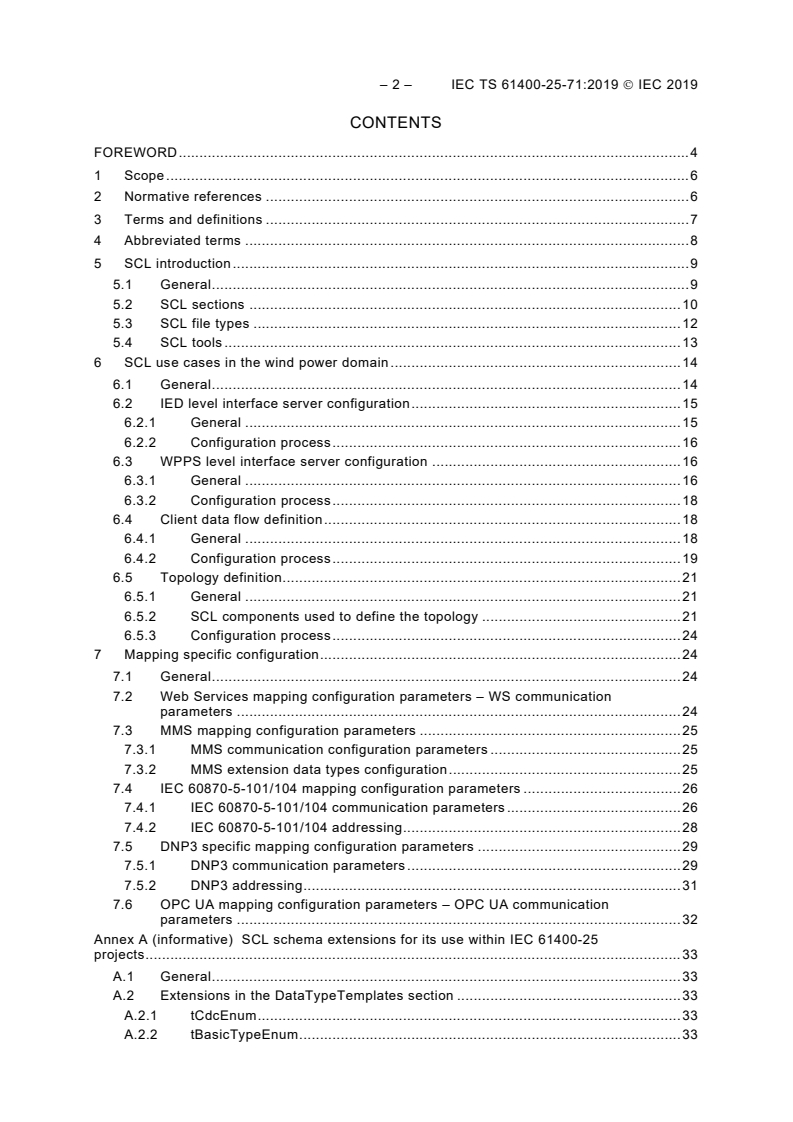
CONTENTS
FOREWORD . 4
1 Scope . 6
2 Normative references . 6
3 Terms and definitions . 7
4 Abbreviated terms . 8
5 SCL introduction . 9
5.1 General . 9
5.2 SCL sections . 10
5.3 SCL file types . 12
5.4 SCL tools . 13
6 SCL use cases in the wind power domain . 14
6.1 General . 14
6.2 IED level interface server configuration . 15
6.2.1 General . 15
6.2.2 Configuration process . 16
6.3 WPPS level interface server configuration . 16
6.3.1 General . 16
6.3.2 Configuration process . 18
6.4 Client data flow definition . 18
6.4.1 General . 18
6.4.2 Configuration process . 19
6.5 Topology definition . 21
6.5.1 General . 21
6.5.2 SCL components used to define the topology . 21
6.5.3 Configuration process . 24
7 Mapping specific configuration . 24
7.1 General . 24
7.2 Web Services mapping configuration parameters – WS communication
parameters . 24
7.3 MMS mapping configuration parameters . 25
7.3.1 MMS communication configuration parameters . 25
7.3.2 MMS extension data types configuration . 25
7.4 IEC 60870-5-101/104 mapping configuration parameters . 26
7.4.1 IEC 60870-5-101/104 communication parameters . 26
7.4.2 IEC 60870-5-101/104 addressing . 28
7.5 DNP3 specific mapping configuration parameters . 29
7.5.1 DNP3 communication parameters . 29
7.5.2 DNP3 addressing . 31
7.6 OPC UA mapping configuration parameters – OPC UA communication
parameters . 32
Annex A (informative) SCL schema extensions for its use within IEC 61400-25
projects . 33
A.1 General . 33
A.2 Extensions in the DataTypeTemplates section . 33
A.2.1 tCdcEnum . 33
A.2.2 tBasicTypeEnum . 33
A.3 Extensions in the Process section . 33
A.3.1 tProcess . 33
A.3.2 ref2SubstationFromTerminal . 33
A.4 Extensions in the Communication section – tPTypeEnum. 33
Annex B (normative) SCL schema for IEC 61400-25 . 34
Annex C (informative) Configuration examples . 82
C.1 General . 82
C.2 Wind power plant configuration with IEC 61400-25 interface at wind turbine
level . 83
C.3 Wind power plant configuration with IEC 61400-25 interface at WPPS . 84
Bibliography . 86
Figure 1 – Example with several IEDs . 15
Figure 2 – Configuration diagram . 16
Figure 3 – Example with only one IED as WPPS . 17
Figure 4 – WPPS logical node allocation . 17
Figure 5 – Report data flow configuration . 18
Figure 6 – Data flow configuration using several ICD/CID/IID files as input . 19
Figure 7 – Data flow configuration using a SCD file as input . 20
Figure 8 – Electrical connection using Line and Segments . 22
Figure 9 – Example of substation connectivity . 23
Figure C.1 – WPP topology . 82
Figure C.2 – WPP Server interface . 84
Table 1 – WS specific communication configuration parameters . 24
Table 2 – MMS specific communication configuration parameters . 25
Table 3 – IEC 60870-5-101 specific communication configuration parameters . 26
Table 4 – IEC 60870-5-104 specific communication configuration parameters . 27
Table 5 – IEC 60870-5-104 redundancy group configuration parameters. 27
Table 6 – IEC 60870-5-101/104 point mapping attributes . 29
Table 7 – DNP3 configuration parameters . 29
Table 8 – DNP3 networking communication configuration parameters . 30
Table 9 – DNP3 serial communication configuration parameters . 30
Table 10 – DNP3 point mapping attributes . 32
Table 11 – OPC UA specific communication configuration parameters . 32
– 4 – IEC TS 61400-25-71:2019 IEC 2019
INTERNATIONAL ELECTROTECHNICAL COMMISSION
____________
WIND ENERGY GENERATION SYSTEMS –
Part 25-71: Communications for monitoring and control
of wind power plants – Configuration description language
FOREWORD
1) The International Electrotechnical Commission (IEC) is a worldwide organization for standardization comprising
all national electrotechnical committees (IEC National Committees). The object of IEC is to promote
international co-operation on all questions concerning standardization in the electrical and electronic fields. To
this end and in addition to other activities, IEC publishes International Standards, Technical Specifications,
Technical Reports, Publicly Available Specifications (PAS) and Guides (hereafter referred to as "IEC
Publication(s)"). Their preparation is entrusted to technical committees; any IEC National Committee interested
in the subject dealt with may participate in this preparatory work. International, governmental and non-
governmental organizations liaising with the IEC also participate in this preparation. IEC collaborates closely
with the International Organization for Standardization (ISO) in accordance with conditions determined by
agreement between the two organizations.
2) The formal decisions or agreements of IEC on technical matters express, as nearly as possible, an international
consensus of opinion on the relevant subjects since each technical committee has representation from all
interested IEC National Committees.
3) IEC Publications have the form of recommendations for international use and are accepted by IEC National
Committees in that sense. While all reasonable efforts are made to ensure that the technical content of IEC
Publications is accurate, IEC cannot be held responsible for the way in which they are used or for any
misinterpretation by any end user.
4) In order to promote international uniformity, IEC National Committees undertake to apply IEC Publications
transparently to the maximum extent possible in their national and regional publications. Any divergence
between any IEC Publication and the corresponding national or regional publication shall be clearly indicated in
the latter.
5) IEC itself does not provide any attestation of conformity. Independent certification bodies provide conformity
assessment services and, in some areas, access to IEC marks of conformity. IEC is not responsible for any
services carried out by independent certification bodies.
6) All users should ensure that they have the latest edition of this publication.
7) No liability shall attach to IEC or its directors, employees, servants or agents including individual experts and
members of its technical committees and IEC National Committees for any personal injury, property damage or
other damage of any nature whatsoever, whether direct or indirect, or for costs (including legal fees) and
expenses arising out of the publication, use of, or reliance upon, this IEC Publication or any other IEC
Publications.
8) Attention is drawn to the Normative references cited in this publication. Use of the referenced publications is
indispensable for the correct application of this publication.
9) Attention is drawn to the possibility that some of the elements of this IEC Publication may be the subject of
patent rights. IEC shall not be held responsible for identifying any or all such patent rights.
The main task of IEC technical committees is to prepare International Standards. In
exceptional circumstances, a technical committee may propose the publication of a Technical
Specification when
• the required support cannot be obtained for the publication of an International Standard,
despite repeated efforts, or
• the subject is still under technical development or where, for any other reason, there is the
future but no immediate possibility of an agreement on an International Standard.
Technical Specifications are subject to review within three years of publication to decide
whether they can be transformed into International Standards.
Technical Specification IEC 61400-25-71 has been prepared by IEC technical committees
TC 88: Wind energy generation systems and TC 57: Power systems management and
associated information exchange.
The text of this Technical Specification is based on the following documents:
Draft TS Report on voting
88/706/DTS 88/715A/RVDTS
Full information on the voting for the approval of this Technical Specification can be found in
the report on voting indicated in the above table.
This document has been drafted in accordance with the ISO/IEC Directives, Part 2.
A list of all parts in the IEC 61400 series, published under the general title Wind energy
generation systems, can be found on the IEC website.
The committee has decided that the contents of this document will remain unchanged until the
stability date indicated on the IEC website under "http://webstore.iec.ch" in the data related to
the specific document. At this date, the document will be
• transformed into an International standard,
• reconfirmed,
• withdrawn,
• replaced by a revised edition, or
• amended.
A bilingual version of this publication may be issued at a later date.
IMPORTANT – The 'colour inside' logo on the cover page of this publication indicates
that it contains colours which are considered to be useful for the correct
understanding of its contents. Users should therefore print this document using a
colour printer.
– 6 – IEC TS 61400-25-71:2019 IEC 2019
WIND ENERGY GENERATION SYSTEMS –
Part 25-71: Communications for monitoring and control
of wind power plants – Configuration description language
1 Scope
The focus of the IEC 61400-25 series is on the communications between wind power plant
components such as wind turbines and actors such as SCADA systems.
Non-IEC 61850/IEC 61400-25 internal communication within wind power plant components is
outside the normative scope of the IEC 61400-25 series.
This document describes how to extend the IEC 61400-25 series with the IEC 61850-6
Substation Configuration description Language (SCL) file format for describing
communication-related Intelligent Electronic Device (IED) configurations of a wind turbine,
wind power plant controller, meteorological mast, etc. The extension of SCL to the wind
domain is intended to simplify integration of wind power plant equipment for clients, as well as
their integration to the electrical system. The adoption of SCL allows formalised tool-based
exchange of IED parameters, communication system configurations, switch yard (function)
structures, as well as description of the relations between them.
The purpose of this format is to formally and efficiently exchange wind turbine and wind power
plant IED capability descriptions, and system descriptions between IED engineering tools and
the system engineering tool(s) of different manufacturers in a compatible way. The file format
is also intended to provide report configuration and alarms as well as HMI interface
information from a wind power plant. This information can be used to engineer overlying
SCADA systems for the site, for connected DSO, or TSO, or for fleet operators' maintenance
and surveillance systems. Finally, the SCL is intended as a documentation of the
configuration and topology of the delivered system.
The System Configuration description Language (SCL) is defined in IEC 61850-6, which in
turn is based on Extensible Markup Language (XML) version 1.0. Extensions to the IED and
communication system model in SCL to cover IEC 61400-25-2 are included in this document.
Also Specific Communication Service Mapping (SCSM) extensions or usage rules to cover all
mappings defined in IEC 61400-25-4 and IEC 61400-25-41 are included in this document.
This document does not specify individual implementations or products using the SCL
language, nor does it constrain the implementation of entities and interfaces within a
computer system. Further this document does not intend to specify the download format of
configuration data to an IED, although the SCL format could be used as part of the
configuration data.
2 Normative references
The following documents are referred to in the text in such a way that some or all of their
content constitutes requirements of this document. For dated references, only the edition
cited applies. For undated references, the latest edition of the referenced document (including
any amendments) applies.
____________
Under consideration.
IEC 61400-25-1, Wind energy generation systems – Part 25-1: Communications for
monitoring and control of wind power plants – Overall description of principles and models
IEC 61400-25-2, Wind turbines – Part 25-2: Communications for monitoring and control of
wind power plants – Information models
IEC 61400-25-3, Wind turbines – Part 25-3: Communications for monitoring and control of
wind power plants – Information exchange models
IEC 61400-25-4:2016, Wind energy generation systems – Part 25-4: Communications for
monitoring and control of wind power plants – Mapping to communication profile
IEC 61400-25-6, Wind energy generation systems – Part 25-6: Communications for monitoring
and control of wind power plants – Logical node classes and data classes for condition
monitoring
IEC 61850-5, Communication networks and systems for power utility automation – Part 5:
Communication requirements for functions and device models
IEC 61850-6:2018, Communication networks and systems for power utility automation –
Part 6: Configuration description language for communication in electrical substation related
to IEDs
IEC 61850-7-1, Communication networks and systems for power utility automation – Part 7-1:
Basic communication structure – Principles and models
IEC 61850-7-2, Communication networks and systems for power utility automation – Part 7-2:
Basic information and communication structure – Abstract communication service interface
(ACSI)
IEC 61850-7-3, Communication networks and systems for power utility automation – Part 7-3:
Basic communication structure – Common data classes
IEC 61850-7-4, Communication networks and systems for power utility automation – Part 7-4:
Basic communication structure – Compatible logical node classes and data object classes
IEC 61850-8-1, Communication networks and systems for power utility automation – Part 8-1:
Specific communication service mapping (SCSM) – Mappings to MMS (ISO 9506-1 and
ISO 9506-2) and to ISO/IEC 8802-3
3 Terms and definitions
For the purposes of this document, the terms and definitions given in IEC 61400-25-1 and the
following apply.
ISO and IEC maintain terminological databases for use in standardization at the following
addresses:
• IEC Electropedia: available at http://www.electropedia.org/
• ISO Online browsing platform: available at http://www.iso.org/obp
3.1
extensible
ability to include terms from other vocabularies
Note 1 to entry: This is fulfilled in SCL if the other vocabularies come with their own XML name space.
– 8 – IEC TS 61400-25-71:2019 IEC 2019
3.2
language
identifiable set of vocabulary terms that has defined constraints
Note 1 to entry: This is the case with SCL, although some constraints are not definable in the XML schema.
3.3
instance
realization by usage of a language
Note 1 to entry: For example, an XML document in SCL describing an IED or a substation is an SCL instance.
3.4
project
system part with engineering responsibility for all contained IEDs
Note 1 to entry: In general, a system is a project. However, sometimes the IED engineering responsibility for
different components of a system belongs to different parties or people. Each IED responsibility area is then a
separate project. An IED can belong to one project only. It is 'owned' by that project.
3.5
backwards compatible
ability of newer receivers to process all instances of the old language in the context of a
language change
Note 1 to entry: For SCL this means that tools built for newer language versions can understand instances from
older versions. System tools in particular should understand old ICD and SSD files, while IED tools should
understand old SCD files to be backward compatible.
3.6
language version
version of the IEC 61850-6 XML schema defining the language
Note 1 to entry: A language instance is produced according to a language (schema) version, which is called its
assigned version, although it may also be valid against other language versions.
4 Abbreviated terms
DSO Distribution system operator
IED Intelligent electronic devices
SAS Substation automated system
SCADA Supervision control and data acquisition
SCSM Specific communication service mapping
TSO Transmission system operator
WPP Wind power plant
WPPC Wind power plant controller
WPPS Wind power plant server
WS Web services
WT Wind turbine
WTC Wind turbine controller
XSD XML schema definition
XML eXtensible markup language
5 SCL introduction
5.1 General
IEC 61850-6 specifies a description language for the configuration of power utility IEDs. This
language is called System Configuration description Language (SCL) and shall be referred to
as basis for use of SCL within the wind domain. The configuration language is based on
Extensible Markup Language (XML) version 1.0.
The scope of SCL is focused on these purposes:
1) system functional specification,
2) IED capability description, and
3) system description.
These purposes shall provide standardized support to system design, communication
engineering and to the description of readily engineered system communication for device
engineering tools.
This is reached by defining an object model describing the IEDs, their communication
connections, and their allocation to the process or single-line diagram, as well as a
standardized way to describe how this model shall be represented in a file to be exchanged
between engineering tools.
SCL can be used to describe IED configurations and communication systems in accordance
with IEC 61850-5 and with the IEC 61850-7 series, for electrical equipment in the wind power
plant components, as well as to describe IED configurations and communication systems in
accordance with IEC 61400-25-2. It allows the formal description of the relations between the
wind power plant and actors such as SCADA systems, relations to electrical components
within a wind power plant, as well as the relation to the utility automation system and process
or single-line diagrams.
At the application level, the electrical topology itself and the relation of the electrical topology
to the logical nodes configured on the IEDs can be described.
SCL allows the description of an IED configuration to be passed to a communication and
application system engineering tool, and to create the whole system configuration description
in a compatible way. Its main purpose is to allow the interoperable exchange of
communication and configuration data between tools and different actors.
IEC 61850-6 specifies a file format for describing communication-related IED configurations
and IED parameters, communication system configurations, single-line diagrams, processes
and the relations among them.
The IED and communication system model in SCL is in accordance with IEC 61850-5,
IEC 61850-7-3 and IEC 61850-7-4. Specific to components of the wind power plant, the
communication system model is in accordance with IEC 61400-25-2, IEC 61400-25-3 and
IEC 61400-25-6. Services are described in SCL following requirements in IEC 61850-6 and
IEC 61850-7-2, following the generic principles outlined also in IEC 61850-7-1.
Specific Communication Service Mapping (SCSM) extensions for mapping to the supported
protocols in IEC 61400-25-4 and IEC 61400-25-41 are described in this document.
Engineering may start either with the allocation of pre-configured devices to wind power
plants, or with the design of the wind power plant functionality, where functions (logical
nodes) are allocated to physical devices later, based on the functional capabilities of devices
and their configuration capabilities.
– 10 – IEC TS 61400-25-71:2019 IEC 2019
Often a mixed approach to engineering is preferred: a process part such as a single-line
diagram is pre-engineered, and then the result is used within the process functionality as the
IEDs are configured and added to the system configuration description.
For SCL, this means that the description language shall be capable of describing:
a) a system specification in terms of the single-line diagram, and allocation of logical nodes
(LN) to components and equipment of the single line to indicate the needed functionality;
b) pre-configured IEDs with a fixed number of logical nodes (LNs), but with no binding to a
specific process – may only be related to a very general process function part;
c) pre-configured IEDs with a pre-configured semantic for a process part of a certain
structure;
d) complete process configuration with all IEDs bound to individual process functions and
primary equipment, enhanced by the access point connections and possible access paths
in subnetworks for all possible clients.
In order to support the above capabilities, several different SCL file types are defined in
IEC 61850-6, each with a semantic file name indicating its information content or the stage of
the engineering process that created the specific SCL file.
5.2 SCL sections
The SCL syntax is specified in IEC 61850-6 using an XML schema (XSD file). This schema
describes a hierarchy of information where the top level elements are:
– Header. Defines the version of the configuration files and the track of changes.
Example from Header section in SCL:
– Process. Logical container that can model the functionality of any system. A wind
power plant can be modelled as a process. A wind turbine can also use a Process to
define its functionality. The Process can hold a Substation inside.
The process part can be nested which means that a process element like a wind
turbine may contain a subcomponent that itself is described as one or several
processes.
Example from Process section in SCL:
…
…
.
…
…
…
– Line. Element to model the electrical connection between substations or a substation
and other Processes as wind turbines.
Incomplete example of Line section in SCL:
…
processName="P1" substationName="S1" voltageLevelName="V35"
bayName="AAF10+04" cNodeName="C7" />
cNodeName="C19" />
…
…
– Substation. It defines the topology of a substation with the different VoltageLevel,
PowerTransformers, Bays and ConductingEquipments. The different protection and
control functions can be allocated in the topology using LNode tags.
Incomplete example of Substation section in SCL:
…
…
…
…
…
…
…
…
…
…
…
– Communication. This section describes a set of SubNetworks and access points
(ConnectedAP) with the Address and all the needed parameters to create a connection
(Association) to the system IED.
Example from Communication section in SCL:
…
…
10.10.10.3
255.255.255.0
00000001
0001
0001
…
– IED. This section describes the different intelligent devices that build the system. In
this element the LogicalDevice and the LN (logical nodes) exposed in the device are
defined. The IED element holds the initial configuration values and the DataSets and
Control Blocks.
An incomplete example of IED section in SCL is included.
…
…
confRev="1">
reasonCode="true" />
– 12 – IEC TS 61400-25-71:2019 IEC 2019
– DataTypeTemplates. A set of information structures organized as LNodeType (logical
node types), DOType (data object types), DAType (data attribute types) and
EnumType (enumeration types) where the information model structure is described. Its
main purpose is the data structure definition and the reusability of types between IEDs
of the same model.
An incomplete example of the DataTypeTemplates section in SCL is presented.
…
…
…
normal
high
low
high-high
low-low
5.3 SCL file types
Rules for the different SCL files are described in IEC 61850-6. They are distinguished by their
extension:
– ICD: IED Capability Description.
Data exchange from the IED configurator to the system configurator. This file describes
the functional and engineering capabilities of an IED type.
– CID: Configured IED Description.
Data exchange from the IED configurator to the IED. It describes the communication
related part of an instantiated IED within a project. The communication section contains
the address of the IED. The process section related to this IED may be present and then
shall have name values assigned according to the project-specific names. It is an SCD
file, possibly stripped down to what the concerned IED shall know (restricted view of
source IEDs). Observe that in the general case more information than this has to be
loaded onto an IED to have it completely configured, for example, the relation of internal
signals to HW terminals, programs in the form of IEC 61131-3 or other code, or local
control panel configuration information.
– IID: Instantiated IED Description.
Data exchange from the IED configurator to the system configurator for a single IED
preconfigured specifically for a project, for example, to include a preconfigured instance
file or IED instance value changes or data model modifications. In this case the IED has
its project-specific name; it may also have project-specific addresses, and a data model
possibly included with some data set definitions preconfigured for the project.
– SSD: System Specification Description.
Data exchange from a system specification tool to the system configurator. This file
describes the single-line diagram and functions of the wind power plant and the required
logical nodes. It shall contain a process description section and may contain the needed
data type templates and logical node type definitions.
– SCD: System Configuration Description.
Data exchange from the system configurator to IED configurators. This file contains all
IEDs, including the configured data flow and needed DataTypeTemplates, a
communication configuration section and a substation description section.
– SED: System Exchange Description.
Data exchange between system configurators of different projects. This file describes the
interfaces of one project to be used by the other project, and at reimport the additionally
engineered interface connections between the projects. It is a subset of an SCD file,
containing the interfacing components of the IEDs to which connections between the
projects shall be engineered and "fix" IEDs referenced by them so as not to lose the
source object of already defined references. Therefore additionally to an SCD file it states
at each IED the engineering rights and the owning project from the view of the using
(importing) project.
NOTE To facilitate the engineering data exchange between projects, IEC 61850-6:2018, 5.5 defines a set of rules
regarding engineering responsibilities. These include definitions to connect an IED with a project and how to
transfer the right to add data flow definitions for a specific IED.
5.4 SCL tools
According to IEC 61850 (all parts), an IED which is claimed to implement a server or client
according to the System Configuration description Language (SCL) defined in IEC 61850-6
shall be accompanied by an ICD file or an IID file if the configuration is specific to an IED
instance of the project. The different SCL tools are the IED configurator and the system
configurator.
The IED configurator is manufacturer-specific (may be even IED-specific). When applying
SCL to the wind domain, the tool shall be able to import or export the files defined by this
document. The tool then provides IED-specific settings and generates IED-specific
configuration files, or it loads the IED configuration into the IED.
The system configurator is an IED-independent system level tool that shall be able to import
or export configuration files defined by this document. It shall be able to import configuration
files from several IEDs, as needed for system level engineering, and used by the
configuration engineer to add system information shared by different IEDs. Then the system
configurator shall generate a wind power plant related configuration file. The system
configurator should also be able to read a System specification file for example as a base for
starting system engineering, or to compare it with an engineered system for the same wind
power plant.
An IED shall only be considered compatible with this document, if it is accompanied:
1) by an (ICD) SCL file describing its capabilities, or
2) by an (IID) SCL file describing its project specific configuration and capabilities, or
– 14 – IEC TS 61400-25-71:2019 IEC 2019
3) by a tool, which can generate one or both of these file types from or for the IED.
In order to be fully compatible also with IEC 61850-6 in addition to the above, an IED would
also have to be able to:
a) directly use a system SCL (SCD) file to set its communication configuration, as far as
setting is possible in this IED (i.e. as a minimum, its needed communication
addresses);
b) or be accompanied by a tool which can import a system SCL (SCD) file to set these
parameters to the IED.
6 SCL use cases in the wind power domain
6.1 General
An IEC 61400-25 system exchanges data between clients and servers. The clients create
associations to the servers in order to monitor and control their behaviour. The SCL can
describe the information model of the servers, the data accessible for each client and the
relationship of the information model to the wind power plant topology.
The list of potential servers that may be included in an SCL file are:
– WTC – Wind Turbine Controller,
– WPPC – Wind Power Plant Controller
– WPPS – Wind Power Plant Server
– MetMast
– CMS – Condition Monitoring Server
– Alarm Server
– Substation IEDs (protection and control)
– Grid meter
The list of potential clients includes:
– Local HMI
– Park operator
– Gateway
– Remote control centre of DSO and TSO
– Fleet SCADA
– Condition monitoring system
The following use cases for the SCL use are described in this document:
1) IED level interface server configuration
2) WPPS level interface server configuration
3) Client data flow definition
4) Topology definition
Annex A describes the changes needed in SCL to be able to work with the
IEC 61400-25-2:2016 and IEC 61400-25-6 information models and the IEC 61400-25-4:2016
mappings.
Annex B includes a compatible schema that can be used to configure wind power plants.
Annex C provides a full SCL description of a wind power plant that is in accordance with the
examples given elsewhere in this document.
...