

IEC 60034-18-32:2010
(Main)Rotating electrical machines - Part 18-32: Functional evaluation of insulation systems - Test procedures for form-wound windings - Evaluation by electrical endurance
General Information
- Abstract
IEC 60034-18-32:2010 describes test procedures for the evaluation of electrical endurance of insulation systems for use in a.c. or d.c. rotating electrical machines using form-wound windings. The test procedures are comparative in nature, such that the performance of a candidate insulation system is compared to that of a reference insulation system with proven service experience. The test procedures are principally directed at the insulation systems in air-cooled machines but may also be used for evaluating parts of the insulation systems in hydrogen cooled machines.
- Status
- Published
- Publication Date
- 12-Oct-2010
- Technical Committee
- TC 2 - Rotating machinery
- Current Stage
- DELPUB - Deleted Publication
- Start Date
- 25-Jan-2022
- Completion Date
- 03-Sep-2018
Buy Documents
IEC 60034-18-32:2010 - Rotating electrical machines - Part 18-32: Functional evaluation of insulation systems - Test procedures for form-wound windings - Evaluation by electrical endurance
IEC 60034-18-32:2010 - Rotating electrical machines - Part 18-32: Functional evaluation of insulation systems - Test procedures for form-wound windings - Evaluation by electrical endurance
Overview
IEC 60034-18-32:2010 is an international standard published by the International Electrotechnical Commission (IEC) that specifies test procedures for the functional evaluation of insulation systems used in form-wound windings of rotating electrical machines. This standard focuses on the electrical endurance testing of insulation systems in both alternating current (a.c.) and direct current (d.c.) machines, primarily targeting air-cooled machines but applicable also to parts of insulation in hydrogen-cooled machines.
The standard establishes comparative test methods where the performance of a candidate insulation system is evaluated against a reference insulation system with proven service history. By providing a uniform framework, IEC 60034-18-32:2010 supports manufacturers, testing laboratories, and users in assessing reliability and durability of stator coil insulation, thus improving the performance and lifespan of rotating electrical machines.
Key Topics
Insulation System Evaluation
The standard emphasizes electrical endurance testing for form-wound winding insulation systems, addressing both mainwall insulation (separating conductors from the core) and turn insulation (covering individual conductors).Comparative Testing Approach
Test procedures are designed to compare candidate insulation systems with established reference systems. This comparative nature aids in qualifying new materials or insulation designs by benchmarking against proven technologies.Test Procedure Selection
IEC 60034-18-32 provides guidance for selecting appropriate test procedures based on past experience and existing knowledge of insulation systems. The most suitable procedures should be designated following standardized naming conventions to promote consistency.Diagnostic and Aging Tests
Comprehensive testing includes voltage application cycles, diagnostic sub-cycles, and aging assessments under controlled voltage levels and temperatures. These procedures help identify insulation degradation, failure modes, and electrical endurance capability.Scope of Application
While focused on air-cooled rotating machines, the standard is applicable to components of insulation systems in hydrogen-cooled machines, accommodating various cooling environments.Failure Analysis and Criteria
The standard outlines methods for detecting failures, locating fault zones, and verifying results through various diagnostic measurements. This ensures that test outcomes reliably indicate insulation system performance.
Applications
Rotating Electrical Machines
IEC 60034-18-32:2010 is essential for manufacturers of motors and generators employing form-wound stator windings who need to assess the functional durability of insulation under electrical stresses encountered in service.Quality Control and Product Development
Laboratories conducting routine quality tests or developing new insulation materials benefit from standardized electrical endurance testing to validate product specifications and improve insulation designs.Condition Monitoring and Service Life Prediction
Utilities and industries relying on rotating machinery can adopt these testing methods to understand insulation aging mechanisms, predict operational life, and plan maintenance schedules effectively.Compliance and Certification
The standard supports compliance verification in line with international norms, facilitating market acceptance and adherence to safety and performance requirements for electrical machines.
Related Standards
- IEC 60034-1 – Specifies rating and performance for rotating electrical machines, providing fundamental definitions referenced in IEC 60034-18-32.
- IEC 60034-15:2009 – Covers impulse voltage withstand levels for form-wound stator coils, complementing endurance evaluations with transient voltage stress criteria.
- IEC 60034-18-1:2010 – Offers general guidelines on the functional evaluation of insulation systems, serving as a foundation for the detailed procedures in Part 18-32.
- IEC 60034-18-42 – Details qualification procedures specifically for inverter-duty insulation systems, relevant when inverter-driven motor testing is required.
IEC 60034-18-32:2010 plays an integral role in ensuring the reliable operation and safety of form-wound winding insulation in industrial and commercial rotating electrical machines. By following these internationally recognized test methods, stakeholders can confidently assess insulation endurance, mitigate failure risks, and support innovation in machine design.
Relations
- Effective Date
- 25-Aug-2026
- Effective Date
- 05-Sep-2023
Buy Documents
IEC 60034-18-32:2010 - Rotating electrical machines - Part 18-32: Functional evaluation of insulation systems - Test procedures for form-wound windings - Evaluation by electrical endurance
IEC 60034-18-32:2010 - Rotating electrical machines - Part 18-32: Functional evaluation of insulation systems - Test procedures for form-wound windings - Evaluation by electrical endurance
Get Certified
Connect with accredited certification bodies for this standard

IMQ S.p.A. (Certification)
Italian electrical product certification.

SLG Prüf- und Zertifizierungs GmbH
German testing and certification body.

UL Solutions
Global safety science company with testing, inspection and certification.
Sponsored listings
Frequently Asked Questions
IEC 60034-18-32:2010 is a standard published by the International Electrotechnical Commission (IEC). Its full title is "Rotating electrical machines - Part 18-32: Functional evaluation of insulation systems - Test procedures for form-wound windings - Evaluation by electrical endurance". This standard covers: IEC 60034-18-32:2010 describes test procedures for the evaluation of electrical endurance of insulation systems for use in a.c. or d.c. rotating electrical machines using form-wound windings. The test procedures are comparative in nature, such that the performance of a candidate insulation system is compared to that of a reference insulation system with proven service experience. The test procedures are principally directed at the insulation systems in air-cooled machines but may also be used for evaluating parts of the insulation systems in hydrogen cooled machines.
IEC 60034-18-32:2010 describes test procedures for the evaluation of electrical endurance of insulation systems for use in a.c. or d.c. rotating electrical machines using form-wound windings. The test procedures are comparative in nature, such that the performance of a candidate insulation system is compared to that of a reference insulation system with proven service experience. The test procedures are principally directed at the insulation systems in air-cooled machines but may also be used for evaluating parts of the insulation systems in hydrogen cooled machines.
IEC 60034-18-32:2010 is classified under the following ICS (International Classification for Standards) categories: 29.160.01 - Rotating machinery in general. The ICS classification helps identify the subject area and facilitates finding related standards.
IEC 60034-18-32:2010 has the following relationships with other standards: It is inter standard links to EN ISO 13631:2002, IEC 60034-18-32:2022. Understanding these relationships helps ensure you are using the most current and applicable version of the standard.
IEC 60034-18-32:2010 is available in PDF format for immediate download after purchase. The document can be added to your cart and obtained through the secure checkout process. Digital delivery ensures instant access to the complete standard document.
Standards Content (Sample)
IEC 60034-18-32 ®
Edition 1.0 2010-10
INTERNATIONAL
STANDARD
NORME
INTERNATIONALE
Rotating electrical machines –
Part 18-32: Functional evaluation of insulation systems – Test procedures for
form-wound windings – Evaluation by electrical endurance
Machines électriques tournantes –
Partie 18-32: Evaluation fonctionnelle des systèmes d’isolation – Procédures
d’essai pour enroulements préformés – Evaluation par endurance électrique
All rights reserved. Unless otherwise specified, no part of this publication may be reproduced or utilized in any form or by
any means, electronic or mechanical, including photocopying and microfilm, without permission in writing from either IEC or
IEC's member National Committee in the country of the requester.
If you have any questions about IEC copyright or have an enquiry about obtaining additional rights to this publication,
please contact the address below or your local IEC member National Committee for further information.
Droits de reproduction réservés. Sauf indication contraire, aucune partie de cette publication ne peut être reproduite
ni utilisée sous quelque forme que ce soit et par aucun procédé, électronique ou mécanique, y compris la photocopie
et les microfilms, sans l'accord écrit de la CEI ou du Comité national de la CEI du pays du demandeur.
Si vous avez des questions sur le copyright de la CEI ou si vous désirez obtenir des droits supplémentaires sur cette
publication, utilisez les coordonnées ci-après ou contactez le Comité national de la CEI de votre pays de résidence.
IEC Central Office
3, rue de Varembé
CH-1211 Geneva 20
Switzerland
Email: inmail@iec.ch
Web: www.iec.ch
About the IEC
The International Electrotechnical Commission (IEC) is the leading global organization that prepares and publishes
International Standards for all electrical, electronic and related technologies.
About IEC publications
The technical content of IEC publications is kept under constant review by the IEC. Please make sure that you have the
latest edition, a corrigenda or an amendment might have been published.
ƒ Catalogue of IEC publications: www.iec.ch/searchpub
The IEC on-line Catalogue enables you to search by a variety of criteria (reference number, text, technical committee,…).
It also gives information on projects, withdrawn and replaced publications.
ƒ IEC Just Published: www.iec.ch/online_news/justpub
Stay up to date on all new IEC publications. Just Published details twice a month all new publications released. Available
on-line and also by email.
ƒ Electropedia: www.electropedia.org
The world's leading online dictionary of electronic and electrical terms containing more than 20 000 terms and definitions
in English and French, with equivalent terms in additional languages. Also known as the International Electrotechnical
Vocabulary online.
ƒ Customer Service Centre: www.iec.ch/webstore/custserv
If you wish to give us your feedback on this publication or need further assistance, please visit the Customer Service
Centre FAQ or contact us:
Email: csc@iec.ch
Tel.: +41 22 919 02 11
Fax: +41 22 919 03 00
A propos de la CEI
La Commission Electrotechnique Internationale (CEI) est la première organisation mondiale qui élabore et publie des
normes internationales pour tout ce qui a trait à l'électricité, à l'électronique et aux technologies apparentées.
A propos des publications CEI
Le contenu technique des publications de la CEI est constamment revu. Veuillez vous assurer que vous possédez
l’édition la plus récente, un corrigendum ou amendement peut avoir été publié.
ƒ Catalogue des publications de la CEI: www.iec.ch/searchpub/cur_fut-f.htm
Le Catalogue en-ligne de la CEI vous permet d’effectuer des recherches en utilisant différents critères (numéro de référence,
texte, comité d’études,…). Il donne aussi des informations sur les projets et les publications retirées ou remplacées.
ƒ Just Published CEI: www.iec.ch/online_news/justpub
Restez informé sur les nouvelles publications de la CEI. Just Published détaille deux fois par mois les nouvelles
publications parues. Disponible en-ligne et aussi par email.
ƒ Electropedia: www.electropedia.org
Le premier dictionnaire en ligne au monde de termes électroniques et électriques. Il contient plus de 20 000 termes et
définitions en anglais et en français, ainsi que les termes équivalents dans les langues additionnelles. Egalement appelé
Vocabulaire Electrotechnique International en ligne.
ƒ Service Clients: www.iec.ch/webstore/custserv/custserv_entry-f.htm
Si vous désirez nous donner des commentaires sur cette publication ou si vous avez des questions, visitez le FAQ du
Service clients ou contactez-nous:
Email: csc@iec.ch
Tél.: +41 22 919 02 11
Fax: +41 22 919 03 00
IEC 60034-18-32 ®
Edition 1.0 2010-10
INTERNATIONAL
STANDARD
NORME
INTERNATIONALE
Rotating electrical machines –
Part 18-32: Functional evaluation of insulation systems – Test procedures for
form-wound windings – Evaluation by electrical endurance
Machines électriques tournantes –
Partie 18-32: Evaluation fonctionnelle des systèmes d’isolation – Procédures
d’essai pour enroulements préformés – Evaluation par endurance électrique
INTERNATIONAL
ELECTROTECHNICAL
COMMISSION
COMMISSION
ELECTROTECHNIQUE
PRICE CODE
INTERNATIONALE
Q
CODE PRIX
ICS 29.160 ISBN 978-2-88912-225-7
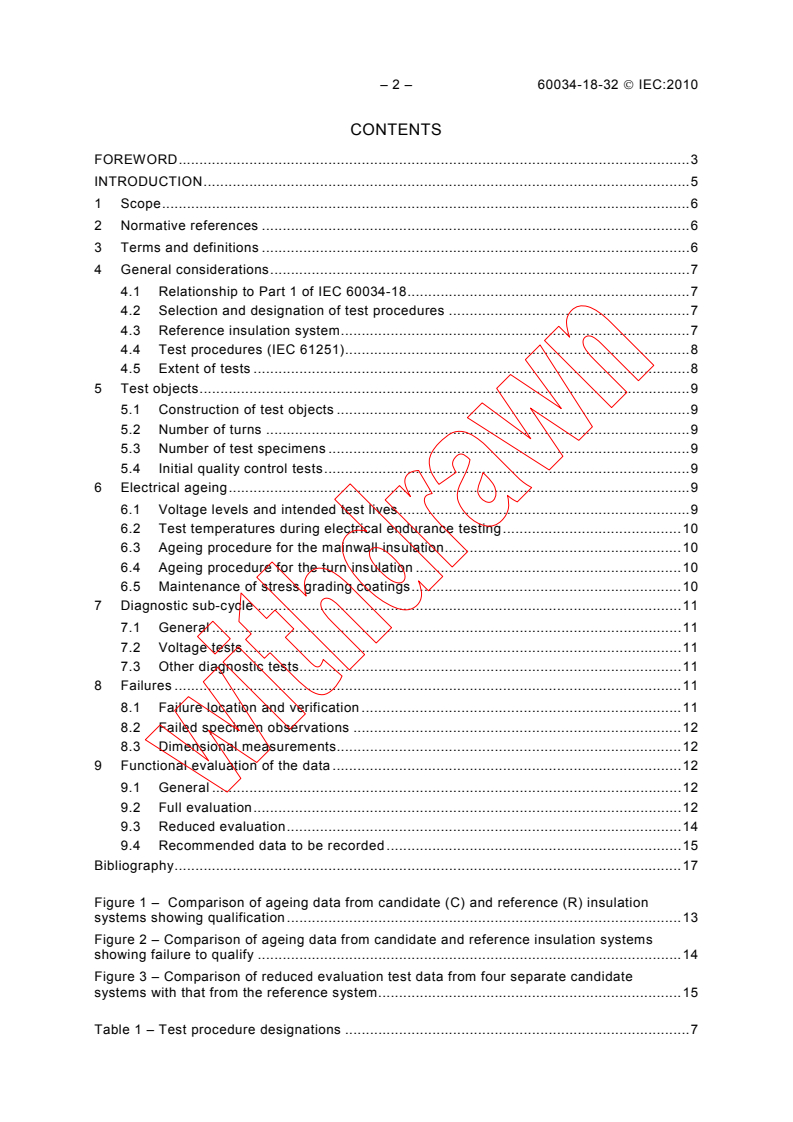
– 2 – 60034-18-32 © IEC:2010
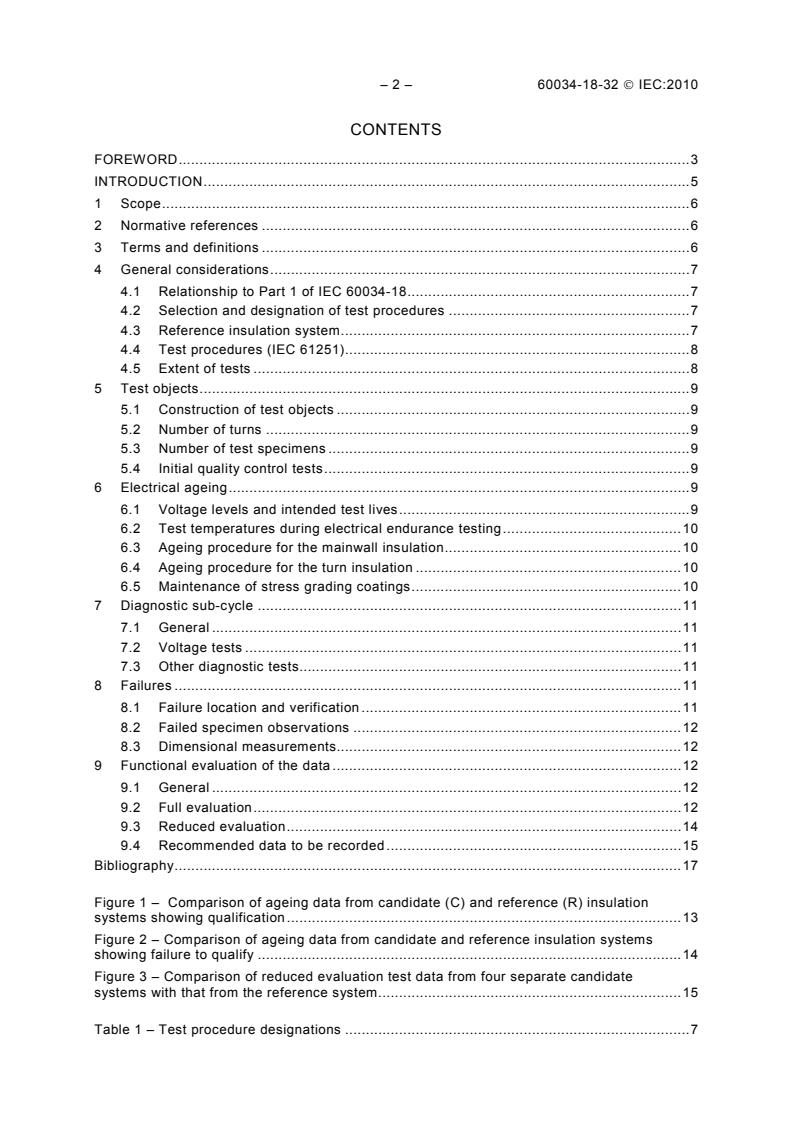
CONTENTS
FOREWORD.3
INTRODUCTION.5
1 Scope.6
2 Normative references .6
3 Terms and definitions .6
4 General considerations.7
4.1 Relationship to Part 1 of IEC 60034-18.7
4.2 Selection and designation of test procedures .7
4.3 Reference insulation system.7
4.4 Test procedures (IEC 61251).8
4.5 Extent of tests .8
5 Test objects.9
5.1 Construction of test objects .9
5.2 Number of turns .9
5.3 Number of test specimens .9
5.4 Initial quality control tests.9
6 Electrical ageing.9
6.1 Voltage levels and intended test lives.9
6.2 Test temperatures during electrical endurance testing.10
6.3 Ageing procedure for the mainwall insulation.10
6.4 Ageing procedure for the turn insulation .10
6.5 Maintenance of stress grading coatings.10
7 Diagnostic sub-cycle .11
7.1 General .11
7.2 Voltage tests .11
7.3 Other diagnostic tests.11
8 Failures .11
8.1 Failure location and verification .11
8.2 Failed specimen observations .12
8.3 Dimensional measurements.12
9 Functional evaluation of the data .12
9.1 General .12
9.2 Full evaluation.12
9.3 Reduced evaluation.14
9.4 Recommended data to be recorded .15
Bibliography.17
Figure 1 – Comparison of ageing data from candidate (C) and reference (R) insulation
systems showing qualification.13
Figure 2 – Comparison of ageing data from candidate and reference insulation systems
showing failure to qualify .
Figure 3 – Comparison of reduced evaluation test data from four separate candidate
systems with that from the reference system.15
Table 1 – Test procedure designations .7
60034-18-32 © IEC:2010 – 3 –
INTERNATIONAL ELECTROTECHNICAL COMMISSION
____________
ROTATING ELECTRICAL MACHINES –
Part 18-32: Functional evaluation of insulation systems –
Test procedures for form-wound windings –
Evaluation by electrical endurance
FOREWORD
1) The International Electrotechnical Commission (IEC) is a worldwide organization for standardization comprising
all national electrotechnical committees (IEC National Committees). The object of IEC is to promote
international co-operation on all questions concerning standardization in the electrical and electronic fields. To
this end and in addition to other activities, IEC publishes International Standards, Technical Specifications,
Technical Reports, Publicly Available Specifications (PAS) and Guides (hereafter referred to as “IEC
Publication(s)”). Their preparation is entrusted to technical committees; any IEC National Committee interested
in the subject dealt with may participate in this preparatory work. International, governmental and non-
governmental organizations liaising with the IEC also participate in this preparation. IEC collaborates closely
with the International Organization for Standardization (ISO) in accordance with conditions determined by
agreement between the two organizations.
2) The formal decisions or agreements of IEC on technical matters express, as nearly as possible, an international
consensus of opinion on the relevant subjects since each technical committee has representation from all
interested IEC National Committees.
3) IEC Publications have the form of recommendations for international use and are accepted by IEC National
Committees in that sense. While all reasonable efforts are made to ensure that the technical content of IEC
Publications is accurate, IEC cannot be held responsible for the way in which they are used or for any
misinterpretation by any end user.
4) In order to promote international uniformity, IEC National Committees undertake to apply IEC Publications
transparently to the maximum extent possible in their national and regional publications. Any divergence
between any IEC Publication and the corresponding national or regional publication shall be clearly indicated in
the latter.
5) IEC itself does not provide any attestation of conformity. Independent certification bodies provide conformity
assessment services and, in some areas, access to IEC marks of conformity. IEC is not responsible for any
services carried out by independent certification bodies.
6) All users should ensure that they have the latest edition of this publication.
7) No liability shall attach to IEC or its directors, employees, servants or agents including individual experts and
members of its technical committees and IEC National Committees for any personal injury, property damage or
other damage of any nature whatsoever, whether direct or indirect, or for costs (including legal fees) and
expenses arising out of the publication, use of, or reliance upon, this IEC Publication or any other IEC
Publications.
8) Attention is drawn to the Normative references cited in this publication. Use of the referenced publications is
indispensable for the correct application of this publication.
9) Attention is drawn to the possibility that some of the elements of this IEC Publication may be the subject of
patent rights. IEC shall not be held responsible for identifying any or all such patent rights.
International Standard IEC 60034-18-32 has been prepared by IEC technical committee 2:
Rotating machinery.
This first edition cancels and replaces IEC/TS 60034-18-32, published in 1995 and constitutes
a technical revision.
The main technical changes with regard to the previous technical specification are as follows.
a) simplification of clauses;
b) reduction in the number of test procedures;
c) inclusion of full bars and coils as test objects;
d) a new clause dealing with failures and failure criteria.
– 4 – 60034-18-32 © IEC:2010
The text of this standard is based on the following documents:
CDV Report on voting
2/1580/CDV 2/1602/RVC
Full information on the voting for the approval of this International Standard can be found in
the report on voting indicated in the above table.
A list of all parts of the IEC 60034 series, published under the general title Rotating electrical
machines, can be found on the IEC website.
NOTE A table of cross-references of all IEC TC 2 publications can be found in the IEC TC 2 dashboard on the
IEC website.
The committee has decided that the contents of this amendment and the base publication will
remain unchanged until the stability date indicated on the IEC web site under
"http://webstore.iec.ch" in the data related to the specific publication. At this date, the
publication will be
• reconfirmed,
• withdrawn,
• replaced by a revised edition, or
• amended.
60034-18-32 © IEC:2010 – 5 –
INTRODUCTION
Part 1 of IEC 60034-18 presents general principles for the evaluation of insulation systems
used in rotating electrical machines.
This standard deals exclusively with insulation systems for form-wound windings and
concentrates on electrical functional evaluation.
– 6 – 60034-18-32 © IEC:2010
ROTATING ELECTRICAL MACHINES –
Part 18-32: Functional evaluation of insulation systems –
Test procedures for form-wound windings –
Evaluation by electrical endurance
1 Scope
This part of IEC 60034-18 describes test procedures for the evaluation of electrical endurance
of insulation systems for use in a.c. or d.c. rotating electrical machines using form-wound
windings. The test procedures are comparative in nature, such that the performance of a
candidate insulation system is compared to that of a reference insulation system with proven
service experience. The test procedures are principally directed at the insulation systems in
air-cooled machines but may also be used for evaluating parts of the insulation systems in
hydrogen cooled machines. Note that the qualification procedures of inverter duty insulation
systems for form-wound windings can be found in IEC 60034-18-42.
2 Normative references
The following referenced documents are indispensable for the application of this document.
For dated references, only the edition cited applies. For undated references, the latest edition
of the referenced document (including any amendments) applies.
IEC 60034-1, Rotating electrical machines – Part 1: Rating and performance
IEC 60034-15:2009, Rotating electrical machines – Part 15: Impulse voltage withstand
levels of form-wound stator coils for rotating a.c. machines
IEC 60034-18-1:2010, Rotating electrical machines – Part 18-1: Functional evaluation of in-
sulation systems – General guidelines
3 Terms and definitions
For the purposes of this document, the following terms and definitions apply.
3.1
mainwall insulation
main electrical insulation that separates the conductors from the earthed stator/rotor core in
motor and generator windings
3.2
turn insulation
electrical insulation that covers each conductor in coils/bars
3.3
interturn insulation
electrical insulation that separates the conductor turns from each other in coils/bars
3.4
corona protection material
material which is used to coat a stator coil/bar within the slot portion of the stator core to
avoid slot discharges
60034-18-32 © IEC:2010 – 7 –
3.5
stress grading material
material generally having a non-linear resistivity characteristic, applied to the endwindings of
stators to reduce the maximum surface electrical stress
4 General considerations
4.1 Relationship to Part 1 of IEC 60034-18
The principles of Part 1 of IEC 60034-18 should be followed unless the recommendations of
this International Standard indicate otherwise.
4.2 Selection and designation of test procedures
One or more of the procedures in this International Standard should be suitable for the
majority of evaluations. Evaluation is usually performed by the manufacturer of the
machine/coils or by a third party laboratory. It is the manufacturer’s responsibility to justify the
most suitable procedure in Table 1 on the basis of past experience and knowledge of the
insulation systems to be compared.
The test procedure should be selected from Table 1 and designated by IEC 60034-18-32
procedure N, where N is the designation given in the Table 1. Subclauses 4.3, 4.4 and 4.5
give guidance on how to select the test procedure.
Table 1 – Test procedure designations
Designation Applied ageing voltage Diagnostic tests
of test
Mainwall Interturn Mainwall Interturn Stress grading
procedure
insulation insulation insulation insulation (7.3)
N (6.3) (6.4) (7.2.1) (7.2.2 or 7.2.3)
AA Constant None Not required (A) No test (A) Optional (D)
CA Constant None Other test (C) No test (A) Optional (D)
AB Constant Yes Not required (A) Impulse test (B) Optional (D)
NOTE 1 The meaning of the letters of the diagnostic test are as follows: A – No test; B – Impulse test;
C – Other test (such as dissipation factor and partial discharge tests); D – Visual observation.
NOTE 2 Where a diagnostic test is not required on the mainwall insulation, the ageing voltage acts
simultaneously as the diagnostic factor.
All the above tests are carried out at room temperature. However, if they are to be performed
at any other temperature (see 6.2.2), the designation of the test procedure shall include the
Celsius temperature in brackets, e.g. AA(190). Each of the procedures may be used for the
full evaluation according to 4.5.1 or for the reduced evaluation according to 4.5.2.
Procedure AA is the preferred choice if the manufacturer has no past experience or
knowledge of the candidate system and the behaviour of the mainwall insulation is defined.
4.3 Reference insulation system
A reference insulation system should be tested using a test procedure equivalent to that used
for the candidate system (see IEC 60034-18-1). The reference insulation system should have
service experience at not less than 75 % of the intended maximum rated voltage of the
candidate system. When extrapolation of the insulation thickness is used, some information
should be provided showing the correlation between electrical lifetime and electrical stress for
the different insulation thicknesses.
– 8 – 60034-18-32 © IEC:2010
4.4 Test procedures (IEC 61251)
4.4.1 General
Electrical ageing tests are usually performed at fixed voltage levels until failure. From such
tests, characteristic times to failure at each voltage level are obtained. The results for both
the candidate system and the reference system should be reported on a graph, as shown by
the example in Figure 1, and compared. There is no proven physical basis for extrapolation of
this characteristic to the service voltage level U / 3 , where U is the r.m.s. rated phase to
N N
phase voltage. Statistical evaluation of the results of testing should be performed according to
IEC 62539.
4.4.2 Electrical ageing of the mainwall insulation
In service, electrical ageing of the mainwall insulation is primarily caused by continuous elec-
trical stress at power frequency. In addition, the insulation is required to withstand transient
over-voltages arising from switching surges or inverter supply. The ability of the mainwall
insulation to withstand transient over-voltages from converter supplies may be demonstrated
by the system’s performance using IEC 60034-18-42. This standard describes voltage ageing
of the mainwall insulation, carried out at power frequency or at a frequency up to 10 times
greater.
4.4.3 Electrical ageing of the turn insulation
Electrical ageing of the turn insulation can arise due to the steady-state stress applied across
the mainwall insulation. This could be particularly significant at the edges of the conductors
where the electrical stress reaches a maximum.
Where multiturn coils or bars are used, the power frequency voltage between turns is
sufficiently low that ageing due to this electric stress is not of major significance. However,
steep-fronted surges on the winding caused by switching and other disturbances can generate
sufficient stress between turns for ageing to take place. Since the waveforms and frequency
of occurrence are variable and dependent upon circuit parameters, this International Standard
recommends that, for comparison purposes, electrical ageing of the turn insulation be
performed using IEC 60034-18-42.
4.5 Extent of tests
4.5.1 Full evaluation
The extent of the electrical functional tests will depend upon the purpose of the evaluation. A
full evaluation will be needed where there are substantial differences in the compositions of
the reference and candidate systems.
4.5.2 Reduced evaluation
There are situations when it will be sufficient to carry out reduced evaluation using the
minimum number of test specimens and the middle voltage level from the range of reference
tests.
Comparison of a candidate insulation system to a reference system, where there are no
intended or only minor differences in composition or manufacturing procedures (so-called
minor changes, see IEC 60034-18-1), may be carried out using only one voltage level but with
the recommended minimum number of test specimens (see 5.3). Reduced evaluation is
allowed only if the rated voltages are the same for both systems.
An example of a minor change might be the sourcing of the same material from a different
supplier or a change of pulping process. An example of a minor processing change might be
the installation of a new controller or new pipework in a vacuum pressure impregnation (VPI)
process. It should be emphasized that a minor change is one which is not expected to have a
60034-18-32 © IEC:2010 – 9 –
significant effect on the insulation system. It is the responsibility of the manufacturer to justify
the use of the reduced qualification procedure
5 Test objects
5.1 Construction of test objects
Test objects should preferably be complete bars or coils made to normal manufacturing
standards. Alternatively, they may be constructed to represent the configuration of the
finished winding component to be evaluated and be subjected to the full normal or intended
manufacturing processes. When using separate coils or bars as models, creepage distances
and any necessary voltage grading are to be appropriate to the stresses applied during
testing. An electrode should extend the full slot length of the model and encircle the entire
circumference of the coil cross-section.
The sample preparation and test procedures described in IEC 60034-18-42 may be used for
qualifying stress grading systems applied to endwinding insulation.
5.2 Number of turns
For the turn insulation, it is generally necessary to use complete coils in order to include the
effects of shaping and conductor reinforcement. The number of turns and the thickness of the
turn insulation should be such that when the test voltage chosen in accordance with 6.1 is
applied, the turn dielectric stress is not less than the highest that would be imposed by
applying the appropriate test voltage to any design of coil for which the insulation system can
be used.
Where a power frequency voltage is to be applied between the turns, the coil should be
wound with two parallel conductors, each insulated with turn insulation, or the coil has to be
cut in the end windings. When using VPI coils, the cut-through and separation of the
conductors in this area have to be done before impregnation. If the test procedure chosen
(see 4.2) does not apply a power frequency voltage between the turns, the test object can be
a multiturn coil wound in the normal manner with a single (or stranded) conductor.
5.3 Number of test specimens
An adequate number of test specimens shall be aged at each test voltage level in order to
obtain statistical confidence. This number should not be less than five.
5.4 Initial quality control tests
Before starting the first ageing sub-cycle, the following quality control tests shall be
performed:
– visual inspection of the test specimens;
– high-voltage tests according to IEC 60034-1;
– dissipation factor test or/and partial discharge test.
6 Electrical ageing
6.1 Voltage levels and intended test lives
For full evaluation as described in 4.5.1, at least three power frequency voltages should be
selected so that the intended mean time to failure at the highest voltage is about 100 h, and
at the lowest voltage above 5 000 h. For reduced evaluation where only one voltage level is
required (see 4.5.2), it should be chosen so that the intended mean time to failure is about
1 000 h. The alternating voltage applied to the test objects should be maintained within ± 3 %.
– 10 – 60034-18-32 © IEC:2010
6.2 Test temperatures during electrical endurance testing
6.2.1 Electrical ageing at room temperature
Electrical ageing is preferably carried out in air at room temperature at voltages and/or
frequencies higher than those in the steady-state operating conditions in order to accelerate
the effects of electrical stress.
6.2.2 Electrical ageing at elevated temperature
Any appropriate means of heating may be used when the electrical ageing tests are
performed at elevated temperatures. The temperature rise due to the applied electrical stress
can affect the results, especially when using increased frequency, and shall be recorded. If
thermal ageing does occur, the testing should follow the procedures in IEC 60034-18-33 for
multifactor testing.
6.3 Ageing procedure for the mainwall insulation
The electrical stress is applied between the stator core or the outer conductive layer on the
surface of the test specimen and the conductors. If the test object is a multiturn coil, both the
mainwall insulation and the turn insulation are aged by the electrical stress during this period.
For test procedures with sub-cycles (Clause 7), the duration of these sub-cycles should be
such that approximately ten sub-cycles are performed on a test specimen having a median
life. Higher than power frequency is allowed to shorten the test times but experience has
shown that the maximum acceptable acceleration factor is 10 times the power frequency.
Care should be taken that the dielectric losses do not increase the temperature of the
insulation so much that the results are affected. This is especially important at elevated
temperatures. The same frequency should be used for the candidate and reference insulation
system. Increased frequency test results may only be used for direct comparison if the lives of
the systems are affected similarly by the increase of frequency.
6.4 Ageing procedure for the turn insulation
Ageing of the turn insulation due to repetitive transient over-voltages is evaluated according
to procedure AB in Table 1. The mainwall insulation ageing sub-cycle is followed by a turn
insulation ageing sub-cycle consisting of the application of a power frequency voltage
between turns for 10 min. This voltage shall be
1,5 ×U
N
n
where where U is the rated voltage of the insulation in kV and n is the number of turns, but
N
not less than 0,3 × U .
N
The temperature rise due to the applied electrical stress can affect the results, especially
when using increased frequency and should be recorded. Increased frequency test results
may only be used for direct comparison if the lives of the systems are affected similarly by the
increase in frequency.
6.5 Maintenance of stress grading coatings
A stress grading coating is usually applied to the outer surface of the coil or bar beyond the
earthed semi-conductive slot coating. The stress grading coating may take the form of paints
or tapes or a combination of the two. During the electrical endurance test, deterioration may
occur which does not result in insulation failure. Remedial action to the stress grading
material and forced air cooling are permitted during the progress of the voltage endurance
test on the basis that it is the mainwall insulation that is being tested rather than the stress
grading system.
60034-18-32 © IEC:2010 – 11 –
7 Diagnostic sub-cycle
7.1 General
Following each ageing sub-cycle, a diagnostic sub-cycle can be performed. Failure of any part
of the test specimen during a diagnostic test constitutes failure of the whole system and shall
be reported as such. The appropriate voltage tests are selected according to the chosen test
procedure in 4.2.
7.2 Voltage tests
7.2.1 Mainwall insulation test
The diagnostic test on the mainwall insulation consists of three successive applications of
a 1,2/50 μs impulse voltage with a peak value of U = (4 U + 5 kV). Alternatively, a mainwall
p
N
power frequency test according to 4.4 of IEC 60034-15 may be used. In this case, an r.m.s.
voltage of (2 U + 1 kV) is applied for 1 min between coil terminals and earth. The applied
N
r.m.s. voltage is then increased at the rate of 1 kV/s up to 2 (2 U + 1 kV), and then
N
immediately reduced at a rate of at least 1 kV/s to zero.
7.2.2 Turn insulation impulse test
For test objects comprising multiturn coils wound with a single or stranded conductor the
diagnostic test of the turn insulation is carried out by an impulse voltage test. The amplitude
(peak) shall be given by the formula U′ = 0,65 (4 U + 5 kV), where U is the rated voltage in
p N N
kV (see IEC 60034-15). The number of impulses to be applied is at least 5.
7.2.3 Turn insulation power frequency test
For test objects comprising parallel isolated conductors a power frequency voltage of an
appropriate magnitude shall be applied between the turns for 1 min. Voltage of an appropriate
magnitude should be higher or equal to the highest ageing voltage.
7.3 Other diagnostic tests
Optional diagnostic measurements may be performed for information or to determine end of
test life. These may replace the voltage tests. Factors such as insulation resistance, loss
tangent, and partial discharges are examples. An end-point criterion may be established for
each diagnostic test, with suitable justification reported.
For the stress grading system, there are no electrical tests defined for diagnostic purposes
but it may be useful to record the condition of the material, viewed with the unaided eye, in
regard to colour and surface imperfections, such as blistering and cracking.
8 Failures
8.1 Failure location and verification
Failure of a specimen occurs when any electrical breakdown of the mainwall insulation
occurs. This will result in the over-current detection system interrupting current to the high
voltage transformer. Failure of the insulation should be verified by re-applying voltage
gradually from zero. A specimen insulation failure will prevent the reapplication of the full test
voltage. Locating the failure site is desirable and may be undertaken by seeing arcing or
heating at the failure site as the voltage is raised. When specimen failure has been verified
the failed sample should be isolated to allow testing to continue on the remaining samples.
– 12 – 60034-18-32 © IEC:2010
8.2 Failed specimen observations
Each failed specimen should be examined to ensure that the failure is valid for statistical
interpretation. This may require some specimen dissection in the area around the insulation
puncture to identify the failure location and its cause.
8.3 Dimensional measurements
The thickness of the insulation wall (mainwall plus turn plus strand) shall be determined at or
near the voltage endurance failure site.
9 Functional evaluation of the data
9.1 General
The evaluation of the test data should follow the guidelines set out below. Under the
assumption of a Weibull distribution, the appropriate statistical analysis should be applied to
calculate the significance of the candidate sample life with regard to that of the reference
sample (see IEC 62539).
The general rule is that the candidate insulation system is considered to be qualified if the
90 % confidence interval of the used probability distribution falls above or within that obtained
from the reference system (see 4.1 in IEC 60034-18-1).
9.2 Full evaluation
Electrical endurance graphs of the candidate and the reference system are plotted as a log-
log representation of the time to failure (t), as a function of the ratio of test voltage (U ) and
t
rated voltage (U ), where U is the rated voltage of the reference system and the candidate
N N
system. The candidate system is qualified if
a) the upper 90 % confidence limit of the candidate system exceeds the upper 90 %
confidence limit of the reference system over the range of reference system test voltages,
or
b) the lower 90 % confidence limit of the candidate system exceeds or is equal to the lower
90 % confidence limit of the reference system at the lowest test voltage and the slope of
the regression line of the mean values of the candidate system is steeper than that of the
reference system.
Ageing results for a candidate system which satisfies condition b) are shown in Figure 1. An
example of a candidate system which fails to qualify in respect of either condition a) or b) is
shown in Figure 2.
60034-18-32 © IEC:2010 – 13 –
t
R
C
2,0 2,5 3,0
U
t
U
N
IEC 2406/10
Key
R ageing data from the reference insulation system (R) showing the 90 % confidence limits
C ageing data from the candidate insulation system (C) showing the 90 % confidence limits
t time in hours
U /U ratio of test voltage to rated voltage
t N
Figure 1 – Comparison of ageing data from candidate (C) and
reference (R) insulation systems showing qualification
– 14 – 60034-18-32 © IEC:2010
t
R
C
2,0 2,5 3,0
U
t
U
N
IEC 2407/10
Key
R ageing data from the reference insulation system (R) showing the 90 % confidence limits
C ageing data from the candidate insulation system (C) showing the 90 % confidence limits
t time in hours
U /U ratio of test voltage to rated voltage
t N
Figure 2 – Comparison of ageing data from candidate and
reference insulation systems showing failure to qualify
9.3 Reduced evaluation
For reduced evaluation using a single voltage (see 4.5.2), the basis of analysis shall be as
shown in Figure 3, where the 90 % tolerance of the 63 % quantile of the ageing results for the
candidate system is compared with the 90 % confidence limits of the reference ageing line at
the same quantile. If a partial overlap occurs within the voltage range of the ageing tests on
the reference system, as shown by candidate system B, it is qualified. Qualification is not
achieved in the case of candidate system A because the measurement is outside the voltage
range used to produce the reference system ageing line. Nor is qualification achieved in the
case of candidate system C since no overlap occurs. Candidate system D is qualified because
the results exceed those of the reference system.
60034-18-32 © IEC:2010 – 15 –
t
R
A
D
B
C
2,0 2,5 3,0
U
t
U
N
IEC 2408/10
Key
R ageing data from the reference insulation system showing the 90 % confidence limits
A ageing results for candidate system A (not qualified)
B ageing results for candidate system B (qualified)
C ageing results for candidate system C (not qualified)
D ageing results for candidate system D (qualified)
t time in hours
U /U ratio of test voltage to rated voltage
t N
Figure 3 – Comparison of reduced evaluation test data from four separate candidate
systems with that from the reference system
9.4 Recommended data to be recorded
The following items are suggested for inclusion in test records:
• ambient temperature and humidity in the test area, if the specimens are tested at room
temperature;
• applied voltage, expressed in equivalent r.m.s.;
• frequency of applied voltage in Hertz;
• total endurance time of each sample;
• results of any preliminary or intermediate diagnostic tests or measurements;
• observations of failure locations;
• observations on the nature of failure or of stress-grading damage;
• voltage endurance test temperature, i.e., the temperature of the thermocouples embedded
in the heater plates;
• minimum and maximum test voltage and test temperature during the test.
– 16 – 60034-18-32 © IEC:2010
It will also be desirable to include other information, such as the nature of the samples, the
nature of the electrodes and the nature of the stress-grading material.
60034-18-32 © IEC:2010 – 17 –
Bibliography
IEC 60034-18-33, Rotating electrical machines – Part 18-33: Functional evaluation of in-
sulation systems – Test procedures for form-wound windings – Multifactor evaluation by
endurance under simultaneous thermal and electrical stresses
IEC 60034-18-42, Rotating electrical machines – Part 18-42: Qualification and acceptance
tests for partial discharge resistant electrical insulation systems (Type II) used in rotating
electrical machines fed from voltage converters
IEC 61251, Electrical insulating materials – A.C. voltage endurance evaluation – Introduction
IEC 62539, Guide for the statistical analysis of electrical insulation breakdown data
______________
– 18 – 60034-18-32 © CEI:2010
SOMMAIRE
AVANT-PROPOS.19
INTRODUCTION.21
1 Domaine d'application .22
2 Références normatives.22
3 Termes et définitions .22
4 Considérations générales .23
4.1 Relation avec la Partie 1 de la CEI 60034-18 .23
4.2 Sélection et désignation des procédures d'essai.23
4.3 Système d'isolation de référence.24
4.4 Procédures d'essai (CEI 61251) .24
4.5 Etendue des essais .24
5 Eprouvettes .25
5.1 Construction des éprouvettes .25
5.2 Nombre de spires .25
5.3 Nombre d'échantillons .26
5.4 Essais préliminaires de contrôle qualité.26
6 Vieillissement électrique.26
6.1 Niveaux de tension et durées prévues pour les essais.26
6.2 Températures d'essai durant l'essai d'endurance électrique .26
6.3 Procédure de vieillissement pour l'isolation principale .26
6.4 Procédure de vieillissement pour l'isolation des spires .27
6.5 Maintenance des revêtements de répartition de contrainte .27
7 Sous-cycle de diagnostic .27
7.1 Généralités.27
7.2 Essais de tension .27
7.3 Autres essais de diagnostic.28
8 Défaillances .28
8.1 Emplacement et vérification des défaillances .28
8.2 Observation des échantillons présentant une défaillance.28
8.3 Mesures des dimensions .
...
IEC 60034-18-32 ®
Edition 1.0 2010-10
INTERNATIONAL
STANDARD
NORME
INTERNATIONALE
Rotating electrical machines –
Part 18-32: Functional evaluation of insulation systems – Test procedures for
form-wound windings – Evaluation by electrical endurance
Machines électriques tournantes –
Partie 18-32: Evaluation fonctionnelle des systèmes d’isolation – Procédures
d’essai pour enroulements préformés – Evaluation par endurance électrique
All rights reserved. Unless otherwise specified, no part of this publication may be reproduced or utilized in any form or by
any means, electronic or mechanical, including photocopying and microfilm, without permission in writing from either IEC or
IEC's member National Committee in the country of the requester.
If you have any questions about IEC copyright or have an enquiry about obtaining additional rights to this publication,
please contact the address below or your local IEC member National Committee for further information.
Droits de reproduction réservés. Sauf indication contraire, aucune partie de cette publication ne peut être reproduite
ni utilisée sous quelque forme que ce soit et par aucun procédé, électronique ou mécanique, y compris la photocopie
et les microfilms, sans l'accord écrit de la CEI ou du Comité national de la CEI du pays du demandeur.
Si vous avez des questions sur le copyright de la CEI ou si vous désirez obtenir des droits supplémentaires sur cette
publication, utilisez les coordonnées ci-après ou contactez le Comité national de la CEI de votre pays de résidence.
IEC Central Office
3, rue de Varembé
CH-1211 Geneva 20
Switzerland
Email: inmail@iec.ch
Web: www.iec.ch
About the IEC
The International Electrotechnical Commission (IEC) is the leading global organization that prepares and publishes
International Standards for all electrical, electronic and related technologies.
About IEC publications
The technical content of IEC publications is kept under constant review by the IEC. Please make sure that you have the
latest edition, a corrigenda or an amendment might have been published.
ƒ Catalogue of IEC publications: www.iec.ch/searchpub
The IEC on-line Catalogue enables you to search by a variety of criteria (reference number, text, technical committee,…).
It also gives information on projects, withdrawn and replaced publications.
ƒ IEC Just Published: www.iec.ch/online_news/justpub
Stay up to date on all new IEC publications. Just Published details twice a month all new publications released. Available
on-line and also by email.
ƒ Electropedia: www.electropedia.org
The world's leading online dictionary of electronic and electrical terms containing more than 20 000 terms and definitions
in English and French, with equivalent terms in additional languages. Also known as the International Electrotechnical
Vocabulary online.
ƒ Customer Service Centre: www.iec.ch/webstore/custserv
If you wish to give us your feedback on this publication or need further assistance, please visit the Customer Service
Centre FAQ or contact us:
Email: csc@iec.ch
Tel.: +41 22 919 02 11
Fax: +41 22 919 03 00
A propos de la CEI
La Commission Electrotechnique Internationale (CEI) est la première organisation mondiale qui élabore et publie des
normes internationales pour tout ce qui a trait à l'électricité, à l'électronique et aux technologies apparentées.
A propos des publications CEI
Le contenu technique des publications de la CEI est constamment revu. Veuillez vous assurer que vous possédez
l’édition la plus récente, un corrigendum ou amendement peut avoir été publié.
ƒ Catalogue des publications de la CEI: www.iec.ch/searchpub/cur_fut-f.htm
Le Catalogue en-ligne de la CEI vous permet d’effectuer des recherches en utilisant différents critères (numéro de référence,
texte, comité d’études,…). Il donne aussi des informations sur les projets et les publications retirées ou remplacées.
ƒ Just Published CEI: www.iec.ch/online_news/justpub
Restez informé sur les nouvelles publications de la CEI. Just Published détaille deux fois par mois les nouvelles
publications parues. Disponible en-ligne et aussi par email.
ƒ Electropedia: www.electropedia.org
Le premier dictionnaire en ligne au monde de termes électroniques et électriques. Il contient plus de 20 000 termes et
définitions en anglais et en français, ainsi que les termes équivalents dans les langues additionnelles. Egalement appelé
Vocabulaire Electrotechnique International en ligne.
ƒ Service Clients: www.iec.ch/webstore/custserv/custserv_entry-f.htm
Si vous désirez nous donner des commentaires sur cette publication ou si vous avez des questions, visitez le FAQ du
Service clients ou contactez-nous:
Email: csc@iec.ch
Tél.: +41 22 919 02 11
Fax: +41 22 919 03 00
IEC 60034-18-32 ®
Edition 1.0 2010-10
INTERNATIONAL
STANDARD
NORME
INTERNATIONALE
Rotating electrical machines –
Part 18-32: Functional evaluation of insulation systems – Test procedures for
form-wound windings – Evaluation by electrical endurance
Machines électriques tournantes –
Partie 18-32: Evaluation fonctionnelle des systèmes d’isolation – Procédures
d’essai pour enroulements préformés – Evaluation par endurance électrique
INTERNATIONAL
ELECTROTECHNICAL
COMMISSION
COMMISSION
ELECTROTECHNIQUE
PRICE CODE
INTERNATIONALE
Q
CODE PRIX
ICS 29.160 ISBN 978-2-88912-225-7
– 2 – 60034-18-32 © IEC:2010
CONTENTS
FOREWORD.3
INTRODUCTION.5
1 Scope.6
2 Normative references .6
3 Terms and definitions .6
4 General considerations.7
4.1 Relationship to Part 1 of IEC 60034-18.7
4.2 Selection and designation of test procedures .7
4.3 Reference insulation system.7
4.4 Test procedures (IEC 61251).8
4.5 Extent of tests .8
5 Test objects.9
5.1 Construction of test objects .9
5.2 Number of turns .9
5.3 Number of test specimens .9
5.4 Initial quality control tests.9
6 Electrical ageing.9
6.1 Voltage levels and intended test lives.9
6.2 Test temperatures during electrical endurance testing.10
6.3 Ageing procedure for the mainwall insulation.10
6.4 Ageing procedure for the turn insulation .10
6.5 Maintenance of stress grading coatings.10
7 Diagnostic sub-cycle .11
7.1 General .11
7.2 Voltage tests .11
7.3 Other diagnostic tests.11
8 Failures .11
8.1 Failure location and verification .11
8.2 Failed specimen observations .12
8.3 Dimensional measurements.12
9 Functional evaluation of the data .12
9.1 General .12
9.2 Full evaluation.12
9.3 Reduced evaluation.14
9.4 Recommended data to be recorded .15
Bibliography.17
Figure 1 – Comparison of ageing data from candidate (C) and reference (R) insulation
systems showing qualification.13
Figure 2 – Comparison of ageing data from candidate and reference insulation systems
showing failure to qualify .
Figure 3 – Comparison of reduced evaluation test data from four separate candidate
systems with that from the reference system.15
Table 1 – Test procedure designations .7
60034-18-32 © IEC:2010 – 3 –
INTERNATIONAL ELECTROTECHNICAL COMMISSION
____________
ROTATING ELECTRICAL MACHINES –
Part 18-32: Functional evaluation of insulation systems –
Test procedures for form-wound windings –
Evaluation by electrical endurance
FOREWORD
1) The International Electrotechnical Commission (IEC) is a worldwide organization for standardization comprising
all national electrotechnical committees (IEC National Committees). The object of IEC is to promote
international co-operation on all questions concerning standardization in the electrical and electronic fields. To
this end and in addition to other activities, IEC publishes International Standards, Technical Specifications,
Technical Reports, Publicly Available Specifications (PAS) and Guides (hereafter referred to as “IEC
Publication(s)”). Their preparation is entrusted to technical committees; any IEC National Committee interested
in the subject dealt with may participate in this preparatory work. International, governmental and non-
governmental organizations liaising with the IEC also participate in this preparation. IEC collaborates closely
with the International Organization for Standardization (ISO) in accordance with conditions determined by
agreement between the two organizations.
2) The formal decisions or agreements of IEC on technical matters express, as nearly as possible, an international
consensus of opinion on the relevant subjects since each technical committee has representation from all
interested IEC National Committees.
3) IEC Publications have the form of recommendations for international use and are accepted by IEC National
Committees in that sense. While all reasonable efforts are made to ensure that the technical content of IEC
Publications is accurate, IEC cannot be held responsible for the way in which they are used or for any
misinterpretation by any end user.
4) In order to promote international uniformity, IEC National Committees undertake to apply IEC Publications
transparently to the maximum extent possible in their national and regional publications. Any divergence
between any IEC Publication and the corresponding national or regional publication shall be clearly indicated in
the latter.
5) IEC itself does not provide any attestation of conformity. Independent certification bodies provide conformity
assessment services and, in some areas, access to IEC marks of conformity. IEC is not responsible for any
services carried out by independent certification bodies.
6) All users should ensure that they have the latest edition of this publication.
7) No liability shall attach to IEC or its directors, employees, servants or agents including individual experts and
members of its technical committees and IEC National Committees for any personal injury, property damage or
other damage of any nature whatsoever, whether direct or indirect, or for costs (including legal fees) and
expenses arising out of the publication, use of, or reliance upon, this IEC Publication or any other IEC
Publications.
8) Attention is drawn to the Normative references cited in this publication. Use of the referenced publications is
indispensable for the correct application of this publication.
9) Attention is drawn to the possibility that some of the elements of this IEC Publication may be the subject of
patent rights. IEC shall not be held responsible for identifying any or all such patent rights.
International Standard IEC 60034-18-32 has been prepared by IEC technical committee 2:
Rotating machinery.
This first edition cancels and replaces IEC/TS 60034-18-32, published in 1995 and constitutes
a technical revision.
The main technical changes with regard to the previous technical specification are as follows.
a) simplification of clauses;
b) reduction in the number of test procedures;
c) inclusion of full bars and coils as test objects;
d) a new clause dealing with failures and failure criteria.
– 4 – 60034-18-32 © IEC:2010
The text of this standard is based on the following documents:
CDV Report on voting
2/1580/CDV 2/1602/RVC
Full information on the voting for the approval of this International Standard can be found in
the report on voting indicated in the above table.
A list of all parts of the IEC 60034 series, published under the general title Rotating electrical
machines, can be found on the IEC website.
NOTE A table of cross-references of all IEC TC 2 publications can be found in the IEC TC 2 dashboard on the
IEC website.
The committee has decided that the contents of this amendment and the base publication will
remain unchanged until the stability date indicated on the IEC web site under
"http://webstore.iec.ch" in the data related to the specific publication. At this date, the
publication will be
• reconfirmed,
• withdrawn,
• replaced by a revised edition, or
• amended.
60034-18-32 © IEC:2010 – 5 –
INTRODUCTION
Part 1 of IEC 60034-18 presents general principles for the evaluation of insulation systems
used in rotating electrical machines.
This standard deals exclusively with insulation systems for form-wound windings and
concentrates on electrical functional evaluation.
– 6 – 60034-18-32 © IEC:2010
ROTATING ELECTRICAL MACHINES –
Part 18-32: Functional evaluation of insulation systems –
Test procedures for form-wound windings –
Evaluation by electrical endurance
1 Scope
This part of IEC 60034-18 describes test procedures for the evaluation of electrical endurance
of insulation systems for use in a.c. or d.c. rotating electrical machines using form-wound
windings. The test procedures are comparative in nature, such that the performance of a
candidate insulation system is compared to that of a reference insulation system with proven
service experience. The test procedures are principally directed at the insulation systems in
air-cooled machines but may also be used for evaluating parts of the insulation systems in
hydrogen cooled machines. Note that the qualification procedures of inverter duty insulation
systems for form-wound windings can be found in IEC 60034-18-42.
2 Normative references
The following referenced documents are indispensable for the application of this document.
For dated references, only the edition cited applies. For undated references, the latest edition
of the referenced document (including any amendments) applies.
IEC 60034-1, Rotating electrical machines – Part 1: Rating and performance
IEC 60034-15:2009, Rotating electrical machines – Part 15: Impulse voltage withstand
levels of form-wound stator coils for rotating a.c. machines
IEC 60034-18-1:2010, Rotating electrical machines – Part 18-1: Functional evaluation of in-
sulation systems – General guidelines
3 Terms and definitions
For the purposes of this document, the following terms and definitions apply.
3.1
mainwall insulation
main electrical insulation that separates the conductors from the earthed stator/rotor core in
motor and generator windings
3.2
turn insulation
electrical insulation that covers each conductor in coils/bars
3.3
interturn insulation
electrical insulation that separates the conductor turns from each other in coils/bars
3.4
corona protection material
material which is used to coat a stator coil/bar within the slot portion of the stator core to
avoid slot discharges
60034-18-32 © IEC:2010 – 7 –
3.5
stress grading material
material generally having a non-linear resistivity characteristic, applied to the endwindings of
stators to reduce the maximum surface electrical stress
4 General considerations
4.1 Relationship to Part 1 of IEC 60034-18
The principles of Part 1 of IEC 60034-18 should be followed unless the recommendations of
this International Standard indicate otherwise.
4.2 Selection and designation of test procedures
One or more of the procedures in this International Standard should be suitable for the
majority of evaluations. Evaluation is usually performed by the manufacturer of the
machine/coils or by a third party laboratory. It is the manufacturer’s responsibility to justify the
most suitable procedure in Table 1 on the basis of past experience and knowledge of the
insulation systems to be compared.
The test procedure should be selected from Table 1 and designated by IEC 60034-18-32
procedure N, where N is the designation given in the Table 1. Subclauses 4.3, 4.4 and 4.5
give guidance on how to select the test procedure.
Table 1 – Test procedure designations
Designation Applied ageing voltage Diagnostic tests
of test
Mainwall Interturn Mainwall Interturn Stress grading
procedure
insulation insulation insulation insulation (7.3)
N (6.3) (6.4) (7.2.1) (7.2.2 or 7.2.3)
AA Constant None Not required (A) No test (A) Optional (D)
CA Constant None Other test (C) No test (A) Optional (D)
AB Constant Yes Not required (A) Impulse test (B) Optional (D)
NOTE 1 The meaning of the letters of the diagnostic test are as follows: A – No test; B – Impulse test;
C – Other test (such as dissipation factor and partial discharge tests); D – Visual observation.
NOTE 2 Where a diagnostic test is not required on the mainwall insulation, the ageing voltage acts
simultaneously as the diagnostic factor.
All the above tests are carried out at room temperature. However, if they are to be performed
at any other temperature (see 6.2.2), the designation of the test procedure shall include the
Celsius temperature in brackets, e.g. AA(190). Each of the procedures may be used for the
full evaluation according to 4.5.1 or for the reduced evaluation according to 4.5.2.
Procedure AA is the preferred choice if the manufacturer has no past experience or
knowledge of the candidate system and the behaviour of the mainwall insulation is defined.
4.3 Reference insulation system
A reference insulation system should be tested using a test procedure equivalent to that used
for the candidate system (see IEC 60034-18-1). The reference insulation system should have
service experience at not less than 75 % of the intended maximum rated voltage of the
candidate system. When extrapolation of the insulation thickness is used, some information
should be provided showing the correlation between electrical lifetime and electrical stress for
the different insulation thicknesses.
– 8 – 60034-18-32 © IEC:2010
4.4 Test procedures (IEC 61251)
4.4.1 General
Electrical ageing tests are usually performed at fixed voltage levels until failure. From such
tests, characteristic times to failure at each voltage level are obtained. The results for both
the candidate system and the reference system should be reported on a graph, as shown by
the example in Figure 1, and compared. There is no proven physical basis for extrapolation of
this characteristic to the service voltage level U / 3 , where U is the r.m.s. rated phase to
N N
phase voltage. Statistical evaluation of the results of testing should be performed according to
IEC 62539.
4.4.2 Electrical ageing of the mainwall insulation
In service, electrical ageing of the mainwall insulation is primarily caused by continuous elec-
trical stress at power frequency. In addition, the insulation is required to withstand transient
over-voltages arising from switching surges or inverter supply. The ability of the mainwall
insulation to withstand transient over-voltages from converter supplies may be demonstrated
by the system’s performance using IEC 60034-18-42. This standard describes voltage ageing
of the mainwall insulation, carried out at power frequency or at a frequency up to 10 times
greater.
4.4.3 Electrical ageing of the turn insulation
Electrical ageing of the turn insulation can arise due to the steady-state stress applied across
the mainwall insulation. This could be particularly significant at the edges of the conductors
where the electrical stress reaches a maximum.
Where multiturn coils or bars are used, the power frequency voltage between turns is
sufficiently low that ageing due to this electric stress is not of major significance. However,
steep-fronted surges on the winding caused by switching and other disturbances can generate
sufficient stress between turns for ageing to take place. Since the waveforms and frequency
of occurrence are variable and dependent upon circuit parameters, this International Standard
recommends that, for comparison purposes, electrical ageing of the turn insulation be
performed using IEC 60034-18-42.
4.5 Extent of tests
4.5.1 Full evaluation
The extent of the electrical functional tests will depend upon the purpose of the evaluation. A
full evaluation will be needed where there are substantial differences in the compositions of
the reference and candidate systems.
4.5.2 Reduced evaluation
There are situations when it will be sufficient to carry out reduced evaluation using the
minimum number of test specimens and the middle voltage level from the range of reference
tests.
Comparison of a candidate insulation system to a reference system, where there are no
intended or only minor differences in composition or manufacturing procedures (so-called
minor changes, see IEC 60034-18-1), may be carried out using only one voltage level but with
the recommended minimum number of test specimens (see 5.3). Reduced evaluation is
allowed only if the rated voltages are the same for both systems.
An example of a minor change might be the sourcing of the same material from a different
supplier or a change of pulping process. An example of a minor processing change might be
the installation of a new controller or new pipework in a vacuum pressure impregnation (VPI)
process. It should be emphasized that a minor change is one which is not expected to have a
60034-18-32 © IEC:2010 – 9 –
significant effect on the insulation system. It is the responsibility of the manufacturer to justify
the use of the reduced qualification procedure
5 Test objects
5.1 Construction of test objects
Test objects should preferably be complete bars or coils made to normal manufacturing
standards. Alternatively, they may be constructed to represent the configuration of the
finished winding component to be evaluated and be subjected to the full normal or intended
manufacturing processes. When using separate coils or bars as models, creepage distances
and any necessary voltage grading are to be appropriate to the stresses applied during
testing. An electrode should extend the full slot length of the model and encircle the entire
circumference of the coil cross-section.
The sample preparation and test procedures described in IEC 60034-18-42 may be used for
qualifying stress grading systems applied to endwinding insulation.
5.2 Number of turns
For the turn insulation, it is generally necessary to use complete coils in order to include the
effects of shaping and conductor reinforcement. The number of turns and the thickness of the
turn insulation should be such that when the test voltage chosen in accordance with 6.1 is
applied, the turn dielectric stress is not less than the highest that would be imposed by
applying the appropriate test voltage to any design of coil for which the insulation system can
be used.
Where a power frequency voltage is to be applied between the turns, the coil should be
wound with two parallel conductors, each insulated with turn insulation, or the coil has to be
cut in the end windings. When using VPI coils, the cut-through and separation of the
conductors in this area have to be done before impregnation. If the test procedure chosen
(see 4.2) does not apply a power frequency voltage between the turns, the test object can be
a multiturn coil wound in the normal manner with a single (or stranded) conductor.
5.3 Number of test specimens
An adequate number of test specimens shall be aged at each test voltage level in order to
obtain statistical confidence. This number should not be less than five.
5.4 Initial quality control tests
Before starting the first ageing sub-cycle, the following quality control tests shall be
performed:
– visual inspection of the test specimens;
– high-voltage tests according to IEC 60034-1;
– dissipation factor test or/and partial discharge test.
6 Electrical ageing
6.1 Voltage levels and intended test lives
For full evaluation as described in 4.5.1, at least three power frequency voltages should be
selected so that the intended mean time to failure at the highest voltage is about 100 h, and
at the lowest voltage above 5 000 h. For reduced evaluation where only one voltage level is
required (see 4.5.2), it should be chosen so that the intended mean time to failure is about
1 000 h. The alternating voltage applied to the test objects should be maintained within ± 3 %.
– 10 – 60034-18-32 © IEC:2010
6.2 Test temperatures during electrical endurance testing
6.2.1 Electrical ageing at room temperature
Electrical ageing is preferably carried out in air at room temperature at voltages and/or
frequencies higher than those in the steady-state operating conditions in order to accelerate
the effects of electrical stress.
6.2.2 Electrical ageing at elevated temperature
Any appropriate means of heating may be used when the electrical ageing tests are
performed at elevated temperatures. The temperature rise due to the applied electrical stress
can affect the results, especially when using increased frequency, and shall be recorded. If
thermal ageing does occur, the testing should follow the procedures in IEC 60034-18-33 for
multifactor testing.
6.3 Ageing procedure for the mainwall insulation
The electrical stress is applied between the stator core or the outer conductive layer on the
surface of the test specimen and the conductors. If the test object is a multiturn coil, both the
mainwall insulation and the turn insulation are aged by the electrical stress during this period.
For test procedures with sub-cycles (Clause 7), the duration of these sub-cycles should be
such that approximately ten sub-cycles are performed on a test specimen having a median
life. Higher than power frequency is allowed to shorten the test times but experience has
shown that the maximum acceptable acceleration factor is 10 times the power frequency.
Care should be taken that the dielectric losses do not increase the temperature of the
insulation so much that the results are affected. This is especially important at elevated
temperatures. The same frequency should be used for the candidate and reference insulation
system. Increased frequency test results may only be used for direct comparison if the lives of
the systems are affected similarly by the increase of frequency.
6.4 Ageing procedure for the turn insulation
Ageing of the turn insulation due to repetitive transient over-voltages is evaluated according
to procedure AB in Table 1. The mainwall insulation ageing sub-cycle is followed by a turn
insulation ageing sub-cycle consisting of the application of a power frequency voltage
between turns for 10 min. This voltage shall be
1,5 ×U
N
n
where where U is the rated voltage of the insulation in kV and n is the number of turns, but
N
not less than 0,3 × U .
N
The temperature rise due to the applied electrical stress can affect the results, especially
when using increased frequency and should be recorded. Increased frequency test results
may only be used for direct comparison if the lives of the systems are affected similarly by the
increase in frequency.
6.5 Maintenance of stress grading coatings
A stress grading coating is usually applied to the outer surface of the coil or bar beyond the
earthed semi-conductive slot coating. The stress grading coating may take the form of paints
or tapes or a combination of the two. During the electrical endurance test, deterioration may
occur which does not result in insulation failure. Remedial action to the stress grading
material and forced air cooling are permitted during the progress of the voltage endurance
test on the basis that it is the mainwall insulation that is being tested rather than the stress
grading system.
60034-18-32 © IEC:2010 – 11 –
7 Diagnostic sub-cycle
7.1 General
Following each ageing sub-cycle, a diagnostic sub-cycle can be performed. Failure of any part
of the test specimen during a diagnostic test constitutes failure of the whole system and shall
be reported as such. The appropriate voltage tests are selected according to the chosen test
procedure in 4.2.
7.2 Voltage tests
7.2.1 Mainwall insulation test
The diagnostic test on the mainwall insulation consists of three successive applications of
a 1,2/50 μs impulse voltage with a peak value of U = (4 U + 5 kV). Alternatively, a mainwall
p
N
power frequency test according to 4.4 of IEC 60034-15 may be used. In this case, an r.m.s.
voltage of (2 U + 1 kV) is applied for 1 min between coil terminals and earth. The applied
N
r.m.s. voltage is then increased at the rate of 1 kV/s up to 2 (2 U + 1 kV), and then
N
immediately reduced at a rate of at least 1 kV/s to zero.
7.2.2 Turn insulation impulse test
For test objects comprising multiturn coils wound with a single or stranded conductor the
diagnostic test of the turn insulation is carried out by an impulse voltage test. The amplitude
(peak) shall be given by the formula U′ = 0,65 (4 U + 5 kV), where U is the rated voltage in
p N N
kV (see IEC 60034-15). The number of impulses to be applied is at least 5.
7.2.3 Turn insulation power frequency test
For test objects comprising parallel isolated conductors a power frequency voltage of an
appropriate magnitude shall be applied between the turns for 1 min. Voltage of an appropriate
magnitude should be higher or equal to the highest ageing voltage.
7.3 Other diagnostic tests
Optional diagnostic measurements may be performed for information or to determine end of
test life. These may replace the voltage tests. Factors such as insulation resistance, loss
tangent, and partial discharges are examples. An end-point criterion may be established for
each diagnostic test, with suitable justification reported.
For the stress grading system, there are no electrical tests defined for diagnostic purposes
but it may be useful to record the condition of the material, viewed with the unaided eye, in
regard to colour and surface imperfections, such as blistering and cracking.
8 Failures
8.1 Failure location and verification
Failure of a specimen occurs when any electrical breakdown of the mainwall insulation
occurs. This will result in the over-current detection system interrupting current to the high
voltage transformer. Failure of the insulation should be verified by re-applying voltage
gradually from zero. A specimen insulation failure will prevent the reapplication of the full test
voltage. Locating the failure site is desirable and may be undertaken by seeing arcing or
heating at the failure site as the voltage is raised. When specimen failure has been verified
the failed sample should be isolated to allow testing to continue on the remaining samples.
– 12 – 60034-18-32 © IEC:2010
8.2 Failed specimen observations
Each failed specimen should be examined to ensure that the failure is valid for statistical
interpretation. This may require some specimen dissection in the area around the insulation
puncture to identify the failure location and its cause.
8.3 Dimensional measurements
The thickness of the insulation wall (mainwall plus turn plus strand) shall be determined at or
near the voltage endurance failure site.
9 Functional evaluation of the data
9.1 General
The evaluation of the test data should follow the guidelines set out below. Under the
assumption of a Weibull distribution, the appropriate statistical analysis should be applied to
calculate the significance of the candidate sample life with regard to that of the reference
sample (see IEC 62539).
The general rule is that the candidate insulation system is considered to be qualified if the
90 % confidence interval of the used probability distribution falls above or within that obtained
from the reference system (see 4.1 in IEC 60034-18-1).
9.2 Full evaluation
Electrical endurance graphs of the candidate and the reference system are plotted as a log-
log representation of the time to failure (t), as a function of the ratio of test voltage (U ) and
t
rated voltage (U ), where U is the rated voltage of the reference system and the candidate
N N
system. The candidate system is qualified if
a) the upper 90 % confidence limit of the candidate system exceeds the upper 90 %
confidence limit of the reference system over the range of reference system test voltages,
or
b) the lower 90 % confidence limit of the candidate system exceeds or is equal to the lower
90 % confidence limit of the reference system at the lowest test voltage and the slope of
the regression line of the mean values of the candidate system is steeper than that of the
reference system.
Ageing results for a candidate system which satisfies condition b) are shown in Figure 1. An
example of a candidate system which fails to qualify in respect of either condition a) or b) is
shown in Figure 2.
60034-18-32 © IEC:2010 – 13 –
t
R
C
2,0 2,5 3,0
U
t
U
N
IEC 2406/10
Key
R ageing data from the reference insulation system (R) showing the 90 % confidence limits
C ageing data from the candidate insulation system (C) showing the 90 % confidence limits
t time in hours
U /U ratio of test voltage to rated voltage
t N
Figure 1 – Comparison of ageing data from candidate (C) and
reference (R) insulation systems showing qualification
– 14 – 60034-18-32 © IEC:2010
t
R
C
2,0 2,5 3,0
U
t
U
N
IEC 2407/10
Key
R ageing data from the reference insulation system (R) showing the 90 % confidence limits
C ageing data from the candidate insulation system (C) showing the 90 % confidence limits
t time in hours
U /U ratio of test voltage to rated voltage
t N
Figure 2 – Comparison of ageing data from candidate and
reference insulation systems showing failure to qualify
9.3 Reduced evaluation
For reduced evaluation using a single voltage (see 4.5.2), the basis of analysis shall be as
shown in Figure 3, where the 90 % tolerance of the 63 % quantile of the ageing results for the
candidate system is compared with the 90 % confidence limits of the reference ageing line at
the same quantile. If a partial overlap occurs within the voltage range of the ageing tests on
the reference system, as shown by candidate system B, it is qualified. Qualification is not
achieved in the case of candidate system A because the measurement is outside the voltage
range used to produce the reference system ageing line. Nor is qualification achieved in the
case of candidate system C since no overlap occurs. Candidate system D is qualified because
the results exceed those of the reference system.
60034-18-32 © IEC:2010 – 15 –
t
R
A
D
B
C
2,0 2,5 3,0
U
t
U
N
IEC 2408/10
Key
R ageing data from the reference insulation system showing the 90 % confidence limits
A ageing results for candidate system A (not qualified)
B ageing results for candidate system B (qualified)
C ageing results for candidate system C (not qualified)
D ageing results for candidate system D (qualified)
t time in hours
U /U ratio of test voltage to rated voltage
t N
Figure 3 – Comparison of reduced evaluation test data from four separate candidate
systems with that from the reference system
9.4 Recommended data to be recorded
The following items are suggested for inclusion in test records:
• ambient temperature and humidity in the test area, if the specimens are tested at room
temperature;
• applied voltage, expressed in equivalent r.m.s.;
• frequency of applied voltage in Hertz;
• total endurance time of each sample;
• results of any preliminary or intermediate diagnostic tests or measurements;
• observations of failure locations;
• observations on the nature of failure or of stress-grading damage;
• voltage endurance test temperature, i.e., the temperature of the thermocouples embedded
in the heater plates;
• minimum and maximum test voltage and test temperature during the test.
– 16 – 60034-18-32 © IEC:2010
It will also be desirable to include other information, such as the nature of the samples, the
nature of the electrodes and the nature of the stress-grading material.
60034-18-32 © IEC:2010 – 17 –
Bibliography
IEC 60034-18-33, Rotating electrical machines – Part 18-33: Functional evaluation of in-
sulation systems – Test procedures for form-wound windings – Multifactor evaluation by
endurance under simultaneous thermal and electrical stresses
IEC 60034-18-42, Rotating electrical machines – Part 18-42: Qualification and acceptance
tests for partial discharge resistant electrical insulation systems (Type II) used in rotating
electrical machines fed from voltage converters
IEC 61251, Electrical insulating materials – A.C. voltage endurance evaluation – Introduction
IEC 62539, Guide for the statistical analysis of electrical insulation breakdown data
______________
– 18 – 60034-18-32 © CEI:2010
SOMMAIRE
AVANT-PROPOS.19
INTRODUCTION.21
1 Domaine d'application .22
2 Références normatives.22
3 Termes et définitions .22
4 Considérations générales .23
4.1 Relation avec la Partie 1 de la CEI 60034-18 .23
4.2 Sélection et désignation des procédures d'essai.23
4.3 Système d'isolation de référence.24
4.4 Procédures d'essai (CEI 61251) .24
4.5 Etendue des essais .24
5 Eprouvettes .25
5.1 Construction des éprouvettes .25
5.2 Nombre de spires .25
5.3 Nombre d'échantillons .26
5.4 Essais préliminaires de contrôle qualité.26
6 Vieillissement électrique.26
6.1 Niveaux de tension et durées prévues pour les essais.26
6.2 Températures d'essai durant l'essai d'endurance électrique .26
6.3 Procédure de vieillissement pour l'isolation principale .26
6.4 Procédure de vieillissement pour l'isolation des spires .27
6.5 Maintenance des revêtements de répartition de contrainte .27
7 Sous-cycle de diagnostic .27
7.1 Généralités.27
7.2 Essais de tension .27
7.3 Autres essais de diagnostic.
...