

IEC 60700-1:1998
(Main)Thyristor valves for high voltage direct current (HVDC) power transmission - Part 1: Electrical testing
General Information
- Abstract
Applies to thyristor valves with metal oxide surge arresters directly connected between the valve terminals, for use in a line commuted commutated converter for high voltage d.c. power transmission or as part of a back-to-back link. Retricted to electrical type and production tests. Tests are based on air insulated valves.
- Status
- Published
- Publication Date
- 04-Nov-2008
- Current Stage
- DELPUB - Deleted Publication
- Start Date
- 28-Jul-2015
- Completion Date
- 28-Aug-2026
Buy Documents
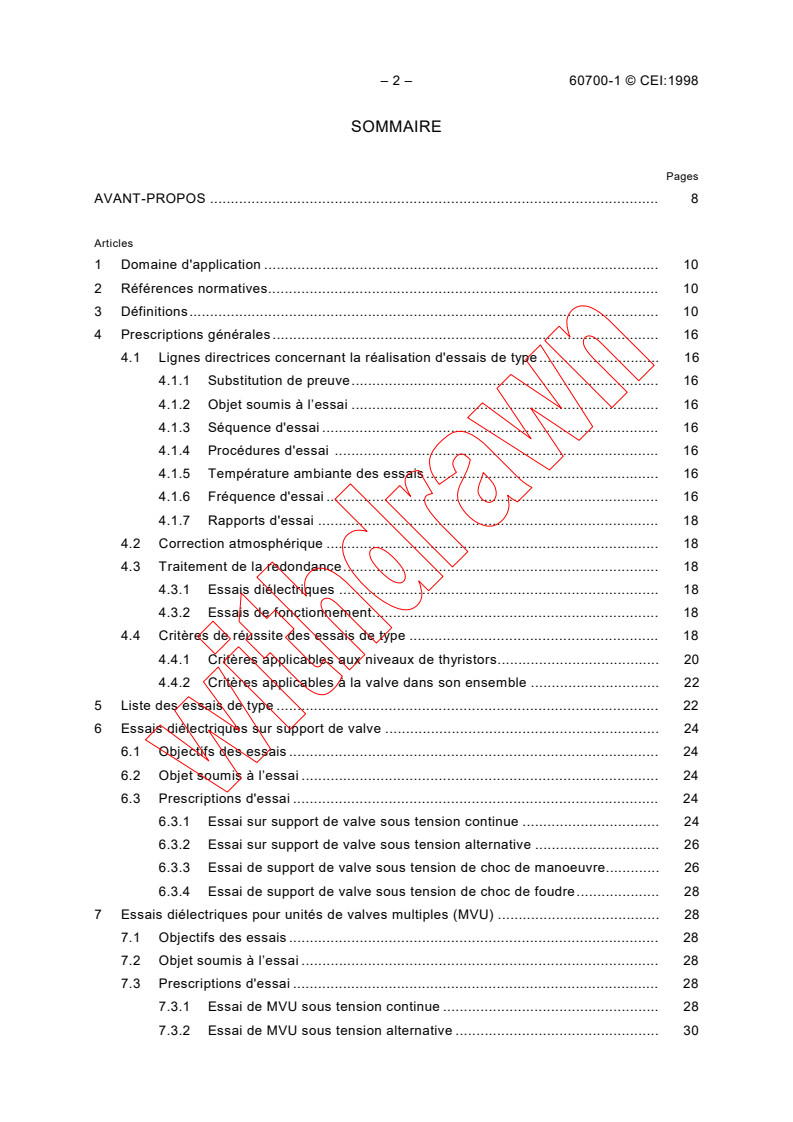
IEC 60700-1:1998 - Thyristor valves for high voltage direct current (HVDC) power transmission - Part 1: Electrical testing Released:9/23/1998
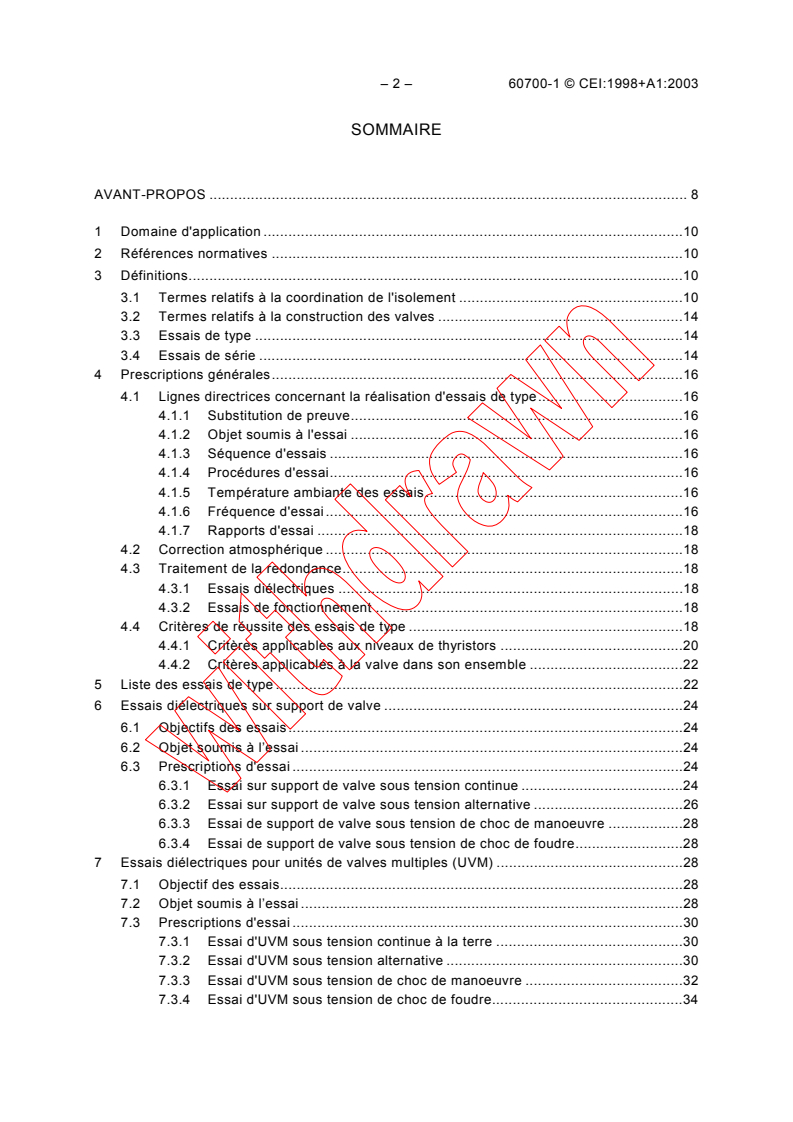
IEC 60700-1:1998+AMD1:2003 CSV - Thyristor valves for high voltage direct current (HVDC) power transmission - Part 1: Electrical testing Released:3/27/2003
IEC 60700-1:1998+AMD1:2003+AMD2:2008 CSV - Thyristor valves for high voltage direct current (HVDC) power transmission - Part 1: Electrical testing Released:11/5/2008
Overview
The IEC 60700-1:1998 standard, titled Thyristor Valves for High Voltage Direct Current (HVDC) Power Transmission - Part 1: Electrical Testing, is published by the International Electrotechnical Commission (IEC). This international standard specifies the electrical testing requirements for thyristor valves used in HVDC power transmission systems, particularly those equipped with metal oxide surge arresters directly connected between valve terminals.
The scope of IEC 60700-1 is limited to electrical type and production tests for air-insulated thyristor valves employed in line-commutated converters or back-to-back links. It details procedures and criteria to ensure these valves meet necessary performance, safety, and reliability standards essential for high voltage DC applications.
Key Topics
Electrical Type and Production Testing: IEC 60700-1 establishes guidelines for both type tests (initial thorough testing) and production tests (routine checks), ensuring valves are robust and reliable for HVDC applications.
Dielectric Testing: The standard includes thorough dielectric tests on valve supports, multiple valve units (MVU), and between valve terminals. These tests cover DC voltage withstand, AC voltage withstand, switching impulses, lightning impulses, and steep front impulse tests.
Firing and Extinction Tests: Periodic firing and extinction tests check the valves' operational capability under continuous, temporary, and minimum voltage conditions, along with transient forward voltage tests during the recovery period.
Fault Current Testing: Specific tests are designed to evaluate valve performance and fault tolerance under one-loop and multiple-loop fault current scenarios, vital for ensuring system resilience.
Electromagnetic Disturbance Insensitivity: The standard addresses valve immunity to electromagnetic disturbances, specifying test approaches and acceptance criteria to maintain stable operation in complex electrical environments.
Special Features and Fault Tolerance: Testing includes examination of valve circuits designed for control, protection, fault tolerance, and monitoring capabilities to support system safety and operational durability.
Test Safety Factors and Partial Discharge Measurements: Normative annexes provide safety margins for testing and procedures for partial discharge measurements, aiding in early detection of insulation issues.
Applications
IEC 60700-1 applies primarily to thyristor valves used in:
HVDC Transmission Systems: Air-insulated thyristor valves deployed in line-commutated converters for long-distance and high-capacity DC power transmission.
Back-to-Back Links: High voltage DC links that connect AC systems without an intervening transmission line, requiring robust valve performance.
HVDC Valve Manufacturing: Manufacturers utilize this standard to design, test, and produce valves that meet stringent international quality and safety benchmarks.
Electric Power Utilities and Grid Operators: Entities responsible for system reliability and safety ensure that thyristor valves conform to this standard, minimizing risk of failure and ensuring efficient power delivery.
Adherence to IEC 60700-1 enables enhanced reliability, safety, and performance of HVDC equipment, significantly contributing to stable and efficient electricity transmission across national and regional grids.
Related Standards
Professionals engaging with IEC 60700-1 should also consider:
IEC 60700-2: Covering mechanical testing of thyristor valves, complementing electrical tests specified in Part 1.
IEC 60137: Pertains to bushings for high-voltage equipment – relevant for interface components with HVDC valves.
IEC 60694: Relates to common specifications for high-voltage switchgear and controlgear, useful for system integration.
IEC 61378 Series: Focuses on converters in HVDC and power electronics, providing functional and operational context.
Integration of these standards with IEC 60700-1 supports comprehensive design and testing approaches for HVDC valve technology.
Keywords: IEC 60700-1, thyristor valves, HVDC power transmission, electrical testing, high voltage direct current, dielectric tests, fault current tests, production tests, electromagnetic disturbance, valve fault tolerance, HVDC standards, IEC standards HVDC, type tests, production testing HVDC valves.
Relations
- Effective Date
- 05-Sep-2023
- Effective Date
- 05-Sep-2023
- Effective Date
- 05-Sep-2023
Buy Documents
IEC 60700-1:1998 - Thyristor valves for high voltage direct current (HVDC) power transmission - Part 1: Electrical testing Released:9/23/1998
IEC 60700-1:1998+AMD1:2003 CSV - Thyristor valves for high voltage direct current (HVDC) power transmission - Part 1: Electrical testing Released:3/27/2003
IEC 60700-1:1998+AMD1:2003+AMD2:2008 CSV - Thyristor valves for high voltage direct current (HVDC) power transmission - Part 1: Electrical testing Released:11/5/2008
Get Certified
Connect with accredited certification bodies for this standard

IMQ S.p.A. (Certification)
Italian electrical product certification.

SLG Prüf- und Zertifizierungs GmbH
German testing and certification body.

UL Solutions
Global safety science company with testing, inspection and certification.
Sponsored listings
Frequently Asked Questions
IEC 60700-1:1998 is a standard published by the International Electrotechnical Commission (IEC). Its full title is "Thyristor valves for high voltage direct current (HVDC) power transmission - Part 1: Electrical testing". This standard covers: Applies to thyristor valves with metal oxide surge arresters directly connected between the valve terminals, for use in a line commuted commutated converter for high voltage d.c. power transmission or as part of a back-to-back link. Retricted to electrical type and production tests. Tests are based on air insulated valves.
Applies to thyristor valves with metal oxide surge arresters directly connected between the valve terminals, for use in a line commuted commutated converter for high voltage d.c. power transmission or as part of a back-to-back link. Retricted to electrical type and production tests. Tests are based on air insulated valves.
IEC 60700-1:1998 is classified under the following ICS (International Classification for Standards) categories: 29.200 - Rectifiers. Convertors. Stabilized power supply. The ICS classification helps identify the subject area and facilitates finding related standards.
IEC 60700-1:1998 has the following relationships with other standards: It is inter standard links to IEC 60700-1:1998/AMD1:2003, IEC 60700-1:1998/AMD2:2008, IEC 60700-1:2015. Understanding these relationships helps ensure you are using the most current and applicable version of the standard.
IEC 60700-1:1998 is available in PDF format for immediate download after purchase. The document can be added to your cart and obtained through the secure checkout process. Digital delivery ensures instant access to the complete standard document.
Standards Content (Sample)
NORME
CEI
INTERNATIONALE
IEC
60700-1
INTERNATIONAL
Première édition
STANDARD
First edition
1998-09
Valves à thyristors pour le transport d’énergie
en courant continu à haute tension (CCHT) –
Partie 1:
Essais électriques
Thyristor valves for high voltage direct current
(HVDC) power transmission –
Part 1:
Electrical testing
Numéro de référence
Reference number
CEI / IEC 60700-1:1998
Numéros des publications Numbering
Depuis le 1er janvier 1997, les publications de la CEI As from 1 January 1997 all IEC publications are
sont numérotées à partir de 60 000. issued with a designation in the 60 000 series.
Publications consolidées Consolidated publications
Les versions consolidées de certaines publications de Consolidated versions of some IEC publications
la CEI incorporant les amendements sont disponibles. including amendments are available. For example,
Par exemple, les numéros d’édition 1.0, 1.1 et 1.2 edition numbers 1.0, 1.1 and 1.2 refer, respectively, to
indiquent respectivement la publication de base, la the base publication, the base publication incor-
publication de base incorporant l’amendement 1, et porating amendment 1 and the base publication
la publication de base incorporant les amendements 1 incorporating amendments 1 and 2.
et 2.
Validité de la présente publication Validity of this publication
Le contenu technique des publications de la CEI est The technical content of IEC publications is kept under
constamment revu par la CEI afin qu'il reflète l'état constant review by the IEC, thus ensuring that the
actuel de la technique. content reflects current technology.
Des renseignements relatifs à la date de re- Information relating to the date of the reconfirmation of
confirmation de la publication sont disponibles dans the publication is available in the IEC catalogue.
le Catalogue de la CEI.
Les renseignements relatifs à des questions à l’étude et Information on the subjects under consideration and
des travaux en cours entrepris par le comité technique work in progress undertaken by the technical com-
qui a établi cette publication, ainsi que la liste des mittee which has prepared this publication, as well as
publications établies, se trouvent dans les documents the list of publications issued, is to be found at the
ci-dessous: following IEC sources:
• «Site web» de la CEI* • IEC web site*
• Catalogue des publications de la CEI • Catalogue of IEC publications
Publié annuellement et mis à jour régulièrement Published yearly with regular updates
(Catalogue en ligne)* (On-line catalogue)*
• Bulletin de la CEI • IEC Bulletin
Disponible à la fois au «site web» de la CEI* Available both at the IEC web site* and
et comme périodique imprimé as a printed periodical
Terminologie, symboles graphiques Terminology, graphical and letter
et littéraux symbols
En ce qui concerne la terminologie générale, le lecteur For general terminology, readers are referred to
se reportera à la CEI 60050: Vocabulaire Electro- IEC 60 050: International Electrotechnical Vocabulary
technique International (VEI). (IEV).
Pour les symboles graphiques, les symboles littéraux For graphical symbols, and letter symbols and signs
et les signes d'usage général approuvés par la CEI, le approved by the IEC for general use, readers are
lecteur consultera la CEI 60027: Symboles littéraux à referred to publications IEC 60027: Letter symbols to
utiliser en électrotechnique, la CEI 60417: Symboles be used in electrical technology, IEC 60417: Graphical
graphiques utilisables sur le matériel. Index, relevé et symbols for use on equipment. Index, survey and
compilation des feuilles individuelles, et la CEI 60617: compilation of the single sheets and IEC 60617:
Symboles graphiques pour schémas. Graphical symbols for diagrams.
* Voir adresse «site web» sur la page de titre. * See web site address on title page.
NORME
CEI
INTERNATIONALE
IEC
60700-1
INTERNATIONAL
Première édition
STANDARD
First edition
1998-09
Valves à thyristors pour le transport d’énergie
en courant continu à haute tension (CCHT) –
Partie 1:
Essais électriques
Thyristor valves for high voltage direct current
(HVDC) power transmission –
Part 1:
Electrical testing
IEC 1998 Droits de reproduction réservés Copyright - all rights reserved
Aucune partie de cette publication ne peut être reproduite ni No part of this publication may be reproduced or utilized in
utilisée sous quelque forme que ce soit et par aucun any form or by any means, electronic or mechanical,
procédé, électronique ou mécanique, y compris la photo- including photocopying and microfilm, without permission in
copie et les microfilms, sans l'accord écrit de l'éditeur. writing from the publisher.
International Electrotechnical Commission 3, rue de Varembé Geneva, Switzerland
Telefax: +41 22 919 0300 e-mail: inmail@iec.ch IEC web site http: //www.iec.ch
CODE PRIX
Commission Electrotechnique Internationale
PRICE CODE X
International Electrotechnical Commission
Pour prix, voir catalogue en vigueur
For price, see current catalogue
– 2 – 60700-1 © CEI:1998
SOMMAIRE
Pages
AVANT-PROPOS . 8
Articles
1 Domaine d'application . 10
2 Références normatives. 10
3 Définitions. 10
4 Prescriptions générales . 16
4.1 Lignes directrices concernant la réalisation d'essais de type . 16
4.1.1 Substitution de preuve. 16
4.1.2 Objet soumis à l’essai . 16
4.1.3 Séquence d'essai . 16
4.1.4 Procédures d'essai . 16
4.1.5 Température ambiante des essais . 16
4.1.6 Fréquence d'essai . 16
4.1.7 Rapports d'essai . 18
4.2 Correction atmosphérique . 18
4.3 Traitement de la redondance. 18
4.3.1 Essais diélectriques . 18
4.3.2 Essais de fonctionnement. 18
4.4 Critères de réussite des essais de type . 18
4.4.1 Critères applicables aux niveaux de thyristors. 20
4.4.2 Critères applicables à la valve dans son ensemble . 22
5 Liste des essais de type . 22
6 Essais diélectriques sur support de valve . 24
6.1 Objectifs des essais . 24
6.2 Objet soumis à l’essai . 24
6.3 Prescriptions d'essai . 24
6.3.1 Essai sur support de valve sous tension continue . 24
6.3.2 Essai sur support de valve sous tension alternative . 26
6.3.3 Essai de support de valve sous tension de choc de manoeuvre. 26
6.3.4 Essai de support de valve sous tension de choc de foudre. 28
7 Essais diélectriques pour unités de valves multiples (MVU) . 28
7.1 Objectifs des essais . 28
7.2 Objet soumis à l’essai . 28
7.3 Prescriptions d'essai . 28
7.3.1 Essai de MVU sous tension continue . 28
7.3.2 Essai de MVU sous tension alternative . 30
60700-1 © IEC:1998 – 3 –
CONTENTS
Page
FOREWORD . 9
Clause
1 Scope . 11
2 Normative references . 11
3 Definitions. 11
4 General requirements. 17
4.1 Guidelines for the performance of type tests. 17
4.1.1 Evidence in lieu. 17
4.1.2 Test object. . 17
4.1.3 Sequence of tests . 17
4.1.4 Test procedures . 17
4.1.5 Ambient temperature for testing. 17
4.1.6 Frequency for testing. 17
4.1.7 Test reports . 19
4.2 Atmospheric correction. 19
4.3 Treatment of redundancy . 19
4.3.1 Dielectric tests . 19
4.3.2 Operational tests . 19
4.4 Criteria for successful type testing. 19
4.4.1 Criteria applicable to thyristor levels . 21
4.4.2 Criteria applicable to the valve as a whole . 23
5 List of type tests. 23
6 Dielectric tests on valve support . 25
6.1 Purpose of tests. 25
6.2 Test object. 25
6.3 Test requirements . 25
6.3.1 Valve support d.c. voltage test. 25
6.3.2 Valve support a.c. voltage test. 27
6.3.3 Valve support switching impulse test . 27
6.3.4 Valve support lightning impulse test. 29
7 Dielectric tests for multiple valve units (MVU) . 29
7.1 Purpose of tests. 29
7.2 Test object. 29
7.3 Test requirements . 29
7.3.1 MVU d.c. voltage test to earth. 29
7.3.2 MVU a.c. voltage test . 31
– 4 – 60700-1 © CEI:1998
Articles Pages
7.3.3 Essai de MVU sous tension de choc de manoeuvre . 32
7.3.4 Essai de MVU sous tension de choc de foudre. 34
8 Essais diélectriques entre les bornes de valve . 34
8.1 Objectifs des essais . 34
8.2 Objet soumis à l’essai . 36
8.3 Prescriptions d'essai . 36
8.3.1 Essai de valve sous tension continue. 36
8.3.2 Essai de valve sous tension alternative. 38
8.3.3 Essais de valve sous tension de choc (généralités). 40
8.3.4 Essai de valve sous tension de choc de manoeuvre. 40
8.3.5 Essai de valve sous tension de choc de foudre . 42
8.3.6 Essai de valve sous tension de choc à front raide . 42
8.4 Essai d'allumage non périodique de valve. 44
8.4.1 Objectifs de l'essai . 44
8.4.2 Objet soumis à l’essai . 44
8.4.3 Prescriptions d'essai . 44
9 Essais d'allumage et d'extinction périodiques . 46
9.1 Objectifs des essais . 46
9.2 Objet soumis à l’essai . 48
9.3 Prescriptions d'essai . 48
9.3.1 Essais en service continu maximal . 50
9.3.2 Essai en service temporaire maximal (α = 90°) . 52
9.3.3 Essais sous tension alternative minimale. 54
9.3.4 Essai à manque de tension temporaire . 56
9.3.5 Essais avec courant continu intermittent . 58
10 Essais sous tension directe transitoire durant la période de rétablissement. 60
10.1 Objectifs des essais . 60
10.2 Objet soumis à l’essai . 60
10.3 Prescriptions d'essai . 60
11 Essai de valve en courant de défaut . 62
11.1 Objectif des essais. 62
11.2 Objet soumis à l’essai: . 62
11.3 Prescriptions d'essai . 62
11.3.1 Essai en courant de défaut à une boucle avec réapplication
de tension directe. 64
11.3.2 Essai en courant de défaut à boucles multiples sans réapplication
de tension directe. 66
60700-1 © IEC:1998 – 5 –
Clause Page
7.3.3 MVU switching impulse test . 33
7.3.4 MVU lightning impulse test . 35
8 Dielectric tests between valve terminals . 35
8.1 Purpose of tests. 35
8.2 Test object. 37
8.3 Test requirements . 37
8.3.1 Valve d.c. voltage test . 37
8.3.2 Valve a.c. voltage test . 39
8.3.3 Valve impulse tests (general) . 41
8.3.4 Valve switching impulse test . 41
8.3.5 Valve lightning impulse test . 43
8.3.6 Valve steep front impulse test. 43
8.4 Valve non-periodic firing test . 45
8.4.1 Purpose of test. 45
8.4.2 Test object . 45
8.4.3 Test requirements . 45
9 Periodic firing and extinction tests . 47
9.1 Purpose of tests. 47
9.2 Test object. 49
9.3 Test requirements . 49
9.3.1 Maximum continuous operating duty tests. 51
9.3.2 Maximum temporary operating duty test (α = 90°) . 53
9.3.3 Minimum a.c. voltage tests . 55
9.3.4 Temporary undervoltage test . 57
9.3.5 Intermittent direct current tests . 59
10 Tests with transient forward voltage during the recovery period. 61
10.1 Purpose of tests. 61
10.2 Test object. 61
10.3 Test requirements . 61
11 Valve fault current tests. 63
11.1 Purpose of tests. 63
11.2 Test object:. 63
11.3 Test requirements . 63
11.3.1 One-loop fault current test with re-applied forward voltage . 65
11.3.2 Multiple-loop fault current test without re-applied forward voltage. 67
– 6 – 60700-1 © CEI:1998
Articles Pages
12 Essais sur l'insensibilité de la valve aux perturbations électromagnétiques. 68
12.1 Objectifs des essais . 68
12.2 Objet soumis à l’essai . 68
12.3 Prescriptions d'essai . 70
12.3.1 Première approche. 70
12.3.2 Deuxième approche. . 70
12.3.3 Critères d'acceptation. 70
13 Essai de caractéristiques spéciales . 70
13.1 Objectifs des essais . 70
13.2 Objet soumis à l’essai . 72
13.3 Prescriptions d'essai . 72
14 Essais de série. 72
14.1 Objectifs des essais . 72
14.2 Objet soumis à l’essai . 72
14.3 Prescriptions d'essai . 72
14.4 Objectifs des essais de série. 74
14.4.1 Examen visuel. 74
14.4.2 Vérification de connexion . 74
14.4.3 Vérification du circuit de répartition des potentiels . 74
14.4.4 Vérification de la résistance à la tension . 74
14.4.5 Essais de décharge partielle. 74
14.4.6 Vérification des auxiliaires. . 74
14.4.7 Vérification de l'allumage. 74
14.4.8 Essai de pression. 74
15 Méthode de détermination de perte . 74
16 Présentation de résultats d'essai de type . 76
Annexe A (normative) Facteurs de sécurité d’essai. 78
Annexe B (normative) Mesures de décharge partielle. . 88
Annexe C (informative) Capacité de tolérance de défaut . . 94
Figure 1 Tension d’essai aux ondes de front raide. 12
60700-1 © IEC:1998 – 7 –
Clause Page
12 Tests for valve insensitivity to electromagnetic disturbance. 69
12.1 Purpose of tests. 69
12.2 Test object. 69
12.3 Test requirements . 71
12.3.1 Approach one. 71
12.3.2 Approach two . 71
12.3.3 Acceptance criteria. 71
13 Testing of special features . 71
13.1 Purpose of tests. 71
13.2 Test object. 73
13.3 Test requirements . 73
14 Production tests . 73
14.1 Purpose of tests. 73
14.2 Test object. 73
14.3 Test requirements . 73
14.4 Production test objectives . 75
14.4.1 Visual inspection . 75
14.4.2 Connection check. 75
14.4.3 Voltage-grading circuit check. 75
14.4.4 Voltage withstand check . 75
14.4.5 Partial discharge tests . 75
14.4.6 Check of auxiliaries . 75
14.4.7 Firing check . 75
14.4.8 Pressure test. 75
15 Method for loss determination . 75
16 Presentation of type test results . 77
Annex A (normative) Test safety factors. 79
Annex B (normative) Partial discharge measurements. 89
Annex C (informative) Fault tolerance capability. 95
Figure 1 Steep front impulse test voltage . 13
– 8 – 60700-1 © CEI:1998
COMMISSION ÉLECTROTECHNIQUE INTERNATIONALE
___________
VALVES À THYRISTORS POUR LE TRANSPORT D'ÉNERGIE
EN COURANT CONTINU À HAUTE TENSION (CCHT) –
Partie 1: Essais électriques
AVANT-PROPOS
1) La CEI (Commission Electrotechnique Internationale) est une organisation mondiale de normalisation composée
de l'ensemble des comités électrotechniques nationaux (Comités nationaux de la CEI). La CEI a pour objet de
favoriser la coopération internationale pour toutes les questions de normalisation dans les domaines de
l'électricité et de l'électronique. A cet effet, la CEI, entre autres activités, publie des Normes Internationales.
Leur élaboration est confiée à des comités d'études, aux travaux desquels tout Comité national intéressé par le
sujet traité peut participer. Les organisations internationales, gouvernementales et non gouvernementales, en
liaison avec la CEI, participent également aux travaux. La CEI collabore étroitement avec l'Organisation
Internationale de Normalisation (ISO), selon des conditions fixées par accord entre les deux organisations.
2) Les décisions ou accords officiels de la CEI concernant les questions techniques, représentent, dans la mesure
du possible un accord international sur les sujets étudiés, étant donné que les Comités nationaux intéressés
sont représentés dans chaque comité d’études.
3) Les documents produits se présentent sous la forme de recommandations internationales. Ils sont publiés
comme normes, rapports techniques ou guides et agréés comme tels par les Comités nationaux.
4) Dans le but d'encourager l'unification internationale, les Comités nationaux de la CEI s'engagent à appliquer de
façon transparente, dans toute la mesure possible, les Normes internationales de la CEI dans leurs normes
nationales et régionales. Toute divergence entre la norme de la CEI et la norme nationale ou régionale
correspondante doit être indiquée en termes clairs dans cette dernière.
5) La CEI n’a fixé aucune procédure concernant le marquage comme indication d’approbation et sa responsabilité
n’est pas engagée quand un matériel est déclaré conforme à l’une de ses normes.
6) L’attention est attirée sur le fait que certains des éléments de la présente Norme internationale peuvent faire
l’objet de droits de propriété intellectuelle ou de droits analogues. La CEI ne saurait être tenue pour
responsable de ne pas avoir identifié de tels droits de propriété et de ne pas avoir signalé leur existence.
La Norme internationale CEI 60700-1 a été établie par le sous-comité 22F: Electronique de
puissance pour les réseaux électriques de transport et de distribution, du comité d’études 22
de la CEI: Electronique de puissance.
Cette partie de la CEI 60700 annule et remplace la CEI 60700, parue en 1981, dont elle
constitue une révision technique.
Le texte de cette norme est issu des documents suivants:
FDIS Rapport de vote
22F/44/FDIS 22F/46/RVD
Le rapport de vote indiqué dans le tableau ci-dessus donne toute information sur le vote ayant
abouti à l'approbation de cette norme.
Les annexes A et B font partie intégrante de la présente norme.
L’annexe C est donnée uniquement à titre d’information.
60700-1 © IEC:1998 – 9 –
INTERNATIONAL ELECTROTECHNICAL COMMISSION
___________
THYRISTOR VALVES FOR HIGH VOLTAGE DIRECT CURRENT (HVDC)
POWER TRANSMISSION –
Part 1: Electrical testing
FOREWORD
1) The IEC (International Electrotechnical Commission) is a worldwide organization for standardization comprising
all national electrotechnical committees (IEC National Committees). The object of the IEC is to promote
international co-operation on all questions concerning standardization in the electrical and electronic fields. To
this end and in addition to other activities, the IEC publishes International Standards. Their preparation is
entrusted to technical committees; any IEC National Committee interested in the subject dealt with may
participate in this preparatory work. International, governmental and non-governmental organizations liaising
with the IEC also participate in this preparation. The IEC collaborates closely with the International Organization
for Standardization (ISO) in accordance with conditions determined by agreement between the two
organizations.
2) The formal decisions or agreements of the IEC on technical matters express, as nearly as possible, an
international consensus of opinion on the relevant subjects since each technical committee has representation
from all interested National Committees.
3) The documents produced have the form of recommendations for international use and are published in the form
of standards, technical reports or guides and they are accepted by the National Committees in that sense.
4) In order to promote international unification, IEC National Committees undertake to apply IEC International
Standards transparently to the maximum extent possible in their national and regional standards. Any
divergence between the IEC Standard and the corresponding national or regional standard shall be clearly
indicated in the latter.
5) The IEC provides no marking procedure to indicate its approval and cannot be rendered responsible for any
equipment declared to be in conformity with one of its standards.
6) Attention is drawn to the possibility that some of the elements of this International Standard may be the subject
of patent rights. The IEC shall not be held responsible for identifying any or all such patent rights.
International Standard IEC 60700-1 has been prepared by subcommittee 22F: Power
electronics for electrical transmission and distribution systems, of IEC technical committee 22:
Power electronics.
This part of IEC 60700 cancels and replaces IEC 60700, published in 1981, and constitutes a
technical revision.
The text of this standard is based on the following documents:
FDIS Report on voting
22F/44/FDIS 22F/46/RVD
Full information on the voting for the approval of this standard can be found in the report on
voting indicated in the above table.
Annexes A and B form an integral part of this standard.
Annex C is for information only.
– 10 – 60700-1 © CEI:1998
VALVES À THYRISTORS POUR LE TRANSPORT D'ÉNERGIE
EN COURANT CONTINU À HAUTE TENSION (CCHT) –
Partie 1: Essais électriques
1 Domaine d'application
La présente norme s'applique aux valves à thyristors équipées de parafoudres à oxyde
métallique directement connectés entre les bornes des valves, qui sont destinées à être
utilisées au niveau d'un convertisseur commuté par le réseau pour le transport d'énergie en
courant continu à haute tension ou dans une liaison en opposition. Elle est limitée aux essais
de type électriques et de série.
Les essais spécifiés dans la présente norme sont basés sur des valves isolées par l'air. Pour
d'autres types de valves, il faut que les prescriptions d'essai et les critères d'acceptation
fassent l'objet d'un accord.
2 Références normatives
Les documents normatifs suivants contiennent des dispositions qui, par suite de la référence
qui y est faite, constituent des dispositions valables pour la présente partie de la CEI 60700.
Au moment de la publication, les éditions indiquées étaient en vigueur. Tout document normatif
est sujet à révision et les parties prenantes aux accords fondés sur la présente partie de la
CEI 60700 sont invitées à rechercher la possibilité d'appliquer les éditions les plus récentes
des documents normatifs indiqués ci-après. Les membres de la CEI et de l'ISO possèdent le
registre des Normes internationales en vigueur.
Guide ISO/CEI 25:1990, Prescriptions générales concernant la compétence des laboratoires
d’étalonnage et d’essais
CEI 60060, Techniques des essais à haute tension
CEI 60060-1:1989, Techniques des essais à haute tension – Partie 1: Définitions et
prescriptions générales relatives aux essais
CEI 60071-1:1993, Coordination de l'isolement – Partie 1: Définitions, principes et règles
CEI 60099, Parafoudres
CEI 60270, 1981, Mesure des décharges partielles
CEI 61803, Détermination des pertes de puissance dans les postes de conversion en
1)
courant continu à haute tension (CCHT)
3 Définitions
Pour les besoins de la présente partie de la CEI 60700, les définitions suivantes s’appliquent.
___________
1)
A publier.
60700-1 © IEC:1998 – 11 –
THYRISTOR VALVES FOR HIGH VOLTAGE DIRECT CURRENT (HVDC)
POWER TRANSMISSION –
Part 1: Electrical testing
1 Scope
This standard applies to thyristor valves with metal oxide surge arresters directly connected
between the valve terminals, for use in a line commutated converter for high voltage d.c. power
transmission or as part of a back-to-back link. It is restricted to electrical type and production
tests.
The tests specified in this standard are based on air insulated valves. For other types of
valves, the test requirements and acceptance criteria must be agreed.
2 Normative references
The following normative documents contain provisions which, through reference in this text,
constitute provisions of this part of IEC 60700. At the time of publication, the editions indicated
were valid. All normative documents are subject to revision, and parties to agreements based
on this part of IEC 60700 are encouraged to investigate the possibility of applying the most
recent editions of the normative documents indicated below. Members of IEC and ISO maintain
registers of currently valid International Standards.
ISO/IEC Guide 25:1990, General requirements for the competence of calibration and testing
laboratories
IEC 60060, High-voltage test techniques
IEC 60060-1:1989, High-voltage test techniques – Part 1: General definitions and test
requirements
IEC 60071-1:1993, Insulation co-ordination – Part 1: Definitions, principles and rules
IEC 60099, Surge arresters
IEC 60270:1981, Partial discharge measurements
IEC 61803, Determination of power losses in high-voltage direct current (HVDC) converter
1)
stations
3 Definitions
For the purpose of this part of IEC 60700, the following definitions apply.
___________
1)
To be published.
– 12 – 60700-1 © CEI:1998
3.1 Termes relatifs à la coordination de l'isolement
3.1.1
tension d'épreuve
valeur d'une tension d'épreuve de forme d'onde type pour laquelle une nouvelle valve, dont
l'intégrité est intacte, ne présente aucune décharge disruptive et respecte tous les autres
critères d'acceptation spécifiés pour l'essai particulier, lorsqu'elle est soumise à un nombre
spécifié d'applications ou une durée spécifiée d'application de la tension d'essai, dans les
conditions spécifiées
3.1.2
tension de choc à front raide
tension de choc à front rapide dont le temps de crête est inférieur à celui d'une tension de choc
de foudre type mais non inférieur à celui d'une tension à front très rapide selon la définition de
la CEI 60071-1. Pour la présente norme, une tension de choc à front raide est définie, dans le
cadre des essais, par la figure 1.
Tension
Raideur S
0,2 T
Valeur crête U
0,6 U
0,5 U
Durée
T
T
IEC 1 326/98
NOTES
U = Valeur crête spécifiée de la tension d'essai aux ondes de front raide (kV)
S = Raideur spécifiée de la tension d'essai aux ondes de front raide (kV/μs)
U
T = Durée de front fictive = (μs)
S
Les conditions suivantes doivent être remplies:
a) La valeur crête de la tension d'essai enregistrée doit être égale à U ± 3 %. Cette tolérance est identique à celle
de la CEI 60060 pour des tensions de choc de foudre normalisées.
b) Pour une excursion de tension de 0,6 U au minimum, la portion croissante de la tension d'essai enregistrée doit
être entièrement comprise entre deux lignes parallèles de raideur S et de séparation 0,2 T
1.
c) La valeur de la tension d’essai à T ne doit pas être plus basse que 0,5 U. T est défini comme l’intervalle de
2 2
temps entre l’origine et l’instant où la tension a diminué à la moitié de la crête de la forme d’onde obtenue de
l’étude de réseau. Cependant, la détection d’un amorçage inattendu des thyristors par un dv/dt doit être assurée.
Figure 1 – Tension d'essai aux ondes de front raide
60700-1 © IEC:1998 – 13 –
3.1 Insulation co-ordination terms
3.1.1
test withstand voltage
value of a test voltage of standard waveshape at which a new valve, with unimpaired integrity,
does not show any disruptive discharge and meets all other acceptance criteria specified for
the particular test, when subjected to a specified number of applications or a specified duration
of the test voltage, under specified conditions
3.1.2
steep front impulse
fast-front voltage impulse whose time to peak is less than that of a standard lightning impulse
but not less than that of a very-fast-front voltage as defined in IEC 60071-1. For this standard,
a steep front impulse voltage for test purposes is defined by figure 1.
Voltage
Steepness S
0,2 T
Peak value U
0,6 U
0,5 U
Time
T
T
IEC 1 326/98
NOTES
U = Specified peak value of steep front impulse test voltage (kV)
S = Specified steepness of steep front impulse test voltage (kV/μs)
U
T = Virtual front time = (μs)
S
The following conditions shall be satisfied:
a) The peak value of the recorded test voltage shall be U ± 3 %. This tolerance is the same as that in IEC 60060
for standard lightning impulse.
b) Over a voltage excursion of not less than 0,6 U, the rising portion of the recorded test voltage shall be entirely
contained between two parallel lines of steepness S and separation 0,2 T
1.
c) The value of the test voltage at T shall not be lower than 0,5 U. T is defined as the time interval between the
2 2
origin and the instant when the voltage has decreased to half the peak value of the waveform which is obtained
from system study. However, it shall be assured that an unintentional dv/dt switching of the thyristors can be
adequately detected.
Figure 1 – Steep front impulse test voltage
– 14 – 60700-1 © CEI:1998
3.1.3
isolement interne et externe
l'air extérieur aux composants et matériaux isolants de la valve, mais contenu dans le profil de
la valve ou de l'unité de valve multiple est considéré comme faisant partie du système
d'isolement interne de la valve. L'isolement externe est constitué par l'air situé entre la surface
externe de la valve ou de l'unité de valve multiple et son environnement.
3.1.4
allumage de protection de valve
moyen de protéger les thyristors contre une surtension en provoquant un allumage à une
tension prédéterminée
3.2 Termes relatifs à la construction des valves
3.2.1
support de valve
partie de la valve offrant un support mécanique et une isolation électrique par rapport à la terre
de la partie active de la valve abritant les sections de valve
NOTE – Il est possible que les conceptions de valve ne présentent pas toutes une identification claire sous une
forme discrète des parties de valves constituant des supports de valve.
3.2.2
structure de valve
structure physique maintenant les niveaux des thyristors d'une valve isolée à la tension
appropriée au-dessus du potentiel de terre
3.2.3
niveaux de thyristors redondants
niveaux de thyristors dans la chaîne en série susceptibles d'être court-circuités alors que les
caractéristiques fonctionnelles d'essai type spécifiées pour la valve sont toujours respectées
3.2.4
électronique de base de la valve
unité électronique, au potentiel de terre, constituant l'interface entre le système de commande
du convertisseur et les valves à thyristors
3.3 Essais de type
essais réalisés pour vérifier que la conception d'une valve respecte les prescriptions
spécifiées. Dans la présente norme, les essais de type sont classés en deux catégories
principales: essais diélectriques et essais de fonctionnement.
3.3.1
essais diélectriques
essais réalisés pour vérifier les caractéristiques haute tension de la valve
3.3.2
essais de fonctionnement
essais réalisés pour vérifier les caractéristiques de la valve liées à l'amorçage, au
désamorçage et au courant
3.4 Essais de série
Essais réalisés pour vérifier que la fabrication s'effectue correctement, de façon que les
propriétés d'une valve correspondent à celles spécifiées.
60700-1 © IEC:1998 – 15 –
3.1.3
internal and external insulation
air external to the components and insulating materials of the valve, but contained within the
profile of the valve or multiple valve unit is considered as part of the internal insulation system
of the valve. The external insulation is the air between the external surface of the valve or
multiple valve unit and its surroundings.
3.1.4
valve protective firing
means of protecting the thyristors from excessive voltage by firing them at a predetermined
voltage
3.2 Valve construction terms
3.2.
...
NORME CEI
INTERNATIONALE IEC
60700-1
INTERNATIONAL
Edition 1.1
STANDARD
2003-03
Edition 1:1998 consolidée par l'amendement 1:2003
Edition 1:1998 consolidated with amendment 1:2003
Valves à thyristors pour le transport d'énergie
en courant continu à haute tension (CCHT) –
Partie 1:
Essais électriques
Thyristor valves for high voltage direct current
(HVDC) power transmission –
Part 1:
Electrical testing
Numéro de référence
Reference number
CEI/IEC 60700-1:1998+A1:2003
Numérotation des publications Publication numbering
Depuis le 1er janvier 1997, les publications de la CEI As from 1 January 1997 all IEC publications are
sont numérotées à partir de 60000. Ainsi, la CEI 34-1 issued with a designation in the 60000 series. For
devient la CEI 60034-1. example, IEC 34-1 is now referred to as IEC 60034-1.
Editions consolidées Consolidated editions
Les versions consolidées de certaines publications de la The IEC is now publishing consolidated versions of its
CEI incorporant les amendements sont disponibles. Par publications. For example, edition numbers 1.0, 1.1
exemple, les numéros d’édition 1.0, 1.1 et 1.2 indiquent and 1.2 refer, respectively, to the base publication,
respectivement la publication de base, la publication de the base publication incorporating amendment 1 and
base incorporant l’amendement 1, et la publication de the base publication incorporating amendments 1
base incorporant les amendements 1 et 2. and 2.
Informations supplémentaires Further information on IEC publications
sur les publications de la CEI
Le contenu technique des publications de la CEI est The technical content of IEC publications is kept
constamment revu par la CEI afin qu'il reflète l'état under constant review by the IEC, thus ensuring that
actuel de la technique. Des renseignements relatifs à the content reflects current technology. Information
cette publication, y compris sa validité, sont dispo- relating to this publication, including its validity, is
nibles dans le Catalogue des publications de la CEI available in the IEC Catalogue of publications
(voir ci-dessous) en plus des nouvelles éditions, (see below) in addition to new editions, amendments
amendements et corrigenda. Des informations sur les and corrigenda. Information on the subjects under
sujets à l’étude et l’avancement des travaux entrepris consideration and work in progress undertaken by the
par le comité d’études qui a élaboré cette publication, technical committee which has prepared this
ainsi que la liste des publications parues, sont publication, as well as the list of publications issued,
également disponibles par l’intermédiaire de: is also available from the following:
• Site web de la CEI (www.iec.ch) • IEC Web Site (www.iec.ch)
• Catalogue des publications de la CEI • Catalogue of IEC publications
Le catalogue en ligne sur le site web de la CEI The on-line catalogue on the IEC web site
(www.iec.ch/catlg-f.htm) vous permet de faire des (www.iec.ch/catlg-e.htm) enables you to search
recherches en utilisant de nombreux critères, by a variety of criteria including text searches,
comprenant des recherches textuelles, par comité technical committees and date of publication. On-
d’études ou date de publication. Des informations line information is also available on recently
en ligne sont également disponibles sur les issued publications, withdrawn and replaced
nouvelles publications, les publications rempla- publications, as well as corrigenda.
cées ou retirées, ainsi que sur les corrigenda.
• IEC Just Published
• IEC Just Published
Ce résumé des dernières publications parues
This summary of recently issued publications
(www.iec.ch/JP.htm) est aussi disponible par
(www.iec.ch/JP.htm) is also available by email.
courrier électronique. Veuillez prendre contact
Please contact the Customer Service Centre (see
avec le Service client (voir ci-dessous) pour plus
below) for further information.
d’informations.
• Service clients
• Customer Service Centre
Si vous avez des questions au sujet de cette
If you have any questions regarding this
publication ou avez besoin de renseignements
publication or need further assistance, please
supplémentaires, prenez contact avec le Service
contact the Customer Service Centre:
clients:
Email: custserv@iec.ch
Email: custserv@iec.ch
Tél: +41 22 919 02 11
Tel: +41 22 919 02 11
Fax: +41 22 919 03 00
Fax: +41 22 919 03 00
.
NORME CEI
INTERNATIONALE IEC
60700-1
INTERNATIONAL
Edition 1.1
STANDARD
2003-03
Edition 1:1998 consolidée par l'amendement 1:2003
Edition 1:1998 consolidated with amendment 1:2003
Valves à thyristors pour le transport d'énergie
en courant continu à haute tension (CCHT) –
Partie 1:
Essais électriques
Thyristor valves for high voltage direct current
(HVDC) power transmission –
Part 1:
Electrical testing
IEC 2003 Droits de reproduction réservés Copyright - all rights reserved
Aucune partie de cette publication ne peut être reproduite ni No part of this publication may be reproduced or utilized in any
utilisée sous quelque forme que ce soit et par aucun procédé, form or by any means, electronic or mechanical, including
électronique ou mécanique, y compris la photocopie et les photocopying and microfilm, without permission in writing from
microfilms, sans l'accord écrit de l'éditeur. the publisher.
International Electrotechnical Commission, 3, rue de Varembé, PO Box 131, CH-1211 Geneva 20, Switzerland
Telephone: +41 22 919 02 11 Telefax: +41 22 919 03 00 E-mail: inmail@iec.ch Web: www.iec.ch
CODE PRIX
CP
Commission Electrotechnique Internationale
PRICE CODE
International Electrotechnical Commission
Международная Электротехническая Комиссия
Pour prix, voir catalogue en vigueur
For price, see current catalogue
– 2 – 60700-1 © CEI:1998+A1:2003
SOMMAIRE
AVANT-PROPOS . 8
1 Domaine d'application .10
2 Références normatives .10
3 Définitions.10
3.1 Termes relatifs à la coordination de l'isolement .10
3.2 Termes relatifs à la construction des valves .14
3.3 Essais de type .14
3.4 Essais de série .14
4 Prescriptions générales.16
4.1 Lignes directrices concernant la réalisation d'essais de type.16
4.1.1 Substitution de preuve.16
4.1.2 Objet soumis à l'essai .16
4.1.3 Séquence d'essais .16
4.1.4 Procédures d'essai.16
4.1.5 Température ambiante des essais.16
4.1.6 Fréquence d'essai.16
4.1.7 Rapports d'essai .18
4.2 Correction atmosphérique .18
4.3 Traitement de la redondance.18
4.3.1 Essais diélectriques .18
4.3.2 Essais de fonctionnement .18
4.4 Critères de réussite des essais de type .18
4.4.1 Critères applicables aux niveaux de thyristors .20
4.4.2 Critères applicables à la valve dans son ensemble .22
5 Liste des essais de type .22
6 Essais diélectriques sur support de valve .24
6.1 Objectifs des essais.24
6.2 Objet soumis à l’essai .24
6.3 Prescriptions d'essai .24
6.3.1 Essai sur support de valve sous tension continue .24
6.3.2 Essai sur support de valve sous tension alternative .26
6.3.3 Essai de support de valve sous tension de choc de manoeuvre .28
6.3.4 Essai de support de valve sous tension de choc de foudre.28
7 Essais diélectriques pour unités de valves multiples (UVM) .28
7.1 Objectif des essais.28
7.2 Objet soumis à l’essai .28
7.3 Prescriptions d'essai .30
7.3.1 Essai d'UVM sous tension continue à la terre .30
7.3.2 Essai d'UVM sous tension alternative .30
7.3.3 Essai d'UVM sous tension de choc de manoeuvre .32
7.3.4 Essai d'UVM sous tension de choc de foudre.34
60700-1 © IEC:1998+A1:2003 – 3 –
CONTENTS
FOREWORD . 9
1 Scope .11
2 Normative references.11
3 Definitions.11
3.1 Insulation co-ordination terms .11
3.2 Valve construction terms.15
3.3 Type tests.15
3.4 Production tests .15
4 General requirements.17
4.1 Guidelines for the performance of type tests.17
4.1.1 Evidence in lieu.17
4.1.2 Test object.17
4.1.3 Sequence of tests .17
4.1.4 Test procedures .17
4.1.5 Ambient temperature for testing .17
4.1.6 Frequency for testing .17
4.1.7 Test reports .19
4.2 Atmospheric correction .19
4.3 Treatment of redundancy .19
4.3.1 Dielectric tests .19
4.3.2 Operational tests.19
4.4 Criteria for successful type testing.19
4.4.1 Criteria applicable to thyristor levels .21
4.4.2 Criteria applicable to the valve as a whole .23
5 List of type tests.23
6 Dielectric tests on valve support .25
6.1 Purpose of tests.25
6.2 Test object.25
6.3 Test requirements.25
6.3.1 Valve support d.c. voltage test.25
6.3.2 Valve support a.c. voltage test.27
6.3.3 Valve support switching impulse test .29
6.3.4 Valve support lightning impulse test.29
7 Dielectric tests for multiple valve units (MVU) .29
7.1 Purpose of tests.29
7.2 Test object.29
7.3 Test requirements.31
7.3.1 MVU d.c. voltage test to earth .31
7.3.2 MVU a.c. voltage test .31
7.3.3 MVU switching impulse test.33
7.3.4 MVU lightning impulse test .35
– 4 – 60700-1 © CEI:1998+A1:2003
8 Essais diélectriques entre les bornes de valve.34
8.1 Objectifs des essais.34
8.2 Objet soumis à l’essai .36
8.3 Prescriptions d'essai .36
8.3.1 Essai de valve sous tension continue .36
8.3.2 Essai de valve sous tension alternative .38
8.3.3 Essais de valve sous tension de choc (généralités) .40
8.3.4 Essai de valve sous tension de choc de manoeuvre.42
8.3.5 Essai de valve sous tension de choc de foudre.42
8.3.6 Essai de valve sous tension de choc à front raide.44
8.4 Essai d'allumage non périodique de valve .44
8.4.1 Objectifs de l'essai .44
8.4.2 Objet soumis à l’essai .46
8.4.3 Prescriptions d'essai .46
9 Essais d'allumage et d'extinction périodiques .48
9.1 Objectifs des essais.48
9.2 Objet soumis à l’essai .48
9.3 Prescriptions d'essai .48
9.3.1 Essais en service continu maximal .50
9.3.2 Essai en service temporaire maximal (αααα = 90°).54
9.3.3 Essais sous tension alternative minimale.56
9.3.4 Essai à manque de tension temporaire .58
9.3.5 Essais avec courant continu intermittent.60
10 Essais sous tension directe transitoire durant la période de rétablissement.60
10.1 Objectifs des essais.60
10.2 Objet soumis à l’essai .60
10.3 Prescriptions d'essai .60
11 Essais de valve en courant de défaut .62
11.1 Objectif des essais.62
11.2 Objet soumis à l’essai: .64
11.3 Prescriptions d'essai .64
11.3.1 Essai en courant de défaut à une boucle avec réapplication de tension
directe .66
11.3.2 Essai en courant de défaut à boucles multiples sans réapplication de
tension directe.66
12 Essais sur l'insensibilité de la valve aux perturbations électromagnétiques .68
12.1 Objectifs des essais.68
12.2 Objet soumis à l’essai .70
12.3 Prescriptions d'essai .70
12.3.1 Première approche.70
12.3.2 Deuxième approche .70
12.3.3 Critères d'acceptation.70
13 Essai de caractéristiques spéciales .72
13.1 Objectifs des essais.72
13.2 Objet soumis à l’essai .72
13.3 Prescriptions d'essai .72
60700-1 © IEC:1998+A1:2003 – 5 –
8 Dielectric tests between valve terminals .35
8.1 Purpose of tests.35
8.2 Test object.37
8.3 Test requirements.37
8.3.1 Valve d.c. voltage test .37
8.3.2 Valve a.c. voltage test .39
8.3.3 Valve impulse tests (general) .41
8.3.4 Valve switching impulse test.43
8.3.5 Valve lightning impulse test .43
8.3.6 Valve steep front impulse test .45
8.4 Valve non-periodic firing test .45
8.4.1 Purpose of test.45
8.4.2 Test object.47
8.4.3 Test requirements .47
9 Periodic firing and extinction tests .49
9.1 Purpose of tests.49
9.2 Test object.49
9.3 Test requirements.49
9.3.1 Maximum continuous operating duty tests .51
9.3.2 Maximum temporary operating duty test (αααα = 90°).55
9.3.3 Minimum a.c. voltage tests .57
9.3.4 Temporary undervoltage test .59
9.3.5 Intermittent direct current tests.61
10 Tests with transient forward voltage during the recovery period.61
10.1 Purpose of tests.61
10.2 Test object.61
10.3 Test requirements.61
11 Valve fault current tests.63
11.1 Purpose of tests.63
11.2 Test object.65
11.3 Test requirements.65
11.3.1 One-loop fault current test with re-applied forward voltage.67
11.3.2 Multiple-loop fault current test without re-applied forward voltage.67
12 Tests for valve insensitivity to electromagnetic disturbance.69
12.1 Purpose of tests.69
12.2 Test object.71
12.3 Test requirements.71
12.3.1 Approach one.71
12.3.2 Approach two .71
12.3.3 Acceptance criteria .71
13 Testing of special features .73
13.1 Purpose of tests.73
13.2 Test object.73
13.3 Test requirements.73
– 6 – 60700-1 © CEI:1998+A1:2003
14 Essais de série .72
14.1 Objectifs des essais.72
14.2 Objet soumis à l’essai .72
14.3 Prescriptions d'essai .74
14.4 Objectifs des essais de série.74
14.4.1 Examen visuel.74
14.4.2 Vérification de connexion .74
14.4.3 Vérification du circuit de répartition des potentiels .74
14.4.4 Vérification de la résistance à la tension.74
14.4.5 Essais de décharge partielle.74
14.4.6 Vérification des auxiliaires.74
14.4.7 Vérification de l'allumage .76
14.4.8 Essai de pression.76
15 Méthode de détermination de perte .76
16 Présentation de résultats d'essai de type.76
Annexe A (normative) Facteurs de sécurité d’essai.78
Annexe B (normative) Mesures de décharge partielle.88
Annexe C (informative) Capacité de tolérance de défaut .92
Figure 1 – Tension d'essai aux ondes de front raide.12
Tableau 1 – Défauts de niveaux de thyristors autorisés au cours des essais .20
Tableau 2 – Liste des essais de type .22
60700-1 © IEC:1998+A1:2003 – 7 –
14 Production tests .73
14.1 Purpose of tests.73
14.2 Test object.73
14.3 Test requirements.75
14.4 Production test objectives .75
14.4.1 Visual inspection .75
14.4.2 Connection check.75
14.4.3 Voltage-grading circuit check .75
14.4.4 Voltage withstand check.75
14.4.5 Partial discharge tests.75
14.4.6 Check of auxiliaries.75
14.4.7 Firing check .77
14.4.8 Pressure test .77
15 Method for loss determination .77
16 Presentation of type test results .77
Annex A (normative) Test safety factors .79
Annex B (normative) Partial discharge measurements .89
Annex C (informative) Fault tolerance capability.93
Figure 1 – Steep front impulse test voltage .13
Table 1 – Thyristor level faults permitted during type tests .21
Table 2 – List of type tests.23
– 8 – 60700-1 © CEI:1998+A1:2003
COMMISSION ÉLECTROTECHNIQUE INTERNATIONALE
____________
VALVES À THYRISTORS POUR LE TRANSPORT D'ÉNERGIE
EN COURANT CONTINU À HAUTE TENSION (CCHT) –
Partie 1: Essais électriques
AVANT-PROPOS
1) La CEI (Commission Electrotechnique Internationale) est une organisation mondiale de normalisation composée
de l'ensemble des comités électrotechniques nationaux (Comités nationaux de la CEI). La CEI a pour objet de
favoriser la coopération internationale pour toutes les questions de normalisation dans les domaines de
l'électricité et de l'électronique. A cet effet, la CEI, entre autres activités, publie des Normes internationales.
Leur élaboration est confiée à des comités d'études, aux travaux desquels tout Comité national intéressé par le
sujet traité peut participer. Les organisations internationales, gouvernementales et non gouvernementales, en
liaison avec la CEI, participent également aux travaux. La CEI collabore étroitement avec l'Organisation
Internationale de Normalisation (ISO), selon des conditions fixées par accord entre les deux organisations.
2) Les décisions ou accords officiels de la CEI concernant les questions techniques représentent, dans la mesure
du possible, un accord international sur les sujets étudiés, étant donné que les Comités nationaux intéressés
sont représentés dans chaque comité d’études.
3) Les documents produits se présentent sous la forme de recommandations internationales. Ils sont publiés
comme normes, spécifications techniques, rapports techniques ou guides et agréés comme tels par les Comités
nationaux.
4) Dans le but d'encourager l'unification internationale, les Comités nationaux de la CEI s'engagent à appliquer de
façon transparente, dans toute la mesure possible, les Normes internationales de la CEI dans leurs normes
nationales et régionales. Toute divergence entre la norme de la CEI et la norme nationale ou régionale
correspondante doit être indiquée en termes clairs dans cette dernière.
5) La CEI n’a fixé aucune procédure concernant le marquage comme indication d’approbation et sa responsabilité
n’est pas engagée quand un matériel est déclaré conforme à l’une de ses normes.
6) L’attention est attirée sur le fait que certains des éléments de la présente Norme internationale peuvent faire
l’objet de droits de propriété intellectuelle ou de droits analogues. La CEI ne saurait être tenue pour
responsable de ne pas avoir identifié de tels droits de propriété et de ne pas avoir signalé leur existence.
La Norme internationale CEI 60700-1 a été établie par le sous-comité 22F: Electronique de
puissance pour les réseaux électriques de transport et de distribution, du comité d’études 22
de la CEI: Electronique de puissance.
La présente version consolidée de la CEI 60700-1 comprend la première édition (1998)
[documents 22F/44/FDIS et 22F/46/RVD] et son amendement 1 (2003) [documents
22F/81/FDIS et 22F/85/RVD].
Le contenu technique de cette version consolidée est donc identique à celui de l'édition de
base et à son amendement; cette version a été préparée par commodité pour l'utilisateur.
Elle porte le numéro d'édition 1.1.
Une ligne verticale dans la marge indique où la publication de base a été modifiée par
l’amendement 1.
Les annexes A et B font partie intégrante de la présente norme.
L’annexe C est donnée uniquement à titre d’information.
Le comité a décidé que le contenu de la publication de base et de son amendement ne sera
pas modifié avant 2007. A cette date, la publication sera
• reconduite;
• supprimée;
• remplacée par une édition révisée, ou
• amendée.
60700-1 © IEC:1998+A1:2003 – 9 –
INTERNATIONAL ELECTROTECHNICAL COMMISSION
____________
THYRISTOR VALVES FOR HIGH VOLTAGE DIRECT CURRENT (HVDC)
POWER TRANSMISSION –
Part 1: Electrical testing
FOREWORD
1) The IEC (International Electrotechnical Commission) is a worldwide organization for standardization comprising
all national electrotechnical committees (IEC National Committees). The object of the IEC is to promote
international co-operation on all questions concerning standardization in the electrical and electronic fields. To
this end and in addition to other activities, the IEC publishes International Standards. Their preparation is
entrusted to technical committees; any IEC National Committee interested in the subject dealt with may
participate in this preparatory work. International, governmental and non-governmental organizations liaising
with the IEC also participate in this preparation. The IEC collaborates closely with the International Organization
for Standardization (ISO) in accordance with conditions determined by agreement between the two
organizations.
2) The formal decisions or agreements of the IEC on technical matters express, as nearly as possible, an
international consensus of opinion on the relevant subjects since each technical committee has representation
from all interested National Committees.
3) The documents produced have the form of recommendations for international use and are published in the form
of standards, technical specifications, technical reports or guides and they are accepted by the National
Committees in that sense.
4) In order to promote international unification, IEC National Committees undertake to apply IEC International
Standards transparently to the maximum extent possible in their national and regional standards. Any
divergence between the IEC Standard and the corresponding national or regional standard shall be clearly
indicated in the latter.
5) The IEC provides no marking procedure to indicate its approval and cannot be rendered responsible for any
equipment declared to be in conformity with one of its standards.
6) Attention is drawn to the possibility that some of the elements of this International Standard may be the subject
of patent rights. The IEC shall not be held responsible for identifying any or all such patent rights.
International Standard IEC 60700-1 has been prepared by subcommittee 22F: Power
electronics for electrical transmission and distribution systems, of IEC technical committee 22:
Power electronics.
This consolidated version of IEC 60700-1 consists of the first edition (1998) [documents
22F/44/FDIS and 22F/46/RVD] and its amendment 1 (2003) [documents 22F/81/FDIS and
22F/85/RVD].
The technical content is therefore identical to the base edition and its amendment and has
been prepared for user convenience.
It bears the edition number 1.1.
A vertical line in the margin shows where the base publication has been modified by
amendment 1.
Annexes A and B form an integral part of this standard.
Annex C is for information only.
The committee has decided that the contents of the base publication and its amendment will
remain unchanged until 2007. At this date, the publication will be
• reconfirmed;
• withdrawn;
• replaced by a revised edition, or
• amended.
– 10 – 60700-1 © CEI:1998+A1:2003
VALVES À THYRISTORS POUR LE TRANSPORT D'ÉNERGIE
EN COURANT CONTINU À HAUTE TENSION (CCHT) –
Partie 1: Essais électriques
1 Domaine d'application
La présente norme s'applique aux valves à thyristors équipées de parafoudres à oxyde
métallique directement connectés entre les bornes des valves, qui sont destinées à être
utilisées au niveau d'un convertisseur commuté par le réseau pour le transport d'énergie en
courant continu à haute tension ou dans une liaison en opposition. Elle est limitée aux essais
de type électriques et de série.
Les essais spécifiés dans la présente norme sont basés sur des valves isolées par l'air. Pour
d'autres types de valves, il faut que les prescriptions d'essai et les critères d'acceptation
fassent l'objet d'un accord.
2 Références normatives
Les documents de référence suivants sont indispensables pour l'application du présent
document. Pour les références datées, seule l'édition citée s'applique. Pour les références non
datées, la dernière édition du document de référence s'applique (y compris les éventuels
amendements).
Guide ISO/CEI 25:1990, Prescriptions générales concernant la compétence des laboratoires
d’étalonnage et d’essais
CEI 60060, Techniques des essais à haute tension
CEI 60060-1:1989, Techniques des essais à haute tension – Partie 1: Définitions et
prescriptions générales relatives aux essais
CEI 60071-1:1993, Coordination de l'isolement – Partie 1: Définitions, principes et règles
CEI 60099, Parafoudres
CEI 60270:1981, Mesure des décharges partielles
CEI 61803:1999, Détermination des pertes de puissance dans les postes de conversion en
courant continu à haute tension (CCHT)
3 Définitions
Pour les besoins de la présente partie de la CEI 60700, les définitions suivantes s’appliquent.
3.1 Termes relatifs à la coordination de l'isolement
3.1.1
tension d'épreuve
valeur d'une tension de tenue d'essai de forme d'onde type pour laquelle une nouvelle valve,
dont l'intégrité est intacte, ne présente aucune décharge disruptive et respecte tous les autres
critères d'acceptation spécifiés pour l'essai particulier, lorsqu'elle est soumise à un nombre
spécifié d'applications ou une durée spécifiée d'application de la tension de tenue d'essai, dans
les conditions spécifiées
60700-1 © IEC:1998+A1:2003 – 11 –
THYRISTOR VALVES FOR HIGH VOLTAGE DIRECT CURRENT (HVDC)
POWER TRANSMISSION –
Part 1: Electrical testing
1 Scope
This standard applies to thyristor valves with metal oxide surge arresters directly connected
between the valve terminals, for use in a line commutated converter for high voltage d.c. power
transmission or as part of a back-to-back link. It is restricted to electrical type and production
tests.
The tests specified in this standard are based on air insulated valves. For other types of
valves, the test requirements and acceptance criteria must be agreed.
2 Normative references
The following referenced documents are indispensable for the application of this document. For
dated references, only the edition cited applies. For undated references, the latest edition of
the referenced document (including any amendments) applies.
ISO/IEC Guide 25:1990, General requirements for the competence of calibration and testing
laboratories
IEC 60060, High-voltage test techniques
IEC 60060-1:1989, High-voltage test techniques – Part 1: General definitions and test
requirements
IEC 60071-1:1993, Insulation co-ordination – Part 1: Definitions, principles and rules
IEC 60099, Surge arresters
IEC 60270:1981, Partial discharge measurements
IEC 61803:1999, Determination of power losses in high-voltage direct current (HVDC)
converter stations
3 Definitions
For the purpose of this part of IEC 60700, the following definitions apply.
3.1 Insulation co-ordination terms
3.1.1
test withstand voltage
value of a test voltage of standard waveshape at which a new valve, with unimpaired integrity,
does not show any disruptive discharge and meets all other acceptance criteria specified for
the particular test, when subjected to a specified number of applications or a specified duration
of the test voltage, under specified conditions
– 12 – 60700-1 © CEI:1998+A1:2003
3.1.2
tension de choc à front raide
tension de choc à front rapide dont le temps de crête est inférieur à celui d'une tension de choc
de foudre type mais non inférieur à celui d'une tension à front très rapide selon la définition de
la CEI 60071-1. Pour la présente norme, une tension de choc à front raide est définie, dans le
cadre des essais, par la figure 1.
Tension
Raideur S
0,2 T
Valeur crête U
0,6 U
0,5 U
Durée
T
T
IEC 1 326/98
NOTES
U = Valeur crête spécifiée de la tension d'essai aux ondes de front raide (kV)
S = Raideur spécifiée de la tension d'essai aux ondes de front raide (kV/μs)
U
T = Durée de front fictive = (μs)
S
Les conditions suivantes doivent être remplies:
a) La valeur crête de la tension d'essai enregistrée doit être égale à U ± 3 %. Cette tolérance est identique à celle
de la CEI 60060 pour des tensions de choc de foudre normalisées.
b) Pour une excursion de tension de 0,6 U au minimum, la portion croissante de la tension d'essai enregistrée doit
être entièrement comprise entre deux lignes parallèles de raideur S et de séparation 0,2 T
1.
c) La valeur de la tension d’essai à T ne doit pas être plus basse que 0,5 U. T est défini comme l’intervalle de
2 2
temps entre l’origine et l’instant où la tension a diminué à la moitié de la crête de la forme d’onde obtenue de
l’étude de réseau. Cependant, la détection d’un amorçage inattendu des thyristors par un dv/dt doit être
assurée.
Figure 1 – Tension d'essai aux ondes de front raide
3.1.3
isolement interne et externe
l'air extérieur aux composants et matériaux isolants de la valve, mais contenu dans le profil de
la valve ou de l'unité de valve multiple est considéré comme faisant partie du système
d'isolement interne de la valve. L'isolement externe est constitué par l'air situé entre la surface
externe de la valve ou de l'unité de valve multiple et son environnement.
3.1.4
allumage de protection de valve
moyen de protéger les thyristors contre une surtension en provoquant un allumage à une
tension prédéterminée
60700-1
...
IEC 60700-1
Edition 1.2 2008-11
INTERNATIONAL
STANDARD
NORME
INTERNATIONALE
Thyristor valves for high voltage direct current (HVDC) power transmission –
Part 1: Electrical testing
Valves à thyristors pour le transport d'énergie en courant continu à haute
tension (CCHT) –
Partie 1: Essais électriques
All rights reserved. Unless otherwise specified, no part of this publication may be reproduced or utilized in any form or by
any means, electronic or mechanical, including photocopying and microfilm, without permission in writing from either IEC or
IEC's member National Committee in the country of the requester.
If you have any questions about IEC copyright or have an enquiry about obtaining additional rights to this publication,
please contact the address below or your local IEC member National Committee for further information.
Droits de reproduction réservés. Sauf indication contraire, aucune partie de cette publication ne peut être reproduite
ni utilisée sous quelque forme que ce soit et par aucun procédé, électronique ou mécanique, y compris la photocopie
et les microfilms, sans l'accord écrit de la CEI ou du Comité national de la CEI du pays du demandeur.
Si vous avez des questions sur le copyright de la CEI ou si vous désirez obtenir des droits supplémentaires sur cette
publication, utilisez les coordonnées ci-après ou contactez le Comité national de la CEI de votre pays de résidence.
IEC Central Office
3, rue de Varembé
CH-1211 Geneva 20
Switzerland
Email: inmail@iec.ch
Web: www.iec.ch
About the IEC
The International Electrotechnical Commission (IEC) is the leading global organization that prepares and publishes
International Standards for all electrical, electronic and related technologies.
About IEC publications
The technical content of IEC publications is kept under constant review by the IEC. Please make sure that you have the
latest edition, a corrigenda or an amendment might have been published.
ƒ Catalogue of IEC publications: www.iec.ch/searchpub
The IEC on-line Catalogue enables you to search by a variety of criteria (reference number, text, technical committee,…).
It also gives information on projects, withdrawn and replaced publications.
ƒ IEC Just Published: www.iec.ch/online_news/justpub
Stay up to date on all new IEC publications. Just Published details twice a month all new publications released. Available
on-line and also by email.
ƒ Electropedia: www.electropedia.org
The world's leading online dictionary of electronic and electrical terms containing more than 20 000 terms and definitions
in English and French, with equivalent terms in additional languages. Also known as the International Electrotechnical
Vocabulary online.
ƒ Customer Service Centre: www.iec.ch/webstore/custserv
If you wish to give us your feedback on this publication or need further assistance, please visit the Customer Service
Centre FAQ or contact us:
Email: csc@iec.ch
Tel.: +41 22 919 02 11
Fax: +41 22 919 03 00
A propos de la CEI
La Commission Electrotechnique Internationale (CEI) est la première organisation mondiale qui élabore et publie des
normes internationales pour tout ce qui a trait à l'électricité, à l'électronique et aux technologies apparentées.
A propos des publications CEI
Le contenu technique des publications de la CEI est constamment revu. Veuillez vous assurer que vous possédez
l’édition la plus récente, un corrigendum ou amendement peut avoir été publié.
ƒ Catalogue des publications de la CEI: www.iec.ch/searchpub/cur_fut-f.htm
Le Catalogue en-ligne de la CEI vous permet d’effectuer des recherches en utilisant différents critères (numéro de référence,
texte, comité d’études,…). Il donne aussi des informations sur les projets et les publications retirées ou remplacées.
ƒ Just Published CEI: www.iec.ch/online_news/justpub
Restez informé sur les nouvelles publications de la CEI. Just Published détaille deux fois par mois les nouvelles
publications parues. Disponible en-ligne et aussi par email.
ƒ Electropedia: www.electropedia.org
Le premier dictionnaire en ligne au monde de termes électroniques et électriques. Il contient plus de 20 000 termes et
définitions en anglais et en français, ainsi que les termes équivalents dans les langues additionnelles. Egalement appelé
Vocabulaire Electrotechnique International en ligne.
ƒ Service Clients: www.iec.ch/webstore/custserv/custserv_entry-f.htm
Si vous désirez nous donner des commentaires sur cette publication ou si vous avez des questions, visitez le FAQ du
Service clients ou contactez-nous:
Email: csc@iec.ch
Tél.: +41 22 919 02 11
Fax: +41 22 919 03 00
IEC 60700-1
Edition 1.2 2008-11
INTERNATIONAL
STANDARD
NORME
INTERNATIONALE
Thyristor valves for high voltage direct current (HVDC) power transmission –
Part 1: Electrical testing
Valves à thyristors pour le transport d'énergie en courant continu à haute
tension (CCHT) –
Partie 1: Essais électriques
INTERNATIONAL
ELECTROTECHNICAL
COMMISSION
COMMISSION
ELECTROTECHNIQUE
PRICE CODE
INTERNATIONALE
CR
CODE PRIX
ICS 29.200; 31.080.20 ISBN 978-2-88910-253-2
– 2 – 60700-1 © IEC:1998+A1:2003+A2:2008
CONTENS
FOREWORD.5
1 Scope.7
2 Normative references.7
3 Definitions .7
3.1 Insulation co-ordination terms .7
3.2 Valve construction terms.9
3.3 Type tests .9
3.4 Production tests.10
4 General requirements .10
4.1 Guidelines for the performance of type tests .10
4.1.1 Evidence in lieu .10
4.1.2 Test object.10
4.1.3 Sequence of tests .10
4.1.4 Test procedures.10
4.1.5 Ambient temperature for testing .10
4.1.6 Frequency for testing .10
4.1.7 Test reports .11
4.2 Atmospheric correction .11
4.3 Treatment of redundancy.11
4.3.1 Dielectric tests .11
4.3.2 Operational tests .11
4.4 Criteria for successful type testing .12
4.4.1 Criteria applicable to thyristor levels.12
4.4.2 Criteria applicable to the valve as a whole.13
5 List of type tests .13
6 Dielectric tests on valve support.14
6.1 Purpose of tests .14
6.2 Test object .15
6.3 Test requirements.15
6.3.1 Valve support d.c. voltage test .15
6.3.2 Valve support a.c. voltage test .16
6.3.3 Valve support switching impulse test .16
6.3.4 Valve support lightning impulse test .16
7 Dielectric tests for multiple valve units (MVU).17
7.1 Purpose of tests .17
7.2 Test object .17
7.3 Test requirements.17
7.3.1 MVU d.c. voltage test to earth .17
7.3.2 MVU a.c. voltage test.18
7.3.3 MVU switching impulse test.19
7.3.4 MVU lightning impulse test.19
8 Dielectric tests between valve terminals .20
8.1 Purpose of tests .20
8.2 Test object .20
8.3 Test requirements.21
60700-1 © IEC:1998+A1:2003+A2:2008 – 3 –
8.3.1 Valve d.c. voltage test.21
8.3.2 Valve a.c. voltage test.21
8.3.3 Valve impulse tests (general) .23
8.3.4 Valve switching impulse test .23
8.3.5 Valve lightning impulse test.24
8.3.6 Valve steep front impulse test .24
8.4 Valve non-periodic firing test.25
8.4.1 Purpose of test .25
8.4.2 Test object.25
8.4.3 Test requirements.25
9 Periodic firing and extinction tests.26
9.1 Purpose of tests .26
9.2 Test object .26
9.3 Test requirements.26
9.3.1 Maximum continuous operating duty tests .27
9.3.2 Maximum temporary operating duty test (α = 90°) .29
9.3.3 Minimum a.c. voltage tests.30
9.3.4 Temporary undervoltage test.31
9.3.5 Intermittent direct current tests.32
10 Tests with transient forward voltage during the recovery period .32
10.1 Purpose of tests .32
10.2 Test object .32
10.3 Test requirements.32
11 Valve fault current tests .33
11.1 Purpose of tests .33
11.2 Test object .34
11.3 Test requirements.34
11.3.1 One-loop fault current test with re-applied forward voltage.35
11.3.2 Multiple-loop fault current test without re-applied forward voltage .36
12 Tests for valve insensitivity to electromagnetic disturbance .36
12.1 Purpose of tests .36
12.2 Test object .37
12.3 Test requirements.37
12.3.1 Approach one .37
12.3.2 Approach two.37
12.3.3 Acceptance criteria .38
13 Testing of special features and fault tolerance.38
13.1 Purpose of tests .38
13.1.1 General .38
13.1.2 Circuits to facilitate the proper control, protection and monitoring
of the valve.38
13.1.3 Features included in the valve to provide fault tolerance.38
13.2 Test object .39
13.3 Test requirements.39
– 4 – 60700-1 © IEC:1998+A1:2003+A2:2008
14 Production tests.39
14.1 Purpose of tests .39
14.2 Test object .39
14.3 Test requirements.39
14.4 Production test objectives .40
14.4.1 Visual inspection.40
14.4.2 Connection check .40
14.4.3 Voltage-grading circuit check .40
14.4.4 Voltage withstand check .40
14.4.5 Partial discharge tests .40
14.4.6 Check of auxiliaries .40
14.4.7 Firing check .40
14.4.8 Pressure test .40
15 Method for loss determination .40
16 Presentation of type test results .41
Annex A (normative) Test safety factors .42
Annex B (normative) Partial discharge measurements .47
Figure 1 – Steep front impulse test voltage.8
Table 1 – Thyristor level faults permitted during type tests .13
Table 2 – List of type tests .14
60700-1 © IEC:1998+A1:2003+A2:2008 – 5 –
INTERNATIONAL ELECTROTECHNICAL COMMISSION
____________
THYRISTOR VALVES FOR HIGH VOLTAGE DIRECT CURRENT (HVDC)
POWER TRANSMISSION –
Part 1: Electrical testing
FOREWORD
1) The International Electrotechnical Commission (IEC) is a worldwide organization for standardization comprising
all national electrotechnical committees (IEC National Committees). The object of IEC is to promote
international co-operation on all questions concerning standardization in the electrical and electronic fields. To
this end and in addition to other activities, IEC publishes International Standards, Technical Specifications,
Technical Reports, Publicly Available Specifications (PAS) and Guides (hereafter referred to as “IEC
Publication(s)”). Their preparation is entrusted to technical committees; any IEC National Committee interested
in the subject dealt with may participate in this preparatory work. International, governmental and non-
governmental organizations liaising with the IEC also participate in this preparation. IEC collaborates closely
with the International Organization for Standardization (ISO) in accordance with conditions determined by
agreement between the two organizations.
2) The formal decisions or agreements of IEC on technical matters express, as nearly as possible, an international
consensus of opinion on the relevant subjects since each technical committee has representation from all
interested IEC National Committees.
3) IEC Publications have the form of recommendations for international use and are accepted by IEC National
Committees in that sense. While all reasonable efforts are made to ensure that the technical content of IEC
Publications is accurate, IEC cannot be held responsible for the way in which they are used or for any
misinterpretation by any end user.
4) In order to promote international uniformity, IEC National Committees undertake to apply IEC Publications
transparently to the maximum extent possible in their national and regional publications. Any divergence
between any IEC Publication and the corresponding national or regional publication shall be clearly indicated in
the latter.
5) IEC provides no marking procedure to indicate its approval and cannot be rendered responsible for any
equipment declared to be in conformity with an IEC Publication.
6) All users should ensure that they have the latest edition of this publication.
7) No liability shall attach to IEC or its directors, employees, servants or agents including individual experts and
members of its technical committees and IEC National Committees for any personal injury, property damage or
other damage of any nature whatsoever, whether direct or indirect, or for costs (including legal fees) and
expenses arising out of the publication, use of, or reliance upon, this IEC Publication or any other IEC
Publications.
8) Attention is drawn to the Normative references cited in this publication. Use of the referenced publications is
indispensable for the correct application of this publication.
9) Attention is drawn to the possibility that some of the elements of this IEC Publication may be the subject of
patent rights. IEC shall not be held responsible for identifying any or all such patent rights.
International Standard IEC 60700-1 has been prepared by subcommittee 22F: Power
electronics for electrical transmission and distribution systems, of IEC technical committee 22:
Power electronics.
This consolidated version of IEC 60700-1 consists of the first edition (1998) [documents
22F/44/FDIS and 22F/46/RVD], its amendment 1 (2003) [documents 22F/81/FDIS and
22F/85/RVD] and its amendment 2 (2008) [documents 22F/154/CDV and 22F/164/RVC].
The technical content is therefore identical to the base edition and its amendments and has
been prepared for user convenience.
It bears the edition number 1.2.
A vertical line in the margin shows where the base publication has been modified by
amendments 1 and 2.
– 6 – 60700-1 © IEC:1998+A1:2003+A2:2008
Annexes A and B form an integral part of this standard.
The committee has decided that the contents of the base publication and its amendments will
remain unchanged until the maintenance result date indicated on the IEC web site under
"http://webstore.iec.ch" in the data related to the specific publication. At this date,
the publication will be
• reconfirmed,
• withdrawn,
• replaced by a revised edition, or
• amended.
60700-1 © IEC:1998+A1:2003+A2:2008 – 7 –
THYRISTOR VALVES FOR HIGH VOLTAGE DIRECT CURRENT (HVDC)
POWER TRANSMISSION –
Part 1: Electrical testing
1 Scope
This standard applies to thyristor valves with metal oxide surge arresters directly connected
between the valve terminals, for use in a line commutated converter for high voltage d.c. power
transmission or as part of a back-to-back link. It is restricted to electrical type and production
tests.
The tests specified in this standard are based on air insulated valves. For other types of
valves, the test requirements and acceptance criteria must be agreed.
2 Normative references
The following referenced documents are indispensable for the application of this document. For
dated references, only the edition cited applies. For undated references, the latest edition of
the referenced document (including any amendments) applies.
ISO/IEC Guide 25:1990, General requirements for the competence of calibration and testing
laboratories
IEC 60060, High-voltage test techniques
IEC 60060-1:1989, High-voltage test techniques – Part 1: General definitions and test
requirements
IEC 60071-1, Insulation co-ordination – Part 1: Definitions, principles and rules
IEC 60099, Surge arresters
IEC 60270:2000, High-voltage test techniques – Partial discharge measurements
IEC 61803:1999, Determination of power losses in high-voltage direct current (HVDC)
converter stations
3 Definitions
For the purpose of this part of IEC 60700, the following definitions apply.
3.1 Insulation co-ordination terms
3.1.1
test withstand voltage
value of a test voltage of standard waveshape at which a new valve, with unimpaired integrity,
does not show any disruptive discharge and meets all other acceptance criteria specified for
the particular test, when subjected to a specified number of applications or a specified duration
of the test voltage, under specified conditions
– 8 – 60700-1 © IEC:1998+A1:2003+A2:2008
3.1.2
steep front impulse
fast-front voltage impulse whose time to peak is less than that of a standard lightning impulse
but not less than that of a very-fast-front voltage as defined in IEC 60071-1. For this standard,
a steep front impulse voltage for test purposes is defined by figure 1.
Voltage
Steepness S
0,2 T
Peak value U
0,6 U
0,5 U
T Time
T
IEC 1 326/98
NOTES
U = Specified peak value of steep front impulse test voltage (kV)
S = Specified steepness of steep front impulse test voltage (kV/μs)
U
T = Virtual front time = (μs)
S
The following conditions shall be satisfied:
a) The peak value of the recorded test voltage shall be U ± 3 %. This tolerance is the same as that in IEC 60060
for standard lightning impulse.
b) Over a voltage excursion of not less than 0,6 U, the rising portion of the recorded test voltage shall be entirely
contained between two parallel lines of steepness S and separation 0,2 T1.
c) The value of the test voltage at T shall not be lower than 0,5 U. T is defined as the time interval between the
2 2
origin and the instant when the voltage has decreased to half the peak value of the waveform which is obtained
from system study. However, it shall be assured that an unintentional dv/dt switching of the thyristors can be
adequately detected.
Figure 1 – Steep front impulse test voltage
3.1.3
internal and external insulation
air external to the components and insulating materials of the valve, but contained within the
profile of the valve or multiple valve unit is considered as part of the internal insulation system
of the valve. The external insulation is the air between the external surface of the valve or
multiple valve unit and its surroundings.
3.1.4
valve protective firing
means of protecting the thyristors from excessive voltage by firing them at a predetermined
voltage
60700-1 © IEC:1998+A1:2003+A2:2008 – 9 –
3.2 Valve construction terms
3.2.1
valve support
that part of the valve which mechanically supports and electrically insulates from earth the
active part of the valve which houses the valve sections
NOTE A part of a valve which is clearly identifiable in a discrete form to be a valve support may not exist in all
designs of valves.
3.2.2
valve structure
physical structure holding the thyristor levels of a valve which is insulated to the appropriate
voltage above earth potential
3.2.3
redundant thyristor levels
the maximum number of thyristor levels in a thyristor valve that may be short-circuited
externally or internally during service without affecting the safe operation of the thyristor valve
as demonstrated by type tests, and which if and when exceeded, would require shutdown of the
valve to replace the failed thyristors or acceptance of increased risk of failures
3.2.4
valve base electronics
electronic unit, at earth potential, which is the interface between the control system for the
converter and the thyristor valves
3.2.5
thyristor level
part of a thyristor valve comprising a thyristor, or thyristors connected in parallel, together with
their immediate auxiliaries, and reactor, if any
3.2.6
valve section
electrical assembly, comprising a number of thyristors and other components, which exhibits
pro-rated electrical properties of a complete valve
3.2.7
multiple valve unit
MVU
single physical structure comprising more than one valve with a common mechanical support
structure
3.3 Type tests
Those tests which are carried out to verify that the valve design will meet the requirements
specified. In this standard, type tests are classified under two major categories: dielectric tests
and operational tests.
3.3.1
dielectric tests
those tests which are carried out to verify the high voltage characteristics of the valve
3.3.2
operational tests
those tests which are carried out to verify the turn-on, turn-off and current related
characteristics of the valve
– 10 – 60700-1 © IEC:1998+A1:2003+A2:2008
3.4 Production tests
Those tests which are carried out to verify proper manufacture, so that the properties of a valve
correspond to those specified.
3.4.1
routine tests
those production tests which are carried out on all valves, valve sections or components
3.4.2
sample tests
those production tests which are carried out on a small number of valves, valve sections or
components taken at random from a batch
4 General requirements
4.1 Guidelines for the performance of type tests
4.1.1 Evidence in lieu
Each design of valve shall be subjected to the type tests specified in this standard. If the valve
is demonstrably similar to one previously tested, the supplier may, in lieu of performing a type
test, submit a test report of a previous type test for consideration by the purchaser. This should
be accompanied by a separate report detailing the differences in the design and demonstrating
how the referenced type test satisfies the test objectives for the proposed design.
4.1.2 Test object
a) Certain type tests may be performed either on a complete valve or on valve sections, as
indicated in table 2. For those type tests on valve sections, the total number of valve
sections tested shall be at least as many as the number in a complete valve.
b) The same valve sections shall be used for all type tests unless otherwise stated.
c) Prior to commencement of type tests, the valve, valve sections and/or the components of
them should be demonstrated to have withstood the production tests to ensure proper
manufacture.
4.1.3 Sequence of tests
The type tests specified can be carried out in any order.
NOTE Tests involving partial discharge measurement may provide added confidence if performed at the end of the
dielectric type test programme.
4.1.4 Test procedures
The tests shall be performed in accordance with IEC 60060, where applicable.
4.1.5 Ambient temperature for testing
The tests shall be performed at the prevailing ambient temperature of the test facility, unless
otherwise specified.
4.1.6 Frequency for testing
AC dielectric tests can be performed at either 50 Hz or 60 Hz. For operational tests, specific
requirements regarding the frequency for testing are given in the relevant clauses.
60700-1 © IEC:1998+A1:2003+A2:2008 – 11 –
4.1.7 Test reports
At the completion of the type tests, the supplier shall provide type test reports in accordance
with clause 16.
4.2 Atmospheric correction
When specified in the relevant clause, atmospheric correction shall be applied to the test
voltages in accordance with IEC 60060-1. The reference conditions to which correction shall be
made are the following:
– pressure:
a) If the insulation coordination of the tested part of the thyristor valve is based on
standard rated withstand voltages according to IEC 60071-1, correction factors are only
applied for altitudes exceeding 1 000 m. Hence, if the altitude of the site a at which the
s
equipment will be installed is ≤1 000 m, then the standard atmospheric air pressure
(b =101,3 kPa) shall be used with no correction for altitude. If a >1 000 m, then the
0 s
standard procedure according to IEC 60060-1 is used except that the reference
atmospheric pressure b is replaced by the atmospheric pressure corresponding to an
altitude of 1 000 m (b ).
1 000 m
b) If the insulation coordination of the tested part of the thyristor valve is not based on
standard rated withstand voltages according to IEC 60071-1, then the standard
procedure according to IEC 60060-1 is used with the reference atmospheric pressure b
(b =101,3 kPa);
– temperature: design maximum valve hall air temperature (°C);
– humidity: design minimum valve hall absolute humidity (g/m ).
The values to be used shall be specified by the supplier.
4.3 Treatment of redundancy
4.3.1 Dielectric tests
For all dielectric tests between valve terminals, the redundant thyristor levels shall be short
circuited, with the possible exception of the valve non-periodic firing test (see 8.4). The location
of thyristor levels to be short circuited shall be agreed by the purchaser and supplier.
NOTE Depending on the design, limitations may be imposed upon the distribution of short-circuited thyristor
levels. For example, there may be an upper limit to the number of short-circuited thyristor levels in one valve
section.
4.3.2 Operational tests
For operational tests, redundant thyristor levels shall not be short circuited. The test voltages
used shall be adjusted by means of a scaling factor k :
n
N
tut
k =
n
NN−
tr
where
N is the number of series thyristor levels in the test object;
tut
N is the total number of series thyristor levels in the valve;
t
N is the total number of redundant series thyristor levels in the valve.
r
– 12 – 60700-1 © IEC:1998+A1:2003+A2:2008
4.4 Criteria for successful type testing
Experience in industry shows that, even with the most careful design of valves, it is not
possible to avoid occasional random failures of thyristor level components during service
operation. Even though these failures may be stress-related, they are considered random to
the extent that the cause of failure or the relationship between failure rate and stress cannot be
predicted or is not amenable to precise quantitative definition. Type tests subject valves or
valve sections, within a short time, to multiple stresses that generally correspond to the worst
stresses that can be experienced by the equipment not more than a few times during the life of
the valve. Considering the above, the criteria for successful type testing set out below therefore
permit a small number of thyristor levels to fail during type testing, providing that the failures
are rare and do not show any pattern that is indicative of inadequate design.
4.4.1 Criteria applicable to thyristor levels
a) If, following a type test as listed in clause 5, more than one thyristor level (alternatively
more than 1 % of the series-connected thyristor levels in a complete valve, if greater) has
become short circuited, then the valve shall be deemed to have failed the type tests.
b) If, following a type test, one thyristor level (or more if still within the 1 % limit) has become
short circuited, then the failed level(s) shall be restored and this type test repeated.
c) If the cumulative number of short-circuited thyristor levels during all type tests is more than
3 % of the series-connected thyristor levels in a complete valve, then the valve shall be
deemed to have failed the type test programme.
d) When type tests are performed on valve sections, the criteria for acceptance above also
apply since the number of valve sections tested shall be not less than the number of
sections in a complete valve (see 4.1.2 a).
e) The valve or valve sections shall be checked after each type test to determine whether or
not any thyristor levels have become short-circuited. Failed thyristors or auxiliary
components found during or at the end of a type test may be replaced before further
testing.
f) At the completion of the test programme, the valve or valve sections shall undergo a series
of check tests, which shall include as a minimum:
– check for voltage withstand of thyristor levels in both forward and reverse direction;
– check of the gating circuits where applicable;
– check of the monitoring circuits;
– check of the thyristor level protection circuits by application of transient voltages above
and below the protection setting(s) where applicable;
– check of the voltage grading circuits.
g) Thyristor level short circuits occurring during the check tests shall be counted as part of the
criteria for acceptance defined above. In addition to short-circuited levels, the total number
of thyristor levels exhibiting faults which do not result in thyristor level short circuit, which
are discovered during the type test programme and the subsequent check tests, shall not
exceed 3 % of the series-connected thyristor levels in a complete valve. If the total number
of such levels exceeds 3%, then the nature of the faults and their cause shall be reviewed
and additional action, if any, agreed between purchaser and supplier.
h) When applying the percentage criteria to determine the permitted maximum number of
short-circuited thyristor levels and the permitted maximum number of levels with faults
which have not resulted in a thyristor level becoming short-circuited, it is usual practice to
round off all fractions to the next highest integer, as illustrated in table 1.
60700-1 © IEC:1998+A1:2003+A2:2008 – 13 –
Table 1 – Thyristor level faults permitted during type tests
Number of thyristor Number of thyristor Total number of thyristor Additional number of
levels in a complete levels permitted to levels permitted to become thyristor levels, in all
valve minus the number become short-circuited short-circuited in all type tests, which have
of redundant levels in any one type test type tests experienced a fault
(N – N ) but have not become
t r
short-circuited
up to 33 1 1 1
34 to 67 1 2 2
68 to 100 1 3 3
etc.
The distribution of short-circuited levels and of other thyristor level faults at the end of all type
tests shall be essentially random and not show any pattern that may be indicative of inadequate
design.
4.4.2 Criteria applicable to the valve as a whole
Breakdown of or external flashover across common electrical equipment associated with more
than one thyristor level of the valve, or disruptive discharge in dielectric material forming part of
the valve structure, cooling ducts, light guides or other insulating parts of the pulse
transmission and distribution system shall not be permitted.
Component and conductor surface temperatures, together with associated current-carrying
joints and connections, and the temperature of adjacent mounting surfaces shall at all times
remain within limits permitted by the design.
5 List of type tests
The table below lists the type tests given in clauses 6 to 13.
– 14 – 60700-1 © IEC:1998+A1:2003+A2:2008
Table 2 – List of type tests
Type test Clause or Test object
subclause
Valve support d.c. voltage test 6.3.1 Valve support
Valve support a.c. voltage test 6.3.2 Valve support
Valve support switching impulse test 6.3.3 Valve support
Valve support lightning impulse test 6.3.4 Valve support
MVU d.c. voltage test to earth 7.3.1 MVU
MVU a.c. voltage test 7.3.2 MVU
MVU switching impulse test 7.3.3 MVU
MVU lightning impulse test 7.3.4 MVU
Valve d.c. voltage test 8.3.1 Valve
Valve a.c. voltage test 8.3.2 Valve
Valve switching impulse test 8.3.4 Valve
Valve lightning impulse test 8.3.5 Valve
Valve steep front impulse test 8.3.6 Valve
Valve non-periodic firing test 8.4 Valve
Maximum continuous operating duty tests 9.3.1 Valve or valve-section
Maximum temporary operating 9.3.2 Valve or valve-section
duty test (α = 90°)
Minimum a.c. voltage tests 9.3.3 Valve or valve-section
Temporary undervoltage test 9.3.4 Valve or valve-section
Intermittent direct current tests 9.3.5 Valve or valve-section
Tests with transient forward voltage during 10 Valve or valve-section
recovery period
One-loop fault current test with re-applied 11.3.1 Valve or valve-section
forward voltage
Multiple-loop fault current test without re-applied 11.3.2 Valve or valve-section
forward voltage
Tests for valve insensitivity to electromagnetic 12 Valve or valve-section
disturbance
Testing of special features and fault tolerance 13 Valve or valve-section
6 Dielectric tests on valve support
6.1 Purpose of tests
The principal objectives of these tests are:
a) to verify the voltage withstand capability of the insulation of the valve support, cooling
ducts, light guides and other insulating components associated with the valve support. If
there is insulation to earth other than the valve support then additional tests may be
necessary.
b) to verify that the partial discharge inception and extinction voltages are above the maximum
operating voltage appearing on the valve support.
NOTE Depending upon the application, it may be possible to eliminate some of the tests on the valve support,
subject to agreement between purchaser and supplier.
60700-1 © IEC:1998+A1:2003+A2:2008 – 15 –
6.2 Test object
The valve support to be used for the tests may be a representative separate object including
representation of the adjacent parts of the valve, or may form part of the assembly used for
single valve or multiple valve unit tests. It shall be assembled with all ancillary components in
place and shall have the adjacent earth potential surfaces properly represented. The coolant
shall be in a condition representative of the most onerous service condition for the purpose of
the test.
6.3 Test requirements
All test levels given below are subject to atmospheric correction as described in 4.2.
6.3.1 Valve support d.c. voltage test
The two main terminals of the valve shall be connected together and the d.c. voltage then
applied between the two main terminals thus connected and earth. Starting from a voltage not
higher than 50 % of the maximum test voltage, the voltage shall be raised to the specified 1
min test voltage in approximately 10 s, kept constant for 1 min, reduced to the specified 3 h
test voltage, kept constant for 3 h and then reduced to zero. During the last hour of the
specified 3 h test, the number of partial discharges exceeding 300 pC shall be recorded as
described in annex B.
The number of pulses exceeding 300 pC shall not exceed 15 pulses per minute, averaged over
the recording period. Of these, no more than seven pulses per minute shall exceed 500 pC, no
more than three pulses per minute shall exceed 1000 pC and no more than one pulse per
minute shall exceed 2 000 pC.
NOTE 1 If an increasing trend in the magnitude or rate of partial discharge is observed the test duration may be
extended by mutual agreement between the purchaser and supplier.
The test shall then be repeated with the voltage of opposite polarity.
NOTE 2 Before repeating the test with opposite polarity, the valve support may be short-circuited and earthed for
several hours. The same procedure may be followed at the end of the d.c. voltage test.
The valve support d.c. test voltage U shall be determined in accordance with the following:
tds
UU=± ×k ×k
tds dmS 1 t
where
U is the maximum value of the d.c. component of the steady-state operating voltage
dmS
appearing across the valve support;
k is a test safety factor;
k = 1,6 for the 1 min test;
k = 1,3 for the 3 h test;
k is the atmospheric correction factor;
t
k is the value according to 4.2 for the 1 min test;
t
k =1,0 for the 3 h test.
t
– 16 – 60700-1 © IEC:1998+A1:2003+A2:2008
6.3.2 Valve support a.c. voltage test
To perform the test, the two main terminals of the valve shall be connected together, and the
a.c. test voltage then applied between the two main terminals thus connected and earth.
Starting from a volta
...