


ISO/IEC 24739-1:2009
(Main)Information technology - AT attachment with packet interface-7 - Part 1: Register delivered command set, logical register set (ATA/ATAPI-7 V1)
Information technology - AT attachment with packet interface-7 - Part 1: Register delivered command set, logical register set (ATA/ATAPI-7 V1)
ISO/IEC 24739-1:2009(E) specifies the AT Attachment Interface between host systems and storage devices. It provides a common attachment interface for systems manufacturers, system integrators, software suppliers and suppliers of intelligent storage devices. It defines the register delivered commands used by devices implementing the standard. The contents of the corrigendum of Septembre 2013 have been included in this copy.
General Information
- Status
- Published
- Publication Date
- 29-Sep-2009
- Technical Committee
- ISO/IEC JTC 1/SC 25 - Interconnection of information technology equipment
- Current Stage
- PPUB - Publication issued
- Start Date
- 30-Sep-2009
- Completion Date
- 31-Dec-2007
Relations
- Effective Date
- 05-Sep-2023
Overview - ISO/IEC 24739-1:2009 (ATA/ATAPI-7 V1)
ISO/IEC 24739-1:2009 specifies the AT Attachment with packet interface (ATA/ATAPI-7) register-delivered command set and logical register set used between host systems and storage devices. Edition 1.0 (2009) - including the September 2013 corrigendum - defines the common interface, register definitions, command semantics and feature sets that enable interoperability of hard drives, SSDs and other ATA/ATAPI storage devices with system hardware and software.
Key Topics and Technical Requirements
The standard covers detailed technical elements critical to storage interface design and implementation:
- Register-delivered command set - full command descriptions (IDENTIFY, READ/WRITE, SMART, SECURITY, etc.) and behavior.
- Logical I/O register set - Data, Command, Status, Error, Device, Features and other registers used for host-device communication.
- Feature sets and extensions - Power Management, Advanced Power Management, SMART (self‑monitoring), Host Protected Area (HPA), CompactFlash Association (CFA) features, 48-bit addressing, streaming and queued/overlapped command support.
- Command and data transfer modes - register-based transfers, DMA/PIO modes, and queued/streaming operations (as defined across the command descriptions).
- Device behavior and error reporting - error register semantics, status transitions and signature/persistence rules.
- Reference to physical/interface parts - parallel and serial interface requirements and layered transport definitions are specified in companion parts (see Related Standards).
All command descriptions, I/O register definitions and feature sets are normative, enabling consistent implementation across vendors.
Applications - Who Uses It and Why
ISO/IEC 24739-1 is directly applicable to:
- Storage device vendors (HDD/SSD firmware teams) - implement ATA/ATAPI commands and feature sets.
- Motherboard and host adapter designers - ensure host controllers correctly interact with ATA devices via registers and commands.
- System integrators and OEMs - validate interoperability and compliance for storage subsystems.
- Driver and OS developers - implement device drivers handling ATA registers, command sequences, power management and SMART reporting.
- Test, QA and compliance engineers - design test cases for command handling, security features and feature-set behavior.
Practical benefits include standardized command semantics for reliable data transfer, consistent power and security behavior, and support for large-capacity addressing (48-bit), SMART monitoring and advanced feature sets.
Related Standards
- ISO/IEC 24739-2 - Parallel interface physical and electrical requirements (see TOC references)
- ISO/IEC 24739-3 - Serial interface (SATA) physical, link and transport layers
For obtaining the full specification, corrections and official copies consult the ISO/IEC or IEC webstore.
Frequently Asked Questions
ISO/IEC 24739-1:2009 is a standard published by the International Electrotechnical Commission (IEC). Its full title is "Information technology - AT attachment with packet interface-7 - Part 1: Register delivered command set, logical register set (ATA/ATAPI-7 V1)". This standard covers: ISO/IEC 24739-1:2009(E) specifies the AT Attachment Interface between host systems and storage devices. It provides a common attachment interface for systems manufacturers, system integrators, software suppliers and suppliers of intelligent storage devices. It defines the register delivered commands used by devices implementing the standard. The contents of the corrigendum of Septembre 2013 have been included in this copy.
ISO/IEC 24739-1:2009(E) specifies the AT Attachment Interface between host systems and storage devices. It provides a common attachment interface for systems manufacturers, system integrators, software suppliers and suppliers of intelligent storage devices. It defines the register delivered commands used by devices implementing the standard. The contents of the corrigendum of Septembre 2013 have been included in this copy.
ISO/IEC 24739-1:2009 is classified under the following ICS (International Classification for Standards) categories: 35.200 - Interface and interconnection equipment. The ICS classification helps identify the subject area and facilitates finding related standards.
ISO/IEC 24739-1:2009 has the following relationships with other standards: It is inter standard links to ISO/IEC 24739-1:2009/COR1:2013. Understanding these relationships helps ensure you are using the most current and applicable version of the standard.
ISO/IEC 24739-1:2009 is available in PDF format for immediate download after purchase. The document can be added to your cart and obtained through the secure checkout process. Digital delivery ensures instant access to the complete standard document.
Standards Content (Sample)
ISO/IEC 24739-1
Edition 1.0 2009-09
INTERNATIONAL
STANDARD
Information technology – AT attachment with packet interface-7 –
Part 1: Register delivered command set, logical register set (ATA/ATAPI-7 V1)
All rights reserved. Unless otherwise specified, no part of this publication may be reproduced or utilized in any form
or by any means, electronic or mechanical, including photocopying and microfilm, without permission in writing from
either IEC or IEC's member National Committee in the country of the requester.
If you have any questions about ISO/IEC copyright or have an enquiry about obtaining additional rights to this
publication, please contact the address below or your local IEC member National Committee for further information.
IEC Central Office
3, rue de Varembé
CH-1211 Geneva 20
Switzerland
Email: inmail@iec.ch
Web: www.iec.ch
About the IEC
The International Electrotechnical Commission (IEC) is the leading global organization that prepares and publishes
International Standards for all electrical, electronic and related technologies.
About IEC publications
The technical content of IEC publications is kept under constant review by the IEC. Please make sure that you have the
latest edition, a corrigenda or an amendment might have been published.
ƒ Catalogue of IEC publications: www.iec.ch/searchpub
The IEC on-line Catalogue enables you to search by a variety of criteria (reference number, text, technical committee,…).
It also gives information on projects, withdrawn and replaced publications.
ƒ IEC Just Published: www.iec.ch/online_news/justpub
Stay up to date on all new IEC publications. Just Published details twice a month all new publications released. Available
on-line and also by email.
ƒ Electropedia: www.electropedia.org
The world's leading online dictionary of electronic and electrical terms containing more than 20 000 terms and definitions
in English and French, with equivalent terms in additional languages. Also known as the International Electrotechnical
Vocabulary online.
ƒ Customer Service Centre: www.iec.ch/webstore/custserv
If you wish to give us your feedback on this publication or need further assistance, please visit the Customer Service
Centre FAQ or contact us:
Email: csc@iec.ch
Tel.: +41 22 919 02 11
Fax: +41 22 919 03 00
ISO/IEC 24739-1
Edition 1.0 2009-09
INTERNATIONAL
STANDARD
Information technology – AT attachment with packet interface-7 –
Part 1: Register delivered command set, logical register set (ATA/ATAPI-7 V1)
INTERNATIONAL
ELECTROTECHNICAL
COMMISSION
PRICE CODE
XC
ICS 35.200 ISBN 2-8318-1061-2
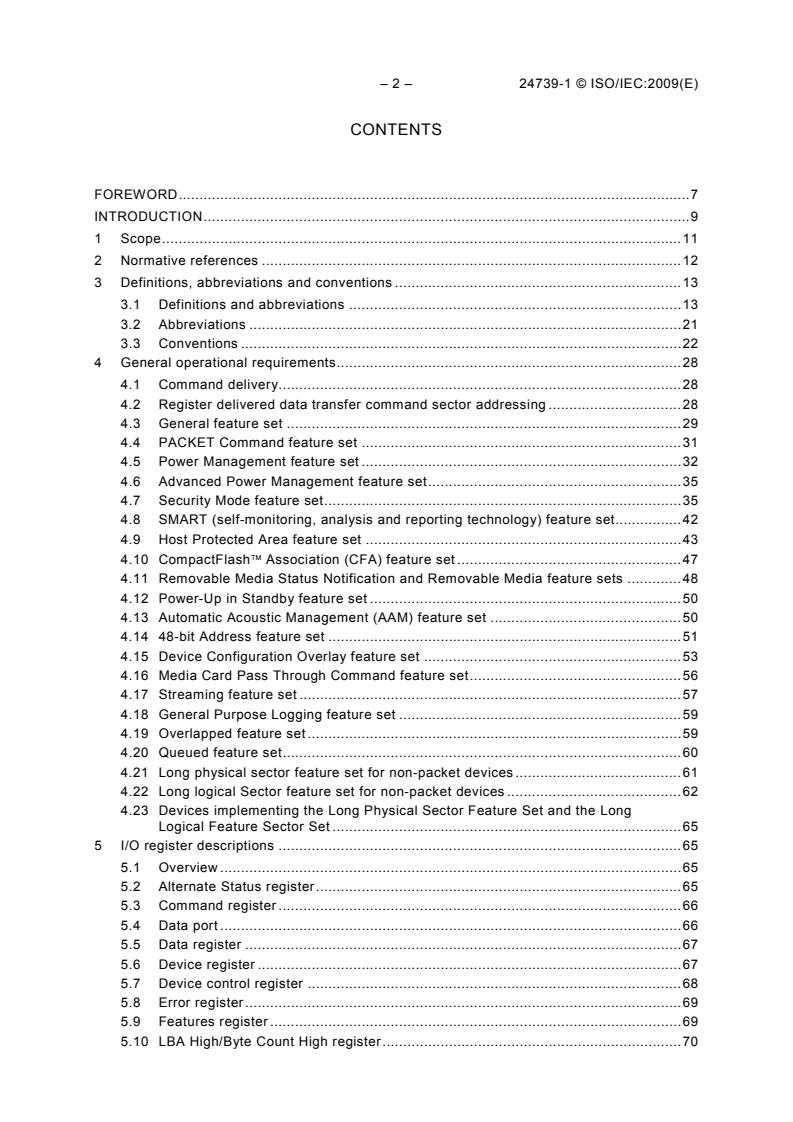
– 2 – 24739-1 © ISO/IEC:2009(E)
CONTENTS
FOREWORD.7
INTRODUCTION.9
1 Scope.11
2 Normative references .12
3 Definitions, abbreviations and conventions .13
3.1 Definitions and abbreviations .13
3.2 Abbreviations .21
3.3 Conventions .22
4 General operational requirements.28
4.1 Command delivery.28
4.2 Register delivered data transfer command sector addressing .28
4.3 General feature set .29
4.4 PACKET Command feature set .31
4.5 Power Management feature set .32
4.6 Advanced Power Management feature set.35
4.7 Security Mode feature set.35
4.8 SMART (self-monitoring, analysis and reporting technology) feature set.42
4.9 Host Protected Area feature set .43
4.10 CompactFlash™ Association (CFA) feature set .47
4.11 Removable Media Status Notification and Removable Media feature sets .48
4.12 Power-Up in Standby feature set .50
4.13 Automatic Acoustic Management (AAM) feature set .50
4.14 48-bit Address feature set .51
4.15 Device Configuration Overlay feature set .53
4.16 Media Card Pass Through Command feature set.56
4.17 Streaming feature set .57
4.18 General Purpose Logging feature set .59
4.19 Overlapped feature set .59
4.20 Queued feature set.60
4.21 Long physical sector feature set for non-packet devices .61
4.22 Long logical Sector feature set for non-packet devices .62
4.23 Devices implementing the Long Physical Sector Feature Set and the Long
Logical Feature Sector Set .65
5 I/O register descriptions .65
5.1 Overview .65
5.2 Alternate Status register.65
5.3 Command register .66
5.4 Data port .66
5.5 Data register .67
5.6 Device register .67
5.7 Device control register .68
5.8 Error register.69
5.9 Features register .69
5.10 LBA High/Byte Count High register.70
24739-1 © ISO/IEC:2009(E) – 3 –
5.11 LBA Low register.70
5.12 LBA Mid/Byte Count Low register .71
5.13 Sector Count/Interrupt Reason register .71
5.14 Status register.71
5.15 Signature and persistence.74
5.16 Single device configurations.75
6 Command descriptions .76
6.1 Overview .76
6.2 CFA ERASE SECTORS.78
6.3 CFA REQUEST EXTENDED ERROR CODE.79
6.4 CFA TRANSLATE SECTOR .82
6.5 CFA WRITE MULTIPLE WITHOUT ERASE .84
6.6 CFA WRITE SECTORS WITHOUT ERASE.86
6.7 CHECK MEDIA CARD TYPE .88
6.8 CHECK POWER MODE.90
6.9 CONFIGURE STREAM.91
6.10 DEVICE CONFIGURATION .94
6.11 DEVICE RESET .108
6.12 DOWNLOAD MICROCODE .109
6.13 EXECUTE DEVICE DIAGNOSTIC .111
6.14 FLUSH CACHE .113
6.15 FLUSH CACHE EXT.115
6.16 GET MEDIA STATUS .118
6.17 IDENTIFY DEVICE .119
6.18 IDENTIFY PACKET DEVICE .144
6.19 IDLE.158
6.20 IDLE IMMEDIATE.160
6.21 MEDIA EJECT.163
6.22 MEDIA LOCK .164
6.23 MEDIA UNLOCK .166
6.24 NOP .168
6.25 PACKET.169
6.26 READ BUFFER .175
6.27 READ DMA .176
6.28 READ DMA EXT.178
6.29 READ DMA QUEUED.181
6.30 READ DMA QUEUED EXT .185
6.31 READ LOG EXT .191
6.32 READ MULTIPLE .204
6.33 READ MULTIPLE EXT.207
6.34 READ NATIVE MAX ADDRESS.210
6.35 READ NATIVE MAX ADDRESS EXT .211
6.36 READ SECTOR(S) .213
6.37 READ SECTOR(S) EXT .216
6.38 READ STREAM DMA EXT.218
6.39 READ STREAM EXT .223
6.40 READ VERIFY SECTOR(S).227
6.41 READ VERIFY SECTOR(S) EXT .229
6.42 SECURITY DISABLE PASSWORD .232
– 4 – 24739-1 © ISO/IEC:2009(E)
6.43 SECURITY ERASE PREPARE .233
6.44 SECURITY ERASE UNIT.235
6.45 SECURITY FREEZE LOCK .237
6.46 SECURITY SET PASSWORD.239
6.47 SECURITY UNLOCK .241
6.48 SERVICE .243
6.49 SET FEATURES.244
6.50 SET MAX .251
6.51 SET MAX ADDRESS EXT .259
6.52 SET MULTIPLE MODE.262
6.53 SLEEP .264
6.54 SMART .266
6.55 STANDBY .297
6.56 STANDBY IMMEDIATE .299
6.57 WRITE BUFFER.300
6.58 WRITE DMA.302
6.59 WRITE DMA EXT .304
6.60 WRITE DMA FUA EXT .308
6.61 WRITE DMA QUEUED .311
6.62 WRITE DMA QUEUED EXT.315
6.63 WRITE DMA QUEUED FUA EXT.320
6.64 WRITE LOG EXT.326
6.65 WRITE MULTIPLE.329
6.66 WRITE MULTIPLE EXT .331
6.67 WRITE MULTIPLE FUA EXT .334
6.68 WRITE SECTOR(S).338
6.69 WRITE SECTOR(S) EXT .340
6.70 WRITE STREAM DMA EXT .342
6.71 WRITE STREAM EXT.346
7 Parallel interface physical and electrical requirements (see ISO/IEC 24739-2) .351
8 Parallel interface signal assignments and descriptions (see ISO/IEC 24739-2) . 351
9 Parallel interface general operating requirements of the physical, data link, and
transport layers (see ISO/IEC 24739-2) .351
10 Parallel interface register addressing (see ISO/IEC 24739-2) . 351
11 Parallel interface transport Protocols (see ISO/IEC 24739-2).351
12 Parallel interface timing (see ISO/IEC 24739-2). 351
13 Serial interface overview (see ISO/IEC 24739-) .351
14 Serial interface physical layer (see ISO/IEC 24739-3) .351
15 Serial interface link layer (see ISO/IEC 24739-3). 351
16 Serial interface transport layer (see ISO/IEC 24739-3) .351
17 Serial interface device command layer (see ISO/IEC 24739-3) . 351
18 Host command layer (see ISO/IEC 24739-3) . 351
19 Serial interface host adapter register interface (see ISO/IEC 24739-3) . 351
20 Serial interface error handling (see ISO/IEC 24739-3) .351
Annex A (informative) Command Set summary .352
Annex B (informative) Design and programming considerations for large physical
sector devices .359
24739-1 © ISO/IEC:2009(E) – 5 –
Annex C Device determination of cable type (informative) (see ISO/IEC 24739-2) . 361
Annex D Signal integrity and UDMA guide (informative) (see ISO/IEC 24739-2) . 361
Annex E Register selection address summary (informative) (see ISO/IEC 24739-2). 361
Annex F Sample code for CRC and scrambling (informative) (see ISO/IEC 24739-3) . 361
Annex G FIS type field value selection (informative) (see ISO/IEC 24739-3) . 361
Annex H Physical layer implementation examples (informative) (see ISO/IEC 24739-3). 361
Annex I Command processing Example (informative) (see ISO/IEC 24739-3) . 361
Bibliography.362
Figure 1 – ATA document relationships.11
Figure 2 – State diagram convention.24
Figure 3 – Byte, word and DWORD relationships .28
Figure 4 – Power management state diagram .33
Figure 5 – Security mode state diagram.37
Figure 6 – SET MAX security state diagram .46
Figure 7 – Device configuration overlay state diagram .54
Figure 8 – Long Logical and long Physical Sector Example.62
Figure 9 – Selective self-test test span example .277
Figure B.1 – Unaligned Write Example.360
Table 1 – PACKET delivered command sets .12
Table 2 – Byte order .26
Table 3 – Byte order .27
Table 4 – Security mode command actions .40
Table 5 – 48-bit addresses .52
Table 6 – 28-bit addresses .52
Table 7 – Media Card type references .56
Table 8 – Long logical sector function.63
Table 9 – I/O registers .65
Table 10 – Extended error codes .81
Table 11 – CFA TRANSLATE SECTOR Information.83
Table 12 – Device Configuration Overlay Features register values.94
Table 13 – Device Configuration Identify data structure . 100
Table 14 – Device Configuration Overlay data structure.105
Table 16 – IDENTIFY DEVICE data .122
Table 17 - Minor version number .135
Table 18 – IDENTIFY PACKET DEVICE data.146
Table 19 – Automatic Standby timer periods .158
Table 20 – Log address definition .192
Table 21 – General Purpose Log Directory .194
Table 22 – Extended Comprehensive SMART error log. 195
Table 23 – Extended Error log data structure .196
Table 24 – Command data structure .197
– 6 – 24739-1 © ISO/IEC:2009(E)
Table 25 – Error data structure .198
Table 26 – State field values.198
Table 27 – Extended Self-test log data structure. 199
Table 28 – Extended Self-test log descriptor entry . 200
Table 29 – Read Stream Error log.201
Table 30 – Error Log Entry.201
Table 31 – Write Stream Error log.202
Table 32 – Streaming Performance Parameters log .203
Table 33 – Sector Time Array Entry (Linearly Interpolated) . 203
Table 34 – Position Array Entry (Linearly Interpolated) .203
Table 35 – Access Time Array Entry (Linearly Interpolated) . 203
Table 36 – Delayed LBA log.204
Table 37 – Security password content.233
Table 38 – SECURITY ERASE UNIT password.237
Table 39 – SECURITY SET PASSWORD data content. 241
Table 40 – Identifier and security level bit interaction.241
Table 41 – SET FEATURES register definitions .246
Table 42 – Transfer mode values.247
Table 43 – Advanced power management levels. 248
Table 44 – Automatic acoustic management levels . 249
Table 45 – SET MAX Features register values .251
Table 46 – SET MAX SET PASSWORD data content.255
Table 47 – SMART Feature register values. 267
Table 48 – SMART EXECUTE OFF-LINE IMMEDIATE LBA Low register values .275
Table 49 – Device SMART data structure .280
Table 50 – Off-line data collection status byte values. 281
Table 51 – Self-test execution status values .281
Table 52 – Log address definition .284
Table 53 – SMART Log Directory.286
Table 54 – SMART summary error log sector.286
Table 55 – Error log data structure .287
Table 56 – Command data structure .288
Table 57 – Error data structure .288
Table 58 – State field values.289
Table 59 – Comprehensive error log .290
Table 60 – Self-test log data structure .291
Table 61 – Self-test log descriptor entry.291
Table 62 – Selective self-test log .292
Table 63 – Selective self-test feature flags .293
Table A.1 – Command matrix.352
Table A.2 – Command codes (sorted by command code).353
Table A.3 – Command codes (sorted by command) .356
24739-1 © ISO/IEC:2009(E) – 7 –
INFORMATION TECHNOLOGY –
AT ATTACHMENT WITH PACKET INTERFACE-7 –
Part 1: Register delivered command set,
logical register set (ATA/ATAPI-7 V1)
FOREWORD
1) ISO (International Organization for Standardization) and IEC (International Electrotechnical Commission) form the
specialized system for worldwide standardization. National bodies that are members of ISO or IEC participate in
the development of International Standards. Their preparation is entrusted to technical committees; any ISO and
IEC member body interested in the subject dealt with may participate in this preparatory work. International
governmental and non-governmental organizations liaising with ISO and IEC also participate in this preparation.
2) In the field of information technology, ISO and IEC have established a joint technical committee, ISO/IEC JTC 1.
Draft International Standards adopted by the joint technical committee are circulated to national bodies for voting.
Publication as an International Standard requires approval by at least 75 % of the national bodies casting a vote.
3) The formal decisions or agreements of IEC and ISO on technical matters express, as nearly as possible, an
international consensus of opinion on the relevant subjects since each technical committee has representation
from all interested IEC and ISO member bodies.
4) IEC, ISO and ISO/IEC publications have the form of recommendations for international use and are accepted
by IEC and ISO member bodies in that sense. While all reasonable efforts are made to ensure that the
technical content of IEC, ISO and ISO/IEC publications is accurate, IEC or ISO cannot be held responsible for
the way in which they are used or for any misinterpretation by any end user.
5) In order to promote international uniformity, IEC and ISO member bodies undertake to apply IEC, ISO and
ISO/IEC publications transparently to the maximum extent possible in their national and regional publications.
Any divergence between any ISO/IEC publication and the corresponding national or regional publication
should be clearly indicated in the latter.
6) ISO and IEC provide no marking procedure to indicate their approval and cannot be rendered responsible for
any equipment declared to be in conformity with an ISO/IEC publication.
7) All users should ensure that they have the latest edition of this publication.
8) No liability shall attach to IEC or ISO or its directors, employees, servants or agents including individual experts
and members of their technical committees and IEC or ISO member bodies for any personal injury, property
damage or other damage of any nature whatsoever, whether direct or indirect, or for costs (including legal fees)
and expenses arising out of the publication of, use of, or reliance upon, this ISO/IEC publication or any other IEC,
ISO or ISO/IEC publications.
9) Attention is drawn to the normative references cited in this publication. Use of the referenced publications is
indispensable for the correct application of this publication.
10) Attention is drawn to the possibility that some of the elements of this International Standard may be the subject of
patent rights. ISO and IEC shall not be held responsible for identifying any or all such patent rights.
International Standard ISO/IEC 24739-1 was prepared by subcommittee 25: Interconnection
of information technology equipment, of ISO/IEC joint technical committee 1: Information
technology.
The list of all currently available parts of the ISO/IEC 24739 series, under the general title
Information technology – AT attachment with packet interface-7, can be found on the IEC web
site.
– 8 – 24739-1 © ISO/IEC:2009(E)
This International Standard has been approved by vote of the member bodies, and the voting
results may be obtained from the address given on the second title page.
This publication has been drafted in accordance with the ISO/IEC Directives, Part 2.
ISO/IEC 24739-1 is to be used in conjunction with ISO/IEC 24739-2 and ISO/IEC 24739-3.
The contents of the corrigendum of September 2013 have been included in this copy.
24739-1 © ISO/IEC:2009(E) – 9 –
INTRODUCTION
ISO/IEC 24739 defines the AT attachment with packet interface (ATAPI). The standard
includes the command set and two transport protocols to support parallel and serial physical
interconnects. ISO/IEC 24739 is partitioned into three parts:
Part 1: Register delivered command set, logical register set (ATA/ATAPI-7 V1)
Part 2: Parallel transport protocols and physical interconnect (ATA/ATAPI-7 V2)
Part 3: Serial transport protocols and physical interconnect (ATA/ATAPI-7 V3)
ISO/IEC 24739 is partitioned in this way to separate the command set (Part 1) for ease of reference
and maintenance. The command set is the same for both the parallel transport (Part 2) and the serial
transport (Part 3).
Parts 1 and Part 2 were substantially derived from the prior version of this standard
(ATA/ATAPI-6, ANSI INCITS 361-2002). Part 3 is new material defining the serial transport of
the ATA/ATAPI interface.
All three parts have a clause that includes introductory material, a common glossary and an
index to the major clauses of the other two parts. After Clause 3 in each of the parts, the
material is part specific. Within each part, references are made to other parts, given with the
full reference of the publication and major clause number, e.g. ISO/IEC 24739-3, Clause 4.
In order to implement the standard for a parallel transport, it is necessary to comply with both
ISO/IEC 24739-1 and ISO/IEC 24739-2. In order to implement the serial transport, it is
necessary to comply with both ISO/IEC 24739-1 and ISO/IEC 24739-3. It should be
recognized, however, that the serial transport as described in ISO/IEC 24739-3 relies heavily
on logical interconnect and protocol concepts and requirements described in ISO/IEC 24739-2.
These concepts are called "parallel emulation" in ISO/IEC 24739-3. In some cases,
references are made to the parallel implementation of ATA, which refers to the parallel
transport (ISO/IEC 24739-2). The reader is strongly advised to consult all three parts when
implementing the serial transport.
This International Standard (ISO/IEC 24739-1) contains the command feature sets for ATA. It
defines structures used by the parallel implementation of ATA and the serial implementation
of ATA. The command descriptions are in alphabetical order, with a cross-reference by
command codes in A nnex A.
The ISO/IEC 24739 series of standards consists of the following parts and clauses:
Part 1
Clause 1 describes the scope.
Clause 2 provides normative references for the entire standard.
Clause 3 provides definitions, abbreviations and conventions used within the entire standard.
Clause 4 describes the general operating requirements of the command layer.
Clause 5 describes the I/O registers.
Clause 6 contains descriptions of the commands.
Clauses 7 through 12 point to the material in ISO/IEC 24739-2.
Clauses 13 through 19 point to material in ISO/IEC 24739-3.
– 10 – 24739-1 © ISO/IEC:2009(E)
Part 2
Clause 1 describes the scope.
Clause 2 provides normative references for the entire standard.
Clause 3 provides definitions, abbreviations and conventions used within the entire standard.
Clauses 4, 5 and 6 point to the material in ISO/IEC 24739-1.
Clause 7 contains the electrical and mechanical characteristics.
Clause 8 contains the signal descriptions.
Clause 9 describes the general operating requirements of the physical, data link and transport
layers.
Clause 10 contains describes register addressing.
Clause 11 contains the transport protocols.
Clause 12 contains the interface timing diagrams.
Clauses 13 through 19 point to material in ISO/IEC 24739-3.
Part 3
Clause 1 describes the scope.
Clause 2 provides normative references for the entire standard.
Clause 3 provides definitions, abbreviations and conventions used within the entire standard.
Clauses 4, 5 and 6 point to the material in ISO/IEC 24739-1.
Clauses 7 through 12 point to the material in ISO/IEC 24739-2.
Clause 13 contains a general overview of the serial interface.
Clause 14 describes the serial physical layer.
Clause 15 describes the serial link layer.
Clause 16 describes the serial transport layer.
Clause 17 describes the device command layer protocol for the serial interface.
Clause 18 describes the host command layer protocol for the serial interface.
Clause 19 describes the serial interface host adapter register interface.
Clause 20 describes the serial interface error handling.
24739-1 © ISO/IEC:2009(E) – 11 –
INFORMATION TECHNOLOGY –
AT ATTACHMENT WITH PACKET INTERFACE-7 –
Part 1: Register delivered command set,
logical register set (ATA/ATAPI-7 V1)
1 Scope
This part of ISO/IEC 24739 specifies the AT Attachment Interface between host systems and
storage devices. It provides a common attachment interface for systems manufacturers,
system integrators, software suppliers and suppliers of intelligent storage devices.
ISO/IEC 24739-1 defines the register delivered commands used by devices implementing the
standard. ISO/IEC 24739-2 defines the connectors and cables for physical interconnection
between host and storage device, the electrical and logical characteristics of the
interconnecting signals and the protocols for the transporting of commands, data and status
over the interface for the parallel interface. ISO/IEC 24739-3 defines the connectors and
cables for physical interconnection between host and storage device, the electrical and logical
characteristics of the interconnecting signals and the protocols for the transporting of
commands, data and status over the interface for the serial interface. Figure 1 shows the
relationship of these documents. For devices implementing the PACKET command feature set,
additional command layer standards are listed in Table 1 and described in Clause 2.
Register delivered command set Packet delivered command sets
Command layer Logical register set See Table 1
ISO/IEC 24739-1
Transport, link, Parallel Transport Protocols Serial Transport Protocols
and physical and Physical interconnect and Physical interconnect
layers ISO/IEC 24739-2 ISO/IEC 24739-3
Figure 1 – ATA document relationships
– 12 – 24739-1 © ISO/IEC:2009(E)
Table 1 – PACKET delivered command sets
Standard
SCSI Primary Commands (SPC)
ISO/IEC 14776-452, SCSI Primary Commands 2 (SPC-2)
ISO/IEC 14776-453, SCSI Primary Commands-3 (SPC-3)
ISO/IEC 14776-322, SCSI Block Commands (SBC-2)
ISO/IEC 14776-331, SCSI Stream Commands (SSC)
Multimedia Commands (MMC)
ISO/IEC 14776-362, Multimedia Commands-2 (MMC-2)
ISO/IEC 14776-363, Multimedia Commands-3 (MMC-3)
ISO/IEC 14776-364: Multimedia Commands-4 (MMC-4)
ATAPI for Removable Media (SFF8070I)
ATA Packet Interface (ATAPI) for Streaming Tape QIC-157 revision D
This standard maintains compatibility with the AT Attachment with packet interface-6 standard
(ATA/ATAPI-6), ANSI INCITS 361-2002, and while providing additional functions, is not
intended to require changes to presently installed devices or existing software.
2 Normative references
The following referenced documents are indispensable for the application of this document.
For dated references only the edition cited applies. For undated references the latest edition
(including any amendments) applies.
ISO/IEC 14776-321, Information technology – Small computer system interface (SCSI-3) –
Part 321: Block commands (SBC) [ANSI INCITS 306-1998 (R2003)]
ISO/IEC 14776-322, Information technology – Small computer system interface (SCSI) –
Part 322: Block commands-2 (SBC-2) [T10/1417-D]
ISO/IEC 14776-331, Information technology – Small computer system interface (SCSI) –
Part 331: Stream commands (SSC) [ANSI INCITS 335-2000]
ISO/IEC 14776-362, Information technology – Small computer system interface (SCSI) –
Part 362: Multimedia commands-2 (MMC-2) [ANSI INCITS 333-2000]
ISO/IEC 14776-363, Information technology – Small computer system interface (SCSI) –
Part 363: Multimedia commands-3 (MMC-3) [ANSI INCITS 360-2002]
(under consideration)
ISO/IEC 14776-364, Information technology – Small computer system interface (SCSI) –
Part 364: Multimedia commands-4 (MMC-4) [T10/1545D]
(under consideration)
ISO/IEC 14776-452, Information technology – Small computer system interface (SCSI) –
Part 452: Primary commands-2 (SPC-2) [ANSI INCITS 351-2001]
ISO/IEC 14776-453, Information technology – Small computer system interface (SCSI) –
Part 453: Primary commands-3 (SPC-3) [T10/1416-D]
(under consideration)
ISO/IEC 13213:1994, Information technology – Microprocessor systems – Control and Status
Register (CSR) Architecture for microprocessor buses
24739-1 © ISO/IEC:2009(E) – 13 –
ISO 7779:1999, Acoustics – Measurement of airborne noise emitted by information technology
and telecommunications equipment
AT Attachment with Packet Interface Extension (ATA/ATAPI-4)[ANSI INCITS 317-1998] (R2003)
SCSI-3 Primary Commands (SPC) [ANSI INCITS 301-1997 (R2002)]
Multimedia Commands (MMC) [ANSI INCITS 304-1997 (R2002)]
Protected Area Run Time Interface Extensions (PARTIES) [ANSI INCITS 346-2001]
ATAPI for Rewritable Media (under development) [SFF8070i]
3 Definitions, abbreviations and conventions
3.1 Definitions and abbreviations
For the purposes of this standard, the following definitions apply.
3.1.1
ASCII Character
designates 8-bit value that is encoded using the ASCII character set
3.1.2
acoustics
measurement of airborne noise emitted by information technology and telecommunications
equipment [see ISO 7779:1999(E)]
3.1.3
ATA (AT Attachment)
ATA defines the physical, electrical, transport and command protocols for the internal
attachment of storage devices to host systems
3.1.4
ATA-1 device
device that complied with ANSI X3.221-1994, the AT Attachment interface for disk drives
NOTE ANSI X3.221-1994 has been withdrawn.
3.1.5
ATA-2 device
device that complied with ANSI X3.279-1996, the AT Attachment interface with extensions
NOTE ANSI X3.279-1996 has been withdrawn.
3.1.6
ATA-3 device
device that complies with ANSI INCITS 298-1997, the AT Attachment-3 Interface
NOTE ANSI INCITS 298-1997 has been withdrawn.
3.1.7
ATA/ATAPI-4 device
device that complies with ANSI INCITS 317-1998
NOTE For reference, see bibliography.
– 14 – 24739-1 © ISO/IEC:2009(E)
3.1.8
ATA/ATAPI-5 device
device that complies with ANSI INCITS 340-2000
NOTE For reference, see bibliography.
3.1.9
ATA/ATAPI-6 device
device that complies with ANSI INCITS 361-2002
NOTE For reference, see bibliography.
3.1.10
ATA/ATAPI-7 device
device that complies with this standard
3.1.11
ATAPI (AT Attachment Packet Interface) device
device implementing the Packet Command feature set
3.1.12
AU (Allocation Unit)
minimum number of logically contiguous sectors on the media as used in the Streaming
feature set
NOTE An Allocation Unit may be accessed with one or more requests.
3.1.13
AV (Audio-Video)
Audio-Video applications use da
...
Questions, Comments and Discussion
Ask us and Technical Secretary will try to provide an answer. You can facilitate discussion about the standard in here.
Loading comments...