

IEC 60674-3-8:2011
(Main)Plastic films for electrical purposes - Part 3: Specifications for individual materials - Sheet 8: Balanced biaxially oriented polyethylene naphthalate (PEN) films used for electrical insulation
General Information
- Abstract
IEC 60674-3-8:2011 gives the requirements for balanced biaxially oriented polyethylene naphthalate (PEN) films for use as electrical insulation.
- Status
- Published
- Publication Date
- 21-Nov-2016
- Technical Committee
- TC 15 - Solid electrical insulating materials
- Drafting Committee
- MT 3 - TC 15/MT 3
- Current Stage
- PPUB - Publication issued
- Start Date
- 13-Jul-2011
- Completion Date
- 15-Aug-2011
Buy Documents
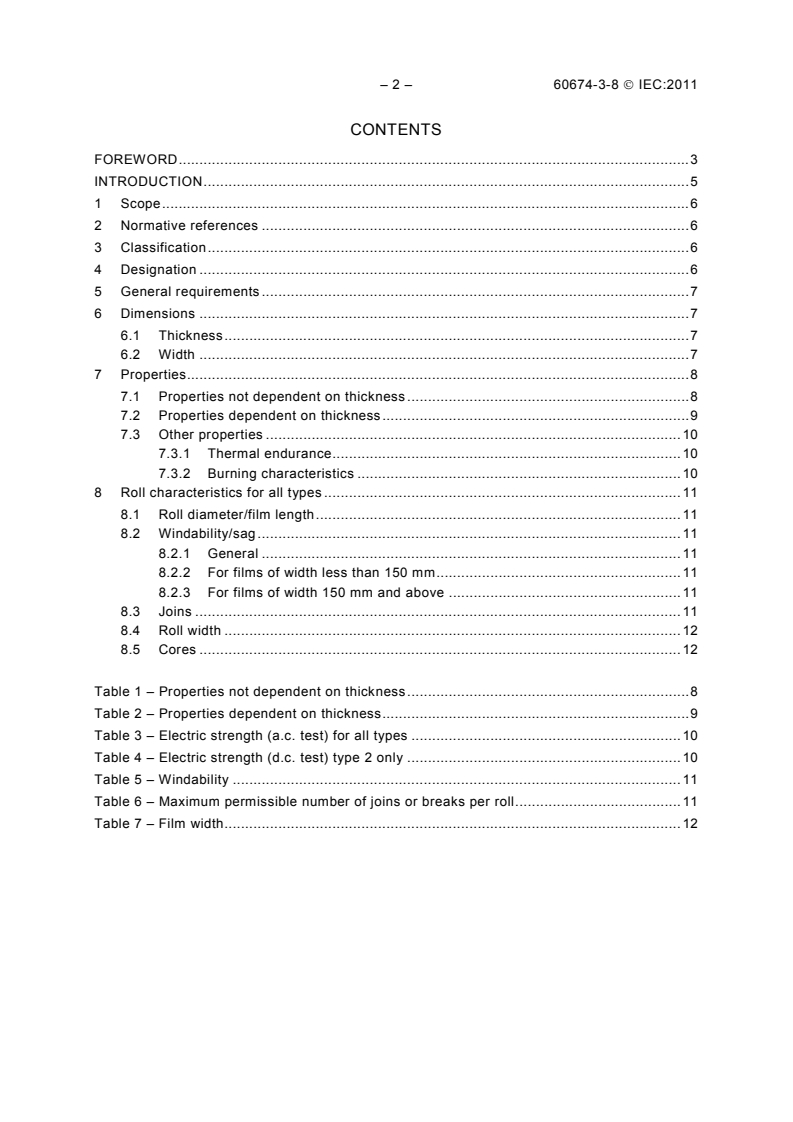
IEC 60674-3-8:2011 - Plastic films for electrical purposes - Part 3: Specifications for individual materials - Sheet 8: Balanced biaxially oriented polyethylene naphthalate (PEN) films used for electrical insulation Released:7/13/2011

IEC 60674-3-8:2011+AMD1:2016 CSV - Plastic films for electrical purposes - Part 3: Specifications for individual materials - Sheet 8: Balanced biaxially oriented polyethylene naphthalate (PEN) films used for electrical insulation Released:11/22/2016
Overview
IEC 60674-3-8:2011 is an international standard from the International Electrotechnical Commission (IEC), specifying the requirements for balanced biaxially oriented polyethylene naphthalate (PEN) films used for electrical insulation. This standard is part of the IEC 60674 series, which addresses plastic films for electrical purposes, focusing on individual material specifications tailored to critical applications in electrical engineering and electronics.
PEN films produced to this standard are widely valued for their excellent electrical properties, mechanical strength, and thermal stability. The standard offers detailed classifications, designations, and performance requirements to ensure consistent quality and reliability for manufacturers and end users in the electrical insulation sector.
Key Topics
- Material Scope: Defines the use of balanced biaxially oriented PEN films specifically for electrical insulation.
- Classification: Identifies three main types:
- Type 1a: General purpose, high hydrolytic stability
- Type 1b: General purpose, standard grade
- Type 2: Capacitor grade
- Designation System: Provides a structured code for PEN film specification, including type, thickness, width, length, and color.
- General Requirements: Ensures the PEN base material is of high purity and balanced orientation, with any additives not adversely affecting performance.
- Dimensional Tolerances: Covers thickness and width measurement methods and tolerances to guarantee precise manufacturing.
- Performance Properties:
- Electrical characteristics: High dielectric strength, specific permittivity, and volume/surface resistivity for insulating applications.
- Mechanical properties: Tensile strength and elongation at break, ensuring mechanical durability.
- Thermal endurance: Guidelines for thermal aging and stability.
- Roll and winding requirements: Prescribes limitations on joins/splices, roll width tolerances, and core sizes.
Applications
Balanced biaxially oriented PEN films that comply with IEC 60674-3-8 are primarily used as electrical insulation films in various industries. Their outstanding electrical, mechanical, and thermal properties make them suitable for:
- High-performance capacitors: Type 2 films are ideal for winding elements, offering high dielectric strength and reliability.
- Flexible cables and wires: Used as an insulating layer due to excellent stability and durability.
- Motors, transformers, and generators: Functioning as slot liners, interlayer insulation, and phase barriers to ensure safe and efficient operation.
- Printed circuit boards (PCBs): Employed as dielectric barriers for multilayer and flexible circuits needing thermal and electrical stability.
- Electronic devices: Utilized in displays and sensors where robust electrical insulation is required.
By following IEC 60674-3-8, manufacturers ensure their PEN films meet stringent global requirements, streamlining cross-border procurement and enhancing operational safety.
Related Standards
Implementing IEC 60674-3-8 benefits from alignment with other essential IEC standards, ensuring compatibility and comprehensive testing:
- IEC 60674-1: Definitions and general requirements for plastic films used for electrical purposes.
- IEC 60674-2: Standardized methods of test for plastic electrical insulation films.
- IEC 60068-2-66: Environmental testing procedures, particularly for damp heat, to assess material endurance.
- IEC 60216-5: Procedures for determining the relative thermal endurance index (RTE) of electrical insulating materials, essential for long-term stability.
Organizations applying balanced biaxially oriented PEN films in their products gain quality assurance and international recognition by adhering to IEC 60674-3-8:2011, facilitating reliable insulation and long-term product performance.
Keywords: IEC 60674-3-8, balanced biaxially oriented polyethylene naphthalate, PEN films, electrical insulation, insulation films standard, capacitor grade insulation, IEC electrical standards, electrical plastic films.
Relations
- Effective Date
- 05-Sep-2023
Buy Documents
IEC 60674-3-8:2011 - Plastic films for electrical purposes - Part 3: Specifications for individual materials - Sheet 8: Balanced biaxially oriented polyethylene naphthalate (PEN) films used for electrical insulation Released:7/13/2011
IEC 60674-3-8:2011+AMD1:2016 CSV - Plastic films for electrical purposes - Part 3: Specifications for individual materials - Sheet 8: Balanced biaxially oriented polyethylene naphthalate (PEN) films used for electrical insulation Released:11/22/2016
Get Certified
Connect with accredited certification bodies for this standard

IMQ S.p.A. (Certification)
Italian electrical product certification.

SLG Prüf- und Zertifizierungs GmbH
German testing and certification body.

UL Solutions
Global safety science company with testing, inspection and certification.
Sponsored listings
Frequently Asked Questions
IEC 60674-3-8:2011 is a standard published by the International Electrotechnical Commission (IEC). Its full title is "Plastic films for electrical purposes - Part 3: Specifications for individual materials - Sheet 8: Balanced biaxially oriented polyethylene naphthalate (PEN) films used for electrical insulation". This standard covers: IEC 60674-3-8:2011 gives the requirements for balanced biaxially oriented polyethylene naphthalate (PEN) films for use as electrical insulation.
IEC 60674-3-8:2011 gives the requirements for balanced biaxially oriented polyethylene naphthalate (PEN) films for use as electrical insulation.
IEC 60674-3-8:2011 is classified under the following ICS (International Classification for Standards) categories: 29.035.20 - Plastics and rubber insulating materials. The ICS classification helps identify the subject area and facilitates finding related standards.
IEC 60674-3-8:2011 has the following relationships with other standards: It is inter standard links to IEC 60674-3-8:2011/AMD1:2016. Understanding these relationships helps ensure you are using the most current and applicable version of the standard.
IEC 60674-3-8:2011 is available in PDF format for immediate download after purchase. The document can be added to your cart and obtained through the secure checkout process. Digital delivery ensures instant access to the complete standard document.
Standards Content (Sample)
IEC 60674-3-8 ®
Edition 1.0 2011-07
INTERNATIONAL
STANDARD
NORME
INTERNATIONALE
Plastic films for electrical purposes –
Part 3: Specifications for individual materials – Sheet 8: Balanced biaxially
oriented polyethylene naphthalate (PEN) films used for electrical insulation
Films plastiques à usages électriques –
Partie 3: Spécifications pour matériaux particuliers – Feuille 8: Films de
polynaphtalate d'éthylène (PEN), à orientation bi-axiale équilibrée, utilisés
dans l'isolation électrique
All rights reserved. Unless otherwise specified, no part of this publication may be reproduced or utilized in any form or by
any means, electronic or mechanical, including photocopying and microfilm, without permission in writing from either IEC or
IEC's member National Committee in the country of the requester.
If you have any questions about IEC copyright or have an enquiry about obtaining additional rights to this publication,
please contact the address below or your local IEC member National Committee for further information.
Droits de reproduction réservés. Sauf indication contraire, aucune partie de cette publication ne peut être reproduite
ni utilisée sous quelque forme que ce soit et par aucun procédé, électronique ou mécanique, y compris la photocopie
et les microfilms, sans l'accord écrit de la CEI ou du Comité national de la CEI du pays du demandeur.
Si vous avez des questions sur le copyright de la CEI ou si vous désirez obtenir des droits supplémentaires sur cette
publication, utilisez les coordonnées ci-après ou contactez le Comité national de la CEI de votre pays de résidence.
IEC Central Office
3, rue de Varembé
CH-1211 Geneva 20
Switzerland
Email: inmail@iec.ch
Web: www.iec.ch
About the IEC
The International Electrotechnical Commission (IEC) is the leading global organization that prepares and publishes
International Standards for all electrical, electronic and related technologies.
About IEC publications
The technical content of IEC publications is kept under constant review by the IEC. Please make sure that you have the
latest edition, a corrigenda or an amendment might have been published.
Catalogue of IEC publications: www.iec.ch/searchpub
The IEC on-line Catalogue enables you to search by a variety of criteria (reference number, text, technical committee,…).
It also gives information on projects, withdrawn and replaced publications.
IEC Just Published: www.iec.ch/online_news/justpub
Stay up to date on all new IEC publications. Just Published details twice a month all new publications released. Available
on-line and also by email.
Electropedia: www.electropedia.org
The world's leading online dictionary of electronic and electrical terms containing more than 20 000 terms and definitions
in English and French, with equivalent terms in additional languages. Also known as the International Electrotechnical
Vocabulary online.
Customer Service Centre: www.iec.ch/webstore/custserv
If you wish to give us your feedback on this publication or need further assistance, please visit the Customer Service
Centre FAQ or contact us:
Email: csc@iec.ch
Tel.: +41 22 919 02 11
Fax: +41 22 919 03 00
A propos de la CEI
La Commission Electrotechnique Internationale (CEI) est la première organisation mondiale qui élabore et publie des
normes internationales pour tout ce qui a trait à l'électricité, à l'électronique et aux technologies apparentées.
A propos des publications CEI
Le contenu technique des publications de la CEI est constamment revu. Veuillez vous assurer que vous possédez
l’édition la plus récente, un corrigendum ou amendement peut avoir été publié.
Catalogue des publications de la CEI: www.iec.ch/searchpub/cur_fut-f.htm
Le Catalogue en-ligne de la CEI vous permet d’effectuer des recherches en utilisant différents critères (numéro de référence,
texte, comité d’études,…). Il donne aussi des informations sur les projets et les publications retirées ou remplacées.
Just Published CEI: www.iec.ch/online_news/justpub
Restez informé sur les nouvelles publications de la CEI. Just Published détaille deux fois par mois les nouvelles
publications parues. Disponible en-ligne et aussi par email.
Electropedia: www.electropedia.org
Le premier dictionnaire en ligne au monde de termes électroniques et électriques. Il contient plus de 20 000 termes et
définitions en anglais et en français, ainsi que les termes équivalents dans les langues additionnelles. Egalement appelé
Vocabulaire Electrotechnique International en ligne.
Service Clients: www.iec.ch/webstore/custserv/custserv_entry-f.htm
Si vous désirez nous donner des commentaires sur cette publication ou si vous avez des questions, visitez le FAQ du
Service clients ou contactez-nous:
Email: csc@iec.ch
Tél.: +41 22 919 02 11
Fax: +41 22 919 03 00
IEC 60674-3-8 ®
Edition 1.0 2011-07
INTERNATIONAL
STANDARD
NORME
INTERNATIONALE
Plastic films for electrical purposes –
Part 3: Specifications for individual materials – Sheet 8: Balanced biaxially
oriented polyethylene naphthalate (PEN) films used for electrical insulation
Films plastiques à usages électriques –
Partie 3: Spécifications pour matériaux particuliers – Feuille 8: Films de
polynaphtalate d'éthylène (PEN), à orientation bi-axiale équilibrée, utilisés
dans l'isolation électrique
INTERNATIONAL
ELECTROTECHNICAL
COMMISSION
COMMISSION
ELECTROTECHNIQUE
PRICE CODE
INTERNATIONALE
CODE PRIX M
ICS 29.035.20 ISBN 978-2-88912-587-6
– 2 – 60674-3-8 IEC:2011
CONTENTS
FOREWORD . 3
INTRODUCTION . 5
1 Scope . 6
2 Normative references . 6
3 Classification . 6
4 Designation . 6
5 General requirements . 7
6 Dimensions . 7
6.1 Thickness . 7
6.2 Width . 7
7 Properties . 8
7.1 Properties not dependent on thickness . 8
7.2 Properties dependent on thickness . 9
7.3 Other properties . 10
7.3.1 Thermal endurance . 10
7.3.2 Burning characteristics . 10
8 Roll characteristics for all types . 11
8.1 Roll diameter/film length . 11
8.2 Windability/sag . 11
8.2.1 General . 11
8.2.2 For films of width less than 150 mm . 11
8.2.3 For films of width 150 mm and above . 11
8.3 Joins . 11
8.4 Roll width . 12
8.5 Cores . 12
Table 1 – Properties not dependent on thickness . 8
Table 2 – Properties dependent on thickness . 9
Table 3 – Electric strength (a.c. test) for all types . 10
Table 4 – Electric strength (d.c. test) type 2 only . 10
Table 5 – Windability . 11
Table 6 – Maximum permissible number of joins or breaks per roll . 11
Table 7 – Film width . 12
60674-3-8 IEC:2011 – 3 –
INTERNATIONAL ELECTROTECHNICAL COMMISSION
____________
PLASTIC FILMS FOR ELECTRICAL PURPOSES –
Part 3: Specifications for individual materials –
Sheet 8: Balanced biaxially oriented polyethylene
naphthalate (PEN) films used for electrical insulation
FOREWORD
1) The International Electrotechnical Commission (IEC) is a worldwide organization for standardization comprising
all national electrotechnical committees (IEC National Committees). The object of IEC is to promote
international co-operation on all questions concerning standardization in the electrical and electronic fields. To
this end and in addition to other activities, IEC publishes International Standards, Technical Specifications,
Technical Reports, Publicly Available Specifications (PAS) and Guides (hereafter referred to as “IEC
Publication(s)”). Their preparation is entrusted to technical committees; any IEC National Committee interested
in the subject dealt with may participate in this preparatory work. International, governmental and non-
governmental organizations liaising with the IEC also participate in this preparation. IEC collaborates closely
with the International Organization for Standardization (ISO) in accordance with conditions determined by
agreement between the two organizations.
2) The formal decisions or agreements of IEC on technical matters express, as nearly as possible, an international
consensus of opinion on the relevant subjects since each technical committee has representation from all
interested IEC National Committees.
3) IEC Publications have the form of recommendations for international use and are accepted by IEC National
Committees in that sense. While all reasonable efforts are made to ensure that the technical content of IEC
Publications is accurate, IEC cannot be held responsible for the way in which they are used or for any
misinterpretation by any end user.
4) In order to promote international uniformity, IEC National Committees undertake to apply IEC Publications
transparently to the maximum extent possible in their national and regional publications. Any divergence
between any IEC Publication and the corresponding national or regional publication shall be clearly indicated in
the latter.
5) IEC itself does not provide any attestation of conformity. Independent certification bodies provide conformity
assessment services and, in some areas, access to IEC marks of conformity. IEC is not responsible for any
services carried out by independent certification bodies.
6) All users should ensure that they have the latest edition of this publication.
7) No liability shall attach to IEC or its directors, employees, servants or agents including individual experts and
members of its technical committees and IEC National Committees for any personal injury, property damage or
other damage of any nature whatsoever, whether direct or indirect, or for costs (including legal fees) and
expenses arising out of the publication, use of, or reliance upon, this IEC Publication or any other IEC
Publications.
8) Attention is drawn to the Normative references cited in this publication. Use of the referenced publications is
indispensable for the correct application of this publication.
9) Attention is drawn to the possibility that some of the elements of this IEC Publication may be the subject of
patent rights. IEC shall not be held responsible for identifying any or all such patent rights.
International Standard IEC 60674-3-8 has been prepared by IEC technical committee 15:
Solid electrical insulating materials.
The text of this standard is based on the following documents:
FDIS Report on voting
15/631/FDIS 15/643/RVD
Full information on the voting for the approval of this standard can be found in the report on
voting indicated in the above table.
This publication has been drafted in accordance with the ISO/IEC Directives, Part 2.
– 4 – 60674-3-8 IEC:2011
A list of all the parts in the IEC 60674 series, under the general title Plastic films for electrical
purposes, can be found on the IEC website.
The committee has decided that the contents of this publication will remain unchanged until
the stability date indicated on the IEC web site under "http://webstore.iec.ch" in the data
related to the specific publication. At this date, the publication will be
• reconfirmed,
• withdrawn,
• replaced by a revised edition, or
• amended.
60674-3-8 IEC:2011 – 5 –
INTRODUCTION
This International Standard is one of a series which deals with plastic films for electrical
purposes.
The series consists of three parts:
Part 1: Definitions and general requirements (IEC 60674-1).
Part 2: Methods of test (IEC 60674-2).
Part 3: Specifications for individual materials (IEC 60674-3).
This standard contains one of the sheets comprising part 3, as follows:
Sheet 8: Balanced biaxially oriented polyethylene naphthalate (PEN) films used for
electrical insulation.
– 6 – 60674-3-8 IEC:2011
PLASTIC FILMS FOR ELECTRICAL PURPOSES –
Part 3: Specifications for individual materials –
Sheet 8: Balanced biaxially oriented polyethylene
naphthalate (PEN) films used for electrical insulation
1 Scope
This International Standard gives the requirements for balanced biaxially oriented poly-
ethylene naphthalate (PEN) films for use as electrical insulation.
Materials which conform to this specification meet established levels of performance.
However, the selection of a material by a user for a specific application should be based on
the actual requirements necessary for adequate performance in that application and not
based on this specification alone.
Safety warning: it is the responsibility of the user of the methods contained or referred to in this
document to ensure that they are used in a safe manner.
2 Normative references
The following referenced documents are indispensable for the application of this document.
For dated references, only the edition cited applies. For undated references, the latest edition
of the referenced document (including any amendments) applies.
IEC 60674-1:1980, Specification for plastic films for electrical purposes – Part 1: Definitions
and general requirements
IEC 60674-2:1988, Specification for plastic films for electrical purposes – Part 2: Methods
of test
IEC60068-2-66:1994, Environmental testing – Part 2: Test methods – Test Cx: Damp heat,
steady state (unsaturated pressurized vapour)
IEC 60216-5:2008, Electrical insulating materials – Thermal endurance properties – Part 5:
Determination of relative thermal endurance index (RTE) of an insulating material
ISO11357-3:1999, Plastics – Differential scanning calorimetry (DSC) – Part 3:Determination
of temperature and enthalpy of melting and crystallization
3 Classification
The PEN film shall be of the following types:
Type 1a: General purpose, high hydrolytic stability grade.
Type 1b: General purpose, standard grade.
Type 2: Capacitor grade.
4 Designation
The plastic film shall be identified by the following designation:
60674-3-8 IEC:2011 – 7 –
Designation of the film - IEC 60674-3-8 - PEN - type - thickness in micrometres - width in
millimetres - length in metres - colour.
Example:
Polyethylene naphthalate - IEC 60674-3-8 - PEN - type 1b - 100 - 20 - 200 – nc
(nc = natural colour; other colours according to IEC 60757).
5 General requirements
The material shall be made from polyethylene naphthalate; it shall be biaxially oriented with
an approximately balanced orientation and shall conform to the requirements laid down in
IEC 60674-1.
For certain applications additives to the base material may be present (e.g. pigments, dyes).
Where such additives are included, they shall not affect the requirements for any of the
properties listed for that type unless otherwise specified.
6 Dimensions
6.1 Thickness
The film thickness shall be measured by a gravimetric method in accordance with the
requirements of Subclause 3.3 of IEC 60674-2.
NOTE There are no requirements for thickness in this standard but preferred thicknesses in µm are as follows:
1,2; 1,3; 1,5; 1,8; 1,9; 2; 2,1; 2,3; 3; 3,5; 4; 5; 6; 8; 9; 12; 16; 19; 20; 25; 38; 45; 50; 75; 89; 100; 125; 188; 200;
250.
The thickness tolerance shall comply with the requirements in Subclause 4.1 of IEC 60674-1
unless otherwise specified in the purchase contract.
6.2 Width
The film width shall be measured in accordance with the requirements of Clause 5 of
IEC 60674-2.
Preferred widths cannot be given on account of the great variety of applications.
The tolerance on the width shall comply with the requirements of Subclause 4.2 of IEC 60674-
0,0
1 except for slot closure applications where on a width of less than 25 mm a tolerance of x
−0,3
mm is specified as an alternative.
– 8 – 60674-3-8 IEC:2011
7 Properties
7.1 Properties not dependent on thickness
Table 1 – Properties not dependent on thickness
IEC 60674- 2
Property Requirements Units Test method Type
Subclause
1a,1b and
Density - normal 1 350 ± 20 kg/m 4, Method D
a
Melting- point °C – 1a,1b and
270 ± 5
b
Permittivity – 16.1 (23 °C, 1 kHz) 1a,1b and
2,6 ± 0,5
b
–3
Dissipation factor – 16.1 (23 °C, 48 Hz – 62 Hz) 1a,1b and
<5 × 10
–3 b
<9 × 10 – 16.1 (23 °C, 1 kHz) 1a and 1b
Volume resistivity 1a and 1b
>10
c
Ω × m 15
>10 2
Surface resistivity 1a and 1b
>10
c
Ω 14
>10
a
DSC method according to ISO 11357-3.
b
Use non-contacting electrodes or evaporated metal electrodes.
c
Measurement conditions shall be 23 °C and 50 % r.h. after 24 h exposure. The test voltages are 100 V ± 10 V for
thicknesses > 10 µm and 10 V for thicknesses < 10 µm.
60674-3-8 IEC:2011 – 9 –
7.2 Properties dependent on thickness
Table 2 – Properties dependent on thickness
Requirements
IEC 60674- 2
Property Units Test method Type
≤15 µm >15 µm up to 100 µm >100 µm up to 250
Subclause
µm
Tensile strength
(either direction)
Minimum value
1a, 1b
a
180 120 95
- Initial value
and 2
b
MPa 10
- After exposure to a
130 100 90 1a
unsaturated damp
c
heat for 96 h
1b and 2
a
110 90 85
Elongation at break
(either direction)
Minimum value
1a, 1b
and 2
a
35 40 40
- Initial value
b
% 10
a
20 20 20 1a
- After exposure to
unsaturated damp
c
heat for 96 h
a
1b and 2
10 10
Dimensional change 23 (150 °C, 1a, 1b
1,3 1,0 0,8
(shrinkage either 15 min) and 2
direction)
%
23 (200 °C, 1a, 1b
6,5 3,5 1,6
10 min) and 2
d
Electric strength See Tables 3 and 4 18.1, a.c. 1a, 1b
and 2
18.2, d.c. 2
a
No requirement for film thicknesses below 5 µm.
b
Rate of extension 100 mm/min, reference lines 100 mm apart.
c
Exposure to unsaturated damp heat (unsaturated pressurized vapour), 120 °C, 85 % r.h. according to Clauses 3 to
9 in IEC 60068-2-66.
d
Method to use 6 mm diameter electrodes. For materials of thicknesses 100 µm or less, tests shall be made in air
using a rate of rise of voltage of 500 V/s. For materials thicker than 100 µm, tests shall be made in transformer oil
in accordance with IEC60243-1.
– 10 – 60674-3-8 IEC:2011
Table 3 – Electric strength (a.c. test) for all types
Nominal Minimum IEC 60674- 2
thickness electric strength Test method
Subclause
µm V/µm
23 °C 150 °C
- 18.1
6 -
-
Using 6 mm diameter
9 -
- electrodes
12 -
c
a 230
16 405 a
c in air.
a
20 360
c
170 b
a
in mineral transformer
25 305
c
a oil.
38 235
c
a
c
50 190 c
in silicone transformer
a
c
75 150
80 oil.
a
c
100 120
b
c
125 95
b c
188 80 40
b
250 70
Table 4 – Electric strength (d.c. test) type 2 only
Minimum Not more than two Not more than one
Nominal
breakdown voltage of the 21 results of the 21 results
thickness
Central value shall be below shall be below
V V V
µm
a
4 1200 500 100
a
5 1200 500 200
a
6 1800 1200 1000
12 5900 3600 3000
a
This value is only for information. The actual value shall be agreed between purchaser
and manufacturer.
7.3 Other properties
7.3.1 Thermal endurance
Thermal endurance for types 1a and 1b films (≥25 µm) shall be measured according to
IEC 60216-5.
RTE ≥ 160*
* End point criterion: 50 % retention of tensile strength.
Reference material: PPS (Polyphenylene Sulfide) film having approximately the same
thickness as the subject material and an ATE in accordance with IEC 60216-5, Subclause
3.1.4.
Ageing temperatures of 180 °C, 200 °C and 220 °C are recommended.
There is no thermal endurance requirement for type 2 films.
7.3.2 Burning characteristics
No requirement.
60674-3-8 IEC:2011 – 11 –
8 Roll characteristics for all types
8.1 Roll diameter/film length
There are no requirements in this standard for roll diameters or film l
...
IEC 60674-3-8 ®
Edition 1.1 2016-11
CONSOLIDATED VERSION
INTERNATIONAL
STANDARD
NORME
INTERNATIONALE
colour
inside
Plastic films for electrical purposes –
Part 3: Specifications for individual materials – Sheet 8: Balanced biaxially
oriented polyethylene naphthalate (PEN) films used for electrical insulation
Films plastiques à usages électriques –
Partie 3: Spécifications pour matériaux particuliers – Feuille 8: Films de
polynaphtalate d'éthylène (PEN), à orientation bi-axiale équilibrée, utilisés dans
l'isolation électrique
All rights reserved. Unless otherwise specified, no part of this publication may be reproduced or utilized in any form
or by any means, electronic or mechanical, including photocopying and microfilm, without permission in writing from
either IEC or IEC's member National Committee in the country of the requester. If you have any questions about IEC
copyright or have an enquiry about obtaining additional rights to this publication, please contact the address below or
your local IEC member National Committee for further information.
Droits de reproduction réservés. Sauf indication contraire, aucune partie de cette publication ne peut être reproduite
ni utilisée sous quelque forme que ce soit et par aucun procédé, électronique ou mécanique, y compris la photocopie
et les microfilms, sans l'accord écrit de l'IEC ou du Comité national de l'IEC du pays du demandeur. Si vous avez des
questions sur le copyright de l'IEC ou si vous désirez obtenir des droits supplémentaires sur cette publication, utilisez
les coordonnées ci-après ou contactez le Comité national de l'IEC de votre pays de résidence.
IEC Central Office Tel.: +41 22 919 02 11
3, rue de Varembé Fax: +41 22 919 03 00
CH-1211 Geneva 20 info@iec.ch
Switzerland www.iec.ch
About the IEC
The International Electrotechnical Commission (IEC) is the leading global organization that prepares and publishes
International Standards for all electrical, electronic and related technologies.
About IEC publications
The technical content of IEC publications is kept under constant review by the IEC. Please make sure that you have the
latest edition, a corrigenda or an amendment might have been published.
IEC Catalogue - webstore.iec.ch/catalogue Electropedia - www.electropedia.org
The stand-alone application for consulting the entire The world's leading online dictionary of electronic and
bibliographical information on IEC International Standards, electrical terms containing 20 000 terms and definitions in
Technical Specifications, Technical Reports and other English and French, with equivalent terms in 15 additional
documents. Available for PC, Mac OS, Android Tablets and languages. Also known as the International Electrotechnical
iPad. Vocabulary (IEV) online.
IEC publications search - www.iec.ch/searchpub IEC Glossary - std.iec.ch/glossary
The advanced search enables to find IEC publications by a 65 000 electrotechnical terminology entries in English and
variety of criteria (reference number, text, technical French extracted from the Terms and Definitions clause of
committee,…). It also gives information on projects, replaced IEC publications issued since 2002. Some entries have been
and withdrawn publications. collected from earlier publications of IEC TC 37, 77, 86 and
CISPR.
IEC Just Published - webstore.iec.ch/justpublished
Stay up to date on all new IEC publications. Just Published IEC Customer Service Centre - webstore.iec.ch/csc
details all new publications released. Available online and If you wish to give us your feedback on this publication or
also once a month by email. need further assistance, please contact the Customer Service
Centre: csc@iec.ch.
A propos de l'IEC
La Commission Electrotechnique Internationale (IEC) est la première organisation mondiale qui élabore et publie des
Normes internationales pour tout ce qui a trait à l'électricité, à l'électronique et aux technologies apparentées.
A propos des publications IEC
Le contenu technique des publications IEC est constamment revu. Veuillez vous assurer que vous possédez l’édition la
plus récente, un corrigendum ou amendement peut avoir été publié.
Catalogue IEC - webstore.iec.ch/catalogue Electropedia - www.electropedia.org
Application autonome pour consulter tous les renseignements
Le premier dictionnaire en ligne de termes électroniques et
bibliographiques sur les Normes internationales,
électriques. Il contient 20 000 termes et définitions en anglais
Spécifications techniques, Rapports techniques et autres
et en français, ainsi que les termes équivalents dans 15
documents de l'IEC. Disponible pour PC, Mac OS, tablettes
langues additionnelles. Egalement appelé Vocabulaire
Android et iPad.
Electrotechnique International (IEV) en ligne.
Recherche de publications IEC - www.iec.ch/searchpub
Glossaire IEC - std.iec.ch/glossary
La recherche avancée permet de trouver des publications IEC
65 000 entrées terminologiques électrotechniques, en anglais
en utilisant différents critères (numéro de référence, texte,
et en français, extraites des articles Termes et Définitions des
comité d’études,…). Elle donne aussi des informations sur les
publications IEC parues depuis 2002. Plus certaines entrées
projets et les publications remplacées ou retirées.
antérieures extraites des publications des CE 37, 77, 86 et
CISPR de l'IEC.
IEC Just Published - webstore.iec.ch/justpublished
Restez informé sur les nouvelles publications IEC. Just Service Clients - webstore.iec.ch/csc
Published détaille les nouvelles publications parues. Si vous désirez nous donner des commentaires sur cette
Disponible en ligne et aussi une fois par mois par email. publication ou si vous avez des questions contactez-nous:
csc@iec.ch.
IEC 60674-3-8 ®
Edition 1.1 2016-11
CONSOLIDATED VERSION
INTERNATIONAL
STANDARD
NORME
INTERNATIONALE
colour
inside
Plastic films for electrical purposes –
Part 3: Specifications for individual materials – Sheet 8: Balanced biaxially
oriented polyethylene naphthalate (PEN) films used for electrical insulation
Films plastiques à usages électriques –
Partie 3: Spécifications pour matériaux particuliers – Feuille 8: Films de
polynaphtalate d'éthylène (PEN), à orientation bi-axiale équilibrée, utilisés dans
l'isolation électrique
INTERNATIONAL
ELECTROTECHNICAL
COMMISSION
COMMISSION
ELECTROTECHNIQUE
INTERNATIONALE
ICS 29.035.20 ISBN 978-2-8322-3633-8
IEC 60674-3-8 ®
Edition 1.1 2016-11
CONSOLIDATED VERSION
REDLINE VERSION
VERSION REDLINE
colour
inside
Plastic films for electrical purposes –
Part 3: Specifications for individual materials – Sheet 8: Balanced biaxially
oriented polyethylene naphthalate (PEN) films used for electrical insulation
Films plastiques à usages électriques –
Partie 3: Spécifications pour matériaux particuliers – Feuille 8: Films de
polynaphtalate d'éthylène (PEN), à orientation bi-axiale équilibrée, utilisés dans
l'isolation électrique
– 2 – IEC 60674-3-8:2011+AMD1:2016 CSV
IEC 2016
CONTENTS
FOREWORD . 3
INTRODUCTION . 5
1 Scope . 6
2 Normative references . 6
3 Classification . 6
4 Designation . 6
5 General requirements . 7
6 Dimensions . 7
6.1 Thickness . 7
6.2 Width . 7
7 Properties . 8
7.1 Properties not dependent on thickness . 8
7.2 Properties dependent on thickness . 9
7.3 Other properties . 10
7.3.1 Thermal endurance . 10
7.3.2 Burning characteristics . 11
8 Roll characteristics for all types . 11
8.1 Roll diameter/film length . 11
8.2 Windability/sag . 11
8.2.1 General . 11
8.2.2 For films of width less than 150 mm . 11
8.2.3 For films of width 150 mm and above . 11
8.3 Joins . 11
8.4 Roll width . 12
8.5 Cores . 12
Table 1 – Properties not dependent on thickness . 8
Table 2 – Properties dependent on thickness . 9
Table 3 – Electric strength (a.c. test) for all types . 10
Table 4 – Electric strength (d.c. test) type 2 only . 10
Table 5 – Windability . 11
Table 6 – Maximum permissible number of joins or breaks per roll . 12
Table 7 – Film width . 12
IEC 2016
INTERNATIONAL ELECTROTECHNICAL COMMISSION
____________
PLASTIC FILMS FOR ELECTRICAL PURPOSES –
Part 3: Specifications for individual materials –
Sheet 8: Balanced biaxially oriented polyethylene
naphthalate (PEN) films used for electrical insulation
FOREWORD
1) The International Electrotechnical Commission (IEC) is a worldwide organization for standardization comprising
all national electrotechnical committees (IEC National Committees). The object of IEC is to promote
international co-operation on all questions concerning standardization in the electrical and electronic fields. To
this end and in addition to other activities, IEC publishes International Standards, Technical Specifications,
Technical Reports, Publicly Available Specifications (PAS) and Guides (hereafter referred to as “IEC
Publication(s)”). Their preparation is entrusted to technical committees; any IEC National Committee interested
in the subject dealt with may participate in this preparatory work. International, governmental and non-
governmental organizations liaising with the IEC also participate in this preparation. IEC collaborates closely
with the International Organization for Standardization (ISO) in accordance with conditions determined by
agreement between the two organizations.
2) The formal decisions or agreements of IEC on technical matters express, as nearly as possible, an international
consensus of opinion on the relevant subjects since each technical committee has representation from all
interested IEC National Committees.
3) IEC Publications have the form of recommendations for international use and are accepted by IEC National
Committees in that sense. While all reasonable efforts are made to ensure that the technical content of IEC
Publications is accurate, IEC cannot be held responsible for the way in which they are used or for any
misinterpretation by any end user.
4) In order to promote international uniformity, IEC National Committees undertake to apply IEC Publications
transparently to the maximum extent possible in their national and regional publications. Any divergence
between any IEC Publication and the corresponding national or regional publication shall be clearly indicated in
the latter.
5) IEC itself does not provide any attestation of conformity. Independent certification bodies provide conformity
assessment services and, in some areas, access to IEC marks of conformity. IEC is not responsible for any
services carried out by independent certification bodies.
6) All users should ensure that they have the latest edition of this publication.
7) No liability shall attach to IEC or its directors, employees, servants or agents including individual experts and
members of its technical committees and IEC National Committees for any personal injury, property damage or
other damage of any nature whatsoever, whether direct or indirect, or for costs (including legal fees) and
expenses arising out of the publication, use of, or reliance upon, this IEC Publication or any other IEC
Publications.
8) Attention is drawn to the Normative references cited in this publication. Use of the referenced publications is
indispensable for the correct application of this publication.
9) Attention is drawn to the possibility that some of the elements of this IEC Publication may be the subject of
patent rights. IEC shall not be held responsible for identifying any or all such patent rights.
This consolidated version of the official IEC Standard and its amendment has been prepared
for user convenience.
IEC 60674-3-8 edition 1.1 contains the first edition (2011-07) [documents 15/631/FDIS and
15/643/RVD] and its amendment 1 (2016-11) [documents 15/738/CDV and 15/761/RVC].
In this Redline version, a vertical line in the margin shows where the technical content is
modified by amendment 1. Additions are in green text, deletions are in strikethrough red text. A
separate Final version with all changes accepted is available in this publication.
– 4 – IEC 60674-3-8:2011+AMD1:2016 CSV
IEC 2016
International Standard IEC 60674-3-8 has been prepared by IEC technical committee 15:
Solid electrical insulating materials.
This publication has been drafted in accordance with the ISO/IEC Directives, Part 2.
A list of all the parts in the IEC 60674 series, under the general title Plastic films for electrical
purposes, can be found on the IEC website.
The committee has decided that the contents of the base publication and its amendment will
remain unchanged until the stability date indicated on the IEC web site under
"http://webstore.iec.ch" in the data related to the specific publication. At this date,
the publication will be
• reconfirmed,
• withdrawn,
• replaced by a revised edition, or
• amended.
IMPORTANT – The 'colour inside' logo on the cover page of this publication indicates
that it contains colours which are considered to be useful for the correct
understanding of its contents. Users should therefore print this document using a
colour printer.
IEC 2016
INTRODUCTION
This International Standard is one of a series which deals with plastic films for electrical
purposes.
The series consists of three parts:
Part 1: Definitions and general requirements (IEC 60674-1).
Part 2: Methods of test (IEC 60674-2).
Part 3: Specifications for individual materials (IEC 60674-3).
This standard contains one of the sheets comprising part 3, as follows:
Sheet 8: Balanced biaxially oriented polyethylene naphthalate (PEN) films used for
electrical insulation.
– 6 – IEC 60674-3-8:2011+AMD1:2016 CSV
IEC 2016
PLASTIC FILMS FOR ELECTRICAL PURPOSES –
Part 3: Specifications for individual materials –
Sheet 8: Balanced biaxially oriented polyethylene
naphthalate (PEN) films used for electrical insulation
1 Scope
This International Standard gives the requirements for balanced biaxially oriented poly-
ethylene naphthalate (PEN) films for use as electrical insulation.
Materials which conform to this specification meet established levels of performance.
However, the selection of a material by a user for a specific application should be based on
the actual requirements necessary for adequate performance in that application and not
based on this specification alone.
Safety warning: it is the responsibility of the user of the methods contained or referred to in this
document to ensure that they are used in a safe manner.
2 Normative references
The following referenced documents are indispensable for the application of this document.
For dated references, only the edition cited applies. For undated references, the latest edition
of the referenced document (including any amendments) applies.
IEC 60674-1:1980, Specification for plastic films for electrical purposes – Part 1: Definitions
and general requirements
IEC 60674-2:1988, Specification for plastic films for electrical purposes – Part 2: Methods
of test
IEC60068-2-66:1994, Environmental testing – Part 2: Test methods – Test Cx: Damp heat,
steady state (unsaturated pressurized vapour)
IEC 60216-5:2008, Electrical insulating materials – Thermal endurance properties – Part 5:
Determination of relative thermal endurance index (RTE) of an insulating material
ISO11357-3:1999, Plastics – Differential scanning calorimetry (DSC) – Part 3:Determination
of temperature and enthalpy of melting and crystallization
3 Classification
The PEN film shall be of the following types:
Type 1a: General purpose, high hydrolytic stability grade.
Type 1b: General purpose, standard grade.
Type 2: Capacitor grade.
4 Designation
The plastic film shall be identified by the following designation:
IEC 2016
Designation of the film - IEC 60674-3-8 - PEN - type - thickness in micrometres - width in
millimetres - length in metres - colour.
Example:
Polyethylene naphthalate - IEC 60674-3-8 - PEN - type 1b - 100 - 20 - 200 – nc
(nc = natural colour; other colours according to IEC 60757).
5 General requirements
The material shall be made from polyethylene naphthalate; it shall be biaxially oriented with
an approximately balanced orientation and shall conform to the requirements laid down in
IEC 60674-1.
For certain applications additives to the base material may be present (e.g. pigments, dyes).
Where such additives are included, they shall not affect the requirements for any of the
properties listed for that type unless otherwise specified.
6 Dimensions
6.1 Thickness
The film thickness shall be measured by a gravimetric method in accordance with the
requirements of Subclause 3.3 of IEC 60674-2.
NOTE There are no requirements for thickness in this standard but preferred thicknesses in µm are as follows:
1,2; 1,3; 1,5; 1,8; 1,9; 2; 2,1; 2,3; 3; 3,5; 4; 5; 6; 8; 9; 12; 16; 19; 20; 25; 38; 45; 50; 75; 89; 100; 125; 188; 200;
250.
The thickness tolerance shall comply with the requirements in Subclause 4.1 of IEC 60674-1
unless otherwise specified in the purchase contract.
6.2 Width
The film width shall be measured in accordance with the requirements of Clause 5 of
IEC 60674-2.
Preferred widths cannot be given on account of the great variety of applications.
The tolerance on the width shall comply with the requirements of Subclause 4.2 of IEC 60674-
0,0
1 except for slot closure applications where on a width of less than 25 mm a tolerance of x
−0,3
mm is specified as an alternative.
– 8 – IEC 60674-3-8:2011+AMD1:2016 CSV
IEC 2016
7 Properties
7.1 Properties not dependent on thickness
Table 1 – Properties not dependent on thickness
IEC 60674- 2
Property Requirements Units Test method Type
Subclause
1a,1b and
Density - normal 1 350 ± 20 kg/m 4, Method D
a
Melting- point °C – 1a,1b and
270 ± 5
b
Permittivity – 16.1 (23 °C, 1 kHz) 1a,1b and
2,6 ± 0,5
b
–3
Dissipation factor – 16.1 (23 °C, 48 Hz – 62 Hz) 1a,1b and
<5 × 10
–3 b
<9 × 10 – 16.1 (23 °C, 1 kHz) 1a and 1b
Volume resistivity 1a and 1b
>10
c
Ω × m 15
>10 2
Surface resistivity 1a and 1b
>10
c
Ω 14
>10
a
DSC method according to ISO 11357-3.
b
Use non-contacting electrodes or evaporated metal electrodes.
c
Measurement conditions shall be 23 °C and 50 % r.h. after 24 h exposure. The test voltages are 100 V ± 10 V for
thicknesses > 10 µm and 10 V for thicknesses < 10 µm.
IEC 2016
7.2 Properties dependent on thickness
Table 2 – Properties dependent on thickness
Requirements
IEC 60674- 2
Property Units Test method Type
≤15 µm >15 µm up to 100 µm >100 µm up to 250
Subclause
µm
Tensile strength
(either direction)
Minimum value
1a, 1b
a
180 120 95
- Initial value
and 2
b
MPa 10
- After exposure to a
130 100 90 1a
unsaturated damp
c
heat for 96 h
1b and 2
a
110 90 85
Elongation at break
(either direction)
Minimum value
1a, 1b
and 2
a
35 40 40
- Initial value
b
% 10
a
20 20 20 1a
- After exposure to
unsaturated damp
c
heat for 96 h
a
1b and 2
10 10
Dimensional change 23 (150 °C, 1a, 1b
1,3 1,0 0,8
(shrinkage either 15 min) and 2
direction)
%
23 (200 °C, 1a, 1b
6,5 3,5 1,6
10 min) and 2
d
Electric strength See Tables 3 and 4 18.1, a.c. 1a, 1b
and 2
18.2, d.c. 2
a
No requirement for film thicknesses below 5 µm.
b
Rate of extension 100 mm/min, reference lines 100 mm apart.
c
Exposure to unsaturated damp heat (unsaturated pressurized vapour), 120 °C, 85 % r.h. according to Clauses 3 to
9 in IEC 60068-2-66.
d
Method to use 6 mm diameter electrodes. For materials of thicknesses 100 µm or less, tests shall be made in air
using a rate of rise of voltage of 500 V/s. For materials thicker than 100 µm, tests shall be made in transformer oil
in accordance with IEC60243-1.
– 10 – IEC 60674-3-8:2011+AMD1:2016 CSV
IEC 2016
Table 3 – Electric strength (a.c. test) for all types
Nominal Minimum electric strength IEC 60674- 2
thickness Test method
V/µm
Subclause
µm
23 °C 150 °C
6 - - 18.1
Using 6 mm
9 - -
diameter
electrodes
12 - -
a c
16 405 290 230
a c
20 360 260 190
a c
25 305 235 170
a c
38 235 190 140
a c
50 190 160 120
a c
75 150 125 100
a c
100 120 100 80
b c
125 95 80 70
b c
188 80 65 50
b c
250 70 60 40
a
in air.
b
in mineral transformer oil.
c
in silicone transformer oil.
Table 4 – Electric strength (d.c. test) type 2 only
Minimum Not more than two Not more than one
Nominal
breakdown voltage of the 21 results of the 21 results
thickness
Central value shall be below shall be below
V V V
µm
a
4 1200 500 100
a
5 1200 500 200
a
6 1800 1200 1000
12 5900 3600 3000
a
This value is only for information. The actual value shall be agreed between purchaser
and manufacturer.
7.3 Other properties
7.3.1 Thermal endurance
Thermal endurance for types 1a and 1b films (≥25 µm) shall be measured according to
IEC 60216-5.
RTE ≥ 160*
* End point criterion: 50 % retention of tensile strength.
Reference material: PPS (Polyphenylene Sulfide) film having approximately the same
thickness as the subject material and an ATE in accordance with IEC 60216-5, Subclause
3.1.4.
Ageing temperatures of 180 °C, 200 °C and 220 °C are recommended.
IEC 2016
There is no thermal endurance requirement for type 2 films.
7.3.2 Burning characteristics
No requirement.
8 Roll characteristics for all types
8.1 Roll diameter/film length
There are no requirements in this standard for roll diameters or film lengths on a roll. These
should be subject to contract.
8.2 Windability/sag
8.2.1 General
The windability shall be measured in accordance with the requirements of Clause 6 of
IEC 60674-2.
8.2.2 For films of width less than 150 mm
Method A shall be used.
8.2.3 For films of width 150 mm and above
Method B shall be used.
Table 5 – Windability
Property Type 1 Type 2
Bias/camber
<10 mm <10 mm
Sag (tension 5 MN/m ) <5 mm <2 mm
The extension required to achieve bias/camber and sag limit shall be not more than 0,1 %.
This requirement does not apply to thicknesses greater than 36 µm for which there are no
requirements.
8.3 Joins
Where joins (splices) are permitted, their construction shall conform to the requirements given
in Subclause 3.3 of IEC 60674-1. Breaks (unjoined pieces) shall also be indicated so as to be
clearly visible when viewed from the end face of the roll.
The number of joins (splices) or breaks in each roll shall not exceed the values given in
Table 6.
– 12 – IEC 60674-3-8:2011+AMD1:2016 CSV
IEC 2016
Table 6 – Maximum permissible number of joins or breaks per roll
Film Width ≤50 mm Width >50 mm Width >50 mm
thickness
Outer diameter Outer diameter Outer diameter
≤250 mm ≤250 mm >250 mm – 400 mm
µm
2; 3; 3,5; 4 6 4 6
5; 6 5 4 5
8 4 3 4
10 4 3 4
4 3 3
≥12
NOTE There is no requirement for films <2 µm.
8.4 Roll width
The maximum difference between the film width measured according to Clause 5 of
IEC 60674-2 and the roll width excluding the core (expressed in millimetres) shall be
according to Table 7.
Table 7 – Film width
Nominal film Requirement
width Maximum difference
mm mm
0,5
<150
1,0
150 to 300
2,0
≥300
8.5 Cores
The preferred core inner diameters are 76 mm and 152 mm.
___________
– 14 – IEC 60674-3-8:2011+AMD1:2016 CSV
IEC 2016
SOMMAIRE
AVANT-PROPOS . 15
INTRODUCTION . 17
1 Domaine d’application . 18
2 Références normatives . 18
3 Classification . 18
4 Désignation . 19
5 Exigences générales . 19
6 Dimensions . 19
6.1 Epaisseur . 19
6.2 Largeur . 19
7 Propriétés . 20
7.1 Propriétés indépendantes de l’épaisseur . 20
7.2 Propriétés dépendantes de l’épaisseur . 21
7.3 Autres propriétés . 22
7.3.1 Endurance thermique . 22
7.3.2 Caractéristiques de combustion . 23
8 Caractéristiques des rouleaux pour tous les types . 23
8.1 Diamètre des rouleaux/longueur de film. 23
8.2 Aptitude à l’enroulement/fléchissement . 23
8.2.1 Généralités . 23
8.2.2 Pour les films dont la largeur est inférieure à 150 mm . 23
8.2.3 Pour les films dont la largeur est supérieure ou égale à 150 mm . 23
8.3 Joints . 23
8.4 Largeur du rouleau . 24
8.5 Mandrins . 24
Tableau 1 – Propriétés indépendantes de l’épaisseur . 20
Tableau 2 – Propriétés dépendantes de l’épaisseur . 21
Tableau 3 – Rigidité électrique (essai en courant alternatif) pour tous les types . 22
Tableau 4 – Rigidité électrique (essai en courant continu) pour le type 2 uniquement . 22
Tableau 5 – Aptitude à l’enroulement . 23
Tableau 6 – Nombre maximal admissible de joints ou de ruptures par rouleau . 24
Tableau 7 – Largeur du film . 24
IEC 2016
COMMISSION ÉLECTROTECHNIQUE INTERNATIONALE
____________
FILMS PLASTIQUES À USAGES ÉLECTRIQUES –
Partie 3: Spécifications pour matériaux particuliers –
Feuille 8: Films de polynaphtalate d'éthylène (PEN), à orientation
bi-axiale équilibrée, utilisés dans l'isolation électrique
AVANT-PROPOS
1) La Commission Electrotechnique Internationale (IEC) est une organisation mondiale de normalisation
composée de l'ensemble des comités électrotechniques nationaux (Comités nationaux de l’IEC). L’IEC a pour
objet de favoriser la coopération internationale pour toutes les questions de normalisation dans les domaines
de l'électricité et de l'électronique. A cet effet, l’IEC – entre autres activités – publie des Normes internationales,
des Spécifications techniques, des Rapports techniques, des Spécifications accessibles au public (PAS) et des
Guides (ci-après dénommés "Publication(s) de l’IEC"). Leur élaboration est confiée à des comités d'études, aux
travaux desquels tout Comité national intéressé par le sujet traité peut participer. Les organisations
internationales, gouvernementales et non gouvernementales, en liaison avec l’IEC, participent également aux
travaux. L’IEC collabore étroitement avec l'Organisation Internationale de Normalisation (ISO), selon des
conditions fixées par accord entre les deux organisations.
2) Les décisions ou accords officiels de l’IEC concernant les questions techniques représentent, dans la mesure
du possible, un accord international sur les sujets étudiés, étant donné que les Comités nationaux de l’IEC
intéressés sont représentés dans chaque comité d’études.
3) Les Publications de l’IEC se présentent sous la forme de recommandations internationales et sont agréées
comme telles par les Comités nationaux de l’IEC. Tous les efforts raisonnables sont entrepris afin que l’IEC
s'assure de l'exactitude du contenu technique de ses publications; l’IEC ne peut pas être tenue responsable de
l'éventuelle mauvaise utilisation ou interprétation qui en est faite par un quelconque utilisateur final.
4) Dans le but d'encourager l'uniformité internationale, les Comités nationaux de l’IEC s'engagent, dans toute la
mesure possible, à appliquer de façon transparente les Publications de l’IEC dans leurs publications nationales
et régionales. Toutes divergences entre toutes Publications de l’IEC et toutes publications nationales ou
régionales correspondantes doivent être indiquées en termes clairs dans ces dernières.
5) L’IEC elle-même ne fournit aucune attestation de conformité. Des organismes de certification indépendants
fournissent des services d'évaluation de conformité et, dans certains secteurs, accèdent aux marques de
conformité de l’IEC. L’IEC n'est responsable d'aucun des services effectués par les organismes de certification
indépendants.
6) Tous les utilisateurs doivent s'assurer qu'ils sont en possession de la dernière édition de cette publication.
7) Aucune responsabilité ne doit être imputée à l’IEC, à ses administrateurs, employés, auxiliaires ou mandataires,
y compris ses experts particuliers et les membres de ses comités d'études et des Comités nationaux de l’IEC,
pour tout préjudice causé en cas de dommages corporels et matériels, ou de tout autre dommage de quelque
nature que ce soit, directe ou indirecte, ou pour supporter les coûts (y compris les frais de justice) et les
dépenses découlant de la publication ou de l'utilisation de cette Publication de l’IEC ou de toute autre
Publication de l’IEC, ou au crédit qui lui est accordé.
8) L'attention est attirée sur les références normatives citées dans cette publication. L'utilisation de publications
référencées est obligatoire pour une application correcte de la présente publication.
9) L’attention est attirée sur le fait que certains des éléments de la présente Publication de l’IEC peuvent faire
l’objet de droits de brevet. L’IEC ne saurait être tenue pour responsable de ne pas avoir identifié de tels droits
de brevets et de ne pas avoir signalé leur existence.
Cette version consolidée de la Norme IEC officielle et de son amendement a été préparée pour
la commodité de l'utilisateur.
L’IEC 60674-3-8 édition 1.1 contient la première édition (2011-07) [documents 15/631/FDIS et
15/643/RVD] et son amendement 1 (2016-11) [documents 15/738/CDV et 15/761/RVC].
Dans cette version Redline, une ligne verticale dans la marge indique où le contenu technique
est modifié par l’amendement 1. Les ajouts sont en vert, les suppressions sont en rouge,
barrées. Une version Finale avec toutes les modifications acceptées est disponible dans cette
publication.
– 16 – IEC 60674-3-8:2011+AMD1:2016 CSV
IEC 2016
La Norme internationale IEC 60674-3-8 a été établie par le comité d’études 15 de
l’IEC: Matériaux isolants électriques solides.
Cette publication a été rédigée selon les Directives ISO/IEC, Partie 2.
Une liste de toutes les parties de la série IEC 60674, présentée sous le titre général Films
plastiques à usages électriques, peut être consultée sur le site web de l’IEC.
Le comité a décidé que le contenu de la publication de base et de son amendement ne sera
pas modifié avant la date de stabilité indiquée sur le site web de l’IEC sous
"http://webstore.iec.ch" dans les données relatives à la publication recherchée. A cette
date, la publication sera
• reconduite,
• supprimée,
• remplacée par une édition révisée, ou
• amendée.
IMPORTANT – Le logo "colour inside" qui se trouve sur la page de couverture de cette
publication indique qu'elle contient des couleurs qui sont considérées comme utiles à
une bonne compréhension de son contenu. Les utilisateurs devraient, par conséquent,
imprimer cette publication en utilisant une imprimante couleur.
IEC 2016
INTRODUCTION
La présente Norme internationale fait partie d'une série traitant des films plastiques à usages
électriques.
Cette série est constituée de trois parties:
Partie 1: Définitions et exigences générales (IEC 60674-1).
Partie 2: Méthodes d'essai (IEC 60674-2).
Partie 3: Spécifications pour matériaux particuliers (IEC 60674-3).
La présente norme comprend l'une des feuilles qui composent la partie 3, comme suit:
Feuille 8: Films de polynaphtalate d'éthylène (PEN), à orientation bi-axiale équilibrée,
utilisés dans l'isolation électrique.
– 18 – IEC 60674-3-8:2011+AMD1:2016 CSV
IEC 2016
FILMS PLASTIQUES À USAGES ÉLECTRIQUES –
Partie 3: Spécifications pour matériaux particuliers –
Feuille 8: Films de polynaphtalate d'éthylène (PEN), à orientation
bi-axiale équilibrée, utilisés dans l'isolation électrique
1 Domaine d’application
La présente Norme internationale donne les exigences relatives aux films de polynaphtalate
d'éthylène (PEN) à orientation bi-axiale équilibrée, utilisés dans l'isolation électrique.
Les matériaux conformes à cette spécification satisfont à des niveaux établis de performance.
Cependant, il convient que le choix d’un matériau par un utilisateur, pour une application
spécifique, soit fondé sur les exigences réelles nécessaires pour obtenir une performance
adéquate pour l’application concernée, et ne soit pas fondé sur cette seule spécification.
Mise en garde relative à la sécurité: il est de la responsabilité de l’utilisateur de s’assurer que
les méthodes présentées ou référencées dans le présent document sont utilisées de manière
sûre.
2 Références normatives
Les documents de référence suivants sont indispensables pour l'application du présent
document. Pour les références datées, seule l’édition citée s’applique. Pour les références
non datées, la dernière édition du document de référence s'applique (y compris les éventuels
amendements).
IEC 60674-1:1980, Spécification pour les films en matière plastique à usages électriques –
Première partie: Définitions et prescriptions générales
IEC 60674-2:1988, Spécification pour les films en matière plastique à usages électriques –
Deuxième partie: Méthodes d’essai
IEC 60068-2-66:1994, Essais d’environnement – Partie 2: Méthodes d’essai – Essai Cx: Essai
continu de chaleur humide (vapeur pressurisée non saturée)
IEC 60216-5:2008, Matériaux isolants électriques – Propriétés d'endurance thermique –
Partie 5 : Détermination de l'indice d'endurance thermique relatif (RTE) d'un matériau isolant
ISO 11357-3:1999, Plastiques – Analyse calorimétrique différentielle (DSC) – Partie 3:
Détermination de la température et de l'enthalpie de fusion et de cristallisation
3 Classification
Le film de PEN doit être un des types suivants:
Type 1a: Usage général, stabilité élevée en présence d'eau.
Type 1b: Usage général, qualité standard.
Type 2: Qualité pour condensateurs.
IEC 2016
4 Désignation
Le film plastique doit être identifié par la désignation suivante:
Désignation du film - IEC 60674-3-8 - PEN - type - épaisseur en micromètres - largeur en
millimètres - longueur en mètres - couleur.
Exemple:
Polynaphtalate d'éthylène - IEC 60674-3-8 - PEN - type 1b - 100 - 20 - 200 – nc
(nc = couleur naturelle (natural colour); autres couleurs selon l’IEC 60757).
5 Exigences générales
Le matériau doit être constitué de polynaphtalate d'éthylène; il doit être orienté bi-axialement
avec une orientation approximativement équilibrée et il doit être conforme aux exigences de
l’IEC 60674-1.
Pour certaines applications, il peut comporter des additifs au matériau de base (par exemple
des pigments, colorants). Lorsque ces additifs sont présents, ils ne doivent pas influer sur les
exigences concernant l’une quelconque des propriétés indiquées pour ce type, sauf
spécification contraire.
6 Dimensions
6.1 Epaisseur
L’épaisseur du film doit être mesurée par une méthode gravimétrique conformément aux
exigences de 3.3 de l’IEC 60674-2.
NOTE Il n’y a pas d’exigence relative à l’épaisseur dans la présente norme, mais les épaisseurs préférentielles
en µm sont les suivantes:
1,2; 1,3; 1,5; 1,8; 1,9; 2; 2,1; 2,3; 3; 3,5; 4; 5; 6; 8; 9; 12; 16; 19; 20; 25; 38; 45; 50; 75; 89; 100; 125; 188; 200;
250.
La tolérance pour l’épaisseur doit être conforme aux exigences de 4.1 de l’IEC 60674-1 sauf
spécifications contraires dans le contrat d’achat.
6.2 Largeur
La largeur du film doit être mesurée conformément aux exigences de l’Article 5 de
l’IEC 60674-2.
Des largeurs préférentielles ne peuvent être données en raison de la grande diversité des
applications.
La tolérance pour la largeur doit être conforme aux exigences de 4.2 de l’IEC 60674-1 sauf
pour les applications de finition d'encoches pour lesquelles sur une largeur inférieure à
0,0
25 mm une tolérance de x mm est spécifiée comme alternative.
−0,3
– 20 – IEC 60674-3-8:2011+AMD1:2016 CSV
IEC 2016
7 Propriétés
7.1 Propriétés indépendantes de l’épaisseur
Tableau 1 – Propriétés indépendantes de l’épaisseur
IEC 60674- 2
Propriétés Exigences Unités Méthodes d’essai
Type
Paragraphe
Masse volumique -
1 350 ± 20 kg/m 4, Méthode D 1a, 1b et 2
normale
a
Point de fusion °C – 1a, 1b et 2
270 ± 5
b
Permittivité 2,6 ± 0,5 – 16.1 (23 °C, 1 kHz) 1a, 1b et 2
–3 b
Facteur de <5 × 10 – 16.1 (23 °C, 48 Hz – 62 Hz) 1a, 1b et 2
dissipation
–3 b
<9 × 10 – 16.1 (23 °C, 1 kHz) 1a et 1b
Résistivité 1a et 1b
>10
transversale c
Ω × m 15
>10
Résistivité de >10 1a et 1b
surface
c
Ω 14
>10 2
a
Méthode DSC selon l'ISO 11357-3.
b
Utiliser des électrodes sans contact ou des électrodes à dépôt métallique vaporisé.
c
Les conditions de mesure doivent être 23°C et 50 % d’humidité relative après 24 h d’exposition. Les
tensions d’essai sont de 100 V ± 10 V pour les épaisseurs supérieures à 10 µm, et 10 V pour les
épaisseurs inférieures à 10 µm.
IEC 2016
7.2 Propriétés dépendantes de l’épaisseur
Tableau 2 – Propriétés dépendantes de l’épaisseur
Exigences IEC 60674- 2
Méthodes
Propriétés Unités Type
≤15 µm >15 µm jusqu'à 100 >100 µm jusqu'à 250
d’essai
µm
µm
Paragraphe
Résistance à la
traction
(l’un ou l’autre sens)
Valeur minimale
1a, 1b et
a
180 120 95
b
- Valeur initiale MPa 10
a
130 100 90 1a
- Après exposition à
une chaleur humide
1b et 2
a
non saturée pendant
110 90 85
c
96 h
Allongement à la
rupture
(l’un ou l’au
...