


IEC PAS 61811-55:2000
(Main)Electromechanical all-or-nothing relays - Part 55: Blank detail specification - Electromechanical all-or-nothing telecom relays of assessed quality - Two change-over contacts, 11 mm x 7,5 mm (max.) base
General Information
- Abstract
- Status
- Replaced
- Publication Date
- 14-Nov-2000
- Technical Committee
- TC 94 - Electrical relays
- Current Stage
- DELPUB - Deleted Publication
- Start Date
- 27-Feb-2002
- Completion Date
- 28-Aug-2026
Buy Documents

IEC PAS 61811-55:2000 - Electromechanical all-or-nothing relays - Part 55: Blank detail specification - Electromechanical all-or-nothing telecom relays of assessed quality - Two change-over contacts, 11 mm x 7,5 mm (max.) base Released:11/15/2000
Relations
- Effective Date
- 05-Sep-2023
Buy Documents
IEC PAS 61811-55:2000 - Electromechanical all-or-nothing relays - Part 55: Blank detail specification - Electromechanical all-or-nothing telecom relays of assessed quality - Two change-over contacts, 11 mm x 7,5 mm (max.) base Released:11/15/2000
Get Certified
Connect with accredited certification bodies for this standard

IMQ S.p.A. (Certification)
Italian electrical product certification.

SLG Prüf- und Zertifizierungs GmbH
German testing and certification body.

UL Solutions
Global safety science company with testing, inspection and certification.
Sponsored listings
Frequently Asked Questions
IEC PAS 61811-55:2000 is a technical specification published by the International Electrotechnical Commission (IEC). Its full title is "Electromechanical all-or-nothing relays - Part 55: Blank detail specification - Electromechanical all-or-nothing telecom relays of assessed quality - Two change-over contacts, 11 mm x 7,5 mm (max.) base". This standard covers: Electromechanical all-or-nothing relays - Part 55: Blank detail specification - Electromechanical all-or-nothing telecom relays of assessed quality - Two change-over contacts, 11 mm x 7,5 mm (max.) base
Electromechanical all-or-nothing relays - Part 55: Blank detail specification - Electromechanical all-or-nothing telecom relays of assessed quality - Two change-over contacts, 11 mm x 7,5 mm (max.) base
IEC PAS 61811-55:2000 is classified under the following ICS (International Classification for Standards) categories: 29.120.70 - Relays. The ICS classification helps identify the subject area and facilitates finding related standards.
IEC PAS 61811-55:2000 has the following relationships with other standards: It is inter standard links to IEC 61811-55:2002. Understanding these relationships helps ensure you are using the most current and applicable version of the standard.
IEC PAS 61811-55:2000 is available in PDF format for immediate download after purchase. The document can be added to your cart and obtained through the secure checkout process. Digital delivery ensures instant access to the complete standard document.
Standards Content (Sample)
IEC/PAS 61811-55
Edition 1.0
2000-11
QC 160505
Electromechanical all-or-nothing relays –
Part 55:
Blank detail specification –
Electromechanical all-or-nothing telecom relays
of assessed quality – Two change-over contacts,
11 mm ×××× 7,5 mm (max.) base
PUBLI C LY AVAI LABLE SPECI F I CATI O N
IN TER N A TION AL Reference number
E L E C T R OT E CHNI CA L
IEC/PAS 61811-55
C O MMI S S I O N
IEC/PAS 61811-55
Edition 1.0
2000-11
QC 160505
Electromechanical all-or-nothing relays –
Part 55:
Blank detail specification –
Electromechanical all-or-nothing telecom relays
of assessed quality – Two change-over contacts,
11 mm ×××× 7,5 mm (max.) base
PUBLI C LY AVAI LABLE SPECI F I CATI O N
IN TER N A TION AL Reference number
E L E C T R OT E CHNI CA L
IEC/PAS 61811-55
C O MMI S S I O N
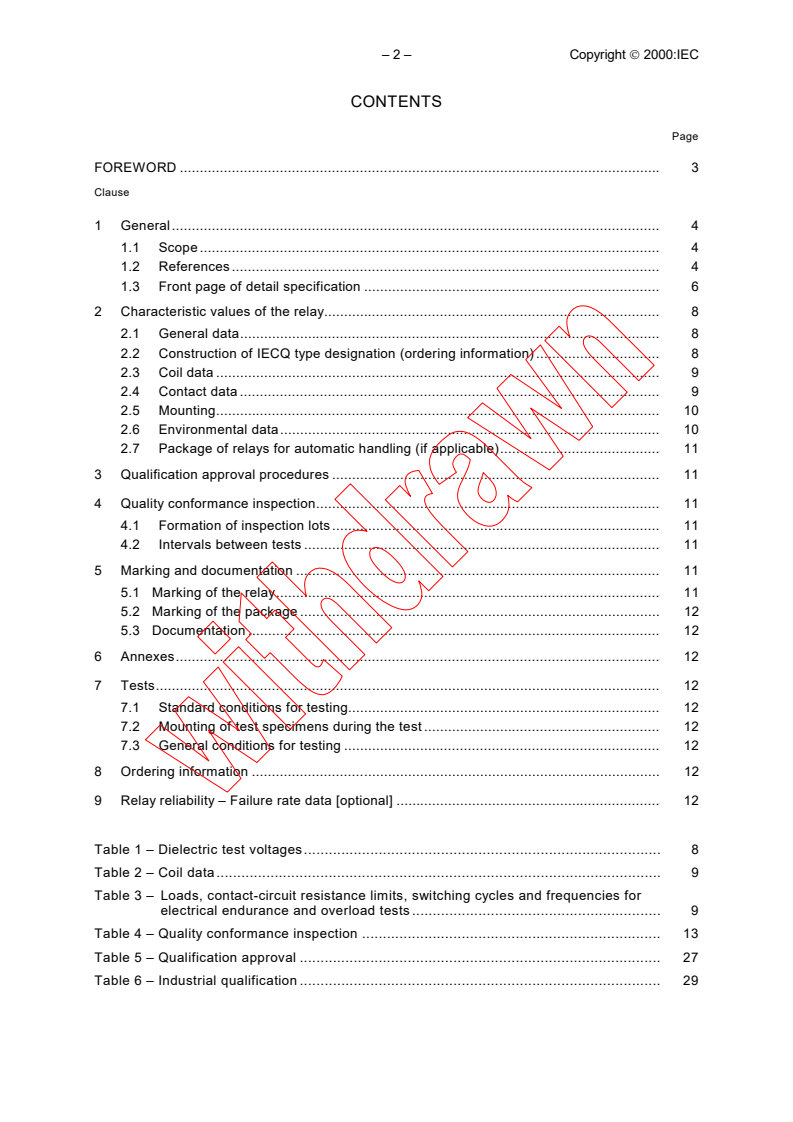
– 2 – Copyright 2000:IEC
CONTENTS
Page
FOREWORD .3
Clause
1 General. 4
1.1 Scope . 4
1.2 References . 4
1.3 Front page of detail specification . 6
2 Characteristic values of the relay. 8
2.1 General data. 8
2.2 Construction of IECQ type designation (ordering information) . 8
2.3 Coil data . 9
2.4 Contact data . 9
2.5 Mounting. 10
2.6 Environmental data. 10
2.7 Package of relays for automatic handling (if applicable). 11
3 Qualification approval procedures . 11
4 Quality conformance inspection. 11
4.1 Formation of inspection lots. 11
4.2 Intervals between tests . 11
5 Marking and documentation . 11
5.1 Marking of the relay. 11
5.2 Marking of the package . 12
5.3 Documentation . 12
6 Annexes. 12
7 Tests. 12
7.1 Standard conditions for testing. 12
7.2 Mounting of test specimens during the test . 12
7.3 General conditions for testing . 12
8 Ordering information . 12
9 Relay reliability – Failure rate data [optional] . 12
Table 1 – Dielectric test voltages. 8
Table 2 – Coil data. 9
Table 3 – Loads, contact-circuit resistance limits, switching cycles and frequencies for
electrical endurance and overload tests . 9
Table 4 – Quality conformance inspection . 13
Table 5 – Qualification approval . 27
Table 6 – Industrial qualification . 29
Copyright 2000:IEC – 3 –
INTERNATIONAL ELECTROTECHNICAL COMMISSION
____________
ELETROMECHANICAL ALL-OR-NOTHING RELAYS –
Part 55: Blank detail specification –
Electromechanical all-or-nothing telecom relays of assessed quality –
Two change-over contacts, 11 mm ×× 7,5 mm (max.) base
××
FOREWORD
A PAS is a technical specification not fulfilling the requirements for a standard, but made available to
the public.
IEC-PAS 61811-55 has been processed by IEC technical committee 94: All-or-nothing electrical relays.
The text of this PAS is based on the This PAS was approved for
following document: publication by the P-members of the
committee concerned as indicated in
the following document:
Draft PAS Report on voting
94/108/PAS 94/109/RVD
Following publication of this PAS, the technical committee or subcommittee concerned will investigate
the possibility of transforming the PAS into an International Standard.
The QC number that appears on the front cover of this publication is the specification number in the IEC
Quality Assessment System for Electronic Components (IECQ).
1) The IEC (International Electrotechnical Commission) is a worldwide organization for standardization comprising
all national electrotechnical committees (IEC National Committees). The object of the IEC is to promote
international co-operation on all questions concerning standardization in the electrical and electronic fields. To
this end and in addition to other activities, the IEC publishes International Standards. Their preparation is
entrusted to technical committees; any IEC National Committee interested in the subject dealt with may
participate in this preparatory work. International, governmental and non-governmental organizations liaising
with the IEC also participate in this preparation. The IEC collaborates closely with the International Organization
for Standardization (ISO) in accordance with conditions determined by agreement between the two
organizations.
2) The formal decisions or agreements of the IEC on technical matters express, as nearly as possible, an
international consensus of opinion on the relevant subjects since each technical committee has representation
from all interested National Committees.
3) The documents produced have the form of recommendations for international use and are published in the form
of standards, technical specifications, technical reports or guides and they are accepted by the National
Committees in that sense.
4) In order to promote international unification, IEC National Committees undertake to apply IEC International
Standards transparently to the maximum extent possible in their national and regional standards. Any
divergence between the IEC Standard and the corresponding national or regional standard shall be clearly
indicated in the latter.
5) The IEC provides no marking procedure to indicate its approval and cannot be rendered responsible for any
equipment declared to be in conformity with one of its standards.
6) Attention is drawn to the possibility that some of the elements of this PAS may be the subject of patent rights.
The IEC shall not be held responsible for identifying any or all such patent rights.
– 4 – Copyright 2000:IEC
ELECTROMECHANICAL ALL-OR-NOTHING RELAYS –
Part 55: Blank detail specification –
Electromechanical all-or-nothing telecom relays of
assessed quality –
Two change-over contacts, 11 mm × 7,5 mm (max.) base
1 General
1.1 Scope
This part of IEC 61811 is a blank detail specification applicable to electromechanical all-or-
nothing telecom relays of assessed quality. Relays according to this standard are provided for
the operation in telecommunication applications. However, as electromechanical all-or-nothing
relays they are also suitable for particular industrial and other applications.
This standard selects from IEC 61810-7 and other sources the appropriate methods of test to
be used in detail specifications derived from this specification, and contains basic test
schedules to be used in the preparation of such specifications in accordance with
IEC 61811-1.
Detailed test schedules are contained in the detail specifications supplementary to this
specification.
1.2 References
IEC 60068-1:1988, Environmental testing – Part 1: General and guidance
Amendment No. 1 (1992)
IEC 60068-2-17:1994, Environmental testing – Part 2: Tests: Test Q: Sealing
IEC 60068-2-20:1979, Environmental testing – Part 2: Tests: Test T: Soldering
Amendment No. 2 (1987)
IEC 60068-2-47:1982, Environmental testing – Part 2: Tests: Test: Mounting of components,
equipment and other articles for dynamic tests including shock (Ea), bump (Eb), vibration (Fc
and Fd) and steady-state acceleration (Ga) and guidance
IEC 60255-14:1981, Electrical relays – Part 14: Endurance test for electrical relay contacts –
Preferred values for contact loads
IEC 60695-2-2:1991, Fire hazard testing – Part 2: Test methods – Section 2: Needle-flame test
IEC 61709:1996, Electronic components – Reliability – Reference conditions for failure rates
and stress models for conversion
IEC 61810-7:1997, Electromechanical all-or-nothing relays – Part 7: Test and measurement
procedures
IEC 61811-1:1999, Electromechanical non-specified time all-or-nothing relays of assessed
quality – Part 1: Generic specification
IEC 61811-50:1997, Electromechanical all-or-nothing relays – Part 50: Sectional specification –
Electromechanical all-or-nothing telecom relays of assessed quality
Copyright 2000:IEC – 5 –
QC 001002-1:1998, IEC Quality Assessment System for Electronic Components (IECQ) –
Rules of Procedure – Part 1: Administration
QC 001002-2:1998, IEC Quality Assessment System for Electronic Components (IECQ) –
Rules of Procedure – Part 2: Documentation
QC 001002-3:1998, IEC Quality Assessment System for Electronic Components (IECQ) –
Rules of Procedure – Part 3: Approval procedures
QC 001005:1996, Register of Firms, Products and Services approved under the IECQ System,
including ISO 9000
CECC 00802:1990, Guidance document: CECC Standard method for the specification of
surface mounting components (SMDs) of assessed quality
(National authorized institutions will complete this clause by making reference to any
documents or specifications directly referred to in their national equivalent of this standard.)
– 6 – Copyright 2000:IEC
1.3 Front page of detail specification
The layout of the front page of detail specification is as follows.
(1) QC xxxxxx (2)
Issue:
Page 1 of
Electronic components of assessed (3) (4)
quality in accordance with:
IEC 61810-7: 1997
IEC 61811-1: 1999
IEC 61811-50: 200X
Detail specification for electromechanical all-or-nothing telecom relays of assessed quality,
two change-over contacts, with 11 mm x 7,5 mm (max.) base
Type: . two change-over contacts (5)
Construction: dual-in-line, with 11 mm × 7,5 mm (max.) base (6)
plastic sealed case, overall height of 6 mm max.
for assembling techniques of printed circuit boards using mounting
holes and soldering or for surface mounting technology (as applicable)
max. 11 max. 7,5
(7) Application: (8)
Relays according to this standard are provided for the
Dimensions in mm
operation in telecommunication applications. However, as
printed circuit board relays they are suitable also for
Recommended
control or switching functions in particular industrial and
pad layout other applications.
3,2 2,2 2,2
5,08
max.1 max.1
Through-hole type
max.1 max.1
max. 11 max. 7,5
3,2 2,22,2
max. 8,5
3,2 2,22,2
max.1 max.1
max. 11 max. 7,5
max.1
max.1
3,2 2,22,2
min. 2,8
3,2 2,22,2
Coplanarity of SMT leads 0,1 mm max
Surface mounting types
Monostable Latching
(Deenergized condition) (Reset condition)
1+ 2 3 4
1+ 2 3 4
8- 7 6 8- 7 6 5
Wiring diagram - Bottom view
Note – Drawings are examples ; the maximum
outer dimensions, the wiring diagram of coil
relay, the terminal arrangement and the same
orientation of all rectangular terminals are
mandatory.
Coil data (9)
Rated voltages: 1,5 . 12 V d.c.
Rated power: 140 / 100 mW
Contact data (10)
Change-over break-before-make contacts
Rated contact voltage: 120 V d.c. / 125 V a.c.
Rated contact current: 1 A max
Rated contact power: 30 W / 30 VA
Limiting continuous current: 1 A max
Component climatic category according to IEC 60068-1: 25/70/21 (11)
Temperature range – operating ambient temperature: –25 °C to +70 °C
– storage temperature: –40 °C to +85 °C
Information about manufacturers who have components qualified according to this detail specification is available in the
current QC 001005.
max. 6 max. 3,8 max. 6
max. 6
min.4
min.2,5
max. 7,5 max. 9,4
Copyright 2000:IEC – 7 –
Key to front page
The numbers between brackets of the front page correspond to the following indications which
should be given.
Identification of the detail specification
(1) The name of the national standards organization under whose authority the detail
specification is published and, if applicable, the organization from which the detail
specification is available.
(2) The IECQ symbol and the number allotted to the completed detail specification by the
IECQ secretariat.
(3) The number and the year of availability of the IEC standard concerning test and
measurement procedures for electromechanical all-or-nothing relays and/or sectional
specification; also national reference, if different.
(4) If different from the IECQ number, the national number of the detail specification, date
of issue and any further information required by the national system, together with any
amendment numbers.
Identification of the relay
(5) Type: monostable or bistable, non-polarized or polarized, two change-over contacts.
(6) Construction: sizes, e.g. dual-in-line, base and overall height, type of relay, based
upon environmental protection (RT III), mounting variants and other typical
construction details.
(7) An outline drawing with main dimensions which are of importance for
interchangeability, and/or reference to the appropriate national or international
document for outlines. Alternatively, this drawing may be given in an annex to the
detail specification, but (7) should always contain an illustration of the general outer
appearance of the component.
Location and dimensions of stand-offs (maximum relay height shall include stand-
offs), position of terminal no. 1 relative to the outside shape, acceptable offset of the
tip of a terminal relative to the nominal grid position, indication of the area on the top
of the relay housing to enable automatic mounting using aspirators, suitable hole
diameter for assembling on printed circuit board.
(8) Typical field of applications.
(9) Available rated coil voltages and rated power.
(10) Available contact arrangements, defined special contact materials and contact
voltage, current and power. The respective code digit for contact materials shall be
listed in an annex, if applicable.
(11) Component climatic category according to clause 8 and annex A of IEC 60068-1, and
temperature range.
– 8 – Copyright 2000:IEC
2 Characteristic values of the relay
2.1 General data
– Thermal resistance: max. . K/W
– Contact application: CA 0, CA 1, and CA 2
– Relay mass: max. . g
– Finish of the terminals: presoldering; admissible non-presoldered part: max. 1 mm to
the stand-off plane, if applicable
– Insulation resistance: 1000 MΩ min. at 500 V d.c. initial value
2 MΩ min. at 500 V d.c. after tests
– Dielectric strength: see table 1
Table 1 – Dielectric test voltages
Dielectric test Impulse voltage test
V a.c. min. V min. – pulse shape
Opened contact circuits 750 1 500 – 10/700 µs
Between adjacent contact circuits 1 000 1 500 – 10/700 µs
Coil to contact circuits 1 500 2 500 – 1,2/50 µs
2.2 Construction of IECQ type designation (ordering information)
Relay IECQ xxxxxx X Y 9 Z
Denomination
IECQ detail specification number
Rated coil voltage (first letter of identification code of table 2)
Rated power (second letter of identification code of table 2)
Defined, special contact material (according to annex)
Special attributes and/or surface mounting type (according to annex)
The coding of the monostable or bistable relay type shall be combined with the rated power of
the coil, if applicable. The reference to two change-over contacts shall be given on the front
page of the specification.
Use code 0 as the last digit if no special attributes apply. If one of the attributes in the example
for a detail specification shall not be considered; the corresponding code number or letter shall
be deleted; there shall be no special marks or open space for non-applicable attributes.
Copyright 2000:IEC – 9 –
2.3 Coil data
Table 2 – Coil data
Identi- Rated Coil Must not Must operate Maxi- Must not Must release Rated
fication voltage resistance operate voltage mum release voltage power
code V ohm voltage V coil voltage V mW
+ 10 % V at coil temperature voltage V at coil temperature
at coil at coil of V at coil of
tem- tempe- at tempe-
perature rature rature
of of of
(23 ± 2) °C 23 °C –25°C 23 °C 70 °C 70 °C 23 °C –25 °C 23 °C 70 °C
2.4 Contact data
2.4.1 Electrical endurance and switching frequency
Contact failure: contact-circuit resistance of a closed contact higher than the value stated in
2.4.2, or resistance of an open contact circuit lower than 100 kΩ, both more than once per 10
cycles or for the minimum number of switching cycles stated, calculated for each single
contact; or a contact fault due to non-opening with a short circuit between break and make
contact (resistance value lower than 100 Ω), i.e. one contact fault is permissible for 100 000
switching cycles and seven contact faults are permissible for 700 000 switching cycles.
Example: at a given endurance of 10 operations the total number of faults, as described
above, shall not exceed 10.
Table 3 – Loads, contact-circuit resistance limits, switching cycles and frequencies for
electrical endurance and overload tests
Loads Contact-circuit resistance Number of switching Switching frequencies
ohm max. cycles min. cycles per s max.
Contact application 0 1 1 000 000 12,5
Resistive – max. contact 1 100 000 3
voltage/max. power
Resistive – max. contact 1 100 000 3
current/max. power
DC open-ended cable 1 1 000 000 12,5
Particular application-related,
if required
Overload 1 * 100 0,3
* Unless otherwise stated in the detail specification.
2.4.2 Static contact-circuit resistance
100 mΩ max. initial value at rated voltage
1 Ω max. during/after electrical endurance, mechanical endurance and environ-
mental tests at rated voltage.
– 10 – Copyright 2000:IEC
2.4.3 Mechanical endurance
10 min. switching cycles.
2.4.4 Timing (without suppression device)
– Operate time: max. 5 ms
– Release time: max. 5 ms
– Bounce time when the contacts are closing: max. 5 ms
– Bounce time when the contacts are opening: max. 3 ms
– Transfer time on operation and release (last break contact opens
before first make contact closes respectively last make contact
opens before first break contact closes – each contact monitored): min. 0,05 ms
2.5 Mounting
The relay terminals are designed to be directly soldered onto the printed circuit board using
conventional assembling techniques or for surface mounting technology (as applicable).
2.6 Environmental data
The relays shall withstand at least the following environmental stresses:
– shock, functional: 98,1 m/s (10 g) half-sine acceleration, 11 ms duration;
– shock, survival: 981 m/s (100 g) half-sine acceleration, 0,5 ms duration;
– vibration (sinusoidal): amplitude 0,75 mm or 98,1 m/s (10 g), 10 Hz to 500 Hz;
– mechanical robustness of terminals
• thrust: 1 N;
• bending: 2 bends;
– soldering
• if particular ageing is required, this shall be selected from procedure 1a, 1b, 2 or 3
of 4.2 of IEC 60068-2-20 and stated in the detail specification;
– through hole type:
• solderability at 235 °C : 2 s;
• resistance to soldering heat, terminal immersion time at 260 °C: 5 s;
– surface mounting type:
• class A1, 6.2 of CECC 00802 (i.e. 260 °C / 5 s and 215 °C / 40 s);
• category 3, 6.2 of CECC 00802 (i.e. vapour phase soldering or infrared soldering, if
the temperature stress is adequate);
.
– enclosure leakage rate: max. 100 Pa cm /s;
– resistance to cleaning solvents when rubbed with
tissue paper
• demineralized or distilled water at 55 °C: 5 min;
– fire hazard, needle flame: min. 10 s.
Copyright 2000:IEC – 11 –
2.7 Package of relays for automatic handling (if applicable)
If stick magazines or tape and reel packaging for automatic handling (to facilitate automatic
relay insertion) are used, their outline drawing (profile and length), storage capacity and
possible marking shall be given in an annex.
3 Qualification approval procedures
– As stated in 3.1.4 a) of QC 001002-3, fixed sample.
– Sampling and test schedule are specified in table 5.
– The tests specified and their order are mandatory.
– Tests stated in table 6 are mandatory only if stated in detail specification.
4 Quality conformance inspection
Quality conformance inspection contains the tests stated in table 4:
– groups A and B: lot-by-lot tests;
– group C: periodic tests.
Unless otherwise stated in this blank detail specification, all tests of table 4 are mandatory.
Where a subgroup contains cumulative tests, the order of the tests is mandatory. Specimens
subjected to tests denoted as destructive (D) shall not be released for delivery.
NOTE If special level of AQL is required, the AQL value regarding Subgroup A4, B1 and B2 in Table 4 should be
provided between the manufacturer and user of a relay.
4.1 Formation of inspection lots
According to 3.2.3 of QC 001002-3, the basis for determination of sample size for the quality
conformance inspection is the relay quantity produced during one week.
4.2 Intervals between tests
– Subgroups A4, B1 and B2: minimum once a week.
– Subgroups C1 and C2: at least once every six months.
– Subgroups C4 to C6: at least once every two years.
5 Marking and documentation
Relays and their package shall be marked as follows.
5.1 Marking of the relay
The marking shall be durable and easily legible, the following items shall be present:
a) Manufacturer's name, logo or trade mark;
b) Relay type and variant code;
c) Coded date of manufacture, in terms of year/week according to 1.5.3 of IEC 61811-50;
d) IECQ in letters or IECQ mark of conformity;
e) IECQ type designation (ordering information) according to 2.2;
f) Identification of terminal no. 1.
NOTE IECQ type designation in Item e) may be omitted in an unavoidable case.
– 12 – Copyright 2000:IEC
5.2 Marking of the package
a) Manufacturer's name, logo or trade mark.
b) Relay type and variant code.
c) Manufacturer’s batch identification code.
d) IECQ in letters or IECQ mark of conformity.
e) IECQ type designation (ordering information) according to 2.2.
f) Detail specification reference if not marked on the relay.
g) Quantity.
5.3 Documentation
For each delivery a declaration of conformity according to QC 001002-2 shall be added.
6 Annexes
Annexes may be added if necessary, for example to show more details on relay mounting,
terminal dimensions, etc.
7 Tests
7.1 Standard conditions for testing
If not otherwise stated, all tests shall be performed under standard conditions for testing
according to 3.5 of IEC 61810-7.
7.2 Mounting of test specimens during the test
The following indications shall apply for mechanical-dynamic tests (shock and vibration): the
relay shall be mounted by its normal mounting method to the test fixture where inherent
resonances have been minimized so as not to invalidate the test (see also IEC 60068-2-47).
7.3 General conditions for testing
Unless otherwise stated, the rated coil voltage specified in table 2 and its suitable polarity (if
applicable) shall be used for all tests and its application to the relay.
8 Ordering information
See 2.2.
9 Relay reliability – Failure rate data [optional]
The evaluation and indication of reliability data is not mandatory.
However, if required in a detail specification, this optional clause shall refer to, and be in line
with, clause 5 of IEC 61811-50 and give a concise description of the methods and the set of
parameters applied. Details shall be given in an appropriate annex to the detail specification,
preferably based upon the provisions of IEC 61709 as indicated in annex A of IEC 61811-50.
Copyright 2000:IEC – 13 –
Table 4 – Quality conformance inspection
Group A
Subgroup A0
For all tests in this subgroup: 100 % test. Discard all failed relays. Tests in this subgroup
shall be carried out as a screening or sorting function, possibly
on-line, prior to the formation of lots from which samples for the
other subgroups are taken. The lot shall be rejected in case of a
failure rate of more than 10 % cumulative.
Test Test Test conditions according to Performance
no. IEC 61810-7 requirements
A0 – 1 Coil resistance (ND) Subclause 3.8.1 Values according to table 2
A0 – 2 Dielectric test (ND) Subclause 3.9 No breakdown or flashover
Application points and test voltage: according to 2.1, Maximum leakage current:
table 1 of this specification 1 mA
Duration of test: 1 s
A0 – 3 Contact-circuit Subclause 3.12 Initial value according to 2.4.2
resistance, static (ND) for each contact closing
Application points: te
...