

IEC 62329-2:2006
(Main)Heat-shrinkable moulded shapes - Part 2: Methods of test
General Information
- Abstract
IEC 62329-2:2006 gives methods of test for heat-shrinkable moulded shapes in a range of configurations and materials suitable for insulation, environmental sealing, mechanical protection and strain relief for connector/cable terminations and multi-way transitions. The tests specified are designed to control the quality of the moulded shapes but it is recognized that they do not completely establish the suitability of moulded shapes for impregnation or encapsulation processes or other specialized applications.
- Status
- Published
- Publication Date
- 09-Jul-2006
- Technical Committee
- TC 15 - Solid electrical insulating materials
- Drafting Committee
- WG 5 - TC 15/WG 5
- Current Stage
- PPUB - Publication issued
- Start Date
- 10-Jul-2006
- Completion Date
- 15-Oct-2006
Buy Documents
IEC 62329-2:2006 - Heat-shrinkable moulded shapes - Part 2: Methods of test Released:7/10/2006
IEC 62329-2:2006 - Heat-shrinkable moulded shapes - Part 2: Methods of test Released:7/10/2006
IEC 62329-2:2006 - Overview
IEC 62329-2:2006 defines the methods of test for heat-shrinkable moulded shapes used for insulation, environmental sealing, mechanical protection and strain relief at connector/cable terminations and multi‑way transitions. The standard provides standardized test procedures and specimen requirements to control the quality and performance of heat‑shrinkable moulded shapes across a range of configurations and materials. It also notes that these tests do not fully determine suitability for specialised processes such as impregnation or encapsulation.
Key topics and test methods
This part of the IEC 62329 series focuses on practical, repeatable test methods. Key technical topics include:
- Test specimen preparation and conditioning - standardized specimen forms, quantities and conditioning environments.
- Mechanical tests - tensile strength, elongation at break, secant modulus, bending at low temperature.
- Thermal tests - heat shock, heat ageing, long‑term heat ageing (3 000 h), dimensional stability on storage, colour stability to heat.
- Electrical properties - electric strength (dielectric breakdown), volume resistivity after damp heat, permittivity and dissipation factor.
- Environmental and chemical resistance - water absorption, resistance to selected fluids, compatibility specimens.
- Fire and safety tests - flammability, oxygen index, smoke index and toxicity index.
- Material characteristics - density, mass, colour fastness to light, halogen content and copper corrosion (corrosive volatiles).
- Reporting and results - procedures for test reporting and interpretation for quality control.
(These topics reflect the test list and clauses specified in the standard document.)
Practical applications and users
IEC 62329-2 is essential for organizations involved in the manufacture, testing, procurement and design of cable accessories and heat‑shrink components:
- Manufacturers - to establish production quality control and batch testing procedures.
- Test laboratories - for accredited material and component testing using standardized methods.
- OEMs & system integrators - to specify acceptance criteria for connector and harness components.
- Design and R&D engineers - to validate material selection and long‑term performance in sealed or insulated assemblies.
- Procurement and compliance teams - to verify supplier claims and ensure consistency across suppliers.
Use cases include quality assurance of heat‑shrink boots, multi‑way transitions, molded strain reliefs, and environmental seals for power, telecom, automotive and industrial cable terminations.
Related standards
- Other parts of the IEC 62329 series (general requirements and other parts) and applicable international standards for electrical insulating materials, flammability, smoke and toxicity testing.
- For complete cross‑references and normative citations consult the IEC catalogue for updates, amendments and related IEC publications.
Keywords: IEC 62329-2, heat-shrinkable moulded shapes, methods of test, heat-shrink, insulation testing, cable terminations, flammability, smoke index, tensile strength.
Relations
- Effective Date
- 25-Aug-2026
- Effective Date
- 25-Aug-2026
- Effective Date
- 25-Aug-2026
Buy Documents
IEC 62329-2:2006 - Heat-shrinkable moulded shapes - Part 2: Methods of test Released:7/10/2006
IEC 62329-2:2006 - Heat-shrinkable moulded shapes - Part 2: Methods of test Released:7/10/2006
Get Certified
Connect with accredited certification bodies for this standard

IMQ S.p.A. (Certification)
Italian electrical product certification.

SLG Prüf- und Zertifizierungs GmbH
German testing and certification body.

UL Solutions
Global safety science company with testing, inspection and certification.
Sponsored listings
Frequently Asked Questions
IEC 62329-2:2006 is a standard published by the International Electrotechnical Commission (IEC). Its full title is "Heat-shrinkable moulded shapes - Part 2: Methods of test". This standard covers: IEC 62329-2:2006 gives methods of test for heat-shrinkable moulded shapes in a range of configurations and materials suitable for insulation, environmental sealing, mechanical protection and strain relief for connector/cable terminations and multi-way transitions. The tests specified are designed to control the quality of the moulded shapes but it is recognized that they do not completely establish the suitability of moulded shapes for impregnation or encapsulation processes or other specialized applications.
IEC 62329-2:2006 gives methods of test for heat-shrinkable moulded shapes in a range of configurations and materials suitable for insulation, environmental sealing, mechanical protection and strain relief for connector/cable terminations and multi-way transitions. The tests specified are designed to control the quality of the moulded shapes but it is recognized that they do not completely establish the suitability of moulded shapes for impregnation or encapsulation processes or other specialized applications.
IEC 62329-2:2006 is classified under the following ICS (International Classification for Standards) categories: 29.035.20 - Plastics and rubber insulating materials. The ICS classification helps identify the subject area and facilitates finding related standards.
IEC 62329-2:2006 has the following relationships with other standards: It is inter standard links to EN 4840-101:2018, EN 4840-102:2019, EN 4840-001:2018. Understanding these relationships helps ensure you are using the most current and applicable version of the standard.
IEC 62329-2:2006 is available in PDF format for immediate download after purchase. The document can be added to your cart and obtained through the secure checkout process. Digital delivery ensures instant access to the complete standard document.
Standards Content (Sample)
INTERNATIONAL IEC
STANDARD 62329-2
First edition
2006-07
Heat-shrinkable moulded shapes –
Part 2:
Methods of test
Reference number
Publication numbering
As from 1 January 1997 all IEC publications are issued with a designation in the
60000 series. For example, IEC 34-1 is now referred to as IEC 60034-1.
Consolidated editions
The IEC is now publishing consolidated versions of its publications. For example,
edition numbers 1.0, 1.1 and 1.2 refer, respectively, to the base publication, the
base publication incorporating amendment 1 and the base publication incorporating
amendments 1 and 2.
Further information on IEC publications
The technical content of IEC publications is kept under constant review by the IEC,
thus ensuring that the content reflects current technology. Information relating to
this publication, including its validity, is available in the IEC Catalogue of
publications (see below) in addition to new editions, amendments and corrigenda.
Information on the subjects under consideration and work in progress undertaken
by the technical committee which has prepared this publication, as well as the list
of publications issued, is also available from the following:
• IEC Web Site (www.iec.ch)
• Catalogue of IEC publications
The on-line catalogue on the IEC web site (www.iec.ch/searchpub) enables you to
search by a variety of criteria including text searches, technical committees
and date of publication. On-line information is also available on recently issued
publications, withdrawn and replaced publications, as well as corrigenda.
• IEC Just Published
This summary of recently issued publications (www.iec.ch/online_news/ justpub)
is also available by email. Please contact the Customer Service Centre (see
below) for further information.
• Customer Service Centre
If you have any questions regarding this publication or need further assistance,
please contact the Customer Service Centre:
Email: custserv@iec.ch
Tel: +41 22 919 02 11
Fax: +41 22 919 03 00
INTERNATIONAL IEC
STANDARD 62329-2
First edition
2006-07
Heat-shrinkable moulded shapes –
Part 2:
Methods of test
IEC 2006 Copyright - all rights reserved
No part of this publication may be reproduced or utilized in any form or by any means, electronic or
mechanical, including photocopying and microfilm, without permission in writing from the publisher.
International Electrotechnical Commission, 3, rue de Varembé, PO Box 131, CH-1211 Geneva 20, Switzerland
Telephone: +41 22 919 02 11 Telefax: +41 22 919 03 00 E-mail: inmail@iec.ch Web: www.iec.ch
PRICE CODE
Commission Electrotechnique Internationale X
International Electrotechnical Commission
МеждународнаяЭлектротехническаяКомиссия
For price, see current catalogue
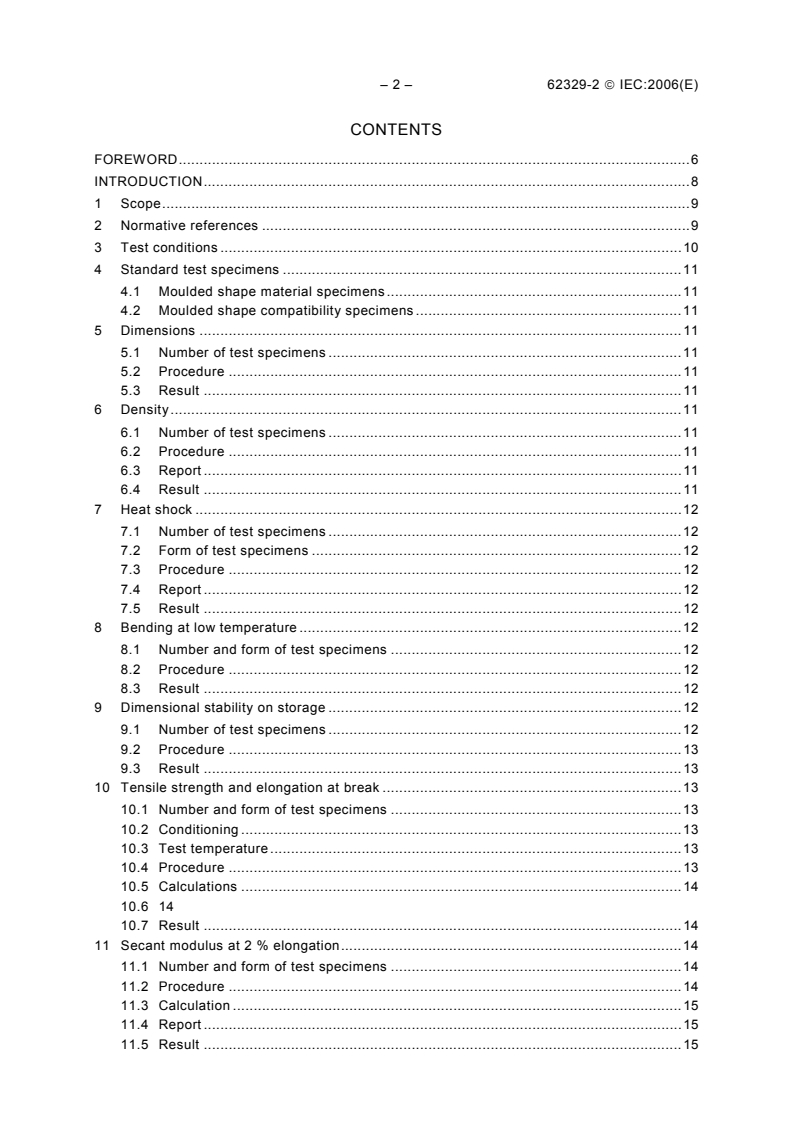
– 2 – 62329-2 © IEC:2006(E)
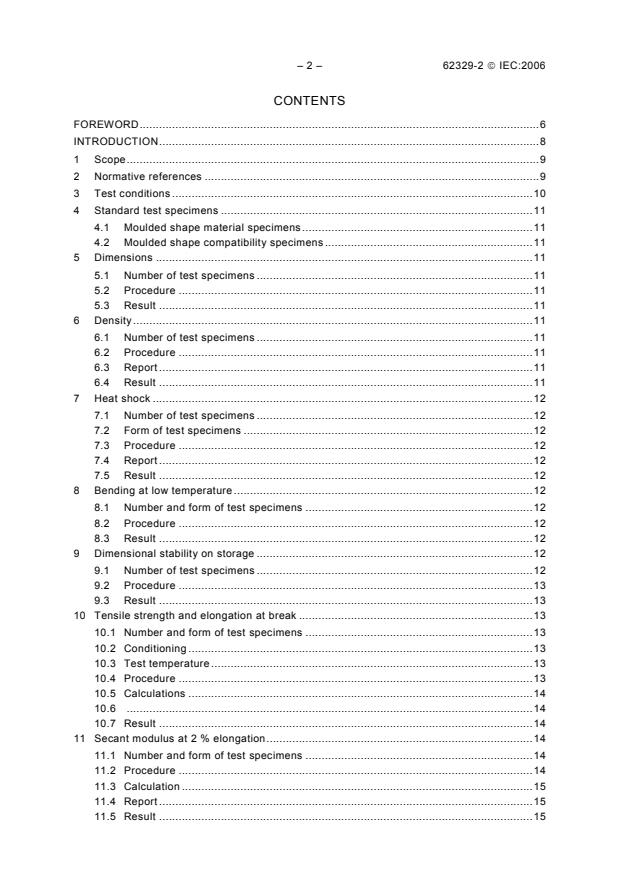
CONTENTS
FOREWORD.6
INTRODUCTION.8
1 Scope.9
2 Normative references .9
3 Test conditions .10
4 Standard test specimens .11
4.1 Moulded shape material specimens.11
4.2 Moulded shape compatibility specimens .11
5 Dimensions .11
5.1 Number of test specimens .11
5.2 Procedure .11
5.3 Result .11
6 Density.11
6.1 Number of test specimens .11
6.2 Procedure .11
6.3 Report .11
6.4 Result .11
7 Heat shock .12
7.1 Number of test specimens .12
7.2 Form of test specimens .12
7.3 Procedure .12
7.4 Report .12
7.5 Result .12
8 Bending at low temperature .12
8.1 Number and form of test specimens .12
8.2 Procedure .12
8.3 Result .12
9 Dimensional stability on storage .12
9.1 Number of test specimens .12
9.2 Procedure .13
9.3 Result .13
10 Tensile strength and elongation at break .13
10.1 Number and form of test specimens .13
10.2 Conditioning .13
10.3 Test temperature.13
10.4 Procedure .13
10.5 Calculations .14
10.6 14
10.7 Result .14
11 Secant modulus at 2 % elongation.14
11.1 Number and form of test specimens .14
11.2 Procedure .14
11.3 Calculation .15
11.4 Report .15
11.5 Result .15
62329-2 © IEC:2006(E) – 3 –
12 Electric strength .15
12.1 Number and form of test specimens .15
12.2 Conditioning .15
12.3 Electrodes .15
12.4 Procedure .15
12.5 Result .15
12.6 Result .16
13 Volume resistivity after damp heat.16
13.1 Number and form of test specimens .16
13.2 Electrodes .16
13.3 Procedure .16
13.4 Result .16
14 Permittivity and dissipation factor .16
14.1 Number and form of test specimens. .16
14.2 Electrodes .16
14.3 Procedure .16
14.4 Calculation .16
14.5 Result .16
15 Resistance to tracking .17
15.1 Report .17
15.2 Result .17
16 Flammability.17
16.1 Number and form of test specimens .17
16.2 Procedure .17
16.3 Result .17
17 Oxygen index .17
17.1 Oxygen index at ambient temperature .17
17.2 Oxygen index at elevated temperature .17
18 Copper corrosion (presence of corrosive volatiles) .17
18.1 Principle.17
18.2 Apparatus.18
18.3 Number and form of test specimens .18
18.4 Procedure .18
18.5 Report .18
18.6 Result .18
19 Colour fastness to light.19
19.1 Principle.19
19.2 Test specimen.19
19.3 Procedure .19
19.4 Result .19
20 Resistance to selected fluids .19
20.1 Principle.19
20.2 Choice of fluid .19
20.3 Methods of assessment.19
20.4 Number and form of test specimens .20
20.5 Procedure .20
20.6 Result .20
– 4 – 62329-2 © IEC:2006(E)
21 Long term heat ageing (3000 h).20
21.1 Number and form of test specimens .20
21.2 Procedure .20
21.3 Report .21
21.4 Result .21
22 Mass .21
22.1 Number of test specimens .21
22.2 Procedure .21
22.3 Result .21
23 Heat ageing.21
23.1 Number and form of test specimens .21
23.2 Procedure .21
24 Water absorption .21
25 Colour stability to heat.21
25.1 Number of test specimens .21
25.2 Form of test specimens .21
25.3 Procedure .22
25.4 Report .22
25.5 Result .22
26 Smoke index.22
26.1 Definitions .22
26.2 Principle.22
26.3 Apparatus.22
26.4 Number and form of test specimen .23
26.5 Conditioning .23
26.6 Mounting of test pieces .23
26.7 Safety of operations .23
26.8 Procedure .23
26.9 Calculation of results.24
27 Toxicity index .26
27.1 Definition.26
27.2 Principle.27
27.3 Apparatus.27
27.4 Conditioning .28
27.5 Safety of operations .28
27.6 Test procedure .28
27.7 Calculation of toxicity index .30
27.8 Toxic constituents .30
27.9 Values for C .31
f
27.10 Result and report.31
28 Halogen content .31
28.1 Method for the determination of low levels of chlorine and/or bromine and/or
iodine .31
28.2 Determination of low levels of fluorine .32
29 Acid gas generation.33
30 Resistance to mould growth.33
62329-2 © IEC:2006(E) – 5 –
31 Compatibility .34
31.1 Dynamic shear at room temperature.34
31.2 Static load .34
31.3 Fluid resistance.35
31.4 Thermal ageing .36
31.5 Peel adhesion .36
31.6 Altitude immersion.37
Bibliography.47
Figure 1 – Dumb-bell specimen for tensile strength test.39
Figure 2 – Schematic details of burner for smoke index test.40
Figure 3 – Compatibility test specimen.41
Figure 4 – Aluminium test adaptor .42
Figure 5 – Tensile test fixture for adaptor.42
Figure 6 – Test arrangement for dynamic shear .43
Figure 7 – Test arrangement for static load.44
Figure 8 – Test assembly for peel adhesion .44
Figure 9 – Test arrangement for heatshrink sleeved cable to moulded shape.45
Figure 10 – Test arrangement for aluminium adaptor to moulded shape.46
– 6 – 62329-2 © IEC:2006(E)
INTERNATIONAL ELECTROTECHNICAL COMMISSION
____________
HEAT-SHRINKABLE MOULDED SHAPES –
Part 2: Methods of test
FOREWORD
1) The International Electrotechnical Commission (IEC) is a worldwide organization for standardization comprising all
national electrotechnical committees (IEC National Committees). The object of IEC is to promote international co-
operation on all questions concerning standardization in the electrical and electronic fields. To this end and in
addition to other activities, IEC publishes International Standards, Technical Specifications, Technical Reports,
Publicly Available Specifications (PAS) and Guides (hereafter referred to as “IEC Publication(s)”). Their preparation
is entrusted to technical committees; any IEC National Committee interested in the subject dealt with may
participate in this preparatory work. International, governmental and non-governmental organizations liaising with
the IEC also participate in this preparation. IEC collaborates closely with the International Organization for
Standardization (ISO) in accordance with conditions determined by agreement between the two organizations.
2) The formal decisions or agreements of IEC on technical matters express, as nearly as possible, an international
consensus of opinion on the relevant subjects since each technical committee has representation from all interested
IEC National Committees.
3) IEC Publications have the form of recommendations for international use and are accepted by IEC National
Committees in that sense. While all reasonable efforts are made to ensure that the technical content of IEC
Publications is accurate, IEC cannot be held responsible for the way in which they are used or for any
misinterpretation by any end user.
4) In order to promote international uniformity, IEC National Committees undertake to apply IEC Publications
transparently to the maximum extent possible in their national and regional publications. Any divergence between
any IEC Publication and the corresponding national or regional publication shall be clearly indicated in the latter.
5) IEC provides no marking procedure to indicate its approval and cannot be rendered responsible for any equipment
declared to be in conformity with an IEC Publication.
6) All users should ensure that they have the latest edition of this publication.
7) No liability shall attach to IEC or its directors, employees, servants or agents including individual experts and
members of its technical committees and IEC National Committees for any personal injury, property damage or
other damage of any nature whatsoever, whether direct or indirect, or for costs (including legal fees) and expenses
arising out of the publication, use of, or reliance upon, this IEC Publication or any other IEC Publications.
8) Attention is drawn to the Normative references cited in this publication. Use of the referenced publications is
indispensable for the correct application of this publication.
9) Attention is drawn to the possibility that some of the elements of this IEC Publication may be the subject of patent
rights. IEC shall not be held responsible for identifying any or all such patent rights.
International Standard IEC 62329-2 has been prepared by IEC technical committee 15: Standards
on specifications for electrical insulating materials.
The text of this standard is based on the following documents:
FDIS Report on voting
15/316/FDIS 15/338/RVD
Full information on the voting for the approval of this standard can be found in the report on
voting indicated in the above table.
This publication has been drafted in accordance with the ISO/IEC Directives, Part 2.
62329-2 © IEC:2006(E) – 7 –
The committee has decided that the contents of this publication will remain unchanged until the
maintenance result date indicated on the IEC web site under "http://webstore.iec.ch" in the data
related to the specific publication. At this date, the publication will be
• reconfirmed,
• withdrawn,
• replaced by a revised edition, or
• amended.
A bilingual version of this publication may be issued at a later date.
– 8 – 62329-2 © IEC:2006(E)
INTRODUCTION
This International Standard is one of a series which deals with heat-shrinkable moulded shapes.
The series consists of the following parts:
Part 1: Definitions and general requirements (IEC 62329-1)
Part 2: Methods of test (IEC 62329-2)
Part 3: Specification requirements for shape dimensions, material requirements and
compatibility performance (IEC 62329-3) (in consideration)
62329-2 © IEC:2006(E) – 9 –
HEAT-SHRINKABLE MOULDED SHAPES –
Part 2: Methods of test
1 Scope
This part of IEC 62329 gives methods of test for heat-shrinkable moulded shapes in a range of
configurations and materials suitable for insulation, environmental sealing, mechanical protection
and strain relief for connector/cable terminations and multi-way transitions.
The tests specified are designed to control the quality of the moulded shapes but it is recognized
that they do not completely establish the suitability of moulded shapes for impregnation or
encapsulation processes or other specialized applications. Where necessary, the test methods in
this Part will need to be supplemented by appropriate impregnation or compatibility tests to suit
the individual circumstances.
2 Normative references
The following referenced documents are indispensable for the application of this document. For
dated references, only the edition cited applies. For undated references, the latest edition of the
referenced document (including any amendments) applies.
IEC 60093:1980, Methods of test for volume resistivity and surface resistivity of solid electrical
insulating materials
IEC 60212:1971, Standard conditions for use prior to and during the testing of solid electrical
insulating materials
IEC 60216-4-1:2006, Electrical insulating materials –Thermal endurance properties – Part 4-1:
Ageing ovens – Single-chamber ovens
IEC 60216-4-2:2000, Electrical insulating materials – Thermal endurance properties – Part 4-2:
Ageing ovens – Precision ovens for use up to 300 °C
IEC 60243-1:1998, Electric strength of insulating materials – Test methods – Part 1: Tests at
power frequencies
IEC 60250:1969, Recommended methods for the determination of the permittivity and dielectric
dissipation factor of electrical insulating materials at power, audio and radio frequencies including
metre wavelengths
IEC 60587:1984, Test methods for evaluating resistance to tracking and erosion of electrical
insulating materials used under severe ambient conditions
IEC 60695-6-30:1996, Fire hazard testing – Part 6: Guidance and test methods on the
assessment of obscuration hazards of vision caused by smoke opacity from electrotechnical
products involved in fires – Section 30: Small scale static method. Determination of smoke
opacity. Description of the apparatus
IEC 60695-11-10:1999, Fire hazard testing – Part 11-10: Test flames – 50 W horizontal and
vertical flame test methods
– 10 – 62329-2 © IEC:2006(E)
IEC 60754-1:1994, Test on gases evolved during combustion of materials from cables – Part 1:
Determination of the amount of halogen acid gas
IEC 60754-2:1991, Test on gases evolved during combustion of materials from cables – Part 2:
Determination of degree of acidity of gases evolved during the combustion of materials taken
from electric cables by measuring pH and conductivity
IEC 62329-1:2005, Heat shrinkable moulded shapes – Part 1: Definitions and general
requirements
ISO 62:1999, Plastics – Determination of water absorption
ISO 105-A02:1993, Textiles – Tests for colour fastness – Part A02: Grey scale for assessing
changes in colour
ISO 105-B01:1994, Textiles – Tests for colour fastness – Part B01: Colour fastness to light:
Daylight
ISO 846:1997, Plastics – Evaluation of the action of micro-organisms
ISO 32611975, Fire tests – Vocabulary
ISO 4589-2:1996, Plastics – Determination of burning behaviour by oxygen index – Part 2:
Ambient-temperature test
ISO 4589-3:1996, Plastics – Determination of burning behaviour by oxygen index – Part 3:
Elevated-temperature test
3 Test conditions
Unless otherwise specified, all tests shall be made under standard ambient conditions according
to IEC 60212; i.e. at a temperature between 15 °C and 35 °C and at ambient relative humidity.
In cases of dispute, the tests shall be carried out at a temperature of 23 °C ± 2 K and at
(50 ± 5) % relative humidity.
When heating at elevated temperature is specified for a test procedure, the specimen shall
be maintained for the prescribed period in a uniformly heated oven complying with either
IEC 60216-4-1 or IEC 60216-4-2.
Where a test at low temperature is specified, the specification sheets of IEC 62329-3 may require
it to be carried out at t °C or lower, where t is the requested temperature. In such cases the
operator may carry out the test at the specified temperature or any lower temperature which is
convenient. If, however, at a temperature below that specified, the specimen fails to meet the
requirements, the test shall be repeated at the specified temperature, subject to a tolerance of
±3 K as specified in IEC 60212. If the specimen then passes, it shall be considered to have met
the requirements.
___________
This standard has been withdrawn.
62329-2 © IEC:2006(E) – 11 –
4 Standard test specimens
4.1 Moulded shape material specimens
Moulded shape material specimens shall be prepared from (2 ± 0,15) mm thick sheets, unless
otherwise specified, and shall be prepared from the same heat-shrinkable material that is to be
used to manufacture the heat-shrinkable moulded shapes. The dimensions of the sheet shall be
sufficient to enable any of the relevant tests to be performed.
NOTE A suitable size has been found to be 150 mm x 150 mm.
4.2 Moulded shape compatibility specimens
See IEC 62329-1, Subclause 4.2, and Clause 31 of this standard.
5 Dimensions
5.1 Number of test specimens
Three specimens of each size and style shall be tested.
5.2 Procedure
Measure the moulded shapes in the as supplied condition and after unrestricted shrinkage as
specified in IEC 62329-3. Carry out unrestricted shrinkage by conditioning in an oven for the time
and temperature specified in IEC 62329-3. Remove the shapes from the oven and allow to cool
naturally to the ambient temperature specified in Clause 3. The method of measurement can be
mechanical, or optical. Wall thickness shall be measured to an accuracy of ±0,05 mm and internal
diameter to an accuracy of ±0,25 mm. In the case of dispute an optical method shall be used.
5.3 Result
Report all measured values as the result.
6 Density
6.1 Number of test specimens
At least three specimens shall be tested, cut from a test sheet in accordance with 4.1.
6.2 Procedure
Any method for the determination of the density may be used which can ensure an accuracy of
±0,01 g/cm .
6.3 Report
Record the method selected for the determination and report all measured values for density
6.4 Result
The result is the mean, unless specified otherwise in the specification sheets of IEC 62329-3.
– 12 – 62329-2 © IEC:2006(E)
7 Heat shock
7.1 Number of test specimens
Three specimens shall be tested.
7.2 Form of test specimens
Cut three specimens in accordance with Clause 10, from a test sheet in accordance with 4.1.
7.3 Procedure
The specimens shall be suspended vertically in an oven for 4 h ± 10 min at the temperature
specified in IEC 62329-3.
The specimens shall be removed and allowed to cool to room temperature. They shall then be
visually examined for any signs of dripping, cracking or flowing. In addition, when so specified in
IEC 62329-3 the specimens shall be tested for tensile strength and elongation at break.
7.4 Report
Report all results from the visual examination. Report all calculated values.
7.5 Result
The results for each property is the central value unless otherwise specified in the specification
sheets of IEC 62329-3.
8 Bending at low temperature
8.1 Number and form of test specimens
Cut three specimens from a test sheet in accordance with 4.1 approximately 150 mm × 6 mm.
8.2 Procedure
The specimens shall be suspended for 4 h ± 10 min in a chamber maintained at the temperature
specified in IEC 62329-3. While still at that temperature, they shall be wound without jerking for
one complete turn in a close helix round a mandrel also at the same temperature and having a
diameter specified in IEC 62329-3. The time to achieve one complete turn shall not be greater
than 5 s. The specimens shall then be allowed to return to room temperature.
The specimens shall then be visually examined without magnification while still on the mandrel for
signs of cracking.
8.3 Result
Report whether there is any cracking.
9 Dimensional stability on storage
9.1 Number of test specimens
Three shapes shall be tested.
62329-2 © IEC:2006(E) – 13 –
9.2 Procedure
The internal diameter of each outlet shall be measured in the expanded state as delivered. The
shapes shall then be stored in a ventilated oven as detailed in Clause 3 for (336 ± 2) h at a
temperature of 40 °C ± 3 K unless otherwise specified in the relevant sheet of IEC 62329-3. They
shall then be removed from the oven, allowed to cool to ambient temperature and the same
dimensions re-measured. The accuracy of measurement shall be in accordance with Clause 5.
Following this measurement, the shapes shall be allowed to fully recover, using the time and
temperature specified in IEC 62329-3 for the shapes being evaluated. The shapes shall then be
cooled to ambient temperature and the recovered dimensions measured.
9.3 Result
Report, as the result, all measured values for each of the three sets of measurements: expanded
dimensions before and after storage at elevated temperature, and fully recovered dimensions
after storage at elevated temperature.
10 Tensile strength and elongation at break
10.1 Number and form of test specimens
Cut five dumb-bell specimens from a test sheet in accordance with 4.1 to the dimensions and
tolerances given in Figure 1. The specimens shall be stamped from the sheet using a single
stroke of a press and a knife edge punch of appropriate form and dimensions.
NOTE The profile given in Figure 1 is that of type 2 of ISO 37.
10.2 Conditioning
Unless otherwise specified in IEC 62329-3, the test specimens shall be kept at an ambient
temperature of 23 °C ± 2 K for at least 1 h before testing, or for a longer time to enable the
specimens to reach a temperature of 23 °C ± 2 K.
10.3 Test temperature
The test shall be made at a temperature of 23 °C ± 2 K.
10.4 Procedure
The width and thickness of the central parallel portion of the specimen shall be measured
between the gauge marks to the nearest 0,01 mm at a minimum of three points. The average
cross-sectional area is then determined.
The specimen shall be mounted in the tensile test machine in axial alignment with the direction of
pull. The jaws shall be separated at the uniform rate specified in IEC 62329-3 for a particular
material. The range of the testing machine shall be such that the maximum load is between 15 %
and 85 % of the maximum scale reading.
The distance between the reference lines at break may conveniently be measured by means of a
rule, callipers or an extensometer.
The maximum load shall be measured to an accuracy of 2 %. The distance between the reference
lines at break shall be measured to within 2 mm.
If the test specimen breaks outside the reference lines the result shall be discarded and a further
test made using another specimen.
– 14 – 62329-2 © IEC:2006(E)
10.5 Calculations
The tensile strength shall be calculated from the maximum load and the original area of cross-
section and the result expressed in megapascals (MPa):
F
max
tensile strength = (MPa)
A
where
F is the maximum load (N);
max
A is the original cross-sectional area (mm ).
The elongation at break shall be expressed as a percentage of the original distance between the
reference lines, i.e.:
()L − L
o
elongation at break (%) = × 100
L
o
where
L is the measured distance between the two marks on the stretched specimen at break;
L is the original distance between the marks.
o
10.6
Report all calculated values.
10.7 Result
The results for each property is the central value unless otherwise specified in the specification
sheets of IEC 62329-3.
11 Secant modulus at 2 % elongation
11.1 Number and form of test specimens
Perform three tests on strips cut from a test sheet in accordance with 4.1. The width of the strips
shall be approximately 20 mm.
11.2 Procedure
a) The secant modulus shall be calculated from the determination of the tensile stress necessary
to produce in the specimen an extension of 2 % of the length between jaws or between
reference lines.
b) Depending on the method of measurement chosen, the length of specimen between the jaws
or reference lines shall be not less than 100 mm.
c) The extension may be measured by means of an extensometer or by jaw separation; the
extension shall be measured to an accuracy of 2 %.
d) The strain rate shall be (0,1 ± 0,03) mm/min for each millimetre length between jaws (e.g.
12 mm/min for a 120 mm length between jaws).
e) An initial tensile force (F) may need to be applied to the specimen for the purpose of
straightening it. This force shall not exceed 3 % of the final value.
f) The force shall be increased until the extension between the jaws or reference lines reaches
2 %. The force (F ) required to produce this extension shall be recorded.
62329-2 © IEC:2006(E) – 15 –
11.3 Calculation
The secant modulus of the specimen shall be calculated as follows:
F − F
(MPa)
2 % secant modulus =
0,02A
where
A is the initial average cross-sectional area of the specimen (mm ) (determined as specified
in 10.4);
F is the force required to produce a 2 % extension (N);
F is the force applied to produce the initial (straightening) stress (N).
11.4 Report
Report all measured values for secant modulus at 2 % elongation.
11.5 Result
The result is the central value unless specified otherwise in the specification sheets of
IEC 62329-3.
12 Electric strength
12.1 Number and form of test specimens
Three specimens shall be tested using standard test sheets in accordance with 4.1.
12.2 Conditioning
In case of doubt or dispute, these tests shall be made on specimens which have been conditioned
by exposure for not less than 24 h to an atmosphere of (50 ± 5) % relative humidity at a
temperature of 23 °C ± 2 K.
12.3 Electrodes
The electrodes shall be in accordance with IEC 60243-1, unequal diameter electrodes for sheet
materials.
12.4 Procedure
The electrodes shall be placed in the centre of the test sheet as described in IEC 60243-1 and
the assembly placed in transformer oil.
The voltage used shall be in accordance with IEC 60243-1 applied between the two electrodes at
a uniform rate from zero, such that breakdown occurs between 10 s and 20 s.
Calculate the electric strength by dividing the voltage at which breakdown occurs by the thickness
of the test sheet. Express the result in MV/m.
12.5 Result
Report all values.
– 16 – 62329-2 © IEC:2006(E)
12.6 Result
The result is the central value, unless otherwise specified in the specification sheets of
IEC 62329-3.
13 Volume resistivity after damp heat
13.1 Number and form of test specimens
Three specimens shall be tested using test sheets in accordance with 4.1.
13.2 Electrodes
The electrodes shall be conductive silver paint in accordance with IEC 60093 for flat specimens
using a guard ring.
13.3 Procedure
Expose the specimens for four days to damp-warm conditions as specified in IEC 60212 (i.e. 96 h
at 40 °C and 93 % relative humidity). While still at these conditions measure the resistance in
accordance with IEC 60093 using (500 ± 15) V d.c. and an electrification time of at least 1 min.
Calculate the volume resistivity in accordance with IEC 60093.
13.4 Result
The result is the central value.
14 Permittivity and dissipation factor
14.1 Number and form of test specimens.
One test sheet in accordance with 4.1.
14.2 Electrodes
The electrodes shall be in accordance with IEC 60250, disk electrodes with a guard ring.
The electrodes may be either metal foil or conductive paint as described in IEC 60250.
14.3 Procedure
The temperature of test shall be 23 °C ± 2 K.
The measurement of permittivity shall be made with a suitable instrument complying with
IEC 60250 and at a frequency of approximately 1000 Hz. The low-voltage lead shall be connected
to the guarded electrode.
14.4 Calculation
The relative permittivity and dissipation factor shall be calculated in accordance with IEC 60250.
14.5 Result
Report the value for relative permittivity and dissipation factor as the result.
62329-2
...
IEC 62329-2 ®
Edition 1.0 2006-07
INTERNATIONAL
STANDARD
NORME
INTERNATIONALE
Heat-shrinkable moulded shapes –
Part 2: Methods of test
Profilés thermorétractables –
Partie 2: Méthodes d’essai
All rights reserved. Unless otherwise specified, no part of this publication may be reproduced or utilized in any form or by
any means, electronic or mechanical, including photocopying and microfilm, without permission in writing from either IEC or
IEC's member National Committee in the country of the requester.
If you have any questions about IEC copyright or have an enquiry about obtaining additional rights to this publication,
please contact the address below or your local IEC member National Committee for further information.
Droits de reproduction réservés. Sauf indication contraire, aucune partie de cette publication ne peut être reproduite
ni utilisée sous quelque forme que ce soit et par aucun procédé, électronique ou mécanique, y compris la photocopie
et les microfilms, sans l'accord écrit de la CEI ou du Comité national de la CEI du pays du demandeur.
Si vous avez des questions sur le copyright de la CEI ou si vous désirez obtenir des droits supplémentaires sur cette
publication, utilisez les coordonnées ci-après ou contactez le Comité national de la CEI de votre pays de résidence.
IEC Central Office
3, rue de Varembé
CH-1211 Geneva 20
Switzerland
Email: inmail@iec.ch
Web: www.iec.ch
About the IEC
The International Electrotechnical Commission (IEC) is the leading global organization that prepares and publishes
International Standards for all electrical, electronic and related technologies.
About IEC publications
The technical content of IEC publications is kept under constant review by the IEC. Please make sure that you have the
latest edition, a corrigenda or an amendment might have been published.
ƒ Catalogue of IEC publications: www.iec.ch/searchpub
The IEC on-line Catalogue enables you to search by a variety of criteria (reference number, text, technical committee,…).
It also gives information on projects, withdrawn and replaced publications.
ƒ IEC Just Published: www.iec.ch/online_news/justpub
Stay up to date on all new IEC publications. Just Published details twice a month all new publications released. Available
on-line and also by email.
ƒ Electropedia: www.electropedia.org
The world's leading online dictionary of electronic and electrical terms containing more than 20 000 terms and definitions
in English and French, with equivalent terms in additional languages. Also known as the International Electrotechnical
Vocabulary online.
ƒ Customer Service Centre: www.iec.ch/webstore/custserv
If you wish to give us your feedback on this publication or need further assistance, please visit the Customer Service
Centre FAQ or contact us:
Email: csc@iec.ch
Tel.: +41 22 919 02 11
Fax: +41 22 919 03 00
A propos de la CEI
La Commission Electrotechnique Internationale (CEI) est la première organisation mondiale qui élabore et publie des
normes internationales pour tout ce qui a trait à l'électricité, à l'électronique et aux technologies apparentées.
A propos des publications CEI
Le contenu technique des publications de la CEI est constamment revu. Veuillez vous assurer que vous possédez
l’édition la plus récente, un corrigendum ou amendement peut avoir été publié.
ƒ Catalogue des publications de la CEI: www.iec.ch/searchpub/cur_fut-f.htm
Le Catalogue en-ligne de la CEI vous permet d’effectuer des recherches en utilisant différents critères (numéro de référence,
texte, comité d’études,…). Il donne aussi des informations sur les projets et les publications retirées ou remplacées.
ƒ Just Published CEI: www.iec.ch/online_news/justpub
Restez informé sur les nouvelles publications de la CEI. Just Published détaille deux fois par mois les nouvelles
publications parues. Disponible en-ligne et aussi par email.
ƒ Electropedia: www.electropedia.org
Le premier dictionnaire en ligne au monde de termes électroniques et électriques. Il contient plus de 20 000 termes et
définitions en anglais et en français, ainsi que les termes équivalents dans les langues additionnelles. Egalement appelé
Vocabulaire Electrotechnique International en ligne.
ƒ Service Clients: www.iec.ch/webstore/custserv/custserv_entry-f.htm
Si vous désirez nous donner des commentaires sur cette publication ou si vous avez des questions, visitez le FAQ du
Service clients ou contactez-nous:
Email: csc@iec.ch
Tél.: +41 22 919 02 11
Fax: +41 22 919 03 00
IEC 62329-2 ®
Edition 1.0 2006-07
INTERNATIONAL
STANDARD
NORME
INTERNATIONALE
Heat-shrinkable moulded shapes –
Part 2: Methods of test
Profilés thermorétractables –
Partie 2: Méthodes d’essai
INTERNATIONAL
ELECTROTECHNICAL
COMMISSION
COMMISSION
ELECTROTECHNIQUE
PRICE CODE
INTERNATIONALE
X
CODE PRIX
ICS 29.035.20 ISBN 978-2-88910-673-8
– 2 – 62329-2 © IEC:2006
CONTENTS
FOREWORD.6
INTRODUCTION.8
1 Scope.9
2 Normative references .9
3 Test conditions .10
4 Standard test specimens .11
4.1 Moulded shape material specimens.11
4.2 Moulded shape compatibility specimens .11
5 Dimensions .11
5.1 Number of test specimens .11
5.2 Procedure .11
5.3 Result .11
6 Density.11
6.1 Number of test specimens .11
6.2 Procedure .11
6.3 Report .11
6.4 Result .11
7 Heat shock .12
7.1 Number of test specimens .12
7.2 Form of test specimens .12
7.3 Procedure .12
7.4 Report .12
7.5 Result .12
8 Bending at low temperature .12
8.1 Number and form of test specimens .12
8.2 Procedure .12
8.3 Result .12
9 Dimensional stability on storage .12
9.1 Number of test specimens .12
9.2 Procedure .13
9.3 Result .13
10 Tensile strength and elongation at break .13
10.1 Number and form of test specimens .13
10.2 Conditioning .13
10.3 Test temperature.13
10.4 Procedure .13
10.5 Calculations .14
10.6 .14
10.7 Result .14
11 Secant modulus at 2 % elongation.14
11.1 Number and form of test specimens .14
11.2 Procedure .14
11.3 Calculation .15
11.4 Report .15
11.5 Result .15
62329-2 © IEC:2006 – 3 –
12 Electric strength .15
12.1 Number and form of test specimens .15
12.2 Conditioning .15
12.3 Electrodes .15
12.4 Procedure .15
12.5 Result .15
12.6 Result .16
13 Volume resistivity after damp heat.16
13.1 Number and form of test specimens .16
13.2 Electrodes .16
13.3 Procedure .16
13.4 Result .16
14 Permittivity and dissipation factor .16
14.1 Number and form of test specimens. .16
14.2 Electrodes .16
14.3 Procedure .16
14.4 Calculation .16
14.5 Result .16
15 Resistance to tracking .17
15.1 Report .17
15.2 Result .17
16 Flammability.17
16.1 Number and form of test specimens .17
16.2 Procedure .17
16.3 Result .17
17 Oxygen index .17
17.1 Oxygen index at ambient temperature .17
17.2 Oxygen index at elevated temperature .17
18 Copper corrosion (presence of corrosive volatiles) .17
18.1 Principle.17
18.2 Apparatus.18
18.3 Number and form of test specimens .18
18.4 Procedure .18
18.5 Report .18
18.6 Result .18
19 Colour fastness to light.19
19.1 Principle.19
19.2 Test specimen.19
19.3 Procedure .19
19.4 Result .19
20 Resistance to selected fluids .19
20.1 Principle.19
20.2 Choice of fluid .19
20.3 Methods of assessment.19
20.4 Number and form of test specimens .20
20.5 Procedure .20
20.6 Result .20
– 4 – 62329-2 © IEC:2006
21 Long term heat ageing (3000 h).20
21.1 Number and form of test specimens .20
21.2 Procedure .20
21.3 Report .21
21.4 Result .21
22 Mass .21
22.1 Number of test specimens .21
22.2 Procedure .21
22.3 Result .21
23 Heat ageing.21
23.1 Number and form of test specimens .21
23.2 Procedure .21
24 Water absorption .21
25 Colour stability to heat.21
25.1 Number of test specimens .21
25.2 Form of test specimens .21
25.3 Procedure .22
25.4 Report .22
25.5 Result .22
26 Smoke index.22
26.1 Definitions .22
26.2 Principle.22
26.3 Apparatus.22
26.4 Number and form of test specimen .23
26.5 Conditioning .23
26.6 Mounting of test pieces .23
26.7 Safety of operations .23
26.8 Procedure .23
26.9 Calculation of results.24
27 Toxicity index .26
27.1 Definition.26
27.2 Principle.27
27.3 Apparatus.27
27.4 Conditioning .28
27.5 Safety of operations .28
27.6 Test procedure .28
27.7 Calculation of toxicity index .30
27.8 Toxic constituents .30
27.9 Values for C .31
f
27.10 Result and report.31
28 Halogen content .31
28.1 Method for the determination of low levels of chlorine and/or bromine and/or
iodine .31
28.2 Determination of low levels of fluorine .32
29 Acid gas generation.33
30 Resistance to mould growth.33
62329-2 © IEC:2006 – 5 –
31 Compatibility .34
31.1 Dynamic shear at room temperature.34
31.2 Static load .34
31.3 Fluid resistance.35
31.4 Thermal ageing .36
31.5 Peel adhesion .36
31.6 Altitude immersion.37
Bibliography.47
Figure 1 – Dumb-bell specimen for tensile strength test.39
Figure 2 – Schematic details of burner for smoke index test.40
Figure 3 – Compatibility test specimen.41
Figure 4 – Aluminium test adaptor .42
Figure 5 – Tensile test fixture for adaptor.42
Figure 6 – Test arrangement for dynamic shear .43
Figure 7 – Test arrangement for static load.44
Figure 8 – Test assembly for peel adhesion .44
Figure 9 – Test arrangement for heatshrink sleeved cable to moulded shape.45
Figure 10 – Test arrangement for aluminium adaptor to moulded shape.46
– 6 – 62329-2 © IEC:2006
INTERNATIONAL ELECTROTECHNICAL COMMISSION
____________
HEAT-SHRINKABLE MOULDED SHAPES –
Part 2: Methods of test
FOREWORD
1) The International Electrotechnical Commission (IEC) is a worldwide organization for standardization comprising all
national electrotechnical committees (IEC National Committees). The object of IEC is to promote international co-
operation on all questions concerning standardization in the electrical and electronic fields. To this end and in
addition to other activities, IEC publishes International Standards, Technical Specifications, Technical Reports,
Publicly Available Specifications (PAS) and Guides (hereafter referred to as “IEC Publication(s)”). Their preparation
is entrusted to technical committees; any IEC National Committee interested in the subject dealt with may
participate in this preparatory work. International, governmental and non-governmental organizations liaising with
the IEC also participate in this preparation. IEC collaborates closely with the International Organization for
Standardization (ISO) in accordance with conditions determined by agreement between the two organizations.
2) The formal decisions or agreements of IEC on technical matters express, as nearly as possible, an international
consensus of opinion on the relevant subjects since each technical committee has representation from all interested
IEC National Committees.
3) IEC Publications have the form of recommendations for international use and are accepted by IEC National
Committees in that sense. While all reasonable efforts are made to ensure that the technical content of IEC
Publications is accurate, IEC cannot be held responsible for the way in which they are used or for any
misinterpretation by any end user.
4) In order to promote international uniformity, IEC National Committees undertake to apply IEC Publications
transparently to the maximum extent possible in their national and regional publications. Any divergence between
any IEC Publication and the corresponding national or regional publication shall be clearly indicated in the latter.
5) IEC provides no marking procedure to indicate its approval and cannot be rendered responsible for any equipment
declared to be in conformity with an IEC Publication.
6) All users should ensure that they have the latest edition of this publication.
7) No liability shall attach to IEC or its directors, employees, servants or agents including individual experts and
members of its technical committees and IEC National Committees for any personal injury, property damage or
other damage of any nature whatsoever, whether direct or indirect, or for costs (including legal fees) and expenses
arising out of the publication, use of, or reliance upon, this IEC Publication or any other IEC Publications.
8) Attention is drawn to the Normative references cited in this publication. Use of the referenced publications is
indispensable for the correct application of this publication.
9) Attention is drawn to the possibility that some of the elements of this IEC Publication may be the subject of patent
rights. IEC shall not be held responsible for identifying any or all such patent rights.
International Standard IEC 62329-2 has been prepared by IEC technical committee 15: Standards
on specifications for electrical insulating materials.
This bilingual version, published in 2009-06, corresponds to the English version.
The text of this standard is based on the following documents:
FDIS Report on voting
15/316/FDIS 15/338/RVD
Full information on the voting for the approval of this standard can be found in the report on
voting indicated in the above table.
The French version of this standard has not been voted upon.
This publication has been drafted in accordance with the ISO/IEC Directives, Part 2.
62329-2 © IEC:2006 – 7 –
The committee has decided that the contents of this publication will remain unchanged until the
maintenance result date indicated on the IEC web site under "http://webstore.iec.ch" in the data
related to the specific publication. At this date, the publication will be
• reconfirmed,
• withdrawn,
• replaced by a revised edition, or
• amended.
– 8 – 62329-2 © IEC:2006
INTRODUCTION
This International Standard is one of a series which deals with heat-shrinkable moulded shapes.
The series consists of the following parts:
Part 1: Definitions and general requirements (IEC 62329-1)
Part 2: Methods of test (IEC 62329-2)
Part 3: Specification requirements for shape dimensions, material requirements and
compatibility performance (IEC 62329-3, under consideration)
62329-2 © IEC:2006 – 9 –
HEAT-SHRINKABLE MOULDED SHAPES –
Part 2: Methods of test
1 Scope
This part of IEC 62329 gives methods of test for heat-shrinkable moulded shapes in a range of
configurations and materials suitable for insulation, environmental sealing, mechanical protection
and strain relief for connector/cable terminations and multi-way transitions.
The tests specified are designed to control the quality of the moulded shapes but it is recognized
that they do not completely establish the suitability of moulded shapes for impregnation or
encapsulation processes or other specialized applications. Where necessary, the test methods in
this Part will need to be supplemented by appropriate impregnation or compatibility tests to suit
the individual circumstances.
2 Normative references
The following referenced documents are indispensable for the application of this document. For
dated references, only the edition cited applies. For undated references, the latest edition of the
referenced document (including any amendments) applies.
IEC 60093:1980, Methods of test for volume resistivity and surface resistivity of solid electrical
insulating materials
IEC 60212:1971, Standard conditions for use prior to and during the testing of solid electrical
insulating materials
IEC 60216-4-1:2006, Electrical insulating materials –Thermal endurance properties – Part 4-1:
Ageing ovens – Single-chamber ovens
IEC 60216-4-2:2000, Electrical insulating materials – Thermal endurance properties – Part 4-2:
Ageing ovens – Precision ovens for use up to 300 °C
IEC 60243-1:1998, Electric strength of insulating materials – Test methods – Part 1: Tests at
power frequencies
IEC 60250:1969, Recommended methods for the determination of the permittivity and dielectric
dissipation factor of electrical insulating materials at power, audio and radio frequencies including
metre wavelengths
IEC 60587:1984, Test methods for evaluating resistance to tracking and erosion of electrical
insulating materials used under severe ambient conditions
IEC 60695-6-30:1996, Fire hazard testing – Part 6: Guidance and test methods on the
assessment of obscuration hazards of vision caused by smoke opacity from electrotechnical
products involved in fires – Section 30: Small scale static method. Determination of smoke
opacity. Description of the apparatus
IEC 60695-11-10:1999, Fire hazard testing – Part 11-10: Test flames – 50 W horizontal and
vertical flame test methods
– 10 – 62329-2 © IEC:2006
IEC 60754-1:1994, Test on gases evolved during combustion of materials from cables – Part 1:
Determination of the amount of halogen acid gas
IEC 60754-2:1991, Test on gases evolved during combustion of materials from cables – Part 2:
Determination of degree of acidity of gases evolved during the combustion of materials taken
from electric cables by measuring pH and conductivity
IEC 62329-1:2005, Heat shrinkable moulded shapes – Part 1: Definitions and general
requirements
ISO 62:1999, Plastics – Determination of water absorption
ISO 105-A02:1993, Textiles – Tests for colour fastness – Part A02: Grey scale for assessing
changes in colour
ISO 105-B01:1994, Textiles – Tests for colour fastness – Part B01: Colour fastness to light:
Daylight
ISO 846:1997, Plastics – Evaluation of the action of micro-organisms
ISO 32611975, Fire tests – Vocabulary
ISO 4589-2:1996, Plastics – Determination of burning behaviour by oxygen index – Part 2:
Ambient-temperature test
ISO 4589-3:1996, Plastics – Determination of burning behaviour by oxygen index – Part 3:
Elevated-temperature test
3 Test conditions
Unless otherwise specified, all tests shall be made under standard ambient conditions according
to IEC 60212; i.e. at a temperature between 15 °C and 35 °C and at ambient relative humidity.
In cases of dispute, the tests shall be carried out at a temperature of 23 °C ± 2 K and at
(50 ± 5) % relative humidity.
When heating at elevated temperature is specified for a test procedure, the specimen shall
be maintained for the prescribed period in a uniformly heated oven complying with either
IEC 60216-4-1 or IEC 60216-4-2.
Where a test at low temperature is specified, the specification sheets of IEC 62329-3 may require
it to be carried out at t °C or lower, where t is the requested temperature. In such cases the
operator may carry out the test at the specified temperature or any lower temperature which is
convenient. If, however, at a temperature below that specified, the specimen fails to meet the
requirements, the test shall be repeated at the specified temperature, subject to a tolerance of
±3 K as specified in IEC 60212. If the specimen then passes, it shall be considered to have met
the requirements.
___________
This standard has been withdrawn.
62329-2 © IEC:2006 – 11 –
4 Standard test specimens
4.1 Moulded shape material specimens
Moulded shape material specimens shall be prepared from (2 ± 0,15) mm thick sheets, unless
otherwise specified, and shall be prepared from the same heat-shrinkable material that is to be
used to manufacture the heat-shrinkable moulded shapes. The dimensions of the sheet shall be
sufficient to enable any of the relevant tests to be performed.
NOTE A suitable size has been found to be 150 mm × 150 mm.
4.2 Moulded shape compatibility specimens
See IEC 62329-1, Subclause 4.2, and Clause 31 of this standard.
5 Dimensions
5.1 Number of test specimens
Three specimens of each size and style shall be tested.
5.2 Procedure
Measure the moulded shapes in the as supplied condition and after unrestricted shrinkage as
specified in IEC 62329-3. Carry out unrestricted shrinkage by conditioning in an oven for the time
and temperature specified in IEC 62329-3. Remove the shapes from the oven and allow to cool
naturally to the ambient temperature specified in Clause 3. The method of measurement can be
mechanical, or optical. Wall thickness shall be measured to an accuracy of ±0,05 mm and internal
diameter to an accuracy of ±0,25 mm. In the case of dispute an optical method shall be used.
5.3 Result
Report all measured values as the result.
6 Density
6.1 Number of test specimens
At least three specimens shall be tested, cut from a test sheet in accordance with 4.1.
6.2 Procedure
Any method for the determination of the density may be used which can ensure an accuracy of
±0,01 g/cm .
6.3 Report
Record the method selected for the determination and report all measured values for density
6.4 Result
The result is the mean, unless specified otherwise in the specification sheets of IEC 62329-3.
– 12 – 62329-2 © IEC:2006
7 Heat shock
7.1 Number of test specimens
Three specimens shall be tested.
7.2 Form of test specimens
Cut three specimens in accordance with Clause 10, from a test sheet in accordance with 4.1.
7.3 Procedure
The specimens shall be suspended vertically in an oven for 4 h ± 10 min at the temperature
specified in IEC 62329-3.
The specimens shall be removed and allowed to cool to room temperature. They shall then be
visually examined for any signs of dripping, cracking or flowing. In addition, when so specified in
IEC 62329-3 the specimens shall be tested for tensile strength and elongation at break.
7.4 Report
Report all results from the visual examination. Report all calculated values.
7.5 Result
The results for each property is the central value unless otherwise specified in the specification
sheets of IEC 62329-3.
8 Bending at low temperature
8.1 Number and form of test specimens
Cut three specimens from a test sheet in accordance with 4.1 approximately 150 mm × 6 mm.
8.2 Procedure
The specimens shall be suspended for 4 h ± 10 min in a chamber maintained at the temperature
specified in IEC 62329-3. While still at that temperature, they shall be wound without jerking for
one complete turn in a close helix round a mandrel also at the same temperature and having a
diameter specified in IEC 62329-3. The time to achieve one complete turn shall not be greater
than 5 s. The specimens shall then be allowed to return to room temperature.
The specimens shall then be visually examined without magnification while still on the mandrel for
signs of cracking.
8.3 Result
Report whether there is any cracking.
9 Dimensional stability on storage
9.1 Number of test specimens
Three shapes shall be tested.
62329-2 © IEC:2006 – 13 –
9.2 Procedure
The internal diameter of each outlet shall be measured in the expanded state as delivered. The
shapes shall then be stored in a ventilated oven as detailed in Clause 3 for (336 ± 2) h at a
temperature of 40 °C ± 3 K unless otherwise specified in the relevant sheet of IEC 62329-3. They
shall then be removed from the oven, allowed to cool to ambient temperature and the same
dimensions re-measured. The accuracy of measurement shall be in accordance with Clause 5.
Following this measurement, the shapes shall be allowed to fully recover, using the time and
temperature specified in IEC 62329-3 for the shapes being evaluated. The shapes shall then be
cooled to ambient temperature and the recovered dimensions measured.
9.3 Result
Report, as the result, all measured values for each of the three sets of measurements: expanded
dimensions before and after storage at elevated temperature, and fully recovered dimensions
after storage at elevated temperature.
10 Tensile strength and elongation at break
10.1 Number and form of test specimens
Cut five dumb-bell specimens from a test sheet in accordance with 4.1 to the dimensions and
tolerances given in Figure 1. The specimens shall be stamped from the sheet using a single
stroke of a press and a knife edge punch of appropriate form and dimensions.
NOTE The profile given in Figure 1 is that of type 2 of ISO 37.
10.2 Conditioning
Unless otherwise specified in IEC 62329-3, the test specimens shall be kept at an ambient
temperature of 23 °C ± 2 K for at least 1 h before testing, or for a longer time to enable the
specimens to reach a temperature of 23 °C ± 2 K.
10.3 Test temperature
The test shall be made at a temperature of 23 °C ± 2 K.
10.4 Procedure
The width and thickness of the central parallel portion of the specimen shall be measured
between the gauge marks to the nearest 0,01 mm at a minimum of three points. The average
cross-sectional area is then determined.
The specimen shall be mounted in the tensile test machine in axial alignment with the direction of
pull. The jaws shall be separated at the uniform rate specified in IEC 62329-3 for a particular
material. The range of the testing machine shall be such that the maximum load is between 15 %
and 85 % of the maximum scale reading.
The distance between the reference lines at break may conveniently be measured by means of a
rule, callipers or an extensometer.
The maximum load shall be measured to an accuracy of 2 %. The distance between the reference
lines at break shall be measured to within 2 mm.
If the test specimen breaks outside the reference lines the result shall be discarded and a further
test made using another specimen.
– 14 – 62329-2 © IEC:2006
10.5 Calculations
The tensile strength shall be calculated from the maximum load and the original area of cross-
section and the result expressed in megapascals (MPa):
F
max
tensile strength = (MPa)
A
where
F is the maximum load (N);
max
A is the original cross-sectional area (mm ).
The elongation at break shall be expressed as a percentage of the original distance between the
reference lines, i.e.:
()L − L
o
elongation at break (%) = × 100
L
o
where
L is the measured distance between the two marks on the stretched specimen at break;
L is the original distance between the marks.
o
10.6
Report all calculated values.
10.7 Result
The results for each property is the central value unless otherwise specified in the specification
sheets of IEC 62329-3.
11 Secant modulus at 2 % elongation
11.1 Number and form of test specimens
Perform three tests on strips cut from a test sheet in accordance with 4.1. The width of the strips
shall be approximately 20 mm.
11.2 Procedure
a) The secant modulus shall be calculated from the determination of the tensile stress necessary
to produce in the specimen an extension of 2 % of the length between jaws or between
reference lines.
b) Depending on the method of measurement chosen, the length of specimen between the jaws
or reference lines shall be not less than 100 mm.
c) The extension may be measured by means of an extensometer or by jaw separation; the
extension shall be measured to an accuracy of 2 %.
d) The strain rate shall be (0,1 ± 0,03) mm/min for each millimetre length between jaws (e.g.
12 mm/min for a 120 mm length between jaws).
e) An initial tensile force (F) may need to be applied to the specimen for the purpose of
straightening it. This force shall not exceed 3 % of the final value.
f) The force shall be increased until the extension between the jaws or reference lines reaches
2 %. The force (F ) required to produce this extension shall be recorded.
62329-2 © IEC:2006 – 15 –
11.3 Calculation
The secant modulus of the specimen shall be calculated as follows:
F − F
(MPa)
2 % secant modulus =
0,02A
where
A is the initial average cross-sectional area of the specimen (mm ) (determined as specified
in 10.4);
F is the force required to produce a 2 % extension (N);
F is the force applied to produce the initial (straightening) stress (N).
11.4 Report
Report all measured values for secant modulus at 2 % elongation.
11.5 Result
The result is the central value unless specified otherwise in the specification sheets of
IEC 62329-3.
12 Electric strength
12.1 Number and form of test specimens
Three specimens shall be tested using standard test sheets in accordance with 4.1.
12.2 Conditioning
In case of doubt or dispute, these tests shall be made on specimens which have been conditioned
by exposure for not less than 24 h to an atmosphere of (50 ± 5) % relative humidity at a
temperature of 23 °C ± 2 K.
12.3 Electrodes
The electrodes shall be in accordance with IEC 60243-1, unequal diameter electrodes for sheet
materials.
12.4 Procedure
The electrodes shall be placed in the centre of the test sheet as described in IEC 60243-1 and
the assembly placed in transformer oil.
The voltage used shall be in accordance with IEC 60243-1 applied between the two elec
...