

IEC 60335-1:2020/AMD1:2025
(Amendment)Amendment 1 - Household and similar electrical appliances - Safety - Part 1: General requirements
General Information
- Abstract
- Status
- Published
- Publication Date
- 30-Oct-2025
- Technical Committee
- TC 61 - Safety of household and similar electrical appliances
- Drafting Committee
- MT 37 - TC 61/MT 37
- Current Stage
- PPUB - Publication issued
- Start Date
- 31-Oct-2025
- Completion Date
- 14-Nov-2025
Buy Documents
IEC 60335-1:2020/AMD1:2025 - Amendment 1 - Household and similar electrical appliances - Safety - Part 1: General requirements Released:10/31/2025
IEC 60335-1:2020/AMD1:2025 - Amendement 1 - Appareils électrodomestiques et analogues - Sécurité - Partie 1 : Exigences générales Released:10/31/2025
IEC 60335-1:2020/AMD1:2025 - Amendment 1 - Household and similar electrical appliances - Safety - Part 1: General requirements Released:10/31/2025
Overview
IEC 60335-1:2020/AMD1:2025 is Amendment 1 to the IEC general safety standard for household and similar electrical appliances (Part 1: General requirements). Published as Edition 6.0 (2025‑10), this amendment updates normative references, adds and clarifies terms, tightens marking and testing rules for battery‑ and DC‑supplied appliances, and refines requirements that affect manufacturers, test laboratories and conformity assessors.
Key topics and technical requirements
- Normative references updated - Several referenced standards are replaced or added (examples: IEC 60598‑1 for luminaires, IEC 60664‑1 for insulation coordination, IEC 60730‑1 for automatic controls, IEC 62133 for batteries, IEC 60384‑14 for suppression capacitors). This aligns Part 1 with the latest component and test standards.
- Battery and DC appliance testing - Battery‑operated appliances, remote controls and accessories are explicitly tested per normative Annex B. For DC‑supplied appliances with unspecified polarity, the amendment requires applying the more unfavorable polarity unless correct polarity is ensured by construction.
- Classification and restrictions - Clarifies use of Class 0 (limited to certain low‑earth‑voltage connections) and notes jurisdictions where Class 0/0I appliances are not allowed.
- Marking and instructions - New requirements for polarity marking using IEC 60417 symbols (positive/negative) and updated caution symbols (ISO 7000 variants). Instructions must describe user/installer actions when appliances are offered with multiple rated values.
- Software and safety terminology - Adds modern software safety terms such as partitioning, software separation, safety‑related and non‑safety‑related software, and communication software - reflecting the growing software content in appliances.
- Protection and test probes - Clarifies application of test probe 18 (not for commercial appliances except parts installed in areas open to the public).
- Heating and component limits - Updates Table 3 and related footnotes for temperature rise limits and component references (capacitors, cord ratings, etc.), and replaces legacy references to align with newer editions of component standards.
Practical applications and users
This amendment is essential for:
- Appliance manufacturers updating designs to meet current safety and marking requirements.
- Design engineers working on battery‑powered, DC‑supplied or software‑controlled appliances.
- Test labs and certification bodies applying the latest test methods and normative references.
- Regulatory authorities and standards writers harmonizing national rules with IEC requirements.
- Technical writers and compliance teams preparing instructions and safety labels.
Adopting IEC 60335-1:2020/AMD1:2025 helps ensure product safety, reduce market access risks, and align appliance design with up‑to‑date component and software safety practices.
Related standards (select)
- IEC 60598‑1 (Luminaires)
- IEC 60664‑1 (Insulation coordination)
- IEC 60730‑1 (Automatic controls)
- IEC 62133 (Portable batteries)
- IEC 60384‑14 (Suppression capacitors)
- IEC 61032 (Protection probes)
Keywords: IEC 60335-1:2020/AMD1:2025, household and similar electrical appliances, appliance safety, general requirements, battery testing, DC polarity, software safety, luminaires, normative references.
Relations
- Effective Date
- 26-Oct-2025
Buy Documents
IEC 60335-1:2020/AMD1:2025 - Amendment 1 - Household and similar electrical appliances - Safety - Part 1: General requirements Released:10/31/2025
IEC 60335-1:2020/AMD1:2025 - Amendement 1 - Appareils électrodomestiques et analogues - Sécurité - Partie 1 : Exigences générales Released:10/31/2025
IEC 60335-1:2020/AMD1:2025 - Amendment 1 - Household and similar electrical appliances - Safety - Part 1: General requirements Released:10/31/2025
Get Certified
Connect with accredited certification bodies for this standard

CIS Institut d.o.o.
Personal Protective Equipment (PPE) certification body. Notified Body NB-2890 for EU Regulation 2016/425 PPE.

Kiwa BDA Testing
Building and construction product certification.
Kmetijski inštitut Slovenije
Agricultural Institute of Slovenia. Soil testing, plant health, agricultural product analysis.
Sponsored listings
Frequently Asked Questions
IEC 60335-1:2020/AMD1:2025 is a standard published by the International Electrotechnical Commission (IEC). Its full title is "Amendment 1 - Household and similar electrical appliances - Safety - Part 1: General requirements". This standard covers: Amendment 1 - Household and similar electrical appliances - Safety - Part 1: General requirements
Amendment 1 - Household and similar electrical appliances - Safety - Part 1: General requirements
IEC 60335-1:2020/AMD1:2025 is classified under the following ICS (International Classification for Standards) categories: 13.120 - Domestic safety; 97.030 - Domestic electrical appliances in general. The ICS classification helps identify the subject area and facilitates finding related standards.
IEC 60335-1:2020/AMD1:2025 has the following relationships with other standards: It is inter standard links to IEC 60335-1:2020. Understanding these relationships helps ensure you are using the most current and applicable version of the standard.
IEC 60335-1:2020/AMD1:2025 is available in PDF format for immediate download after purchase. The document can be added to your cart and obtained through the secure checkout process. Digital delivery ensures instant access to the complete standard document.
Standards Content (Sample)
IEC 60335-1 ®
Edition 6.0 2025-10
INTERNATIONAL
STANDARD
AMENDMENT 1
Household and similar electrical appliances - Safety -
Part 1: General requirements
ICS 13.120; 97.030 ISBN 978-2-8327-0781-4
IEC 60335-1:2020-09/AMD1:2025-10(en)
All rights reserved. Unless otherwise specified, no part of this publication may be reproduced or utilized in any form or
by any means, electronic or mechanical, including photocopying and microfilm, without permission in writing from either
IEC or IEC's member National Committee in the country of the requester. If you have any questions about IEC copyright
or have an enquiry about obtaining additional rights to this publication, please contact the address below or your local
IEC member National Committee for further information.
IEC Secretariat Tel.: +41 22 919 02 11
3, rue de Varembé info@iec.ch
CH-1211 Geneva 20 www.iec.ch
Switzerland
About the IEC
The International Electrotechnical Commission (IEC) is the leading global organization that prepares and publishes
International Standards for all electrical, electronic and related technologies.
About IEC publications
The technical content of IEC publications is kept under constant review by the IEC. Please make sure that you have the
latest edition, a corrigendum or an amendment might have been published.
IEC publications search - IEC Products & Services Portal - products.iec.ch
webstore.iec.ch/advsearchform Discover our powerful search engine and read freely all the
The advanced search enables to find IEC publications by a publications previews, graphical symbols and the glossary.
variety of criteria (reference number, text, technical With a subscription you will always have access to up to date
committee, …). It also gives information on projects, content tailored to your needs.
replaced and withdrawn publications.
Electropedia - www.electropedia.org
The world's leading online dictionary on electrotechnology,
IEC Just Published - webstore.iec.ch/justpublished
Stay up to date on all new IEC publications. Just Published containing more than 22 500 terminological entries in English
details all new publications released. Available online and and French, with equivalent terms in 25 additional languages.
once a month by email. Also known as the International Electrotechnical Vocabulary
(IEV) online.
IEC Customer Service Centre - webstore.iec.ch/csc
If you wish to give us your feedback on this publication or
need further assistance, please contact the Customer
Service Centre: sales@iec.ch.
INTERNATIONAL ELECTROTECHNICAL COMMISSION
____________
Household and similar electrical appliances - Safety -
Part 1: General requirements
AMENDMENT 1
FOREWORD
1) The International Electrotechnical Commission (IEC) is a worldwide organization for standardization comprising all
national electrotechnical committees (IEC National Committees). The object of IEC is to promote international co-
operation on all questions concerning standardization in the electrical and electronic fields. To this end and in addition
to other activities, IEC publishes International Standards, Technical Specifications, Technical Reports, Publicly
Available Specifications (PAS) and Guides (hereafter referred to as "IEC Publication(s)"). Their preparation is
entrusted to technical committees; any IEC National Committee interested in the subject dealt with may participate
in this preparatory work. International, governmental and non-governmental organizations liaising with the IEC also
participate in this preparation. IEC collaborates closely with the International Organization for Standardization (ISO)
in accordance with conditions determined by agreement between the two organizations.
2) The formal decisions or agreements of IEC on technical matters express, as nearly as possible, an international
consensus of opinion on the relevant subjects since each technical committee has representation from all interested
IEC National Committees.
3) IEC Publications have the form of recommendations for international use and are accepted by IEC National
Committees in that sense. While all reasonable efforts are made to ensure that the technical content of IEC
Publications is accurate, IEC cannot be held responsible for the way in which they are used or for any
misinterpretation by any end user.
4) In order to promote international uniformity, IEC National Committees undertake to apply IEC Publications
transparently to the maximum extent possible in their national and regional publications. Any divergence between
any IEC Publication and the corresponding national or regional publication shall be clearly indicated in the latter.
5) IEC itself does not provide any attestation of conformity. Independent certification bodies provide conformity
assessment services and, in some areas, access to IEC marks of conformity. IEC is not responsible for any services
carried out by independent certification bodies.
6) All users should ensure that they have the latest edition of this publication.
7) No liability shall attach to IEC or its directors, employees, servants or agents including individual experts and
members of its technical committees and IEC National Committees for any personal injury, property damage or other
damage of any nature whatsoever, whether direct or indirect, or for costs (including legal fees) and expenses arising
out of the publication, use of, or reliance upon, this IEC Publication or any other IEC Publications.
8) Attention is drawn to the Normative references cited in this publication. Use of the referenced publications is
indispensable for the correct application of this publication.
9) IEC draws attention to the possibility that the implementation of this document may involve the use of (a) patent(s).
IEC takes no position concerning the evidence, validity or applicability of any claimed patent rights in respect thereof.
As of the date of publication of this document, IEC had not received notice of (a) patent(s), which may be required
to implement this document. However, implementers are cautioned that this may not represent the latest information,
which may be obtained from the patent database available at https://patents.iec.ch. IEC shall not be held responsible
for identifying any or all such patent rights.
Amendment 1 to IEC 60335-1:2020 has been prepared by IEC technical committee 61: Safety of
household and similar electrical appliances.
The text of this Amendment is based on the following documents:
Draft Report on voting
61/7471/FDIS 61/7502/RVD
Full information on the voting for its approval can be found in the report on voting indicated in the
above table.
The language used for the development of this Amendment is English.
This document was drafted in accordance with ISO/IEC Directives, Part 2, and developed in
accordance with ISO/IEC Directives, Part 1 and ISO/IEC Directives, IEC Supplement, available at
www.iec.ch/members_experts/refdocs. The main document types developed by IEC are described
in greater detail at www.iec.ch/publications/.
A list of all parts of the IEC 60335 series, under the general title Household and similar electrical
appliances – Safety, can be found on the IEC website.
The committee has decided that the contents of this document will remain unchanged until the
stability date indicated on the IEC website under webstore.iec.ch in the data related to the specific
document. At this date, the document will be
– reconfirmed,
– withdrawn, or
– revised.
___________
Foreword
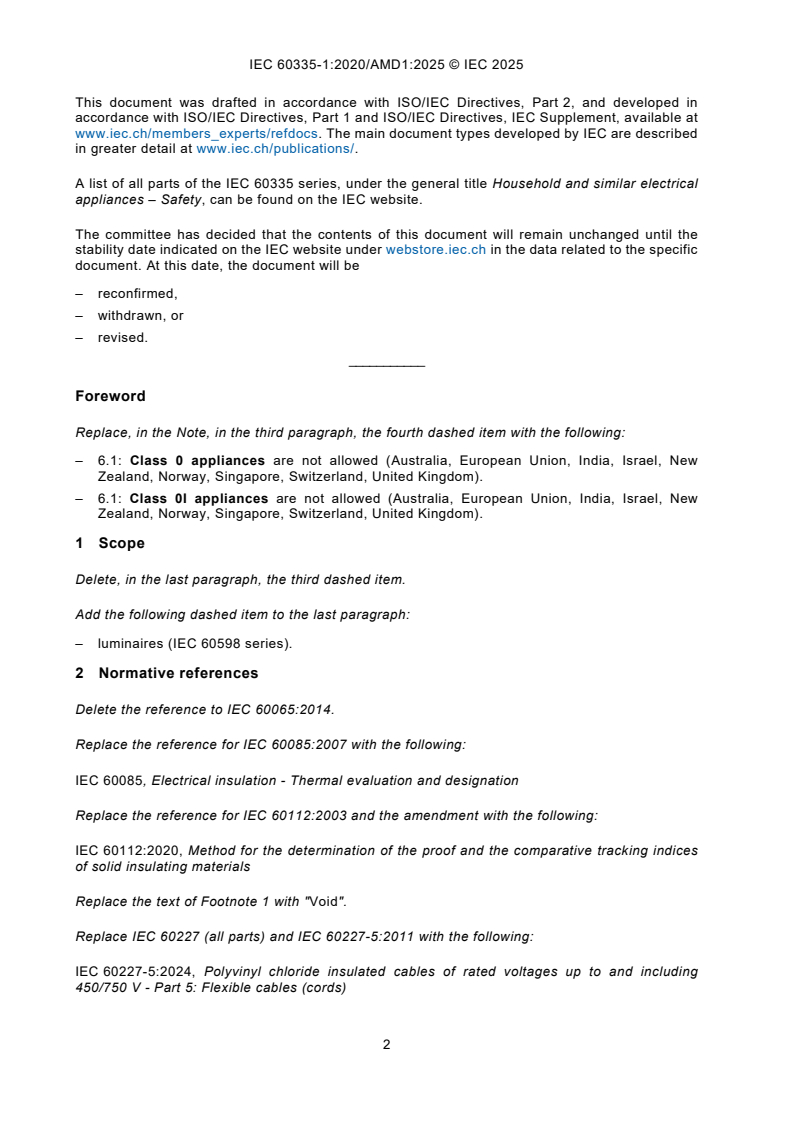
Replace, in the Note, in the third paragraph, the fourth dashed item with the following:
– 6.1: Class 0 appliances are not allowed (Australia, European Union, India, Israel, New
Zealand, Norway, Singapore, Switzerland, United Kingdom).
– 6.1: Class 0I appliances are not allowed (Australia, European Union, India, Israel, New
Zealand, Norway, Singapore, Switzerland, United Kingdom).
1 Scope
Delete, in the last paragraph, the third dashed item.
Add the following dashed item to the last paragraph:
– luminaires (IEC 60598 series).
2 Normative references
Delete the reference to IEC 60065:2014.
Replace the reference for IEC 60085:2007 with the following:
IEC 60085, Electrical insulation - Thermal evaluation and designation
Replace the reference for IEC 60112:2003 and the amendment with the following:
IEC 60112:2020, Method for the determination of the proof and the comparative tracking indices
of solid insulating materials
Replace the text of Footnote 1 with "Void".
Replace IEC 60227 (all parts) and IEC 60227-5:2011 with the following:
IEC 60227-5:2024, Polyvinyl chloride insulated cables of rated voltages up to and including
450/750 V - Part 5: Flexible cables (cords)
Replace IEC 60245 (all parts) with the following:
IEC 60245-4, Rubber insulated cables - Rated voltages up to and including 450/750 V - Part 4:
Cords and flexible cables
Replace IEC 60384-14:2013 and the amendment with the following:
IEC 60384-14:2023, Fixed capacitors for use in electronic equipment - Part 14: Sectional
specification - Fixed capacitors for electromagnetic interference suppression and connection to
the supply mains
Replace the text of Footnote 3 with "Void".
Replace IEC 60445:2017 with the following:
IEC 60445, Basic and safety principles for man-machine interface, marking and identification -
Identification of equipment terminals, conductor terminations and conductors
Replace IEC 60598-1:2014 and the amendment with the following:
IEC 60598-1:2024, Luminaires - Part 1: General requirements and tests
Replace IEC 60664-1:2007 with the following
IEC 60664-1:2020, Insulation coordination for equipment within low-voltage supply systems - Part
1: Principles, requirements and tests
IEC 60664-1:2020/AMD1:2025
Replace the text of Footnote 5 with "Void".
Replace IEC 60695-2-11:2014 with the following:
IEC 60695-2-11:2021, Fire hazard testing - Part 2-11: Glowing/hot-wire based test methods - Glow-
wire flammability test method for end products (GWEPT)
Replace IEC 60730-1:2013 and the amendment with the following:
IEC 60730-1:2022, Automatic electrical controls - Part 1: General requirements
Delete IEC 60730-2-8:2018.
Replace IEC 60730-2-9:2015 and the amendment with the following:
IEC 60730-2-9, Automatic electrical controls - Part 2-9: Particular requirements for temperature
sensing controls
Replace the text of Footnotes 6 and 7 with "Void".
Add the following new references:
IEC 60747-5-5:2020, Semiconductor devices - Part 5-5: Optoelectronic devices - Photocouplers
IEC 60998-2-1, Connecting devices for low-voltage circuits for household and similar purposes
Part 2-1: Particular requirements for connecting devices as separate entities with screw-type
clamping units
IEC 60998-2-2, Connecting devices for low-voltage circuits for household and similar purposes -
Part 2-2: Particular requirements for connecting devices as separate entities with screwless-type
clamping units
Replace IEC 61032:1997 with the following:
IEC 61032, Protection of persons and equipment by enclosures - Probes for verification
Replace IEC 61558-2-6:2009 and IEC 61558-2-16:2009 and the amendment with the following:
IEC 61558-2-6, Safety of transformers, reactors, power supply units and combinations thereof -
Part 2-6: Particular requirements and tests for safety isolating transformers and power supply units
incorporating safety isolating transformers for general applications
IEC 61558-2-16:2021, Safety of transformers, reactors, power supply units and combinations
thereof - Part 2-16: Particular requirements and tests for switch mode power supply units and
transformers for switch mode power supply units for general applications
Replace the text of Footnote 10 with "Void".
Replace IEC 62133-1:2017 with the following:
IEC 62133-1, Secondary cells and batteries containing alkaline or other non-acid electrolytes -
Safety requirements for portable sealed secondary cells, and for batteries made from them, for
use in portable applications - Part 1: Nickel systems
Replace IEC 62133-2:2017 with the following and add the following footnote:
IEC 62133-2:2017 , Secondary cells and batteries containing alkaline or other non-acid
electrolytes - Safety requirements for portable sealed secondary cells, and for batteries made from
them, for use in portable applications - Part 2: Lithium systems
IEC 62133-2:2017/AMD1:2021
There exists a consolidated edition 1.1:2021 that includes edition 1 and its Amendment 1.
Replace IEC 62471:2006 with the following:
IEC 62471, Photobiological safety of lamps and lamp systems
Add the following new reference:
IEC 62471-7, Photobiological safety of lamps and lamp systems - Part 7: Light sources and
luminaires primarily emitting visible radiation
Replace IEC 62821 (all parts) with the following:
IEC 62821-3, Electric cables - Halogen-free, low smoke, thermoplastic insulated and sheathed
cables of rated voltages up to and including 450/750 V - Part 3: Flexible cables (cords)
Add the following new reference:
IEC 63010-1, Halogen-free thermoplastic insulated and sheathed flexible cables of rated voltages
up to and including 300/300 V - Part 1: General requirements and cables
3 Terms and definitions
3.1.3 Replace, in Note 2 to entry, "transient voltages" with "transient overvoltages".
3.2.2 Replace Note 1 to entry with the following:
Note 1 to entry: In battery-operated appliances, if the battery is placed in a separate box, a flexible cord connecting
the box with the appliance is considered to be an interconnection cord. Flexible leads connecting the box with the
appliance are considered to be an interconnection cord.
3.3.6 Add the following Note to entry:
Note 1 to entry: Optocouplers are not protective impedances in the meaning of this standard.
Add the following new terms:
3.8.7
area open to the public
area in which the general public can have access
Note 1 to entry: Examples include customer areas in:
– grocery stores;
– canteens;
– train stations;
– self-service restaurants; and
– town squares and sidewalks/pathways.
Note 2 to entry: The general public can include children.
3.9.4
partitioning
software architecture technique used to split the software functionalities into modules with different
functions and defined interfaces between those modules
Note 1 to entry: When a software application contains both safety and non-safety modules that share the same
component resources, partitioning is a method to facilitate the prevention of unintentional software execution or
unintentional memory corruption.
3.9.5
software separation
separation between different software functions that can interact with each other through defined
data interfaces
Note 1 to entry: Software separation can be achieved physically or virtually through proper partitioning.
Note 2 to entry: Examples are physically separated microprocessors on independent hardware or one microprocessor
with properly separated routines, dedicated memory, timing and error checking, etc.
3.9.6
safety-related software
software that is used to implement safety functions in a safety related system
3.9.7
non-safety-related software
software that is used for functional purposes
3.9.8
communication software
software used to enable remote communication through public networks
5 General conditions for the tests
5.17 Replace the first paragraph with the following:
Battery-operated appliances, parts of appliances, remote controls and other accessories
containing batteries are tested in accordance with normative Annex B.
Add the following new subclause:
5.23 For DC supplied appliances, where the supply terminals for the connection of the supply
have no indication of polarity, the more unfavourable polarity shall be applied unless the correct
polarity is ensured by construction of the appliance.
6 Classification
6.1 Add the following as the second paragraph:
Class 0 shall only be used for appliances intended for connection by means of
– cord and plug, or
– pins for insertion into socket-outlets
to circuits operating at voltages not exceeding 150 V to earth.
NOTE In Australia and New Zealand, irrespective of the operating voltage, Class 0 appliances are not allowed.
7 Marking and instructions
7.1 Add, before the last paragraph, the following new text:
For DC supplied appliances, when the polarity of the supply terminals is identified:
– the positive terminal shall be indicated by symbol IEC 60417-5005 (2002-10); and
– the negative terminal shall be indicated by symbol IEC 60417-5006 (2002-10).
7.3 Delete, in the second paragraph, "and which have to be adjusted for use at a particular value
by the user or installer".
Delete, in Note 2, "(an appliance with a selector switch)".
7.6 Add, in the first paragraph, the following new symbols:
[symbol IEC 60417-5005 plus; positive polarity
(2002-10)]
[symbol IEC 60417-5006 minus; negative polarity
(2002-10)]
[symbol ISO 7000-0434B (2004-01)] Caution
Add the following after the third paragraph:
Symbol ISO 7000-0434A (2004-01) and symbol ISO 7000-0434B (2004-01) may be used as
alternatives.
7.12 Add, before the last paragraph, the following:
For appliances marked with different rated values (separated by an oblique stroke (/)) and which
have to be adjusted for use at a particular value by the user or installer, instructions shall be
included to indicate what action must be taken to adjust the appliance for operation at the required
rated values.
7.12.1 Delete the third paragraph.
8 Protection against access to live parts
8.1.1 Replace the penultimate paragraph with the following:
Test probe 18 is not applied to appliances for commercial use. However, test probe 18 is applied
to parts of commercial appliances that are intended to be installed in areas open to the public.
11 Heating
11.2 Change, in the first paragraph, the text to italic text.
In the seventh and eighth paragraphs, delete the second sentences.
Table 3 – Maximum normal temperature rises
Add, in Table 3, footnotes "o" and "p" at the end of "Rubber, polychloroprene or polyvinyl chloride
insulation of internal and external wiring, including supply cords:"
Replace, in "Outer surface of capacitors", the reference in the second dashed item, second bullet
point, as follows:
• capacitors complying with IEC 60384-14;
Replace, in footnote "d", "Table 12.1 of IEC 60598-1:2014 including
IEC 60598-1:2014/AMD1:2017" with "Table 21 of IEC 60598-1:2024".
Replace footnote "j" with the following:
j
60245 IEC 53 and 57 supply cords have a T rating of 60 °C;
60227 IEC 52 and 53 supply cords have a T rating of 70 °C;
60227 IEC 56 and 57 supply cords have a T rating of 90 °C;
60227 IEC 74 and 75 supply cords have a T rating of 70 °C;
62821 IEC 101 and 101f supply cords have a T rating of 70 °C;
62821 IEC 102 and 102f supply cords have a T rating of 70 °C;
Internal wiring code designation 60227 IEC 06 has a T rating of 70 °C;
Internal wiring code designation 60245 IEC 03 has a T rating of 180 °C;
Internal wiring code designation 60245 IEC 05 and 60245 IEC 07 have a T rating of 110 °C.
Add the following new footnotes:
o
For appliances provided with an automatic cord reel, the temperature rise of the cord sheath is determined as near
as possible to the hub of the reel and also between the two outermost layers of the cord on the reel.
p
For cord storage devices, other than automatic cord reels, which are intended to accommodate the supply cord
partially while the appliance is in operation, the temperature rise of the stored part of the cord is determined at the
most unfavourable place.
14 Transient overvoltages
Table 6 – Impulse test voltage
Replace, in footnote "a", "Subclause 6.1.2.2.1.3 of IEC 60664-1:2007" with "Subclause 6.2.2.1.4
of IEC 60664-1:2020 and IEC 60664-1/AMD1:2025."
19 Abnormal operation
19.1 Add, after the seventh paragraph of the test specification, the following new paragraph:
DC supplied appliances where the supply terminals have an indication of polarity are subjected to
the test of 19.18.
19.11.2 Replace, in item c), "IEC 60384-14:2013 including IEC 60384-14:2013/AMD1:2016" with
"IEC 60384-14".
19.11.4.4 Delete, in the first paragraph, in the first sentence, ", five positive impulses and five
negative impulses being applied at the selected points".
19.13 Replace, in the eighth paragraph, "Universal Serial Bus (USB) outlet" with "accessible
Universal Serial Bus (USB) outlet".
Add the following new subclause:
19.18 DC supplied appliances are supplied at rated voltage but with the polarity reversed, unless
the correct polarity is ensured by the construction of the appliance.
20 Stability and mechanical hazards
20.1 Replace the second sentence of the fourth paragraph with the following new text and Note:
In this case, effective means to prevent the appliance from rolling or sliding are necessary.
NOTE 1 Blocking castors or wheels and controlling feet by means of a stop with small dimensions are considered as
effective means.
Add, after the fourth paragraph, the following new text and Note:
Portable appliances shall be tested with the most unfavourable combination of feet, suction cups
and similar parts removed, unless they are non-detachable parts.
Where portable appliances use suction cups for stability, they shall also be tested with any
combination of all suction cups rendered inoperative.
NOTE 2 The following are examples of methods to render suction cups inoperative:
– Using a perforated surface as an inclined plane.
– Sprinkling flour or other powder on the inclined plane.
– Making holes in the body of the suction cup.
20.2 Replace the second paragraph of the test specification with the following:
Test probe 18 is not applied to appliances for commercial use. However, test probe 18 is applied
to parts of commercial appliances that are intended to be installed in areas open to the public.
22 Construction
22.11 Replace, in the sixth paragraph, in the second dashed item, the two bullet points with the
following:
• if the projection of the part that is gripped is less than 10 mm in the direction of removal,
30 N;
• in all other cases, 50 N.
22.31 Replace the first paragraph with the following:
Clearances and creepage distances over supplementary insulation and reinforced insulation
shall not be reduced below the values specified in Clause 29 as a result of wear.
Replace the introductory text of the second paragraph with the following:
If a part, such as a wire, screw, nut or spring, becomes loose or falls out of position, clearances
and creepage distances between live parts and accessible parts shall not be reduced below
the values specified for supplementary insulation. This requirement does not apply if:
Add, in the second dashed item in the second paragraph, "and a force of 2 N is applied to the rigid
wire" after "loosened":
Add, in the second paragraph, the following new dashed item:
– close-fitting tubing or sleeving (for example, a heat-shrink or rubber sleeve), applied over the
wire and its complete termination;
22.42 Replace the existing text with the following:
Protective impedance shall consist of:
– at least two separate components; or
– a single Class Y1 capacitor complying with IEC 60384-14:2023, including Subclause 8.4.1, with
a passive flammability category B and 21 days minimum duration for the damp heat, steady
state test.
Component impedances shall be unlikely to change significantly during the lifetime of the
appliance.
When two or more separate components are used:
– capacitors shall comply with the requirements for Class Y capacitors in IEC 60384-14.
– each resistor shall comply with the test below.
Each capacitor shall be appropriately rated for the working voltage and environmental conditions
of the application where it is used.
If any one of the components is open-circuited or, when two or more separate components are
used, if each component in turn is short-circuited, the values specified in 8.1.4 shall not be
exceeded.
Compliance is checked by inspection, by measurements and, for resistors, by the following tests
which are carried out on ten samples of each resistor.
The resistance of each sample resistor is measured.
Each sample resistor shall then be subjected to the damp heat test according to IEC 60068-2-78,
with the following minimum details:
– temperature: (40 ± 2) °C;
– humidity: (93 ± 3) % relative humidity;
– test duration: 21 days.
Each sample resistor is then subjected to the impulse voltage test of Clause 14 using the next
higher step for rated impulse voltage from Table 15.
After the test, the resistance of each sample resistor is measured again and it shall not have
changed by more than 10 %. No failure of each sample resistor is allowed.
22.54 Replace the current text with "Deleted".
22.62 Replace, in the second paragraph, in item b), "separation" with "software separation" and
bold "partitioning".
Add the following new subclause:
22.63 Appliances incorporating an optical filter, cover, door, shutter or similar means to prevent
the user from being exposed to an optical radiation hazard during normal use, shall incorporate
measures to fulfil the requirements of 32.2, when the door or shutter is opened, or the detachable
optical filter or detachable cover is removed.
Compliance is checked by the test of 32.2 with the door or shutter opened, or detachable optical
filter or detachable cover removed.
If compliance relies on the operation of an electronic circuit, the test is repeated with the
appliance supplied at rated voltage and operated under normal operation while the following
conditions are applied separately:
a) the fault conditions in a) to g) of 19.11.2 are then applied one at a time to the electronic
circuit.
b) the electromagnetic phenomena test of 19.11.4.1 to 19.11.4.7 are then applied to the
appliance. The tests are carried out with surge protective devices disconnected, unless they
incorporate spark gaps.
The appliance shall comply with 32.2.
If the electronic circuit is programmable, the software shall contain measures to control the
fault/error conditions specified in Table R.1 and is evaluated in accordance with the relevant
requirements of normative Annex R.
23 Internal wiring
23.3 In the first paragraph, replace "complying with IEC 60227 or IEC 60245 or IEC 62821" with
"at least code designation 60227 IEC 52, 60245 IEC 57 or 62821 IEC 101".
23.5 In the second paragraph, replace "IEC 60227 or IEC 60245 or IEC 62821" with
"IEC 60227-5, IEC 60245-4, IEC 62821-3 or IEC 63010-1".
Replace the first sentence of the second paragraph of the test specification with the following:
The insulation of single layer internal wiring shall be electrically equivalent to the insulation of
conductors in cords complying with IEC 60227-5, IEC 60245-4, IEC 62821-3 or IEC 63010-1 or
comply with the following electric strength test.
Replace, in the second sentence of the second paragraph of the test specification, "basic
insulation" with "insulation".
23.10 Replace in the second paragraph, "Table 6 of IEC 60227-5:2011 reference numbers 1 and
2" with "Table 7 of IEC 60227-5:2024, reference numbers 1 and 2".
24 Components
24.1 Delete the second sentence of the fourth paragraph.
Replace, in the second dashed item of the eighth paragraph, "IEC 60695-2-11:2014" with
"IEC 60695-2-11".
In NOTE 2, replace "Clause 7 of IEC 60730-1:2013/AMD1:2015" with "Clause 5 of
IEC 60730-1:2022".
24.1.1 Replace the first paragraph with the following:
The relevant standard for capacitors likely to be permanently subjected to the supply voltage and
used for radio interference suppression or for voltage dividing is IEC 60384-14.
Replace the last paragraph with the following:
If capacitors likely to be permanently connected to the supply voltage and used either for radio
interference suppression or for voltage dividing have to be tested, they are tested in accordance
with normative Annex F.
Add the following as a new last paragraph:
Class Y capacitors used in protective impedance shall comply with 22.42.
24.1.2 Replace the first sentence of the first paragraph with following:
The relevant standard for transformers in associated switch mode power supplies is Annex BB of
IEC 61558-2-16:2021.
Replace, in the second paragraph, "IEC 61558-2-6:2009" with "IEC 61558-2-6".
24.1.3 Replace the fourth paragraph with the following:
If the switch only operates a motor starting relay complying with IEC 60730-2-10 with the number
of cycles of operation declared for automatic action and for manual action in accordance with
IEC 60730-1 of at least 10 000 cycles, it is not necessary to test the complete switching system.
24.1.4 Replace the first paragraph with the following:
The relevant standard for automatic electrical controls is IEC 60730-1 together with the relevant
Part 2.
Replace, in the second paragraph, the introductory text with the following:
The number of cycles of operation declared for automatic action and for manual action in
accordance with IEC 60730-1 shall not be less than the following:
Replace the third, fourth and fifth paragraphs with the following:
The number of cycles does not apply for controls that operate during the test of Clause 11 if the
appliance meets the requirements of this standard when the control is short-circuited or rendered
inoperative.
If automatic controls have to be tested, they are also tested in accordance with Subclauses 9.3.5
to 9.3.8 and Clause 19 of IEC 60730-1:2022 as type 1 controls. The tests of Clauses 14, 15 and
16 of IEC 60730-1:2022 are not carried out before carrying out the test of Clause 19.
The ambient temperature during the test of Clause 19 of IEC 60730-1:2022 is that occurring during
the test of Clause 11 in the appliance, as specified in footnote b of Table 3.
Replace the seventh and eighth paragraphs with the following:
For water valves containing live parts and that are incorporated in external hoses for connection
of an appliance to the water mains, the degree of protection provided by enclosures against
harmful ingress of water shall be IPX7 in accordance with IEC 60529.
Thermal cut-outs of the capillary type shall comply with the requirements for type 2.K controls in
IEC 60730-2-9.
24.1.9 Replace the existing text with the following:
Contactors and relays, other than motor starting relays, are tested as part of the appliance under
the maximum load conditions occurring in the appliance for at least the number of cycles of
operation in 24.1.4 selected according to the contactor or relay function in the appliance.
24.1.10 Replace the existing text with the following:
Electrical light sources and luminaires that have been previously tested and found to comply with
IEC 62471-7 are considered to comply with 32.2 under the conditions occurring in the appliance
without testing, unless a combination of two or more such light sources or luminaires are located
less than 400 mm apart in the same plane.
NOTE 1 IEC 62471-7 can be applied to laser products used for illumination and signalling when the conditions of
IEC 60825-1:2014, 4.4 are met.
NOTE 2 Testing can include the assessment of the usage of multiple identical light sources or luminaires in the same
plane based on the assessment of the single light source or single luminaire.
24.1.11 Add, in the first sentence, after "with the appliance" the following:
"in accordance with 22.58".
Replace the last sentence with the following text and table:
Cord sets with cords complying with IEC 62821-3 or IEC 63010-1 are also allowed as shown in
Table 20.
Table 20 – Halogen-free cord sets and cords
a b
Type of connector or plug connector
Type of cord Nominal cross-sectional area
mm
c
2,5 A for class I appliances 62821 IEC 101 or 63010 IEC 111
0,75
c
2,5 A for class II appliances 62821 IEC 101 or
0,75
62821 IEC 101f or
63010 IEC 111 or
63010 IEC 111f
6 A 62821 IEC 101 or 0,75
62821 IEC 101f or
63010 IEC 111 or
63010 IEC 111f
d e
10 A for cold conditions
62821 IEC 102 or 62821 IEC 102f 0,75
d e
16 A for cold conditions
62821 IEC 102 or 62821 IEC 102f 1,0
a
For cord sets using IEC 63010-1 cords, the cord length shall not exceed 4 m.
b
Conductors of cords shall have a nominal cross-sectional area not less than specified.
c 2
If the cord has a length not exceeding 2 m, a nominal cross-sectional area of 0,5 mm is allowed.
d
This applies only for 10 A and 16 A cold conditions connectors and plug connectors for class II appliances.
e
If the cord has a length exceeding 2 m, nominal cross-sectional areas shall be minimum
– 1,0 mm for 10 A connectors;
– 1,5 mm for 16 A connectors.
Add the following new subclause:
24.1.12 The relevant standard for optocouplers is IEC 60747-5-5. When optocouplers are used
for protection against electric shock when bridging double insulation or reinforced insulation,
they shall comply with IEC 60747-5-5:2020, Clause 5. The maximum withstanding isolation voltage
according to IEC 60747-5-5 shall be at least the voltage required by Table 7 of this standard for
the insulation bridged by the optocoupler.
25 Supply connection and external flexible cords
25.2 Replace, in NOTE 1, "may" with "can".
25.7 In the third dashed item, of the first paragraph, for polyvinyl chloride sheathed cords, after
"shall not be used if" add ",in normal use,", delete "metal" and add the following after the second
bulleted item.
Normal use does not include storage or user maintenance.
Replace, in the fifth dashed item of the first paragraph, "Their properties should be at least those
of:" with the following:
These supply cords shall not be used if, in normal use, they are likely to touch parts having a
temperature rise exceeding 75 K during the test of Clause 11. Their properties shall be at least
those of:
Add, at the end of the first bullet point of the fifth dashed item of the first paragraph, ", for
appliances having a mass not exceeding 3 kg".
Add, at the end of the second bullet point of the fifth dashed item of the first paragraph, ", for other
appliances".
Add, after the second bullet point of the fifth dashed item of the first paragraph, the following:
Normal use does not include storage or user maintenance.
Add, after the fifth dashed item of the first paragraph the following new dashed item:
– Halogen-free, thermoplastic insulated and sheathed
These supply cords shall not be used if, in normal use, they are likely to touch parts having a
temperature rise exceeding 75 K during the test of Clause 11.
Normal use does not include storage or user maintenance.
Their properties shall be at least those of halogen-free, thermoplastic insulated and sheathed
flexible cable (code designation 63010 IEC 111 for circular cable and code designation
63010 IEC 111f for flat cable).
25.23 Replace, in the first paragraph, the introductory text with the following:
Interconnection cords for other than class III constructions shall comply with the requirements
for the supply cord, except that:
Delete the third dashed item and add the following after the first paragraph:
Interconnection cords for class III constructions shall be adequately insulated.
27 Provisions for earthing
27.2 Replace, in the first paragraph, "earthing terminals" with "terminals providing earthing
continuity for external conductors or internal conductors".
28 Screws and connections
28.1 Delete the three paragraphs above Table 14.
Table 14 – Torque for testing screws and nuts
Add footnote a to column heading I, footnote b to column heading II and footnote c to column
heading III and add the footnotes a, b and c as follows:
a
Column I is applicable for metal screws without heads if the screw does not protrude from the hole when
tightened.
b
Column II is applicable for:
– other metal screws and for nuts;
– screws of insulating material:
• having a hexagonal head with the dimension across flats exceeding the overall thread diameter;
• with a cylindrical head and a socket for a key, the socket having a cross-corner dimension exceeding
the overall thread diameter;
• with a head having a slot or cross-slots, the length of which exceeds 1,5 times the overall thread
diameter.
c
Column III is applicable for other screws of insulating material.
29 Clearances, creepage distances and solid insulation
Renumber NOTE to NOTE 1 and replace IEC 60664-1:2007 with IEC 60664-1.
Add the following new NOTE 2:
NOTE 2 For requirements for different supply systems, see IEC 60664-1:2020, Table F.3 and Table F.4.
29.1 Replace, in the second paragraph, IEC 60664-1:2007 with IEC 60664-1:2020.
Replace, in footnote b of Table 16 and in NOTE 2, IEC 60664-1:2007 with IEC 60664-1.
29.1.4 Replace, in the first paragraph, in the second dashed item, "Table F.7a in
IEC 60664-1:2007" with "Table F.8 in IEC 60664-1:2020".
Replace, in the first paragraph, in the second and third dashed items, only the first "steady-state
voltage" with "steady-state peak voltage, temporary overvoltage".
29.1.5 Replace, in the first paragraph, in the second dashed item, "Table F.7a in
IEC 60664-1:2007" with "Table F.8 in IEC 60664-1:2020".
Replace, in the second and third dashed items of the first paragraph, only the first "steady-state
voltage" with "steady state peak voltage, temporary overvoltage".
Replace, in the second and third paragraphs, "Table F.7a in IEC 60664-1:2007" with "Table F.8 in
IEC 60664-1:2020".
Replace, in the third paragraph, "as specified in Table F.7a" with "as specified in Table F.8".
29.2 Replace, in NOTE 3, IEC 60664-1:2007 with IEC 60664-1.
Replace, in the seventh paragraph "Subclause 4.8.1.3 of IEC 60664-1:2007" with "Subclause
5.3.2.4 of IEC 60664-1:2020".
In the penultimate paragraph, replace "IEC 60112:2003 including IEC 60112:2003/AMD1:2009"
with "IEC 60112".
29.2.4 Replace, in footnote a of Table 18, "Table F. 4 of IEC 60664-1:2007" with "Table F.5 of
IEC 60664-1:2020 and IEC 60664-1/AMD1:2025".
29.3.4 Replace, in the NOTE, IEC 60664-1:2007 with IEC 60664-1:2020.
30 Resistance to heat and fire
30.2 Replace, in NOTE 1, "IEC 60695-2-11:2014" with "IEC 60695-2-11:2021".
30.2.1 Replace, in the first paragraph, "IEC 60695-2-11:2014" with "IEC 60695-2-11".
30.2.2 Replace, in the first, fourth, fifth, sixth and eighth paragraphs, "IEC 60695-2-11:2014" with
"IEC 60695-2-11".
Add, in the third and fifth paragraphs, in the first dashed item, "at rated voltage", after "normal
operation".
30.2.3.1 Replace, in the first, third and fourth paragraphs, "IEC 60695-2-11:2014" with
"IEC 60695-2-11".
Add, in the first paragraph, "at rated voltage", after "normal operation".
30.2.3.2 Replace, in the first, fourth, eighth and ninth paragraphs, "IEC 60695-2-11:2014" with
"IEC 60695-2-11".
Add, in the third paragraph, in the first dashed item, "at rated voltage", after "normal operation".
Add, in the fifth paragraph, in the first dashed item in the first bullet point, "at rated voltage", after
"normal operation".
Add, in the fifth paragraph, in the second dashed item, in the first bullet point, "at rated voltage",
after "normal operation".
32 Radiation, toxicity and similar hazards
32.2 Replace the existing text with the following:
Appliances shall not present an optical radiation hazard due to their operation in normal use.
Unless otherwise specified, the following components are considered to comply with IEC 62471-7:
– visible light indicators;
– infrared sources used for signalling or communication;
– infrared ranging sensors;
– seven-segment indicators;
– liquid-crystal displays;
– organic LED displays (OLED);
– plasma displays.
Compliance of electrical light sources and luminaires incorporated in the appliance predominantly
emitting radiation in the visible range and used to illuminate spaces or objects, is checked following
the measurement procedure described in IEC 62471 and assessed after IEC 62471-7, using a time
to dose for the blue light hazard of 10 s (BLH-B) and an assessment distance of 200 mm.
If no limits or tests for functions other than illumination are specified in the relevant Part 2, then
compliance is checked following the measurement procedure described in IEC 62471 and
assessed after IEC 62471-7, using a time to dose for the blue light hazard of 10 s (BLH-B) and an
assessment distance of 200 mm.
NOTE Optical radiation functions other than illumination can be disinfection by UV radiation, photobiological effects on
the skin, heating by infrared radiation and others. Testing for possible leakage and straylight from these other optical
radiation functions are considered in the relevant Part 2.
Figure 12 – Example of the placement of the cylinder
Add a callout E to the figure as follows:
Add, to the Key, the following: "E vertical cylinder"
Figure 13 – Small parts cylinder
Add the source as follows:
[SOURCE: ISO 8124-1:2022, Figure 26]
Annex B – Battery-operated appliances, separable batteries and
detachable batteries for battery-operated appliance
Replace, in the first paragraph, in the first and second dashed items, "battery-operated
appliances and remote controls" with "battery-operated appliances, parts of appliances, remote
controls and other accessories".
3 Terms and definitions
Add the following new term and definition:
B.3.6.2
small battery
battery that can be contained within the small parts cylinder of Figure 13
Note 1 to entry: Examples of small batteries are coin batteries, button batteries, AAA batteries.
Note 2 to entry: Coin and button batteries are known as single cell batteries with a diameter greater than its height.
5 General conditions for the tests
Add the following new subclause:
B.5.4 The tests are carried out with the battery provided with or intended for the appliance. If
more than one battery type is intended to be used with the appliance, the tests shall be carried
out using the battery that gives the most unfavourable result.
7 Marking and instructions
7.1 Add, before the last paragraph, the following new paragraphs:
Battery-operated appliances, parts of appliances, remote controls and other accessories
incorporating coin batteries or button batteries that are user replaceable shall be marked with the
following, as applicable:
– the symbols ISO 7000-0434A (2004-01) or ISO 7000-0434B (2004-01) in combination with
IEC 60417-6367 (2017-11),
– the symbols ISO 7000-0434A (2004-01) or ISO 7000-0434B (2004-01) in combination with
IEC 60417-6368 (2017-11), or
– with the substance of one of the following:
• CAUTION: Contains coin battery.
• CAUTION: Contains button batte
...
IEC 60335-1 ®
Edition 6.0 2025-10
NORME
INTERNATIONALE
AMENDEMENT 1
Appareils électrodomestiques et analogues - Sécurité -
Partie 1: Exigences générales
ICS 13.120; 97.030 ISBN 978-2-8327-0781-4
IEC 60335-1:2020-09/AMD1:2025-10(fr)
Droits de reproduction réservés. Sauf indication contraire, aucune partie de cette publication ne peut être reproduite ni
utilisée sous quelque forme que ce soit et par aucun procédé, électronique ou mécanique, y compris la photocopie et
les microfilms, sans l'accord écrit de l'IEC ou du Comité national de l'IEC du pays du demandeur. Si vous avez des
questions sur le copyright de l'IEC ou si vous désirez obtenir des droits supplémentaires sur cette publication, utilisez
les coordonnées ci-après ou contactez le Comité national de l'IEC de votre pays de résidence.
IEC Secretariat Tel.: +41 22 919 02 11
3, rue de Varembé info@iec.ch
CH-1211 Geneva 20 www.iec.ch
Switzerland
A propos de l'IEC
La Commission Electrotechnique Internationale (IEC) est la première organisation mondiale qui élabore et publie des
Normes internationales pour tout ce qui a trait à l'électricité, à l'électronique et aux technologies apparentées.
A propos des publications IEC
Le contenu technique des publications IEC est constamment revu. Veuillez vous assurer que vous possédez l’édition la
plus récente, un corrigendum ou amendement peut avoir été publié.
Recherche de publications IEC - IEC Products & Services Portal - products.iec.ch
webstore.iec.ch/advsearchform Découvrez notre puissant moteur de recherche et consultez
La recherche avancée permet de trouver des publications gratuitement tous les aperçus des publications, symboles
IEC en utilisant différents critères (numéro de référence, graphiques et le glossaire. Avec un abonnement, vous aurez
texte, comité d’études, …). Elle donne aussi des toujours accès à un contenu à jour adapté à vos besoins.
informations sur les projets et les publications remplacées
ou retirées. Electropedia - www.electropedia.org
Le premier dictionnaire d'électrotechnologie en ligne au
IEC Just Published - webstore.iec.ch/justpublished monde, avec plus de 22 500 articles terminologiques en
Restez informé sur les nouvelles publications IEC. Just anglais et en français, ainsi que les termes équivalents
dans 25 langues additionnelles. Egalement appelé
Published détaille les nouvelles publications parues.
Disponible en ligne et une fois par mois par email. Vocabulaire Electrotechnique International (IEV) en ligne.
Service Clients - webstore.iec.ch/csc
Si vous désirez nous donner des commentaires sur cette
publication ou si vous avez des questions contactez-
nous: sales@iec.ch.
COMMISSION ÉLECTROTECHNIQUE INTERNATIONALE
____________
Appareils électrodomestiques et analogues - Sécurité -
Partie 1: Exigences générales
AMENDEMENT 1
AVANT-PROPOS
1) La Commission Électrotechnique Internationale (IEC) est une organisation mondiale de normalisation composée de
l'ensemble des comités électrotechniques nationaux (Comités nationaux de l'IEC). L'IEC a pour objet de favoriser la
coopération internationale pour toutes les questions de normalisation dans les domaines de l'électricité et de
l'électronique. A cet effet, l'IEC – entre autres activités – publie des Normes internationales, des Spécifications
techniques, des Rapports techniques, des Spécifications accessibles au public (PAS) et des Guides (ci-après
dénommés "Publication(s) de l'IEC"). Leur élaboration est confiée à des comités d'études, aux travaux desquels tout
Comité national intéressé par le sujet traité peut participer. Les organisations internationales, gouvernementales et
non gouvernementales, en liaison avec l'IEC, participent également aux travaux. L'IEC collabore étroitement avec
l'Organisation Internationale de Normalisation (ISO), selon des conditions fixées par accord entre les deux
organisations.
2) Les décisions ou accords officiels de l'IEC concernant les questions techniques représentent, dans la mesure du
possible, un accord international sur les sujets étudiés, étant donné que les Comités nationaux de l'IEC intéressés
sont représentés dans chaque comité d'études.
3) Les Publications de l'IEC se présentent sous la forme de recommandations internationales et sont agréées comme
telles par les Comités nationaux de l'IEC. Tous les efforts raisonnables sont entrepris afin que l'IEC s'assure de
l'exactitude du contenu technique de ses publications; l'IEC ne peut pas être tenue responsable de l'éventuelle
mauvaise utilisation ou interprétation qui en est faite par un quelconque utilisateur final.
4) Dans le but d'encourager l'uniformité internationale, les Comités nationaux de l'IEC s'engagent, dans toute la mesure
possible, à appliquer de façon transparente les Publications de l'IEC dans leurs publications nationales et régionales.
Toutes divergences entre toutes Publications de l'IEC et toutes publications nationales ou régionales
correspondantes doivent être indiquées en termes clairs dans ces dernières.
5) L'IEC elle-même ne fournit aucune attestation de conformité. Des organismes de certification indépendants
fournissent des services d'évaluation de conformité et, dans certains secteurs, accèdent aux marques de conformité
de l'IEC. L'IEC n'est responsable d'aucun des services effectués par les organismes de certification indépendants.
6) Tous les utilisateurs doivent s'assurer qu'ils sont en possession de la dernière édition de cette publication.
7) Aucune responsabilité ne doit être imputée à l'IEC, à ses administrateurs, employés, auxiliaires ou mandataires, y
compris ses experts particuliers et les membres de ses comités d'études et des Comités nationaux de l'IEC, pour
tout préjudice causé en cas de dommages corporels et matériels, ou de tout autre dommage de quelque nature que
ce soit, directe ou indirecte, ou pour supporter les coûts (y compris les frais de justice) et les dépenses découlant
de la publication ou de l'utilisation de cette Publication de l'IEC ou de toute autre Publication de l'IEC, ou au crédit
qui lui est accordé.
8) L'attention est attirée sur les références normatives citées dans cette publication. L'utilisation de publications
référencées est obligatoire pour une application correcte de la présente publication.
9) L'IEC attire l'attention sur le fait que la mise en application du présent document peut entraîner l'utilisation d'un ou
de plusieurs brevets. L'IEC ne prend pas position quant à la preuve, à la validité et à l'applicabilité de tout droit de
brevet revendiqué à cet égard. À la date de publication du présent document, l'IEC n'avait pas reçu notification qu'un
ou plusieurs brevets pouvaient être nécessaires à sa mise en application. Toutefois, il y a lieu d'avertir les
responsables de la mise en application du présent document que des informations plus récentes sont susceptibles
de figurer dans la base de données de brevets, disponible à l'adresse https://patents.iec.ch. L'IEC ne saurait être
tenue pour responsable de ne pas avoir identifié de tels droits de brevets.
L'Amendement 1 à l'IEC 60335-1:2020 a été établi par le comité d'études 61 de l'IEC: Sécurité
des appareils électrodomestiques et analogues.
Le texte de cet Amendement est issu des documents suivants:
Projet Rapport de vote
61/7471/FDIS 61/7502/RVD
Le rapport de vote indiqué dans le tableau ci-dessus donne toute information sur le vote ayant
abouti à son approbation.
La langue employée pour l'élaboration de cet Amendement est l'anglais.
Ce document a été rédigé selon les Directives ISO/IEC, Partie 2, il a été développé selon les
Directives ISO/IEC, Partie 1 et les Directives ISO/IEC, Supplément IEC, disponibles sous
www.iec.ch/members_experts/refdocs. Les principaux types de documents développés par l'IEC
sont décrits plus en détail sous www.iec.ch/publications/.
Une liste de toutes les parties de la série IEC 60335, publiées sous le titre général Appareils
électrodomestiques et analogues – Sécurité, se trouve sur le site web de l'IEC.
Le comité a décidé que le contenu de ce document ne sera pas modifié avant la date de stabilité
indiquée sur le site web de l'IEC sous webstore.iec.ch dans les données relatives au document
recherché. À cette date, le document sera
– reconduit,
– supprimé, ou
– révisé.
___________
Avant-propos
Remplacer, dans la Note, dans le troisième alinéa, le quatrième tiret par ce qui suit:
– 6.1: Les appareils de la classe 0 ne sont pas admis (Australie, Union européenne, Inde,
Israël, Nouvelle-Zélande, Norvège, Singapour, Suisse, Royaume-Uni).
– 6.1: Les appareils de la classe 0I ne sont pas admis (Australie, Union européenne, Inde,
Israël, Nouvelle-Zélande, Norvège, Singapour, Suisse, Royaume-Uni).
1 Domaine d'application
Supprimer, au dernier alinéa, le troisième tiret.
Ajouter le tiret suivant au dernier alinéa:
– aux luminaires (série IEC 60598).
2 Références normatives
Supprimer la référence à l'IEC 60065:2014.
Remplacer la référence à l'IEC 60085:2007 par ce qui suit:
IEC 60085, Isolation électrique - Évaluation et désignation thermiques
Remplacer la référence à l'IEC 60112-2003 et à l'amendement par ce qui suit:
IEC 60112:2020, Méthode de détermination des indices de résistance et de tenue au cheminement
des matériaux isolants solides
Remplacer le texte de la note de bas de page 1 par "Vacant".
Remplacer l'IEC 60227 (toutes les parties) et l'IEC 60227-5:2011 par ce qui suit:
IEC 60227-5:2024, Polyvinyl chloride insulated cables of rated voltages up to and
including 450/750 V - Part 5: Flexible cables (cords) (disponible en anglais seulement)
Remplacer l'IEC 60245 (toutes les parties) par ce qui suit:
IEC 60245-4, Conducteurs et câbles isolés au caoutchouc - Tension assignée au plus égale à
450/750 V - Partie 4: Câbles souples
Remplacer l'IEC 60384-14:2013 et l'amendement par ce qui suit:
IEC 60384-14:2023, Condensateurs fixes utilisés dans les équipements électroniques - Partie 14:
Spécification intermédiaire - Condensateurs fixes pour la suppression des interférences
électromagnétiques et la connexion au réseau d'alimentation
Remplacer le texte de la note de bas de page 3 par "Vacant".
Remplacer l'IEC 60445:2017 par ce qui suit:
IEC 60445, Principes fondamentaux et de sécurité pour les interfaces homme-machine, le
marquage et l'identification - Identification des bornes de matériels, des extrémités de conducteurs
et des conducteurs
Remplacer l'IEC 60598-1:2014 et l'amendement par ce qui suit:
IEC 60598-1:2024, Luminaires - Partie 1: Exigences générales et essais
Remplacer l'IEC 60664-1:2007 par ce qui suit:
IEC 60664-1:2020, Coordination de l'isolement des matériels dans les réseaux d'énergie
électrique à basse tension - Partie 1: Principes, exigences et essais
IEC 60664-1:2020/AMD1:2025
Remplacer le texte de la note de bas de page 5 par "Vacant".
Remplacer l'IEC 60695-2-11:2014 par ce qui suit :
IEC 60695-2-11:2021, Essais relatifs aux risques du feu - Partie 2-11: Essais au fil
incandescent/chauffant – Méthode d'essai d'inflammabilité pour produits finis (GWEPT)
Remplacer l'IEC 60730-1:2013 et l'amendement par ce qui suit:
IEC 60730-1:2022, Dispositifs de commande électrique automatiques - Partie 1: Exigences
générales
Supprimer l'IEC 60730-2-8:2018.
Remplacer l'IEC 60730-2-9:2015 et l'amendement par ce qui suit:
IEC 60730-2-9, Dispositifs de commande électrique automatiques - Partie 2-9: Exigences
particulières pour les dispositifs de commande thermosensibles
Remplacer le texte des notes de bas de page 6 et 7 par "Vacant".
Ajouter les nouvelles références suivantes:
IEC 60747-5-5:2020, Dispositifs à semiconducteurs - Partie 5-5: Dispositifs optoélectroniques -
Photocoupleurs
IEC 60998-2-1, Dispositifs de connexion pour circuits basse tension pour usage domestique et
analogue - Partie 2-1: Règles particulières pour dispositifs de connexion en tant que parties
séparées avec organes de serrage à vis
IEC 60998-2-2, Dispositifs de connexion pour circuits basse tension pour usage domestique et
analogue - Partie 2-2: Règles particulières pour dispositifs de connexion en tant que parties
séparées avec organes de serrage sans vis
Remplacer l'IEC 61032:1997 par ce qui suit:
IEC 61032, Protection des personnes et des matériels par les enveloppes - Calibres d'essai pour
la vérification
Remplacer l'IEC 61558-2-6:2009 ainsi que l'IEC 61558-2-16:2009 et l'amendement par ce qui suit:
IEC 61558-2-6, Safety of transformers, reactors, power supply units and combinations thereof -
Part 2-6: Particular requirements and tests for safety isolating transformers and power supply units
incorporating safety isolating transformers for general applications (disponible en anglais
seulement)
IEC 61558-2-16, Sécurité des transformateurs, bobines d'inductance, blocs d'alimentation et
combinaisons de ces éléments - Partie 2-16: Exigences particulières et essais pour les blocs
d'alimentation à découpage et les transformateurs pour blocs d'alimentation à découpage pour
applications d'ordre général
Remplacer le texte de la note de bas de page 10 par "Vacant".
Remplacer l'IEC 62133-1:2017 par ce qui suit:
IEC 62133-1, Accumulateurs alcalins et autres accumulateurs à électrolyte non acide - Exigences
de sécurité pour les accumulateurs portables étanches, et pour les batteries qui en sont
constituées, destinés à l'utilisation dans des applications portables - Partie 1: Systèmes au nickel
Remplacer l'IEC 62133-2:2017 par ce qui suit et ajouter la note de bas de page suivante:
IEC 62133-2:2017 , Accumulateurs alcalins et autres accumulateurs à électrolyte non acide -
Exigences de sécurité pour les accumulateurs portables étanches, et pour les batteries qui en sont
constituées, destinés à l'utilisation dans des applications portables - Partie 2: Systèmes au lithium
IEC 62133-2:2017/AMD1:2021
Il existe une édition consolidée 1.1:2021 qui comprend l'édition 1 et son Amendement 1.
Remplacer l'IEC 62471:2006 par ce qui suit:
IEC 62471, Sécurité photobiologique des lampes et des appareils utilisant des lampes
Ajouter la nouvelle référence suivante:
IEC 62471-7, Sécurité photobiologique des lampes et des appareils utilisant des lampes -
Partie 7 : sources de lumière et luminaires qui émettent principalement un rayonnement visible
Remplacer l'IEC 62821 (toutes les parties) par ce qui suit:
IEC 62821-3, Câbles électriques - Câbles à isolation et gaine thermoplastique sans halogène à
faible dégagement de fumée de tension assignée au plus égale à 450/750 V - Partie 3: Câbles
souples (cordons)
Ajouter la nouvelle référence suivante:
IEC 63010-1, Halogen-free thermoplastic insulated and sheathed flexible cables of rated voltages
up to and including 300/300 V - Part 1: General requirements and cables (disponible en anglais
seulement)
3 Termes et définitions
3.1.3 Remplacer, dans la Note 2 à l'article, "tensions transitoires" par "surtensions transitoires".
3.2.2 Remplacer la Note 1 à l'article par ce qui suit:
Note 1 à l'article: Pour les appareils alimentés par batteries, si la batterie est placée dans un boîtier séparé, un
câble souple raccordant le boîtier à l'appareil est considéré comme un câble d'interconnexion. Le conducteur souple
raccordant le boîtier à l'appareil est considéré comme un câble d'interconnexion.
3.3.6 Ajouter la Note à l'article suivante:
Note 1 à l'article: Les optocoupleurs ne sont pas des impédances de protection au sens de la présente norme.
Ajouter les nouveaux termes suivants:
3.8.7
endroit ouvert au public
endroit qui peut être accessible au grand public
Note 1 à l'article: Il s'agit par exemple des endroits réservés aux clients dans:
– les épiceries;
– les cantines;
– les gares;
– les restaurants en libre-service; et
– les places publiques et les trottoirs/chemins.
Note 2 à l'article: Le grand public peut inclure les enfants.
3.9.4
partitionnement
technique d'architecture logicielle utilisée pour diviser les fonctionnalités du logiciel en modules
avec différentes fonctions et des interfaces définies entre ces modules
Note 1 à l'article Lorsqu'une application logicielle contient à la fois des modules de sécurité et des modules non relatifs
à la sécurité qui partagent les mêmes ressources de composants, le partitionnement est une méthode qui facilite la
prévention d'une exécution involontaire du logiciel ou d'une corruption involontaire de la mémoire.
3.9.5
séparation logicielle
séparation entre différentes fonctions logicielles qui peuvent interagir les unes avec les autres par
le biais d'interfaces de données définies
Note 1 à l'article: La séparation logicielle peut être réalisée physiquement ou virtuellement au moyen d'un
partitionnement approprié.
Note 2 à l'article: Des microprocesseurs séparés physiquement sur des matériels indépendants ou un microprocesseur
avec des routines bien distinctes, une mémoire dédiée, une temporisation et un système de contrôle des erreurs, etc.
constituent des exemples.
3.9.6
logiciel relatif à la sécurité
logiciel utilisé pour mettre en œuvre des fonctions de sécurité dans un système relatif à la sécurité
3.9.7
logiciel non relatif à la sécurité
logiciel utilisé pour des besoins fonctionnels
3.9.8
logiciel de communication
logiciel utilisé pour permettre la communication à distance par le biais de réseaux publics
5 Conditions générales d'essais
5.17 Remplacer le premier alinéa par ce qui suit:
Les appareils alimentés par batterie, les parties d'appareils, les commandes à distance et autres
accessoires qui comprennent des batteries sont soumis à l'essai conformément à l'Annexe B
normative.
Ajouter le nouveau paragraphe suivant:
5.23 Pour les appareils alimentés en courant continu, dont les bornes d'alimentation pour le
raccordement de l'alimentation ne fournissent aucune indication de la polarité, la polarité la plus
défavorable doit être appliquée, sauf si la polarité correcte est assurée par la construction de
l'appareil.
6 Classification
6.1 Ajouter le texte suivant en tant que deuxième alinéa:
La classe 0 doit uniquement être utilisée pour les appareils destinés à être raccordés par
– un câble et une fiche, ou
– pour les broches destinées à être introduites dans des socles de prises de courant
dans des circuits qui fonctionnent à des tensions inférieures ou égales à 150 V à la terre.
NOTE En Australie et en Nouvelle-Zélande, quelle que soit la tension de fonctionnement, les appareils de la classe 0
ne sont pas autorisés.
7 Marquage et instructions
7.1 Ajouter, avant le dernier alinéa, le nouveau texte suivant:
Pour les appareils alimentés en courant continu, lorsque la polarité des bornes d'alimentation est
identifiée:
– la borne positive doit être indiquée par le symbole IEC 60417-5005 (2002-10); et
– la borne négative doit être indiquée par le symbole IEC 60417-5006 (2002-10).
7.3 Supprimer, au deuxième alinéa, "et qui doivent être réglés par l'utilisateur ou l'installateur
afin d'être utilisés à une valeur donnée".
Supprimer, dans la Note 2, "(appareil avec un commutateur)".
7.6 Ajouter, au premier alinéa, les nouveaux symboles suivants:
[symbole IEC 60417-5005 plus; polarité positive
(2002-10)]
[symbole IEC 60417-5006 moins; polarité négative
(2002-10)]
[symbole ISO 7000-0434B (2004-01)] Attention
Ajouter ce qui suit après le troisième alinéa:
Le symbole ISO 7000-0434A (2004-01) et le symbole ISO 7000-0434B (2004-01) peuvent être
utilisés comme alternatives.
7.12 Ajouter, avant le dernier alinéa, ce qui suit:
Pour les appareils marqués de différentes valeurs assignées (séparées par une barre oblique (/))
et qui doivent être réglés par l'utilisateur ou l'installateur afin d'être utilisés à une valeur donnée,
des instructions doivent être incluses afin d'indiquer l'action à réaliser pour régler l'appareil de
manière à fonctionner aux valeurs assignées exigées.
7.12.1 Supprimer le troisième alinéa.
8 Protection contre l'accès aux parties actives
8.1.1 Remplacer l'avant-dernier alinéa par ce qui suit:
Le calibre d'essai 18 n'est pas appliqué sur les appareils destinés à un usage commercial.
Toutefois, le calibre d'essai 18 est appliqué aux parties des appareils à usage commercial destinés
à être installés dans des endroits ouverts au public.
11 Échauffements
11.2 Mettre, au premier alinéa, le texte en italique.
Aux septième et huitième alinéas, supprimer les deuxièmes phrases.
Tableau 3 – Échauffements normaux maximaux
Ajouter, dans le Tableau 3, les notes de bas de tableau "o" et "p" à la fin de "Isolation en
caoutchouc, en polychloroprène ou en polychlorure de vinyle des conducteurs internes et
externes, y compris les câbles d'alimentation:"
Remplacer, dans "Surface extérieure des condensateurs", la référence de la deuxième puce du
deuxième tiret, comme suit:
• condensateurs conformes à l'IEC 60384-14;
Remplacer, dans la note de bas de tableau "d", "Tableau 12.1 de l'IEC 60598-1:2014, y compris
l'IEC 60598-1:2014/AMD1:2017" par "Tableau 21 de l'IEC 60598-1:2024".
Remplacer la note de bas de tableau "j" par ce qui suit:
j
Les câbles d'alimentation 60245 IEC 53 et 57 ont une caractéristique T de 60 °C;
les câbles d'alimentation 60227 IEC 52 et 53 ont une caractéristique T de 70 °C;
les câbles d'alimentation 60227 IEC 56 et 57 ont une caractéristique T de 90 °C;
les câbles d'alimentation 60227 IEC 74 et 75 ont une caractéristique T de 70 °C;
les câbles d'alimentation 62821 IEC 101 et 101f ont une caractéristique T de 70 °C;
les câbles d'alimentation 62821 IEC 102 et 102f ont une caractéristique T de 70 °C;
la dénomination 60227 IEC 06 pour les conducteurs internes a une caractéristique assignée T de 70 °C;
la dénomination 60245 IEC 03 pour les conducteurs internes a une caractéristique assignée T de 180 °C;
les dénominations 60245 IEC 05 et 60245 IEC 07 pour les conducteurs internes ont une caractéristique assignée T
de 110 °C.
Ajouter les nouvelles notes de bas de tableau suivantes:
o
Pour les appareils équipés d'un enrouleur de câble automatique, l'échauffement de la gaine du câble est déterminé
aussi près que possible du moyeu de l'enrouleur ainsi qu'entre les deux couches extérieures du câble sur l'enrouleur.
p
Pour les dispositifs de rangement du câble autres que les enrouleurs automatiques, qui sont prévus pour loger en
partie le câble d'alimentation pendant que l'appareil est en fonctionnement, l'échauffement de la partie du câble
non déroulée est déterminé à l'endroit le plus défavorable.
14 Surtensions transitoires
Tableau 6 – Tension d'essai de choc
Remplacer, dans la note de bas de tableau "a", "6.1.2.2.1.3 de l'IEC 60664-1:2007" par "6.2.2.1.4
de l'IEC 60664-1:2020 et l'IEC 60664-1/AMD1:2025."
19 Fonctionnement anormal
19.1 Ajouter, après le septième alinéa des modalités d'essais, le nouvel alinéa suivant:
Les appareils alimentés en courant continu pour lesquels les bornes d'alimentation comportent
une indication de polarité sont soumis à l'essai du 19.18.
19.11.2 Remplacer, au point c), "l'IEC 60384-14:2013, y compris
l'IEC 60384-14:2013/AMD1:2016" par "l'IEC 60384-14".
19.11.4.4 Supprimer, dans la première phrase du premier alinéa, ", cinq impulsions positives et
cinq impulsions négatives étant appliquées aux points sélectionnés".
19.13 Remplacer, au huitième alinéa, "prise de bus universel en série (USB)" par "prise de bus
universel en série (USB) accessible".
Ajouter le nouveau paragraphe suivant:
19.18 Les appareils alimentés en courant continu sont alimentés sous la tension assignée, mais
avec la polarité inversée, sauf si la polarité correcte est assurée par la construction de l'appareil.
20 Stabilité et dangers mécaniques
20.1 Remplacer la deuxième phrase du quatrième alinéa par le nouveau texte suivant et la
nouvelle Note suivante:
Dans ce cas, des moyens efficaces pour empêcher l'appareil de rouler ou de glisser sont
nécessaires.
NOTE 1 Bloquer les roulettes ou les roues et contrôler les pieds au moyen d'un dispositif d'arrêt de faibles dimensions
sont considérés comme des moyens efficaces.
Ajouter, après le quatrième paragraphe, le nouveau texte suivant et la nouvelle Note suivante:
Les appareils mobiles doivent être soumis à l'essai avec la combinaison la plus défavorable de
pieds, ventouses et parties analogues retirés, sauf s'il s'agit de parties non amovibles.
Lorsque les appareils mobiles utilisent des ventouses pour la stabilité, ils doivent également être
soumis à l'essai avec toute combinaison de toutes les ventouses rendues inopérantes.
NOTE 2 Les exemples suivants constituent des méthodes pour rendre les ventouses inopérantes:
– Utiliser une surface perforée comme plan incliné.
– Saupoudrer de la farine ou autre poudre sur le plan incliné.
– Réaliser des trous dans le corps de la ventouse.
20.2 Remplacer le deuxième alinéa des modalités d'essais par ce qui suit:
Le calibre d'essai 18 n'est pas appliqué sur les appareils destinés à un usage commercial.
Toutefois, le calibre d'essai 18 est appliqué aux parties des appareils à usage commercial destinés
à être installés dans des endroits ouverts au public.
22 Construction
22.11 Remplacer, au deuxième tiret du sixième alinéa, les deux puces par ce qui suit:
• si la saillie de la partie à saisir est inférieure à 10 mm dans la direction du retrait, 30 N;
• dans tous les autres cas, 50 N.
22.31 Remplacer le premier alinéa par ce qui suit:
Les distances dans l'air et les lignes de fuite sur une isolation supplémentaire et une isolation
renforcée ne doivent être réduites au-dessous des valeurs spécifiées à l'Article 29 par suite des
effets de l'usure.
Remplacer le texte introductif du deuxième alinéa par ce qui suit:
Si une partie, telle qu'un fil, une vis, un écrou ou un ressort, se desserre ou se détache, les
distances dans l'air et les lignes de fuite entre parties actives et parties accessibles ne
doivent pas être réduites au-dessous des valeurs spécifiées pour l'isolation supplémentaire.
Cette exigence ne s'applique pas si:
Ajouter, au deuxième tiret du deuxième alinéa, "et qu'une force de 2 N est appliquée au conducteur
rigide " après "desserrées":
Ajouter, au deuxième alinéa, le nouveau tiret suivant:
– un tube ou un manchon ajusté (par exemple, un manchon en caoutchouc ou thermorétractable)
est appliqué sur le fil et sur l'ensemble de la terminaison associée;
22.42 Remplacer le texte existant par ce qui suit:
L'impédance de protection doit être constituée:
– d'au moins deux composants distincts; ou
– d'un seul condensateur de classe Y1 conforme à l'IEC 60384-14:2023, y compris le 8.4.1, avec
une catégorie B pour l'inflammabilité passive et une durée minimale de 21 jours pour l'essai
continu de chaleur humide.
Les impédances des composants ne doivent pas être susceptibles de varier de façon significative
pendant la durée de vie de l'appareil.
Lorsque deux composants distincts ou plus sont utilisés:
– les condensateurs doivent satisfaire aux exigences applicables aux condensateurs de classe
Y de l'IEC 60384-14;
– chaque résistance doit satisfaire à l'essai ci-dessous.
Chaque condensateur doit être adapté à la tension de service et aux conditions d'environnement
de l'application dans laquelle il est utilisé.
Si l'un des composants est en circuit ouvert ou, lorsque deux composants distincts ou plus sont
utilisés, si chaque composant est court-circuité à tour de rôle, les valeurs spécifiées au 8.1.4 ne
doivent pas être dépassées.
La vérification est effectuée par examen, par mesurage et, pour les résistances, par les essais
suivants qui sont effectués sur dix échantillons de chaque résistance.
La résistance de chaque échantillon est mesurée.
Chaque échantillon doit ensuite être soumis à l'essai de chaleur humide selon l'IEC 60068-2-78,
avec au minimum les détails suivants:
– température: (40 ± 2) °C;
– humidité: (93 ± 3) % d'humidité relative;
– durée de l'essai: 21 jours.
Chaque échantillon est ensuite soumis à l'essai de tension de choc de l'Article 14 en utilisant le
niveau immédiatement supérieur pour la tension assignée de tenue aux chocs selon le
Tableau 15.
Après l'essai, la résistance de chaque échantillon est à nouveau mesurée, et elle ne doit pas avoir
varié de plus de 10 %. Aucune défaillance n'est admise pour chaque échantillon.
22.54 Remplacer le texte existant par "Supprimé".
22.62 Remplacer, au point b) du deuxième alinéa, "séparation" par "séparation logicielle" et
mettre en gras "division".
Ajouter le nouveau paragraphe suivant:
22.63 Les appareils qui comportent un filtre optique, un couvercle, une porte, un obturateur ou
des dispositifs analogues visant à empêcher l'utilisateur d'être exposé à un danger de
rayonnement optique en usage normal doivent intégrer des mesures permettant de satisfaire aux
exigences du 32.2, lorsque la porte ou l'obturateur est ouvert, ou lorsque le filtre optique
amovible ou le couvercle amovible est retiré.
La vérification est effectuée par l'essai du 32.2 lorsque la porte ou l'obturateur est ouvert ou que
le filtre optique amovible ou le couvercle amovible est retiré.
Si la conformité repose sur le fonctionnement d'un circuit électronique, l'essai est répété avec
l'appareil alimenté à la tension assignée et mis en fonctionnement dans les conditions de
fonctionnement normal, tandis que les conditions suivantes sont appliquées séparément:
a) les conditions de défaut a) à g) en 19.11.2 sont alors successivement appliquées au circuit
électronique;
b) les essais de phénomènes électromagnétiques des 19.11.4.1 à 19.11.4.7 sont ensuite réalisés
sur l'appareil. Les essais sont effectués en déconnectant les dispositifs de protection contre
les surtensions, sauf si ceux-ci comportent des éclateurs.
L'appareil doit satisfaire au 32.2.
Si le circuit électronique est programmable, le logiciel doit comporter des mesures pour contrôler
les conditions de défaut/d'erreur spécifiées dans le Tableau R.1 et il est évalué conformément aux
exigences applicables de l'Annexe R normative.
23 Conducteurs internes
23.3 Au premier alinéa, remplacer "conforme à l'IEC 60227, à l'IEC 60245 ou à l'IEC 62821" par
"avec au moins la dénomination 60227 IEC 52, 60245 IEC 57 ou 62821 IEC 101".
23.5 Au deuxième alinéa, remplacer "l'IEC 60227, l'IEC 60245 ou l'IEC 62821" par
"l'IEC 60227-5, l'IEC 60245-4, l'IEC 62821-3 ou l'IEC 63010-1".
Remplacer la première phrase du deuxième alinéa des modalités d'essais par ce qui suit:
L'isolation des conducteurs internes à couche simple doit être électriquement équivalente à
l'isolation des conducteurs des câbles conformes à l'IEC 60227-5, l'IEC 60245-4, l'IEC 62821-3 ou
l'IEC 63010-1, ou satisfaire à l'essai de rigidité diélectrique suivant.
Remplacer, dans la deuxième phrase du deuxième alinéa des modalités d'essais, "isolation
principale" par "isolation".
23.10 Remplacer, au deuxième alinéa, "le Tableau 6 de l'IEC 60227-5:2011, numéros de
référence 1 et 2" par "le Tableau 7 de l''IEC 60227-5:5:2024, numéros de référence 1 et 2".
24 Composants
24.1 Supprimer la deuxième phrase du quatrième alinéa.
Remplacer, au deuxième tiret du huitième alinéa, "IEC 60695-2-11:2014" par "IEC 60695-2-11".
Dans le NOTE 2, remplacer "l'Article 7 de l'IEC 60730-1:2013/AMD1:2015" par "l'Article 5 de
l'IEC 60730-1:2022".
24.1.1 Remplacer le premier alinéa par ce qui suit:
Pour les condensateurs susceptibles d'être soumis en permanence à la tension d'alimentation et
utilisés pour l'antiparasitage ou dans un diviseur de tension, la norme applicable est
l'IEC 60384-14.
Remplacer le dernier alinéa par ce qui suit:
Si des condensateurs susceptibles d'être reliés en permanence à la tension d'alimentation et
utilisés pour l'antiparasitage ou dans un diviseur de tension doivent être soumis à l'essai, ils le
sont conformément à l'Annexe F normative.
Ajouter le nouvel alinéa suivant en tant que dernier alinéa:
Les condensateurs de la classe Y utilisés dans l'impédance de protection doivent être conformes
au 22.42.
24.1.2 Remplacer la première phrase du premier alinéa par ce qui suit:
La norme appropriée aux transformateurs dans les circuits d'alimentation à découpage associés
est l'IEC 61558-2-16:2021, Annexe BB.
Remplacer, au deuxième alinéa, "l'IEC 61558-2-6:2009" par "l'IEC 61558-2-6".
24.1.3 Remplacer le quatrième alinéa par ce qui suit:
Si l'interrupteur commande uniquement un relais de démarrage de moteur conforme à
l'IEC 60730-2-10 avec le nombre de cycles de fonctionnement déclaré pour l'action automatique
et l'action manuelle conformément à l'IEC 60730-1, soit au moins 10 000 cycles, il n'est pas
nécessaire de soumettre à l'essai le système de coupure complet.
24.1.4 Remplacer le premier alinéa par ce qui suit:
Pour les dispositifs de commande électrique automatiques, la norme applicable est l'IEC 60730-1
conjointement avec la Partie 2 applicable.
Remplacer, au deuxième alinéa, le texte d'introduction par ce qui suit:
Le nombre de cycles de fonctionnement déclaré pour l'action automatique et l'action manuelle
conformément à l'IEC 60730-1 ne doit pas être inférieur à ce qui suit:
Remplacer les troisième, quatrième et cinquième alinéas par ce qui suit:
Pour les dispositifs de commande qui fonctionnent pendant les essais de l'Article 11, le nombre
de cycles de fonctionnement ne s'applique pas, si l'appareil satisfait aux exigences de la présente
norme lorsque les dispositifs sont mis en court-circuit ou rendus inopérants.
Si les dispositifs de commande automatiques doivent être soumis aux essais, ils sont également
soumis à l'essai conformément aux 9.3.5 à 9.3.8 et à l'Article 19 de l'IEC 60730-1:2022, comme
dispositifs du type 1. Les essais des Articles 14, 15 et 16 de l'IEC 60730-1:2022 ne sont pas
effectués avant l'essai de l'Article 19.
La température ambiante au cours de l'essai de l'Article 19 de l'IEC 60730-1:2022 est celle qui
apparaît au cours de l'essai de l'Article 11 dans l'appareil, comme cela est spécifié dans la note
de bas de tableau b du Tableau 3.
Remplacer le septième et le huitième alinéa par ce qui suit:
Pour les vannes qui comportent des parties actives et qui sont incorporées aux tuyaux extérieurs
destinés au raccordement de l'appareil au réseau d'alimentation en eau, le degré de protection
procuré par les enveloppes contre les effets nuisibles dus à la pénétration d'eau doit être IPX7
conformément à l'IEC 60529.
Les coupe-circuits thermiques de type capillaire doivent satisfaire aux exigences relatives aux
commandes de type 2.K de l'IEC 60730-2-9.
24.1.9 Remplacer le texte existant par ce qui suit:
Les contacteurs et les relais, autres que les relais de démarrage des moteurs, sont soumis aux
essais en tant que partie de l'appareil dans les conditions de charge maximales qui se produisent
dans l'appareil, pour au moins le nombre de cycles de fonctionnement du 24.1.4, choisi
conformément à la fonction du contacteur ou du relais dans l'appareil.
24.1.10 Remplacer le texte existant par ce qui suit:
Les sources de lumière électriques et les luminaires précédemment soumis à l'essai et jugés
conformes à l'IEC 62471-7 sont considérés comme étant conformes au 32.2 dans les conditions
qui se produisent dans l'appareil sans essai, sauf si une combinaison d'au moins deux de ces
sources de lumière ou luminaires situés à moins de 400 mm l'un de l'autre se trouve dans le même
plan.
NOTE 1 L'IEC 62471-7 peut être appliquée aux appareils à laser utilisés pour l'éclairage et la signalisation lorsque les
conditions de l'IEC 60825-1:2014, 4.4, sont respectées.
NOTE 2 Les tests peuvent inclure l'évaluation de l'utilisation de plusieurs sources lumineuses ou luminaires identiques
dans le même plan, basée sur l'évaluation d'une seule source lumineuse ou d'un seul luminaire.
24.1.11 Ajouter, dans la première phrase, après "avec l'appareil", ce qui suit:
"conformément au 22.58".
Remplacer la dernière phrase par le texte et le tableau suivants:
Les cordons-connecteurs équipés de câbles conformes à l'IEC 62821-3 ou l'IEC 63010-1 sont
également admis, comme cela est indiqué dans le Tableau 20.
Tableau 20 – Cordons-connecteurs et câbles sans halogène
a b
Type de connecteur ou fiche mobile mâle
Type de câble Section- nominale
mm
c
2,5 A pour les appareils de la classe I 62821 IEC 101 ou 63010 IEC 111
0,75
c
2,5 A pour les appareils de la classe II 62821 IEC 101 ou
0,75
62821 IEC 101f ou
63010 IEC 111 ou
63010 IEC 111f
6 A 62821 IEC 101 ou 0,75
62821 IEC 101f ou
63010 IEC 111 ou
63010 IEC 111f
d e
10 A pour conditions froides
62821 IEC 102 ou 62821 IEC 102f 0,75
d e
16 A pour conditions froides
62821 IEC 102 ou 62821 IEC 102f 1,0
a
Pour les cordons-connecteurs qui utilisent des câbles IEC 63010-1, la longueur du câble ne doit pas dépasser
4 m.
b
Les conducteurs des câbles doivent avoir une section nominale au moins égale à celle spécifiée.
c 2
Si le câble a une longueur inférieure ou égale à 2 m, une section nominale de 0,5 mm est admise.
d
Cela s'applique uniquement aux connecteurs et fiches mobiles mâles de 10 A et 16 A pour conditions froides
pour les appareils de la classe II.
e
Si le câble a une longueur supérieure à 2 m, les sections nominales doivent être d'au moins
– 1,0 mm pour les connecteurs de 10 A;
– 1,5 mm pour les connecteurs de 16 A.
Ajouter le nouveau paragraphe suivant:
24.1.12 Pour les optocoupleurs, la norme applicable est l'IEC 60747-5-5. Lorsque des
optocoupleurs sont utilisés pour la protection contre les chocs électriques lors du pontage d'une
double isolation ou d'une isolation renforcée, ils doivent être conformes à l'IEC 60747-5-5:2020,
Article 5. La tenue de contrainte maximale de la tension d'isolement selon l'IEC 60747-5-5 doit
être au moins égale à la tension exigée par le Tableau 7 de la présente norme pour l'isolation
pontée par l'optocoupleur.
25 Raccordement au réseau et câbles souples extérieurs
25.2 Cette modification ne s'applique qu'à la version anglaise.
25.7 Au troisième tiret du premier alinéa, pour les câbles sous gaine de polychlorure de vinyle,
après "ne doivent pas être utilisés", ajouter "en usage normal", supprimer "métalliques" et ajouter
ce qui suit après la deuxième puce.
L'usage normal ne comprend pas le stockage ou l'entretien par l'utilisateur.
Remplacer, au cinquième tiret du premier alinéa, "Il convient que leurs propriétés soient au
minimum celles:" par ce qui suit:
Ces câbles d'alimentation ne doivent pas être utilisés s'ils sont susceptibles, en usage
normal, de toucher des parties dont l'échauffement dépasse 75 K au cours des essais de
l'Article 11. Leurs propriétés doivent au moins être celles:
Ajouter, à la fin de la première puce du cinquième tiret du premier alinéa, ", pour les appareils
dont la masse ne dépasse pas 3 kg".
Ajouter, à la fin de la deuxième puce du cinquième tiret du premier alinéa, ", pour les autres
appareils".
Ajouter, après la deuxième puce du cinquième tiret du premier alinéa, ce qui suit:
L'usage normal ne comprend pas le stockage ou l'entretien par l'utilisateur.
Ajouter, après le cinquième tiret du premier alinéa, le nouveau tiret suivant:
– À isolation et gaine thermoplastique sans halogène
Ces câbles d'alimentation ne doivent pas être utilisés s'ils sont susceptibles de toucher des
parties métalliques dont l'échauffement dépasse 75 K au cours des essais de l'Article 11.
L'usage normal ne comprend pas le stockage ou l'entretien par l'utilisateur.
Leurs propriétés doivent être au minimum celles d'un câble souple à isolation et gaine
thermoplastique sans halogène (dénomination 63010 IEC 111 pour câble circulaire et
dénomination 63010 IEC 111f pour câble plat).
25.23 Remplacer, au premier alinéa, le texte d'introduction par ce qui suit:
Les câbles d'interconnexion pour les parties autres que des parties de la classe III doivent être
conformes aux exigences pour les câbles d'alimentation, avec les exceptions suivantes:
Supprimer le troisième tiret et ajouter ce qui suit après le premier alinéa:
Les câbles d'interconnexion pour les parties de la classe III doivent être convenablement
isolés.
27 Dispositions en vue de la mise à la terre
27.2 Remplacer, au premier alinéa, "bornes de terre" par "bornes qui assurent la continuité de
terre pour les conducteurs externes ou les conducteurs internes".
28 Vis et connexions
28.1 Supprimer les trois alinéas au-dessus du Tableau 14.
Tableau 14 – Couple pour l'essai des vis et des écrous
Ajouter la note de bas de tableau a au titre de la colonne I, la note de bas de tableau b au titre de
la colonne II et la note de bas de tableau c au titre de la colonne III et ajouter les notes de bas de
tableau a, b et c comme suit:
a
La colonne I s'applique aux vis métalliques sans tête qui ne font pas saillie après serrage complet.
b
La colonne II s'applique:
– aux autres vis métalliques et aux écrous;
– aux vis en matière isolante:
• à tête hexagonale dont le diamètre du cercle inscrit dépasse le diamètre extérieur du filetage;
• à tête cylindrique avec un évidement dont le diamètre du cercle circonscrit dépasse le diamètre
extérieur du filetage;
• à tête à fente simple ou en croix, ayant une longueur dépassant 1,5 fois le diamètre extérieur du
filetage.
c
La colonne III s'applique aux autres vis en matière isolante.
29 Distances dans l'air, lignes de fuite et isolation solide
Renuméroter le NOTE en NOTE 1 et remplacer IEC 60664-1:2007 par IEC 60664-1.
Ajouter la nouvelle NOTE 2 suivante:
NOTE 2 Pour les exigences relatives aux différents réseaux d'alimentation, voir l'IEC 60664-1:2020, Tableau F.3 et
Tableau F.4.
29.1 Remplacer, au troisième alinéa, IEC 60664-1:2007 par IEC 60664-1:2020.
Remplacer, dans la note de bas de tableau b du Tableau 16 et dans la NOTE 2, IEC 60664-1:2007
par IEC 60664-1.
29.1.4 Remplacer, au deuxième tiret du premier alinéa, "Tableau F.7a de l'IEC 60664-1:2007"
par "Tableau F.8 de l'IEC 60664-1:2020".
Remplacer, aux deuxième et troisième tirets du premier alinéa, la première occurrence seulement
de "tension en régime permanent" par "tension de crête en régime permanent, la surtension
temporaire".
29.1.5 Remplacer, au deuxième tiret du premier alinéa, "Tableau F.7a de l'IEC 60664-1:2007"
par "Tableau F.8 de l'IEC 60664-1:2020".
Remplacer, aux deuxième et troisième tirets du premier alinéa, la première occurrence seulement
de "tension en régime permanent" par "tension de crête en régime permanent, la surtension
temporaire".
Remplacer, aux deuxième et troisième alinéas, le deuxième tiret, "Tableau F.7a de
l'IEC 60664‑1:2007" par "Tableau F.8 de l'IEC 60664-1:2020".
Remplacer, au troisième alinéa, "comme cela est spécifié dans le Tableau F.7a" par "comme cela
est spécifié dans le Tableau F.8".
29.2 Remplacer, dans la NOTE 3, IEC 60664-1:2007 par IEC 60664-1.
Remplacer, au septième alinéa, "le 4.8.1.3 de l'IEC 60664-1:2007" par "le 5.3.2.4 de
l'IEC 60664-1:2020".
À l'avant-dernier a
...
IEC 60335-1 ®
Edition 6.0 2025-10
INTERNATIONAL
STANDARD
NORME
INTERNATIONALE
AMENDMENT 1
AMENDEMENT 1
Household and similar electrical appliances - Safety -
Part 1: General requirements
Appareils électrodomestiques et analogues - Sécurité -
Partie 1 : Exigences générales
ICS 13.120, 97.030 ISBN 978-2-8327-0781-4
IEC 60335-1:2020-09/AMD1:2025-10(en-fr)
All rights reserved. Unless otherwise specified, no part of this publication may be reproduced or utilized in any form or
by any means, electronic or mechanical, including photocopying and microfilm, without permission in writing from either
IEC or IEC's member National Committee in the country of the requester. If you have any questions about IEC copyright
or have an enquiry about obtaining additional rights to this publication, please contact the address below or your local
IEC member National Committee for further information.
Droits de reproduction réservés. Sauf indication contraire, aucune partie de cette publication ne peut être reproduite ni
utilisée sous quelque forme que ce soit et par aucun procédé, électronique ou mécanique, y compris la photocopie et
les microfilms, sans l'accord écrit de l'IEC ou du Comité national de l'IEC du pays du demandeur. Si vous avez des
questions sur le copyright de l'IEC ou si vous désirez obtenir des droits supplémentaires sur cette publication, utilisez
les coordonnées ci-après ou contactez le Comité national de l'IEC de votre pays de résidence.
IEC Secretariat Tel.: +41 22 919 02 11
3, rue de Varembé info@iec.ch
CH-1211 Geneva 20 www.iec.ch
Switzerland
About the IEC
The International Electrotechnical Commission (IEC) is the leading global organization that prepares and publishes
International Standards for all electrical, electronic and related technologies.
About IEC publications
The technical content of IEC publications is kept under constant review by the IEC. Please make sure that you have the
latest edition, a corrigendum or an amendment might have been published.
IEC publications search - IEC Products & Services Portal - products.iec.ch
webstore.iec.ch/advsearchform Discover our powerful search engine and read freely all the
The advanced search enables to find IEC publications by a publications previews, graphical symbols and the glossary.
variety of criteria (reference number, text, technical With a subscription you will always have access to up to date
committee, …). It also gives information on projects, content tailored to your needs.
replaced and withdrawn publications.
Electropedia - www.electropedia.org
IEC Just Published - webstore.iec.ch/justpublished The world's leading online dictionary on electrotechnology,
Stay up to date on all new IEC publications. Just Published containing more than 22 500 terminological entries in English
details all new publications released. Available online and and French, with equivalent terms in 25 additional languages.
once a month by email. Also known as the International Electrotechnical Vocabulary
(IEV) online.
IEC Customer Service Centre - webstore.iec.ch/csc
If you wish to give us your feedback on this publication or
need further assistance, please contact the Customer
Service Centre: sales@iec.ch.
A propos de l'IEC
La Commission Electrotechnique Internationale (IEC) est la première organisation mondiale qui élabore et publie des
Normes internationales pour tout ce qui a trait à l'électricité, à l'électronique et aux technologies apparentées.
A propos des publications IEC
Le contenu technique des publications IEC est constamment revu. Veuillez vous assurer que vous possédez l’édition la
plus récente, un corrigendum ou amendement peut avoir été publié.
Recherche de publications IEC - IEC Products & Services Portal - products.iec.ch
webstore.iec.ch/advsearchform Découvrez notre puissant moteur de recherche et consultez
La recherche avancée permet de trouver des publications gratuitement tous les aperçus des publications, symboles
IEC en utilisant différents critères (numéro de référence, graphiques et le glossaire. Avec un abonnement, vous aurez
texte, comité d’études, …). Elle donne aussi des toujours accès à un contenu à jour adapté à vos besoins.
informations sur les projets et les publications remplacées
ou retirées. Electropedia - www.electropedia.org
Le premier dictionnaire d'électrotechnologie en ligne au
IEC Just Published - webstore.iec.ch/justpublished monde, avec plus de 22 500 articles terminologiques en
Restez informé sur les nouvelles publications IEC. Just anglais et en français, ainsi que les termes équivalents
Published détaille les nouvelles publications parues. dans 25 langues additionnelles. Egalement appelé
Disponible en ligne et une fois par mois par email. Vocabulaire Electrotechnique International (IEV) en ligne.
Service Clients - webstore.iec.ch/csc
Si vous désirez nous donner des commentaires sur cette
publication ou si vous avez des questions contactez-
nous: sales@iec.ch.
INTERNATIONAL ELECTROTECHNICAL COMMISSION
____________
Household and similar electrical appliances - Safety -
Part 1: General requirements
AMENDMENT 1
FOREWORD
1) The International Electrotechnical Commission (IEC) is a worldwide organization for standardization comprising all
national electrotechnical committees (IEC National Committees). The object of IEC is to promote international co-
operation on all questions concerning standardization in the electrical and electronic fields. To this end and in addition
to other activities, IEC publishes International Standards, Technical Specifications, Technical Reports, Publicly
Available Specifications (PAS) and Guides (hereafter referred to as "IEC Publication(s)"). Their preparation is
entrusted to technical committees; any IEC National Committee interested in the subject dealt with may participate
in this preparatory work. International, governmental and non-governmental organizations liaising with the IEC also
participate in this preparation. IEC collaborates closely with the International Organization for Standardization (ISO)
in accordance with conditions determined by agreement between the two organizations.
2) The formal decisions or agreements of IEC on technical matters express, as nearly as possible, an international
consensus of opinion on the relevant subjects since each technical committee has representation from all interested
IEC National Committees.
3) IEC Publications have the form of recommendations for international use and are accepted by IEC National
Committees in that sense. While all reasonable efforts are made to ensure that the technical content of IEC
Publications is accurate, IEC cannot be held responsible for the way in which they are used or for any
misinterpretation by any end user.
4) In order to promote international uniformity, IEC National Committees undertake to apply IEC Publications
transparently to the maximum extent possible in their national and regional publications. Any divergence between
any IEC Publication and the corresponding national or regional publication shall be clearly indicated in the latter.
5) IEC itself does not provide any attestation of conformity. Independent certification bodies provide conformity
assessment services and, in some areas, access to IEC marks of conformity. IEC is not responsible for any services
carried out by independent certification bodies.
6) All users should ensure that they have the latest edition of this publication.
7) No liability shall attach to IEC or its directors, employees, servants or agents including individual experts and
members of its technical committees and IEC National Committees for any personal injury, property damage or other
damage of any nature whatsoever, whether direct or indirect, or for costs (including legal fees) and expenses arising
out of the publication, use of, or reliance upon, this IEC Publication or any other IEC Publications.
8) Attention is drawn to the Normative references cited in this publication. Use of the referenced publications is
indispensable for the correct application of this publication.
9) IEC draws attention to the possibility that the implementation of this document may involve the use of (a) patent(s).
IEC takes no position concerning the evidence, validity or applicability of any claimed patent rights in respect thereof.
As of the date of publication of this document, IEC had not received notice of (a) patent(s), which may be required
to implement this document. However, implementers are cautioned that this may not represent the latest information,
which may be obtained from the patent database available at https://patents.iec.ch. IEC shall not be held responsible
for identifying any or all such patent rights.
Amendment 1 to IEC 60335-1:2020 has been prepared by IEC technical committee 61: Safety of
household and similar electrical appliances.
The text of this Amendment is based on the following documents:
Draft Report on voting
61/7471/FDIS 61/7502/RVD
Full information on the voting for its approval can be found in the report on voting indicated in the
above table.
The language used for the development of this Amendment is English.
This document was drafted in accordance with ISO/IEC Directives, Part 2, and developed in
accordance with ISO/IEC Directives, Part 1 and ISO/IEC Directives, IEC Supplement, available at
www.iec.ch/members_experts/refdocs. The main document types developed by IEC are described
in greater detail at www.iec.ch/publications/.
A list of all parts of the IEC 60335 series, under the general title Household and similar electrical
appliances – Safety, can be found on the IEC website.
The committee has decided that the contents of this document will remain unchanged until the
stability date indicated on the IEC website under webstore.iec.ch in the data related to the specific
document. At this date, the document will be
– reconfirmed,
– withdrawn, or
– revised.
___________
Foreword
Replace, in the Note, in the third paragraph, the fourth dashed item with the following:
– 6.1: Class 0 appliances are not allowed (Australia, European Union, India, Israel, New
Zealand, Norway, Singapore, Switzerland, United Kingdom).
– 6.1: Class 0I appliances are not allowed (Australia, European Union, India, Israel, New
Zealand, Norway, Singapore, Switzerland, United Kingdom).
1 Scope
Delete, in the last paragraph, the third dashed item.
Add the following dashed item to the last paragraph:
– luminaires (IEC 60598 series).
2 Normative references
Delete the reference to IEC 60065:2014.
Replace the reference for IEC 60085:2007 with the following:
IEC 60085, Electrical insulation - Thermal evaluation and designation
Replace the reference for IEC 60112:2003 and the amendment with the following:
IEC 60112:2020, Method for the determination of the proof and the comparative tracking indices
of solid insulating materials
Replace the text of Footnote 1 with "Void".
Replace IEC 60227 (all parts) and IEC 60227-5:2011 with the following:
IEC 60227-5:2024, Polyvinyl chloride insulated cables of rated voltages up to and including
450/750 V - Part 5: Flexible cables (cords)
Replace IEC 60245 (all parts) with the following:
IEC 60245-4, Rubber insulated cables - Rated voltages up to and including 450/750 V - Part 4:
Cords and flexible cables
Replace IEC 60384-14:2013 and the amendment with the following:
IEC 60384-14:2023, Fixed capacitors for use in electronic equipment - Part 14: Sectional
specification - Fixed capacitors for electromagnetic interference suppression and connection to
the supply mains
Replace the text of Footnote 3 with "Void".
Replace IEC 60445:2017 with the following:
IEC 60445, Basic and safety principles for man-machine interface, marking and identification -
Identification of equipment terminals, conductor terminations and conductors
Replace IEC 60598-1:2014 and the amendment with the following:
IEC 60598-1:2024, Luminaires - Part 1: General requirements and tests
Replace IEC 60664-1:2007 with the following
IEC 60664-1:2020, Insulation coordination for equipment within low-voltage supply systems - Part
1: Principles, requirements and tests
IEC 60664-1:2020/AMD1:2025
Replace the text of Footnote 5 with "Void".
Replace IEC 60695-2-11:2014 with the following:
IEC 60695-2-11:2021, Fire hazard testing - Part 2-11: Glowing/hot-wire based test methods - Glow-
wire flammability test method for end products (GWEPT)
Replace IEC 60730-1:2013 and the amendment with the following:
IEC 60730-1:2022, Automatic electrical controls - Part 1: General requirements
Delete IEC 60730-2-8:2018.
Replace IEC 60730-2-9:2015 and the amendment with the following:
IEC 60730-2-9, Automatic electrical controls - Part 2-9: Particular requirements for temperature
sensing controls
Replace the text of Footnotes 6 and 7 with "Void".
Add the following new references:
IEC 60747-5-5:2020, Semiconductor devices - Part 5-5: Optoelectronic devices - Photocouplers
IEC 60998-2-1, Connecting devices for low-voltage circuits for household and similar purposes
Part 2-1: Particular requirements for connecting devices as separate entities with screw-type
clamping units
IEC 60998-2-2, Connecting devices for low-voltage circuits for household and similar purposes -
Part 2-2: Particular requirements for connecting devices as separate entities with screwless-type
clamping units
Replace IEC 61032:1997 with the following:
IEC 61032, Protection of persons and equipment by enclosures - Probes for verification
Replace IEC 61558-2-6:2009 and IEC 61558-2-16:2009 and the amendment with the following:
IEC 61558-2-6, Safety of transformers, reactors, power supply units and combinations thereof -
Part 2-6: Particular requirements and tests for safety isolating transformers and power supply units
incorporating safety isolating transformers for general applications
IEC 61558-2-16:2021, Safety of transformers, reactors, power supply units and combinations
thereof - Part 2-16: Particular requirements and tests for switch mode power supply units and
transformers for switch mode power supply units for general applications
Replace the text of Footnote 10 with "Void".
Replace IEC 62133-1:2017 with the following:
IEC 62133-1, Secondary cells and batteries containing alkaline or other non-acid electrolytes -
Safety requirements for portable sealed secondary cells, and for batteries made from them, for
use in portable applications - Part 1: Nickel systems
Replace IEC 62133-2:2017 with the following and add the following footnote:
IEC 62133-2:2017 , Secondary cells and batteries containing alkaline or other non-acid
electrolytes - Safety requirements for portable sealed secondary cells, and for batteries made from
them, for use in portable applications - Part 2: Lithium systems
IEC 62133-2:2017/AMD1:2021
There exists a consolidated edition 1.1:2021 that includes edition 1 and its Amendment 1.
Replace IEC 62471:2006 with the following:
IEC 62471, Photobiological safety of lamps and lamp systems
Add the following new reference:
IEC 62471-7, Photobiological safety of lamps and lamp systems - Part 7: Light sources and
luminaires primarily emitting visible radiation
Replace IEC 62821 (all parts) with the following:
IEC 62821-3, Electric cables - Halogen-free, low smoke, thermoplastic insulated and sheathed
cables of rated voltages up to and including 450/750 V - Part 3: Flexible cables (cords)
Add the following new reference:
IEC 63010-1, Halogen-free thermoplastic insulated and sheathed flexible cables of rated voltages
up to and including 300/300 V - Part 1: General requirements and cables
3 Terms and definitions
3.1.3 Replace, in Note 2 to entry, "transient voltages" with "transient overvoltages".
3.2.2 Replace Note 1 to entry with the following:
Note 1 to entry: In battery-operated appliances, if the battery is placed in a separate box, a flexible cord connecting
the box with the appliance is considered to be an interconnection cord. Flexible leads connecting the box with the
appliance are considered to be an interconnection cord.
3.3.6 Add the following Note to entry:
Note 1 to entry: Optocouplers are not protective impedances in the meaning of this standard.
Add the following new terms:
3.8.7
area open to the public
area in which the general public can have access
Note 1 to entry: Examples include customer areas in:
– grocery stores;
– canteens;
– train stations;
– self-service restaurants; and
– town squares and sidewalks/pathways.
Note 2 to entry: The general public can include children.
3.9.4
partitioning
software architecture technique used to split the software functionalities into modules with different
functions and defined interfaces between those modules
Note 1 to entry: When a software application contains both safety and non-safety modules that share the same
component resources, partitioning is a method to facilitate the prevention of unintentional software execution or
unintentional memory corruption.
3.9.5
software separation
separation between different software functions that can interact with each other through defined
data interfaces
Note 1 to entry: Software separation can be achieved physically or virtually through proper partitioning.
Note 2 to entry: Examples are physically separated microprocessors on independent hardware or one microprocessor
with properly separated routines, dedicated memory, timing and error checking, etc.
3.9.6
safety-related software
software that is used to implement safety functions in a safety related system
3.9.7
non-safety-related software
software that is used for functional purposes
3.9.8
communication software
software used to enable remote communication through public networks
5 General conditions for the tests
5.17 Replace the first paragraph with the following:
Battery-operated appliances, parts of appliances, remote controls and other accessories
containing batteries are tested in accordance with normative Annex B.
Add the following new subclause:
5.23 For DC supplied appliances, where the supply terminals for the connection of the supply
have no indication of polarity, the more unfavourable polarity shall be applied unless the correct
polarity is ensured by construction of the appliance.
6 Classification
6.1 Add the following as the second paragraph:
Class 0 shall only be used for appliances intended for connection by means of
– cord and plug, or
– pins for insertion into socket-outlets
to circuits operating at voltages not exceeding 150 V to earth.
NOTE In Australia and New Zealand, irrespective of the operating voltage, Class 0 appliances are not allowed.
7 Marking and instructions
7.1 Add, before the last paragraph, the following new text:
For DC supplied appliances, when the polarity of the supply terminals is identified:
– the positive terminal shall be indicated by symbol IEC 60417-5005 (2002-10); and
– the negative terminal shall be indicated by symbol IEC 60417-5006 (2002-10).
7.3 Delete, in the second paragraph, "and which have to be adjusted for use at a particular value
by the user or installer".
Delete, in Note 2, "(an appliance with a selector switch)".
7.6 Add, in the first paragraph, the following new symbols:
[symbol IEC 60417-5005 plus; positive polarity
(2002-10)]
[symbol IEC 60417-5006 minus; negative polarity
(2002-10)]
[symbol ISO 7000-0434B (2004-01)] Caution
Add the following after the third paragraph:
Symbol ISO 7000-0434A (2004-01) and symbol ISO 7000-0434B (2004-01) may be used as
alternatives.
7.12 Add, before the last paragraph, the following:
For appliances marked with different rated values (separated by an oblique stroke (/)) and which
have to be adjusted for use at a particular value by the user or installer, instructions shall be
included to indicate what action must be taken to adjust the appliance for operation at the required
rated values.
7.12.1 Delete the third paragraph.
8 Protection against access to live parts
8.1.1 Replace the penultimate paragraph with the following:
Test probe 18 is not applied to appliances for commercial use. However, test probe 18 is applied
to parts of commercial appliances that are intended to be installed in areas open to the public.
11 Heating
11.2 Change, in the first paragraph, the text to italic text.
In the seventh and eighth paragraphs, delete the second sentences.
Table 3 – Maximum normal temperature rises
Add, in Table 3, footnotes "o" and "p" at the end of "Rubber, polychloroprene or polyvinyl chloride
insulation of internal and external wiring, including supply cords:"
Replace, in "Outer surface of capacitors", the reference in the second dashed item, second bullet
point, as follows:
• capacitors complying with IEC 60384-14;
Replace, in footnote "d", "Table 12.1 of IEC 60598-1:2014 including
IEC 60598-1:2014/AMD1:2017" with "Table 21 of IEC 60598-1:2024".
Replace footnote "j" with the following:
j
60245 IEC 53 and 57 supply cords have a T rating of 60 °C;
60227 IEC 52 and 53 supply cords have a T rating of 70 °C;
60227 IEC 56 and 57 supply cords have a T rating of 90 °C;
60227 IEC 74 and 75 supply cords have a T rating of 70 °C;
62821 IEC 101 and 101f supply cords have a T rating of 70 °C;
62821 IEC 102 and 102f supply cords have a T rating of 70 °C;
Internal wiring code designation 60227 IEC 06 has a T rating of 70 °C;
Internal wiring code designation 60245 IEC 03 has a T rating of 180 °C;
Internal wiring code designation 60245 IEC 05 and 60245 IEC 07 have a T rating of 110 °C.
Add the following new footnotes:
o
For appliances provided with an automatic cord reel, the temperature rise of the cord sheath is determined as near
as possible to the hub of the reel and also between the two outermost layers of the cord on the reel.
p
For cord storage devices, other than automatic cord reels, which are intended to accommodate the supply cord
partially while the appliance is in operation, the temperature rise of the stored part of the cord is determined at the
most unfavourable place.
14 Transient overvoltages
Table 6 – Impulse test voltage
Replace, in footnote "a", "Subclause 6.1.2.2.1.3 of IEC 60664-1:2007" with "Subclause 6.2.2.1.4
of IEC 60664-1:2020 and IEC 60664-1/AMD1:2025."
19 Abnormal operation
19.1 Add, after the seventh paragraph of the test specification, the following new paragraph:
DC supplied appliances where the supply terminals have an indication of polarity are subjected to
the test of 19.18.
19.11.2 Replace, in item c), "IEC 60384-14:2013 including IEC 60384-14:2013/AMD1:2016" with
"IEC 60384-14".
19.11.4.4 Delete, in the first paragraph, in the first sentence, ", five positive impulses and five
negative impulses being applied at the selected points".
19.13 Replace, in the eighth paragraph, "Universal Serial Bus (USB) outlet" with "accessible
Universal Serial Bus (USB) outlet".
Add the following new subclause:
19.18 DC supplied appliances are supplied at rated voltage but with the polarity reversed, unless
the correct polarity is ensured by the construction of the appliance.
20 Stability and mechanical hazards
20.1 Replace the second sentence of the fourth paragraph with the following new text and Note:
In this case, effective means to prevent the appliance from rolling or sliding are necessary.
NOTE 1 Blocking castors or wheels and controlling feet by means of a stop with small dimensions are considered as
effective means.
Add, after the fourth paragraph, the following new text and Note:
Portable appliances shall be tested with the most unfavourable combination of feet, suction cups
and similar parts removed, unless they are non-detachable parts.
Where portable appliances use suction cups for stability, they shall also be tested with any
combination of all suction cups rendered inoperative.
NOTE 2 The following are examples of methods to render suction cups inoperative:
– Using a perforated surface as an inclined plane.
– Sprinkling flour or other powder on the inclined plane.
– Making holes in the body of the suction cup.
20.2 Replace the second paragraph of the test specification with the following:
Test probe 18 is not applied to appliances for commercial use. However, test probe 18 is applied
to parts of commercial appliances that are intended to be installed in areas open to the public.
22 Construction
22.11 Replace, in the sixth paragraph, in the second dashed item, the two bullet points with the
following:
• if the projection of the part that is gripped is less than 10 mm in the direction of removal,
30 N;
• in all other cases, 50 N.
22.31 Replace the first paragraph with the following:
Clearances and creepage distances over supplementary insulation and reinforced insulation
shall not be reduced below the values specified in Clause 29 as a result of wear.
Replace the introductory text of the second paragraph with the following:
If a part, such as a wire, screw, nut or spring, becomes loose or falls out of position, clearances
and creepage distances between live parts and accessible parts shall not be reduced below
the values specified for supplementary insulation. This requirement does not apply if:
Add, in the second dashed item in the second paragraph, "and a force of 2 N is applied to the rigid
wire" after "loosened":
Add, in the second paragraph, the following new dashed item:
– close-fitting tubing or sleeving (for example, a heat-shrink or rubber sleeve), applied over the
wire and its complete termination;
22.42 Replace the existing text with the following:
Protective impedance shall consist of:
– at least two separate components; or
– a single Class Y1 capacitor complying with IEC 60384-14:2023, including Subclause 8.4.1, with
a passive flammability category B and 21 days minimum duration for the damp heat, steady
state test.
Component impedances shall be unlikely to change significantly during the lifetime of the
appliance.
When two or more separate components are used:
– capacitors shall comply with the requirements for Class Y capacitors in IEC 60384-14.
– each resistor shall comply with the test below.
Each capacitor shall be appropriately rated for the working voltage and environmental conditions
of the application where it is used.
If any one of the components is open-circuited or, when two or more separate components are
used, if each component in turn is short-circuited, the values specified in 8.1.4 shall not be
exceeded.
Compliance is checked by inspection, by measurements and, for resistors, by the following tests
which are carried out on ten samples of each resistor.
The resistance of each sample resistor is measured.
Each sample resistor shall then be subjected to the damp heat test according to IEC 60068-2-78,
with the following minimum details:
– temperature: (40 ± 2) °C;
– humidity: (93 ± 3) % relative humidity;
– test duration: 21 days.
Each sample resistor is then subjected to the impulse voltage test of Clause 14 using the next
higher step for rated impulse voltage from Table 15.
After the test, the resistance of each sample resistor is measured again and it shall not have
changed by more than 10 %. No failure of each sample resistor is allowed.
22.54 Replace the current text with "Deleted".
22.62 Replace, in the second paragraph, in item b), "separation" with "software separation" and
bold "partitioning".
Add the following new subclause:
22.63 Appliances incorporating an optical filter, cover, door, shutter or similar means to prevent
the user from being exposed to an optical radiation hazard during normal use, shall incorporate
measures to fulfil the requirements of 32.2, when the door or shutter is opened, or the detachable
optical filter or detachable cover is removed.
Compliance is checked by the test of 32.2 with the door or shutter opened, or detachable optical
filter or detachable cover removed.
If compliance relies on the operation of an electronic circuit, the test is repeated with the
appliance supplied at rated voltage and operated under normal operation while the following
conditions are applied separately:
a) the fault conditions in a) to g) of 19.11.2 are then applied one at a time to the electronic
circuit.
b) the electromagnetic phenomena test of 19.11.4.1 to 19.11.4.7 are then applied to the
appliance. The tests are carried out with surge protective devices disconnected, unless they
incorporate spark gaps.
The appliance shall comply with 32.2.
If the electronic circuit is programmable, the software shall contain measures to control the
fault/error conditions specified in Table R.1 and is evaluated in accordance with the relevant
requirements of normative Annex R.
23 Internal wiring
23.3 In the first paragraph, replace "complying with IEC 60227 or IEC 60245 or IEC 62821" with
"at least code designation 60227 IEC 52, 60245 IEC 57 or 62821 IEC 101".
23.5 In the second paragraph, replace "IEC 60227 or IEC 60245 or IEC 62821" with
"IEC 60227-5, IEC 60245-4, IEC 62821-3 or IEC 63010-1".
Replace the first sentence of the second paragraph of the test specification with the following:
The insulation of single layer internal wiring shall be electrically equivalent to the insulation of
conductors in cords complying with IEC 60227-5, IEC 60245-4, IEC 62821-3 or IEC 63010-1 or
comply with the following electric strength test.
Replace, in the second sentence of the second paragraph of the test specification, "basic
insulation" with "insulation".
23.10 Replace in the second paragraph, "Table 6 of IEC 60227-5:2011 reference numbers 1 and
2" with "Table 7 of IEC 60227-5:2024, reference numbers 1 and 2".
24 Components
24.1 Delete the second sentence of the fourth paragraph.
Replace, in the second dashed item of the eighth paragraph, "IEC 60695-2-11:2014" with
"IEC 60695-2-11".
In NOTE 2, replace "Clause 7 of IEC 60730-1:2013/AMD1:2015" with "Clause 5 of
IEC 60730-1:2022".
24.1.1 Replace the first paragraph with the following:
The relevant standard for capacitors likely to be permanently subjected to the supply voltage and
used for radio interference suppression or for voltage dividing is IEC 60384-14.
Replace the last paragraph with the following:
If capacitors likely to be permanently connected to the supply voltage and used either for radio
interference suppression or for voltage dividing have to be tested, they are tested in accordance
with normative Annex F.
Add the following as a new last paragraph:
Class Y capacitors used in protective impedance shall comply with 22.42.
24.1.2 Replace the first sentence of the first paragraph with following:
The relevant standard for transformers in associated switch mode power supplies is Annex BB of
IEC 61558-2-16:2021.
Replace, in the second paragraph, "IEC 61558-2-6:2009" with "IEC 61558-2-6".
24.1.3 Replace the fourth paragraph with the following:
If the switch only operates a motor starting relay complying with IEC 60730-2-10 with the number
of cycles of operation declared for automatic action and for manual action in accordance with
IEC 60730-1 of at least 10 000 cycles, it is not necessary to test the complete switching system.
24.1.4 Replace the first paragraph with the following:
The relevant standard for automatic electrical controls is IEC 60730-1 together with the relevant
Part 2.
Replace, in the second paragraph, the introductory text with the following:
The number of cycles of operation declared for automatic action and for manual action in
accordance with IEC 60730-1 shall not be less than the following:
Replace the third, fourth and fifth paragraphs with the following:
The number of cycles does not apply for controls that operate during the test of Clause 11 if the
appliance meets the requirements of this standard when the control is short-circuited or rendered
inoperative.
If automatic controls have to be tested, they are also tested in accordance with Subclauses 9.3.5
to 9.3.8 and Clause 19 of IEC 60730-1:2022 as type 1 controls. The tests of Clauses 14, 15 and
16 of IEC 60730-1:2022 are not carried out before carrying out the test of Clause 19.
The ambient temperature during the test of Clause 19 of IEC 60730-1:2022 is that occurring during
the test of Clause 11 in the appliance, as specified in footnote b of Table 3.
Replace the seventh and eighth paragraphs with the following:
For water valves containing live parts and that are incorporated in external hoses for connection
of an appliance to the water mains, the degree of protection provided by enclosures against
harmful ingress of water shall be IPX7 in accordance with IEC 60529.
Thermal cut-outs of the capillary type shall comply with the requirements for type 2.K controls in
IEC 60730-2-9.
24.1.9 Replace the existing text with the following:
Contactors and relays, other than motor starting relays, are tested as part of the appliance under
the maximum load conditions occurring in the appliance for at least the number of cycles of
operation in 24.1.4 selected according to the contactor or relay function in the appliance.
24.1.10 Replace the existing text with the following:
Electrical light sources and luminaires that have been previously tested and found to comply with
IEC 62471-7 are considered to comply with 32.2 under the conditions occurring in the appliance
without testing, unless a combination of two or more such light sources or luminaires are located
less than 400 mm apart in the same plane.
NOTE 1 IEC 62471-7 can be applied to laser products used for illumination and signalling when the conditions of
IEC 60825-1:2014, 4.4 are met.
NOTE 2 Testing can include the assessment of the usage of multiple identical light sources or luminaires in the same
plane based on the assessment of the single light source or single luminaire.
24.1.11 Add, in the first sentence, after "with the appliance" the following:
"in accordance with 22.58".
Replace the last sentence with the following text and table:
Cord sets with cords complying with IEC 62821-3 or IEC 63010-1 are also allowed as shown in
Table 20.
Table 20 – Halogen-free cord sets and cords
a b
Type of connector or plug connector
Type of cord Nominal cross-sectional area
mm
c
2,5 A for class I appliances 62821 IEC 101 or 63010 IEC 111
0,75
c
2,5 A for class II appliances 62821 IEC 101 or
0,75
62821 IEC 101f or
63010 IEC 111 or
63010 IEC 111f
6 A 62821 IEC 101 or 0,75
62821 IEC 101f or
63010 IEC 111 or
63010 IEC 111f
d e
10 A for cold conditions
62821 IEC 102 or 62821 IEC 102f 0,75
d e
16 A for cold conditions
62821 IEC 102 or 62821 IEC 102f 1,0
a
For cord sets using IEC 63010-1 cords, the cord length shall not exceed 4 m.
b
Conductors of cords shall have a nominal cross-sectional area not less than specified.
c 2
If the cord has a length not exceeding 2 m, a nominal cross-sectional area of 0,5 mm is allowed.
d
This applies only for 10 A and 16 A cold conditions connectors and plug connectors for class II appliances.
e
If the cord has a length exceeding 2 m, nominal cross-sectional areas shall be minimum
– 1,0 mm for 10 A connectors;
– 1,5 mm for 16 A connectors.
Add the following new subclause:
24.1.12 The relevant standard for optocouplers is IEC 60747-5-5. When optocouplers are used
for protection against electric shock when bridging double insulation or reinforced insulation,
they shall comply with IEC 60747-5-5:2020, Clause 5. The maximum withstanding isolation voltage
according to IEC 60747-5-5 shall be at least the voltage required by Table 7 of this standard for
the insulation bridged by the optocoupler.
25 Supply connection and external flexible cords
25.2 Replace, in NOTE 1, "may" with "can".
25.7 In the third dashed item, of the first paragraph, for polyvinyl chloride sheathed cords, after
"shall not be used if" add ",in normal use,", delete "metal" and add the following after the second
bulleted item.
Normal use does not include storage or user maintenance.
Replace, in the fifth dashed item of the first paragraph, "Their properties should be at least those
of:" with the following:
These supply cords shall not be used if, in normal use, they are likely to touch parts having a
temperature rise exceeding 75 K during the test of Clause 11. Their properties shall be at least
those of:
Add, at the end of the first bullet point of the fifth dashed item of the first paragraph, ", for
appliances having a mass not exceeding 3 kg".
Add, at the end of the second bullet point of the fifth dashed item of the first paragraph, ", for other
appliances".
Add, after the second bullet point of the fifth dashed item of the first paragraph, the following:
Normal use does not include storage or user maintenance.
Add, after the fifth dashed item of the first paragraph the following new dashed item:
– Halogen-free, thermoplastic insulated and sheathed
These supply cords shall not be used if, in normal use, they are likely to touch parts having a
temperature rise exceeding 75 K during the test of Clause 11.
Normal use does not include storage or user maintenance.
Their properties shall be at least those of halogen-free, thermoplastic insulated and sheathed
flexible cable (code designation 63010 IEC 111 for circular cable and code designation
63010 IEC 111f for flat cable).
25.23 Replace, in the first paragraph, the introductory text with the following:
Interconnection cords for other than class III constructions shall comply with the requirements
for the supply cord, except that:
Delete the third dashed item and add the following after the first paragraph:
Interconnection cords for class III constructions shall be adequately insulated.
27 Provisions for earthing
27.2 Replace, in the first paragraph, "earthing terminals" with "terminals providing earthing
continuity for external conductors or internal conductors".
28 Screws and connections
28.1 Delete the three paragraphs above Table 14.
Table 14 – Torque for testing screws and nuts
Add footnote a to column heading I, footnote b to column heading II and footnote c to column
heading III and add the footnotes a, b and c as follows:
a
Column I is applicable for metal screws without heads if the screw does not protrude from the hole when
tightened.
b
Column II is applicable for:
– other metal screws and for nuts;
– screws of insulating material:
• having a hexagonal head with the dimension across flats exceeding the overall thread diameter;
• with a cylindrical head and a socket for a key, the socket having a cross-corner dimension exceeding
the overall thread diameter;
• with a head having a slot or cross-slots, the length of which exceeds 1,5 times the overall thread
diameter.
c
Column III is applicable for other screws of insulating material.
29 Clearances, creepage distances and solid insulation
Renumber NOTE to NOTE 1 and replace IEC 60664-1:2007 with IEC 60664-1.
Add the following new NOTE 2:
NOTE 2 For requirements for different supply systems, see IEC 60664-1:2020, Table F.3 and Table F.4.
29.1 Replace, in the second paragraph, IEC 60664-1:2007 with IEC 60664-1:2020.
Replace, in footnote b of Table 16 and in NOTE 2, IEC 60664-1:2007 with IEC 60664-1.
29.1.4 Replace, in the first paragraph, in the second dashed item, "Table F.7a in
IEC 60664-1:2007" with "Table F.8 in IEC 60664-1:2020".
Replace, in the first paragraph, in the second and third dashed items, only the first "steady-state
voltage" with "steady-state peak voltage, temporary overvoltage".
29.1.5 Replace, in the first paragraph, in the second dashed item, "Table F.7a in
IEC 60664-1:2007" with "Table F.8 in IEC 60664-1:2020".
Replace, in the second and third dashed items of the first paragraph, only the first "steady-state
voltage" with "steady state peak voltage, temporary overvoltage".
Replace, in the second and third paragraphs, "Table F.7a in IEC 60664-1:2007" with "Table F.8 in
IEC 60664-1:2020".
Replace, in the third paragraph, "as specified in Table F.7a" with "as specified in Table F.8".
29.2 Replace, in NOTE 3, IEC 60664-1:2007 with IEC 60664-1.
Replace, in the seventh paragraph "Subclause 4.8.1.3 of IEC 60664-1:2007" with "Subclause
5.3.2.4 of IEC 60664-1:2020".
In the penultimate paragraph, replace "IEC 60112:2003 including IEC 60112:2003/AMD1:2009"
with "IEC 60112".
29.2.4 Replace, in footnote a of Table 18, "Table F. 4 of IEC 60664-1:2007" with "Table F.5 of
IEC 60664-1:2020 and IEC 60664-1/AMD1:2025".
29.3.4 Replace, in the NOTE, IEC 60664-1:2007 with IEC 60664-1:2020.
30 Resistance to heat and fire
30.2 Replace, in NOTE 1, "IEC 60695-2-11:2014" with "IEC 60695-2-11:2021".
30.2.1 Replace, in the first paragraph, "IEC 60695-2-11:2014" with "IEC 60695-2-11".
30.2.2 Replace, in the first, fourth, fifth, sixth and eighth paragraphs, "IEC 60695-2-11:2014" with
"IEC 60695-2-11".
Add, in the third and fifth paragraphs, in the first dashed item, "at rated voltage", after "normal
operation".
30.2.3.1 Replace, in the first, third and fourth paragraphs, "IEC 60695-2-11:2014" with
"IEC 60695-2-11".
Add, in the first paragraph, "at rated voltage", after "normal operation".
30.2.3.2 Replace, in the first, fourth, eighth and ninth paragraphs, "IEC 60695-2-11:2014" with
"IEC 60695-2-11".
Add, in the third paragraph, in the first dashed item, "at rated voltage", after "normal operation".
Add, in the fifth paragraph, in the first dashed item in the first bullet point, "at rated voltage", after
"normal operation".
Add, in the fifth paragraph, in the second dashed item, in the first bullet point, "at rated voltage",
after "normal operation".
32 Radiation, toxicity and similar hazards
32.2 Replace the existing text with the following:
Appliances shall not present an optical radiation hazard due to their operation in normal use.
Unless otherwise specified, the following components are considered to comply with IEC 62471-7:
– visible light indicators;
– infrared sources used for signalling or communication;
– infrared ranging sensors;
– seven-segment indicators;
– liquid-crystal displays;
– organic LED displays (OLED);
– plasma displays.
Compliance of electrical light sources and luminaires incorporated in the appliance predominantly
emitting radiation in the visible range and used to illuminate spaces or objects, is checked following
the measurement procedure described in IEC 62471 and assessed after IEC 62471-7, using a time
to dose for the blue light hazard of 10 s (BLH-B) and an assessment distance of 200 mm.
If no limits or tests for functions other than illumination are specified in the relevant Part 2, then
compliance is checked follo
...