


IEC 62439:2008
(Main)High availability automation networks
General Information
- Abstract
IEC 62439:2008(E) is applicable to high-availability automation networks based on the ISO/IEC 8802-3 (Ethernet) technology. It specifies:
- a classification scheme for network characteristics (see Annex A);
- a methodology for estimating network availability (see Annex B);
- a set of communication protocols that realize high availability automation networks via the use of redundancy and that can be used in a variety of applications.
- Status
- Replaced
- Publication Date
- 13-May-2008
- Technical Committee
- SC 65C - Industrial networks
- Current Stage
- DELPUB - Deleted Publication
- Start Date
- 26-Feb-2010
- Completion Date
- 28-Aug-2026



Relations
- Effective Date
- 05-Sep-2023
- Effective Date
- 05-Sep-2023
- Effective Date
- 05-Sep-2023
- Effective Date
- 05-Sep-2023
- Effective Date
- 05-Sep-2023
- Effective Date
- 05-Sep-2023
Get Certified
Connect with accredited certification bodies for this standard

BSI Group
BSI (British Standards Institution) is the business standards company that helps organizations make excellence a habit.

DVS-ZERT GmbH
German welding certification society.
CARES (UK Certification Authority for Reinforcing Steels)
UK certification for reinforcing steels and construction.
Sponsored listings
Frequently Asked Questions
IEC 62439:2008 is a standard published by the International Electrotechnical Commission (IEC). Its full title is "High availability automation networks". This standard covers: IEC 62439:2008(E) is applicable to high-availability automation networks based on the ISO/IEC 8802-3 (Ethernet) technology. It specifies: - a classification scheme for network characteristics (see Annex A); - a methodology for estimating network availability (see Annex B); - a set of communication protocols that realize high availability automation networks via the use of redundancy and that can be used in a variety of applications.
IEC 62439:2008(E) is applicable to high-availability automation networks based on the ISO/IEC 8802-3 (Ethernet) technology. It specifies: - a classification scheme for network characteristics (see Annex A); - a methodology for estimating network availability (see Annex B); - a set of communication protocols that realize high availability automation networks via the use of redundancy and that can be used in a variety of applications.
IEC 62439:2008 is classified under the following ICS (International Classification for Standards) categories: 25.040.40 - Industrial process measurement and control; 35.100.05 - Multilayer applications. The ICS classification helps identify the subject area and facilitates finding related standards.
IEC 62439:2008 has the following relationships with other standards: It is inter standard links to IEC 62439-1:2010, IEC 62439-4:2010, IEC 62439-5:2010, IEC 62439-3:2010, IEC 62439-2:2010, IEC 62439-6:2010. Understanding these relationships helps ensure you are using the most current and applicable version of the standard.
IEC 62439:2008 is available in PDF format for immediate download after purchase. The document can be added to your cart and obtained through the secure checkout process. Digital delivery ensures instant access to the complete standard document.
Standards Content (Sample)
IEC 62439
Edition 1.0 2008-05
INTERNATIONAL
STANDARD
High availability automation networks
All rights reserved. Unless otherwise specified, no part of this publication may be reproduced or utilized in any form
or by any means, electronic or mechanical, including photocopying and microfilm, without permission in writing from
either IEC or IEC's member National Committee in the country of the requester.
If you have any questions about IEC copyright or have an enquiry about obtaining additional rights to this publication,
please contact the address below or your local IEC member National Committee for further information.
IEC Central Office
3, rue de Varembé
CH-1211 Geneva 20
Switzerland
Email: inmail@iec.ch
Web: www.iec.ch
About the IEC
The International Electrotechnical Commission (IEC) is the leading global organization that prepares and publishes
International Standards for all electrical, electronic and related technologies.
About IEC publications
The technical content of IEC publications is kept under constant review by the IEC. Please make sure that you have the
latest edition, a corrigenda or an amendment might have been published.
ƒ Catalogue of IEC publications: www.iec.ch/searchpub
The IEC on-line Catalogue enables you to search by a variety of criteria (reference number, text, technical committee,…).
It also gives information on projects, withdrawn and replaced publications.
ƒ IEC Just Published: www.iec.ch/online_news/justpub
Stay up to date on all new IEC publications. Just Published details twice a month all new publications released. Available
on-line and also by email.
ƒ Electropedia: www.electropedia.org
The world's leading online dictionary of electronic and electrical terms containing more than 20 000 terms and definitions
in English and French, with equivalent terms in additional languages. Also known as the International Electrotechnical
Vocabulary online.
ƒ Customer Service Centre: www.iec.ch/webstore/custserv
If you wish to give us your feedback on this publication or need further assistance, please visit the Customer Service
Centre FAQ or contact us:
Email: csc@iec.ch
Tel.: +41 22 919 02 11
Fax: +41 22 919 03 00
IEC 62439
Edition 1.0 2008-05
INTERNATIONAL
STANDARD
High availability automation networks
INTERNATIONAL
ELECTROTECHNICAL
COMMISSION
PRICE CODE
XH
ICS 25.040; 35.040 ISBN 2-8318-9765-3
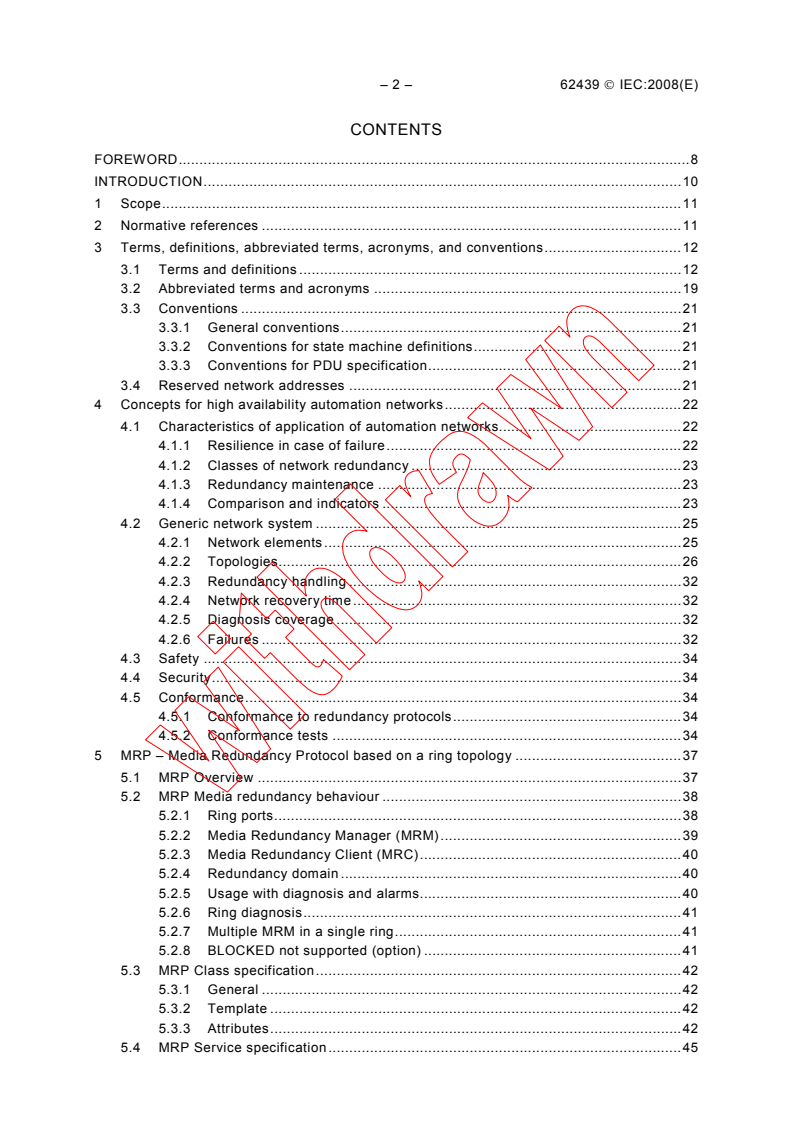
– 2 – 62439 © IEC:2008(E)
CONTENTS
FOREWORD.8
INTRODUCTION.10
1 Scope.11
2 Normative references .11
3 Terms, definitions, abbreviated terms, acronyms, and conventions.12
3.1 Terms and definitions .12
3.2 Abbreviated terms and acronyms .19
3.3 Conventions .21
3.3.1 General conventions.21
3.3.2 Conventions for state machine definitions.21
3.3.3 Conventions for PDU specification.21
3.4 Reserved network addresses .21
4 Concepts for high availability automation networks.22
4.1 Characteristics of application of automation networks.22
4.1.1 Resilience in case of failure.22
4.1.2 Classes of network redundancy .23
4.1.3 Redundancy maintenance .23
4.1.4 Comparison and indicators .23
4.2 Generic network system .25
4.2.1 Network elements.25
4.2.2 Topologies.26
4.2.3 Redundancy handling .32
4.2.4 Network recovery time .32
4.2.5 Diagnosis coverage .32
4.2.6 Failures .32
4.3 Safety .34
4.4 Security.34
4.5 Conformance.34
4.5.1 Conformance to redundancy protocols.34
4.5.2 Conformance tests .34
5 MRP – Media Redundancy Protocol based on a ring topology .37
5.1 MRP Overview .37
5.2 MRP Media redundancy behaviour .38
5.2.1 Ring ports.38
5.2.2 Media Redundancy Manager (MRM).39
5.2.3 Media Redundancy Client (MRC).40
5.2.4 Redundancy domain .40
5.2.5 Usage with diagnosis and alarms.40
5.2.6 Ring diagnosis.41
5.2.7 Multiple MRM in a single ring.41
5.2.8 BLOCKED not supported (option) .41
5.3 MRP Class specification.42
5.3.1 General .42
5.3.2 Template .42
5.3.3 Attributes.42
5.4 MRP Service specification.45
62439 © IEC:2008(E) – 3 –
5.4.1 Start MRM .45
5.4.2 Stop MRM .46
5.4.3 State Change .47
5.4.4 Start MRC .48
5.4.5 Stop MRC.49
5.4.6 Read MRM .50
5.4.7 Read MRC.52
5.5 MRP Protocol specification.53
5.5.1 PDU description .53
5.5.2 Protocol machines .59
5.6 MRP Installation, configuration and repair .79
5.6.1 Ring port parameters.79
5.6.2 Ring topology parameters.80
5.6.3 MRM and MRC parameters.80
5.6.4 Configuration.81
6 PRP – Parallel Redundancy Protocol.81
6.1 PRP Principle of operation .81
6.1.1 Single points of failure .83
6.1.2 Node structure.83
6.1.3 Compatibility between singly and doubly attached nodes.84
6.1.4 Network management.84
6.1.5 Transition to non-redundant networks.84
6.1.6 Duplicate handling.85
6.1.7 Configuration check.90
6.1.8 Network supervision .90
6.1.9 Redundancy management interface.90
6.2 PRP protocol specifications.91
6.2.1 Installation, configuration and repair guidelines .91
6.2.2 MAC addresses .91
6.2.3 Multicast MAC addresses .91
6.2.4 IP addresses .91
6.2.5 Nodes.92
6.2.6 Duplicate accept mode .92
6.2.7 Duplicate discard mode .92
6.3 PRP service specification .98
6.3.1 Arguments .98
6.3.2 NodesTable .99
6.3.3 PRP Write .100
6.3.4 PRP Read .101
6.4 PRP Management Information Base .102
6.5 PRP Protocol Implementation Conformance Statement (PICS) . 103
7 CRP – Cross-network Redundancy Protocol .103
7.1 CRP Overview.103
7.2 CRP Nodes .103
7.3 CRP LAN topology .103
7.4 CRP Key components .105
7.4.1 CRP General protocol operation .105
7.4.2 CRP Statistics .106
7.4.3 CRP Network_Status_Table .107
– 4 – 62439 © IEC:2008(E)
7.4.4 CRP Recovery time .110
7.4.5 CRP Multicast messages .111
7.4.6 CRP Unicast messages .111
7.4.7 CRP Redundancy information.112
7.4.8 CRP Redundancy statistics .112
7.5 CRP Protocol .112
7.5.1 CRP Singly attached node.112
7.5.2 CRP Doubly attached node.112
7.5.3 CRP Installation, configuration and repair. 112
7.5.4 CRP LRE model attributes.112
7.5.5 CRP Encoding of the DiagnosticFrame .118
7.5.6 CRP Encoding of the AnnunciationFrame .119
7.5.7 CRP Common protocol .121
7.5.8 CRP Operational messages.123
7.5.9 CRP services.126
8 BRP – Beacon redundancy protocol .133
8.1 BRP Overview .133
8.2 BRP Principle of operation .133
8.2.1 General .133
8.2.2 Network topology.133
8.2.3 Network components .135
8.2.4 Rapid reconfiguration of network traffic. 136
8.3 BRP stack and fault detection features .136
8.4 BRP Protocol specification .138
8.4.1 MAC addresses .138
8.4.2 EtherType.138
8.4.3 Fault detection mechanisms .138
8.4.4 End node state diagram.138
8.4.5 Beacon end node state diagram .145
8.5 BRP Message structure.152
8.5.1 General .152
8.5.2 IEEE 802.3 tagged frame header.152
8.5.3 Beacon message .152
8.5.4 Learning_Update message .153
8.5.5 Failure_Notify message .153
8.5.6 Path_Check_Request message .153
8.5.7 Path_Check_Response message.154
8.6 BRP Fault recovery time.154
8.7 BRP Service definition.155
8.7.1 Supported services.155
8.7.2 Common service parameters .155
8.7.3 Set node parameters service .155
8.7.4 Get node parameters service.157
8.7.5 Add node receive parameters service .159
8.7.6 Remove node receive parameters service .160
8.7.7 Get node status service .161
Annex A (informative) Classification of networks. 163
Annex B (informative) Availability calculations .165
Annex C (normative) Network management information base .174
62439 © IEC:2008(E) – 5 –
Annex D (informative) PRP algorithm as pseudo-code . 197
Bibliography.200
Figure 1 – General network elements (tree topology) .25
Figure 2 – Example of tree topology.27
Figure 3 – Example of linear topology.28
Figure 4 – Example of ring topology.28
Figure 5 – Example of a partially meshed topology .29
Figure 6 – Example of fully meshed topology .30
Figure 7 – Single LAN structure without redundant leaf links.30
Figure 8 – Single LAN structure with redundant leaf links.31
Figure 9 – Redundant LAN structure without redundant leaf links .31
Figure 10 – Redundant LAN structure with redundant leaf links .31
Figure 11 – Conformance test overview .35
Figure 12 – MRP Stack .38
Figure 13 – MRP Ring topology with one manager and clients .39
Figure 14 – MRP MRM in an open ring .39
Figure 15 – MRP Ring with more than one MRM.41
Figure 16 – MRP Protocol machine for MRM.60
Figure 17 – MRP Protocol machine for MRC .70
Figure 18 – PRP General redundant network example .81
Figure 19 – PRP Redundant network example as two LANs (bus topology).82
Figure 20 – PRP Redundant ring example with SANs and DANPs. .82
Figure 21 – PRP Single Ring with DANPs in SRP mode.83
Figure 22 – PRP Two DANPs communicating .83
Figure 23 – PRP Redundancy Box, transition from single to double LAN. .85
Figure 24 – PRP Frame extended by an RCT.86
Figure 25 – PRP Tagged frame extended by an RCT .87
Figure 26 – PRP Constructed, padded frame closed by an RCT.87
Figure 27 – PRP Drop window on LAN_A.88
Figure 28 – PRP Drop window reduction after a discard.89
Figure 29 – PRP Frame from LAN_B was not discarded. .89
Figure 30 – PRP Synchronized LANs.89
Figure 31 – CRP Stack architecture .103
Figure 32 – CRP Single LAN topography .104
Figure 33 – CRP Double LAN topology .104
Figure 34 – CRP DiagnosticFrame pair approach.105
Figure 35 – CRP Example system.106
Figure 36 – BRP Star network example.133
Figure 37 – BRP Linear network example .134
Figure 38 – BRP Ring network example.135
Figure 39 – BRP Stack architecture .136
Figure 40 – BRP State diagram of end node .139
– 6 – 62439 © IEC:2008(E)
Figure 41 – BRP State diagram for beacon end node.146
Figure B.1 – General symmetrical fault model.166
Figure B.2 – Simplified fault model .167
Figure B.3 – Asymmetric fault model.168
Figure B.4 – Network with no redundancy .169
Figure B.5 – Network with no single point of failure.170
Figure B.6 – Network with resiliency to second failure.172
Table 1 – Examples of application grace time .22
Table 2 – Examples of redundancy protocols .24
Table 3 – MRP Start MRM .45
Table 4 – MRP Stop MRM.47
Table 5 – MRP Change State.47
Table 6 – MRP Start MRC.48
Table 7 – MRP Stop MRC .49
Table 8 – MRP Read MRM .50
Table 9 – MRP Read MRC.52
Table 10 – MRP IEEE 802.3 DLPDU syntax.54
Table 11 – MRP OUI.54
Table 12 – MRP MulticastMACAddress.55
Table 13 – MRP TagControlInformation.Priority field.55
Table 14 – MRP LT field .55
Table 15 – MRP APDU syntax .56
Table 16 – MRP Substitutions.56
Table 17 – MRP_TLVHeader.Type.56
Table 18 – MRP_Version .57
Table 19 – MRP_Prio.57
Table 20 – MRP_PortRole .57
Table 21 – MRP_RingState.58
Table 22 – MRP_Interval .58
Table 23 – MRP_Transition.58
Table 24 – MRP_TimeStamp .58
Table 25 – MRP_Blocked.59
Table 26 – MRP_DomainUUID.59
Table 27 – MRP Local variables of MRM protocol machine .61
Table 28 – MRM State machine .62
Table 29 – MRP Local variables of MRC protocol machine .71
Table 30 – MRC State machine .71
Table 31 – MRP Functions.76
Table 32 – MRP FDB Clear Timer.79
Table 33 – MRP Topology Change Timer.79
Table 34 – MRP Network/Connection parameters .80
Table 35 – MRP MRM parameters .80
62439 © IEC:2008(E) – 7 –
Table 36 – MRP MRC parameters.80
Table 37 – PRP_Supervision frame with VLAN tagging.96
Table 38 – PRP Constants.98
Table 39 – PRP Arguments.99
Table 40 – PRP Arguments.100
Table 41 – PRP Write .101
Table 42 – PRP Read .102
Table 43 – CRP Example Network_Status_Table for node 3 . 106
Table 44 – CRP Network_Status_Table for singly connected nodes. 108
Table 45 – CRP Network_Status_Table for DANC .109
Table 46 – CRP Path_Status_Sets .116
Table 47 – CRP Example of a Path_Status_Set . 116
Table 48 – CRP Configuration attributes impact on LAN operation. 117
Table 49 – CRP DiagnosticFrame format .118
Table 50 – CRP AnnunciationFrame .119
Table 51 – CRP Unicast destination address handling . 124
Table 52 – CRP Configuration Parameters.125
Table 53 – CRP Set assignment info service parameters . 126
Table 54 – CRP Get redundancy info service.128
Table 55 – CRP Put redundancy info service .130
Table 56 – CRP Get statistics service .131
Table 57 – BRP End node flags .140
Table 58 – BRP End node state transition table . 141
Table 59 – BRP Beacon end node flags .147
Table 60 – BRP Beacon end node state transition table. 148
Table 61 – BRP Common Header with IEEE 802.3 tagged frame format . 152
Table 62 – BRP Beacon message format .153
Table 63 – BRP Learning_Update message format . 153
Table 64 – BRP Failure_Notify message format . 153
Table 65 – BRP Path_Check_Request message format .153
Table 66 – BRP Path_Check_Response message format . 154
Table 67 – BRP Set Node Parameters service parameters. 156
Table 68 – BRP Get Node Parameters service parameters .157
Table 69 – BRP Add Node Receive Parameters service parameters . 159
Table 70 – BRP Remove Node Receive Parameters service parameters. 160
Table 71 – BRP Get Node Status service parameters .161
Table A.1 – Code assignment for the field. 163
Table A.2 – Code assignment for the field .163
Table A.3 – Code assignment for the field .163
Table A.4 – Code assignment for the field.164
– 8 – 62439 © IEC:2008(E)
INTERNATIONAL ELECTROTECHNICAL COMMISSION
_____________
HIGH AVAILABILITY AUTOMATION NETWORKS
FOREWORD
1) The International Electrotechnical Commission (IEC) is a worldwide organization for standardization comprising
all national electrotechnical committees (IEC National Committees). The object of IEC is to promote
international co-operation on all questions concerning standardization in the electrical and electronic fields. To
this end and in addition to other activities, IEC publishes International Standards, Technical Specifications,
Technical Reports, Publicly Available Specifications (PAS) and Guides (hereafter referred to as “IEC
Publication(s)”). Their preparation is entrusted to technical committees; any IEC National Committee interested
in the subject dealt with may participate in this preparatory work. International, governmental and non-
governmental organizations liaising with the IEC also participate in this preparation. IEC collaborates closely
with the International Organization for Standardization (ISO) in accordance with conditions determined by
agreement between the two organizations.
2) The formal decisions or agreements of IEC on technical matters express, as nearly as possible, an international
consensus of opinion on the relevant subjects since each technical committee has representation from all
interested IEC National Committees.
3) IEC Publications have the form of recommendations for international use and are accepted by IEC National
Committees in that sense. While all reasonable efforts are made to ensure that the technical content of IEC
Publications is accurate, IEC cannot be held responsible for the way in which they are used or for any
misinterpretation by any end user.
4) In order to promote international uniformity, IEC National Committees undertake to apply IEC Publications
transparently to the maximum extent possible in their national and regional publications. Any divergence
between any IEC Publication and the corresponding national or regional publication shall be clearly indicated in
the latter.
5) IEC provides no marking procedure to indicate its approval and cannot be rendered responsible for any
equipment declared to be in conformity with an IEC Publication.
6) All users should ensure that they have the latest edition of this publication.
7) No liability shall attach to IEC or its directors, employees, servants or agents including individual experts and
members of its technical committees and IEC National Committees for any personal injury, property damage or
other damage of any nature whatsoever, whether direct or indirect, or for costs (including legal fees) and
expenses arising out of the publication, use of, or reliance upon, this IEC Publication or any other IEC
Publications.
8) Attention is drawn to the Normative references cited in this publication. Use of the referenced publications is
indispensable for the correct application of this publication.
9) The International Electrotechnical Commission (IEC) draws attention to the fact that it is claimed that
compliance with this document may involve the use of the following patents:
a) Clause 5 (MRP) may involve Patent WO 99/046908 A1 “Local network, especially Ethernet network, with
redundancy properties and redundancy manager”, owned by Siemens AG A&D, Gleiwitzerstr. 555, Nürnberg
90475 Germany and Hirschmann Automation and Control GmbH, Stuttgarter Strasse 45-51,
Neckartenzlingen 72654, Germany
b) Clause 6 (PRP) may involve Patent WO06053459 “Reception of redundant and non-redundant frames”,
owned by ABB Switzerland Ltd, Corporate Research, Segelhofstr 1K, 5405 Baden, Switzerland.
c) Clause 7 (CRP) may involve Patent U.S. 6,826,590 „Block Oriented Control System on High Speed
Ethernet“, owned by the Fieldbus Foundation, 9005 Mountain Ridge Drive – Bowie Bldg, Suite190, Austin,
TX 78759
d) Clause 8 (BRP) may involve Patent Application Serial No. US 11/520,192, "Multiple fault-tolerant Ethernet
redundancy", owned by Rockwell Automation Technologies, Inc., 1 Allen-Bradley Drive, Mayfield Heights,
Ohio, USA
IEC takes no position concerning the evidence, validity and scope of these patent rights.
The holders of these patents have assured the IEC that they are willing to negotiate licenses under reasonable
and non-discriminatory terms and conditions with applicants throughout the world. In this respect, the statement
of the holders of these patent rights is registered with IEC.
Attention is drawn to the possibility that some of the elements of this document may be the subject of patent
rights other than those identified above. IEC shall not be held responsible for identifying any or all such patent
rights.”
IEC 62439 has been prepared by subcommittee 65C: Industrial networks, of IEC technical
committee 65: Industrial-process measurement and control.
62439 © IEC:2008(E) – 9 –
The text of this International Standard is based on the following documents:
FDIS Report on voting
65C/495/FDIS 65C/498/RVD
Full information on the voting for the approval of this standard can be found in the report on
voting indicated in the above table.
This publication has been drafted in accordance with ISO/IEC Directives, Part 2.
The committee has decided that the contents of this publication will remain unchanged until
the maintenance result date indicated on the IEC web site under "http://webstore.iec.ch" in the
data related to the specific publication. At this date, the publication will be
• reconfirmed,
• withdrawn,
• replaced by a revised edition, or
• amended.
A bilingual version of this publication may be issued at a later date.
– 10 – 62439 © IEC:2008(E)
INTRODUCTION
This International Standard specifies relevant principles for high availability networks that
meet the requirements for industrial automation networks.
In the fault-free state of the network, this International Standard provides ISO/IEC 8802-3
compatible, reliable data communication, and preserves determinism of real-time data
communication. In cases of fault, removal, and insertion of a component, it provides
deterministic recovery times.
The typical Ethernet communication capabilities as used in the office world are fully retained,
so that the software involved remains applicable.
The market is in need of several network solutions, each with different performance
characteristics and functional capabilities, matching diverse application requirements. These
solutions support different redundancy topologies and mechanisms which are introduced in
Clause 4 and specified in the clauses following it. Clause 4 also distinguishes between the
different solutions, giving guidance to the user.
This International Standard follows the general structure and terms of IEC 61158.
62439 © IEC:2008(E) – 11 –
HIGH AVAILABILITY AUTOMATION NETWORKS
1 Scope
This International Standard is applicable to high-availability automation networks based on
the ISO/IEC 8802-3 (Ethernet) technology.
This International Standard specifies
• a classification scheme for network characteristics (see Annex A);
• a methodology for estimating network availability (see Annex B);
• a set of communication protocols that realize high availability automation networks via the
use of redundancy and that can be used in a variety of applications (see Clauses 5, 6, 7,
8).
2 Normative references
The following referenced documents are indispensable for the application of this International
Standard. For dated references, only the edition cited applies. For undated references, the
latest edition of the referenced document (including any amendments) applies.
IEC 60050-191, International Electrotechnical Vocabulary (IEV) – Chapter 191: Dependability
and quality of service
IEC 61158 (all parts), Industrial communication networks – Fieldbus specifications
IEC 61784-1, Industrial communication networks – Profiles – Part 1: Fieldbus profiles
IEC 61784-2, Industrial communications networks – Profiles – Part 2: Additional fieldbus
profiles for real-time networks based on ISO/IEC 8802-3
IEC 61918, Industrial communications networks – Installation of communication networks in
industrial premises
IEEE 802, IEEE standard for local and metropolitan area networks: Overview and Architecture
IEEE 802a, IEEE standard for local and metropolitan area networks: Overview and
Architecture
Amendment 1: Ethertypes for Prototype and Vendor-Specific Protocol Development
IEEE 802.1D, IEEE standard for local and metropolitan area networks: Media Access Control
(MAC) bridges
IEEE 802.1Q, IEEE standards for local and metropolitan area networks: Virtual bridged local
area networks
IEEE 802.3:2005, Carrier sense multiple access with collision detection (CSMA/CD) access
method and physical layer specifications
IEEE 1588, IEEE Standard for a Precision Clock Synchronization Protocol for Networked
Measurement and Control Systems
– 12 – 62439 © IEC:2008(E)
DARPA Internet Program Protocol Specification, Internet Protocol, RFC 791
3 Terms, definitions, abbreviated terms, acronyms, and conventions
3.1 Terms and definitions
For the purposes of this document, the terms and definitions given in IEC 60050-191, as well
as the following, apply.
3.1.1
aggregated link
set of inter-switch links configured to work as one inter-switch link
[IEEE 802.3:2005, Clause 43]
3.1.2
aggregated ports
set of inter-switch ports configured to work as one inter-switch port
[IEEE 802.3:2005, Clause 43]
3.1.3
availability (performance)
ability of an item to be in a state to perform a required function under given conditions at a
given instant of time or over a given time interval, assuming that the required external
resources are provided.
NOTE 1 This ability depends on the combined aspects of the reliability performance, the maintainability
performance, and the maintenance support performance.
NOTE 2 Required external resources, other than maintenance resources, do not affect the availability
performance of the item.
[IEV 191-02-05]
3.1.4
channel
layer 2 connection between two end nodes which consists of one or more paths (for
redundancy) between end nodes
3.1.5
common mode failure
failure that affects all redundant elements for a given function at the same time
3.1
...