


IEC TR 62283:2010
(Main)Optical fibres - Guidance for nuclear radiation tests
General Information
- Abstract
IEC/TR 62283:2010(E) gives a short summary of the radiation exposure in certain environments and applications and the different radiation effects on fibres. It also describes the most important radiation effect, i.e. the increase of transmission loss, and its strong dependence on a variety of fibre properties and test conditions. These dependencies need to be known in order to perform appropriate tests for each specific application as well as to understand, compare and qualify the test results obtained at different laboratories when performed according to IEC 60793-1-54, Optical fibres - Part 1-54: Measurement methods and test procedures - Gamma irradiation. The main changes with respect to the previous edition are:
- Clause 5 now also covers industrial environment,
- A new Clause 9 has been added to deal with "measurement techniques and quality assurance of attenuation measurements".
- Status
- Published
- Publication Date
- 27-Jun-2010
- Technical Committee
- SC 86A - Fibres and cables
- Drafting Committee
- WG 1 - TC 86/SC 86A/WG 1
- Current Stage
- PPUB - Publication issued
- Start Date
- 28-Jun-2010
- Completion Date
- 15-Oct-2010
Overview
IEC TR 62283:2010 - "Optical fibres - Guidance for nuclear radiation tests" is a technical report from the IEC that provides practical background and guidance for testing optical fibres exposed to ionizing radiation. It summarizes typical radiation environments (reactors, fusion, space, medical, military, industrial) and explains radiation effects on optical fibres, with a strong focus on the dominant effect: radiation‑induced transmission loss (attenuation). The report clarifies dependencies on fibre properties and test conditions so laboratories and designers can perform appropriate radiation tests and compare results obtained under IEC 60793-1-54 gamma‑irradiation procedures.
Key Topics and Requirements
- Radiation environments & dose concepts: overview of natural and technical radiation sources, dose units (Gray, rad), dose rate and material-dependent dose deposition.
- Radiation shielding & dosimetry: guidance on dose calculation, dosimeter selection and facility considerations for reliable test campaigns.
- Irradiation facilities and particle types: guidance for continuous gamma, neutron, proton, electron and pulsed irradiations and their relevance to fibre degradation.
- Radiation effects on fibres: mechanisms and manifestations such as ionization, defect generation, refractive-index changes, and most importantly, increase of attenuation.
- Dependencies of radiation‑induced loss: effects of fibre type, wavelength, temperature, light power (photobleaching), dose rate, irradiation history and radiation type; annealing behavior after exposure.
- Measurement techniques & quality assurance: new Clause 9 in Edition 2 adds best practices for attenuation measurement methods, uncertainty control and inter‑laboratory comparability.
- Passive components: guidance on radiation effects for connectors, couplers, multiplexers and fibre Bragg gratings.
Practical Applications
IEC TR 62283 is used to:
- Design and qualify optical fibres and passive components for harsh radiation environments (nuclear power plants, fusion facilities, space missions, high‑energy physics experiments, medical and military systems, industrial irradiation sites).
- Define realistic test conditions and interpret results from gamma and particle irradiation according to IEC 60793-1-54.
- Establish measurement quality assurance for attenuation testing to ensure repeatable, comparable results between test labs.
- Support procurement, acceptance testing and lifetime prediction of fibre optic links used where ionizing radiation is a risk.
Who should use this standard
- Fibre manufacturers and materials scientists
- Test laboratories and dosimetrists
- System designers for nuclear, space, medical and defense applications
- Quality assurance engineers and standards/qualification teams
Related Standards
- IEC 60793-1-54 - Measurement methods and test procedures - Gamma irradiation (primary test method referenced)
- IEC 60793-1-40 - Attenuation measurement methods
- IEC 60793-1-46 - Monitoring changes in optical transmittance
IEC TR 62283 complements these standards by giving the radiation‑science context and measurement QA guidance needed to perform meaningful, application‑specific radiation tests on optical fibres.
Relations
- Effective Date
- 05-Sep-2023
Get Certified
Connect with accredited certification bodies for this standard

ANCE
Mexican certification and testing association.

Intertek Slovenia
Intertek testing, inspection, and certification services in Slovenia.

LNE (Laboratoire National de Métrologie et d'Essais)
French national laboratory for metrology and testing.
Sponsored listings
Frequently Asked Questions
IEC TR 62283:2010 is a technical report published by the International Electrotechnical Commission (IEC). Its full title is "Optical fibres - Guidance for nuclear radiation tests". This standard covers: IEC/TR 62283:2010(E) gives a short summary of the radiation exposure in certain environments and applications and the different radiation effects on fibres. It also describes the most important radiation effect, i.e. the increase of transmission loss, and its strong dependence on a variety of fibre properties and test conditions. These dependencies need to be known in order to perform appropriate tests for each specific application as well as to understand, compare and qualify the test results obtained at different laboratories when performed according to IEC 60793-1-54, Optical fibres - Part 1-54: Measurement methods and test procedures - Gamma irradiation. The main changes with respect to the previous edition are: - Clause 5 now also covers industrial environment, - A new Clause 9 has been added to deal with "measurement techniques and quality assurance of attenuation measurements".
IEC/TR 62283:2010(E) gives a short summary of the radiation exposure in certain environments and applications and the different radiation effects on fibres. It also describes the most important radiation effect, i.e. the increase of transmission loss, and its strong dependence on a variety of fibre properties and test conditions. These dependencies need to be known in order to perform appropriate tests for each specific application as well as to understand, compare and qualify the test results obtained at different laboratories when performed according to IEC 60793-1-54, Optical fibres - Part 1-54: Measurement methods and test procedures - Gamma irradiation. The main changes with respect to the previous edition are: - Clause 5 now also covers industrial environment, - A new Clause 9 has been added to deal with "measurement techniques and quality assurance of attenuation measurements".
IEC TR 62283:2010 is classified under the following ICS (International Classification for Standards) categories: 33.180.10 - Fibres and cables. The ICS classification helps identify the subject area and facilitates finding related standards.
IEC TR 62283:2010 has the following relationships with other standards: It is inter standard links to IEC TR 62283:2003. Understanding these relationships helps ensure you are using the most current and applicable version of the standard.
IEC TR 62283:2010 is available in PDF format for immediate download after purchase. The document can be added to your cart and obtained through the secure checkout process. Digital delivery ensures instant access to the complete standard document.
Standards Content (Sample)
IEC/TR 62283 ®
Edition 2.0 2010-06
TECHNICAL
REPORT
Optical fibres – Guidance for nuclear radiation tests
IEC/TR 62283:2010(E)
All rights reserved. Unless otherwise specified, no part of this publication may be reproduced or utilized in any form or by
any means, electronic or mechanical, including photocopying and microfilm, without permission in writing from either IEC or
IEC's member National Committee in the country of the requester.
If you have any questions about IEC copyright or have an enquiry about obtaining additional rights to this publication,
please contact the address below or your local IEC member National Committee for further information.
Droits de reproduction réservés. Sauf indication contraire, aucune partie de cette publication ne peut être reproduite
ni utilisée sous quelque forme que ce soit et par aucun procédé, électronique ou mécanique, y compris la photocopie
et les microfilms, sans l'accord écrit de la CEI ou du Comité national de la CEI du pays du demandeur.
Si vous avez des questions sur le copyright de la CEI ou si vous désirez obtenir des droits supplémentaires sur cette
publication, utilisez les coordonnées ci-après ou contactez le Comité national de la CEI de votre pays de résidence.
IEC Central Office
3, rue de Varembé
CH-1211 Geneva 20
Switzerland
Email: inmail@iec.ch
Web: www.iec.ch
About IEC publications
The technical content of IEC publications is kept under constant review by the IEC. Please make sure that you have the
latest edition, a corrigenda or an amendment might have been published.
ƒ Catalogue of IEC publications: www.iec.ch/searchpub
The IEC on-line Catalogue enables you to search by a variety of criteria (reference number, text, technical committee,…).
It also gives information on projects, withdrawn and replaced publications.
ƒ IEC Just Published: www.iec.ch/online_news/justpub
Stay up to date on all new IEC publications. Just Published details twice a month all new publications released. Available
on-line and also by email.
ƒ Electropedia: www.electropedia.org
The world's leading online dictionary of electronic and electrical terms containing more than 20 000 terms and definitions
in English and French, with equivalent terms in additional languages. Also known as the International Electrotechnical
Vocabulary online.
ƒ Customer Service Centre: www.iec.ch/webstore/custserv
If you wish to give us your feedback on this publication or need further assistance, please visit the Customer Service
Centre FAQ or contact us:
Email: csc@iec.ch
Tel.: +41 22 919 02 11
Fax: +41 22 919 03 00
IEC/TR 62283 ®
Edition 2.0 2010-06
TECHNICAL
REPORT
Optical fibres – Guidance for nuclear radiation tests
INTERNATIONAL
ELECTROTECHNICAL
COMMISSION
PRICE CODE
V
ICS 33.180.10 ISBN 978-2-88912-031-4
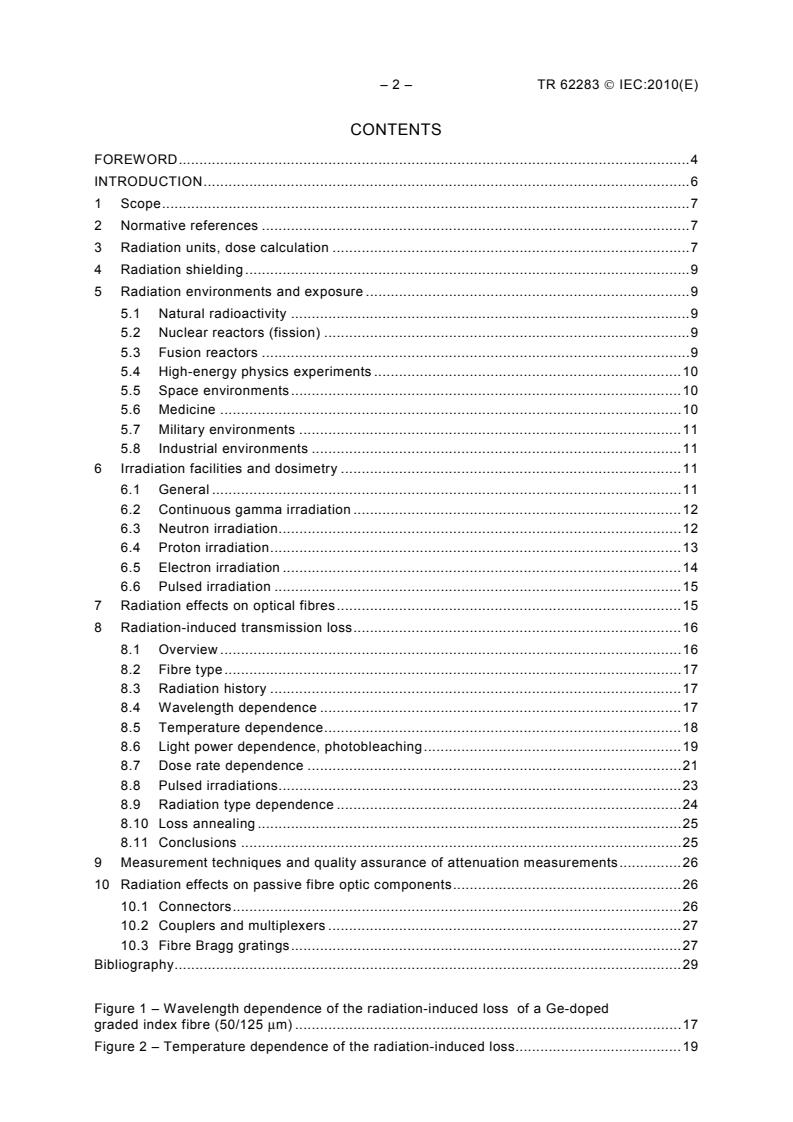
– 2 – TR 62283 © IEC:2010(E)
CONTENTS
FOREWORD.4
INTRODUCTION.6
1 Scope.7
2 Normative references .7
3 Radiation units, dose calculation .7
4 Radiation shielding .9
5 Radiation environments and exposure .9
5.1 Natural radioactivity .9
5.2 Nuclear reactors (fission) .9
5.3 Fusion reactors .9
5.4 High-energy physics experiments .10
5.5 Space environments.10
5.6 Medicine .10
5.7 Military environments .11
5.8 Industrial environments .11
6 Irradiation facilities and dosimetry .11
6.1 General .11
6.2 Continuous gamma irradiation .12
6.3 Neutron irradiation.12
6.4 Proton irradiation.13
6.5 Electron irradiation .14
6.6 Pulsed irradiation .15
7 Radiation effects on optical fibres.15
8 Radiation-induced transmission loss.16
8.1 Overview .16
8.2 Fibre type.17
8.3 Radiation history .17
8.4 Wavelength dependence .17
8.5 Temperature dependence.18
8.6 Light power dependence, photobleaching.19
8.7 Dose rate dependence .21
8.8 Pulsed irradiations.23
8.9 Radiation type dependence .24
8.10 Loss annealing .25
8.11 Conclusions .25
9 Measurement techniques and quality assurance of attenuation measurements.26
10 Radiation effects on passive fibre optic components.26
10.1 Connectors.26
10.2 Couplers and multiplexers .27
10.3 Fibre Bragg gratings.27
Bibliography.29
Figure 1 – Wavelength dependence of the radiation-induced loss of a Ge-doped
graded index fibre (50/125 μm) .17
Figure 2 – Temperature dependence of the radiation-induced loss.19
TR 62283 © IEC:2010(E) – 3 –
Figure 3 – Light power dependence of the radiation-induced loss of an undoped
single-mode fibre .20
Figure 4 – Light power dependence of the radiation-induced loss in modern MM SI
and SM fibres .20
Figure 5 – Dose rate dependence of the radiation-induced loss; T = 22 °C .22
Figure 6 – Annealing of the radiation-induced loss of a Ge-doped GI fibre after pulsed
electron irradiation with dose values of 5 Gy(SiO ), 100 Gy(SiO ) and 1 000 Gy(SiO ),
2 2 2
respectively .23
– 4 – TR 62283 © IEC:2010(E)
INTERNATIONAL ELECTROTECHNICAL COMMISSION
____________
OPTICAL FIBRES –
GUIDANCE FOR NUCLEAR RADIATION TESTS
FOREWORD
1) The International Electrotechnical Commission (IEC) is a worldwide organization for standardization comprising
all national electrotechnical committees (IEC National Committees). The object of IEC is to promote
international co-operation on all questions concerning standardization in the electrical and electronic fields. To
this end and in addition to other activities, IEC publishes International Standards, Technical Specifications,
Technical Reports, Publicly Available Specifications (PAS) and Guides (hereafter referred to as “IEC
Publication(s)”). Their preparation is entrusted to technical committees; any IEC National Committee interested
in the subject dealt with may participate in this preparatory work. International, governmental and non-
governmental organizations liaising with the IEC also participate in this preparation. IEC collaborates closely
with the International Organization for Standardization (ISO) in accordance with conditions determined by
agreement between the two organizations.
2) The formal decisions or agreements of IEC on technical matters express, as nearly as possible, an international
consensus of opinion on the relevant subjects since each technical committee has representation from all
interested IEC National Committees.
3) IEC Publications have the form of recommendations for international use and are accepted by IEC National
Committees in that sense. While all reasonable efforts are made to ensure that the technical content of IEC
Publications is accurate, IEC cannot be held responsible for the way in which they are used or for any
misinterpretation by any end user.
4) In order to promote international uniformity, IEC National Committees undertake to apply IEC Publications
transparently to the maximum extent possible in their national and regional publications. Any divergence
between any IEC Publication and the corresponding national or regional publication shall be clearly indicated in
the latter.
5) IEC itself does not provide any attestation of conformity. Independent certification bodies provide conformity
assessment services and, in some areas, access to IEC marks of conformity. IEC is not responsible for any
services carried out by independent certification bodies.
6) All users should ensure that they have the latest edition of this publication.
7) No liability shall attach to IEC or its directors, employees, servants or agents including individual experts and
members of its technical committees and IEC National Committees for any personal injury, property damage or
other damage of any nature whatsoever, whether direct or indirect, or for costs (including legal fees) and
expenses arising out of the publication, use of, or reliance upon, this IEC Publication or any other IEC
Publications.
8) Attention is drawn to the Normative references cited in this publication. Use of the referenced publications is
indispensable for the correct application of this publication.
9) Attention is drawn to the possibility that some of the elements of this IEC Publication may be the subject of
patent rights. IEC shall not be held responsible for identifying any or all such patent rights.
The main task of IEC technical committees is to prepare International Standards. However, a
technical committee may propose the publication of a technical report when it has collected
data of a different kind from that which is normally published as an International Standard, for
example "state of the art".
IEC 62283, which is a technical report, has been prepared by subcommittee 86A: Fibres and
cables, of IEC technical committee 86: Fibre optics.
This second edition cancels and replaces the first edition of IEC/TR 62283 published in 2003
and constitutes a technical revision.
The main changes with respect to the previous edition are listed below:
– Clause 5 now also covers Industrial environment.
– a new Clause 9 has been added to deal with "Measurement techniques and quality
assurance of attenuation measurements".
TR 62283 © IEC:2010(E) – 5 –
The text of this technical report is based on the following documents:
Enquiry draft Report on voting
86A/1312/DTR 86A/1327/RVC
Full information on the voting for the approval of this technical report can be found in the
report on voting indicated in the above table.
This publication has been drafted in accordance with the ISO/IEC Directives, Part 2.
The committee has decided that the contents of this publication will remain unchanged until
the stability date indicated on the IEC web site under "http://webstore.iec.ch" in the data
related to the specific publication. At this date, the publication will be
• reconfirmed,
• withdrawn,
• replaced by a revised edition, or
• amended.
A bilingual version of this publication may be issued at a later date.
– 6 – TR 62283 © IEC:2010(E)
INTRODUCTION
In order to restrict the test method of IEC 60793-1-54, Optical fibres – Part 1-54: Measure-
ment methods and test procedures – Gamma irradiation to a clear, concise listing of
instructions, the background knowledge that is necessary to perform correct, relevant and
expressive irradiation tests as well as to limit measurement uncertainty is presented here
separately as a "guidance document".
TR 62283 © IEC:2010(E) – 7 –
OPTICAL FIBRES –
GUIDANCE FOR NUCLEAR RADIATION TESTS
1 Scope
This technical report gives a short summary of the radiation exposure in certain environments
and applications and the different radiation effects on fibres. It also describes the most
important radiation effect, i.e. the increase of transmission loss, and its strong dependence on
a variety of fibre properties and test conditions. These dependencies need to be known in
order to perform appropriate tests for each specific application as well as to understand,
compare and qualify the test results obtained at different laboratories when performed
according to IEC 60793-1-54, Optical fibres – Part 1-54: Measurement methods and test
procedures – Gamma irradiation.
2 Normative references
The following referenced documents are indispensable for the application of this document.
For dated references, only the edition cited applies. For undated references, the latest edition
of the referenced document (including any amendments) applies.
IEC 60793-1-40, Optical fibres − Part 1- 40: Measurement methods and test procedures −
Attenuation
IEC 60793-1-46, Optical fibres − Part 1-46: Measurement methods and test procedures −
Monitoring of changes in optical transmittance
IEC 60793-1-54, Optical fibres − Part 1-54: Measurement methods and test procedures −
Gamma irradiation
3 Radiation units, dose calculation
The interaction of radiation with matter depends on charge, mass and energy in the case of
particle radiation (for example, electrons, protons, neutrons, alphas and heavy ions) and on
energy in the case of electromagnetic radiation such as X-rays or gamma quanta. The
interaction causes an energy transfer to the respective matter. This leads to ionization and
warming up. Additionally structural damage in the material may occur at higher doses, leading
to other effects such as changes of refractive index or mechanical properties.
The higher the radiation's energy, the stronger its penetrability and the longer its range. The
energy unit is the electron Volt (eV). Usual radiation energies in natural or technical
environments range from tens of keV (medical X-rays) to several MeV (fission or fusion
reactors and nuclear weapons). Current energies at high-energy physics accelerators vary
depending on the type of colliding particles. The highest energy for electron-positron
collisions is 100 GeV per beam. For proton-proton collisions the energy per beam is 1 TeV.
The new "Large Hadron Collider" (LHC) at CERN uses beams with an energy of 7 TeV. In
addition, there are quite a number of other accelerators which operate between these limits.
Note that these energies refer to the colliding particles. The secondary particles, i.e. the ones
likely to affect fibres, have much lower energies.
The energy deposited by ionizing radiation in matter is called "energy dose" (or absorbed
−7
dose). The old unit is rad, (rd or rad); 1 rad = 100 erg/g (1 erg = 10 J) but should not be
used anymore. The SI unit is the Gray [Gy]; 1 Gy = 1 J/kg = 100 rad.
– 8 – TR 62283 © IEC:2010(E)
Some dosimeter types measure the charge released in a gas (for example, ionization
chambers). This was used to define another type of dose, the "ion dose". The ion dose unit is
−4
the röntgen (non-SI unit), [R]; 1 R = 2,58 × 10 C/kg, with C = charge unit (coulomb).
Conversion of ion dose, D', to energy dose, D, can be performed for Co gamma rays (about
1,2 MeV) by
Gy(air)
D = 0,879 D' (1)
R
If this unit is used, the values of relevant quantities shall be given in terms of SI units first
followed by these non-SI units in parentheses.
The energy transfer of gammas and X-rays to matter depends on their energy as well as on
the irradiated material. Therefore, the material has to be added to the dose unit (for example
[Gy(Si)], [rad(SiO )], [Gy(air)] etc.), and the dose D(d) measured with a dosimeter material d
(for example, air) can differ significantly from the dose D(m) deposited in the investigated
material m (for example, Si, SiO , InGaAs etc.).
The dose ratio between both materials D(m) is given by the ratio of their "photon mass energy
absorption coefficient" μ /ρ:
en
(μ / ρ)
en m
D(m) = D(d) (2)
(μ / ρ)
en d
The μ /ρ-values can differ significantly, especially for materials of high and low atomic
en
number at energies < 300 keV. They are tabulated for various elements and compounds in
reference [1 ] .
The dose rate, i.e. the dose exposition per time, should be given in units of Gy/h, kGy/h, or
Gy/s.
The intensity of particle radiation is usually characterized by the fluence Φ. The unit is
2 −2
particles/cm or only cm . The dose of charged particles (in a certain material depth) can be
calculated from their fluence and their (energy-dependent) energy loss per unit of length,
dE/dx (= stopping power):
Φ dE
D = ⋅ (3)
ρ dx
with ρ = material density. The stopping power can be calculated with the software package
"SRIM" , see [2]. The particle fluence per time unit is called flux or flux density. The unit is
−2 −1
cm s .
The neutron dose D can be calculated from its fluence Φ and the energy and material
n
n
dependent "fluence dose conversion factor" or "kerma factor" k(E ,Mat.):
n
.)D = Φ ⋅k(E ,Mat (4)
n n n
The kerma-factors are tabulated for a variety of elements and compounds in [3] .
___________
1)
Numbers in square brackets refer to the bibliography.
2)
SRIM is the trade name of a product supplied by IBM. This information is given for the convenience of users of
this Technical Report and does not constitute an endorsement by IEC of the product named. Equivalent
products may be used if they can be shown to lead to the same results.
TR 62283 © IEC:2010(E) – 9 –
4 Radiation shielding
Shielding of optical fibres against (especially gamma) radiation is in most cases not
reasonably achievable since, for example, gamma rays of 1 MeV are attenuated to 1/10 of
their initial intensity only by 5 cm of lead.
However, buried fibre cables that are layed in at least 1 m depth are shielded against 1 MeV
gamma rays by about a factor of 10 .
5 Radiation environments and exposure
5.1 Natural radioactivity
The predominant radiation type is gamma rays. Typical annual dose value for earth cables or
undersea cables is <0,004 Gy. The total dose during an expected cable lifetime of 25 years
would thus be <0,1 Gy. Distinctly higher values are possible, for example, above uranium or
thorium ore deposits. The dose and dose rates are typical and may vary depending on the
specific application.
5.2 Nuclear reactors (fission)
Optical fibres can be exposed to gamma rays as well as to thermal and fast neutrons. Dose
and fluence values depend strongly on the place within the reactor building and the operating
conditions of the reactor (for example the power delivery, normal operation or accident).
Within the containment area, exposure levels range from 0,001 Gy/h to 0,03 Gy/h up to about
1 Gy/h near the primary coolant lines. The dose rate around the fuel rods is of the order of
3 4
10 Gy/h. In the early stage of an accident, dose rates as high as 10 Gy/h will occur within
the containment [4] .
The neutron flux (= fluence Φ per unit of time) within the containment can range from about
–2 –1 12 –2 –1
10 cm s up to about 10 cm s near the fuel rods.
The dose, dose rates and neutron fluence are typical and may vary depending on the specific
application.
5.3 Fusion reactors
The primary radiation emitted after the fusion of deuterium (D) and tritium (T) nuclei are
4 4
14 MeV neutrons and He nuclei (energy about 3,5 MeV). The He ions are very short-ranged
and will not reach optical fibres that might be used as sensors or to transfer data, whereas the
fast neutrons are very penetrating and will also activate the structural materials around the
reaction chamber. These materials then emit high gamma ray intensities also after reactor
turn-off.
Again, the total dose and neutron fluence values depend strongly on location and operation
conditions.
For the future test facility ITER (International Thermonuclear Experimental Reactor), gamma
2 7 9
dose rates at the first wall of about 2×10 Gy/s and life dose values of 10 Gy to 10 Gy are
–
20 2
expected. The neutron fluence there could reach values up to 10 cm .
At inertial confinement fusion (ICF) facilities such as "Laser Megajoule" (France) or "National
Ignition Facility" (USA) diagnostic equipment, comprising also optical fibres, is exposed to
3 10
pulsed radiation of up to 10 Gy at dose rates up to 10 Gy/s.
The dose and dose rates are typical and may vary depending on the specific application.
– 10 – TR 62283 © IEC:2010(E)
5.4 High-energy physics experiments
Usually, in high-energy physics, electrons or protons with energies as high as several
100 GeV (protons) are used to study elementary particles. In order to increase the reaction
energy it is common that two beams collide within a reaction zone which is surrounded by
huge detectors analyzing the reaction products. The accelerator tube and the inner parts of
the detectors will become highly radioactive, especially if protons collide.
The secondary radiation that threatens the accelerator control instruments and the detector
read-out equipment mainly consists of pions (mean energy several 100 MeV), gamma rays
and, at radii >50 cm, of neutrons with maximum energies up to more than 100 MeV, but a
mean energy of only about 1 MeV to 2 MeV. The radiation intensities strongly depend on the
operating conditions (particle energy, beam current), the distance from the beam line, and the
emission angle (maximum in beam direction). Particularly in the beam cleaning sections, high
radiation levels may occur.
5 6
The annual total dose can be of the order of 10 Gy to 10 Gy and the neutron fluence can
13 −2 15 −2
reach values from 10 cm to 10 cm . The dose and dose rates are typical and may vary,
depending on the specific application.
5.5 Space environments
Close to the earth the dominating radiations are solar protons, trapped protons and trapped
electrons. "Trapped" means trapped by the magnetic field of the earth, within the Van Allen
Belts.
The electrons are concentrated in an inner zone (ending at about 2,4 earth radii) and an outer
zone (between about 2,8 earth radii and 12 earth radii). Their maximum energy is about
7 MeV. They can be stopped, for example, by about 10 mm Al. During the slowing down
process in matter, they produce penetrating X-rays (Bremsstrahlung).
The proton flux decreases with increasing distance from earth. The maximum energy is
several 100 MeV. For example, the range of 300 MeV protons in Al is about 24 cm. More than
90 % of the protons have energies below 100 MeV.
In a geostationary orbit (for example, 15° east) the total annual dose behind 3 mm Al is nearly
600 Gy, of which about 550 Gy is caused by trapped electrons and about 50 Gy by solar
protons. In a low earth orbit (LEO), height 1 000 km and 70° inclination, the total annual dose
of about 823 Gy (behind 3 mm Al) is composed of about 400 Gy trapped electron contribution,
about 420 Gy trapped proton contribution and 3 Gy solar proton contribution.
Additionally to the above-mentioned radiation types, cosmic rays are an additional type of
space radiation. The "primary" cosmic rays are a low flux of high energetic particles (about
85 % protons, 14 % alpha particles and about 1 % heavier nuclei). Their contribution to the
total dose, however, is negligible.
Particle fluences for certain orbits and dose values can be calculated, for example, with the
"SPENVIS" system [5]. The dose and dose rates are typical and may vary depending on the
specific application.
5.6 Medicine
For radiography purposes (diagnostics) X-rays with energies <100 keV are used. With modern
−3
image intensifier techniques dose values <10 Gy are sufficient to take a series of
expressive pictures.
Irradiation of tumours is made with Co gamma rays, high energy electrons (20 MeV to
30 MeV), high energy protons (60 MeV to 300 MeV) or heavy ions (for example C, 2 GeV to
4 GeV), and thermal or fast neutrons. Dose values within the tumour can reach several Gy per
TR 62283 © IEC:2010(E) – 11 –
"session". The dose and dose rates are typical and may vary depending on the specific
application.
5.7 Military environments
The radiation emitted from a nuclear weapon can be divided into prompt (gamma) radiation
−8
emitted during the explosion phase within a time of about 10 s, and a delayed component
(gammas and fast neutrons) becoming effective after times of up to 1 min. Despite the fact
that the contribution of prompt radiation to the total dose is less than 10 %, this component
−8
can be very destructive because of its high dose rate (for example, 1 Gy within 10 s, i.e. a
dose rate of 10 Gy/s). Therefore, special tests with pulsed radiation sources (for example,
flash X-ray generators) would have to be performed to simulate this radiation component.
Total dose and neutron fluence depend on weapon strength (explosive force), the weapon
type (contribution of fusion energy), and the distance from the explosion site. The radiation
emission for a given explosive force can be increased by increasing the fusion contribution
("neutron bomb" or "radiation enhanced weapon"). According to the "balanced hardening"
principle, fibre cables should not withstand extremely high radiation dose values near the
center of the explosion, where heat and shock wave will destroy the cable anyway.
Typical (initial) radiation exposure levels are
8 9
− prompt radiation dose rate 10 Gy/s to 10 Gy/s (prompt dose 1 Gy to 5 Gy),
− total dose 30 Gy to 100 Gy,
12 −2 13 −2
− fast neutron fluence 10 cm to 10 cm (1 MeV).
With high-altitude (= exo-atmospheric) nuclear explosions the high amount of X-ray energy
will not be absorbed and can cause significant damage, even far away from the explosion.
Apart from the initial radiation (emitted within about 1 min after explosion) "fall out" can
severely contaminate large areas, dependent on explosion height, direction and strength of
the wind, and rainfall. Dose levels up to several tens of Gy can be reached within 10 h to 15 h
after explosion in areas of several 100 km .
Details about radiation emission from nuclear weapons can be found, for example, in [6] . T h e
dose and dose rates are typical and may vary depending on the specific application.
5.8 Industrial environments
Several industrial applications benefit from ionising radiation. Examples are sterilisation and
material irradiations, especially plastic materials. For sterilisation either gamma sources with
high activities or electron accelerators are used depending on the target material and
thickness. Such gamma sources can have activities of up to exa-Becquerel (10 Bq or EBq).
Electron accelerators are often used for cross linking of plastic materials. They are operated
with energies of up to several MeV. Here not only does the primary electron beam have to be
considered, but also the secondary X-ray field. The doses vary between the applications and
could be up to some 10 kGy or even MGy.
6 Irradiation facilities and dosimetry
6.1 General
In most environments radiation exposure is caused by different kinds of radiation, as outlined
in Clause 5. As long as gamma rays or high energy X-rays are the dominant radiation type it
might be sufficient to apply the expected total dose by gamma rays. However, in cases where
fast neutrons, protons and even high energy electrons contribute significantly to the total
dose, irradiation with these particle types might also become important for reasons that are
described briefly in 8.8.
– 12 – TR 62283 © IEC:2010(E)
6.2 Continuous gamma irradiation
In most of the radiation environments, the mean gamma energy is around 1 MeV so that
60 137
irradiation tests can be made with the widely used radioactive isotopes Co or Cs. Their
gamma energy and half-life are about 1,25 MeV (mean value) and 5,3 years or 0,66 MeV and
30,2 years, respectively. Test samples (as well as dosimeters) would have to be covered with
the energy-dependent dose build-up layer in order to reach "secondary electron equilibrium".
For Co gamma radiation a layer thickness of 1,5 mm aluminium is sufficient [7 ].
Irradiation with distinctly higher gamma energy can also change the fibre degradation
mechanism (ratio of ionization and structural damage). Use of low energy gammas (or X-
rays), especially below 0,1 MeV, will lead to rapid variation of dose as a function of depth
within the fibre sample and to dosimetry errors ("dose enhancement" at interfaces between
different materials).
The radiation-induced transmission loss of fibres also depends on dose rate, i.e. on the time
that is necessary to reach the expected dose (see 8.7). Irradiation should therefore only be
performed with dose rates recommended by the "test procedure" (if not otherwise specified) in
order to give comparable results.
Dose rate and/or dose can be measured, for example, with ionization chambers,
thermoluminescence dosimeters (TLDs) or radiochromatic film. A dose build-up layer of
necessary thickness has to be provided. At high dose rates ionization chambers might show
unacceptably high "recombination loss". Dose measurement with calibrated "dosimeter
fibres", i.e. fibres with very high and non-annealing increase of attenuation, (see [8] , [9 ], [ 1 0 ],
and [11] and the literature cited therein), can give improved results for specific test sample
configurations. Using optical fibres for dosimetry requires some experience to be routinely
applied.
6.3 Neutron irradiation
Different radiation sources usually produce neutrons with a distinctly different energy
spectrum, as outlined in Clause 4. In [12], it is described how neutrons of different energy
lead to different fibre degradation mechanisms. To investigate the influence of neutron
irradiation on optical fibres it is therefore not sufficient to apply a certain neutron fluence. At
least the mean energy at the test facility should be comparable with that of the radiation
environment in question.
Radioactive (α, n) neutron sources and spontaneous fission sources (mainly Cf) release
"fast" neutrons with energies of several MeV. (α, n) sources are a mixture of α-emitters such
9 12
as Ra, Am or Po with Be. Collision of an α particle with a Be nucleus can result in a C
nucleus and a fast neutron. An Am-Be source with an activity of 1 Ci (= Curie) would only
yield about 2×10 n/s (in 4π). Such sources are cheap, but their neutron output is too low for
the majority of the necessary tests.
Some fission reactors are used for test purposes. These research reactors can deliver high
15 −2 −1
fluxes (up to about 10 cm s ) of fast (mean neutron energy about 1 MeV) as well as slow
or "thermal" neutrons with energies <1 MeV, depending on the reactor design.
Relatively high fluxes of monoenergetic fast neutrons can be obtained with "neutron
generators". These are small accelerators where deuterons (d) are accelerated to energies of
only 0,2 MeV to 0,5 MeV. The deuterons are focused on a "target" that contains deuterium (D)
or tritium (T) and produce neutrons with an energy of about 2,6 MeV or 14,5 MeV,
8 −1
respectively. The neutron output with a deuteron current of 1 mA is about 4×10 s or
11 −1
10 s , respectively (in 4π).
Very high intensities of fast neutrons can be produced at "spallation sources". These are
accelerators where protons with energies up to 1 GeV and beam currents up to 1 mA are
directed on to a heavy metal target (for example, Pb or Hg). In order to produce thermalized
TR 62283 © IEC:2010(E) – 13 –
neutrons, the target can be surrounded by moderating material, and fluxes up to about
14 −2 −1
5×10 cm s are available. Existing facilities are the SINQ source at Paul-Scherrer-
Institute (CH), ISIS at Rutherford Appleton Laboratory (UK), and SNS at Oak Ridge National
Laboratory (US).
Pulsed reactors (for example, of the TRIGA type) and, especially, "fast burst reactors" are
mainly used for nuclear weapons effects testing. They produce neutron pulses with a duration
of <50 ms or <0,1 ms, respectively. The neutrons are accompanied by high energetic gammas
that contribute about 10 % to the total dose.
Several neutron irradiation places are also available at CERN [1 3], [14]. The neutrons are
secondary products and are mostly released during nuclear reactions with high energetic
protons. The energy spectrum is comparable with that of fission neutrons. Comparable
sources providing either a secondary quasi mono-energetic neutron beam [15] or an
atmospheric neutron spectrum [16] are available at the Uppsala Neutron Beam Facility of
TSL, Sweden.
For some special situations, it is possible to simulate the effect of neutrons of one energy (for
example, fission neutrons with a mean energy of about 1 MeV) by neutrons with distinctly
different energy, for example, fusion neutrons with about 14,5 MeV. From reference [3] , i t c an
be calculated that 14,5 MeV neutrons will cause the same dose in SiO as a fluence about 10
times higher of 1 MeV neutrons. On the other hand, it is known that 14,5 MeV neutrons cause
only about 2,5 times higher structural or displacement damage (in Si) than the same fluence
of 1 MeV neutrons. One therefore has to know if and when fast neutrons degrade optical fibre
performance by their deposited dose rather than by their displacement damage (see 8.9).
The fluence of fast as well as of thermal neutrons is mainly determined by activation analysis
or fission chambers. For thermal neutron detection, a fission chamber contains, for example,
235 238
U instead of U for fast neutrons. Correspondingly, one has to choose for activation
analysis isotopes with high cross section for fast or for thermal neutrons. The dose of the
respective fluences can be calculated with the material- and energy-dependent fluence dose
conversion factors tabulated in [3]. The fluence of thermal neutrons can also be determined
by calibrated dosimeter fibres with B-doped core [9]. For neutron energies >2,5 MeV, it has to
be considered that high energetic "recoil protons" out of the hydrogen (H) containing coating
or cable materials can increase the dose in deeper layers of a fibre spool or in a cabled fibre
by up to a factor of about five, dependent on neutron energy and hydrogen content [12 ] , [1 7 ].
6.4 Proton irradiation
The only environment where greater lengths of optical fibres might be exposed to
considerable fluences of high energetic protons are the radiation belts of the earth (see 5.5)
and, especially, of Jupiter. Fibres are increasingly used, for example, for data bus systems of
satellites (usually multimode step-index (MM SI) with pure SiO core of high OH content) or in
fibre amplifiers or fibre lasers of "free space laser communication" systems (rare earth doped
and polarization maintaining single-mode (SM) fibres).
In reference [18], it was shown that Co gamma and 60 MeV proton irradiation up to a dose
3 5
of 10 Gy (= 10 rad) leads to nearly the same radiation-induced fibre loss increase.
Obviously, the proton-induced loss seemed to be about 25 % lower. For an explanation, see
8.9. This general observation was also confirmed with rare earth doped fibres [19 ].
Since proton doses of 10 Gy are only obtained during several years in a "LEO" (see 5.5), it is
usually sufficient to make fibre tests up to the total dose (electron plus proton plus X-rays)
with cheaper and more convenient gamma irradiations. This does not hold for the
semiconductor components of a whole system where protons cause distinctly higher
displacement damage than gamma irradiation up to the same dose. For proton dose values of
4 5
10 Gy to 10 Gy as they might be obtained during longer Jupiter missions, the structural
damage caused by protons will be higher than the already existing defect concentration in as
drawn fibres, leading to higher loss increase (see 8.9). Therefore fibre tests can no longer be
– 14 – TR 62283 © IEC:2010(E)
made with gamma rays. The proton energy should be comparable with the mean energy in the
respective space environment in order to have comparable ratios of ionization and
displacement damage.
Proton irradiations can take place at linear accelerators and, especially, cyclotrons that
deliver protons with energies between about 10 MeV and several 100 MeV. Such machines
are often used as injectors for research facilities in the GeV energy range (see 5.4).
For accurate, expressive fibre tests, the irradiated length should be at least 5 m to 50 m,
depending on fibre type. The fibres can be coiled up to spools, but their diameter should be
greater than 5 cm to 10 cm, at least with multimode (MM) fibres. Often the fibre temperature
has to be varied. These conditions can only be met at facilities which deliver higher energies
(>30 MeV), where protons can leave the vacuum beam tube. The narrow beam diameter
should be widened up by additional scatter foils so that, at distances between about 1 m and
5 m behind the scatter foil, a relatively homogeneous proton flux distribution is achieved
across diameters between about 5 cm to 25 cm. The penetration depth of the protons should
be calculated and the sample arrangement carefully chosen to avoid self shielding effects and
larger energy variations across the sample. Such test facilities are, for example, described in
[2 0] , [2 1] .
Dosimetry can be made by activation foils, ionization chambers , TLDs or radiochromatic film.
Dose measurements with calibrated "dosimeter fibres" can give improved results for specific
test sample configurations (see 6.1). The proton fluence can be calculated from the dose with
the energy and material dependent proton "stopping power" (= energy loss per length unit)
that is tabulated in [22]. Calculations for spacious, thicker samples where the proton energy
decreases with increasing depth are facilitated by the computer program "SRIM" (see [ 2 ]) .
6.5 Electron irradiation
In space environments most of the electrons are already stopped by the outer satellite shell
because of their low energy (< 7 MeV, see 5.5), producing penetrating X-rays. The effect of
space electrons on optical fibres can therefore be simulated with sufficient accuracy by
irradiation with Co gamma rays. At accelerators high energy electrons have to be
considered.
In cases where electron irradiation is explicitly demanded, one can use Van de Graaff
generators. Their maximum energy ranges from about 1 MeV to 10 MeV. For homogeneous
irradiation of fibre coils the narrow beam should leave the vacuum beam tube through a thin
metal foil. This foil can at the same time act as a scattering foil that widens the beam. With
electrons of such relatively low energy it is also possible to wave the narrow beam across the
spool by means of electromagnetic deflectors, like in a TV tube.
Electron irradiation is often made with betatrons and (smaller) linear accelerators. Here the
electrons have distinctly higher energy (from about 25 MeV to several 100 MeV) and cause
nuclear reactions and considerable displacement damage, i.e. the ratio of structural damage
and ionization is higher than it would be in space. High energy electrons should therefore only
be used for lower dose values (<10 Gy), as long as the electron-induced defect concentration
is lower than that in unirradiated fibres (see 6.3). Up to these doses no significant differences
were observed between Co gamma rays, 10 MeV electrons, and 25 MeV electrons.
In cross linking irradiations of cable materials the fibres in the cables can also be exposed to
electrons and secondary X-rays. The dose deposed in the fibres depends on the electron
energy, the cable and coating materials and their thicknesses. Furthermore, structural
changes in the cable materials can introduce additional stress to the fibre, leading to
increasing attenuation. Therefore the separation of mechanical and radiation-induced losses
is difficult, demanding a careful analysis of the respective contributions.
Dosimetry can be made with ionization chambers, scintillation detectors, TLDs, radio-
chromatic film or dosimeter fibres (see 6.1).
TR 62283 © IEC:2010(E) – 15 –
6.6 Pulsed irradiation
If a higher radiation dose is applied within a very short time, i.e. with an extremely high dose
rate, the radiation-induced fibre loss can reach tremendous values (see 8.8). During such a
short time, annealing mechanisms cannot reduce the induced absorption like during an
irradiation up to the same dose within seconds, minutes or even days (space). Therefore
continuous irradiations are not suitable to simulate the effects of nuclear detonations or those
at ICF facilities.
The most convenient and cheapest way to simulate such high dose rates are flash-X-ray
facilities where voltages of several 10 V are instantaneously applied to a field emission tube,
3 4
leading to an electron current of several 10
...