

IEC 60846-2:2007
(Main)Radiation protection instrumentation - Ambient and/or directional dose equivalent (rate) meters and/or monitors for beta, X and gamma radiation - Part 2: High range beta and photon dose and dose rate portable instruments for emergency radiation protection purposes
General Information
- Abstract
Applies to portable or transportable dose equivalent (rate) meters and/or monitors for the measurement of ambient and/or directional dose equivalent (rate) from external beta, X and gamma radiation during emergency situations. Applies directly to dose equivalent (rate) meters intended for the determination of the dose equivalent or dose equivalent rate from external beta and/or X and gamma radiation of energies up to 10 MeV during emergency situations.
- Status
- Published
- Publication Date
- 09-Jul-2007
- Technical Committee
- SC 45B - Radiation protection instrumentation
- Drafting Committee
- WG 8 - TC 45/SC 45B/WG 8
- Current Stage
- DELPUB - Deleted Publication
- Start Date
- 16-Dec-2015
- Completion Date
- 28-Aug-2026
Buy Documents
IEC 60846-2:2007 - Radiation protection instrumentation - Ambient and/or directional dose equivalent (rate) meters and/or monitors for beta, X and gamma radiation - Part 2: High range beta and photon dose and dose rate portable instruments for emergency radiation protection purposes Released:7/10/2007
Overview
IEC 60846-2:2007 is an international standard published by the International Electrotechnical Commission (IEC). It outlines requirements for radiation protection instrumentation, specifically focusing on high range beta and photon dose and dose rate portable meters and monitors used in emergency radiation protection situations. The standard is essential for ensuring reliable and accurate measurement of ambient and/or directional dose equivalents (or dose equivalent rates) from external beta, X, and gamma radiation in critical and potentially hazardous environments.
Designed to cover emergency circumstances, IEC 60846-2:2007 applies to portable or transportable dose equivalent (rate) meters, ensuring they perform accurately under extreme conditions such as nuclear incidents, radiological emergencies, or industrial accidents. It addresses instrumentation capable of detecting radiation energies up to 10 MeV, with a focus on rapid deployment and effective emergency response.
Key Topics
- Scope and Applicability: The standard details which types of portable or transportable meters are included, emphasizing instruments used during emergencies for measuring high doses and rates of beta and photon radiation.
- Performance Requirements: It specifies design and functional criteria, including measuring range (from 1 mSv/h up to 10 Sv/h), effective measurement range, and alarm capabilities.
- Environmental Considerations: The document addresses operational reliability in harsh conditions such as wide temperature and humidity extremes, mechanical shocks, and resistance to contamination.
- Radiation Response: Requirements for the measurement response to various types and energies of radiation, response consistency across angles and with remote probes or extensions, and statistical fluctuation limits.
- Mechanical and Electrical Robustness: Tests and requirements include drop resistance, switch protection, minimal warm-up times, and overall instrument durability.
- Calibration and Testing: Provisions for test methods, performance verification against reference sources, and alignment with international calibration practices.
- User Safety and Usability: Emphasizes clear indicators, ease of decontamination, portability (with defined weight limits), and ergonomic features suitable for emergency use.
Applications
IEC 60846-2:2007 delivers significant practical value in scenarios where emergency radiation protection instrumentation is crucial. Key applications include:
- Nuclear Power Plants: For rapid radiation assessment and response during abnormal events or accidents, ensuring staff safety and regulatory compliance.
- First Responders: Equips emergency teams with robust tools for monitoring radiation at accident sites, contamination zones, or during disaster recovery operations.
- Industrial Safety: Used in environments where high-energy X-ray, beta, or gamma sources are handled, such as radiography, sterilization, or material testing facilities.
- Regulatory Inspections: Supports regulatory authorities in verifying workplace safety by ensuring compliance with local and international nuclear safety standards.
- Military and Civil Defense: Serves as a critical tool in preparedness kits for radiological threat scenarios.
- Healthcare and Research: Ensures safe environments in medical radiology departments or research institutions working with high energy sources.
By meeting IEC 60846-2:2007 requirements, organizations can improve emergency preparedness, reduce health risks, and demonstrate due diligence in occupational radiation protection.
Related Standards
Stakeholders implementing or referencing IEC 60846-2:2007 may benefit from familiarity with the following related standards:
- IEC 60846:2002 – Radiation protection instrumentation - General requirements for ambient/directional dose equivalent meters and monitors.
- IEC 60325:2002 – Radiation protection instrumentation for alpha, beta, and alpha/beta contamination meters and monitors.
- ISO 4037-1 – X and gamma reference radiation for calibration.
- ICRU Report 47 – Fundamental concepts on measurement quantities in radiation protection.
- IEC 60846-1 (future revision) – Anticipated updates integrating advancements in measurement practices and expanded scope for emergency protection instrumentation.
Summary
IEC 60846-2:2007 is the globally recognized benchmark for high-range beta and photon dose and dose rate portable instruments used during emergencies. Adhering to this standard ensures accurate, reliable, and safe radiation monitoring when it matters most, supporting occupational safety, public health, and robust emergency response strategies.
Relations
- Effective Date
- 10-Feb-2026
- Effective Date
- 05-Sep-2023
Buy Documents
IEC 60846-2:2007 - Radiation protection instrumentation - Ambient and/or directional dose equivalent (rate) meters and/or monitors for beta, X and gamma radiation - Part 2: High range beta and photon dose and dose rate portable instruments for emergency radiation protection purposes Released:7/10/2007
Get Certified
Connect with accredited certification bodies for this standard

CIS Institut d.o.o.
Personal Protective Equipment (PPE) certification body. Notified Body NB-2890 for EU Regulation 2016/425 PPE.

Kiwa BDA Testing
Building and construction product certification.
Kmetijski inštitut Slovenije
Agricultural Institute of Slovenia. Soil testing, plant health, agricultural product analysis.
Sponsored listings
Frequently Asked Questions
IEC 60846-2:2007 is a standard published by the International Electrotechnical Commission (IEC). Its full title is "Radiation protection instrumentation - Ambient and/or directional dose equivalent (rate) meters and/or monitors for beta, X and gamma radiation - Part 2: High range beta and photon dose and dose rate portable instruments for emergency radiation protection purposes". This standard covers: Applies to portable or transportable dose equivalent (rate) meters and/or monitors for the measurement of ambient and/or directional dose equivalent (rate) from external beta, X and gamma radiation during emergency situations. Applies directly to dose equivalent (rate) meters intended for the determination of the dose equivalent or dose equivalent rate from external beta and/or X and gamma radiation of energies up to 10 MeV during emergency situations.
Applies to portable or transportable dose equivalent (rate) meters and/or monitors for the measurement of ambient and/or directional dose equivalent (rate) from external beta, X and gamma radiation during emergency situations. Applies directly to dose equivalent (rate) meters intended for the determination of the dose equivalent or dose equivalent rate from external beta and/or X and gamma radiation of energies up to 10 MeV during emergency situations.
IEC 60846-2:2007 is classified under the following ICS (International Classification for Standards) categories: 13.280 - Radiation protection. The ICS classification helps identify the subject area and facilitates finding related standards.
IEC 60846-2:2007 has the following relationships with other standards: It is inter standard links to EN 62598:2013, IEC 60846-2:2015. Understanding these relationships helps ensure you are using the most current and applicable version of the standard.
IEC 60846-2:2007 is available in PDF format for immediate download after purchase. The document can be added to your cart and obtained through the secure checkout process. Digital delivery ensures instant access to the complete standard document.
Standards Content (Sample)
INTERNATIONAL IEC
STANDARD
CEI
60846-2
NORME
First edition
INTERNATIONALE
Première édition
2007-07
Radiation protection instrumentation –
Ambient and/or directional dose equivalent
(rate) meters and/or monitors for beta, X and
gamma radiation –
Part 2:
High range beta and photon dose and dose rate
portable instruments for emergency radiation
protection purposes
Instrumentation pour la radioprotection –
Instruments pour la mesure et/ou la surveillance
de l’équivalent de dose (ou du débit d’équivalent
de dose) ambiant et/ou directionnel pour les
rayonnements bêta, X et gamma –
Partie 2:
Instruments portables de grande étendue, pour
la mesure de la dose et du débit de dose des
rayonnements photoniques et bêta dans des
situations d’urgence de radioprotection
Reference number
Numéro de référence
IEC/CEI 60846-2:2007
All rights reserved. Unless otherwise specified, no part of this publication may be reproduced or utilized in any form
or by any means, electronic or mechanical, including photocopying and microfilm, without permission in writing from
either IEC or IEC's member National Committee in the country of the requester.
If you have any questions about IEC copyright or have an enquiry about obtaining additional rights to this publication,
please contact the address below or your local IEC member National Committee for further information.
Droits de reproduction réservés. Sauf indication contraire, aucune partie de cette publication ne peut être reproduite
ni utilisée sous quelque forme que ce soit et par aucun procédé, électronique ou mécanique, y compris la photocopie
et les microfilms, sans l'accord écrit de la CEI ou du Comité national de la CEI du pays du demandeur.
Si vous avez des questions sur le copyright de la CEI ou si vous désirez obtenir des droits supplémentaires sur cette
publication, utilisez les coordonnées ci-après ou contactez le Comité national de la CEI de votre pays de résidence.
IEC Central Office
3, rue de Varembé
CH-1211 Geneva 20
Switzerland
Email: inmail@iec.ch
Web: www.iec.ch
About the IEC
The International Electrotechnical Commission (IEC) is the leading global organization that prepares and publishes
International Standards for all electrical, electronic and related technologies.
About IEC publications
The technical content of IEC publications is kept under constant review by the IEC. Please make sure that you have the
latest edition, a corrigenda or an amendment might have been published.
ƒ Catalogue of IEC publications: www.iec.ch/searchpub
The IEC on-line Catalogue enables you to search by a variety of criteria (reference number, text, technical committee,…).
It also gives information on projects, withdrawn and replaced publications.
ƒ IEC Just Published: www.iec.ch/online_news/justpub
Stay up to date on all new IEC publications. Just Published details twice a month all new publications released. Available
on-line and also by email.
ƒ Customer Service Centre: www.iec.ch/webstore/custserv
If you wish to give us your feedback on this publication or need further assistance, please visit the Customer Service
Centre FAQ or contact us:
Email: csc@iec.ch
Tel.: +41 22 919 02 11
Fax: +41 22 919 03 00
A propos de la CEI
La Commission Electrotechnique Internationale (CEI) est la première organisation mondiale qui élabore et publie des
normes internationales pour tout ce qui a trait à l'électricité, à l'électronique et aux technologies apparentées.
A propos des publications CEI
Le contenu technique des publications de la CEI est constamment revu. Veuillez vous assurer que vous possédez
l’édition la plus récente, un corrigendum ou amendement peut avoir été publié.
ƒ Catalogue des publications de la CEI: www.iec.ch/searchpub/cur_fut-f.htm
Le Catalogue en-ligne de la CEI vous permet d’effectuer des recherches en utilisant différents critères (numéro de
référence, texte, comité d’études,…). Il donne aussi des informations sur les projets et les publications retirées ou
remplacées.
ƒ Just Published CEI: www.iec.ch/online_news/justpub
Restez informé sur les nouvelles publications de la CEI. Just Published détaille deux fois par mois les nouvelles
publications parues. Disponible en-ligne et aussi par email.
ƒ Service Clients: www.iec.ch/webstore/custserv/custserv_entry-f.htm
Si vous désirez nous donner des commentaires sur cette publication ou si vous avez des questions, visitez le FAQ du
Service clients ou contactez-nous:
Email: csc@iec.ch
Tél.: +41 22 919 02 11
Fax: +41 22 919 03 00
INTERNATIONAL IEC
STANDARD
CEI
60846-2
NORME
First edition
INTERNATIONALE
Première édition
2007-07
Radiation protection instrumentation –
Ambient and/or directional dose equivalent
(rate) meters and/or monitors for beta, X and
gamma radiation –
Part 2:
High range beta and photon dose and dose rate
portable instruments for emergency radiation
protection purposes
Instrumentation pour la radioprotection –
Instruments pour la mesure et/ou la surveillance
de l’équivalent de dose (ou du débit d’équivalent
de dose) ambiant et/ou directionnel pour les
rayonnements bêta, X et gamma –
Partie 2:
Instruments portables de grande étendue, pour
la mesure de la dose et du débit de dose des
rayonnements photoniques et bêta dans des
situations d’urgence de radioprotection
PRICE CODE
Q
CODE PRIX
Commission Electrotechnique Internationale
International Electrotechnical Commission
МеждународнаяЭлектротехническаяКомиссия
For price, see current catalogue
Pour prix, voir catalogue en vigueur
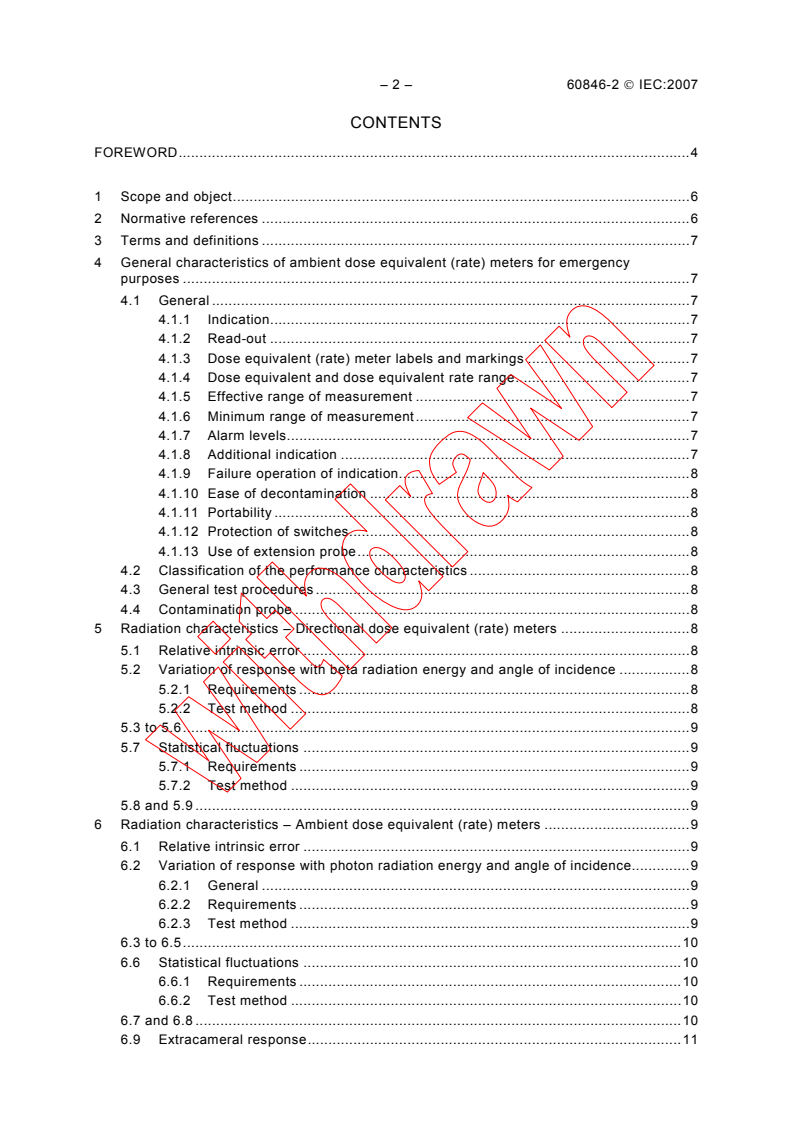
– 2 – 60846-2 © IEC:2007
CONTENTS
FOREWORD.4
1 Scope and object.6
2 Normative references .6
3 Terms and definitions .7
4 General characteristics of ambient dose equivalent (rate) meters for emergency
purposes .7
4.1 General .7
4.1.1 Indication.7
4.1.2 Read-out .7
4.1.3 Dose equivalent (rate) meter labels and markings .7
4.1.4 Dose equivalent and dose equivalent rate range.7
4.1.5 Effective range of measurement .7
4.1.6 Minimum range of measurement.7
4.1.7 Alarm levels.7
4.1.8 Additional indication .7
4.1.9 Failure operation of indication.8
4.1.10 Ease of decontamination .8
4.1.11 Portability .8
4.1.12 Protection of switches.8
4.1.13 Use of extension probe.8
4.2 Classification of the performance characteristics .8
4.3 General test procedures .8
4.4 Contamination probe .8
5 Radiation characteristics – Directional dose equivalent (rate) meters .8
5.1 Relative intrinsic error .8
5.2 Variation of response with beta radiation energy and angle of incidence .8
5.2.1 Requirements .8
5.2.2 Test method .8
5.3 to 5.6.9
5.7 Statistical fluctuations .9
5.7.1 Requirements.9
5.7.2 Test method.9
5.8 and 5.9 .9
6 Radiation characteristics – Ambient dose equivalent (rate) meters .9
6.1 Relative intrinsic error .9
6.2 Variation of response with photon radiation energy and angle of incidence.9
6.2.1 General .9
6.2.2 Requirements .9
6.2.3 Test method .9
6.3 to 6.5.10
6.6 Statistical fluctuations .10
6.6.1 Requirements.10
6.6.2 Test method.10
6.7 and 6.8 .10
6.9 Extracameral response.11
60846-2 © IEC:2007 – 3 –
6.9.1 Requirements.11
6.9.2 Test method.11
6.10 Response of instrument with extended probe .11
6.10.1 Requirements.11
6.10.2 Test method.11
7 Electrical characteristics of ambient dose equivalent (rate) meters .11
7.1 and 7.2 .11
7.3 Warm-up time.11
7.3.1 Requirements.11
7.3.2 Test method.11
7.4 and 7.5 .11
8 Mechanical characteristics of ambient dose equivalent (rate) meters.12
8.1 Mechanical shock during operation.12
8.2 Orientation of dose equivalent (rate) meter (geotropism) .12
8.3 Drop test .12
8.3.1 Requirements .12
8.3.2 Test method .12
9 Environmental characteristics, performance requirements and tests .12
9.1 Ambient temperature influence .12
9.1.1 Requirements .12
9.1.2 Test method .13
9.2 Relative humidity.13
9.3 Atmospheric pressure.13
9.4 Sealing against moisture .13
9.5 Storage and transport.13
9.6 Electromagnetic compatibility .13
9.7 Vibration and shock during transport and shipping .13
9.8 Temperature shock.13
9.8.1 Requirements .13
9.8.2 Test method .14
10 Summary of characteristics .14
11 Documentation .14
Bibliography.17
Table 1 – Limits of the coefficient of variation and of the relative intrinsic error.15
Table 2 – Radiation characteristics of directional dose equivalent (rate) meters .15
Table 3 – Radiation characteristics of ambient dose equivalent (rate) meters.15
Table 4 – Electrical, mechanical and environmental characteristics of directional and
ambient dose equivalent (rate) meters .16
– 4 – 60846-2 © IEC:2007
INTERNATIONAL ELECTROTECHNICAL COMMISSION
____________
RADIATION PROTECTION INSTRUMENTATION –
AMBIENT AND/OR DIRECTIONAL DOSE EQUIVALENT (RATE) METERS
AND/OR MONITORS FOR BETA, X AND GAMMA RADIATION –
Part 2: High range beta and photon dose and dose rate portable
instruments for emergency radiation protection purposes
FOREWORD
1) The International Electrotechnical Commission (IEC) is a worldwide organization for standardization comprising
all national electrotechnical committees (IEC National Committees). The object of IEC is to promote
international co-operation on all questions concerning standardization in the electrical and electronic fields. To
this end and in addition to other activities, IEC publishes International Standards, Technical Specifications,
Technical Reports, Publicly Available Specifications (PAS) and Guides (hereafter referred to as “IEC
Publication(s)”). Their preparation is entrusted to technical committees; any IEC National Committee interested
in the subject dealt with may participate in this preparatory work. International, governmental and non-
governmental organizations liaising with the IEC also participate in this preparation. IEC collaborates closely
with the International Organization for Standardization (ISO) in accordance with conditions determined by
agreement between the two organizations.
2) The formal decisions or agreements of IEC on technical matters express, as nearly as possible, an international
consensus of opinion on the relevant subjects since each technical committee has representation from all
interested IEC National Committees.
3) IEC Publications have the form of recommendations for international use and are accepted by IEC National
Committees in that sense. While all reasonable efforts are made to ensure that the technical content of IEC
Publications is accurate, IEC cannot be held responsible for the way in which they are used or for any
misinterpretation by any end user.
4) In order to promote international uniformity, IEC National Committees undertake to apply IEC Publications
transparently to the maximum extent possible in their national and regional publications. Any divergence
between any IEC Publication and the corresponding national or regional publication shall be clearly indicated in
the latter.
5) IEC provides no marking procedure to indicate its approval and cannot be rendered responsible for any
equipment declared to be in conformity with an IEC Publication.
6) All users should ensure that they have the latest edition of this publication.
7) No liability shall attach to IEC or its directors, employees, servants or agents including individual experts and
members of its technical committees and IEC National Committees for any personal injury, property damage or
other damage of any nature whatsoever, whether direct or indirect, or for costs (including legal fees) and
expenses arising out of the publication, use of, or reliance upon, this IEC Publication or any other IEC
Publications.
8) Attention is drawn to the Normative references cited in this publication. Use of the referenced publications is
indispensable for the correct application of this publication.
9) Attention is drawn to the possibility that some of the elements of this IEC Publication may be the subject of
patent rights. IEC shall not be held responsible for identifying any or all such patent rights.
International Standard IEC 60846-2 has been prepared by subcommittee 45B: Radiation
protection instrumentation, of IEC technical committee 45: Nuclear instrumentation.
This part of IEC 60846 is to be used in conjunction with IEC 60846:2002.
NOTE IEC 60846:2002 is currently under revision and will be issued as IEC 60846-1 around 2008-2009. This part
of IEC 60846 will then be revised with references to the new publication IEC 60846-1.
60846-2 © IEC:2007 – 5 –
The text of this standard is based on the following documents:
FDIS Report on voting
45B/542/FDIS 45B/549/RVD
Full information on the voting for the approval of this standard can be found in the report on
voting indicated in the above table.
This publication has been drafted in accordance with the ISO/IEC Directives, Part 2.
A list of all parts of the IEC 60846 series, under the general title Radiation protection
instrumentation – Ambient and/or directional dose equivalent (rate) meters and/or monitors for
beta, X and gamma radiation, can be found on the IEC website.
The committee has decided that the contents of this publication will remain unchanged until
the maintenance result date indicated on the IEC web site under "http://webstore.iec.ch" in
the data related to the specific publication. At this date, the publication will be
• reconfirmed,
• withdrawn,
• replaced by a revised edition, or
• amended.
– 6 – 60846-2 © IEC:2007
RADIATION PROTECTION INSTRUMENTATION –
AMBIENT AND/OR DIRECTIONAL DOSE EQUIVALENT (RATE) METERS
AND/OR MONITORS FOR BETA, X AND GAMMA RADIATION –
Part 2: High range beta and photon dose and dose rate portable
instruments for emergency radiation protection purposes
1 Scope and object
This part of the IEC 60846 series applies to portable or transportable dose equivalent (rate)
meters and/or monitors for the measurement of ambient and/or directional dose equivalent
(rate) from external beta, X and gamma radiation during emergency situations. It applies
directly to dose equivalent (rate) meters intended for the determination of the dose equivalent
or dose equivalent rate from external beta and/or X and gamma radiation of energies up to
10 MeV during emergency situations.
The object of this part of the IEC 60846 series is to specify the design requirements and the
performance characteristics of dose equivalent (rate) meters intended for the determination of
ambient and/or directional dose equivalent (rate) as defined in ICRU Report 47 under
emergency conditions. With the exception of modified or new clauses listed below, all clauses
in IEC 60846:2002 are applicable for instruments used for emergency purposes.
This part of the IEC 60846 series does not specify which instruments are required nor does it
consider the numbers or specific locations of such instruments. This part of the IEC 60846
series does not identify instrumentation for specific types of accidents. It is essential that the
rated ranges of the instruments and the radiological and non-radiological conditions for which
the instruments are designed adequately cover the accident and post-accident conditions as
determined by accident analysis and/or specified by appropriate regulatory authorities or
qualified individuals. It is expected that accidents will involve both dose equivalent (rate) and
environmental extremes (e.g. temperature and humidity). Specifications for instruments for
measuring dose equivalent rates less than the minimum detectable dose rate level specified
in this part of the IEC 60846 series are contained in IEC 60846:2002. Where such instruments
are also to be used for emergency measurements, they shall also meet the requirements of
this part of the IEC 60846 series.
Although this part of the IEC 60846 series specifies the requirements for instruments primarily
for emergency use, such instruments may also be used for on-site measurements at other
times. If the instrument has a remote detector and if an additional detector is provided in the
measuring assembly to measure dose equivalent rate at the location of the operator, the
requirements shall apply to both of the detectors.
2 Normative references
This clause of IEC 60846:2002 applies, with the following additional references:
IEC 60325:2002, Radiation protection instrumentation – Alpha, beta and alpha/beta (beta
energy >60 keV) contamination meters and monitors
IEC 60846:2002, Radiation protection instrumentation – Ambient and/or directional dose
equivalent (rate) meters and/or monitors for beta, X and gamma radiation
60846-2 © IEC:2007 – 7 –
3 Terms and definitions
For the purposes of this document, the terms and definitions given in 3.1 to 3.4 of
IEC 60846:2002 apply, without modification.
An additional definition applies:
3.2.15
extracameral
response to radiation of all the parts of the instrument except the detector itself
4 General characteristics of ambient dose equivalent (rate) meters for
emergency purposes
4.1 General
4.1.1 Indication
The indications of the ambient dose equivalent (rate) meter shall be in units of dose
equivalent (rate), for example, Sievert or Sievert per hour, respectively.
4.1.2 Read-out
Single scale is preferred. If multiple scales are used, the changing of measuring range and
read-out scale shall be simultaneous and shall be clearly displayed. All scales shall be
readable under normal lighting conditions.
4.1.3 Dose equivalent (rate) meter labels and markings
This subclause of IEC 60846:2002 applies, without modification.
4.1.4 Dose equivalent and dose equivalent rate range
The implementation of the ICRP recommendations requires the determination of dose
equivalent rate over a wide range of values. Under some circumstances, dose equivalent
rates as high as 10 Sv/h require measurement. For application as an emergency instrument,
the dose equivalent rates of interest are within the range from approximately 1 mSv/h to
10 Sv/h. If integrating capability is provided, the range between 1 mSv to 10 Sv is usually of
interest.
4.1.5 Effective range of measurement
This subclause of IEC 60846:2002 applies, without modification.
4.1.6 Minimum range of measurement
The minimum effective range of measurement of dose equivalent rate shall cover at least four
orders of magnitude and shall include the range from 1 mSv/h to 10 Sv/h. The minimum
effective range of dose equivalent shall cover at least four orders of magnitude and shall
include 10 Sv.
4.1.7 Alarm levels
This subclause of IEC 60846:2002 applies, without modification.
4.1.8 Additional indication
This subclause of IEC 60846:2002 applies, without modification.
– 8 – 60846-2 © IEC:2007
4.1.9 Failure operation of indication
This subclause of IEC 60846:2002 applies, without modification.
4.1.10 Ease of decontamination
This subclause of IEC 60846:2002 applies, without modification.
4.1.11 Portability
In the case of survey meters, the complete instrument should not exceed 4 kg in weight and
shall be equipped with handles, straps or other means to facilitate operation while being
carried. It is recognized that an extension probe or some other means may be required to
reduce the dose to the operator.
4.1.12 Protection of switches
Switches and other controls shall be protected to prevent inadvertent de-activation or mal-
operation of the instrument.
4.1.13 Use of extension probe
If an extension probe is to be used, the instrument shall be tested with the probe in place. The
manufacturer shall provide the method to be used to perform the test together with the results
of the test.
4.2 Classification of the performance characteristics
This subclause of IEC 60846:2002 applies, without modification.
4.3 General test procedures
This subclause of IEC 60846:2002 applies, without modification.
4.4 Contamination probe
Emergency dose rate monitors are frequently provided with a surface contamination probe.
This probe shall meet the requirements of IEC 60325.
5 Radiation characteristics – Directional dose equivalent (rate) meters
5.1 Relative intrinsic error
This subclause of IEC 60846:2002 applies, without modification.
5.2 Variation of response with beta radiation energy and angle of incidence
5.2.1 Requirements
The response of the directional dose equivalent (rate) meter to beta radiation produced by the
90 90
reference radiation of Sr/ Y in the calibration direction shall not differ by more than ±50 %
85 204
from unity. In addition, the response to the reference radiation of Kr or Tl shall be given
by the manufacturer.
5.2.2 Test method
90 90
Sr/ Y, the response shall be measured for zero angle of
For the beta radiation of
incidence.
60846-2 © IEC:2007 – 9 –
5.3 to 5.6
These subclauses of IEC 60846:2002 apply, without modification.
5.7 Statistical fluctuations
5.7.1 Requirements
The coefficient of variation of the indication due to random fluctuations shall be less than the
values given in Table 2 of IEC 60846-2.
5.7.2 Test method
This subclause of IEC 60846:2002 applies, without modification.
5.8 and 5.9
These subclauses of IEC 60846:2002 apply, without modification.
6 Radiation characteristics – Ambient dose equivalent (rate) meters
6.1 Relative intrinsic error
This subclause of IEC 60846:2002 applies, without modification.
6.2 Variation of response with photon radiation energy and angle of incidence
6.2.1 General
Where telescopic or remote cylindrical probes are used for emergency instrumentation, the
following subclauses replace 6.2.1 and 6.2.2 of IEC 60846:2002. In all other cases, 6.2 of
IEC 60846:2002 applies, without modification.
6.2.2 Requirements
The relative response due to a change of the radiation energy and angle of incidence shall not
exceed the following values:
• 0,71 to 1,67 for 80 keV to 1,5 MeV and 0° to ±60° and 180° to (180°±60°).
• 0,625 to 2,50 for 80 keV to 1,5 MeV and ±60° to ±120°; however, at 90°±10° a lower
response of 0,50 is allowed.
• 0,625 to 2,50 for 1,5 MeV to 7 MeV and 0° to ±60° and 180° to (180°±60°).
All indicated dose values shall be corrected for non-linear response and, if necessary, for the
effect of the influence quantity dose rate.
Where more than one detector is utilized, then these requirements shall apply to each
detector.
NOTE 1 The calibration direction for cylindrical probes is typically normal to the axis of symmetry.
NOTE 2 The range of the response 0,71 to 1,67 corresponds to the range of the correction factor 1,00 ±0,40.
The range of the response 0,625 to 2,50 corresponds to the range of the correction factor 1,00 ±0,60.
6.2.3 Test method
The tests should be performed using the narrow-spectrum series of radiation qualities of
ISO 4037-1, however if very high dose rates are required, the wide-spectrum series or high air
kerma rate series may be required.
– 10 – 60846-2 © IEC:2007
In order to minimize the number of measurements, in a first step the minimum rated photon
energy is determined where both requirements on energy and angular dependence of
response are met.
The energy dependence of response for angles of incidence of α=0° normalized to its value at
Cs gamma energy, R (Ei, 0°), is measured and plotted versus the photon energy at the
points of the mean energies of the used X-ray spectra, Ei. The photon energy where the
response falls outside 0,71 to 1,67 (for 80 keV up to 1,5 MeV) or outside 0,625 to 2,50 (for
1,5 MeV up to 7 MeV) is determined. For the radiation quality with the mean energy above
the lower photon energy thus determined, the response is measured for all angles between 0°
and 180° at 15° intervals in two perpendicular planes containing the reference direction
through the reference point of the dose equivalent (rate) meter. If for this radiation quality, all
values of response are between 0,71 to 1,67 (for 80 keV up to 1,5 MeV and 0° to ±60° and
180° to {180°±60°}) and between 0,625 to 2,50 (for 80 keV up to 1,5 MeV and ±60° to ±120°;
however at 90° the response is allowed to be as low as 0,50) and between 0,625 to 2,50 (for
1,5 MeV up to 7 MeV and 0° to ±60° and 180° to {180°±60°}, the procedure shall be repeated
with the radiation quality with the next lower mean photon energy. Otherwise, the radiation
quality with the higher mean energy shall be chosen.
For both radiation qualities used in the test, all measured responses are plotted as a function
of photon energy. Each two responses belonging together shall be connected by a straight
line. The minimum rated photon energy is obtained by the intersection of the straight line with
the specified limits at the lowest photon energy.
In a second step, further radiation qualities in the rated range of use shall be chosen to prove
that all normalized responses R (E,α) are within its specified limits. One radiation quality is
determined by the maximum energy of the rated range of use. If the normalized responses R
(Ei, 0°) determined before have extreme values in the rated range, then the corresponding
radiation qualities are further values for these tests concerning the angle of incidence,
otherwise at least one quality shall be chosen within the rated range.
In principle, it is desirable that this test be performed at the same dose equivalent (rate) for
each radiation quality. In practice, this may not be possible, in which case, the indicated dose
equivalent (rate) for each radiation quality shall be corrected for the relative intrinsic error at
the indicated dose equivalent (rate) (see 5.1.1 of IEC 60846:2002).
6.3 to 6.5
These subclauses of IEC 60846:2002 apply, without modification.
6.6 Statistical fluctuations
6.6.1 Requirements
The coefficient of variation of the indication due to random fluctuations shall be less than the
values given in Table 2 of IEC 60846-2.
6.6.2 Test method
Subclause 5.7.2 of IEC 60846:2002 applies, without modification.
6.7 and 6.8
These subclauses of IEC 60846:2002 apply, without modification.
60846-2 © IEC:2007 – 11 –
6.9 Extracameral response
6.9.1 Requirements
The instrument shall not exhibit an extracameral response greater than or equal to 2 % of
scale reading when exposed to a dose rate greater than or equal to 1 Sv/h with photon energy
90 90
of 1,25 MeV and beta radiation from Sr/ Y.
6.9.2 Test method
With the detector and its surrounding housing shielded or not in the radiation field, expose the
rest of the instrument, including cable, electronics (not contained in the housing in which the
detector is contained), and the indicating device, to a dose rate of 1 Sv/h with a photon
90 90
energy of 1,25 MeV and betas from Sr/ Y (one after the other) for at least 10 min. The
scale reading (indicated value) shall be less than 2 % of the irradiated dose rate: that is less
than 20 mSv/h.
6.10 Response of instrument with extended probe
6.10.1 Requirements
The instrument with an extended probe shall exhibit no change in radiation characteristics
defined above when tested up to the maximum extension (or cable length) specified by the
manufacturer. Where multiple detectors are utilized to cover the entire range, they shall be
tested separately.
6.10.2 Test method
The instrument shall be tested as required in 6.1 through 6.9 with the detector located at the
minimum and maximum distances (or cable length) specified by the manufacturer. The
response shall be the same, within 5 %, for both locations.
7 Electrical characteristics of ambient dose equivalent (rate) meters
7.1 and 7.2
These subclauses of IEC 60846:2002 apply, without modification.
7.3 Warm-up time
7.3.1 Requirements
The instrument shall be capable of starting operation at the lowest temperature of the rated
range and operate as normally. 1 min after instrument switched on, the response shall not
differ by more than 10 % from the value obtained after 60 min.
7.3.2 Test method
The dose equivalent meter with the batteries fitted shall be placed for at least 4 h inside the
environmental chamber with the temperature at –25 °C. Then the dose equivalent meter shall
be switched on and shall operate as normally. 1 min after switch on, the response shall not
differ by more than 10 % from the value obtained after 60 min.
7.4 and 7.5
These subclauses of IEC 60846:2002 apply, without modification.
– 12 – 60846-2 © IEC:2007
8 Mechanical characteristics of ambient dose equivalent (rate) meters
8.1 Mechanical shock during operation
This subclause of IEC 60846:2002 applies, without modification.
8.2 Orientation of dose equivalent (rate) meter (geotropism)
This subclause of IEC 60846:2002 applies, without modification.
8.3 Drop test
8.3.1 Requirements
Portable dose equivalent (rate) meters used for emergency purposes shall be able to
withstand without damage, a drop from a height of 1 m (distance from meter surface) onto a
concrete floor.
8.3.2 Test method
The dose equivalent (rate) meter shall withstand at least one single drop from 1 m to each
surface of dose equivalent (rate) meter so that the unit is still operable after the drop. The test
may be performed either with one or more test units in such a way that one drop onto each
surface of the dose equivalent (rate) meter is tested. The instrument passes the test if the
instrument response does not deviate from the original response by ± 20 %. If the dose
equivalent recorded is important to measurement, then the data recorded before drop shall be
maintained and shall not be increased by more than 0,7 H (H is the lower limit of the
0 0
effective range of measurement). The drop can make the instrument switch off but the user
shall be able to switch the unit back on. The dose equivalent (rate) meter shall be inspected
and the physical condition be documented.
9 Environmental characteristics, performance requirements and tests
9.1 Ambient temperature influence
9.1.1 Requirements
The indicated values of the portable dose equivalent (rate) meters used for emergency
purposes shall remain within the following ranges of the indicated values obtained at 20 °C
over the following temperature ranges:
a) Assemblies for extended temperature range: over the range of temperature from –25 °C to
+50 °C, the indicated value shall not deviate by more than ± 20 % from that obtained
under standard test conditions. It is recommended that portable assemblies be designed
to meet these requirements for outdoor use.
b) Assemblies for extreme temperature range: where the assembly is to be used in hotter
conditions, the indicated value shall not deviate by more than ± 30 % from that obtained
under standard test conditions over the temperature range of –25 °C to +70 °C.
c) Assemblies for all temperature ranges: where the assembly is to be used in hotter
conditions (e.g. fire), the indicated value shall not deviate by more than ± 30 % from that
obtained under standard test conditions over the temperature range specified by the
manufacturer.
NOTE 1 Some means of maintaining the batteries at a temperature within the nominal operation range may be
required when assemblies are operated at temperatures below –10 °C.
NOTE 2 The manufacturer shall state the maximum temperature the instrument can withstand.
60846-2 © IEC:2007 – 13 –
9.1.2 Test method
For this test, the dose (rate) meter shall be exposed to a photon radiation source of sufficient
intensity providing an indication in the second most sensitive range. The dose (rate) meter
and the photon source shall be arranged in a reproducible geometry for the test.
The dose (rate) meter shall be held at a temperature of 20 °C ± 2 °C and allowed to stabilize
for a minimum of 60 min. The indication of the dose (rate) meter shall be determined. The
dose (rate) meter and the source shall be removed from this environment and placed directly
in an environmental chamber such that the same exposure geometry is established and the
temperature near the meter is maintained within 5 °C for each maximum and minimum
temperature identified in the three temperature ranges identified in 9.1.1. This procedure shall
be performed in less than 5 min. The temperature shall then be maintained at each of its
extreme values for at least 4 h, and the indication of the dose (rate) meter measured during
the last 30 min of the period. The dose (rate) meter shall be removed from the environmental
chamber and returned to the first environment such that the same exposure environment is
established and the temperature near the meter is 20 °C ± 2 °C. This procedure shall be
performed in less than 5 min. The indication shall then be determined during the last 30 min
of a 2 h period.
It is not, in general, necessary to control the humidity of the air in the chamber unless the
meter is particularly sensitive to changes of humidity. Humidity levels should be low enough to
prevent condensation (<75 %). The limits of variation of indications shall be within the values
given in Table 2 of this part of the IEC 60846:2002.
9.2 Relative humidity
Portable dose equivalent (rate) meters used for emergency purposes shall meet the extended
rated range of humidity in 9.2 of IEC 60846:2002 which states that the indication of the dose
equivalent (rate) shall not vary by more than ±10 % obtained from that under standard test
conditions with a range of humidity up to 95 % at 35 °C.
9.3 Atmospheric pressure
This subclause of IEC 60846:2002 applies, without modification.
9.4 Sealing against moisture
This subclause of IEC 60846:2002 applies, without modification.
9.5 Storage and transport
This subclause of IEC 60846:2002 applies, without modification.
9.6 Electromagnetic compatibility
This subclause of IEC 60846:2002 applies, without modification.
9.7 Vibration and shock during transport and shipping
This subclause of IEC 60846:2002 applies, without modification.
9.8 Temperature shock
9.8.1 Requirements
The indicated value of the dose (rate) meter shall not vary by more than ±20 % from the
o
indicated value taken at a temperature of 20 C when the temperature is raised from 20 °C to
50 °C or lowered from 20 °C to –10 °C in less than 5 min.
– 14 – 60846-2 © IEC:2007
The indicated value of the dose (rate) meter shall not vary by more than ± 20 % from the
indicated value taken at a temperature of 50 °C or –10 °C when the temperature changes
from either one of the above temperatures to 20 °C.
9.8.2 Test method
For this test, the dose (rate) meter shall be exposed to a photon radiation source of sufficient
intensity to provide an indication in the second most sensitive range. The dose (rate) meter
and the photon source shall be arranged in a reproducible geometry for the test.
The dose (rate) meter shall be held at a temperature of 20 °C ± 5 °C and allowed to stabilize
for a minimum of 60 min. The indication of the dose (rate) meter shall be determined. The
dose (rate) meter and the source shall be removed from this environment and placed directly
in an environmental chamber such that the same exposure geometry is established and the
temperature near the meter is maintained between 45 °C and 50 °C. This procedure shall be
performed in less than 5 min. The indication shall then be determined every 15 min over a
period of 2 h. The meter shall remain in this environment during the period to reach a stable
temperature.
The dose (rate) meter shall be removed from the environmental chamber and returned to the
first environment such that the same exposure environment is established and the
temperature near the meter is 20 °C ±5 °C. This procedure shall be performed in less than
5 min. The indication shall then be determined every 15 min over a period of 2 h. The meter
shall remain in this environment during the period necessary to reach a stable temperature.
The test shall be repeated inside the environmental chamber with a temperature near the
meter maintained between –10 °C and –5 °C.
10 Summary of characteristics
This subclause of IEC 60846:2002 applies, without modification.
11 Documentation
This sub clause of IEC 60846:2002 applies, without modification.
Tables 1 to 4 are given in case different entries are valid. In all other cases, the entries of the
Tables given in IEC 60846:2002 are valid.
60846-2 © IEC:2007 – 15 –
Table 1 – Limits of the coefficient of variation and of the relative intrinsic error
Limit of the relative
Characteristics under test for (Minimum effective) range Sub-
intrinsic error or limits
beta and gamma radiation of measurement clause
of coefficient of variation
Relative intrinsic error Dose rate measurement:
1)
directional dose equivalent Four orders of magnitude, ±20 % 4.1.6, 5.1
(rate) including 1 mSv/h to 10 Sv/h.
Relative intrinsic error ambient Dose measurement:
1)
dose equivalent (rate) Four orders of magnitude, ±20 % 4.1.6, 6.1
including 10 Sv.
H < 1 mSv 15 %
Statistical fluctuation:
(16 – H/1 mSv) %
1 mSv ≤ H < 11 mSv 5.7, 6.6
dose equivalent
H ≥ 11 mSv 5 %
&
–1
H < 1 mSv h 15 %
Statistical fluctuation:
& &
–1 –1 –1 5.7, 6.6
1 mSv h ≤ H < 11 mSv h [16 – H /(1 mS
...