


IEC PAS 61290-3-1:2002
(Main)Optical fibre amplifiers - Basic specification - Part 3-1: Test methods for noise figure parameters - Optical spectrum analyzer
Optical fibre amplifiers - Basic specification - Part 3-1: Test methods for noise figure parameters - Optical spectrum analyzer
Establishes uniform requirements for accurate and reliable measurements, by means of the optical spectrum analyzer method, of the following OA parameters: Signal-spontaneous noise figure, forward amplified spontaneous emission (ASE) power level, as defined in clause 3 of IEC 61291-1. The methods described apply to single-channel stimlus only.
General Information
- Status
- Replaced
- Publication Date
- 11-Apr-2002
- Technical Committee
- SC 86C - Fibre optic systems, sensing and active devices
- Drafting Committee
- WG 3 - TC 86/SC 86C/WG 3
- Current Stage
- DELPUB - Deleted Publication
- Start Date
- 28-Aug-2003
- Completion Date
- 13-Feb-2026
Relations
- Effective Date
- 05-Sep-2023

Get Certified
Connect with accredited certification bodies for this standard

TL 9000 QuEST Forum
Telecommunications quality management system.

ANCE
Mexican certification and testing association.

Intertek Slovenia
Intertek testing, inspection, and certification services in Slovenia.
Sponsored listings
Frequently Asked Questions
IEC PAS 61290-3-1:2002 is a technical specification published by the International Electrotechnical Commission (IEC). Its full title is "Optical fibre amplifiers - Basic specification - Part 3-1: Test methods for noise figure parameters - Optical spectrum analyzer". This standard covers: Establishes uniform requirements for accurate and reliable measurements, by means of the optical spectrum analyzer method, of the following OA parameters: Signal-spontaneous noise figure, forward amplified spontaneous emission (ASE) power level, as defined in clause 3 of IEC 61291-1. The methods described apply to single-channel stimlus only.
Establishes uniform requirements for accurate and reliable measurements, by means of the optical spectrum analyzer method, of the following OA parameters: Signal-spontaneous noise figure, forward amplified spontaneous emission (ASE) power level, as defined in clause 3 of IEC 61291-1. The methods described apply to single-channel stimlus only.
IEC PAS 61290-3-1:2002 is classified under the following ICS (International Classification for Standards) categories: 33.180.30 - Optic amplifiers. The ICS classification helps identify the subject area and facilitates finding related standards.
IEC PAS 61290-3-1:2002 has the following relationships with other standards: It is inter standard links to IEC 61290-3-1:2003. Understanding these relationships helps ensure you are using the most current and applicable version of the standard.
IEC PAS 61290-3-1:2002 is available in PDF format for immediate download after purchase. The document can be added to your cart and obtained through the secure checkout process. Digital delivery ensures instant access to the complete standard document.
Standards Content (Sample)
IEC/PAS 61290-3-1
Edition 1.0
2002-04
PRE-STANDARD
Optical fibre amplifiers –
Basic specification –
Part 3-1:
Test methods for noise figure parameters –
Optical spectrum analyzer
PUBLI C LY AVAI LABLE SPECI F I CATI O N
INTERNATIONAL
ELECTROTECHNICAL
Reference number
COMMISSION
IEC/PAS 61290-3-1
IEC/PAS 61290-3-1
Edition 1.0
2002-04
Optical fibre amplifiers –
Basic specification –
Part 3-1:
Test methods for noise figure parameters –
Optical spectrum analyzer
PUBLICLY AVAILABLE SPECIFICATION
INTERNATIONAL
ELECTROTECHNICAL
Reference number
COMMISSION
IEC/PAS 61290-3-1
– 2 – Copyright © 2002, IEC
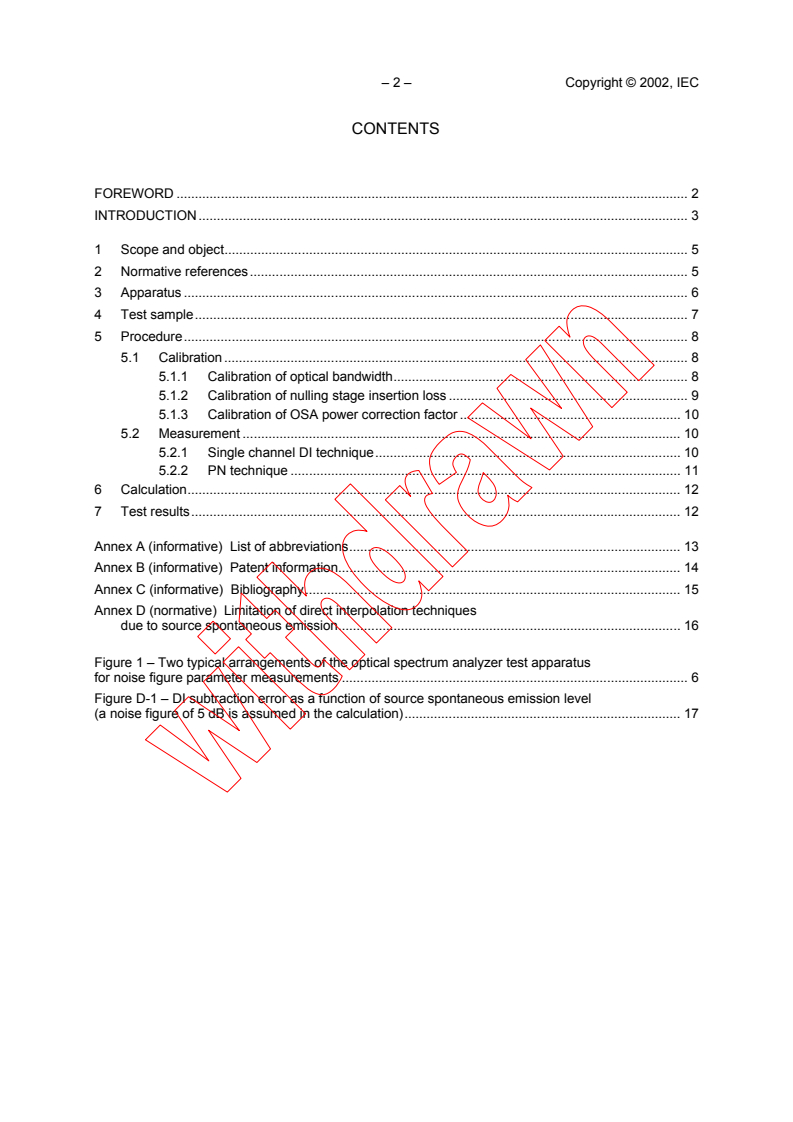
CONTENTS
FOREWORD . 2
INTRODUCTION . 3
1 Scope and object. 5
2 Normative references. 5
3 Apparatus . 6
4 Test sample. 7
5 Procedure. 8
5.1 Calibration . 8
5.1.1 Calibration of optical bandwidth. 8
5.1.2 Calibration of nulling stage insertion loss . 9
5.1.3 Calibration of OSA power correction factor . 10
5.2 Measurement . 10
5.2.1 Single channel DI technique. 10
5.2.2 PN technique . 11
6 Calculation. 12
7 Test results. 12
Annex A (informative) List of abbreviations. 13
Annex B (informative) Patent information. 14
Annex C (informative) Bibliography. 15
Annex D (normative) Limitation of direct interpolation techniques
due to source spontaneous emission. 16
Figure 1 – Two typical arrangements of the optical spectrum analyzer test apparatus
for noise figure parameter measurements . 6
Figure D-1 – DI subtraction error as a function of source spontaneous emission level
(a noise figure of 5 dB is assumed in the calculation). 17
INTERNATIONAL ELECTROTECHNICAL COMMISSION
___________
OPTICAL FIBRE AMPLIFIERS – BASIC SPECIFICATION –
PART 3-1: Test methods for noise figure parameters –
Optical spectrum analyzer
FOREWORD
A PAS is a technical specification not fulfilling the requirements for a standard, but made available to the public.
IEC-PAS 61290-3-1 has been processed by subcommittee 86C: Fibre optic systems and active devices, of IEC
technical committee 86: Fibre optics.
The text of this PAS is based on the This PAS was approved for publication
following document: by the P-members of the committee
concerned as indicated in the following
document:
Draft PAS Report on voting
86C/392/PAS 86C/401/RVD
Following publication of this PAS, the technical committee or subcommittee concerned will investigate the
possibility of transforming the PAS into an International Standard.
1) The IEC (International Electrotechnical Commission) is a worldwide organization for standardization comprising all national
electrotechnical committees (IEC National Committees). The object of the IEC is to promote international co-operation on all
questions concerning standardization in the electrical and electronic fields. To this end and in addition to other activities, the
IEC publishes International Standards. Their preparation is entrusted to technical committees; any IEC National Committee
interested in the subject dealt with may participate in this preparatory work. International, governmental and non-
governmental organizations liaising with the IEC also participate in this preparation. The IEC collaborates closely with the
International Organization for Standardization (ISO) in accordance with conditions determined by agreement between the
two organizations.
2) The formal decisions or agreements of the IEC on technical matters express, as nearly as possible, an international
consensus of opinion on the relevant subjects since each technical committee has representation from all interested
National Committees.
3) The documents produced have the form of recommendations for international use and are published in the form of
standards, technical specifications, technical reports or guides and they are accepted by the National Committees in that
sense.
4) In order to promote international unification, IEC National Committees undertake to apply IEC International Standards
transparently to the maximum extent possible in their national and regional standards. Any divergence between the IEC
Standard and the corresponding national or regional standard shall be clearly indicated in the latter.
5) The IEC provides no marking procedure to indicate its approval and cannot be rendered responsible for any equipment
declared to be in conformity with one of its standards.
6) Attention is drawn to the possibility that some of the elements of this PAS may be the subject of patent rights. The IEC shall
not be held responsible for identifying any or all such patent rights.
– 4 – Copyright © 2002, IEC
INTRODUCTION
This part of IEC 61290 is devoted to the subject of optical amplifiers. The technology of optical
amplifiers is still rapidly evolving, hence amendments and new additions to this publication can be
expected. Each abbreviation introduced in this part of IEC 61290 is generally explained in the text the
first time it appears. However, for an easier understanding of the whole text, a list of all abbreviations
used in this document is given in annex A.
Information concerning a patent involved in this part of IEC 61290, the holder of which accepted the
IEC policy on patents, is given in annex B.
This document should be read in conjunction with IEC 61291-1: Optical amplifiers − Part 1: Generic
specification.
OPTICAL FIBRE AMPLIFIERS – BASIC SPECIFICATION –
Part 3-1: Test methods for noise figure parameters –
Optical spectrum analyzer
1 Scope and object
This part of IEC 61290 applies to commercially available optical fibre amplifiers (OFAs) using active
fibres containing rare-earth dopants, or semiconductor optical amplifiers (SOWs) using laser gain
media.
The object of this part of IEC 61290 is to establish uniform requirements for accurate and reliable
measurements, by means of the optical spectrum analyzer test method, of the following OA
parameters, as defined in clause 3 of the international standard IEC 61291-1:
a) signal-spontaneous noise figure
b) forward amplified spontaneous emission (ASE) power level
The methods described in this document apply to single-channel stimulus only.
Two alternatives for determining the signal-spontaneous beat noise are possible, namely the ASE
direct interpolation technique (DI) and the polarization nulling with interpolation technique (PN). The
accuracy of the DI technique will suffer when the slope of the OA spectral ASE curve has large
wavelength dependence, as in the case of an OA with an internal narrowband ASE suppressing filter.
The accuracy of the DI technique degrades at high input power level due to the spontaneous emission
from the laser source(s). Annex D provides guidance on the limits of this technique for high input
power.
NOTE 1 – All numerical values followed by (‡) are intended to be currently under study.
NOTE 2 – General aspects of noise figure test methods are reported in the international standard IEC 61290-3
2 Normative references
The following referenced documents are indispensable for the application of this document. For dated
references, only the edition cited applies. For undated references, the latest edition of the referenced
document (including any amendments) applies.
IEC 60793-1-1: Optical fibres – Part 1-1: Generic specification – General
IEC 60825-1: Safety of laser products – Part 1: Equipment classification, requirements and user's
guide
IEC 60825-2: Safety of laser products – Part 2: Safety of optical fibre communication systems
IEC 60874-1: Connectors for optical fibres and cables – Part 1: Generic specification
IEC 61290-1-1: Optical amplifier test methods − Basic specification − Test methods for gain
parameters – Part 1-1: Optical spectrum analyser
IEC 61290-3-1: Optical fibre amplifiers – Basic specification − Part 1-1: Test methods for gain
parameters – Optical spectrum analyser
IEC 61291-1: Optical amplifiers – Part 1: Generic specification
NOTE – A list of informative (not normative) references is given in annex C.
– 6 – Copyright © 2002, IEC
3 Apparatus
Two schemes of the measurement set-up (for DI and PN techniques, respectively), are given in
figure 1.
The test equipment listed below, with the required characteristics, is needed.
a) Narrowband optical source:
The optical source shall be either at a fixed wavelength or wavelength tunable.
– Fixed-wavelength optical source:
This optical source shall generate light with a wavelength and optical power specified in the
relevant detail specification. Unless otherwise specified, the optical source shall emit light with the
full width at half maximum of the spectrum narrower than 1 nm (‡). Single-line lasers such as a
distributed feedback (DFB) laser, a distributed Bragg reflector (DBR) laser, an external cavity laser
(ECL) are applicable. Also applicable is a light emitting diode (LED) with a narrowband filter. The
suppression ratio for the side modes for the single-line laser shall be higher than 30 dB (‡).
The output power fluctuation shall be less than 0,05 dB (‡), which may be better attainable with an
optical isolator at the output port of the optical source. Source-spontaneous emission and spectral
broadening at the base of the lasing spectrum should be minimal for laser sources.
– Wavelength-tunable optical source:
This optical source shall generate wavelength-tunable light within the range specified in the
relevant detail specification. Its optical power shall be specified in the relevant detail specification.
Unless otherwise specified, the optical source shall emit light with the full width at half maximum of
the spectrum narrower than 1 nm (‡). A single-line laser or an LED with a narrow bandpass optical
filter is applicable for example. The suppression ratio of the side modes for the single-line laser
shall be higher than 30 dB (‡). The output power fluctuation shall be less than 0,05 dB (‡), which
may be better attainable with an optical isolator at the output port of the optical source. Source-
spontaneous emission and spectral broadening at the base of the lasing spectrum should be
minimal for the ECL.
Narrowband Polarization Optical
DB
Linear
optical OA spectrum
polarizer controller
analyzer
source
Variable
optical
OA
attenuator
under
test
Source module
a) DI technique
Narrowband
Linear
Optical
DB Polarization
optical
Polarization
OA Linear
polarizer spectrum
controller
controller
source
Variable polarizer
analyzer
optical
OA
attenuator
Nulling stage
under
test
Source module
PN technique
b)
Figure 1 – Two typical arrangements of the optical spectrum analyzer
test apparatus for noise figure parameter measurements
b) Polarization controller:
This device shall be able to convert any state of polarization of a signal to any other state of
polarization. The polarization controller may consist of an all fibre polarization controller or a
quarter-wave plate rotatable by a minimum of 90 degrees followed by a half wave plate rotatable
by a minimum of 180 degrees. The reflectance of this device shall be smaller than −50 dB (‡) at
each port. The insertion loss variation of this device shall be less than 0,2 dB (‡).
c) Linear polarizer:
This device should have a minimum extinction ration of 30 dB (‡), and reflectance smaller than
−50 dB (‡) at each port. A rotatable polarizer is preferred to maximize the input signal power.
d) Variable optical attenuator:
The attenuation range and stability shall be over 40 dB (‡) and better than 0,1 dB (‡), respectively.
The reflectance from this device shall be smaller than −50 dB (‡) at each port.
e) Optical spectrum analyzer:
The optical spectrum analyzer (OSA) shall have polarization sensitivity less than 0,1 dB (‡),
stability better than 0,1 dB (‡), and wavelength accuracy better than 0,05 nm (‡). The linearity
should be better than 0,2 dB (‡) over the device dynamic range. The reflectance from this device
shall be smaller than −50 dB (‡) at its input port.
f) Optical power meter:
This device shall have a measurement accuracy better than 0,2 dB (‡), irrespective of the state of
polarization, within the operational wavelength bandwidth of the OA and within the power range
from −40 to +20 dBm (‡).
NOTE – The optical power meter is for calibration purposes.
g) Broadband optical source:
This device shall provide output broadband optical power over the operational wavelength
bandwidth of the OA (for example, 1530 nm to 1565 nm). The output spectrum shall be flat with
less than a 0,1 dB (‡) variation over the measurement bandwidth range (typically 10 nm). For
example, the ASE generated by an OA with no signal applied could be used.
h) Optical connectors:
The connection loss repeatability shall be better than 0,1 dB (‡). The reflectance from this device
shall be smaller than −50 dB (‡).
i) Optical fibre jumpers:
The mode field diameter of the optical fibre jumpers shall be as close as possible to that of fibres
used as input and output ports of the OA. The reflectance from this device shall be smaller than
−50 dB (‡), and the device length shall be short (<2m). The jumpers between the source and the
device under test should remain undisturbed during the duration of the measurements in order to
minimize state of polarization changes.
Subsequently, the combination of the narrowband optical source, the linear polarizer, the variable
optical attenuator, and the input polarization controller shall be referred to as the source module. The
polarization controller of the source module is optional and is required only when polarization
dependent performances are to be measured.
The combination of the output polarization controller and the linear polarizer will be referred to as the
nulling stage. The nulling stage is only required for the PN technique is employed and may be omitted
for the DI technique.
4 Test sample
The OA under test shall operate at nominal operating conditions. If the OA is likely to cause laser
oscillations due to unwanted reflections, use of optical isolators is recommended to bracket the OA
under test. This will minimize the signal instability and the measurement inaccuracy.
Care shall be taken in maintaining the state of polarization of the input light during the measurement.
Changes in the polarization state of the input light may result in input optical power changes because
of the slight polarization dependency expected from all the used optical components, leading to
measurement errors.
– 8 – Copyright © 2002, IEC
5 Procedure
This test method is based on the optical measurement of the foll
...
Questions, Comments and Discussion
Ask us and Technical Secretary will try to provide an answer. You can facilitate discussion about the standard in here.
Loading comments...