

IEC 61400-11:1998
(Main)Wind turbine generator systems - Part 11: Acoustic noise measurement techniques
General Information
- Abstract
Presents measurement procedures that enable noise emissions of a wind tubine to be characterized with respect to a range of wind speeds and directions. Allows comparisons between different wind turbines.
- Status
- Published
- Publication Date
- 31-Aug-1998
- Technical Committee
- TC 88 - Wind energy generation systems
- Current Stage
- DELPUB - Deleted Publication
- Start Date
- 10-Dec-2002
- Completion Date
- 28-Aug-2026
Overview
IEC 61400-11:1998 - "Wind turbine generator systems - Part 11: Acoustic noise measurement techniques" defines standardized procedures for measuring and characterizing wind turbine noise. The standard prescribes acoustic and non‑acoustic instrumentation, microphone placement and measurement positions, meteorological data requirements, data reduction and correction methods, and reporting content so that noise emissions can be compared across turbines and wind conditions. Key reference conditions used in the standard include a reference height of 10 m, reference roughness length of 0.05 m, and an acoustic reference wind speed of 8 m/s.
Key topics and technical requirements
- Measurement methodology: Procedures for selecting measurement positions close enough to avoid propagation errors but far enough to treat the rotor as a finite source.
- Instrumentation: Requirements for acoustic instruments (sound level meters, filters, calibrators) and non‑acoustic instruments (anemometers, meteorological mast) and traceable calibration.
- Wind and reference conditions: Conversion of measured wind speed to standardized wind speed using the 10 m / 0.05 m reference conditions for consistent comparisons.
- Acoustic descriptors:
- A‑weighted (LA) and C‑weighted (LC) sound levels and equivalent continuous A‑weighted level (LAeq).
- Apparent sound power level (LWA) defined relative to 1 pW at the rotor centre and referenced to the acoustic reference wind speed.
- Directivity (Δ): differences in sound level measured at downstream and other positions.
- Tonality (ΔLtn): assessment of tonal components versus masking noise in critical bands.
- Data reduction and corrections: Background noise correction, wind speed dependence, octave/third‑octave band analysis, and methods to estimate uncertainty.
- Reporting: Required content including turbine characterization, environment, instrumentation, acoustic and non‑acoustic data, and uncertainty assessment.
Applications and users
IEC 61400-11 is used by:
- Manufacturers to specify and declare acoustic performance.
- Purchasers and developers to set contract noise criteria.
- Operators for verification after installation or refurbishment.
- Planners and regulators for environmental assessment, permitting and compliance. Practical applications include performance testing, environmental impact assessment, comparative benchmarking of turbine models, and resolving community noise concerns.
Related standards
- IEC 61400-12:1998 (power performance testing)
- IEC 60651, 60804 (sound level meters)
- IEC 60942 (sound calibrators)
- IEC 61260 (octave/fractional filters)
These referenced standards cover instrument specifications and calibration methods needed to implement IEC 61400-11 measurements correctly.
Keywords: IEC 61400-11, wind turbine noise, acoustic measurement, apparent sound power level, tonality, A-weighted, microphone positions, wind speed reference, noise measurement standard.
Relations
- Revised
IEC 61400-11:2002 - Wind turbine generator systems - Part 11: Acoustic noise measurement techniques - Effective Date
- 05-Sep-2023
Get Certified
Connect with accredited certification bodies for this standard

DNV
DNV is an independent assurance and risk management provider.

Lloyd's Register
Lloyd's Register is a global professional services organisation specialising in engineering and technology.
DNV Energy Systems
Energy and renewable energy certification.
Sponsored listings
Frequently Asked Questions
IEC 61400-11:1998 is a standard published by the International Electrotechnical Commission (IEC). Its full title is "Wind turbine generator systems - Part 11: Acoustic noise measurement techniques". This standard covers: Presents measurement procedures that enable noise emissions of a wind tubine to be characterized with respect to a range of wind speeds and directions. Allows comparisons between different wind turbines.
Presents measurement procedures that enable noise emissions of a wind tubine to be characterized with respect to a range of wind speeds and directions. Allows comparisons between different wind turbines.
IEC 61400-11:1998 is classified under the following ICS (International Classification for Standards) categories: 27.180 - Wind turbine energy systems. The ICS classification helps identify the subject area and facilitates finding related standards.
IEC 61400-11:1998 has the following relationships with other standards: It is inter standard links to IEC 61400-11:2002. Understanding these relationships helps ensure you are using the most current and applicable version of the standard.
IEC 61400-11:1998 is available in PDF format for immediate download after purchase. The document can be added to your cart and obtained through the secure checkout process. Digital delivery ensures instant access to the complete standard document.
Standards Content (Sample)
INTERNATIONAL
IEC
STANDARD
61400-11
First edition
1998-09
Wind turbine generator systems –
Part 11:
Acoustic noise measurement techniques
Aérogénérateurs –
Partie 11:
Techniques de mesure du bruit acoustique
Reference number
Numbering
As from 1 January 1997 all IEC publications are issued with a designation in the
60000 series.
Consolidated publications
Consolidated versions of some IEC publications including amendments are
available. For example, edition numbers 1.0, 1.1 and 1.2 refer, respectively, to the
base publication, the base publication incorporating amendment 1 and the base
publication incorporating amendments 1 and 2.
Validity of this publication
The technical content of IEC publications is kept under constant review by the IEC,
thus ensuring that the content reflects current technology.
Information relating to the date of the reconfirmation of the publication is available
in the IEC catalogue.
Information on the subjects under consideration and work in progress undertaken by
the technical committee which has prepared this publication, as well as the list of
publications issued, is to be found at the following IEC sources:
• IEC web site*
• Catalogue of IEC publications
Published yearly with regular updates
(On-line catalogue)*
• IEC Bulletin
Available both at the IEC web site* and as a printed periodical
Terminology, graphical and letter symbols
For general terminology, readers are referred to IEC 60050: International Electro-
technical Vocabulary (IEV).
For graphical symbols, and letter symbols and signs approved by the IEC for
general use, readers are referred to publications IEC 60027: Letter symbols to be
used in electrical technology, IEC 60417: Graphical symbols for use on equipment.
Index, survey and compilation of the single sheets and IEC 60617: Graphical symbols
for diagrams.
* See web site address on title page.
INTERNATIONAL
IEC
STANDARD
61400-11
First edition
1998-09
Wind turbine generator systems –
Part 11:
Acoustic noise measurement techniques
Aérogénérateurs –
Partie 11:
Techniques de mesure du bruit acoustique
IEC 1998 Copyright - all rights reserved
No part of this publication may be reproduced or utilized in any form or by any means, electronic or
mechanical, including photocopying and microfilm, without permission in writing from the publisher.
International Electrotechnical Commission 3, rue de Varembé Geneva, Switzerland
Telefax: +41 22 919 0300 e-mail: inmail@iec.ch IEC web site http: //www.iec.ch
Commission Electrotechnique Internationale
PRICE CODE
W
International Electrotechnical Commission
For price, see current catalogue
– 2 – 61400-11 © IEC:1998(E)
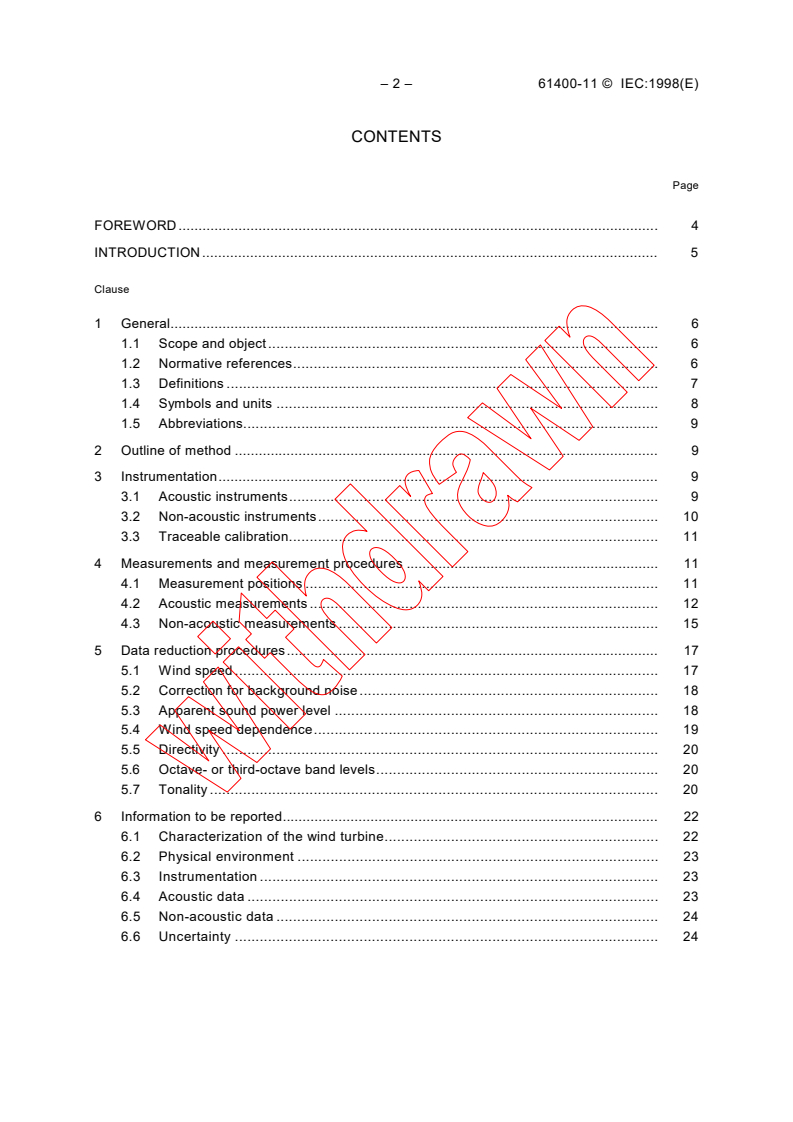
CONTENTS
Page
FOREWORD.4
INTRODUCTION . 5
Clause
1 General. 6
1.1 Scope and object. 6
1.2 Normative references. 6
1.3 Definitions. 7
1.4 Symbols and units . 8
1.5 Abbreviations. 9
2 Outline of method . 9
3 Instrumentation. 9
3.1 Acoustic instruments. 9
3.2 Non-acoustic instruments. 10
3.3 Traceable calibration. 11
4 Measurements and measurement procedures . 11
4.1 Measurement positions. 11
4.2 Acoustic measurements. 12
4.3 Non-acoustic measurements. 15
5 Data reduction procedures. 17
5.1 Wind speed. 17
5.2 Correction for background noise. 18
5.3 Apparent sound power level . 18
5.4 Wind speed dependence. 19
5.5 Directivity. 20
5.6 Octave- or third-octave band levels. 20
5.7 Tonality. 20
6 Information to be reported. 22
6.1 Characterization of the wind turbine. 22
6.2 Physical environment. 23
6.3 Instrumentation. 23
6.4 Acoustic data. 23
6.5 Non-acoustic data. 24
6.6 Uncertainty. 24
61400-11 © IEC:1998(E) – 3 –
Page
Tables
1 Effective noise bandwidth . 14
2 Roughness length . 18
3 Bandwidth of critical bands . 21
D.1 Examples of possible values of type B uncertainty components relevant for
apparent sound power level . 37
Figures
1 Mounting of the microphone – plan view . 25
2 Mounting of the microphone – vertical cross-section . 26
3 Standard pattern for microphone measurement positions . 27
4 Illustration of the definitions of R and slant distance R . 28
0 1
5 Allowable region for meteorological mast position as a function of ß – plan view . 29
6 Allowable range for meteorological mast position – cross-section . 30
B.1 Tolerances for frequency characteristics . 33
Annexes
A Other characteristics of WTGS noise emission and their quantification . 31
B Criteria for recording/playback equipment . 33
C Assessment of turbulence . 35
D Assessment of measurement uncertainty . 36
E Bibliography .39
– 4 – 61400-11 © IEC:1998(E)
INTERNATIONAL ELECTROTECHNICAL COMMISSION
_________
WIND TURBINE GENERATOR SYSTEMS –
Part 11: Acoustic noise measurement techniques
FOREWORD
1) The IEC (International Electrotechnical Commission) is a worldwide organization for standardization comprising all
national electrotechnical committees (IEC National Committees). The object of the IEC is to promote international
co-operation on all questions concerning standardization in the electrical and electronic fields. To this end and in
addition to other activities, the IEC publishes International Standards. Their preparation is entrusted to technical
committees; any IEC National Committee interested in the subject dealt with may participate in this preparatory
work. International, governmental and non-governmental organizations liaising with the IEC also participate in this
preparation. The IEC collaborates closely with the International Organization for Standardization (ISO) in
accordance with conditions determined by agreement between the two organizations.
2) The formal decisions or agreements of the IEC on technical matters express, as nearly as possible, an international
consensus of opinion on the relevant subjects since each technical committee has representation from all
interested National Committees.
3) The documents produced have the form of recommendations for international use and are published in the form of
standards, technical reports or guides and they are accepted by the National Committees in that sense.
4) In order to promote international unification, IEC National Committees undertake to apply IEC International
Standards transparently to the maximum extent possible in their national and regional standards. Any divergence
between the IEC Standard and the corresponding national or regional standard shall be clearly indicated in the
latter.
5) The IEC provides no marking procedure to indicate its approval and cannot be rendered responsible for any
equipment declared to be in conformity with one of its standards.
6) Attention is drawn to the possibility that some of the elements of this International Standard may be the subject of
patent rights. The IEC shall not be held responsible for identifying any or all such patent rights.
International Standard IEC 61400-11 has been prepared by IEC technical committee 88: Wind
turbine systems.
The text of this standard is based on the following documents:
FDIS Report on voting
88/96/FDIS 88/97/RVD
Full information on the voting for the approval of this standard can be found in the report on
voting indicated in the above table.
Annexes A, B, C, D and E are for information only.
A bilingual version of this standard may be issued at a later date.
61400-11 © IEC:1998(E) – 5 –
INTRODUCTION
The purpose of this part of IEC 61400 is to provide a uniform methodology that will ensure
consistency and accuracy in the measurement and analysis of acoustical emissions by wind
turbine generator systems (WTGS). This standard has been prepared with the anticipation that it
would be applied by:
– the WTGS manufacturer striving to meet well defined acoustic emission performance
requirements and/or a possible declaration system;
– the WTGS purchaser in specifying such performance requirements;
– the WTGS operator who may be required to verify that stated, or required, acoustic
performance specifications are met for new or refurbished units;
– the WTGS planner or regulator who must be able to accurately and fairly define acoustical
emission characteristics of WTGS in response to environmental regulations or permit
requirements for new or modified installations.
This standard provides guidance in the measurement, analysis and reporting of complex acoustic
emissions from wind turbine generator systems (WTGS). The standard will benefit those parties
involved in the manufacture, installation planning and permitting, operation, utilization, and
regulation of WTGS. The technically accurate measurement and analysis techniques
recommended in this document should be applied by all parties to ensure that continuing
development and operation of WTGS is carried out in an atmosphere of consistent and accurate
communication relative to environmental concerns. This standard presents measurement and
reporting procedures expected to provide accurate results that can be replicated by others.
The consistency of results using the method for measurement of tonality will be assessed, and
future revisions will address any identified shortcomings.
– 6 – 61400-11 © IEC:1998(E)
WIND TURBINE GENERATOR SYSTEMS –
Part 11: Acoustic noise measurement techniques
1 General
1.1 Scope and object
This part of IEC 61400 presents sound measurement procedures that enable noise emissions of
a wind turbine to be characterized. This involves using measurement methods appropriate to
noise emission assessment at locations close to the machine, in order to avoid errors due to
sound propagation, but far enough away to allow for the finite source size. The procedures
described are different in some respects from those that would be adopted for noise assessment
in community noise studies. They are intended to facilitate characterization of wind turbine noise
with respect to a range of wind speeds and directions. Standardization of measurement
procedures will also facilitate comparisons between different wind turbines.
The procedures present methodologies that will enable the noise emissions of a single WTGS to
be characterized in a consistent and accurate manner. These procedures include the following:
– location of acoustic measurement positions;
– requirements for the acquisition of acoustic, meteorological, and associated WTGS
operational data;
– analysis of the data obtained and the content for the data report; and
– definition of specific acoustic emission parameters, and associated descriptors which are
used for making environmental assessments.
The standard is not restricted to WTGS of a particular size or type. The procedures described in
this standard allow for the thorough description of the noise emission from a WTGS. If, in some
cases, less comprehensive measurements are needed, such measurements are made according
to the relevant parts of this standard.
1.2 Normative references
The following normative documents contain provisions that, through reference in this text,
constitute provisions of this part of IEC 61400. At the time of publication, the editions indicated
were valid. All normative documents are subject to revision, and parties to agreements based on
this part of IEC 61400 are encouraged to investigate the possibility of applying the most recent
editions of the normative documents indicated below. Members of IEC and ISO maintain registers
of currently valid International Standards.
IEC 60386:1972, Method of measurement of speed fluctuations in sound recording and
reproducing equipment
IEC 60651:1979, Sound level meters
IEC 60688:1997, Electrical measuring transducers for converting a.c. electrical quantities to
analogue or digital signals
IEC 60804:1985, Integrating-averaging sound level meters
IEC 60942:1997, Electroacoustics – Sound calibrators
IEC 61260:1995, Electroacoustics – Octave-band and fractional-octave-band filters
IEC 61400-12:1998, Wind turbine generator systems – Part 12: Wind turbine power performance
testing
61400-11 © IEC:1998(E) – 7 –
1.3 Definitions
For the purposes of this standard, the following definitions apply:
1.3.1
acoustic reference wind speed V (in metres per second)
aref
a wind speed of 8 m/s at reference conditions (10 m height, roughness length equal to 0,05 m)
used in the calculation of the apparent sound power level to provide a uniform basis for the
comparison of apparent sound power levels from different WTGS
1.3.2
apparent sound power level L (in decibels)
WA
the A-weighted sound power level re 1 pW of a point source at the rotor centre with the same
emission in the downwind direction as the wind turbine being measured as determined at the
acoustic reference wind speed
1.3.3
A-weighted or C-weighted sound pressure levels (in decibels)
sound pressure levels measured with the A or C frequency weighting networks specified in
IEC 60651, designated by L or L , respectively
A C
1.3.4
directivity Δ (in decibels)
i
the difference between the A-weighted sound pressure levels measured at measurement
positions 2, 3, and 4 and those measured at the reference position 1 downstream from the turbine
corrected to the same distance from the WTGS rotor centre
1.3.5
grazing angle φ (in degrees)
the angle between the plane of the microphone board and a line from the microphone to the rotor
centre
1.3.6
reference distance R (in metres)
the nominal horizontal distance from the centre of the base of the WTGS to each of the
prescribed microphone positions
1.3.7
reference height z (in metres)
ref
a height of 10 m used for converting wind speed to reference conditions
1.3.8
reference roughness length z (in metres)
0ref
a roughness length of 0,05 m used for converting wind speed to reference conditions
1.3.9
sound pressure level L (in decibels)
p
10 times the logarithm to the base 10 of the ratio of the mean-square sound pressure to the
square of the reference sound pressure of 20 μPa
1.3.10
standardized wind speed V (in metres per second)
s
wind speed converted to reference conditions (height 10 m and roughness length 0,05 m) using a
logarithmic profile
1.3.11
tonality ΔL (in decibels)
tn
the difference between the tone level and the level of the masking noise in the critical band
around the tone
– 8 – 61400-11 © IEC:1998(E)
1.4 Symbols and units
β angle used to define allowable area for anemometer mast location (°)
φ grazing angle (°)
D rotor diameter (horizontal axis turbine) or equatorial diameter (vertical axis turbine) (m)
Δ directivity at "i th" position (dB)
i
ΔL tonality (dB)
tn
f frequency of tone (Hz)
f centre frequency of critical band (Hz)
c
z anemometer height (m)
z reference height for wind speed, 10 m (m)
ref
H height of rotor centre (horizontal axis turbine) or height of rotor equatorial
plane (vertical axis turbine) above local ground near the wind turbine (m)
L or L A or C-weighted sound pressure level (dB)
A C
L equivalent continuous A-weighted sound pressure level (dB)
Aeq
L equivalent continuous A-weighted sound pressure level corrected for background
Aeq,c
noise at acoustic reference wind speed and corrected to reference conditions (dB)
L equivalent continuous A-weighted sound pressure level in position "i"
Aeq,i
corrected for background noise (dB)
L equivalent continuous sound pressure level of the background noise (dB)
n
L sound pressure level (dB)
p
L sound pressure level of masking noise within a critical band (dB)
pn
L average of analysis bandwidth sound pressure levels of masking noise (dB)
pn,avg
L sound pressure level of the tone or tones (dB)
pt
L equivalent continuous sound pressure level of wind turbine noise alone (dB)
s
L equivalent continuous sound pressure level of combined wind turbine and
s+n
background noise (dB)
L apparent sound power level (dB)
WA
p atmospheric pressure (kPa)
P measured electric power (W)
m
P normalised electric power (W)
n
R slant distance to reference position 1 (m)
R slant distance, from rotor centre to actual measurement position "i",
i
where i =1, 2, 3, or 4 (m)
R reference distance (m)
t air temperature (°C)
U , U , U uncertainty components (dB)
A B C
V wind speed at height, z (m/s)
z
V acoustic reference wind speed, 8 m/s (m/s)
aref
V standardized wind speed (m/s)
s
z roughness length (m)
z reference roughness length, 0,05 m (m)
0ref
61400-11 © IEC:1998(E) – 9 –
1.5 Abbreviations
1.5.1 FFT Fast Fourier transform
1.5.2 WTGS Wind turbine generator system(s)
2 Outline of method
This part of IEC 61400 defines the procedures to be used in the measurement, analysis and
reporting of acoustic emissions of WTGS. Instrumentation and calibration requirements are
specified to ensure accuracy and consistency of acoustic and non-acoustic measurements. Non-
acoustic measurements required to define the atmospheric conditions relevant to determining the
acoustic emissions are also specified. All parameters to be measured and reported are identified,
as are the data reduction methods required to obtain these parameters.
Application of the method described in this International Standard provides the value of the
apparent A-weighted sound power level, its variation with wind speed and the directivity of an
individual WTGS. Measurements include octave or third-octave band sound pressure levels, and
narrow band spectra.
The measurements are made at locations close to the turbine in order to minimize the influence
of terrain effects, atmospheric conditions or wind-induced noise. To account for the size of the
WTGS under test, a reference distance R based on the WTGS dimensions is used.
Measurements are taken with a microphone positioned on a board placed on the ground to
reduce the wind noise generated at the microphone and to minimize the influence of different
ground types.
Measurements of sound pressure levels and wind speeds are made simultaneously over short
periods of time and over a wide range of wind speeds. The measured wind speeds are adjusted
to corresponding wind speeds at a reference height of 10 m and a reference roughness length
of 0,05 m. The sound level at the acoustic reference wind speed of 8 m/s is determined based on
a derived regression line correlating the sound levels and wind speeds. The apparent A-weighted
sound power level is calculated from that sound level.
The directivity is determined by comparing the A-weighted sound pressure levels at three
additional positions around the turbine with those measured at the reference position.
Informative annexes are included that cover:
– other acoustic characteristics of WTGS noise that may be present (annex A);
– criteria for data recording and playback equipment (annex B);
– assessment of turbulence intensity (annex C);
– measurement uncertainty (annex D).
3 Instrumentation
3.1 Acoustic instruments
The following equipment is necessary to perform the acoustic measurements as set forth in this
standard.
3.1.1 Equipment for the determination of the equivalent
continuous A-weighted sound pressure level
The equipment shall meet the requirements of a type 1 sound level meter according to
IEC 60804. The diameter of the microphone shall be no greater than 13 mm.
– 10 – 61400-11 © IEC:1998(E)
3.1.2 Equipment for the determination of octave or third-octave band spectra
In addition to the requirements given for type 1 sound level meters, the equipment shall have a
constant frequency response over at least the frequency range 45 Hz to 5 600 Hz. The filters
shall meet the requirements of IEC 61260 for Class 1 filters.
The equivalent continuous sound pressure levels in octave or third-octave band shall be
determined simultaneously with centre frequencies from 63 Hz to 4 kHz (third-octaves from 50 Hz
to 5 kHz). It may be relevant to measure the low-frequency noise emission of a WTGS. In such
cases, a wider frequency range is necessary, as discussed in annex A.
3.1.3 Equipment for the determination of narrow band spectra
The equipment shall fulfill the relevant requirements for IEC 60651 type 1 instrumentation in the
frequency range 20 Hz to 5 600 Hz.
3.1.4 Microphone with reflecting surface and windscreen
The microphone shall be mounted on a flat hard board with the diaphragm of the microphone in a
plane normal to the board and with the axis of the microphone pointing towards the wind turbine, as
in figures 1 and 2. The board shall have a minimum width or diameter of 1,0 m and be made from a
material that is acoustically hard, such as a piece of plywood or hard chip-board with a thickness of
at least 12,0 mm, or a piece of metal with a thickness of at least 2,5 mm. If a rectangular board is
used, the microphone shall be placed 100 mm to 150 mm from any line of symmetry.
The windscreen to be used with the ground-mounted microphone shall consist of a primary and,
where necessary, a secondary windscreen. The primary windscreen shall consist of one half of an
open cell foam sphere with a diameter of approximately 90 mm, which is centred around the
diaphragm of the microphone, as in figure 2.
The secondary windscreen shall be used when it is necessary to obtain an adequate signal-to-
noise ratio at low frequencies in high winds.
For example, it could consist of a wire frame of approximate hemispherical shape, at least
450 mm in diameter, which is covered with a 13 mm to 25 mm layer of open cell foam with a
porosity of 4 to 8 pores per 10 mm. This secondary hemispherical windscreen shall be placed
symmetrically over the smaller primary windscreen.
If the secondary wind screen is used, the frequency response of the secondary wind screen
mounted on a hard board must be documented.
3.1.5 Acoustical calibrator
The complete sound measurement system, including any recording, data logging or computing
systems, shall be calibrated immediately before and after the measurement session at one or
more frequencies, using an acoustical calibrator on the microphone. The calibrator shall fulfill the
requirements of IEC 60942 class 1, and shall be used within its specified environmental conditions.
3.1.6 Data recording/playback systems
If a data recording/playback system is an integral part of the measurement instrumentation, the
entire chain of measurement instruments shall fulfil the relevant requirements of IEC 60651, for
type 1 instrumentation. Examples are given in annex B.
3.2 Non-acoustic instruments
The following equipment is necessary to perform the non-acoustic measurements set forth in this
standard.
61400-11 © IEC:1998(E) – 11 –
3.2.1 Anemometers
The anemometer and its signal processing equipment shall have an a maximum deviation from
the calibration value of ±0,5 m/s in the wind speed range from 3 m/s to 20 m/s. The anemometer
shall be capable of measuring the average wind speed over time intervals synchronized with the
noise measurements.
3.2.2 Electric power transducer
The electric power transducer, including current and voltage transformers, shall meet the
accuracy requirements of IEC 60688 Class 1.
3.2.3 Wind direction transducer
The wind direction transducer shall be accurate to within ±6° .
3.2.4 Other instrumentation
Instruments to measure distance are required. Instruments to measure air temperature and
atmospheric pressure are required for certain measurement procedures.
3.3 Traceable calibration
The following equipment shall be checked regularly and be calibrated with traceability to a
national or primary standards laboratory. The maximum time from the last calibration shall be as
stated for each item of equipment:
– acoustic calibrator: 12 months;
– microphone: 24 months;
– integrating sound level meter: 24 months;
– spectrum analyzer: 36 months;
– data recording/playback system: 24 months;
– anemometer: 24 months;
– electric power transducer: 24 months.
An instrument shall always be recalibrated if it has been repaired or is suspected of fault or
damage.
4 Measurements and measurement procedures
4.1 Measurement positions
To fully characterize the noise emission of a WTGS, the following measurement positions are
required.
4.1.1 Acoustic measurement positions
Four microphone positions are to be used. The four positions shall be laid out in a pattern around
the vertical centre-line of the WTGS tower as indicated in the plan view shown in figure 3. The
downwind measurement position is identified as the reference position, as shown in figure 3. The
direction of the positions shall be accurate within ±15° relative to the wind direction at the time of
measurement. The horizontal distance R from the wind turbine tower vertical centreline to each
microphone position shall be as shown in figure 3, with a tolerance of 20 %, and shall be
measured with an accuracy of ±2 %.
– 12 – 61400-11 © IEC:1998(E)
As shown in figure 4a, the reference distance R for horizontal axis turbines is given by:
D
R = H + (1)
where
H is the vertical distance from the ground to the rotor centre; and
D is the diameter of the rotor.
As shown in figure 4b, the reference distance R for vertical axis wind turbines is given by :
R = H + D (2)
where
H is the vertical distance from the ground to the rotor equatorial plane; and
D is the equatorial diameter.
The microphone mounting board shall be placed flat upon the ground with its longer axis (if any)
pointing towards the wind turbine. The grazing angle φ, as shown in figure 4, shall be between 25°
and 40°. This may require adjustment of the measurement position within the tolerances stated
above.
The measurement position shall be chosen so that the calculated influence from any reflecting
structures, such as buildings or walls, shall be less than 0,2 dB.
4.1.2 Wind speed and direction measurement positions
The test anemometer and wind direction transducer shall be mounted in the upwind direction of
the WTGS at a height between 10 m and rotor centre. The transducers shall be placed at a
distance between 2 D and 4 D from the rotor centre. The allowable region in which the
anemometer and wind direction transducer shall be located is given in figure 5.
The angle β is given by:
zz−
ref
ββ= ()−+ββ (3)
max min min
−
Hz
ref
where
z is the anemometer height, see figure 6;
z is the reference height of 10 m;
ref
H is the height of the rotor centre or equatorial plane of the wind turbine, see figure 4;
β is the maximum angle for β, β = 90°;
max max
β is the minimum angle for β, β = 30°.
min min
During the course of the test, the test anemometer shall not be within the wake of any portion of
any other WTGS rotor or other structure. The wake of a WTGS shall be considered to extend 10
rotor diameters downwind of the WTGS. The wind speed and wind direction transducers shall be
placed so that they do not interfere with each other.
61400-11 © IEC:1998(E) – 13 –
4.2 Acoustic measurements
To fully characterize the noise emission of a WTGS, the following acoustic measurements are
required.
4.2.1 Acoustic measurement requirements
The acoustic measurements shall permit the following information to be determined about the
noise emission from the WTGS:
– the apparent sound power level;
– the dependence on wind speed;
– the directivity;
– the octave or third-octave band levels;
– the tonality.
Optional measurements may include infrasound, low-frequency noise and impulsivity.
The complete measurement chain shall be calibrated at least at one frequency before and after
the measurements, or if the microphones are disconnected during repositioning.
4.2.2 Acoustic measurements at the reference position 1
To fully characterize the noise emission of a WTGS, the following acoustic measurements shall
be made at reference position 1.
4.2.2.1 A-weighted sound pressure level
The equivalent continuous A-weighted sound pressure level of the noise from the WTGS shall be
measured at the reference position by a series of at least 30 measurements concurrent with
measurements of the wind speed.
Each measurement shall be integrated over a period of not less than 1 min. Periods with intruding
intermittent background noise (as from aircraft) shall be omitted. The measurements shall cover
as broad a range of wind speeds, between cut-in and the wind speed where rated power is
obtained, as practically possible. The range shall be at least 4 m/s (wind speed at 10 m height
and roughness length of 0,05 m). To obtain a sufficient range of wind speeds it may be necessary
to take the measurements in several measurement series. At least 10 of the measurements shall
be taken during a wind speed not differing by more than 2 m/s from the acoustic reference wind
speed. At least 25 % of the measurements shall be above and 25 % below the acoustic reference
wind speed.
With the WTGS stopped, and using the same measurement set-up, the background noise shall
be measured immediately before or after each measurement series of WTGS noise. In total at
least 30 measurements shall be made, covering corresponding ranges of wind speed as stated
above. When measuring background noise, every effort shall be made to ensure that the
background sound measurements are representative of the background noise that occurred
during the wind turbine noise emission measurements.
4.2.2.2 Octave or third-octave band measurements
The octave or third-octave band spectrum of the noise from the WTGS in the reference position
shall be determined as the energy average of five spectra, each measured over at least 1 min. As
a minimum, the octave bands with centre frequencies from 63 Hz to 4 kHz, inclusive, shall be
measured. During the measurement, the wind speed, averaged over each of the five periods,
shall differ less than 2 m/s from the acoustic reference wind speed. There shall be periods in
which the wind speed is below as well as above the acoustic reference wind speed. Periods with
intruding intermittent background noise shall be omitted.
– 14 – 61400-11 © IEC:1998(E)
With the wind turbine stopped, the background noise shall be measured immediately before or
after the WTGS noise full octave or third-octave band measurement, using the same measure-
ment set-up and during similar wind conditions. The measurement shall be energy-averaged over
at least five 1 min periods.
4.2.2.3 Narrow-band measurements
Narrow-band spectra of the sound from the WTGS shall be measured in the reference position 1
over a period of at least 2 min, when the wind speed averaged over the same period differs by
less than 1 m/s from the acoustic reference wind speed. If, during the measurements, intruding
intermittent background noises occur, these periods of intruding noise shall be omitted.
The effective noise bandwidth shall be less than the values shown in table 1.
If the measured sound contains widely spaced tones, it may be necessary to measure a number
of spectra with different full-scale frequencies to obtain a sufficient frequency resolution
equivalent to table 1. If there are closely spaced tone components, a finer resolution is necessary.
Table 1 – Effective noise bandwidth
Tone frequency 20 – 63 63 – 200 200 – 630 630 – 2 000 2 000 – 5 000
Hz
Absolute 20 Hz 20 Hz 20 Hz 22 Hz 57 Hz
Effective noise
bandwidth
Relative 32 % 10 % 3,5 % 2,8 % 2 %
To determine the tonality of the WTGS, at least 200 contiguous spectra shall be measured, using
a time weighting F (Fast) over a time period of at least 2 min. To determine the frequency of the
tone or tones, as well as the masking noise level within the critical band around them, these
specra shall be energy-averaged to produce a single, long-term spectrum. To determine the
maximum tone level, 25 % of the spectra having the highest tone levels shall be identified and
their tone levels shall be arithmetically averaged.
With real time analyzers, a linear integration period of 0,25 s approximates time weighting F.
The following information applies to 400 line FFT analyzers:
– with full scale frequency 1 kHz, a single spectrum approximates time weighting F;
– with full scale frequency 2 kHz or higher, the exponential average of two spectra approxi-
mates time weighting F. The full scale frequency shall not exceed the real time frequency of
the analyzer.
With the WTGS stopped, the background noise shall be measured in the same way, and during
similar wind conditions, as the WTGS noise measurements. The background noise shall only be
integrated over a period of 2 min; measurements with time weighting F are not needed.
In cases where tonality changes with the wind speed, narrowband measurements shall be made
at the wind speeds where the tones are most noticeable. This may be at wind speeds either
higher or lower than the acoustic reference wind speed.
4.2.2.4 Optional measurements
It is recommended that additional measurements be taken to quantify noise emissions from a
WTGS that has a definite character that is not described by the measurements procedures
detailed in this standard.
61400-11 © IEC:1998(E) – 15 –
Such a character might be the emission of infrasound, low-frequency noise, low-frequency
modulation of the broadband noise, impulses, or unusual sounds (such as a whine, hiss, screech
or hum), distinct impulses in the noise (for example bangs, clatters, clicks, or thumps), or noise
that is irregular enough in character to attract attention. These areas are discussed, and possible
quantitative measures outlined in annex A. These measures are not, at present, universally
accepted and are given for guidance only.
4.2.3 Acoustic measurements at positions 2, 3 and 4
To fully characterize the acoustic emissions of a WTGS, the following acoustic measurements
shall be made at positions 2, 3, and 4.
4.2.3.1 A-weighted sound pressure level
The equivalent continuous A-weighted sound pressure level of the noise from the WTGS shall be
measured in the non-reference positions by one of the following two methods.
In the first (preferred) method, the measurements in the non-reference positions shall be made
simultaneously with corresponding measurements in the reference position. The measurements
in the three non-reference positions may be made individually, but each one shall be made
simultaneously with measurement in the reference position. The sound pressure level at each
position shall be determined as the energy average of five measurements each integrated over at
least 1 min. Periods with intruding intermittent background noise shall be omitted. During
the measurements, the wind speed averaged over each of the five periods shall differ by less
than 2 m/s from the acoustic reference wind speed.
With the WTGS stopped, the background noise shall be measured immediately before or after
each measurement of WTGS noise, using the same measurement setup, and under similar wind
conditions. The measurements shall be energy-averaged over five periods of at least 1 min.
In the second method, simultaneous measurements are not required. The equivalent continuous
A-weighted sound pressure level of the noise from the WTGS in each of the three non-reference
positions shall be measured as a series of at least 10 measurements, each energy-averaged over
at least 1 min concurrent with wind speed measurements. During the measurements, the
wind speed V shall differ by less than 2 m/s from the acoustic reference wind speed, and at least
s
25 % of the measurements shall be above and 25 % below the acoustic reference wind speed.
Periods with intermittent background noise shall be omitted.
With the WTGS stopped, the background noise shall be measured immediately before or after
the WTGS noise measurements in the same positions, using the same measurement setup, and
during similar wind and background conditions. At least 10 measurements, each energy-averaged
over at least 1 min, shall be obtained.
4.2.3.2 Octave, third-octave and narrow-band measurements
If the directivity of the WTGS noise is greater than 1,5 dB in any of the non-reference positions,
the noise from the WTGS, measured in the position with the highest directivity, shall be measured
and analyzed in narrow-band and octave or third-octave bands.
4.3 Non-acoustic measurements
The following non-acoustic measurements shall be made.
4.3.1 Wind speed measurements
The wind speed shall be determined according to one of the following two methods. Method 1 is
the preferred method.
– 16 – 61400-11 © IEC:1998(E)
4.3.1.1 Method 1: determination of the wind speed from the electric output and the power curve
The wind speed shall be obtained from measurements of the electric power produced and
preferably measured according to IEC 61400-12 from a traceable measured power versus wind
speed curve, preferably for the same turbine or, otherwise, for the same type of wind turbine with
the same components and adjustments.
Electric power shall be averaged over the same period as the noise measurements.
The power curve relates the power to the wind speed averaged over the rotor swept area. For
most WTGS, the wind speed can be determined from the measured electric power. Correlation
between measured sound level and measured electric power is very high up to the point of
maximum power.
The use of power measurements and the WTGS power curve is the preferred method of wind
speed determination, provided the WTGS operates below the maximum power point during the
noise measurement series.
Record the power produced by the WTGS, and confirm that, for each noise sampling period, the
power did not exceed 95 % of the maximum power point.
The power curve gives the relation between the wind speed at rotor centre height and the electric
power that the turbine produces for standard atmospheric conditions of 15 °C and 101,3 kPa. The
electric power measured during the noise measurements shall be converted to these standard
atmospheric conditions, using the following equation:
t p
k ref
PP=
nm
t p
ref
(4)
where
P is the normalized electric power (kW);
n
P is the measured electric power (kW);
m
t is air temperature in K, t = t + 273;
k k c
t is the air temperature (°C);
c
t is 288 K;
ref
p is the atmospheric pressure (kPa);
p is the reference atmospheric pressure, p = 101,3 kPa.
ref ref
The wind speed at rotor centre height obtained from the power curve at P shall be adjusted for a
n
height of 10 m and the reference roughness length, as described in clause 5.
4.3.1.2 Method 2: determination of wind speed with an anemometer
If an anemometer is used to measure wind speeds, the wind speed measurement results shall be
adjusted to a height of 10 m and the reference roughness length as described in clause 5.
Measurement by an anemometer at between 10 m and rotor centre height will also be appropriate
during background sound measurements, when the wind turbine is parked, and the turbine has
been used as an anemometer during the turbine noise measurements.
Wind speed data points shall be arithmetically averaged over the same period as, and shall be
taken simultaneously with, the noise measurements.
61400-11 © IEC:1998(E) – 17 –
4.3.2 Wind direction
Wind direction shall be observed from a wind direction transducer to ensure that measurement
locations are within 15° of their nominal azimuth positions with respect to upwind, and to measure
the position of the anemometer. Wind direction shall be averaged over the same period as the
noise measurements.
4.3.3 Other atmospheric conditions
Air temperature and pressure shall be measured and recorded at least every 2 h.
Turbulence in the wind incident to a WTGS can affect its aerodynamic noise emission. A
discussion of turbulence is contained in annex C.
5 Data reduction procedures
5.1 Wind speed
The wind speeds measured at height z or determined at rotor centre height H from
measurements of electrical power shall be corrected to the wind speed V at referenc
...