

IEC 60127-2:2003
(Main)Miniature fuses - Part 2: Cartridge fuse-links
General Information
- Abstract
Relates to special requirements applicable to cartridge fuse-links for miniature fuses with dimensions of 5 mm x 20 mm and 6.3 mm x 32 mm for the protection of electric appliances, electronic equipment and component parts thereof, normally intended for use indoors.
- Status
- Published
- Publication Date
- 22-Aug-2010
- Technical Committee
- SC 32C - Miniature fuses
- Drafting Committee
- WG 5 - TC 32/SC 32C/WG 5
- Current Stage
- DELPUB - Deleted Publication
- Start Date
- 19-Sep-2014
- Completion Date
- 28-Aug-2026
Buy Documents
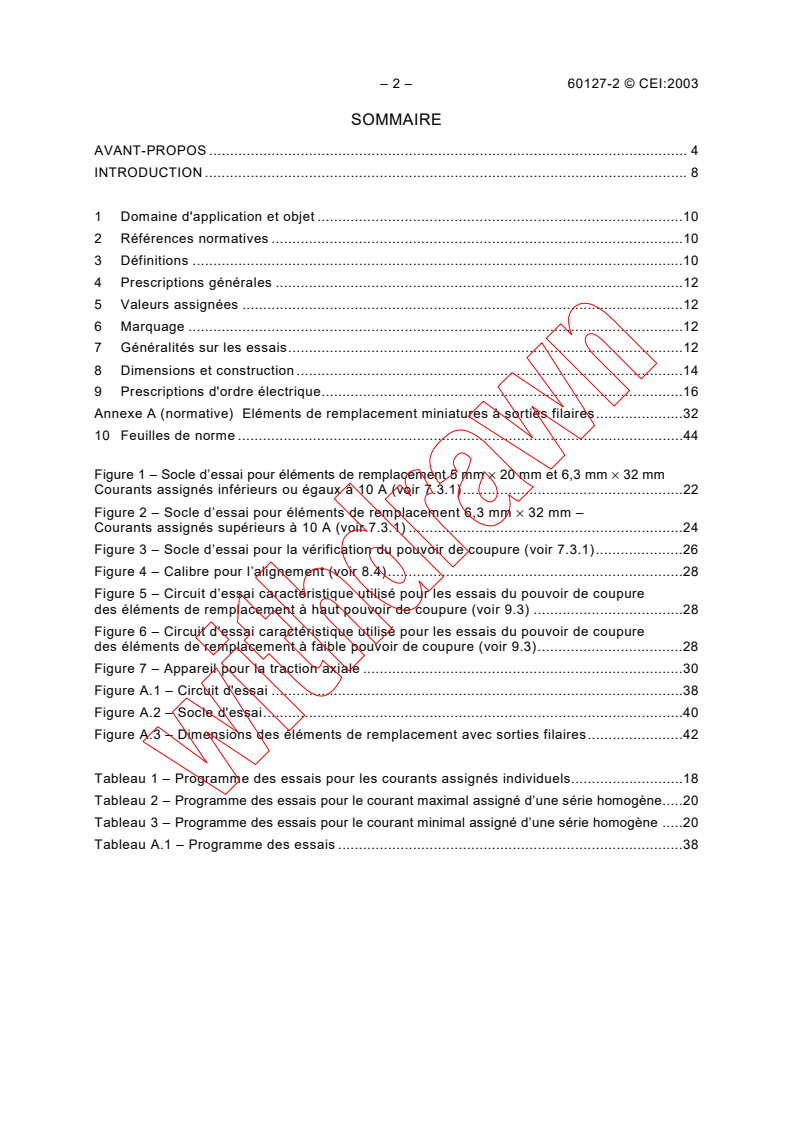
IEC 60127-2:2003 - Miniature fuses - Part 2: Cartridge fuse-links Released:1/31/2003
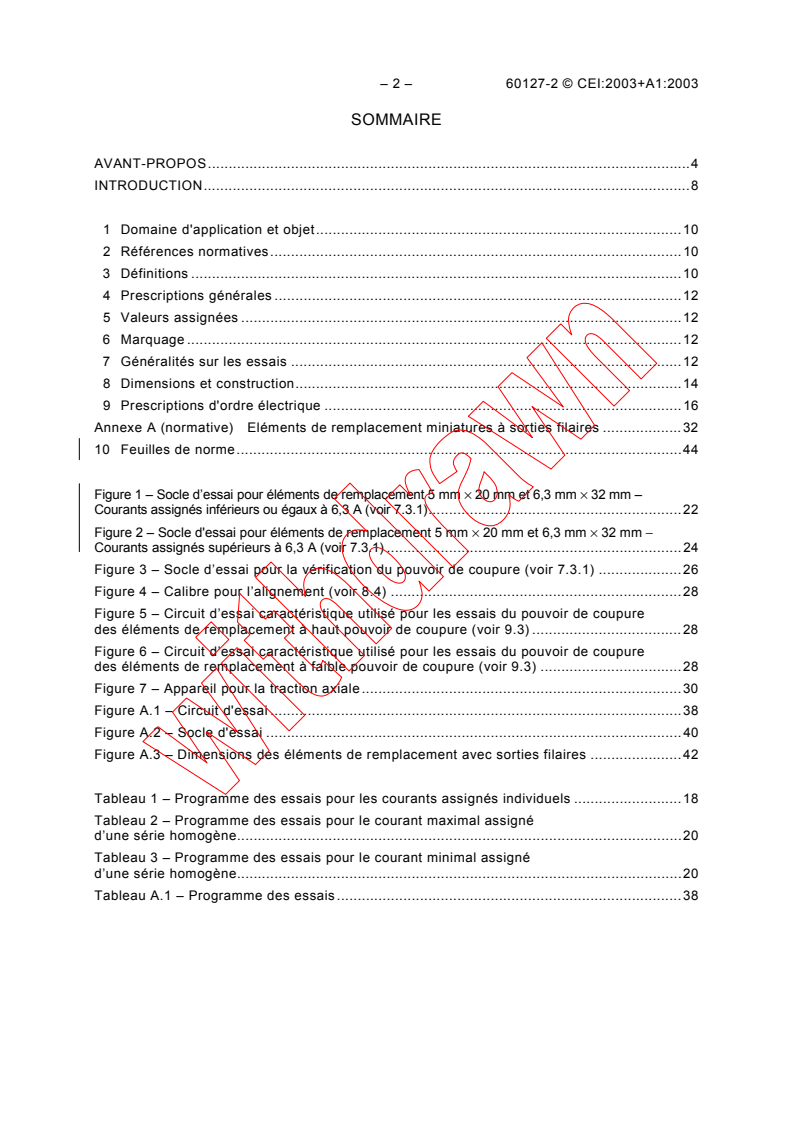
IEC 60127-2:2003+AMD1:2003 CSV - Miniature fuses - Part 2: Cartridge fuse-links Released:11/21/2003
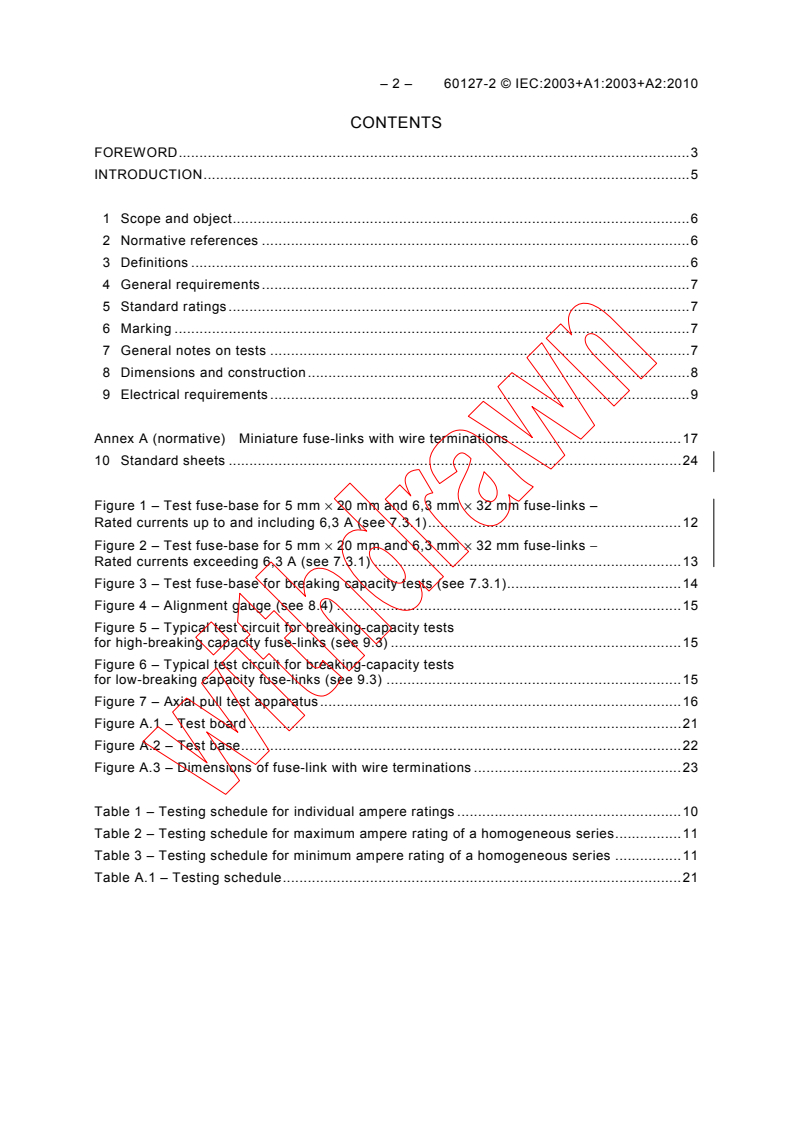
IEC 60127-2:2003+AMD1:2003+AMD2:2010 CSV - Miniature fuses - Part 2: Cartridge fuse-links Released:8/23/2010
Overview
IEC 60127-2:2003 is an international standard developed by the International Electrotechnical Commission (IEC) that defines the special requirements for cartridge fuse-links used in miniature fuses. These fuse-links have standard dimensions of 5 mm × 20 mm and 6.3 mm × 32 mm and are designed primarily for protecting electric appliances, electronic equipment, and component parts intended for indoor use. The standard supplements the general provisions outlined in IEC 60127-1 by specifying additional test methods, construction details, and marking requirements unique to cartridge fuse-links.
This standard is crucial in ensuring the reliability, safety, and interoperability of miniature fuses in various electrical and electronic applications, contributing to consistent performance under typical indoor conditions.
Key Topics
Scope and Applicability
IEC 60127-2 targets cartridge fuse-links for miniature fuses used indoors. It excludes fuses for appliances operating in special conditions such as corrosive or explosive atmospheres. It complements IEC 60127-1, which covers definitions and general requirements for miniature fuses.Fuse Dimensions
Standard sizes addressed are 5 mm × 20 mm and 6.3 mm × 32 mm, which are common dimensions for miniature cartridge fuses used across many electronic devices.Marking Requirements
Fuse-links must be clearly marked with rated current, voltage, and a breaking capacity symbol, which indicates the fuse's interrupting capacity:- H: High breaking capacity
- L: Low breaking capacity
- E: Enhanced breaking capacity
These markings enable correct selection and identification in manufacturing and maintenance.
Testing Procedures
The standard specifies detailed test schedules and conditions to ensure fuse reliability, including environmental tests, electrical tests, and mechanical tests. Fuse-links must be tested using specific fuse-bases designed to simulate real-world mounting conditions. Testing includes:- Individual rating tests
- Homogeneous series tests for maximum and minimum ampere ratings
- Durability and breaking capacity tests under specified conditions
Construction and Materials
Specific requirements for the materials used in fuse bases and contacts are outlined, such as the use of silvered brass contacts with defined electrical resistance limits to ensure consistent performance.
Applications
IEC 60127-2 cartridge fuse-links are widely used in:
Electric Appliances
Protection of household and commercial electrical products preventing damage from overloads or short circuits.Electronic Equipment
Ensuring safe operation in consumer electronics, computing devices, communication hardware, and measurement instruments.Component Parts
Embedded miniature fuse-links in modules and printed circuit boards for reliable circuit protection.
These fuse-links are suited for indoor environments where typical electrical safety standards apply, safeguarding both devices and users from electrical faults.
Related Standards
IEC 60127-1: Miniature fuses – Part 1: Definitions and general requirements for miniature fuse-links – provides foundational terms and broad requirements used in conjunction with Part 2.
IEC 60068 Series: Environmental testing standards referenced for verifying fuse performance under stress conditions such as soldering and mechanical endurance.
IEC 60249-2-5: Specifications for base materials used in electronics, including flammability and mechanical properties relevant to fuse mounting.
IEC 60127 Series: Other parts dedicated to different fuse types and guidelines:
- Part 3: Sub-miniature fuse-links
- Part 4: Universal modular fuse-links
- Part 5: Quality assessment guidelines
- Part 6: Fuse-holders for miniature fuse-links
- Part 10: User guide
Employing IEC 60127-2 helps manufacturers, engineers, and safety inspectors maintain compliance with international best practices in fuse design and application, reducing risk and enhancing product durability.
Keywords: IEC 60127-2, miniature fuses, cartridge fuse-links, fuse testing, fuse marking, high breaking capacity fuses, miniature cartridge fuses, electrical appliance protection, fuse standards, fuse safety, electronic equipment fuse, indoor fuse protection.
Relations
- Effective Date
- 05-Sep-2023
- Effective Date
- 05-Sep-2023
- Effective Date
- 05-Sep-2023
- Effective Date
- 05-Sep-2023
- Effective Date
- 05-Sep-2023
Buy Documents
IEC 60127-2:2003 - Miniature fuses - Part 2: Cartridge fuse-links Released:1/31/2003
IEC 60127-2:2003+AMD1:2003 CSV - Miniature fuses - Part 2: Cartridge fuse-links Released:11/21/2003
IEC 60127-2:2003+AMD1:2003+AMD2:2010 CSV - Miniature fuses - Part 2: Cartridge fuse-links Released:8/23/2010
Get Certified
Connect with accredited certification bodies for this standard

IMQ S.p.A. (Certification)
Italian electrical product certification.

SLG Prüf- und Zertifizierungs GmbH
German testing and certification body.

UL Solutions
Global safety science company with testing, inspection and certification.
Sponsored listings
Frequently Asked Questions
IEC 60127-2:2003 is a standard published by the International Electrotechnical Commission (IEC). Its full title is "Miniature fuses - Part 2: Cartridge fuse-links". This standard covers: Relates to special requirements applicable to cartridge fuse-links for miniature fuses with dimensions of 5 mm x 20 mm and 6.3 mm x 32 mm for the protection of electric appliances, electronic equipment and component parts thereof, normally intended for use indoors.
Relates to special requirements applicable to cartridge fuse-links for miniature fuses with dimensions of 5 mm x 20 mm and 6.3 mm x 32 mm for the protection of electric appliances, electronic equipment and component parts thereof, normally intended for use indoors.
IEC 60127-2:2003 is classified under the following ICS (International Classification for Standards) categories: 29.120.50 - Fuses and other overcurrent protection devices. The ICS classification helps identify the subject area and facilitates finding related standards.
IEC 60127-2:2003 has the following relationships with other standards: It is inter standard links to IEC 60127-2:2003/AMD1:2003, IEC 60127-2:2003/AMD2:2010, IEC 60127-2:2014, IEC 60127-2:1989, IEC 60127-2:1989/AMD2:2000. Understanding these relationships helps ensure you are using the most current and applicable version of the standard.
IEC 60127-2:2003 is available in PDF format for immediate download after purchase. The document can be added to your cart and obtained through the secure checkout process. Digital delivery ensures instant access to the complete standard document.
Standards Content (Sample)
NORME CEI
INTERNATIONALE IEC
60127-2
INTERNATIONAL
Deuxième édition
STANDARD
Second edition
2003-01
Coupe-circuit miniatures –
Partie 2:
Cartouches
Miniature fuses –
Part 2:
Cartridge fuse-links
Numéro de référence
Reference number
CEI/IEC 60127-2:2003
Numérotation des publications Publication numbering
Depuis le 1er janvier 1997, les publications de la CEI As from 1 January 1997 all IEC publications are
sont numérotées à partir de 60000. Ainsi, la CEI 34-1 issued with a designation in the 60000 series. For
devient la CEI 60034-1. example, IEC 34-1 is now referred to as IEC 60034-1.
Editions consolidées Consolidated editions
Les versions consolidées de certaines publications de la The IEC is now publishing consolidated versions of its
CEI incorporant les amendements sont disponibles. Par publications. For example, edition numbers 1.0, 1.1
exemple, les numéros d’édition 1.0, 1.1 et 1.2 indiquent and 1.2 refer, respectively, to the base publication,
respectivement la publication de base, la publication de the base publication incorporating amendment 1 and
base incorporant l’amendement 1, et la publication de the base publication incorporating amendments 1
base incorporant les amendements 1 et 2. and 2.
Informations supplémentaires Further information on IEC publications
sur les publications de la CEI
Le contenu technique des publications de la CEI est The technical content of IEC publications is kept
constamment revu par la CEI afin qu'il reflète l'état under constant review by the IEC, thus ensuring that
actuel de la technique. Des renseignements relatifs à the content reflects current technology. Information
cette publication, y compris sa validité, sont dispo- relating to this publication, including its validity, is
nibles dans le Catalogue des publications de la CEI available in the IEC Catalogue of publications
(voir ci-dessous) en plus des nouvelles éditions, (see below) in addition to new editions, amendments
amendements et corrigenda. Des informations sur les and corrigenda. Information on the subjects under
sujets à l’étude et l’avancement des travaux entrepris consideration and work in progress undertaken by the
par le comité d’études qui a élaboré cette publication, technical committee which has prepared this
ainsi que la liste des publications parues, sont publication, as well as the list of publications issued,
également disponibles par l’intermédiaire de: is also available from the following:
• Site web de la CEI (www.iec.ch) • IEC Web Site (www.iec.ch)
• Catalogue des publications de la CEI • Catalogue of IEC publications
Le catalogue en ligne sur le site web de la CEI The on-line catalogue on the IEC web site
(www.iec.ch/catlg-f.htm) vous permet de faire des (www.iec.ch/catlg-e.htm) enables you to search
recherches en utilisant de nombreux critères, by a variety of criteria including text searches,
comprenant des recherches textuelles, par comité technical committees and date of publication. On-
d’études ou date de publication. Des informations line information is also available on recently
en ligne sont également disponibles sur les issued publications, withdrawn and replaced
nouvelles publications, les publications rempla- publications, as well as corrigenda.
cées ou retirées, ainsi que sur les corrigenda.
• IEC Just Published
• IEC Just Published
Ce résumé des dernières publications parues
This summary of recently issued publications
(www.iec.ch/JP.htm) est aussi disponible par
(www.iec.ch/JP.htm) is also available by email.
courrier électronique. Veuillez prendre contact
Please contact the Customer Service Centre (see
avec le Service client (voir ci-dessous) pour plus
below) for further information.
d’informations.
• Service clients
• Customer Service Centre
Si vous avez des questions au sujet de cette
If you have any questions regarding this
publication ou avez besoin de renseignements
publication or need further assistance, please
supplémentaires, prenez contact avec le Service
contact the Customer Service Centre:
clients:
Email: custserv@iec.ch
Email: custserv@iec.ch
Tél: +41 22 919 02 11
Tel: +41 22 919 02 11
Fax: +41 22 919 03 00
Fax: +41 22 919 03 00
.
NORME CEI
INTERNATIONALE IEC
60127-2
INTERNATIONAL
Deuxième édition
STANDARD
Second edition
2003-01
Coupe-circuit miniatures –
Partie 2:
Cartouches
Miniature fuses –
Part 2:
Cartridge fuse-links
IEC 2003 Droits de reproduction réservés Copyright - all rights reserved
Aucune partie de cette publication ne peut être reproduite ni No part of this publication may be reproduced or utilized in any
utilisée sous quelque forme que ce soit et par aucun procédé, form or by any means, electronic or mechanical, including
électronique ou mécanique, y compris la photocopie et les photocopying and microfilm, without permission in writing from
microfilms, sans l'accord écrit de l'éditeur. the publisher.
International Electrotechnical Commission, 3, rue de Varembé, PO Box 131, CH-1211 Geneva 20, Switzerland
Telephone: +41 22 919 02 11 Telefax: +41 22 919 03 00 E-mail: inmail@iec.ch Web: www.iec.ch
CODE PRIX
U
Commission Electrotechnique Internationale PRICE CODE
International Electrotechnical Commission
Международная Электротехническая Комиссия
Pour prix, voir catalogue en vigueur
For price, see current catalogue
– 2 – 60127-2 © CEI:2003
SOMMAIRE
AVANT-PROPOS . 4
INTRODUCTION .8
1 Domaine d'application et objet .10
2 Références normatives .10
3 Définitions .10
4 Prescriptions générales .12
5 Valeurs assignées .12
6 Marquage .12
7 Généralités sur les essais.12
8 Dimensions et construction .14
9 Prescriptions d'ordre électrique.16
Annexe A (normative) Eléments de remplacement miniatures à sorties filaires.32
10 Feuilles de norme .44
Figure 1 – Socle d’essai pour éléments de remplacement 5 mm × 20 mm et 6,3 mm × 32 mm
Courants assignés inférieurs ou égaux à 10 A (voir 7.3.1).22
Figure 2 – Socle d’essai pour éléments de remplacement 6,3 mm × 32 mm –
Courants assignés supérieurs à 10 A (voir 7.3.1) .24
Figure 3 – Socle d’essai pour la vérification du pouvoir de coupure (voir 7.3.1).26
Figure 4 – Calibre pour l’alignement (voir 8.4).28
Figure 5 – Circuit d’essai caractéristique utilisé pour les essais du pouvoir de coupure
des éléments de remplacement à haut pouvoir de coupure (voir 9.3) .28
Figure 6 – Circuit d’essai caractéristique utilisé pour les essais du pouvoir de coupure
des éléments de remplacement à faible pouvoir de coupure (voir 9.3).28
Figure 7 – Appareil pour la traction axiale .30
Figure A.1 – Circuit d'essai .38
Figure A.2 – Socle d'essai.40
Figure A.3 – Dimensions des éléments de remplacement avec sorties filaires.42
Tableau 1 – Programme des essais pour les courants assignés individuels.18
Tableau 2 – Programme des essais pour le courant maximal assigné d’une série homogène.20
Tableau 3 – Programme des essais pour le courant minimal assigné d’une série homogène .20
Tableau A.1 – Programme des essais .38
60127-2 © IEC:2003 – 3 –
CONTENTS
FOREWORD . 5
INTRODUCTION .9
1 Scope and object .11
2 Normative references.11
3 Definitions .11
4 General requirements .13
5 Standard ratings .13
6 Marking .13
7 General notes on tests.13
8 Dimensions and construction .15
9 Electrical requirements .17
Annex A (normative) Miniature fuse-links with wire terminations.33
10 Standard sheets.45
Figure 1 – Test fuse-base for 5 mm × 20 mm and 6,3 mm × 32 mm fuse-links – rated
currents up to and including 10 A (see 7.3.1) .23
Figure 2 – Test fuse-base for 6,3 mm × 32 mm fuse-links – Rated currents exceeding
10 A (see 7.3.1) .25
Figure 3 – Test fuse-base for breaking capacity tests (see 7.3.1) .27
Figure 4 – Alignment gauge (see 8.4).29
Figure 5 – Typical test circuit for breaking-capacity tests for high-breaking capacity
fuse-links (see 9.3) .29
Figure 6 – Typical test circuit for breaking-capacity tests for low-breaking capacity
fuse-links (see 9.3) .29
Figure 7 – Axial pull test apparatus .31
Figure A.1 – Test board.39
Figure A.2 – Test base.41
Figure A.3 – Dimensions of fuse-link with wire terminations .43
Table 1 – Testing schedule for individual ampere ratings .19
Table 2 – Testing schedule for maximum ampere rating of a homogeneous series .21
Table 3 – Testing schedule for minimum ampere rating of a homogeneous series.21
Table A.1 – Testing schedule .39
– 4 – 60127-2 © CEI:2003
COMMISSION ÉLECTROTECHNIQUE INTERNATIONALE
____________
COUPE-CIRCUIT MINIATURES –
Partie 2: Cartouches
AVANT-PROPOS
1) La CEI (Commission Electrotechnique Internationale) est une organisation mondiale de normalisation
composée de l'ensemble des comités électrotechniques nationaux (Comités nationaux de la CEI). La CEI a
pour objet de favoriser la coopération internationale pour toutes les questions de normalisation dans les
domaines de l'électricité et de l'électronique. A cet effet, la CEI, entre autres activités, publie des Normes
internationales. Leur élaboration est confiée à des comités d'études, aux travaux desquels tout Comité national
intéressé par le sujet traité peut participer. Les organisations internationales, gouvernementales et non
gouvernementales, en liaison avec la CEI, participent également aux travaux. La CEI collabore étroitement
avec l'Organisation Internationale de Normalisation (ISO), selon des conditions fixées par accord entre les
deux organisations.
2) Les décisions ou accords officiels de la CEI concernant les questions techniques représentent, dans la mesure
du possible, un accord international sur les sujets étudiés, étant donné que les Comités nationaux intéressés
sont représentés dans chaque comité d’études.
3) Les documents produits se présentent sous la forme de recommandations internationales. Ils sont publiés
comme normes, spécifications techniques, rapports techniques ou guides et agréés comme tels par les
Comités nationaux.
4) Dans le but d'encourager l'unification internationale, les Comités nationaux de la CEI s'engagent à appliquer de
façon transparente, dans toute la mesure possible, les Normes internationales de la CEI dans leurs normes
nationales et régionales. Toute divergence entre la norme de la CEI et la norme nationale ou régionale
correspondante doit être indiquée en termes clairs dans cette dernière.
5) La CEI n’a fixé aucune procédure concernant le marquage comme indication d’approbation et sa responsabilité
n’est pas engagée quand un matériel est déclaré conforme à l’une de ses normes.
6) L’attention est attirée sur le fait que certains des éléments de la présente Norme internationale peuvent faire
l’objet de droits de propriété intellectuelle ou de droits analogues. La CEI ne saurait être tenue pour
responsable de ne pas avoir identifié de tels droits de propriété et de ne pas avoir signalé leur existence.
La Norme internationale CEI 60127-2 a été établie par le sous-comité 32C: Coupe-circuit à
fusibles miniatures, du comité d'études 32 de la CEI: Coupe-circuit à fusibles.
Cette deuxième édition annule et remplace la première édition parue en 1989, ainsi que
l'amendement 1 (1995) et l'amendement 2 (2000) et constitue une révision technique.
Les principaux changements effectués dans cette norme sont les suivants:
– Addition de la Feuille de norme 6: Eléments de remplacement 5 mm × 20 mm, fusion
rapide, haut pouvoir de coupure
– Addition de l’Annexe A: Eléments de remplacement miniatures à sorties filaires
– Addition d’une série d’essais homogène.
Le texte de cette norme est issu des documents suivants:
FDIS Rapport de vote
32C/326/FDIS 32C/333/RVD
Le rapport de vote indiqué dans le tableau ci-dessus donne toute information sur le vote ayant
abouti à l'approbation de cette norme.
60127-2 © IEC:2003 – 5 –
INTERNATIONAL ELECTROTECHNICAL COMMISSION
____________
MINIATURE FUSES –
Part 2: Cartridge fuse-links
FOREWORD
1) The IEC (International Electrotechnical Commission) is a worldwide organization for standardization comprising
all national electrotechnical committees (IEC National Committees). The object of the IEC is to promote
international co-operation on all questions concerning standardization in the electrical and electronic fields. To
this end and in addition to other activities, the IEC publishes International Standards. Their preparation is
entrusted to technical committees; any IEC National Committee interested in the subject dealt with may
participate in this preparatory work. International, governmental and non-governmental organizations liaising
with the IEC also participate in this preparation. The IEC collaborates closely with the International
Organization for Standardization (ISO) in accordance with conditions determined by agreement between the
two organizations.
2) The formal decisions or agreements of the IEC on technical matters express, as nearly as possible, an
international consensus of opinion on the relevant subjects since each technical committee has representation
from all interested National Committees.
3) The documents produced have the form of recommendations for international use and are published in the form
of standards, technical specifications, technical reports or guides and they are accepted by the National
Committees in that sense.
4) In order to promote international unification, IEC National Committees undertake to apply IEC International
Standards transparently to the maximum extent possible in their national and regional standards. Any
divergence between the IEC Standard and the corresponding national or regional standard shall be clearly
indicated in the latter.
5) The IEC provides no marking procedure to indicate its approval and cannot be rendered responsible for any
equipment declared to be in conformity with one of its standards.
6) Attention is drawn to the possibility that some of the elements of this International Standard may be the subject
of patent rights. The IEC shall not be held responsible for identifying any or all such patent rights.
International Standard IEC 60127-2 has been prepared by subcommittee 32C: Miniature
fuses, of IEC technical committee 32: Fuses.
This second edition cancels and replaces the first edition, published in 1989, together with
amendment 1 (1995) and amendment 2 (2000) and constitutes a technical revision.
The major changes are as follows:
− Addition of Standard Sheet 6: Enhanced breaking capacity fuse-links 5 mm × 20 mm
− Addition of Annex A: Miniature fuse-links with wire terminations
− Addition of homogeneous series testing.
The text of this standard is based on the following documents:
FDIS Report on voting
32C/326/FDIS 32C/333/RVD
Full information on the voting for the approval of this standard can be found in the report on
voting indicated in the above table.
– 6 – 60127-2 © CEI:2003
Il convient de lire cette norme conjointement à la CEI 60127-1 (citée dans ce document en
tant que Partie 1).
Cette publication a été rédigée selon les Directives ISO/CEI, Partie 2.
Le comité a décidé que le contenu de la publication de base et de ses amendements ne sera
pas modifié avant 2003. A cette date, la publication sera
• reconduite;
• supprimée;
• remplacée par une édition révisée, ou
• amendée.
60127-2 © IEC:2003 – 7 –
This standard should be read in conjunction with IEC 60127-1 (hereinafter referred to as
Part 1).
This publication has been drafted in accordance with the ISO/IEC Directives, Part 2.
The committee has decided that the contents of the base publication and its amendments will
remain unchanged until 2003. At this date, the publication will be
• reconfirmed;
• withdrawn;
• replaced by a revised edition, or
• amended.
– 8 – 60127-2 © CEI:2003
INTRODUCTION
Les utilisateurs de coupe-circuit miniatures expriment le souhait de n'avoir à considérer qu'un
seul numéro de publication pour toutes les normes, recommandations et autres documents
les concernant afin de faciliter tout renvoi aux coupe-circuit à fusibles d'autres spécifications,
par exemple celles relatives aux équipements.
De plus, un seul numéro de publication et la subdivision en plusieurs parties faciliteront la
mise en œuvre de nouvelles normes car les articles comprenant des prescriptions générales
n'auront pas à être répétés.
La nouvelle série de la CEI 60127, sous le titre général Coupe-circuit miniatures est à
subdiviser comme suit:
CEI 60127-1:1988, Coupe-circuit miniatures – Première partie: Définitions pour coupe-circuit
miniatures et prescriptions générales pour éléments de remplacement miniatures
CEI 60127-2:2002, Coupe-circuit miniatures – Partie 2: Cartouches
CEI 60127-3, Coupe-circuit miniatures – Troisième partie: Eléments de remplacement sub-
miniatures
CEI 60127-4, Coupe-circuit miniatures – Quatrième partie: Eléments de remplacement modu-
laires universels
CEI 60127-5, Coupe-circuit miniatures – Cinquième partie: Directives pour l’évaluation de la
qualité des éléments de remplacement miniatures
CEI 60127-6, Coupe-circuit miniatures – Sixième partie: Ensembles-porteurs pour éléments
de remplacement miniatures
CEI 60127-7, (Libre pour d’autres documents)
CEI 60127-8, (Libre pour d’autres documents)
CEI 60127-9, (Libre pour d'autres documents)
CEI 60127-10, Coupe-circuit miniatures – Dixième partie: Guide d’application
La partie 2 concerne des prescriptions supplémentaires, des équipements d’essai et des
feuilles de norme.
Dans la présente norme, le système SI a été utilisé pour les unités.
60127-2 © IEC:2003 – 9 –
INTRODUCTION
According to the wish expressed by the users of miniature fuses, all standards, recom-
mendations and other documents relating to miniature fuses should have the same publication
number in order to facilitate reference to fuses in other specifications, for example, equipment
specifications.
Furthermore, a single publication number and subdivision into parts would facilitate the
establishment of new standards, because Clauses containing general requirements need not
be repeated.
The new IEC 60127 series, under the general heading Miniature fuses, is thus subdivided as
follows:
IEC 60127-1:1988, Miniature fuses – Part 1: Definitions for miniature fuses and general
requirements for miniature fuse-links
IEC 60127-2:2002, Miniature fuses – Part 2: Cartridge fuse-links
IEC 60127-3, Miniature fuses – Part 3: Sub-miniature fuse-links
IEC 60127-4, Miniature fuses – Part 4: Universal modular fuse-links
IEC 60127-5, Miniature fuses – Part 5: Guidelines for quality assessment of miniature fuse-
links
IEC 60127-6, Miniature fuses – Part 6: Fuse-holders for miniature fuse-links
IEC 60127-7, (Free for further documents)
IEC 60127-8, (Free for further documents)
IEC 60127-9, (Free for further documents)
IEC 60127-10, Miniature fuses – Part 10: User guide
This Part 2 covers additional requirements, test equipment and standard sheets.
The SI system of units is used throughout this standard.
– 10 – 60127-2 © CEI:2003
COUPE-CIRCUIT MINIATURES –
Partie 2: Cartouches
1 Domaine d'application et objet
La présente partie de la CEI 60127 s'applique aux prescriptions particulières relatives aux élé-
ments de remplacement à cartouche pour coupe-circuit miniatures de dimensions 5 mm × 20 mm
et 6,3 mm × 32 mm pour la protection d'appareils électriques, de matériels électroniques et de
leurs éléments constituants, destinés normalement à être utilisés à l'intérieur.
Elle n'est pas applicable aux coupe-circuit placés dans des appareils destinés à être employés
dans des conditions particulières, telles qu'atmosphères corrosives ou explosives.
Les prescriptions de la présente norme s'ajoutent à celles de la partie 1.
La présente norme a pour objet de définir des méthodes d’essai particulières et supplémen-
taires applicables aux éléments de remplacement à cartouche venant s’ajouter aux prescriptions
de la partie 1.
2 Références normatives
Les documents de référence suivants sont indispensables pour l'application du présent
document. Pour les références datées, seule l'édition citée s'applique. Pour les références
non datées, la dernière édition du document de référence s'applique (y compris les éventuels
amendements).
CEI 60068-2-20:1979, Essais d'environnement – Deuxième partie: Essais – Essai T: Soudure
CEI 60068-2-21:1999, Essais d'environnement – Partie 2-21: Essais – Essai U: Robustesse
des sorties et des dispositifs de fixation
CEI 60127-1:1988, Coupe-circuit miniatures – Première partie: Définitions pour coupe-circuit
miniatures et prescriptions générales pour éléments de remplacement miniatures
Amendement 1 (1999)
CEI 60249-2-5:1987, Matériaux de base pour circuits imprimés – Deuxième partie:
Spécifications – Spécification n° 5: Feuille de tissu de verre époxyde recouverte de cuivre,
d'inflammabilité définie (essai de combustion verticale)
ISO 3:1973, Nombres normaux – Séries de nombres normaux
3 Définitions
Pour les besoins de la présente partie de la CEI 60127, les définitions de l’article 3 de la
Partie 1 s’appliquent.
________
Il existe une édition consolidée 1.1 (1999) qui comprend la CEI 60127-1 (1988) ainsi que l’amendement 1 (1999).
60127-2 © IEC:2003 – 11 –
MINIATURE FUSES –
Part 2: Cartridge fuse-links
1 Scope and object
This part of IEC 60127 relates to special requirements applicable to cartridge fuse-links for
miniature fuses with dimensions measuring 5 mm × 20 mm and 6,3 mm × 32 mm for the
protection of electric appliances, electronic equipment and component parts thereof, normally
intended for use indoors.
It does not apply to fuses for appliances intended to be used under special conditions, such
as in corrosive or explosive atmospheres.
This standard applies in addition to the requirements of Part 1.
The object of this standard is to define special and additional test methods for cartridge fuse-
links applying in addition to the requirements of Part 1.
2 Normative references
The following referenced documents are indispensable for the application of this document.
For dated references, only the edition cited applies. For undated references, the latest edition
of the referenced document (including any amendments) applies.
IEC 60068-2-20:1979, Environmental testing – Part 2: Tests – Test T: Soldering
IEC 60068-2-21:1999, Environmental testing – Part 2-21: Tests – Test U: Robustness of
terminations and integral mounting devices
IEC 60127-1:1988, Miniature fuses – Part 1: Definitions for miniature fuses and general
requirements for miniature fuse-links
Amendement 1 (1999)
IEC 60249-2-5:1987, Base materials for printed circuits – Part 2: Specifications –
Specification No. 5: Epoxide woven glass fabric copper-clad laminated sheet of defined
flammability (vertical burning test)
ISO 3:1973, Preferred numbers – Series of preferred numbers
3 Definitions
For the purposes of this part of IEC 60127, the definitions contained in Clause 3 of Part 1
apply.
________
There is a consolidated edition 1.1 (1999) including IEC 60127-1 (1988) and Amendment 1 (1999).
– 12 – 60127-2 © CEI:2003
4 Prescriptions générales
L’article 4 de la Partie 1 s’applique.
5 Valeurs assignées
L’article 5 de la Partie 1 s’applique.
6 Marquage
En dehors des prescriptions données à l'article 6 de la Partie 1, la règle suivante est
à respecter:
6.1 En dehors des prescriptions données en 6.1 de la Partie 1, chaque élément de
remplacement à cartouche doit porter les indications suivantes:
e) Un symbole indiquant le pouvoir de coupure assigné. Ce symbole doit être placé entre
l'indication du courant assigné et celle de la tension assignée.
Ces symboles sont
H à haut pouvoir de coupure,
L à faible pouvoir de coupure,
E à pouvoir de coupure renforcé.
EXEMPLES de marquage:
T 31 5L25 0 V
F4 H 2 5 0 V
T 3 15 E 2 50 V
6.4 Les valeurs pour «d» et «s» doivent être 0,8 mm ± 0,2 mm.
7 Généralités sur les essais
En dehors des prescriptions données à l'article 7 de la Partie 1, les règles suivantes sont à
respecter:
7.2.1 Pour les essais individuels des courants assignés des fusibles, le nombre d’éléments
de remplacement requis est de 48 dont 12 sont gardés en réserve. Le programme des essais
est donné dans le Tableau 1.
Pour le courant maximal assigné d’une série homogène, le nombre d’éléments de remplace-
ment requis est de 48 dont 22 sont gardés en réserve. Le programme des essais est donné
dans le Tableau 2.
Pour le courant minimal assigné d’une série homogène, le nombre d’éléments de remplace-
ment requis est de 33 dont 16 sont gardés en réserve. Le programme des essais est donné
dans le Tableau 3.
60127-2 © IEC:2003 – 13 –
4 General requirements
Clause 4 of Part 1 applies.
5 Standard ratings
Clause 5 of Part 1 applies.
6 Marking
In addition to the requirements of Clause 6, Part 1, the following criterion shall be observed:
6.1 In addition to the requirements of 6.1 in Part 1 each fuse-link shall be marked with:
e) A symbol denoting the rated breaking capacity. This symbol shall be placed between the
marking for the rated current and the marking for the rated voltage.
These symbols are
H denoting high breaking capacity,
L denoting low breaking capacity,
E denoting enhanced breaking capacity.
EXAMPLES of marking:
T 31 5L25 0 V
F4 H 2 5 0 V
T 3 15 E 2 50 V
6.4 The values for “d” and “s” shall be 0,8 mm ± 0,2 mm.
7 General notes on tests
In addition to the requirements of Clause 7 in Part 1, the following criteria are to be observed:
7.2.1 For testing individual fuse ratings, the number of fuse-links required is 48, of which 12
are kept as spares. The testing schedule is shown in Table 1.
For the maximum ampere rating of a homogeneous series, the number of fuse-links required
is 48, of which 22 are kept as spares. The testing schedule is shown in Table 2.
For the minimum ampere rating of a homogeneous series the number of fuse-links required
is 33, of which 16 are kept as spares. The testing schedule is shown in Table 3.
– 14 – 60127-2 © CEI:2003
7.3.1 Socles d'essai
Lorsque l'exécution d'un essai nécessite un socle pour le montage de l'élément de
remplacement, on doit employer des socles conformes aux Figures 1, 2 ou 3, selon le cas.
La résistance de contact entre chacun des contacts et une pièce en laiton argenté présentant
les mêmes cotes nominales et la même forme que l'élément de remplacement à essayer ne
doit pas dépasser 3 mΩ et est mesurée dans les conditions suivantes:
a) afin d'éviter la destruction des fines pellicules isolantes se trouvant sur les contacts, la
force électromotrice du circuit ne doit pas dépasser 20 mV (tension continue ou valeur de
crête de la tension alternative);
b) afin d'éviter l'échauffement excessif des contacts, le courant qui les traverse ne doit pas
dépasser 1 A.
Les pièces métalliques du socle, hormis les ressorts et les connexions, doivent être en laiton.
Les pièces en laiton du socle et du calibre utilisé pour mesurer la résistance de contact
doivent avoir une teneur comprise entre 58 % et 70 % de cuivre. Les contacts doivent être
argentés.
Pour les éléments de remplacement de courant assigné inférieur ou égal à 10 A, un socle
conforme à la Figure 1 doit être employé. La pression de contact doit être comprise entre 4 N
et 6 N. Le conducteur flexible et les fils de connexion doivent être en cuivre et avoir une
section assignée de 1 mm ; la longueur de chaque fil de connexion doit être de 500 mm
environ.
Pour les éléments de remplacement de courant assigné supérieur à 10 A, un socle conforme
à la Figure 2, doit être employé. La pression de contact doit être comprise entre 8 N et 12 N.
Le conducteur flexible et les fils de connexion doivent être en cuivre et avoir une section
assignée de 6 mm ; la longueur de chaque fil de connexion doit être de 500 mm environ.
Dans le cas d'essais du pouvoir de coupure, un socle conforme à la Figure 3, avec la même
pression de contact et la même section de conducteur que pour le socle d'essai conforme à la
Figure 2 doit être employé.
8 Dimensions et construction
En dehors des prescriptions données à l'article 8 de la Partie 1, les règles et les essais
suivants sont à respecter:
8.2 Construction
Dans le cas où l'élément de remplacement doit être «non transparent», un tube transparent
peut être utilisé pourvu qu'il soit prévu un remplissage opaque.
La conformité est vérifiée par examen.
La présente norme suppose que l'enveloppe isolante des cartouches est en verre, céramique
ou matière analogue non combustible.
Pour les autres matières, des essais complémentaires peuvent être nécessaires.
8.3 Sorties
Les éléments de remplacement doivent comporter à chaque extrémité une capsule métallique
de forme cylindrique.
Les sections extrêmes des capsules cylindriques doivent être sensiblement planes et
normales à l'axe.
60127-2 © IEC:2003 – 15 –
7.3.1 Fuse-bases for tests
For tests that require a fuse-base for mounting the fuse-links, bases according to Figures 1,
2 or 3, shall be used as appropriate.
The contact resistance between each contact and a silvered brass piece having the same
nominal dimensions and shape as the fuse-link to be tested shall not exceed 3 mΩ and is
measured under the following conditions:
a) in order to prevent the breakdown of thin insulating layers on the contacts, the e.m.f. of
the circuit shall not exceed 20 mV (d.c. or a.c. peak);
b) in order to prevent undue heating of the contacts, the current flowing shall not exceed 1 A.
Metal parts of the fuse-base, except the spring and connections, shall be made of brass.
Brass parts of the fuse-base and of the gauge for measuring contact resistance shall have a
copper content of between 58 % and 70 %. Contacts shall be silver-plated.
For fuse-links with rated currents up to and including 10 A, a fuse-base according to Figure 1
shall be used. The contact force shall be between 4 N and 6 N. The flexible lead and terminal
wires shall be of copper and shall have a cross-sectional area of 1 mm ; the length of each of
the terminal wires being approximately 500 mm.
For fuse-links with rated currents exceeding 10 A, a fuse-base according to Figure 2 shall be
used. The contact force shall be between 8 N and 12 N. The flexible lead and terminal wires
shall be of copper and shall have a cross-sectional area of 6 mm ; the length of each of the
terminal wires being approximately 500 mm.
For breaking capacity tests, a fuse-base according to Figure 3, with the same contact force
and conductor cross-sectional area as for the base in Figure 2, shall be used.
8 Dimensions and construction
In addition to the requirements of Clause 8 in Part 1, the following criteria and tests shall be
observed:
8.2 Construction
Where a “non-transparent” fuse-link is specified, a transparent case (body) may be used
provided that there is an opaque filler.
Compliance is checked by inspection.
This standard is based on the assumption that the case (body) is made of glass, ceramic or
similar non-combustible material.
For other materials, additional tests may be necessary.
8.3 Terminations
Fuse-links shall have at each end a metallic cap of cylindrical form.
The outer ends of the cylindrical caps shall be substantially flat and at right angles to the axis.
– 16 – 60127-2 © CEI:2003
Les capsules doivent être rigidement fixées de manière qu'il ne soit pas possible de les retirer
sans endommager l'élément de remplacement.
La conformité est vérifiée par examen et par l'essai suivant:
Les échantillons sont plongés pendant 24 h dans une eau ayant une température comprise
entre 15 °C et 35 °C. Ils sont ensuite retirés et un effort de traction dont la valeur est
progressivement augmentée jusqu'à 5 N est appliqué pendant 1 min à chaque capsule.
Les capsules doivent rester solidement fixées.
Un équipement d'essai approprié est spécifié à la Figure 7, et doit être utilisé en cas de litige.
En utilisant cet appareil, l'essai peut être effectué sans déformer les capsules.
8.4 Disposition des sorties
Les axes des capsules et du corps de l'élément de remplacement doivent être normalement
alignés.
La conformité est vérifiée à l'aide du calibre représenté à la Figure 4.
L'élément de remplacement doit traverser le calibre sur toute sa longueur sous l'action de son
propre poids.
9 Prescriptions d'ordre électrique
En dehors des prescriptions données à l'article 9 de la Partie 1, les règles et les essais
suivants sont à respecter:
9.3 Pouvoir de coupure
9.3.1 En dehors des prescriptions données en 9.3.1 de la Partie 1, les règles suivantes sont
à respecter:
L'essai doit être effectué en courant alternatif.
Le schéma du circuit d'essai caractéristique pour la vérification des hauts pouvoirs de
coupure est représenté sur la Figure 5, et celui qui est réservé à la vérification des faibles
pouvoirs de coupure sur la Figure 6. Un socle d'essai conforme à la Figure 3, doit être
employé.
Le facteur de puissance du circuit d'essai au haut pouvoir de coupure assigné doit être
compris entre 0,7 et 0,8. Pour les essais aux courant présumés plus faibles, l'inductance du
circuit doit être maintenue constante et le courant doit être ajusté en changeant seulement la
résistance.
9.3.2 En dehors des critères de défaut prescrits dans la Partie 1, dans chacun des essais,
l'élément de remplacement doit fonctionner d'une façon satisfaisante, sans aucune des
manifestations ci-dessous:
– soudage des contacts;
– illisibilité du marquage après essai;
– perforation des surfaces externes des capsules, visibles à l’œil nu.
60127-2 © IEC:2003 – 17 –
The end caps shall be firmly attached so that it is not possible to remove them without
damaging the fuse-link.
Compliance is checked by inspection and by the following test:
The samples are immersed in water for 24 h at a temperature of between 15 °C and 35 °C.
After removal from the water, and axial pull steadily increasing to 5 N is applied to each cap
for 1 min.
The caps shall remain firmly attached.
A suitable test apparatus for this purpose is given in Figure 7 and shall be used in cases of
dispute. By using this apparatus, the test can be performed without distorting the end caps.
8.4 Alignment and configuration of terminations
The end caps and the body of the fuse-link shall be in reasonable alignment.
Compliance is checked by means of the gauge shown in Figure 4.
The entire length of the fuse-link shall pass through the gauge by the fuse-link’s own weight.
9 Electrical requirements
In addition to the requirements of Clause 9 in Part 1, the following criteria and tests are to be
observed:
9.3 Breaking capacity
9.3.1 In addition to the requirements of 9.3.1 in Part 1, the following shall be observed:
AC shall be used for this test.
A typical test circuit for the rated high-breaking capacity test is given in Figure 5, and for the
rated low-breaking capacity test, a typical test circuit is given in Figure 6. A test base
according to Figure 3 shall be used.
The power factor of the test circuit at rated high-breaking capacity shall be between 0,7
and 0,8. For tests at lower prospective currents, the inductance in the circuit shall remain
constant and the current shall be adjusted by changing only the resistance.
9.3.2 In addition to the criteria of failure prescribed in Part 1, in each of the tests the fuse-
link shall operate satisfactorily without any of the following phenomena:
– fusing together of the contacts;
– illegibility of marking after test;
– piercing of the external surfaces of the end caps, visible to the naked eye.
– 18 – 60127-2 © CEI:2003
On néglige, par contre, les manifestations suivantes:
– taches noires sur les capsules;
– petites déformations des capsules;
– fissuration de l'élément de remplacement.
Tableau 1 – Programme des essais pour les courants assignés individuels
Para- Description Elément de remplacement
graphe
1-6 7 8 12 16 19 22 23 28 31 34 35 40 43 46
9 10 14 17 20 24 25 29 32 36 37 41 44 47
11 13 15 18 21 26 27 30 33 38 39 42 45 48
a
9.4 Essai d’endurance X
a b
9.2.2 Essai à température élevée X
a
9.2.1 Caractéristiques 10 I X
N
temps/courant
4 I X
N
2,75 I
X
N
2,0 I ou 2,1 I X
N N
9.3 Essai de pouvoir de coupure: X
Pouvoir de coupure assigné
5 fois le courant assigné X
10 fois le courant assigné X
50 fois le courant assigné X
250 fois le courant assigné X
8.3 Sorties (essai des capsules) X X X X
a
8.5 Soudures X X X X X X
a
6.2 Lisibilité et indélébilité XX X X
du marquage
a
Ces paragraphes se trouvent dans la Partie 1.
b
Applicable uniquement si la feuille de norme le spécifie.
60127-2 © IEC:2003 – 19 –
The following phenomena are neglected:
– black spots on the end caps;
– small deformation of the end caps;
– cracking of the fuse-link.
Table 1 – Testing schedule for individual ampere ratings
Sub- Description Fuse-link no.
clause
1-6 7 8 12 16 19 22 23 28 31 34 35 40 43 46
9 10 14 17 20 24 25 29 32 36 37 41 44 47
11 13 15 18 21 26 27 30 33 38 39 42 45 48
a
Endurance test X
9.4
a b
X
9.2.2 Test at elevated temperature
a
Time/current characteristics 10 I X
9.2.1
N
4 I X
N
2,75 I X
N
2,0 I or 2,1 I X
N N
9.3 Breaking capacity test: X
Rated breaking capacity
5 times the rated current X
10 times the rated current X
50 times the rated current X
250 times the rated current X
8.3 Terminations (end cap test) X X X X
a
Soldered joints X X X X X X
8.5
a
Legibility and indelibility XX X X
6.2
of marking
a
These subclauses are to be found in Part 1.
b
Applicable only when specified on the standard sheet.
– 20 – 60127-2 © CEI:2003
Tableau 2 – Programme des essais pour le courant maximal assigné
d’une série homogène
Numéros de l'élément de remplacement en valeur décroissante
de la chute de tension
Para-
Description
7 10 28 31 34 37 40 43 46
graphe
1-6 8 11 13-17 18-27 29 32 35 38 41 44 47
9 12 30 33 36 39 42 45 48
a
9.4 Essai d’endurance X
a b
9.2.2 Essai à température élevée X
a
9.2.1 Caractéristiques 10 I X
N
temps/courant
4 I X
N
2,75 I X
N
2,0 I ou 2,1 I X
N N
9.3 Pouvoir de coupure assigné X
8.3 Sorties (essai des capsules) X X X X
a
8.5 Soudures X X X X X X
a
6.2 Lisibilité et indélébilité XXXX
du marquage
a
Ces paragraphes se trouvent dans la CEI 60127-1.
b
Applicable uniquement si la feuille de norme le spécifie.
Tableau 3 – Programme des essais pour le courant
minimal assigné d’une série homogène
Numéros de l'élément de remplacement en valeur
décroissante de la chute de tension
Paragraphe Description
7 10 28 31
1-6 8 11 13-17 18-27 29 32
9 12 30 33
a
9.4 Essai d’endurance X
a
9.2.1 Caractéristiques temps/courant 10 I X
N
2,0 I ou 2,1 I
X
N N
9.3 Pouvoir de coupure assigné X
a
Ces paragraphes se trouvent dans la CEI 60127-1.
60127-2 © IEC:2003 – 21 –
Table 2 – Testing schedule for maximum ampere rating of a homogeneous series
Fuse-link numbers in decreasing value
of voltage drop
Sub-
Description
7 10 28 31 34 37 40 43 46
clause
1-6 8 11 13-17 18-27 29 32 35 38 41 44 47
9 12 30 33 36 39 42 45 48
a
Endurance test X
9.4
a
Test at elevated X
9.2.2
b
temperature
a
9.2.1 Time/current characteristics 10 I X
N
4 I X
N
2,75 I X
N
2,0 I or 2,1 I X
N N
9.3 Rated breaking capacity X
8.3 Terminations (end cap test) X X X X
a
8.5 Soldered joints X X X X X X
a
6.2 Legibility and indelibility XXXX
of marking
a
These subclauses are to be found in IEC 60127-1.
b
Applicable only when specified on the standard sheet.
Table 3 – Testing schedule for minimum ampere rating of a homogeneous series
Fuse-link numbers in decreasing value of voltage drop
7 10 28 31
Subclause Description
1-6 8 11 13-17 18-27 29 32
9 12 30 33
a
Endurance test X
9.4
a
Time/current characteristics 10 I X
9.2.1
N
2,0 I or 2,1 I X
N N
9.3 Rated breaking capacity X
a
These subclauses are to be found in IEC 60127-1.
...
IEC 60127-2
Edition 2.1 2003-11
INTERNATIONAL
STANDARD
NORME
INTERNATIONALE
Miniature fuses –
Part 2: Cartridge fuse-links
Coupe-circuit miniatures –
Partie 2: Cartouches
All rights reserved. Unless otherwise specified, no part of this publication may be reproduced or utilized in any form or by
any means, electronic or mechanical, including photocopying and microfilm, without permission in writing from either IEC or
IEC's member National Committee in the country of the requester.
If you have any questions about IEC copyright or have an enquiry about obtaining additional rights to this publication,
please contact the address below or your local IEC member National Committee for further information.
Droits de reproduction réservés. Sauf indication contraire, aucune partie de cette publication ne peut être reproduite
ni utilisée sous quelque forme que ce soit et par aucun procédé, électronique ou mécanique, y compris la photocopie
et les microfilms, sans l'accord écrit de la CEI ou du Comité national de la CEI du pays du demandeur.
Si vous avez des questions sur le copyright de la CEI ou si vous désirez obtenir des droits supplémentaires sur cette
publication, utilisez les coordonnées ci-après ou contactez le Comité national de la CEI de votre pays de résidence.
IEC Central Office
3, rue de Varembé
CH-1211 Geneva 20
Switzerland
Email: inmail@iec.ch
Web: www.iec.ch
About the IEC
The International Electrotechnical Commission (IEC) is the leading global organization that prepares and publishes
International Standards for all electrical, electronic and related technologies.
About IEC publications
The technical content of IEC publications is kept under constant review by the IEC. Please make sure that you have the
latest edition, a corrigenda or an amendment might have been published.
ƒ Catalogue of IEC publications: www.iec.ch/searchpub
The IEC on-line Catalogue enables you to search by a variety of criteria (reference number, text, technical committee,…).
It also gives information on projects, withdrawn and replaced publications.
ƒ IEC Just Published: www.iec.ch/online_news/justpub
Stay up to date on all new IEC publications. Just Published details twice a month all new publications released. Available
on-line and also by email.
ƒ Electropedia: www.electropedia.org
The world's leading online dictionary of electronic and electrical terms containing more than 20 000 terms and definitions
in English and French, with equivalent terms in additional languages. Also known as the International Electrotechnical
Vocabulary online.
ƒ Customer Service Centre: www.iec.ch/webstore/custserv
If you wish to give us your feedback on this publication or need further assistance, please visit the Customer Service
Centre FAQ or contact us:
Email: csc@iec.ch
Tel.: +41 22 919 02 11
Fax: +41 22 919 03 00
A propos de la CEI
La Commission Electrotechnique Internationale (CEI) est la première organisation mondiale qui élabore et publie des
normes internationales pour tout ce qui a trait à l'électricité, à l'électronique et aux technologies apparentées.
A propos des publications CEI
Le contenu technique des publications de la CEI est constamment revu. Veuillez vous assurer que vous possédez
l’édition la plus récente, un corrigendum ou amendement peut avoir été publié.
ƒ Catalogue des publications de la CEI: www.iec.ch/searchpub/cur_fut-f.htm
Le Catalogue en-ligne de la CEI vous permet d’effectuer des recherches en utilisant différents critères (numéro de référence,
texte, comité d’études,…). Il donne aussi des informations sur les projets et les publications retirées ou remplacées.
ƒ Just Published CEI: www.iec.ch/online_news/justpub
Restez informé sur les nouvelles publications de la CEI. Just Published détaille deux fois par mois les nouvelles
publications parues. Disponible en-ligne et aussi par email.
ƒ Electropedia: www.electropedia.org
Le premier dictionnaire en ligne au monde de termes électroniques et électriques. Il contient plus de 20 000 termes et
définitions en anglais et en français, ainsi que les termes équivalents dans les langues additionnelles. Egalement appelé
Vocabulaire Electrotechnique International en ligne.
ƒ Service Clients: www.iec.ch/webstore/custserv/custserv_entry-f.htm
Si vous désirez nous donner des commentaires sur cette publication ou si vous avez des questions, visitez le FAQ du
Service clients ou contactez-nous:
Email: csc@iec.ch
Tél.: +41 22 919 02 11
Fax: +41 22 919 03 00
IEC 60127-2
Edition 2.1 2003-11
INTERNATIONAL
STANDARD
NORME
INTERNATIONALE
Miniature fuses –
Part 2: Cartridge fuse-links
Coupe-circuit miniatures –
Partie 2: Cartouches
INTERNATIONAL
ELECTROTECHNICAL
COMMISSION
COMMISSION
ELECTROTECHNIQUE
PRICE CODE
INTERNATIONALE
CN
CODE PRIX
ICS 29.120.50 ISBN 2-8318-7250-2
– 2 – 60127-2 © CEI:2003+A1:2003
SOMMAIRE
AVANT-PROPOS.4
INTRODUCTION.8
1 Domaine d'application et objet.10
2 Références normatives.10
3 Définitions .10
4 Prescriptions générales .12
5 Valeurs assignées .12
6 Marquage .12
7 Généralités sur les essais .12
8 Dimensions et construction.14
9 Prescriptions d'ordre électrique .16
Annexe A (normative) Eléments de remplacement miniatures à sorties filaires .32
10 Feuilles de norme.44
Figure 1 – Socle d’essai pour éléments de remplacement 5 mm × 20 mm et 6,3 mm × 32 mm –
Courants assignés inférieurs ou égaux à 6,3 A (voir 7.3.1).22
Figure 2 – Socle d'essai pour éléments de remplacement 5 mm × 20 mm et 6,3 mm × 32 mm −
Courants assignés supérieurs à 6,3 A (voir 7.3.1) .24
Figure 3 – Socle d’essai pour la vérification du pouvoir de coupure (voir 7.3.1) .26
Figure 4 – Calibre pour l’alignement (voir 8.4) .28
Figure 5 – Circuit d’essai caractéristique utilisé pour les essais du pouvoir de coupure
des éléments de remplacement à haut pouvoir de coupure (voir 9.3) .28
Figure 6 – Circuit d’essai caractéristique utilisé pour les essais du pouvoir de coupure
des éléments de remplacement à faible pouvoir de coupure (voir 9.3) .28
Figure 7 – Appareil pour la traction axiale.30
Figure A.1 – Circuit d'essai .38
Figure A.2 – Socle d'essai .40
Figure A.3 – Dimensions des éléments de remplacement avec sorties filaires .42
Tableau 1 – Programme des essais pour les courants assignés individuels .18
Tableau 2 – Programme des essais pour le courant maximal assigné
d’une série homogène.20
Tableau 3 – Programme des essais pour le courant minimal assigné
d’une série homogène.20
Tableau A.1 – Programme des essais.38
60127-2 © IEC:2003+A1:2003 – 3 –
CONTENTS
FOREWORD.5
INTRODUCTION.9
1 Scope and object.11
2 Normative references .11
3 Definitions .11
4 General requirements .13
5 Standard ratings .13
6 Marking .13
7 General notes on tests .13
8 Dimensions and construction.15
9 Electrical requirements .17
Annex A (normative) Miniature fuse-links with wire terminations .33
10 Standard sheets.45
Figure 1 – Test fuse-base for 5 mm × 20 mm and 6,3 mm × 32 mm fuse-links –
Rated currents up to and including 6,3 A (see 7.3.1).23
Figure 2 – Test fuse-base for 5 mm × 20 mm and 6,3 mm × 32 mm fuse-links −
Rated currents exceeding 6,3 A (see 7.3.1) .25
Figure 3 – Test fuse-base for breaking capacity tests (see 7.3.1).27
Figure 4 – Alignment gauge (see 8.4) .29
Figure 5 – Typical test circuit for breaking-capacity tests
for high-breaking capacity fuse-links (see 9.3) .29
Figure 6 – Typical test circuit for breaking-capacity tests
for low-breaking capacity fuse-links (see 9.3) .29
Figure 7 – Axial pull test apparatus.31
Figure A.1 – Test board .39
Figure A.2 – Test base.41
Figure A.3 – Dimensions of fuse-link with wire terminations .43
Table 1 – Testing schedule for individual ampere ratings .19
Table 2 – Testing schedule for maximum ampere rating of a homogeneous series.21
Table 3 – Testing schedule for minimum ampere rating of a homogeneous series .21
Table A.1 – Testing schedule.39
– 4 – 60127-2 © CEI:2003+A1:2003
COMMISSION ÉLECTROTECHNIQUE INTERNATIONALE
____________
COUPE-CIRCUIT MINIATURES –
Partie 2: Cartouches
AVANT-PROPOS
1) La Commission Electrotechnique Internationale (CEI) est une organisation mondiale de normalisation
composée de l'ensemble des comités électrotechniques nationaux (Comités nationaux de la CEI). La CEI a
pour objet de favoriser la coopération internationale pour toutes les questions de normalisation dans les
domaines de l'électricité et de l'électronique. A cet effet, la CEI – entre autres activités – publie des Normes
internationales, des Spécifications techniques, des Rapports techniques, des Spécifications accessibles au
public (PAS) et des Guides (ci-après dénommés "Publication(s) de la CEI"). Leur élaboration est confiée à des
comités d'études, aux travaux desquels tout Comité national intéressé par le sujet traité peut participer. Les
organisations internationales, gouvernementales et non gouvernementales, en liaison avec la CEI, participent
également aux travaux. La CEI collabore étroitement avec l'Organisation Internationale de Normalisation (ISO),
selon des conditions fixées par accord entre les deux organisations.
2) Les décisions ou accords officiels de la CEI concernant les questions techniques représentent, dans la mesure
du possible, un accord international sur les sujets étudiés, étant donné que les Comités nationaux de la CEI
intéressés sont représentés dans chaque comité d’études.
3) Les Publications de la CEI se présentent sous la forme de recommandations internationales et sont agréées
comme telles par les Comités nationaux de la CEI. Tous les efforts raisonnables sont entrepris afin que la CEI
s'assure de l'exactitude du contenu technique de ses publications; la CEI ne peut pas être tenue responsable
de l'éventuelle mauvaise utilisation ou interprétation qui en est faite par un quelconque utilisateur final.
4) Dans le but d'encourager l'uniformité internationale, les Comités nationaux de la CEI s'engagent, dans toute la
mesure possible, à appliquer de façon transparente les Publications de la CEI dans leurs publications
nationales et régionales. Toutes divergences entre toutes Publications de la CEI et toutes publications
nationales ou régionales correspondantes doivent être indiquées en termes clairs dans ces dernières.
5) La CEI n’a prévu aucune procédure de marquage valant indication d’approbation et n'engage pas sa
responsabilité pour les équipements déclarés conformes à une de ses Publications.
6) Tous les utilisateurs doivent s'assurer qu'ils sont en possession de la dernière édition de cette publication.
7) Aucune responsabilité ne doit être imputée à la CEI, à ses administrateurs, employés, auxiliaires ou
mandataires, y compris ses experts particuliers et les membres de ses comités d'études et des Comités
nationaux de la CEI, pour tout préjudice causé en cas de dommages corporels et matériels, ou de tout autre
dommage de quelque nature que ce soit, directe ou indirecte, ou pour supporter les coûts (y compris les frais
de justice) et les dépenses découlant de la publication ou de l'utilisation de cette Publication de la CEI ou de
toute autre Publication de la CEI, ou au crédit qui lui est accordé.
8) L'attention est attirée sur les références normatives citées dans cette publication. L'utilisation de publications
référencées est obligatoire pour une application correcte de la présente publication.
9) L’attention est attirée sur le fait que certains des éléments de la présente Publication de la CEI peuvent faire
l’objet de droits de propriété intellectuelle ou de droits analogues. La CEI ne saurait être tenue pour
responsable de ne pas avoir identifié de tels droits de propriété et de ne pas avoir signalé leur existence.
La Norme internationale CEI 60127-2 a été établie par le sous-comité 32C: Coupe-circuit à
fusibles miniatures, du comité d'études 32 de la CEI: Coupe-circuit à fusibles.
Les principaux changements effectués dans cette norme sont les suivants:
– Addition de la Feuille de norme 6: Eléments de remplacement 5 mm × 20 mm, fusion
rapide, haut pouvoir de coupure
– Addition de l’Annexe A: Eléments de remplacement miniatures à sorties filaires
– Addition d’une série d’essais homogène.
La présente version consolidée de la CEI 60127-2 comprend la deuxième édition (2003)
[documents 32C/326/FDIS et 32C/333/RVD] et son amendement 1 (2003) [documents
32C/338/FDIS et 32C/344/RVD].
Le contenu technique de cette version consolidée est donc identique à celui de l'édition de
base et à son amendement; cette version a été préparée par commodité pour l'utilisateur.
60127-2 © IEC:2003+A1:2003 – 5 –
INTERNATIONAL ELECTROTECHNICAL COMMISSION
____________
MINIATURE FUSES –
Part 2: Cartridge fuse-links
FOREWORD
1) The International Electrotechnical Commission (IEC) is a worldwide organization for standardization comprising
all national electrotechnical committees (IEC National Committees). The object of IEC is to promote
international co-operation on all questions concerning standardization in the electrical and electronic fields. To
this end and in addition to other activities, IEC publishes International Standards, Technical Specifications,
Technical Reports, Publicly Available Specifications (PAS) and Guides (hereafter referred to as “IEC
Publication(s)”). Their preparation is entrusted to technical committees; any IEC National Committee interested
in the subject dealt with may participate in this preparatory work. International, governmental and non-
governmental organizations liaising with the IEC also participate in this preparation. IEC collaborates closely
with the International Organization for Standardization (ISO) in accordance with conditions determined by
agreement between the two organizations.
2) The formal decisions or agreements of IEC on technical matters express, as nearly as possible, an international
consensus of opinion on the relevant subjects since each technical committee has representation from all
interested IEC National Committees.
3) IEC Publications have the form of recommendations for international use and are accepted by IEC National
Committees in that sense. While all reasonable efforts are made to ensure that the technical content of IEC
Publications is accurate, IEC cannot be held responsible for the way in which they are used or for any
misinterpretation by any end user.
4) In order to promote international uniformity, IEC National Committees undertake to apply IEC Publications
transparently to the maximum extent possible in their national and regional publications. Any divergence
between any IEC Publication and the corresponding national or regional publication shall be clearly indicated in
the latter.
5) IEC provides no marking procedure to indicate its approval and cannot be rendered responsible for any
equipment declared to be in conformity with an IEC Publication.
6) All users should ensure that they have the latest edition of this publication.
7) No liability shall attach to IEC or its directors, employees, servants or agents including individual experts and
members of its technical committees and IEC National Committees for any personal injury, property damage or
other damage of any nature whatsoever, whether direct or indirect, or for costs (including legal fees) and
expenses arising out of the publication, use of, or reliance upon, this IEC Publication or any other IEC
Publications.
8) Attention is drawn to the Normative references cited in this publication. Use of the referenced publications is
indispensable for the correct application of this publication.
9) Attention is drawn to the possibility that some of the elements of this IEC Publication may be the subject of
patent rights. IEC shall not be held responsible for identifying any or all such patent rights.
International Standard IEC 60127-2 has been prepared by subcommittee 32C: Miniature
fuses, of IEC technical committee 32: Fuses.
The major changes are as follows:
− Addition of Standard Sheet 6: Enhanced breaking capacity fuse-links 5 mm × 20 mm
− Addition of Annex A: Miniature fuse-links with wire terminations
− Addition of homogeneous series testing.
This consolidated version of IEC 60127-2 consists of the second edition (2003) [documents
32C/326/FDIS and 32C/333/RVD] and its amendment 1 (2003) [documents 32C/338/FDIS and
32C/344/RVD].
The technical content is therefore identical to the base edition and its amendment and has
been prepared for user convenience.
– 6 – 60127-2 © CEI:2003+A1:2003
Elle porte le numéro d'édition 2.1.
Une ligne verticale dans la marge indique où la publication de base a été modifiée par
l'amendement 1.
Il convient de lire cette norme conjointement à la CEI 60127-1 (citée dans ce document en
tant que Partie 1).
Cette publication a été rédigée selon les Directives ISO/CEI, Partie 2.
Le comité a décidé que le contenu de la publication de base et de son amendement 1 ne sera
pas modifié avant 2006. A cette date, la publication sera
• reconduite;
• supprimée;
• remplacée par une édition révisée, ou
• amendée.
60127-2 © IEC:2003+A1:2003 – 7 –
It bears the edition number 2.1.
A vertical line in the margin shows where the base publication has been modified by
amendment 1.
This standard should be read in conjunction with IEC 60127-1 (hereinafter referred to as Part 1).
This publication has been drafted in accordance with the ISO/IEC Directives, Part 2.
The committee has decided that the contents of the base publication and its amendment 1 will
remain unchanged until 2006. At this date, the publication will be
• reconfirmed;
• withdrawn;
• replaced by a revised edition, or
• amended.
– 8 – 60127-2 © CEI:2003+A1:2003
INTRODUCTION
Les utilisateurs de coupe-circuit miniatures expriment le souhait de n'avoir à considérer qu'un
seul numéro de publication pour toutes les normes, recommandations et autres documents
les concernant afin de faciliter tout renvoi aux coupe-circuit à fusibles d'autres spécifications,
par exemple celles relatives aux équipements.
De plus, un seul numéro de publication et la subdivision en plusieurs parties faciliteront la
mise en œuvre de nouvelles normes car les articles comprenant des prescriptions générales
n'auront pas à être répétés.
La nouvelle série de la CEI 60127, sous le titre général Coupe-circuit miniatures est à
subdiviser comme suit:
CEI 60127-1:1988, Coupe-circuit miniatures – Première partie: Définitions pour coupe-circuit
miniatures et prescriptions générales pour éléments de remplacement miniatures
CEI 60127-2:2002, Coupe-circuit miniatures – Partie 2: Cartouches
CEI 60127-3, Coupe-circuit miniatures – Troisième partie: Eléments de remplacement sub-
miniatures
CEI 60127-4, Coupe-circuit miniatures – Quatrième partie: Eléments de remplacement modu-
laires universels
CEI 60127-5, Coupe-circuit miniatures – Cinquième partie: Directives pour l’évaluation de la
qualité des éléments de remplacement miniatures
CEI 60127-6, Coupe-circuit miniatures – Sixième partie: Ensembles-porteurs pour éléments
de remplacement miniatures
CEI 60127-7, (Libre pour d’autres documents)
CEI 60127-8, (Libre pour d’autres documents)
CEI 60127-9, (Libre pour d'autres documents)
CEI 60127-10, Coupe-circuit miniatures – Dixième partie: Guide d’application
La partie 2 concerne des prescriptions supplémentaires, des équipements d’essai et des
feuilles de norme.
Dans la présente norme, le système SI a été utilisé pour les unités.
60127-2 © IEC:2003+A1:2003 – 9 –
INTRODUCTION
According to the wish expressed by the users of miniature fuses, all standards, recom-
mendations and other documents relating to miniature fuses should have the same publication
number in order to facilitate reference to fuses in other specifications, for example, equipment
specifications.
Furthermore, a single publication number and subdivision into parts would facilitate the
establishment of new standards, because Clauses containing general requirements need not
be repeated.
The new IEC 60127 series, under the general heading Miniature fuses, is thus subdivided as
follows:
IEC 60127-1:1988, Miniature fuses – Part 1: Definitions for miniature fuses and general
requirements for miniature fuse-links
IEC 60127-2:2002, Miniature fuses – Part 2: Cartridge fuse-links
IEC 60127-3, Miniature fuses – Part 3: Sub-miniature fuse-links
IEC 60127-4, Miniature fuses – Part 4: Universal modular fuse-links
IEC 60127-5, Miniature fuses – Part 5: Guidelines for quality assessment of miniature fuse-
links
IEC 60127-6, Miniature fuses – Part 6: Fuse-holders for miniature fuse-links
IEC 60127-7, (Free for further documents)
IEC 60127-8, (Free for further documents)
IEC 60127-9, (Free for further documents)
IEC 60127-10, Miniature fuses – Part 10: User guide
This Part 2 covers additional requirements, test equipment and standard sheets.
The SI system of units is used throughout this standard.
– 10 – 60127-2 © CEI:2003+A1:2003
COUPE-CIRCUIT MINIATURES –
Partie 2: Cartouches
1 Domaine d'application et objet
La présente partie de la CEI 60127 s'applique aux prescriptions particulières relatives aux élé-
ments de remplacement à cartouche pour coupe-circuit miniatures de dimensions 5 mm × 20 mm
et 6,3 mm × 32 mm pour la protection d'appareils électriques, de matériels électroniques et de
leurs éléments constituants, destinés normalement à être utilisés à l'intérieur.
Elle n'est pas applicable aux coupe-circuit placés dans des appareils destinés à être employés
dans des conditions particulières, telles qu'atmosphères corrosives ou explosives.
Les prescriptions de la présente norme s'ajoutent à celles de la partie 1.
La présente norme a pour objet de définir des méthodes d’essai particulières et supplémen-
taires applicables aux éléments de remplacement à cartouche venant s’ajouter aux prescriptions
de la partie 1.
2 Références normatives
Les documents de référence suivants sont indispensables pour l'application du présent
document. Pour les références datées, seule l'édition citée s'applique. Pour les références
non datées, la dernière édition du document de référence s'applique (y compris les éventuels
amendements).
CEI 60068-2-20:1979, Essais d'environnement – Deuxième partie: Essais – Essai T: Soudure
CEI 60068-2-21:1999, Essais d'environnement – Partie 2-21: Essais – Essai U: Robustesse
des sorties et des dispositifs de fixation
CEI 60127-1:1988, Coupe-circuit miniatures – Première partie: Définitions pour coupe-circuit
miniatures et prescriptions générales pour éléments de remplacement miniatures
Amendement 1 (1999)
CEI 60249-2-5:1987, Matériaux de base pour circuits imprimés – Deuxième partie:
Spécifications – Spécification n° 5: Feuille de tissu de verre époxyde recouverte de cuivre,
d'inflammabilité définie (essai de combustion verticale)
ISO 3:1973, Nombres normaux – Séries de nombres normaux
3 Définitions
Pour les besoins de la présente partie de la CEI 60127, les définitions de l’article 3 de la
Partie 1 s’appliquent.
________
Il existe une édition consolidée 1.1 (1999) qui comprend la CEI 60127-1 (1988) ainsi que l’amendement 1 (1999).
60127-2 © IEC:2003+A1:2003 – 11 –
MINIATURE FUSES –
Part 2: Cartridge fuse-links
1 Scope and object
This part of IEC 60127 relates to special requirements applicable to cartridge fuse-links for
miniature fuses with dimensions measuring 5 mm × 20 mm and 6,3 mm × 32 mm for the
protection of electric appliances, electronic equipment and component parts thereof, normally
intended for use indoors.
It does not apply to fuses for appliances intended to be used under special conditions, such
as in corrosive or explosive atmospheres.
This standard applies in addition to the requirements of Part 1.
The object of this standard is to define special and additional test methods for cartridge fuse-
links applying in addition to the requirements of Part 1.
2 Normative references
The following referenced documents are indispensable for the application of this document.
For dated references, only the edition cited applies. For undated references, the latest edition
of the referenced document (including any amendments) applies.
IEC 60068-2-20:1979, Environmental testing – Part 2: Tests – Test T: Soldering
IEC 60068-2-21:1999, Environmental testing – Part 2-21: Tests – Test U: Robustness of
terminations and integral mounting devices
IEC 60127-1:1988, Miniature fuses – Part 1: Definitions for miniature fuses and general
requirements for miniature fuse-links
Amendement 1 (1999)
IEC 60249-2-5:1987, Base materials for printed circuits – Part 2: Specifications –
Specification No. 5: Epoxide woven glass fabric copper-clad laminated sheet of defined
flammability (vertical burning test)
ISO 3:1973, Preferred numbers – Series of preferred numbers
3 Definitions
For the purposes of this part of IEC 60127, the definitions contained in Clause 3 of Part 1
apply.
________
There is a consolidated edition 1.1 (1999) including IEC 60127-1 (1988) and Amendment 1 (1999).
– 12 – 60127-2 © CEI:2003+A1:2003
4 Prescriptions générales
L’article 4 de la Partie 1 s’applique.
5 Valeurs assignées
L’article 5 de la Partie 1 s’applique.
6 Marquage
En dehors des prescriptions données à l'article 6 de la Partie 1, la règle suivante est
à respecter:
6.1 En dehors des prescriptions données en 6.1 de la Partie 1, chaque élément de
remplacement à cartouche doit porter les indications suivantes:
e) Un symbole indiquant le pouvoir de coupure assigné. Ce symbole doit être placé entre
l'indication du courant assigné et celle de la tension assignée.
Ces symboles sont
H à haut pouvoir de coupure,
L à faible pouvoir de coupure,
E à pouvoir de coupure renforcé.
EXEMPLES de marquage:
T 3 1 5 L 2 5 0 V
F 4 H 2 5 0 V
T 3 1 5 E 2 5 0 V
6.4 Les valeurs pour «d» et «s» doivent être 0,8 mm ± 0,2 mm.
7 Généralités sur les essais
En dehors des prescriptions données à l'article 7 de la Partie 1, les règles suivantes sont à
respecter:
7.2.1 Pour les essais individuels des courants assignés des fusibles, le nombre d’éléments
de remplacement requis est de 48 dont 12 sont gardés en réserve. Le programme des essais
est donné dans le Tableau 1.
Pour le courant maximal assigné d’une série homogène, le nombre d’éléments de remplace-
ment requis est de 48 dont 22 sont gardés en réserve. Le programme des essais est donné
dans le Tableau 2.
Pour le courant minimal assigné d’une série homogène, le nombre d’éléments de remplace-
ment requis est de 33 dont 16 sont gardés en réserve. Le programme des essais est donné
dans le Tableau 3.
60127-2 © IEC:2003+A1:2003 – 13 –
4 General requirements
Clause 4 of Part 1 applies.
5 Standard ratings
Clause 5 of Part 1 applies.
6 Marking
In addition to the requirements of Clause 6, Part 1, the following criterion shall be observed:
6.1 In addition to the requirements of 6.1 in Part 1 each fuse-link shall be marked with:
e) A symbol denoting the rated breaking capacity. This symbol shall be placed between the
marking for the rated current and the marking for the rated voltage.
These symbols are
H denoting high breaking capacity,
L denoting low breaking capacity,
E denoting enhanced breaking capacity.
EXAMPLES of marking:
T 3 1 5 L 2 5 0 V
F 4 H 2 5 0 V
T 3 1 5 E 2 5 0 V
6.4 The values for “d” and “s” shall be 0,8 mm ± 0,2 mm.
7 General notes on tests
In addition to the requirements of Clause 7 in Part 1, the following criteria are to be observed:
7.2.1 For testing individual fuse ratings, the number of fuse-links required is 48, of which 12
are kept as spares. The testing schedule is shown in Table 1.
For the maximum ampere rating of a homogeneous series, the number of fuse-links required
is 48, of which 22 are kept as spares. The testing schedule is shown in Table 2.
For the minimum ampere rating of a homogeneous series the number of fuse-links required
is 33, of which 16 are kept as spares. The testing schedule is shown in Table 3.
– 14 – 60127-2 © CEI:2003+A1:2003
7.3.1 Socles d'essai
Lorsque l'exécution d'un essai nécessite un socle pour le montage de l'élément de
remplacement, on doit employer des socles conformes aux Figures 1, 2 ou 3, selon le cas.
La résistance de contact entre chacun des contacts et une pièce en laiton argenté présentant
les mêmes cotes nominales et la même forme que l'élément de remplacement à essayer ne
doit pas dépasser 3 mΩ et est mesurée dans les conditions suivantes:
a) afin d'éviter la destruction des fines pellicules isolantes se trouvant sur les contacts, la
force électromotrice du circuit ne doit pas dépasser 20 mV (tension continue ou valeur de
crête de la tension alternative);
b) afin d'éviter l'échauffement excessif des contacts, le courant qui les traverse ne doit pas
dépasser 1 A.
Les pièces métalliques du socle, hormis les ressorts et les connexions, doivent être en laiton.
Les pièces en laiton du socle et du calibre utilisé pour mesurer la résistance de contact
doivent avoir une teneur comprise entre 58 % et 70 % de cuivre. Les contacts doivent être
argentés.
Pour les éléments de remplacement de courant assigné inférieur ou égal à 6,3 A, un socle
conforme à la Figure 1 doit être employé. La pression de contact doit être comprise entre 4 N
et 6 N. Le conducteur flexible et les fils de connexion doivent être en cuivre et avoir une
; la longueur de chaque fil de connexion doit être de 500 mm
section assignée de 1 mm
environ.
Pour les éléments de remplacement de courant assigné supérieur à 6,3 A, un socle conforme
à la Figure 2, doit être employé. La pression de contact doit être comprise entre 8 N et 12 N.
Le conducteur flexible et les fils de connexion doivent être en cuivre et avoir une section
assignée de 6 mm ; la longueur de chaque fil de connexion doit être de 500 mm environ.
Dans le cas d'essais du pouvoir de coupure, un socle conforme à la Figure 3, avec la même
pression de contact et la même section de conducteur que pour le socle d'essai conforme à la
Figure 2 doit être employé.
8 Dimensions et construction
En dehors des prescriptions données à l'article 8 de la Partie 1, les règles et les essais
suivants sont à respecter:
8.2 Construction
Dans le cas où l'élément de remplacement doit être «non transparent», un tube transparent
peut être utilisé pourvu qu'il soit prévu un remplissage opaque.
La conformité est vérifiée par examen.
La présente norme suppose que l'enveloppe isolante des cartouches est en verre, céramique
ou matière analogue non combustible.
Pour les autres matières, des essais complémentaires peuvent être nécessaires.
8.3 Sorties
Les éléments de remplacement doivent comporter à chaque extrémité une capsule métallique
de forme cylindrique.
Les sections extrêmes des capsules cylindriques doivent être sensiblement planes et
normales à l'axe.
60127-2 © IEC:2003+A1:2003 – 15 –
7.3.1 Fuse-bases for tests
For tests that require a fuse-base for mounting the fuse-links, bases according to Figures 1,
2 or 3, shall be used as appropriate.
The contact resistance between each contact and a silvered brass piece having the same
nominal dimensions and shape as the fuse-link to be tested shall not exceed 3 mΩ and is
measured under the following conditions:
a) in order to prevent the breakdown of thin insulating layers on the contacts, the e.m.f. of
the circuit shall not exceed 20 mV (d.c. or a.c. peak);
b) in order to prevent undue heating of the contacts, the current flowing shall not exceed 1 A.
Metal parts of the fuse-base, except the spring and connections, shall be made of brass.
Brass parts of the fuse-base and of the gauge for measuring contact resistance shall have a
copper content of between 58 % and 70 %. Contacts shall be silver-plated.
For fuse-links with rated currents up to and including 6,3 A, a fuse-base according to Figure 1
shall be used. The contact force shall be between 4 N and 6 N. The flexible lead and terminal
wires shall be of copper and shall have a cross-sectional area of 1 mm ; the length of each of
the terminal wires being approximately 500 mm.
For fuse-links with rated currents exceeding 6,3 A, a fuse-base according to Figure 2 shall be
used. The contact force shall be between 8 N and 12 N. The flexible lead and terminal wires
shall be of copper and shall have a cross-sectional area of 6 mm ; the length of each of the
terminal wires being approximately 500 mm.
For breaking capacity tests, a fuse-base according to Figure 3, with the same contact force
and conductor cross-sectional area as for the base in Figure 2, shall be used.
8 Dimensions and construction
In addition to the requirements of Clause 8 in Part 1, the following criteria and tests shall be
observed:
8.2 Construction
Where a “non-transparent” fuse-link is specified, a transparent case (body) may be used
provided that there is an opaque filler.
Compliance is checked by inspection.
This standard is based on the assumption that the case (body) is made of glass, ceramic or
similar non-combustible material.
For other materials, additional tests may be necessary.
8.3 Terminations
Fuse-links shall have at each end a metallic cap of cylindrical form.
The outer ends of the cylindrical caps shall be substantially flat and at right angles to the axis.
– 16 – 60127-2 © CEI:2003+A1:2003
Les capsules doivent être rigidement fixées de manière qu'il ne soit pas possible de les retirer
sans endommager l'élément de remplacement.
La conformité est vérifiée par examen et par l'essai suivant:
Les échantillons sont plongés pendant 24 h dans une eau ayant une température comprise
entre 15 °C et 35 °C. Ils sont ensuite retirés et un effort de traction dont la valeur est
progressivement augmentée jusqu'à 5 N est appliqué pendant 1 min à chaque capsule.
Les capsules doivent rester solidement fixées.
Un équipement d'essai approprié est spécifié à la Figure 7, et doit être utilisé en cas de litige.
En utilisant cet appareil, l'essai peut être effectué sans déformer les capsules.
8.4 Disposition des sorties
Les axes des capsules et du corps de l'élément de remplacement doivent être normalement
alignés.
La conformité est vérifiée à l'aide du calibre représenté à la Figure 4.
L'élément de remplacement doit traverser le calibre sur toute sa longueur sous l'action de son
propre poids.
9 Prescriptions d'ordre électrique
En dehors des prescriptions données à l'article 9 de la Partie 1, les règles et les essais
suivants sont à respecter:
9.3 Pouvoir de coupure
9.3.1 En dehors des prescriptions données en 9.3.1 de la Partie 1, les règles suivantes sont
à respecter:
L'essai doit être effectué en courant alternatif.
Le schéma du circuit d'essai caractéristique pour la vérification des hauts pouvoirs de
coupure est représenté sur la Figure 5, et celui qui est réservé à la vérification des faibles
pouvoirs de coupure sur la Figure 6. Un socle d'essai conforme à la Figure 3, doit être
employé.
Le facteur de puissance du circuit d'essai au haut pouvoir de coupure assigné doit être
compris entre 0,7 et 0,8. Pour les essais aux courant présumés plus faibles, l'inductance du
circuit doit être maintenue constante et le courant doit être ajusté en changeant seulement la
résistance.
9.3.2 En dehors des critères de défaut prescrits dans la Partie 1, dans chacun des essais,
l'élément de remplacement doit fonctionner d'une façon satisfaisante, sans aucune des
manifestations ci-dessous:
– soudage des contacts;
– illisibilité du marquage après essai;
– perforation des surfaces externes des capsules, visibles à l’œil nu.
60127-2 © IEC:2003+A1:2003 – 17 –
The end caps shall be firmly attached so that it is not possible to remove them without
damaging the fuse-link.
Compliance is checked by inspection and by the following test:
The samples are immersed in water for 24 h at a temperature of between 15 °C and 35 °C.
After removal from the water, and axial pull steadily increasing to 5 N is applied to each cap
for 1 min.
The caps shall remain firmly attached.
A suitable test apparatus for this purpose is given in Figure 7 and shall be used in cases of
dispute. By using this apparatus, the test can be performed without distorting the end caps.
8.4 Alignment and configuration of terminations
The end caps and the body of the fuse-link shall be in reasonable alignment.
Compliance is checked by means of the gauge shown in Figure 4.
The entire length of the fuse-link shall pass through the gauge by the fuse-link’s own weight.
9 Electrical requirements
In addition to the requirements of Clause 9 in Part 1, the following criteria and tests are to be
observed:
9.3 Breaking capacity
9.3.1 In addition to the requirements of 9.3.1 in Part 1, the following shall be observed:
AC shall be used for this test.
A typical test circuit for the rated high-breaking capacity test is given in Figure 5, and for the
rated low-breaking capacity test, a typical test circuit is given in Figure 6. A test base
according to Figure 3 shall be used.
The power factor of the test circuit at rated high-breaking capacity shall be between 0,7
and 0,8. For tests at lower prospective currents, the inductance in the circuit shall remain
constant and the current shall be adjusted by changing only the resistance.
9.3.2 In addition to the criteria of failure prescribed in Part 1, in each of the tests the fuse-
link shall operate satisfactorily without any of the following phenomena:
– fusing together of the contacts;
– illegibility of marking after test;
– piercing of the external surfaces of the end caps, visible to the naked eye.
– 18 – 60127-2 © CEI:2003+A1:2003
On néglige, par contre, les manifestations suivantes:
– taches noires sur les capsules;
– petites déformations des capsules;
– fissuration de l'élément de remplacement.
Tableau 1 – Programme des essais pour les courants assignés individuels
Para- Description Elément de remplacement
graphe
1-6 7 8 12 16 19 22 23 28 31 34 35 40 43 46
9 10 14 17 20 24 25 29 32 36 37 41 44 47
11 13 15 18 21 26 27 30 33 38 39 42 45 48
a
9.4 Essai d’endurance X
a b
9.2.2 Essai à température élevée X
a
9.2.1 Caractéristiques 10 I X
N
temps/courant
4 I X
N
2,75 I X
N
2,0 I ou 2,1 I X
N N
9.3 Essai de pouvoir de coupure: X
Pouvoir de coupure assigné
5 fois le courant assigné X
10 fois le courant assigné X
50 fois le courant assigné X
250 fois le courant assigné X
8.3 Sorties (essai des capsules) X X X X
a
8.5 Soudures X X X X X X
a
6.2 Lisibilité et indélébilité X X X X
du marquage
a
Ces paragraphes se trouvent dans la Partie 1.
b
Applicable uniquement si la feuille de norme le spécifie.
60127-2 © IEC:2003+A1:2003 – 19 –
The following phenomena are neglected:
– black spots on the end caps;
– small deformation of the end caps
...
IEC 60127-2 ®
Edition 2.2 2010-08
INTERNATIONAL
STANDARD
NORME
INTERNATIONALE
Miniature fuses –
Part 2: Cartridge fuse-links
Coupe-circuit miniatures –
Partie 2: Cartouches
All rights reserved. Unless otherwise specified, no part of this publication may be reproduced or utilized in any form or by
any means, electronic or mechanical, including photocopying and microfilm, without permission in writing from either IEC or
IEC's member National Committee in the country of the requester.
If you have any questions about IEC copyright or have an enquiry about obtaining additional rights to this publication,
please contact the address below or your local IEC member National Committee for further information.
Droits de reproduction réservés. Sauf indication contraire, aucune partie de cette publication ne peut être reproduite
ni utilisée sous quelque forme que ce soit et par aucun procédé, électronique ou mécanique, y compris la photocopie
et les microfilms, sans l'accord écrit de la CEI ou du Comité national de la CEI du pays du demandeur.
Si vous avez des questions sur le copyright de la CEI ou si vous désirez obtenir des droits supplémentaires sur cette
publication, utilisez les coordonnées ci-après ou contactez le Comité national de la CEI de votre pays de résidence.
IEC Central Office
3, rue de Varembé
CH-1211 Geneva 20
Switzerland
Email: inmail@iec.ch
Web: www.iec.ch
About the IEC
The International Electrotechnical Commission (IEC) is the leading global organization that prepares and publishes
International Standards for all electrical, electronic and related technologies.
About IEC publications
The technical content of IEC publications is kept under constant review by the IEC. Please make sure that you have the
latest edition, a corrigenda or an amendment might have been published.
ƒ Catalogue of IEC publications: www.iec.ch/searchpub
The IEC on-line Catalogue enables you to search by a variety of criteria (reference number, text, technical committee,…).
It also gives information on projects, withdrawn and replaced publications.
ƒ IEC Just Published: www.iec.ch/online_news/justpub
Stay up to date on all new IEC publications. Just Published details twice a month all new publications released. Available
on-line and also by email.
ƒ Electropedia: www.electropedia.org
The world's leading online dictionary of electronic and electrical terms containing more than 20 000 terms and definitions
in English and French, with equivalent terms in additional languages. Also known as the International Electrotechnical
Vocabulary online.
ƒ Customer Service Centre: www.iec.ch/webstore/custserv
If you wish to give us your feedback on this publication or need further assistance, please visit the Customer Service
Centre FAQ or contact us:
Email: csc@iec.ch
Tel.: +41 22 919 02 11
Fax: +41 22 919 03 00
A propos de la CEI
La Commission Electrotechnique Internationale (CEI) est la première organisation mondiale qui élabore et publie des
normes internationales pour tout ce qui a trait à l'électricité, à l'électronique et aux technologies apparentées.
A propos des publications CEI
Le contenu technique des publications de la CEI est constamment revu. Veuillez vous assurer que vous possédez
l’édition la plus récente, un corrigendum ou amendement peut avoir été publié.
ƒ Catalogue des publications de la CEI: www.iec.ch/searchpub/cur_fut-f.htm
Le Catalogue en-ligne de la CEI vous permet d’effectuer des recherches en utilisant différents critères (numéro de référence,
texte, comité d’études,…). Il donne aussi des informations sur les projets et les publications retirées ou remplacées.
ƒ Just Published CEI: www.iec.ch/online_news/justpub
Restez informé sur les nouvelles publications de la CEI. Just Published détaille deux fois par mois les nouvelles
publications parues. Disponible en-ligne et aussi par email.
ƒ Electropedia: www.electropedia.org
Le premier dictionnaire en ligne au monde de termes électroniques et électriques. Il contient plus de 20 000 termes et
définitions en anglais et en français, ainsi que les termes équivalents dans les langues additionnelles. Egalement appelé
Vocabulaire Electrotechnique International en ligne.
ƒ Service Clients: www.iec.ch/webstore/custserv/custserv_entry-f.htm
Si vous désirez nous donner des commentaires sur cette publication ou si vous avez des questions, visitez le FAQ du
Service clients ou contactez-nous:
Email: csc@iec.ch
Tél.: +41 22 919 02 11
Fax: +41 22 919 03 00
IEC 60127-2 ®
Edition 2.2 2010-08
INTERNATIONAL
STANDARD
NORME
INTERNATIONALE
Miniature fuses –
Part 2: Cartridge fuse-links
Coupe-circuit miniatures –
Partie 2: Cartouches
INTERNATIONAL
ELECTROTECHNICAL
COMMISSION
COMMISSION
ELECTROTECHNIQUE
PRICE CODE
INTERNATIONALE
CN
CODE PRIX
ICS 29.120.50 ISBN 978-2-88912-125-0
– 2 – 60127-2 © IEC:2003+A1:2003+A2:2010
CONTENTS
FOREWORD.0H3
INTRODUCTION.1H5
1 Scope and object.2H6
2 Normative references .3H6
3 Definitions .4H6
4 General requirements .5H7
5 Standard ratings .6H7
6 Marking .7H7
7 General notes on tests .8H7
8 Dimensions and construction.9H8
9 Electrical requirements .10H9
Annex A (normative) Miniature fuse-links with wire terminations .11H17
10 Standard sheets.12H24
Figure 1 – Test fuse-base for 5 mm × 20 mm and 6,3 mm × 32 mm fuse-links –
Rated currents up to and including 6,3 A (see 7.3.1).13H12
Figure 2 – Test fuse-base for 5 mm × 20 mm and 6,3 mm × 32 mm fuse-links −
Rated currents exceeding 6,3 A (see 7.3.1) .14H13
Figure 3 – Test fuse-base for breaking capacity tests (see 7.3.1).15H14
Figure 4 – Alignment gauge (see 8.4) .16H15
Figure 5 – Typical test circuit for breaking-capacity tests
for high-breaking capacity fuse-links (see 9.3) .17H15
Figure 6 – Typical test circuit for breaking-capacity tests
for low-breaking capacity fuse-links (see 9.3) .18H15
Figure 7 – Axial pull test apparatus.19H16
Figure A.1 – Test board .20H21
Figure A.2 – Test base.21H22
Figure A.3 – Dimensions of fuse-link with wire terminations .22H23
Table 1 – Testing schedule for individual ampere ratings .23H10
Table 2 – Testing schedule for maximum ampere rating of a homogeneous series.24H11
Table 3 – Testing schedule for minimum ampere rating of a homogeneous series .25H11
Table A.1 – Testing schedule.26H21
60127-2 © IEC:2003+A1:2003+A2:2010 – 3 –
INTERNATIONAL ELECTROTECHNICAL COMMISSION
____________
MINIATURE FUSES –
Part 2: Cartridge fuse-links
FOREWORD
1) The International Electrotechnical Commission (IEC) is a worldwide organization for standardization comprising
all national electrotechnical committees (IEC National Committees). The object of IEC is to promote
international co-operation on all questions concerning standardization in the electrical and electronic fields. To
this end and in addition to other activities, IEC publishes International Standards, Technical Specifications,
Technical Reports, Publicly Available Specifications (PAS) and Guides (hereafter referred to as “IEC
Publication(s)”). Their preparation is entrusted to technical committees; any IEC National Committee interested
in the subject dealt with may participate in this preparatory work. International, governmental and non-
governmental organizations liaising with the IEC also participate in this preparation. IEC collaborates closely
with the International Organization for Standardization (ISO) in accordance with conditions determined by
agreement between the two organizations.
2) The formal decisions or agreements of IEC on technical matters express, as nearly as possible, an international
consensus of opinion on the relevant subjects since each technical committee has representation from all
interested IEC National Committees.
3) IEC Publications have the form of recommendations for international use and are accepted by IEC National
Committees in that sense. While all reasonable efforts are made to ensure that the technical content of IEC
Publications is accurate, IEC cannot be held responsible for the way in which they are used or for any
misinterpretation by any end user.
4) In order to promote international uniformity, IEC National Committees undertake to apply IEC Publications
transparently to the maximum extent possible in their national and regional publications. Any divergence
between any IEC Publication and the corresponding national or regional publication shall be clearly indicated in
the latter.
5) IEC itself does not provide any attestation of conformity. Independent certification bodies provide conformity
assessment services and, in some areas, access to IEC marks of conformity. IEC is not responsible for any
services carried out by independent certification bodies.
6) All users should ensure that they have the latest edition of this publication.
7) No liability shall attach to IEC or its directors, employees, servants or agents including individual experts and
members of its technical committees and IEC National Committees for any personal injury, property damage or
other damage of any nature whatsoever, whether direct or indirect, or for costs (including legal fees) and
expenses arising out of the publication, use of, or reliance upon, this IEC Publication or any other IEC
Publications.
8) Attention is drawn to the Normative references cited in this publication. Use of the referenced publications is
indispensable for the correct application of this publication.
9) Attention is drawn to the possibility that some of the elements of this IEC Publication may be the subject of
patent rights. IEC shall not be held responsible for identifying any or all such patent rights.
International Standard IEC 60127-2 has been prepared by subcommittee 32C: Miniature
fuses, of IEC technical committee 32: Fuses.
The major changes are as follows:
− Addition of Standard Sheet 6: Enhanced breaking capacity fuse-links 5 mm × 20 mm
− Addition of Annex A: Miniature fuse-links with wire terminations
− Addition of homogeneous series testing.
This consolidated version of IEC 60127-2 consists of the second edition (2003) [documents
32C/326/FDIS and 32C/333/RVD], its amendment 1 (2003) [documents 32C/338/FDIS and
32C/344/RVD] and its amendment 2 (2010) [documents 32C/432/FDIS and 32C/433/RVD].
The technical content is therefore identical to the base edition and its amendments and has
been prepared for user convenience.
– 4 – 60127-2 © IEC:2003+A1:2003+A2:2010
It bears the edition number 2.2.
A vertical line in the margin shows where the base publication has been modified by
amendments 1 and 2.
This standard should be read in conjunction with IEC 60127-1 (hereinafter referred to as Part 1).
This publication has been drafted in accordance with the ISO/IEC Directives, Part 2.
The committee has decided that the contents of the base publication and its amendments will
remain unchanged until the stability date indicated on the IEC web site under
"http://webstore.iec.ch" in the data related to the specific publication. At this date, the publication will
be
• reconfirmed,
• withdrawn,
• replaced by a revised edition, or
• amended.
60127-2 © IEC:2003+A1:2003+A2:2010 – 5 –
INTRODUCTION
According to the wish expressed by the users of miniature fuses, all standards, recom-
mendations and other documents relating to miniature fuses should have the same publication
number in order to facilitate reference to fuses in other specifications, for example, equipment
specifications.
Furthermore, a single publication number and subdivision into parts would facilitate the
establishment of new standards, because Clauses containing general requirements need not
be repeated.
The new IEC 60127 series, under the general heading Miniature fuses, is thus subdivided as
follows:
IEC 60127-1:1988, Miniature fuses – Part 1: Definitions for miniature fuses and general
requirements for miniature fuse-links
IEC 60127-2:2002, Miniature fuses – Part 2: Cartridge fuse-links
IEC 60127-3, Miniature fuses – Part 3: Sub-miniature fuse-links
IEC 60127-4, Miniature fuses – Part 4: Universal modular fuse-links
IEC 60127-5, Miniature fuses – Part 5: Guidelines for quality assessment of miniature fuse-
links
IEC 60127-6, Miniature fuses – Part 6: Fuse-holders for miniature fuse-links
IEC 60127-7, (Free for further documents)
IEC 60127-8, (Free for further documents)
IEC 60127-9, (Free for further documents)
IEC 60127-10, Miniature fuses – Part 10: User guide
This Part 2 covers additional requirements, test equipment and standard sheets.
The SI system of units is used throughout this standard.
– 6 – 60127-2 © IEC:2003+A1:2003+A2:2010
MINIATURE FUSES –
Part 2: Cartridge fuse-links
1 Scope and object
This part of IEC 60127 relates to special requirements applicable to cartridge fuse-links for
miniature fuses with dimensions measuring 5 mm × 20 mm and 6,3 mm × 32 mm for the
protection of electric appliances, electronic equipment and component parts thereof, normally
intended for use indoors.
It does not apply to fuses for appliances intended to be used under special conditions, such
as in corrosive or explosive atmospheres.
This standard applies in addition to the requirements of Part 1.
The object of this standard is to define special and additional test methods for cartridge fuse-
links applying in addition to the requirements of Part 1.
2 Normative references
The following referenced documents are indispensable for the application of this document.
For dated references, only the edition cited applies. For undated references, the latest edition
of the referenced document (including any amendments) applies.
IEC 60068-2-20:1979, Environmental testing – Part 2: Tests – Test T: Soldering
IEC 60068-2-21:1999, Environmental testing – Part 2-21: Tests – Test U: Robustness of
terminations and integral mounting devices
IEC 60127-1:1988, Miniature fuses – Part 1: Definitions for miniature fuses and general
requirements for miniature fuse-links0F
Amendement 1 (1999)
IEC 60249-2-5:1987, Base materials for printed circuits – Part 2: Specifications –
Specification No. 5: Epoxide woven glass fabric copper-clad laminated sheet of defined
flammability (vertical burning test)
ISO 3:1973, Preferred numbers – Series of preferred numbers
3 Definitions
For the purposes of this part of IEC 60127, the definitions contained in Clause 3 of Part 1
apply.
________
There is a consolidated edition 1.1 (1999) including IEC 60127-1 (1988) and Amendment 1 (1999).
60127-2 © IEC:2003+A1:2003+A2:2010 – 7 –
4 General requirements
Clause 4 of Part 1 applies.
5 Standard ratings
Clause 5 of Part 1 applies.
6 Marking
In addition to the requirements of Clause 6, Part 1, the following criterion shall be observed:
6.1 In addition to the requirements of 6.1 in Part 1 each fuse-link shall be marked with:
e) A symbol denoting the rated breaking capacity. This symbol shall be placed between the
marking for the rated current and the marking for the rated voltage.
These symbols are
H denoting high breaking capacity,
L denoting low breaking capacity,
E denoting enhanced breaking capacity.
EXAMPLES of marking:
T 3 1 5 L 2 5 0 V
F 4 H 2 5 0 V
T 3 1 5 E 2 5 0 V
6.4 The values for “d” and “s” shall be 0,8 mm ± 0,2 mm.
7 General notes on tests
In addition to the requirements of Clause 7 in Part 1, the following criteria are to be observed:
7.2.1 For testing individual fuse ratings, the number of fuse-links required is 48, of which 12
are kept as spares. The testing schedule is shown in Table 1.
For the maximum ampere rating of a homogeneous series, the number of fuse-links required
is 48, of which 22 are kept as spares. The testing schedule is shown in Table 2.
For the minimum ampere rating of a homogeneous series the number of fuse-links required
is 33, of which 16 are kept as spares. The testing schedule is shown in Table 3.
– 8 – 60127-2 © IEC:2003+A1:2003+A2:2010
7.3.1 Fuse-bases for tests
For tests that require a fuse-base for mounting the fuse-links, bases according to Figures 1,
2 or 3, shall be used as appropriate.
The contact resistance between each contact and a silvered brass piece having the same
nominal dimensions and shape as the fuse-link to be tested shall not exceed 3 mΩ and is
measured under the following conditions:
a) in order to prevent the breakdown of thin insulating layers on the contacts, the e.m.f. of
the circuit shall not exceed 20 mV (d.c. or a.c. peak);
b) in order to prevent undue heating of the contacts, the current flowing shall not exceed 1 A.
Metal parts of the fuse-base, except the spring and connections, shall be made of brass.
Brass parts of the fuse-base and of the gauge for measuring contact resistance shall have a
copper content of between 58 % and 70 %. Contacts shall be silver-plated.
For fuse-links with rated currents up to and including 6,3 A, a fuse-base according to Figure 1
shall be used. The contact force shall be between 4 N and 6 N. The flexible lead and terminal
wires shall be of copper and shall have a cross-sectional area of 1 mm ; the length of each of
the terminal wires being approximately 500 mm.
For fuse-links with rated currents exceeding 6,3 A, a fuse-base according to Figure 2 shall be
used. The contact force shall be between 8 N and 12 N. The flexible lead and terminal wires
shall be of copper and shall have a cross-sectional area of 6 mm ; the length of each of the
terminal wires being approximately 500 mm.
For breaking capacity tests, a fuse-base according to Figure 3, with the same contact force
and conductor cross-sectional area as for the base in Figure 2, shall be used.
8 Dimensions and construction
In addition to the requirements of Clause 8 in Part 1, the following criteria and tests shall be
observed:
8.2 Construction
Where a “non-transparent” fuse-link is specified, a transparent case (body) may be used
provided that there is an opaque filler.
This standard is based on the assumption that the case (body) is made of glass, ceramic or
similar non-combustible material.
8.3 Terminations
Fuse-links shall have at each end a metallic cap of cylindrical form.
The outer ends of the cylindrical caps shall be substantially flat and at right angles to the axis.
60127-2 © IEC:2003+A1:2003+A2:2010 – 9 –
The end caps shall be firmly attached so that it is not possible to remove them without
damaging the fuse-link.
Compliance is checked by inspection and by the following test:
The samples are immersed in water for 24 h at a temperature of between 15 °C and 35 °C.
After removal from the water, and axial pull steadily increasing to 5 N is applied to each cap
for 1 min.
The caps shall remain firmly attached.
A suitable test apparatus for this purpose is given in Figure 7 and shall be used in cases of
dispute. By using this apparatus, the test can be performed without distorting the end caps.
8.4 Alignment and configuration of terminations
The end caps and the body of the fuse-link shall be in reasonable alignment.
Compliance is checked by means of the gauge shown in Figure 4.
The entire length of the fuse-link shall pass through the gauge by the fuse-link’s own weight.
9 Electrical requirements
In addition to the requirements of Clause 9 in Part 1, the following criteria and tests are to be
observed:
9.3 Breaking capacity
9.3.1 In addition to the requirements of 9.3.1 in Part 1, the following shall be observed:
AC shall be used for this test.
A typical test circuit for the rated high-breaking capacity test is given in Figure 5, and for the
rated low-breaking capacity test, a typical test circuit is given in Figure 6. A test base
according to Figure 3 shall be used.
The power factor of the test circuit at rated high-breaking capacity shall be between 0,7
and 0,8. For tests at lower prospective currents, the inductance in the circuit shall remain
constant and the current shall be adjusted by changing only the resistance.
9.3.2 In addition to the criteria of failure prescribed in Part 1, in each of the tests the fuse-
link shall operate satisfactorily without any of the following phenomena:
– fusing together of the contacts;
– illegibility of marking after test;
– piercing of the external surfaces of the end caps, visible to the naked eye.
– 10 – 60127-2 © IEC:2003+A1:2003+A2:2010
The following phenomena are neglected:
– black spots on the end caps;
– small deformation of the end caps;
– cracking of the fuse-link.
Table 1 – Testing schedule for individual ampere ratings
Sub- Description Fuse-link no.
clause
1-6 7 8 12 16 19 22 23 28 31 34 35 40 43 46
9 10 14 17 20 24 25 29 32 36 37 41 44 47
11 13 15 18 21 26 27 30 33 38 39 42 45 48
a
Endurance test X
9.4
a b
X
9.2.2 Test at elevated temperature
a
Time/current characteristics 10 I X
9.2.1
N
4 I X
N
2,75 I X
N
2,0 I or 2,1 I X
N N
9.3 Breaking capacity test: X
Rated breaking capacity
5 times the rated current X
10 times the rated current X
50 times the rated current X
250 times the rated current X
8.3 Terminations (end cap test) X X X X
a
Soldered joints X X X X X X
8.5
a
Legibility and indelibility X X X X
6.2
of marking
a
These subclauses are to be found in Part 1.
b
Applicable only when specified on the standard sheet.
60127-2 © IEC:2003+A1:2003+A2:2010 – 11 –
Table 2 – Testing schedule for maximum ampere rating of a homogeneous series
Fuse-link numbers in decreasing value
of voltage drop
Sub-
Description
7 10 28 31 34 37 40 43 46
clause
1-6 8 11 13-17 18-27 29 32 35 38 41 44 47
9 12 30 33 36 39 42 45 48
a
Endurance test X
9.4
a
Test at elevated
9.2.2 X
b
temperature
a
9.2.1 Time/current characteristics 10 I X
N
4 I X
N
2,75 I X
N
2,0 I or 2,1 I X
N N
9.3 Rated breaking capacity X
8.3 Terminations (end cap test) X X X X
a
8.5 Soldered joints X X X X X X
a
6.2 Legibility and indelibility X X X X
of marking
a
These subclauses are to be found in IEC 60127-1.
b
Applicable only when specified on the standard sheet.
Table 3 – Testing schedule for minimum ampere rating of a homogeneous series
Fuse-link numbers in decreasing value of voltage drop
7 10 28 31
Subclause Description
1-6 8 11 13-17 18-27 29 32
12 30 33
a
Endurance test X
9.4
a
Time/current characteristics 10 I X
9.2.1
N
2,0 I or 2,1 I X
N N
9.3 Rated breaking capacity X
a
These subclauses are to be found in IEC 60127-1.
– 12 – 60127-2 © IEC:2003+A1:2003+A2:2010
Dimensions in millimetres with tolerance of 0,1 mm
a b
Fuse-links
mm mm
20 48
5 mm × 20 mm
32 60
6,3 mm × 32 mm
IEC 2013/02
Figure 1 – Test fuse-base for 5 mm × 20 mm and 6,3 mm × 32 mm fuse-links –
Rated currents up to and including 6,3 A (see 7.3.1)
60127-2 © IEC:2003+A1:2003+A2:2010 – 13 –
Dimensions in millimetres with tolerances of 0,1 mm
IEC 2332/02
Figure 2 – Test fuse-base for 5 mm × 20 mm and 6,3 mm × 32 mm fuse-links −
Rated currents exceeding 6,3 A (see 7.3.1)
– 14 – 60127-2 © IEC:2003+A1:2003+A2:2010
Dimensions in millimetres with tolerance of 0,1 mm
a b
Fuse-links
mm mm
20 67
5 mm × 20 mm
32 79
6,3 mm × 32 mm
IEC 2015/02
Figure 3 – Test fuse-base for breaking capacity tests (see 7.3.1)
60127-2 © IEC:2003+A1:2003+A2:2010 – 15 –
IEC 201 6/02
Figure 4 – Alignment gauge (see 8.4)
IEC 2017 /02
Figure 5 – Typical test circuit for breaking-capacity tests for
high-breaking capacity fuse-links (see 9.3)
IEC 2018/02
Key for Figures 5 and 6
A Removable link used for calibration
C Contactor that makes the circuit
D Switch to disconnect the source of supply
F Fuse under test
S Source of supply, impedance less than 10 % of the total impedance of the circuit
L Air-cored inductance of 0,30 mH ± 3 %
R Series resistor, adjusted to obtain correct prospective current
R Parallel resistor of 40 Ω ± 10 % acting as a damping resistor
Figure 6 – Typical test circuit for breaking-capacity tests for
low-breaking capacity fuse-links (see 9.3)
– 16 – 60127-2 © IEC:2003+A1:2003+A2:2010
IEC 2019/02
Dimensions in millimetres
The device has 3 tubes (1, 2, 3) sliding within each other.
The outer tube (1) has an opening at its upper end and a fixture receiving one end of the test sample.
The intermediate tube (2) similarly has a recess at its upper end and a fixture receiving the other end of the test
sample.
The inner tube (3) is connected with tube (2) by means of a spring (4).
Moving downward tube (3) by pulling with knob (5) extends spring (4) and thus applies a steadily increasing axial
force to tube (2) and to the test specimen.
The varying length of fuse cap and total link will be compensated by the sliding tube (2). Its lower end (6) appears
within the observation window (7) and serves as a reference mark. The other mark (dashed line) together with the
indication “5 N” is printed on tube (3). Coincidence of both marks is attained by adequately moving down knob (5),
which can be screwed tight in this position.
Screw (8) ensures alignment of tubes (1) and (2).
The testing device is to be used and calibrated in the vertical position with the fuse under test at the top.
Figure 7 – Axial pull test apparatus
60127-2 © IEC:2003+A1:2003+A2:2010 – 17 –
Annex A
(normative)
Miniature fuse-links with wire terminations
Introduction
The automatic assembly of electrical and electronic circuits on printed boards has led to a
requirement for miniature cartridge fuse-links which have the performance level of existing
5 mm × 20 mm types and are of a form suitable for automatic insertion into printed boards.
This annex supplements the requirements of this standard and is to be applied to already
tested and approved 5 mm × 20 mm fuse-links which are available without wire terminations.
A.1 Scope
This annex relates to special requirements applicable to miniature fuse-links adapted to
printed circuits and used for the protection of electric appliances, electronic equipment and
component parts thereof, normally intended to be used indoors.
The following details of the terminations are not specified: the method of fixing, the orientation,
the geometry of the cross section and the length.
The object of this annex is to define additional test methods for miniature fuse-links with wire
terminations.
A.2 General notes on tests
In addition to the requirements of Clause 7 in Part 1, the following criteria shall be observed.
A.2.1 Type tests
The number of miniature fuse-links required is 21.
The requirements of 7.2.2 in IEC 60127-1 are not applicable.
No failure is allowed in any of the additional tests specified in this annex.
A.2.2 Testing schedule
The schedule for testing miniature fuse-links with wire terminations shall be according to
Table A.1.
A.2.3 Test bases for tests
Miniature fuse-links with wire terminations shall be tested in a test board as shown in
Figure A.1. The fuse-link under test shall be soldered to the test board, using the minimum
amount of heat to produce a satisfactory soldered joint, and excess wire shall be removed.
The test board shall then be mounted on the test base of Figure A.2.
– 18 – 60127-2 © IEC:2003+A1:2003+A2:2010
The test board shall be made of epoxide woven glass fabric copper-clad laminated sheet as
defined in IEC 60249-2-5.
The nominal sheet thickness including the metal foil shall be 1,6 mm.
The nominal thickness of the copper layer shall be 0,035 mm for fuse-links rated up to and
including 6,3 A and 0,070 mm for fuse-links above 6,3 A.
Metal parts of the test base shall be made of brass with copper content between 58 % and
70 %. Contact parts shall be silver-plated.
A.3 Dimensions and construction
In addition to the requirements of Clause 8 of IEC 60127-1, the following criteria are to be
observed.
A.3.1 Dimensions
The dimensions of the miniature fuse-link shall comply with Figure A.3. Compliance is
checked by measurement.
A.3.2 Mechanical tests on terminations
Terminations shall withstand the mechanical forces likely to be encountered during normal
use. Compliance is checked by the following tests which are to be performed in accordance
with IEC 60068-2-21.
The samples are preconditioned by immersion in water for 24 h at a temperature between
15 °C and 35 °C.
With the miniature fuse-link held in a fixed position, each terminal in turn is subjected to the
forces laid down in items a) and b). Test sample groups shall be equally divided between the
following termination tests.
a) Test Ua : tensile
With the termination in its normal position and the fuse-link held by its body, a force of
(10 ± 1) N is applied in the direction of axis and acting in a direction away from the body of
the component. The force shall be applied progressively (without any shock) and then
maintained for a period of (10 ± 1) s.
b) Test Ub: bending (applicable to pliable terminations only)
For the bending test according to IEC 60068-2-21, the force applied shall be:
– (5 ± 0,5) N for wire diameters of 0,5 mm to 0,8 mm;
– (10 ± 0,5) N for wire diameters of above 0,8 mm to 1,25 mm;
and the number of bends shall be two. The bending can be done according to Method 1
(two bends in opposite directions) or Method 2 (two bends in the same direction).
NOTE The value of the force to be applied for wire diameters above 1,25 mm and for strip terminations can be
found in Table 4 of IEC 60068-2-21.
At the conclusion of testing, the miniature fuse-link terminations shall remain firmly attached
and the voltage drop shall not exceed the maximum permissible values in the relevant
standard sheet.
60127-2 © IEC:2003+A1:2003+A2:2010 – 19 –
A.3.3 Solderability of terminations
The fuse-links shall be subjected to Test Ta of IEC 60068-2-20, using Method 1 (solder bath
at 235 °C), with the following conditions:
Ageing: None (as received)
Immersion conditions: (235 ± 5) °C, (2 ± 0,5) s
Depth of immersion: 2,0 mm ± 0,5 mm (from seating plane)
Flux type: Non-activated
Screen: A screen should be used.
Inspection shall be carried out under adequate light with the naked eye or with the assistance
of a magnifier capable of giving a magnification of 4 to 10.
The dipped surface shall be covered with a smooth and bright solder coating, with no more
than small amounts (less than 10 % of the tested area) of scattered imperfections such as
pin-holes or un-wetted or de-wetted areas. These imperfections shall not be concentrated in
one area.
A.3.4 Resistance to soldering heat
The fuse-links shall be subjected to Test Tb of IEC 60068-2-20, using Method 1A (solder bath
at 260 °C), with the following conditions:
Ageing: None (as received)
Immersion conditions: (260 ± 5) °C, (10 ± 1) s
Depth of immersion: 2,0 mm ± 0,5 mm (from seating plane)
Flux type: Activated
Screen: A screen should be used.
After the test the fuse-link shall not have cracked, marking shall be readable and colour
coding, if used, shall not have changed colour.
The voltage drop is measured as specified in A.4.1 and shall not exceed the maximum values
specified in the relevant standard sheet.
A.4 Electrical requirements
In addition to the requirements of Clause 9, the following criteria shall be observed.
A.4.1 Voltage drop
The use of a high impedance voltmeter is recommended for measuring the voltage drop.
Voltage drop shall be measured at the points marked with U in Figure A.1.
A.4.2 Time/current characteristic at normal ambient temperature
Time/current characteristic at 2,1 I shall be checked in accordance with the relevant
N
standard sheet.
A.4.3 Breaking capacity
Rated breaking capacity shall be checked as specified in the relevant standard sheet.
– 20 – 60127-2 © IEC:2003+A1:2003+A2:2010
A.4.4 Fuse-link temperature
Fuse-links shall be tested according to 9.7 of IEC 60127-1 with the following modifications:
Replace the second paragraph of 9.7 by the following:
The temperature rise, as measured on the terminations where they enter the test board, shall
not exceed 150 K when the fuse-link is tested as follows. The fuse-link shall be spaced 1 mm
from the printed wiring board.
Replace the text of the first dash by:
– the initial current shall be 1,5 I ;
N
Replace the text of the last dash by:
– the temperature during the last 30 seconds prior to opening shall be ignored.
Add an additional dash and text as follows:
– the thermocouple size shall be no larger than 0,05 mm (30 AWG).
Delete the NOTE 1and change the NOTE 2 to NOTE.
60127-2 © IEC:2003+A1:2003+A2:2010 – 21 –
Table A.1 – Testing schedule
Fuse-link number
1 4 7 to 12 13 16 19
Subclause Description
2 5 14 17 20
3 6 15 18 21
A.3.1 Dimensions X X X X X X
A.4.1 Voltage drop X X
A.4.2 2,1 I X
N
A.4.3 Rated breaking capacity X
A.3.2 Mechanical tests on terminations X
A.3.3 Solderability X
A.3.4 Resistance to soldering heat X
A.4.4 Fuse-link temperature X
A.4.1 Voltage drop X X
NOTE Fuse-links numbered 7 to 12 and 16 to 18 are tested before soldering to the test board for the
measurement of voltage drop. Fuse-links 13 to 15 are not soldered to the test board.
4,2 U O U 20,0
3,0
0,5
7,5
10,0
33,0
R3,75
16,5
D
27,5
5,0 90,0
100,0
IEC 014/03
Not to scale Dimensions in millimetres
Key
O copper layer: 0,035 mm for rated current up to and including 6,3 A;
0,070 mm for rated current above 6,3 A.
Hot tin dipping is optional.
U connection for voltage drop measurement
D diameter of 1 mm for rated current up to and including 6,3 A;
diameter of 1,5 mm for rated current above 6,3 A.
NOTE A mechanical device may be used as long as it is demonstrated that the results are the same.
Figure A.1 – Test board
– 22 – 60127-2 © IEC:2003+A1:2003+A2:2010
C
D
I
F
G
E
27,5 Ref. A
B
H
30,0
40,0
90,0
137,0
IEC 1698/2000
Not to scale Dimensions in millimetres
Key
A base of low heat conducting material, thickness 10 mm
B brass electrodes 10 mm × 10 mm
C fuse-link soldered in place
D fixing screws
E contact screws holding solder terminal
F test board (see Figure A.1)
G space between end-caps of fuse-link and test board: 0,25 mm minimum
H top view of test base with 10 mm × 10 mm brass electrodes
I 10 mm maximum above test board
NOTE The terminations of the fuse-link may be bent as required to fit the test board.
Figure A.2 – Test base
60127-2 © IEC:2003+A1:2003+A2:2010 – 23 –
24 Max.
10 ± 2
IEC 1699/2000
Not to scale Dimensions in millimetres
Terminations
a) The length of the terminations is not specified.
b) The cross-sectional shape of the wire termination is optional.
c) The termination must go through a hole of:
– 1 mm diameter for rated currents up to and including 6,3 A;
– 1,5 mm diameter for rated currents above 6,3 A.
d) The orientation of the terminations is not specified (alternative shown above).
e) The method of fixing the terminations is not specified.
Figure A.3 – Dimensions of fuse-link with wire terminations
6 Max.
– 24 – 60127-2 © IEC:2003+A1:2003+A2:2010
10 Standard sheets
Standard sheet
Fuse-links 5 mm × 20 mm
Quick-acting
High-breaking capacity
Page 1
Dimensions in millimetres
IEC 2334/02
Alignment: The dimensions of the gauge are as follows: h = 30 mm; d = 5,38 mm ± 0,01 mm (see 8.4).
Construction: The fuse-link shall be non-transparent.
Maximum Maximum sustained
a Rated voltage voltage drop power dissipation
Rated current
V mV b
W
50 mA 10 000
63 mA 8 800
80 mA 7 600
100 mA 7 000 1,6
125 mA 5 000
160 mA 4 300
200 mA 3 500
250 mA 2 800
315 mA 2 500
400 mA 2 000
500 mA 1 800 2,5
630 mA 250 1 500
800 mA 1 200
1 A 1 000
1,25 A 800
1,6 A 600
2 A 500
2,5 A 400
3,15 A 350
4 A 300 4
5 A 250
6,3 A 200
8 A 200
10 A 200
a
Intermediate values shall be chosen from the R 20 series according to ISO 3.
b
Measured after 1 h (for ratings above 6,3 A after 30 min) at 1,5 I .
N
Marking
Fuse-links shall be marked with the following:
a) rated current;
b) rated voltage;
c) manufacturer's name or trade mark;
d) characteristic symbol F;
e) breaking capacity symbol H.
∅
60127-2 © IEC:2003+A1:2003+A2:2010 – 25 –
Standard sheet
Fuse-links 5 mm × 20 mm
Quick-acting
High-breaking capacity
Page 2
Pre-arcing time/current characteristic
The pre-arcing time shall be within the following limits:
Rated current 2,1 I 2,75 I 4 I 10 I
N N N N
Maximum Minimum Maximum Minimum Maximum Maximum
50 mA to 4 A 30 min 10 ms 2 s 3 ms 300 ms 20 ms
Above 4 A to 6,3 A 30 min 10 ms 3 s 3 ms 300 ms 20 ms
Above 6,3 A to 10 A 30 min 40 ms 20 s 10 ms 1 s 30 ms
Breaking capacity
Rated breaking capacity: 1 500 A, tested with a.c. and using the circuit given in Figure 5 for the high-breaking capacity test.
Endurance test
100 cycles at 1,2 times the rated current according to 9.4 a) of IEC 60127-1, followed by 1 h (for ratings above 6,3 A
30 min) at 1,5 times the rated current according to 9.4 b) of IEC 60127-1.
– 26 – 60127-2 © IEC:2003+A1:2003+A2:2010
Standard sheet
Fuse-links 5 mm × 20 mm
Quick-acting
Low-breaking capacity
Page 1
This type of fuse-link is recommended for the protection of circuits in telecommunication equipment or similar circuits with
limited short-circuit current.
Dimensions in millimetres
IEC 2334/02
Alignment: The dimensions of the gauge are as follows: h = 30 mm; d = 5,38 mm ± 0,01 mm (see 8.4).
Construction: The fuse-link shall be transparent.
Maximum Maximum sustained
a Rated voltage voltage drop power dissipation
Rated current
V mV b
W
32 mA 10 000
40 mA 8 000
50 mA 7 000
63 mA 5 000
80 mA 4 000
100 mA 3 500
125 mA 2 000
160 mA 2 000
200 mA 1 700
250 mA 1 400
315 mA 1 300 1,6
400 mA 1 200
500 mA 250 1 000
630 mA 650
800 mA 240
1 A 200
1,25 A 200
1,6 A 190
2 A 170
2,5 A
3,15 A
4 A 130
2,5
5 A 130
6,3 A 130
8 A 130
125 4
10 A 130
a
Intermediate values shall be chosen from the R 20 series according to ISO 3.
b
Measured after 1 h (for ratings above 6,3 A after 30 min) at 1,5 I .
N
Marking
Fuse-links shall be marked with the following:
a) rated current;
b) rated voltage;
c) manufacturer's name or trade mark;
d) characteristic symbol F;
e) breaking capacity symbol L.
∅
60127-2 © IEC:2003+A1:2003+A2:2010 – 27 –
Standard sheet
Fuse-links 5 mm × 20 mm
Quick-acting
Low-breaking capacity
Page 2
Pre-arcing time/current characteristic
The pre-arcing time shall be within the following limits:
Rated current 2,1 I 2,75 I 4 I 10 I
N N N N
Maximum Minimum Maximum Minimum Maximum Maximum
32 mA to 100 mA 30 min 10 ms 500 ms 3 ms 100 ms 20 ms
Above 100 mA to 6,3 A 30 min 50 ms 2 s 10 ms 300 ms 20 ms
Above 6,3 A to 10 A 30 min 50 ms 2 s 10 ms 400 ms 40 ms
Breaking capacity
Rated breaking capacity: 35 A or 10 I whichever is greater, tested with a.c. and using the circuit given in Figure 6 for the
N
low-breaking capacity test.
For breaking capacity rated currents above 6,3 A shall be tested at 125 V.
NOTE Care should be taken that the prospective fault currents of the circuit are within these limits.
Endurance test
100 cycles at 1,2 times the rated current according to 9.4 a) of IEC 60127-1, followed by 1 h (for ratings above 6,3 A
30 min) at 1,5 times the rated current according to 9.4 b) of IEC 60127-1.
– 28 – 60127-2 © IEC:2003+A1:2003+A2:2010
Standard sheet
Fuse-links 5 mm × 20 mm
Time-lag (surge proof)
Low-breaking capacity
Page 1
This type of fuse-link is recommended for the protection of circuits in telecommunication equipment or similar circuits with
limited short-circuit current.
Dimensions in millimetres
IEC 2334/02
Alignment: The dimensions of the gauge are as follows: h = 30 mm; d = 5,38 mm ± 0,01 mm (see 8.4).
Construction: The fuse-link shall be transparent.
Maximum Maximum sustained
a Rated voltage voltage drop power dissipation
Rated current
V mV b
W
32 mA 5 000
40 mA 4 000
50 mA 3 500
63 mA 3 000
80 mA 3 000
...