


IEC PAS 60127-8:2014
(Main)Miniature fuses - Part 8: Fuse resistors with particular overcurrent protection
General Information
- Abstract
IEC/PAS 60127-8:2014(E) relates to fuse resistors with particular overcurrent protection rated up to 500 V a.c. and/or 500 V d.c. for printed circuits and other substrate systems, used for the protection of electric appliances, electronic equipment and component parts thereof, normally intended to be used indoors. It does not apply to fuse resistors with particular overcurrent protection for appliances intended to be used under special conditions, such as in a corrosive or explosive atmosphere. The object of this PAS is:
- to establish uniform requirements for fuse resistors with particular overcurrent protection so as to protect appliances or parts of appliances in the most suitable way;
- to define the performance of the fuse resistors with particular overcurrent protection, so as to give guidance to manufacturers of electrical appliances and electronic equipment and to ensure replacement of fuse resistors with particular overcurrent protection by those of similar dimensions and characteristics;
- to define methods of testing. This PAS applies in addition to the requirements of IEC 60127-1. Keywords: resistors with particular overcurrent protection, protection of electric appliances, electronic equipment and component parts
- Status
- Replaced
- Publication Date
- 15-Dec-2014
- Technical Committee
- SC 32C - Miniature fuses
- Current Stage
- DELPUB - Deleted Publication
- Start Date
- 26-Jun-2018
- Completion Date
- 28-Aug-2026
Relations
- Revised
IEC 60127-8:2018 - Miniature fuses - Part 8: Fuse resistors with particular overcurrent protection - Effective Date
- 05-Sep-2023
Get Certified
Connect with accredited certification bodies for this standard

IMQ S.p.A. (Certification)
Italian electrical product certification.

SLG Prüf- und Zertifizierungs GmbH
German testing and certification body.

UL Solutions
Global safety science company with testing, inspection and certification.
Sponsored listings
Frequently Asked Questions
IEC PAS 60127-8:2014 is a technical specification published by the International Electrotechnical Commission (IEC). Its full title is "Miniature fuses - Part 8: Fuse resistors with particular overcurrent protection". This standard covers: IEC/PAS 60127-8:2014(E) relates to fuse resistors with particular overcurrent protection rated up to 500 V a.c. and/or 500 V d.c. for printed circuits and other substrate systems, used for the protection of electric appliances, electronic equipment and component parts thereof, normally intended to be used indoors. It does not apply to fuse resistors with particular overcurrent protection for appliances intended to be used under special conditions, such as in a corrosive or explosive atmosphere. The object of this PAS is: - to establish uniform requirements for fuse resistors with particular overcurrent protection so as to protect appliances or parts of appliances in the most suitable way; - to define the performance of the fuse resistors with particular overcurrent protection, so as to give guidance to manufacturers of electrical appliances and electronic equipment and to ensure replacement of fuse resistors with particular overcurrent protection by those of similar dimensions and characteristics; - to define methods of testing. This PAS applies in addition to the requirements of IEC 60127-1. Keywords: resistors with particular overcurrent protection, protection of electric appliances, electronic equipment and component parts
IEC/PAS 60127-8:2014(E) relates to fuse resistors with particular overcurrent protection rated up to 500 V a.c. and/or 500 V d.c. for printed circuits and other substrate systems, used for the protection of electric appliances, electronic equipment and component parts thereof, normally intended to be used indoors. It does not apply to fuse resistors with particular overcurrent protection for appliances intended to be used under special conditions, such as in a corrosive or explosive atmosphere. The object of this PAS is: - to establish uniform requirements for fuse resistors with particular overcurrent protection so as to protect appliances or parts of appliances in the most suitable way; - to define the performance of the fuse resistors with particular overcurrent protection, so as to give guidance to manufacturers of electrical appliances and electronic equipment and to ensure replacement of fuse resistors with particular overcurrent protection by those of similar dimensions and characteristics; - to define methods of testing. This PAS applies in addition to the requirements of IEC 60127-1. Keywords: resistors with particular overcurrent protection, protection of electric appliances, electronic equipment and component parts
IEC PAS 60127-8:2014 is classified under the following ICS (International Classification for Standards) categories: 29.120.50 - Fuses and other overcurrent protection devices. The ICS classification helps identify the subject area and facilitates finding related standards.
IEC PAS 60127-8:2014 has the following relationships with other standards: It is inter standard links to IEC 60127-8:2018. Understanding these relationships helps ensure you are using the most current and applicable version of the standard.
IEC PAS 60127-8:2014 is available in PDF format for immediate download after purchase. The document can be added to your cart and obtained through the secure checkout process. Digital delivery ensures instant access to the complete standard document.
Standards Content (Sample)
IEC PAS 60127-8 ®
Edition 1.0 2014-12
PUBLICLY AVAILABLE
SPECIFICATION
PRE-STANDARD
Miniature fuses –
Part 8: Fuse resistors with particular overcurrent protection
All rights reserved. Unless otherwise specified, no part of this publication may be reproduced or utilized in any form
or by any means, electronic or mechanical, including photocopying and microfilm, without permission in writing from
either IEC or IEC's member National Committee in the country of the requester. If you have any questions about IEC
copyright or have an enquiry about obtaining additional rights to this publication, please contact the address below or
your local IEC member National Committee for further information.
IEC Central Office Tel.: +41 22 919 02 11
3, rue de Varembé Fax: +41 22 919 03 00
CH-1211 Geneva 20 info@iec.ch
Switzerland www.iec.ch
About the IEC
The International Electrotechnical Commission (IEC) is the leading global organization that prepares and publishes
International Standards for all electrical, electronic and related technologies.
About IEC publications
The technical content of IEC publications is kept under constant review by the IEC. Please make sure that you have the
latest edition, a corrigenda or an amendment might have been published.
IEC Catalogue - webstore.iec.ch/catalogue Electropedia - www.electropedia.org
The stand-alone application for consulting the entire The world's leading online dictionary of electronic and
bibliographical information on IEC International Standards, electrical terms containing more than 30 000 terms and
Technical Specifications, Technical Reports and other definitions in English and French, with equivalent terms in 14
documents. Available for PC, Mac OS, Android Tablets and additional languages. Also known as the International
iPad. Electrotechnical Vocabulary (IEV) online.
IEC publications search - www.iec.ch/searchpub IEC Glossary - std.iec.ch/glossary
The advanced search enables to find IEC publications by a More than 55 000 electrotechnical terminology entries in
variety of criteria (reference number, text, technical English and French extracted from the Terms and Definitions
committee,…). It also gives information on projects, replaced clause of IEC publications issued since 2002. Some entries
and withdrawn publications. have been collected from earlier publications of IEC TC 37,
77, 86 and CISPR.
IEC Just Published - webstore.iec.ch/justpublished
Stay up to date on all new IEC publications. Just Published IEC Customer Service Centre - webstore.iec.ch/csc
details all new publications released. Available online and If you wish to give us your feedback on this publication or
also once a month by email. need further assistance, please contact the Customer Service
Centre: csc@iec.ch.
IEC PAS 60127-8 ®
Edition 1.0 2014-12
PUBLICLY AVAILABLE
SPECIFICATION
PRE-STANDARD
Miniature fuses –
Part 8: Fuse resistors with particular overcurrent protection
INTERNATIONAL
ELECTROTECHNICAL
COMMISSION
PRICE CODE
T
ICS 29.120.50 ISBN 978-2-8322-1982-9
– 2 – IEC PAS 60127-8:2014 © IEC 2014
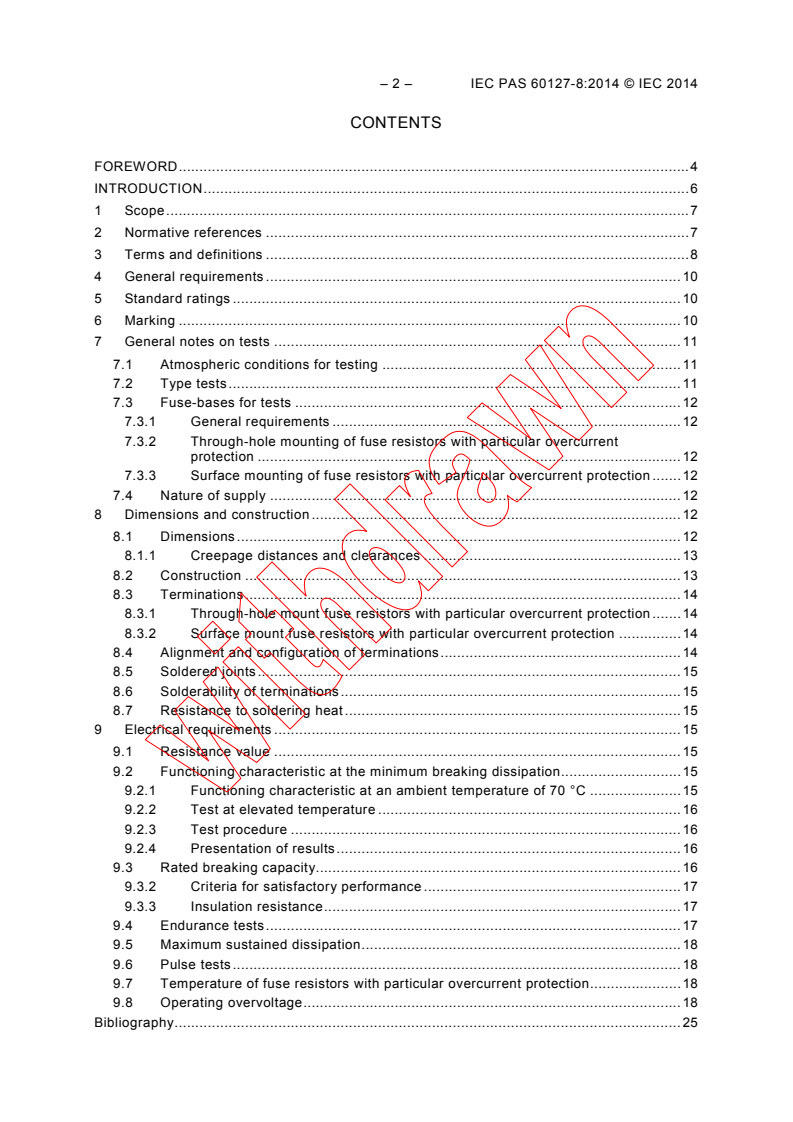
CONTENTS
FOREWORD . 4
INTRODUCTION . 6
1 Scope . 7
2 Normative references . 7
3 Terms and definitions . 8
4 General requirements . 10
5 Standard ratings . 10
6 Marking . 10
7 General notes on tests . 11
7.1 Atmospheric conditions for testing . 11
7.2 Type tests . 11
7.3 Fuse-bases for tests . 12
7.3.1 General requirements . 12
7.3.2 Through-hole mounting of fuse resistors with particular overcurrent
protection . 12
7.3.3 Surface mounting of fuse resistors with particular overcurrent protection . 12
7.4 Nature of supply . 12
8 Dimensions and construction . 12
8.1 Dimensions . 12
8.1.1 Creepage distances and clearances . 13
8.2 Construction . 13
8.3 Terminations . 14
8.3.1 Through-hole mount fuse resistors with particular overcurrent protection . 14
8.3.2 Surface mount fuse resistors with particular overcurrent protection . 14
8.4 Alignment and configuration of terminations . 14
8.5 Soldered joints . 15
8.6 Solderability of terminations . 15
8.7 Resistance to soldering heat . 15
9 Electrical requirements . 15
9.1 Resistance value . 15
9.2 Functioning characteristic at the minimum breaking dissipation. 15
9.2.1 Functioning characteristic at an ambient temperature of 70 °C . 15
9.2.2 Test at elevated temperature . 16
9.2.3 Test procedure . 16
9.2.4 Presentation of results . 16
9.3 Rated breaking capacity. 16
9.3.2 Criteria for satisfactory performance . 17
9.3.3 Insulation resistance . 17
9.4 Endurance tests . 17
9.5 Maximum sustained dissipation . 18
9.6 Pulse tests . 18
9.7 Temperature of fuse resistors with particular overcurrent protection. 18
9.8 Operating overvoltage . 18
Bibliography . 25
Figure 1 – Test board for through-hole mount fuse resistors with particular overcurrent
protection . 20
Figure 2 – Test board for surface mount fuse resistors with particular overcurrent
protection . 21
Figure 3 – Test fuse-base . 22
Figure 4 – Bending jig for surface mount fuse resistors with particular overcurrent
protection . 23
Figure 5 – Test circuit for the tests according to 9.3 . 24
Table 1 – Creepage distances and clearances (absolute minimum values) . 13
Table 2 – Test voltages for dielectric strength . 17
Table 3 – Testing schedule for individual dissipation ratings . 19
– 4 – IEC PAS 60127-8:2014 © IEC 2014
INTERNATIONAL ELECTROTECHNICAL COMMISSION
____________
MINIATURE FUSES –
Part 8: Fuse resistors with particular overcurrent protection
FOREWORD
1) The International Electrotechnical Commission (IEC) is a worldwide organization for standardization comprising
all national electrotechnical committees (IEC National Committees). The object of IEC is to promote
international co-operation on all questions concerning standardization in the electrical and electronic fields. To
this end and in addition to other activities, IEC publishes International Standards, Technical Specifications,
Technical Reports, Publicly Available Specifications (PAS) and Guides (hereafter referred to as “IEC
Publication(s)”). Their preparation is entrusted to technical committees; any IEC National Committee interested
in the subject dealt with may participate in this preparatory work. International, governmental and non-
governmental organizations liaising with the IEC also participate in this preparation. IEC collaborates closely
with the International Organization for Standardization (ISO) in accordance with conditions determined by
agreement between the two organizations.
2) The formal decisions or agreements of IEC on technical matters express, as nearly as possible, an international
consensus of opinion on the relevant subjects since each technical committee has representation from all
interested IEC National Committees.
3) IEC Publications have the form of recommendations for international use and are accepted by IEC National
Committees in that sense. While all reasonable efforts are made to ensure that the technical content of IEC
Publications is accurate, IEC cannot be held responsible for the way in which they are used or for any
misinterpretation by any end user.
4) In order to promote international uniformity, IEC National Committees undertake to apply IEC Publications
transparently to the maximum extent possible in their national and regional publications. Any divergence
between any IEC Publication and the corresponding national or regional publication shall be clearly indicated in
the latter.
5) IEC itself does not provide any attestation of conformity. Independent certification bodies provide conformity
assessment services and, in some areas, access to IEC marks of conformity. IEC is not responsible for any
services carried out by independent certification bodies.
6) All users should ensure that they have the latest edition of this publication.
7) No liability shall attach to IEC or its directors, employees, servants or agents including individual experts and
members of its technical committees and IEC National Committees for any personal injury, property damage or
other damage of any nature whatsoever, whether direct or indirect, or for costs (including legal fees) and
expenses arising out of the publication, use of, or reliance upon, this IEC Publication or any other IEC
Publications.
8) Attention is drawn to the Normative references cited in this publication. Use of the referenced publications is
indispensable for the correct application of this publication.
9) Attention is drawn to the possibility that some of the elements of this IEC Publication may be the subject of
patent rights. IEC shall not be held responsible for identifying any or all such patent rights.
A PAS is a technical specification not fulfilling the requirements for a standard, but made
available to the public.
IEC PAS 60127-8 has been processed by subcommittee 32C: Miniature fuses, of IEC
technical committee 32: Fuses.
The text of this PAS is based on the This PAS was approved for
following document: publication by the P-members of the
committee concerned as indicated in
the following document
Draft PAS Report on voting
32C/500/PAS 32C/503/RVD
Following publication of this PAS, which is a pre-standard publication, the technical committee
or subcommittee concerned may transform it into an International Standard.
A list of all parts in the IEC 60127, published under the general title Miniature fuses, can be
found on the IEC website.
This PAS shall remain valid for an initial maximum period of 3 years starting from the
publication date. The validity may be extended for a single period up to a maximum of
3 years, at the end of which it shall be published as another type of normative document, or
shall be withdrawn.
– 6 – IEC PAS 60127-8:2014 © IEC 2014
INTRODUCTION
In recent years, so-called “fuse resistors” have increasingly been used in electrical and
electronic applications. The term “fuse resistor”, however, which has become established in
the market, is misleading. The actual function of a fuse resistor is that of a resistor in an
electrical or electronic circuit. Only when an overload of multiple times the rated dissipation
occurs can fuse resistors interrupt an electric current. In a wide range between the rated
dissipation and the manufacturer’s specified breaking dissipation, fuse resistors provide poor
or no overcurrent protection. So if they are incorrectly rated and improperly used in an
application, this may result in potential risk of fire.
Fuse resistors perform the function of a fuse only within a particular overcurrent range, and,
from a technical point of view, must therefore be referred to as “fuse resistors with particular
overcurrent protection”.
Fuse resistors with particular overcurrent protection can safely interrupt high short-circuit
currents, but are not capable of interrupting overload currents.
For safety reasons, they shall therefore only be used in combination with an accompanying
overload current protection device, i.e. a true fuse, if overload currents cannot be excluded to
occur in the respective application.
MINIATURE FUSES –
Part 8: Fuse resistors with particular overcurrent protection
1 Scope
This part of IEC 60127 relates to fuse resistors with particular overcurrent protection rated up
to 500 V a.c. and/or 500 V d.c. for printed circuits and other substrate systems, used for the
protection of electric appliances, electronic equipment and component parts thereof, normally
intended to be used indoors.
It does not apply to fuse resistors with particular overcurrent protection for appliances
intended to be used under special conditions, such as in a corrosive or explosive atmosphere.
The object of this PAS is
a) to establish uniform requirements for fuse resistors with particular overcurrent protection
so as to protect appliances or parts of appliances in the most suitable way;
b) to define the performance of the fuse resistors with particular overcurrent protection, so as
to give guidance to manufacturers of electrical appliances and electronic equipment and to
ensure replacement of fuse resistors with particular overcurrent protection by those of
similar dimensions and characteristics;
c) to define methods of testing.
This PAS applies in addition to the requirements of IEC 60127-1.
NOTE Manufacturers of fuse resistors with particular overcurrent protection must ensure on their own
responsibility that their products comply with the requirements of the resistor-related standards IEC 60115-1,
IEC 60115-4-101 and IEC 60115-4-102 (withdrawn).
The object of this PAS is to establish uniform test methods for fuse resistors with particular
overcurrent protection, so as to allow verification of the values (for example rated dissipation,
functioning characteristic and rated breaking capacity values) specified by the manufacturer.
2 Normative references
The following documents, in whole or in part, are normatively referenced in this document and
are indispensable for its application. For dated references, only the edition cited applies. For
undated references, the latest edition of the referenced document (including any
amendments) applies.
IEC 60063:1963, Preferred number series for resistors and capacitors
Amendment 1:1967
Amendment 2:1977
IEC 60068-2-21:2006, Environmental testing – Part 2-21: Tests – Test U: Robustness of
terminations and integral mounting devices
IEC 60127-1:2006, Miniature fuses – Part 1: Definitions for miniature fuses and general
requirements for miniature fuse-links
IEC 60194:2006, Printed board design, manufacture and assembly – Terms and definitions
– 8 – IEC PAS 60127-8:2014 © IEC 2014
IEC 60695-2-12:2010, Fire hazard testing – Part 2-12: Glowing/hot-wire based test methods –
Glow-wire flammability index (GWFI) test method for materials
IEC 60695-2-13:2010, Fire hazard testing – Part 2-13: Glowing/hot-wire based test methods –
Glow-wire ignition temperature (GWIT) test method for materials
IEC 60695-4:2012, Fire hazard testing – Part 4: Terminology concerning fire tests for
electrotechnical products
IEC 61249-2-7:2002, Materials for printed boards and other interconnecting structures – Part
2-7: Reinforced base materials clad and unclad – Epoxide woven E-glass laminated sheet of
defined flammability (vertical burning test), copper-clad
3 Terms and definitions
For the purposes of this document, the terms and definitions given in Clause 3 of IEC 60127-
1:2006, as well as the following apply.
3.28
fuse resistor with particular overcurrent protection
fuse resistor capable of continuously carrying currents up to at least the rated power
dissipation and of interrupting currents above a defined multiple of the rated dissipation up to
its rated breaking capacity
Note 1 to entry: Fuse resistors with particular overcurrent protection can safely interrupt high short-circuit
currents, but are not capable of interrupting overload currents. They are therefore allowed to be used only in
combination with an accompanying overload current protection device such as a miniature fuse, if overload
currents cannot be excluded to occur in the respective application.
3.29
fuse resistor with particular overcurrent protection for through-hole mounting
fuse resistor with particular overcurrent protection designed for soldering directly into a
printed wiring board, with insertion of its leads in suitably designed holes
3.30
fuse resistor with particular overcurrent protection for surface mounting
fuse resistor with particular overcurrent protection designed for direct conductive attachment
by solder or other means onto the surface of a substrate, without insertion of its leads in
suitably designed holes or sockets
3.31
land
portion of a conductive pattern usually but not exclusively used for the connection and/or
attachment of components (see IEC 60194)
Note 1 to entry: Further definitions which may be useful in the application of surface-mount fuse resistors with
particular overcurrent protection may be found in IEC 60115-1 and IEC 60115-8.
3.32
critical resistance
resistance value at which the rated voltage is equal to the limiting element voltage
Note 1 to entry: At an ambient temperature of 70 °C, the maximum voltage which may be applied across the
terminations of a fuse resistor with particular overcurrent protection is either the calculated rated voltage, if the
resistance is less than the critical resistance, or the limiting element voltage, if the resistance is equal to or greater
than the critical resistance. At temperatures other than 70 °C, it is important that account be taken of the derating
curve and of the limiting element voltage in the calculation of any voltage to be applied.
Note 2 to entry: Related terminology: Rated voltage, limiting element voltage.
3.33
limiting element voltage
U
max
maximum d.c. or a.c. r.m.s. voltage that may be continuously applied to the terminations of a
fuse resistor with particular overcurrent protection (generally dependent upon size and
manufacturing technology of the fuse resistor with particular overcurrent protection)
Note 1 to entry: Where the term "a.c. r.m.s. voltage" is used in this standard, the peak voltage should not exceed
1,42 times the r.m.s. value.
Note 2 to entry: This voltage can only be applied to fuse resistors with particular overcurrent protection when the
resistance value is equal to or higher than the critical resistance value.
Note 3 to entry: Related terminology: rated voltage, critical resistance.
3.34
rated resistance
resistance value for which the fuse resistor with particular overcurrent protection has been
designed, and which is generally used for denomination of the fuse resistor with particular
overcurrent protection
3.35
rated dissipation
P
maximum permissible dissipation at an ambient temperature of 70 °C under the conditions of
the respective acceptance criteria
Note 1 to entry: If the rated dissipation depends on special means supporting the abduction of the dissipation to
the environment, for example, special circuit board material, special conductor dimensions, heat-sink, such means
have to be identified whenever the rated dissipation is mentioned.
Note 2 to entry: Related terminology: rated temperature, rated voltage.
3.36
rated temperature
maximum ambient temperature at which the rated dissipation may be applied continuously
Note 1 to entry: The rated temperature has a value of 70 °C, unless otherwise prescribed in the relevant sectional
specification.
Note 2 to entry: Related terminology: rated dissipation.
3.37
rated voltage of the fuse resistor with particular overcurrent protection
U
r
d.c. or a.c. r.m.s. voltage calculated from the square root of the product of the rated
resistance and the rated dissipation
Note 1 to entry: At high values of resistance, the rated voltage may not be applicable because of the size and the
construction of the fuse resistor with particular overcurrent protection.
Note 2 to entry: Related terminology: rated dissipation, limiting element voltage.
3.38
minimum breaking dissipation
minimum value of the breaking dissipation which is equal to a multiple of the rated dissipation
and at which the fuse resistor with particular overcurrent protection can still safely interrupt
the circuit
Note 1 to entry: In this standard the minimum breaking dissipation is specified to be 16 times the rated
dissipation. This value corresponds to the values given by most of the manufacturers.
– 10 – IEC PAS 60127-8:2014 © IEC 2014
4 General requirements
The requirements of IEC 60127-1:2006, Clause 4, are replaced as follows:
Fuse resistors with particular overcurrent protection shall be so constructed that their fuse
function is reliable and safe and they are consistent in performance at the minimum breaking
dissipation up to and including the breaking capacity rating and at any voltage up to the rated
voltage, when used within the limits of this standard.
During normal use of the fuse resistor with particular overcurrent protection and within the
conditions given in this standard, no permanent arc, nor external arcing, nor any flame that
can endanger the surroundings, shall be produced. During testing and after operation, the
fuse resistor with particular overcurrent protection shall not have suffered damage and the
surroundings shall be unimpaired. Marking shall still be legible.
In general, compliance is checked by carrying out all the tests specified.
5 Standard ratings
The values of rated resistance shall be selected from the E12 or E24 series as given in
IEC 60063.
6 Marking
The requirements of IEC 60127-1:2006, Clause 6, are replaced as follows:
6.1 Each fuse resistor with particular overcurrent protection shall be marked as follows:
a) Rated resistance in ohm (abbreviation Ω or mΩ).
b) The marking of the tolerance on rated resistance shall follow and be adjacent to the
marking of the rated resistance.
c) Rated dissipation in watt (abbreviation W).
d) Manufacturer's name or trade mark.
e) The symbol “F” shall precede and be adjacent to the marking of the rated resistance.
6.2 Marking shall be indelible and easily legible.
In the case of screen or pad printing, compliance is
...