


IEC 62246-4:2023
(Main)Reed switches – Part 4: Application in conjunction with magnetic actuator used for magnetic sensing devices
Reed switches – Part 4: Application in conjunction with magnetic actuator used for magnetic sensing devices
IEC 62246-4:2023 gives additional requirements for the evaluation of functional characteristics on reed switching components operated by magnetic actuator and gives guidance for their implementation in selected applications.
This document specifies test and measurement procedures for the application of reed switch (contact) based magnetic sensors.
In case the application of a reed contact magnetic sensor determines additional requirements exceeding those specified in this document, the sensor is evaluated with this application in accordance with the relevant IEC or ISO standard(s) (e.g. IEC 62061 or ISO 13849 series, IEC 60335-1 and relevant parts of the IEC 60335-2 series, IEC 60730-1, IEC 61373, ISO 16750-3).
This document does not apply to:
– sensing or monitoring of the position of elements of interlocking devices for movable guards (see ISO 14119);
– sensing or monitoring of the position of elements of pressure sensitive protective equipment (PSPE, see ISO 13856 series);
– electrical equipment for measurement, control, and laboratory use (see IEC 61010-1);
– aircraft – proximity switches (see ISO 6859-1).
Information contained in this document is relevant to the application of a magnetic sensor on new installations as well as modifications to existing installations.
Contacts à lames souples - Partie 4: Application en combinaison avec un actionneur magnétique utilisé pour les dispositifs de détection magnétiques
L'IEC 62246-4:2023 fournit des exigences supplémentaires pour l'évaluation des caractéristiques fonctionnelles des composants des contacts à lames souples activés par un actionneur magnétique, ainsi que des recommandations pour leur mise en œuvre dans certaines applications.
Le présent document spécifie des procédures d'essai et de mesure pour l'application de capteurs magnétiques à contacts à lames souples.
Si l'utilisation d'un capteur magnétique à lames souples établit des exigences supplémentaires qui dépassent celles spécifiées dans le présent document, ce capteur est évalué dans le cadre de son application selon la ou les normes IEC ou ISO appropriées (par exemple, l'IEC 62061 ou la série ISO 13849, l'IEC 60335-1 et les parties pertinentes de la série IEC 60335-2, l'IEC 60730-1, l'IEC 61373, l'ISO 16750-3).
Le présent document ne s'applique pas:
– à la détection ou surveillance de la position des éléments des dispositifs de verrouillage des protecteurs mobiles (voir l'ISO 14119);
– à la détection ou surveillance de la position des éléments des équipements de protection sensibles à la pression (PSPE, voir la série ISO 13856);
– au matériel électrique de mesure, de commande et de laboratoire (voir l'IEC 61010-1);
– aux détecteurs de proximité en aéronautique (voir l'ISO 6859-1).
Les informations contenues dans le présent document concernent l'application d'un capteur magnétique dans de nouvelles installations ainsi que les modifications apportées à des installations existantes.
General Information
- Status
- Published
- Publication Date
- 14-Feb-2023
- Technical Committee
- TC 94 - Electrical relays
- Drafting Committee
- WG 6 - TC 94/WG 6
- Current Stage
- PPUB - Publication issued
- Start Date
- 15-Feb-2023
- Completion Date
- 17-Mar-2023
Overview
IEC 62246-4:2023 is an international standard developed by the International Electrotechnical Commission (IEC) that focuses on reed switches-specifically their application in conjunction with magnetic actuators for magnetic sensing devices. This part 4 of the IEC 62246 series sets additional requirements for evaluating the functional characteristics of reed switching components when operated by a magnetic actuator. It provides comprehensive guidance for implementing these magnetic sensors effectively in selected applications.
The document establishes standardized test and measurement procedures tailored for reed switch-based magnetic sensors, ensuring reliable and safe operation when these devices are used for magnetic sensing. Importantly, it addresses key performance factors such as operating distance, contact reliability, insulation resistance, response speed, endurance, and environmental robustness, among others.
This standard is intended for new installations and modifications in existing systems but excludes specific sectors such as interlocking devices, pressure-sensitive protective equipment, laboratory electrical equipment, and aircraft proximity switches, which are covered by other specialized standards.
Key Topics
- Functional Characteristics: Evaluation of reed switch components operated by magnetic actuators, focusing on contact reliability, response speed, and operating distance.
- Rated Values: Definitions and considerations for rated insulation voltage, operating voltage and current, contact ratings, number of operations, and climatic categories.
- Test Procedures:
- Visual inspections and dimension checks to ensure physical compliance.
- Functional tests including operating distance, magnetic interference, response speed, and contact circuit resistance.
- Electrical endurance and mechanical endurance tests to verify long-term operation under stress.
- Environmental and mechanical stress evaluations such as vibration, shock, temperature variations, damp heat, salt mist exposure, and fluid contamination resistance.
- Enclosure protection and sealing tests for assessing device durability against environmental ingress.
- Heat and fire resistance tests including glow-wire and ball pressure testing.
- Documentation and Marking: Requirements for component data, marking, and use of standardized symbols for clear identification and traceability.
- Exclusions and Reference Standards: Clarifications on applications not covered by this standard, directing users to other IEC or ISO standards such as IEC 62061, ISO 13849 for safety-related control systems, IEC 60335 series for household appliances, and ISO 14119 for interlocking devices.
Applications
IEC 62246-4:2023 is critical for industries and sectors where magnetic sensing devices based on reed switches are used, including but not limited to:
- Automation and manufacturing systems requiring reliable magnetic position sensing.
- Electrical appliances and consumer electronics where magnetic sensors detect component states.
- Building and security systems employing magnetic actuators for access control.
- Mechanical systems needing precise monitoring of movable components by magnetic sensing.
- Automotive and industrial machinery where magnetic sensors contribute to safe and efficient operation.
By adhering to this standard, manufacturers and engineers can ensure that reed switch magnetic sensors achieve optimal performance, durability, and safety in their specific applications.
Related Standards
To complement the use and evaluation of reed switch magnetic sensors as described in IEC 62246-4:2023, the following related IEC and ISO standards are often referenced:
- IEC 62061 and ISO 13849 series: Safety of machinery – safety-related control systems.
- ISO 14119: Safety of machinery – interlocking devices associated with guards.
- ISO 13856 series: Pressure-sensitive protective equipment (PSPE).
- IEC 60335-1 and IEC 60335-2 series: Safety of household and similar electrical appliances.
- IEC 60730-1: Automatic electrical controls for household and similar use.
- IEC 61373: Railway applications – shock and vibration requirements.
- ISO 16750-3: Road vehicles – environmental conditions and testing for electrical components.
- IEC 61010-1: Safety requirements for electrical equipment for measurement, control, and laboratory use.
- ISO 6859-1: Aircraft – magnetic switches for proximity sensing.
These standards provide broader safety, performance, and environmental requirements that harmonize with IEC 62246-4:2023 for comprehensive evaluation and deployment of magnetic switching devices.
Keywords: IEC 62246-4:2023, reed switches, magnetic actuator, magnetic sensing devices, test procedures, contact reliability, insulation resistance, operating distance, electromagnetic compatibility, environmental testing, electrical durability, IEC standards, magnetic sensors applications.
Get Certified
Connect with accredited certification bodies for this standard

Intertek Testing Services NA Inc.
Intertek certification services in North America.

UL Solutions
Global safety science company with testing, inspection and certification.

ANCE
Mexican certification and testing association.
Sponsored listings
Frequently Asked Questions
IEC 62246-4:2023 is a standard published by the International Electrotechnical Commission (IEC). Its full title is "Reed switches – Part 4: Application in conjunction with magnetic actuator used for magnetic sensing devices". This standard covers: IEC 62246-4:2023 gives additional requirements for the evaluation of functional characteristics on reed switching components operated by magnetic actuator and gives guidance for their implementation in selected applications. This document specifies test and measurement procedures for the application of reed switch (contact) based magnetic sensors. In case the application of a reed contact magnetic sensor determines additional requirements exceeding those specified in this document, the sensor is evaluated with this application in accordance with the relevant IEC or ISO standard(s) (e.g. IEC 62061 or ISO 13849 series, IEC 60335-1 and relevant parts of the IEC 60335-2 series, IEC 60730-1, IEC 61373, ISO 16750-3). This document does not apply to: – sensing or monitoring of the position of elements of interlocking devices for movable guards (see ISO 14119); – sensing or monitoring of the position of elements of pressure sensitive protective equipment (PSPE, see ISO 13856 series); – electrical equipment for measurement, control, and laboratory use (see IEC 61010-1); – aircraft – proximity switches (see ISO 6859-1). Information contained in this document is relevant to the application of a magnetic sensor on new installations as well as modifications to existing installations.
IEC 62246-4:2023 gives additional requirements for the evaluation of functional characteristics on reed switching components operated by magnetic actuator and gives guidance for their implementation in selected applications. This document specifies test and measurement procedures for the application of reed switch (contact) based magnetic sensors. In case the application of a reed contact magnetic sensor determines additional requirements exceeding those specified in this document, the sensor is evaluated with this application in accordance with the relevant IEC or ISO standard(s) (e.g. IEC 62061 or ISO 13849 series, IEC 60335-1 and relevant parts of the IEC 60335-2 series, IEC 60730-1, IEC 61373, ISO 16750-3). This document does not apply to: – sensing or monitoring of the position of elements of interlocking devices for movable guards (see ISO 14119); – sensing or monitoring of the position of elements of pressure sensitive protective equipment (PSPE, see ISO 13856 series); – electrical equipment for measurement, control, and laboratory use (see IEC 61010-1); – aircraft – proximity switches (see ISO 6859-1). Information contained in this document is relevant to the application of a magnetic sensor on new installations as well as modifications to existing installations.
IEC 62246-4:2023 is classified under the following ICS (International Classification for Standards) categories: 29.120.70 - Relays. The ICS classification helps identify the subject area and facilitates finding related standards.
IEC 62246-4:2023 is available in PDF format for immediate download after purchase. The document can be added to your cart and obtained through the secure checkout process. Digital delivery ensures instant access to the complete standard document.
Standards Content (Sample)
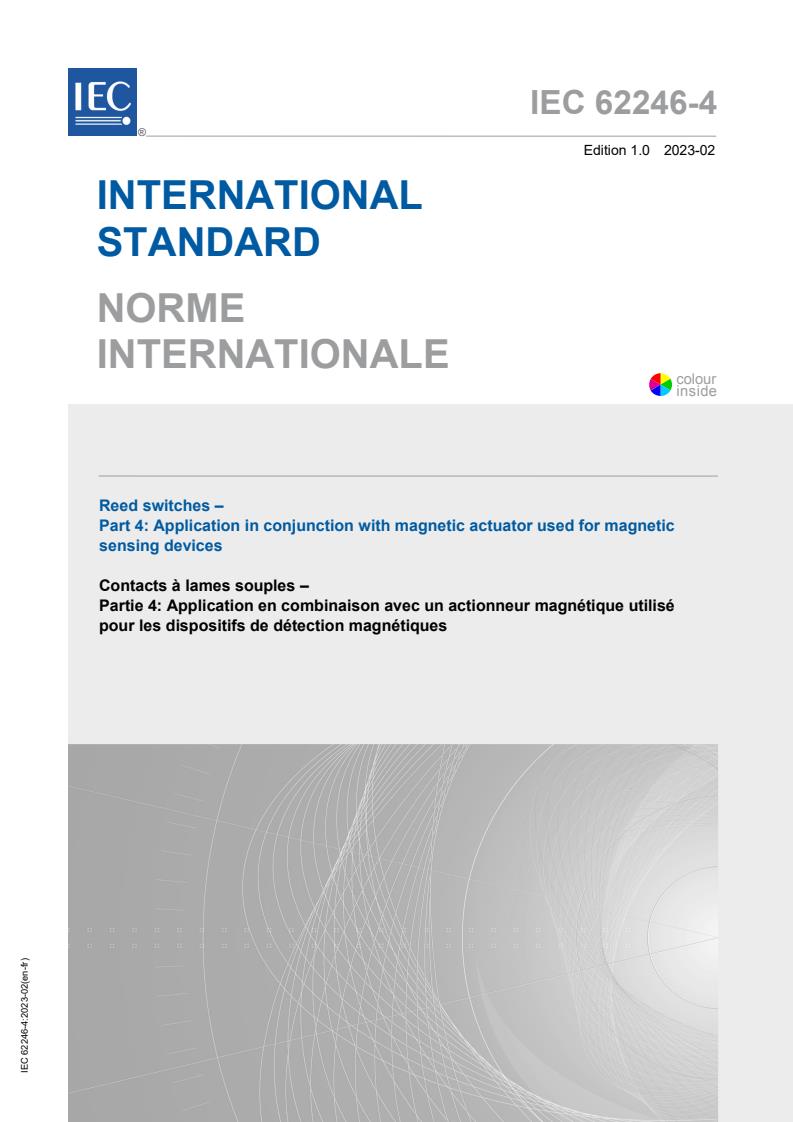
IEC 62246-4 ®
Edition 1.0 2023-02
INTERNATIONAL
STANDARD
NORME
INTERNATIONALE
colour
inside
Reed switches –
Part 4: Application in conjunction with magnetic actuator used for magnetic
sensing devices
Contacts à lames souples –
Partie 4: Application en combinaison avec un actionneur magnétique utilisé
pour les dispositifs de détection magnétiques
All rights reserved. Unless otherwise specified, no part of this publication may be reproduced or utilized in any form
or by any means, electronic or mechanical, including photocopying and microfilm, without permission in writing from
either IEC or IEC's member National Committee in the country of the requester. If you have any questions about IEC
copyright or have an enquiry about obtaining additional rights to this publication, please contact the address below or
your local IEC member National Committee for further information.
Droits de reproduction réservés. Sauf indication contraire, aucune partie de cette publication ne peut être reproduite ni
utilisée sous quelque forme que ce soit et par aucun procédé, électronique ou mécanique, y compris la photocopie et
les microfilms, sans l'accord écrit de l'IEC ou du Comité national de l'IEC du pays du demandeur. Si vous avez des
questions sur le copyright de l'IEC ou si vous désirez obtenir des droits supplémentaires sur cette publication, utilisez
les coordonnées ci-après ou contactez le Comité national de l'IEC de votre pays de résidence.
IEC Secretariat Tel.: +41 22 919 02 11
3, rue de Varembé info@iec.ch
CH-1211 Geneva 20 www.iec.ch
Switzerland
About the IEC
The International Electrotechnical Commission (IEC) is the leading global organization that prepares and publishes
International Standards for all electrical, electronic and related technologies.
About IEC publications
The technical content of IEC publications is kept under constant review by the IEC. Please make sure that you have the
latest edition, a corrigendum or an amendment might have been published.
IEC publications search - webstore.iec.ch/advsearchform IEC Products & Services Portal - products.iec.ch
The advanced search enables to find IEC publications by a Discover our powerful search engine and read freely all the
variety of criteria (reference number, text, technical publications previews. With a subscription you will always have
committee, …). It also gives information on projects, replaced access to up to date content tailored to your needs.
and withdrawn publications.
Electropedia - www.electropedia.org
IEC Just Published - webstore.iec.ch/justpublished
The world's leading online dictionary on electrotechnology,
Stay up to date on all new IEC publications. Just Published
containing more than 22 300 terminological entries in English
details all new publications released. Available online and once
and French, with equivalent terms in 19 additional languages.
a month by email.
Also known as the International Electrotechnical Vocabulary
(IEV) online.
IEC Customer Service Centre - webstore.iec.ch/csc
If you wish to give us your feedback on this publication or need
further assistance, please contact the Customer Service
Centre: sales@iec.ch.
A propos de l'IEC
La Commission Electrotechnique Internationale (IEC) est la première organisation mondiale qui élabore et publie des
Normes internationales pour tout ce qui a trait à l'électricité, à l'électronique et aux technologies apparentées.
A propos des publications IEC
Le contenu technique des publications IEC est constamment revu. Veuillez vous assurer que vous possédez l’édition la
plus récente, un corrigendum ou amendement peut avoir été publié.
Recherche de publications IEC - Découvrez notre puissant moteur de recherche et consultez
webstore.iec.ch/advsearchform gratuitement tous les aperçus des publications. Avec un
La recherche avancée permet de trouver des publications IEC abonnement, vous aurez toujours accès à un contenu à jour
en utilisant différents critères (numéro de référence, texte, adapté à vos besoins.
comité d’études, …). Elle donne aussi des informations sur les
projets et les publications remplacées ou retirées. Electropedia - www.electropedia.org
Le premier dictionnaire d'électrotechnologie en ligne au monde,
IEC Just Published - webstore.iec.ch/justpublished
avec plus de 22 300 articles terminologiques en anglais et en
Restez informé sur les nouvelles publications IEC. Just
français, ainsi que les termes équivalents dans 19 langues
Published détaille les nouvelles publications parues.
additionnelles. Egalement appelé Vocabulaire
Disponible en ligne et une fois par mois par email.
Electrotechnique International (IEV) en ligne.
Service Clients - webstore.iec.ch/csc
Si vous désirez nous donner des commentaires sur cette
publication ou si vous avez des questions contactez-nous:
sales@iec.ch.
IEC Products & Services Portal - products.iec.ch
IEC 62246-4 ®
Edition 1.0 2023-02
INTERNATIONAL
STANDARD
NORME
INTERNATIONALE
colour
inside
Reed switches –
Part 4: Application in conjunction with magnetic actuator used for magnetic
sensing devices
Contacts à lames souples –
Partie 4: Application en combinaison avec un actionneur magnétique utilisé
pour les dispositifs de détection magnétiques
INTERNATIONAL
ELECTROTECHNICAL
COMMISSION
COMMISSION
ELECTROTECHNIQUE
INTERNATIONALE
ICS 29.120.70 ISBN 978-2-8322-6469-0
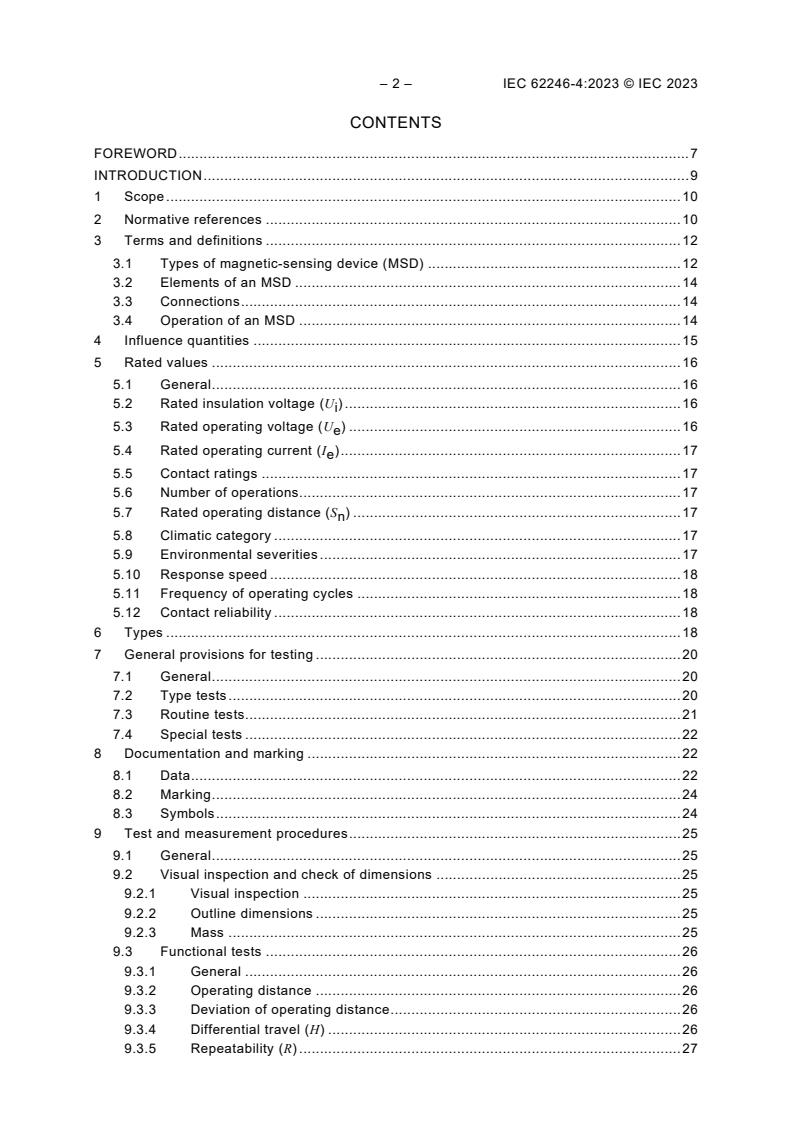
– 2 – IEC 62246-4:2023 © IEC 2023
CONTENTS
FOREWORD . 7
INTRODUCTION . 9
1 Scope . 10
2 Normative references . 10
3 Terms and definitions . 12
3.1 Types of magnetic-sensing device (MSD) . 12
3.2 Elements of an MSD . 14
3.3 Connections . 14
3.4 Operation of an MSD . 14
4 Influence quantities . 15
5 Rated values . 16
5.1 General . 16
5.2 Rated insulation voltage (U ) . 16
i
5.3 Rated operating voltage (U ) . 16
e
5.4 Rated operating current (I ) . 17
e
5.5 Contact ratings . 17
5.6 Number of operations. 17
5.7 Rated operating distance (S ) . 17
n
5.8 Climatic category . 17
5.9 Environmental severities . 17
5.10 Response speed . 18
5.11 Frequency of operating cycles . 18
5.12 Contact reliability . 18
6 Types . 18
7 General provisions for testing . 20
7.1 General . 20
7.2 Type tests . 20
7.3 Routine tests. 21
7.4 Special tests . 22
8 Documentation and marking . 22
8.1 Data . 22
8.2 Marking . 24
8.3 Symbols . 24
9 Test and measurement procedures . 25
9.1 General . 25
9.2 Visual inspection and check of dimensions . 25
9.2.1 Visual inspection . 25
9.2.2 Outline dimensions . 25
9.2.3 Mass . 25
9.3 Functional tests . 26
9.3.1 General . 26
9.3.2 Operating distance . 26
9.3.3 Deviation of operating distance . 26
9.3.4 Differential travel (H) . 26
9.3.5 Repeatability (R) . 27
9.3.6 Magnetic interference . 27
9.3.7 Response speed (if applicable) . 27
9.3.8 Frequency of operating cycles (f) (if applicable) . 29
9.3.9 Functional test by temperature change . 31
9.3.10 Contact circuit resistance . 32
9.3.11 Temperature rise . 32
9.4 Insulation resistance . 32
9.4.1 Procedures . 32
9.4.2 Requirements . 33
9.5 Dielectric test . 33
9.5.1 Procedures . 33
9.5.2 Requirements . 34
9.6 Endurance tests . 34
9.6.1 General . 34
9.6.2 Procedures for electrical endurance test . 34
9.6.3 Requirements . 35
9.6.4 Procedures for mechanical endurance test (if applicable) . 35
9.6.5 Requirements . 35
9.7 External connections . 35
9.7.1 General . 35
9.7.2 Robustness of terminal with lead wire (if applicable) . 36
9.7.3 Robustness of terminal (if applicable) . 36
9.7.4 Soldering terminals (if applicable) . 37
9.7.5 Connector (if applicable) . 37
9.8 Mechanical stresses tests . 37
9.8.1 General . 37
9.8.2 Mounting . 37
9.8.3 Vibration . 37
9.8.4 Shock . 38
9.8.5 Rough handling shocks (if applicable) . 39
9.9 Environmental tests . 39
9.9.1 General . 39
9.9.2 Cold. 40
9.9.3 Dry heat . 40
9.9.4 Damp heat, steady state . 40
9.9.5 Mould growth . 41
9.9.6 Fluid contamination (if applicable) . 41
9.9.7 Salt mist (if applicable) . 42
9.10 Enclosure protection tests . 42
9.10.1 General . 42
9.10.2 Degree of enclosure . 42
9.10.3 Pressurized water (if applicable) . 42
9.11 Sealing (if applicable) . 43
9.11.1 General . 43
9.11.2 Procedures . 43
9.11.3 Requirements . 43
9.12 Heat and fire resistance . 43
9.12.1 General . 43
9.12.2 Glow-wire . 43
– 4 – IEC 62246-4:2023 © IEC 2023
9.12.3 Ball pressure . 44
9.13 Making and breaking capacity (if applicable) . 45
9.13.1 General . 45
9.13.2 Procedures . 45
9.13.3 Requirements . 45
9.14 Conditional short-circuit current test (if applicable) . 46
9.14.1 General . 46
9.14.2 Procedures . 46
9.14.3 Requirements . 46
9.15 Contact reliability test . 46
9.15.1 General . 46
9.15.2 Procedures . 46
9.15.3 Requirements . 46
9.16 Electromagnetic compatibility (EMC) . 46
Annex A (informative) Explanations relating to reed contact magnetic sensor –
Example . 47
Annex B (informative) Explanations relating to the operation of reed contact magnetic
sensor – Example . 48
Annex C (informative) Work principles regarding sensing distances . 49
C.1 General . 49
C.2 Reed contact magnetic sensor with magnetic actuator set (separate type) . 49
C.2.1 Operation . 49
C.2.2 Axial approach . 49
C.2.3 Lateral approach. 50
C.3 Reed contact magnetic sensor with magnetic actuator set (latching type) . 51
C.3.1 Operation . 51
C.3.2 Specified directions . 51
C.4 Reed contact magnetic sensor with magnetic actuator set (fork type) . 52
C.4.1 Operation . 52
C.4.2 Specified directions . 52
C.5 Reed contact magnetic sensor with magnetic actuator set (plunger type) . 53
C.5.1 Operation . 53
C.5.2 Specified directions . 53
C.6 Reed contact magnetic sensor with magnetic actuator set (float type) . 54
C.6.1 Operation . 54
C.6.2 Specific directions . 55
Annex D (informative) Risk assessment . 56
D.1 General . 56
D.2 Risk assessment procedure . 56
D.3 Achieving tolerable risk . 57
D.4 Application of risk assessment procedures (proposal for the user) . 59
Annex E (informative) Test procedures regarding response speed . 61
E.1 General . 61
E.2 Test circuit . 61
E.3 Test sequence . 61
Annex F (informative) Special tests . 63
F.1 General . 63
F.2 Functional tests . 63
F.3 Functional tests and mechanical durability . 63
F.4 Vibration and shock tests for special requirements of applications . 63
F.5 Explosion proofness . 63
F.5.1 General . 63
F.5.2 Procedures . 63
F.5.3 Requirements . 64
Bibliography . 65
Figure 1 – Methods for measuring the response speed . 28
Figure 2 – Output signal . 28
Figure 3 – Methods for measuring the operating frequency (f). 30
Figure 4 – Output signal during the measuring of operating frequency (f) . 31
Figure 5 – Ball pressure test apparatus . 45
Figure A.1 – Driven method for reed contact magnetic sensor by permanent magnetic
actuator . 47
Figure B.1 – Explanatory diagram of terms related to operation by magnetic actuator . 48
Figure C.1 – Operating approaches . 49
Figure C.2 – Axial approach relating to sensing distances . 50
Figure C.3 – Lateral approach relating to sensing distances . 51
Figure C.4 – Specified directions relating to sensing distances and contact states . 52
Figure C.5 – Specified directions relating to sensing distances . 53
Figure C.6 – Sensing distances . 54
Figure C.7 – Sensing distances according to liquid level . 55
Figure D.1 – Iterative process of risk assessment and risk reduction . 56
Figure D.2 – Risk reduction . 58
Figure E.1 – Test circuit – Example . 61
Figure E.2 – Measurement data by oscilloscope – Example . 62
Table 1 – Reference values of influence quantities . 16
Table 2 – Rated insulation voltage . 16
Table 3 – Rated operating voltage . 17
Table 4 – Rated operating distance . 17
Table 5 – Rated maximum working pressure . 17
Table 6 – Examples of output functions of MSD . 19
Table 7 – Type testing . 21
Table 8 – Routine tests . 22
Table 9 – Required data . 23
Table 10 – Symbols . 25
Table 11 – Examples of indication of rated values. 25
Table 12 – Deviation of operating distance . 26
Table 13 – Remanence value . 27
Table 14 – Typical rated speeds . 28
Table 15 – Typical operating times of switching loads . 29
Table 16 – Frequency of operating cycles . 31
Table 17 – Function test by temperature change . 31
– 6 – IEC 62246-4:2023 © IEC 2023
Table 18 – Deviation of operating distance . 32
Table 19 – Test current . 32
Table 20 – Rated voltage of insulation resistance test . 33
Table 21 – Dielectric test voltage . 33
Table 22 – Minimum clearances and creepage distances . 34
Table 23 – Number of cycles for endurance test . 35
Table 24 – Criteria for electrical endurance tests . 35
Table 25 – Torque severity . 36
Table 26 – Value of applied force for test U . 37
a1
Table 27 – Vibration test . 38
Table 28 – Shock test . 39
Table D.1 – Examples of the relation between failure mode, consequences and hazard . 59
Table D.2 – Severity of harm . 59
Table D.3 – Probability of harm . 60
Table D.4 – Risk category . 60
INTERNATIONAL ELECTROTECHNICAL COMMISSION
____________
REED SWITCHES –
Part 4: Application in conjunction with magnetic actuator
used for magnetic sensing devices
FOREWORD
1) The International Electrotechnical Commission (IEC) is a worldwide organization for standardization comprising
all national electrotechnical committees (IEC National Committees). The object of IEC is to promote international
co-operation on all questions concerning standardization in the electrical and electronic fields. To this end and
in addition to other activities, IEC publishes International Standards, Technical Specifications, Technical Reports,
Publicly Available Specifications (PAS) and Guides (hereafter referred to as “IEC Publication(s)”). Their
preparation is entrusted to technical committees; any IEC National Committee interested in the subject dealt with
may participate in this preparatory work. International, governmental and non-governmental organizations liaising
with the IEC also participate in this preparation. IEC collaborates closely with the International Organization for
Standardization (ISO) in accordance with conditions determined by agreement between the two organizations.
2) The formal decisions or agreements of IEC on technical matters express, as nearly as possible, an international
consensus of opinion on the relevant subjects since each technical committee has representation from all
interested IEC National Committees.
3) IEC Publications have the form of recommendations for international use and are accepted by IEC National
Committees in that sense. While all reasonable efforts are made to ensure that the technical content of IEC
Publications is accurate, IEC cannot be held responsible for the way in which they are used or for any
misinterpretation by any end user.
4) In order to promote international uniformity, IEC National Committees undertake to apply IEC Publications
transparently to the maximum extent possible in their national and regional publications. Any divergence between
any IEC Publication and the corresponding national or regional publication shall be clearly indicated in the latter.
5) IEC itself does not provide any attestation of conformity. Independent certification bodies provide conformity
assessment services and, in some areas, access to IEC marks of conformity. IEC is not responsible for any
services carried out by independent certification bodies.
6) All users should ensure that they have the latest edition of this publication.
7) No liability shall attach to IEC or its directors, employees, servants or agents including individual experts and
members of its technical committees and IEC National Committees for any personal injury, property damage or
other damage of any nature whatsoever, whether direct or indirect, or for costs (including legal fees) and
expenses arising out of the publication, use of, or reliance upon, this IEC Publication or any other IEC
Publications.
8) Attention is drawn to the Normative references cited in this publication. Use of the referenced publications is
indispensable for the correct application of this publication.
9) Attention is drawn to the possibility that some of the elements of this IEC Publication may be the subject of patent
rights. IEC shall not be held responsible for identifying any or all such patent rights.
IEC 62246-4 has been prepared by IEC technical committee 94: All-or-nothing electrical relays.
It is an International Standard.
The text of this International Standard is based on the following documents:
Draft Report on voting
94/786/FDIS 94/807/RVD
Full information on the voting for its approval can be found in the report on voting indicated in
the above table.
The language used for the development of this International Standard is English.
– 8 – IEC 62246-4:2023 © IEC 2023
This document was drafted in accordance with ISO/IEC Directives, Part 2, and developed in
accordance with ISO/IEC Directives, Part 1 and ISO/IEC Directives, IEC Supplement, available
at www.iec.ch/members_experts/refdocs. The main document types developed by IEC are
described in greater detail at www.iec.ch/publications.
A list of all parts in the IEC 62246 series, published under the general title Reed switches can
be found on the IEC website.
The committee has decided that the contents of this document will remain unchanged until the
stability date indicated on the IEC website under webstore.iec.ch in the data related to the
specific document. At this date, the document will be
• reconfirmed,
• withdrawn,
• replaced by a revised edition, or
• amended.
IMPORTANT – The "colour inside" logo on the cover page of this document indicates that it
contains colours which are considered to be useful for the correct understanding of its
contents. Users should therefore print this document using a colour printer.
INTRODUCTION
Reed switches are used as sensing devices in a variety of applications (e.g. safety of machinery,
alarm detectors, factory automation, pneumatics and hydraulics, railways, automotive, utilities,
healthcare, consumer electronics and appliances, lifts).
The intention of this document is:
1) to define the functions, types, characteristics, product information, etc. for magnetic sensing
devices:
– recommended response speed and frequency of operating cycles are determined as
rated values;
2) to specify the test and measurement procedures for magnetic sensing devices:
– response speed and operating time of load are determined when used as trip function
or presence sensing function according to the relevant standards;
3) to specify the additional tests for magnetic sensing devices used for specific product
standards.
– 10 – IEC 62246-4:2023 © IEC 2023
REED SWITCHES –
Part 4: Application in conjunction with magnetic actuator
used for magnetic sensing devices
1 Scope
This part of IEC 62246 gives additional requirements for the evaluation of functional
characteristics on reed switching components operated by magnetic actuator and gives
guidance for their implementation in selected applications.
This document specifies test and measurement procedures for the application of reed switch
(contact) based magnetic sensors.
NOTE This document can be used in conjunction with specific product standards (e.g. IEC 60947-5-1) applying
reed switching with magnetic actuation to provide specific requirements and verification methods.
In case the application of a reed contact magnetic sensor determines additional requirements
exceeding those specified in this document, the sensor is evaluated with this application in
accordance with the relevant IEC or ISO standard(s) (e.g. IEC 62061 or ISO 13849 series,
IEC 60335-1 and relevant parts of the IEC 60335-2 series, IEC 60730-1, IEC 61373,
ISO 16750-3).
This document does not apply to:
– sensing or monitoring of the position of elements of interlocking devices for movable guards
(see ISO 14119);
– sensing or monitoring of the position of elements of pressure sensitive protective equipment
(PSPE, see ISO 13856 series);
– electrical equipment for measurement, control, and laboratory use (see IEC 61010-1);
– aircraft – proximity switches (see ISO 6859-1).
Information contained in this document is relevant to the application of a magnetic sensor on
new installations as well as modifications to existing installations.
2 Normative references
The following documents are referred to in the text in such a way that some or all of their content
constitutes requirements of this document. For dated references, only the edition cited applies.
For undated references, the latest edition of the referenced document (including any
amendments) applies.
IEC 60068-2-1:2007, Environmental testing – Part 2-1: Tests – Test A: Cold
IEC 60068-2-2:2007, Environmental testing – Part 2-2: Tests – Test B: Dry heat
IEC 60068-2-6:2007, Environmental testing – Part 2-6: Tests – Test Fc: Vibration (sinusoidal)
IEC 60068-2-10:2005, Environmental testing – Part 2-10: Tests – Test J and guidance: Mould
growth
IEC 60068-2-10:2005/AMD1:2018
IEC 60068-2-11:2021, Environmental testing – Part 2-11: Tests – Test Ka: Salt mist
IEC 60068-2-17:1994, Basic environmental testing procedures – Part 2-17: Tests – Test Q:
Sealing
IEC 60068-2-18:2017, Environmental testing – Part 2-18: Tests – Test R and guidance: Water
IEC 60068-2-21:2021, Environmental testing – Part 2-21: Tests – Test U: Robustness of
terminations and integral mounting devices
IEC 60068-2-27:2008, Environmental testing – Part 2-27: Tests – Test Ea and guidance: Shock
IEC 60068-2-31:2008, Environmental testing – Part 2-31: Tests – Test Ec: Rough handling
shocks, primarily for equipment-type specimens
IEC 60068-2-78:2012, Environmental testing – Part 2-78: Tests – Test Cab: Damp heat, steady
state
IEC 60079 (all parts), Explosive atmospheres
IEC 60079-0:2017, Explosive atmospheres – Part 0: Equipment – General requirements
IEC 60079-1:2014, Explosive atmospheres – Part 1: Equipment protection by flameproof
enclosures "d"
IEC 60079-10-1:2020, Explosive atmospheres – Part 10-1: Classification of areas – Explosive
gas atmospheres
IEC 60079-11:2011, Explosive atmospheres – Part 11: Equipment protection by intrinsic
safety "i"
IEC 60079-15:2017, Explosive atmospheres – Part 15: Equipment protection by type of
protection "n"
IEC 60079-18:2014, Explosive atmospheres – Part 18: Equipment protection by
encapsulation "m"
IEC 60079-18:2014/AMD1:2017
IEC 60417, Graphical symbols for use on equipment
(available at http://www.graphical-symbols.info/equipment)
IEC 60529:1989, Degrees of protection provided by enclosures (IP Code)
IEC 60529:1989/AMD1:1999
IEC 60529:1989/AMD2:2013
IEC 60695-2-10:2021, Fire hazard testing – Part 2-10: Glowing/hot-wire based test methods –
Glow-wire apparatus and common test procedure
IEC 60695-2-11:2021, Fire hazard testing – Part 2-11: Glowing/hot-wire based test methods –
Glow-wire flammability test method for end-products (GWEPT)
IEC 60695-2-12:2021, Fire hazard testing – Part 2-12: Glowing/hot-wire based test methods –
Glow-wire flammability index (GWFI) test method for materials
IEC 60695-2-13:2021, Fire hazard testing – Part 2-13: Glowing/hot-wire based test methods –
Glow-wire ignition temperature (GWFI) test method for materials
– 12 – IEC 62246-4:2023 © IEC 2023
IEC 60721-3-3:2019, Classification of environmental conditions – Part 3-3: Classification of
groups of environmental parameters and their severities – Stationary use at weatherprotected
locations
IEC 60947-5-1:2016, Low-voltage switchgear and controlgear – Part 5-1: Control circuit devices
and switching elements – Electromechanical control circuit devices
IEC 61373: 2010, Railway applications – Rolling stock equipment – Shock and vibration tests
IEC 61810-1:2015, Electromechanical elementary relays – Part 1: General and safety
requirements
IEC 61810-1:2015/AMD1:2019
IEC 61810-7:2006, Electromechanical elementary relays – Part 7: Test and measurement
procedures
IEC 62246 (all parts), Reed switches
IEC 62246-1:2015, Reed switches – Part 1: Generic specification
ISO/IEC 80079-20-1:2017, Explosive atmospheres – Part 20-1: Material characteristics for gas
and vapour classification – Test methods and data
ISO 16750-3:2012, Road vehicles – Environmental conditions and testing for electrical and
electronic equipment – Part 3: Mechanical loads
3 Terms and definitions
For the purposes of this document, the terms and definitions given in IEC 62246 (all parts), and
the following apply.
ISO and IEC maintain terminology databases for use in standardization at the following
addresses:
• IEC Electropedia: available at http://www.electropedia.org/
• ISO Online browsing platform: available at http://www.iso.org/obp
3.1 Types of magnetic-sensing device (MSD)
3.1.1
magnetic-sensing device
MSD
assembly of either devices or components or both working together for protective tripping or
presence sensing purposes and comprising as a minimum
– a reed contact magnetic sensor;
and
– an output signal switching device
Note 1 to entry: The output switching device can be a reed switch.
Note 2 to entry: A description of the elements of the MSD is given in 3.2, that of the external connections of the
MSD in 3.3 and that of the operation of the MSD in 3.4.
Note 3 to entry: Explanations regarding reed contact magnetic sensors are given in Annex A.
Note 4 to entry: Explanations regarding the operation of reed contact magnetic sensors are given in Annex B.
Note 5 to entry: Proximity switches specified in IEC 60947-5-2 and IEC 60947-5-3 are not magnetic sensing
devices.
Note 6 to entry: In safety related applications, magnetic sensing devices can be used with a safety monitoring
device.
3.1.2
reed contact magnetic proximity sensor
electromechanical control circuit device without external power supply, operated by the
presence of a magnetic actuator or magnetic float actuator or ferromagnetic plate without
contact and consisting of a reed contact-based sensor and a magnetic actuator
Note 1 to entry: Reed contact magnetic proximity sensors designed for industrial applications are called reed
contact magnetic switches in IEC AFDIS 60947-5-1:2023, which is under preparation.
Note 2 to entry: Reed contact magnetic proximity sensors are not proximity switches, as specified in IEC 60947-5-2
and IEC 60947-5-3.
3.1.3
reed contact magnetic proximity sensor with magnetic actuator set
reed contact-based magnetic sensor
...
Questions, Comments and Discussion
Ask us and Technical Secretary will try to provide an answer. You can facilitate discussion about the standard in here.
Loading comments...