

IEC TS 61400-30:2023
(Main)Wind energy generation systems - Part 30: Safety of wind turbine generators - General principles for design
General Information
- Abstract
IEC TS 61400-30:2023 specifies the essential health and safety requirements related to the design of wind turbines with horizontal axes with the exception of those included in the scope of IEC 61400-2. This document focuses on requirements for safe operation, inspection, maintenance, installation and decommissioning.
- Status
- Published
- Publication Date
- 14-Sep-2023
- Technical Committee
- TC 88 - Wind energy generation systems
- Drafting Committee
- PT 61400-30 - TC 88/PT 61400-30
- Current Stage
- PPUB - Publication issued
- Start Date
- 15-Sep-2023
- Completion Date
- 24-Jul-2023
Overview
IEC TS 61400-30:2023 is a Technical Specification published by the International Electrotechnical Commission (IEC) that focuses on the safety requirements in the design of horizontal axis wind turbine generators. This standard outlines fundamental health and safety principles covering the entire wind turbine lifecycle, including design, installation, operation, inspection, maintenance, and decommissioning. The document applies predominantly to horizontal axis wind turbines, except those covered by IEC 61400-2 (typically addressing smaller turbines and alternate concepts). The specification is relevant to designers, manufacturers, owners, operators, and maintenance teams involved in wind energy projects.
As wind energy generation becomes increasingly important in sustainable power solutions, ensuring safety and reliability for workers and surrounding communities is critical. IEC TS 61400-30:2023 harmonizes safety expectations and supports global alignment in wind turbine design and operation.
Key Topics
IEC TS 61400-30:2023 covers a wide range of topics critical to wind turbine generator safety, including:
- Health and Safety Requirements: Defines essential safety measures and risk reduction strategies for wind turbine systems.
- Significant Hazards: Identifies and categorizes hazards requiring specific design actions to minimize risks.
- Control Systems: Addresses safe design and operation of control devices, emergency stops, and operational modes.
- Isolation of Energy Sources: Specifies requirements for effective isolation and de-energizing to ensure maintenance safety.
- Electrical Systems: Covers protection, high and low voltage installations, arc flash mitigation, and battery/UPS considerations.
- Mechanical Systems: Includes design guidance for towers, substructures, blades, braking and yaw systems, hydraulic and pneumatic components.
- Working Environment: Human factors such as ergonomic access, safe platform design, fall protection, and confined space management.
- Lighting Systems: Outlines both normal and emergency lighting needs for safe operation and evacuation.
- Fire Protection: Risk assessments, protection systems, and emergency strategies to mitigate fire hazards.
- Emergency Escape and Rescue: Establishes evacuation, escape routes, rescue equipment, and procedures for adverse conditions.
- Information for Use: Requirements for instructions, alarms, signage, and markings to ensure user awareness and compliance.
Applications
The practical value of IEC TS 61400-30:2023 lies in its systematic guidance for:
- Original Equipment Manufacturers (OEMs): Designing wind turbines that meet international safety standards, ensuring marketability and regulatory compliance.
- Wind Farm Developers and Operators: Specifying safe systems, managing operational risk, and streamlining maintenance protocols.
- Installation and Maintenance Teams: Following safe access, inspection, and repair procedures as outlined by the standard.
- Health, Safety, and Environment (HSE) Professionals: Implementing risk assessments and mitigation strategies throughout the turbine lifecycle.
- Regulatory and Certification Bodies: Assessing conformity of wind energy projects to recognized international safety benchmarks.
By adhering to this standard, stakeholders can enhance worker safety, improve turbine reliability, and reduce the likelihood of accidents and downtime at wind energy facilities.
Related Standards
IEC TS 61400-30:2023 integrates with a broader set of international and industry-specific standards, including:
- IEC 61400-1: Design requirements for wind energy generation systems.
- IEC 61400-2: Safety for small wind turbines.
- IEC 61400-3-1 and IEC TS 61400-3-2: Offshore wind turbine safety requirements.
- IEC 61400-24: Lightning protection in wind turbines.
- IEC 60204-1, IEC 60364-4-41: Machinery electrical safety standards.
- ISO 12100: General principles for machinery safety and risk assessment.
- ISO 13849-1, ISO 13850: Safety of control systems and emergency stop functions.
- ISO 14122-1 to ISO 14122-4: Permanent means of access for machinery.
Implementing IEC TS 61400-30:2023 alongside related standards helps wind energy stakeholders establish comprehensive, internationally aligned safety management practices throughout the wind turbine lifecycle.
Get Certified
Connect with accredited certification bodies for this standard

DNV
DNV is an independent assurance and risk management provider.

Lloyd's Register
Lloyd's Register is a global professional services organisation specialising in engineering and technology.
DNV Energy Systems
Energy and renewable energy certification.
Sponsored listings
Frequently Asked Questions
IEC TS 61400-30:2023 is a technical specification published by the International Electrotechnical Commission (IEC). Its full title is "Wind energy generation systems - Part 30: Safety of wind turbine generators - General principles for design". This standard covers: IEC TS 61400-30:2023 specifies the essential health and safety requirements related to the design of wind turbines with horizontal axes with the exception of those included in the scope of IEC 61400-2. This document focuses on requirements for safe operation, inspection, maintenance, installation and decommissioning.
IEC TS 61400-30:2023 specifies the essential health and safety requirements related to the design of wind turbines with horizontal axes with the exception of those included in the scope of IEC 61400-2. This document focuses on requirements for safe operation, inspection, maintenance, installation and decommissioning.
IEC TS 61400-30:2023 is classified under the following ICS (International Classification for Standards) categories: 27.180 - Wind turbine energy systems. The ICS classification helps identify the subject area and facilitates finding related standards.
IEC TS 61400-30:2023 is available in PDF format for immediate download after purchase. The document can be added to your cart and obtained through the secure checkout process. Digital delivery ensures instant access to the complete standard document.
Standards Content (Sample)
IEC TS 61400-30 ®
Edition 1.0 2023-09
TECHNICAL
SPECIFICATION
colour
inside
Wind energy generation systems –
Part 30: Safety of wind turbine generators – General principles for design
All rights reserved. Unless otherwise specified, no part of this publication may be reproduced or utilized in any form
or by any means, electronic or mechanical, including photocopying and microfilm, without permission in writing from
either IEC or IEC's member National Committee in the country of the requester. If you have any questions about IEC
copyright or have an enquiry about obtaining additional rights to this publication, please contact the address below or
your local IEC member National Committee for further information.
IEC Secretariat Tel.: +41 22 919 02 11
3, rue de Varembé info@iec.ch
CH-1211 Geneva 20 www.iec.ch
Switzerland
About the IEC
The International Electrotechnical Commission (IEC) is the leading global organization that prepares and publishes
International Standards for all electrical, electronic and related technologies.
About IEC publications
The technical content of IEC publications is kept under constant review by the IEC. Please make sure that you have the
latest edition, a corrigendum or an amendment might have been published.
IEC publications search - webstore.iec.ch/advsearchform IEC Products & Services Portal - products.iec.ch
The advanced search enables to find IEC publications by a Discover our powerful search engine and read freely all the
variety of criteria (reference number, text, technical publications previews. With a subscription you will always have
committee, …). It also gives information on projects, replaced access to up to date content tailored to your needs.
and withdrawn publications.
Electropedia - www.electropedia.org
IEC Just Published - webstore.iec.ch/justpublished
The world's leading online dictionary on electrotechnology,
Stay up to date on all new IEC publications. Just Published
containing more than 22 300 terminological entries in English
details all new publications released. Available online and once
and French, with equivalent terms in 19 additional languages.
a month by email.
Also known as the International Electrotechnical Vocabulary
(IEV) online.
IEC Customer Service Centre - webstore.iec.ch/csc
If you wish to give us your feedback on this publication or need
further assistance, please contact the Customer Service
Centre: sales@iec.ch.
IEC TS 61400-30 ®
Edition 1.0 2023-09
TECHNICAL
SPECIFICATION
colour
inside
Wind energy generation systems –
Part 30: Safety of wind turbine generators – General principles for design
INTERNATIONAL
ELECTROTECHNICAL
COMMISSION
ICS 27.180 ISBN 978-2-8322-7439-2
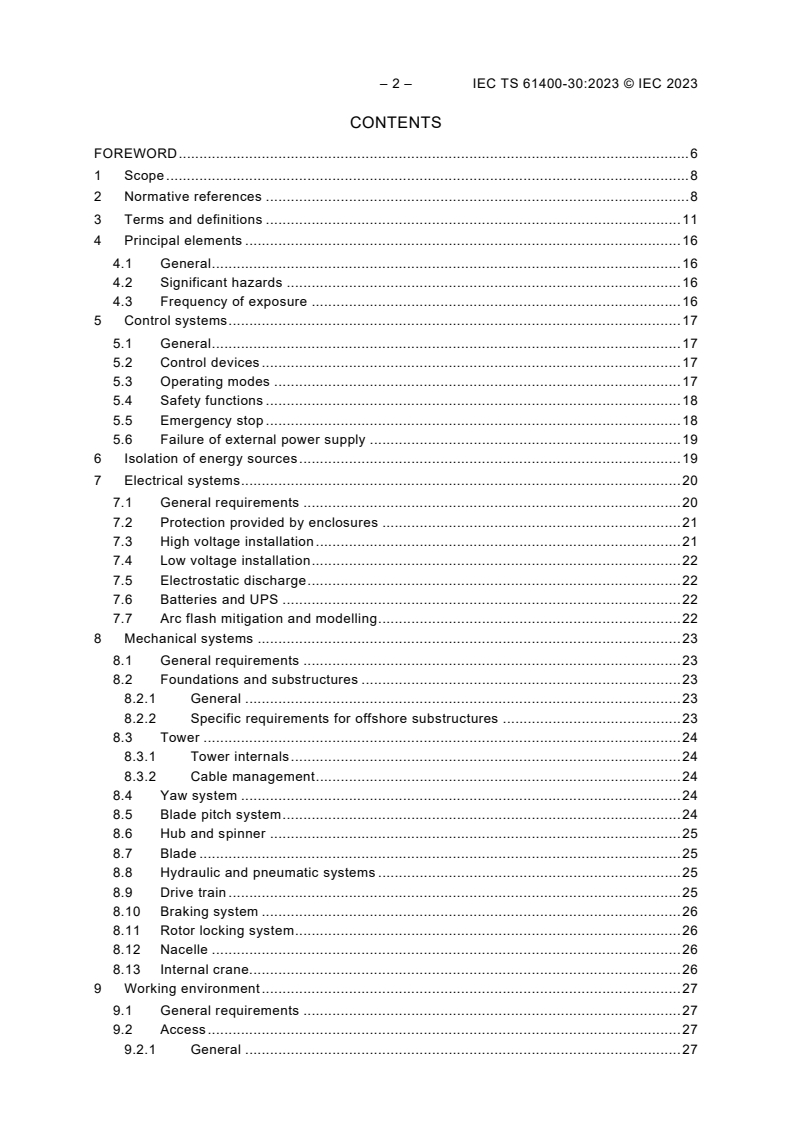
– 2 – IEC TS 61400-30:2023 © IEC 2023
CONTENTS
FOREWORD . 6
1 Scope . 8
2 Normative references . 8
3 Terms and definitions . 11
4 Principal elements . 16
4.1 General . 16
4.2 Significant hazards . 16
4.3 Frequency of exposure . 16
5 Control systems . 17
5.1 General . 17
5.2 Control devices . 17
5.3 Operating modes . 17
5.4 Safety functions . 18
5.5 Emergency stop . 18
5.6 Failure of external power supply . 19
6 Isolation of energy sources . 19
7 Electrical systems . 20
7.1 General requirements . 20
7.2 Protection provided by enclosures . 21
7.3 High voltage installation . 21
7.4 Low voltage installation . 22
7.5 Electrostatic discharge . 22
7.6 Batteries and UPS . 22
7.7 Arc flash mitigation and modelling . 22
8 Mechanical systems . 23
8.1 General requirements . 23
8.2 Foundations and substructures . 23
8.2.1 General . 23
8.2.2 Specific requirements for offshore substructures . 23
8.3 Tower . 24
8.3.1 Tower internals . 24
8.3.2 Cable management . 24
8.4 Yaw system . 24
8.5 Blade pitch system . 24
8.6 Hub and spinner . 25
8.7 Blade . 25
8.8 Hydraulic and pneumatic systems . 25
8.9 Drive train . 25
8.10 Braking system . 26
8.11 Rotor locking system . 26
8.12 Nacelle . 26
8.13 Internal crane. 26
9 Working environment . 27
9.1 General requirements . 27
9.2 Access . 27
9.2.1 General . 27
9.2.2 Doorways . 28
9.2.3 Stairs and stepladders . 31
9.2.4 Fixed ladders . 31
9.2.5 Provisions for personal fall protection . 34
9.2.6 Access platforms . 37
9.2.7 Space in front of electrical panels . 37
9.2.8 Bluntness of edges . 39
9.2.9 Climbing assistance . 40
9.2.10 Service lift . 40
9.2.11 Helihoist and aviation aids . 41
9.2.12 Offshore vessel access . 44
9.3 Working conditions. 45
9.3.1 Noise exposure . 45
9.3.2 Vibration . 45
9.3.3 Radiation . 46
9.3.4 Thermal . 46
9.3.5 Air quality . 46
9.3.6 Restricted and confined spaces . 46
9.4 Ergonomic . 47
9.4.1 General . 47
9.4.2 Human machine interfaces . 47
10 Lighting systems . 47
10.1 General . 47
10.1.1 Lighting for safety in wind turbines . 47
10.1.2 Internal lighting . 47
10.1.3 External lighting . 48
10.2 Design requirements for lighting systems . 48
10.3 Design requirements for emergency lighting systems . 48
10.4 Illumination levels . 49
10.5 Illumination level assessment . 49
10.5.1 General . 49
10.5.2 Illumination level verification . 50
11 Fire protection . 50
11.1 General . 50
11.2 Foreseeable misuses . 51
11.3 Fire risk assessment . 51
11.4 Fire hazards . 51
11.5 Risk reduction . 52
11.5.1 General . 52
11.5.2 Inherently safe design measures . 52
11.5.3 Safeguarding . 52
11.5.4 Monitoring and warning system . 53
11.5.5 Complementary protective measures . 53
11.6 Information for use . 54
12 Emergency, escape and evacuation. 54
12.1 General requirements . 54
12.1.1 General . 54
12.1.2 Evacuation and escape . 54
12.1.3 Routes . 55
– 4 – IEC TS 61400-30:2023 © IEC 2023
12.1.4 Equipment . 55
12.1.5 Escape point(s) . 56
12.1.6 Verification of evacuation and escape strategy . 56
12.2 Rescue . 57
12.2.1 General . 57
12.2.2 Equipment . 57
12.2.3 Verification of the rescue strategy . 57
12.3 Adverse weather . 57
13 Information for use . 58
13.1 General . 58
13.2 Safety signs and safety markings . 58
13.3 Acoustic and visual alarms . 58
13.4 Instructions . 58
13.4.1 General . 58
13.4.2 Instructions in case of emergency . 59
Annex A (informative) List of significant hazards . 60
Annex B (normative) Example of walkways with different shape than a rectangle . 66
Annex C (normative) Climbing assistance . 67
Annex D (informative) Lighting − Determination of the maintenance factor . 68
Bibliography . 69
Figure 1 – Sketch of minimum door opening size . 28
Figure 2 – Transition between internal and external platform . 29
Figure 3 – External platform at entrance door . 30
Figure 4 – Modified size of manholes . 30
Figure 5 – Example of handle . 32
Figure 6 – Side-step distance . 32
Figure 7 – Obstacles in ladder climbing area . 33
Figure 8 – Resting platforms . 34
Figure 9 – Anchor point dimensions . 35
Figure 10 – Space in front of electrical panels . 37
Figure 11 – Evacuation in both directions and passing width . 38
Figure 12 – Minimum passing width, evacuation in one direction. 38
Figure 13 – Evacuation in both directions . 39
Figure 14 – Edges and corners . 40
Figure 15 – Edge radius and chamfer for parts . 40
Figure 16 – Minimum helicopter distance to blade . 42
Figure 17 – Helihoist layout example . 43
Figure 18 – Illuminance levels measurement on ladders . 50
Figure B.1 – Relation between height and width . 66
Figure B.2 – Examples of different shapes . 66
Table 1 – Tolerance for spacing of rungs . 31
Table 2 – Requirements for rest platforms and moveable rest landings . 33
Table 3 – Fall protection loads . 36
Table 4 – Illuminance levels . 49
Table A.1 – List of significant hazards . 60
– 6 – IEC TS 61400-30:2023 © IEC 2023
INTERNATIONAL ELECTROTECHNICAL COMMISSION
____________
WIND ENERGY GENERATION SYSTEMS –
Part 30: Safety of wind turbine generators – General principles for design
FOREWORD
1) The International Electrotechnical Commission (IEC) is a worldwide organization for standardization comprising
all national electrotechnical committees (IEC National Committees). The object of IEC is to promote international
co-operation on all questions concerning standardization in the electrical and electronic fields. To this end and
in addition to other activities, IEC publishes International Standards, Technical Specifications, Technical Reports,
Publicly Available Specifications (PAS) and Guides (hereafter referred to as "IEC Publication(s)"). Their
preparation is entrusted to technical committees; any IEC National Committee interested in the subject dealt with
may participate in this preparatory work. International, governmental and non-governmental organizations liaising
with the IEC also participate in this preparation. IEC collaborates closely with the International Organization for
Standardization (ISO) in accordance with conditions determined by agreement between the two organizations.
2) The formal decisions or agreements of IEC on technical matters express, as nearly as possible, an international
consensus of opinion on the relevant subjects since each technical committee has representation from all
interested IEC National Committees.
3) IEC Publications have the form of recommendations for international use and are accepted by IEC National
Committees in that sense. While all reasonable efforts are made to ensure that the technical content of IEC
Publications is accurate, IEC cannot be held responsible for the way in which they are used or for any
misinterpretation by any end user.
4) In order to promote international uniformity, IEC National Committees undertake to apply IEC Publications
transparently to the maximum extent possible in their national and regional publications. Any divergence between
any IEC Publication and the corresponding national or regional publication shall be clearly indicated in the latter.
5) IEC itself does not provide any attestation of conformity. Independent certification bodies provide conformity
assessment services and, in some areas, access to IEC marks of conformity. IEC is not responsible for any
services carried out by independent certification bodies.
6) All users should ensure that they have the latest edition of this publication.
7) No liability shall attach to IEC or its directors, employees, servants or agents including individual experts and
members of its technical committees and IEC National Committees for any personal injury, property damage or
other damage of any nature whatsoever, whether direct or indirect, or for costs (including legal fees) and
expenses arising out of the publication, use of, or reliance upon, this IEC Publication or any other IEC
Publications.
8) Attention is drawn to the Normative references cited in this publication. Use of the referenced publications is
indispensable for the correct application of this publication.
9) IEC draws attention to the possibility that the implementation of this document may involve the use of (a)
patent(s). IEC takes no position concerning the evidence, validity or applicability of any claimed patent rights in
respect thereof. As of the date of publication of this document, IEC had not received notice of (a) patent(s), which
may be required to implement this document. However, implementers are cautioned that this may not represent
the latest information, which may be obtained from the patent database available at https://patents.iec.ch. IEC
shall not be held responsible for identifying any or all such patent rights.
IEC TS 61400-30 has been prepared by IEC technical committee 88: Wind energy generation
systems. It is a Technical Specification.
The text of this Technical Specification is based on the following documents:
Draft Report on voting
88/910/DTS 88/935A/RVDTS
Full information on the voting for its approval can be found in the report on voting indicated in
the above table.
The language used for the development of this Technical Specification is English.
This document was drafted in accordance with ISO/IEC Directives, Part 2, and developed in
accordance with ISO/IEC Directives, Part 1 and ISO/IEC Directives, IEC Supplement, available
at www.iec.ch/members_experts/refdocs. The main document types developed by IEC are
described in greater detail at www.iec.ch/publications.
A list of all parts in the IEC 61400 series, published under the general title Wind energy
generation systems, can be found on the IEC website.
The committee has decided that the contents of this document will remain unchanged until the
stability date indicated on the IEC website under webstore.iec.ch in the data related to the
specific document. At this date, the document will be
• reconfirmed,
• withdrawn,
• replaced by a revised edition, or
• amended.
IMPORTANT – The "colour inside" logo on the cover page of this document indicates that it
contains colours which are considered to be useful for the correct understanding of its
contents. Users should therefore print this document using a colour printer.
– 8 – IEC TS 61400-30:2023 © IEC 2023
WIND ENERGY GENERATION SYSTEMS –
Part 30: Safety of wind turbine generators – General principles for design
1 Scope
This part of IEC 61400, which is a Technical Specification, specifies the essential health and
safety requirements related to the design of wind turbines with horizontal axes with the
exception of those included in the scope of IEC 61400-2.
For other wind turbine concepts such as vertical axes, floating, or smaller turbines
(see IEC 61400-2), the principles of this document are valid, however they are adjusted to the
actual concept.
This document focuses on requirements for safe operation, inspection, maintenance,
installation and decommissioning.
2 Normative references
The following documents are referred to in the text in such a way that some or all of their content
constitutes requirements of this document. For dated references, only the edition cited applies.
For undated references, the latest edition of the referenced document (including any
amendments) applies.
IEC 60073, Basic and safety principles for man-machine interface, marking and identification –
Coding principles for indicators and actuators
IEC 60204-1:2016, Safety of machinery - Electrical equipment of machines - Part 1: General
requirements
IEC 60204-11, Safety of machinery – Electrical equipment of machines – Part 11: Requirements
for equipment for voltages above 1 000 V AC or 1 500 V DC and not exceeding 36 kV
IEC 60364-4-41, Low-voltage electrical installations – Part 4-41: Protection for safety –
Protection against electric shock
IEC 60529, Degrees of protection provided by enclosures (IP Code)
IEC 60695-11-10, Fire hazard testing – Part 11-10: Test flames – 50 W horizontal and vertical
flame test methods
IEC 60950-1, Information technology equipment − Safety − Part 1: General requirements
IEC 61000-6-2, Electromagnetic compatibility (EMC) – Part 6-2: Generic standards – Immunity
standard for industrial environments
IEC 61000-6-4, Electromagnetic compatibility (EMC) – Part 6-4: Generic standards – Emission
standard for industrial environments
IEC 61310-1, Safety of machinery – Indication, marking and actuation – Part 1: Requirements
for visual, acoustic and tactile signals
IEC 61400-1:2019, Wind energy generation systems – Part 1: Design requirements
IEC 61400-3-1, Wind energy generation systems – Part 3-1: Design requirements for fixed
offshore wind turbines
IEC TS 61400-3-2, Wind energy generation systems – Part 3-2: Design requirements for floating
offshore wind turbines
IEC 61400-24, Wind energy generation systems – Part 24: Lightning protection
IEC 61439-1, Low-voltage switchgear and controlgear assemblies – Part 1: General rules
IEC 61439-2, Low-voltage switchgear and controlgear assemblies – Part 2: Power switchgear
and controlgear assemblies
IEC 61508 (all parts), Functional safety of electrical/electronic/programmable electronic safety-
related systems
IEC 61936-1:2021, Power installations exceeding 1 kV AC and 1,5 kV DC − Part 1: AC
IEC 62040 (all parts), Uninterruptible power systems (UPS) – Part 1: Safety requirements
IEC 62061:2021, Safety of machinery – Functional safety of safety-related control systems
IEC 62271-200, High-voltage switchgear and controlgear – Part 200: AC metal-enclosed
switchgear and controlgear for rated voltages above 1 kV and up to and including 52 kV
IEC 62485 (all parts), Safety requirements for secondary batteries and battery installations
ISO 3864 (all parts), Graphical symbols – Safety colours and safety signs
ISO 4413, Hydraulic fluid power – General rules and safety requirements for systems and their
components
ISO 4414, Pneumatic fluid power – General rules and safety requirements for systems and their
components
ISO 7010, Graphical symbols – Safety colours and safety signs – Registered safety signs
ISO 7250 (all parts), Basic human body measurements for technological design
ISO 9355 (all parts), Ergonomic requirements for the design of displays and control actuators
ISO 11228 (all parts), Ergonomics – Manual handling
ISO/TR 11688-1, Acoustics – Recommended practice for the design of low-noise machinery
and equipment – Part 1: Planning
ISO/TR 11688-2, Acoustics − Recommended practice for the design of low-noise machinery
and equipment − Part 2: Introduction to the physics of low-noise design
ISO 12100:2010, Safety of machinery – General principles for design – Risk assessment and
risk reduction
– 10 – IEC TS 61400-30:2023 © IEC 2023
ISO 13732-1, Ergonomics of the thermal environment – Methods for the assessment of human
responses to contact with surfaces – Part 1: Hot surfaces
ISO 13732-3, Ergonomics of the thermal environment − Methods for the assessment of human
responses to contact with surfaces − Part 3: Cold surfaces
ISO 13849-1:2015 , Safety of machinery – Safety-related parts of control systems – Part 1:
General principles for design
ISO 13849 (all parts), Safety of machinery − Safety-related parts of control systems
ISO 13850:2015, Safety of machinery – Emergency stop function – Principles for design
ISO 13854, Safety of machinery – Minimum gaps to avoid crushing of parts of the human body
ISO 13857, Safety of machinery – Safety distances to prevent hazard zones being reached by
upper and lower limbs
ISO 14118, Safety of machinery – Prevention of unexpected start-up
ISO 14119, Safety of machinery – Interlocking devices associated with guards – Principles for
design and selection
ISO 14120, Safety of machinery – Guards – General requirements for the design and
construction of fixed and movable guards
ISO 14122-1, Safety of machinery – Permanent means of access to machinery – Part 1: Choice
of fixed means and general requirements of access
ISO 14122-2, Safety of machinery – Permanent means of access to machinery – Part 2:
Working platforms and walkways
ISO 14122-3, Safety of machinery – Permanent means of access to machinery – Part 3: Stairs,
stepladders and guard-rails
ISO 14122-4:2016, Safety of machinery – Permanent means of access to machinery – Part 4:
Fixed ladders
ISO 14567, Personal protective equipment for protection against falls from a height – Single-
point anchor devices
ISO 15534 (all parts), Ergonomic design for the safety of machinery
ISO 19353:2019, Safety of machinery – Fire prevention and fire protection
ISO 20607, Safety of machinery – Instruction handbook – General drafting principles
EN 353-1, Personal fall protection equipment – Guided type fall arresters including an anchor
line – Part 1: Guided type fall arresters including a rigid anchor line
EN 353-2, Personal protective equipment against falls from a height – Part 2: Guided type fall
arresters including a flexible anchor line
___________
Withdrawn.
EN 1005 (all parts), Safety of machinery – Human physical performance
EN 12198 (all parts), Safety of machinery – Assessment and reduction of risks arising from
radiation emitted by machinery
EN 12464-1, Light and lighting – Lighting of workplaces – Part 1: Indoor workplaces
EN 16165:2021, Determination of slip resistance of pedestrian surfaces – Methods of evaluation
CIE 97:2005, Guide on the maintenance of indoor electric lighting systems
ICAO Annex 14. 9th Edition, July 2022
3 Terms and definitions
For the purposes of this document, the following terms and definitions apply.
ISO and IEC maintain terminology databases for use in standardization at the following
addresses:
• IEC Electropedia: available at https://www.electropedia.org/
• ISO Online browsing platform: available at https://www.iso.org/obp
3.1
hazard
potential source of harm
[SOURCE: ISO/IEC Guide 51:2014, 3.2]
3.2
significant hazard
hazard which has been identified as relevant and which requires specific action by the designer
to eliminate or to reduce the risk according to the risk assessment
Note 1 to entry: A relevant hazard is identified as the result of one step of the process described in Clause 5.
[SOURCE: ISO 12100:2010, 3.8, modified – Note 1 to entry has been changed.]
3.3
risk
combination of the probability of occurrence of harm (physical injury or damage to health) and
the severity of that harm
[SOURCE: ISO 12100:2010, 3.12, modified – "(physical injury or damage to health)" has been
added.]
3.4
intended use
use of a machine in accordance with the information for use provided in the instructions
[SOURCE: ISO 12100:2010, 3.23]
3.5
protective measure
measure intended to achieve adequate risk reduction, implemented:
– 12 – IEC TS 61400-30:2023 © IEC 2023
• by the designer (inherently safe design, safeguarding and complementary protective
measures, information for use) and/or
• by the user (organization: safe working procedures, supervision, permit-to-work systems;
provision and use of additional safeguards; use of personal protective equipment; training)
[SOURCE: ISO 12100:2010, 3.19]
3.6
environment
surroundings in which a product or system exists, including air, water, land, natural resources,
flora, fauna, humans, and their interrelation
[SOURCE: IEC Guide 109:2012, 3.3]
3.7
environmental conditions
characteristics of the environment (wind, altitude, temperature, humidity, etc.) which may affect
the wind turbine behaviour
[SOURCE: IEC 61400-1:2019, 3.17]
3.8
external conditions
factors affecting operation of a wind turbine, including the environmental conditions
(temperature, snow, ice, etc.) and the electrical network conditions
[SOURCE: IEC 61400-1:2019, 3.18]
3.9
anchorage
for a personal protective equipment, structure or part of structure which can support load from
fall protection or rescue systems
3.10
anchor point
component or sub-system that functions as an interface between the anchorage and a fall
protection, work positioning, rope access or rescue system for the purpose of coupling the
system to the anchorage
Note 1 to entry: It can be intended or not intended to be removable.
3.11
limited free fall
limited distance that can be compared with "fall on the actual level" i.e., a trip or slip where
person is falling onto the surface/ground on which he or she was standing/walking ~ a fall at
same level
Note 1 to entry: "Limited free fall" distance is set to maximum 0,5 m.
3.12
fall protection
system (including all components) a worker/technician uses to provide protection from falling
and/or to safely arrest and mitigate the impact of a worker/technician’s fall if one occurs
Note 1 to entry: Examples of personal fall protection systems include personal fall arrest systems, positioning
systems and travel restraint systems.
3.13
fall arrest
system used to arrest a worker/technician in a fall from a walking-working surface, consisting
of a body harness, anchorage and connector
Note 1 to entry: The means of connection can include a lanyard, deceleration device, lifeline, or a suitable
combination of these.
3.14
work positioning
system of equipment and connectors that, when used with a body harness or body belt, allows
a worker/technician to be supported on an elevated vertical surface, such as a wall or
windowsill, and work with both hands free
Note 1 to entry: Positioning systems also are called "positioning system devices" and "work-positioning equipment."
3.15
fall/travel restraint
combination of an anchorage, anchor point, lanyard (or other means of connection) and body
support that a worker/technician uses to eliminate the possibility of a worker/technician going
over the edge of a walking-working surface
3.16
evacuation
in a wind turbine, process of leaving the wind turbine in an emergency situation, when persons
are able to use the predefined access route
Note 1 to entry: Successful evacuation will result in personnel being transferred to a place of safety.
3.17
escape
in a wind turbine, process of leaving the wind turbine in an emergency situation when the
persons are unable to use the predefined access route.
Note 1 to entry: It is a last resort method of getting out of the wind turbine.
3.18
rescue
in a wind turbine, operation to retrieve an injured person out of the turbine or a person unable
to self-rescue to a place of safety
3.19
rescue equipment
in a wind turbine, system of equipment, anchorage and connectors that, when used with a body
harness, rescue harness or body belt, allows a worker/technician to be rescued by getting
descended from an elevated vertical surface, such as a machine, structure, etc.
3.20
place of safety
means an onshore or safe offshore location or vessel where medical treatment and other
facilities for the care of survivors are available
3.21
place of temporary safety
place where a person is not exposed to the fire or the fire effects (e.g., such as smoke or falling
objects)
Note 1 to entry: It can be a refuge inside the wind turbine or the sea.
– 14 – IEC TS 61400-30:2023 © IEC 2023
3.22
available safe egress time
ASET
amount of time from fire ignition to the development of untenable conditions
3.23
required safe egress time
RSET
amount of time, measured from fire ignition that required for the last person to evacuate to a
place of safety or place of temporary safety
3.24
control functions
functions of the control system that based on information about the condition of the wind turbine
and/or its environment, adjust the wind turbine in order to maintain it within the operating limits
defined by the wind turbine designer
3.25
control system
system implementing the wind turbine control, protection and safety functions, including
sensors, logic elements, actuators, communication networks and power supplies
Note 1 to entry: The intent of the control system is to control operation of the wind turbine by active and passive
means and keep the operating parameters within the design limits.
3.26
control station
location inside or outside the wind turbine where a control panel, a control device or
arrangement of control panels and control devices or other means to manually control the wind
turbine is located
3.27
design limits
maximum or minimum values used in a design
3.28
substructure
part of an offshore wind turbine support structure which transfers the loads acting on the
structure into the seabed
3.29
boat landing
area where access from the vessel takes place, i.e., the part of the access ladder where the
fender tubes are placed
3.30
performance level
PL
discrete level used to specify the ability of safety-related parts of control systems to perform a
safety function under foreseeable conditions
3.31
required performance level
PL
R
performance level (PL) applied in order to achieve the required risk reduction for each safety
function
[SOURCE: ISO 13849-1:2015, 3.1.24]
3.32
restricted space
enclosed or partially enclosed space, not intended for continuous human occupancy that has a
restricted, limited, or impeded means of entry or exit because of its construction
Note 1 to entry: It can be thought of as a work area in which the only hazard is the difficulty of getting into or out of
the space. All other hazards are either non‐existent or have been eliminated or controlled.
3.33
confined space
enclosed or partially enclosed space that is not designed or intended for continuous human
occupancy, with a restricted, limited, or impeded means of entry and exit because of its
construction, and which can become hazardous to a person entering it, due to either an
atmosphere that is or can be injurious (by oxygen deficiency or flammability, explosivity or
toxicity), or due to an activity which can produce adverse or harmful consequences
3.34
equipment
single apparatus or set of devices or apparatuses, or the set of main devices of an installation,
or all devices necessary to perform a specific task
3.35
safe state
condition of the wind turbine with an acceptable level of residual risks according to the risk
assessment
3.36
safety-related part of a control system
SRP/CS
part of a control system that responds to safety-related input signals and generates safety-
related output signals
[SOURCE: ISO 13849-1:2015, 3.1.1, modified – Notes to entry have been deleted]
3.37
safety functions
in wind turbine, functions of the control system whose failure can result in an immediate
increase of the risk(s)
3.38
safety integrity level
SIL
discrete level (one out of a possible three) for describing the capability to perform a safety
function where safety integrity level three has the highest level of safety integrity and safety
integrity level one has the lowest
[SOURCE: IEC 62061:2021, 3.2.24]
3.39
standstill
condition of a wind turbine that is stopped
[SOURCE: IEC 61400-1:2019, 3.54]
3.40
wind turbine
generator system which converts the kinetic wind energy into electric energy
– 16 – IEC TS 61400-30:2023 © IEC 2023
[SOURCE: IEC 61400-1:2019, 3.71, modified – "generator system" has been deleted from the
term, generator has been added to "system" in the definition.]
3.41
rest platform
in wind turbines, horizontal platform, which allows more than one person to rest (standing and
sitting)
3.42
moveable rest landing
in wind turbines, small horizontal platform where a single person can rest (standing) with both
feet fully supported
3.43
service lift
machine with a fully enclosed load carrying unit including floor, walls, doors and roof which is
guided and intended for transport of persons and materials between different levels
4 Principal elements
4.1 General
The wind turbine shall be designed according to the principles in ISO 12100 for the significant
hazards as a minimum as identified in Annex A of the present document.
A wind turbine shall be designed and constructed so t
...