

IEC TS 62749:2020
(Main)Assessment of power quality - Characteristics of electricity supplied by public networks
General Information
- Abstract
IEC TS 62749:2020 specifies the expected characteristics of electricity at the SUPPLY TERMINALS of public low, medium and high voltage, 50 Hz or 60 Hz, networks.
NOTE 1 The boundaries between the various voltage levels can be different for different countries/regions. In the context of this TS, the following terms for system voltage are used:
- low voltage (LV) refers to less than or equal to 1 kV;
- medium voltage (MV) refers to between 1 kV and 35 kV;
- high voltage (HV) refers to between 35 kV and 230 kV.
While power quality is related to EMC in a number of ways this document is not an EMC publication. This second edition cancels and replaces the first edition published in 2015. This edition constitutes a technical revision. This edition includes the following significant technical changes with respect to the previous edition:
a) minimum number of remaining data for weekly analysis,
b) improvement of the compatibility between EN 50160 and IEC TS 62749,
c) further explanation of the conception of daily sliding window,
d) further explanation of the aggregation method used for events,
e) further explanation of the relation between Power Quality and EMC,
f) addition of a new definition of mains communicating system (MCS),
g) addition of a new Annex G: Other phenomena,
h) transfer of the main content of IEC TR 62510 to IEC TS 62749.
- Status
- Published
- Publication Date
- 10-Feb-2020
- Technical Committee
- TC 8 - System aspects of electrical energy supply
- Drafting Committee
- WG 11 - TC 8/WG 11
Buy Documents
IEC TS 62749:2020 - Assessment of power quality - Characteristics of electricity supplied by public networks Released:2/11/2020
IEC TS 62749:2020 RLV - Assessment of power quality - Characteristics of electricity supplied by public networks Released:2/11/2020
Overview
IEC TS 62749:2020 - Assessment of power quality defines expected characteristics of electricity at the supply terminals of public low, medium and high voltage networks (50 Hz or 60 Hz). It applies to public networks with the following system voltage terms: LV ≤ 1 kV, MV 1 kV–35 kV, HV 35 kV–230 kV. This Technical Specification provides recommended values for power quality indices and standardized methods for assessment, monitoring and reporting of power quality (PQ) phenomena at public network connection points.
Key topics and technical requirements
- Power quality indices: recommended values and limits for frequency deviation, supply voltage deviation, voltage unbalance, flicker, harmonic and interharmonic voltages, rapid voltage changes, transient overvoltages, voltage dips (sags), swells and interruptions.
- Measurement & assessment methods: site and system-aspect assessment procedures; continuous phenomena analysis (percentile-based, weekly/daily sliding windows) and event (single discontinuous) evaluation; aggregation methods for events and time-aggregation rules.
- Harmonics & interharmonics: guidance for LV, MV and HV points of supply including recommended individual harmonic levels and total harmonic distortion considerations.
- Event reporting: formats and indices for describing single events (magnitude-duration tables, SARFI-like indices).
- New/updated elements in 2020 edition: minimum data requirements for weekly analysis, improved compatibility with EN 50160, clarifications on daily sliding windows and event aggregation, added definition of mains communicating system (MCS), Annex G (other phenomena), and transfer of IEC TR 62510 content into the TS.
- Scope note: while related to electromagnetic compatibility (EMC), IEC TS 62749 is not an EMC publication; it explains the relation between PQ and EMC (Annex F).
Applications and who uses it
IEC TS 62749 is practical for:
- Distribution and transmission system operators (DSOs/TSOs) - defining monitoring programs and network performance targets.
- Regulators and planners - specifying acceptable PQ levels for public supply.
- Power quality engineers & consultants - designing measurement campaigns, interpreting PQ indices and producing compliance reports.
- Equipment manufacturers & suppliers - understanding supply characteristics for product immunity and compatibility.
- Large consumers and facility managers - assessing supply quality impacts on sensitive equipment.
- Power monitoring vendors - implementing measurement algorithms (percentiles, aggregation, event logging).
Keywords: IEC TS 62749:2020, power quality, public networks, supply terminals, harmonics, voltage dips, flicker, mains communicating system (MCS), power quality assessment.
Related standards
- EN 50160 - compatibility and improved alignment noted in this edition.
- IEC TR 62510 - main content transferred into IEC TS 62749 (edition 2020).
Relations
- Effective Date
- 05-Sep-2023
- Effective Date
- 05-Sep-2023
Buy Documents
IEC TS 62749:2020 - Assessment of power quality - Characteristics of electricity supplied by public networks Released:2/11/2020
IEC TS 62749:2020 RLV - Assessment of power quality - Characteristics of electricity supplied by public networks Released:2/11/2020
Get Certified
Connect with accredited certification bodies for this standard

BSMI (Bureau of Standards, Metrology and Inspection)
Taiwan's standards and inspection authority.
Sponsored listings
Frequently Asked Questions
IEC TS 62749:2020 is a technical specification published by the International Electrotechnical Commission (IEC). Its full title is "Assessment of power quality - Characteristics of electricity supplied by public networks". This standard covers: IEC TS 62749:2020 specifies the expected characteristics of electricity at the SUPPLY TERMINALS of public low, medium and high voltage, 50 Hz or 60 Hz, networks. NOTE 1 The boundaries between the various voltage levels can be different for different countries/regions. In the context of this TS, the following terms for system voltage are used: - low voltage (LV) refers to less than or equal to 1 kV; - medium voltage (MV) refers to between 1 kV and 35 kV; - high voltage (HV) refers to between 35 kV and 230 kV. While power quality is related to EMC in a number of ways this document is not an EMC publication. This second edition cancels and replaces the first edition published in 2015. This edition constitutes a technical revision. This edition includes the following significant technical changes with respect to the previous edition: a) minimum number of remaining data for weekly analysis, b) improvement of the compatibility between EN 50160 and IEC TS 62749, c) further explanation of the conception of daily sliding window, d) further explanation of the aggregation method used for events, e) further explanation of the relation between Power Quality and EMC, f) addition of a new definition of mains communicating system (MCS), g) addition of a new Annex G: Other phenomena, h) transfer of the main content of IEC TR 62510 to IEC TS 62749.
IEC TS 62749:2020 specifies the expected characteristics of electricity at the SUPPLY TERMINALS of public low, medium and high voltage, 50 Hz or 60 Hz, networks. NOTE 1 The boundaries between the various voltage levels can be different for different countries/regions. In the context of this TS, the following terms for system voltage are used: - low voltage (LV) refers to less than or equal to 1 kV; - medium voltage (MV) refers to between 1 kV and 35 kV; - high voltage (HV) refers to between 35 kV and 230 kV. While power quality is related to EMC in a number of ways this document is not an EMC publication. This second edition cancels and replaces the first edition published in 2015. This edition constitutes a technical revision. This edition includes the following significant technical changes with respect to the previous edition: a) minimum number of remaining data for weekly analysis, b) improvement of the compatibility between EN 50160 and IEC TS 62749, c) further explanation of the conception of daily sliding window, d) further explanation of the aggregation method used for events, e) further explanation of the relation between Power Quality and EMC, f) addition of a new definition of mains communicating system (MCS), g) addition of a new Annex G: Other phenomena, h) transfer of the main content of IEC TR 62510 to IEC TS 62749.
IEC TS 62749:2020 is classified under the following ICS (International Classification for Standards) categories: 17.220.99 - Other standards related to electricity and magnetism. The ICS classification helps identify the subject area and facilitates finding related standards.
IEC TS 62749:2020 has the following relationships with other standards: It is inter standard links to IEC TS 62749:2015, IEC TS 62749:2026. Understanding these relationships helps ensure you are using the most current and applicable version of the standard.
IEC TS 62749:2020 is available in PDF format for immediate download after purchase. The document can be added to your cart and obtained through the secure checkout process. Digital delivery ensures instant access to the complete standard document.
Standards Content (Sample)
IEC TS 62749 ®
Edition 2.0 2020-02
TECHNICAL
SPECIFICATION
colour
inside
Assessment of power quality – Characteristics of electricity supplied by public
networks
All rights reserved. Unless otherwise specified, no part of this publication may be reproduced or utilized in any form
or by any means, electronic or mechanical, including photocopying and microfilm, without permission in writing from
either IEC or IEC's member National Committee in the country of the requester. If you have any questions about IEC
copyright or have an enquiry about obtaining additional rights to this publication, please contact the address below or
your local IEC member National Committee for further information.
IEC Central Office Tel.: +41 22 919 02 11
3, rue de Varembé info@iec.ch
CH-1211 Geneva 20 www.iec.ch
Switzerland
About the IEC
The International Electrotechnical Commission (IEC) is the leading global organization that prepares and publishes
International Standards for all electrical, electronic and related technologies.
About IEC publications
The technical content of IEC publications is kept under constant review by the IEC. Please make sure that you have the
latest edition, a corrigendum or an amendment might have been published.
IEC publications search - webstore.iec.ch/advsearchform Electropedia - www.electropedia.org
The advanced search enables to find IEC publications by a The world's leading online dictionary on electrotechnology,
variety of criteria (reference number, text, technical containing more than 22 000 terminological entries in English
committee,…). It also gives information on projects, replaced and French, with equivalent terms in 16 additional languages.
and withdrawn publications. Also known as the International Electrotechnical Vocabulary
(IEV) online.
IEC Just Published - webstore.iec.ch/justpublished
Stay up to date on all new IEC publications. Just Published IEC Glossary - std.iec.ch/glossary
details all new publications released. Available online and 67 000 electrotechnical terminology entries in English and
once a month by email. French extracted from the Terms and Definitions clause of
IEC publications issued since 2002. Some entries have been
IEC Customer Service Centre - webstore.iec.ch/csc collected from earlier publications of IEC TC 37, 77, 86 and
If you wish to give us your feedback on this publication or CISPR.
need further assistance, please contact the Customer Service
Centre: sales@iec.ch.
IEC TS 62749 ®
Edition 2.0 2020-02
TECHNICAL
SPECIFICATION
colour
inside
Assessment of power quality – Characteristics of electricity supplied by public
networks
INTERNATIONAL
ELECTROTECHNICAL
COMMISSION
ICS 17.220.99 ISBN 978-2-8322-7849-9
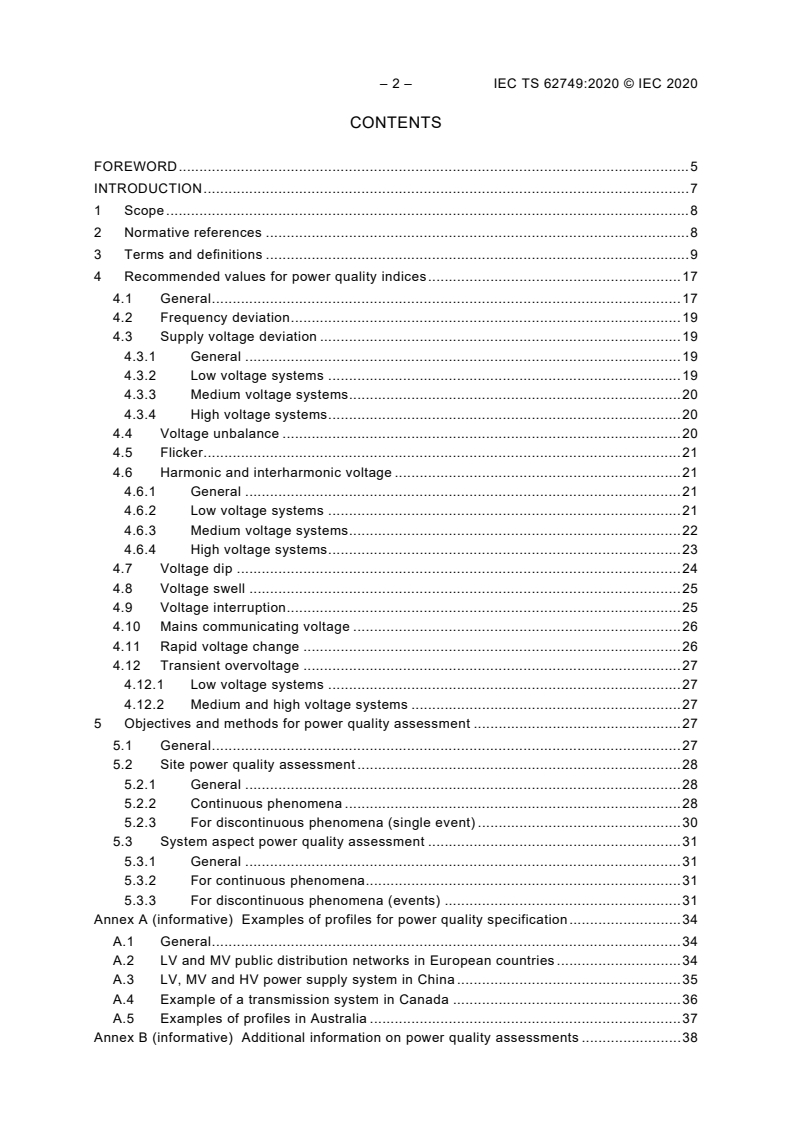
– 2 – IEC TS 62749:2020 © IEC 2020
CONTENTS
FOREWORD . 5
INTRODUCTION . 7
1 Scope . 8
2 Normative references . 8
3 Terms and definitions . 9
4 Recommended values for power quality indices . 17
4.1 General . 17
4.2 Frequency deviation . 19
4.3 Supply voltage deviation . 19
4.3.1 General . 19
4.3.2 Low voltage systems . 19
4.3.3 Medium voltage systems . 20
4.3.4 High voltage systems . 20
4.4 Voltage unbalance . 20
4.5 Flicker . 21
4.6 Harmonic and interharmonic voltage . 21
4.6.1 General . 21
4.6.2 Low voltage systems . 21
4.6.3 Medium voltage systems . 22
4.6.4 High voltage systems . 23
4.7 Voltage dip . 24
4.8 Voltage swell . 25
4.9 Voltage interruption . 25
4.10 Mains communicating voltage . 26
4.11 Rapid voltage change . 26
4.12 Transient overvoltage . 27
4.12.1 Low voltage systems . 27
4.12.2 Medium and high voltage systems . 27
5 Objectives and methods for power quality assessment . 27
5.1 General . 27
5.2 Site power quality assessment . 28
5.2.1 General . 28
5.2.2 Continuous phenomena . 28
5.2.3 For discontinuous phenomena (single event) . 30
5.3 System aspect power quality assessment . 31
5.3.1 General . 31
5.3.2 For continuous phenomena . 31
5.3.3 For discontinuous phenomena (events) . 31
Annex A (informative) Examples of profiles for power quality specification . 34
A.1 General . 34
A.2 LV and MV public distribution networks in European countries . 34
A.3 LV, MV and HV power supply system in China . 35
A.4 Example of a transmission system in Canada . 36
A.5 Examples of profiles in Australia . 37
Annex B (informative) Additional information on power quality assessments . 38
B.1 Weekly percentile values assessed on a daily sliding basis . 38
B.2 Example on system aspect continuous disturbance evaluation . 39
B.3 Aggregation method used for events . 39
B.3.1 General . 39
B.3.2 Time aggregation . 39
Annex C (informative) Main impact of poor power quality . 42
C.1 General . 42
C.2 Harmonic distortion . 42
C.3 Voltage unbalance . 42
C.4 Voltage deviation . 43
C.5 Frequency deviation . 43
C.6 Voltage fluctuation . 43
C.7 Flicker . 43
C.8 Voltage dip (or voltage sag) . 43
C.9 Transient overvoltages . 43
Annex D (informative) Power quality issues related to distributed generation and
micro-grids . 44
D.1 General . 44
D.2 Voltage deviation . 44
D.3 Harmonics . 44
D.4 DG magnetic bias (DC current injection) . 44
D.5 Voltage fluctuation and flicker . 45
D.6 High frequency conducted disturbances . 45
Annex E (informative) Methods to maintain and improve power quality . 46
E.1 General . 46
E.2 Voltage deviation . 46
E.3 Harmonics . 46
E.4 Flicker . 47
E.5 Voltage unbalance . 47
E.6 Voltage dip/swell/short time interruption . 48
Annex F (informative) Relation between power quality and EMC . 49
F.1 General . 49
F.2 Differences between power quality and compatibility levels . 49
F.3 Example of power quality level versus compatibility level . 50
Annex G (informative) Other phenomena . 53
G.1 General . 53
G.2 Level behaviour over time . 53
G.3 Duration . 53
G.4 Periodicity . 53
G.5 Bandwidth . 54
Annex H (informative) Role of stakeholders for power quality management –
Coordination of the parties involved . 55
H.1 General . 55
H.2 Network operator – Network user . 55
H.3 Network user – Equipment supplier . 55
H.4 Network operator – Equipment supplier . 56
Bibliography . 57
– 4 – IEC TS 62749:2020 © IEC 2020
Figure 1 – Mains communicating voltages recommended values in percent of U used
N
in public LV networks (or U in public MV networks) . 26
c
Figure 2 – Example for illustrating voltage THD assessment result trends . 30
Figure 3 – Example showing information of single event assessment . 31
th
Figure B.1 – Comparison of two methods of assessing weekly 95 percentile values . 38
Figure B.2 – Example for illustrating the differences resulted by time aggregation
method . 40
Figure B.3 – Example of time sequence of voltage dips that can be aggregated in two
different ways . 41
Figure F.1 – Application points in a LV system (example) . 50
Figure F.2 – Relation between disturbance levels (schematic significance only) . 50
Figure F.3 – Cumulative distribution of all THD values recorded at 30 points of supply
of the LV system, during one week . 51
th
Figure F.4 – Weekly 95 percentile THD values evaluated at each monitored LV point
of supply . 52
Table 1 – Classification of electromagnetic phenomena addressed by power quality
indices . 8
Table 2 – Flicker severity P recommended values . 21
lt
Table 3 – Recommended values of individual harmonic voltages at the low voltage
points of supply for orders up to 50 given in percent of the fundamental voltage U . 22
Table 4 – Recommended values of individual harmonic voltages at the medium voltage
points of supply for orders up to 50 given in percent of the fundamental voltage U . 23
Table 5 – Indicative values of individual harmonic voltages at the high voltage points of
supply given in percent of the fundamental voltage U . 24
Table 6 – Site power quality assessment methods . 29
Table 7 – Example of single event assessment . 30
Table 8 – List of individual events measured at a single monitoring site . 32
Table 9 – SARFI-X indices coming out of Table 8 . 32
Table 10 – Magnitude-duration table format . 33
Table A.1 – Examples of profiles in European countries . 34
Table A.2 – Examples of profiles in China . 35
Table A.3 – Examples of profiles in Canada . 36
Table A.4 – Examples of profiles in Australia . 37
Table B.1 – Listing of system power quality evaluation . 39
INTERNATIONAL ELECTROTECHNICAL COMMISSION
____________
ASSESSMENT OF POWER QUALITY – CHARACTERISTICS
OF ELECTRICITY SUPPLIED BY PUBLIC NETWORKS
FOREWORD
1) The International Electrotechnical Commission (IEC) is a worldwide organization for standardization comprising
all national electrotechnical committees (IEC National Committees). The object of IEC is to promote international
co-operation on all questions concerning standardization in the electrical and electronic fields. To this end and
in addition to other activities, IEC publishes International Standards, Technical Specifications, Technical Reports,
Publicly Available Specifications (PAS) and Guides (hereafter referred to as “IEC Publication(s)”). Their
preparation is entrusted to technical committees; any IEC National Committee interested in the subject dealt with
may participate in this preparatory work. International, governmental and non-governmental organizations liaising
with the IEC also participate in this preparation. IEC collaborates closely with the International Organization for
Standardization (ISO) in accordance with conditions determined by agreement between the two organizations.
2) The formal decisions or agreements of IEC on technical matters express, as nearly as possible, an international
consensus of opinion on the relevant subjects since each technical committee has representation from all
interested IEC National Committees.
3) IEC Publications have the form of recommendations for international use and are accepted by IEC National
Committees in that sense. While all reasonable efforts are made to ensure that the technical content of IEC
Publications is accurate, IEC cannot be held responsible for the way in which they are used or for any
misinterpretation by any end user.
4) In order to promote international uniformity, IEC National Committees undertake to apply IEC Publications
transparently to the maximum extent possible in their national and regional publications. Any divergence between
any IEC Publication and the corresponding national or regional publication shall be clearly indicated in the latter.
5) IEC itself does not provide any attestation of conformity. Independent certification bodies provide conformity
assessment services and, in some areas, access to IEC marks of conformity. IEC is not responsible for any
services carried out by independent certification bodies.
6) All users should ensure that they have the latest edition of this publication.
7) No liability shall attach to IEC or its directors, employees, servants or agents including individual experts and
members of its technical committees and IEC National Committees for any personal injury, property damage or
other damage of any nature whatsoever, whether direct or indirect, or for costs (including legal fees) and
expenses arising out of the publication, use of, or reliance upon, this IEC Publication or any other IEC Publications.
8) Attention is drawn to the Normative references cited in this publication. Use of the referenced publications is
indispensable for the correct application of this publication.
9) Attention is drawn to the possibility that some of the elements of this IEC Publication may be the subject of patent
rights. IEC shall not be held responsible for identifying any or all such patent rights.
The main task of IEC technical committees is to prepare International Standards. In exceptional
circumstances, a technical committee may propose the publication of a Technical Specification
when
• the required support cannot be obtained for the publication of an International Standard,
despite repeated efforts, or
• the subject is still under technical development or where, for any other reason, there is the
future but no immediate possibility of an agreement on an International Standard.
Technical Specifications are subject to review within three years of publication to decide
whether they can be transformed into International Standards.
IEC TS 62749, which is a technical specification, has been prepared by IEC technical
committee 8: System aspects of electrical energy supply.
– 6 – IEC TS 62749:2020 © IEC 2020
The text of this Technical Specification is based on the following documents:
Draft TS Report on voting
8/1512/DTS 8/1524/RVDTS
Full information on the voting for the approval of this Technical Specification can be found in
the report on voting indicated in the above table.
This document has been drafted in accordance with the ISO/IEC Directives, Part 2.
This second edition cancels and replaces the first edition published in 2015. This edition
constitutes a technical revision.
This edition includes the following significant technical changes with respect to the previous
edition:
a) minimum number of remaining data for weekly analysis,
b) improvement of the compatibility between EN 50160 and IEC TS 62749,
c) further explanation of the conception of daily sliding window,
d) further explanation of the aggregation method used for events,
e) further explanation of the relation between Power Quality and EMC,
f) addition of a new definition of mains communicating system (MCS),
g) addition of a new Annex G: Other phenomena,
h) transfer of the main content of IEC TR 62510 to IEC TS 62749.
The committee has decided that the contents of this publication will remain unchanged until the
stability date indicated on the IEC website under "http://webstore.iec.ch" in the data related to
the specific publication. At this date, the publication will be
• transformed into an International standard,
• reconfirmed,
• withdrawn,
• replaced by a revised edition, or
• amended.
A bilingual version of this publication may be issued at a later date.
IMPORTANT – The 'colour inside' logo on the cover page of this publication indicates
that it contains colours which are considered to be useful for the correct understanding
of its contents. Users should therefore print this document using a colour printer.
INTRODUCTION
The description of electricity is of fundamental importance within electricity supply systems. In
the past, its characteristics depended less on its generation than on the way in which it was
transported by networks and being used by the equipment of the multiple users. Faults or other
events such as short-circuit and lightning strikes occurring within users' installations or public
networks also disturb or degrade it.
Nowadays, Smart Grid construction and massive deployment of renewable energy sources
increase the complexity of power quality management. For more information about power
quality issues related to distributed generation and micro-grids, refer to Annex D.
NOTE For more information about role of stakeholders for power quality management, see Annex H.
There is a need for a common set of power quality (PQ) indices and measurement methods in
order to allow different system operators to measure and report power quality in a consistent
manner.
Regarding the limits or levels of power quality, the situation differs. Historically, the electrical
systems in different countries/regions have been designed in different ways to cater for
national/regional variations like different geographic, climatic or commercial conditions, etc. It
is thus essential that any set of internationally agreed power quality limits or levels also
recognize these differences, which depends namely on the system configuration, the transfer
characteristics between the different voltage levels (attenuation or amplification), the actual
disturbance levels on the system, etc.
Also, the quality of power is not absolute. Optimizing power quality should be carried out in a
cost-effective manner to balance network user power quality requirements and willingness to
pay for it with power quality supply costs.
Therefore, some of the objectives recommended hereafter allow for a range of values, or
options, while still ensuring the coordination of disturbance levels between different parts of the
system or voltage levels.
Then, the requirements to be applied can be expressed by the association of the IEC Power
Quality framework from the normative part of this document and profiles. Examples of profiles
are given in Annex A.
– 8 – IEC TS 62749:2020 © IEC 2020
ASSESSMENT OF POWER QUALITY – CHARACTERISTICS
OF ELECTRICITY SUPPLIED BY PUBLIC NETWORKS
1 Scope
This Technical Specification specifies the expected characteristics of electricity at the point of
supply of public low, medium and high voltage, 50 Hz or 60 Hz, networks, as well as power
quality assessment methods.
NOTE 1 The boundaries between the various voltage levels can be different for different countries/regions. In the
context of this TS, the following terms for system voltage are used:
• low voltage (LV) refers to U ≤ 1 kV;
N
• medium voltage (MV) refers to 1 kV < U ≤ 35 kV;
N
• high voltage (HV) refers to 35 kV < U ≤ 230 kV.
N
NOTE 2 Because of existing network structures, in some countries/regions, the boundary between medium and high
voltage can be different.
This document applies to the phenomena listed in Table 1.
Table 1 – Classification of electromagnetic phenomena
addressed by power quality indices
Other phenomena
Continuous phenomena Discontinuous phenomena –
Events
FREQUENCY DEVIATION SUPPLY INTERRUPTION MAINS COMMUNICATING
VOLTAGES
SUPPLY VOLTAGE DEVIATION VOLTAGE DIP
VOLTAGE UNBALANCE VOLTAGE SWELL
HARMONIC VOLTAGE TRANSIENT OVERVOLTAGE
INTERHARMONIC VOLTAGE RAPID VOLTAGE CHANGE
FLICKER (VOLTAGE
FLUCTUATION)
NOTE 3 Specification of related measurement methods can be found in IEC 61000-4-30.
NOTE 4 Specification of the performance of related measuring instruments can be found in IEC 62586.
While power quality is related to EMC in a number of ways, especially because compliance with
power quality requirements depends on the control of cumulative effect of electromagnetic
emission from all/multiple equipment and/or installations, this document is not an EMC
publication (see also Annex F).
2 Normative references
The following documents are referred to in the text in such a way that some or all of their content
constitutes requirements of this document. For dated references, only the edition cited applies.
For undated references, the latest edition of the referenced document (including any
amendments) applies.
IEC 60038, IEC standard voltages
IEC 60364-4-44, Low-voltage electrical installations – Part 4-44: Protection for safety –
Protection against voltage disturbances and electromagnetic disturbances
IEC 60364-5-53, Low-voltage electrical installations – Part 5-53: Selection and erection of
electrical equipment – Devices for protection for safety, isolation, switching, control and
monitoring
IEC 61000-2-2:2002, Electromagnetic compatibility (EMC) – Part 2-2: Environment –
Compatibility levels for low-frequency conducted disturbances and signalling in public low-
voltage power supply systems
IEC 61000-2-2:2002/AMD1:2017
IEC 61000-2-2:2002/AMD2:2018
IEC 61000-2-12, Electromagnetic compatibility (EMC) – Part 2-12: Environment – Compatibility
levels for low-frequency conducted disturbances and signalling in public medium-voltage power
supply systems
IEC TR 61000-2-14, Electromagnetic compatibility (EMC) – Part 2-14: Environment –
Overvoltages on public electricity distribution networks
IEC 61000-4-30:2015, Electromagnetic compatibility (EMC) – Part 4-30: Testing and
measurement techniques – Power quality measurement methods
3 Terms and definitions
For the purposes of this document, the following terms and definitions apply.
ISO and IEC maintain terminological databases for use in standardization at the following
addresses:
• IEC Electropedia: available at http://www.electropedia.org/
• ISO Online browsing platform: available at http://www.iso.org/obp
NOTE Terms are listed in alphabetical order.
3.1
code
collection of rules concerning rights and duties of the parties involved in a certain part of the
electric power system
Note 1 to entry: For example: grid code, distribution code, code in electric power system.
[SOURCE: IEC 60050-617:2009, 617-03-03, modified – "code in electric power system" has
been added in the Note to entry]
3.2
connection agreement
agreement entered between the system operator and a system user which governs the
procedure and conditions for connection
[SOURCE: IEC 60050-617:2009, 617-04-03]
3.3
declared supply voltage
U
c
supply voltage agreed by the network operator and the network user
– 10 – IEC TS 62749:2020 © IEC 2020
Note 1 to entry: Generally declared supply voltage U is the nominal voltage U but it may be different according
c N
to the agreement between the network operator and the network user.
3.4
electricity
set of the phenomena associated with electric charges and electric currents
Note 1 to entry: In the context of electric power systems, electricity is often described as a product with particular
characteristics.
[SOURCE: IEC 60050-121:1998, 121-11-76, modified – The note has been added]
3.5
electromagnetic environment
totality of electromagnetic phenomena existing at a given location
Note 1 to entry: In general, the electromagnetic environment is time-dependent and its description can need a
statistical approach.
[SOURCE: IEC 60050-161:2018, 161-01-01]
3.6
electromagnetic disturbance
electromagnetic phenomenon that can degrade the performance of a device, equipment or
system, or adversely affect living or inert matter
Note 1 to entry: An electromagnetic disturbance can be an electromagnetic noise, an unwanted signal or a change
in the propagation medium itself.
Note 2 to entry: Electromagnetic disturbance in this TS refers to low frequency conducted phenomena.
[SOURCE: IEC 60050-161:2018, 161-01-05, modified – Note 2 to entry has been replaced and
Note 3 to entry has been deleted]
3.7
electromagnetic compatibility
ability of equipment or a system to function satisfactorily in its electromagnetic environment
without introducing intolerable electromagnetic disturbances to anything in that environment
[SOURCE: IEC 60050-161:2018, 161-01-07]
3.8
(electromagnetic) compatibility level
specified electromagnetic disturbance level used as a reference level for co-ordination in the
setting of emission and immunity limits
Note 1 to entry: By convention, the compatibility level is chosen so that there is only a small probability that it will
be exceeded by the actual disturbance level.
[SOURCE: IEC 60050-161:1990, 161-03-10, modified – Note has been shortened and Note 2
has been deleted]
3.9
flagged data
data that has been marked to indicate that its measurement or its aggregation may have been
affected by interruptions, dips, or swells
[SOURCE: IEC 61000-4-30:2015, 3.5, modified – modified to better understand this term]
3.10
flicker
impression of unsteadiness of visual sensation induced by a light stimulus whose luminance or
spectral distribution fluctuates with time
Note 1 to entry: Voltage fluctuation cause changes of the luminance of lamps which can create the visual
phenomenon called flicker. Above a certain threshold, flicker becomes annoying. The annoyance grows very rapidly
with the amplitude of the fluctuation. At certain repetition rates, even very small amplitudes can be annoying.
Note 2 to entry: For the time being, flicker is qualified based on incandescent lamp’s behaviour.
[SOURCE: IEC 60050-161:1990, 161-08-13, modified – Notes to entry have been added]
3.11
flicker severity
intensity of flicker annoyance evaluated by the following quantities:
) measured over a period of ten minutes;
• short term severity (P
st
• long term severity (P ) calculated from a sequence of 12 Pst-values over a two hours interval,
lt
according to the following expression:
P
sti
P=
lt ∑
i=1
Note 1 to entry: For details of P and P , see IEC 61000-4-15.
st lt
3.12
frequency deviation
difference between power supply frequency (f ) and nominal frequency (f )
H,1 N
[SOURCE: IEC 60050-614:2016, 614-01-10, modified – "system frequency at a given instant
and its nominal value" has been changed to "power supply frequency (f ) and nominal
H,1
frequency (f )"]
N
3.13
group total harmonic distortion
THDG (abbreviation)
THDG (symbol)
Y
ratio of the RMS value of the harmonic groups (Y ) to the RMS value of the group associated
g,h
with the fundamental (Y ):
g,1
h
max
Y
gh,
THDG =
∑
Y
Y
h=2
g,1
Note 1 to entry: The symbol Y is replaced, as required, by the symbol I for currents or by the symbol U for voltages.
[SOURCE: IEC 61000-4-7:2002/AMD1:2008, 3.3.2]
3.14
harmonic frequency
f
H,h
frequency which is an integer multiple of the power supply (fundamental) frequency
– 12 – IEC TS 62749:2020 © IEC 2020
[SOURCE: IEC 61000-4-7: 2002/AMD1:2008, 3.2.1, modified – "fundamental frequency of the
power system" has been changed to "power supply (fundamental) frequency", the formula and
Note to entry have been removed]
3.15
harmonic order
h
(integer) ratio of a harmonic frequency (f ) to the power supply frequency (f )
H,h H,1
[SOURCE: IEC 60050-161:1990, 161-02-19, modified – "the integral number given by the ratio
of the frequency of a harmonic to the fundamental frequency" has been changed to "(integer)
ratio of a harmonic frequency (f ) to the power supply frequency (f )"]
H,h H,1
3.16
harmonic ratio
HR
ratio of individual harmonic order component (U or I ) to the fundamental component (U or I )
h h 1 1
3.17
mains communicating system
MCS
system using mains power lines to transmit information signals, either on the public electricity
distribution network or within installations of network users
[SOURCE: IEC 61000-2-2 :2002/AMD1:2017, 3.1.8, modified – "electrical" has been deleted]
3.18
mains communicating voltage
signal superimposed on the supply voltage for the purpose of transmission of information in the
public supply network and to network users' premises
Note 1 to entry: Three types of signals in the public supply network can be classified:
• ripple control signals: superimposed sinusoidal voltage signals in the frequency range 110 Hz to 3 000 Hz;
• power-line-carrier signals: superimposed sinusoidal voltage signals in the frequency range 3 kHz to 148,5 kHz;
• mains marking signals: superimposed short time alterations (transients) at selected points of the voltage
waveform.
3.19
system operator
network operator
party responsible for safe and reliable operation of a part of the electric power system in a
certain area and for connection to other parts of the electric power system
[SOURCE: IEC 60050-617:2009, 617-02-09]
3.20
nominal frequency
f
N
value of frequency used to designate or identify a system
3.21
nominal voltage
U
N
value of voltage used to designate or identify a system
Note 1 to entry: For example: nominal voltage of a system.
[SOURCE: IEC 60050-601:1985, 601-01-21, modified – the abbreviation has been added,
"suitable approximate" from beginning of definition has been removed]
3.22
normal operating conditions
operating conditions of a public electricity supply system typically including all generation
variations, load variations and reactive compensation or filter states (e.g. shunt capacitor
states), planned outages and planned arrangements during maintenance and construction work,
non-ideal operating conditions and normal contingencies under which the considered system
has been designed to operate
Note 1 to entry: Normal system operating conditions typically exclude exceptional situations such as: conditions
arising as a result of a fault or a combination of faults beyond that planned for under the system security standard,
unavoidable circumstances (for example: force majeure, exceptional weather conditions and other natural disasters,
acts by public authorities, industrial actions), cases where Network users significantly exceed their emission limits
or do not comply with the connection requirements, and temporary generation or supply arrangements adopted to
maintain supply to Network users during maintenance or construction work, where otherwise supply would be
interrupted.
Note 2 to entry: For example: nominal operating conditions of a public electricity supply system.
[SOURCE: IEC TR 61000-3-6:2008, 3.15, modified –"of the system or of the disturbing
installation" has been replaced by "of a public electricity supply system", "and planned" has
been added to "arrangements", "or the disturbing installation" has been deleted and "the Note
to entry has been slightly changed]
3.23
percentile value
U (symbol)
x%
value such that x percent (x %) of measurements are smaller than or equal to that value, over
a given period
3.24
planning level
level of a particular disturbance in a particular environment, adopted as a reference value for
the limits to be set for the emissions from the installations in a particular system, in order to co-
ordinate those limits with all the limits adopted for equipment and installations intended to be
connected to the power supply system
Note 1 to entry: Planning levels are considered internal quality objectives to be specified at a local level by those
responsible for planning and operating the power supply system in the relevant area.
[SOURCE: IEC TR 61000-3-6:2008, 3.16]
3.25
point of common coupling
PCC
point in a public power supply network, electrically nearest to a particular load, at which other
loads are, or may be, connected
Note 1 to entry: These loads can be either devices, equipment or systems, or distinct network user’s installations.
[SOURCE: IEC 60050-161:1990,161-07-15, modified – "of a power supply network" has been
changed to "in a public power supply network", In the first note, "customer's" has been changed
to "user's" and Note 2 to entry has been deleted]
3.26
point of supply
supply terminal
point in a distribution or transmission network designated as such and contractually fixed, at
which electric energy is exchanged between contractual partners
– 14 – IEC TS 62749:2020 © IEC 2020
Note 1 to entry: Point of supply can be different from the boundary between the electricity supply system and the
user’s own installation or from the metering point.
[SOURCE: IEC 60050-617:2009, 617-04-02, modified – "or transmission" has been added after
"distribution" and "may" has been changed to "can" in the Note to entry]
3.27
network user
party supplying electric power and energy to, or being supplied with electric power and energy
from, a transmission system or a distribution system
Note 1 to entry: For example: power network user.
[SOURCE: IEC 60050-617:2009, 617-02-07, modified – The note to entry has been added]
3.28
power quality
characteristics of the electricity at a given point on an electrical system, evaluated against a set
of reference technical parameters
Note 1 to entry: These parameters might, in some cases, relate to the compatibility between electricity supplied on
a network and the loads connected to that network.
Note 2 to entry: In the context of this Technical Specification, power quality refers to point of supply and focuses
on defining the characteristics of the voltage and frequency.
[SOURCE: IEC 60050-617:2009, 617-01-05, modified – "electric current, voltage and
frequencies" have been replaced by "electricity", In Note 1 to entry "electric power system" has
been replaced by "network" and Note 2 to entry has been added]
3.29
power quality indices
technical parameters characterizing the quality of electricity, measured at a given point,
relevant for the assessment of the quality of the electricity delivered by a network operator
3.30
profile
specification that supplements a standard by limiting options, in order to serve the needs of
users in a geographic area or in an application domain
3.31
RMS value of a harmonic component
Y
H,h
RMS value of one of the components having a harmonic frequency in the analysis of a non-
sinusoidal waveform. For brevity, such a component may be referred to simply as a 'harmonic'
Note 1 to entry: The symbol Y is replaced, as required by the symbol I for currents, by the symbol U for voltages.
Note 2 to entry: For more details, see IEC 61000-4-7:2002/AMD1:2008.
[SOURCE: IEC 61000-4-7:2002/AMD1:2008, 3.2.3, modified – The three notes have been
replaced]
3.32
RMS value of a harmonic group
Y
g,h
square root of the sum of the squares of the RMS value of a harmonic and the spectral
components adjacent to it within the time window, thus summing the energy contents of the
neighboring components with that of the harmonic proper
Note 1 to entry: The symbol Y is replaced, as required by the symbol I for currents, by the symbol U for voltages.
Note 2 to entry: For more details, see IEC 61000-4-7:2002/AMD1:2008.
[SOURCE: IEC 61000-4-7: 2002/AMD1:2008, 3.2.4, modified – The end of the definition has
been deleted]
3.33
RMS value of an interharmonic centred subgroup
Y
isg,h
RMS value of all interharmonic components in the interval between two consecutive harmonic
frequencies, excluding frequency components directly adjacent to the harmonic frequencies
Note 1 to entry: The RMS value of the centred subgroup between the harmonic orders h and h + 1 is designated as
Y ; for example, the centred subgroup between h = 5 and h = 6 is designated as Y
isg,h isg,5.
Note 2 to entry: For more details, see IEC 61000-4-7:2002/AMD1:2008.
[SOURCE: IEC 61000-4-7:2002/AMD1:2008, 3.4.3, modified – "spectral" has been replaced by
"interharmonic", the end of the de
...
IEC TS 62749 ®
Edition 2.0 2020-02
REDLINE VERSION
TECHNICAL
SPECIFICATION
colour
inside
Assessment of power quality – Characteristics of electricity supplied by public
networks
All rights reserved. Unless otherwise specified, no part of this publication may be reproduced or utilized in any form
or by any means, electronic or mechanical, including photocopying and microfilm, without permission in writing from
either IEC or IEC's member National Committee in the country of the requester. If you have any questions about IEC
copyright or have an enquiry about obtaining additional rights to this publication, please contact the address below or
your local IEC member National Committee for further information.
IEC Central Office Tel.: +41 22 919 02 11
3, rue de Varembé info@iec.ch
CH-1211 Geneva 20 www.iec.ch
Switzerland
About the IEC
The International Electrotechnical Commission (IEC) is the leading global organization that prepares and publishes
International Standards for all electrical, electronic and related technologies.
About IEC publications
The technical content of IEC publications is kept under constant review by the IEC. Please make sure that you have the
latest edition, a corrigendum or an amendment might have been published.
IEC publications search - webstore.iec.ch/advsearchform Electropedia - www.electropedia.org
The advanced search enables to find IEC publications by a The world's leading online dictionary on electrotechnology,
variety of criteria (reference number, text, technical containing more than 22 000 terminological entries in English
committee,…). It also gives information on projects, replaced and French, with equivalent terms in 16 additional languages.
and withdrawn publications. Also known as the International Electrotechnical Vocabulary
(IEV) online.
IEC Just Published - webstore.iec.ch/justpublished
Stay up to date on all new IEC publications. Just Published IEC Glossary - std.iec.ch/glossary
details all new publications released. Available online and 67 000 electrotechnical terminology entries in English and
once a month by email. French extracted from the Terms and Definitions clause of
IEC publications issued since 2002. Some entries have been
IEC Customer Service Centre - webstore.iec.ch/csc collected from earlier publications of IEC TC 37, 77, 86 and
If you wish to give us your feedback on this publication or CISPR.
need further assistance, please contact the Customer Service
Centre: sales@iec.ch.
IEC TS 62749 ®
Edition 2.0 2020-02
REDLINE VERSION
TECHNICAL
SPECIFICATION
colour
inside
Assessment of power quality – Characteristics of electricity supplied by public
networks
INTERNATIONAL
ELECTROTECHNICAL
COMMISSION
ICS 17.220.99 ISBN 978-2-8322-7880-2
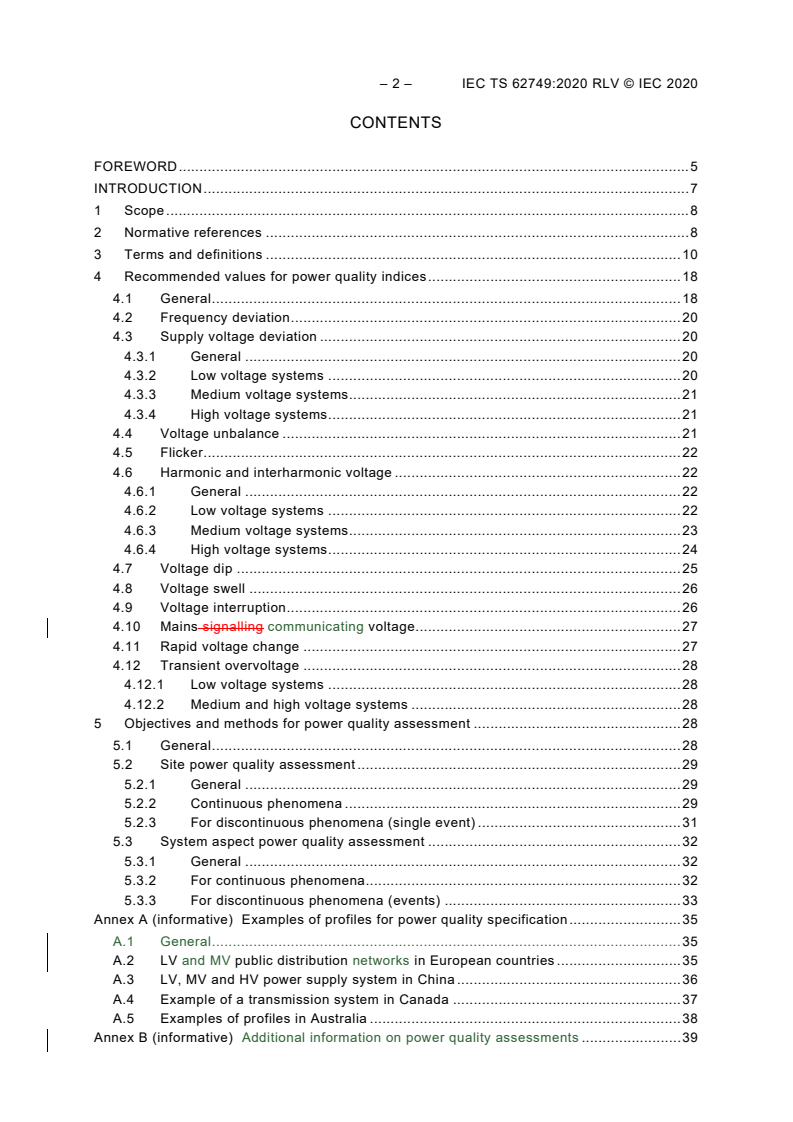
– 2 – IEC TS 62749:2020 RLV © IEC 2020
CONTENTS
FOREWORD . 5
INTRODUCTION . 7
1 Scope . 8
2 Normative references . 8
3 Terms and definitions . 10
4 Recommended values for power quality indices . 18
4.1 General . 18
4.2 Frequency deviation . 20
4.3 Supply voltage deviation . 20
4.3.1 General . 20
4.3.2 Low voltage systems . 20
4.3.3 Medium voltage systems . 21
4.3.4 High voltage systems . 21
4.4 Voltage unbalance . 21
4.5 Flicker . 22
4.6 Harmonic and interharmonic voltage . 22
4.6.1 General . 22
4.6.2 Low voltage systems . 22
4.6.3 Medium voltage systems . 23
4.6.4 High voltage systems . 24
4.7 Voltage dip . 25
4.8 Voltage swell . 26
4.9 Voltage interruption . 26
4.10 Mains signalling communicating voltage . 27
4.11 Rapid voltage change . 27
4.12 Transient overvoltage . 28
4.12.1 Low voltage systems . 28
4.12.2 Medium and high voltage systems . 28
5 Objectives and methods for power quality assessment . 28
5.1 General . 28
5.2 Site power quality assessment . 29
5.2.1 General . 29
5.2.2 Continuous phenomena . 29
5.2.3 For discontinuous phenomena (single event) . 31
5.3 System aspect power quality assessment . 32
5.3.1 General . 32
5.3.2 For continuous phenomena . 32
5.3.3 For discontinuous phenomena (events) . 33
Annex A (informative) Examples of profiles for power quality specification . 35
A.1 General . 35
A.2 LV and MV public distribution networks in European countries . 35
A.3 LV, MV and HV power supply system in China . 36
A.4 Example of a transmission system in Canada . 37
A.5 Examples of profiles in Australia . 38
Annex B (informative) Additional information on power quality assessments . 39
B.1 Weekly percentile values assessed on a daily sliding basis . 39
B.2 Example on system aspect continuous disturbance evaluation . 40
B.3 Aggregation method used for events . 40
B.3.1 General . 40
B.3.2 Time aggregation . 40
Annex C (informative) Main impact of poor power quality . 43
C.1 General . 43
C.2 Harmonic distortion . 43
C.3 Voltage unbalance . 44
C.4 Voltage deviation . 44
C.5 Frequency deviation . 44
C.6 Voltage fluctuation . 44
C.7 Flicker . 44
C.8 Voltage dip (or voltage sag) . 44
C.9 Transient overvoltages . 45
Annex D (informative) Power quality issues related to distributed generation and
micro-grids . 46
D.1 General . 46
D.2 Voltage deviation . 46
D.3 Harmonics . 46
D.4 DG magnetic bias (DC current injection) . 46
D.5 Voltage fluctuation and flicker . 47
D.6 High frequency conducted disturbances . 47
Annex E (informative) Methods to maintain and improve power quality . 48
E.1 General . 48
E.2 Voltage deviation . 48
E.3 Harmonics . 48
E.4 Flicker . 49
E.5 Voltage unbalance . 49
E.6 Voltage dip/swell/short time interruption . 50
Annex F (informative) Relation between power quality and EMC . 51
F.1 General . 51
F.2 Differences between power quality and compatibility levels . 51
F.3 Example of power quality level versus compatibility level . 52
Annex G (informative) Other phenomena . 55
G.1 General . 55
G.2 Level behaviour over time . 55
G.3 Duration . 55
G.4 Periodicity . 55
G.5 Bandwidth . 56
Annex H (informative) Role of stakeholders for power quality management –
Coordination of the parties involved . 57
H.1 General . 57
H.2 Network operator – Network user . 57
H.3 Network user – Equipment supplier . 57
H.4 Network operator – Equipment supplier . 58
Bibliography . 59
– 4 – IEC TS 62749:2020 RLV © IEC 2020
Figure 1 – Signal Mains communicating voltages recommended values in percent of
U used in public LV networks (or U in public MV networks) . 27
N c
Figure 2 – Example for illustrating voltage THD assessment result trends . 31
Figure 3 – Example showing information of single event assessment . 32
th
Figure B.1 – Comparison of two methods of assessing weekly 95 percentile values . 39
Figure B.2 – Example for illustrating the differences resulted by time aggregation
method . 41
Figure B.3 – Example of time sequence of voltage dips that can be aggregated in two
different ways . 42
Figure F.1 – Application points in a LV system (example) . 52
Figure F.2 – Relation between disturbance levels (schematic significance only) . 52
Figure F.3 – Cumulative distribution of all THD values recorded at 30 points of supply
of the LV system, during one week . 53
th
Figure F.4 – Weekly 95 percentile THD values evaluated at each monitored LV point
of supply . 54
Table 1 – Classification of electromagnetic phenomena addressed by power quality
indices . 8
Table 2 – Flicker severity P recommended values . 22
lt
Table 3 – Recommended values of individual harmonic voltages at the low voltage
points of supply terminals for orders up to 50 given in percent of the fundamental
voltage U . 23
Table 4 – Recommended values of individual harmonic voltages at the medium voltage
points of supply terminals for orders up to 50 given in percent of the fundamental
voltage U . 24
Table 5 – Indicative values of individual harmonic voltages at the high voltage points of
supply terminals given in percent of the fundamental voltage U . 25
Table 6 – Site power quality assessment methods . 30
Table 7 – Example of single event assessment . 32
Table 8 – List of individual events measured at a single monitoring site . 33
Table 9 – SARFI-X indices coming out of Table 8 . 34
Table 10 – Magnitude-duration table format . 34
Table A.1 – Examples of profiles in European countries . 35
Table A.2 – Examples of profiles in China . 36
Table A.3 – Examples of profiles in Canada . 37
Table A.4 – Examples of profiles in Australia . 38
Table B.1 – Listing of system power quality evaluation . 40
INTERNATIONAL ELECTROTECHNICAL COMMISSION
____________
ASSESSMENT OF POWER QUALITY – CHARACTERISTICS
OF ELECTRICITY SUPPLIED BY PUBLIC NETWORKS
FOREWORD
1) The International Electrotechnical Commission (IEC) is a worldwide organization for standardization comprising
all national electrotechnical committees (IEC National Committees). The object of IEC is to promote international
co-operation on all questions concerning standardization in the electrical and electronic fields. To this end and
in addition to other activities, IEC publishes International Standards, Technical Specifications, Technical Reports,
Publicly Available Specifications (PAS) and Guides (hereafter referred to as “IEC Publication(s)”). Their
preparation is entrusted to technical committees; any IEC National Committee interested in the subject dealt with
may participate in this preparatory work. International, governmental and non-governmental organizations liaising
with the IEC also participate in this preparation. IEC collaborates closely with the International Organization for
Standardization (ISO) in accordance with conditions determined by agreement between the two organizations.
2) The formal decisions or agreements of IEC on technical matters express, as nearly as possible, an international
consensus of opinion on the relevant subjects since each technical committee has representation from all
interested IEC National Committees.
3) IEC Publications have the form of recommendations for international use and are accepted by IEC National
Committees in that sense. While all reasonable efforts are made to ensure that the technical content of IEC
Publications is accurate, IEC cannot be held responsible for the way in which they are used or for any
misinterpretation by any end user.
4) In order to promote international uniformity, IEC National Committees undertake to apply IEC Publications
transparently to the maximum extent possible in their national and regional publications. Any divergence between
any IEC Publication and the corresponding national or regional publication shall be clearly indicated in the latter.
5) IEC itself does not provide any attestation of conformity. Independent certification bodies provide conformity
assessment services and, in some areas, access to IEC marks of conformity. IEC is not responsible for any
services carried out by independent certification bodies.
6) All users should ensure that they have the latest edition of this publication.
7) No liability shall attach to IEC or its directors, employees, servants or agents including individual experts and
members of its technical committees and IEC National Committees for any personal injury, property damage or
other damage of any nature whatsoever, whether direct or indirect, or for costs (including legal fees) and
expenses arising out of the publication, use of, or reliance upon, this IEC Publication or any other IEC Publications.
8) Attention is drawn to the Normative references cited in this publication. Use of the referenced publications is
indispensable for the correct application of this publication.
9) Attention is drawn to the possibility that some of the elements of this IEC Publication may be the subject of patent
rights. IEC shall not be held responsible for identifying any or all such patent rights.
This redline version of the official IEC Standard allows the user to identify the changes
made to the previous edition. A vertical bar appears in the margin wherever a change has
been made. Additions are in green text, deletions are in strikethrough red text.
– 6 – IEC TS 62749:2020 RLV © IEC 2020
The main task of IEC technical committees is to prepare International Standards. In exceptional
circumstances, a technical committee may propose the publication of a Technical Specification
when
• the required support cannot be obtained for the publication of an International Standard,
despite repeated efforts, or
• the subject is still under technical development or where, for any other reason, there is the
future but no immediate possibility of an agreement on an International Standard.
Technical Specifications are subject to review within three years of publication to decide
whether they can be transformed into International Standards.
IEC TS 62749, which is a technical specification, has been prepared by IEC technical
committee 8: System aspects of electrical energy supply.
The text of this Technical Specification is based on the following documents:
Draft TS Report on voting
8/1512/DTS 8/1524/RVDTS
Full information on the voting for the approval of this Technical Specification can be found in
the report on voting indicated in the above table.
This document has been drafted in accordance with the ISO/IEC Directives, Part 2.
This second edition cancels and replaces the first edition published in 2015. This edition
constitutes a technical revision.
This edition includes the following significant technical changes with respect to the previous
edition:
a) minimum number of remaining data for weekly analysis,
b) improvement of the compatibility between EN 50160 and IEC TS 62749,
c) further explanation of the conception of daily sliding window,
d) further explanation of the aggregation method used for events,
e) further explanation of the relation between Power Quality and EMC,
f) addition of a new definition of mains communicating system (MCS),
g) addition of a new Annex G: Other phenomena,
h) transfer of the main content of IEC TR 62510 to IEC TS 62749.
The committee has decided that the contents of this publication will remain unchanged until the
stability date indicated on the IEC website under "http://webstore.iec.ch" in the data related to
the specific publication. At this date, the publication will be
• transformed into an International standard,
• reconfirmed,
• withdrawn,
• replaced by a revised edition, or
• amended.
IMPORTANT – The 'colour inside' logo on the cover page of this publication indicates
that it contains colours which are considered to be useful for the correct understanding
of its contents. Users should therefore print this document using a colour printer.
INTRODUCTION
The description of electricity is of fundamental importance within electricity supply systems. In
general the past, its characteristics depended less on its generation than on the way in which
it is was transported by networks and being used by the equipment of the multiple users. Faults
or other events such as short-circuit and lightning strikes occurring within users' installations or
public networks also disturb or degrade it.
Nowadays, Smart Grid construction and massive deployment of renewable energy sources
increase the complexity of power quality management. For more information about power
quality issues related to distributed generation and micro-grids, refer to Annex D.
NOTE For more information about role of stakeholders for power quality management, see Annex H.
There is a need for a common set of power quality (PQ) indices and measurement methods in
order to allow different system operators to measure and report power quality in a consistent
manner.
Regarding the limits or levels of power quality, the situation differs. Historically, the electrical
systems in different countries/regions have been designed in different ways to cater for
national/regional variations like different geographic, climatic or commercial conditions, etc. It
is thus essential that any set of internationally agreed power quality limits or levels also
recognize these differences, which depends namely on the system configuration, the transfer
characteristics between the different voltage levels (attenuation or amplification), the actual
disturbance levels on the system, etc.
Also, the level of power quality is not absolute rather it depends on the price that clients are
willing to pay for it. Optimizing power quality should be carried out in a cost-effective manner in
that if NETWORK USERs expect power quality to be an intrinsic characteristic of the product
they also want it at the lowest price.
Also, the quality of power is not absolute. Optimizing power quality should be carried out in a
cost-effective manner to balance network user power quality requirements and willingness to
pay for it with power quality supply costs.
Therefore, some of the objectives recommended hereafter allow for a range of values, or
options, while still ensuring the coordination of disturbance levels between different parts of the
system or voltage levels.
Then, the requirements to be applied can be expressed by the association of the IEC Power
Quality framework from the normative part of this document and profiles. Examples of profiles
are given in Annex A.
– 8 – IEC TS 62749:2020 RLV © IEC 2020
ASSESSMENT OF POWER QUALITY – CHARACTERISTICS
OF ELECTRICITY SUPPLIED BY PUBLIC NETWORKS
1 Scope
This Technical Specification specifies the expected characteristics of electricity at the SUPPLY
TERMINALS point of supply of public low, medium and high voltage, 50 Hz or 60 Hz, networks,
as well as power quality assessment methods.
NOTE 1 The boundaries between the various voltage levels may can be different for different countries/regions. In
the context of this TS, the following terms for system voltage are used:
• low voltage (LV) refers to U ≤ 1 kV;
N
• medium voltage (MV) refers to 1 kV < U ≤ 35 kV;
N
• high voltage (HV) refers to 35 kV < U ≤ 230 kV.
N
NOTE 2 Because of existing network structures, in some countries/regions, the boundary between medium and high
voltage can be different.
This document applies to the phenomena listed in Table 1.
Table 1 – Classification of electromagnetic phenomena
addressed by power quality indices
Other phenomena
Continuous phenomena Discontinuous phenomena –
Events
FREQUENCY DEVIATION SUPPLY INTERRUPTION MAINS COMMUNICATING
VOLTAGES
SUPPLY VOLTAGE DEVIATION VOLTAGE DIP
VOLTAGE UNBALANCE VOLTAGE SWELL
HARMONIC VOLTAGE TRANSIENT OVERVOLTAGE
INTERHARMONIC VOLTAGE RAPID VOLTAGE CHANGE
FLICKER (VOLTAGE
FLUCTUATION)
MAINS SIGNALLING VOLTAGES
NOTE 3 Specification of related measurement methods can be found in IEC 61000-4-30, EMC – Testing and
measurement techniques – Power Quality measurement methods.
NOTE 4 Specification of the performance of related measuring instruments can be found in IEC 62586, Power
quality measurement in power supply systems.
While power quality is related to EMC in a number of ways, especially because compliance with
power quality requirements depends on the control of cumulative effect of electromagnetic
emission from all/multiple equipment and/or installations, this document is not an EMC
publication (see also Annex F).
2 Normative references
The following documents are referred to in the text in such a way that some or all of their content
constitutes requirements of this document. For dated references, only the edition cited applies.
For undated references, the latest edition of the referenced document (including any
amendments) applies.
IEC 60038, IEC standard voltages
IEC 60364-4-44, Low-voltage electrical installations – Part 4-44: Protection for safety –
Protection against voltage disturbances and electromagnetic disturbances
IEC 60364-5-53, Low-voltage electrical installations of buildings – Part 5-53: Selection and
erection of electrical equipment – Devices for protection for safety, isolation, switching, control
and monitoring
IEC 61000-2-2:2002, Electromagnetic compatibility (EMC) – Part 2-2: Environment –
Compatibility levels for low-frequency conducted disturbances and signalling in public low-
voltage power supply systems
IEC 61000-2-2:2002/AMD1:2017
IEC 61000-2-2:2002/AMD2:2018
IEC TR 61000-2-8, Electromagnetic compatibility (EMC) – Part 1-8: Environment – Voltage dips
and short interruptions on public electric power supply systems with statistical measurement
results
IEC 61000-2-12, Electromagnetic compatibility (EMC) – Part 2-12: Environment – Compatibility
levels for low-frequency conducted disturbances and signalling in public medium-voltage power
supply systems
IEC TR 61000-2-14, Electromagnetic compatibility (EMC) – Part 2-14: Environment –
Overvoltages on public electricity distribution networks
IEC 61000-3-2, Electromagnetic compatibility (EMC) – Part 3-2: Limits – Limits for harmonic
current emissions (equipment input current ≤ 16 A per phase)
IEC 61000-3-3, Electromagnetic compatibility (EMC) – Part 3-3: Limits – Limitation of voltage
changes, voltage fluctuations and flicker in public low-voltage supply systems, for equipment
with rated current ≤ 16 A per phase and not subject to conditional connection
IEC TR 61000-3-6, Electromagnetic compatibility (EMC) – Part 3-6: Limits – Assessment of
emission limits for the connection of distorting installations to MV, HV and EHV power systems
IEC TR 61000-3-7, Electromagnetic compatibility (EMC) – Part 3-7: Limits – Assessment of
emission limits for the connection of fluctuating load installations to MV, HV and EHV power
systems
IEC 61000-3-11, Electromagnetic compatibility (EMC) – Part 3-11: Limits – Limitation of voltage
changes, voltage fluctuations and flicker in public low-voltage supply systems – Equipment with
rated current ≤ 75 A and subject to conditional connection
IEC 61000-3-12, Electromagnetic compatibility (EMC) – Part 3-12: Limits – Limits for harmonic
currents produced by equipment connected to public low-voltage systems with input current >16
A and ≤ 75 A per phase
IEC TR 61000-3-13, Electromagnetic compatibility (EMC) – Part 3-13: Limits – Assessment of
emission limits for the connection of unbalanced installations to MV, HV and EHV power
systems
IEC TR 61000-3-14, Electromagnetic compatibility (EMC) – Part 3-14: Limits – Assessment of
emission limits for the connection of disturbing installations to LV power systems
– 10 – IEC TS 62749:2020 RLV © IEC 2020
IEC 61000-4-7:2009, Electromagnetic compatibility (EMC) – Part 4-7: Testing and
measurement techniques – General guide on harmonics and interharmonics measurements and
instrumentation, for power supply systems and equipment connected thereto
IEC 61000-4-15, Electromagnetic compatibility (EMC) – Part 4-15: Testing and measurement
techniques – Flickermeter – Functional and design specifications
IEC 61000-4-30:20082015, Electromagnetic compatibility (EMC) – Part 4-30: Testing and
measurement techniques – Power quality measurement methods
IEC 62586-1, Power quality measurement in power supply systems – Part 1: Power quality
instruments (PQI)
IEC 62586-2, Power quality measurement in power supply systems – Part 2: Functional tests
and uncertainty requirements
3 Terms and definitions
For the purposes of this document, the following terms and definitions apply.
ISO and IEC maintain terminological databases for use in standardization at the following
addresses:
• IEC Electropedia: available at http://www.electropedia.org/
• ISO Online browsing platform: available at http://www.iso.org/obp
NOTE Terms are listed in alphabetical order.
3.1
code (in electric power system)
collection of rules concerning rights and duties of the parties involved in a certain part of the
electric power system
Note 1 to entry: For example: grid code, distribution code, code in electric power system.
[SOURCE: IEC 60050-617:2009, 617-03-03, modified – "code in electric power system" has
been added in the Note to entry]
3.2
connection agreement
agreement entered between the system operator and a system user which governs the
procedure and conditions for connection
[SOURCE: IEC 60050-617:2009, 617-04-03]
3.3
declared supply voltage
U
c
supply voltage agreed by the network operator and the network user
Note 1 to entry: Generally declared supply voltage U is the nominal voltage U but it may be different according
c N
to the agreement between the network operator and the network user.
3.4
electricity
set of the phenomena associated with electric charges and electric currents
[SOURCE: IEC 60050-121:1998, 121-11-76]
Note 1 to entry: In the context of electric power systems, electricity is often described as a product with particular
characteristics.
[SOURCE: IEC 60050-121:1998, 121-11-76, modified – The note has been added]
3.5
electromagnetic environment
totality of electromagnetic phenomena existing at a given location
Note 1 to entry: In general, the electromagnetic environment is time-dependent and its description can need a
statistical approach.
[SOURCE: IEC 60050-161:2018, 161-01-01]
3.6
electromagnetic disturbance
electromagnetic phenomenon that can degrade the performance of a device, equipment or
system, or adversely affect living or inert matter
Note 1 to entry: An electromagnetic disturbance can be an electromagnetic noise, an unwanted signal or a change
in the propagation medium itself.
Note 2 to entry: Electromagnetic disturbance in this TS refers to low frequency conducted phenomena.
[SOURCE: IEC 60050-161:2018, 161-01-05, modified – Note 2 to entry has been replaced and
Note 3 to entry has been deleted]
3.7
electromagnetic compatibility
ability of equipment or a system to function satisfactorily in its electromagnetic environment
without introducing intolerable electromagnetic disturbances to anything in that environment
[SOURCE: IEC 60050-161:19902018, 161-01-07]
3.8
(electromagnetic) compatibility level
specified electromagnetic disturbance level used as a reference level for co-ordination in the
setting of emission and immunity limits
Note 1 to entry: By convention, the compatibility level is chosen so that there is only a small probability that it will
be exceeded by the actual disturbance level.
[SOURCE: IEC 60050-161:1990, 161-03-10, modified – Note has been shortened and Note 2
has been deleted]
3.9
flagged data
data that has been marked to indicate that its measurement or its aggregation may have been
affected by interruptions, dips, or swells
[SOURCE: IEC 61000-4-30:2015, 3.5, modified – modified to better understand this term]
3.10
flicker
impression of unsteadiness of visual sensation induced by a light stimulus whose luminance or
spectral distribution fluctuates with time
Note 1 to entry: Voltage fluctuation cause changes of the luminance of lamps which can create the visual
phenomenon called flicker. Above a certain threshold, flicker becomes annoying. The annoyance grows very rapidly
with the amplitude of the fluctuation. At certain repetition rates, even very small amplitudes can be annoying.
– 12 – IEC TS 62749:2020 RLV © IEC 2020
Note 2 to entry: For the time being, flicker is qualified based on incandescent lamp’s behaviour.
[SOURCE: IEC 60050-161:1990, 161-08-13, modified – Notes to entry have been added]
3.11
flicker severity
intensity of flicker annoyance evaluated by the following quantities:
• short term severity (P ) measured over a period of ten minutes;
st
• long term severity (P ) calculated from a sequence of 12 Pst-values over a two hours interval,
lt
according to the following expression:
P
sti
P =
∑
lt
i=1
Note 1 to entry: For details of P and P , see IEC 61000-4-15.
st lt
3.12
frequency deviation
difference between power supply frequency (f ) and nominal frequency (f )
H,1 N
[SOURCE: IEC 60050-614:2016, 614-01-10, modified – "system frequency at a given instant
and its nominal value" has been changed to "power supply frequency (f ) and nominal
H,1
)"]
frequency (f
N
3.13
group total harmonic distortion
THDG (abbreviation)
THDG (symbol)
Y
ratio of the RMS value of the harmonic groups (Y ) to the RMS value of the group associated
g,h
with the fundamental (Y ):
g,1
h
max
Y
gh,
THDG =
Y ∑
Y
h=2
g,1
Note 1 to entry: The symbol Y is replaced, as required, by the symbol I for currents or by the symbol U for voltages.
[SOURCE: IEC 61000-4-7:20092002/AMD1:2008, 3.3.2]
3.14
harmonic frequency
f
H,h
frequency which is an integer multiple of the power supply (fundamental) frequency
[SOURCE: IEC 61000-4-7:20092002/AMD1:2008, 3.2.1, modified – "fundamental frequency of
the power system" has been changed to "power supply (fundamental) frequency", the formula
and Note to entry have been removed]
3.15
harmonic order
h
(integer) ratio of a harmonic frequency (f ) to the power supply frequency (f )
H,h H,1
[SOURCE: IEC 60050-161:1990, 161-02-19, modified – "the integral number given by the ratio
of the frequency of a harmonic to the fundamental frequency" has been changed to "(integer)
ratio of a harmonic frequency (f ) to the power supply frequency (f )"]
H,h H,1
3.16
harmonic ratio
HR
ratio of individual harmonic order component (U or I ) to the fundamental component (U or I )
h h 1 1
3.17
mains communicating system
MCS
system using mains power lines to transmit information signals, either on the public electricity
distribution network or within installations of network users
[SOURCE: IEC 61000-2-2 :2002/AMD1:2017, 3.1.8, modified – "electrical" has been deleted]
3.18
mains signalling communicating voltage
signal superimposed on the supply voltage for the purpose of transmission of information in the
public supply network and to network users' premises
Note 1 to entry: Three types of signals in the public supply network can be classified:
• ripple control signals: superimposed sinusoidal voltage signals in the frequency range 110 Hz to 3 000 Hz;
• power-line-carrier signals: superimposed sinusoidal voltage signals in the frequency range 3 kHz to 148,5 kHz;
• mains marking signals: superimposed short time alterations (transients) at selected points of the voltage
waveform.
3.19
system operator
network operator
party responsible for safe and reliable operation of a part of the electric power system in a
certain area and for connection to other parts of the electric power system
[SOURCE: IEC 60050-617:2009, 617-02-09]
3.20
nominal frequency
f
N
value of frequency used to designate or identify a system
3.21
nominal system voltage
U
N
value of voltage used to designate or identify a system
Note 1 to entry: For example: nominal voltage of a system.
[SOURCE: IEC 60050-601:1985, 601-01-21, modified – the abbreviation has been added,
"suitable approximate" from beginning of definition has been removed]
3.22
normal operating conditions (of a public electricity supply system)
operating conditions of a public electricity supply system typically including all generation
variations, load variations and reactive compensation or filter states (e.g. shunt capacitor
states), planned outages and planned arrangements during maintenance and construction work,
non-ideal operating conditions and normal contingencies under which the considered system
has been designed to operate
– 14 – IEC TS 62749:2020 RLV © IEC 2020
Note 1 to entry: Normal system operating conditions typically exclude exceptional situations such as: conditions
arising as a result of a fault or a combination of faults beyond that planned for under the system security standard,
unavoidable circumstances (for example: force majeure, exceptional weather conditions and other natural disasters,
acts by public authorities, industrial actions), cases where Network users significantly exceed their emission limits
or do not comply with the connection requirements, and temporary generation or supply arrangements adopted to
maintain supply to Network users during maintenance or construction work, where otherwise supply would be
interrupted.
Note 2 to entry: For example: nominal operating conditions of a public electricity supply system.
[SOURCE: IEC TR 61000-3-6:2008, 3.1415, modified –"of the system or of the disturbing
installation" has been replaced by "of a public electricity supply system", "and planned" has
been added to term and definition "arrangements", "or the disturbing installation" has been
deleted and "the Note to entry has been slightly changed]
3.23
percentile value
U (symbol)
x%
value such that x percent (x %) of measurements are smaller than or equal to that value, over
a given period
3.24
planning level
level of a particular disturbance in a particular environment, adopted as a reference value for
the limits to be set for the emissions from the installations in a particular system, in order to co-
ordinate those limits with all the limits adopted for equipment and installations intended to be
connected to the power supply system
Note 1 to entry: Planning levels are considered internal quality objectives to be specified at a local level by those
responsible for planning and operating the power supply system in the relevant area.
[SOURCE: IEC TR 61000-3-6:2008, 3.16]
3.25
point of common coupling
PCC
point in a public power supply network, electrically nearest to a particular load, at which other
loads are, or may be, connected
Note 1 to entry: These loads can be either devices, equipment or systems, or distinct network user’s installations.
[SOURCE: IEC 60050-161:1990,161-07-15, modified – ("consumer's installation" replaced by
"load") "of a power supply network" has been changed to "in a public power supply network", In
the first note, "customer's" has been changed to "user's" and Note 2 to entry has been deleted]
3.26
point of supply
supply terminal
point in a distribution or transmission network desig
...