

IEC 61290-3-2:2008
(Main)Optical amplifiers - Test methods - Part 3-2: Noise figure parameters - Electrical spectrum analyzer method
General Information
- Abstract
IEC 61290-3-2:2008 applies to optical fibre amplifiers (OFA) using active fibres, containing rare-earth dopants, presently commercially available. Establishes uniform requirements for accurate and reliable measurements, of the noise figure, as defined in 3.1.17 of IEC 61291-1, by means of the electricial spectrum analyzer (ESA) method. This technical revision includes updates to specifically address all types of optical amplifiers - not just optical fibre amplifiers. This standard should be read in conjunction with IEC 61290-3 and IEC 61291-1.
- Status
- Published
- Publication Date
- 20-Jul-2008
- Technical Committee
- SC 86C - Fibre optic systems, sensing and active devices
- Drafting Committee
- WG 3 - TC 86/SC 86C/WG 3
- Current Stage
- PPUB - Publication issued
- Start Date
- 21-Jul-2008
- Completion Date
- 15-Oct-2008
Overview
The IEC 61290-3-2:2008 standard, titled Optical Amplifiers – Test Methods – Part 3-2: Noise Figure Parameters – Electrical Spectrum Analyzer Method, establishes uniform and accurate procedures for measuring the noise figure of optical amplifiers using the Electrical Spectrum Analyzer (ESA) method. Developed by the International Electrotechnical Commission (IEC), this standard applies broadly to all commercially available optical amplifiers, including rare-earth doped optical fibre amplifiers, semiconductor optical amplifiers (SOAs), and planar waveguide optical amplifiers (PWOAs).
This technical revision broadens the scope beyond optical fibre amplifiers to encompass all types of optical amplifiers. It complements related standards IEC 61290-3 and IEC 61291-1 and ensures reliable noise figure measurement, a critical parameter defining amplifier performance, through a direct measurement of total electrical noise.
Key Topics
Scope and Applicability
IEC 61290-3-2 applies to active fibre amplifiers containing rare-earth dopants, Raman amplifiers, SOAs, and PWOAs. It is designed for amplifiers commercially available and used in modern telecommunication and data communication networks.Noise Figure Measurement
The standard specifies the electrical spectrum analyzer method for measuring the noise figure, closely tied to the definition in IEC 61291-1. Unlike optical spectrum analyzer methods, the ESA method measures the total noise including amplified spontaneous emission and other noise contributions, making it suitable for all amplifier types.Test Setup and Calibration
The standard details the apparatus configuration, including optical sources, modulators, photodetectors, and ESA settings needed for precise noise figure measurement. It describes frequency-scanning and selected-frequency techniques for calibration and measurement.Measurement Accuracy and Limitations
The expected measurement accuracy is ±20% or ±1 dB in average noise figure. The method accounts for noise contributions such as multiple path interference and receiver-related noise, emphasizing calibration and test repeatability.Symbols and Abbreviations
The document defines symbols such as noise factor (F), noise figure (NF), gain (G), relative intensity noise (RIN), and multiple path interference (MPI), facilitating standard communication and reporting.
Applications
Telecommunications
IEC 61290-3-2 supports the design and quality assurance of optical amplifiers used in fiber optic communication systems, including long-haul and metro networks where noise figure critically impacts signal to noise ratio and system reach.Component Manufacturing
Optical device manufacturers use this standard to test and certify amplifiers, ensuring compliance with international criteria for noise performance.Research and Development
Laboratories involved in designing new amplifier technologies apply the ESA noise figure test method to characterize noise properties accurately during product development.System Integration and Testing
Network integrators and testing services rely on standardized noise figure measurements to evaluate system performance and troubleshoot amplifier-related noise issues.
Related Standards
IEC 61290-3
Basic specifications and test methods for noise figure parameters in optical fibre amplifiers, providing foundational concepts referenced by Part 3-2.IEC 61291-1
Generic specifications for optical amplifiers, including noise figure definitions and performance metrics essential for correctly applying IEC 61290-3-2.IEC 60728-6
Cable networks and optical equipment standards relevant for optical amplifier testing in cable TV and multimedia distribution systems.ISO/IEC Directives Part 2
Provides guidelines on standard preparation relevant to the drafting and technical consistency of IEC 61290-3-2.
Keywords: IEC 61290-3-2, optical amplifiers, noise figure measurement, electrical spectrum analyzer, ESA method, optical fibre amplifiers, semiconductor optical amplifiers, noise figure parameters, optical testing standards, IEC optical amplifier standards, optical amplifier noise, telecommunications testing.
Relations
- Effective Date
- 05-Sep-2023
Get Certified
Connect with accredited certification bodies for this standard

ANCE
Mexican certification and testing association.

Intertek Slovenia
Intertek testing, inspection, and certification services in Slovenia.

LNE (Laboratoire National de Métrologie et d'Essais)
French national laboratory for metrology and testing.
Sponsored listings
Frequently Asked Questions
IEC 61290-3-2:2008 is a standard published by the International Electrotechnical Commission (IEC). Its full title is "Optical amplifiers - Test methods - Part 3-2: Noise figure parameters - Electrical spectrum analyzer method". This standard covers: IEC 61290-3-2:2008 applies to optical fibre amplifiers (OFA) using active fibres, containing rare-earth dopants, presently commercially available. Establishes uniform requirements for accurate and reliable measurements, of the noise figure, as defined in 3.1.17 of IEC 61291-1, by means of the electricial spectrum analyzer (ESA) method. This technical revision includes updates to specifically address all types of optical amplifiers - not just optical fibre amplifiers. This standard should be read in conjunction with IEC 61290-3 and IEC 61291-1.
IEC 61290-3-2:2008 applies to optical fibre amplifiers (OFA) using active fibres, containing rare-earth dopants, presently commercially available. Establishes uniform requirements for accurate and reliable measurements, of the noise figure, as defined in 3.1.17 of IEC 61291-1, by means of the electricial spectrum analyzer (ESA) method. This technical revision includes updates to specifically address all types of optical amplifiers - not just optical fibre amplifiers. This standard should be read in conjunction with IEC 61290-3 and IEC 61291-1.
IEC 61290-3-2:2008 is classified under the following ICS (International Classification for Standards) categories: 33.180.30 - Optic amplifiers. The ICS classification helps identify the subject area and facilitates finding related standards.
IEC 61290-3-2:2008 has the following relationships with other standards: It is inter standard links to IEC 61290-3-2:2003. Understanding these relationships helps ensure you are using the most current and applicable version of the standard.
IEC 61290-3-2:2008 is available in PDF format for immediate download after purchase. The document can be added to your cart and obtained through the secure checkout process. Digital delivery ensures instant access to the complete standard document.
Standards Content (Sample)
IEC 61290-3-2
Edition 2.0 2008-07
INTERNATIONAL
STANDARD
NORME
INTERNATIONALE
Optical amplifiers – Test methods –
Part 3-2: Noise figure parameters – Electrical spectrum analyzer method
Amplificateurs optiques – Méthodes d’essais -
Partie 3-2: Paramètres du facteur de bruit – Méthode de l’analyseur spectral
électrique
All rights reserved. Unless otherwise specified, no part of this publication may be reproduced or utilized in any form or by
any means, electronic or mechanical, including photocopying and microfilm, without permission in writing from either IEC or
IEC's member National Committee in the country of the requester.
If you have any questions about IEC copyright or have an enquiry about obtaining additional rights to this publication,
please contact the address below or your local IEC member National Committee for further information.
Droits de reproduction réservés. Sauf indication contraire, aucune partie de cette publication ne peut être reproduite
ni utilisée sous quelque forme que ce soit et par aucun procédé, électronique ou mécanique, y compris la photocopie
et les microfilms, sans l'accord écrit de la CEI ou du Comité national de la CEI du pays du demandeur.
Si vous avez des questions sur le copyright de la CEI ou si vous désirez obtenir des droits supplémentaires sur cette
publication, utilisez les coordonnées ci-après ou contactez le Comité national de la CEI de votre pays de résidence.
IEC Central Office
3, rue de Varembé
CH-1211 Geneva 20
Switzerland
Email: inmail@iec.ch
Web: www.iec.ch
About the IEC
The International Electrotechnical Commission (IEC) is the leading global organization that prepares and publishes
International Standards for all electrical, electronic and related technologies.
About IEC publications
The technical content of IEC publications is kept under constant review by the IEC. Please make sure that you have the
latest edition, a corrigenda or an amendment might have been published.
ƒ Catalogue of IEC publications: www.iec.ch/searchpub
The IEC on-line Catalogue enables you to search by a variety of criteria (reference number, text, technical committee,…).
It also gives information on projects, withdrawn and replaced publications.
ƒ IEC Just Published: www.iec.ch/online_news/justpub
Stay up to date on all new IEC publications. Just Published details twice a month all new publications released. Available
on-line and also by email.
ƒ Electropedia: www.electropedia.org
The world's leading online dictionary of electronic and electrical terms containing more than 20 000 terms and definitions
in English and French, with equivalent terms in additional languages. Also known as the International Electrotechnical
Vocabulary online.
ƒ Customer Service Centre: www.iec.ch/webstore/custserv
If you wish to give us your feedback on this publication or need further assistance, please visit the Customer Service
Centre FAQ or contact us:
Email: csc@iec.ch
Tel.: +41 22 919 02 11
Fax: +41 22 919 03 00
A propos de la CEI
La Commission Electrotechnique Internationale (CEI) est la première organisation mondiale qui élabore et publie des
normes internationales pour tout ce qui a trait à l'électricité, à l'électronique et aux technologies apparentées.
A propos des publications CEI
Le contenu technique des publications de la CEI est constamment revu. Veuillez vous assurer que vous possédez
l’édition la plus récente, un corrigendum ou amendement peut avoir été publié.
ƒ Catalogue des publications de la CEI: www.iec.ch/searchpub/cur_fut-f.htm
Le Catalogue en-ligne de la CEI vous permet d’effectuer des recherches en utilisant différents critères (numéro de référence,
texte, comité d’études,…). Il donne aussi des informations sur les projets et les publications retirées ou remplacées.
ƒ Just Published CEI: www.iec.ch/online_news/justpub
Restez informé sur les nouvelles publications de la CEI. Just Published détaille deux fois par mois les nouvelles
publications parues. Disponible en-ligne et aussi par email.
ƒ Electropedia: www.electropedia.org
Le premier dictionnaire en ligne au monde de termes électroniques et électriques. Il contient plus de 20 000 termes et
définitions en anglais et en français, ainsi que les termes équivalents dans les langues additionnelles. Egalement appelé
Vocabulaire Electrotechnique International en ligne.
ƒ Service Clients: www.iec.ch/webstore/custserv/custserv_entry-f.htm
Si vous désirez nous donner des commentaires sur cette publication ou si vous avez des questions, visitez le FAQ du
Service clients ou contactez-nous:
Email: csc@iec.ch
Tél.: +41 22 919 02 11
Fax: +41 22 919 03 00
IEC 61290-3-2
Edition 2.0 2008-07
INTERNATIONAL
STANDARD
NORME
INTERNATIONALE
Optical amplifiers – Test methods –
Part 3-2: Noise figure parameters – Electrical spectrum analyzer method
Amplificateurs optiques – Méthodes d’essais -
Partie 3-2: Paramètres du facteur de bruit – Méthode de l’analyseur spectral
électrique
INTERNATIONAL
ELECTROTECHNICAL
COMMISSION
COMMISSION
ELECTROTECHNIQUE
PRICE CODE
INTERNATIONALE
Q
CODE PRIX
ICS 33.180.30 ISBN 2-8318-9898-6
– 2 – 61290-3-2 © IEC:2008
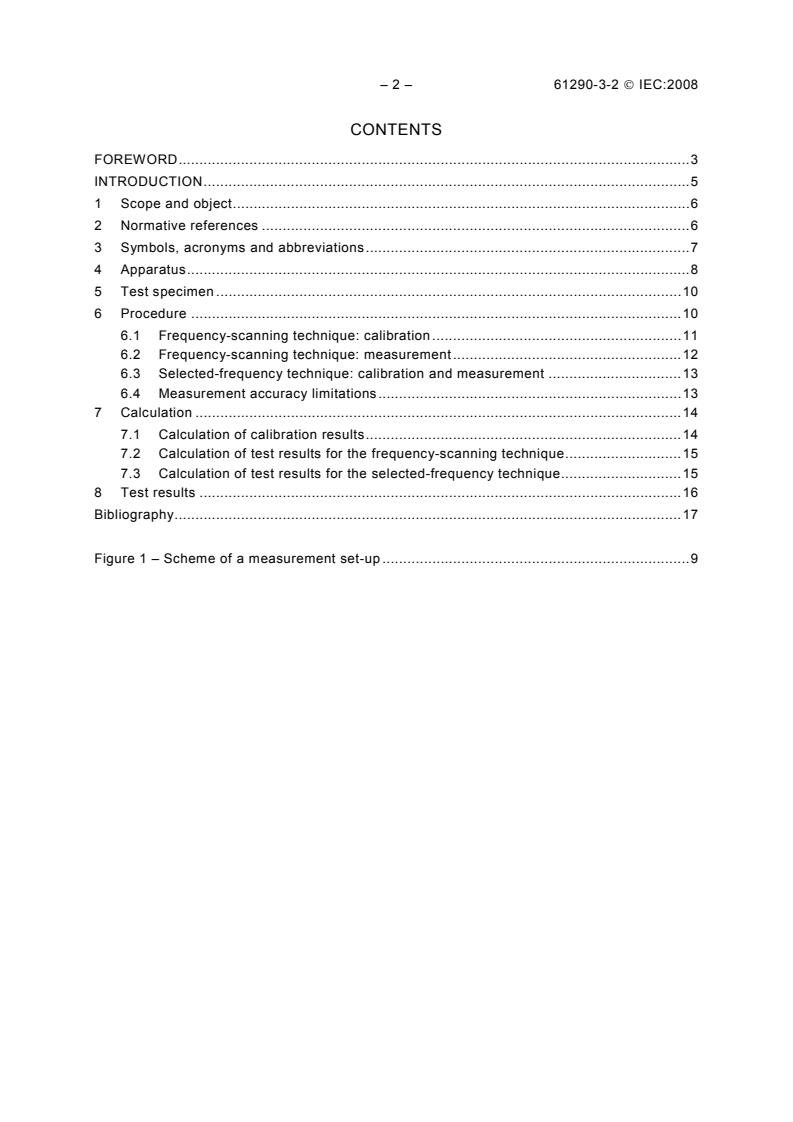
CONTENTS
FOREWORD.3
INTRODUCTION.5
1 Scope and object.6
2 Normative references .6
3 Symbols, acronyms and abbreviations.7
4 Apparatus.8
5 Test specimen .10
6 Procedure .10
6.1 Frequency-scanning technique: calibration.11
6.2 Frequency-scanning technique: measurement.12
6.3 Selected-frequency technique: calibration and measurement .13
6.4 Measurement accuracy limitations.13
7 Calculation .14
7.1 Calculation of calibration results.14
7.2 Calculation of test results for the frequency-scanning technique.15
7.3 Calculation of test results for the selected-frequency technique.15
8 Test results .16
Bibliography.17
Figure 1 – Scheme of a measurement set-up .9
61290-3-2 © IEC:2008 – 3 –
INTERNATIONAL ELECTROTECHNICAL COMMISSION
____________
OPTICAL AMPLIFIERS –
TEST METHODS –
Part 3-2: Noise figure parameters –
Electrical spectrum analyzer method
FOREWORD
1) The International Electrotechnical Commission (IEC) is a worldwide organization for standardization comprising
all national electrotechnical committees (IEC National Committees). The object of IEC is to promote
international co-operation on all questions concerning standardization in the electrical and electronic fields. To
this end and in addition to other activities, IEC publishes International Standards, Technical Specifications,
Technical Reports, Publicly Available Specifications (PAS) and Guides (hereafter referred to as “IEC
Publication(s)”). Their preparation is entrusted to technical committees; any IEC National Committee interested
in the subject dealt with may participate in this preparatory work. International, governmental and non-
governmental organizations liaising with the IEC also participate in this preparation. IEC collaborates closely
with the International Organization for Standardization (ISO) in accordance with conditions determined by
agreement between the two organizations.
2) The formal decisions or agreements of IEC on technical matters express, as nearly as possible, an international
consensus of opinion on the relevant subjects since each technical committee has representation from all
interested IEC National Committees.
3) IEC Publications have the form of recommendations for international use and are accepted by IEC National
Committees in that sense. While all reasonable efforts are made to ensure that the technical content of IEC
Publications is accurate, IEC cannot be held responsible for the way in which they are used or for any
misinterpretation by any end user.
4) In order to promote international uniformity, IEC National Committees undertake to apply IEC Publications
transparently to the maximum extent possible in their national and regional publications. Any divergence
between any IEC Publication and the corresponding national or regional publication shall be clearly indicated in
the latter.
5) IEC provides no marking procedure to indicate its approval and cannot be rendered responsible for any
equipment declared to be in conformity with an IEC Publication.
6) All users should ensure that they have the latest edition of this publication.
7) No liability shall attach to IEC or its directors, employees, servants or agents including individual experts and
members of its technical committees and IEC National Committees for any personal injury, property damage or
other damage of any nature whatsoever, whether direct or indirect, or for costs (including legal fees) and
expenses arising out of the publication, use of, or reliance upon, this IEC Publication or any other IEC
Publications.
8) Attention is drawn to the Normative references cited in this publication. Use of the referenced publications is
indispensable for the correct application of this publication.
9) Attention is drawn to the possibility that some of the elements of this IEC Publication may be the subject of
patent rights. IEC shall not be held responsible for identifying any or all such patent rights.
International Standard IEC 61290-3-2 has been prepared by subcommittee 86C: Fibre optic
systems and active devices, of IEC technical committee 86: Fibre optics.
This second edition cancels and replaces the first edition published in 2003 and constitutes a
technical revision. It includes updates to specifically address all types of optical amplifiers –
not just optical fibre amplifiers.
This standard should be read in conjunction with IEC 61290-3 and IEC 61291-1.
– 4 – 61290-3-2 © IEC:2008
The text of this standard is based on the following documents:
CDV Report on voting
86C/784/CDV 86C/828/RVC
Full information on the voting for the approval of this standard can be found in the report on
voting indicated in the above table.
This publication has been drafted in accordance with the ISO/IEC Directives, Part 2.
A list of all parts of IEC 61290 series, published under the general title Optical amplifiers –
Test methods, can be found on the IEC website.
The committee has decided that the contents of this publication will remain unchanged until
the maintenance result date indicated on the IEC web site under "http://webstore.iec.ch" in the
data related to the specific publication. At this date, the publication will be
• reconfirmed,
• withdrawn,
• replaced by a revised edition, or
• amended.
61290-3-2 © IEC:2008 – 5 –
INTRODUCTION
This part of IEC 61290 is devoted to the subject of optical amplifiers. The technology of
optical amplifiers is still rapidly evolving, hence amendments and new additions to this
standard can be expected.
Each symbol and abbreviation introduced in this standard is generally explained in the text
the first time it appears. However, for an easier understanding of the whole text, a list of all
symbols and abbreviations used in this standard is given in Clause 3.
– 6 – 61290-3-2 © IEC:2008
OPTICAL AMPLIFIERS –
TEST METHODS –
Part 3-2: Noise figure parameters –
Electrical spectrum analyzer method
1 Scope and object
This part of IEC 61290 applies to all commercially available optical amplifiers (OAs), including
OAs using optically pumped fibres (OFAs based on either rare-earth doped fibres or on the
Raman effect), semiconductor optical amplifiers (SOAs) and planar waveguide optical
amplifiers (PWOAs).
The object of this standard is to establish uniform requirements for accurate and reliable
measurements, by means of the electrical spectrum analyzer (ESA) method, of the noise
figure, as defined in IEC 61291-1.
The present test method is based on direct electrical noise measurement and it is directly
related to its definition including all relevant noise contributions. Therefore, this method can
be used for all types of optical amplifiers, including SOA and Raman amplifiers which can
have significant contributions besides amplified spontaneous emission, because it measures
the total noise figure. For further details of applicability, see IEC 61290-3. An alternative test
method based on the optical spectrum analyzer can be used, particularly for different noise
parameters (such as the signal-spontaneous noise factor) but it is not included in the object of
this standard.
NOTE 1 All numerical values followed by (‡) are suggested values for which the measurement is assured. Other
values may be acceptable but should be verified.
NOTE 2 A measurement accuracy for the average noise factor of ±20 %(‡), respectively ±1 dB, should be
attainable with this method (see Clause 6).
NOTE 3 General aspects of noise figure test methods are reported in IEC 61290-3.
2 Normative references
The following referenced documents are indispensable for the application of this document.
For dated references, only the edition cited applies. For undated references, the latest edition
of the referenced document (including any amendments) applies.
IEC 60728-6, Cable networks for television signals, sound signals and interactive services –
Part 6: Optical equipment
IEC 61290-3: Optical fibre amplifiers – Basic specification – Part 3: Test methods for noise
figure parameters
IEC 61291-1, Optical amplifiers – Part 1: Generic specification
NOTE A list of informative references is given in the bibliography.
___________
The first editions of some of these parts were published under the general title Optical fibre amplifiers – Basic
specification or Optical amplifiers – Test methods. Future editions of these parts will appear under the new
general title listed above. The individual titles of Parts 1-1, 3-1, 5-2, 10-1, 10-2, 10-3, 11-1 and 11-2 will be
updated in future editions of these parts to reflect the overall structure of the series.
61290-3-2 © IEC:2008 – 7 –
3 Symbols, acronyms and abbreviations
For the purposes of this document, the following symbols, acronyms and abbreviations apply.
B calibrated, noise equivalent ESA electrical bandwidth (not necessarily the
e
resolution bandwidth)
c speed of light in vacuum
e electron charge
f baseband frequency
F (total) noise factor
F , frequency-independent contribution to total noise factor
non-mpi
F noise factor contribution from multiple path interference noise (OA internal
mpi
reflections)
G OA optical signal gain
h Planck's constant
k optical power reduction factor (default k = 0,5); it can be obtained by taking the
square root of the electrical power reduction factor
ν optical frequency = c/λ
Δν source FWHM linewidth with modulation on
2 –1
H , H (f) S /ΔP = transfer function of receiver in watts
0 0 esa in
I multi-path interference figure of merit, the noise factor contribution caused by
mpi
multiple path interference integrated over all baseband frequencies (0 to
infinity);
I photodetector current
pd
λ wavelength in vacuum
m relative modulation amplitude (the ratio of RMS optical power modulation
amplitude to average optical power)
NF(f) (total) noise figure
N (f) (frequency-dependent) ESA noise contribution caused by the laser relative
,
rin 0
intensity noise, at calibration conditions
N (frequency-dependent) noise caused by the laser relative intensity noise (RIN),
rin,
measured with ESA
N (frequency-independent) shot noise caused by the optical input power, at
,0
shot
calibration conditions, measured with ESA
thermal noise level as measured with ESA (optical input port of receiver
N
thermal
module closed);
N (f) (frequency-dependent) noise power measured with ESA with input and output
attenuator set to 0 dB, thermal noise level subtracted, without OA test device
N '(f) (frequency-dependent) noise power measured with ESA with input attenuator
set to 3 dB (default) and output attenuator set to 0 dB, thermal noise level
subtracted, without OA test device
N (f) frequency-dependent noise power, with OA inserted, thermal noise level
subtracted, measured with ESA
P time-averaged optical input power = T P (with modulation on); optical
,
in in in 0
power radiated from the end of the input jumper cable
P time-averaged optical input power at 0 dB setting of input attenuator (with
,
in 0
modulation on)
ΔP RMS optical power amplitude
in, rms
P total optical power radiated from the output port of the OA, including the ASE
out
– 8 – 61290-3-2 © IEC:2008
r , r (f) effective photodetector responsivity through output attenuator at 0 dB setting
0 0
RIN (f) source relative intensity noise; generally, the square of the RMS optical power
source
fluctuation divided by the (baseband) bandwidth and the square of the CW
power
S electrical power of the modulation signal at T = 1, measured with ESA,
0 in
without OA inserted
S electrical power of the modulation signal, with OA inserted, measured with ESA
T transmission factor of input attenuator relative to transmission at 0 dB setting,
in
expressed in linear form
T transmission factor of output attenuator relative to transmission at 0 dB setting,
out
expressed in linear form
T voltage amplification between detector output and ESA input; this quantity
x
usually depends on the baseband frequency
CW continuous wave
DFB distributed feedback laser
ESA electrical spectrum analyzer
FWHM full width at half maximum
MPI multiple path interference
OA optical fibre amplifier
–1
RIN relative intensity noise of the source, expressed in Hz
RMS root mean square
4 Apparatus
The scheme of a possible implementation of the measurement set-up is shown in Figure 1.
The test equipment listed below, with the required characteristics, is needed.
a) A source module with the following components
1) A laser source with a single-line spectrum, for example: a distributed feedback (DFB)
laser diode. The laser source shall be sine-wave amplitude modulated with one single
frequency that is sufficiently higher than the linewidth of the source. A modulation
frequency at least 3 times higher than the linewidth is advisable. The relative
modulation amplitude, m (that is, the ratio of root mean square, RMS, optical power
modulation amplitude to average optical power) shall be sufficiently small to ensure
operation in the linear regime. A value for m of 2 % to 10 %(‡) is considered adequate.
Direct or external modulation can be used.
An achievable average output power, P , of not less than 0 dBm is advisable, to be
,
in 0
able to generate the desired OA saturation state.
The linewidth FWHM (full width at half maximum) under modulation shall be between
20 MHz(‡) and 100 MHz(‡). This is considered the best range for accurate
determination of the noise contribution from multiple path interference, because it
closely reflects the typical linewidths of DFB lasers, the typical laser source used in
conjunction with OAs. A linewidth of 20 MHz is adequate for a minimum spacing of
7,5 m between the OA internal reflection points. Using narrower linewidths will lead to
the undesired situation that the OA internal reflections interfere in a coherent way and
that substantially different noise figure results are obtained. A linewidth of more than
100 MHz will cause OA noise contributions at frequencies which are higher than the
high end of the ESA bandwidth.
The relative intensity noise (RIN) of the laser source shall be less than –150 dB/Hz(‡)
within the frequency range of interest (for example, 10 MHz to 2 GHz).
61290-3-2 © IEC:2008 – 9 –
The spontaneous emission power, relative to the signal power, shall be less than
–40 dB/nm(‡) in order to avoid large noise contributions from spontaneous-
spontaneous mixing of the source spontaneous emission.
2) A built-in or external isolator, so that external reflections have no influence on the
laser spectrum and on the laser relative intensity noise. The isolator shall have an
optical isolation of better than 60 dB(‡). The reflectance at the isolator output port
shall be less than –50 dB(‡).
3) An input attenuator with variable attenuation, >40 dB attenuation range, better than
±0,05 dB(‡) linearity and external/internal reflectances of less than –50 dB(‡). This
attenuator serves as means of changing the source output power without changing its
spectrum, relative intensity noise (RIN) or state of polarization. The purpose of this
attenuator is to control the input power and to allow a distinction of shot noise from
other noise sources during calibration.
NOTE Alternatively, a simpler attenuator with no linearity requirement can be used if the change of loss
is measured with the electrical spectrum analyzer.
4) A polarization controller with the following capabilities: generation of all possible
output polarization states from an arbitrary input polarization state, optical power
dependence on output polarization state less than ±0,01 dB(‡), and reflectances less
than –50 dB(‡).
DFB laser Electrical
Polarization
Optical
with spectrum
dB OA dB
controller
detector
isolator analyzer
Variable
Electrical
Optical filter
Variable
output
amplifier
OFA under (optional)
input attenuator
attenuator
test
Source module Receiver module
Possibly
Optical
separable
Modulation
power
source
meter
Power meter jumper cable
IEC 1187/08
Figure 1 – Scheme of a measurement set-up
b) A modulation source (that is, a signal generator) capable of generating the frequency and
amplitude stated above.
c) An optical power meter with the following capabilities:
− it shall be capable of measuring the total radiated power from the output connector (or
bare fibre) of the source module. It shall have a measurement accuracy of better than
±0,2 dB, irrespective of the state of polarization, within the operational wavelength
band of the OA. The minimum power level is defined by the source power at 0 dB
attenuator setting. The highest power level is given by the OA output power at the
highest input power;
− it is advisable to make the output port of the output attenuator accessible, because
then the OA output power can alternatively be measured through the output
attenuator, thereby reducing the need for high power measurement.
d) A receiver module with a noise equivalent power (in optical watts/hertz) not larger (‡) than
the RIN-related noise at the output of the source module at the input attenuator 0 dB
setting. The receiver module shall consist of the following components:
– 10 – 61290-3-2 © IEC:2008
1) an output attenuator with variable attenuation, with attenuation range greater than
40 dB, linearity better than ±0,05 dB(‡), peak-to-peak polarization dependence better
than 0,05 dB(‡), essentially flat wavelength-response, external/internal reflectances of
less than –50 dB(‡), power level capabilities up to the maximum OA output power. The
purpose of this attenuator is to provide accurate attenuation before the detector input;
2) an O/E converter, preferably a combination of a photodetector with a reflectance of
less than –30 dB(‡) and a peak-to-peak polarization dependence better than
0,05 dB(‡), and an electrical amplifier with high-impedance input (to achieve low
thermal noise);
3) an electrical spectrum analyzer (ESA). It should have a frequency range in which any
multiple path interference (MPI) contribution to the noise figure is decayed to
insignificance. Usually, frequency ranges from 10 MHz to 2 GHz(‡) fulfill this
requirement. The ESA noise floor should be lower than the noise floor at the output of
the (electrical) amplifier when the source module is connected and the input attenuator
is set to 0 dB attenuation (in this case, the amplifier noise floor contains noise from
source RIN, detector shot noise and the electrical amplifier thermal noise).
e) Optical jumper cables with mode field diameters as close as possible to those of the fibres
used as input and output ports of the OA.
f) Optical connectors compatible with those used as optical input ports of the OA test device,
with a loss repeatability of better than ±0,1 dB. Their reflectance shall be less than
–50 dB(‡). Alternatively, optical splicing can be used as a method for connecting the OA to
the measurement set-up (this is considered the most accurate method).
g) Optionally, an optical filter to reduce/exclude the noise contribution from spontaneous-
spontaneous mixing from the measurement results. The filter shall have the following
properties: filter bandwidth sufficiently small to obtain the desired reduction of the
spontaneous-spontaneous noise, input and output reflectances less than −50 dB(‡), peak-
to-peak polarization dependence less than 0,05 dB(‡), stop-band attenuation greater than
30 dB.
5 Test specimen
The OA shall operate at nominal operating conditions. If the OA or the test apparatus is likely
to cause optical interference problems in the set-up, optical isolators should be used to
bracket the OA under test. This will minimize the signal instability and the measurement
uncertainty.
The OA optical ports may be optical connectors or bare fibre pigtails.
Care should be taken in maintaining the state of polarization of the input light during
measurement. Changes in the polarization state may result in changes of the optical input
power and in changes in the noise due to multiple path interference. Therefore, it is necessary
to adjust the input polarization state in order to maximize the noise figure.
6 Procedure
6.1 General remark
All signal and noise measurements with the electrical spectrum analyzer are in electrical
watts. All noise measurement results are to be understood as a function of frequency and
after subtraction of the (possibly frequency dependent) thermal noise (see 6.2, step i)).
Two alternative techniques are possible, namely the frequency-scanning technique and the
selected-frequency technique. The frequency-scanning technique is advisable when the
frequency-dependence of the noise produced by the OA is unknown or non-monotonic. The
selected-frequency technique may be used when the total noise power N (f) (with the OA
inserted and excluding the thermal noise) either is essentially frequency independent (that is,
when the noise contribution from multi-path interference is negligible) or decays monotonically
61290-3-2 © IEC:2008 – 11 –
with the frequency (that is, when the noise contribution from multi-path interference is
essentially incoherent).
6.2 Frequency-scanning technique: calibration
In this procedure, the frequency-dependent shot noise and laser intensity noise shall be
separately determined. To accomplish this, the noise shall be measured at the different
optical power levels, in order to distinguish the two kinds of noise. This procedure does not
require access to the photocurrent or the output of the output attenuator. It is assumed that
the attenuators are linear, that is to say that setting an attenuation of 3 dB reduces the power
level by 3 dB.
It is expected that the setting of the polarization controller will have negligible influence on the
calibration results.
All noise measurements listed below are to be made as a function of the baseband frequency,
within the frequency range specified in the relevant detail specification. The noise value at the
modulation frequency should be estimated by interpolation.
The following calibration procedure shall be followed.
a) For the ESA, select a suitable baseband frequency range and measurement steps within
this range (for example, a range from 10 MHz to 2 GHz with a step of 5 MHz).
NOTE 1 The baseband frequency range should be at least 30(‡) times larger than the source FWHM
linewidth, Δν (with modulation on).
b) Set suitable laser bias conditions. Do not change these conditions during calibration or
measurement.
c) Set input and output attenuators to 0 dB (for best measurement accuracy).
d) Set the source modulation frequency and modulation amplitude, (for example, around
200 MHz and 5 %, respectively). The modulation frequency should be chosen where RIN
and MPI are small.
It is advisable to use a modulation frequency at least 3 times higher than the linewidth of
the source. Adjust modulation source accordingly. The modulation shall remain constant
during the entire calibration and measurement.
e) Measure the time-averaged OA input power, P , with power meter.
in,0
f) Measure the modulation index as accurately as possible. There are two possibilities,
depending on whether or not the transfer function of the receiver module H(f) is known.
If H(f) is known, then measure the time-averaged input power, P , and the signal power,
in,0
S , with the electrical spectrum analyzer. Then calculate m using:
1 S
m =
(1)
()
P H f
in, 0
where
S
H( f ) =
ΔP
in, rms
ΔP is the RMS optical power modulation amplitude at input of receiver module.
in,rms
If H(f) is unknown, then m can be measured with an oscilloscope: connect the modulated
laser source to a combination of wide bandwidth photodetector, load resistor and
oscilloscope with sufficiently high bandwidth. In this measurement, it is assumed that the
frequency response of both the photodetector and the oscilloscope are flat up to the
modulation frequency. Measure the optical power modulation amplitude and average
optical power with the oscilloscope.
– 12 – 61290-3-2 © IEC:2008
Calculate m, using:
ΔP
in, rms
m = (2)
P
in, 0
where
ΔP is the r.m.s. optical power modulation amplitude;
in,rms
P is the time-averaged optical power at the input of the OA.
in,0
NOTE 2 Photodetectors do not necessarily have flat frequency response. Some photodetectors exhibit a drop
in frequency response at frequencies much lower than given by the detector parasitic capacitance.
g) Measure the linewidth of the source, Δν. Two methods are commonly used in linewidth
measurements:
– heterodyning: in this method, the source spectrum is added to the spectrum of a
tunable laser to create a beat spectrum on the photodetector that can be analyzed with
the electrical spectrum analyzer;
– self-heterodyning: in this method, the source spectrum is sent through a Mach-Zehnder
interferometer with two arms of sufficiently unequal length. Then the photodetector
mixes the spectrum with its delayed version. The beat spectrum can be analyzed on
the electrical spectrum analyzer.
A more detailed description of this measurement, using the self-heterodyning method, is
given in IEC 60728-6.
h) Record the (calibrated, noise equivalent) electrical bandwidth, B , of the ESA.
e
Refer to the instrument documentation on how to obtain/calibrate the electrical bandwidth.
i) Measure the thermal noise, N (f), with the ESA at no optical input power. Subtract
thermal
N (f) from all further noise measurements. Be mindful of the need for sufficiently low
thermal
thermal noise to avoid uncertainty in this subtraction (see 6.5).
j) Measure the electrical power of the modulation signal, S .
k) Measure the frequency-dependent noise, N (f) (this quantity includes shot noise and laser
RIN noise; thermal noise is already subtracted).
l) Use the input attenuator to reduce the optical input power to 50 % (3 dB). This is
equivalent to a reduction of the electrical signal power by 6 dB.
Measure the frequency-dependent noise level, N '(f).
Alternatively, use a different attenuation factor for reduction of the input power. This may
be advisable when the ESA thermal noise level for 3 dB attenuation is too high.
Record the optical power reduction factor, k (default k = 0,5).
Measure the frequency-dependent noise level, N '(f).
If the receiver module allows access to the photocurrent, then steps k) and l) can alternatively
be replaced by the following ones:
k') Measure the photocurrent, I , with optical input power, P , applied to the input of the
pd,0 in,0
receiver module as before.
l') Measure the frequency-dependent noise level, N (f) (thermal noise subtracted).
6.3 Frequency-scanning technique: measurement
The measurement procedure is as follows:
a) Set the input power using appropriate setting of input attenuator. Use the same laser
operation condition and modulation signal as in the previous subclause.
Record the (linear) attenuator transmission factor, T .
in
Alternatively, measure the actual input power, P , with the power meter.
in
b) Insert the OA.
61290-3-2 © IEC:2008 – 13 –
c) Measure the total optical power at OA output, P , with the optical power meter. A jumper
out
cable may be necessary if the OA output port cannot be directly connected to the power
meter; in this case, the insertion loss of the additional connector pair has to be estimated,
and the measured power has to be increased to obtain the true OA output power.
If the output port of the output attenuator is accessible, it may be advantageous to
measure the output power through the attenuator.
d) Set the output attenuator so that the ESA signal power can be measured with best
accuracy. Record attenuator transmission factor, T .
out
e) Change the input polarization state until the total noise power, N (f), reaches a maximum.
Measure and record the total noise power, N (f), with the ESA. Use the same baseband
frequencies utilized for calibration, as in 6.1.
f) Record the signal power, S .
6.4 Selected-frequency technique: calibration and measurement
The procedure a) through c) shall be followed if N (f) is essentially frequency independent.
a) Select a suitable frequency, f (for example, 100 MHz).
b) Follow steps b) to l) of 6.1, performing all frequency-dependent noise measurements at f
only.
c) Follow steps a) to f) of 6.2, performing all frequency-dependent noise measurements at f
only.
The procedure a’) through d’) shall be followed if N (f) decays monotonically with frequency.
a') Select a first frequency, f , as the one at which the total noise power, N (f), is sufficiently
1 1
larger than the total noise power at the upper bound of the frequency range. This value is
assumed to be influenced by (non-coherent) multiple path interference.
b') Select a second frequency, f , as the one at which the total noise power, N (f), has
2 1
decayed to a steady-state value. This value is assumed to represent a noise without any
contribution from multiple path interference.
c') Follow steps b) to l) of 6.2, performing all frequency-dependent noise measurements at f
and f only.
d') Follow steps a) to f) of 6.3, performing all frequency-dependent noise measurements at f
and f only.
6.5 Measurement accuracy limitations
In the calibration procedure, good measurement accuracy is expected when the thermal noise
of the receiver module, as measured with the ESA at zero optical input power, is at least
3 dB(‡) smaller than the shot noise from the photodetector.
N ≤ N – 3 dB (3)
thermal shot,0
In the noise measurement of the OA test device, the strongest limitation is expected from the
noise caused by source RIN, because this noise power contribution rises with the square of
the signal output power; whereas the shot noise and the OA-related noise typically exhibit a
much smaller dependence on signal output power.
Good accuracy in the measurement of the OA test device is expected when the noise
contribution from source RIN is at least smaller than the noise contribution from photodetector
shot noise at the highest OA input power (for example, 0 dBm). This is based on the
assumption that the attenuation value will be increased to accommodate the higher power
levels expected from the OA output.
N ≤ N (4)
rin,0 shot,0
– 14 – 61290-3-2 © IEC:2008
It is advisable to verify that relations (3) and (4) are valid in the measurement conditions.
7 Calculation
NOTE 1 All noise measurement results are to be understood as a function of frequency. All equations in this
clause are in linear, not logarithmic form.
NOTE 2 The background for the calculations presented in Clause 7 is reported in IEC/TR 61292-2.
7.1 Calculation of calibration results
Use the two measured ESA noise powers in order to separate shot noise and RIN
contributions.
a) Calculate shot noise contribution to the ESA noise power (this quantity should not
depend on the frequency) as
'
N = 4N ( f ) − N ( f ) (5)
shot,0 0 0
If a power reduction factor other than k = 0,5 was chosen, then use the following equation:
' 2
N ( f ) − k N ( f )
0 0
N = (6)
shot,0
k()1−k
b) Calculate the contribution from the (frequency-dependent) source relative intensity
noise (RIN) to the ESA noise power as
'
)N ( f ) = 2N ( f ) − 4N ( f (7)
rin,0 0 0
If a power reduction factor other than k = 0,5 was chosen, then use the following equation:
kN ( f ) − N '( f )
0 0
N (f) = (8)
,
rin 0
k(1− k)
b') If the photocurrent measurement alternative was chosen, then calculate the effective
photodetector responsivity (which includes the loss of the output attenuator at 0 dB
attenuation) as
I
pd,0
r = (9)
P
in,0
and calculate the shot and RIN contributions using the following equations:
2e × B S
e 0
N = (10)
shot,0
r × m P
0 in,0
N ( f ) = N ( f ) − N (11)
rin,0 0 shot,0
c) Calculate the (frequency-dependent) source RIN (and verify that it is less than
–150 dB/Hz(‡)) as
2e × N ( f )
rin,0
RIN ( f ) = (1/Hz) (12)
source
r P × N
0 in,0 shot,0
log
RIN ( f ) = 10log[]RIN ( f ) (dB/Hz) (13)
source source
61290-3-2 © IEC:2008 – 15 –
For the purpose of this procedure, it is sufficient to know the approximate RIN value. This
quantity is not needed for the calculation of the test results. Therefore, it may be sufficient
in Equations 12 and 13 above.
to estimate the value of r
7.2 Calculation of test results for the frequency-scanning technique
The equations below make use of the following previously calculated calibration results and
measurement results:
– results obtained from calibration: P , m, Δν, N (f), S , N , N (f), B .
in,0 thermal 0 shot,0 rin,0 e
– results obtained from measurement: T , T , P , S , N (f).
in out out 1 1
a) Calculate the (frequency dependent) noise factor and noise figure as
N ( f )
P m P
OFA,1
out in
F( f ) = + ×
2hν B S
G P e 1
in
NF( f )=10logF( f )
(14)
where
N ( f ) N ( f )
N
N ( f ) T P
OFA,1 rin,0 shot,0
1 out out
= − − ×
S S S S P
1 1 0 1 in,0
1 S
G = (optical gain), and
T T S
in out 0
P = T P (input power)
in in in,0
b) If there is no noise figure decrease with frequency, then use the frequency-averaged noise
factor to calculate the noise figure.
c) If the OA produces multiple interference (MPI) noise, then the noise factor is expected to
decrease with frequency and to reach a stable value at high frequencies (see
IEC 61290-3). Thus calculate the noise figure at a sufficiently large number of baseband
frequencies.
d) Optionally, if the noise figure decays monotonically with baseband frequency, calculate the
MPI figure of merit, I , and the frequency-independent contribution to total noise factor,
mpi
F , by least-square fit of the calculated (frequency-dependent) noise factors and the
non-mpi
measured linewidth of the source to the following noise figure model:
⎛ 2I ⎞
Δν
mpi
⎜ ⎟
NF( f ) = 10log F + × (15)
non−mpi
⎜ 2 2⎟
π
f + Δν
⎝ ⎠
NOTE F can be calculated as the noise factor at high frequencies at which the noise contribution from
non-mpi
MPI has decayed to insignificance.
d) Optionally, if the spontaneous-spontaneous contribution to noise figure is either
excluded by optical filtering or known to be negligible, calculate the signal-
spontaneous noise figure (from F and G previously determined) as
non-mpi
⎛ 1⎞
= ⎜ − ⎟ (16)
NF 10log F
sig−sp non −mpi
⎜ ⎟
G
⎝ ⎠
7.3 Calculation of test results for the selected-frequency technique
If the noise figure is essentially frequency-independent, then calculate the average noise
factor and then the noise figure as in 7.2.
– 16 – 61290-3-2 © IEC:2008
If the noise figure decays monotonically with the baseband frequency, then calculate only the
noise factors, F and F , at the two frequencies f and f as in 7.2. Thus calculate the MPI
1 2 1 2
figure of merit, I , and the frequency-independent contribution to total noise factor, F ,
non-mpi
mpi
as
F = F (17)
non–mpi 2
2 2
⎛ ⎞
π f +Δν
⎜ ⎟
I =()F − F (18)
mpi 1 2
⎜ ⎟
2 Δν
⎝ ⎠
Finally, calculate the noise factor at baseband frequency f (or at different frequencies) as
⎛ ⎞
2I
Δν
mpi
⎜ ⎟
NF(f) =10log F + (19)
non−mpi
⎜ 2 2⎟
π
f +Δν
⎝ ⎠
8 Test results
The following details shall be presented:
a) arrangement of the test set-up and measurement method;
b) wavelength(s) of the measurement;
c) spectral linewidth (full width at half maximum) of the source;
d) RIN of the optical source;
e) modulation amplitude and frequency of the optical source;
f) indication of the optical pump power (if applicable and required);
g) ambient temperature (if required);
h) optical power of input signal;
i) resolution bandwidth of the electrical spectrum analyzer;
j) noise figure NF and the corresponding baseband frequency or, alternatively, frequency-
dependent noise figure;
k) frequency-independent contribution to the noise factor, F , and the MPI figure of
non-mpi
merit, I (if required);
mpi
l) signal-spontaneous noise figure (if required).
61290-3-2 © IEC:2008 – 17 –
Bibliography
IEC 60793 (all parts), Optical fibres
IEC 60825-1, Safety of laser products – Part 1: Equipment classification and requirements
IEC 60825-2, Safety of laser products – Part 2: Safety of optical fibre communication systems
(OFCS)
IEC 60874-1, Connectors for optical fibres and cables – Part 1: Generic specification
IEC/TR 61292-2, Optical amplifier technical reports – Part 2: Theoretical background for noise
figure evaluation using the electrical spectrum analyzer
IEC/TR 61931, Fibre optics – Terminology
___________
– 18 – 61290-3-2 ©
...