

IEC/IEEE 62271-37-013:2015
(Main)High-voltage switchgear and controlgear - Part 37-013: Alternating-current generator circuit-breakers
General Information
- Abstract
IEC/IEEE 62271-37-013:2015(E) is applicable to three-phase a.c. high-voltage generator circuit-breakers, hereafter called generator circuit-breaker, designed for indoor or outdoor installation and for operation at frequencies of 50 Hz and 60 Hz on systems having voltages above 1 kV and up to 38 kV. It is applicable to generator circuit-breakers that are installed between the generator and the transformer terminals. Requirements relative to generator circuit-breakers intended for use with generators and transformers rated 10 MVA or more are covered specifically. Generator circuits rated less than 10 MVA and pumped storage installations are considered special applications, and their requirements are not completely covered by this standard. This standard is also applicable to the operating mechanisms of generator circuit-breakers and to their auxiliary equipment. This standard has been prepared by a joint working group comprised of members both from IEC 17A/WG 52 representing subcommittee 17A: High-voltage switchgear and controlgear, of IEC technical committee 17: Switchgear and controlgear, in cooperation with IEEE WG P62271-37-013 representing the Switchgear Committee of the Power and Energy Society of the IEEE, under the IEC/IEEE Dual Logo Agreement.
The contents of the corrigendum of June 2017 have been included in this copy.
- Status
- Published
- Publication Date
- 22-Oct-2015
- Technical Committee
- SC 17A - Switching devices
- Drafting Committee
- WG 52 - TC 17/SC 17A/WG 52
- Current Stage
- DELPUB - Deleted Publication
- Start Date
- 19-Oct-2021
- Completion Date
- 04-May-2018
Overview
IEC/IEEE 62271-37-013:2015 - "High‑voltage switchgear and controlgear - Part 37‑013: Alternating‑current generator circuit‑breakers" is an international dual‑logo standard that specifies requirements for three‑phase a.c. generator circuit‑breakers (GCBs). It applies to indoor and outdoor installations on 50 Hz and 60 Hz systems with voltages above 1 kV up to 38 kV, and is intended primarily for GCBs installed between the generator and transformer. The 2015 edition includes the June 2017 corrigendum.
Key topics and technical requirements
This standard defines essential ratings, tests and design features for high‑voltage generator circuit‑breakers and their auxiliary systems:
- Rated parameters: rated voltage, frequency, normal current, short‑time and peak withstand currents, making/breaking currents and transient recovery voltage (TRV) characteristics.
- Operating sequences and time quantities: standard sequences for short‑circuit, load and out‑of‑phase operations; rated break time and minimum opening time.
- Design and construction: requirements for liquids/gases, earthing, enclosures (IP/IK), creepage distances, gas/vacuum tightness, fire/flame considerations, EMC and X‑ray emission.
- Mechanisms and auxiliary equipment: specifications for closing/opening releases, stored energy and dependent power operation, interlocks, position indication and nameplates.
- Type tests and measurements: dielectric tests, radio interference (RIV), temperature‑rise, short‑time and peak withstand current tests, TRV verification and measurement of circuit resistances.
- Special provisions: explicit focus on GCBs for generators/transformers rated 10 MVA or more; installations below 10 MVA and pumped‑storage plants are treated as special applications and are not fully covered.
Practical applications
IEC/IEEE 62271‑37‑013 is used to:
- Specify and procure high‑voltage generator circuit‑breakers for power plants, combined‑cycle plants and large synchronous generator installations.
- Guide design and type‑testing of GCBs to meet safety, performance and interoperability requirements.
- Establish factory and site acceptance criteria for TRV behavior, short‑circuit interruption capability and mechanical endurance.
Who should use this standard
- Switchgear and generator circuit‑breaker manufacturers
- Power plant and substation design engineers
- Utility protection and commissioning teams
- Test laboratories and certification bodies
- Procurement/specification writers for large rotating‑machine installations
Related standards
- IEC 62271‑1 (general rules for high‑voltage switchgear and controlgear) - referenced for general requirements and temperature/insulation classes.
- Other IEC/IEEE 62271 parts covering specific switchgear types, testing methods and system interfaces.
Keywords: IEC/IEEE 62271‑37‑013:2015, generator circuit‑breaker, high‑voltage switchgear, TRV, type tests, rated short‑circuit current, HV GCB, alternating‑current generator circuit‑breakers.
Relations
- Effective Date
- 05-Sep-2023
Get Certified
Connect with accredited certification bodies for this standard

IMQ S.p.A. (Certification)
Italian electrical product certification.

SLG Prüf- und Zertifizierungs GmbH
German testing and certification body.

UL Solutions
Global safety science company with testing, inspection and certification.
Sponsored listings
Frequently Asked Questions
IEC/IEEE 62271-37-013:2015 is a standard published by the International Electrotechnical Commission (IEC). Its full title is "High-voltage switchgear and controlgear - Part 37-013: Alternating-current generator circuit-breakers". This standard covers: IEC/IEEE 62271-37-013:2015(E) is applicable to three-phase a.c. high-voltage generator circuit-breakers, hereafter called generator circuit-breaker, designed for indoor or outdoor installation and for operation at frequencies of 50 Hz and 60 Hz on systems having voltages above 1 kV and up to 38 kV. It is applicable to generator circuit-breakers that are installed between the generator and the transformer terminals. Requirements relative to generator circuit-breakers intended for use with generators and transformers rated 10 MVA or more are covered specifically. Generator circuits rated less than 10 MVA and pumped storage installations are considered special applications, and their requirements are not completely covered by this standard. This standard is also applicable to the operating mechanisms of generator circuit-breakers and to their auxiliary equipment. This standard has been prepared by a joint working group comprised of members both from IEC 17A/WG 52 representing subcommittee 17A: High-voltage switchgear and controlgear, of IEC technical committee 17: Switchgear and controlgear, in cooperation with IEEE WG P62271-37-013 representing the Switchgear Committee of the Power and Energy Society of the IEEE, under the IEC/IEEE Dual Logo Agreement. The contents of the corrigendum of June 2017 have been included in this copy.
IEC/IEEE 62271-37-013:2015(E) is applicable to three-phase a.c. high-voltage generator circuit-breakers, hereafter called generator circuit-breaker, designed for indoor or outdoor installation and for operation at frequencies of 50 Hz and 60 Hz on systems having voltages above 1 kV and up to 38 kV. It is applicable to generator circuit-breakers that are installed between the generator and the transformer terminals. Requirements relative to generator circuit-breakers intended for use with generators and transformers rated 10 MVA or more are covered specifically. Generator circuits rated less than 10 MVA and pumped storage installations are considered special applications, and their requirements are not completely covered by this standard. This standard is also applicable to the operating mechanisms of generator circuit-breakers and to their auxiliary equipment. This standard has been prepared by a joint working group comprised of members both from IEC 17A/WG 52 representing subcommittee 17A: High-voltage switchgear and controlgear, of IEC technical committee 17: Switchgear and controlgear, in cooperation with IEEE WG P62271-37-013 representing the Switchgear Committee of the Power and Energy Society of the IEEE, under the IEC/IEEE Dual Logo Agreement. The contents of the corrigendum of June 2017 have been included in this copy.
IEC/IEEE 62271-37-013:2015 is classified under the following ICS (International Classification for Standards) categories: 29.130.10 - High voltage switchgear and controlgear. The ICS classification helps identify the subject area and facilitates finding related standards.
IEC/IEEE 62271-37-013:2015 has the following relationships with other standards: It is inter standard links to IEC/IEEE 62271-37-013:2015/COR1:2017. Understanding these relationships helps ensure you are using the most current and applicable version of the standard.
IEC/IEEE 62271-37-013:2015 is available in PDF format for immediate download after purchase. The document can be added to your cart and obtained through the secure checkout process. Digital delivery ensures instant access to the complete standard document.
Standards Content (Sample)
IEC/IEEE 62271-37-013 ®
Edition 1.0 2015-10
INTERNATIONAL
STANDARD
colour
inside
High-voltage switchgear and controlgear –
Part 37-013: Alternating-current generator circuit-breakers
All rights reserved. Unless otherwise specified, no part of this publication may be reproduced or utilized in any form
or by any means, electronic or mechanical, including photocopying and microfilm, without permission in writing being
secured. Requests for permission to reproduce should be addressed to either IEC at the address below or IEC’s
member National Committee in the country of the requester or from IEEE.
IEC Central Office Institute of Electrical and Electronics Engineers, Inc.
3, rue de Varembé 3 Park Avenue
CH-1211 Geneva 20 New York, NY 10016-5997
Switzerland United States of America
Tel.: +41 22 919 02 11 stds.ipr@ieee.org
Fax: +41 22 919 03 00 www.ieee.org
info@iec.ch
www.iec.ch
About the IEC
The International Electrotechnical Commission (IEC) is the leading global organization that prepares and publishes
International Standards for all electrical, electronic and related technologies.
About the IEEE
IEEE is the world’s largest professional association dedicated to advancing technological innovation and excellence for
the benefit of humanity. IEEE and its members inspire a global community through its highly cited publications,
conferences, technology standards, and professional and educational activities.
About IEC/IEEE publications
The technical content of IEC/IEEE publications is kept under constant review by the IEC and IEEE. Please make sure
that you have the latest edition, a corrigendum or an amendment might have been published.
IEC Catalogue - webstore.iec.ch/catalogue Electropedia - www.electropedia.org
The stand-alone application for consulting the entire The world's leading online dictionary of electronic and
bibliographical information on IEC International Standards, electrical terms containing more than 30 000 terms and
Technical Specifications, Technical Reports and other definitions in English and French, with equivalent terms in
documents. Available for PC, Mac OS, Android Tablets 15 additional languages. Also known as the International
and iPad. Electrotechnical Vocabulary (IEV) online.
IEC publications search - www.iec.ch/searchpub IEC Glossary - std.iec.ch/glossary
The advanced search enables to find IEC publications by a More than 60 000 electrotechnical terminology entries in
variety of criteria (reference number, text, technical English and French extracted from the Terms and
committee,…). It also gives information on projects, Definitions clause of IEC publications issued since 2002.
replaced and withdrawn publications. Some entries have been collected from earlier publications
of IEC TC 37, 77, 86 and CISPR.
IEC Just Published - webstore.iec.ch/justpublished
Stay up to date on all new IEC publications. Just Published IEC Customer Service Centre - webstore.iec.ch/csc
details all new publications released. Available online and If you wish to give us your feedback on this publication or
also once a month by email. need further assistance, please contact the Customer
Service Centre: csc@iec.ch.
IEC/IEEE 62271-37-013 ®
Edition 1.0 2015-10
INTERNATIONAL
STANDARD
colour
inside
High-voltage switchgear and controlgear –
Part 37-013: Alternating-current generator circuit-breakers
INTERNATIONAL
ELECTROTECHNICAL
COMMISSION
ICS 29.130.10 ISBN 978-2-8322-2871-5
– 2 – IEC/IEEE 62271-37-013:2015
© IEC/IEEE 2015
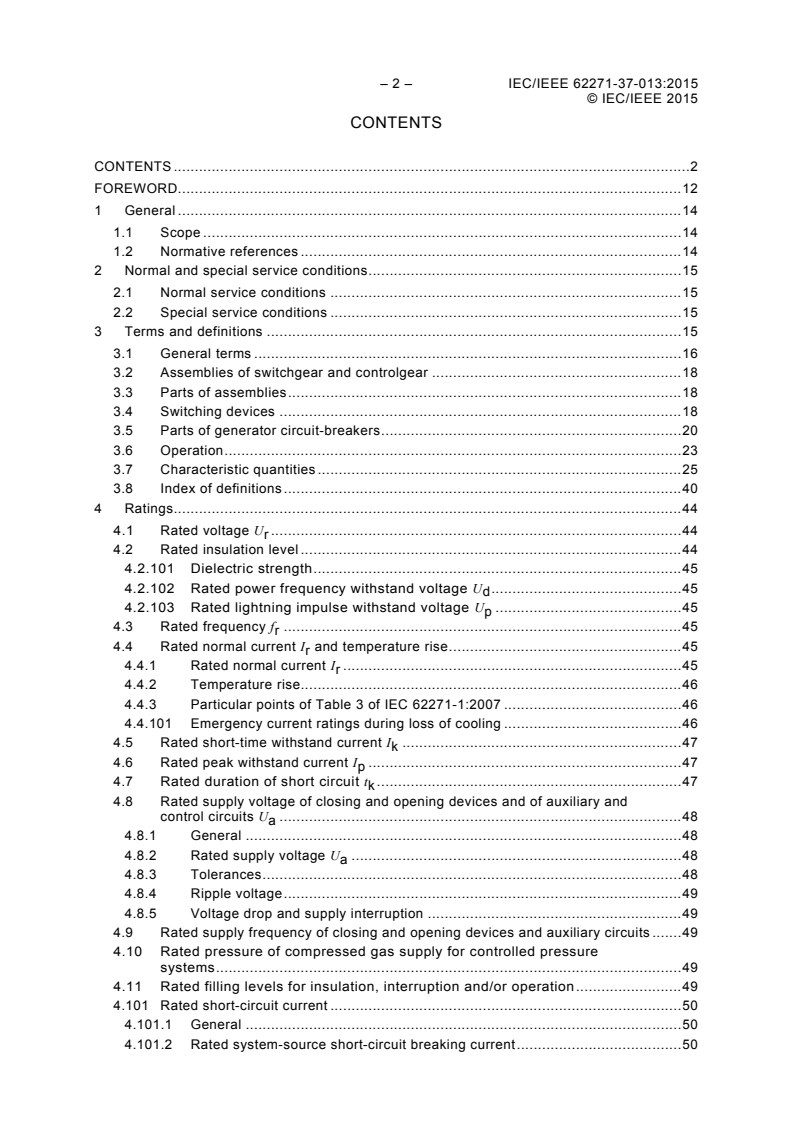
CONTENTS
CONTENTS . 2
FOREWORD. 12
1 General . 14
1.1 Scope . 14
1.2 Normative references . 14
2 Normal and special service conditions . 15
2.1 Normal service conditions . 15
2.2 Special service conditions . 15
3 Terms and definitions . 15
3.1 General terms . 16
3.2 Assemblies of switchgear and controlgear . 18
3.3 Parts of assemblies . 18
3.4 Switching devices . 18
3.5 Parts of generator circuit-breakers . 20
3.6 Operation . 23
3.7 Characteristic quantities . 25
3.8 Index of definitions . 40
4 Ratings . 44
4.1 Rated voltage U . 44
r
4.2 Rated insulation level . 44
4.2.101 Dielectric strength . 45
4.2.102 Rated power frequency withstand voltage U . 45
d
4.2.103 Rated lightning impulse withstand voltage U . 45
p
4.3 Rated frequency f . 45
r
4.4 Rated normal current I and temperature rise . 45
r
4.4.1 Rated normal current I . 45
r
4.4.2 Temperature rise. 46
4.4.3 Particular points of Table 3 of IEC 62271-1:2007 . 46
4.4.101 Emergency current ratings during loss of cooling . 46
4.5 Rated short-time withstand current I . 47
k
4.6 Rated peak withstand current I . 47
p
4.7 Rated duration of short circuit t . 47
k
4.8 Rated supply voltage of closing and opening devices and of auxiliary and
control circuits U . 48
a
4.8.1 General . 48
4.8.2 Rated supply voltage U . 48
a
4.8.3 Tolerances . 48
4.8.4 Ripple voltage . 49
4.8.5 Voltage drop and supply interruption . 49
4.9 Rated supply frequency of closing and opening devices and auxiliary circuits . 49
4.10 Rated pressure of compressed gas supply for controlled pressure
systems . 49
4.11 Rated filling levels for insulation, interruption and/or operation . 49
4.101 Rated short-circuit current . 50
4.101.1 General . 50
4.101.2 Rated system-source short-circuit breaking current . 50
© IEC/IEEE 2015
4.101.3 Rated generator-source short-circuit breaking current . 52
4.101.4 Rated single-phase-to-earth fault breaking current . 54
4.102 Rated peak short-circuit making current I . 54
MC
4.103 Rated load making and breaking current . 54
4.104 Rated out-of-phase making and breaking current . 55
4.105 Rated transient recovery voltage (TRV) related to the breaking currents . 55
4.105.1 Representation of TRV waves . 55
4.105.2 Rated values of TRV . 56
4.106 Standard operating sequence . 57
4.106.1 General . 57
4.106.2 Rated short-circuit current operating sequence . 58
4.106.3 Rated load current operating sequence . 58
4.106.4 Rated out-of-phase current operating sequence . 58
4.107 Rated time quantities . 58
4.107.1 General . 58
4.107.2 Rated break-time . 58
4.107.3 Rated minimum opening time . 59
4.108 Mechanical operation endurance capability classes M1 and M2 . 59
5 Design and construction . 59
5.1 Requirements for liquids in generator circuit-breakers . 59
5.2 Requirements for gases in generator circuit-breakers . 60
5.3 Earthing of generator circuit-breakers . 60
5.4 Auxiliary and control equipment . 60
5.5 Dependent power operation . 61
5.6 Stored energy operation . 61
5.7 Independent manual or power operation (independent unlatched operation) . 61
5.8 Operation of releases . 61
5.8.1 Shunt closing release . 61
5.8.2 Shunt opening release . 61
5.8.3 Capacitor operation of shunt releases . 61
5.8.4 Under-voltage release . 61
5.8.101 Multiple releases . 61
5.8.102 Operation limits of releases . 61
5.8.103 Power consumption of releases . 61
5.9 Low- and high-pressure interlocking devices . 62
5.10 Nameplates . 62
5.10.101 Accessories . 64
5.10.102 Modification of generator circuit-breakers . 64
5.11 Interlocking devices . 64
5.12 Position indication . 64
5.13 Degrees of protection provided by enclosures . 64
5.13.1 Protection of persons against access to hazardous parts and protection
of the equipment against ingress of solid foreign objects (IP coding) . 65
5.13.2 Protection against ingress of water (IP coding) . 65
5.13.3 Protection of equipment against mechanical impact under normal
service conditions (IK coding) . 65
5.14 Creepage distances for outdoor insulators . 65
5.15 Gas and vacuum tightness . 65
5.16 Liquid tightness . 65
– 4 – IEC/IEEE 62271-37-013:2015
© IEC/IEEE 2015
5.17 Fire hazard (flammability) . 65
5.18 Electromagnetic compatibility (EMC) . 65
5.19 X-ray emission . 65
5.20 Corrosion . 65
5.101 Requirements for simultaneity of poles during single closing and single
opening operations . 65
5.102 General requirement for operation . 66
5.103 Pressure limits of fluids for operation . 66
5.104 Vent outlets . 66
5.105 Warning labels . 66
5.106 Instructions . 66
6 Type tests . 67
6.1 General . 68
6.1.1 Grouping of tests . 68
6.1.2 Information for identification of specimens . 68
6.1.3 Information to be included in type-test reports . 68
6.2 Dielectric tests . 68
6.2.1 Ambient air conditions during tests . 68
6.2.2 Wet test procedure . 69
6.2.3 Condition of the generator circuit-breaker during dielectric tests . 69
6.2.4 Criteria to pass the test . 69
6.2.5 Application of test voltage and test conditions . 69
6.2.6 Tests of generator circuit-breakers of U ≤ 245 kV . 69
r
6.2.7 Tests of generator circuit-breakers of U > 245 kV . 70
r
6.2.8 Artificial pollution tests for outdoor insulators . 70
6.2.9 Partial discharge tests . 70
6.2.10 Dielectric tests on auxiliary and control circuits . 70
6.2.11 Voltage test as a condition check . 70
6.3 Radio interference voltage (r.i.v.) tests . 70
6.4 Measurement of the resistance of circuits . 71
6.4.1 Main circuit . 71
6.4.2 Auxiliary circuits . 71
6.5 Temperature-rise tests . 71
6.5.1 Conditions of the generator circuit-breaker to be tested . 71
6.5.2 Arrangement of the equipment . 71
6.5.3 Measurement of the temperature and the temperature rise . 73
6.5.4 Ambient air temperature . 73
6.5.5 Temperature-rise tests of the auxiliary and control equipment . 73
6.5.6 Interpretation of the temperature-rise tests . 74
6.5.101 Demonstrations of emergency conditions . 74
6.6 Short-time withstand current and peak withstand current tests . 74
6.6.1 Arrangement of the generator circuit-breaker and of the test circuit . 74
6.6.2 Test current and duration . 74
6.6.3 Behaviour of generator circuit-breaker during test . 74
6.6.4 Conditions of generator circuit-breaker after test . 74
6.7 Verification of the degree of protection . 75
6.7.1 Verification of the IP coding . 75
6.7.2 Verification of the IK coding . 75
6.8 Tightness tests . 75
© IEC/IEEE 2015
6.9 Electromagnetic compatibility (EMC) tests . 75
6.10 Additional tests on auxiliary and control circuits . 75
6.10.1 General . 75
6.10.2 Functional tests . 75
6.10.3 Electrical continuity of earthed metallic parts test . 75
6.10.4 Verification of the operational characteristics of auxiliary contacts . 75
6.10.5 Environmental tests . 75
6.10.6 Dielectric tests . 76
6.11 X-radiation test procedure for vacuum interrupters . 76
6.101 Mechanical and environmental tests . 76
6.101.1 Miscellaneous provisions for mechanical and environmental tests . 76
6.101.2 Mechanical operation test at ambient air temperature . 79
6.101.3 Low and high temperature tests . 81
6.101.4 Sound level tests . 85
6.102 Miscellaneous provisions for making and breaking tests . 85
6.102.1 General . 85
6.102.2 Number of test specimens . 86
6.102.3 Arrangement of generator circuit-breaker for tests . 86
6.102.4 General considerations concerning testing methods . 88
6.102.5 Synthetic tests . 94
6.102.6 No-load operations before tests . 94
6.102.7 Alternative operating mechanisms . 94
6.102.8 Behaviour of generator circuit-breaker during tests . 95
6.102.9 Condition of generator circuit-breaker after tests . 96
6.102.10 Demonstration of the most severe switching conditions . 98
6.102.11 Methods of determining prospective transient recovery voltage waves . 115
6.103 System-source short-circuit making and breaking tests . 115
6.103.1 Power factor of test circuit . 115
6.103.2 Frequency of test circuit . 115
6.103.3 Earthing of test circuit . 115
6.103.4 Connection of test circuit to generator circuit-breaker. 117
6.103.5 Applied voltage for system-source short-circuit making tests . 117
6.103.6 System-source short-circuit making current . 117
6.103.7 System-source short-circuit breaking current . 117
6.103.8 Transient recovery voltage (TRV) for system-source short-circuit
breaking tests . 118
6.103.9 Measurement of transient recovery voltage during test . 119
6.103.10 Power frequency recovery voltage . 119
6.103.11 System-source short-circuit test operating sequence . 119
6.103.12 System-source short-circuit test-duties . 119
6.104 Load current breaking tests . 121
6.104.1 General . 121
6.104.2 Conditions of test severity . 122
6.104.3 Number of tests . 122
6.105 Generator-source short-circuit current making and breaking tests . 122
6.105.1 Power factor of test circuit . 122
6.105.2 Frequency of test circuit . 122
6.105.3 Earthing of test circuit . 123
6.105.4 Connection of the test circuit to the generator circuit-breaker . 123
– 6 – IEC/IEEE 62271-37-013:2015
© IEC/IEEE 2015
6.105.5 Applied voltage for generator-source short-circuit making tests . 123
6.105.6 Generator-source short-circuit making current . 124
6.105.7 Generator-source short-circuit breaking current . 124
6.105.8 Transient recovery voltage (TRV) for generator-source short-circuit
breaking tests . 125
6.105.9 Measurement of transient recovery voltage during test . 125
6.105.10 Power frequency recovery voltage . 125
6.105.11 Generator-source short-circuit test operating sequence . 125
6.105.12 Generator-source short-circuit breaking test-duties . 125
6.106 Out-of-phase making and breaking tests . 131
6.106.1 General . 131
6.106.2 Out-of-phase current switching capability . 132
6.106.3 Conditions of test severity . 132
6.106.4 Test circuit . 134
6.106.5 Applied voltage before out-of-phase making tests . 136
6.106.6 Transient recovery voltage (TRV) for out-of-phase breaking tests . 136
6.106.7 Demonstration of the most severe switching conditions during test-duty
OP1 . 136
6.106.8 Demonstration of the most severe switching conditions during test-duty
OP2 . 136
7 Routine tests . 136
7.1 Dielectric test on the main circuit . 137
7.2 Tests on auxiliary and control circuits . 137
7.2.1 Inspection of auxiliary and control circuits, and verification of conformity
to the circuit diagrams and wiring diagrams . 137
7.2.2 Functional tests . 137
7.2.3 Verification of protection against electrical shock . 137
7.2.4 Dielectric tests . 137
7.3 Measurement of the resistance of the main circuit . 138
7.4 Tightness test . 138
7.4.1 Controlled pressure systems for gas . 138
7.4.2 Closed pressure systems for gas . 138
7.4.3 Sealed pressure systems . 138
7.4.4 Liquid tightness tests . 138
7.5 Design and visual checks . 139
7.101 Mechanical operating tests . 139
8 Guide to the selection of generator circuit-breakers . 140
8.101 General . 140
8.102 General application conditions . 141
8.102.1 Normal service conditions . 141
8.102.2 Special service conditions . 141
8.103 Application consideration . 143
8.103.1 General . 143
8.103.2 Rated voltage . 143
8.103.3 Rated insulation level . 143
8.103.4 Rated frequency. 144
8.103.5 Rated normal current . 144
8.103.6 Short-circuit current rating . 144
8.103.7 TRV rating for system-source and generator-source short-circuits . 159
8.103.8 Rated load making and breaking current . 165
© IEC/IEEE 2015
8.103.9 Rated out-of-phase making and breaking current . 169
8.103.10 Excitation switching current . 170
8.103.11 Capacitive switching current . 171
9 Information to be given with enquiries, tenders and orders . 171
10 Rules for transport, storage, installation, operation and maintenance . 173
10.1 Conditions during transport, storage and installation . 173
10.2 Installation . 174
10.2.1 Unpacking and lifting . 174
10.2.2 Assembly . 174
10.2.3 Mounting . 174
10.2.4 Connections . 174
10.2.5 Final installation inspection . 174
10.2.6 Basic input data by the user . 175
10.2.7 Basic input data by the manufacturer . 175
10.2.101 Commissioning tests . 175
10.2.102 Commissioning checks and test programme . 176
10.3 Operation . 179
10.4 Maintenance . 180
10.4.1 General . 180
10.4.2 Recommendations for the manufacturer . 180
10.4.3 Recommendations for the user . 181
10.4.4 Failure report . 181
11 Safety . 183
11.1 Precautions by manufacturers . 183
11.2 Precautions by users . 183
11.3 Electrical aspects . 184
11.4 Mechanical aspects . 184
11.5 Thermal aspects . 185
11.6 Operation aspects . 185
12 Influence of the product on the environment . 185
Annex A (normative) Tolerances on test quantities during type tests . 186
Annex B (normative) Records and reports of type tests according to 6.6, 6.103, 6.104,
6.105 and 6.106 . 190
B.1 Information and results to be recorded . 190
B.2 Information to be included in type test reports . 190
B.2.1 General . 190
B.2.2 Apparatus tested . 190
B.2.3 Rated characteristics of generator circuit-breaker, including its
operating devices and auxiliary equipment . 190
B.2.4 Test conditions (for each series of tests) . 191
B.2.5 Short-circuit making and breaking tests . 191
B.2.6 Short-time withstand current test . 192
B.2.7 No-load operation . 192
B.2.8 Out-of-phase making and breaking tests . 192
B.2.9 Load current switching tests . 193
B.2.10 Oscillographic and other records . 193
Annex C (…) . 194
Annex D (normative) Use of mechanical characteristics and related requirements . 195
– 8 – IEC/IEEE 62271-37-013:2015
© IEC/IEEE 2015
Annex E (informative) Example of the application of a generator circuit-breaker . 196
E.1 General . 196
E.2 System characteristics . 196
E.3 System-source short-circuit current . 198
E.3.1 AC component of the system-source short-circuit breaking current . 198
E.3.2 System-source asymmetrical short-circuit breaking current . 199
E.4 Generator-source short-circuit current . 201
E.4.1 AC component of the generator-source short-circuit breaking current . 201
E.4.2 Generator-source asymmetrical short-circuit breaking current . 202
E.5 Transient recovery voltage . 204
E.6 Out-of-phase conditions . 204
E.7 Normal current application . 207
E.8 Generator circuit-breaker electrical characteristics . 208
Annex F (informative) For generator circuit-breakers connected to the step-up
transformer by shielded cables - An example of the effects of added capacitance
on TRV requirements for a system-source fault . 210
Annex G (informative) Symbols and related terminology . 213
G.1 Comparison of IEEE and IEC electrical terms and symbols . 213
G.2 Comparison between TRV terminology and symbols . 214
Annex H (informative) Determination of the degree of asymmetry for generator-source
short-circuit breaking tests . 216
Annex I (informative) Faults in case of three-winding step-up transformer . 218
Bibliography . 221
Figure 1 – Typical oscillogram of a three-phase short-circuit make-break cycle . 35
Figure 2 – Generator circuit-breaker without resistors – Opening operation . 36
Figure 3 – Generator circuit-breaker without resistors – Close-open cycle . 36
Figure 4 – Generator circuit-breaker with opening resistors – Opening operation . 37
Figure 5 – Generator circuit-breaker with opening resistors – Close-open cycle. 37
Figure 6 – Example of a three-phase asymmetrical current . 38
Figure 7 – Examples of possible valid interruptions in a phase with intermediate level
of asymmetry after a major loop and a corresponding time t . 39
Figure 8 – Examples of possible valid interruptions in a phase with intermediate level
of asymmetry after a minor loop and a corresponding time t . 40
Figure 9 – Effect of various cooling failures and subsequent load reductions on
generator circuit-breaker temperature . 47
Figure 10 – Typical asymmetrical system-source short-circuit current . 51
Figure 11 – Degree of asymmetry as a function of time after fault initiation . 52
Figure 12 – Typical asymmetrical generator-source short-circuit current with a strong
decrement of the a.c. component . 53
Figure 13 – 2-parameter representation of prospective TRV waveform for
interrupting three-phase symmetrical faults . 56
Figure 14 – Typical temperature rise test setup for single-phase-enclosed generator
circuit-breakers (top view) . 73
Figure 15 – Test sequences for low and high temperature tests . 85
Figure 16 – Reference mechanical travel characteristics (idealised curve) . 89
© IEC/IEEE 2015
Figure 17 – Reference mechanical travel characteristics (idealised curve) with the
prescribed envelopes centered over the reference curve (+5 %, –5 %), contact
separation in this example at time t = 20 ms . 90
Figure 18 – Reference mechanical travel characteristics (idealised curve) with the
prescribed envelopes fully displaced upward from the reference curve (+10 %, –0 %),
contact separation in this example at time t = 20 ms . 90
Figure 19 – Reference mechanical travel characteristics (idealised curve) with the
prescribed envelopes fully displaced downward from the reference curve (+0 %, –
10 %), contact separation in this example at time t = 20 ms . 91
Figure 20 – Equivalent testing set-up for unit testing of generator circuit-breakers with
more than one separate interrupter units . 92
Figure 21 – Two valid three-phase symmetrical breaking operations . 100
Figure 22 – Three-phase asymmetrical breaking operations – Minimum arcing time
with intermediate asymmetry after major loop (t ) . 102
arc min 1
Figure 23 – Three-phase asymmetrical breaking operations – Maximum arcing time for
the first-pole-to-clear after major loop (t ) . 103
arc max 1
Figure 24 – Three-phase asymmetrical breaking operations – Minimum arcing time
with intermediate asymmetry after minor loop (t ) . 104
arc min 2
Figure 25 – Three-phase asymmetrical breaking operations – Maximum arcing time for
the last-pole-to-clear after extended major loop (t ) . 105
arc max 2
Figure 26 – Single-phase asymmetrical breaking operations – Minimum arcing time
with intermediate asymmetry after major loop (t ) . 107
arc min 1
Figure 27 – Single-phase asymmetrical breaking operations – Maximum arcing time
for the first-pole-to-clear after major loop (t ) . 108
arc max 1
Figure 28 – Single-phase asymmetrical breaking operations – Minimum arcing time
with intermediate asymmetry after minor loop (t ) . 109
arc min 2
Figure 29 – Single-phase asymmetrical breaking operations – Maximum arcing time
for the last-pole-to-clear extended major loop (t ) .
...