

IEC 60794-6-30:2020
(Main)Optical fibre cables - Part 6-30: Indoor-outdoor cables - Family specification for weatherised indoor cables
General Information
- Abstract
IEC 60794-6-30:2020 is a family specification covering optical fibre indoor cables that are deployed in short length (≤ 10 m) outdoor environments. These cables generally possess the characteristics associated with indoor cable designs having the appropriate fire performance and flexibility that makes them suitable for use in premises. Because of its predicted use outdoors, stability against environmental attack, for example UV radiation and humidity (see IEC 60794-6:2020, Table 1), is important. Typical application spaces include the extension of a short length of indoor cable outside the building such as to a NAP mounted outside the building at the house wall.
- Status
- Published
- Publication Date
- 24-Sep-2020
- Technical Committee
- SC 86A - Fibres and cables
- Drafting Committee
- WG 1 - TC 86/SC 86A/WG 1
- Current Stage
- PPUB - Publication issued
- Start Date
- 25-Sep-2020
- Completion Date
- 30-Oct-2020
Overview
IEC 60794-6-30:2020 is an international standard developed by the International Electrotechnical Commission (IEC) that defines family specifications for weatherised indoor optical fibre cables designed for indoor-outdoor use. This standard specifically addresses optical fibre cables that are mainly intended for indoor use but are deployed in short outdoor sections of 10 meters or less, such as the extension of cables from inside a building to a Network Access Point (NAP) located just outside, typically mounted on a house wall.
These cables combine the flexibility and fire performance characteristics of indoor cables with enhanced durability and stability against environmental factors like ultraviolet (UV) radiation and humidity, important for their brief outdoor exposure. The standard covers construction requirements, mechanical and environmental performance testing, and electrical and fire safety criteria suitable for premises installations with short outdoor exposure.
Key Topics
- Scope: Covers optical fibre cables designed for short outdoor runs (no longer than 10 meters), combining indoor use flexibility and fire safety with weather resistance for temporary or short outdoor conditions.
- Cable Construction: Defines mechanical and material specifications to ensure stability against environmental challenges such as UV exposure, humidity, and temperature variations.
- Mechanical Performance: Includes stringent testing for tensile strength, abrasion resistance, crushing, impact resilience, bending, torsion, flexing, kinking, and rip cord functionality to guarantee cable durability.
- Environmental Tests: Encompasses temperature cycling, water penetration, UV resistance, environmental stress cracking, material compatibility, ageing, and compound flow to assess cable lifespan under expected conditions.
- Fire Performance: Addresses fire safety with tests such as vertical flame propagation in accordance with IEC 60332-1 to meet indoor fire regulations.
- Applicable Standards: The document references other IEC tests and standards for complementary fire safety and electrical continuity requirements.
- Test Criteria: Specifies test parameters and acceptance criteria ensuring cables maintain optical and mechanical integrity during short outdoor deployments.
- Examples: Illustrative weatherised indoor cables include reinforced simplex cables, mini-breakout designs, and jelly-free central loose tube cables.
Applications
IEC 60794-6-30:2020 compliant cables are ideally suited for premises requiring optical fibre cable sections that transition from indoor to mild outdoor environments, such as:
- Extending fibre optic communication cabling from inside buildings to external network termination points.
- Short outdoor cable runs on building exteriors for last-mile connectivity.
- Weather-exposed indoor cable sections in data centers, telecommunications rooms, or utility rooms connected to outside equipment.
- Temporary external deployments where indoor-level flexibility and fire compliance are mandatory, alongside moderate environmental protection.
By adhering to this standard, manufacturers ensure that cables provide reliable optical performance, safety, and durability without the need for traditional heavy-duty outdoor cables, reducing cost and easing installation in mixed indoor/outdoor scenarios.
Related Standards
- IEC 60794 Series: A comprehensive series covering different types of optical fibre cables, including outdoor cables (Part 2), indoor cables (Part 1), and specific application guidelines.
- IEC 60332-1: Test methods for vertical flame propagation on single insulated cables critical for fire safety compliance in indoor environments.
- IEC 60794-6:2020: Provides general test criteria for cable mechanical and environmental performance, referenced within IEC 60794-6-30 for environmental stability.
- ISO/IEC Directives, Part 2: Methodology guiding the drafting and structuring of international standards such as IEC 60794-6-30.
By following IEC 60794-6-30:2020, manufacturers and network designers ensure that optical fibre indoor-outdoor cables meet stringent requirements for fire safety, flexibility, and environmental resistance, supporting robust and reliable fibre optic infrastructure in indoor environments with limited outdoor exposure. This standard is essential for meeting both safety and operational demands in modern fibre optic cabling applications.
Get Certified
Connect with accredited certification bodies for this standard

ANCE
Mexican certification and testing association.

Intertek Slovenia
Intertek testing, inspection, and certification services in Slovenia.

LNE (Laboratoire National de Métrologie et d'Essais)
French national laboratory for metrology and testing.
Sponsored listings
Frequently Asked Questions
IEC 60794-6-30:2020 is a standard published by the International Electrotechnical Commission (IEC). Its full title is "Optical fibre cables - Part 6-30: Indoor-outdoor cables - Family specification for weatherised indoor cables". This standard covers: IEC 60794-6-30:2020 is a family specification covering optical fibre indoor cables that are deployed in short length (≤ 10 m) outdoor environments. These cables generally possess the characteristics associated with indoor cable designs having the appropriate fire performance and flexibility that makes them suitable for use in premises. Because of its predicted use outdoors, stability against environmental attack, for example UV radiation and humidity (see IEC 60794-6:2020, Table 1), is important. Typical application spaces include the extension of a short length of indoor cable outside the building such as to a NAP mounted outside the building at the house wall.
IEC 60794-6-30:2020 is a family specification covering optical fibre indoor cables that are deployed in short length (≤ 10 m) outdoor environments. These cables generally possess the characteristics associated with indoor cable designs having the appropriate fire performance and flexibility that makes them suitable for use in premises. Because of its predicted use outdoors, stability against environmental attack, for example UV radiation and humidity (see IEC 60794-6:2020, Table 1), is important. Typical application spaces include the extension of a short length of indoor cable outside the building such as to a NAP mounted outside the building at the house wall.
IEC 60794-6-30:2020 is classified under the following ICS (International Classification for Standards) categories: 33.180.10 - Fibres and cables. The ICS classification helps identify the subject area and facilitates finding related standards.
IEC 60794-6-30:2020 is available in PDF format for immediate download after purchase. The document can be added to your cart and obtained through the secure checkout process. Digital delivery ensures instant access to the complete standard document.
Standards Content (Sample)
IEC 60794-6-30 ®
Edition 1.0 2020-09
INTERNATIONAL
STANDARD
NORME
INTERNATIONALE
colour
inside
Optical fibre cables –
Part 6-30: Indoor-outdoor cables – Family specification for weatherised indoor
cables
Câbles à fibres optiques –
Partie 6-30: Câbles intérieurs/extérieurs – Spécification de famille pour
les câbles intérieurs résistants aux intempéries
All rights reserved. Unless otherwise specified, no part of this publication may be reproduced or utilized in any form
or by any means, electronic or mechanical, including photocopying and microfilm, without permission in writing from
either IEC or IEC's member National Committee in the country of the requester. If you have any questions about IEC
copyright or have an enquiry about obtaining additional rights to this publication, please contact the address below or
your local IEC member National Committee for further information.
Droits de reproduction réservés. Sauf indication contraire, aucune partie de cette publication ne peut être reproduite
ni utilisée sous quelque forme que ce soit et par aucun procédé, électronique ou mécanique, y compris la photocopie
et les microfilms, sans l'accord écrit de l'IEC ou du Comité national de l'IEC du pays du demandeur. Si vous avez des
questions sur le copyright de l'IEC ou si vous désirez obtenir des droits supplémentaires sur cette publication, utilisez
les coordonnées ci-après ou contactez le Comité national de l'IEC de votre pays de résidence.
IEC Central Office Tel.: +41 22 919 02 11
3, rue de Varembé info@iec.ch
CH-1211 Geneva 20 www.iec.ch
Switzerland
About the IEC
The International Electrotechnical Commission (IEC) is the leading global organization that prepares and publishes
International Standards for all electrical, electronic and related technologies.
About IEC publications
The technical content of IEC publications is kept under constant review by the IEC. Please make sure that you have the
latest edition, a corrigendum or an amendment might have been published.
IEC publications search - webstore.iec.ch/advsearchform Electropedia - www.electropedia.org
The advanced search enables to find IEC publications by a The world's leading online dictionary on electrotechnology,
variety of criteria (reference number, text, technical containing more than 22 000 terminological entries in English
committee,…). It also gives information on projects, replaced and French, with equivalent terms in 16 additional languages.
and withdrawn publications. Also known as the International Electrotechnical Vocabulary
(IEV) online.
IEC Just Published - webstore.iec.ch/justpublished
Stay up to date on all new IEC publications. Just Published IEC Glossary - std.iec.ch/glossary
details all new publications released. Available online and 67 000 electrotechnical terminology entries in English and
once a month by email. French extracted from the Terms and Definitions clause of
IEC publications issued since 2002. Some entries have been
IEC Customer Service Centre - webstore.iec.ch/csc collected from earlier publications of IEC TC 37, 77, 86 and
If you wish to give us your feedback on this publication or CISPR.
need further assistance, please contact the Customer Service
Centre: sales@iec.ch.
A propos de l'IEC
La Commission Electrotechnique Internationale (IEC) est la première organisation mondiale qui élabore et publie des
Normes internationales pour tout ce qui a trait à l'électricité, à l'électronique et aux technologies apparentées.
A propos des publications IEC
Le contenu technique des publications IEC est constamment revu. Veuillez vous assurer que vous possédez l’édition la
plus récente, un corrigendum ou amendement peut avoir été publié.
Recherche de publications IEC - Electropedia - www.electropedia.org
webstore.iec.ch/advsearchform Le premier dictionnaire d'électrotechnologie en ligne au
La recherche avancée permet de trouver des publications IEC monde, avec plus de 22 000 articles terminologiques en
en utilisant différents critères (numéro de référence, texte, anglais et en français, ainsi que les termes équivalents dans
comité d’études,…). Elle donne aussi des informations sur les 16 langues additionnelles. Egalement appelé Vocabulaire
projets et les publications remplacées ou retirées. Electrotechnique International (IEV) en ligne.
IEC Just Published - webstore.iec.ch/justpublished Glossaire IEC - std.iec.ch/glossary
Restez informé sur les nouvelles publications IEC. Just 67 000 entrées terminologiques électrotechniques, en anglais
Published détaille les nouvelles publications parues. et en français, extraites des articles Termes et Définitions des
Disponible en ligne et une fois par mois par email. publications IEC parues depuis 2002. Plus certaines entrées
antérieures extraites des publications des CE 37, 77, 86 et
Service Clients - webstore.iec.ch/csc CISPR de l'IEC.
Si vous désirez nous donner des commentaires sur cette
publication ou si vous avez des questions contactez-nous:
sales@iec.ch.
IEC 60794-6-30 ®
Edition 1.0 2020-09
INTERNATIONAL
STANDARD
NORME
INTERNATIONALE
colour
inside
Optical fibre cables –
Part 6-30: Indoor-outdoor cables – Family specification for weatherised indoor
cables
Câbles à fibres optiques –
Partie 6-30: Câbles intérieurs/extérieurs – Spécification de famille pour
les câbles intérieurs résistants aux intempéries
INTERNATIONAL
ELECTROTECHNICAL
COMMISSION
COMMISSION
ELECTROTECHNIQUE
INTERNATIONALE
ICS 33.180.10 ISBN 978-2-8322-8909-9
– 2 – IEC 60794-6-30:2020 © IEC 2020
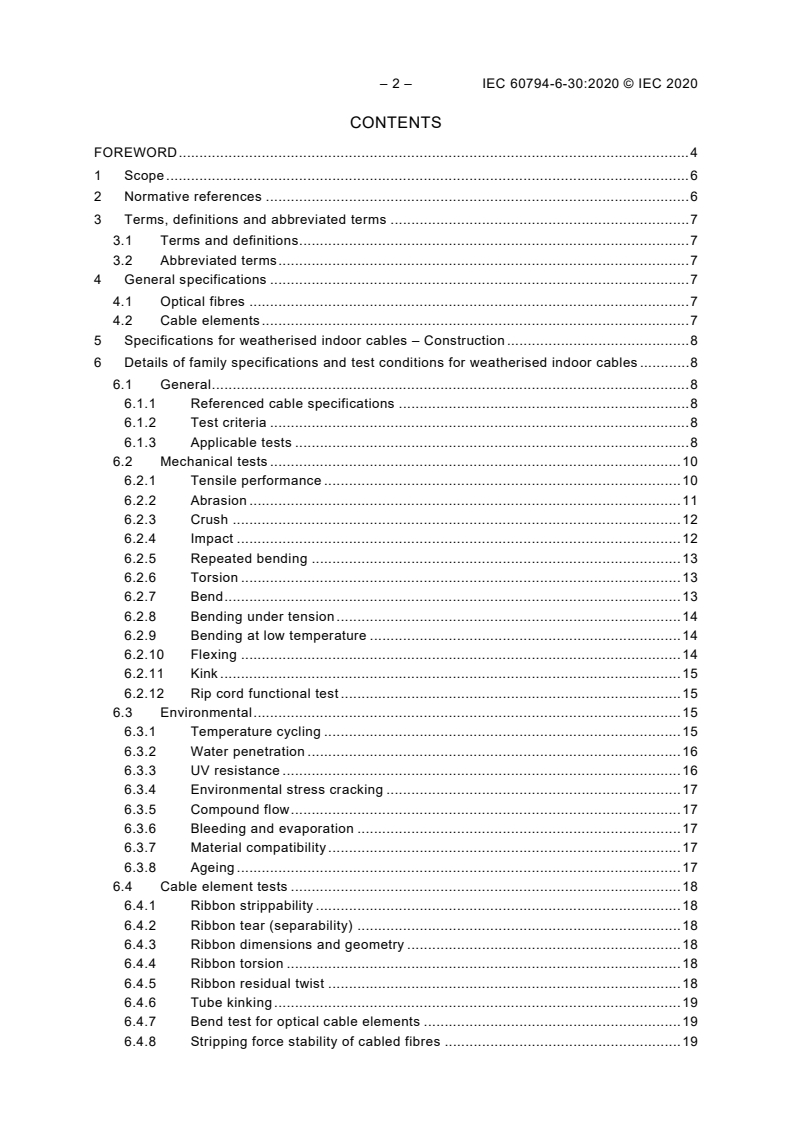
CONTENTS
FOREWORD . 4
1 Scope . 6
2 Normative references . 6
3 Terms, definitions and abbreviated terms . 7
3.1 Terms and definitions . 7
3.2 Abbreviated terms . 7
4 General specifications . 7
4.1 Optical fibres . 7
4.2 Cable elements . 7
5 Specifications for weatherised indoor cables – Construction . 8
6 Details of family specifications and test conditions for weatherised indoor cables . 8
6.1 General . 8
6.1.1 Referenced cable specifications . 8
6.1.2 Test criteria . 8
6.1.3 Applicable tests . 8
6.2 Mechanical tests . 10
6.2.1 Tensile performance . 10
6.2.2 Abrasion . 11
6.2.3 Crush . 12
6.2.4 Impact . 12
6.2.5 Repeated bending . 13
6.2.6 Torsion . 13
6.2.7 Bend . 13
6.2.8 Bending under tension . 14
6.2.9 Bending at low temperature . 14
6.2.10 Flexing . 14
6.2.11 Kink . 15
6.2.12 Rip cord functional test . 15
6.3 Environmental . 15
6.3.1 Temperature cycling . 15
6.3.2 Water penetration . 16
6.3.3 UV resistance . 16
6.3.4 Environmental stress cracking . 17
6.3.5 Compound flow . 17
6.3.6 Bleeding and evaporation . 17
6.3.7 Material compatibility . 17
6.3.8 Ageing . 17
6.4 Cable element tests . 18
6.4.1 Ribbon strippability . 18
6.4.2 Ribbon tear (separability) . 18
6.4.3 Ribbon dimensions and geometry . 18
6.4.4 Ribbon torsion . 18
6.4.5 Ribbon residual twist . 18
6.4.6 Tube kinking . 19
6.4.7 Bend test for optical cable elements . 19
6.4.8 Stripping force stability of cabled fibres . 19
6.5 Other tests . 19
6.5.1 Fire performance . 19
6.5.2 Electrical continuity. 19
6.5.3 Thickness of non-metallic sheath . 19
6.5.4 Overall dimensions . 20
Annex A (informative) Examples of weatherised indoor cables . 21
Annex B (informative) Blank detail specification and minimum requirements . 22
Bibliography . 23
Figure A.1 – Weatherised, reinforced simplex indoor cable . 21
Figure A.2 – Weatherised mini-breakout indoor cable . 21
Figure A.3 – Weatherised jelly free central loose tube indoor cable. 21
Table 1 – Tests applicable for mechanical and environmental performance of
weatherised indoor cables . 9
Table 2 – Low and high temperatures . 16
– 4 – IEC 60794-6-30:2020 © IEC 2020
INTERNATIONAL ELECTROTECHNICAL COMMISSION
____________
OPTICAL FIBRE CABLES –
Part 6-30: Indoor-outdoor cables –
Family specification for weatherised indoor cables
FOREWORD
1) The International Electrotechnical Commission (IEC) is a worldwide organization for standardization comprising
all national electrotechnical committees (IEC National Committees). The object of IEC is to promote international
co-operation on all questions concerning standardization in the electrical and electronic fields. To this end and
in addition to other activities, IEC publishes International Standards, Technical Specifications, Technical Reports,
Publicly Available Specifications (PAS) and Guides (hereafter referred to as "IEC Publication(s)"). Their
preparation is entrusted to technical committees; any IEC National Committee interested in the subject dealt with
may participate in this preparatory work. International, governmental and non-governmental organizations liaising
with the IEC also participate in this preparation. IEC collaborates closely with the International Organization for
Standardization (ISO) in accordance with conditions determined by agreement between the two organizations.
2) The formal decisions or agreements of IEC on technical matters express, as nearly as possible, an international
consensus of opinion on the relevant subjects since each technical committee has representation from all
interested IEC National Committees.
3) IEC Publications have the form of recommendations for international use and are accepted by IEC National
Committees in that sense. While all reasonable efforts are made to ensure that the technical content of IEC
Publications is accurate, IEC cannot be held responsible for the way in which they are used or for any
misinterpretation by any end user.
4) In order to promote international uniformity, IEC National Committees undertake to apply IEC Publications
transparently to the maximum extent possible in their national and regional publications. Any divergence between
any IEC Publication and the corresponding national or regional publication shall be clearly indicated in the latter.
5) IEC itself does not provide any attestation of conformity. Independent certification bodies provide conformity
assessment services and, in some areas, access to IEC marks of conformity. IEC is not responsible for any
services carried out by independent certification bodies.
6) All users should ensure that they have the latest edition of this publication.
7) No liability shall attach to IEC or its directors, employees, servants or agents including individual experts and
members of its technical committees and IEC National Committees for any personal injury, property damage or
other damage of any nature whatsoever, whether direct or indirect, or for costs (including legal fees) and
expenses arising out of the publication, use of, or reliance upon, this IEC Publication or any other IEC Publications.
8) Attention is drawn to the Normative references cited in this publication. Use of the referenced publications is
indispensable for the correct application of this publication.
9) Attention is drawn to the possibility that some of the elements of this IEC Publication may be the subject of patent
rights. IEC shall not be held responsible for identifying any or all such patent rights.
International Standard IEC 60794-6-30 has been prepared by subcommittee SC86A: Fibres and
cables, of IEC technical committee 86: Fibre optics.
The text of this International Standard is based on the following documents:
FDIS Report on voting
86A/2038/FDIS 86A/2049/RVD
Full information on the voting for the approval of this International Standard can be found in the
report on voting indicated in the above table.
This document has been drafted in accordance with the ISO/IEC Directives, Part 2.
A list of all parts in the IEC 60794 series, published under the general title Optical fibre cables,
can be found on the IEC website.
The committee has decided that the contents of this document will remain unchanged until the
stability date indicated on the IEC website under "http://webstore.iec.ch" in the data related to
the specific document. At this date, the document will be
• reconfirmed,
• withdrawn,
• replaced by a revised edition, or
• amended.
IMPORTANT – The 'colour inside' logo on the cover page of this publication indicates
that it contains colours which are considered to be useful for the correct understanding
of its contents. Users should therefore print this document using a colour printer.
– 6 – IEC 60794-6-30:2020 © IEC 2020
OPTICAL FIBRE CABLES –
Part 6-30: Indoor-outdoor cables –
Family specification for weatherised indoor cables
1 Scope
This part of IEC 60794 is a family specification covering optical fibre indoor cables that are
deployed in short length (≤ 10 m) outdoor environments. These cables generally possess the
characteristics associated with indoor cable designs having the appropriate fire performance
and flexibility that makes them suitable for use in premises. Because of its predicted use
outdoors, stability against environmental attack, for example UV radiation and humidity (see
IEC 60794-6:2020, Table 1), is important. Typical application spaces include the extension of
a short length of indoor cable outside the building such as to a NAP mounted outside the
building at the house wall.
2 Normative references
The following documents are referred to in the text in such a way that some or all of their content
constitutes requirements of this document. For dated references, only the edition cited applies.
For undated references, the latest edition of the referenced document (including any
amendments) applies.
IEC 60332-1 (all parts), Tests on electric and optical fibre cables under fire conditions – Part 1:
Test for vertical flame propagation for a single insulated wire or cable
IEC 60332-3 (all parts), Tests on electric and optical fibre cables under fire conditions – Part 3:
Test for vertical flame spread of vertically-mounted bunched wires or cables
IEC 60793-2-10:2019, Optical fibres – Part 2-10: Product specifications – Sectional
specification for category A1 multimode fibres
IEC 60793-2-50:2018, Optical fibres – Part 2-50: Product specifications – Sectional
specification for class B single-mode fibres
IEC 60794-1-1, Optical fibre cables – Part 1-1: Generic specification – General
IEC 60794-1-21, Optical fibre cables – Part 1-21: Generic specification – Basic optical cable
test procedures – Mechanical test methods
IEC 60794-1-22:2017, Optical fibre cables – Part 1-22: Generic specification – Basic optical
cable test procedures – Environmental test methods
IEC 60794-1-23, Optical fibre cables – Part 1-23: Generic specification – Basic optical cable
test procedures – Cable element test methods
IEC 60794-1-24, Optical fibre cables – Part 1-24: Generic specification – Basic optical cable
test procedures – Electrical test methods
IEC 60794-1-31:2018, Optical fibre cables – Part 1-31: Sectional specification for cable element
– optical fibre ribbon
IEC 60794-1-215, Optical fibre cables – Part 1-215: Generic specification – Basic optical cable
test procedures – Environmental test methods – Cable external freezing test, Method F15
IEC 60794-2, Optical fibre cables – Part 2: Indoor cables – Sectional specification
IEC 60794-2-20:2013, Optical fibre cables – Part 2-20: Indoor cables – Family specification for
multi-fibre optical cables
IEC 60794-2-30:2019, Optical fibre cables – Part 2-30: Indoor cables – Family specification for
optical fibre ribbon cables for use in terminated cable assemblies
IEC 60811-202, Electric and optical fibre cables – Test methods for non-metallic materials –
Part 202: General tests – Measurement of thickness of non-metallic sheath
IEC 60811-203, Electric and optical fibre cables – Test methods for non-metallic materials –
Part 203: General tests – Measurement of overall dimensions
IEC 60811-406, Electric and optical fibre cables – Test methods for non-metallic materials –
Part 406: Miscellaneous tests – Resistance to stress cracking of polyethylene and
polypropylene compounds
ISO 4892-2:2013, Plastics – Methods of exposure to laboratory light sources – Part 2: Xenon-
arc lamps
3 Terms, definitions and abbreviated terms
For the purposes of this document, the terms, definitions and abbreviated terms given in
IEC 60794-1-1 and the following apply.
ISO and IEC maintain terminological databases for use in standardization at the following
addresses:
• IEC Electropedia: available at http://www.electropedia.org/
• ISO Online browsing platform: available at http://www.iso.org/obp
3.1 Terms and definitions
No terms and definitions are listed in this document.
3.2 Abbreviated terms
NAP network access point
HFFR halogen free flame retardant
4 General specifications
4.1 Optical fibres
The optical fibre shall conform to the requirements of IEC 60793-2-10 or IEC 60793-2-50. The
fibre type shall be agreed between the customer and supplier. The cabled fibre shall conform
to IEC 60794-2.
4.2 Cable elements
The cable elements shall conform to IEC 60794-2.
– 8 – IEC 60794-6-30:2020 © IEC 2020
5 Specifications for weatherised indoor cables – Construction
The cable design can be derived from a typical indoor cable design according to the product
specifications described in IEC 60794-2. The specific demand related to UV resistance and
resistance against humidity will require the appropriate selection of the jacket material in
combination with other material and/or design considerations. See Annex A for examples of
weatherised indoor cables.
6 Details of family specifications and test conditions for weatherised indoor
cables
6.1 General
6.1.1 Referenced cable specifications
The specific specifications will depend on the specific design of the indoor cable which was
selected as basis for the design of the weatherised indoor cable. The appropriate family
specifications from IEC 60794-2 (all parts) should be referenced for mechanical
(IEC 60794-2-10:2011, 5.3, IEC 60794-2-20:2013, 4.3, and IEC 60794-2-30:2019, 5.3) and
environmental specifications (IEC 60794-2-10:2011, 5.4, IEC 60794-2-20:2013, 4.4, and
IEC 60794-2-30:2019, 5.4). Additional design characteristics for outdoor exposure to UV
radiation should reference IEC 60794-1-22, method F14. Test methods are defined in the
generic specifications IEC 60794-1-21, IEC 60794-1-22, IEC 60794-1-23 and IEC 60794-1-24.
6.1.2 Test criteria
6.1.3 Applicable tests
The cable types defined in these referenced IEC 60794-2 family specifications are simplex and
duplex cables, multi-fibre cables, and ribbon cables. Family requirements and test conditions
in 6.2 through 6.5 apply to these types, as noted. If no differentiation is stated in the subclause,
they apply to all cable types.
Compliance with the specification shall be verified by carrying out tests selected from Table 1.
It is not intended that all tests in Table 1 be carried out in all cases. The tests to be applied and
the frequency of testing shall be agreed between the customer and supplier.
Table 1 – Tests applicable for mechanical and environmental
performance of weatherised indoor cables
Characteristics Detail Test methods Remarks
requirements
Mechanical tests Typically required of most cable
designs
Tensile See 6.2.1 IEC 60794-1-21,
performance
method E1
Abrasion See 6.2.2 IEC 60794-1-21, Resistance of sheath markings
method E2B
Crush See 6.2.3 IEC 60794-1-21, Plate/plate crush test
method E3A
Impact See 6.2.4 IEC 60794-1-21,
method E4
Repeated bending See 6.2.5 IEC 60794-1-21,
method E6
Torsion See 6.2.6 IEC 60794-1-21,
method E7
Bend See 6.2.7 IEC 60794-1-21, Default method E11A
method E11
Bending under See 6.2.8 IEC 60794-1-21,
tension
method E18A, procedure 1
Bending at low
See 6.2.9 IEC 60794-1-21, method E11A
temperature
Flexing See 6.2.10 IEC 60794-1-21, method E8
Kink See 6.2.11 IEC 60794-1-21, method E10 Cable kink
Rip cord functional See 6.2.12 IEC 60794-1-21, method E25
Environmental
tests
Temperature See 6.3.1 IEC 60794-1-22,
cycling
method F1
Water penetration See 6.3.2 IEC 60794-1-22, If specified
method F5
UV resistance See 6.3.3 IEC 60794-1-22,
method F14 (method ISO 4892-
2)
Environmental See 6.3.4 IEC 60811-406 Highly filled thermoplastics
stress cracking (e.g. FRNC materials) are
sensitive to stress cracking.
The test was developed for PE
and PP and thus shall be
adapted.
Compound flow See 6.3.5 IEC 60794-1-22, method F16 If filled tubes are used
(drip)
Bleeding and See 6.3.6 IEC 60794-1-23, method G9
evaporation
Material See 6.3.7 IEC 60794-1-219, method F19,
compatibility should be applied
Ageing See 6.3.8 IEC 60794-1-22 method F9
– 10 – IEC 60794-6-30:2020 © IEC 2020
Characteristics Detail Test methods Remarks
requirements
Cable freezing - IEC 60794-1-215, method F15A Not included
or F15B Not generally an issue for
indoor cables. If required, see
IEC 60794-6-10:2020, 6.3.6 for
guidance.
Cable element
tests
Ribbon strippability See 6.4.1 IEC 60794-1-23, If ribbons are used
method G10B
Ribbon tear See 6.4.2 IEC 60794-1-23, If ribbons are used
(separability)
method G5
Ribbon dimensions See 6.4.3 IEC 60794-1-23, If ribbons are used
and geometry
method G2
Ribbon torsion See 6.4.4 IEC 60794-1-23, If ribbons are used
method G6
Ribbon residual See 6.4.5 IEC 60794-1-23, If ribbons are used
twist
method G8
Tube kinking See 6.4.6 IEC 60794-1-23, If tubes are used.
method G7
Bend for optical See 6.4.7 IEC 60794-1-23, method G1
cable elements
Stripping force See 6.4.8 IEC 60794-1-23, method G10A
stability of cabled
optical fibres
Other tests
Fire performance See 6.5.1 IEC 60332-1 Regional legal requirements
(all parts) shall be fulfilled. For more
details, see IEC TR 62222.
IEC 60332-3
(all parts)
IEC 61034
IEC 60754-2
Electrical continuity See 6.5.2 IEC 60794-1-24, method H3 For cables with metallic
elements
Thickness of non- See 6.5.3 IEC 60811-202
metallic sheath
Overall dimensions See 6.5.4 IEC 60811-203
6.2 Mechanical tests
6.2.1 Tensile performance
a) Family specifications
While the cable is under short-term tensile load (T , rated tensile load),
M
• the axial fibre strain shall be < 60 % of the fibre proof strain, and
• the attenuation shall be measured and recorded. Any required max. change of
attenuation shall be agreed between customer and supplier.
, residual load),
While the cable is under the long-term tensile load (T
L
• the axial fibre strain shall be:
– < 20 % of fibre proof test, for fibre proof tested to ≤ 1 % strain (e.g., 0,69 GPa, 0,2 %
absolute strain), and
– < 17 % of fibre proof test, for fibre proof tested to greater than 1 % to 2 % strain (e.g.,
0,69 GPa to 1,38 GPa, 0,34 % absolute strain for 2 % proof tested fibre);
NOTE For fibres proof tested at levels above 1 % strain, the safe long-term load will not scale linearly
with proof strain, so a lower percentage of the proof stain is applicable. There is no agreement for strain
limits for proof tests above 2 % strain.
• the change in attenuation shall be:
– single-mode fibre: no change;
– multimode fibre: ≤ 0,2 dB.
Under visual examination without magnification, there shall be no damage to the sheath or
to the cable elements after the test.
b) Test conditions (simplex and duplex cables)
Method: IEC 60794-1-21, method E1
Load: 75 N applied for 10 min for simplex cables and normal duplex
cables 150 N for 10 min for duplex cables which consist of
independent simplex cables
Diameter of chuck drums
and transfer devices: Not less than 250 mm
Rate of transfer device: Either 100 mm/min or 100 N/min
Length of sample: Sufficient to achieve the desired accuracy of measurement of
attenuation change and shall be agreed between customer and
supplier.
c) Test conditions (multi fibre cables)
Method: IEC 60794-1-21, method E1
Load and duration: 400 N or the weight of 1 km of cable, whichever is greater and for
a minimum of 5 min
Diameter of chuck drums Not smaller than the minimum bending diameter
and transfer devices: specified for the cable under load
Velocity of transfer device: Either 100 mm/min or 100 N/min
Length of sample: Sufficient to achieve the desired accuracy of measurement of
attenuation change (typically 300 m) and shall be agreed between
customer and supplier.
d) Test conditions (fibre ribbon cables)
Method: IEC 60794-1-21, method E1
Load and duration: 400 N, applied for a minimum of 5 min
Diameter of chuck drums Not smaller than the minimum bending diameter
and transfer devices: specified for the cable under load
Velocity of transfer device: Either 100 mm/min or 100 N/min
Length of sample: Sufficient to achieve the desired accuracy of measurement of
attenuation change (typically 300 m) and shall be agreed between
customer and supplier.
6.2.2 Abrasion
a) Family specifications
Sheath abrasion resistance: There shall be no perforation of the sheath after performing the
needle test according to method E2A of IEC 60794-1-21.
Cable marking abrasion: The print shall be legible after the test performed according to
method E2B of IEC 60794-1-21 (felt test).
b) Test conditions (sheath abrasion resistance)
Method: IEC 60794-1-21, method E2A
Load: 2 N
– 12 – IEC 60794-6-30:2020 © IEC 2020
Number of cycles: 50
NOTE Other loads and number of cycles can be agreed between customer and supplier.
c) Test conditions (cable marking resistance)
Method: IEC 60794-1-21, method E2B, method 2
Load: 4 N
Number of cycles: 3
NOTE Other loads and number of cycles can be agreed between customer and supplier.
6.2.3 Crush
a) Family specifications
Under the short term load (installation test), the attenuation change shall not exceed
• 0,15 dB for single-mode fibres;
• 0,30 dB for multimode fibres.
At the end of the long term loading (operational test), before releasing the load, there shall
be no change in attenuation from the initial value(s) (for multi fibre cables).
There shall be no visible damage to the cable elements.
b) Test conditions (simplex and duplex cables)
Method: IEC 60794-1-21, method E3A
Load: 500 N
Duration: 1 min
Length between test locations: 500 mm
NOTE In the case of flat cables, the force is applied on the flat sides of the cable.
c) Test conditions (multi fibre cables)
Method: IEC 60794-1-21, method E3A
Force during installation: 500 N
Duration during installation: 1 min
Force during operation: 300 N
Duration during operation: 15 min
Length between test locations: 500 mm
d) Test conditions (fibre ribbon cables)
Method: IEC 60794-1-21, method E3A
Force: 500 N
Duration: 1 min
Length between test locations: 500 mm
6.2.4 Impact
a) Family specifications
No fibre break
b) Test conditions (simplex and duplex cables, multi fibre cables, fibre ribbon cables)
Method: IEC 60794-1-21, method E4
Impact energy: 1,0 J
Radius of striking surface: 12,5 mm
Number of impacts: at least 3
Length between test locations: 500 mm
6.2.5 Repeated bending
a) Family specifications
Simplex and duplex cables, multifibre cables, ribbon cables: There shall be no damage to
the sheath and to the cable elements as well as no fibre breakage
b) Test conditions (simplex cables and duplex cables)
Method: IEC 60794-1-21, method E6
Bending radius: 20 times cable diameter
Number of cycles: 100
Mass of weight: 2 kg
c) Test conditions (multi fibre cables)
Method: IEC 60794-1-21, method E6
Bending radius: 20 times cable diameter
Number of cycles: 100
Mass of weight: 4 kg
d) Test conditions (fibre ribbon cables)
Method: IEC 60794-1-21, method E6
Bending radius: 100 mm
Number of cycles: 100
Mass of weight: 4 kg
6.2.6 Torsion
a) Family specifications
There shall be no damage to the sheath and to the cable elements as well as no fibre
breakage.
b) Test conditions (simplex and duplex cables)
Method: IEC 60794-1-21, method E7
Number of cycles: 3
Distance between fixed and rotation clamp: 125 times cable diameter but no more than
1 m.
Tension load: 20 N
c) Test conditions (Multi fibre cables)
Method: IEC 60794-1-21, method E7
Number of cycles: 10
Distance between fixed and rotation clamp: 125 times cable diameter. However max.
2,0 m
Tension load: 20 N
d) Test conditions (Fibre ribbon cables)
Method: IEC 60794-1-21, method E7
Number of cycles: 20
Distance between fixed and rotation clamp: 250 mm
Tension load: 20 N
6.2.7 Bend
a) Family specifications
No change in attenuation after the test, and there shall be no visible damage to the cable
elements.
– 14 – IEC 60794-6-30:2020 © IEC 2020
b) Test conditions
Method: IEC 60794-1-21, method E11A
Mandrel diameter (simplex and duplex cables): 60 mm
Mandrel diameter (multi fibre cables): 20 times cable diameter (multi fibre cable)
Mandrel diameter (fibre ribbon cables): 50 mm
Number of turns: 6
Number of cycles: 10
6.2.8 Bending under tension
a) Family specifications
Simplex and duplex cables: None
Multi fibre cables: No change in attenuation after the test, and there shall be no visible
damage to the cable elements.
Fibre ribbon cables: None
b) Test conditions (simplex and duplex cables)
No requirement
c) Test conditions (multi fibre cables)
Method: IEC 60794-1-21, method E18A, procedure 1
Bending radius: 20 times cable diameter
Load: 400 N or weight of 1 km cable, whichever is greater
d) Test conditions (fibre ribbon cables)
No requirement
6.2.9 Bending at low temperature
a) Family specifications
Simplex and duplex cables: None
Multi-fibre cables and fibre ribbon cables: There shall be no cracks in the cable sheath after
the test when examined with normal or corrected vision. There shall be no fibre breaks
during the test.
b) Test conditions (simplex and duplex cables)
No requirements
c) Test conditions (multi fibre cables, fibre ribbon cables)
Method: IEC 60794-1-21, method E11A
Bending radius: 10 times cable diameter
Test temperature: 0 °C, −10 °C or −15 °C depending on application and customer
requirements
Number of turns per helix: 6
Number of cycles: 2
6.2.10 Flexing
a) Family specifications
None (simplex and duplex cables)
No fibre break (multi fibre cables, fibre ribbon cables)
b) Test conditions (simplex and duplex cables)
No test required
c) Test conditions (multi fibre cables, fibre ribbon cables)
Method: IEC 60794-1-21, method E8
Number of cycles: 100 (multi fibre cables)
Number of cycles: 300 (Fibre ribbon cables)
Pulley diameter: 20 times cable diameter
Mass of weights: 2 kg (minimum)
6.2.11 Kink
a) Family specifications (simplex and duplex cables, multi fibre cables)
No kink shall occur at calculated bend diameters greater than the specified minimum.
Family specifications (fibre ribbon cables)
None
b) Test conditions (simplex and duplex cables, fibre ribbon cables)
Method: IEC 60794-1-21, method E10
Minimum loop diameter: 20 times cable diameter
Test conditions (fibre ribbon cables)
No requirement
6.2.12 Rip cord functional test
a) Family specification
The rip cord shall rip through the cable sheath and shall not break for the entirety of the pull.
If the rip cord breaks prior to reaching the 1 m mark, two additional follow-up specimens
may be tested from the same cable length. The cable passes if neither of the two follow-up
specimens breaks prior to reaching the 1 m mark.
If the rip cord pulls out of the end of the cable without slitting the sheath, repeat the test.
b) Test conditions
Method: IEC 60794-1-21, method E25
6.3 Environmental
6.3.1 Temperature cycling
a) Family specifications
For T to T , there shall be no change in attenuation as defined in IEC 60794-1-1.
A1 B1
b) Test conditions
Method: IEC 60794-1-22, method F1 (T-cycle as indicated in Figure 1 of
IEC 60794-1-22:2017)
Sample length: finished cable length, min. 500 m (fibre length should be longer than 1 000 m)
– 16 – IEC 60794-6-30:2020 © IEC 2020
Table 2 – Low and high temperatures
Low temperature, T High temperature, T
A1 B1
°C °C
–10 +60
–10 +70
–25 +70 Recommended for weatherised indoor cables
–25 +85
–30 +60
–40 +65
–40 +70
–40 +75
–40 +85
The temperature limits in this table are according to the different operating service environments in IEC 61753-1. A
suitable operating service environment should be selected according to the application.
T and T : see Table 2
A1 B1
Alternative high and low temperatures may be agreed between the customer and the
supplier for warmer or colder climates.
Number of cycles: 2, but additional cycles may be required in accordance with particular
customer requirements.
If, due to intended application length, a shorter cable sample is agreed between supplier
and customer, this length shall be sufficient to ensure accurate, repeatable test results as
per the dynamic range and resolution of the optical test equipment.
6.3.2 Water penetration
a) Family specifications
The cable shall not propagate water longitudinally.
b) Test conditions
Method: IEC 60794-1-22, method F5B, method F5C
6.3.3 UV resistance
a) Family specifications
After exposure, the average tensile and elongation of the test specimens from the outer
jacket shall be a minimum of 80 % of the original value.
NOTE This test is also needed when only short parts of the cable are installed with exposure to UV irradiation.
Cable jackets of PE-based materials using a minimum of 2,5 % by weight of carbon black
as colourant may be exempt from UV testing per 6.3.3.
b) .Test conditions
Method: IEC 60794-1-22, method F14
Use method ISO 4892-2 (xenon-arc test) as for outdoor cable testing
Exposure time: 750 h, UV exposure is dependent on the region. Longer exposure times
could be agreed between the customer and supplier.
Since during that test the samples are also sprayed with water to simulate the impact of
humidity on the cable performance, no separate "humidity" test is required to fulfil the
requirements of a weatherised cable defined by Table 1 in IEC 60794-6:2020.
6.3.4 Environmental stress cracking
a) Family specifications
No samples shall be broken after the test.
b) Test conditions
Method: IEC 60811-406 (modifications shall be agreed between the customer and the
manufacturer).
The jacket material is often made of a polymer resin which is highly filled with a flame
retardant additive and thus is more sensitive to stress cracking than the pure polymer (e.g.
PE, PP). Thus, the test shall be adapted to the specific jacket material. Tests shall be agreed
between customer and manufacturer.
6.3.5 Compound flow
a) Family specifications
Unless otherwise specified in the detail specification, the cable specimens shall be permitted
maximum flow quantity of 0,050 g. If the flow quantity from one of the cable specimens
exceeds 0,050 g, but is less than 0,100 g, prepare two additional cable specimens in
accordance with IEC 60794-1-22:2017, 15.2 c), and test as per IEC 60794-1-22:2017, 15.4
a) to f). The test shall be considered successful if neither of the second set of specimens
has flow quantities which exceed 0,050 g.
b) Test conditions
Method: IEC 60794-1-22, method F16
6.3.6 Bleeding and evaporation
a) Family specifications
The reported average results shall not exceed the maximum values given in the detail
specification.
b) Test conditions
Method: IEC 60794-1-23, method G9
6.3.7 Material compatibility
a) Family specifications
, method) should be performed and the
Tests according to Table 1 (IEC 60794-1-219
criteria listed in 3.4.2 (visual inspection) and 3.4.3 (physical testing) should be fulfilled.
b) Test conditions
Method: IEC 60794-1-219, method F19
6.3.8 Ageing
a) Family specifications
Calculate the change in attenuation from the initial measurement (see 8.4 of IEC 60794-1-
22:2017, method F9). Unless otherwise agreed between customer and supplier, the
maximum allowable attenuation increase shall be
1) for single-mode fibre, tested at 1 550 nm: 0,25 dB/km, maximum, and 0,10 dB/km,
average, or
2) for multimode fibre, tested at 1 300 nm: 0,6 dB/km, maximum, and 0,4 dB/km, average.
____________
Under preparation. Stage at the time of publication: IEC/PCC 60794-1-219:2020.
– 18 – IEC 60794-6-30:2020 © IEC 2020
After measuring attenuation, an appropriate section of the cable shall be dissected. Any
elements of the cable which are colour coded (fibres, buffer tubes, sheath) shall be
examined as per Annex A of IEC 60794-1-22:2017.
b) Test conditions
Method: IEC 60794-1-22, method F9
6.4 Cable element tests
6.4.1 Ribbon strippability
a) Family specifications
At least 25 mm of the ribbon matrix and the fibres’ protective coatings shall be removable
with commercially available stripping tools with no fibre breakage. Any remaining coating
residue shall be readily removable using isopropyl alcohol wipes.
b) Test conditions
IEC 60794-1-23 method G10B
6.4.2 Ribbon tear (separability)
a) Family specifications
The primary requirement is to be able to make the tear without fibre damage (coating
damage or fibre breakage). For ribbons where the fibres are required to be separated, the
coloured primary coating of the separated fibre(s) shall be effectively free from ribbon matrix
residues.
Any colour coding of fibres shall remain sufficiently intact within any 25 mm segment to
enable individual fibres to be distinguished from each other (see also
IEC 60794-1-31:2018, 4.4.2).
The minimum or maximum and mean tear forces shall be as specified in the detail
specification.
b) Test conditions
IEC 60794-1-23, method G5
6.4.3 Ribbon dimensions and geometry
a) Family specifications
Unless otherwise specified in the detail specification, the width, height and fibre alignment
shall be in accordance with IEC 60794-1-31:2018, Table
...