

CISPR TR 18-3:2017
(Main)Radio interference characteristics of overhead power lines and high-voltage equipment - Part 3: Code of practice for minimizing the generation of radio noise
General Information
- Abstract
CISPR TR 18-3:2017 which is a technical report, applies to radio noise from overhead power lines and high-voltage equipment which may cause interference to radio reception, excluding the fields from power line carrier signals. The frequency range covered is 0,15 MHz to 3 GHz. This third edition cancels and replaces the second edition published in 2010. This edition constitutes a technical revision. This edition includes the following significant technical changes with respect to the previous edition:
- localisation system of spark discharges which might contain frequency components up to 3 GHz;
- information regarding equations for predetermination of the radio noise level from HVDC overhead power lines.
Keywords: radio noise from overhead power lines and high-voltage equipment
- Status
- Published
- Publication Date
- 26-Oct-2017
- Current Stage
- PPUB - Publication issued
- Start Date
- 27-Oct-2017
- Completion Date
- 02-Nov-2017
Buy Documents
CISPR TR 18-3:2017 - Radio interference characteristics of overhead power lines and high-voltage equipment - Part 3: Code of practice for minimizing the generation of radio noise Released:10/27/2017
CISPR TR 18-3:2017 RLV - Radio interference characteristics of overhead power lines and high-voltage equipment - Part 3: Code of practice for minimizing the generation of radio noise Released:10/27/2017
Overview
CISPR TR 18-3:2017 is a technical report published by the International Electrotechnical Commission (IEC) under the CISPR series. This document provides a comprehensive code of practice aimed at minimizing the generation of radio noise and interference emitted from overhead power lines and high-voltage equipment. The recommendations and guidelines are essential for safeguarding the quality of radio broadcast sound and television reception in the frequency range of 0.15 MHz to 3 GHz, excluding interference from power line carrier signals. This third edition incorporates the latest technical developments, including new localization systems for identifying spark discharges and updated methods for predicting radio noise levels from HVDC overhead power lines.
Key Topics
- Sources of Radio Noise: The standard discusses common sources of radio interference associated with overhead power lines and high-voltage equipment, such as corona discharges, surface discharges on insulators, and sparks or micro-sparks due to faulty contacts and commutation effects.
- Design Recommendations: Guidance is provided for engineers on how to design, construct, and maintain power lines and associated equipment to reduce radio noise. This includes recommendations on conductor geometry, hardware shaping, choice of insulators, and preventive measures to avoid damage or contamination.
- Detection and Location of Defects: The document addresses methods for detecting and locating defects on power lines that result in abnormal radio noise emissions, such as damaged conductors, faulty clamps, or polluted insulators. It highlights RF-based spark discharge detectors and direction-of-arrival (DOA) estimation techniques for source localization.
- Prediction Methods: There is a strong focus on analytical, empirical, and comparative methods for predicting reference radio noise levels under different weather conditions and system configurations, with special attention to large conductor bundles and HVDC systems.
Applications
Implementing the practices outlined in CISPR TR 18-3:2017 yields several practical benefits:
- Transmission System Design: Engineers can use the guidelines to design overhead lines and high-voltage installations that comply with radio interference limits, ensuring minimal impact on radio and television signal quality.
- Quality Assurance and Maintenance: Utilities and operators can employ the detection and diagnosis techniques to monitor and address radio noise issues that might arise from equipment ageing, environmental effects, or accidental damage.
- Regulatory Compliance: Adherence to this standard helps organizations meet national and international regulations on electromagnetic compatibility (EMC) for power infrastructure.
- Predictive Planning: The formulas and methodologies for calculating radio noise levels enable predictive modeling during the planning phases of new line installations or system upgrades, minimizing the risk of interference issues post-commissioning.
Related Standards
CISPR TR 18-3:2017 forms part of a wider family of standards that provide a holistic approach to managing radio interference from high-voltage systems:
- CISPR TR 18-1: Covers the description and underlying phenomena of electromagnetic fields generated by overhead power lines and high-voltage equipment.
- CISPR TR 18-2: Specifies methods of measurement and procedures for setting limits on radio noise emissions from overhead lines and high-voltage equipment.
- IEC 60050-161: Offers standardized terminology on electromagnetic compatibility, supporting clear communication and understanding among engineers and professionals.
- ISO/IEC Guide 99: Supplies basic metrology concepts and terms relevant for test procedures and conformity assessment.
CISPR TR 18-3:2017 is an essential reference for engineers, utility operators, and regulatory bodies involved in the design, operation, and oversight of electrical power transmission systems. Applying its recommendations supports robust, interference-free operation of both existing and future high-voltage infrastructure, helping deliver consistent radio and television broadcast quality in affected areas.
Relations
- Effective Date
- 05-Sep-2023
Buy Documents
CISPR TR 18-3:2017 - Radio interference characteristics of overhead power lines and high-voltage equipment - Part 3: Code of practice for minimizing the generation of radio noise Released:10/27/2017
CISPR TR 18-3:2017 RLV - Radio interference characteristics of overhead power lines and high-voltage equipment - Part 3: Code of practice for minimizing the generation of radio noise Released:10/27/2017
Get Certified
Connect with accredited certification bodies for this standard

ANCE
Mexican certification and testing association.

Intertek Slovenia
Intertek testing, inspection, and certification services in Slovenia.

LNE (Laboratoire National de Métrologie et d'Essais)
French national laboratory for metrology and testing.
Sponsored listings
Frequently Asked Questions
CISPR TR 18-3:2017 is a technical report published by the International Electrotechnical Commission (IEC). Its full title is "Radio interference characteristics of overhead power lines and high-voltage equipment - Part 3: Code of practice for minimizing the generation of radio noise". This standard covers: CISPR TR 18-3:2017 which is a technical report, applies to radio noise from overhead power lines and high-voltage equipment which may cause interference to radio reception, excluding the fields from power line carrier signals. The frequency range covered is 0,15 MHz to 3 GHz. This third edition cancels and replaces the second edition published in 2010. This edition constitutes a technical revision. This edition includes the following significant technical changes with respect to the previous edition: - localisation system of spark discharges which might contain frequency components up to 3 GHz; - information regarding equations for predetermination of the radio noise level from HVDC overhead power lines. Keywords: radio noise from overhead power lines and high-voltage equipment
CISPR TR 18-3:2017 which is a technical report, applies to radio noise from overhead power lines and high-voltage equipment which may cause interference to radio reception, excluding the fields from power line carrier signals. The frequency range covered is 0,15 MHz to 3 GHz. This third edition cancels and replaces the second edition published in 2010. This edition constitutes a technical revision. This edition includes the following significant technical changes with respect to the previous edition: - localisation system of spark discharges which might contain frequency components up to 3 GHz; - information regarding equations for predetermination of the radio noise level from HVDC overhead power lines. Keywords: radio noise from overhead power lines and high-voltage equipment
CISPR TR 18-3:2017 is classified under the following ICS (International Classification for Standards) categories: 33.100.01 - Electromagnetic compatibility in general. The ICS classification helps identify the subject area and facilitates finding related standards.
CISPR TR 18-3:2017 has the following relationships with other standards: It is inter standard links to CISPR TR 18-3:2010. Understanding these relationships helps ensure you are using the most current and applicable version of the standard.
CISPR TR 18-3:2017 is available in PDF format for immediate download after purchase. The document can be added to your cart and obtained through the secure checkout process. Digital delivery ensures instant access to the complete standard document.
Standards Content (Sample)
CISPR TR 18-3 ®
Edition 3.0 2017-10
TECHNICAL
REPORT
colour
inside
INTERNATIONAL SPECIAL COMMITTEE ON RADIO INTERFERENCE
Radio interference characteristics of overhead power lines and high-voltage
equipment –
Part 3: Code of practice for minimizing the generation of radio noise
All rights reserved. Unless otherwise specified, no part of this publication may be reproduced or utilized in any form
or by any means, electronic or mechanical, including photocopying and microfilm, without permission in writing from
either IEC or IEC's member National Committee in the country of the requester. If you have any questions about IEC
copyright or have an enquiry about obtaining additional rights to this publication, please contact the address below or
your local IEC member National Committee for further information.
IEC Central Office Tel.: +41 22 919 02 11
3, rue de Varembé Fax: +41 22 919 03 00
CH-1211 Geneva 20 info@iec.ch
Switzerland www.iec.ch
About the IEC
The International Electrotechnical Commission (IEC) is the leading global organization that prepares and publishes
International Standards for all electrical, electronic and related technologies.
About IEC publications
The technical content of IEC publications is kept under constant review by the IEC. Please make sure that you have the
latest edition, a corrigenda or an amendment might have been published.
IEC Catalogue - webstore.iec.ch/catalogue Electropedia - www.electropedia.org
The stand-alone application for consulting the entire The world's leading online dictionary of electronic and
bibliographical information on IEC International Standards, electrical terms containing 20 000 terms and definitions in
Technical Specifications, Technical Reports and other English and French, with equivalent terms in 16 additional
documents. Available for PC, Mac OS, Android Tablets and languages. Also known as the International Electrotechnical
iPad. Vocabulary (IEV) online.
IEC publications search - www.iec.ch/searchpub IEC Glossary - std.iec.ch/glossary
The advanced search enables to find IEC publications by a 65 000 electrotechnical terminology entries in English and
variety of criteria (reference number, text, technical French extracted from the Terms and Definitions clause of
committee,…). It also gives information on projects, replaced IEC publications issued since 2002. Some entries have been
and withdrawn publications. collected from earlier publications of IEC TC 37, 77, 86 and
CISPR.
IEC Just Published - webstore.iec.ch/justpublished
Stay up to date on all new IEC publications. Just Published IEC Customer Service Centre - webstore.iec.ch/csc
details all new publications released. Available online and If you wish to give us your feedback on this publication or
also once a month by email. need further assistance, please contact the Customer Service
Centre: csc@iec.ch.
CISPR TR 18-3 ®
Edition 3.0 2017-10
TECHNICAL
REPORT
colour
inside
INTERNATIONAL SPECIAL COMMITTEE ON RADIO INTERFERENCE
Radio interference characteristics of overhead power lines and high-voltage
equipment –
Part 3: Code of practice for minimizing the generation of radio noise
INTERNATIONAL
ELECTROTECHNICAL
COMMISSION
ICS 33.100.01 ISBN 978-2-8322-4893-5
– 2 – CISPR TR 18-3:2017 IEC 2017
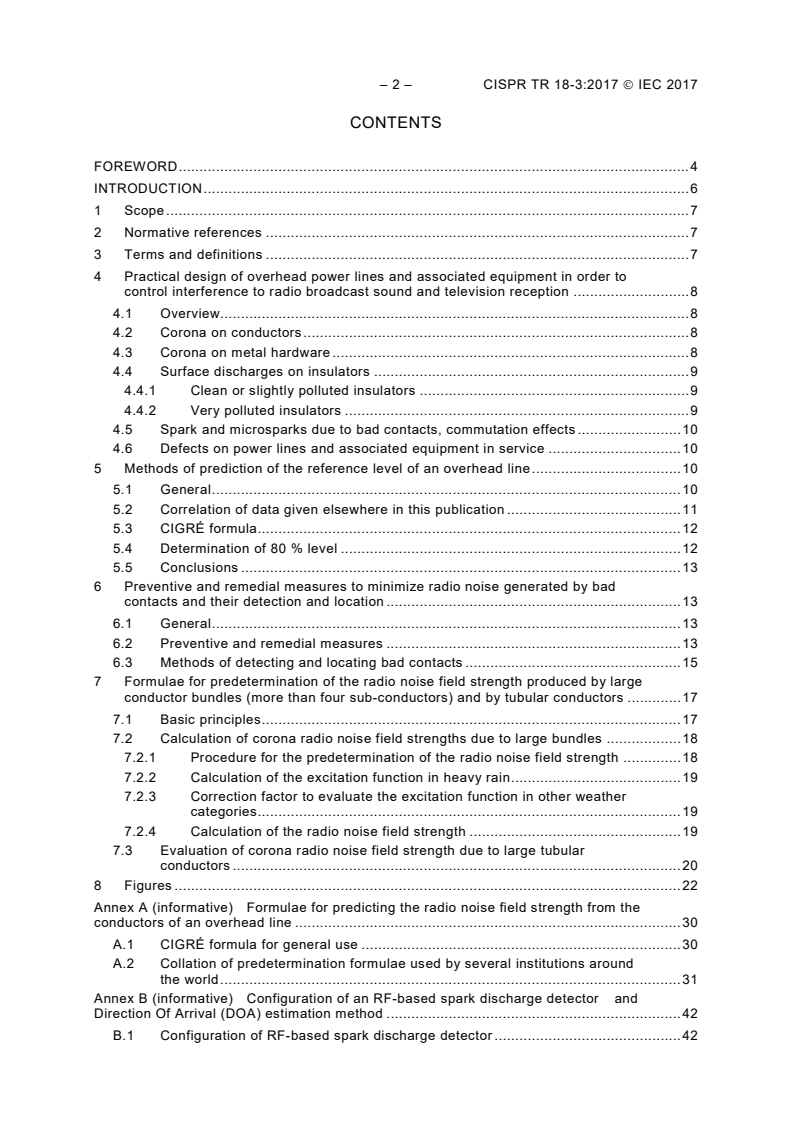
CONTENTS
FOREWORD . 4
INTRODUCTION . 6
1 Scope . 7
2 Normative references . 7
3 Terms and definitions . 7
4 Practical design of overhead power lines and associated equipment in order to
control interference to radio broadcast sound and television reception . 8
4.1 Overview. 8
4.2 Corona on conductors . 8
4.3 Corona on metal hardware . 8
4.4 Surface discharges on insulators . 9
4.4.1 Clean or slightly polluted insulators . 9
4.4.2 Very polluted insulators . 9
4.5 Spark and microsparks due to bad contacts, commutation effects . 10
4.6 Defects on power lines and associated equipment in service . 10
5 Methods of prediction of the reference level of an overhead line . 10
5.1 General . 10
5.2 Correlation of data given elsewhere in this publication . 11
5.3 CIGRÉ formula. 12
5.4 Determination of 80 % level . 12
5.5 Conclusions . 13
6 Preventive and remedial measures to minimize radio noise generated by bad
contacts and their detection and location . 13
6.1 General . 13
6.2 Preventive and remedial measures . 13
6.3 Methods of detecting and locating bad contacts . 15
7 Formulae for predetermination of the radio noise field strength produced by large
conductor bundles (more than four sub-conductors) and by tubular conductors . 17
7.1 Basic principles . 17
7.2 Calculation of corona radio noise field strengths due to large bundles . 18
7.2.1 Procedure for the predetermination of the radio noise field strength . 18
7.2.2 Calculation of the excitation function in heavy rain . 19
7.2.3 Correction factor to evaluate the excitation function in other weather
categories . 19
7.2.4 Calculation of the radio noise field strength . 19
7.3 Evaluation of corona radio noise field strength due to large tubular
conductors . 20
8 Figures . 22
Annex A (informative) Formulae for predicting the radio noise field strength from the
conductors of an overhead line . 30
A.1 CIGRÉ formula for general use . 30
A.2 Collation of predetermination formulae used by several institutions around
the world . 31
Annex B (informative) Configuration of an RF-based spark discharge detector and
Direction Of Arrival (DOA) estimation method . 42
B.1 Configuration of RF-based spark discharge detector . 42
B.2 Direction of Arrival (DOA) estimation method based on Time Difference of
Arrival (TDOA) [17] . 42
Annex C (informative) Analytical procedure for the predetermination of the radio
noise field strength, at a given distance from an overhead line with large bundle
conductors . 44
C.1 Analytical procedure . 44
C.2 Example of calculation of the radio noise field strength . 45
Bibliography . 51
Figure 1 – Bundle conductors . 22
Figure 2 – Line with conductors in a flat configuration . 23
Figure 3 – Line with conductors in a delta configuration . 24
Figure 4 – Line with conductors in a triangular configuration . 25
Figure 5 – Line with conductors in a flat configuration . 26
Figure 6 – Line with conductors in a delta configuration . 27
Figure 7 – Line with conductors in a triangular configuration . 28
Figure 8 – Tubular conductors of 40 cm diameter. 29
Figure B.1 – Configuration of RF-based spark discharge detector [17] . 42
Figure B.2 – Coordinates and arrangement of the four-antenna-square array. 43
Figure C.1 – Designation of the geometrical quantities for the simplified analytical
method . 49
Figure C.2 – Lateral profiles of the radio noise field strengths produced by the
individual phases and of the total field, as calculated in the given example . 50
Table A.1 – Empirical methods, terms of the predetermination formulae developed by
several institutions, survey . 32
Table A.2 – Empirical methods, complete predetermination formulae developed by
several institutions, survey . 34
Table A.3 – Predetermination formulae, examples for calculation of the absolute field
strength levels . 36
Table A.4 – Empirical methods, complete predetermination formulae for DC lines
developed by several institutions, survey . 38
Table A.5 – Formulae for calculation of the excitation function in fair weather for DC
lines developed by several institutions, survey . 40
– 4 – CISPR TR 18-3:2017 IEC 2017
INTERNATIONAL ELECTROTECHNICAL COMMISSION
INTERNATIONAL SPECIAL COMMITTEE ON RADIO INTERFERENCE
____________
RADIO INTERFERENCE CHARACTERISTICS
OF OVERHEAD POWER LINES
AND HIGH-VOLTAGE EQUIPMENT –
Part 3: Code of practice for minimizing
the generation of radio noise
FOREWORD
1) The International Electrotechnical Commission (IEC) is a worldwide organization for standardization comprising
all national electrotechnical committees (IEC National Committees). The object of IEC is to promote
international co-operation on all questions concerning standardization in the electrical and electronic fields. To
this end and in addition to other activities, IEC publishes International Standards, Technical Specifications,
Technical Reports, Publicly Available Specifications (PAS) and Guides (hereafter referred to as “IEC
Publication(s)”). Their preparation is entrusted to technical committees; any IEC National Committee interested
in the subject dealt with may participate in this preparatory work. International, governmental and non-
governmental organizations liaising with the IEC also participate in this preparation. IEC collaborates closely
with the International Organization for Standardization (ISO) in accordance with conditions determined by
agreement between the two organizations.
2) The formal decisions or agreements of IEC on technical matters express, as nearly as possible, an international
consensus of opinion on the relevant subjects since each technical committee has representation from all
interested IEC National Committees.
3) IEC Publications have the form of recommendations for international use and are accepted by IEC National
Committees in that sense. While all reasonable efforts are made to ensure that the technical content of IEC
Publications is accurate, IEC cannot be held responsible for the way in which they are used or for any
misinterpretation by any end user.
4) In order to promote international uniformity, IEC National Committees undertake to apply IEC Publications
transparently to the maximum extent possible in their national and regional publications. Any divergence
between any IEC Publication and the corresponding national or regional publication shall be clearly indicated in
the latter.
5) IEC itself does not provide any attestation of conformity. Independent certification bodies provide conformity
assessment services and, in some areas, access to IEC marks of conformity. IEC is not responsible for any
services carried out by independent certification bodies.
6) All users should ensure that they have the latest edition of this publication.
7) No liability shall attach to IEC or its directors, employees, servants or agents including individual experts and
members of its technical committees and IEC National Committees for any personal injury, property damage or
other damage of any nature whatsoever, whether direct or indirect, or for costs (including legal fees) and
expenses arising out of the publication, use of, or reliance upon, this IEC Publication or any other IEC
Publications.
8) Attention is drawn to the Normative references cited in this publication. Use of the referenced publications is
indispensable for the correct application of this publication.
9) Attention is drawn to the possibility that some of the elements of this IEC Publication may be the subject of
patent rights. IEC shall not be held responsible for identifying any or all such patent rights.
The main task of IEC technical committees is to prepare International Standards. However, a
technical committee may propose the publication of a technical report when it has collected
data of a different kind from that which is normally published as an International Standard, for
example "state of the art".
CISPR 18-3, which is a technical report, has been prepared by CISPR subcommittee B:
Interference relating to industrial, scientific and medical radio-frequency apparatus, to other
(heavy) industrial equipment, to overhead power lines, to high voltage equipment and to
electric traction.
This third edition cancels and replaces the second edition published in 2010. This edition
constitutes a technical revision.
This edition includes the following significant technical changes with respect to the previous
edition:
a) localisation system of spark discharges which might contain frequency components up to
3 GHz;
b) information regarding equations for predetermination of the radio noise level from HVDC
overhead power lines.
The text of this technical report is based on the following documents:
DTR Report on voting
CIS/B/655/DTR CIS/B/676/RVDTR
Full information on the voting for the approval of this technical report can be found in the
report on voting indicated in the above table.
This publication has been drafted in accordance with the ISO/IEC Directives, Part 2.
A list of all parts of the CISPR 18 series can be found under the general title Radio
interference characteristics of overhead power lines and high-voltage equipment, on the IEC
website.
The committee has decided that the contents of this publication will remain unchanged until
the stability date indicated on the IEC website under "http://webstore.iec.ch" in the data
related to the specific publication. At this date, the publication will be
• reconfirmed,
• withdrawn,
• replaced by a revised edition, or
• amended.
A bilingual version of this publication may be issued later on.
IMPORTANT – The 'colour inside' logo on the cover page of this publication indicates
that it contains colours which are considered to be useful for the correct
understanding of its contents. Users should therefore print this document using a
colour printer.
– 6 – CISPR TR 18-3:2017 IEC 2017
INTRODUCTION
This Technical Report is the third of a three-part series dealing with radio noise generated by
electrical power transmission and distribution facilities (overhead lines and substations). It
contains recommendations for minimizing the generation of radio noise emanating from high-
voltage (HV) power systems which include, but are not restricted to, HVAC or HVDC overhead
power lines, HVAC substations and HVDC converter stations, hardware, etc., in order to
promoting protection of radio reception.
The recommendations given in this Part 3 of the CISPR 18 series are intended to be a useful
aid to engineers involved in design, erection and maintenance of overhead lines and HV
stations and also to anyone concerned with checking the radio noise performance of a line to
ensure satisfactory protection of radio reception. Information on the physical phenomena
involved in the generation of electromagnetic noise fields is found in CISPR TR 18-1. It also
includes the main properties of such fields and their numerical values. CISPR TR 18-2
contains recommendations for methods of measurement for use on-site or in a laboratory. It
furthermore recommends procedures for determination of limits for the radio noise from HV
power systems.
The second editions of CISPR 18-1, -2, -3 underwent thorough edition in the maintenance
work. The purpose of the maintenance work was to review for update in the measurement
conditions, terminology, and the lateral profiles of radio noise, etc. Other updates belonged to
the description of HVDC systems and to the upper edge measurement frequency.
The review for this third edition of CISPR 18-3 focused on the following issues:
a) description on gap noise locating system involved in the expansion of upper measuring
frequency from 300 MHz to 3 GHz;
b) collation of predetermination formulae of radio noise level for DC power lines involved in
update on DC description.
The CISPR 18 series does not deal with biological effects on living matter or any issues
related to exposure to electromagnetic fields.
Considering
a) that the radiation of electromagnetic energy from overhead power lines causes
interference,
b) that the level of this noise may be reduced by the design and lay-out of a line,
c) that when defects cause unusually high levels of interference there is need to detect and
locate these faults,
this document recommends as CODE OF PRACTICE for minimizing the generation of radio
noise, that the latest edition of CISPR Publication 18-3, including amendments, be used as
guide for minimizing the generation of such noise caused by overhead power lines.
CISPR TR 18-1 describes the main properties of the physical phenomena involved in the
production of 123 disturbing electromagnetic fields by overhead lines and provides numerical
values of such fields.
In CISPR TR 18-2 methods of measurement and procedures for determining limits of such
radio 125 interference are recommended.
This CISPR TR 18-3 forms a "Code of Practice" to reduce to a minimum the production of
radio noise by power lines and equipment.
NOTE The recommendation above is based on CISPR RECOMMENDATION No. 57.
RADIO INTERFERENCE CHARACTERISTICS
OF OVERHEAD POWER LINES
AND HIGH-VOLTAGE EQUIPMENT –
Part 3: Code of practice for minimizing
the generation of radio noise
1 Scope
This part of CISPR 18, which is a technical report, applies to radio noise from overhead power
lines and high-voltage equipment which may cause interference to radio reception, excluding
the fields from power line carrier signals.
The frequency range covered is 0,15 MHz to 3 GHz.
2 Normative references
The following documents are referred to in the text in such a way that some or all of their
content constitutes requirements of this document. For dated references, only the edition
cited applies. For undated references, the latest edition of the referenced document (including
any amendments) applies.
IEC 60050-161, International Electrotechnical Vocabulary (IEV) – Chapter 161:
Electromagnetic compatibility
CISPR TR 18-1:__ , Radio interference characteristics of overhead power lines and high-
voltage equipment – Part 1: Description of phenomena
CISPR TR 18-2:__ , Radio interference characteristics of overhead power lines and high-
voltage equipment – Part 2: Methods of measurement and procedure for determining limits
ISO IEC Guide 99, International vocabulary of metrology – Basic and general concepts and
associated terms (VIM)
NOTE Informative references are listed in the Bibliography.
3 Terms and definitions
For the purposes of this document, the terms and definitions given in IEC 60050-161 and the
ISO IEC Guide 99 apply.
ISO and IEC maintain terminological databases for use in standardization at the following
addresses:
• IEC Electropedia: available at http://www.electropedia.org/
• ISO Online browsing platform: available at http://www.iso.org/obp
_____________
Under preparation. Stage at the time of publication: CISPR/RPUB 18-1:2017.
Under preparation. Stage at the time of publication: CISPR/RPUB 18-2:2017.
– 8 – CISPR TR 18-3:2017 IEC 2017
4 Practical design of overhead power lines and associated equipment in order
to control interference to radio broadcast sound and television reception
4.1 Overview
This clause provides guidance on the techniques that may be applied during the design,
construction and operation of high voltage overhead power lines and associated equipment in
order to keep the various types of radio noise described in this document within acceptable
levels.
4.2 Corona on conductors
During line design, consideration should be given to the geometric parameters of the line, in
order to ensure that radio noise due to conductor corona will not exceed a specified
acceptable level. The most important parameters are conductor diameter and number of
conductors per phase. Other parameters that could be varied, such as distance between
phases, height of conductors above ground or spacing of sub-conductors in the bundle, have
a smaller effect. In practice, they are usually determined by mechanical or insulation
requirements.
The quantitative laws that determine the level of radio noise caused by conductor corona are
discussed in 4.3 of CISPR TR 18-1:__ , and in Clause 7. These laws normally apply to both
stranded and smooth conductors, since the surface unevenness caused by stranding does not,
in general, substantially change the noise level, especially when conductors are damp or wet.
The existence of scratched or broken strands or deposits of extraneous substances such as
dirt or insects on the surface, on the other hand, may lead to severe localised corona
discharges, due to high local voltage gradients. This may considerably increase the noise
level of the line. For these reasons, it is necessary to avoid damage to the conductor surface
during construction. It should be handled with great care in transportation and erection and
suitable techniques should be used to avoid contact of the conductor with the ground or other
objects during stringing. It is also advisable to avoid external greasing of the conductor for
protection during transportation and tensioning; when the conductor is loaded, the increase in
temperature, especially in hot weather, will cause this grease to run to the outside, gathering
dirt and leading to areas with high local gradient and consequent radio noise. When the steel
core or inside layers are greased for corrosion protection, a type of grease should be selected
that will not migrate to the surface of the conductor even at the highest temperature.
4.3 Corona on metal hardware
Radio noise due to corona on metal hardware, such as suspension clamps, dead-end clamps,
yokes, guard rings, horns, spacers, etc., can be controlled. Appropriate shapes and
dimensions may be specified during the design stage in order to avoid points of high voltage
gradient. All edges and corners should be well rounded, bolt heads should be rounded or
shielded and sharp points and protrusions should be avoided. It is also important that the
protective galvanized finish on hardware be smooth, particularly at points of maximum voltage
gradient.
Guard devices are sometimes installed to protect an insulator string from the destructive
effects of a power arc and to improve the distribution of the potential along the string. They
also contribute to the reduction of the level of radio noise from the conductor clamps, since
they screen sharp points or protrusions on the clamps. The type and dimensions of the guard
devices should be chosen in such a way that they do not themselves produce radio noise. For
example, the use of simple horns should be avoided at voltages exceeding about 150 kV, and
the diameter of tubes forming guard rings should be sufficiently large to ensure that no corona
occurs during rain.
_____________
Under preparation. Stage at the time of publication: CISPR/RPUB 18-1:2017.
Present knowledge seems to indicate, however, that it may be relatively difficult to design
guard rings suitable for rainy conditions, even if they are made of multiple tubes. In which
case, it may be necessary to devise special arrangements for the yoke so that the string is
screened directly by the conductor bundle and is protected from power arcs by suitable
devices on the sub-conductors of the bundle.
As in the case of conductors, it is important to avoid damage to the hardware during
manufacture, transportation, construction and maintenance by handling them with great care
at all times.
4.4 Surface discharges on insulators
4.4.1 Clean or slightly polluted insulators
The radio noise produced by these insulators under dry conditions can be controlled by:
• the use of insulators of suitable design, especially as regards their geometry and the
characteristics of the material at the more critical areas, or
• the use of guard devices designed to improve the distribution of voltage on the surface of
the insulator or along the insulator string.
In insulator design, the use of conducting glaze, for example, improves the distribution of the
surface voltage gradient on the insulator. In the design of a guard device, a metal ring as
close as possible to the insulator, or to at least the first two or three insulators at the line end
of an insulator string, may considerably improve the voltage distribution on the insulator or
along the insulator string and reduce radio noise. The ring, however, shall remain compatible
with other requirements such as insulation withstand, protection of the insulators from power
arcs, screening of the clamps, etc. (see 4.3).
The radio noise produced in damp weather, fog or rain is usually more difficult to control than
the noise under dry conditions. It is, however, seldom a critical factor in line design, since the
increase in noise due to water droplets on the insulators is usually less important than the
corresponding increase in noise produced by the conductors.
4.4.2 Very polluted insulators
Under dry conditions, in addition to the phenomena that cause noise on a clean insulator,
other phenomena of the corona type may occur due to surface unevenness created by
pollution deposits, as mentioned in 6.1 of CISPR TR 18-1:__ . Under these conditions even
careful design of the various parts of an insulator may be of little benefit. Stress control
devices suitable for improving the voltage distribution on the insulator or along the insulator
string, however, may considerably improve the radio noise performance.
When the polluted insulator surface is wet, radio noise is generated by sparks across the dry
bands, created by the leakage currents, as discussed in 6.1 of CISPR TR 18-1:__ .
Occasionally, this noise has very high frequency components. It may affect both sound and
television reception and is difficult to control. The only practical remedy is to limit the leakage
current activity on the surface of the polluted insulator. This may be achieved by:
a) diminishing the voltage stress on the insulator – for example by using a longer surface
creepage path than is necessary for electrical withstand;
b) using special types of insulators such as those made of organic material or coated with
semi-conducting glaze, or designs with a longer creepage path such as fog type units,
special shapes, etc.;
c) coating the insulators with silicone grease.
_____________
Under preparation. Stage at the time of publication: CISPR/RPUB 18-1:2017.
Under preparation. Stage at the time of publication: CISPR/RPUB 18-1:2017.
– 10 – CISPR TR 18-3:2017 IEC 2017
4.5 Spark and microsparks due to bad contacts, commutation effects
Remedial measures for eliminating or reducing these types of radio noise are described in
Clause 5 and in 8.4 of CISPR TR 18-1:__ respectively.
4.6 Defects on power lines and associated equipment in service
Even if all possible precautions have been taken during design and construction of a power
line or substation to keep radio noise within acceptable limits, defects may occasionally occur
during operation, resulting in intolerable noise. This may be caused by breakage of strands on
the conductors, damage to clamps or insulators or accumulation of pollution on conductors
and insulators. In general, these defects shall be eliminated in order that the power system
may operate properly, whether or not they are sources of radio noise. In fact, the occasional
noise caused by such defects may result in detection and location of potential power system
faults.
These abnormal noise sources may be located by various instruments such as radio noise
measuring sets, television receivers or ultrasonic and optical detectors. Location will often be
easier when the noise affects television reception, since at very high frequencies longitudinal
attenuation along the line is very high. When only low and medium wave frequencies are
affected, location of the noise source may require the recording of the longitudinal attenuation
of the radio noise field strength, combined with optical, ultrasonic or ultraviolet devices, as
discussed in Clause 5.
5 Methods of prediction of the reference level of an overhead line
5.1 General
This document has been written to provide the engineer in the field with the theoretical and
practical background necessary to deal with radio interference problems. Technical aspects
have been dealt with in Part 1 and many of the aspects discussed are dealt with in this clause
in a simplified manner to bring together the theoretical and practical issues.
The reference level of a line is the strength of the radio noise field at a reference frequency
of 500 kHz and at a direct distance of 20 m from the nearest conductor of the line. Where the
voltage gradient in the air at the surfaces of the conductors of a normal line is greater than
about 12 kV/cm to 14 kV/cm, depending on conductor diameter, the radio noise performance
of the line is determined by the performance of the conductors. The number and diameter of
the conductors per phase of a proposed line are often decided by the current-carrying
capacity required or by economic considerations and usually a prediction of the reference
level is required for a particular weather condition. If a line is designed with the conductors at
a high surface gradient, very little can be done to reduce the noise level once the line has
been constructed.
Figure B.14 of CISPR TR 18-1:__ gives the correction to be applied to a radio noise level
relating to a measurement frequency other than 500 kHz.
Where the voltage gradient in the air at the surfaces of the conductors of a line is less than
about 12 kV/cm, the radio noise level is usually determined by the insulators and hardware. In
this case the radio noise performance of the line is inherently good and it is usually desirable
to preserve this good quality by selecting insulators and hardware of a matching quality. Most
of the methods of prediction or predetermination are concerned with the conductor noise and
do not apply to lines where the conductors are at a low surface gradient. None of the methods
applies to sparking sources at loose or imperfect contacts.
_____________
Under preparation. Stage at the time of publication: CISPR/RPUB 18-1:2017.
Under preparation. Stage at the time of publication: CISPR/RPUB 18-1:2017.
5.2 Correlation of data given elsewhere in this publication
This subclause contains information about the correlation of the radio noise voltage at the line
and the resulting radio noise field strength at ground level at a certain lateral or direct
distance slant to the respective line.
a) Methods relating to noise from conductors
Subclause 5.3 of CISPR TR 18-1:__ gives a survey of methods of prediction or
predetermination for AC lines, both analytical or semi-empirical and empirical or
comparative.
The analytical method relies on the results of measurements carried out on a short length
of sample conductor in a test cage and involves highly complex analyses. The sample
conductor can be tested with any desired surface condition and the radio noise voltage
measured by a circuit given in 4.5 of CISPR TR 18-2:__ . However, for AC lines, a reliable
prediction of the reference level due to conductor corona can be calculated only from the
wet test in this method since in this case the number of individual corona sources per unit
length is sufficiently high to represent a statistically satisfactory sample.
The simple comparative formulae referred to in 5.3 of CISPR TR 18-1:__ rely on the
results of radio-noise field strength measurements carried out on an existing line of similar
design. These formulae take into account the effects of any difference between the
reference and proposed lines such as the differences in surface voltage gradient or
conductor diameter. If the design of the reference and the proposed lines are similar and
the operating conditions, such as air pollution, etc., are also similar, a fairly accurate
prediction may be obtained of the reference level to be expected from the proposed line
due to conductor corona. The effects of weather may also be determined by taking
measurements on the reference line in a variety of weather conditions.
In 5.4 and Annex B of CISPR TR 18-1:__ is given a catalogue of radio noise field
strength profiles resulting from conductor corona for certain designs of single circuit
overhead line. The profiles are correct when the value of the voltage gradient in the air at
the surfaces of the conductors of the lines are sufficiently high to produce radio noise. The
values of the field strength, at a measurement frequency of 500 kHz, are given for both
heavy rain and average fair weather conditions, the heavy rain conditions producing a
higher field strength of between 17 dB and 25 dB. The profiles show the attenuation of the
field with distance normal to the lines for distances out to 150 m.
For DC lines, reference is made to 8.2 of CISPR TR 18-1:__ for the calculation of the
noise level.
b) Method relating to noise from insulators and/or fittings
Subclause 6.2 of CISPR TR 18-1:__ gives a correlation between the radio noise voltage
generated by a hardware or component of a line, when measured in accordance with the
procedure given in 4.5 of CISPR TR 18-2:__ , and the level of the reference field. This
correlation applies where the line has a single noise source, for example a broken
insulator, or where multiple sources are distributed uniformly along the line. The method,
which includes a semi-empirical formula, is particularly useful where the conductors of a
proposed line are to operate at a low surface gradient and a prediction is required of the
reference level to be expected from the insulators of the line. When the measurement
procedure according to 4.5 of CISPR TR 18-2:__ is carried out on insulators, then they
_____________
Under preparation. Stage at the time of publication: CISPR/RPUB 18-1:2017.
Under preparation. Stage at the time of publication: CISPR/RPUB 18-2:2017.
Under preparation. Stage at the time of publication: CISPR/RPUB 18-1:2017.
Under preparation. Stage at the time of publication: CISPR/RPUB 18-1:2017.
Under preparation. Stage at the time of publication: CISPR/RPUB 18-1:2017.
Under preparation. Stage at the time of publication: CISPR/RPUB 18-1:2017.
Under preparation. Stage at the time of publication: CISPR/RPUB 18-2:2017.
Under preparation. Stage at the time of publication: CISPR/RPUB 18-2:2017.
– 12 – CISPR TR 18-3:2017 IEC 2017
are usually in a clean and dry condition, since this condition is normally specified. But the
procedure is not restricted to measurements on clean and dry objects and specially
polluted sample insulators could be tested when damp and when dry and the results
inserted into the formula to predict the reference level of a proposed line.
c) Methods relating to aggregate noise from the conductors, insulators and/or hardware
Subclause 5.2 of CISPR TR 18-1:__ gives information on the use of test lines. Where
conditions relating to a new design of line are such that they cannot be related to data
available from an existing line, the expected performance is sometimes studied on a
relatively short test line. Such test line studies are particularly useful when a new system,
for operation at a much higher voltage than hitherto, is in the planning stage. The radio
noise performance of the experimental line is monitored in a range of weather and
atmospheric conditions so that the performance of the proposed line can be assessed
under the conditions it will experience in service. This could also include the effects of
insulator pollution. Other important data, such as corona loss and acoustic noise
performance, can also be obtained from the test line at the same time.
In 5.4 of CISPR TR 18-2:__ a method is given whereby the reference level of a line may
be found which will protect a given broadcast signal strength at a given distance from the
line for 80 % of the time with 80 % confidence.
5.3 CIGRÉ formula
A simple direct formula has also been evolved for predicting the level of the radio noise field
strength to be expected from the conductors of AC lines. The formula, which is empirically
based, gives the most probable level to be expected from aged conductors in fair weather at a
direct distance D0 of 20 m from the nearest conductor at a measurement frequency of
500 kHz. The formula is derived from lines operating at voltages between 200 kV and 765 kV
and at maximum voltage gradients between 12 kV/cm and 20 kV/cm. Strictly seen, the formula
gives the noise from one phase conductor or bundle of a line and the effects of the other
conductors may be taken into account by a summation process. However, for a number of
designs of lines within these ranges, it is found that only a small error is introduced if only the
conductor producing the highest noise at the measuring point of a three-phase line is
considered; usually this is the nearest conductor but not necessarily so in all cases.
The formula is
E = 3,5 g + 12 r – 30, in dB(µV/m)
max
where
E is the level of the radio noise field strength in dB(µV/m) at a direct distance D of 20 m
from nearest conductor of proposed AC line;
g is the maximum gradient of the RMS voltage at the conductor surface, in kV/cm;
max
r is the radius of conductor or sub-conductor, in cm.
This matter is considered in more detail in Annex A.
5.4 Determination of 80 % level
The 80 % level for a line may be predicted by calculation [2, 3] or, if the line exists, the 80 %
level may be determined with a high degree of confidence, by measurement. Methods of
determining the 80 % level are as follows:
_____________
Under preparation. Stage at the time of publication: CISPR/RPUB 18-1:2017.
Under preparation. Stage at the time of publication: CISPR/RPUB 18-1:2017.
The figures in square brackets refer to the Bibliography.
1) for an existing line, the 80 % level may be determined, with a high degree of confidence,
from the all-weather distribution curve obtained by measurements made over a period of
one year;
2) if the all-weather distribution curve is not available, or in the case of a proposed line, the
results of measurements made one line of similar design in a similar climate and pollution
environment could be used;
3) from the figures mentioned in 4.3.4 of CISPR TR 18-1:__ it is seen that, on average, the
80 % level for a line is 10 dB greater than the 50 % level. Therefore, if the 50 % level is
known, the 80 % level may be estimated;
4) the 80 % level may be predicted by adding 5 dB to 15 dB, depending on the climate, to the
fair-weather level estimated from the simple formula given in 5.3.
5.5 Conclusions
The particular method of prediction to use in the case of a particular proposed line will depend
on whether the interest is in conductor corona or noise due to insulators and/or hardware that
is whether the conductors are to operate at a voltage gradient greater than about 14 kV/cm or
less than about 12 kV/cm. For voltage gradients in between these values, both the conductors
and the insulators may contribute to the noise level of the proposed line.
The simple comparative formula referred to in item a) of 5.2, the catalogue of radio noise field
strength profiles re
...
CISPR TR 18-3 ®
Edition 3.0 2017-10
REDLINE VERSION
INTERNATIONAL
STANDARD
colour
inside
INTERNATIONAL SPECIAL COMMITTEE ON RADIO INTERFERENCE
Radio interference characteristics of overhead power lines and high-voltage
equipment –
Part 3: Code of practice for minimizing the generation of radio noise
All rights reserved. Unless otherwise specified, no part of this publication may be reproduced or utilized in any form
or by any means, electronic or mechanical, including photocopying and microfilm, without permission in writing from
either IEC or IEC's member National Committee in the country of the requester. If you have any questions about IEC
copyright or have an enquiry about obtaining additional rights to this publication, please contact the address below or
your local IEC member National Committee for further information.
IEC Central Office Tel.: +41 22 919 02 11
3, rue de Varembé info@iec.ch
CH-1211 Geneva 20 www.iec.ch
Switzerland
About the IEC
The International Electrotechnical Commission (IEC) is the leading global organization that prepares and publishes
International Standards for all electrical, electronic and related technologies.
About IEC publications
The technical content of IEC publications is kept under constant review by the IEC. Please make sure that you have the
latest edition, a corrigendum or an amendment might have been published.
IEC publications search - webstore.iec.ch/advsearchform Electropedia - www.electropedia.org
The advanced search enables to find IEC publications by a The world's leading online dictionary on electrotechnology,
variety of criteria (reference number, text, technical containing more than 22 000 terminological entries in English
committee,…). It also gives information on projects, replaced and French, with equivalent terms in 16 additional languages.
and withdrawn publications. Also known as the International Electrotechnical Vocabulary
(IEV) online.
IEC Just Published - webstore.iec.ch/justpublished
Stay up to date on all new IEC publications. Just Published IEC Glossary - std.iec.ch/glossary
details all new publications released. Available online and 67 000 electrotechnical terminology entries in English and
once a month by email. French extracted from the Terms and Definitions clause of
IEC publications issued since 2002. Some entries have been
IEC Customer Service Centre - webstore.iec.ch/csc collected from earlier publications of IEC TC 37, 77, 86 and
If you wish to give us your feedback on this publication or CISPR.
need further assistance, please contact the Customer Service
Centre: sales@iec.ch.
CISPR TR 18-3 ®
Edition 3.0 2017-10
REDLINE VERSION
INTERNATIONAL
STANDARD
colour
inside
INTERNATIONAL SPECIAL COMMITTEE ON RADIO INTERFERENCE
Radio interference characteristics of overhead power lines and high-voltage
equipment –
Part 3: Code of practice for minimizing the generation of radio noise
INTERNATIONAL
ELECTROTECHNICAL
COMMISSION
ICS 33.100.01 ISBN 978-2-8322-5000-6
– 2 – CISPR TR 18-3:2017 RLV IEC 2017
CONTENTS
FOREWORD . 4
INTRODUCTION . 6
1 Scope . 8
2 Normative references . 8
3 Terms and definitions . 8
4 Practical design of overhead power lines and associated equipment in order to
control interference to radio broadcast sound and television reception . 9
4.1 Overview. 9
4.2 Corona on conductors . 9
4.3 Corona on metal hardware . 9
4.4 Surface discharges on insulators . 10
4.4.1 Clean or slightly polluted insulators . 10
4.4.2 Very polluted insulators . 10
4.5 Spark and microsparks due to bad contacts, commutation effects . 11
4.6 Defects on power lines and associated equipment in service . 11
5 Methods of prediction of the reference level of an overhead line . 11
5.1 General . 11
5.2 Correlation of data given elsewhere in this publication . 12
5.3 CIGRÉ formula. 13
5.4 Determination of 80 % level . 13
5.5 Conclusions . 14
6 Preventive and remedial measures to minimize radio noise generated by bad
contacts and their detection and location . 14
6.1 General . 14
6.2 Preventive and remedial measures . 14
6.3 Methods of detecting and locating bad contacts . 16
7 Formulae for predetermination of the radio noise field strength produced by large
conductor bundles (more than four sub-conductors) and by tubular conductors . 18
7.1 Basic principles . 18
7.2 Calculation of corona radio noise field strengths due to large bundles . 19
7.2.1 Procedure for the predetermination of the radio noise field strength . 19
7.2.2 Calculation of the excitation function in heavy rain . 20
7.2.3 Correction factor to evaluate the excitation function in other weather
categories . 20
7.2.4 Calculation of the radio noise field strength . 20
7.3 Evaluation of corona radio noise field strength due to large tubular
conductors . 21
8 Figures . 23
Bibliography . 52
Annex A (informative) Formulae for predicting the radio noise field strength from the
conductors of an overhead line . 31
A.1 CIGRÉ formula for general use . 31
A.2 Collation of predetermination formulae used by several institutions around
the world . 32
Annex B (informative) Configuration of an RF-based spark discharge detector and
Direction Of Arrival (DOA) estimation method . 43
B.2 Direction of Arrival (DOA) estimation method based on Time Difference of
Arrival (TDOA) [17] . 43
B.1 Configuration of RF-based spark discharge detector . 43
Annex C (informative) Analytical procedure for the predetermination of the radio
noise field strength, at a given distance from an overhead line with large bundle
conductors . 45
C.1 Analytical procedure . 45
C.2 Example of calculation of the radio noise field strength . 46
Figure 1 – Bundle conductors . 23
Figure 2 – Line with conductors in a flat configuration . 24
Figure 3 – Line with conductors in a delta configuration . 25
Figure 4 – Line with conductors in a triangular configuration . 26
Figure 5 – Line with conductors in a flat configuration . 27
Figure 6 – Line with conductors in a delta configuration . 28
Figure 7 – Line with conductors in a triangular configuration . 29
Figure 8 – Tubular conductors of 40 cm diameter. 30
Figure B.1 – Configuration of RF-based spark discharge detector [17] . 43
Figure B.2 – Coordinates and arrangement of the four-antenna-square array. 44
Figure C.1 – Designation of the geometrical quantities for the simplified analytical
method . 50
Figure C.2 – Lateral profiles of the radio noise field strengths produced by the
individual phases and of the total field, as calculated in the given example . 51
Table A.1 – Empirical methods, terms of the predetermination formulae developed by
several institutions, survey . 33
Table A.2 – Empirical methods, complete predetermination formulae developed by
several institutions, survey (1 of 2) . 35
Table A.3 – Predetermination formulae, examples for calculation of the absolute field
strength levels (1 of 2) . 37
Table A.4 – Empirical methods, complete predetermination formulae for DC lines
developed by several institutions, survey (1 of 2) . 39
Table A.5 – Formulae for calculation of the excitation function in fair weather for DC
lines developed by several institutions, survey . 41
– 4 – CISPR TR 18-3:2017 RLV IEC 2017
INTERNATIONAL ELECTROTECHNICAL COMMISSION
INTERNATIONAL SPECIAL COMMITTEE ON RADIO INTERFERENCE
____________
RADIO INTERFERENCE CHARACTERISTICS
OF OVERHEAD POWER LINES
AND HIGH-VOLTAGE EQUIPMENT –
Part 3: Code of practice for minimizing
the generation of radio noise
FOREWORD
1) The International Electrotechnical Commission (IEC) is a worldwide organization for standardization comprising
all national electrotechnical committees (IEC National Committees). The object of IEC is to promote
international co-operation on all questions concerning standardization in the electrical and electronic fields. To
this end and in addition to other activities, IEC publishes International Standards, Technical Specifications,
Technical Reports, Publicly Available Specifications (PAS) and Guides (hereafter referred to as “IEC
Publication(s)”). Their preparation is entrusted to technical committees; any IEC National Committee interested
in the subject dealt with may participate in this preparatory work. International, governmental and non-
governmental organizations liaising with the IEC also participate in this preparation. IEC collaborates closely
with the International Organization for Standardization (ISO) in accordance with conditions determined by
agreement between the two organizations.
2) The formal decisions or agreements of IEC on technical matters express, as nearly as possible, an international
consensus of opinion on the relevant subjects since each technical committee has representation from all
interested IEC National Committees.
3) IEC Publications have the form of recommendations for international use and are accepted by IEC National
Committees in that sense. While all reasonable efforts are made to ensure that the technical content of IEC
Publications is accurate, IEC cannot be held responsible for the way in which they are used or for any
misinterpretation by any end user.
4) In order to promote international uniformity, IEC National Committees undertake to apply IEC Publications
transparently to the maximum extent possible in their national and regional publications. Any divergence
between any IEC Publication and the corresponding national or regional publication shall be clearly indicated in
the latter.
5) IEC itself does not provide any attestation of conformity. Independent certification bodies provide conformity
assessment services and, in some areas, access to IEC marks of conformity. IEC is not responsible for any
services carried out by independent certification bodies.
6) All users should ensure that they have the latest edition of this publication.
7) No liability shall attach to IEC or its directors, employees, servants or agents including individual experts and
members of its technical committees and IEC National Committees for any personal injury, property damage or
other damage of any nature whatsoever, whether direct or indirect, or for costs (including legal fees) and
expenses arising out of the publication, use of, or reliance upon, this IEC Publication or any other IEC
Publications.
8) Attention is drawn to the Normative references cited in this publication. Use of the referenced publications is
indispensable for the correct application of this publication.
9) Attention is drawn to the possibility that some of the elements of this IEC Publication may be the subject of
patent rights. IEC shall not be held responsible for identifying any or all such patent rights.
This redline version of the official IEC Standard allows the user to identify the changes
made to the previous edition. A vertical bar appears in the margin wherever a change
has been made. Additions are in green text, deletions are in strikethrough red text.
The main task of IEC technical committees is to prepare International Standards. However, a
technical committee may propose the publication of a technical report when it has collected
data of a different kind from that which is normally published as an International Standard, for
example "state of the art".
CISPR 18-3, which is a technical report, has been prepared by CISPR subcommittee B:
Interference relating to industrial, scientific and medical radio-frequency apparatus, to other
(heavy) industrial equipment, to overhead power lines, to high voltage equipment and to
electric traction.
This third edition cancels and replaces the second edition published in 2010. This edition
constitutes a technical revision.
This edition includes the following significant technical changes with respect to the previous
edition:
a) localisation system of spark discharges which might contain frequency components up to
3 GHz;
b) information regarding equations for predetermination of the radio noise level from HVDC
overhead power lines.
The text of this technical report is based on the following documents:
DTR Report on voting
CIS/B/655/DTR CIS/B/676/RVDTR
Full information on the voting for the approval of this technical report can be found in the
report on voting indicated in the above table.
This publication has been drafted in accordance with the ISO/IEC Directives, Part 2.
A list of all parts of the CISPR 18 series can be found under the general title Radio
interference characteristics of overhead power lines and high-voltage equipment, on the IEC
website.
The committee has decided that the contents of this publication will remain unchanged until
the stability date indicated on the IEC website under "http://webstore.iec.ch" in the data
related to the specific publication. At this date, the publication will be
• reconfirmed,
• withdrawn,
• replaced by a revised edition, or
• amended.
A bilingual version of this publication may be issued later on.
IMPORTANT – The 'colour inside' logo on the cover page of this publication indicates
that it contains colours which are considered to be useful for the correct
understanding of its contents. Users should therefore print this document using a
colour printer.
– 6 – CISPR TR 18-3:2017 RLV IEC 2017
INTRODUCTION
This Technical Report is the third of a three-part series dealing with radio noise generated by
electrical power transmission and distribution facilities (overhead lines and substations). It
contains recommendations for minimizing the generation of radio noise emanating from high-
voltage (HV) power systems which include, but are not restricted to, HVAC or HVDC overhead
power lines, HVAC substations and HVDC converter stations, hardware, etc., in order to
promoting protection of radio reception.
The recommendations given in this Part 3 of the CISPR 18 series are intended to be a useful
aid to engineers involved in design, erection and maintenance of overhead lines and HV
stations and also to anyone concerned with checking the radio noise performance of a line to
ensure satisfactory protection of radio reception. Information on the physical phenomena
involved in the generation of electromagnetic noise fields is found in CISPR TR 18-1. It also
includes the main properties of such fields and their numerical values. CISPR TR 18-2
contains recommendations for methods of measurement for use on-site or in a laboratory. It
furthermore recommends procedures for determination of limits for the radio noise from HV
power systems.
This second edition of CISPR 18-3 was adapted to the modern structure and content of
technical reports issued by IEC. The first edition of CISPR 18-3 underwent thorough edition
and adaptation to modern terminology. Furthermore its content was adjusted such as to allow
for use of the lateral distance y for the conduction of measurements in the field.
The second editions of CISPR 18-1, -2, -3 underwent thorough edition in the maintenance
work. The purpose of the maintenance work was to review for update in the measurement
conditions, terminology, and the lateral profiles of radio noise, etc. Other updates belonged to
the description of HVDC systems and to the upper edge measurement frequency.
The review for this third edition of CISPR 18-3 focused on the following issues:
a) description on gap noise locating system involved in the expansion of upper measuring
frequency from 300 MHz to 3 GHz;
b) collation of predetermination formulae of radio noise level for DC power lines involved in
update on DC description.
The CISPR 18 series does not deal with biological effects on living matter or any issues
related to exposure to electromagnetic fields.
The main content of this technical report is based on CISPR Rec. No. 57 given below:
CISPR RECOMMENDATION No. 57
CODE OF PRACTICE FOR MINIMIZING THE GENERATION OF RADIO NOISE
Considering
a) that the radiation of electromagnetic energy from overhead power lines causes
interference to sound and television broadcasting,
b) that the level of this noise may be reduced by the design and lay-out of a line,
c) that when defects cause unusually high levels of interference there is need to detect and
locate these faults,
this document recommends as CODE OF PRACTICE for minimizing the generation of radio
noise, that the latest edition of CISPR Publication 18-3, including amendments, be used as
guide for minimizing the generation of radio such noise caused by overhead power lines.
CISPR TR 18-1 describes the main properties of the physical phenomena involved in the
production of 123 disturbing electromagnetic fields by overhead lines and provides numerical
values of such fields.
In CISPR TR 18-2 methods of measurement and procedures for determining limits of such
radio 125 interference are recommended.
This CISPR TR 18-3 forms a "Code of Practice" to reduce to a minimum the production of
radio noise by power lines and equipment.
It provides information which is advisable to follow both when designing various fittings and
components and when stringing the conductors and installing the hardware of the line.
It also describes methods of detecting and locating defects resulting in unusually high
interference levels, and provides prevention and correction procedures that are generally
simple to implement.
Lastly, this Part 3 provides formulae for predicting the most probable radio noise field of a line
for various weather conditions, insofar as radio noise is caused by conductor corona.
NOTE The recommendation above is based on CISPR RECOMMENDATION No. 57.
– 8 – CISPR TR 18-3:2017 RLV IEC 2017
RADIO INTERFERENCE CHARACTERISTICS
OF OVERHEAD POWER LINES
AND HIGH-VOLTAGE EQUIPMENT –
Part 3: Code of practice for minimizing
the generation of radio noise
1 Scope
This part of CISPR 18, which is a technical report, applies to radio noise from overhead power
lines and high-voltage equipment which may cause interference to radio reception, excluding
the fields from power line carrier signals.
The frequency range covered is 0,15 MHz to 300 MHz 3 GHz.
2 Normative references
The following documents are referred to in the text in such a way that some or all of their
content constitutes requirements of this document. For dated references, only the edition
cited applies. For undated references, the latest edition of the referenced document (including
any amendments) applies.
IEC 60050-161, International Electrotechnical Vocabulary (IEV) – Chapter 161:
Electromagnetic compatibility
CISPR TR 18-1:2010__ , Radio interference characteristics of overhead power lines and
high-voltage equipment – Part 1: Description of phenomena
CISPR TR 18-2:2010__ , Radio interference characteristics of overhead power lines and
high-voltage equipment – Part 2: Methods of measurement and procedure for determining
limits
ISO IEC Guide 99, International vocabulary of metrology – Basic and general concepts and
associated terms (VIM)
NOTE Informative references are listed in the Bibliography.
3 Terms and definitions
For the purposes of this document, the terms and definitions given in IEC 60050-161 and the
ISO IEC Guide 99 apply.
ISO and IEC maintain terminological databases for use in standardization at the following
addresses:
• IEC Electropedia: available at http://www.electropedia.org/
• ISO Online browsing platform: available at http://www.iso.org/obp
_____________
Under preparation. Stage at the time of publication: CISPR/RPUB 18-1:2017.
Under preparation. Stage at the time of publication: CISPR/RPUB 18-2:2017.
4 Practical design of overhead power lines and associated equipment in order
to control interference to radio broadcast sound and television reception
4.1 Overview
This clause provides guidance on the techniques that may be applied during the design,
construction and operation of high voltage overhead power lines and associated equipment in
order to keep the various types of radio noise described in this document within acceptable
levels.
4.2 Corona on conductors
During line design, consideration should be given to the geometric parameters of the line, in
order to ensure that radio noise due to conductor corona will not exceed a specified
acceptable level. The most important parameters are conductor diameter and number of
conductors per phase. Others parameters that could be varied, such as distance between
phases, height of conductors above ground or spacing of sub-conductors in the bundle, have
a smaller effect. In practice, they are usually determined by mechanical or insulation
requirements.
The quantitative laws that determine the level of radio noise caused by conductor corona are
discussed in 4.3 of CISPR TR 18-1:__ , and in Clause 7. These laws normally apply to both
stranded and smooth conductors, since the surface unevenness caused by stranding does not,
in general, substantially change the noise level, especially when conductors are damp or wet.
The existence of scratched or broken strands or deposits of extraneous substances such as
dirt or insects on the surface, on the other hand, may lead to severe localised corona
discharges, due to high local voltage gradients. This may considerably increase the noise
level of the line. For these reasons, it is necessary to avoid damage to the conductor surface
during construction. It should be handled with great care in transportation and erection and
suitable techniques should be used to avoid contact of the conductor with the ground or other
objects during stringing. It is also advisable to avoid external greasing of the conductor for
protection during transportation and tensioning; when the conductor is loaded, the increase in
temperature, especially in hot weather, will cause this grease to run to the outside, gathering
dirt and leading to areas with high local gradient and consequent radio noise. When the steel
core or inside layers are greased for corrosion protection, a type of grease should be selected
that will not migrate to the surface of the conductor even at the highest temperature.
4.3 Corona on metal hardware
Radio noise due to corona on metal hardware, such as suspension clamps, dead-end clamps,
yokes, guard rings, horns, spacers, etc., can be controlled. Appropriate shapes and
dimensions may be specified during the design stage in order to avoid points of high voltage
gradient. All edges and corners should be well rounded, bolt heads should be rounded or
shielded and sharp points and protrusions should be avoided. It is also important that the
protective galvanized finish on hardware be smooth, particularly at points of maximum voltage
gradient.
Guard devices are sometimes installed to protect an insulator string from the destructive
effects of a power arc and to improve the distribution of the potential along the string. They
also contribute to the reduction of the level of radio noise from the conductor clamps, since
they screen sharp points or protrusions on the clamps. The type and dimensions of the guard
devices should be chosen in such a way that they do not themselves produce radio noise. For
example, the use of simple horns should be avoided at voltages exceeding about 150 kV, and
the diameter of tubes forming guard rings should be sufficiently large to ensure that no corona
occurs during rain.
_____________
Under preparation. Stage at the time of publication: CISPR/RPUB 18-1:2017.
– 10 – CISPR TR 18-3:2017 RLV IEC 2017
Present knowledge seems to indicate, however, that it may be relatively difficult to design
guard rings suitable for rainy conditions, even if they are made of multiple tubes. In which
case, it may be necessary to devise special arrangements for the yoke so that the string is
screened directly by the conductor bundle and is protected from power arcs by suitable
devices on the sub-conductors of the bundle.
As in the case of conductors, it is important to avoid damage to the hardware during
manufacture, transportation, construction and maintenance by handling them with great care
at all times.
4.4 Surface discharges on insulators
4.4.1 Clean or slightly polluted insulators
The radio noise produced by these insulators under dry conditions can be controlled by:
• the use of insulators of suitable design, especially as regards their geometry and the
characteristics of the material at the more critical areas, or
• the use of guard devices designed to improve the distribution of voltage on the surface of
the insulator or along the insulator string.
In insulator design, the use of conducting glaze, for example, improves the distribution of the
surface voltage gradient on the insulator. In the design of a guard device, a metal ring as
close as possible to the insulator, or to at least the first two or three insulators at the line end
of an insulator string, may considerably improve the voltage distribution on the insulator or
along the insulator string and reduce radio noise. The ring, however, shall remain compatible
with other requirements such as insulation withstand, protection of the insulators from power
arcs, screening of the clamps, etc. (see 4.3).
The radio noise produced in damp weather, fog or rain is usually more difficult to control than
the noise under dry conditions. It is, however, seldom a critical factor in line design, since the
increase in noise due to water droplets on the insulators is usually less important than the
corresponding increase in noise produced by the conductors.
4.4.2 Very polluted insulators
Under dry conditions, in addition to the phenomena that cause noise on a clean insulator,
other phenomena of the corona type may occur due to surface unevenness created by
pollution deposits, as mentioned in 6.1 of CISPR TR 18-1:__ . Under these conditions even
careful design of the various parts of an insulator may be of little benefit. Stress control
devices suitable for improving the voltage distribution on the insulator or along the insulator
string, however, may considerably improve the radio noise performance.
When the polluted insulator surface is wet, radio noise is generated by sparks across the dry
bands, created by the leakage currents, as discussed in 6.1 of CISPR TR 18-1:__ .
Occasionally, this noise has very high frequency components. It may affect both sound and
television reception and is difficult to control. The only practical remedy is to limit the leakage
current activity on the surface of the polluted insulator. This may be achieved by:
a) diminishing the voltage stress on the insulator – for example by using a longer surface
creepage path than is necessary for electrical withstand;
b) using special types of insulators such as those made of organic material or coated with
semi-conducting glaze, or designs with a longer creepage path such as fog type units,
special shapes, etc.;
c) coating the insulators with silicone grease.
_____________
Under preparation. Stage at the time of publication: CISPR/RPUB 18-1:2017.
Under preparation. Stage at the time of publication: CISPR/RPUB 18-1:2017.
4.5 Spark and microsparks due to bad contacts, commutation effects
Remedial measures for eliminating or reducing these types of radio noise are described in
Clause 5 and in 8.4 of CISPR TR 18-1:__ respectively.
4.6 Defects on power lines and associated equipment in service
Even if all possible precautions have been taken during design and construction of a power
line or substation to keep radio noise within acceptable limits, defects may occasionally occur
during operation, resulting in intolerable noise. This may be caused by breakage of strands on
the conductors, damage to clamps or insulators or accumulation of pollution on conductors
and insulators. In general, these defects shall be eliminated in order that the power system
may operate properly, whether or not they are sources of radio noise. In fact, the occasional
noise caused by such defects may result in detection and location of potential power system
faults.
These abnormal noise sources may be located by various instruments such as radio noise
measuring sets, television receivers or ultrasonic and optical detectors. Location will often be
easier when the noise affects television reception, since at very high frequencies longitudinal
attenuation along the line is very high. When only low and medium frequency radio
broadcasts wave frequencies are affected, location of the noise source may require the
recording of the longitudinal attenuation of the radio noise field strength, combined with
optical, ultrasonic or ultraviolet devices, as discussed in Clause 5.
5 Methods of prediction of the reference level of an overhead line
5.1 General
This document has been written to provide the engineer in the field with the theoretical and
practical background necessary to deal with radio interference problems. Technical aspects
have been dealt with in Part 1 and many of the aspects discussed are dealt with in this clause
in a simplified manner to bring together the theoretical and practical issues.
The reference level of a line is the strength of the radio noise field at a reference frequency
of 500 kHz and at a direct distance of 20 m from the nearest conductor of the line. Where the
voltage gradient in the air at the surfaces of the conductors of a normal line is greater than
about 12 kV/cm to 14 kV/cm, depending on conductor diameter, the radio noise performance
of the line is determined by the performance of the conductors. The number and diameter of
the conductors per phase of a proposed line are often decided by the current-carrying
capacity required or by economic considerations and usually a prediction of the reference
level is required for a particular weather condition. If a line is designed with the conductors at
a high surface gradient, very little can be done to reduce the noise level once the line has
been constructed.
Figure B.14 of CISPR TR 18-1:__ gives the correction to be applied to a radio noise level
relating to a measurement frequency other than 500 kHz.
Where the voltage gradient in the air at the surfaces of the conductors of a line is less than
about 12 kV/cm, the radio noise level is usually determined by the insulators and hardware. In
this case the radio noise performance of the line is inherently good and it is usually desirable
to preserve this good quality by selecting insulators and hardware of a matching quality. Most
of the methods of prediction or predetermination are concerned with the conductor noise and
do not apply to lines where the conductors are at a low surface gradient. None of the methods
applies to sparking sources at loose or imperfect contacts.
_____________
Under preparation. Stage at the time of publication: CISPR/RPUB 18-1:2017.
Under preparation. Stage at the time of publication: CISPR/RPUB 18-1:2017.
– 12 – CISPR TR 18-3:2017 RLV IEC 2017
5.2 Correlation of data given elsewhere in this publication
This subclause contains information about the correlation of the radio noise voltage at the line
and the resulting radio noise field strength at ground level at a certain lateral or direct
distance slant to the respective line.
a) Methods relating to noise from conductors
Subclause 5.3 of CISPR TR 18-1:__ gives a survey of methods of prediction or
predetermination for AC lines, both analytical or semi-empirical and empirical or
comparative.
The analytical method relies on the results of measurements carried out on a short length
of sample conductor in a test cage and involves highly complex analyses. The sample
conductor can be tested with any desired surface condition and the radio noise voltage
measured by a circuit given in 4.5 of CISPR TR 18-2:__ . However, for AC lines, a reliable
prediction of the reference level due to conductor corona can be calculated only from the
wet test in this method since in this case the number of individual corona sources per unit
length is sufficiently high to represent a statistically satisfactory sample.
The simple comparative formulae referred to in 5.3 of CISPR TR 18-1:__ rely on the
results of radio-noise field strength measurements carried out on an existing line of similar
design. These formulae take into account the effects of any difference between the
reference and proposed lines such as the differences in surface voltage gradient or
conductor diameter. If the design of the reference and the proposed lines are similar and
the operating conditions, such as air pollution, etc., are also similar, a fairly accurate
prediction may be obtained of the reference level to be expected from the proposed line
due to conductor corona. The effects of weather may also be determined by taking
measurements on the reference line in a variety of weather conditions.
In 5.4 and Annex B of CISPR TR 18-1:__ is given a catalogue of radio noise field
strength profiles resulting from conductor corona for certain designs of single circuit
overhead line. The profiles are correct when the value of the voltage gradient in the air at
the surfaces of the conductors of the lines are sufficiently high to produce radio noise. The
values of the field strength, at a measurement frequency of 500 kHz, are given for both
heavy rain and average fair weather conditions, the heavy rain conditions producing a
higher field strength of between 17 dB and 25 dB. The profiles show the attenuation of the
field with distance normal to the lines for distances out to 150 m.
For DC lines, reference should be is made to 8.2 of CISPR TR 18-1:__ for the
calculation of the noise level.
b) Method relating to noise from insulators and/or fittings
Subclause 6.2 of CISPR TR 18-1:__ gives a correlation between the radio noise voltage
generated by a hardware or component of a line, when measured in accordance with the
procedure given in 4.5 of CISPR TR 18-2:__ , and the level of the reference field. This
correlation applies where the line has a single noise source, for example a broken
insulator, or where multiple sources are distributed uniformly along the line. The method,
which includes a semi-empirical formula, is particularly useful where the conductors of a
proposed line are to operate at a low surface gradient and a prediction is required of the
reference level to be expected from the insulators of the line. When the measurement
procedure according to 4.5 of CISPR TR 18-2:__ is carried out on insulators, then they
_____________
Under preparation. Stage at the time of publication: CISPR/RPUB 18-1:2017.
Under preparation. Stage at the time of publication: CISPR/RPUB 18-2:2017.
Under preparation. Stage at the time of publication: CISPR/RPUB 18-1:2017.
Under preparation. Stage at the time of publication: CISPR/RPUB 18-1:2017.
Under preparation. Stage at the time of publication: CISPR/RPUB 18-1:2017.
Under preparation. Stage at the time of publication: CISPR/RPUB 18-1:2017.
Under preparation. Stage at the time of publication: CISPR/RPUB 18-2:2017.
Under preparation. Stage at the time of publication: CISPR/RPUB 18-2:2017.
are usually in a clean and dry condition, since this condition is normally specified. But the
procedure is not restricted to measurements on clean and dry objects and specially
polluted sample insulators could be tested when damp and when dry and the results
inserted into the formula to predict the reference level of a proposed line.
c) Methods relating to aggregate noise from the conductors, insulators and/or hardware
Subclause 5.2 of CISPR TR 18-1:__ gives information on the use of test lines. Where
conditions relating to a new design of line are such that they cannot be related to data
available from an existing line, the expected performance is sometimes studied on a
relatively short test line. Such test line studies are particularly useful when a new system,
for operation at a much higher voltage than hitherto, is in the planning stage. The radio
noise performance of the experimental line is monitored in a range of weather and
atmospheric conditions so that the performance of the proposed line can be assessed
under the conditions it will experience in service. This could also include the effects of
insulator pollution. Other important data, such as corona loss and acoustic noise
performance, can also be obtained from the test line at the same time.
In 5.4 of CISPR TR 18-2:__ a method is given whereby the reference level of a line may
be found which will protect a given broadcast signal strength at a given distance from the
line for 80 % of the time with 80 % confidence.
5.3 CIGRÉ formula
A simple direct formula has also been evolved for predicting the level of the radio noise field
strength to be expected from the conductors of a line AC lines. The formula, which is
empirically based, gives the most probable level to be expected from aged conductors in fair
weather at a direct distance D0 of 20 m from the nearest conductor at a measurement
frequency of 500 kHz. The formula is derived from lines operating at voltages between 200 kV
and 765 kV and at maximum voltage gradients between 12 kV/cm and 20 kV/cm. Strictly seen,
the formula gives the noise from one phase conductor or bundle of a line and the effects of
the other conductors may be taken into account by a summation process. However, for a
number of designs of lines within these ranges, it is found that only a small error is introduced
if only the conductor producing the highest noise at the measuring point of a three-phase line
is considered; usually this is the nearest conductor but not necessarily so in all cases.
The formula is
E = 3,5 g + 12 r – 30, in dB(µV/m)
max
where
E is the level of the radio noise field strength in dB(µV/m) at a direct distance D of 20 m
from nearest conductor of proposed AC line;
g is the maximum gradient of the RMS voltage at the conductor surface, in kV/cm;
max
r is the radius of conductor or sub-conductor, in cm.
This matter is considered in more detail in Annex A.
5.4 Determination of 80 % level
The 80 % level for a line may be predicted by calculation [2, 3] or, if the line exists, the 80 %
level may be determined with a high degree of confidence, by measurement. Methods of
determining the 80 % level are as follows:
_____________
Under preparation. Stage at the time of publication: CISPR/RPUB 18-1:2017.
Under preparation. Stage at the time of publication: CISPR/RPUB 18-1:2017.
The figures in square brackets refer to the Bibliography.
– 14 – CISPR TR 18-3:2017 RLV IEC 2017
1) for an existing line, the 80 % level may be determined,
...