

IEC 61300-2-14:2012
(Main)Fibre optic interconnecting devices and passive components - Basic test and measurement procedures - Part 2-14: Tests - High optical power
General Information
- Abstract
IEC 61300-2-14:2012 describes a procedure for determining the suitability of a fibre optic interconnecting device or a passive component to withstand the exposure to optical power that may occur during operation. This third edition cancels and replaces the second edition published in 2005 and constitutes a technical revision. This edition includes the following significant technical change with respect to the previous edition: fundamental change of the measurement method to introduce various measurement environments such as limited testing resources. Keywords: exposure to optical power
- Status
- Published
- Publication Date
- 06-Nov-2012
- Technical Committee
- SC 86B - Fibre optic interconnecting devices and passive components
- Drafting Committee
- WG 4 - TC 86/SC 86B/WG 4
- Current Stage
- DELPUB - Deleted Publication
- Start Date
- 11-Feb-2021
- Completion Date
- 13-Dec-2019
Overview
IEC 61300-2-14:2012 is an international standard published by the International Electrotechnical Commission (IEC) that sets out the basic test and measurement procedures for fibre optic interconnecting devices and passive components under exposure to high optical power conditions. This third edition, a technical revision of the 2005 second edition, introduces a fundamental change in the measurement method to accommodate various environments, including limited testing resources. The standard ensures that fibre optic components and devices can reliably withstand operational optical power levels without degradation.
Key Topics
- High Optical Power Testing: Provides detailed procedures to evaluate the resilience of fibre optic interconnecting devices and passive components when subjected to high levels of optical power that may be encountered during operation.
- Test Apparatus: Specifies equipment requirements, including the optical source (often a tunable light source), optical detector (power meter), environmental chamber for temperature and humidity controls, data acquisition systems, branching devices, and temporary joints.
- Measurement Parameters: Defines critical measurement conditions such as wavelength/frequency stability, output power stability, linearity and resolution of detectors, and environmental factors (temperature, humidity, exposure time).
- Test Procedure: Covers stages from preconditioning, initial examination, conditioning under high optical power, recovery, and final examination and measurement to ensure thorough evaluation.
- Safety and Accuracy: Emphasizes the use of safety devices and precise calibration techniques to maintain test integrity and personnel safety, referencing IEC 60825-1 for laser safety classification.
- Pass/Fail Criteria: Includes recommended guidelines in Annex B for assessing component performance during exposure periods.
- Adaptability: Introduces flexible measurement methods adaptable to different test setups and resource availability, making it practical for a broad range of testing environments.
Applications
- Fibre Optic Communications: Ensures the reliability and performance of fibre optic connectors, adapters, multiplexers, and other passive devices used in networks exposed to high-power optical signals.
- High-Power Amplifier Systems: Validates components used in fibre optic amplifier setups where high optical power levels can cause damage or performance degradation.
- Component Manufacturers: Aids manufacturers in quality assurance by providing standardized procedures to certify their products’ ability to withstand operational optical power.
- Telecommunication Infrastructure: Helps telecom providers guarantee the long-term stability and safety of their fibre optic interconnecting infrastructure, preventing failures due to optical power exposure.
- Testing Laboratories: Facilitates consistent and repeatable test methodologies for evaluating optical devices in compliance with international standards.
Related Standards
- IEC 61300-1: Provides general guidance and foundational test procedures for fibre optic interconnecting devices and passive components.
- IEC 61300-3-1: Covers visual examination procedures essential before and after testing for physical defects.
- IEC 61300-3-3: Details active monitoring techniques for detecting changes in attenuation and return loss during testing.
- IEC 61300-3-35: Focuses on endface visual and automated inspection of fibre optic connectors, crucial for assessing optical quality.
- IEC 60825-1: Specifies safety requirements and classification for laser products used as optical sources in testing setups.
IEC 61300-2-14:2012 provides a comprehensive, globally recognized framework for validating the durability and safety of fibre optic components under high optical power. Its practical procedures and adaptable testing methods ensure the quality and reliability critical to advanced optical communication systems. Integrating this standard into manufacturing and testing workflows greatly enhances confidence in component performance and network integrity.
Relations
- Effective Date
- 05-Sep-2023
- Effective Date
- 05-Sep-2023
Get Certified
Connect with accredited certification bodies for this standard

ANCE
Mexican certification and testing association.

Intertek Slovenia
Intertek testing, inspection, and certification services in Slovenia.

LNE (Laboratoire National de Métrologie et d'Essais)
French national laboratory for metrology and testing.
Sponsored listings
Frequently Asked Questions
IEC 61300-2-14:2012 is a standard published by the International Electrotechnical Commission (IEC). Its full title is "Fibre optic interconnecting devices and passive components - Basic test and measurement procedures - Part 2-14: Tests - High optical power". This standard covers: IEC 61300-2-14:2012 describes a procedure for determining the suitability of a fibre optic interconnecting device or a passive component to withstand the exposure to optical power that may occur during operation. This third edition cancels and replaces the second edition published in 2005 and constitutes a technical revision. This edition includes the following significant technical change with respect to the previous edition: fundamental change of the measurement method to introduce various measurement environments such as limited testing resources. Keywords: exposure to optical power
IEC 61300-2-14:2012 describes a procedure for determining the suitability of a fibre optic interconnecting device or a passive component to withstand the exposure to optical power that may occur during operation. This third edition cancels and replaces the second edition published in 2005 and constitutes a technical revision. This edition includes the following significant technical change with respect to the previous edition: fundamental change of the measurement method to introduce various measurement environments such as limited testing resources. Keywords: exposure to optical power
IEC 61300-2-14:2012 is classified under the following ICS (International Classification for Standards) categories: 33.180.20 - Fibre optic interconnecting devices. The ICS classification helps identify the subject area and facilitates finding related standards.
IEC 61300-2-14:2012 has the following relationships with other standards: It is inter standard links to IEC 61300-2-14:2021, IEC 61300-2-14:2005. Understanding these relationships helps ensure you are using the most current and applicable version of the standard.
IEC 61300-2-14:2012 is available in PDF format for immediate download after purchase. The document can be added to your cart and obtained through the secure checkout process. Digital delivery ensures instant access to the complete standard document.
Standards Content (Sample)
IEC 61300-2-14 ®
Edition 3.0 2012-11
INTERNATIONAL
STANDARD
NORME
INTERNATIONALE
Fibre optic interconnecting devices and passive components – Basic test and
measurement procedures –
Part 2-14: Tests – High optical power
Dispositifs d'interconnexion et composants passifs à fibres optiques –
Méthodes fondamentales d’essais et de mesures –
Partie 2-14: Essais – Puissance optique élevée
All rights reserved. Unless otherwise specified, no part of this publication may be reproduced or utilized in any form
or by any means, electronic or mechanical, including photocopying and microfilm, without permission in writing from
either IEC or IEC's member National Committee in the country of the requester.
If you have any questions about IEC copyright or have an enquiry about obtaining additional rights to this publication,
please contact the address below or your local IEC member National Committee for further information.
Droits de reproduction réservés. Sauf indication contraire, aucune partie de cette publication ne peut être reproduite ni
utilisée sous quelque forme que ce soit et par aucun procédé, électronique ou mécanique, y compris la photocopie et les
microfilms, sans l'accord écrit de la CEI ou du Comité national de la CEI du pays du demandeur.
Si vous avez des questions sur le copyright de la CEI ou si vous désirez obtenir des droits supplémentaires sur cette
publication, utilisez les coordonnées ci-après ou contactez le Comité national de la CEI de votre pays de résidence.
IEC Central Office Tel.: +41 22 919 02 11
3, rue de Varembé Fax: +41 22 919 03 00
CH-1211 Geneva 20 info@iec.ch
Switzerland www.iec.ch
About the IEC
The International Electrotechnical Commission (IEC) is the leading global organization that prepares and publishes
International Standards for all electrical, electronic and related technologies.
About IEC publications
The technical content of IEC publications is kept under constant review by the IEC. Please make sure that you have the
latest edition, a corrigenda or an amendment might have been published.
Useful links:
IEC publications search - www.iec.ch/searchpub Electropedia - www.electropedia.org
The advanced search enables you to find IEC publications The world's leading online dictionary of electronic and
by a variety of criteria (reference number, text, technical electrical terms containing more than 30 000 terms and
committee,…). definitions in English and French, with equivalent terms in
It also gives information on projects, replaced and additional languages. Also known as the International
withdrawn publications. Electrotechnical Vocabulary (IEV) on-line.
IEC Just Published - webstore.iec.ch/justpublished Customer Service Centre - webstore.iec.ch/csc
Stay up to date on all new IEC publications. Just Published If you wish to give us your feedback on this publication
details all new publications released. Available on-line and or need further assistance, please contact the
also once a month by email. Customer Service Centre: csc@iec.ch.
A propos de la CEI
La Commission Electrotechnique Internationale (CEI) est la première organisation mondiale qui élabore et publie des
Normes internationales pour tout ce qui a trait à l'électricité, à l'électronique et aux technologies apparentées.
A propos des publications CEI
Le contenu technique des publications de la CEI est constamment revu. Veuillez vous assurer que vous possédez
l’édition la plus récente, un corrigendum ou amendement peut avoir été publié.
Liens utiles:
Recherche de publications CEI - www.iec.ch/searchpub Electropedia - www.electropedia.org
La recherche avancée vous permet de trouver des Le premier dictionnaire en ligne au monde de termes
publications CEI en utilisant différents critères (numéro de électroniques et électriques. Il contient plus de 30 000
référence, texte, comité d’études,…). termes et définitions en anglais et en français, ainsi que
Elle donne aussi des informations sur les projets et les les termes équivalents dans les langues additionnelles.
publications remplacées ou retirées. Egalement appelé Vocabulaire Electrotechnique
International (VEI) en ligne.
Just Published CEI - webstore.iec.ch/justpublished
Service Clients - webstore.iec.ch/csc
Restez informé sur les nouvelles publications de la CEI.
Just Published détaille les nouvelles publications parues. Si vous désirez nous donner des commentaires sur
Disponible en ligne et aussi une fois par mois par email. cette publication ou si vous avez des questions
contactez-nous: csc@iec.ch.
IEC 61300-2-14 ®
Edition 3.0 2012-11
INTERNATIONAL
STANDARD
NORME
INTERNATIONALE
Fibre optic interconnecting devices and passive components – Basic test and
measurement procedures –
Part 2-14: Tests – High optical power
Dispositifs d'interconnexion et composants passifs à fibres optiques –
Méthodes fondamentales d’essais et de mesures –
Partie 2-14: Essais – Puissance optique élevée
INTERNATIONAL
ELECTROTECHNICAL
COMMISSION
COMMISSION
ELECTROTECHNIQUE
PRICE CODE
INTERNATIONALE
CODE PRIX N
ICS 33.180.20 ISBN 978-2-83220-438-2
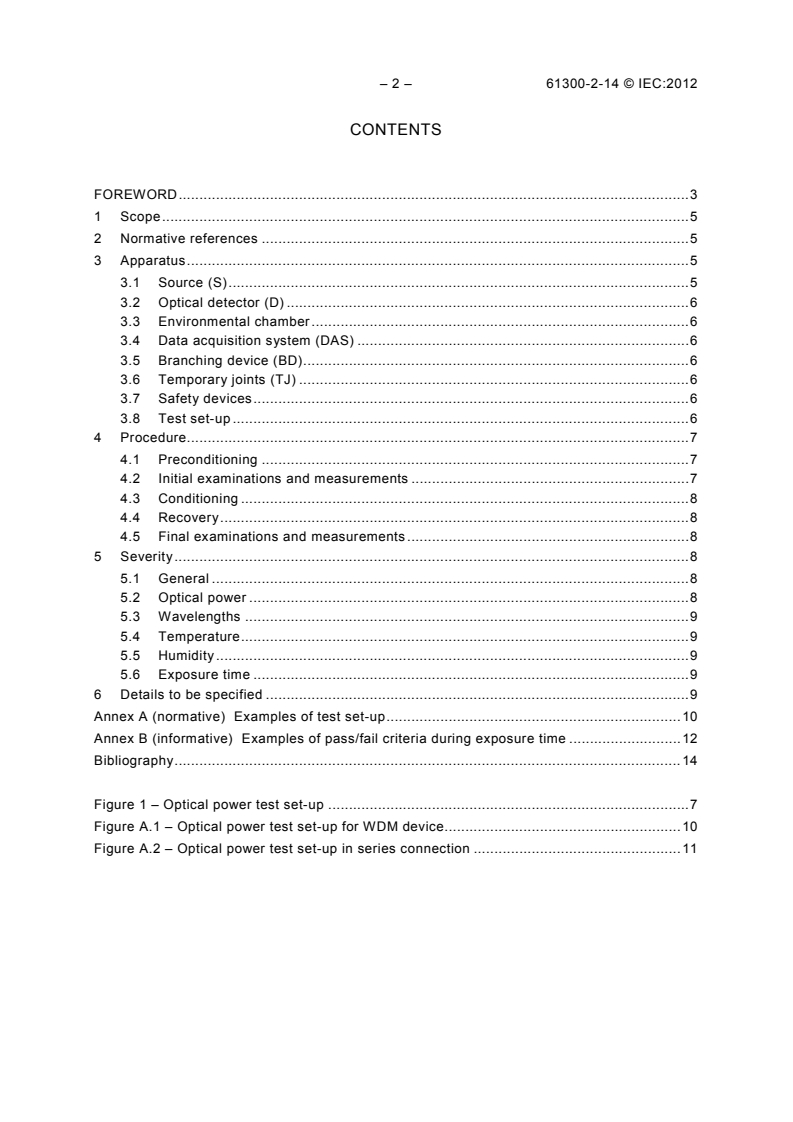
– 2 – 61300-2-14 © IEC:2012
CONTENTS
FOREWORD . 3
1 Scope . 5
2 Normative references . 5
3 Apparatus . 5
3.1 Source (S) . 5
3.2 Optical detector (D) . 6
3.3 Environmental chamber . 6
3.4 Data acquisition system (DAS) . 6
3.5 Branching device (BD) . 6
3.6 Temporary joints (TJ) . 6
3.7 Safety devices . 6
3.8 Test set-up . 6
4 Procedure. 7
4.1 Preconditioning . 7
4.2 Initial examinations and measurements . 7
4.3 Conditioning . 8
4.4 Recovery . 8
4.5 Final examinations and measurements . 8
5 Severity . 8
5.1 General . 8
5.2 Optical power . 8
5.3 Wavelengths . 9
5.4 Temperature . 9
5.5 Humidity . 9
5.6 Exposure time . 9
6 Details to be specified . 9
Annex A (normative) Examples of test set-up . 10
Annex B (informative) Examples of pass/fail criteria during exposure time . 12
Bibliography . 14
Figure 1 – Optical power test set-up . 7
Figure A.1 – Optical power test set-up for WDM device . 10
Figure A.2 – Optical power test set-up in series connection . 11
61300-2-14 © IEC:2012 – 3 –
INTERNATIONAL ELECTROTECHNICAL COMMISSION
____________
FIBRE OPTIC INTERCONNECTING DEVICES
AND PASSIVE COMPONENTS –
BASIC TEST AND MEASUREMENT PROCEDURES –
Part 2-14: Tests – High optical power
FOREWORD
1) The International Electrotechnical Commission (IEC) is a worldwide organization for standardization comprising
all national electrotechnical committees (IEC National Committees). The object of IEC is to promote
international co-operation on all questions concerning standardization in the electrical and electronic fields. To
this end and in addition to other activities, IEC publishes International Standards, Technical Specifications,
Technical Reports, Publicly Available Specifications (PAS) and Guides (hereafter referred to as “IEC
Publication(s)”). Their preparation is entrusted to technical committees; any IEC National Committee interested
in the subject dealt with may participate in this preparatory work. International, governmental and non-
governmental organizations liaising with the IEC also participate in this preparation. IEC collaborates closely
with the International Organization for Standardization (ISO) in accordance with conditions determined by
agreement between the two organizations.
2) The formal decisions or agreements of IEC on technical matters express, as nearly as possible, an international
consensus of opinion on the relevant subjects since each technical committee has representation from all
interested IEC National Committees.
3) IEC Publications have the form of recommendations for international use and are accepted by IEC National
Committees in that sense. While all reasonable efforts are made to ensure that the technical content of IEC
Publications is accurate, IEC cannot be held responsible for the way in which they are used or for any
misinterpretation by any end user.
4) In order to promote international uniformity, IEC National Committees undertake to apply IEC Publications
transparently to the maximum extent possible in their national and regional publications. Any divergence
between any IEC Publication and the corresponding national or regional publication shall be clearly indicated in
the latter.
5) IEC itself does not provide any attestation of conformity. Independent certification bodies provide conformity
assessment services and, in some areas, access to IEC marks of conformity. IEC is not responsible for any
services carried out by independent certification bodies.
6) All users should ensure that they have the latest edition of this publication.
7) No liability shall attach to IEC or its directors, employees, servants or agents including individual experts and
members of its technical committees and IEC National Committees for any personal injury, property damage or
other damage of any nature whatsoever, whether direct or indirect, or for costs (including legal fees) and
expenses arising out of the publication, use of, or reliance upon, this IEC Publication or any other IEC
Publications.
8) Attention is drawn to the Normative references cited in this publication. Use of the referenced publications is
indispensable for the correct application of this publication.
9) Attention is drawn to the possibility that some of the elements of this IEC Publication may be the subject of
patent rights. IEC shall not be held responsible for identifying any or all such patent rights.
International Standard IEC 61300-2-14 has been prepared by subcommittee 86B: Fibre optic
interconnecting devices and passive components, of IEC technical committee 86: Fibre optics.
This third edition cancels and replaces the second edition published in 2005 and constitutes a
technical revision.
This edition includes the following significant technical change with respect to the previous
edition:
– fundamental change of the measurement method to introduce various measurement
environments such as limited testing resources.
– 4 – 61300-2-14 © IEC:2012
The text of this standard is based on the following documents:
FDIS Report on voting
86B/3488/FDIS 86B/3533/RVD
Full information on the voting for the approval of this standard can be found in the report on
voting indicated in the above table.
This publication has been drafted in accordance with the ISO/IEC Directives, Part 2.
A list of all parts in the IEC 61300 series, published under the general title Fibre optic
interconnecting devices and passive components – Basic test and measurement procedures,
can be found on the IEC website.
The committee has decided that the contents of this publication will remain unchanged until
the stability date indicated on the IEC web site under "http://webstore.iec.ch" in the data
related to the specific publication. At this date, the publication will be
• reconfirmed,
• withdrawn,
• replaced by a revised edition, or
• amended.
61300-2-14 © IEC:2012 – 5 –
FIBRE OPTIC INTERCONNECTING DEVICES
AND PASSIVE COMPONENTS –
BASIC TEST AND MEASUREMENT PROCEDURES –
Part 2-14: Tests – High optical power
1 Scope
This part of IEC 61300 describes a procedure for determining the suitability of a fibre optic
interconnecting device or a passive component to withstand the exposure to optical power
that may occur during operation.
NOTE General information and guidance concerning relevant test and measurement procedures is contained in
IEC 61300-1.
2 Normative references
The following documents, in whole or in part, are normatively referenced in this document and
are indispensable for its application. For dated references, only the edition cited applies. For
undated references, the latest edition of the referenced document (including any
amendments) applies.
IEC 60825-1, Safety of laser products – Part 1: Equipment classification and requirements
IEC 61300-1, Fibre optic interconnecting devices and passive components – Basic test and
measurement procedures – Part 1: General and guidance
IEC 61300-3-1, Fibre optic interconnecting devices and passive components – Basic test and
measurement procedures – Part 3-1: Examinations and measurements – Visual examination
IEC 61300-3-3, Fibre optic interconnecting devices and passive components – Basic test and
measurement procedures – Part 3-3: Examinations and measurements – Active monitoring of
changes in attenuation and return loss
IEC 61300-3-35, Fibre optic interconnecting devices and passive components – Basic test
and measurement procedures – Part 3-35: Examinations and measurements – Fibre optic
connector endface visual and automated inspection
3 Apparatus
3.1 Source (S)
The source unit consists of an optical emitter, the means to connect to it and the associated
drive electronics. A tunable light source (TLS) in which a specific output wavelength can be
tuned may be chosen as the optical emitter. A TLS may consist of a tunable LD and an optical
amplifier, or be a fibre ring laser in order to get an efficient power to test. Generally, the
power and stability requirements of a test will necessitate that the means to connect to the
optical emitter be a fibre pigtail. It shall be stable in output power and wavelength/frequency
over the measurement period. For DWDM devices, the frequency uncertainty (instead of the
wavelength uncertainty) shall be less than half of the channel bandwidth. Unless otherwise
stated in the relevant specification, the source shall have the following characteristics:
a) Centre wavelength uncertainty including stability:
– 6 – 61300-2-14 © IEC:2012
– nominal centre wavelength ±5 nm (for WWDM and CWDM devices);
b) Centre frequency uncertainty:
– nominal centre frequency ±6,3 GHz (for DWDM devices of 25 GHz channel bandwidth);
– nominal centre frequency ±12,5 GHz (for DWDM devices of 50 GHz channel
bandwidth);
– nominal centre frequency ±25 GHz (for DWDM devices of 100 GHz channel bandwidth).
c) Output power uncertainty and stability:
– nominal output power ±0,05 dB.
3.2 Optical detector (D)
The optical detector unit is an optical power meter and consists of an optical detector, the
means to connect to it and the associated electronics. The detectors shall have sufficient
dynamic range to make the necessary measurements and shall be linear over the
measurement range. The detectors shall be stable over the measurement period and shall
have an operational wavelength range consistent with the DUT. The connection to the
detectors shall be an adaptor that accepts a connector plug of the appropriate design. The
detectors shall be capable of capturing all light emitted by the connector plug. Unless
otherwise stated in the relevant specification, the detectors shall have the following
characteristics:
– linearity: ≤ ±0,1 dB;
– uncertainty including polarization dependency: ≤ ±0,05 dB;
– resolution: ≤ ±0,01 dB.
3.3 Environmental chamber
The test set-up shall include an environmental chamber capable of producing and maintaining
the specified temperature and/or humidity.
3.4 Data acquisition system (DAS)
Recording of the optical power readings at the optical detector may be done either manually
or automatically. Appropriate DAS shall be used where measurements are performed
automatically.
3.5 Branching device (BD)
The splitting ratio of the branching device shall be stable over the optical powers and
wavelengths chosen for the test. It shall also be insensitive to polarization. The branching
devices shall be stable during the test. The splitting ratio of 1:99 for branching devices is
recommended in order to input high power to the DUT and low power to the optical detector.
3.6 Temporary joints (TJ)
These are typically used in connecting the device under test to the test apparatus. Generally,
the optical power and stability requirements of a test will necessitate that the temporary joints
be fusion splices.
3.7 Safety devices
All necessary safety devices, including laser safety glasses, signs and other safety materials,
shall be provided in order to protect individuals from possible hazards during testing.
3.8 Test set-up
For two-port optical components, a typical layout for the test apparatus is shown in Figure 1.
61300-2-14 © IEC:2012 – 7 –
This test procedure involves the use of optical powers, which constitute a potential ocular and
skin hazard to test personnel. All necessary safety procedures shall be adopted in accordance
with IEC 60825-1. In particular, the DUT shall be unpowered (that is, with no power
propagating in the fibre) when conducting a visual examination.
Optical connectors shall not be used. Fusion splices shall be used for all connecting points as
described in 3.6.
Environmental
Metal doped fibre
chamber
(Termination)
S DUT
TJ
TJ
BD BD
D3 D1
D2
DAS
IEC 2024/12
Figure 1 – Optical power test set-up
For multiport devices such as branching devices, all combinations of input and output ports
shall be tested, unless otherwise stated in the relevant specification.
For WDM devices, multi-wavelength shall be input at the same time according to the
application. Clause A.1 describes an example of the test set-up for WDM devices.
To minimize test equipments, the DUTs can be connected as a series. Clause A.2 describes
an example of the test set-up for a series connection of DUTs.
4 Procedure
4.1 Preconditioning
The chosen test samples shall be representative of a standard product.
Prepare and clean the DUTs according to the manufacturer’s instructions. Visual examination
shall be undertaken in accordance with IEC 61300-3-1 and IEC 61300-3-35. Debris or the
presence of contamination is one of the primary causes of failure in high optical power
connector applications.
Precondition the DUTs for 2 h at the standard atmospheric conditions as defined in
IEC 61300-1, unless otherwise specified in the relevant specification.
4.2 Initial examinations and measurements
Complete initial examinations and measurements on the DUTs as required by the relevant
specification. The results of the initial measurement shall be within the limit established in the
relevant specification.
– 8 – 61300-2-14 © IEC:2012
4.3 Conditioning
4.3.1 Set the chamber and the DUT to the standard atmospheric conditions. Place the DUT in
the chamber in its normal operating position. The hook-ups of the DUT to the peripheral
equipment shall also be placed in its normal operating position, when required.
4.3.2 Adjust the chamber temperature and humidity to the specified severity. The rate of
change of temperature shall not exceed 1 °C/min, averaged over a maximum period of 5 min.
Allow the DUT to reach stable temperature and maintain the temperature for the exposure
time.
4.3.3 Set the wavelength and optical power to be input to the DUT and turn on the optical
source and input optical power to the DUT.
4.3.4 Continue to input the optical power to the DUT for the exposure time specified in
severity. Monitor the changes in attenuation and return loss of the DUT according to
IEC 61300-3-3 during the exposure time. The changes shall be within the pass criteria
specified in the relevant specification (see Annex B).
4.3.5 At the completion of the exposure time, stop inputting the optical power and change the
temperature in the chamber to the standard atmospheric condition. Continue to maintain the
DUT in the chamber while the temperature is gradually changed.
4.4 Recovery
Allow the DUT to remain under the standard atmospheric condition for 2 h, as defined in
IEC 61300-1, unless otherwise specified in the relevant specification.
4.5 Final examinations and measurements
On completion of the test, remove all fixtures and make final examinations and measurements
on the DUT, as required by the relevant specification, to ensure that there is no permanent
damage to the DUT. Clean the DUT according to the manufacturer’s instructions. The results
of the final measurement shall be within the limit established in the relevant specification.
Unless otherwise specified in the relevant specification, visually examine the DUT in
accordance with IEC 61300-3-1. Check for evidence of any degradation in the DUT. This may
include, for example:
a) broken, loose or damaged parts or accessories;
b) breaking or damage to the cable jacket, seals, strain relief or fibres;
c) displaced, bent, or broken parts.
5 Severity
5.1 General
Severity is a combination of an optical power, a wavelength, a temperature, humidity and an
exposure time. The severity shall be specified in the relevant specification.
5.2 Optical power
The optical power of the test shall be decided in consideration of the application, unless
otherwise stated in the relevant specification. The following optical powers are examples:
– 10 mW, 30 mW, 50 mW, 100 mW, 300 mW and 500 mW.
61300-2-14 © IEC:2012 – 9 –
5.3 Wavelengths
The test wavelength shall be the centre or typical wavelength of all operating wavelength
ranges specified in the relevant specification. The following wavelengths are examples:
– 980 nm, 1 310 nm, 1 490 nm, 1 510 nm, 1 550 nm, 1 580 nm, 1 610 nm and 1 650 nm.
For WDM devices, the combinations of multi-wavelengths which are input at the same time,
shall be decided in consideration of the application, unless otherwise stated in the relevant
specification.
5.4 Temperature
Unless otherwise stated in the relevant specification, the test temperature shall be the
maximum temperature of the operating temperature range specified in the relevant
specification.
5.5 Humidity
Unless otherwise stated in the relevant specification, the test humidity shall be controlled at
the maximum humidity of the operating humidity range specified in the relevant specification.
In case the DUT is hermetically seal-packaged, the test humidity does not need to be
controlled.
5.6 Exposure time
The test exposure time shall be decided in consideration of the thermal capacity of the DUT.
For a small component whose weight is approximately less than 0,1 kg, the test exposure time
of 30 min is recommended.
6 Details to be specified
The following details, as applicable, shall be specified in the relevant specification:
a) optical power;
b) wavelengths;
c) temperature;
d) humidity;
e) exposure time;
f) initial examinations, initial measurements and initial performance requirements;
g) examinations during test, measurements during test and performance requirements during
test;
h) final examinations, final measurements and final performance requirements;
i) deviations from test procedure;
j) additional pass/fail criteria;
k) number of ports and combinations of input and output ports;
l) combinations of multi-wavelengths which are input at the same time for WDM devices.
– 10 – 61300-2-14 © IEC:2012
Annex A
(normative)
Examples of test set-up
A.1 WDM devices
For WDM devices, multi-wavelength shall be input at the same time according to the
application. For two inputs/one output WDM components, a typical layout for the test
apparatus is shown in Figure A.1.
The optical power of the first wavelength is input from the source S1. In addition, the optical
power of the second wavelength is input from the source S2 at the same time. The optical
power ratio of the first wavelength and second wavelength shall be stated in the relevant
specification, based on the application. In Figure A.1, the attenuation changes for the first
wavelength and second wavelength are monitored at the wavelength tunable optical detector
D1, respectively. For the tunable optical detector D1, an OSA (Optical Spectrum Analyser), or
a combination of a tunable filter and an optical power meter, is recommended.
Environmental
Metal doped fibre
chamber
(Termination)
S1
DUT
TJ
TJ
BD BD
D1
(tunable
D3
D2
detector)
S2
TJ
BD
D5
D4
DAS
IEC 2025/12
Figure A.1 – Optical power test set-up for WDM device
A.2 Series connection set-up
To minimize test equipments, the DUT can be connected as a series. To test three DUTs
simultaneously, a typical layout for the test apparatus is shown in Figure A.2.
In this set-up, the optical power input to the last DUT, for example, DUT3 in Figure A.2, shall
be equal or higher than the optical power specified in the relevant specification.
61300-2-14 © IEC:2012 – 11 –
Environmental
chamber
S DUT1
TJ
TJ
BD BD
D3 D1
D2 D4
DUT2
TJ
TJ
BD
D5
D6
DUT3
Metal doped fibre
TJ
TJ
BD
(Termination)
D7
DAS
IEC 2026/12
Figure A.2 – Optical power test set-up in series connection
– 12 – 61300-2-14 © IEC:2012
Annex B
(informative)
Examples of pass/fail criteria during exposure time
B.1 General
During the exposure time of the optical power, only the changes in attenuation and return loss
can be measured according to IEC 61300-3-3. It shall be noted that polarization dependent
loss (PDL) and wavelength dependent loss (WDL) are difficult to monitor and the
measurement uncertainty might be larger than the initial and final measurements according to
IEC 61300-3-4 or some other standards in the IEC 61300 series.
B.2 Attenuation limitation of monitoring
The pass/fail criteria for attenuation limitation during the exposure shall include a
consideration of uncertainties caused by PDL, WDL and the measurement system itself, in
order to prevent the misclassification of a DUT within the limitation being misjudged as a
failure DUT. This attenuation limitation of monitoring could pass over some DUT, with slightly
high attenuation, from being classified as failure; however, some of those DUT could be
marked as a failure in the final measurement.
An example of attenuation limitation of monitoring A (dB) is:
limit,mon
A = A + A + A + A
limit,mon limit,offline PDL WDL error
where
A is the original attenuation limitation of offline measurement for initial and final
limit,offline
measurement (dB);
A is the PDL of the DUT or a constant specified in the relevant specification (dB);
PDL
A is the WDL of the DUT or a constant specified in the relevant specification
WDL
(dB);
A is the value based on the measurement error of the system including light
error
source stability, detector uncertainty and losses of temporary joints (dB).
During monitoring, the change of attenuation ∆A (dB) should be within following formula:
∆A(t) ≤ A – A
limit,offline 0,ini
where
A is the attenuation of the DUT measured in the initial measurement according to
0,ini
IEC 61300-3-4;
∆A(t) is the change of attenuation calculated from the measured optical power
change as ∆A(t) = P(t) – P(t = 0);
P(t = 0) is the measured output optical power at the first measurement of monitoring;
P(t) is the measured output optical power at the time of t.
B.3 Return loss limitation
The pass/fail criteria for return loss during the exposure could be specified by a similar
method.
61300-2-14 © IEC:2012 – 13 –
Sometimes the measurement system used for high optical power is not suitable for the
measurement of very high return loss limitation specified for initial and final measurement. In
such a case, another pass/fail criterion shall be adopted. An example is described in Clause
B.4.
B.4 Judgment based on the change
These examples of pass/fail criteria could be adopted as additional or alternative
requirements for Clauses B.1 and B.2. During monitoring, the change of attenuation ∆A (dB)
and the change of return loss ∆RL (dB) shall be within the following requirements:
– for a component with an initial insertion loss of less than 1,0 dB, ∆A ≤ 0,3 dB;
– fo
...