

IEC 62343-1-2:2007
(Main)Dynamic modules - Part 1-2: Performance standards - Dynamic chromatic dispersion compensator with pigtails for use in controlled environments (Category C)
General Information
- Abstract
This part of IEC 62343 contains the minimum initialisation test and measurement requirements and severities, which an optical dynamic chromatic dispersion compensator (DCDC) shall satisfy in order to be categorised as meeting the requirements of DCDC used in controlled environments. The requirements cover optical dynamic chromatic dispersion compensators for Category C - Controlled environments.
- Status
- Published
- Publication Date
- 10-Jul-2007
- Technical Committee
- SC 86C - Fibre optic systems, sensing and active devices
- Drafting Committee
- WG 5 - TC 86/SC 86C/WG 5
- Current Stage
- DELPUB - Deleted Publication
- Start Date
- 25-Jun-2015
- Completion Date
- 28-Aug-2026
Buy Documents
IEC 62343-1-2:2007 - Dynamic modules - Part 1-2: Performance standards - Dynamic chromatic dispersion compensator with pigtails for use in controlled environments (Category C) Released:7/11/2007
Overview
IEC 62343-1-2:2007 is an international standard published by the International Electrotechnical Commission (IEC) that defines performance standards for dynamic chromatic dispersion compensators (DCDC) with pigtails, specifically designed for use in controlled environments (Category C). This document establishes the minimum initialization test, measurement requirements, and performance severities needed for DCDC modules to qualify for operation within controlled settings. The standard supports the advancement and harmonization of optics in fiber communications by specifying rigorous testing protocols, performance criteria, and environmental considerations.
Key Topics
Dynamic Chromatic Dispersion Compensators (DCDC): Two-port in-line optical devices that automatically control and adjust time-varying dispersion in optical signals, ensuring optimized transmission quality.
Controlled Environments (Category C): Environments with regulated temperature and humidity where the devices operate, typically indoors or in data centers with climate control.
Performance Testing: Includes initialisation tests, measurement of insertion loss ripple, dispersion tuning time, and bandwidth characteristics across spectral bands aligned with ITU-T recommendations.
Spectral Bands and Operating Wavelengths: Tests cover multiple spectral bands such as O, E, S, C, L, and U bands consistent with ITU-T G. Sup39, ensuring compatibility across varying fiber optic systems.
Sample Size and Test Procedures: Minimum three modules per test, tested under IEC 61300 series conditions, with fiber length requirements for climatic and environmental tests.
Interface and Dimension Standards: Module dimensions comply with IEC interface standards or manufacturer specifications, with connectorized modules adhering to IEC 61753-021-2.
Applications
Fiber Optic Communications: Enhances data transmission quality by dynamically compensating for chromatic dispersion in high-speed optical networks.
DWDM Systems: Supports Dense Wavelength Division Multiplexing by stabilizing signal quality and reducing dispersion-induced errors across multiple wavelength channels.
Telecommunication Infrastructure: Enables reliable, high-performance operation of optical modules within controlled environment facilities like data centers, central offices, and network hubs.
Optical Network Equipment Manufacturing: Provides a compliance benchmark for manufacturers producing dynamic chromatic dispersion compensators, ensuring interoperability and consistent quality.
System Design and Testing: Aids network engineers and designers in selecting and validating DCDC modules per international performance and environmental standards.
Related Standards
IEC 61300 Series: Basic test and measurement procedures for fiber optic interconnecting devices and passive components, essential for module testing.
IEC 61753-021-2: Performance standard for fiber optic connectors terminated on single-mode fiber in controlled environments, applicable for connectorized DCDC modules.
ITU-T Recommendations G.671, G.692, G. Sup39: Define transmission characteristics, optical interfaces for multichannel systems, and optical system design considerations related to dispersion and wavelength management.
Practical Value
Implementing IEC 62343-1-2 ensures that dynamic chromatic dispersion compensators meet stringent quality and performance requirements required for stable optical communication networks. Adherence to this standard minimizes signal degradation caused by chromatic dispersion, improving network reliability, reducing downtime, and facilitating scalable bandwidth capacities. It provides manufacturers and users with a clear framework for testing, reporting, and compliance verification, promoting innovation and trust in optical module deployment for controlled environmental conditions.
Keywords
dynamic chromatic dispersion compensator, DCDC, controlled environment optical modules, IEC 62343-1-2, fiber optic standards, chromatic dispersion compensation, optical communications, DWDM systems, optical module testing, IEC standards, telecommunications equipment, spectral bands optical fiber
Relations
- Effective Date
- 05-Sep-2023
Buy Documents
IEC 62343-1-2:2007 - Dynamic modules - Part 1-2: Performance standards - Dynamic chromatic dispersion compensator with pigtails for use in controlled environments (Category C) Released:7/11/2007
Get Certified
Connect with accredited certification bodies for this standard

ANCE
Mexican certification and testing association.

Intertek Slovenia
Intertek testing, inspection, and certification services in Slovenia.

LNE (Laboratoire National de Métrologie et d'Essais)
French national laboratory for metrology and testing.
Sponsored listings
Frequently Asked Questions
IEC 62343-1-2:2007 is a standard published by the International Electrotechnical Commission (IEC). Its full title is "Dynamic modules - Part 1-2: Performance standards - Dynamic chromatic dispersion compensator with pigtails for use in controlled environments (Category C)". This standard covers: This part of IEC 62343 contains the minimum initialisation test and measurement requirements and severities, which an optical dynamic chromatic dispersion compensator (DCDC) shall satisfy in order to be categorised as meeting the requirements of DCDC used in controlled environments. The requirements cover optical dynamic chromatic dispersion compensators for Category C - Controlled environments.
This part of IEC 62343 contains the minimum initialisation test and measurement requirements and severities, which an optical dynamic chromatic dispersion compensator (DCDC) shall satisfy in order to be categorised as meeting the requirements of DCDC used in controlled environments. The requirements cover optical dynamic chromatic dispersion compensators for Category C - Controlled environments.
IEC 62343-1-2:2007 is classified under the following ICS (International Classification for Standards) categories: 33.180.30 - Optic amplifiers. The ICS classification helps identify the subject area and facilitates finding related standards.
IEC 62343-1-2:2007 has the following relationships with other standards: It is inter standard links to IEC 62343-1-2:2015. Understanding these relationships helps ensure you are using the most current and applicable version of the standard.
IEC 62343-1-2:2007 is available in PDF format for immediate download after purchase. The document can be added to your cart and obtained through the secure checkout process. Digital delivery ensures instant access to the complete standard document.
Standards Content (Sample)
INTERNATIONAL IEC
STANDARD
CEI
62343-1-2
NORME
First edition
INTERNATIONALE
Première édition
2007-07
Dynamic modules –
Part 1-2:
Performance standards –
Dynamic chromatic dispersion
compensator with pigtails for use
in controlled environments (Category C)
Modules dynamiques –
Partie 1-2:
Normes de qualité de fonctionnement –
Compensateur de dispersion chromatique
dynamique avec fibres-amorces, pour usage
en environnements contrôlés (Catégorie C)
Reference number
Numéro de référence
IEC/CEI 62343-1-2:2007
All rights reserved. Unless otherwise specified, no part of this publication may be reproduced or utilized in any form
or by any means, electronic or mechanical, including photocopying and microfilm, without permission in writing from
either IEC or IEC's member National Committee in the country of the requester.
If you have any questions about IEC copyright or have an enquiry about obtaining additional rights to this publication,
please contact the address below or your local IEC member National Committee for further information.
Droits de reproduction réservés. Sauf indication contraire, aucune partie de cette publication ne peut être reproduite
ni utilisée sous quelque forme que ce soit et par aucun procédé, électronique ou mécanique, y compris la photocopie
et les microfilms, sans l'accord écrit de la CEI ou du Comité national de la CEI du pays du demandeur.
Si vous avez des questions sur le copyright de la CEI ou si vous désirez obtenir des droits supplémentaires sur cette
publication, utilisez les coordonnées ci-après ou contactez le Comité national de la CEI de votre pays de résidence.
IEC Central Office
3, rue de Varembé
CH-1211 Geneva 20
Switzerland
Email: inmail@iec.ch
Web: www.iec.ch
About the IEC
The International Electrotechnical Commission (IEC) is the leading global organization that prepares and publishes
International Standards for all electrical, electronic and related technologies.
About IEC publications
The technical content of IEC publications is kept under constant review by the IEC. Please make sure that you have the
latest edition, a corrigenda or an amendment might have been published.
ƒ Catalogue of IEC publications: www.iec.ch/searchpub
The IEC on-line Catalogue enables you to search by a variety of criteria (reference number, text, technical committee,…).
It also gives information on projects, withdrawn and replaced publications.
ƒ IEC Just Published: www.iec.ch/online_news/justpub
Stay up to date on all new IEC publications. Just Published details twice a month all new publications released. Available
on-line and also by email.
ƒ Customer Service Centre: www.iec.ch/webstore/custserv
If you wish to give us your feedback on this publication or need further assistance, please visit the Customer Service
Centre FAQ or contact us:
Email: csc@iec.ch
Tel.: +41 22 919 02 11
Fax: +41 22 919 03 00
A propos de la CEI
La Commission Electrotechnique Internationale (CEI) est la première organisation mondiale qui élabore et publie des
normes internationales pour tout ce qui a trait à l'électricité, à l'électronique et aux technologies apparentées.
A propos des publications CEI
Le contenu technique des publications de la CEI est constamment revu. Veuillez vous assurer que vous possédez
l’édition la plus récente, un corrigendum ou amendement peut avoir été publié.
ƒ Catalogue des publications de la CEI: www.iec.ch/searchpub/cur_fut-f.htm
Le Catalogue en-ligne de la CEI vous permet d’effectuer des recherches en utilisant différents critères (numéro de
référence, texte, comité d’études,…). Il donne aussi des informations sur les projets et les publications retirées ou
remplacées.
ƒ Just Published CEI: www.iec.ch/online_news/justpub
Restez informé sur les nouvelles publications de la CEI. Just Published détaille deux fois par mois les nouvelles
publications parues. Disponible en-ligne et aussi par email.
ƒ Service Clients: www.iec.ch/webstore/custserv/custserv_entry-f.htm
Si vous désirez nous donner des commentaires sur cette publication ou si vous avez des questions, visitez le FAQ du
Service clients ou contactez-nous:
Email: csc@iec.ch
Tél.: +41 22 919 02 11
Fax: +41 22 919 03 00
INTERNATIONAL IEC
STANDARD
CEI
62343-1-2
NORME
First edition
INTERNATIONALE
Première édition
2007-07
Dynamic modules –
Part 1-2:
Performance standards –
Dynamic chromatic dispersion
compensator with pigtails for use
in controlled environments (Category C)
Modules dynamiques –
Partie 1-2:
Normes de qualité de fonctionnement –
Compensateur de dispersion chromatique
dynamique avec fibres-amorces, pour usage
en environnements contrôlés (Catégorie C)
PRICE CODE
L
CODE PRIX
Commission Electrotechnique Internationale
International Electrotechnical Commission
МеждународнаяЭлектротехническаяКомиссия
For price, see current catalogue
Pour prix, voir catalogue en vigueur
– 2 – 62343-1-2 © IEC:2007
CONTENTS
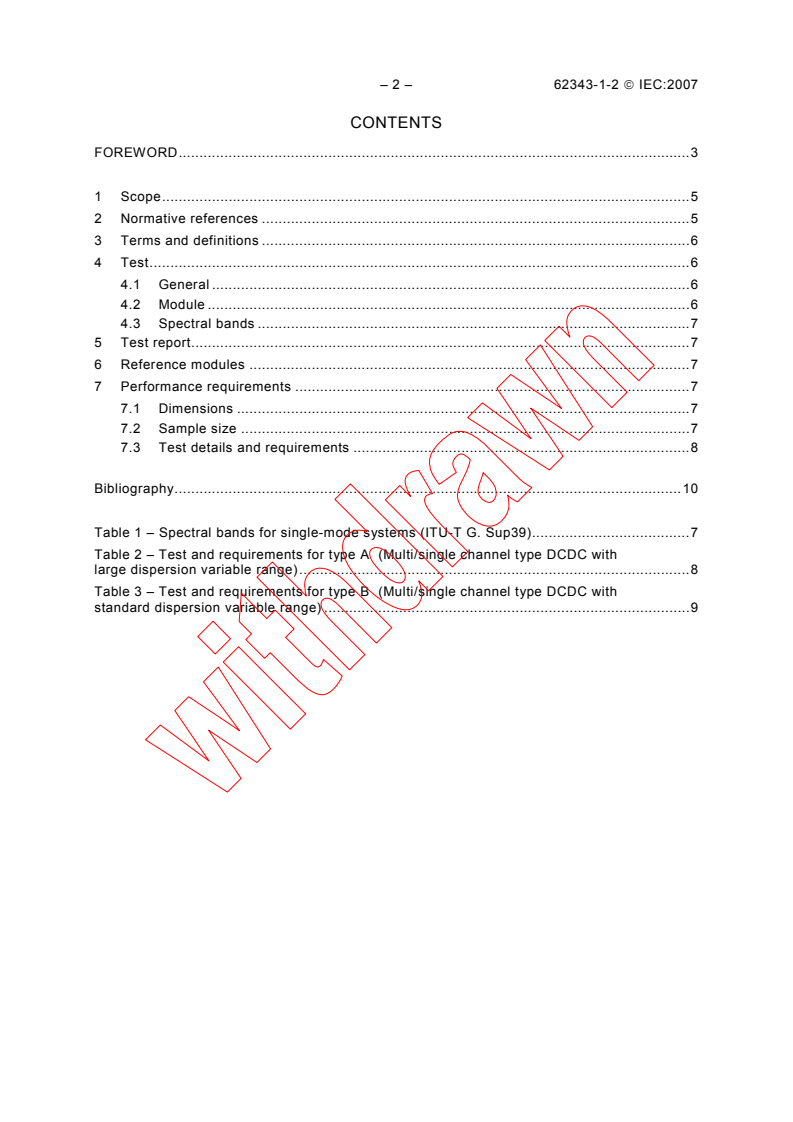
FOREWORD.3
1 Scope.5
2 Normative references .5
3 Terms and definitions .6
4 Test.6
4.1 General .6
4.2 Module .6
4.3 Spectral bands .7
5 Test report.7
6 Reference modules .7
7 Performance requirements .7
7.1 Dimensions .7
7.2 Sample size .7
7.3 Test details and requirements .8
Bibliography.10
Table 1 – Spectral bands for single-mode systems (ITU-T G. Sup39).7
Table 2 – Test and requirements for type A (Multi/single channel type DCDC with
large dispersion variable range).8
Table 3 – Test and requirements for type B (Multi/single channel type DCDC with
standard dispersion variable range) .9
62343-1-2 © IEC:2007 – 3 –
INTERNATIONAL ELECTROTECHNICAL COMMISSION
____________
DYNAMIC MODULES –
Part 1-2: Performance standards –
Dynamic chromatic dispersion compensator
with pigtails for use in controlled environments
(Category C)
FOREWORD
1) The International Electrotechnical Commission (IEC) is a worldwide organization for standardization comprising
all national electrotechnical committees (IEC National Committees). The object of IEC is to promote
international co-operation on all questions concerning standardization in the electrical and electronic fields. To
this end and in addition to other activities, IEC publishes International Standards, Technical Specifications,
Technical Reports, Publicly Available Specifications (PAS) and Guides (hereafter referred to as “IEC
Publication(s)”). Their preparation is entrusted to technical committees; any IEC National Committee interested
in the subject dealt with may participate in this preparatory work. International, governmental and non-
governmental organizations liaising with the IEC also participate in this preparation. IEC collaborates closely
with the International Organization for Standardization (ISO) in accordance with conditions determined by
agreement between the two organizations.
2) The formal decisions or agreements of IEC on technical matters express, as nearly as possible, an international
consensus of opinion on the relevant subjects since each technical committee has representation from all
interested IEC National Committees.
3) IEC Publications have the form of recommendations for international use and are accepted by IEC National
Committees in that sense. While all reasonable efforts are made to ensure that the technical content of IEC
Publications is accurate, IEC cannot be held responsible for the way in which they are used or for any
misinterpretation by any end user.
4) In order to promote international uniformity, IEC National Committees undertake to apply IEC Publications
transparently to the maximum extent possible in their national and regional publications. Any divergence
between any IEC Publication and the corresponding national or regional publication shall be clearly indicated in
the latter.
5) IEC provides no marking procedure to indicate its approval and cannot be rendered responsible for any
equipment declared to be in conformity with an IEC Publication.
6) All users should ensure that they have the latest edition of this publication.
7) No liability shall attach to IEC or its directors, employees, servants or agents including individual experts and
members of its technical committees and IEC National Committees for any personal injury, property damage or
other damage of any nature whatsoever, whether direct or indirect, or for costs (including legal fees) and
expenses arising out of the publication, use of, or reliance upon, this IEC Publication or any other IEC
Publications.
8) Attention is drawn to the Normative references cited in this publication. Use of the referenced publications is
indispensable for the correct application of this publication.
9) Attention is drawn to the possibility that some of the elements of this IEC Publication may be the subject of
patent rights. IEC shall not be held responsible for identifying any or all such patent rights.
International Standard IEC 62343-1-2 has been prepared by subcommittee 86C: Fibre optic
systems and active devices, of IEC technical committee 86: Fibre optics.
The text of this standard is based on the following documents:
CDV Result of voting
86C/698/CDV 86C/755/RVC
Full information on the voting for the approval of this standard can be found in the report on
voting indicated in the above table.
This publication has been drafted in accordance with the ISO/IEC Directives, Part 2.
– 4 – 62343-1-2 © IEC:2007
A list of all parts of IEC 62343 series, under the general title Dynamic modules, can be found
on the IEC website.
The committee has decided that the contents of this publication will remain unchanged until
the maintenance result date indicated on the IEC web site under "http://webstore.iec.ch" in
the data related to the specific publication. At this date, the publication will be
• reconfirmed,
• withdrawn,
• replaced by a revised edition, or
• amended.
62343-1-2 © IEC:2007 – 5 –
DYNAMIC MODULES –
Part 1-2: Performance standards –
Dynamic chromatic dispersion compensator
with pigtails for use in controlled environments
(Category C)
1 Scope
This part of IEC 62343 contains the minimum initialisation test and measurement
requirements and severities, which an optical dynamic chromatic dispersion compensator
(DCDC) shall satisfy in order to be categorised as meeting the requirements of DCDC used in
controlled environments. The requirements cover optical dynamic chromatic dispersion
compensators for Category C – Controlled environments.
2 Normative references
The following referenced documents are indispensable for the application of this document.
For dated references, only the edition cited applies. For undated references, the latest edition
of the referenced document (including any amendments) applies.
IEC 61300 (all parts), Fibre optic interconnecting devices and passive components – Basic
test and measurement procedures
IEC 61300-1, Fibre optic interconnecting devices and passive components – Basic test and
measurement procedures – Part 1: General and guidance
IEC 61300-3-2, Fibre optic interconnecting devices and passive components – Basic test and
measurement procedures – Part 3-2: Examinations and measurements – Polarization
dependence of attenuation in a single-mode fibre optic device
IEC 61300-3-29, Fibre optic interconnecting devices and passive components – Basic test
and measurement procedures – Part 3-29: Examinations and measurements – Measurement
techniques for characterizing the amplitude of the spectral transfer function of DWDM
components
IEC 61300-3-32, Fibre optic interconnecting devices and passive components – Basic test
and measurement procedures – Part 3-32: Examinations and measurements – Polarization
mode dispersion measurement for passive optical components
IEC 61753-021-2: Fibre optic interconnecting devices and passive components performance
standard – Part 021-2: Fibre optic connectors terminated on single-mode fibre for category C
– Controlled environment
ITU-T Recommendation G.671: Transmission characteristics of optical components and sub-
systems
ITU-T Recommendation G.692: Optical interfaces for multichannel systems with optical
amplifiers
ITU-T G. Sup39: Optical system design and engineering considerations
– 6 – 62343-1-2 © IEC:2007
3 Terms and definitions
For the purposes of this document, the following definitions apply.
3.1
dynamic chromatic dispersion compensator
two-port in-line device that is capable of transforming, by internal or external automatic
control, an input signal with time-varying dispersion into an output signal in which an output
channel dispersion value is set for a required level of value
3.2
operating wavelength range
the specified range of wavelengths from λ to λ about a nominal operating wavelength λ ,
imin imax I
within which a dynamic optical module is designed to operate with a specified performance
3.3
channel frequency range
the frequency range within which a device is expected to operate with a specified
performance. For a particular nominal channel central frequency, f , this frequency range is
nomi
from f = (f - Δf ) to f = (f + Δf ), where Δf is the maximum channel central
imin nomi max imax nomi max max
frequency deviation.
3.4
insertion loss ripple
the maximum peak-to-peak variation of the insertion loss within a channel frequency (or
wavelength) range
3.5
channel spacing
the centre to centre difference in frequency (or wavelength) between adjacent channels in a
device
3.6
dispersion tuning time
the longest elapsed time it takes a module to change a dispersion setting from an arbitrary
initial dispersion value to a desired final dispersion value, when the resulting dispersion target
tolerance is met
4 Test
4.1 General
The characterization of a dynamic chromatic dispersion compensator requires demonstration
that those components or features within the module, together with that of the module itself,
are capable of yielding the performance requirements as defined in the relevant specification.
Where it can be adequately demonstrated that components or features have previously met
all of the requirements of a specific performance standard category, they may be declared as
complying with that performance standard. This may obviate the need for repeat testing of
components or features in such cases. Where this occurs, reference shall be made to the
relevant test reports or documentation.
4.2 Module
Unless otherwise specified, all DCDC module test methods shall be in accordance with the
IEC 61300 series.
62343-1-2 © IEC:2007 – 7 –
DCDC modules used for each test are intended to be previously unstressed new samples but
may be selected from previously used samples if desired. Each test defines the number of
samples to be evaluated.
All measurements shall be carried out at standard test conditions, as defined in IEC 61300-1,
unless otherwise stated. If the module is provided with an active temperature control, this
shall be set at the setpoint specified by the manufacturer.
The defined performance requirements apply to every combination of input and output port,
over all polarization states and over all specified environmental conditions.
4.3 Spectral bands
All tests are to be carried out to validate performance over the required operating wavelength
range. As a result, single or multiple spectral bands may be chosen for the qualification and
differing target specifications may be assigned to each spectral band.
Table 1 is intended to provide guidance on the wavelength ranges of the various spectral
bands. It is not intended for specification. Values of operating wavelength used in
performance verification shall be specified between the customer and supplier or shall be as
defined in the manufacturer’s specification.
Table 1 – Spectral bands for single-mode systems (ITU-T G. Sup39)
Band Descriptor Range
nm
O-band Original 1 260 to 1 360
E-band Extended 1 360 to 1 460
S-band Short wavelength 1 460 to 1 530
C-band Conventional 1 530 to 1 565
L-band Long wavelength 1 565 to 1 625
U-band Ultralong wavelength 1 625 to 1 675
5 Test report
Fully documented test reports and supporting evidence shall be prepared and be available for
inspections as evidence that the tests have been carried out and complied with.
6 Reference modules
The testing for these modules does not require the use of reference modules.
7 Performance requirements
7.1 Dimensions
Dimensions shall comply with either an appropriate IEC interface standard or with those given
in the manufacturer's drawings, where the IEC interface standard does not exist or cannot be
used.
7.2 Sample size
Three (3) DCDC modules are used in each module test. The tests may be performed
individually or in sequential order.
– 8 – 62343-1-2 © IEC:2007
The test sample size and sequencing requirements for the modules shall be defined in the
relevant specification.
7.3 Test details and requirements
The requirements are given only for non-connectorised DCDC modules. For connectorised
modules, the connector performances shall be in compliance with IEC 61753-021-2.
A minimum length of fibre or cable of 1,5 m per port shall be included in all climatic and
environmental tests.
Unless otherwise specified, the insertion loss and the bandpass of the device during an
environmental test shall be measured for a single input/output port combination.
The channel spacings, unless otherwise specified, shall be in accordance with ITU-T
Recommendation G.692.
The test details and requirements for performance standard category C are shown in Tables 2
and 3.
Table 2 – Test and requirements for type A
(Multi/single channel type DCDC with large dispersion variable range)
No Tests Requirements Details
1A Channel frequency range (ITU-T-grid) ±10 GHz (for 10 Gbps) ITU-T Recommendation G.671
(ITU-T-grid) ±40 GHz (for 40 Gbps)
2A Dispersion variable range –1 800 ps/nm to +1 800 ps/nm (for Method under consideration
10 Gbps)
–400 ps/nm to +400 ps/nm (for 40
Gbps)
3A Insertion loss IEC 61300-3-29
≤ 12 dB
4A Insertion loss ripple < 0,5 dB IEC 61300-3-29
over the channel frequency range
5A Group delay ripple Method under consideration
≤ ± 6 ps (for 10 Gbps)
Method under consideration
≤ ± 2 ps (for 40 Gbps)
6A Polarization dependent IEC 61300-3-2
≤ 0,6 dB
loss
over the channel frequency range
7A Inter-channel loss ≤ 0,85 dB (Only multi-channel type ) IEC 61300-3-29
uniformity
8A Polarization mode ≤ 3 ps (for 10 Gbps) IEC 61300-3-32
dispersion
JME/PSA, PPS methods
≤ 1 ps (for 40 Gbps)
9A Dispersion setting error ≤ ± 5 ps/nm The same as in test no.2
10A Dispersion tuning time
≤ 30 s
11A Power consumption
≤ 10 W
12A Optical power handling +23 dBm Method under consideration
and damage threshold
characterisation
62343-1-2 © IEC:2007 – 9 –
Table 3 – Test and requirements for type B
(Multi/single channel type DCDC with standard dispersion variable range)
No Tests Requirements Details
1B Channel frequency range ITU-T Recommendation G.671
(ITU-T-grid) ±10 GHz (10 Gbps)
(ITU-T- grid) ±40 GHz (40 Gbps)
2B Dispersion variabl
...