

IEC TS 63111:2025
(Main)Hydraulic turbines, storage pumps and pump-turbines – Hydraulic transient analysis, design considerations and testing
General Information
- Abstract
IEC TS 63111:2025 describes hydraulic transient phenomena of hydro turbines, storage pumps and pump-turbines and the factors that affect them, (2) provides modelling and measurement best practice guidelines and resulting limitations (3) defines relevant equipment design criteria, and (4) identifies potential mitigation solutions. Definitions of the relevant terms and quantities are provided along with descriptions of the system components that are considered. In this Technical Specification, abnormal transient phenomena are also defined and described, including component malfunction and catastrophic events like component rupture. The probability of the occurrence of these extreme events and how this can influence the relevant safety margin is described. This Technical Specification provides guidelines and commonly accepted practices to model and compute transient conditions. It provides a summary of the basic hypotheses and equations, together with relevant characteristic quantities and system time constants. Accepted methods of modelling hydraulic components, and related numerical simulation methods are identified. This specification details the input data, including best practices for model testing of hydraulic machines, valves, gates, etc. to acquire reliable transient modelling. This Technical Specification describes methodologies for on-site measurements with respect to transient such as load rejection tests, runaway tests, etc. Recommendations are provided for quantities to be monitored during these tests, with related instrumentation, calibration and data acquisition systems. Procedures for comparing on-site measurements with numerical simulation results are proposed.
- Status
- Published
- Publication Date
- 09-Oct-2025
- Technical Committee
- TC 4 - Hydraulic turbines
- Drafting Committee
- WG 36 - TC 4/WG 36
- Current Stage
- PPUB - Publication issued
- Start Date
- 10-Oct-2025
- Completion Date
- 15-Aug-2025


Overview
IEC TS 63111:2025 - Hydraulic turbines, storage pumps and pump‑turbines – Hydraulic transient analysis, design considerations and testing - is a Technical Specification from IEC that addresses hydraulic transient phenomena in hydropower and pumped‑storage systems. It describes the causes and effects of transients (including waterhammer and mass oscillations), sets out modelling and measurement best practices, defines equipment design criteria, and identifies mitigation options. The specification also covers abnormal and catastrophic events, their probabilities, and implications for safety margins.
Key topics and technical requirements
- Hydraulic transient phenomena: waterhammer, mass oscillation, machine transients, counter‑thrust and uplift.
- Definitions and system description: standardized terms, symbols, units and component descriptions (penstocks, surge tanks, valves, turbines).
- Governing equations & solution methods: presentation of basic hypotheses, equations and accepted numerical methods (analytical, graphical, method of characteristics, finite difference).
- Component modelling: recommended models for pipes (elastic/rigid columns), valves, surge tanks and hydraulic machines plus limitations of each model.
- Input data & testing: best practices for acquiring reliable transient model inputs via model testing of machines, valves and gates.
- On‑site transient tests: methodologies for load rejection, runaway and commissioning tests; recommended monitored quantities, instrumentation, calibration and data acquisition.
- Validation & uncertainty: software validation, statistical treatment of measured data, definitions of error and uncertainty for comparing measurements with simulations.
- Load cases & design margins: classification of normal, exceptional and catastrophic load cases, guidance on combinations and depth of analysis at project stages.
- Mitigation: identification of potential technical mitigation solutions and limitations.
Practical applications
- Design and verification of penstocks, surge tanks and control valves to withstand transient loads.
- Calibration and validation of transient simulation tools used in hydropower and pumped‑storage projects.
- Preparation and execution of on‑site tests (load rejection, runaway, first filling) and interpretation of measured transient data.
- Risk assessment for abnormal and catastrophic events and determination of safety margins.
- Informing operational procedures and protective system settings to reduce transient impact.
Who should use this standard
- Hydropower and pumped‑storage design engineers and OEMs
- Test and commissioning engineers and site teams
- Numerical modelers and software developers for transient analysis
- Plant operators, asset owners and regulators
- Consultants and researchers in hydraulic machinery and fluid transient dynamics
Related standards
Refer to other IEC and national standards covering hydraulic machines, commissioning tests, instrumentation and safety for complementary requirements and normative references.
Get Certified
Connect with accredited certification bodies for this standard

DNV
DNV is an independent assurance and risk management provider.

Lloyd's Register
Lloyd's Register is a global professional services organisation specialising in engineering and technology.
DNV Energy Systems
Energy and renewable energy certification.
Sponsored listings
Frequently Asked Questions
IEC TS 63111:2025 is a technical specification published by the International Electrotechnical Commission (IEC). Its full title is "Hydraulic turbines, storage pumps and pump-turbines – Hydraulic transient analysis, design considerations and testing". This standard covers: IEC TS 63111:2025 describes hydraulic transient phenomena of hydro turbines, storage pumps and pump-turbines and the factors that affect them, (2) provides modelling and measurement best practice guidelines and resulting limitations (3) defines relevant equipment design criteria, and (4) identifies potential mitigation solutions. Definitions of the relevant terms and quantities are provided along with descriptions of the system components that are considered. In this Technical Specification, abnormal transient phenomena are also defined and described, including component malfunction and catastrophic events like component rupture. The probability of the occurrence of these extreme events and how this can influence the relevant safety margin is described. This Technical Specification provides guidelines and commonly accepted practices to model and compute transient conditions. It provides a summary of the basic hypotheses and equations, together with relevant characteristic quantities and system time constants. Accepted methods of modelling hydraulic components, and related numerical simulation methods are identified. This specification details the input data, including best practices for model testing of hydraulic machines, valves, gates, etc. to acquire reliable transient modelling. This Technical Specification describes methodologies for on-site measurements with respect to transient such as load rejection tests, runaway tests, etc. Recommendations are provided for quantities to be monitored during these tests, with related instrumentation, calibration and data acquisition systems. Procedures for comparing on-site measurements with numerical simulation results are proposed.
IEC TS 63111:2025 describes hydraulic transient phenomena of hydro turbines, storage pumps and pump-turbines and the factors that affect them, (2) provides modelling and measurement best practice guidelines and resulting limitations (3) defines relevant equipment design criteria, and (4) identifies potential mitigation solutions. Definitions of the relevant terms and quantities are provided along with descriptions of the system components that are considered. In this Technical Specification, abnormal transient phenomena are also defined and described, including component malfunction and catastrophic events like component rupture. The probability of the occurrence of these extreme events and how this can influence the relevant safety margin is described. This Technical Specification provides guidelines and commonly accepted practices to model and compute transient conditions. It provides a summary of the basic hypotheses and equations, together with relevant characteristic quantities and system time constants. Accepted methods of modelling hydraulic components, and related numerical simulation methods are identified. This specification details the input data, including best practices for model testing of hydraulic machines, valves, gates, etc. to acquire reliable transient modelling. This Technical Specification describes methodologies for on-site measurements with respect to transient such as load rejection tests, runaway tests, etc. Recommendations are provided for quantities to be monitored during these tests, with related instrumentation, calibration and data acquisition systems. Procedures for comparing on-site measurements with numerical simulation results are proposed.
IEC TS 63111:2025 is classified under the following ICS (International Classification for Standards) categories: 27.140 - Hydraulic energy engineering. The ICS classification helps identify the subject area and facilitates finding related standards.
IEC TS 63111:2025 is available in PDF format for immediate download after purchase. The document can be added to your cart and obtained through the secure checkout process. Digital delivery ensures instant access to the complete standard document.
Standards Content (Sample)
IEC TS 63111 ®
Edition 1.0 2025-10
TECHNICAL
SPECIFICATION
Hydraulic turbines, storage pumps and pump-turbines – Hydraulic transient
analysis, design considerations and testing
ICS 27.140 ISBN 978-2-8327-0605-3
All rights reserved. Unless otherwise specified, no part of this publication may be reproduced or utilized in any form or
by any means, electronic or mechanical, including photocopying and microfilm, without permission in writing from either
IEC or IEC's member National Committee in the country of the requester. If you have any questions about IEC copyright
or have an enquiry about obtaining additional rights to this publication, please contact the address below or your local
IEC member National Committee for further information.
IEC Secretariat Tel.: +41 22 919 02 11
3, rue de Varembé info@iec.ch
CH-1211 Geneva 20 www.iec.ch
Switzerland
About the IEC
The International Electrotechnical Commission (IEC) is the leading global organization that prepares and publishes
International Standards for all electrical, electronic and related technologies.
About IEC publications
The technical content of IEC publications is kept under constant review by the IEC. Please make sure that you have the
latest edition, a corrigendum or an amendment might have been published.
IEC publications search - IEC Products & Services Portal - products.iec.ch
webstore.iec.ch/advsearchform Discover our powerful search engine and read freely all the
The advanced search enables to find IEC publications by a publications previews, graphical symbols and the glossary.
variety of criteria (reference number, text, technical With a subscription you will always have access to up to date
committee, …). It also gives information on projects, content tailored to your needs.
replaced and withdrawn publications.
Electropedia - www.electropedia.org
The world's leading online dictionary on electrotechnology,
IEC Just Published - webstore.iec.ch/justpublished
Stay up to date on all new IEC publications. Just Published containing more than 22 500 terminological entries in English
details all new publications released. Available online and and French, with equivalent terms in 25 additional languages.
once a month by email. Also known as the International Electrotechnical Vocabulary
(IEV) online.
IEC Customer Service Centre - webstore.iec.ch/csc
If you wish to give us your feedback on this publication or
need further assistance, please contact the Customer
Service Centre: sales@iec.ch.
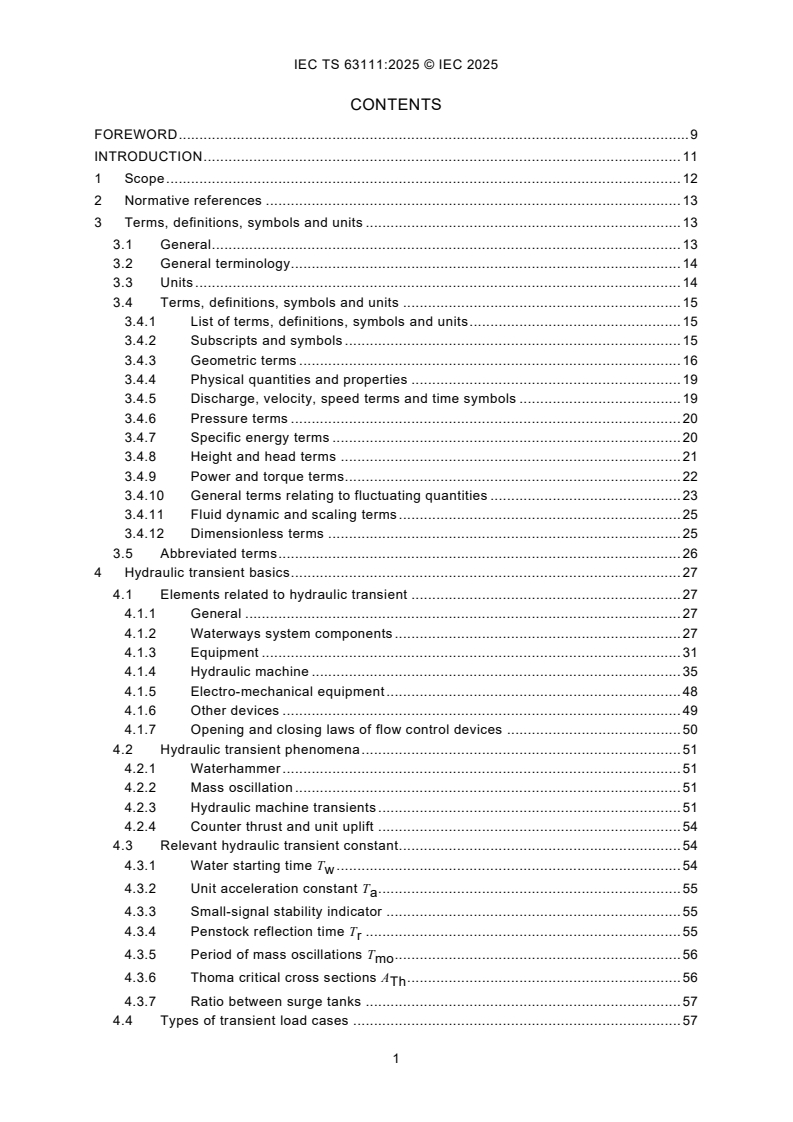
CONTENTS
FOREWORD . 9
INTRODUCTION . 11
1 Scope . 12
2 Normative references . 13
3 Terms, definitions, symbols and units . 13
3.1 General . 13
3.2 General terminology . 14
3.3 Units . 14
3.4 Terms, definitions, symbols and units . 15
3.4.1 List of terms, definitions, symbols and units . 15
3.4.2 Subscripts and symbols . 15
3.4.3 Geometric terms . 16
3.4.4 Physical quantities and properties . 19
3.4.5 Discharge, velocity, speed terms and time symbols . 19
3.4.6 Pressure terms . 20
3.4.7 Specific energy terms . 20
3.4.8 Height and head terms . 21
3.4.9 Power and torque terms . 22
3.4.10 General terms relating to fluctuating quantities . 23
3.4.11 Fluid dynamic and scaling terms . 25
3.4.12 Dimensionless terms . 25
3.5 Abbreviated terms . 26
4 Hydraulic transient basics . 27
4.1 Elements related to hydraulic transient . 27
4.1.1 General . 27
4.1.2 Waterways system components . 27
4.1.3 Equipment . 31
4.1.4 Hydraulic machine . 35
4.1.5 Electro-mechanical equipment . 48
4.1.6 Other devices . 49
4.1.7 Opening and closing laws of flow control devices . 50
4.2 Hydraulic transient phenomena . 51
4.2.1 Waterhammer . 51
4.2.2 Mass oscillation . 51
4.2.3 Hydraulic machine transients . 51
4.2.4 Counter thrust and unit uplift . 54
4.3 Relevant hydraulic transient constant . 54
4.3.1 Water starting time T . 54
w
4.3.2 Unit acceleration constant T . 55
a
4.3.3 Small-signal stability indicator . 55
4.3.4 Penstock reflection time T . 55
r
4.3.5 Period of mass oscillations T . 56
mo
4.3.6 Thoma critical cross sections A . 56
Th
4.3.7 Ratio between surge tanks . 57
4.4 Types of transient load cases . 57
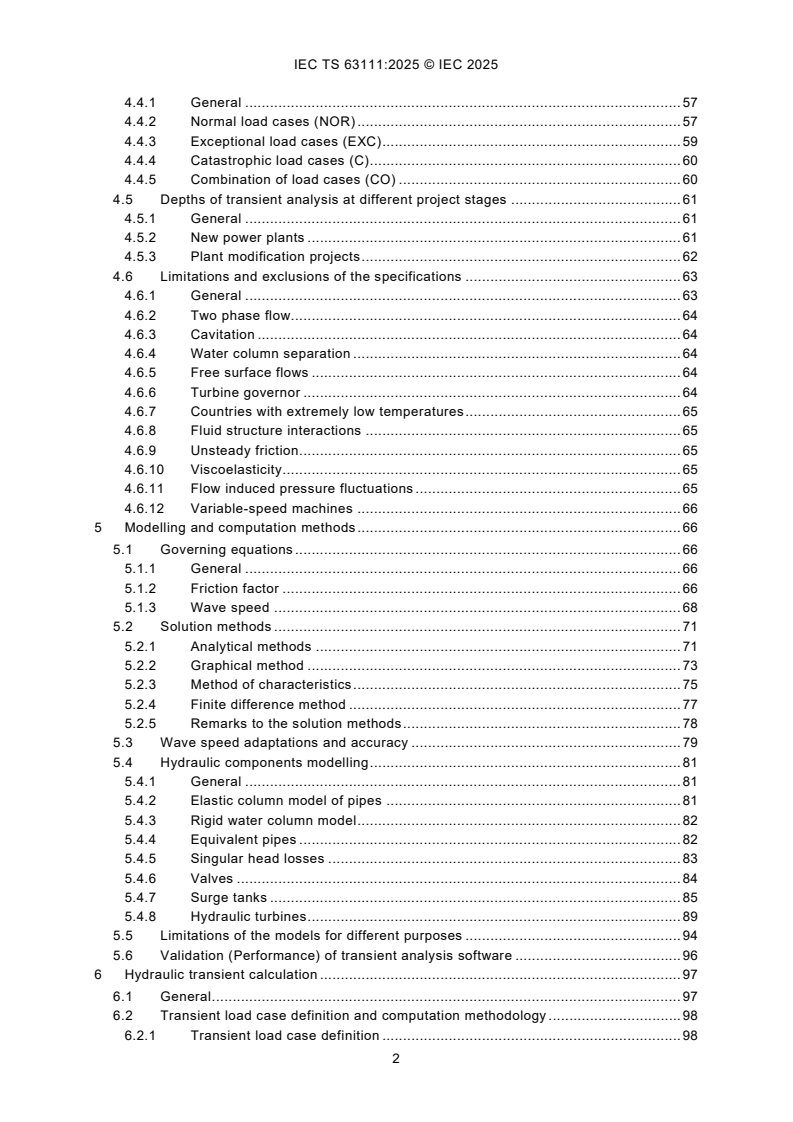
4.4.1 General . 57
4.4.2 Normal load cases (NOR) . 57
4.4.3 Exceptional load cases (EXC) . 59
4.4.4 Catastrophic load cases (C) . 60
4.4.5 Combination of load cases (CO) . 60
4.5 Depths of transient analysis at different project stages . 61
4.5.1 General . 61
4.5.2 New power plants . 61
4.5.3 Plant modification projects . 62
4.6 Limitations and exclusions of the specifications . 63
4.6.1 General . 63
4.6.2 Two phase flow. 64
4.6.3 Cavitation . 64
4.6.4 Water column separation . 64
4.6.5 Free surface flows . 64
4.6.6 Turbine governor . 64
4.6.7 Countries with extremely low temperatures . 65
4.6.8 Fluid structure interactions . 65
4.6.9 Unsteady friction . 65
4.6.10 Viscoelasticity . 65
4.6.11 Flow induced pressure fluctuations . 65
4.6.12 Variable-speed machines . 66
5 Modelling and computation methods . 66
5.1 Governing equations . 66
5.1.1 General . 66
5.1.2 Friction factor . 66
5.1.3 Wave speed . 68
5.2 Solution methods . 71
5.2.1 Analytical methods . 71
5.2.2 Graphical method . 73
5.2.3 Method of characteristics . 75
5.2.4 Finite difference method . 77
5.2.5 Remarks to the solution methods . 78
5.3 Wave speed adaptations and accuracy . 79
5.4 Hydraulic components modelling . 81
5.4.1 General . 81
5.4.2 Elastic column model of pipes . 81
5.4.3 Rigid water column model . 82
5.4.4 Equivalent pipes . 82
5.4.5 Singular head losses . 83
5.4.6 Valves . 84
5.4.7 Surge tanks . 85
5.4.8 Hydraulic turbines . 89
5.5 Limitations of the models for different purposes . 94
5.6 Validation (Performance) of transient analysis software . 96
6 Hydraulic transient calculation . 97
6.1 General . 97
6.2 Transient load case definition and computation methodology . 98
6.2.1 Transient load case definition . 98
6.2.2 Methodology for transient load case computation . 99
6.3 Short list of load cases . 109
6.3.1 General . 109
6.3.2 Normal load cases . 109
6.3.3 Exceptional load cases . 112
6.3.4 Catastrophic load case . 116
6.3.5 Load case combination . 117
6.4 Identification of load cases by critical values . 120
6.4.1 General . 120
6.4.2 Overspeed . 120
6.4.3 Water static pressure . 121
6.4.4 Water levels . 123
6.4.5 Additional values . 124
6.5 Identification of load cases by project stage . 124
6.6 Identification of load cases by machine type . 126
6.6.1 General . 126
6.6.2 Francis turbine . 128
6.6.3 Pelton turbine . 128
6.6.4 Kaplan turbine . 129
6.6.5 Reversible pump-turbine and pump . 129
6.7 Identification of load cases by plant layout . 129
6.7.1 General . 129
6.7.2 Single unit, single penstock . 130
6.7.3 Single unit, single penstock with surge shafts . 130
6.7.4 Multiple units, shared penstock, surge shafts and waterways . 130
6.7.5 Multiple units on same shaft . 130
6.7.6 "Complex plant" . 130
6.7.7 List of load cases by plant layout . 130
6.8 Identification of load cases corresponding to field tests or commissioning . 132
6.8.1 Plant first filling and reservoir maintenance . 132
6.8.2 Plant commissioning . 132
6.9 Example of how to build a table of load cases . 133
7 Prototype hydraulic transient test . 134
7.1 General . 134
7.2 Measurement quantities . 134
7.3 Measurement techniques . 135
7.4 Frequency range selection . 137
7.4.1 Calibration of the 1D model . 137
7.4.2 Frequency treatment and preparation of measured data for guaranteed
comparison . 138
7.4.3 Statistical treatment of measured data for guaranteed comparison . 139
7.4.4 Comparison with guarantees . 139
7.5 Uncertainties in measurements and presentation of results . 140
7.5.1 Definition of error . 140
7.5.2 Definition of uncertainty . 140
7.5.3 Types of error . 140
7.5.4 Total uncertainty . 142
7.6 Recommended tests . 142
7.6.1 General . 142
7.6.2 Site conditions and transposition of results . 143
7.6.3 Field test program and test protocol . 144
7.7 Field measurement report . 144
8 Comparison between site measurements and calculations . 145
8.1 General . 145
8.2 Direct comparison of transient results with guaranteed values . 145
8.3 Comparison of transient tests with numerical simulations results . 146
8.3.1 General . 146
8.3.2 Approach to calibrate and validate the model and determine numerical
model uncertainty . 146
8.3.3 Adjustment of the numerical transient model . 148
8.4 Considerations of the fluctuating quantities . 148
8.5 Adjustment of unit during field tests . 149
8.6 Comparison of simulated results with expected or guaranteed values . 150
8.7 Updated calculation report . 150
Annex A (informative) Example of load cases for different plant layouts and project
stages . 151
A.1 Disclaimer . 151
A.2 List of examples . 151
A.3 Francis turbine with PRV at offer phase . 152
A.3.1 Layout description . 152
A.3.2 Operating range definition . 152
A.3.3 Table of load cases . 153
A.4 Pelton turbine with a surge tank at feasibility phase . 160
A.4.1 Layout description . 160
A.4.2 Operating range definition . 160
A.4.3 Table of load cases . 161
A.5 Kaplan turbine at execution phase . 164
A.5.1 Layout description . 164
A.5.2 Operating range definition . 164
A.5.3 Table of load cases . 165
A.6 Bulb turbine at offer phase . 169
A.6.1 Layout description . 169
A.6.2 Operating range definition . 169
A.6.3 Table of load cases . 170
A.7 Reversible Francis pump-turbine at feasibility phase . 173
A.7.1 Layout description . 173
A.7.2 Operating range definition . 173
A.7.3 Table of load cases . 174
A.8 Ternary unit at execution phase . 182
A.8.1 Layout description . 182
A.8.2 Operating range definition . 182
A.8.3 Table of load cases . 183
Annex B (informative) Optional model tests and CFD analysis . 184
B.1 General . 184
B.2 Hydraulic machine characteristics . 184
B.3 Advanced valves characteristics . 188
B.4 Surge tanks . 188
B.4.1 General . 188
B.4.2 Steady state flow measurement . 188
B.4.3 Transient flow measurements . 189
B.5 Open channel flow . 190
B.6 Intakes and outlets. 192
B.7 Manifold model test . 193
B.8 Integrated model test of hydropower generating system . 194
B.8.1 Basic methodology and components of the integrated model . 194
B.8.2 Similarity law and model scale . 195
Annex C (informative) Examples of sample calculation of the value to be compared to
the guarantee . 197
Bibliography . 200
Figure 3-1 – Guide vane opening and angle . 17
Figure 3-2 – Reference diameter and bucket width . 18
Figure 3-3 – Flux diagram for power and discharge. 23
Figure 3-4 – Illustration of some definitions related to oscillating quantities . 25
Figure 4-1 – General schematic of a typical hydropower plant arrangement . 27
Figure 4-2 – Possible configurations of surge tanks – Sketches 1 to 4 . 29
Figure 4-3 – Schematic of a simple pressurised air chamber . 30
Figure 4-4 – Common valve designs . 32
Figure 4-5 – Schematic of sealing ring arrangement (left) and corresponding loss
characteristic of valve with sealing ring between 89,9 ° and 90 ° . 33
Figure 4-6 – Schematic of spherical valve with pressure balancing bypass . 34
Figure 4-7 – Hydraulic machine application diagram . 35
Figure 4-8 – Schematic view of water jet between nozzle and bucket . 36
Figure 4-9 – Schematic view of 6-jet vertical Pelton-type turbine. 36
Figure 4-10 – Schematic view of Pelton-type turbine runner and bucket . 37
Figure 4-11 – Schematic view of Pelton-type turbine deflector . 37
Figure 4-12 – Schematic view of Francis-type turbine for runner and spiral inlet . 38
Figure 4-13 – Francis typical discharge characteristics; lines of constant guide vane
opening (solid) and runaway curve (dashed) . 38
Figure 4-14 – Deriaz sketch and model runner (3 of 6 runner blades removed) . 39
Figure 4-15 – Deriaz typical discharge characteristics – lines of constant guide vane
opening (solid) and runaway curve (dashed) . 39
Figure 4-16 – Schematic view of Kaplan-type turbine . 40
Figure 4-17 – Kaplan typical discharge characteristics – lines of constant guide vane
opening (solid) and runaway curve (dashed) . 41
Figure 4-18 – Schematic view of a Saxo-type turbine . 42
Figure 4-19 – Schematic layout of a bulb (left) and pit (right) turbine . 42
Figure 4-20 – Schematic layout of a S-downstream (left) and S-upstream (right) turbine . 43
Figure 4-21 – Schematic view of (radial) pump-turbine . 43
Figure 4-22 – Pump-turbine typical 4-quadrant characteristics for a single-regulated
(radial) pump-turbine . 44
Figure 4-23 – Multi-stage pump (left), and 4-quadrant pump characteristics (right) . 45
Figure 4-24 – Schematic view of ternary set with Pelton type turbine and storage pump . 46
Figure 4-25 – Relationship between servomotor stroke and distributor opening angle . 46
Figure 4-26 – Schematic arrangement of PRV oil-hydraulically linked to hydraulic
machine . 47
Figure 4-27 – Schematic view of pressure relief valves . 48
Figure 4-28 – Example of ring gate valve discharge characteristics . 49
Figure 4-29 – Possible mode changes for pump-turbine . 52
Figure 5-1 – Nikuradse-Moody diagram for Darcy-Weisbach friction coefficient . 67
Figure 5-2 – Pressurized pipe subject to downstream flow control device closure
inducing waterhammer pressure wave . 71
Figure 5-3 – Pressurized pipe subject to downstream flow control device instantaneous
closure inducing direct waterhammer with steep pressure wave front . 72
Figure 5-4 – Pressurized pipe subject to downstream flow control device with closure
time equal to 2 × L/a inducing reduced waterhammer with linear pressure wave front in
case of linear discharge reduction over time . 72
Figure 5-5 – Negative waterhammer pressure wave downstream of a closing flow
control device . 73
Figure 5-6 – Set of characteristic line in [H-Q] plane (top) linked to characteristic line in
the [x-t] plane (bottom) for progressive waves and retrograde waves . 74
Figure 5-7 – Simple hydraulic system with upper reservoir, pressurized pipe and
downstream end valve considered for waterhammer calculation with graphical method. 74
Figure 5-8 – Head versus discharge diagram obtained from waterhammer calculation
of a valve closing in time of T = 4 × L/a using graphical method (left) and
closure
corresponding time domain evolution of the valve discharge and head (right) . 75
Figure 5-9 – Characteristic lines in the x-t plane . 75
Figure 5-10 – Wave speed adaptation of pipes . 80
Figure 5-11 – Schematic sketch of a pipe element . 81
Figure 5-12 – Equivalent pipe . 83
Figure 5-13 – Schematic sketch of a valve . 84
Figure 5-14 – Schematic representation of a free surface surge tank . 85
Figure 5-15 – Example of computation of a surge tank’s hydraulic inductance . 87
Figure 5-16 – Schematic sketch of a pressurized air chamber (air cushion surge
chamber) . 88
Figure 5-17 – Typical runner profiles of a Francis turbine depending on specific speed . 90
Figure 5-18 – Typical examples of performance characteristics for Francis turbines,
reversible Francis pump-turbines, Pelton turbines and axial turbines . 92
Figure 5-19 – Francis turbine reference diameter D and corresponding elevation to be
s
considered for draft tube pressure calculation . 93
Figure 6-1 – Sketch of typical load cases . 98
Figure 6-2 – Sketch of water level boundary conditions. 99
Figure 6-3 – Typical turbine operating range head versus discharge . 101
Figure 6-4 – Typical pump operating range head versus discharge . 102
Figure 6-5 – Example of a closing law of a reversible Francis unit in pump mode. 103
Figure 6-6 – Example of a typical guide vane closing law with two slopes . 104
Figure 6-7 – Example of guide vane closing law effect on overspeed and overpressure . 105
Figure 6-8 – Example of closing and opening laws of guide vanes and MIV . 106
Figure 6-9 – Example of the simultaneous closing sequence of blades, guide vanes
and downstream gate for a Bulb unit subjected to a load rejection . 107
Figure 6-10 – Example of final conditions of a transient computation case for
overpressure (top figure) and pressure drop (bottom figure) . 108
Figure 7-1 – Checking of instrument . 136
Figure 7-2 – Illustration of 97 % confidence level . 139
Figure 8-1 – Comparison between measured signal and simulated signal . 147
Figure 8-2 – Graph illustrating raw data and filtered data . 148
Figure 8-3 – Determination of the fluctuating quantity Y, the absolute difference
between the filtered data and the average data . 149
Figure A.1 – Hydraulic layout including Francis turbines with PRV . 152
Figure A.2 – Definition of Francis turbine operating points . 153
Figure A.3 – Hydraulic layout including Pelton turbines with a surge tank . 160
Figure A.4 – Definition of Pelton turbine operating points . 161
Figure A.5 – Hydraulic layout including Kaplan turbines . 164
Figure A.6 – Definition of Kaplan turbine operating points . 165
Figure A.7 – Hydraulic layout including Bulb turbines . 169
Figure A.8 – Definition of Bulb turbine operating points . 170
Figure A.9 – Hydraulic layout including reversible Francis pump-turbines . 173
Figure A.10 – Definition of Francis turbine operating points . 174
Figure A.11 – Definition of typical Francis pump-turbine operating points in pump mode . 174
Figure A.12 – Hydraulic layout including ternary unit . 182
Figure A.13 – Definition of Pelton turbine operating points . 183
Figure A.14 – Definition of pump operating points . 183
Figure B.1 – Comparison of pump-turbine four quadrant characteristics between high
sigma and sigma plant . 185
Figure B.2 – Example of influence of asynchronous opening of two guide vanes on the
pump-turbine hill chart (dashed lines are the original more pronounced S-shape
characteristic, solid lines are the new less pronounced S-shape characteristic
assuming two guide vanes operating asynchronously) . 186
Figure B.3 – Example of pump-turbine start-up failing to synchronise due to S-shape
instability . 187
Figure B.4 – Example of pump-turbine start-up with successful synchronisation and
loading with partially open main inlet valve . 187
Figure B.5 – Example of flow streamlines through a butterfly valve computed from CFD . 188
Figure B.6 – Example of flow physical model test of surge tank and related comparison
of CFD computation results with streamlines for surge tank inflow conditions . 189
Figure B.7 – Example of downstream surge tank transient physical model test to
evaluate the impact of free surface waves, possible air admission and slugs and
shocks phenomena . 190
Figure B.8 – Example of free surface flow physical model tests developing in tailrace
tunnel and comparison of related CFD results of hydraulic jump at bifurcation . 191
Figure B.9 – Example of the comparison between site disjunction wave and reduced
scale model tests (1/35) . 192
Figure B.10 – Example of free surface flow physical model tests of intake and
development of free surface vortex for extreme flow conditions . 193
Figure B.11 – Example of physical model tests of manifold and identification of flow
separation using ink injection . 193
Figure B.12 – Photo and overall illustration of an integrated physical model of
hydropower generating system . 194
Figure B.13 – Operating trajectories as dynamic loops in the S-shaped region of
hydraulic machine . 195
Figure C.1 – Penstock pressure – Fluctuating quantity. 197
Figure C.2 – Penstock pressure – Averaged measured value and simulation . 197
Figure C.3 – Draft tube pressure fluctuating quantity . 198
Figure C.4 – Draft tube pressure – Averaged measured value and simulation . 198
Table 5-1 – Pipe elasticity dA/(A·dp) depending on type of support for thin-walled pipes . 69
Table 5-2 – Pipe elasticity dA/(A·dp) depending on type of support for thick-walled
pipes . 69
Table 5-3 – Material properties of common materials in hydropower . 70
Table 5-4 – Typical wave speed in different pipe arrangements . 70
Table 5-5 – Example of wave speed adaptation for 3 different pipes . 81
Table 5-6 – Definition of head loss coefficients for valves . 85
Table 5-7 – Recommended minimum modelling complexity for different project stages . 94
Table 6-1 – Locations of interest and corresponding critical value to be assessed
through numerical simulations . 108
Table 6-2 – Load cases by critical values – Overspeed . 121
Table 6-3 – Load cases by critical values – Static pressure rise . 122
Table 6-4 – Load cases by critical values – Static pressure drop . 123
Table 6-5 – Load cases by critical values – Water levels. 123
Table 6-6 – Normal load cases . 125
Table 6-7 – Exceptional load cases. 125
Table 6-8 – Catastrophic load cases . 125
Table 6-9 – Combined load cases . 126
Table 6-10 – Normal load cases. 127
Table 6-11 – Exceptional load cases . 127
Table 6-12 – Catastrophic load cases . 127
Table 6-13 – Combined load cases . 128
Table 6-14 – Normal load cases. 131
Table 6-15 – Exceptional load cases . 131
Table 6-16 – Catastrophic load cases . 131
Table 6-17 – Combined load cases . 132
Table 8-1 – Typical model uncertainty (MU %) . 147
Table B.1 – Similarity law and model scale of integrated model test of hydropower
generating system . 196
INTERNATIONAL ELECTROTECHNICAL COMMISSION
____________
Hydraulic turbines, storage pumps and pump-turbines -
Hydraulic transient analysis, design considerations and testing
FOREWORD
1) The International Electrotechnical Commission (IEC) is a worldwide organization fo
...