

IEC 60674-3-1:1998
(Main)Plastic films for electrical purposes - Part 3: Specifications for individual materials - Sheet 1: Biaxially oriented polypropylene (PP) film for capacitors
General Information
- Abstract
Gives the requirements for biaxially oriented polypropylene film having a smooth or rough surface, corona treated when required for vacuum metallization. The films are for use as dielectric in capacitors.
- Status
- Published
- Publication Date
- 14-Dec-2011
- Technical Committee
- TC 15 - Solid electrical insulating materials
- Drafting Committee
- MT 3 - TC 15/MT 3
- Current Stage
- DELPUB - Deleted Publication
- Start Date
- 25-Aug-2021
- Completion Date
- 28-Dec-2018
Buy Documents
IEC 60674-3-1:1998 - Plastic films for electrical purposes - Part 3: Specifications for individual materials - Sheet 1: Biaxially oriented polypropylene (PP) film for capacitors Released:3/16/1998
IEC 60674-3-1:1998+AMD1:2011 CSV - Plastic films for electrical purposes - Part 3: Specifications for individual materials - Sheet 1: Biaxially oriented polypropylene (PP) films for capacitors Released:12/15/2011
Overview
IEC 60674-3-1:1998 is an international standard developed by the International Electrotechnical Commission (IEC) that specifies requirements for biaxially oriented polypropylene (PP) films used for electrical purposes, with a focus on their application as dielectric materials in capacitors. The standard covers PP films with smooth or rough surfaces, including those corona-treated for vacuum metallization, ensuring reliable performance in various capacitor manufacturing processes.
The document details essential physical and electrical properties, preferred dimensions, and requirements for film treatment. By establishing uniform criteria, IEC 60674-3-1:1998 helps manufacturers, suppliers, and buyers guarantee film quality and compatibility in the global supply chain for electrical and electronic components.
Key Topics
- Material Scope: Biaxially oriented polypropylene (PP) films for use as dielectric layers in capacitors, with options for smooth or rough surfaces and corona treatment for metallization.
- Classification: Two main types are addressed:
- Type 1: Smooth surfaces
- Subtypes for corona treatment: untreated, single-side, or double-side treated
- Type 2: At least one rough surface
- Similar subtypes for corona treatment
- Type 1: Smooth surfaces
- Requirements:
- Physical properties such as density, melting point, tensile strength, elongation at break, and permittivity
- Electrical characteristics including surface/volume resistivity and electric strength (d.c. test)
- Dimensional parameters for thickness, width, and roll characteristics
- Designations: Defined system for identifying film type, thickness, width, and length
- Performance Tests: References to test methods from related standards (especially for dielectric strength, resistivity, shrinkage, and wetting tension)
- Customization: Options for agreed specifications between supplier and purchaser regarding properties such as liquid absorption, compatibility with impregnation fluids, and dissipation factor under impregnated conditions
Applications
Biaxially oriented polypropylene (PP) films standardized per IEC 60674-3-1:1998 are pivotal in the electrical industry, especially for the following:
- Capacitors: The primary application, where PP films serve as dielectric layers in the construction of film capacitors used for power electronics, signal processing, and filtering applications.
- Vacuum Metallized Films: Corona-treated surfaces facilitate the deposition of metal layers, enhancing the film's effectiveness in metallized capacitor types.
- High-Performance Electrical Insulation: Consistent electrical and physical properties make these films suitable as insulation materials in other electrical devices requiring high dielectric strength and thermal stability.
- Custom Electronic Components: The clear classification and properties allow for specialized capacitor design, accommodating requirements like high-voltage endurance, low dissipation factor, or compatibility with specific impregnants.
By adhering to this standard, manufacturers achieve reliable product performance, consistent quality, and improved compatibility with global capacitor production technologies.
Related Standards
IEC 60674-3-1:1998 is part of the IEC 60674 series, which addresses plastic films for electrical purposes. Other related standards include:
- IEC 60674-1: Definitions and general requirements for plastic films in electrical applications, providing the essential terminology and baseline requirements referenced throughout the series.
- IEC 60674-2: Methods of test for plastic films, detailing standardized procedures for evaluating film properties such as thickness, resistivity, and mechanical strength.
- IEC 61074: Specifies procedures for determining melting and crystallization properties of insulating materials.
- ISO 534: Offers standardized methods for determining the thickness and apparent density of paper, board, and sheet materials, applicable when measuring film bulking properties.
Compliance with these related standards ensures comprehensive quality control and interoperability across various stages of film production and capacitor manufacturing.
Practical Value
By following the requirements of IEC 60674-3-1:1998, industry professionals benefit through:
- Assured Material Quality: Clearly established criteria for PP dielectric films lead to reliable, high-quality capacitor production.
- Interoperability: Universal definitions, measurements, and test methods streamline procurement, manufacturing, and quality assurance in international markets.
- Design Flexibility: The standard’s classification and customizable parameters enable tailored solutions for advanced capacitor applications and emerging electronic technologies.
Relations
- Effective Date
- 05-Sep-2023
- Effective Date
- 05-Sep-2023
Buy Documents
IEC 60674-3-1:1998 - Plastic films for electrical purposes - Part 3: Specifications for individual materials - Sheet 1: Biaxially oriented polypropylene (PP) film for capacitors Released:3/16/1998
IEC 60674-3-1:1998+AMD1:2011 CSV - Plastic films for electrical purposes - Part 3: Specifications for individual materials - Sheet 1: Biaxially oriented polypropylene (PP) films for capacitors Released:12/15/2011
Get Certified
Connect with accredited certification bodies for this standard

IMQ S.p.A. (Certification)
Italian electrical product certification.

SLG Prüf- und Zertifizierungs GmbH
German testing and certification body.

UL Solutions
Global safety science company with testing, inspection and certification.
Sponsored listings
Frequently Asked Questions
IEC 60674-3-1:1998 is a standard published by the International Electrotechnical Commission (IEC). Its full title is "Plastic films for electrical purposes - Part 3: Specifications for individual materials - Sheet 1: Biaxially oriented polypropylene (PP) film for capacitors". This standard covers: Gives the requirements for biaxially oriented polypropylene film having a smooth or rough surface, corona treated when required for vacuum metallization. The films are for use as dielectric in capacitors.
Gives the requirements for biaxially oriented polypropylene film having a smooth or rough surface, corona treated when required for vacuum metallization. The films are for use as dielectric in capacitors.
IEC 60674-3-1:1998 is classified under the following ICS (International Classification for Standards) categories: 29.035.20 - Plastics and rubber insulating materials. The ICS classification helps identify the subject area and facilitates finding related standards.
IEC 60674-3-1:1998 has the following relationships with other standards: It is inter standard links to IEC 60674-3-1:1998/AMD1:2011, IEC 60674-3-1:2021. Understanding these relationships helps ensure you are using the most current and applicable version of the standard.
IEC 60674-3-1:1998 is available in PDF format for immediate download after purchase. The document can be added to your cart and obtained through the secure checkout process. Digital delivery ensures instant access to the complete standard document.
Standards Content (Sample)
NORME
CEI
INTERNATIONALE
IEC
60674-3-1
INTERNATIONAL
Première édition
STANDARD
First edition
1998-03
Films plastiques à usages électriques –
Partie 3:
Spécifications pour matériaux particuliers –
Feuille 1: Films de polypropylène biorienté (PP)
pour condensateurs
Plastic films for electrical purposes –
Part 3:
Specifications for individual materials –
Sheet 1: Biaxially oriented polypropylene (PP)
films for capacitors
Numéro de référence
Reference number
CEI/IEC 60674-3-1:1998
Numéros des publications Numbering
Depuis le 1er janvier 1997, les publications de la CEI As from 1 January 1997 all IEC publications are issued
sont numérotées à partir de 60000. with a designation in the 60000 series.
Publications consolidées Consolidated publications
Les versions consolidées de certaines publications de Consolidated versions of some IEC publications
la CEI incorporant les amendements sont disponibles. including amendments are available. For example,
Par exemple, les numéros d’édition 1.0, 1.1 et 1.2 edition numbers 1.0, 1.1 and 1.2 refer, respectively, to
indiquent respectivement la publication de base, la the base publication, the base publication incorporating
publication de base incorporant l’amendement 1, et la amendment 1 and the base publication incorporating
publication de base incorporant les amendements 1 amendments 1 and 2.
et 2.
Validité de la présente publication Validity of this publication
Le contenu technique des publications de la CEI est The technical content of IEC publications is kept under
constamment revu par la CEI afin qu'il reflète l'état constant review by the IEC, thus ensuring that the
actuel de la technique. content reflects current technology.
Des renseignements relatifs à la date de reconfirmation Information relating to the date of the reconfirmation of
de la publication sont disponibles dans le Catalogue de the publication is available in the IEC catalogue.
la CEI.
Les renseignements relatifs à ces révisions, à l'établis- Information on the revision work, the issue of revised
sement des éditions révisées et aux amendements editions and amendments may be obtained from
peuvent être obtenus auprès des Comités nationaux de la IEC National Committees and from the following
CEI et dans les documents ci-dessous: IEC sources:
• Bulletin de la CEI • IEC Bulletin
• Annuaire de la CEI • IEC Yearbook
Accès en ligne* On-line access*
• Catalogue des publications de la CEI • Catalogue of IEC publications
Publié annuellement et mis à jour régulièrement Published yearly with regular updates
(Accès en ligne)* (On-line access)*
Terminologie, symboles graphiques Terminology, graphical and letter
et littéraux symbols
En ce qui concerne la terminologie générale, le lecteur For general terminology, readers are referred to
se reportera à la CEI 60050: Vocabulaire Electro- IEC 60050: International Electrotechnical Vocabulary
technique International (VEI). (IEV).
Pour les symboles graphiques, les symboles littéraux et For graphical symbols, and letter symbols and signs
les signes d'usage général approuvés par la CEI, le approved by the IEC for general use, readers are
referred to publications IEC 60027: Letter symbols to
lecteur consultera la CEI 60027: Symboles littéraux à
utiliser en électrotechnique, la CEI 60417: Symboles be used in electrical technology, IEC 60417: Graphical
graphiques utilisables sur le matériel. Index, relevé et symbols for use on equipment. Index, survey and
compilation des feuilles individuelles, et la CEI 60617: compilation of the single sheets and IEC 60617:
Symboles graphiques pour schémas. Graphical symbols for diagrams.
Publications de la CEI établies par IEC publications prepared by the same
le même comité d'études technical committee
L'attention du lecteur est attirée sur les listes figurant à The attention of readers is drawn to the end pages of
la fin de cette publication, qui énumèrent les this publication which list the IEC publications issued
publications de la CEI préparées par le comité d'études by the technical committee which has prepared the
qui a établi la présente publication. present publication.
* Voir adresse «site web» sur la page de titre. * See web site address on title page.
NORME
CEI
INTERNATIONALE
IEC
60674-3-1
INTERNATIONAL
Première édition
STANDARD
First edition
1998-03
Films plastiques à usages électriques –
Partie 3:
Spécifications pour matériaux particuliers –
Feuille 1: Films de polypropylène biorienté (PP)
pour condensateurs
Plastic films for electrical purposes –
Part 3:
Specifications for individual materials –
Sheet 1: Biaxially oriented polypropylene (PP)
films for capacitors
IEC 1998 Droits de reproduction réservés Copyright - all rights reserved
Aucune partie de cette publication ne peut être reproduite ni No part of this publication may be reproduced or utilized in
utilisée sous quelque forme que ce soit et par aucun any form or by any means, electronic or mechanical,
procédé, électronique ou mécanique, y compris la photo- including photocopying and microfilm, without permission in
copie et les microfilms, sans l'accord écrit de l'éditeur. writing from the publisher.
International Electrotechnical Commission 3, rue de Varembé Geneva, Switzerland
Telefax: +41 22 919 0300 e-mail: inmail@iec.ch IEC web site http: //www.iec.ch
CODE PRIX
Commission Electrotechnique Internationale
PRICE CODE L
International Electrotechnical Commission
Pour prix, voir catalogue en vigueur
For price, see current catalogue
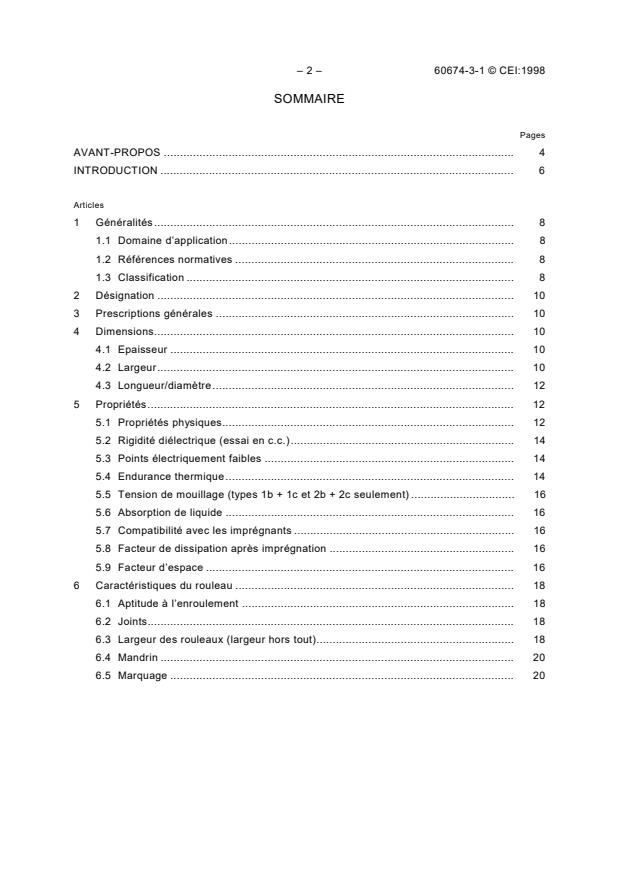
– 2 – 60674-3-1 © CEI:1998
SOMMAIRE
Pages
AVANT-PROPOS . 4
INTRODUCTION . 6
Articles
1 Généralités. 8
1.1 Domaine d’application. 8
1.2 Références normatives . 8
1.3 Classification . 8
2 Désignation . 10
3 Prescriptions générales . 10
4 Dimensions. 10
4.1 Epaisseur . 10
4.2 Largeur. 10
4.3 Longueur/diamètre. 12
5 Propriétés. 12
5.1 Propriétés physiques. 12
5.2 Rigidité diélectrique (essai en c.c.). 14
5.3 Points électriquement faibles . 14
5.4 Endurance thermique. 14
5.5 Tension de mouillage (types 1b + 1c et 2b + 2c seulement) . 16
5.6 Absorption de liquide . 16
5.7 Compatibilité avec les imprégnants . 16
5.8 Facteur de dissipation après imprégnation . 16
5.9 Facteur d’espace . 16
6 Caractéristiques du rouleau . 18
6.1 Aptitude à l’enroulement . 18
6.2 Joints. 18
6.3 Largeur des rouleaux (largeur hors tout). 18
6.4 Mandrin . 20
6.5 Marquage . 20
60674-3-1 IEC:1998 – 3 –
CONTENTS
Page
FOREWORD . 5
INTRODUCTION . 7
Clause
1 General . 9
1.1 Scope . 9
1.2 Normative references. 9
1.3 Classification . 9
2 Designation . 11
3 General requirements . 11
4 Dimensions. 11
4.1 Thickness . 11
4.2 Width. 11
4.3 Length/diameter. 13
5 Properties. 13
5.1 Physical properties. 13
5.2 Electric strength (d.c. test) . 15
5.3 Electrical weak spots . 15
5.4 Thermal endurance. 15
5.5 Wetting tension (types 1b + 1c and 2b + 2c only). 17
5.6 Liquid absorption . 17
5.7 Compatibility with impregnants . 17
5.8 Dissipation factor under impregnated conditions. 17
5.9 Space factor . 17
6 Roll characteristics . 19
6.1 Windability. 19
6.2 Joins. 19
6.3 Roll width (overall width) . 19
6.4 Core . 21
6.5 Labelling. 21
– 4 – 60674-3-1 © CEI:1998
COMMISSION ÉLECTROTECHNIQUE INTERNATIONALE
__________
FILMS PLASTIQUES À USAGES ÉLECTRIQUES –
Partie 3: Spécifications pour matériaux particuliers –
Feuille 1: Films de polypropylène biorienté (PP) pour condensateurs
AVANT-PROPOS
1) La CEI (Commission Electrotechnique Internationale) est une organisation mondiale de normalisation composée
de l'ensemble des comités électrotechniques nationaux (Comités nationaux de la CEI). La CEI a pour objet de
favoriser la coopération internationale pour toutes les questions de normalisation dans les domaines de
l'électricité et de l'électronique. A cet effet, la CEI, entre autres activités, publie des Normes Internationales.
Leur élaboration est confiée à des comités d'études, aux travaux desquels tout Comité national intéressé par le
sujet traité peut participer. Les organisations internationales, gouvernementales et non gouvernementales, en
liaison avec la CEI, participent également aux travaux. La CEI collabore étroitement avec l'Organisation
Internationale de Normalisation (ISO), selon des conditions fixées par accord entre les deux organisations.
2) Les décisions ou accords officiels de la CEI concernant les questions techniques, représentent, dans la mesure
du possible un accord international sur les sujets étudiés, étant donné que les Comités nationaux intéressés
sont représentés dans chaque comité d’études.
3) Les documents produits se présentent sous la forme de recommandations internationales. Ils sont publiés
comme normes, rapports techniques ou guides et agréés comme tels par les Comités nationaux.
4) Dans le but d'encourager l'unification internationale, les Comités nationaux de la CEI s'engagent à appliquer de
façon transparente, dans toute la mesure possible, les Normes internationales de la CEI dans leurs normes
nationales et régionales. Toute divergence entre la norme de la CEI et la norme nationale ou régionale
correspondante doit être indiquée en termes clairs dans cette dernière.
5) La CEI n’a fixé aucune procédure concernant le marquage comme indication d’approbation et sa responsabilité
n’est pas engagée quand un matériel est déclaré conforme à l’une de ses normes.
6) L’attention est attirée sur le fait que certains des éléments de la présente Norme internationale peuvent faire
l’objet de droits de propriété intellectuelle ou de droits analogues. La CEI ne saurait être tenue pour
responsable de ne pas avoir identifié de tels droits de propriété et de ne pas avoir signalé leur existence.
La Norme internationale CEI 60674-3-1 a été établie par le sous-comité 15C: Spécifications, du
comité d’études 15 de la CEI: Matériaux isolants
Le texte de cette norme est issu des documents suivants:
FDIS Rapport de vote
15C/862/FDIS 15C/952/RVD
Le rapport de vote indiqué dans le tableau ci-dessus donne toute information sur le vote ayant
abouti à l'approbation de cette norme.
60674-3-1 IEC:1998 – 5 –
INTERNATIONAL ELECTROTECHNICAL COMMISSION
__________
PLASTIC FILMS FOR ELECTRICAL PURPOSES –
Part 3: Specifications for individual materials –
Sheet 1: Biaxially oriented polypropylene (PP) films for capacitors
FOREWORD
1) The IEC (International Electrotechnical Commission) is a worldwide organization for standardization comprising
all national electrotechnical committees (IEC National Committees). The object of the IEC is to promote
international co-operation on all questions concerning standardization in the electrical and electronic fields. To
this end and in addition to other activities, the IEC publishes International Standards. Their preparation is
entrusted to technical committees; any IEC National Committee interested in the subject dealt with may
participate in this preparatory work. International, governmental and non-governmental organizations liaising
with the IEC also participate in this preparation. The IEC collaborates closely with the International Organization
for Standardization (ISO) in accordance with conditions determined by agreement between the two
organizations.
2) The formal decisions or agreements of the IEC on technical matters express, as nearly as possible, an
international consensus of opinion on the relevant subjects since each technical committee has representation
from all interested National Committees.
3) The documents produced have the form of recommendations for international use and are published in the form
of standards, technical reports or guides and they are accepted by the National Committees in that sense.
4) In order to promote international unification, IEC National Committees undertake to apply IEC International
Standards transparently to the maximum extent possible in their national and regional standards. Any
divergence between the IEC Standard and the corresponding national or regional standard shall be clearly
indicated in the latter.
5) The IEC provides no marking procedure to indicate its approval and cannot be rendered responsible for any
equipment declared to be in conformity with one of its standards.
6) Attention is drawn to the possibility that some of the elements of this International Standard may be the subject
of patent rights. The IEC shall not be held responsible for identifying any or all such patent rights.
International Standard IEC 60674-3-1 has been prepared by subcommittee 15C: Specifications,
of IEC technical committee 15: Insulating materials.
The text of this standard is based on the following documents:
FDIS Report on voting
15C/862/FDIS 15C/952/RVD
Full information on the voting for the approval of this standard can be found in the report on
voting indicated in the above table.
– 6 – 60674-3-1 © CEI:1998
INTRODUCTION
La présente Norme internationale fait partie d’une série traitant des films en matière plastique
à usages électriques.
Cette série comporte trois parties:
– Partie 1: Définitions et prescriptions générales (CEI 60674-1).
– Partie 2: Méthodes d’essai (CEI 60674-2).
– Partie 3: Spécifications pour matériaux particuliers (CEI 60674-3).
La présente norme comprend l’une des feuilles qui composent la partie 3 comme suit:
Feuille 1: Films de polypropylène biorienté (PP) pour condensateurs.
60674-3-1 IEC:1998 – 7 –
INTRODUCTION
This International Standard is one of a series which deals with plastic films for electrical
purposes.
The series consists of three parts.
– Part 1: Definitions and general requirements (IEC 60674-1).
– Part 2: Methods of test (IEC 60674-2).
– Part 3: Specifications for individual materials (IEC 60674-3).
This standard contains one of the sheets comprising part 3, as follows:
Sheet 1: Biaxially oriented (PP) polypropylene films for capacitors.
– 8 – 60674-3-1 © CEI:1998
FILMS PLASTIQUES À USAGES ÉLECTRIQUES –
Partie 3: Spécifications pour matériaux particuliers –
Feuille 1: Films de polypropylène biorienté (PP) pour condensateurs
1 Généralités
1.1 Domaine d’application
La présente feuille de la CEI 60674-3 donne les prescriptions relatives aux films de
polypropylène biorienté à surface lisse ou rugueuse, avec traitement par effet couronne si
nécessaire pour la métallisation sous vide. Les films sont utilisés comme diélectrique dans les
condensateurs.
1.2 Références normatives
Les documents normatifs suivants contiennent des dispositions qui, par suite de la référence
qui y est faite, constituent des dispositions valables pour la présente feuille de la CEI 60674-3.
Au moment de la publication, les éditions indiquées étaient en vigueur. Tout document normatif
est sujet à révision et les parties prenantes aux accords fondés sur la présente feuille de la
CEI 60674-3 sont invitées à rechercher la possibilité d’appliquer les éditions les plus récentes
1)
des documents normatifs indiqués ci-après . Les membres de la CEI et de l’ISO possèdent le
registre des Normes internationales en vigueur.
CEI 60674-1:1980, Spécification pour les films en matière plastique à usages électriques –
Première partie: Définitions et prescriptions générales
CEI 60674-2:1988, Spécification pour les films en matière plastique à usages électriques –
Deuxième partie: Méthodes d’essai
CEI 61074:1991, Détermination des chaleurs et températures de fusion et de cristallisation des
matériaux isolants électriques par exploration calorimétrique comparative.
ISO 534:1988, Papier et carton – Détermination de l’épaisseur et de la masse volumique des
feuilles uniques ou des feuilles en liasses
1.3 Classification
Le film de polypropylène doit être des types suivants:
Type 1: à surfaces lisses (facteur d’espace <5 %, voir 5.9);
Type 1a: sans traitement par effet couronne;
Type 1b: traitement d’une face pour permettre la métallisation sous vide;
Type 1c: traitement des deux faces;
Type 2: au moins une face rugueuse (facteur d’espace ≥5 %, voir 5.9);
Type 2a: sans traitement par effet couronne;
Type 2b: traitement d’une face pour permettre la métallisation sous vide;
Type 2c: traitement des deux faces.
___________
1)
En cas de litige, l'édition de référence est applicable.
60674-3-1 IEC:1998 – 9 –
PLASTIC FILMS FOR ELECTRICAL PURPOSES –
Part 3: Specifications for individual materials –
Sheet 1: Biaxially oriented polypropylene (PP) films for capacitors
1 General
1.1 Scope
This sheet of IEC 60674-3 gives the requirements for biaxially oriented polypropylene film
having a smooth or rough surface, corona treated when required for vacuum
...
IEC 60674-3-1 ®
Edition 1.1 2011-12
INTERNATIONAL
STANDARD
NORME
INTERNATIONALE
colour
inside
Plastic films for electrical purposes –
Part 3: Specifications for individual materials – Sheet 1: Biaxially oriented
polypropylene (PP) films for capacitors
Films plastiques à usages électriques –
Partie 3: Spécifications pour matériaux particuliers – Feuille 1: Films de
polypropylène biorienté (PP) pour condensateurs
All rights reserved. Unless otherwise specified, no part of this publication may be reproduced or utilized in any form or by
any means, electronic or mechanical, including photocopying and microfilm, without permission in writing from either IEC or
IEC's member National Committee in the country of the requester.
If you have any questions about IEC copyright or have an enquiry about obtaining additional rights to this publication,
please contact the address below or your local IEC member National Committee for further information.
Droits de reproduction réservés. Sauf indication contraire, aucune partie de cette publication ne peut être reproduite
ni utilisée sous quelque forme que ce soit et par aucun procédé, électronique ou mécanique, y compris la photocopie
et les microfilms, sans l'accord écrit de la CEI ou du Comité national de la CEI du pays du demandeur.
Si vous avez des questions sur le copyright de la CEI ou si vous désirez obtenir des droits supplémentaires sur cette
publication, utilisez les coordonnées ci-après ou contactez le Comité national de la CEI de votre pays de résidence.
IEC Central Office
3, rue de Varembé
CH-1211 Geneva 20
Switzerland
Email: inmail@iec.ch
Web: www.iec.ch
About the IEC
The International Electrotechnical Commission (IEC) is the leading global organization that prepares and publishes
International Standards for all electrical, electronic and related technologies.
About IEC publications
The technical content of IEC publications is kept under constant review by the IEC. Please make sure that you have the
latest edition, a corrigenda or an amendment might have been published.
Catalogue of IEC publications: www.iec.ch/searchpub
The IEC on-line Catalogue enables you to search by a variety of criteria (reference number, text, technical committee,…).
It also gives information on projects, withdrawn and replaced publications.
IEC Just Published: www.iec.ch/online_news/justpub
Stay up to date on all new IEC publications. Just Published details twice a month all new publications released. Available
on-line and also by email.
Electropedia: www.electropedia.org
The world's leading online dictionary of electronic and electrical terms containing more than 20 000 terms and definitions
in English and French, with equivalent terms in additional languages. Also known as the International Electrotechnical
Vocabulary online.
Customer Service Centre: www.iec.ch/webstore/custserv
If you wish to give us your feedback on this publication or need further assistance, please visit the Customer Service
Centre FAQ or contact us:
Email: csc@iec.ch
Tel.: +41 22 919 02 11
Fax: +41 22 919 03 00
A propos de la CEI
La Commission Electrotechnique Internationale (CEI) est la première organisation mondiale qui élabore et publie des
normes internationales pour tout ce qui a trait à l'électricité, à l'électronique et aux technologies apparentées.
A propos des publications CEI
Le contenu technique des publications de la CEI est constamment revu. Veuillez vous assurer que vous possédez
l’édition la plus récente, un corrigendum ou amendement peut avoir été publié.
Catalogue des publications de la CEI: www.iec.ch/searchpub/cur_fut-f.htm
Le Catalogue en-ligne de la CEI vous permet d’effectuer des recherches en utilisant différents critères (numéro de référence,
texte, comité d’études,…). Il donne aussi des informations sur les projets et les publications retirées ou remplacées.
Just Published CEI: www.iec.ch/online_news/justpub
Restez informé sur les nouvelles publications de la CEI. Just Published détaille deux fois par mois les nouvelles
publications parues. Disponible en-ligne et aussi par email.
Electropedia: www.electropedia.org
Le premier dictionnaire en ligne au monde de termes électroniques et électriques. Il contient plus de 20 000 termes et
définitions en anglais et en français, ainsi que les termes équivalents dans les langues additionnelles. Egalement appelé
Vocabulaire Electrotechnique International en ligne.
Service Clients: www.iec.ch/webstore/custserv/custserv_entry-f.htm
Si vous désirez nous donner des commentaires sur cette publication ou si vous avez des questions, visitez le FAQ du
Service clients ou contactez-nous:
Email: csc@iec.ch
Tél.: +41 22 919 02 11
Fax: +41 22 919 03 00
IEC 60674-3-1 ®
Edition 1.1 2011-12
INTERNATIONAL
STANDARD
NORME
INTERNATIONALE
colour
inside
Plastic films for electrical purposes –
Part 3: Specifications for individual materials – Sheet 1: Biaxially oriented
polypropylene (PP) films for capacitors
Films plastiques à usages électriques –
Partie 3: Spécifications pour matériaux particuliers – Feuille 1: Films de
polypropylène biorienté (PP) pour condensateurs
INTERNATIONAL
ELECTROTECHNICAL
COMMISSION
COMMISSION
ELECTROTECHNIQUE
PRICE CODE
INTERNATIONALE
CODE PRIX CD
ICS 29.035.20 ISBN 978-2-88912-796-2
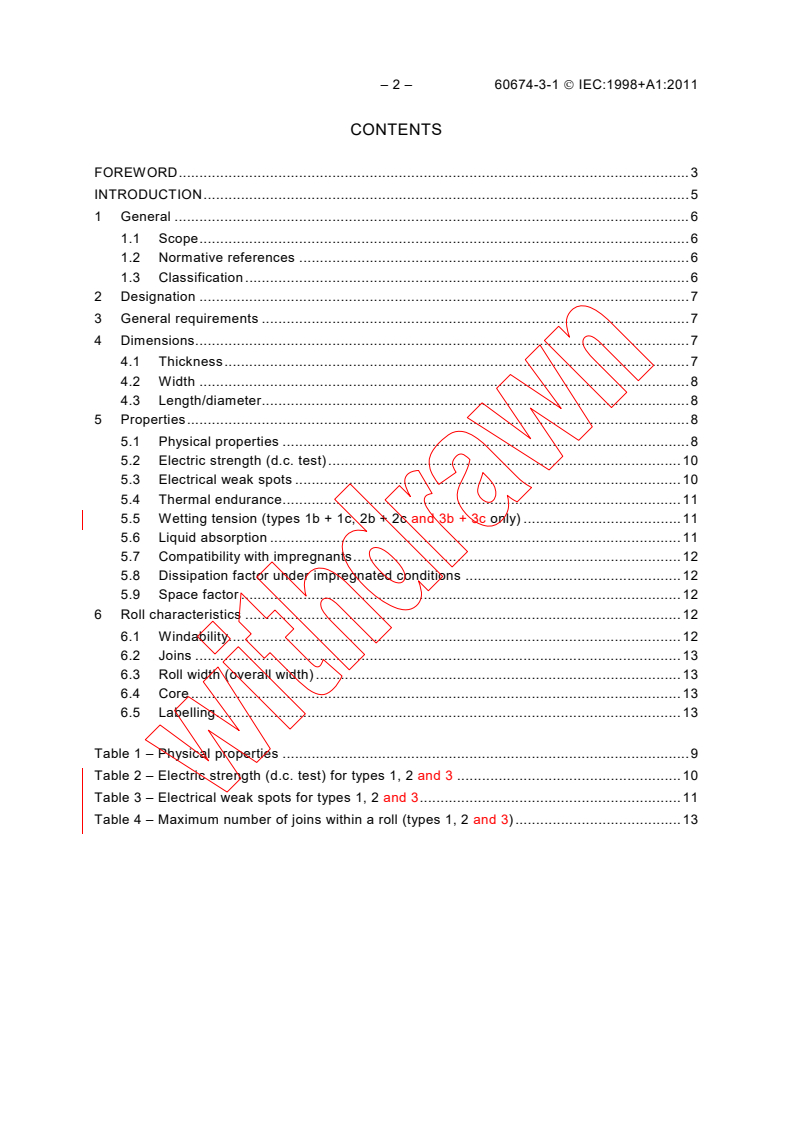
– 2 – 60674-3-1 IEC:1998+A1:2011
CONTENTS
FOREWORD . 3
INTRODUCTION . 5
1 General . 6
1.1 Scope . 6
1.2 Normative references . 6
1.3 Classification . 6
2 Designation . 7
3 General requirements . 7
4 Dimensions . 7
4.1 Thickness . 7
4.2 Width . 8
4.3 Length/diameter. 8
5 Properties . 8
5.1 Physical properties . 8
5.2 Electric strength (d.c. test) . 10
5.3 Electrical weak spots . 10
5.4 Thermal endurance . 11
5.5 Wetting tension (types 1b + 1c, 2b + 2c and 3b + 3c only) . 11
5.6 Liquid absorption . 11
5.7 Compatibility with impregnants . 12
5.8 Dissipation factor under impregnated conditions . 12
5.9 Space factor . 12
6 Roll characteristics . 12
6.1 Windability . 12
6.2 Joins . 13
6.3 Roll width (overall width) . 13
6.4 Core . 13
6.5 Labelling . 13
Table 1 – Physical properties . 9
Table 2 – Electric strength (d.c. test) for types 1, 2 and 3 . 10
Table 3 – Electrical weak spots for types 1, 2 and 3 . 11
Table 4 – Maximum number of joins within a roll (types 1, 2 and 3) . 13
60674-3-1 IEC:1998+A1:2011 – 3 –
INTERNATIONAL ELECTROTECHNICAL COMMISSION
__________
PLASTIC FILMS FOR ELECTRICAL PURPOSES –
Part 3: Specifications for individual materials –
Sheet 1: Biaxially oriented polypropylene (PP) films for capacitors
FOREWORD
1) The International Electrotechnical Commission (IEC) is a worldwide organization for standardization comprising
all national electrotechnical committees (IEC National Committees). The object of IEC is to promote
international co-operation on all questions concerning standardization in the electrical and electronic fields. To
this end and in addition to other activities, IEC publishes International Standards, Technical Specifications,
Technical Reports, Publicly Available Specifications (PAS) and Guides (hereafter referred to as “IEC
Publication(s)”). Their preparation is entrusted to technical committees; any IEC National Committee interested
in the subject dealt with may participate in this preparatory work. International, governmental and non-
governmental organizations liaising with the IEC also participate in this preparation. IEC collaborates closely
with the International Organization for Standardization (ISO) in accordance with conditions determined by
agreement between the two organizations.
2) The formal decisions or agreements of IEC on technical matters express, as nearly as possible, an international
consensus of opinion on the relevant subjects since each technical committee has representation from all
interested IEC National Committees.
3) IEC Publications have the form of recommendations for international use and are accepted by IEC National
Committees in that sense. While all reasonable efforts are made to ensure that the technical content of IEC
Publications is accurate, IEC cannot be held responsible for the way in which they are used or for any
misinterpretation by any end user.
4) In order to promote international uniformity, IEC National Committees undertake to apply IEC Publications
transparently to the maximum extent possible in their national and regional publications. Any divergence
between any IEC Publication and the corresponding national or regional publication shall be clearly indicated in
the latter.
5) IEC itself does not provide any attestation of conformity. Independent certification bodies provide conformity
assessment services and, in some areas, access to IEC marks of conformity. IEC is not responsible for any
services carried out by independent certification bodies.
6) All users should ensure that they have the latest edition of this publication.
7) No liability shall attach to IEC or its directors, employees, servants or agents including individual experts and
members of its technical committees and IEC National Committees for any personal injury, property damage or
other damage of any nature whatsoever, whether direct or indirect, or for costs (including legal fees) and
expenses arising out of the publication, use of, or reliance upon, this IEC Publication or any other IEC
Publications.
8) Attention is drawn to the Normative references cited in this publication. Use of the referenced publications is
indispensable for the correct application of this publication.
9) Attention is drawn to the possibility that some of the elements of this IEC Publication may be the subject of
patent rights. IEC shall not be held responsible for identifying any or all such patent rights.
This consolidated version of IEC 60674-3-1 consists of the first edition (1998)
[documents 15C/862/FDIS and 15C/952/RVD] and its amendment 1 (2011) [documents
15/596/CDV and 15/609/RVC]. It bears the edition number 1.1.
The technical content is therefore identical to the base edition and its amendment and
has been prepared for user convenience. A vertical line in the margin shows where the
base publication has been modified by amendment 1. Additions and deletions are
displayed in red, with deletions being struck through.
– 4 – 60674-3-1 IEC:1998+A1:2011
International Standard IEC 60674-3-1 has been prepared by subcommittee 15C: Specifications,
of IEC technical committee 15: Insulating materials.
The committee has decided that the contents of the base publication and its amendments will
remain unchanged until the stability date indicated on the IEC web site under
"http://webstore.iec.ch" in the data related to the specific publication. At this date, the
publication will be
• reconfirmed,
• withdrawn,
• replaced by a revised edition, or
• amended.
IMPORTANT – The “colour inside” logo on the cover page of this publication indicates
that it contains colours which are considered to be useful for the correct understanding
of its contents. Users should therefore print this publication using a colour printer.
60674-3-1 IEC:1998+A1:2011 – 5 –
INTRODUCTION
This International Standard is one of a series which deals with plastic films for electrical
purposes.
The series consists of three parts.
– Part 1: Definitions and general requirements (IEC 60674-1).
– Part 2: Methods of test (IEC 60674-2).
– Part 3: Specifications for individual materials (IEC 60674-3).
This standard contains one of the sheets comprising part 3, as follows:
Sheet 1: Biaxially oriented (PP) polypropylene films for capacitors.
– 6 – 60674-3-1 IEC:1998+A1:2011
PLASTIC FILMS FOR ELECTRICAL PURPOSES –
Part 3: Specifications for individual materials –
Sheet 1: Biaxially oriented polypropylene (PP) films for capacitors
1 General
1.1 Scope
This sheet of IEC 60674-3 gives the requirements for biaxially oriented polypropylene film
having a smooth or rough surface, corona treated when required for vacuum metallization. The
films are for use as dielectric in capacitors.
Materials which conform to this specification meet established levels of performance. However,
the selection of a material by a user for a specific application should be based on the actual
requirements necessary for adequate performance in that application and not based on this
specification alone.
Safety warning: It is the responsibility of the user of the methods contained or referred to in this
document to ensure that they are used in a safe manner.
1.2 Normative references
The following normative documents contain provisions which, through reference in this text,
constitute provisions of this sheet of IEC 60674-3. At the time of publication, the editions
indicated were valid. All normative documents are subject to revision, and parties to agreement
based on this sheet of IEC 60674-3 are encouraged to investigate the possibility of applying the
1)
most recent editions of the normative documents indicated below . Members of IEC and ISO
maintain registers of currently valid International Standards.
IEC 60674-1:1980, Specification for plastic films for electrical purposes – Part 1: Definitions
and general requirements
IEC 60674-2:1988, Specification for plastic films for electrical purposes – Part 2: Methods of
test
IEC 61074:1991, Determination of heats and temperatures of melting and crystallization of
electrically insulating materials by differential scanning calorimetry
ISO 534:1988, Paper and board – Determination of thickness and apparent bulk density or
apparent sheet density
ISO 11357-3, Plastics – Differential scanning calorimetry (DSC) – Part 3:Determination of
temperature and enthalpy of melting and crystallization
1.3 Classification
The polypropylene film shall be of the following types:
Type 1: having smooth surfaces (space factor <5 %, see 5.9);
Type 1a: not corona treated;
___________
1)
In case of dispute, the referenced edition is applicable.
60674-3-1 IEC:1998+A1:2011 – 7 –
Type 1b: one side pre-treated to facilitate the vacuum deposition of metal;
Type 1c: both sides pre-treated;
Type 2: having at least one rough surface (space factor ≥5 %, voir 5.9);
Type 2a: not corona treated;
Type 2b: one side pre-treated to facilitate the vacuum deposition of metal;
Type 2c: both sides pre-treated.
Type 3: having high electric strength for thin film (film thickness ≤ 3,5 µm);
Type 3a: not corona treated;
Type 3b: one side pre-treated to facilitate the vacuum deposition of metal;
Type 3c: both sides pre-treated.
2 Designation
The plastic film shall be identified by the following designation:
Designation of the film - IEC 60674-3-1 - PP - type - thickness in micrometres - width in
millimetres - length in metres.
EXAMPLE
Polypropylene film - IEC 60674-3-1 - PP - 1a - 6 - 100 - 3000.
3 General requirements
The materials shall be made essentially from isotactic type polypropylene homopolymer and
shall conform to the requirements laid down in IEC 60674-1.
4 Dimensions
4.1 Thickness
The film thickness shall be measured in accordance with the requirements of 3.3 of IEC 60674-2.
This is in general the gravimetric thickness, but for type 2 distinction shall be made between
thickness determined by weighing (t = gravimetric thickness) and thickness measured by
g
micrometer method (t = bulking thickness).
b
Gravimetric thickness shall be measured in accordance with the requirements of 3.3 of
IEC 60674-2.
Bulking (micrometric) thickness shall be measured in accordance with ISO 534, except that the
four test pieces are initially made up of 12 film layers, the layers being cut together using a
suitable template (preferably 250 mm × 200 mm, the 200 mm dimension being in the machine
direction) from a blanket of film about 0,5 mm thick taken from the outer surface of the roll
being sampled. Discard the first and last layer of each pack or test piece just prior to imposing
the pack between the open pressure faces of the micrometer.
– 8 – 60674-3-1 IEC:1998+A1:2011
There are no requirements for thickness in this standard but preferred gravimetric thicknesses
are as follows:
Type 1: 4,0; 5,0; 6,0; 7,0; 8,0; 10,0; 12,0; 15,0; 18,0; 20,0 and 25 µm.
Type 2: 7,4; 9,0; 10,1; 11,0; 12,0; 12,7; 13,6; 14,4; 15,2; 16,2 and 17,8 µm.
Type 3: 2,5; 2,8; 3,0 and 3,5 µm.
The thickness tolerance shall comply with the requirements of IEC 60674-1 unless otherwise
specified.
4.2 Width
The film width shall be measured in accordance with the requirements of clause 5 of
IEC 60674-2.
Preferred widths cannot be given on account of the great variety of applications and different
requirements throughout the capacitor industry.
The tolerance on the width shall comply with the requirements of 4.2 of IEC 60674-1.
4.3 Length/diameter
There are no requirements in this standard for length or diameters of rolls. These should be
subject to purchase contract.
5 Properties
5.1 Physical properties
See table 1.
60674-3-1 IEC:1998+A1:2011 – 9 –
Table 1 – Physical properties
Property Test method Unit Requirement Remarks
Density IEC 60674-2, Mg/m³ 0,91 ± 0,01 This method is only suitable for film
clause 4, method D
thickness >12 µm. The recommended
mixture is methanol/ethylene glycol
Melting point IEC 61074 °C 165 to 175 DSC method
ISO 11357-3
Tensile strength IEC 60674-2, MPa Minimum Specimen width (15 ± 3) mm,
(either direction) clause 10 Type 1: 120 rate of extension (100 ± 2) mm/min,
Type 2: 90 reference lines with the initial grip
separation (100 ± 2) mm apart
Elongation at break % Minimum
(either direction) Type 1: 40
Type 2: 30
Type 3:30
Surface resistivity IEC 60674-2,
Ω ≥10
1)
clause 14
Volume resistivity IEC 60674-2, Ωm >10 The test voltages are (100 ± 10) V
1)
clause 15
for thicknesses >10 µm and (10 ± 1) V
for thicknesses ≤10 µm
Dissipation factor IEC 60674-2, Use non-contacting electrodes or
at 23 °C and subclause 16.1 or evaporated metal electrodes
–4
48 Hz – 62 Hz: 16.2 (subclause 16.1)
≤3 × 10
–4
1 kHz:
≤3 × 10
Permittivity IEC 60674-2, 2,2 ± 0,1 Use non-contacting electrodes or
subclause 16.1 evaporated metal electrodes
(subclause 16.1)
Dimensional change IEC 60674-2, Shrinkage shall be agreed between buyer
for shrinkage: clause 23 and seller
– Machine direction %
– Transverse %
direction
NOTE Although the potential effects of certain properties such as crystallinity, orientation and isotactic/ atactic
content on the performance of the film are recognized, no recommendations regarding the determination of these
parameters have been made, particularly as no suitable test methods are available in IEC 60674-2.
1)
Measurement conditions: (23 ± 2) °C and (50 ± 5) % relative humidity after at least 24 h exposure.
– 10 – 60674-3-1 IEC:1998+A1:2011
5.2 Electric strength (d.c. test)
Electric strength shall be measured according to 18.2 of IEC 60674-2. The central value shall
be not less than the value given in table 2. The winding tension shall 2,5 N/mm² ± 0,5 N/mm².
Table 2 – Electric strength (d.c. test) for types 1, 2 and 3
Nominal film thickness Electric strength Not more than 1 of 21
(central value) results shall be below
µm V/µm V/µm
4 120 40
5 150 60
6 190 80
7 and 7,4 230 100
8 250 120
9 270 145
10 and 10,1 290 165
11 300 175
12 310 185
12,7 315 195
>12,7 to 25 320 200
Nominal film Type Electric strength Not more than 1 of 21
thickness (central value) results shall be below
V/µm V/µm
µm
23 °C 105 °C 23 °C 105 °C
2,5 250 125 150 75
2,8 250 125 150 75
3,0 250 125 150 75
3,5 250 125 150 75
4 120 - 40 -
5 150 - 60 -
6 190 - 80 -
7 and 7,4 230 - 100 -
8 1 250 - 120 -
9 and 270 - 145 -
10 and 10,1 2 290 - 165 -
11 300 - 175 -
12 310 - 185 -
12,7 315 - 195 -
320 - 200 -
>12,7 to 25
5.3 Electrical weak spots
Electrical weak spots shall be measured according to 19.3 of IEC 60674-2 with a test voltage of
150 V/µm based on the nominal thickness of the film.
60674-3-1 IEC:1998+A1:2011 – 11 –
Electrical weak spots shall be measured according to 19.3 of IEC 60674-2 with a test voltage of
150 V/µm for types 1 and 2, and 250 V/µm for type 3, based on the nominal thickness of the film.
The number of faults counted shall not exceed the numbers given in table 3. A minimum
surface area of 5 m² is to be tested.
Table 3 – Electrical weak spots for types 1, 2 and 3
Nominal thickness Fault count/m²
µm
4 2,6
5 2,3
6 1,8
7 and 7,4 1,7
8 1,5
9 1,3
10 and 10,1 1,2
11 1,1
1,0
≥12
Nominal thickness
Type
Fault count/m²
µm
2,5 2,6
2,8 2,6
3,0 2,6
3,5 2,6
4 2,6
5 2,3
6 1,8
7 and 7,4 1 1,7
8 1,5
and
9 2 1,3
10 and 10,1 1,2
11 1,1
1,0
≥12
5.4 Thermal endurance
There is no requirement in this standard for thermal endurance.
5.5 Wetting tension (types 1b + 1c, 2b + 2c and 3b + 3c only)
When tested in accordance with clause 9 of IEC 60674-2, the wetting tension of the tested
–1
surface shall not be less than 35 mN⋅m .
5.6 Liquid absorption
For satisfactory construction of impregnated capacitors the absorption of the impregnant by the
film may need to be controlled within certain limits. If required, the method of measurement,
– 12 – 60674-3-1 IEC:1998+A1:2011
the time and the temperature used and the absorption limits shall be agreed between supplier
1)
and purchaser .
The preferred method shall conform with clause 31 of IEC 60674-2.
5.7 Compatibility with impregnants
The compatibility of the film with selected dielectric fluids shall be determined using a method
agreed upon between the supplier and the purchaser. This method may, for example, be based
1)
on swelling or solubility of the film in the fluid, or on contamination of the fluid or the film .
5.8 Dissipation factor under impregnated conditions
The impregnants and the methods of testing used throughout the capacitor industry vary widely
and many of the materials and procedures are proprietary. Where the dissipation factor of the
film under impregnated conditions must be to an agreed standard, the limiting values and the
1)
method of measurement should be agreed between supplier and purchaser .
5.9 Space factor
Space factor: Caused by surface roughness, space factor is the percentage increase in bulking
(micrometric) thickness over gravimetric thickness.
There are no requirements for space factor in this standard but the preferred space factor
value is SF = (10 ± 3) %.
Space factor is calculated using the following formula:
t − t
b g
SF = × 100 (%)
t
g
where
t is the bulking thickness in micrometres;
b
t is the gravimetric thickness in micrometres.
g
6 Roll characteristics
6.1 Windability
The windability shall be measured in accordance with the requirements of clause 6 of
IEC 60674-2.
6.1.1 For reels of width less than 150 mm, method A shall be used.
Bias/camber <10 mm
Sag (tension 5 MN/m²) <2 mm
6.1.2 For reels of width 150 mm and above, method B shall be used.
Bias/camber <10 mm
Sag (tension 5 MN/m²) <2 mm
___________
1)
In view of the wide variety of impregnants available today and under development for capacitor application, no
specific tests and/or limits can be given in this standard for liquid absorption (5.6), compatibility with dielectric
fluids (5.7) and dissipation factor under impregnated conditions (5.8).
60674-3-1 IEC:1998+A1:2011 – 13 –
The extension required to achieve bias/camber and sag limit shall be not more than 0
...